Article
J. Braz. Chem. Soc., Vol. 19, No. 8, 1595-1599, 2008. Printed in Brazil - ©2008 Sociedade Brasileira de Química 0103 - 5053 $6.00+0.00
*e-mail: [email protected]
B(HSO
4)
3: a Novel and Efficient Solid Acid Catalyst for the Regioselective Conversion of
Epoxides to Thiocyanohydrins under Solvent-Free Conditions
Ali Reza Kiasat* and Mehdi Fallah-Mehrjardi
Department of Chemistry, Faculty of Sciences, Shahid Chamran University, Ahvaz 61357-4-3169, Iran
B(HSO4)3 foi facilmente preparado e usado como um novo e eficiente catalisador ácido
sólido, para conversão de epóxidos às correspondentes tiocianohidrinas sob condições livre de solvente, com altos rendimentos. As principais características desta metodologia são o baixo custo do processo, a facilidade de obtenção do catalisador, a versatilidade e alta regiosseletividade do procedimento.
B(HSO4)3 was easily prepared and used as a novel and efficient solid acid catalyst for conversion
of epoxides to the corresponding thiocyanohydrins under solvent-free conditions with high isolated yields. The salient features of this methodology are cheaper process, easy availability of the catalyst, versatility, and high regioselectivity of the procedure.
Keywords: boron sulfonic acid, solid acid, thiocyanohydrin, solvent-free, ring opening of epoxide
Introduction
The importance of minimizing the impact that chemical processing produces on the environment is growing, with an increased appreciation of the need to reduce pollution and depletion of our finite environmental resources. Optimal use of material and energy, and an efficient waste management can be recognized as important factors for environmental protection. To realize this goal, in recent years, significant articles have appeared reporting efficient solvent-free reactions by grinding.1 This technique has
many advantages such as reduced pollution, low cost, process simplicity and easier workup. In addition, from the green and environmental acceptability, recently more attention has been paid to the application of inorganic acidic salts in organic synthesis.2 Solid acids have many
advantages such as simplicity in handling, decreased reactor and plant corrosion problems, and more environmentally safe disposal in different chemical processes. Also, wastes and by-products can be minimized or avoided by using solid acids in developing cleaner synthesis routes.
Thiocyanates are important intermediates in agricultural and pharmaceutical chemistry. Synthetic access by epoxide ring opening with thiocyanate anion has been limited by a further reaction to give thiirane.3 The formation of thiirane
from the reaction of epoxide and thiocyanate ion has been explained to occur through the intermediacy of the corresponding β-hydroxy thiocyanate, but this intermediate has not been isolated due to its rapid conversion to the corresponding thiirane.4 Thus, few methods are reported
for the preparation of β-hydroxy thiocyanates,5-11 but some
of these methods are limited to specific epoxides and are not applicable as versatile reagents in the preparation of
β-hydroxy thiocyanates and suffer from disadvantages such as long reaction times, low regioselectivity, using of organic solvents, using of expensive catalysts or involve high temperature reaction conditions. Therefore, it seems that there is still a need for development of novel methods that proceed under mild and eco-friendly conditions.
In continuation of our studies on the synthesis of
β-hydroxy thiocyanate,12,13 we describe our successful
results that led to an extremely convenient method for the transformation of epoxides into the corresponding
β-hydroxy thiocyanates using NH4SCN and in the presence of B(HSO4)3 as solid acid catalyst in solvent-free process in high isolated yields.
Results and Discussion
B(HSO4)3: a Novel and Efficient Solid Acid Catalyst J. Braz. Chem. Soc. 1596
because HCl gas was evolved from the reaction vessel immediately (Scheme 1).
We examined the catalytic ability of B(HSO4)3 for conversion of epoxides to corresponding thiocyanohydrins. Therefore, phenyl glycidyl ether (1 mmol) was reacted with ammonium thiocyanate (1.5 mmol) in the presence of B(HSO4)3 in different solvents and under solvent-free condition. The results in Table 1 were clearly shown that although water was the best solvent among those tested, the best result was obtained under solvent-free conditions. TLC analysis was showed that under solvent free conditions, conversion was completed after 4 minutes and 3-phenoxy-2-hydroxypropyl thiocyanate was produced in 92% isolated yield. According to obtained results, this catalyst acted very efficiently and only 0.3 mmol of the catalyst is enough to convert different epoxides (1 mmol) carrying electron donating or withdrawing groups to their corresponding β-hydroxy thiocyanates in high isolated yields (Scheme 2).
It is noteworthy that no evidence for the formation of thiiranes as by-product of the reactions was observed. It seems that B(HSO4)3 can be facilitated the ring opening of the epoxides by hydrogen bonding. In addition it, probably stabilize the produced thiocyanohydrins and inhibit their conversion to thiiranes.
As shown in Table 1, in the absence of catalyst, thiirane was produced as only product. Also, in the presence of boric acid as catalyst, reaction time was increased and the mixture of thiocyanohydrin and thiirane were produced.
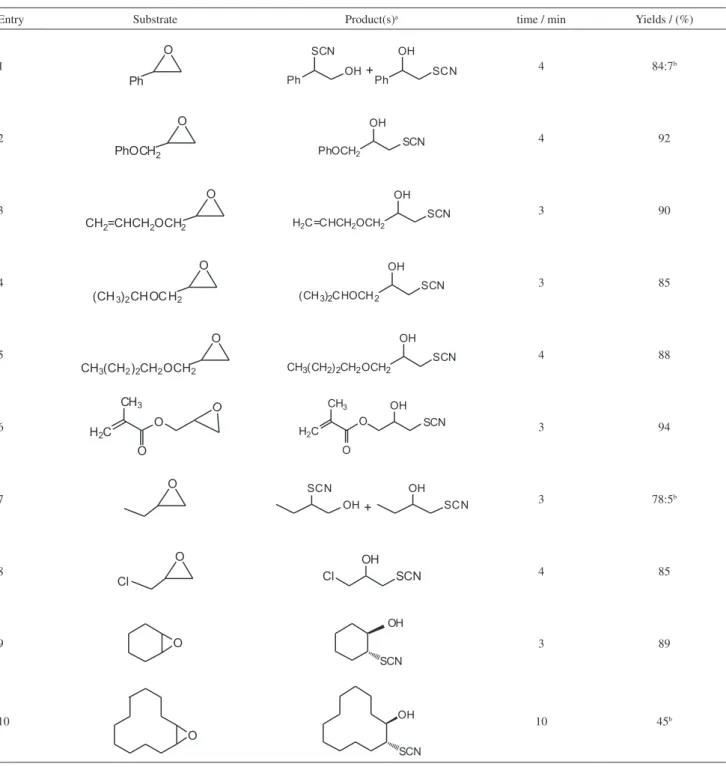
To ascertain the scope and limitation of the present reaction, several epoxides were examined; these results are summarized in Table 2. Except for the reactions of styrene oxide (entry 1) and 1,2-epoxybutane (entry 7) which produced a small percentage of the other regioisomer, the reactions of the epoxides were found to be highly regioselective and only one isomer was obtained. Also in the case of cyclic epoxides (Table 2, entries 9, 10), trans products were obtained. Obviously, the regioselectivity of the ring opening of epoxides is thoroughly dependent on the mechanism of the reaction and particularly on steric and electronic factors. As shown in Table 2, for epoxides carrying electron withdrawing groups, it is the steric factor which predominates and the nucleophilic attack of thiocyanate anion is strongly favored on the primary carbon atom of epoxides. In contrary, for epoxides carrying electron donating groups, the electronic factor predominates and the nucleophilic attack of thiocyanate anion is strongly favored on the secondary carbon atom of epoxides.
By comparison, numbers of methods for the conversion of epoxides to the corresponding thiocyanohydrins are
Scheme 1.
Scheme 2.
Table 1. Consideration of different conditions for thiocyanation of phenyl glycidyl ether
No. Solvent NH4SCN/mmol B(HSO4)3/mmol Condition time/min Conversion/(%) Yields/(%)
thiocyanohydrin thiirane
1 Et2O 3 0.5 r.t. 240 50 45
-2 CH2Cl2 3 0.5 r.t. 240 60 35 20
3 CH3CN 3 0.5 r.t. 240 50 45
-4 H2O 3 0.5 r.t. 180 100 75
-5 H2O 3 0.5 reflux 60 100 50 (30)a
-6 - 1.5 0.3 grinding 4 100 92
-7 - 1.5 - grinding 10 100 - 80
Kiasat and Fallah-Mehrjardi 1597 Vol. 19, No. 8, 2008
Table 2. Conversion of epoxides to thiocyanohydrins by using B(HSO4)3 under solvent-free conditions
Entry Substrate Product(s)a time / min Yields / (%)
1 4 84:7b
2 4 92
3 3 90
4 3 85
5 4 88
6 3 94
7 3 78:5b
8 4 85
9 3 89
10 10 45b
aProducts were identified by compared of their physical and spectral data with those of authentic samples. bAccording to GC analysis.
given in Table 3. As shown in Table 3, our procedure has higher regioselectivity and shorter reaction time than other methods.
Conclusions
We describe a novel and efficient method for the synthesis of β-hydroxy thiocyanates by the regioselective
B(HSO4)3: a Novel and Efficient Solid Acid Catalyst J. Braz. Chem. Soc. 1598
Experimental
General
Epoxides and other chemicals were purchased from Fluka and Merck in high purity. All of the thiocyanohydrin compounds were prepared by our procedure, and their spectroscopic and physical data were compared with those of authentic samples. IR spectra were recorded on a BOMEM MB-Series 1998 FT-IR spectrophotometer. 1H
and 13C NMR spectra were recorded in CDCl
3 on a Bruker
Advanced DPX 400 MHz spectrometer using TMS as internal standard. The purity determination of the products and reaction monitoring were accomplished by TLC on silica gel polygram SILG/UV 254 plates.
Preparation of boron sulfonic acid
A 50 mL suction flask was equipped with a constant pressure dropping funnel. The gas outlet was connected to a vacuum system through an adsorbing solution (water) and an alkali trap. Boric acid (1.55 g, 25 mmol) was charged in the flask and chlorosulfonic acid (8.74 g, ca. 5 mL, 75 mmol) was added dropwise over a period of 1 h at room temperature. HCl evolved immediately. After completion of the addition, the mixture was shaken for 1 h, while the residual HCl was eliminated by suction. Then the mixture was washed with diethyl ether to remove the unreacted chlorosulfonic acid. Finally, a grayish solid material was obtained in 93% yield (7.0 g).
General procedure for the preparation of β-hydroxy thiocyanates
In a mortar, a mixture of epoxide (1 mmol), NH4SCN (1.5 mmol), B(HSO4)3 (0.3 mmol) and silica gel (0.5 g) was pulverized for the time specified in the Table 2. The reaction progress was followed by TLC. After completion of the reaction, ethyl acetate was added and the heterogeneous mixture was filtered. Then, the filtrate washed with water (2×10 mL). The organic layer was separated and dried over anhydrous Na2SO4. After evaporation of solvent under reduced pressure, the desired thiocyanohydrins were obtained in high isolated yields. For styrene oxide and 1,2-epoxybutane, further purification were achieved by preparative TLC or by silica gel column chromatography.
Selected spectroscopic data
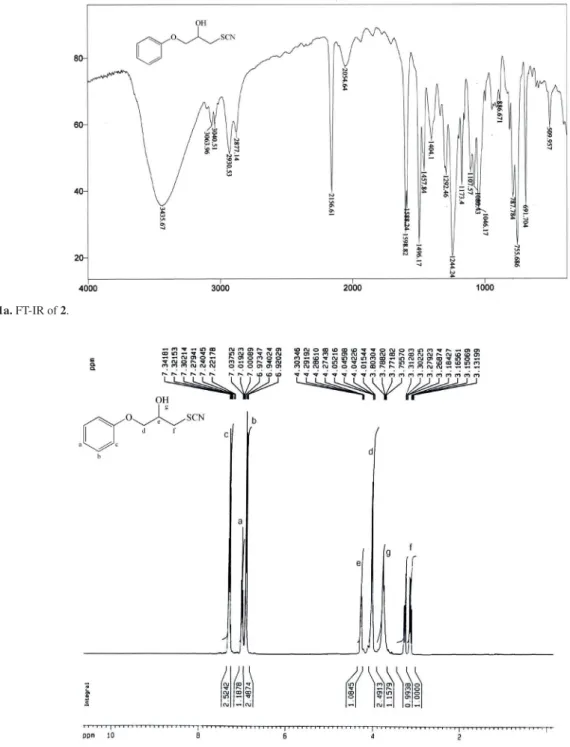
3-Phenoxy-2-hydroxypropyl thiocyanate(2)14
IR νmax/cm−1: 2157 (SCN); 1H-NMR (CDCl
3, 400 MHz):
d 3.30 (2H, d, CH2SCN), 3.78 (1H, s, OH), 4.15 (2H, d, OCH2), 4.29 (1H, m, CHOH), 6.95 (2H, m, Ar-H), 7.02 (1H, m, Ar-H), 7.28 (2H, m, Ar-H); 13C-NMR (CDCl
3,
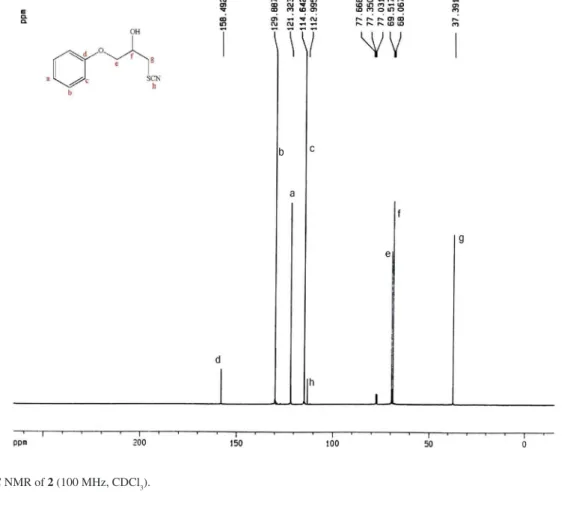
100 MHz): d 37.4 (CH2SCN), 68.1 (CHOH), 69.5 (OCH2), 113.0 (SCN), 114.6 (o-CH), 121.3 (p-CH), 129.9 (m-CH), 158.5 (C).
3-Allyloxy-2-hydroxypropyl thiocyanate (3)14
IR νmax/cm−1: 2156 (SCN); 1H-NMR (CDCl
3, 400 MHz):
d 3.04 (1H, s, OH), 3.24 (2H, d, CH2SCN), 3.53 (2H, d, OCH2), 4.05 (3H, m, OCH2CHOH), 5.19-5.29 (2H, m,
Table 3. Comparison of thiocyanation of styrene oxide with different methods
Entry Reagents and reaction conditions Reaction time / min α attacka β attackb Yield / (%)
1 B(HSO4)3 / NH4SCN / solvent-freec 4 92 8 91
2 DDQ / NH4SCN / CH3CN / reflux5 50 89 11 91
3 Ti(OPri)
4/ NH4SCN / THF / reflux
7 240 - - 30
4 PTC / NH4SCN / CH3CN / r.t.9 90 90 10 90
5 T(4-OH P)P / NH4SCN / CH3CN / reflux10 20 - - 96
6 BABMB/ NH4SCN / CH3CN / reflux11 10 20 80 91
7 CoIIT(p-OHP)P / NH
4SCN / N2 / CH3CN / reflux
14 25 17 83 96
8 [PTPPCl2]Cl/ NH4SCN / N2 / CH3CN / reflux15 22 20 80 96
9 Selectfluor / NH4SCN / CH3CN / r.t.16 150 17 83 95
10 Pd(PPh3)4 / NH4SCN / N2 / THF / reflux12 120 thiirane 35
11 BABMB / KSCN / CH3CN / reflux11 120 “ 10
12 ZnCl2/ KSCN / THF / reflux17 180 “ 60
Kiasat and Fallah-Mehrjardi 1599 Vol. 19, No. 8, 2008
=CH2), 5.87 (1H, m, =CH); 13C-NMR (CDCl
3, 100 MHz): d
37.3 (CH2SCN), 69.2 (CH2O), 71.1 (CHOH), 71.6 (OCH2), 113.1 (SCN), 117.5 (CH2=), 133.7 (=CH).
2-Hydroxy-3-thiocyanatopropyl methacrylate (6)12
IR νmax/cm−1: 2157(SCN); 1H-NMR (CDCl
3, 400 MHz):
d 1.85 (3H, m, CH3), 3.01-3.18 (2H, d, CH2SCN), 3.40 (1H, m, CHOH), 4.13 (1H, s, OH), 4.15 (2H, d, OCH2), 5.56 (1H, m, =CH2), 6.07 (1H, m, =CH2); 13C-NMR (CDCl
3,
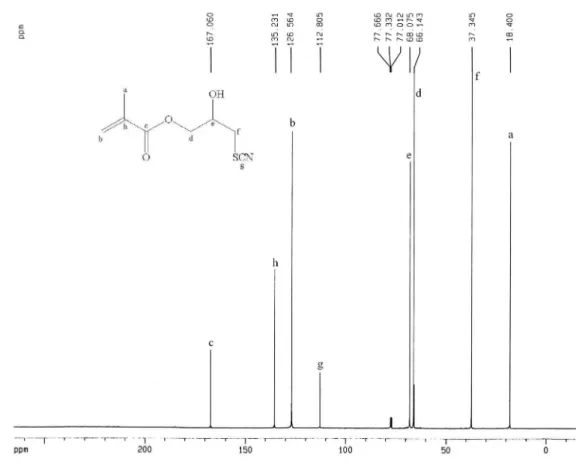
100 MHz): d 18.4 (CH3), 37.3 (CH2SCN), 66.1 (OCH2), 68.1 (CHOH), 112.8 (SCN), 126.6 (CH2=), 135.2 (=CH), 167.1 (C=O).
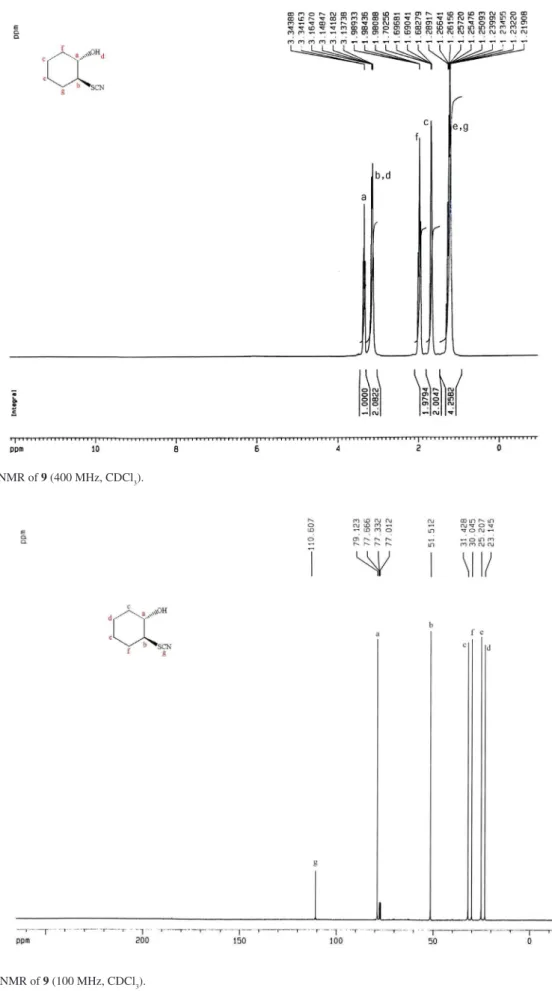
2-Hydroxycyclohexyl thiocyanate (9)9,14
IR νmax/cm−1: 2152 (SCN); 1H-NMR (CDCl 3, 400
MHz): d 1.21-1.29 (4H, m, CH2CH2CHSCN), 1.69 (2H, m, CH2CH2CHOH), 1.98 (2H, m, CH2CHOH), 3.14 (1H, s, OH), 3.16 (1H, m, CHSCN), 3.34 (1H, m, CHOH).
13C-NMR (CDCl
3, 100 MHz): d 23.1 (CH2CH2), 25.2
(CH2CH2), 30.0 (CH2CHSCN), 31.4 (CH2CHOH), 51.5 (CHSCN), 79.1 (CHOH), 110.6 (SCN).
Acknowledgments
The authors are thankful to the Shahid Chamran University Research Council for financial support of this work.
Supplementary Information
Supplementary data are available free of charge at http:// jbcs.sbq.org.br, as PDF file.
References
1. Mirjalili, B. F.; Zolfigol, M. A.; Bamoniri, A.; Hazar, A.; J. Braz. Chem. Soc.2005, 16, 877; Kiasat, A. R.; Kazemi, F.; Mehrjardi, M. F.; J. Chin. Chem. Soc.2007, 54, 1337; Kiasat, A. R.; Kazemi, F.; Mehrjardi, M. F.; Asian J. Chem.2005, 17, 2830.
2. Salehi, P.; Zolfigol, M. A.; Shirini, F.; Baghbanzadeh, M.; Curr. Org. Chem. 2006, 10, 2171; Salehi, P.; Dabiri, M.; Zolfigol, M. A. ; Fard, M. A. B.; J. Braz. Chem. Soc.2004, 15, 773. 3. Sander, M.; Chem. Rev. 1966, 66,297; Tamami, B.; Kiasat, A.
R.; Synth. Commun.1996, 26, 3953; Kiasat, A. R.; Kazemi, F.; Mehrjardi, M. F.; Phosphorus, Sulfur Silicon Relat. Elem. 2004, 179, 1841.
4. Vedejs, E.; Krafft, G. A.; Tetrahedron1982, 38, 2857. 5. Iranpoor, N.; Kohmareh, G. A.; Phosphorus, Sulfur Silicon
Relat. Elem. 1999, 152, 135.
6. Choudary, B. M.; Shobha, S.; Kantam, M. L.; Synth. Commun. 1990, 20, 2313.
7. Najera, C.; Sansano, J. M.; Tetrahedron1991, 47, 5193. 8. Tanabe, Y.; Mori, K.; Yoshida, Y.; J. Chem. Soc., Perkin Trans.
11997, 671.
9. Tamami, B.; Mahdavi, H.; Tetrahedron Lett.2002, 43, 6225. 10. Sharghi, H.; Nasseri, M. A.; Hasani Nejad, A.; J. Mol. Catal.
A: Chem.2003, 206, 53.
11. Niknam, K.; Phosphorus, Sulfur Silicon Relat. Elem. 2004, 179, 499.
12. Kiasat, A. R.; Mehrjardi, M. F.; Catal. Commun.2008, 9, 1497.
13. Kiasat, A. R.; Zayadi, M.; Mehrjardi, M. F.; Chin. Chem. Lett. 2008, 19, 665.
14. Sharghi, H.; Nejad, A. H.; Nasseri, M. A.; New J. Chem. 2004, 28, 946.
15. Sharghi, H.; Nejad, A. H.; Phosphorus, Sulfur Silicon Relat. Elem. 2004, 179, 2297.
16. Yadav, J. S.; Reddy, B. V. S.; Reddy, C.-S.; Tetrahedron Lett. 2004, 45, 1291.
17. Olszewski, A.; Gros, P.; Fort, Y.; Tetrahedron Lett.1997, 38, 8699.
Received: June 16, 2008
Supplementary Information
J. Braz. Chem. Soc., Vol. 19, No. 8, S1-S6, 2008. Printed in Brazil - ©2008 Sociedade Brasileira de Química 0103 - 5053 $6.00+0.00
*e-mail: [email protected]
B(HSO
4)
3: A Novel and Efficient Solid Acid Catalyst for the Regioselective Conversion of
Epoxides to Thiocyanohydrins under Solvent-Free Conditions
Ali Reza Kiasat* and Mehdi Fallah-Mehrjardi
Department of Chemistry, Faculty of Sciences, Shahid Chamran University, Ahvaz 61357-4-3169, Iran
Figure S1b.1H NMR of 2 (400 MHz, CDCl 3).
B(HSO4)3: A Novel and Efficient Solid Acid Catalyst J. Braz. Chem. Soc. S2
Figure S2a. FT-IR of 3.
Kiasat and Fallah-Mehrjardi S3 Vol. 19, No. 8, 2008
Figure S2c.13C NMR of 3 (100 MHz, CDCl 3).
B(HSO4)3: A Novel and Efficient Solid Acid Catalyst J. Braz. Chem. Soc. S4
Figure S3b.1H NMR of 6 (400 MHz, CDCl 3).
Kiasat and Fallah-Mehrjardi S5 Vol. 19, No. 8, 2008
Figure S4a. FT-IR of 9.
B(HSO4)3: A Novel and Efficient Solid Acid Catalyst J. Braz. Chem. Soc. S6
Figure S4c.13C NMR of 9 (100 MHz, CDCl 3).