
Article
J. Braz. Chem. Soc., Vol. 20, No. 3, 482-487, 2009. Printed in Brazil - ©2009 Sociedade Brasileira de Química 0103 - 5053 $6.00+0.00
*e-mail: [email protected]; [email protected]
Catalyst- and Solvent-free Synthesis of Imidazo[1,2-
a
]pyridines
Dong-Jian Zhu,a Jiu-Xi Chen,*,a Miao-Chang Liu,a Jin-Chang Dinga,b and Hua-Yue Wu*,a
aCollege of Chemistry and Materials Engineering, Wenzhou University, Wenzhou, 325027, China
bWenzhou Vocational and Technical College, Wenzhou, 325035, China
Um método altamente eficiente e simples foi descrito para a síntese de imidazo[1,2-a]piridinas
pela condensação de α-halocetonas (ArCOCHXR2, Ar = C
6H5, 4-MeOC6H4, 4-ClC6H4, 2,4-Cl2C6H3;
X = Br, Cl; R2 = H, CH
3) com 2-aminopiridinas, apresentando rendimentos entre bons a excelentes
sem a necessidade de adição de catalisador e solvente.
A highly efficient and facile method has been described for the synthesis of imidazo[1,2-a]
pyridines in good to excellent yields by condensation of the α-haloketones (ArCOCHXR2, Ar =
C6H5, 4-MeOC6H4, 4-ClC6H4, 2,4-Cl2C6H3; X = Br, Cl; R
2 = H, CH
3) with 2-aminopyridines without
the use of any additional catalyst and solvent.
Keywords: imidazo[1,2-a]pyridines, α-haloketones, 2-aminopyridines, catalyst-free, solvent-free
Introduction
It has long been known that imidazo[1,2-a]pyridine derivatives exhibit diverse biological activities1 and were
used as antiviral,2 antiulcer,3 antibacterial,4 antifungal,5
antiprotozoal,6 antiherpes,7 anti-inflammatory.8 Recently,
Leopoldo et al.9 reported synthetic approaches leading to
4-[ω-[4-arylpiperazin-1-yl]alkoxy]phenyl) imidazo[1,2-a] pyridine derivatives (Figure 1, I), which were described as fluorescent high-affinity dopamine D3 receptor ligands as potential probes for receptor visualization, and the fluorescent moiety compound 2-(4-methoxyphenyl) imidazo[1,2-a]pyridine (Figure 1, II), which is characterized by the 2-phenylimidazo[1,2-a]pyridine moiety, presented an oxygen that can be easily functionalized to afford potential D3 receptor ligands structurally related to the D3 receptor ligands.10 The majority of reported imidazo[1,2-a]pyridines
syntheses proceeded from the condensation reaction of the α-bromocarbonyl compounds with 2-aminopyridine derivative under neutral11 or weak basic conditions.12
A mechanism for the reaction has been proposed,13
which includes the nucleophilic substitution of the bromide by the pyridine-nitrogen in the 2-aminopyridine derivative. Imidazo[1,2-a]pyridine derivatives were also synthesized by solid support14 and using catalyst such
as Al2O315 and TiCl
4.
16 Other methodologies included
treating 2-aminopyridines with α-tosyloxyketones,17 a
polymer supported [hydroxy(sulfonyloxy)iodo]benzene with ketones or alcohols,18 alkynyl(phenyl)iodonium
salts,19 α-diazoketones,20 and propargyl bromide.21
Although these methods are suitable for certain synthetic conditions sometimes, however, some of these procedures are associated with one or more disadvantages such as hazardous organic solvents, high cost, long reaction time, low yield, use of stoichiometric and even excess amounts of reagents or catalysts, special apparatus and drastic reaction conditions, which leaves scope for further development of new environmentally clean syntheses.
As the increase in environmental consciousness chemical research and industry,22 the challenge for a
sustainable environment calls for clean procedures that can avoid using harmful organic solvents, or even better, do not
Zhu et al. 483 Vol. 20, No. 3, 2009
need solvent at all. In continuation of our interest in green chemistry,23 we herein wish to report the neat reaction of
2-aminopyridine with α-haloketones under catalyst- and solvent-free conditions, affording imidazo[1,2-a]pyridine derivatives in good to excellent yields.
Results and Discussion
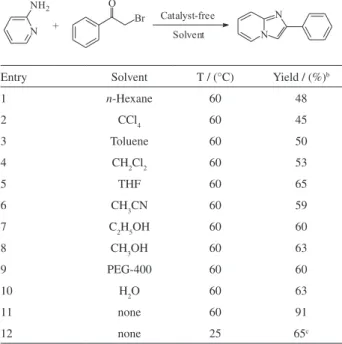
To optimize the reaction conditions, initial studies were concentrated on reactions of the α-bromoacetophenone with 2-aminopyridine as a model reaction. After careful screening, to our delight, the reaction occurred for 20 min affording 2-phenylimidazo[1,2-a]pyridine (3a) in 91% yield at 60 oC in the absence of catalyst and solvent
(Table 1, entry 11). It was observed that the mixture was initially in a solid state, and then turned to liquid state during the process of stirring, finally solidified to a light yellow solid mass.
Encouraged by this result, we further carried out comparative reactions to optimize the reaction conditions. The results are summarized in Table 1. When the reaction was carried out at room temperature in the absence of catalyst and solvent, only 65% yield was obtained, even when the reaction time was prolonged to 24 h (Table 1, entry 12). The nonpolar solvents, such as n-hexane, toluene, CCl4 gave lower yields under similar reaction conditions (Table 1, entries 1-3). The polar aprotic
solvents (CH2Cl2, THF and CH3CN) also afforded comparatively lower yields (Table 1, entries 4-6). The polar protic solvents (C2H5OH, CH3OH, PEG-400 and H2O) still gave comparatively lower conversions (Table 1, entries 7-10). It is remarkable that the reaction carried out at 60 oC in the absence of catalyst and solvent afforded
3a in excellent yield (91%), which is significantly higher than those obtained for the nonpolar or polar solvents. The structure of 3a was characterized by 1H NMR, 13C NMR,
IR and by comparison with authentic samples prepared by literature procedure. The 1H NMR spectra of 3a shows
a characteristic peak at d 7.87 ppm corresponding to the hydrogen of imidazole ring, whereas in the 13C NMR
spectrum, the peak appearing of d 108.1, 145.7 and 145.8 ppm corresponds to C-3, C-2 and C-9, respectively, of the imidazole ring. And in the IR spectrum, the structure of 3a showed C=N stretching peak at 1625 cm-1.
With the optimized conditions in hand, the reactions of different 2-aminopyridines with various α-haloketones were examined to explore the scope and generality of this present protocol for the synthesis of various imidazo[1,2-a] pyridines (Table 2). As expected, the reaction proceeded smoothly with yields ranging from good to excellent and tolerated various functional groups such as chloro, methyl and methoxy groups.
As shown in Table 2, the α-bromoacetophenone with electron-rich functionality as well as electron-poor functionality undergoes condensation reaction with 2-aminopyridine or substituted 2-aminopyridine equally well to afford the corresponding products in good to excellent yields. Even when employing the hindered α-methylphenacyl bromide and 2-aminopyridine or 2-amino-5-methylpyridine, good yields (Table 2, entries 10-11, 70% and 64%, respectively) were also obtained after slightly prolonging the reaction time to 60 min. Nevertheless, 2-aminopyridine with electron-withdrawing substituted group chloro is less nucleophilic and more slowly than electron-neutral or donating analogues.
Encouraged by our success, we screened a few reactions of the commercially available and deactivated α-chloroketone with 2-aminopyridine or 2-amino-5-methylpyridine. To our delight, when employing α-chloroacetophenone and 2-aminopyridine or 2-amino-5-methylpyridine, excellent yields (Table 2, entries 12-13, 83% and 88%, respectively) were obtained after slightly prolonging the reaction time to 80 min and 40 min, respectively. Furthermore, the para- and ortho-substituted 2,2’,4’-trichloroacetophenone with 2-aminopyridine or 2-amino-5-methylpyridine also can afford the corresponding products 3l and 3m in 75% and 65% yields, respectively (Table 2, entries 14-15).
Table 1. The condensation of 2-aminopyridine with α-bromoacetophenone under different reaction conditionsa
Entry Solvent T / (°C) Yield / (%)b
1 n-Hexane 60 48
2 CCl4 60 45
3 Toluene 60 50
4 CH2Cl2 60 53
5 THF 60 65
6 CH3CN 60 59
7 C2H5OH 60 60
8 CH3OH 60 63
9 PEG-400 60 60
10 H2O 60 63
11 none 60 91
12 none 25 65c
aReaction conditions: α-bromoacetophenone (1.0 mmol), 2-aminopyridine
(1.0 mmol), solvent (1 mL) at 60 oC for 20 min. bIsolated yield. cThe
Catalyst- and Solvent-free Synthesis of Imidazo[1,2-a]pyridines J. Braz. Chem. Soc. 484
In summary, we have described a simple, highly efficient, and facile procedure for the synthesis of imidazo[1,2-a] pyridine derivatives from the readily available starting materials. To the best of our knowledge, this is the first report catalyst-free synthesis of imidazo[1,2-a]pyridines in the absence of solvent under mild conditions. The procedure offers simple experimental procedure, short reaction time, catalyst-free, solvent free, low cost, efficient yield and mild reaction conditions, which makes this method a useful and attractive strategy in view of economic and environmental advantages. Currently, studies on the extension of this protocol are ongoing in our laboratory.
Experimental
All reagents were commercial available and used without any purification. Melting points were recorded on Digital Melting Point Apparatus WRS-1B and are uncorrected. IR spectra were recorded on a Bruker-EQUINOX55 spectrometer. Mass spectra (EI, 70 ev) were measured with SHIMADZU GCMS-QP2010 Plus. 1H NMR and 13C NMR
spectra were recorded on a Brucker AC 300 instrument using CDCl3 as the solvent with tetramethylsilane (TMS) as an internal standard at room temperature. Chemical shifts were given in d relative to TMS, the coupling constants J are
given in Hz. Elemental analysis was determined on a Carlo-Erba 1108 instrument. All reactions were conducted using standard Schlenk techniques. Column chromatography was performed using EM Silica gel 60 (300-400 mesh).
General procedure for the preparation of pyrazoles
A mixture of α-haloketone 2 (1.0 mmol), 2-aminopyridine or substituted 2-aminopyridine 1 (1.0 mmol) was stirred at 60 oC under vigorous magnetic stirring for the specified
time as mentioned in Table 2. The progress of the reaction was monitored by TLC. After completion of the reaction, the product was washed with dehydrated alcohol or ethyl acetate (3 × 10 mL). The combined organic solvent was removed under vacuum to obtain the crude solid product. The crude product was further purified by silica gel column chromatography using ethyl acetate-petroleum ether (1:3) as eluent to afford the pure product 3.
The spectral and analytical data of all compounds are given below.
2-Phenylimidazo[1,2-a]pyridine (3a)
White solid, mp 136-137 oC (lit. 131-133 oC);201H NMR
(300 MHz, CDCl3) d (ppm) 8.12 (dd, J 1.04, 1.03, 1H), 7.98-7.96 (m, 2H), 7.88 (s, 1H), 7.64 (d, J 9.14, 1H), 7.45
Table 2. Synthesis of imidazo[1,2-a]pyridinepyrazoles under catalyst- and solvent-free conditionsa
Entry α-Haloketone R1 time / min Product Yield / (%)b mp / oC
Ar X R2
1 C6H5 Br H H 20 3a 91 136-137
2 C6H5 Br H CH3 5 3b 92 171-173
3 C6H5 Br H Cl 15 3c 90 204-206
4 p-MeOC6H4 Br H H 10 3d 95 135-136
5 p-MeOC6H4 Br H CH3 5 3e 93 179-181
6 p-MeOC6H4 Br H Cl 25 3f 80 234-236
7 p-ClC6H4 Br H H 15 3g 95 207-209
8 p-ClC6H4 Br H CH3 5 3h 91 239-240
9 p-ClC6H4 Br H Cl 130 3i 75 205-207
10 C6H5 Br CH3 H 60 3j 70 159-161
11 C6H5 Br CH3 CH3 60 3k 64 114-116
12 C6H5 Cl H H 80 3a 83 136-137
13 C6H5 Cl H CH3 40 3b 88 171-173
14 2,4-Cl2C6H3 Cl H H 50 3l 75 181-182
15 2,4-Cl2C6H3 Cl H CH3 50 3m 65 135-136
Zhu et al. 485 Vol. 20, No. 3, 2009
(t, J 7.22, 2H), 7.35 (d, J 7.33, 1H), 7.20-7.17 (m, 1H), 6.79 (d, J 6.78, 1H); 13C NMR (75 MHz, CDCl
3) d (ppm) 145.8,
145.7, 133.8, 128.7, 127.9, 126.0, 125.6, 124.6, 117.5, 112.4, 108.1. IR (KBr) νmax/cm
-1: 2925, 2857, 1738, 1625,
1511, 1460, 1383, 1269, 1201, 1122, 1081, 1040, 744, 688, 458. MS (ESI): m/z (%) 195 ([M+H]+, 100).
6-Methyl-2-phenylimidazo[1,2-a]pyridine (3b)
White solid, mp 171-173 oC (lit. 172-174 oC);241H NMR
(300 MHz, CDCl3) d (ppm) 7.95 (d, J 7.05, 2H), 7.83 (s, 1H), 7.73 (s, 1H), 7.53 (d, J 9.09, 1H), 7.44 (t, J 6.63, 2H), 7.33 (d, J 6.44, 1H), 7.00 (d, J 8.82, 1H), 2.29 (s, 3H, CH3); 13C NMR (75 MHz, CDCl
3) d (ppm) 145.4, 144.7,
133.9, 128.7, 127.84, 127.78, 125.9, 123.3, 122.0, 116.7, 107.9, 18.0; IR (KBr) νmax/cm-1: 2921, 1628, 1525, 1471,
1418, 1342, 1259, 1206, 1159, 1079, 846, 805, 768, 715, 685, 571, 506.
6-Chloro-2-phenylimidazo[1,2-a]pyridine (3c)
White solid, mp 204-206 oC (lit. 204-207 oC);25 1H
NMR (300 MHz, CDCl3) d (ppm) 8.15 (s, 1H), 7.94 (d, J 7.25, 2H), 7.82 (s, 1H), 7.57 (d, J 9.12, 1H), 7.51-7.38 (m, 2H), 7.34 (d, J 7.19, 1H), 7.14 (d, J 9.41, 1H); 13C NMR
(75 MHz, CDCl3) d (ppm) 146.9, 144.1, 133.3, 128.8, 128.3, 126.1, 126.0, 123.4, 120.5, 117.9, 108.5; IR (KBr) νmax/cm
-1: 2976, 2925, 1635, 1512, 1473, 1425, 1387, 1332,
1241, 1206, 1133, 1074, 938, 809, 772, 719, 506.
2-(4-Methoxyphenyl)imidazo[1,2-a]pyridine (3d)
White solid, mp 135-136 oC (lit. 133-134 oC);171H NMR
(300 MHz, CDCl3) d (ppm) 8.09 (d, J 6.77, 1H), 7.89 (dd, J 1.95, 1.94, 2H), 7.77 (s, 1H), 7.61 (d, J 9.08, 1H), 7.17-7.15 (m, 1H), 6.97 (dd, J 1.97, 1.94, 2H), 6.76 (dd, J 0.82, 0.81, 1H), 3.85 (s, 3H, OCH3); 13C NMR (75 MHz, CDCl
3)
d (ppm) 159.6, 145.64, 145.57, 127.3, 126.4, 125.4, 124.5, 117.2, 114.1, 112.3, 107.2, 55.3; IR (KBr) νmax/cm
-1: 2961,
2838, 1612, 1548, 1482, 1371, 1285, 1244, 1175, 1110, 1077, 1030, 924, 838, 743, 631, 536, 446.
2-(4-Methoxyphenyl)-6-methylimidazo[1,2-a]pyridine (3e) White solid, mp 179-181 oC; 1H NMR (300 MHz,
CDCl3) d (ppm) 7.88 (d, J 2.26, 2H), 7.86 (d, J 2.11, 1H), 7.68 (s, 1H), 7.51 (d, J 9.48, 1H), 7.01 (d, J 1.57, 2H), 6.96 (dd, J 2.10, 2.06, 1H), 3.85 (s, 3H, OCH3), 2.31 (s, 3H, CH3); 13C NMR (75 MHz, CDCl
3) d (ppm) 159.5, 145.3,
144.6, 127.7, 127.2, 126.6, 123.3, 121.9, 116.5, 114.1, 107.0, 55.3, 18.1; IR (KBr) νmax/cm-1: 2926, 1612, 1546,
1483, 1413, 1341, 1301, 1246, 1174, 1103, 1023, 839, 794, 744, 710, 591, 528; MS (ESI): m/z (%), 239 ([M+H]+, 100);
Anal. calc. for C15H14N2O: C, 75.61; H, 5.92; N, 11.76. Found: C, 75.63; H, 5.90; N, 11.78.
6-Chloro-2-(4-methoxyphenyl)imidazo[1,2-a]pyridine (3f) White solid, mp 234-236 oC (lit. 227-228 oC);261H NMR
(300 MHz, CDCl3) d (ppm) 8.16-8.15 (m, 1H), 7.88 (dd, J 2.05, 2.04, 2H), 7.75 (s, 1H), 7.56 (d, J 9.54, 1H), 7.13 (dd, J 1.99, 1.96, 1H), 6.99 (dd, J 2.00, 2.01, 2H), 3.87 (s, 3H, OCH3); 13C NMR (75 MHz, CDCl
3) d (ppm) 160.1, 147.1,
144.2, 127.6, 126.3, 126.0, 123.4, 120.5, 117.8, 114.4, 107.8, 55.5. IR (KBr) νmax/cm-1: 2995, 1610, 1551, 1487, 1371,
1305, 1250, 1176, 1108, 1070, 1030, 933, 841, 803, 742, 705, 575, 524; MS (ESI): m/z (%), 259 ([M+H]+, 100).
2-(4-Chlorophenyl)imidazo[1,2-a]pyridine (3g)
White solid, mp 207-209 oC (lit. 201 oC);181H NMR (300
MHz, CDCl3) d (ppm) 8.09 (d, J 6.78, 1H), 7.87 (d, J 8.52, 2H), 7.82 (s, 1H), 7.61 (d, J 9.15, 1H), 7.39 (d, J 8.52, 2H), 7.17 (t, J 7.17, 1H), 6.77 (t, J 6.60, 1H); 13C NMR (75 MHz, CDCl
3)
d (ppm) 145.7, 144.6, 133.6, 132.3, 128.9, 127.2, 125.6, 124.9, 117.5, 112.6, 108.2; IR (KBr) νmax/cm-1: 2917, 1632, 1471,
1369, 1250, 1202, 1089, 1009, 933, 830, 742, 598, 510.
2-(4-Chlorophenyl)-6-methylimidazo[1,2-a]pyridine (3h) White solid, mp 239-240 oC (lit. 240-242 oC);151H NMR
(300 MHz, CDCl3) d (ppm) 7.89 (d, J 2.83, 2H), 7.88 (s, 1H), 7.75 (s, 1H), 7.54 (t, J 6.05, 1H), 7.39 (d, J 8.53, 2H), 7.05 (d, J 9.34, 1H), 2.33 (s, 3H, CH3); 13C NMR (75 MHz,
CDCl3) d (ppm) 144.8, 144.4, 133.5, 132.5, 128.9, 128.1, 127.1, 123.3, 122.3, 116.8, 107.9, 18.1; IR (KBr) νmax/cm-1:
2921, 1635, 1540, 1465, 1409, 1257, 1206, 1090, 1010, 944, 835, 803, 734, 511.
6-Chloro-2-(4-chlorophenyl)imidazo[1,2-a]pyridine (3i) White solid, mp 205-207 oC (lit. 209 oC);271H NMR
(300 MHz, CDCl3) d (ppm) 8.14-8.13 (m, 1H), 7.85 (dd, J 1.99, 1.97, 2H), 7.77 (s, 1H), 7.55 (d, J 9.57, 1H), 7.42-7.39 (m, 2H), 7.14 (dd, J 1.98, 1.97, 1H); 13C NMR (75 MHz,
CDCl3) d(ppm) 145.9, 144.3, 134.3, 132.0, 129.2, 127.5,
126.6, 123.6, 121.0, 118.1, 108.7; IR (KBr) νmax/cm-1: 3130,
1653, 1525, 1470, 1419, 1336, 1260, 1202, 1071, 1009, 935, 833, 799, 734, 511; MS (ESI): m/z (%), 263 ([M+H]+,
100), 265 ([M+2+H]+, 70), 267 ([M+4+H]+, 15).
3-Methyl-2-phenylimidazo[1,2-a]pyridine (3j)
Pale yellow solid, mp 159-161 oC (lit. 153-154 oC);17 1H NMR (300 MHz, CDCl
3) d (ppm) 7.88 (d, J 6.87, 1H),
7.82-7.78 (m, 2H), 7.64 (d, J 9.06, 1H), 7.49-7.44 (m, 2H), 7.36 (d, J 7.38, 1H), 7.17-7.16 (m, 1H), 6.84 (d, J 6.75, 1H), 2.63 (s, 3H, CH3); 13C NMR (75 MHz, CDCl
3) d (ppm)
144.3, 142.4, 134.9, 128.5, 128.3, 127.3, 123.5, 122.8, 117.4, 115.9, 112.0, 9.6; IR (KBr) νmax/cm-1: 3027, 1629,
Catalyst- and Solvent-free Synthesis of Imidazo[1,2-a]pyridines J. Braz. Chem. Soc. 486
3,6-Dimethyl-2-phenylimidazo[1,2-a]pyridine (3k) Pale yellow solid, mp 114-116 oC; 1H NMR (300 MHz,
CDCl3) d (ppm) 7.82-7.79 (m, 2H), 7.66 (s, 1H), 7.54 (d, J 9.16, 1H), 7.46 (t, J 7.36, 2H), 7.34 (t, J 7.49, 1H), 7.02 (d, J 9.17, 1H), 2.61 (s, 3H, CH3), 2.36 (s, 3H, CH3); 13C
NMR (75 MHz, CDCl3) d (ppm) 143.5, 142.3, 135.1, 128.5, 128.2, 127.2, 126.6, 121.5, 120.6, 116.8, 115.6, 18.4, 9.7; IR (KBr) νmax/cm
-1: 2920, 1634, 1496, 1447, 1388, 1332,
1261, 1188, 1127, 1043, 777, 699, 581, 507; MS (ESI): m/z (%), 223 ([M+H]+, 100); Anal. calc. for C
15H14N2: C, 81.05;
H, 6.35; N, 12.60. Found: C, 81.08; H, 6.34; N, 12.58.
2-(2,4-Dichlorophenyl)imidazo[1,2-a]pyridine (3l) Pale yellow solid, mp 181-182 oC; 1H NMR (300 MHz,
CDCl3) d (ppm) 8.28-8.26 (m, 2H), 8.14 (d, J 6.77, 1H), 7.62 (d, J 9.11, 1H), 7.49-7.48 (m, 1H), 7.36 (dd, J 2.01, 1.99, 1H), 7.23-7.18 (m, 1H), 6.81 (t, J 6.76, 1H); 13C NMR
(75 MHz, CDCl3)d (ppm) 144.5, 140.8, 133.6, 132.1, 131.7, 130.9, 130.0, 127.4, 125.8, 125.1, 117.6, 112.6, 112.4; IR (KBr) νmax/cm
-1: 3042, 1632, 1544, 1461, 1367,
1242, 1105, 1043, 931, 826, 749, 704, 623, 555; MS (ESI): m/z (%), 263 ([M+H]+, 100), 265 ([M+2+H]+, 70), 267
([M+4+H]+, 15); Anal. calc. for C
15H12Cl2N2: C, 61.87; H,
4.15; N, 9.62. Found: C, 61.88; H, 4.17; N, 9.59.
2-(2,4-Dichlorophenyl)-6-methylimidazo[1,2-a]pyridine (3m)
Pale yellow solid, mp 134-135 oC; 1H NMR (300 MHz,
CDCl3) d (ppm) 8.25 (d, J 8.55, 1H), 8.17 (s, 1H), 7.91 (s, 1H), 7.51 (d, J 9.33, 1H), 7.46 (d, J 2.13, 1H), 7.34 (dd, J 2.16, 2.07, 1H), 7.04 (dd, J 1.47, 1.50, 1H); 13C NMR
(75 MHz, CDCl3) d (ppm) 143.6, 140.5, 133.4, 132.0, 131.6, 131.1, 130.0, 128.3, 127.3, 123.4, 122.2, 116.8, 112.2, 18.1; IR (KBr) νmax/cm
-1: 2960, 1641, 1540, 1458,
1419, 1380, 1342, 1256, 1201, 1142, 1096, 1039, 938, 853, 793, 743, 700, 563, 461; MS (ESI): m/z (%), 277 ([M+H]+,
100), 279 ([M+2+H]+, 70), 281 ([M+4+H]+, 15); Anal.
calc. for C14H10Cl2N2: C, 60.67; H, 3.64; N, 10.11. Found: C, 60.69; H, 3.65; N, 10.09.
Acknowledgments
We are grateful to the National Key Technology R&D Program (No. 2007BAI34B00) and the Natural Science Foundation of Zhengjiang Province (No. Y4080107) for financial support.
Supplementary Information
Supplementary data are available free of charge at http:// jbcs.sbq.org.br, as PDF file.
References
1. Gudmundsson, K. S.; Johns, B. A.; Org. Lett.2003, 5, 1369; Enguehard, C.; Fauvelle, F.; Debouzy, J.; Peinnequin, A.; Thery, I.; Dabouis V.; Gueiffier, A.; Eur. J. Pharm. Sci. 2005, 24, 219; Hamdouchi, C.; Zhong, B.; Mendoza, J.; Collins, E.; Jaramillo, C.; Diego, J.; Robertson, D.; Spencer, C. D.; Anderson, B. D.; Watkins, S. A.; Zhang F.; Brooks, H. B.; Bioorg. Med. Chem. Lett.2005, 15, 1943.
2. Elhakmoui, A.; Gueiffier, A.; Milhavet, J. C.; Blache Y.; Chapat, J. P.; Bioorg. Med. Chem. Lett.1994, 4, 1937; Gueiffier, A.; Lhassani, M.; Elhakmoui, A.; Snoeck, R.; Andrei, G.; Chavignion, O.; Teulade, J. C.; Kerbal, A.; Essassi, M.; Debouzy, J. C.; Witurowo, J. P.; Blache, Y.; Balzarini, J.; De Clercq, E.; Chapat, J. P.; J. Med. Chem. 1996, 39, 2856; Gudmundsson, K. S.; Drach J. C.; Townsend, L. B.; J. Org. Chem.1997, 62, 3453; Pan, S.; Wang, G.; Shinazi, R. F.; Zhao, K.; Tetrahedron Lett. 1998, 39, 8191; Hamdouchi, C.; de Blas, J.; del Prado, M.; Gruber, J.; Heinz, B. A.; Vance,L.; J. Med. Chem. 1999, 42, 50; Gudmundsson, K. S.; Williams, J. D.; Drach, J. C.; Townsend, L.; B. J. Med. Chem. 2003, 46, 1449; Puerstinger, G.; Paeshuyse, J.; Declercq, E.; Neyts, J.; Bioorg. Med. Chem. Lett.2007, 17, 390.
3. Kaminsky, J. J.; Puchalski, C.; Solomon, D. M.; Rizvi, R. K.; Conn, D. J.; Elliot, A. J.; Lovey, R. G.; Guzik, H.; Chui, P. J. S.; Long, J. F.; McPhail, A. T.; J. Med. Chem.1989, 32, 1686; Kaesura, Y.; Nishino, S.; Inoue, Y.; Tomoi, M.; Taksugi, H.; Chem. Pharm. Bull. 1992, 40, 371; Kaminsky, J. J.; Doweyko, A. M.; J. Med. Chem.1997, 40, 427.
4. Rewankar, G. R.; Matthews, J. R.; Robins, R. K.; J. Med. Chem. 1975, 18, 1253; Rival, Y.; Grassy G.; Michel, G.; Chem. Pharm. Bull.1992, 40, 1170.
5. Fisher, M. H.; Lusi, A.; J. Med. Chem.1972, 15, 982; Rival, Y.; Grassy, G.; Taudou, A.; Ecalle,R.; Eur. J. Med. Chem. 1991, 26, 13.
6. Biftu, T.; Feng, D.; Fisher, M.; Liang, G. B.; Qian, X.; Scribner, A.; Dennis, R.; Lee, S.; Liberator, P. A.; Brown, C.; Gurnett, A.; Leavitt, P. S.; Thompson, D.; Mathew, J.; Misura, A.; Samaras, S.; Tamas, T.; Sina, J. F.; McNulty, K. A.; McKnight,C. G.; Bioorg. Med. Chem. Lett. 2006, 16, 2479; Ismail, M. A.; Arafa, R. K.; Wenzler, T.; Brun,R.; Tanious, F. A.; Wilson, W. D. Boykin, D. W.; Bioorg. Med. Chem.2008, 16, 683.
7. Gudmundsson, K. S.; Johns,B. A.; Bioorg. Med. Chem. Lett. 2007, 17, 2735.
8. Rupert, K. C.; Henry, J. R.; Dodd, J. H.; Wadsworth, S. A.; Cavender, D. E.; Olini, G. C.; Fahmy; B.; Siekierka, J. J.; Bioorg. Med. Chem. Lett. 2003, 13, 347.
9. Leopoldo, M.; Lacivita, E.; Passafiume, E.; Contino, M.; Colabufo, N. A.; Berardi, F.; Perrone, R.; J. Med. Chem. 2007, 50, 5043. 10. Wright, J.; Heffner, T.; Pugsley, T.; MacKenzie, R.; Wise, L.;
Zhu et al. 487 Vol. 20, No. 3, 2009
11. Burkholder, C.; Dolbier, Jr. W. R.; Médebielle, M.; Ait-Mohand, S.; Tetrahedron Lett. 2001, 42, 3077; Patel, H. S.; Linn, J. A.; Drewry, D. H.; Hillesheim, D. A.; Zuercher, W. J.; Hoekstra, W. J.; Tetrahedron Lett.2003, 44, 4077; Ismail, M. A.; Brun, R.; Wenzler, T.; Tanious, F. A.; Wilson, W. D.; Boykin, D. W.; J. Med. Chem. 2004, 47, 3658; DiMauro E. F.; Vitullo, J. R.; J. Org. Chem. 2006, 71, 3959; Sharma, S.; Saha, B.; Sawant, D.; Kundu, B.; J. Comb. Chem.2007, 9, 783.
12. Gudmundsson, K. S.; Johns, B. A.; Org. Lett. 2003, 5, 1369; Koubachi, J.; Kazzouli, S. E.; Berteina-Raboin, S.; Mouaddib A.; Guillaumet, G.; J. Org. Chem. 2007, 72, 7650; Takizawa, S.; Nishida, J.; Tsuzuki, T.; Tokito, S.; Yamashita, Y.; Inorg. Chem. 2007, 46, 4308.
13. Swakula, E.; Paudler, W.; Tetrahedron1982, 38, 49; Cai, L.; Chin, F. T.; Pike, V. W.; Toyama, H.; Liow, J. S.; Zoghbi, S. S.; Modell, K.; Briard, E.; Shetty, H. U.; Sinclair, K.; Donohue, S.; Tipre, D.; Kung, M. P.; Dagostin, C.; Widdowson, D. A.; Green, M.; Gao, W.; Herman, M. M.; Ichise, M.; Innis,R. B.; J. Med. Chem. 2004, 47, 2208.
14. Kazzouli, S. E.; Berteina-Raboin, S.; Mouaddib, A. Guillaumet, G.; Tetrahedron Lett.2003, 44, 6265.
15. Ponnala, S.; Kiran Kumar, S. T. V. S.; Bhat, B. A.; Sahu, D. P.; Synth. Commun.2005, 901.
16. Cai, L.; Brouwer, C.; Sinclair, K.; Cuevas, J.; Pike, V. W.; Synthesis 2006, 133.
17. Xie, Y. Y.; Chen, Z. C.; Zheng, Q. G.; Synthesis 2002, 1505. 18. Ueno, M.; Togo, H.; Synthesis 2004, 2673.
19. Liu, Z.; Chen, Z. C.; Zheng, Q. G.; Synth. Commun.2004, 361.
20. Yadav, J. S.; Reddy, B. V. S.; Rao, Y. G.; Srinivas, M.; Narsaiah, A. V.; Tetrahedron Lett.2007, 48, 7717.
21. B a k h e r a d , M . ; N a s r- I s fa h a n i , H . ; Ke iva n l o o , A . ; Doostmohammadi, N.; Tetrahedron Lett. 2008, 49, 3819. 22. Dupont, J.; Consorti, C. S.; Spencer. J.; J. Braz. Chem. Soc.
2000, 11, 337; Lenardao, E. J.; Freitag, R. A.; Dabdoub, M. J.; Batista, A. C. F.; Silveira, C. C.; Quim. Nova 2003, 26, 123; Perin, G.; Jacob, R. G.; Botteselle, G. V.; Kublik, E. L.; Lenardão, E. J.; Cella, R.; dos Santos, P. C. S.; J. Braz. Chem. Soc.2005, 16, 857.
23. Chen, J. X.; Wu, H. Y.; Zheng, Z. G.; Jin, C.; Zhang, X. X.; Su, W. K.; Tetrahedron Lett.2006, 47, 5383; Su, W. K.; Chen, J. X.; Wu, H. Y.; Jin, C.; J. Org. Chem.2007, 72, 4524; Chen, J. X.; Wu, D. Z.; He, F.; Liu M. C.; Wu H. Y.; Ding, J. C.; Su, W. K.; Tetrahedron Lett. 2008, 49, 3814; Chen, J. X.; Wu, H. Y.; Jin, C.; Zhang, X. X.; Xie, Y. Y.; Su, W. K.; Green Chem. 2006, 8, 330; Chen, X. A.; Zhang, C. F.; Wu, H. Y.; Yu, X. C.; Su, W. K.; Ding, J. C.; Synthesis2007, 20, 3233; Chen, J. X.; Su, W. K.; Wu, H. Y.; Liu, M. C.; Jin, C.; Green Chem.2007, 9, 972; Chen, J. X.; Liu, M. C.; Yang, X. L.; Ding, J. C.; Wu, H. Y.; J. Braz. Chem. Soc.2008, 19, 877; Xiong, W.; Chen, J. X.; Liu, M. C.; Ding, J. C.; Wu, H. Y.; Su, W. K.; J. Braz. Chem. Soc. 2009, 20, 367.
24. Mattu, F.; Marongiu, E.; Ann. Chim.1964,5, 496.
25. Tomoda, H.; Hirano, T.; Saito, S.; Mutai, T.; Araki, K.; Bull. Chem. Soc. Jpn.1999, 72, 1327.
26. Katritzky, A. R.; Qui, G.; Long, Q. H.; He, H. Y.; Steel, P. J.; J. Org. Chem. 2000, 65, 9201.
27. Buu-Hoi, N. P.; Xuong, N. D.; Suu, V. T.; J. Chem. Soc.1958, 2815.
Received: November 10, 2008
Supplementary Information
J. Braz. Chem. Soc., Vol. 20, No. 3, S1-S13, 2009. Printed in Brazil - ©2009 Sociedade Brasileira de Química 0103 - 5053 $6.00+0.00
*e-mail: [email protected]; [email protected]
Catalyst- and Solvent-free Synthesis of Imidazo[1,2-
a
]pyridines
Dong-Jian Zhu,a Jiu-Xi Chen,*,a Miao-Chang Liu,a Jin-Chang Ding,a,b and Hua-Yue Wu*,a
aCollege of Chemistry and Materials Engineering, Wenzhou University, Wenzhou, 325027, China
bWenzhou Vocational and Technical College, Wenzhou, 325035, P. R. China
Figure S1. 1H NMR of 3a (300 MHz, CDCl 3) and
Catalyst- and Solvent-free Synthesis of Imidazo[1,2-a]pyridines J. Braz. Chem. Soc. S2
Figure S2. 1H NMR of 3b (300 MHz, CDCl 3) and
Zhu et al. S3 Vol. 00, No. 00, 2009
Figure S3. 1H NMR of 3c (300 MHz, CDCl 3) and
Catalyst- and Solvent-free Synthesis of Imidazo[1,2-a]pyridines J. Braz. Chem. Soc. S4
Figure S4. 1H NMR of 3d (300 MHz, CDCl 3) and
Zhu et al. S5 Vol. 00, No. 00, 2009
Figure S5. 1H NMR of 3e (300 MHz, CDCl 3) and
Catalyst- and Solvent-free Synthesis of Imidazo[1,2-a]pyridines J. Braz. Chem. Soc. S6
Figure S6. 1H NMR of 3f (300 MHz, CDCl 3) and
Zhu et al. S7 Vol. 00, No. 00, 2009
Figure S7. 1H NMR of 3g (300 MHz, CDCl 3) and
Catalyst- and Solvent-free Synthesis of Imidazo[1,2-a]pyridines J. Braz. Chem. Soc. S8
Figure S8. 1H NMR of 3h (300 MHz, CDCl 3) and
Zhu et al. S9 Vol. 00, No. 00, 2009
Figure S9. 1H NMR of 3i (300 MHz, CDCl 3) and
Catalyst- and Solvent-free Synthesis of Imidazo[1,2-a]pyridines J. Braz. Chem. Soc. S10
Figure S10. 1H NMR of 3j (300 MHz, CDCl 3) and
Zhu et al. S11 Vol. 00, No. 00, 2009
Figure S11. 1H NMR of 3k (300 MHz, CDCl 3) and
Catalyst- and Solvent-free Synthesis of Imidazo[1,2-a]pyridines J. Braz. Chem. Soc. S12
Figure S12. 1H NMR of 3l (300 MHz, CDCl 3) and
Zhu et al. S13 Vol. 00, No. 00, 2009
Figure S13. 1H NMR of 3m (300 MHz, CDCl 3) and
![Table 2. Synthesis of imidazo[1,2-a]pyridinepyrazoles under catalyst- and solvent-free conditions a](https://thumb-eu.123doks.com/thumbv2/123dok_br/18993592.461489/3.892.74.798.131.581/table-synthesis-imidazo-pyridinepyrazoles-catalyst-solvent-free-conditions.webp)


