RBRH, Porto Alegre, v. 22, e11, 2017
Scientiic/Technical Article
http://dx.doi.org/10.1590/2318-0331.011716033
Reservoir yield intercomparison of large dams in
Jaguaribe Basin-CE in climate change scenarios
Intercomparação das vazões regularizadas de grandes reservatórios da bacia do Rio Jaguaribe-CE em cenários de mudanças climáticas
Renato de Oliveira Fernandes1,2, Cleiton da Silva Silveira3, Ticiana Marinho de Carvalho Studart1 and
Francisco de Assis de Souza Filho1
1Universidade Federal do Ceará, Fortaleza, CE, Brazil 2Universidade Regional do Cariri, Juazeiro do Norte, CE, Brazil
3Universidade da Integração Internacional da Lusofonia Afro-Brasileira, Redenção, CE, Brazil
E-mails: [email protected] (ROF), [email protected] (CSS), [email protected] (TMCS),
[email protected] (FASF)
Received: March 10, 2016 - Revised: August 17, 2016 - Accepted: September 26, 2016
ABSTRACT
Climate changes can have different impacts on water resources. Strategies to adapt to climate changes depend on impact studies. In this context, this study aimed to estimate the impact that changes in precipitation, projected by Global Circulation Models (GCMs) in the
ifth report by the Intergovernmental Panel on Climate Change (IPCC-AR5) may cause on reservoir yield (Q90) of large reservoirs (Castanhão and Banabuiú), located in the Jaguaribe River Basin, Ceará. The rainfall data are from 20 GCMs using two greenhouse
gas scenarios (RCP4.5 and RCP8.5). The precipitation projections were used as input data for the rainfall-runoff model (SMAP) and, after the reservoirs’ inlow generation, the reservoir yields were simulated in the AcquaNet model, for the time periods of 2040-2069
and 2070-2099. The results were analyzed and presented a great divergence, in sign (increase or decrease) and in the magnitude of
change of Q90. However, most Q90 projections indicated reduction in both reservoirs, for the two periods, especially at the end of
the 21th century.
Keywords: CMIP5; Reservoir yield; Coupling models.
RESUMO
As mudanças climáticas devem causar diversos impactos nos recursos hídricos. As estratégias de adaptação às alterações previstas no
clima dependem de estudos de impactos. Nesse contexto, esse trabalho tem como objetivo estimar os impactos que as alterações na precipitação, projetada pelos Modelos de Circulação Global (MCGs) do quinto relatório do Painel Intergovernamental de Mudanças Climáticas (IPCC-AR5), podem causar nas vazões regularizadas (Q90) de dois grandes reservatórios (Castanhão e Banabuiú) localizados
bacia do Rio Jaguaribe, Ceará. Os dados de precipitação são provenientes de 20 MCGs em dois cenários de emissão de gases de efeito
estufa (RCP4.5 e RCP8.5). As projeções de precipitação alimentaram um modelo chuva-vazão (SMAP) e posteriormente, após a geração das séries de vazões aluentes aos reservatórios, foram simuladas as vazões regularizadas pelos reservatórios no modelo AcquaNet para os períodos de 2040-2069 e 2070-2099. Os resultados foram comparados entre si e indicaram grandes divergências tanto quanto ao sinal (acréscimo ou redução) como quanto à magnitude da mudança na vazão regularizada. Entretanto, a maioria das projeções indica redução da Q90 nos reservatórios para os dois períodos, principalmente para o inal do século.
INTRODUCTION
Climate changes can have impacts on various ields. In water
resources, changes should occur in patterns of extreme events,
in river lows, in evaporation rates and, consequently, in reservoir
yields (IPCC, 2014).
Semiarid regions, such as Brazilian Northeast, where problems are caused by relatively scarce water, are considered the most vulnerable to the impacts of climate changes (MARENGO, 2009). In these regions, the presence of surface reservoirs is an essential condition to obtain water supplies (CAMPOS et al., 2003).
The most precise estimate of reservoir natural inlows and their yields provides various beneits; the main is planning water
allocations, especially in a period of water rationing or scarcity. In Brazil, the determination of the amount of water to be allocated per user depends on grants (ANA, 2013). Grants are based on a
reference yield (generally Q90) which assumes statistical stationarity
of the hydrological series (MILLY et al., 2008).
In climate change scenarios, the reservoir inlows and their
capacity for regulation will probably undergo great changes and may render the assumption of stationarity invalid. (BRAVO et al.,
2013; MONTENEGRO; RAGAB, 2012; VAN VLIET et al.,
2013; LÓPEZ-MORENO et al., 2014). Changes in hydrological
processes and in water resources systems are consequences of
the changes projected for climate variables such as precipitation
and temperature. The irst variable is directly associated with
basin runoff, while the second is related to the evaporation rates in the reservoirs.
In order to deal with the projected impacts of climate changes on water resources, the management system must adopt strategies for adaptation (OLMSTEAD, 2014). The measures to adapt the water resources system to climate change impacts usually combine investments in infrastructure (hard strategies) and changes of policies and economic incentives, changes in cultural patterns or patterns of production and consumption (soft strategies) (BATES et al., 2008; GLEICK, 2003).
The Brazilian Panel on Climate Changes (PBMC - Painel Brasileiro de Mudanças Climáticas) (PBMC, 2014) makes several recommendations for the use of measures to adapt the water resources system to the projected changes. The purpose of adopting these measures is to increase the response capacity and reduce the vulnerability of populations and ecosystems.
Independent of adaptive measures to be adopted, there is a
need to anticipate possibilities to deine actions. Studies of climate
processes needed to anticipate the management actions in water resources, are generally based on the results of Global Climate Models (GCMs). The GCMs simulate the planet’s current climate, known as the baseline scenario and project future changes based on greenhouse gas emission scenarios which are related to social, economic and technological development, besides population growth, political actions, etc.
In this study, the impacts of recent climate change scenarios of the Intergovernmental Panel on Climate Changes– IPCC (IPCC, 2014) on the yields of large reservoirs in Ceará for future periods are evaluated. Two reservoirs located in the Jaguaribe River Basin – Castanhão and Banabuiú - were chosen. These two, which operate in parallel, are the most downstream reservoirs located
in the basin and are responsible for the perenialization of the Jaguaribe and Banabuiú valleys.
Climate change scenarios and uncertainties
Climate change scenarios are usually generated based on Global Climate Models (GCMs) and their spatial resolution may
be adjusted using the downscaling technique to provide an input to
the impact studies (WILBY; WIGLEY, 1997; PIELKE Sr; WILBY, 2012). In water resources, the hydrological models generally use the results of the GCMs or of the Regional Circulation Models (RCM) as input data.
The outputs of the hydrological models, in turn, are used
for studies on reservoir operation, crop irrigation, lood and
drought forecasts, and other purposes (e.g. ADAM et al., 2015;
CHIEN; YEH; KNOUFT, 2013; WATTS et al., 2011).
The GCMs simulate climate behavior worldwide based on
speciic initial and boundary conditions that represent possible
futures in the atmospheric composition (MOSS et al., 2008). Often
the bias of the GCMs is corrected using different techniques
(EHRET et al., 2012). Currently the GCMs most used for studies of climate change impacts are those that appear in the IPCC reports.
The Coupled Model Intercomparison Project Phase 5 –
CMIP5 models (TAYLOR; STOUFFER; MEEHL, 2012) are
examples of recent models that made up the the ifth report of
IPCC (IPCC, 2013). The Greenhouse Gas (GHG) concentrations
used as input data in the GCMs of the CMIP5 are represented
in the so called Representative Concentration Pathways (RCPs) (VAN
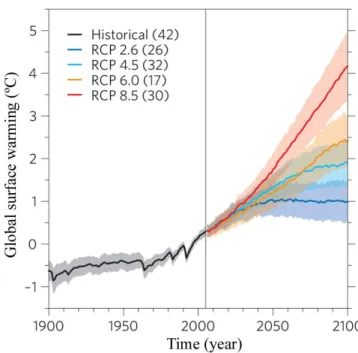
VUUREN et al., 2011). The GCMs create projections of different climate variables, such as precipitation and temperature (Figure 1), based on the RCPs.
Figure 1. Global temperature increase used in IPCC-AR5 presented
The RCPs contain representations of scenarios of more
intense (RCP8.5), moderate (RCP6 and RCP4.5) and low (RCP2.6)
GHG emissions. The RCPs are numbered according to the possible values that radioactive forcings (W.m-2) may take on in
2100 compared to the pre-industrial period.
The CMIP5 models show great advances over those of
CMIP3, whose results were used to make up the IPCCs fourth report (AR4) on climate changes (MEEHL et al., 2007). The advances in
CMIP5 include mainly a great number of models, more complex
models and with high resolution, a better representation of the external forcings and other kinds of scenarios, including, explicitly, the GHG emission mitigation policies (TAYLOR; STOUFFER; MEEHL, 2012; SILLMANN et al., 2013).
Despite recent advances obtained using CMIP5 compared
to CMIP3, Knutti and Sedlácek (2013) remark that the results
obtained by the GCMs of CMIP5, extraordinarily do not present signiicant changes in the projections of temperature and
precipitation considering the different scenarios on the global scale and compared to the GCMs of CMIP3.
For South America, Torres and Marengo (2013, 2014) evaluated the uncertainties in the projections of temperature and precipitation and the hotspots generated by the different
GCMs present in CMIP3 and CMIP5 for the future climate,
especially for the period of 2071-2100 compared to the 1961-1990 period (baseline). Forty-eight GCMs and scenarios SRES B1,
A1B and A2 (CMIP3) and RCP 2.6, 4.5, 6.0 and 8.5 (CMIP5)
were used. The methods used to evaluate the uncertainties were: REA - Reliability Ensemble Averaging, modiied REA and Bayesian inference (GIORGI; MEARNS, 2002; TEBALDI et al., 2005). The simulations of the current climate (1961-1990), both with
the CMIP3 and CMIP5 models, were a good representation of
the basic climate aspects. However, the simulations coming from
CMIP5 remained closer to the historical climate observed. As to
future projections, the temperature increase proved greater than the interval of associated uncertainty for all of South America in the different periods, scenarios and ensembles of models, indicating high reliability of the projections. In the more intense radioactive
forcings (A2 and RCP8.5) the probability that the temperature
would exceed 2 °C in the 2071-2100 period was greater than 90% for all of South America. On the other hand, the methods for the evaluation of the uncertainty of precipitation were not different from the arithmetic average of the GCMs. The intervals of uncertainties of precipitation presented magnitudes that were
equal to or greater than the changes projected by the models of CMIP3 and CMIP5, thus indicating low reliability of the GCM
responses to represent future precipitation.
Silveira (2014), aiming to elaborate a planning system with multiple time and space scales, evaluated the tendency for
change in precipitation and low for the 21st century from the
data supplied by the GCMs of CMIP5, in scenarios RCP4.5 and RCP8.5, for catchments of the Brazilian electricity sector and
those of the Jaguaribe-Metropolitano system in the state of Ceará. The hydrological model used was SMAP (LOPES; BRAGA JUNIOR;
CONEJO, 1981) with the bias of monthly precipitation corrected
by a probability distribution function. Although the CMIP5 models
are good representations of the seasonal precipitation patterns, with a high correlation with the historical values observed, there
are divergences among the models regarding the future of rains in the different regions of the electricity sector.
Regarding the lows in the electricity sector, scenario RCP4.5 does not present a signiicant tendency in most of the catchments evaluated. On the other hand in RCP8.5 (a scenario
with high GHG emissions), they show a tendency to changes in several basins, especially in the North region of Brazil, indicating
the possibility of signiicant climate changes. In RCP8.5 and in
the North sector, most of the models signal a negative tendency
indicating the reduction of mean annual lows, especially at Belo Monte, In the Northeast sector for scenarios RCP4.5 and RCP8.5, the models presented differences in the catchment of the hydropower plant of Xingó, located on São Francisco River,
showing great uncertainties in this basin for the 21st century.
The tendencies to changes in the mean annual lows in
the basins of the Jaguaribe-Metropolitano system in the state of
Ceará (basins of the Orós, Castanhão, Banabuiú, Pacoti-Riachão)
for the 21st century, compared to the 1950-1999 period, presented
great differences for scenarios RCP4.5 (10 GCMs) and RCP8.5
(14 GCMs). Despite the discrepancies, most of the models indicate
a reduction of the mean annual lows in all the basins for the
21st century (SILVEIRA et al., 2014).
In the Castanhão reservoir basin for scenario RCP4.5, except for two GCMs, the results show that the lows must be
reduced by at least 20% in all periods. On the other hand, in the
RCP8.5 scenario, most of the GCMs also indicate a reduction in the mean lows. The reduction of lows in the two GHG scenarios analyzed is sometimes greater than 50% and close to 100% in the
2040-2069 and 2070-2099 periods for some GCMs. Nevertheless,
two GCMs (IPSL-CM5A-LR and IPSL-CM5A-MR) presented an increase of up to 200% in the mean inlows of the two scenarios
for the 21st century.
In the Banabuiú reservoir basin most of the models also
indicated a reduction of lows in both scenarios. For the period of 2010-2039, in scenarios RCP4.5 and RCP8.5, the reduction must be at least 10% and 5%, respectively. In scenario RCP8.5 the reduction ranged between 5% and 65% (2010-2039), 5% and 75% (2040-2069) and 5% and 90% (2070-2098). The GCMs “IPSL-CM5A-LR” and “IPSL-CM5A-MR”, as in the Castanhão basin, also signaled a large increase in the mean lows in the two
scenarios for the 21st century in the Banabuiú basin.
The recent results obtained by Knutti and Sedlácek (2013) on a global scale, Torres and Marengo (2013, 2014) for South America, and Silveira (2014) for the catchments of the electric sector and Ceará, show that the uncertainties involved in climate and hydrological projection are still high. From the physical standpoint, the uncertainties are associated mainly with the natural variability of the climate system, the trajectories or paths that can be followed by GHG emissions and aerosols, besides the response of the global climate system to the different concentrations of GHG. As to the modeling process, the uncertainties are related to the structure of the models (be they climatic or hydrological), the
downscaling technique used (dynamic or statistical), spatial scale
(global, regional or catchment), and temporal (years, decades or century), among others (KNUTTI; SEDLÁCEK, 2013; PIELKE
Even with the advances in the GCMs from CMIP3 to
CMIP5 in the concept of the GHG scenarios and increase of
spatial resolution, the uncertainties are still one of the greatest challenges for impact studies, notably in water resources. The use
of multiple models (such as those of CMIP3 and CMIP5) is an alternative to understand the uncertainties and become acquainted
with the sign of projected change (addition or reduction), by most of the climate models (KNUTTI, 2010).
Quality in the projection of low by a hydrological model depends on the quality of the responses of the atmospheric
models in forecasting the climate variables, especially precipitation. Acknowledging that the responses of the atmospheric model
inluence low simulation on a catchment scale, many studies evaluate
the predictive capacity of different GCMs and MCRs from the perspective of hydrological modeling (e.g., MARKSTROM et al., 2012; DANKERS et al., 2013; SCHEWE et al., 2013).
Any decision-making in water resources to adapt to the context of climate changes must consider the uncertainties involved (SIGEL et al., 2010). These uncertainties may possibly be minimized by increasing the spatial and temporal resolution of the climate models and the use of high performance computers (SHUKLA et al., 2009). However, the management system will still have to deal with the unpredictability resulting from the interaction of social and ecological systems (WAGENER et al., 2010).
MATERIAL AND METHODS
Case study: Jaguaribe River-CE
Jaguaribe River lies in the state of Ceará, Brazil. It is 633 km long, with a catchment of 74,000 km2, draining 81 municipalities,
the equivalent of about 50% of the state territory. The catchment is formed by ive sub-basins, the upper, middle and lower Jaguaribe
River, Salgado River and Banabuiú River (Figure 2).
Jaguaribe is a highly regulated river basin. The three largest reservoirs in the State were constructed there, in terms of storage
capacity (K) and reservoir yield (Q90): Castanhão (K=6.7 billion m 3
and Q90=29.0 m3/s), Orós (K=1.9 billion m3 and Q
90=20.4 m 3/s)
and Banabuiú (K=1.6 billion m3 and Q
90=12.9 m
3/s) (SRH,
2011a, b, c). It is estimated that there are another 4,713 smaller reservoirs in this basin (FORMIGA-JOHNSSON; KEMPER,
2005). The main water users are the irrigators, ish farmers, and
water utilities. There is an aggregate demand of the industrial complex in the metropolitan area of Fortaleza, agribusiness and agricultural systems in ‘Canal do Trabalhador’ (PINHEIRO et al.,
2007; MARTINS et al., 2013).
The allocation of the reservoir yields is decided at
the end of the irst semester (usually in June) in so-called “negotiated allocation meetings” and “planning seminars”
(AQUINO et al., 2013; SILVA; OLIVEIRA; BEZERRA,
1996). At these meetings and seminars, simulations of reservoir emptying are performed considering the stock of water, the demands from the previous years, and the absence of water inputs in the second semester (dry season). The long term water allocation is determined by grants.
Castanhão and Banabuiú reservoir yields in climate change scenarios
This study uses a top-down type approach (WILBY; DESSAI, 2010) involving the extraction of rainfall projects from
20 GCMs using the statistical downscaling technique (WILBY;
WIGLEY, 1997). The rainfall scenarios of the GCMs were used
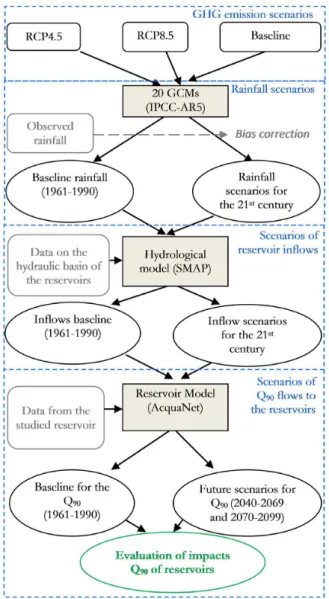
as input data in a rainfall-runoff model to estimate the inlows. Later the scenarios of inlows fed a reservoir model to simulate
the reservoir yields of Castanhão and Banabuiú reservoirs, in two distinct future periods (Figure 3). Although it is acknowledged
that the lows released from Orós reservoir have an impact on the reservoir yields of Castanhão, the irst reservoir mentioned was
not included in this study because these impacts are considered
mainly associated with the deinition of operational rules that determine the low to be released downstream from this reservoir.
The scenarios of inlows to Castanhão and Banabuiú reservoirs are the ampliied results of Silveira et al. (2014), which
determined the natural inlows into the four main reservoirs of the
Jaguaribe-Metropolitano system, including Castanhão and Banabuiú, for the 21st century, based on 10 GCMs for RCP4.5 and 14 GCMs
for the RCP8.5 of CMIP5. This study expands the number of
GCMs to 20 (Table 1) in RCP4.5 and RCP8.5. The RCPs, which are input data to the GCMs involve a large number of variables, such as adoption of technologies, land use, CO2 emission, etc.
(VAN VUUREN et al., 2011; MEINSHAUSEN et al., 2011).
The radioactive forcings of the RCP4.5 and RCP8.5 take on the value of 4.5 W/m2 and 8.5 W.m–2 in the year of 2100, respectively.
Figure 2. Location of the study area and spatial distribution of
The estimate of changes in the reservoir inlows and yields
were obtained by calculating the deviations from the projections
involving the baseline scenario (Equations 1 and 2). The baseline
scenario which is necessary to compare the changes in the hydrological regime and also to reduce systematic errors of the models, refers to the period from 1961 to 1990.
. .
.
.
100
−
=×
aflu proj aflu base aflu
aflu base
Q Q
Q
δ (1)
90% 90%
90%
90%
100
−
=×
proj base base
Q Q
Q
δ (2)
Where:
δal. and δ90% - represent the variation of the mean inlows and Q90 in
the reservoirs, respectively, in relation to the baseline scenario (%).
Qalu. proj. and Q90%. proj – represent the mean inlows and yields
projected for the future based on the rainfall data of each GCM, respectively (m3/s).
Qalu. base. and Q90% base – represent the inlows and yields in the
baseline scenario obtained from the rainfall data of the GCMs, respectively (m3/s).
The hydrological model, of the rainfall-runoff type was the Soil Moisture Accounting Procedure – SMAP, which is conceptual and deterministic, with a concentrated structure This model is part of the large family of hydrological models for the calculation of soil humidity. Its structure is relatively simple and its parameters are related to the mean physical parameters in the basin.
The water balance in the reservoirs took into account
only the mean inlows projected by the hydrological model on
the monthly scale. Therefore, the losses due to future evaporation
inluenced mainly by the increase in temperature were ignored.
The evaporation data and the physical characteristics are the values presented in the environmental inventory for the two reservoirs being studied (SRH, 2011a, c).
The model used to simulate the reservoirs was AcquaNet
(PORTO; MÉLLO JUNIOR; ROBERTO, 2005). This model
represents the water resources system through nodes, and these are
volume nodes (reservoirs) and passage nodes (conluences, points
of diversion, points of entry, and points of demand) and arcs or links (canals, supply pipes, and natural river reaches).
Figure 4 presents the low network elaborated in the AcquaNet model and used to simulate the yields of the two reservoirs that
are being studied. The elements “Qreg_banab” and “Qreg_cast”
represent the water demand in the Banabuiú and Castanhão reservoirs respectively. Links L1 and L2 represent reaches of the Banabuiú
river, while L3, L4 and L5 represent the Jaguaribe river (without a
scale). The drain at the end of the network is an abstraction used in the model to represent the water that exceeds the demands that have greater priorities.
In AcquaNet it is possible to deine a set of priorities for
the demands and for water storage in the reservoirs. The priorities vary from 1 to 99, and the lowest values have the highest priority.
The “Qreg_banab” and “Qreg_cast” demands were simulated with high priorities (priority equal to 1), and the drain with a low priority (priority equal to 99). The reservoirs had priorities equal to 50. The simulations in the reservoirs were performed for yields with 90% guarantee (Q90), i.e., a frequency of 10% of non-provision
of total demand.
Figure 3. Representation of the methodology adopted to evaluate
the impact of climate changes in Q90.
Figure 4. Flow network used to simulate the reservoir yields
RESULTS AND DISCUSSION
Projections of the reservoir inlows
The variation of the mean inlows (δalu.) obtained from the rainfall-runoff model considering the precipitation data of
20 GCMs of CMIP5 presented divergences (Figure 5). There was
less divergence in the inlows (δalu.) for the 2040-2069 period than for the 2070-2099 period in both GHG emission scenarios. Hence, for inlows into the two reservoirs, the results are less divergent
in the irst period (2040-2069) than in the second (2070-2099).
The divergences are associated with the representation of the climate processes present in the structure of each model and corroborated the divergences in the results of the GCMs found by Torres and Marengo (2013, 2014), for precipitations in South America, and Silveira (2014) for the inlows in different basins of the electricity sector and of Ceará.
Analysis of the variation of mean inlows (δalu.) for each reservoir shows that the change in the Castanhão presents a negative tendency in both periods, as can be found in most of the
projections (65%) that point to negative values and consequently
median values lower than zero. On the other hand, in Banabuiú, the tendency, according to the median was positive or null. These results agree with Silveira et al. (2014) as to the tendency for the
reduction of inlows signaled by most of the GCMs in Castanhão. However, the addition of up to 200% in the inlows detected by the authors cited for GCM “IPSL-CM5A-LR”, in this study, did not surpass 63%. The projections of the inlows associated with “GFDL-CM3” were those that presented the greatest additions, and could reach 71% for Banabuiú and 108% for Castanhão during the 2040-2069 period and RCP8.5.
In general, the diversions of the inlows (δalu.) increase with the change of the GHG emission scenario from moderate
(RCP4.5) to more intense (RCP8.5) and from the mid-21st century
(2040-2069) to the end of this century (2070-2099).
Projections of reservoir yields
The changes in the inlows (δalu.) to the Castanhão and
Banabuiú reservoirs were relected in the values of low diversions Q90 (δ90%). Figure 6 shows the changes in reservoir yields with a 90% guarantee (δ90%) in the two reservoirs studied, considering the
rainfall data of the 20 GCMs in the RCP4.5 and RCP8.5 scenarios
for the 2040-2069 and 2070-2099 periods that were used as input data in the hydrological model. The percentages shown in Figure 6 represent a reduction (bars on the negative axis) or increase (bars on the positive axis), per period and GHG emission scenario.
The diversions of the reservoir yields (δ90%) are very different from each other, both as to the sign (reduction or addition), and as to the magnitude of change. Figure 6 shows that the projections from some models indicate a reduction greater than 60%, in the two reservoirs simultaneously: MPI-ESM-MR, during the 2070-2099
period for RCP4.5 (Figure 6C), CESM1-BGC, during the 2040-2069
period for RCP8.5 (Figure 6B) and BCC-CSM1-1, during the
2070-2099 period and RCP8.5 (Figure 6D). “MIROC-ESM-CHEM”
also pointed at a reduction greater than 60%, but only for Banabuiú
in the 2070-2099 period and RCP4.5. The reductions in Q90 greater
than 60% originating in the data of the GCMs “CESM1-BGC” and “BCC-CSM1-1” in RCP8.5 agree with the results obtained
by Silveira et al. (2014) who identiied these GCMs as those that
project large reductions in the inlows to the two reservoirs and that consequently affect the yields.
The great reductions in Q90 presented in the GCMs mentioned, show that even though the 20 GCMs were fed the same information, they may have different responses, mainly due
Table 1. GGMs of the CMIP5 used.
GCM Modeling Center
ACCESS1-0 CSIRO (Commonwealth Scientiic and Industrial Research Organisation, Australia), and BOM (Bureau of Meteorology, Australia)
ACCESS1-3
BCC-CSM1-1 Beijing Climate Center, China Meteorological Administration CanESM2 Canadian Centre for Climate Modelling and Analysis
CCSM4 National Center for Atmospheric Research CESM1-BGC
National Science Foundation, Department of Energy, National Center for Atmospheric Research
CESM1-CAM5
CMCC-CM
Centro Euro-Mediterraneo per I Cambiamenti Climatici CMCC-CMS
GFDL-CM3
Geophysical Fluid Dynamics Laboratory GFDL-ESM2M
HadGEM2-AO Met Ofice Hadley Centre (additional HadGEM2-ES realizations contributed by Instituto Nacional de Pesquisas Espaciais)
HadGEM2-ES
INM-CM4 Institute for Numerical Mathematics
IPSL-CM5A-LR
Institut Pierre-Simon Laplace
IPSL-CM5B-LR
MIROC5 Atmosphere and Ocean Research Institute (The University of Tokyo), National Institute for Environmental Studies,
and Japan Agency for Marine-Earth Science and Technology
MIROC-ESM-CHEM Japan Agency for Marine-Earth Science and Technology, Atmosphere and Ocean Research Institute (The University of Tokyo), and National Institute for Environmental Studies
MPI-ESM-LR
Max Planck Institute for Meteorology (MPI-M) MPI-ESM-MR
to the differences in the representation of the physical processes in the structure of each model.
In general, the diversions of Q90 (δ90%) which indicated a reduction in both reservoirs and periods, presented higher
percentages than those that signaled an increase, both for RCP4.5 and for RCP8.5.
Considering the changes projected in Q90 (δ90%) generated
for the two reservoirs and scenarios (80 projections per reservoir),
11 signaled additions greater than 20%. On the other hand, 41 projections indicated a reduction greater than 20%. These reductions may occur mainly at the end of the century (2070-2099), given that most of the projections agree with the reduction.
The data from the CGMs that indicated an increase greater than 20% were: GFDL-CM3, for Castanhão (in all scenarios and
periods), and for Banabuiú (for 2040-2069 in RCP8.5):
MIROC-ESM-CHEM, for Castanhão (2040-2069, in RCP4.5, Figure 6A) and
RCP8.5 (Figure 6B); CESM1-BGC, in the 2070-2099 period in
RCP8.5 for Castanhão (Figure 6D); ACCESS1-0, in the 2040-2069
period in RCP8.5 for Banabuiú (Figure 6B), HadGEM2-AO
and CCSM4, in the 2040-2069 period and RCP4.5 for Banabuiú
(Figure 6A).
Particularly “GFDL-CM3” in RCP8.5, meant for Castanhão, an addition of Q90 much above the other 19 GCMs for the two
periods. The latter result is associated with the increase signaled
by “GFDL-CM3” for inlows to Castanhão of up to 108% for 2040-2069 and 80% for 2070-2099. Thus, the projections that meant greater changes in Q90 in reservoirs consistently correspond
also to the inlow data with greater variations.
The variations in the lows with a 90% guarantee (δ90%), for
the periods analyzed indicate a tendency to the reduction of the water availability in the two reservoirs. Although the results present divergences, this information shows the interval of variation of
Q90 and can make it easier to anticipate the adaptive measures of the region to the probable changes in the water availability due
to climate changes, especially regarding the reduction of Q90 of Castanhão reservoir, which, for the projections with the greatest reductions, may compromise the supply of several user sectors in the state of Ceará, including the metropolitan area of Fortaleza and the Jaguaribe valley.
CONCLUSION
This study evaluated the possible impacts of changes in
precipitation projected by the GCMs of IPCC-AR5 (CMIP5) on inlows and regulated by two large surface reservoirs (Castanhão
and Banabuiú), located in the Jaguaribe river basin in Ceará.
The variation of inlows (δalu.) and Q90 (δ90%), for the Castanhão and Banabuiú reservoirs, estimated from data of
20 GCMs of CMIP5, for the periods of 2040-2069 and 2070-2099, in the emission scenarios RCP4.5 (moderate) and RCP8.5 (intense),
indicated great divergences among them, both as to the sign (addition or reduction), and as to the magnitude of change.
The divergences between the diversions in the inlows
(δalu.) to Castanhão and Banabuiú increase with the change of
the scenario from moderate GHG emission (RCP4.5) to more intense (RCP8.5) and from the mid-21st century (2040-2069) to
the end of this century (2070-2099). Despite these divergences,
it can be seen that the inlows projected for Castanhão tended to
be reduced, while for Banabuiú the tendency is positive or null.
As to Q90, it can however be observed that most of the diversions (δ90%) indicate a tendency for reduction in both reservoirs. This reduction may be greater than 60% in relation to the baseline scenario, as indicated in the changes generated from
four GCMs. Moreover, in 51% of the projections, in Q90 they
indicated a reduction greater than 20% and another 12.5% signaled an increase greater than 20% in Q90.
The results also indicated that if the changes in Q90 occur,
there is a great chance that there will be a more intense reduction, given that the percentages of reduction (negative values) are, in absolute values, greater than the percentages projected for the
increase of Q90 as related to the baseline period.
The reductions in the values of the reservoir yields can be even greater, if the simulations take into account the increased
evaporation rates, inluenced mainly by the increased temperature
predicted for the future.
The international policies for mitigation discuss the possibility of minimizing the mean increase of global temperature
to values between 1.5 °C and 2 °C, which is compatible with the Figure 6. Variation in reservoir yields of Castanhão and Banabuiú,
with a 90% guarantee for scenarios RCP4.5 (A, C) and RCP8.5
(B, D), 2040-2069 (A, B) and 2070-2099 (C, D) periods for
RCP4.5 scenario and the 2070-2099 period, analyzed in the present study. Thus, there is a pressing need to deine strategies to adapt
the water resources sector to climate changes. Considering the uncertainties inherent to the process described, the adaptation
strategies need to be lexible and dynamic, and should evolve over
time, with new information and further knowledge.
ACKNOWLEDGEMENTS
The irst author thanks the Ceará Foundation for Support to Scientiic and Technological Development (FUNCAP - Fundação Cearense de Apoio ao Desenvolvimento Cientíico e Tecnológico) for inancial support, through the PhD fellowship, and the Regional
University of Cariri (URCA) for leave from teaching activities in order to perform this study.
REFERENCES
ADAM, K. N.; FAN, F. M.; BRAVO, J. M.; COLLISCHONN,
W.; PONTES, P. R. M. Mudanças climáticas e vazões extremas na Bacia do Rio Paraná. Revista Brasileira de Recursos Hídricos, v.
20, n. 4, p. 999-1007, 2015. http://dx.doi.org/10.21168/rbrh.
v20n4.p999-1007.
ANA - Agência Nacional de Águas. Manual de procedimentos técnicos e administrativos de outorga de direito de uso de recursos hídricos. Brasília: ANA, 2013. 249 p.
AQUINO, S. H. S.; SILVA, S. M. O.; SILVA, D. C.; SOUZA
FILHO, F. A. Alocação de longo prazo no estado do Ceará. In:
SOUZA FILHO, F. A.; CAMPOS, J. N. B.; AQUINO, S. H. S.
(Orgs.). Gerenciamento de recursos hídricos no semiárido. Fortaleza:
Edição Gráfica e Editora, 2013. p. 257-275.
BATES, B. C.; KUNDZEWICZ, Z. W.; WU, S.; PALUTIKOF, J. P. (Eds.). Climate change and water. Geneva: IPCC, 2008. 210 p. Intergovernmental Panel on Climate Change Technical Paper, 6.
BRAVO, J. M.; COLLISCHONN, W.; DA PAZ, A. R.; ALLASIA,
D.; DOMECQ, F. Impact of projected climate change on hydrologic regime of the Upper Paraguay River basin. Climatic Change, v. 127, n.
1, p. 27-41, 2013. http://dx.doi.org/10.1007/s10584-013-0816-2.
CAMPOS, J. N. B.; STUDART, T. M. C.; MARTINZ, D. D. G.; NASCIMENTO, L. S. V. Contribuições ao debate sobre as eficiências
de pequenos e grandes reservatórios. Revista Brasileira de Recursos Hídricos, v. 8, n. 2, p. 31-38, 2003. http://dx.doi.org/10.21168/
rbrh.v8n2.p31-38.
CHIEN, H.; YEH, P. J. F.; KNOUFT, J. H. Modeling the potential impacts of climate change on streamflow in agricultural watersheds of the Midwestern United States. Journal of Hydrology (Amsterdam), v. 491, p. 73-88, 2013. http://dx.doi.org/10.1016/j. jhydrol.2013.03.026.
DANKERS, R.; ARNELL, N. W.; CLARK, D. B.; FALLOON,
P.; FEKETE, B. M.; GOSLING, S. N.; HEINKE, J.; KIM, H.;
MASAKI, Y.; SATOH, Y.; STACKE, T. First look at changes in flood hazard in the Inter-Sectoral Impact Model Intercomparison Project ensemble. Proceedings of the National Academy of Sciences of the United States of America, v. 111, n. 9, 3257-3261, 2013. http://
dx.doi.org/10.1073/pnas.1302078110. PMid:24344290.
EHRET, U.; ZEHE, E.; WULFMEYER, V.; WARRACH-SAGI,
K.; LIEBERT, J. Should we apply bias correction to global and regional climate model data? Hydrology and Earth System Sciences Discussions, v. 9, n. 4, p. 5355-5387, 2012. http://dx.doi.org/10.5194/
hessd-9-5355-2012.
FORMIGA-JOHNSSON, R. M.; KEMPER, K. E. Institutional and policy analysis of river basin management in the Jaguaribe River Basin, Ceará, Brazil. Washington, DC: The World Bank, 2005. Policy Research Working Paper 3649.
GIORGI, F.; MEARNS, L. O. Calculation of average, uncertainty range, and reliability of regional climate changes from AOGCM
simulations via the “Reliability Ensemble Averaging” (REA) method.
Journal of Climate, v. 15, n. 10, p. 1141-1158, 2002. http://dx.doi.
org/10.1175/1520-0442(2002)015<1141:COAURA>2.0.CO;2.
GLEICK, P. H. Global freshwater resources: soft-path solutions for the 21st century. Science, v. 302, n. 5650, p. 1524-1528, 2003.
PMid:14645837.http://dx.doi.org/10.1126/science.1089967.
IPCC - Intergovernmental Panel on Climate Change. Climate change: the physical science basis. Cambridge: Cambridge University
Press, 2013. 1535 p. Contribution of Working Group I to the
Fifth Assessment Report of the Intergovernmental Panel on Climate Change.
IPCC - Intergovernmental Panel on Climate Change. Summary
for policymakers. In: FIELD, C. B.; BARROS, V. R.; DOKKEN, D. J.; MACH, K. J.; MASTRANDREA, M. D.; BILIR, T. E.; CHATTERJEE, M.; EBI, K. L.; ESTRADA, Y. O.; GENOVA, R. C.; GIRMA, G.; KISSEL, E. S.; LEVY, A. N.; MACCRACKEN, S.; MASTRANDREA, P. R.; WHITE, L. L. (Eds.). Climate change: impacts, adaptation, and vulnerability: part A: global and sectoral aspects. Cambridge: Cambridge University Press, 2014. p. 1-32. Contribution of Working Group II to the Fifth Assessment Report of the Intergovernmental Panel on Climate Change.
KNUTTI, R. The end of model democracy? Climatic Change, v.
102, n. 3-4, p. 395-404, 2010. http://dx.doi.org/10.1007/s10584-010-9800-2.
KNUTTI, R.; SEDLÁCEK, J. Robustness and uncertainties in the
new CMIP5 climate model projections. Nature Climate Change, v. 3, n. 4, p. 369-373, 2013. http://dx.doi.org/10.1038/nclimate1716.
LOPES, J. E. G.; BRAGA JUNIOR, B. P. F.; CONEJO, J. G. L.
A. Simulação hidrológica: aplicações de um modelo simplificado.
In: SIMPÓSIO BRASILEIRO DE RECURSOS HÍDRICOS, 3..
LÓPEZ-MORENO, J. I.; ZABALZA, J.; VICENTE-SERRANO,
S. M.; REVUELTO, J.; GILABERTE, M.; AZORIN-MOLINA,
C.; MORÁN-TEJEDA, E.; GARCÍA-RUIZ, J. M.; TAGUE, C.
Impact of climate and land use change on water availability and
reservoir management: Scenarios in the Upper Aragón River,
Spanish Pyrenees. The Science of the Total Environment, v. 493, p. 1222-1231, 2014. PMid:24090497. http://dx.doi.org/10.1016/j. scitotenv.2013.09.031.
MARENGO, J. A. Vulnerabilidade, Impactos e adaptação as mudanças de clima no semiárido do Brasil. Parcerias Estrategicas, v. 1, n. 1, p. 149-176, 2009.
MARKSTROM, S. L.; HAY, L. E.; WARD-GARRISON, C. D.; RISLEY, J. C.; BATTAGLIN, W. A.; BJERKLIE, D. M.; CHASE,
K. J.; CHRISTIANSEN, D. E.; DUDLEY, R. W.; HUNT, R. J.; KOCZOT, K. M.; MASTIN, M. C.; REGAN, R. S.; VIGER, R.
J.; VINING, K. C.; WALKER, J. F. Integrated watershed-scale response to climate change for selected basins across the United States. Reston: U.S. Geological Survey, 2012. 143 p. Scientific Investigations Report,
2011-5077.
MARTINS, E. S. P. R.; BRAGA, C. F. C.; NYS, E.; SOUZA FILHO,
F. A.; FREITAS, M. A. S. Impacto das mudanças climáticas e projeções de demanda sobre o processo de alocação de água em duas bacias do Nordeste Semiárido. Brasília: ANA, 2013. 88 p. Série Água Brasil 8, v. 1.
MEEHL, G. A.; COVEY, C.; DELWORTH, T.; MOJIB, L.;
MCAVANEY, B.; MITCHELL, J. F. B.; STOUFFER, R. J.; TAYLOR, K. E. The WCRP CMIP3 multimodel dataset: a new era in climate change research. Bulletin of the American Meteorological Society, v. 88, n. 9, p. 1383-1394, 2007. http://dx.doi.org/10.1175/
BAMS-88-9-1383.
MEINSHAUSEN, M.; SMITH, S. J.; CALVIN, K. V.; DANIEL,
J. S.; KAINUMA, M. L. T.; LAMARQUE, J.-F.; MATSUMOTO,
K.; MONTZKA, S. A.; RAPER, S. C. B.; RIAHI, K.; THOMSON,
A. M.; VELDERS, G. J. M.; VAN VUUREN, D. The RCP
greenhouse gas concentrations and their extension from 1765 to
2300. Climatic Change, 2011.
MILLY, P. C. D.; BETANCOURT, J.; FALKENMARK, M.; HIRSCH, R. M.; KUNDZEWICZ, Z. W.; LETTENMAIER, D. P.; STOUFFER, R. J. Stationarity is dead: whither water management? Science, v. 319, n. 5863, p. 573-574, 2008. PMid:18239110. http://
dx.doi.org/10.1126/science.1151915.
MONTENEGRO, S.; RAGAB, R. Impact of possible climate and land use changes in the semiarid regions: a case study from North Eastern Brazil. Journal of Hydrology (Amsterdam), v. 434-435,
p. 55-68, 2012. http://dx.doi.org/10.1016/j.jhydrol.2012.02.036.
MOSS, R.; BABIKER, M.; BRINKMAN, S.; CALVO, E.; CARTER,
T. R.; EDMONDS, J.; ELGIZOULI, I.; EMORI, S.; ERDA,
L.; HIBBARD, K.; JONES, R.; KAINUMA, M.; KELLEHER,
J.; LAMARQUE, J.-F.; MANNING, M. R.; MATTHEWS, B.;
MEEHL, J.; MEYER, L.; MITCHELL, J. F. B.; NAKICENOVIC,
N.; O’NEILL, B.; PICHS, R.; RIAHI, K.; ROSE, S. K.; RUNCI,
P.; STOUFFER, R. J.; VANVUUREN, D. P.; WEYANT, J. P.; WILBANKS, T. J.; VAN YPERSELE, J. P.; ZUREK, M. Towards new scenarios for analysis of emissions, climate change, impacts, and response strategies: IPCC Expert Meeting Report. Noordwijkerhout:
Intergovernmental Panel on Climate Change, 2008. 155 p.
OLMSTEAD, S. M. Climate change adaptation and water resource management: a review of the literature. Energy Economics, v. 46, p.
500-509, 2014. http://dx.doi.org/10.1016/j.eneco.2013.09.005.
PBMC - Painel Brasileiro de Mudanças Climáticas. Impactos, vulnerabilidades e adaptação às mudanças climáticas. Rio de Janeiro: Universidade Federal do Rio de Janeiro, 2014. 414 p. Contribuição do Grupo de Trabalho 2 do Painel Brasileiro de Mudanças
Climáticas ao Primeiro Relatório da Avaliação Nacional sobre
Mudanças Climáticas.
PCMDI - Program for Climate Model Diagnosis and Intercomparison. CMIP5: Coupled Model Intercomparison project. 2016. Available from:
<http://cmip-pcmdi.llnl.gov/cmip5/availability.html>. Access
in: 01 Jan. 2016.
PIELKE Sr, R. A.; WILBY, R. L. Regional climate downscaling: what’s the point? Eos, Transactions, American Geophysical Union, v. 93,
n. 5, p. 52-53, 2012. http://dx.doi.org/10.1029/2012EO050008.
PINHEIRO, P. L.; FREITAS, H. B.; CHAVES, F. A.; MAIA, E. C. M. Operação do Açude Castanhão para perenização do Rio Jaguaribe, ano 2003, Ceará, Brasil. In: SIMPÓSIO BRASILEIRO DE RECURSOS HÍDRICOS, 27., 2007, São Paulo. Porto Alegre: ABRH, 2007.
PORTO, R. L. L.; MÉLLO JUNIOR, A. V.; ROBERTO, A. N.
AcquaNet: arquitetura, estratégias e ferramentas. In: SIMPÓSIO BRASILEIRO DE RECURSOS HÍDRICOS, 16., 2005, João Pessoa. Porto Alegre: ABRH, 2005.
SCHEWE, J.; HEINKE, J.; GERTEN, D.; HADDELAND, I.; ARNELL, N. W.; CLARK, D. B.; DANKERS, R.; EISNER, S.; FEKETE, B.; COLÓN-GONZÁLEZ, F. J.; GOSLING, S. N.; KIM, H.; LIU, X.; MASAKI, Y.; PORTMANN, F. T.; SATOH, Y.; STACKE, T.; TANG, Q.; WADA, Y.; WISSER, D.; ALBRECHT,
T.; FRIELER, K.; PIONTEK, F.; WARSZAWSKI, L.; KABAT, P. Multi-model assessment of water scarcity under climate change. Proceedings of the National Academy of Sciences of the United States of America, v. 111, n. 9, p. 3245-3250, 2013. http://dx.doi.org/10.1073/ pnas.1222460110. PMid:24344289.
SHUKLA, J.; HAGEDORN, R.; MILLER, M.; PALMER, T.
N.; HOSKINS, B.; KINTER, J.; MAROTZKE, J.; SLINGO, J. Strategies: revolution in climate prediction is both necessary and possible: a declaration at the world modelling summit for climate prediction. Bulletin of the American Meteorological Society, v. 90, n. 2,
p. 175-178, 2009. http://dx.doi.org/10.1175/2008BAMS2759.1.
EU Water Framework Directive. Ecological Economics, v. 69, n. 3, p.
502-510, 2010. http://dx.doi.org/10.1016/j.ecolecon.2009.11.012.
SILLMANN, J.; KHARIN, V. V.; ZHANG, X.; ZWIERS, F.
W.; BRONAUGH, D. Climate extremes indices in the CMIP5 multimodel ensemble: part 1: model evaluation in the present climate. Journal of Geophysical Research, v. 118, p. 1-18, 2013.
SILVA, U. P. A.; OLIVEIRA, J. L. F.; BEZERRA, H. E. R. A
experiência de gerenciamento participativo na Bacia Hidrográfica do Jaguaribe – Ceará. In: SIMPÓSIO DE RECURSOS HÍDRICOS DO NORDESTE, 3., 1996, Salvador. Porto Alegre: ABRH, 1996.
SILVEIRA, C. S. Modelagem integrada de meteorologia e recursos hídricos em múltiplas escalas temporais e espaciais: aplicação no Ceará e no setor hidroelétrico brasileiro. 2014. 352 f. Tese (Doutorado). Programa de
Pós-graduação em Engenharia Civil, Departamento de Engenharia
Hidráulica e Ambiental, Universidade Federal do Ceará, Fortaleza, 2014.
SILVEIRA, C. S.; SOUZA FILHO, F. A.; ARAUJO JUNIOR,
L. M.; DIAS, T. A.; CABRAL, S. L. Análise das projeções de vazão média anual no sistema Jaguaribe-Metropolitano para os
cenários RCP4.5 e RCP8.5 do IPCC-AR5 para o século XXI. In:
SIMPÓSIO DE RECURSOS HÍDRICOS DO NORDESTE, 12., 2014, Natal. Natal: Água e Desenvolvimento, 2014.
SRH - Secretaria dos Recursos Hídricos do Estado do Ceará. Inventário Ambiental do açude Castanhão. Fortaleza, 2011a. 142 p.
SRH - Secretaria dos Recursos Hídricos do Estado do Ceará. Inventário Ambiental do açude Orós. Fortaleza, 2011b. 126 p.
SRH - Secretaria dos Recursos Hídricos do Estado do Ceará. Inventário Ambiental do açude Banabuiú. Fortaleza, 2011c. 111 p.
TAYLOR, K. E.; STOUFFER, R. J.; MEEHL, G. A. An overview
of CMIP5 and the experiment design. Bulletin of the American Meteorological Society, v. 93, n. 4, p. 485-498, 2012. http://dx.doi.
org/10.1175/BAMS-D-11-00094.1.
TEBALDI, C.; SMITH, R. L.; NYCHKA, D.; MEARNS, L. O.
Quantifying uncertainty in projections of regional climate change:
a bayesian approach to the analysis of multimodel ensembles. Journal of Climate, v. 18, n. 10, p. 1524-1540, 2005. http://dx.doi.
org/10.1175/JCLI3363.1.
TORRES, R. R.; MARENGO, J. A. Uncertainty assessments of climate change projections over South America. Theoretical and Applied Climatology, v. 112, n. 1-2, p. 253-272, 2013. http://dx.doi.
org/10.1007/s00704-012-0718-7.
TORRES, R. R.; MARENGO, J. A. Climate change hotspots over
South America: from CMIP3 to CMIP5 multi-model datasets.
Theoretical and Applied Climatology, v. 117, n. 3-4, p. 579-587, 2014. http://dx.doi.org/10.1007/s00704-013-1030-x.
VAN VLIET, M. T. H.; FRANSSEN, W. H. P.; YEARSLEY, J.
R.; LUDWIG, F.; HADDELAND, I.; LETTENMAIER, D. P.; KABAT, P. Global river discharge and water temperature under climate change. Global Environmental Change, v. 23, n. 2, p. 450-464, 2013. http://dx.doi.org/10.1016/j.gloenvcha.2012.11.002.
VAN VUUREN, D. P.; EDMONDS, J.; KAINUMA, M.; RIAHI,
K.; THOMSON, A.; HIBBARD, K.; HURTT, C.; KRAM, T.;
KREY, V.; LAMARQUE, J.; MASUI, T.; MEINSHAUSEN, M.;
NAKICENOVIC, N.; SMITH, S. J.; ROSE, S. K. The representative concentration pathways: an overview. Climatic Change, v. 109, n.
1-2, p. 5-31, 2011. http://dx.doi.org/10.1007/s10584-011-0148-z.
WAGENER, T.; SIVAPALAN, M.; TROCH, P. A.; MCGLYNN,
B. L.; HARMAN, C. J.; GUPTA, H. V.; KUMAR, P.; RAO, P. S. C.; BASU, N. B.; WILSON, J. S. The future of hydrology: an evolving science for a changing world. Water Resources Research, v. 46, n. 5, p. 1-10, 2010. http://dx.doi.org/10.1029/2009WR008906.
WATTS, R. J.; RICHTER, B. D.; OPPERMAN, J. J.; BOWMER, K. H. Dam reoperation in an era of climate change. Marine & Freshwater Research, v. 62, n. 3, p. 321-327, 2011. http://dx.doi. org/10.1071/MF10047.
WILBY, R. L.; DESSAI, S. Robust adaptation to climate change. Weather, v. 65, n. 7, p. 180-185, 2010. http://dx.doi.org/10.1002/
wea.543.
WILBY, R. L.; WIGLEY, T. M. L. Downscaling general circulation model output: a review of methods and limitations. Progress in Physical Geography, v. 21, n. 4, p. 530-548, 1997. http://dx.doi.org /10.1177/030913339702100403.
Authors contributions
Renato de Oliveira Fernandes: Literature review, text structure, simulations of reservoir yields and drafting the text.
Cleiton da Silva Silveira: Downscaling of the GCM precipitation data, correction of the bias of precipitation and simulation of
the inlows to the reservoirs and text revision
Ticiana Marinho de Carvalho Studart: Advising and planning in all parts of the development of the study and text revision
Francisco de Assis de Souza Filho: Deinition of the methodology,