Cremilde Aparecida Trindade Radovanovic
I, Cheila Aparecida Bevilaqua
II,
Carlos Alexandre Molena-Fernandes
III, Sonia Silva Marcon
II Universidade Estadual de Maringá, Health Sciences Center, Department of Nursing. Maringá, Paraná, Brazil.
II Universidade Estadual de Maringá, Health Sciences Center, Department of Physical Education. Maringá, Paraná, Brazil.
III Universidade Estadual de Maringá,. Paranavaí, Paraná, Brazil.
How to cite this article:
Radovanovic CAT, Bevilaqua CA, Molena-Fernandes CA, Marcon SS. Multi-professional intervention in adults with arterial hypertension: a randomized clinical trial. Rev Bras Enferm [Internet]. 2016;69(6):1005-11.
DOI: http://dx.doi.org/10.1590/0034-7167-2016-0320
Submission: 06-21-2016 Approval: 07-28-2016
ABSTRACT
Objective: assess the infl uence of an intervention, comprised of counseling related to health and aerobic physical training for lowering pressure values, in anthropometric indicators and in the adjustment of biochemical parameters in individuals with hypertension. Method: intervention study of the randomized clinical trial variety, with 42 individuals. The intervention-group followed the protocol of health counseling, nutrition and physical activity. Results: two intervention groups were considered: intervention-group (a) and intervention-group (b). Intervention-group (a) showed signifi cant decrease in measurements of systolic and diastolic arterial pressure, of high-density lipoprotein parameters, hip circumference values and waist-hip ratio. Intervention-group (b) presented signifi cant decrease in systolic arterial pressure values. Conclusion: it was found that the health intervention in conjunction with physical activities were effective in decreasing and/or controlling values for pressure, biochemical and anthropometric indicators.
Descriptors: Clinical Trial; Hypertension; Motor Activity; Cardiovascular Nursing; Health Education.
RESUMO
Objetivo: avaliar a infl uência de uma intervenção, constituída por orientações relacionadas à saúde e treinamento físico aeróbio, na diminuição dos valores pressóricos, dos indicadores antropométricos e na adequação dos parâmetros bioquímicos de indivíduos com hipertensão. Método: estudo de intervenção do tipo ensaio clínico randomizado, com 42 indivíduos. O grupo-intervenção seguiu o protocolo de orientações de saúde e nutricionais e da realização de atividade física. Resultados: consideraram-se dois grupos de intervenção, grupo-intervenção (a) e grupo-intervenção (b). O grupo-intervenção (a) revelou diminuição signifi cativa dos valores de pressão arterial sistólica e diastólica, dos parâmetros de lipoproteína de alta densidade e dos valores de circunferência do quadril e relação cintura–quadril. O grupo-intervenção (b) apresentou diminuição signifi cativa para o valor de pressão arterial sistólica. Conclusão: destaca-se que a intervenção em saúde atrelada à atividade física mostrou-se efi ciente na diminuição e/ou controle dos valores pressóricos, bioquímicos e dos indicadores antropométricos.
Descritores: Ensaio Clínico; Hipertensão; Atividade Motora; Enfermagem Cardiovascular; Educação em Saúde.
RESUMEN
Objetivo: evaluar la infl uencia de una intervención consistente en orientaciones relativas a la salud y entrenamiento físico aeróbico, en la disminución de valores de presión, de indicadores antropométricos y en adecuación de parámetros bioquímicos de individuos con hipertensión. Método: estudio de intervención, tipo ensayo clínico randomizado, con 42 individuos. El grupo-intervención siguió el protocolo de orientaciones de salud, nutricionales y de realización de actividad física. Resultados: Se consideraron dos grupos de intervención: grupo-intervención (a) y grupo-intervención (b). El grupo-intervención (a) mostró disminución signifi cativa de valores de presión arterial sistólica y diastólica, de parámetros de lipoproteína de alta densidad y de valores de circunferencia de caderas y relación cintura-caderas. El grupo-intervención (b) mostró disminución signifi cativa
Multi-professional intervention in adults with arterial hypertension:
a randomized clinical trial
Cremilde Aparecida Trindade Radovanovic E-mail: [email protected]
CORRESPONDING AUTHOR
INTRODUCTION
Arterial hypertension is high among global mortality risks, with an estimate of 9.4 million deaths worldwide in 2010(1).
It is an important risk factor for cardiovascular diseases, and its prevalence is similar for all social groups, although low-er among individuals with highlow-er income(2). In 2000, global
prevalence was 25%, and the estimate for 2025 is 29%(3); in
the Brazilian population, the estimate in 2013 was 21.4%(4).
Some factors contribute to the high prevalence of arterial hypertension, such as being overweight and obesity, aging, lack of physical activity, inadequate diet, harmful use of alco-hol, psychological stress, genetic factors and socioeconomic determinants(5).
The adoption of healthy habits, such as regular physical activity and adequate diet, are important actions for the treat-ment of arterial hypertension and the impletreat-mentation of public policies(6). In this context, health education in association to
life-style changes are important tools for the promotion of health(7).
Among professionals involved in health education, nurses have a central role, acting as agents in the process of social change. Through health education and using dialogic teaching meth-ods, nurses can value, respect and empower individuals’ au-tonomy in searching for better health conditions(8).
Although health education programs for groups of individu-als with arterial hypertension and other chronic diseases are fre-quent, there are still gaps in knowledge related to the practice of the health team in these programs. Moreover, results of this prac-tice on patients’ life conditions and on work performance are not systematically assessed .The aim of this study was to assess the influence of an intervention, comprised of counseling relat-ed to health such as aerobic physical training, in lowering pres-sure values, anthropometric indicators and in the adjustment of biochemical parameters in individuals with hypertension.
METHOD
Ethical aspects
The study was approved by the Permanent Committee for Human Research Ethics (COPEP) – CAAE 0114.093.000-10 and by the Brazilian Registry of Clinical Trials (RBR-6673s5). All participants read and signed a free and informed consent form.
Design, location of study and period
Intervention study of the randomized clinical trial variety, parallel, open, with two divisions. The intervention was carried out in the period from February until May 2012. The population comprised hypertensive individuals aged between 20 and 60 years who lived in the city of Paiçandu, state of Paraná, Brazil. They were identified in the research “Population inquiry on the prevalence of cardiovascular risk factors”, which detected that,
among 415 individuals interviewed, 94 self-identified as hyper-tensive, thus being considered eligible for the study. Selection was randomized and they were split in two grups: Intervention (IG) and Control (CG).
Population and sample
For IG, the following inclusion criteria were adopted: medi-cal certificates for aptitude for physimedi-cal activity, interest and availability to regularly attend intervention activities three times per week for four months. Of the 49 randomly chosen individuals, 21 (17 women and four men) met those criteria. For CG, inclusion criteria were accepting and finishing all physical and biochemical assessments at two different times. Of the 45 randomly chosen individuals, 21 (16 women and five men) accepted to be part of research. All participants con-ducted anthropometric and biochemical assessments, with measurement of arterial pressure.
Protocol of study
The intervention was carried out during 16 weeks, with a total of 48 meetings, which were coordinated by a nurse and a physical education professional. Intervention for IG adopted the following protocol:
1. Nutritional counseling -- Once a month, in a total of four meetings with a nutritionist, there was counseling on different types of food, their functions and importance, different approaches in their preparation and orienta-tions about dietary practices, in addition to answering questions. All orientations had the goal of motivating adherence to new and healthy dietary behaviors. 2. Heath counseling -- Activity coordinated by a nurse, with
participation of other invited health workers, once a week, with a total of 12 meetings lasting 60 minutes each. The authors and the participants of the intervention-group es-tablished the themes addressed at each meeting, which were planned in advance. Actions for health promotion and prevention that were addressed during the 12 meet-ings had the goal of controlling arterial hypertension and other cardiovascular risk factors, especially focusing on the adoption of healthy lifestyle habits -- physical activities and leisure -- and also on the control and monitoring of arterial pressure, in addition to the relinquishment of habits that could jeopardize the health of hypertensive individuals. 3. Aerobic physical activities practice --For 16 weeks, in a
total of 48 meetings, lasting 60 minutes each. Physical exercises were carried out under guidance of a physical education professional. They were monitored by a nurse and involved three stages: warm-up and initial stretching (15 minutes), aerobic activity, followed by focused exer-cises (35 minutes), and final stretching (10 minutes). Ex-ercise intensity varied from light to moderate, with each de valor de presión arterial sistólica. Conclusión: se evidencia que la intervención en salud ligada a la actividad física mostró eficiencia en disminución y/o control de los valores de presión, bioquímicos y de indicadores antropométricos.
individual’s limits being observed, using heart rate moni-tors to estimate adequate rhythm, with the goal of increas-ing benefits and detectincreas-ing undesirable changes early. Car-diac rhythm was calculated with the formula [220 (-) age], being established at 40% to 60% of maximum frequency. 4. Arterial pressure was measured by the nurse at all
ses-sions - At the beginning and end of activities, after 15 minutes of rest, according to recommendations from VI Diretrizes Brasileiras para Hipertensão (VI Brazilian Guidelines for Hypertension). A manual arterial pres-sure monitor was used, with prespres-sure being consid-ered high when systolic arterial pressure (SAP) was ≥ 140mmHG and diastolic (DAP) was ≥ 90mmHg(9).
Anthropometric measurements -- weight and anthropometric indicators -- body mass index (BMI), waist-hip ratio (WHR) and body fat percentage (BFP) were determined by measuring body composition (multi-frequency bioimpedance made by In Body, model 520®), observing: four-hour fast; no
moderate or vigorous physical activity in the previous 8 hours; emptying of bladder 30 minutes before the test and pause in diuretic drug use for at least 24 hours(10).
Adopted anthropometric indicators were BMI, abdominal circumference (AC), waist-hip ratio (WHR) and hip cir-cumference (HC). Cut-off points for BMI were those recommended by WHO(11),
with obesity starting at BMI ≥ 30 kg/m2.
AC was measured at the middle point between the border of the back and the iliac crest with a metric tape, and it was considered altered when higher than 102 cm for men and 88 cm for women. Waist-hip ratio was considered inade-quate when above 0.90 cm for men and 0.85 cm for women.
Biological material was collected for analysis of blood levels of total cholester-ol (TC), high-density lipoprotein (HDL-C), low-density lipoprotein (LDL-C), triglyc-erides (TG) and glucose. All individuals were instructed to fast for 12 hours.
Analysis of results and statistics Data were registered at a databank in software Microsoft Office Excel 2007®, with double typing. Data were
processed and analyzed with the statis-tical package Statistic 11.0. Compari-sons between the two measurements (before and after the intervention) of arterial pressure values, anthropomet-ric data and biochemical values were determined through a Student’s T-test, with significant results starting at p < 0,05. To measure arterial pressure
values (individual), a chart was created at each training ses-sion to show variations in systolic and diastolic pressure dur-ing the four months of study.
RESULTS
The CONSORT diagram (Figure 1) presents allotment, fol-low-up and analysis of participants.
Mean participant age in IGa was 51.2 ± 10.0 years, with a variation from 27 to 60 years. Mean participant age in IGb was 54.6 ± 6.3 years, with a variation from 41 to 60 years. Mean participant age in CG was 52.6 ± 8.1 years, varying from 27 to 60 years. Most participants in each group were women, in economical class C, and white. Regarding civil status, in IGb, half the participants lived alone; in the other two groups, most lived with their partners. Every participant had at least one commorbidity: diabetes mellitus, obesity, hypothyroidism, dyslipidemias and osteoarticular diseases. Only one partici-pant was not under continuous medication.
INCLUSION
ALLOTMENT
FOLLOW-UP
FOLLOW-UP
Assessed for eligibility (n = 415)
Excluded Do not meet inclusion criteria
Allotment for intervention (n = 49) Were alloted for IG intervention (n = 21)
Were not alloted for intervention (Incompatible time slots, inadequate physical condition,
lack of motivation) (n = 28)
Evaluations (n = 15)
Questionnaire with sociodemographic information, life habits and knowledge about the disease; anthropometric
measurements; bioimpedance; biochemical exams and measurement of arterial pressure Losses during intervention follow-up (n = 6) reasons: Death
in family, surgical procedures, diseases and daily activities. During intervention, the study was divided in two groups
IGa - attended 16 weeks (n = 9) IGb - attended 8 weeks (n = 6)
Allotment for CG control (n = 45) Were alloted to control group (n = 21) Were not alloted to control-group (incompatible time
slots, lack of motivation) (n = 24)
Evaluations (n = 15)
Questionnaire with sociodemographic information, life habits and knowledge about the disease; anthropometric measurements; bioimpedance; biochemical exams and
measurement of arterial pressure Losses during intervention follow-up -- (n = 6) reason:
not all evaluations were performed. Randomized
(n = 94)
Comparison of arterial pressure before and after the intervention (Table 1) showed that IGb had the highest initial SAP and presented a higher decrease in its values, with a significant statistical difference (143.3 ± 11.0 to 121.7 ± 14.6, p = 0.024). IGa presented significant decrease in SAP and DAP (132.2 ± 13.9 to 118.9 ± 8.7, p = 0.036 and 86.7 ± 9.4 to 77.8 ± 6.3, p = 0.041, respectively). CG presented non-significant decrease in SAP and DAP values.
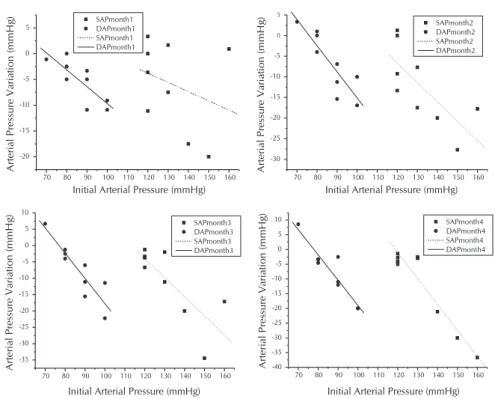
A high variation in behaviors of SAP and DAP can be observed in Figure 2 (IGa), with some individuals presenting increase in initial values. However, there was a trend for de-crease after the first month, especial-ly among participants who presented a more elevated initial pressure. This behavior remained in the second month of intervention, and, after the third month, the trend for decrease in arterial pressure became more evi-dent for all participants in this group. In the fourth month, all participants presented values close to normality (120 mmHg systolic pressure and 80 mmHg diastolic pressure).
Figure 3 shows that IGb partici-pants also presented, starting in the first month, a trend of decreasing arterial pressure, especially be-tween those who presented higher initial pressure values. It also shows a high variation in SAP and DAP be-haviors, with some individuals pre-senting increase in arterial pressure, a characteristic that persisted in the second month.
Table 1 – Characteristics of values for diastolic arterial pressure and systolic arterial pressure from participants in intervention groups “a” and “b” and control group, before and after intervention, Paiçandu, Brazil
Variables Groups
Intervention (n = 15) Control (n=15)
Intervention group a (n=9) Intervention group b (n=6)
Pre Post P value Pre Post P value Pre Post P value
SAP (mmHg) 132.2 ± 13.9 118.9 ± 8.7 0.036 143.3 ± 11.0 121.7 ± 14.6 0.024 138.7 ± 13.8 128.7 ± 16.3 0.112
DAP (mmHg) 86.7 ± 9.4 77.8 ± 6.3 0.041 95.0 ± 7.6 83.3 ± 12.5 0.104 88.7 ± 11.5 84.7 ± 9.6 0.324
Note: SAP - Systolic Arterial Pressure; DAP - Diastolic Arterial Pressure
Figure 2 – Variation in diastolic arterial pressure and systolic arterial pressure in rela-tion to initial arterial pressures during the four months of participarela-tion in intervention-group “a”
70 80 90 100 110 120 130 140 150 160
-20 -15 -10 -5 0 5 A rte ri al
Pressure Variation (
m
m
H
g
)
Initial Arterial Pressure (mmHg) SAPmonth1 DAPmonth1 SAPmonth1 DAPmonth1 SAPmonth2 DAPmonth2 SAPmonth2 DAPmonth2
70 80 90 100 110 120 130 140 150 160
-30 -25 -20 -15 -10 -5 0 5 A rte ri al Pressure Variation (mmH g )
Initial Arterial Pressure (mmHg)
SAPmonth3 DAPmonth3 SAPmonth3 DAPmonth3 SAPmonth4 DAPmonth4 SAPmonth4 DAPmonth4
70 80 90 100 110 120 130 140 150 160
-35 -30 -25 -20 -15 -10 -5 0 5 10 A rte ri al Pressure Variation (mmH g )
Initial Arterial Pressure (mmHg)
70 80 90 100 110 120 130 140 150 160
-40 -35 -30 -25 -20 -15 -10 -5 0 5 10 A rte ri al
Pressure Variation (
m
m
H
g
)
Initial Arterial Pressure (mmHg)
Figure 3 – Variation in diastolic arterial pressure and systolic arterial pressure in rela-tion to initial arterial pressures during the two months of participarela-tion in intervention-group “b”
90 100 110 120 130 140 150 160
-30 -25 -20 -15 -10 -5 0 A rte ri al Pressure Variation (mmH g)
Initial Arterial Pressure (mmHg)
90 100 110 120 130 140 150 160
-50 -40 -30 -20 -10 0 10 A rte ri al Pressure Variation (mmH g )
IGa presented changes in all analyzed biochemical variables, but the difference was only statistically significant for HDL, which went from 50.4 ± 6.6 to 54.2 ± 7.8 (p = 0.034). IGb and CG showed changes in biochemical parameters (glucose, HDL and TG; and glucose, TC, HDL and TG, respectively), how-ever, both had no statistically significant differences (Table 2).
IGa participants presented decrease in mean values for all anthropometric variables (Table 2), and this was statistically significant for HC (p = 0.042) and WHR (p = 0.030). IGb pre-sented decrease only in WHR (0.98 ± 0.06 to 0.97 ± 0.05) and CG in percentage of body fat (38.0 ± 6.4 to 37.9 ± 6.9) and HC (105.3 ± 6.4) to 103.6 ± 5.7), however, difference were not statistically significant.
DISCUSSION
Six subjects of the intervention-group did not participate until the end because of various and personal reasons (death in families, surgery procedures, diseases and daily activities, among others). Another study asserts that non-adherence to intervention groups can be related to socioeconomic, environ-mental and low self-esteem factors(12).
Mean values for SAP and DAP in IGa participants and for SAP in IGb significantly decreased, presenting results similar to other intervention studies with individuals over 18 years of age. These studies also involved physical training and health counseling during various time lengths, in other words, 24 weeks, 16 weeks and 12 weeks; there was also significant de-crease in SAP and DAP(13-14).
The literature points out the processes possibly involved in the anti-hypertensive effects of exercise. They include direct mechanisms, among which are a reduction of sympathetic activ-ity, increase in baroreflex sensitivity and improvement in endo-thelial function. They also include indirect mechanisms such as obesity reduction and improvement of metabolic profile. Thus, the inclusion of regular physical activity is a recommendable non-pharmacological procedure for hypertension treatment, not only for its beneficial effects on arterial pressure, but especially for the possibility of reducing cardiovascular risk factors(15-18).
In this study, despite the few weeks of intervention, there was significant HDL increase for IGa and also decrease of oth-er lipid and glycemic values (TC, LDL, TG and glucose). These findings can be related to physical activity in association with health and nutritional counseling. Research conducted with an obese and sedentary population after 15 weeks of physi-cal exercise demonstrated significant increase in HDL levels and decrease in total cholesterol(19), confirming that physical
exercise causes changes in lipid parameters(19).
Significant differences in WHR and HQ were also observed in IGa participants. IGb and CG participants did not present significant differences. In another study, intervention with health counseling without association to physical activities was also efficient in decreasing SAP, anthropometric variables and in lipid profile(20). However, changes in lifestyle habits can
lead to prevention of cardiovascular diseases.
Effecting habit changes in populations with chronic problems through group activities enables improvements in discussions related to health issues, since the group can help participants Table 2 – Biochemical and anthropometric characteristics of participants in intervention groups “a” and “b” and control group,
before and after intervention, Paiçandu, Brazil
Biochemical variables
Groups
Intervention (n=15) Control (n=15)
Intervention-group “a” (n=9) Intervention-group “b” (n=6)
Pre Post p value Pre Post p value Pre Post p value
Glucose (mg/dl) 94.1 ± 7.9 90.0 ± 8.0 0.170 92.2 ± 14.1 90.3 ± 7.7 0.598 120.1 ± 30.9 108.5 ± 30.7 0.331
TC (mg/dl) 205.2 ± 41.9 195.3 ± 33.0 0.454 196.0 ± 40.3 202.2 ± 30.9 0.689 187.5 ± 35.4 181.8 ± 34.4 0.353
HDL-C (mg/dl) 50.4 ± 6.6 54.2 ± 7.8 0.034 54.0 ± 19.6 57.2 ± 23.2 0.574 48.2 ± 15.6 51.7 ± 17.4 0.080
LDL-C (mg/dl) 119.5 ± 29.2 114.3 ± 32.4 0.640 110.3 ± 25.8 118.0 ± 22.6 0.377 102.9 ± 32.9 104.3 ± 25.5 0.820
TG (mg/dl) 187.3 ± 87.9 146.0 ± 52.3 0.123 189.5 ± 196 134.7 ± 65.3 0.409 182.7±103.9 141.8 ± 78.5 0.249
Anthropometric variations
Weight (Kg) 75.9 ± 21.4 73.3 ± 19.1 0.111 68.2 ± 12.1 68.2 ± 13.3 0.969 73.5 ± 9.4 73.7 ± 9.3 0.584
BMI (Kg/m²) 30.6 ± 6.2 29.7 ± 6.2 0.121 27.2 ± 4.5 27.1 ± 4.5 0.881 29.5 ± 2.4 29.6 ± 2.5 0.575
BFP 39.9 ± 7.2 38.4 ± 8.5 0.056 34.5 ± 8.9 34.8 ± 7.7 0.642 38.0 ± 6.4 37.9 ± 6.9 0.828
AC 95.0 ± 14.2 93.2 ± 15.6 0.183 93.0 ± 11.0 93.2 ± 10.1 0.947 96.1 ± 8.3 97.1 ± 8.2 0.210
HC (cm) 108.9 ± 11.6 106.4 ± 12.1 0.042 104.2 ± 10.1 102.5 ± 12.3 0.195 105.3 ± 6.4 103.6 ± 5.7 0.456
WHR 1.00 ± 0.07 0.99 ± 0.07 0.030 0.98 ± 0.06 0.97 ± 0.05 0.363 0.99 ± 0.04 1.0 ± 0.05 0.451
REFERENCES
1. Lim SS, Vos T, Flaxman AD, Danaei G, Shibuya K,
Adair-Rohani H et al. A comparative risk assessment of
burden of disease and injury attributable to 67 risk fac-tors and risk factor clusters in 21 regions, 1990– 2010: a systematic analysis for the Global Burden of Disea-se Study 2010. Lancet [Internet]. 2012[cited 2016 Jan 15];380(9859):2224−60. Available from: http://dx.doi. org/10.1016/S0140-6736(12)61766-8
2. World Health Organization. Global status report on
non-communicable diseases. 2010. Geneva, WHO. 2010 [cited 2016 Jan 15]. Available from: http://www.who.int/ nmh/publications/ncd_report_full_en.pdf
3. Talaei M, Sadeghi M, Mohammadifard N, Shokouh P,
Oveisgharan S, Sarrafzadegan N. Incident hypertension and its predictors: the Isfahan Cohort Study. J Hyertens [Internet]. 2014[cited 2015 Dec 15];32(1):30-8. Available from: http://dx.doi.org/10.1097/HJH.0b013e32836591d4
4. Andrade SSA, Stopa, Brito AS, Chueri OS, Szwarcwald CL,
Malta DC. Prevalência de hipertensão arterial autorreferida na população brasileira: análise da Pesquisa Nacional de Saúde, 2013. Epidemiol Serv Saúde [Internet]. 2015 [cited 2015 Dec 15];24(2):297-304. Available from: http://dx.doi. org/10.5123/S1679-49742015000200012
5. World Health Organization. Global Status Report on
non-communicable diseases. 2014. Available from: http://apps. who.int/iris/bitstream/10665/148114/1/9789241564854_e ng.pdf?ua=1
6. Danaei G, Finucane MM, Lin JK, Singh GM, Paciorek CJ,
Cowan MJ, Farzadfar F, Stevens GA, Lim SS, Riley LM, Ez-zati M. National, regional, and global trends in systolic blood pressure since 1980: systematic analysis of health examina-tion surveys and epidemiological studies with 786 country-years and 5-4 million participants. Lancet [Internet]. 2011[cit-ed 2015 Dec 15];377(9765):568-77. Available from: http:// dx.doi.org/10.1016/S0140-6736(10)62036-3
7. Cervera DPP, Parreira BDM, Goulart BF. Educação em
saúde: percepção dos enfermeiros da atenção básica em Uberaba (MG). Ciênc Saúde Colet [Internet]. 2011[cited 2015 Dec 15];16(Sup.1):1547-54. Available from: http:// dx.doi.org/10.1590/S1413-81232011000700090
8. Silva LD, Beck CLC, Dissen CM, Tavares JP, Budó MLD,
Silva HS. O enfermeiro e a educação em saúde: um estu-do bibliográfico. Rev Enferm UFSM [Internet]. 2012[cited 2015 Dec 15];2(2):412-9. Available from: http://dx.doi. org/10.5902/217976922676
9. Sociedade Brasileira de Cardiologia. Sociedade Brasileira
de Hipertensão. Sociedade Brasileira de Nefrologia. VI Diretrizes Brasileiras de Hipertensão. Arq Bras Cardiol [In-ternet]. 2010[cited 2015 Dec 15];95(1supl.):1-51. Avail-able from: http://publicacoes.cardiol.br/consenso/2010/ Diretriz_hipertensao_associados.pdf
10. Associação Brasileira de Nutrologia. Sociedade Brasileira de Nutrição Parenteral e Enteral. Projeto Diretrizes. Utilização da bioimpedância para avaliação da massa corpórea [Inter-net]. 2009[cited 2015 Dec 15]. Available from: http://www. projetodiretrizes.org.br/8_volume/39-Utilizacao.pdf
11. World Health Organization. Diet, nutrition and the preven-tion of chronic diseases: report of a joint WHO/FAO expert consultation [Internet].Geneva; 2003[cited 2015 Dec 15]. Available from: http://www.who.int/dietphysicalactivity/publ ications/trs916/en/gsfao_introduction.pdf
12. Torres H de C, Franco LJ, Stradioto MA, Hortale VA, Schall VT. Evaluation of a diabetes education program. Rev Saúde Públi-ca [Internet]. 2009[cited 2015 Dec 15];43(2):291-8. Available from: http://www.scielo.br/pdf/rsp/v43n2/en_05.pdf
13. Sánchez P, Belén M, Reza CG, Pilar MM del , Castro MEM. Ejercicio físico con ritmo: intervención de enfermería para el control de la hipertensión arterial en um Municipio del estado de México. Esc Anna Nery Rev Enferm [Internet]. 2011[cited 2015 Dec 15];15(4):717-22. Available from:
better handle their limitations through regaining autonomy and the possibility of living more harmoniously with their health conditions(21). Coping with cardiovascular diseases and other
chronic diseases demands multidisciplinary and multi-profes-sional approaches, with strategic emphasis on prevention, treat-ment and control(22); It also requires actions that have positive
results on these diseases and their risk factors(23).
The type of intervention employed in this study is an im-portant and feasible tool for health workers when treating individuals with CNCDs, especially for nurses, since health education is part of their routine, and also because these pro-fessionals have a significant role in the prevention and promo-tion of health. This type of strategy is an important ally in plan-ning health actions, in the promotion, prevention and control activities for arterial hypertension and also other cardiovascu-lar diseases, with possible success in decreasing mortality by chronic non-communicable diseases.
The limitations and difficulties found in this study result from some participants not attending the complete proposed
period. However, since the strategy was efficient, it is worth adapting to frequency, time and location in order to favor the participation of a larger number of individuals.
CONCLUSION
The intervention was effective. Aerobic physical training and health and nutritional counseling with a multi-professional team were adequate/efficient to decrease and/or control pressure, an-thropometric and biochemic values, especially for those who participated in the study during the whole 16 weeks, according to what was proposed in the intervention protocol.
FUNDING
http://dx.doi.org/10.1590/S1414-81452011000400009
14. Park Y, Song M, Cho B, Limc J, Song W, Kima S. The effects of an integrated health education and exercise pro-gram in community-dwelling older adults with hyperten-sion: a randomized controlled trial. Patient Educ Couns [Internet]. 2011[cited 2015 Dec 15];82(1):133-7. Avail-able from: http://dx.doi.org/10.1016/j.pec.2010.04.002
15. Pontes Junior FLI, Prestes J, Leite RD, Rodriguez D. Influência do treinamento aeróbio nos mecanismos fisiopatológicos da hipertensão arterial sistêmica. Rev Bras Ciênc Esporte [Inter-net]. 2010[cited 2015 Dec 15];32(2-4):229-44. Available from: http://dx.doi.org/10.1590/S0101-32892010000200016.
16. Korsager LM, Matchkov VV. Hypertension and physical exercise: the role of oxidative stress. Medicina (Kaunas) [Internet]. 2016[cited 2015 Dec 15];52(1):19-27. Avail-able from: http://www.sciencedirect.com/science/article/ pii/S1010660X16000070
17. Millar PJ, McGowan CL, Cornelissen VA, Araujo CG, Swaine IL. Evidence for the role of isometric exercise train-ing in reductrain-ing blood pressure: potential mechanisms and future directions. Sports Med [Internet]. 2014[cited 2015 Dec 15];44(3):345-56. Available from: http://link.springer. com/article/10.1007%2Fs40279-013-0118-x#page-1
18. Roque FR, Briones AM, Garcia-Redondo AB, Galan M,
Martinez-Revelles S, Avendano MS, et al. Aerobic exercise
reduces oxidative stress and improves vascular changes of small mesenteric and coronary arteries in hyperten-sion. Br J Pharmacol [Internet]. 2013[cited 2015 Dec
15];168(3):686–703. Available from: http://onlinelibrary. wiley.com/doi/10.1111/j.1476-5381.2012.02224.x/pdf
19. Kannan U, Vasudevan K, Balasubramaniam K, Yerrabelli D, Shanmugavel K, John NA. Effect of Exercise Intensity on Lipid Profile in Sedentary Obese Adults J Clin Di-agn Res [Internet]. 2014[cited 2015 Dec 15];8(7):BC08– BC10. Available from: http://www.ncbi.nlm.nih.gov/pmc/ articles/PMC4149062/
20. Machado JC, Cotta RMM, Moreira TR, Silva LS. Análise de três estratégias de educação em saúde para portadores de hipertensão arterial. Ciênc Saúde Colet [Internet]. 2016[ci-ted 2015 Dec 15];21(2):611-20. Available from: http:// dx.doi.org/10.1590/1413-81232015212.20112014.
21. Soares LC, Santana MG, Thofehrn MB, Dias DG. Educação em saúde na modalidade grupal: relato de experiência. Cienc Cuid Saude [Internet]. 2009[cited 2015 Dec 15];8(1):118-23. Availa-ble from: http://dx.doi.org/10.4025/cienccuidsaude.v8i1.7786
22. Hill MN, Mensah GA. Global cardiovascular disease preven-tion: a call to action for nursing. J Cardiovasc Nurs [Internet]. 2011[cited 2015 Dec 15];26(4):S4. Available from: https:// www.escardio.org/static_file/Escardio/Subspecialty/Councils/ ccnap/global-cv-prevention-call-to-action-nursing.pdf