Simone Maria Muniz da Silva Bezerra
I, Eduardo Tavares Gomes
I,
Paulo César da Costa Galvão
I, Karolayne Vieira de Souza
II Universidade de Pernambuco, Postgraduate Program in Nursing. Recife, Pernambuco, Brazil.
How to cite this article:
Bezerra SMMS, Gomes ET, Galvão PCC, Souza KV. Spiritual well-being and hope in the preoperative period of cardiac surgery. Rev Bras Enferm [Internet]. 2018;71(2):398-405. DOI: http://dx.doi.org/10.1590/0034-7167-2016-0642
Submission: 02-14-2017 Approval: 07-18-2017
ABSTRACT
Objective: To characterize relations between spiritual well-being and hope of patients in the preoperative period of cardiac
surgery. Method: Exploratory cross-sectional study with quantitative approach, performed in the infi rmaries of a reference hospital in cardiology. We evaluated 69 patients hospitalized in preoperative period of myocardial revascularization, valve repair or replacement. Results: We verifi ed that patients hold relevant scores of hope and welfare in all areas, being the existential well-being signifi cantly lower than the religious one. The average of the spiritual well-being score was below the required to be considered high. There was no signifi cant correlation between welfare and hope. Conclusion: Nurses should develop a watchful eye to these issues, be trained in specifi c protocols of spiritual anamnese and use the real moments of care to strengthen the patients.
Descriptors: Preoperative Period; Cardiac Surgery; Myocardial Revascularization; Spirituality; Psychological Adaptation.
RESUMO
Objetivo: Caracterizar as relações entre o bem-estar espiritual e a esperança dos pacientes em pré-operatório de cirurgia
cardíaca. Método: Estudo transversal, exploratório, com abordagem quantitativa, realizado nas enfermarias de um hospital de referência em cardiologia. Foram avaliados 69 pacientes internados no período pré-operatório de cirurgia de revascularização miocárdica, troca ou plastia valvar. Resultados: Verifi cou-se que os pacientes mantinham relevantes escores de esperança e bem-estar em todos os domínios, sendo que o bem-estar existencial foi signifi cativamente menor que o bem-estar religioso. A média do escore de bem-estar espiritual fi cou abaixo do corte para ser considerada elevada. Não houve correlação signifi cativa entre bem-estar e esperança. Conclusão: Os enfermeiros devem desenvolver um olhar atento para essas questões, ser treinados em protocolos específi cos de anamnese espiritual e aproveitar os momentos reais de cuidado para fortalecer os pacientes.
Descritores: Período Pré-Operatório; Cirurgia Cardíaca; Revascularização Miocárdica; Espiritualidade; Adaptação Psicológica.
RESUMEN
Objetivo: Caracterizar las relaciones entre el bienestar espiritual y la esperanza de los pacientes en el preoperatorio de cirugía cardíaca.
Método: Estudio transversal, exploratorio, con abordaje cuantitativo, realizado en las enfermerías de un hospital de referencia en
cardiología. Fueron evaluados a 69 pacientes internados en el período preoperatorio de cirugía de revascularización miocárdica, cambio o plastia de válvula. Resultados: Se certifi có que los pacientes mantenían relevantes puntajes de esperanza y bienestar en todos los dominios, siendo que el bienestar existencial fue signifi cativamente más pequeño que el bienestar religioso. El promedio del puntaje de bienestar espiritual quedó abajo del corte para ser considerado elevado. No hubo correlación signifi cativa entre el bienestar y la esperanza. Conclusión: Los enfermeros deben desarrollar una atenta mirada para esas cuestiones, ser entrenados en protocolos específi cos de anamnesis espiritual y aprovechar los momentos reales de cuidado para fortalecer a los pacientes.
Descriptores: Período Preoperatorio; Cirugía Cardíaca; Revascularización Miocárdica; Espiritualidad; Adaptación Psicológica.
Spiritual well-being and hope in the preoperative period
of cardiac surgery
Bem-estar espiritual e esperança no período pré-operatório de cirurgia cardíaca
El bienestar espiritual y la esperanza en el período preoperatorio de cirugía cardíaca
INTRODUCTION
Surgery is generally referred in literature as the major stressor, and the preoperative period represents not only the possibility of cure, but also of failure and nonsuccess(1). Cardiac surgery has the peculiarity of involving the organ popularly recognized as the “noblest” and directly related to the maintenance of life. The unknown, along with the pos-sibility of failure, causes anguish in individuals, translated, in most cases, into anxiety and depression(2).
The theme of spirituality and religiosity has awakened interest in the academic milieu(3). Spiritual needs can be understood as the satisfaction of a spiritual growth, which makes people more sociable, hopeful and at peace with their divinity or transcendence(4).
An investigation conducted with preoperative patients of general surgery showed that patients with high religiosity levels had lower levels of anxiety(5). This study, though pre-senting selection bias of the sample (Islamic, in total) and not using a validated instrument for evaluation of the stud-ied religiosity, indicates the need to elaborate the subject in the academic and professional milieu.
Another research, aiming to evaluate the relations be-tween believing in God and religiosity in the preoperative period of cardiac surgery, using qualitative methodology, presented that belief positively affected the encounter with a new sense to the surgical process. The interviews inferred that the disease was not directly related to old ideas of di-vine punishment, but the awareness of the relation of heart disease with lack of healthy habits proved to be associated with feelings of guilt(1).
Therefore, it is necessary to understand the spirituality phenomenon and its role in maintaining patient’s welfare when facing the sickness, surgical process and arising ex-istential crisis as well as their relations with the encounter of a meaning to the moment of life and with the hope that patients lay on their future.
The incipient “theme approach” in the education of health professionals directly affects their professional prac-tice. The patient does not suffer alone with that deficit, but also the team loses opportunities, since they do not under-stand subjective phenomena in the health-disease process. Besides seeking to understand these gaps in therapeutic relationship between professional and patient, more research should be performed to provide evidence for the integral care. With the incorporation of new evidences, assistance protocols can be reformulated considering hitherto neglected dimen-sions in health care such as spirituality and religiosity.
This study aimed to characterize relations between spiri-tual well-being and hope of patients in the preoperative pe-riod of cardiac surgery.
METHOD
Ethical aspects
The research was based on the precepts of the NCS Resolu-tion no. 466/2012 and evaluated by the Ethics Committee of
Complexo Hospitalar (Hospital Complex) HOUC/PROCAPE of the University of Pernambuco and an integrant part of the approved project.
Design, study location and period
This is an exploratory cross-sectional study with quan-titative approach, performed in the infirmaries of coro-nariopathies, myocardiopathies and valvulopathies of the Pronto-Socorro Cardiológico Universitário de Pernambuco (PROCAPE/UPE) (University Cardiological Emergency Room of Pernambuco – PROCAPE/UPE) between October 2015 and February 2016.
Population and sample
A total of 69 patients hospitalized in the collection period that already knew the date of the surgery of myocardial re-vascularization, valve repair or replacement, were evaluated considering the following inclusion and exclusion criteria:
Inclusion criteria: admitted patients in preoperative pe-riod of cardiac surgery of myocardial revascularization, valve repair or replacement, aware of the surgery date for the fol-lowing day;
Exclusion criteria: lowered awareness level, impaired ver-bal communication or any clinical or psychological condi-tion that harmed the interview or made it uncomfortable; surgical indication for aortic diseases and congenital dis-eases; previous use of antidepressant; previous medical di-agnosis regarding mood or anxiety disorders, or any other psychiatric disorder; not have participated in any health edu-cation or anxiety reduction protocol; refusal at any step of the interview.
Study protocol
Patients were evaluated in the afternoon, before the vis-iting hour for relatives, whereas the visit routines of the nursing and medical teams were performed in the morning. Since the time for interviews was restrict, between lunch and visiting time, only one per day was usually performed. Pref-erably, it was asked the companion to leave the interview in such a way that the patients could have greater freedom to respond. The interviews, average time of 22.4 minutes, oc-curred on the surgery eve, and they were not conducted on the date scheduled for the operation.
Data were collected by researchers through their specific instrument, containing: a questionnaire elaborated for so-ciodemographic survey, which requested data such as sex, age, origin, income (in minimum wages, considering the current value in the period – R$ 788.00), education (in years of study), religious affiliation, type of surgery, hospitalization time etc.; Spiritual Well-Being Scale (SWB); and the Herth Hope Index (HHI).
Among the possible domains, only the personal and the transcendental domains were assessed, since they are closer and more related to the object of study and, to this end, it was used an already validated scale, the SWB Scale. This is an instrument divided in two subscales (of 10 items each), one of religious well-being (RWB) and another of existen-tial well-being (EWB). The items regarding RWB contain a reference to God, and the ones of EWB refer to the feeling of encounter with purpose and commitment to something meaningful in life.
Half of the questions in the scale are written in positive direction and the other half in negative one. The scale has 20 questions that must be answered by a Likert scale of six op-tions: totally agree (TA), agree more than disagree (Ad), partial-ly agree (PA), partialpartial-ly disagree (PD), disagree more than agree (Da), and strongly disagree (SD). The questions with positive connotation (3, 4, 7, 8, 10, 11, 14, 15, 17, 19 and 20) have its score summed as follows: TA = 6; Ad = 5; PA = 4; PD = 3; Da = 2; and SD = 1. The other questions are negative and should be summed in an inverse way (TA = 1; Ad = 2; PA = 3 and so on). The total of the scale is the sum of the scores, which can range from 20 to 120 of these 20 questions(7-8).
The HHI was the chosen instrument, among other interna-tional hope measurers, since it is a self-report scale, of easy and fast application, multidimensional, which clearly reflects the dimension of hope in clinical populations, with few items and reduced complexity, being a tool more clinically help-ful(9). With suitable validity and reliability, it assists researchers in the assessment of states of hope among patients and the effectiveness of strategies to increase hope. The Index consists of a scale of 12 items affirmatively written, and the ranking of items occurs by Likert scale of four points. The total score ranges from 12 to 48, where the higher the score, the higher the level of hope. There are two items – the affirmation num-ber 3 and numnum-ber 6 – that present inverted scores (9).
Analysis of results and statistics
The primary data storage was presented in software Micro-soft Excel 2013 spreadsheets. Data were analyzed through re-sources of descriptive and inferential statistics, using Epi-info 7.0 and SPSS 20.0 softwares.
We used the t-student test to verify the significance in the average comparisons of the continuous variables, considering the statistical significance as p < 0.05 (5%). The association between used scales and subscales and other variables was evaluated through the Pearson correlation coefficient and, fi-nally, the internal consistency of the items of the scales was assessed by Cronbach’s alpha (α).
HHI presented α = 0.797, the SWB, α = 0.866 and the subscales of religious well-being and spiritual well-being, re-spectively, α = 0.717 and α = 0.873, demonstrating signifi-cant internal consistency.
RESULTS
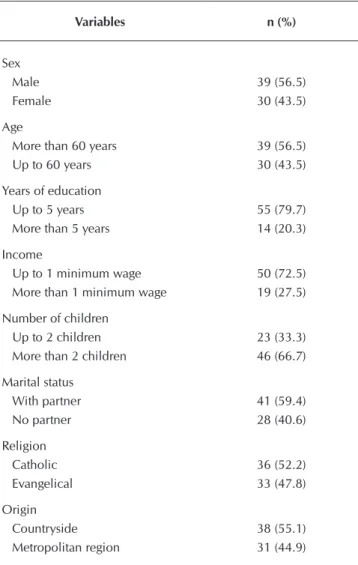
The sample was predominantly composed of male patients (56.5%), aging more than 60 years (56.5%) and education of up
to 5 years of study (79.7%) – considered to be low. The income was lower than 1 minimum wage for 72.5% of the patients. Most had more than 2 children (66.7%) and a partner (59.4%), both considered, in such cases, regardless of the relationship being formal or not. Regarding the origin, 55.1% resided outside the metropolitan region (Table 1). All the patients were adherents to a religion, being 52.2% Catholics and 47.8% Evangelicals (Table 1).
Table 1 – Sociodemographic characterization of the
sam-ple, Recife, Pernambuco, Brazil, 2016
Variables n (%)
Sex
Male 39 (56.5)
Female 30 (43.5)
Age
More than 60 years 39 (56.5)
Up to 60 years 30 (43.5)
Years of education
Up to 5 years 55 (79.7)
More than 5 years 14 (20.3)
Income
Up to 1 minimum wage 50 (72.5)
More than 1 minimum wage 19 (27.5)
Number of children
Up to 2 children 23 (33.3)
More than 2 children 46 (66.7)
Marital status
With partner 41 (59.4)
No partner 28 (40.6)
Religion
Catholic 36 (52.2)
Evangelical 33 (47.8)
Origin
Countryside 38 (55.1)
Metropolitan region 31 (44.9)
only two patients (2.9%) requested the presence of a leader or a religious representative (Table 2).
There was no difference between sexes regarding the spiritual well-being, its dimensions, nor hope. When we di-chotomized the sample between elders and non-elders, it was ascertained that elders reported better results in all wel-fare domains, mainly regarding the religious and total well-being, and presented spiritual well-being considered high, i.e., more than 100 points. In the assessment of hope, there was no difference between elders and non-elders (Table 3).
Among the groups, there were no differences of spiritual well-being and hope when assessed in the context of years of study, income, or presence of companions (Table 3).
Although the difference is not significant, probably due to the dimension of the sample, the Evangelicals presented higher well-being scores, and the Catholics, higher scores of hope. Only the domain of religious well-being had statisti-cal significant difference, being highest among Evangelistatisti-cals (Table 3).
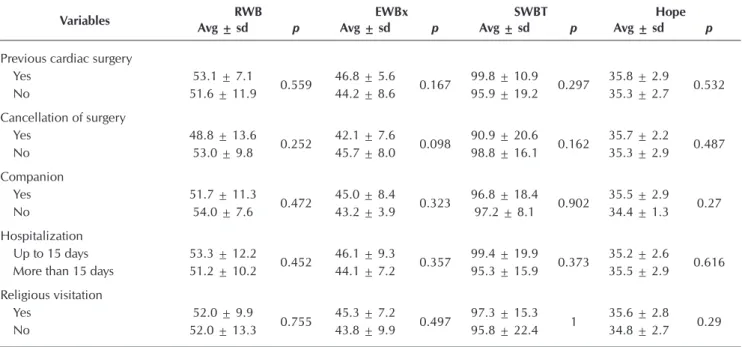
The experiments of previous cardiac surgery, cancellation of surgery, presence of companions, long hospitalization time and religious visitation were not variables that signifi-cantly affected spiritual well-being and hope (Table 4).
In a correlation analysis, we found that spiritual well-being has weak and direct association with age (p = 0.045) and weak and inverse with the number of children (p = 0.04), while hope had weak and direct associations with the years of study (p = 0.013) and income (p = 0.007) and weak and inverse with number of children (p = 0.05). There was no significant correlation between well-being and hope (Table 5).
Table 2 – Data of surgery and hospitalization, Recife,
Per-nambuco, Brazil, 2016
Variables n (%)
Surgery
Myocardial revascularization 47 (68.1) Valve repair or replacement 22 (31.9)
Previous cardiac surgery
Yes 17 (24.6)
No 52 (75.4)
Cancellation of surgery
Yes 17 (24.6)
No 52 (75.4)
Companion
Yes 61 (88.4)
No 8 (11.6)
Hospitalization time
Up to 15 days 26 (37.7)
More than 15 days 43 (62.3)
Received religious visitation?
Yes 49 (71.0)
No 20 (29.0)
Requested religious visitation?
Yes 2 (2.9)
No 67 (97.1)
Table 3 – Scores of spiritual well-being and hope by socioeconomic dichotomized variables, Recife, Pernambuco, Brazil, 2016
Variables Avg ± sdRWB p Avg ± sdEWBx p Avg ± sdSWBT p Avg ± sdHope p
Sex
Male 51.9 ± 10.2
0.792 45.4 ± 8.1 0.542 97.3 ± 16.7 0.982 35.5 ± 2.9 0.852
Female 52.1 ± 11.9 44.2 ± 8.1 96.2 ± 18.8 35.3 ± 2.6
Age
Up to 60 years 49.9 ± 13.1
0.007 43.7 ± 9.4 0.199 93.7 ± 21.3 0.009 35.0 ± 2.8 0.2
More than 60 years 54.7 ± 6.5 46.3 ± 5.7 100.9 ± 9.6 35.9 ± 2.7
Years of education
Up to 5 years 51.4 ± 12.1
0.342 44.5 ± 8.5 0.55 95.9 ± 19.2 0.385 35.2 ± 2.8 0.377
More than 5 years 54.5 ± 3.1 46.0 ± 6.1 100.5 ± 7.2 36.0 ± 2.6
Income
Up to 1 MW 51.9 ± 12.1
0.857 44.2 ± 8.2 0.297 96.1 ± 19.1 0.51 35.1 ± 2.4 0.158
More than 1 MW 52.3 ± 7.4 46.4 ± 7.4 98.7 ± 12.5 36.3 ± 3.4
Marital status
With partner 50.6 ± 13.3
0.149 44.5 ± 9.1 0.641 95.1 ± 21.2 0.261 35.4 ± 2.9 0.955
No partner 54.1 ± 5.8 45.4 ± 6.3 99.4 ± 9.7 35.4 ± 2.5
Religion
Catholic 49.6 ± 13.9
0.05 44.4 ± 11.2 0.622 94.0 ± 22.5 0.154 35.8 ± 3.1 0.245
Evangelical 54.6 ± 5.5 45.3 ± 4.8 99.9 ± 8.8 35.0 ± 2.4
DISCUSSION
People perennially present spiritual needs related to tran-scendence and satisfaction of a growth, whose accomplish-ment promotes hope, well-being, sociability and encounter with peace and meanings for life(4-6).
Regarding the studied sample, existential well-being, re-lated to crises experienced during the period, the pursuit for meaning and to inner questioning about the whys of every sit-uation, was significantly lower than the religious well-being.
The maintenance of religious well-being, considering the relationship with God through the individual’s personal reli-giosity, helps giving sense to the difficult process that the pa-tient is going through(1). Although the process of how the ex-perience of religiosity impacts physical health is still unclear,
there are evidences of better results for those who use these resources(10). An international cohort study on 162 patients, assessing physiological markers of stress (serum cortisol, C-reactive protein and Interleukin-6), reported that those who used religious coping strategies and social support also had better results after cardiac surgery(10).
The sample of the aforementioned study presented an av-erage of age close to 60 years, i.e., higher than the one of our study. Studies demonstrate that older patients have more mood disorders in the preoperative period, despite not evalu-ating the relation of these disorders with spiritual well-being, disregarding the religiosity and the subjectivity in the experi-ence of surgical procedure(11).
A survey conducted in a national reference center, when comparing the manners of hosting in the preoperative period,
Table 4 – Scores of spiritual well-being and hope by variables related to the hospitalization and surgery, Recife, Pernambuco,
Brazil, 2016
Variables RWB EWBx SWBT Hope
Avg ± sd p Avg ± sd p Avg ± sd p Avg ± sd p
Previous cardiac surgery
Yes 53.1 ± 7.1
0.559 46.8 ± 5.6 0.167 99.8 ± 10.9 0.297 35.8 ± 2.9 0.532
No 51.6 ± 11.9 44.2 ± 8.6 95.9 ± 19.2 35.3 ± 2.7
Cancellation of surgery
Yes 48.8 ± 13.6
0.252 42.1 ± 7.6 0.098 90.9 ± 20.6 0.162 35.7 ± 2.2 0.487
No 53.0 ± 9.8 45.7 ± 8.0 98.8 ± 16.1 35.3 ± 2.9
Companion
Yes 51.7 ± 11.3
0.472 45.0 ± 8.4 0.323 96.8 ± 18.4 0.902 35.5 ± 2.9 0.27
No 54.0 ± 7.6 43.2 ± 3.9 97.2 ± 8.1 34.4 ± 1.3
Hospitalization
Up to 15 days 53.3 ± 12.2
0.452 46.1 ± 9.3 0.357 99.4 ± 19.9 0.373 35.2 ± 2.6 0.616
More than 15 days 51.2 ± 10.2 44.1 ± 7.2 95.3 ± 15.9 35.5 ± 2.9
Religious visitation
Yes 52.0 ± 9.9
0.755 45.3 ± 7.2 0.497 97.3 ± 15.3 1 35.6 ± 2.8 0.29
No 52.0 ± 13.3 43.8 ± 9.9 95.8 ± 22.4 34.8 ± 2.7
Note: Avg ± sd – average ± standard deviation; SWBT – total spiritual well-being; RWB – religious well-being; EWB – existential well-being.
Table 5 – Associations between spiritual well-being and hope and continuous variables, Recife, Pernambuco, Brazil, 2016
Variables Avg ± sd Spiritual well-being Hope
r p r p
Age 59.90 ± 12.59 0.24 0.045 -0.11 0.372
Years of education 5.59 ± 4.61 0.12 0.335 0.30 0.013
Income 1.31 ± 1.07 0.03 0.823 0.22 0.007
Number of children 3.52 ± 2.13 -0.25 0.04 -0.22 0.05
Hospitalization time 20.75 ± 10.64 -0.63 0.61 0.04 0.741
Religious well-being 52.00 ± 10.94 0.94 <0.001 -0.09 0.443
Existential well-being 44.84 ± 8.05 0.89 <0.001 -0.03 0.775
Spiritual well-being 96.84 ± 17.51 ---- ---- -0.07 0.54
Hope 35.41 ± 2.79 -0.07 0.54 ----
demonstrated, through the evaluation of lower levels of anxi-ety, that the presence of the family is more significant for the confrontation than the sole contact of a nurse(12). In evalua-tions carried out in the sample of this study, the presence of companions was not determinant for better or worse results of spiritual well-being or hope. However, it was not evaluated the type of relationship with the companion nor the sphere in the relationship where the most intimate fears, anxieties and concerns would be approached or the religiosity expressed.
Another study of the preoperative period, when assessing the strategies of confrontation used by patients waiting for the cardiac surgery, reported that the modality of sustentative cop-ing, which includes spirituality, was used in 50% of cases(13). Other researches with qualitative approaches demonstrated the presence of positive feelings and the pursuit of faith and hope in religiosity when facing the event of cardiac surgery, with high values of spiritual resources in the confrontation with the operation(14-15).
One more cohort study observed 335 patients submit-ted to cardiac surgery, excluding the ones of emergency and heart transplant, for 30 months and concluded more than the religiosity implication in reducing preoperative anxiety and depression. They applied validated scales for evaluation of spirituality, religiosity, religious practices and beliefs, reli-gious/spiritual coping, optimism and hope, to present results over time. The reports demonstrated that better rates on these aspects reflected in higher existential growth regarding the psycho-spiritual development of individuals that underwent a surgical experience(16).
Another publication from the same authors, also in cohort to evaluate long-term anxiety and depression (30 months) re-garding the spiritual and existential aspects in the preoperative showed prayer, optimism and hope as predictors of lower rates of depression and intrinsic religiosity and hope as predictors of lower anxiety(17). Still in the same cohort, the authors named prayer as protection factor against fatigue during the follow-up, and preoperative anxiety, on the other hand, as increasing factor in evaluating the physical and mental fatigue(18).
Finally, there were few studies that investigated the issue of hope in the preoperative period of cardiac surgery and con-sidered it as main or secondary outcome of the investigation. There was a study that determined a significant association be-tween hope and religious-spiritual positive coping, but none that correlated it with spiritual well-being(19).
In Brazil, research that considers hope of chronic patients and their relationship with the clinic are relatively recent, keeping in mind that the authors who translated and validated the scale stated that until 2005 there was no instrument avail-able in Portuguese for such(9). However, the hope construct has emerged in qualitative research to understand the mean-ings and factors that influence the process of going through cardiac revascularization surgery for patients, families and healthcare professionals(20-23). In these studies, spirituality is referred as important in the participation in the surgical ex-perience, since patients can share their anguishes with God and have, in faith, the hope of achieving good results after
surgery(20-23). Lastly, although the relation between hope, faith and religiosity and the expectation about the surgery is fre-quent, patients can refer to it without making such correlation, just by knowing that the prognosis without surgery would be worse, despite the arising risks(23).
CONCLUSION
In the preoperative period of cardiac surgery, the patient assessment should consider the perspective of completeness, with metaphysical dimensions, often neglected, which can directly impact on reestablishment of the health of the body and, mainly, the psycho-emotional welfare before a particu-larly difficult and delicate process.
Regarding this perspective, the evidences in our study, in which patients generally did not reach high scores of spiri-tual well-being or hopes, should be a target for more reflec-tion. Nurses should develop a watchful eye to these issues, be trained in specific protocols of spiritual anamnese and use the real moments of care to strengthen the patients. Referring the find that existential well-being fell short from the religious one, a suggested strategy to nurses who deal with preopera-tive period of cardiac surgery is using, in their interventions, the religiosity that the patients have to help them in the pro-cess of encountering sense and re-significances.
We suggest, finally, that these propositions should be tested in practice and assessed in research in the preoperative pe-riod of cardiac surgery, in order to contribute to the mainte-nance of spiritual well-being, alleviate possible crises, reduce anxiety and depression and increase hope in life, promoting health in full perspective.
Study limitations
The sample that composed the study was not enough in or-der to observe some relations through the employed statistical tests. We suggest that other studies with qualitative approach can deepen what was evidenced in this study. Whereas there was no difference between spiritual well-being and hope when assessed from the perspective of most of the tested vari-ables, it is suggested to evaluate afterwards which factors can directly impact these outcomes.
Contributions of the study
This study reinforces the commitment that nursing must maintain a humanistic, as well as a metaphysics, proposal as-sociated with values that refer to the recognition of the spiri-tual dimensions of life and inner strength mobilized at the period of care.
REFERENCES
1. Gomes ET, Espinha DCM, Bezerra SMMS. Religiosidade e crença em Deus no pré-operatório de cirurgia cardíaca. Online Braz J Nurs [Internet]. 2015 [cited 2016 Aug 9];14(3):273-83. Available from: http://www.objnursing.uff.br/index.php/nursing/article/ view/5138/pdf_865
2. Quintana JF, Kalil RAK. Cirurgia cardíaca: manifestações psicológicas do paciente no pré e pós-operatório. Psicol Hosp[Internet]. 2012 [cited 2016 Aug 9];10(2):16-32. Available from: http://pepsic.bvsalud.org/pdf/ph/v10n2/v10n2a03.pdf
3. Moreira-Almeida A, Koenig HG, Lucchetti G. Clinical implications of spirituality to mental health: review of evidence and practical guidelines. Rev Bras Psiquiatr [Internet]. 2014 [cited 2016 Aug 9];36(2):176-82. Available from: http://www.scielo.br/ pdf/rbp/v36n2/1516-4446-rbp-2014-36-2-176.pdf
4. Yousefi H, Abedi HA. Spiritual care in hospitalized patients. Iran J Nurs Midwifery Res [Internet]. 2011 [cited 2016 Aug 9];16(1):125-32. Available from: http://www.ncbi.nlm.nih.gov/pmc/articles/PMC3203292/
5. Kalkhoran MA, Karimollahi M. Religiousness and preoperative anxiety: a correlational study. Ann Gen Hosp Psychiatry [Internet]. 2007 [cited 2016 Aug 9];6(17). Available from: http://www.ncbi.nlm.nih.gov/pmc/articles/PMC1947984/
6. Fisher J. The four domains model: connecting spirituality, health and well-being. Religions [Internet]. 2011 [cited 2016 Aug 9];2:17-28. Available from: http://www.mdpi.com/2077-1444/2/1/17
7. Volcan SMA, Sousa PLR, Mari JJ, Horta BL. Relação entre bem-estar espiritual e transtornos psiquiátricos menores: estudo transversal. Rev Saúde Pública [Internet]. 2003 [cited 2016 Aug 9];37(4):440-5. Available from: http://www.scielo.br/pdf/rsp/ v37n4/16778.pdf
8. Marques LF, Sarriera JC, Dell’aglio DD. Adaptação e validação da Escala de Bem-Estar Espiritual (EBE). Aval Psicol [Internet]. 2009 [cited 2016 Aug 9];8(2):179-86. Available from: http://pepsic.bvsalud.org/pdf/avp/v8n2/v8n2a04.pdf
9. Sartore AC, Grossi SAA. Escala de Esperança de Herth: instrumento adaptado e validado para a língua portuguesa. Rev Esc Enferm USP [Internet]. 2008 [cited 2016 Aug 9];42(2):227-32. Available from: http://www.scielo.br/pdf/reeusp/v42n2/a02.pdf
10. Ai AL, Kabbaj M, Kathy LL. Body affects mind? Preoperative behavioral and biological predictors for postoperative symptoms in mental health. J Behav Med [Internet]. 2014 [cited 2016 Aug 9];37:289-99. Available from: http://www.ncbi.nlm.nih.gov/ pubmed/23274763
11. Krannich JHA, Weyers P, Lueger S, Herzog M, Bohrer T, Elert O. Presence of depression and anxiety before and after coronary artery bypass graft surgery and their relationship to age. BMC Psychiatry [Internet]. 2007 [cited 2016 Aug 9];7:47. Available from: http://www.biomedcentral.com/1471-244X/7/47
12. Assis CC, Lopes JL, Nogueira-Martins LA, Barros ALBL. Acolhimento e sintomas de ansiedade em pacientes no pré-operatório de cirurgia cardíaca. Rev Bras Enferm [Internet]. 2014 [cited 2016 Aug 9];67(3):401-7. Available from: http://www.scielo.br/pdf/ reben/v67n3/0034-7167-reben-67-03-0401.pdf
13. Umann J, Guido LA, Linen GFC, Freitas EO. Enfermagem perioperatória em cirurgia cardíaca: revisão integrativa da literatura. Reme Rev Min Enferm [Internet]. 2011 [cited 2016 Aug 9];15(2):275-81. Available from: http://www.reme.org.br/artigo/detalhes/36#
14. Vargas TVP, Maia EM, Dantas RAS. Sentimentos de pacientes no pré-operatório de cirurgia cardíaca. Rev Latino-Am Enferm[Internet]. 2006 [cited 2016 Aug 9];14(3):383-8. Available from: http://www.scielo.br/pdf/rlae/v14n3/pt_v14n3a12.pdf
15. Koerich C, Baggio MA, Erdmann AL, Lanzoni GMM, Higashi GDC. Revascularização miocárdica: estratégias para o enfrentamento da doença e do processo cirúrgico. Acta Paul Enferm[Internet]. 2013 [cited 2016 Aug 9];26(1):8-13. Available from: http://www. scielo.br/pdf/ape/v26n1/03.pdf
16. Ai AL, Hall DE. Divine love and deep connections: a long-term follow-up of patients surviving cardiac surgery. J Aging Res [Internet]. 2011 [cited 2016 Aug 9];2011:841061. Available from: http://www.ncbi.nlm.nih.gov/pmc/articles/PMC3124964
17. Ai AL, Ladd KL, Peterson C, Cook CA, Shearer M, Koenig HG. Long-term adjustment after surviving open heart surgery: the effect of using prayer for coping replicated in a prospective design. Gerontologist [Internet]. 2010 [cited 2016 Aug 9];50(6):798-809. Available from: http://www.ncbi.nlm.nih.gov/pmc/articles/PMC2982210/pdf/gnq046.pdf
18. Ai AL, Wink P, Shearer M. Fatigue of survivors following cardiac surgery: positive influences of preoperative prayer coping. Br J Health Psychol [Internet]. 2012 [cited 2016 Aug 9];17(4):724-42. Available from: http://www.ncbi.nlm.nih.gov/pubmed/22524258
19. Ai AL, Park CL, Huang B, Rodgers W, Tice TN. Psychosocial mediation of religious coping styles: a study of short-term psychological distress following cardiac surgery. Pers Soc Psychol Bull [Internet]. 2007 [cited 2016 Aug 9];33(6):867-82. Available from: https:// www.ncbi.nlm.nih.gov/pubmed/17483394
20. Lanzoni GMM, Higashi GDC, Koerich C, Erdmann AL, Baggio MA. Fatores que influenciam o processo de viver a revascularização cardíaca. Texto Contexto Enferm [Internet]. 2015 [cited 2016 Aug 9];24(1):270-8. Available from: http://www.scielo.br/pdf/tce/ v24n1/pt_0104-0707-tce-24-01-00270.pdf
www.ncbi.nlm.nih.gov/pubmed/23546316
22. Mendonça KMB, Andrade TM. What do patients think about while waiting for myocardial revascularization? Crit Pathw Cardiol [Internet]. 2013 [cited 2016 Aug 9];12(4):188-91. Available from: https://www.ncbi.nlm.nih.gov/pubmed/24240547