Leão SC et al. / Mesoblastic nephroma with poor evolution: a case report
Radiol Bras. 2015 Nov/Dez;48(6):396–398 396
0100-3984 © Colégio Brasileiro de Radiologia e Diagnóstico por Imagem
Case Report
Mixed subtype of congenital mesoblastic nephroma with poor
evolution: a case report and literature review
*
Nefroma mesoblástico congênito subtipo misto com má evolução: relato de caso e revisão da literatura
Leão SC, Fernandes DM, Dias BG, Oliveira WR, Oliveira SM, Rangel MRU. Mixed subtype of congenital mesoblastic nephroma with poor evolution: a case report and literature review. Radiol Bras. 2015 Nov/Dez;48(6):396–398.
Abstract
R e s u m o
A male child born at 27 weeks, weighting 1305 g and presenting with a right-sided abdominal tumor. Computed tomography scan demonstrated the presence of a solid mass compressing the right kidney. Puncture biopsy revealed congenital mesoblastic nephroma. The patient underwent total right nephroureterectomy, and died on the second day after surgery.
Keywords: Mesoblastic nephroma; Kidney; Preterm birth.
Criança do gênero masculino, nascida com 27 semanas e 1.305 g de peso, apresentando tumor abdominal à direita. Tomografia computadorizada revelou formação sólida comprometendo o rim direito. Foi realizada biópsia por punção, cujo diagnóstico foi nefroma mesoblástico congênito. O paciente foi submetido a nefroureterectomia total direita, falecendo no segundo dia de pós-operatório.
Unitermos: Nefroma mesoblástico; Rim; Prematuridade.
* Study developed at Universidade Federal de Sergipe (UFS), Aracaju, SE, Brazil. 1. MDs, Department of Medicine, Universidade Federal de Sergipe (UFS), Aracaju, SE, Brazil.
2. PhD, Associate Professor, Department of Medicine, Universidade Federal de Sergipe (UFS), Aracaju, SE, Brazil.
3. PhD, Associate Professor, Department of Medicine, Universidade Federal de Sergipe (UFS), Aracaju, SE, Brazil. (In memoriam).
Mailing Address: Dr. Sydney Correia Leão. Departamento de Medicina da Univer-sidade Federal de Sergipe. Rua Claudio Batista, s/nº. Aracaju, SE, Brazil, 49060-100. E-mail: [email protected].
Received November 11, 2013. Accepted after revision March 14, 2014.
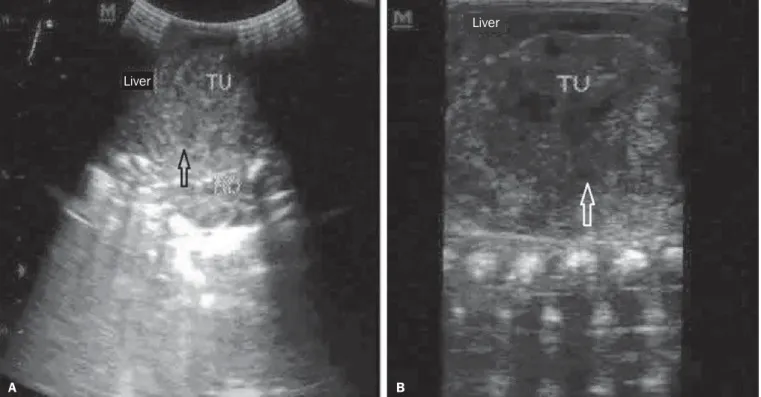
mor at right, besides respiratory failure, and the patient was referred to the neonatal intensive care unit. Abdominal ul-trasonography (US) demonstrated a solid tumor measuring 5.0 × 4.7 × 4.0 cm between the renal and hepatic regions (Figure 1). Abdominal computed tomography (CT) revealed the liver with a normal attenuation coefficient and presence of a solid mass with heterogeneous post-contrast enhance-ment compromising the right kidney, measuring about 4 cm in its largest diameter (Figure 2). Puncture biopsy was per-formed for pathological anatomy and immunohistochemi-cal analyses. Histopathologiimmunohistochemi-cal analysis demonstrated spindle cell tumor with high mitotic index (10 mitoses/10 CGA). On the other hand, the immunohistochemical analysis re-vealed positive Ki-67 (10% of cells), CD99 and smooth muscle actin. The conclusion was classical/cell variants (mixed subtype) of congenital mesoblastic nephroma. Be-cause of the histological type of the tumor, the neonate was submitted to total right nephroureterectomy. A bulky tumor occupying the whole renal locus, attached to the liver was found during the surgical procedure. The diaphragm was not involved. During the procedure, there was rupture of the tumor capsule, and the case evolved to the patient’s death on the second postoperative day due to septic shock.
DISCUSSION
Congenital mesoblastic nephromas (also known as Bolande’s tumor) are most commonly found in male indi-viduals, at a ratio of 2:1(5). Such tumors probably originate
from nephrogenic mesenchymal proliferation and generally present as an incidental finding of asymptomatic abdomi-nal mass in neonates(1,3). In some cases, tumor rupture may Sydney Correia Leão1, Diego Marques Fernandes1, Bruno Garcia Dias1, Wlisses Ramon Oliveira1,
Simone Maria de Oliveira2, Margareth Rose Uchoa Rangel3
http://dx.doi.org/10.1590/0100-3984.2013.1613
INTRODUCTION
Congenital mesoblastic nephroma is rare renal neopla-sia that was initially described by Bolande in 1967(1,2). In
spite of its low prevalence, congenital mesoblastic nephroma represents the most common renal neoplasm in neonates(1,3).
Such a tumor type is generally diagnosed at birth, or even between three and six months of age, is rarely found during childhood and exceptionally in the adulthood(1,4). The prog-nosis is generally good, particularly in cases where total surgical resection (radical nephrectomy or nephroureterec-tomy) is performed(3,4).
The present article reports a case of a mixed subtype of congenital mesoblastic nephroma with poor evolution, prob-ably resulting from prematurity and postoperative septic shock.
CASE REPORT
tu-Leão SC et al. / Mesoblastic nephroma with poor evolution: a case report
Radiol Bras. 2015 Nov/Dez;48(6):396–398 397
occur, leading to hemoperitoneum(1,6). In some cases, the diagnosis may be made early in the prenatal period either by means of amniocentesis or US(5,6). Besides tumor mass,
sonographic findings include presence of polyhydramnios, sometimes in association with non-immune hydrops, which is generally fatal(3).
Imaging methods play an important role in the post-natal diagnosis of mesoblastic nephromas(7). Such methods can
preoperatively assess the local invasion by the tumor, besides
allowing to follow-up the patients for possible local recidi-vation(8). Usually, US demonstrates a homogeneous, solid,
well defined lesion with a gross appearance(7,9). In some
cases, typical small-sized mesoblastic nephromas may show a concentric pattern, alternating between hypo- and hyper-echoic rings(10). The use of Doppler US allow for detecting
intratumoral hypervascularization(6).
CT allows for visualization of a solid renal mass with variable attenuation coefficient and possible necrotic and
A B
Figure 2. Abdominal computed tomography. A: Transverse section demonstrating the presence of a hypodense, solid mass measuring approximately 4 cm in diameter in the right renal locus (arrow). B: Transverse section demonstrating the presence of heterogeneous post-contrast enhancement in the region of the right kidney (arrow).
Figure 1. Total abdominal ultrasonography. A: Presence of heterogeneous tumor (TU) measuring approximately 5 × 4.7 × 4 cm located between the liver and the right renal locus (arrow). B: Presence of heterogeneous lesion, with hypoechoic areas predominantly located in the central region (arrow).
A B
Liver
Leão SC et al. / Mesoblastic nephroma with poor evolution: a case report
Radiol Bras. 2015 Nov/Dez;48(6):396–398 398
hemorrhagic areas, giving the lesion a heterogeneous appear-ance, which could indicate a worse prognosis(11). The presence
of small cystic areas is rarely observed, particularly in cases of typical mesoblastic nephromas(7,9,10). Magnetic resonance imaging (MRI) is useful to identify invasion of local struc-tures by the tumor. At MRI, mesoblastic nephromas present isosignal in relation to the renal cortex and to the skeletal muscle at T1-weighted images, and hypersignal in relation to those structures at T2-weighted images(12). Excretory
urog-raphy also is useful in the diagnosis of congenital mesoblastic nephromas, allowing for detecting distortion of the pyelo-caliceal system caused by the presence of the renal mass(10). The differential diagnosis of congenital mesoblastic nephromas should be made with other renal neoplasias such as metanephric adenomas, renal clear cell carcinomas and Wilms’ tumor(8). Wilms’ tumor and congenital mesoblastic nephromas are radiologically indistinguishable, so the dif-ferential diagnosis between such conditions is only possible by means of histopathology(8).
Generally, mesoblastic nephromas are unilateral tumors, although in some cases they may be found bilaterally(1).
Macroscopically, the tumor is generally whitish and solid, with weight and volume ranging from 0.01 kg to 2 kg, and 150 to 200 cm3
, respectively(3,4). Two presentations of this tumor can be observed at the microscope, namely the classi-cal and cellular patterns. At immunohistochemiclassi-cal analysis, congenital mesoblastic nephromas are positive for vimentin and smooth muscle actin, and negative for desmin, CD34, epithelial membrane antigen and cytokeratin(1).
Usually, the treatment of this type of tumor is surgical, either with nephrectomy or total nephrouretectomy which, besides reducing the possibility of recurrence, will serve as treatment for the hypertension secondary to hyperreni-nemia(3,6). With resection, the prognosis will be generally
good, particularly in cases of classical histological subtype(5).
Factors determining a poor prognosis are related to age, presence of positive surgical margins, and to a mixed histo-logical type(5).
In the present report, the case of a male, preterm neo-nate with a large, solid renal tumor at right is described. Im-aging studies demonstrated the tumor with heterogeneous contrast enhancement. Histopathological analysis in
associa-tion with immunohistochemical panel suggested the pres-ence of a mixed subtype of congenital mesoblastic nephro-mas. The patient was submitted to total nephrouretectomy. Basically, except for the prematurity, all the other charac-teristics of the present case are in agreement with the litera-ture.
The authors conclude that mesoblastic nephromas rep-resents a rare renal neoplasia, and the knowledge on its clini-cal, radiological and histopathological characteristics is important to facilitate the differential diagnosis with other most common pediatric renal tumors.
REFERENCES
1. Bisceglia M, Carosi I, Vairo M, et al. Congenital mesoblastic neph-roma: report of a case with review of the most significant literature. Pathol Res Pract. 2000;196:199–204.
2. Henno S, Loeuillet L, Henry C, et al. Cellular mesoblastic neph-roma: morphologic, cytogenetic and molecular links with congeni-tal fibrosarcoma. Pathol Res Pract. 2003;199:35–40.
3. Santos LG, Carvalho JSR, Reis MA, et al. Nefroma mesoblástico congênito subtipo celular: relato de caso. J Bras Nefrol. 2011;33: 109–12.
4. Dal Cin P, Lipcsei G, Hermand G, et al. Congenital mesoblastic nephroma and trisomy 11. Cancer Genet Cytogenet. 1998;103:68– 70.
5. Furtwaengler R, Reinhard H, Leuschner I, et al. Mesoblastic neph-roma – a report from the Gesellschaft fur Pädiatrische Onkologie und Hämatologie (GPOH). Cancer. 2006;106:2275–83. 6. Kotani T, Sumigama S, Hayakawa H, et al. Elevated levels of
al-dosterone in the amniotic fluid in two cases of congenital meso-blastic nephroma. Ultrasound Obstet Gynecol. 2010;36:256–8. 7. Khashu M, Osiovich H, Sargent MA. Congenital mesoblastic
neph-roma presenting with neonatal hypertension. J Perinatol. 2005;25: 433–5.
8. Ozturk A, Haliloglu M, Akpinar E, et al. Cellular congenital meso-blastic nephroma with contralateral medullary nephrocalcinosis. Br J Radiol. 2004;77:436–7.
9. Zeilinger G, Deeg KH, Beck JD. Ultrasound study of congenital mesoblastic nephroma. Klin Padiatr. 1988;200:321–3.
10. Chan HS, Cheng MY, Mancer K, et al. Congenital mesoblastic neph-roma: a clinicoradiologic study of 17 cases representing the patho-logic spectrum of the disease. J Pediatr. 1987;111:64–70. 11. Rieumont MJ, Whitman GJ. Mesoblastic nephroma. AJR Am J
Roentgenol. 1994;162:76.