ABSTRACT
http://dx.doi.org/10.1590/1678-7757201302270
Prevalence of long face pattern in Brazilian
individuals of different ethnic backgrounds
Mauricio de Almeida CARDOSO1, Renata Cristina Faria Ribeiro de CASTRO1, Tien LI AN2, David NORMANDO3,
Daniela Gamba GARIB4, 1
1- DDS, PhD, Professor of Orthodontics, University of Sagrado Coração - USC, Bauru, SP, Brazil.
2- DDS, PhD, Professor in Orthodontics, Department of Dentistry, School of Health Sciences, University of Brasilia, Brasilia, DF, Brazil. 3- DDS, PhD, Assistant Professor, Department of Orthodontics, Brazil Federal University, Belém, PA, Brazil.
4- DDS, PhD, Associate Professor, Department of Pediatric Dentistry, Orthodontics and Community Health, Bauru School of Dentistry, University of São Paulo, Bauru, SP, Brazil.
Corresponding address: Dr. Mauricio de Almeida Cardoso, - Universidade do Sagrado Coração - Rua Irmã Arminda, 10-50 - Jardim Brasil - Bauru - SP - 17011-160 - Brazil - e-mail: [email protected]
!"#$ % &'!"$% &'!
O
bjective: The long face pattern is a facial deformity with increased anterior total facial height due to vertical excess of the lower facial third. Individuals with long face may present different degrees of severity in vertical excess, as well as malocclusions thattreatment prognosis. This survey assessed the distribution of ethnically different individuals with vertical excess according to three levels of severity and determined the prevalence of long face pattern. Material and Methods: The survey was comprised of 5,020 individuals of Brazilian ethnicity (2,480 females and 2,540 males) enrolled in middle schools in Bauru-SP, Brazil. The criterion for inclusion of individuals with vertically impaired facial relationships was based on lip incompetence, evaluated under natural light, in standing natural head subtypes according to the severity: mild, moderate, and severe. Then the pooled sample was distributed according to ethnical background as White (Caucasoid), Black (African descent), Brown (mixed descent), Yellow (Asian descent) and Brazilian Indian (Brazilian native descent). The Chi-square (χ2) test was used (p<0.05) to compare the frequency
ratios of individuals with vertically impaired facial relationships in the total sample and among different ethnicities, according to the three levels of severity. Results: The severe subtype was rare, except in Black individuals (7.32%), who also presented the highest relative frequency (45.53%) of moderate subtype, followed by Brown individuals (43.40%). In the mild subtype, Yellow (68.08%) and White individuals (62.21%) showed similar and higher relative frequency values. Conclusions: Black individuals had greater prevalence of long face pattern, followed by Brown, White and Yellow individuals. The prevalence of long face pattern was 14.06% in which 13.39% and 0.68% belonged to moderate and severe subtypes, respectively.
Key words: Epidemiology. Long face pattern.
INTRODUCTION
Long face pattern consists of facial deformities
with increased anterior total facial height1,17 as
a consequence of vertical excess of the lower facial third1,4,11,25, which results in an oval10 or
taper1 facial appearance. In this pattern, lip
incompetence is mandatory1,4,25 and when the lips
seal, contraction of the perioral musculature can
of the chin contour1,4,10,23 and the appearance of
a more retrognathic mandible11,25.Gingiva and
incisor overexposure occur during smiling4,10,23
as a result of anterior and posterior maxillary
dentoalveolar growth excess1, which constitutes
the chief complaint of patients1,10,11,25.
marked nasolabial depression23. The length of the
upper lip is usually normal10,11,23, but it may be
short and aggravate the deformity11. The lower
lip posture is often impaired with excessive lip vermilion display at rest10,11. The nose is long1,4,10,11,
and the nostrils are narrow1,8,11,25 with prominent
nasal dorsum in lateral view4,10,11,23.In this context,
the orthodontic treatment alone is very limited, and an orthodontic-surgical approach would be
more appropriate9,24.
Despite the detailed description of long face pattern in the literature, few studies have
investigated the epidemiology of this deformity7.
A survey performed by the National Center for
Health Statistics15 showed a prevalence of 1.5%
among North Americans, where 0.75% of these individuals presented unattractive facial esthetics severe enough for indication of orthodontic-surgical treatment. Similar prevalence was found by another study (0.6%) with regard to individuals
with a severe long face pattern20.
In addition, it is important to consider the prevalence of different degrees of severity in vertical excess that may affect the face considering the great variation of long face problems, ranging from individuals without temporary passive lip sealing due to functional deviations unattractiveness due to long face pattern. The categorization of vertical excess is useful to determine the treatment prognosis.
The differentiation among ethnic groups in an epidemiological survey is of fundamental importance, as many studies reported racial differences in facial features. The Brazilian p o p u l a t i o n p r e s e n t s a va r i e t y o f e t h n i c
most heterogeneous population in the world18.
The State of São Paulo belongs to the Southeast region, which may represent Brazil in terms of its
ethnicity distribution19. Thus, this survey assessed
the distribution of ethnically different individuals with vertically excess according to three levels of severity, and determined the prevalence of long face pattern.
MATERIAL AND METHODS
In accordance with Resolution 196/96 of the National Health Council, the Declaration of Helsinki and the Nuremberg Code for human experimentation and after approval by the Institutional Review Board of Univ. Estadual Paulista - UNESP at Araçatuba (FOA 2005-01085), the present sample size was calculated considering a 95% confidence interval and 1.5% of the
estimated prevalence for long face pattern15. By
assuming that 0.35% of margin error could exist
in the population estimate, a sample size of 4,643
individuals was needed, according to the formula27
. Added to an estimated 10% of potential
5000 individuals was established to achieve the desired accuracy. The sample size was estimated on the Epiinfo 6.04 software.
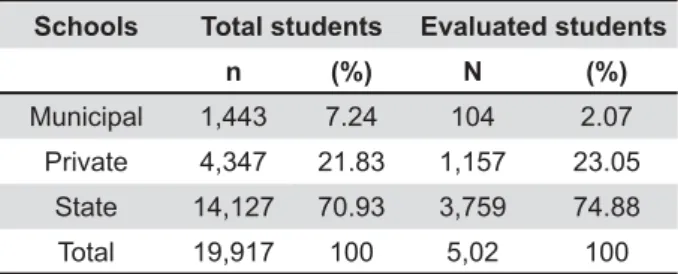
The present study was conducted on 5,020 individuals of Brazilian ethnicity enrolled in public and private middle schools (5th to 8th grades) in the
city of Bauru: 2,480 females (49.40%) and 2,540 males (50.60%) (Table 1). The individuals were aged 10 years to 16 years and 11 months, with a !"#$&'!**"*+ !;!!#$&'! year and 3 months) for females and 13 years #$&'!"+
Only morphological facial analysis was considered as the basis for the present study. = > = ?> Brown, Yellow and Brazilian Indian, according to the criteria established by the Brazilian Institute of Geography and Statistics (IBGE – Instituto
?@ JK+5. The ethnic
distribution among residents in the city of Bauru-SP and among the evaluated sample is presented in Table 2. Besides the skin color (evaluated in the ventral part of the forearm), the color and texture of the hair, the color of the eyes, and the forms of the lips and mouth were also considered in the
Q18 (2003).
According to the inclusion criteria, the individual should not present clinically observed syndromes and/or history of surgery, or fractures in the facial or skull region. The history of previous or ongoing orthopedic and/or orthodontic treatment was not an exclusion criterion, because both the facial proportions and relationships19,24,26. All
individuals were evaluated under natural light, in standing natural head position with the lips at rest without the aid of any special equipment, by a single examiner (MAC) experienced in orthodontics and properly calibrated for facial morphology
Schools Total students Evaluated students
n (%) N (%)
Municipal 1,443 7.24 104 2.07
Private 4,347 21.83 1,157 23.05
State 14,127 70.93 3,759 74.88
Total 19,917 100 5,02 100
evaluation11.
vertically impaired facial relationships with excess is morphological, based on lip incompetence,
that is, absence of lip sealing at rest1,4,25.Once
according to the severity as mild, moderate, and
thoroughly described and has proven to be reliable
in a previous study6 that demonstrated intra- and
inter-examiner agreement.
Classification criteria for the mild subtype included lip incompetence, excessive exposure of maxillary incisors at rest and/or gingiva when smiling, and presence of mild disproportion between the middle and lower facial thirds, even posturally. In summary, these individuals could be considered as transitory long face, postural or even borderline
to long face21. In this manner, they would present
a good prognosis for conservative treatment
(orthodontic and/or orthopedic)6 (Figure 1).
Figure 1- Facial photographs showing the mild subtype individual. Note that vertical facial proportions are balanced even though lip incompetence is observed. Parents signed informed consent for the publication of these pictures
Figure 2- Facial photographs showing the moderate subtype individual. Note that vertical facial proportions are unbalanced. The lower facial height is increased in relation to the middle facial height. Parents signed informed consent for the publication of these pictures
With regard to moderate subtype, the
discrepancy between the middle and lower facial thirds, besides the features already described in the previous subtype, thus certainly characterizing a long face pattern individual. In these individuals, the prognosis is regular for conservative treatment
(orthodontic and/or orthopedic)6 (Figure 2).
Individuals in the severe subtype should present a severe disproportion between the middle and lower facial thirds, associated with features described in the previous subtype combined to more typical signs of long face, severe enough to cause unattractiveness. In these individuals, the
prognosis is poor for conservative treatment, and orthognathic surgery is indicated for normalization of facial relationships6 (Figure 3).
For statistical processing, all results were analyzed on the Statistica 5.1 software (Stat Soft
Inc., Tulsa, USA). The Chi-square (χ2) test was
VX # Z[[V+ compare the frequency ratios of individuals with vertically impaired facial relationships in the total sample and among different ethnicities, according to the three levels of severity.
RESULTS
An evaluation of the intra- and inter-examiner
error in a previous study6 revealed a moderate
agreement, evidencing the accuracy of the present methodology. In general, 34.94% of the pooled sample presents vertical excess and 65.06% belong to other patterns, either pattern I, II, III or short face. Considering that long face pattern consists of moderate and severe subtypes, 14.06% of individuals showed long face pattern, in which 0.68% belonged to the severe subtype (Table 3).
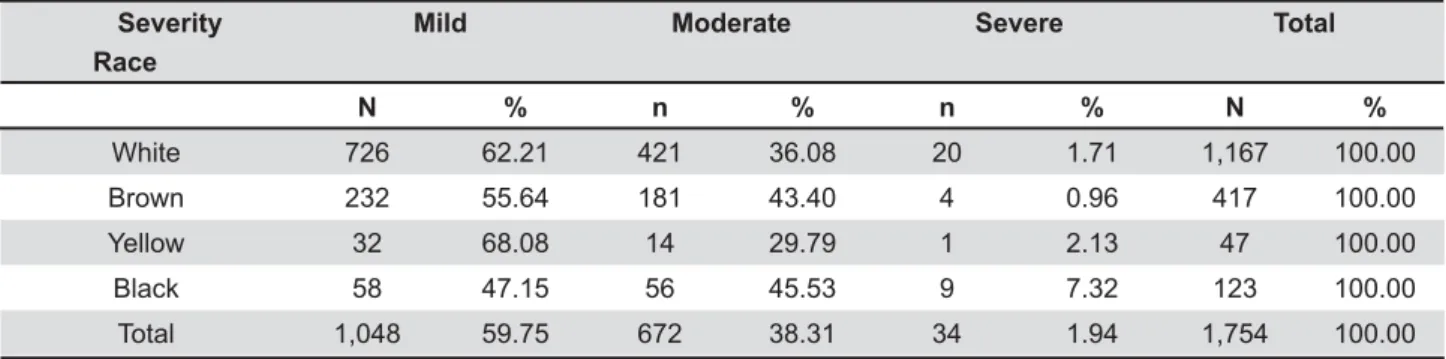
When the relative frequencies were analyzed (Table 4), the severe subtype was rare for all ethnicities, except for Black individuals (7.32%), whose value was three times higher compared to other ethnicities. With regard to the moderate subtype, Black individuals presented the highest relative frequency (45.53%), followed by Brown
Race n total % n
evaluated %
White 237,925 75.67 3,559 70.90
Brown 55,504 17.65 1,041 20.73
Black 15,281 4.86 279 5.56
Yellow 5,096 1.62 141 2.81
Brazilian Indian
625 0.20 0 0
Total 314,431 100% 5,020 100%
Table 2- Ethnic distribution of residents and evaluated sample in the city of Bauru-SP (Source: Ministry of Planning, Budget and Management. Brazilian Institute of Geography and Statistics)
Pattern Race
Mild Moderate Severe Other patterns Total
N % n % n % n % N %
White 726 14.46 421 8.39 20 0.40 2,392 47.65 3,559 70.90
Brown 232 4.62 181 3.60 4 0.08 624 12.43 1,041 20.73
Yellow 32 0.64 14 0.28 1 0.02 94 1.87 141 2.81
Black 58 1.16 56 1.11 9 0.18 156 3.11 279 5.56
Total 1,048 20.88 672 13.38 34 0.68 3,266 65.06 5,020 100.00
Table 3- Comparison of the prevalence of individuals with vertical excess and other patterns, according to severity, for each ethnic group
<$' Race
Mild Moderate Severe Total
N % n % n % N %
White 726 62.21 421 36.08 20 1.71 1,167 100.00
Brown 232 55.64 181 43.40 4 0.96 417 100.00
Yellow 32 68.08 14 29.79 1 2.13 47 100.00
Black 58 47.15 56 45.53 9 7.32 123 100.00
Total 1,048 59.75 672 38.31 34 1.94 1,754 100.00
individuals (43.40%), who were above the average relative frequency of the pooled sample (38.31%). An opposite situation was observed in the mild subtype, where Yellow (68.08%) and White individuals (62.21%) showed similar and higher relative frequency values.
DISCUSSION
Facial patterns are primary etiological factors
that determine the traces of malocclusions6. The
long face pattern similarly respects this rule, and malocclusions in individuals with long face are primarily the result of compensation of teeth aiming \] epidemiological surveys in orthodontics, to date, have been directed to the teeth and little information has been reserved to the facial patterns.
According to Hill13 (1992), the more complex the
survey method, the more errors could be generated. The subjective facial analysis parameters based for classification are not less validated or less reproducible. This method can be considered as an easier form for survey registration with good
reproducibility once the examiners are calibrated6.
With regard to the sample, the ethnic distribution can be considered as representative for the city of Bauru-SP, except for the Brazilian Indian group, who are concentrated in the rural area and were not covered in the present survey (Table 2). The ethnic distribution found in our survey cannot be considered as representative for Brazil. Thus, it may represent the distribution of the long face pattern in different races in Bauru, but not of a racial group in Brazil.
The high prevalence of vertical facial excess found in the present survey (34.94%) can be explained by the use of lip incompetency as the criterion in the present survey. The lip incompetency is mandatory in long face individuals; however, this characteristic may be frequent during the facial growth period, when it may be considered
as normal2. For those individuals with temporary
lip incompetency, malocclusion may not be present and orthodontic or orthopedic treatment may be unnecessary. To discriminate temporary from permanent lip incompetency, other facial features should be associated for the correct diagnosis6. From
the three subtypes of vertical facial excess, only moderate and severe subtypes were considered as long face patterns.
According to the prevalence of different severities of vertical facial excess, individuals with mild subtype (20.88%) were predominant (Table 3). Mild subtype individuals (Figure 1) may be different from each other, for who it may be speculated that the primary etiologic factors are not genetic, but local or general.
be only postural, which morphologically represents a mandatory yet temporary inadequacy between the internal and external functional components.
Individuals with vertical facial excess at moderate
individuals. A prevalence of 14.06% of individuals with long face pattern was found in this survey, resulting from the combined prevalence of moderate (13.38%) and severe subtypes (0.68%) (Table 3). Individuals with mild vertical facial excess were not included in the composition of the group of patients
as having transitory, postural or even borderline long face.
A slightly higher prevalence (4.1%) was reported in a retrospective study of 1,460 consecutive patients who sought treatment in the orthognathic
surgery service in North Carolina (USA)21. Since
the sample consisted of individuals seeking surgical treatment and the focus of the investigation was facial asymmetry instead of the long face pattern itself, these results may hardly be compared with those found in the present study.
With regard to frequency distribution, White individuals prevailed in all three levels of severity of vertical facial excess. However, this should not be considered as the true prevalence, but a tendency of White individuals in the pooled sample. When the relative frequency was analyzed, statistically
Yellow (68.08%) and White individuals (62.21%) showed higher frequencies of individuals with mild subtype, followed by the Brown (55.64%). Black individuals showed the lowest frequency of mild subtype (47.15%) (Table 4). Among individuals with long face pattern, constituted by moderate and severe subtypes, Black individuals showed the highest prevalence (7.32%), followed by Yellow (2.13%), White (1.71%) and Brown individuals (0.96%) (Table 4).
Although the Black ethnic group represented 5.56% of the total sample, this ethnic group showed the highest frequency of long face pattern. The tendency of increased facial height in Black individuals, of different magnitudes, has already been suggested in some cephalometric
studies3,12,16,22. Barter3 (1995) hypothetically
suggested that this increase in facial height was the compensatory mechanism of the mandible that rotates in a clockwise direction to compensate for the growth of the mandibular body. In other words, this morphological characteristic found in the Black ethnicity would predispose to an increase in vertical dimension.
Another survey conducted by the National Center
aged 12 to 17 years found a higher prevalence and severity of anterior open bite in Afro-Americans (16.3%) in comparison to White individuals (3.9%). Despite the limitations inherent to the survey, a great difference has been evidenced in the occlusal characteristics between different ethnic groups. This ethnic dimorphism in the characteristics of occlusion could certainly be extrapolated to facial relationships in such magnitude that still needs to be investigated and understood.
The results obtained from this survey suggest some characteristics with ethnic traits. As Yellow, White and Black ethnic groups are totally distinct from each other and Black individuals also participate in the genealogical line to constitute the Brown individuals18, their prevalence of vertical facial
excess as well as the severity of the deformity were also peculiar to each ethnic group. In this context, the Brown ethnic group, which usually resulted from the miscegenation of White and Black, may still present remnants of genetic traits of the Black ethnic group. This fact probably explains a greater proportion of individuals with vertical facial excess and long face pattern observed in both ethnicities.
According to a recent demographic census performed in Brazil, there is an evident increase of Brown ethnic individuals, resulting from miscegenation between White ethnic and Brown ethnic individuals as well as the miscegenation
between White ethnic and Brazilian Indians5.
Probably, the genetic traits of the Black ethnicity \ ? _ portion of Brazilian White individuals that also
showed genetic traces of the Black ethnicity18.
The miscegenation could be credited as one of the reasons explaining why vertical facial excess is highly prevalent among Brazilians compared to other populations in the world. Also, different sampling criteria may result in different prevalence values between the present study and the literature.
In summary, in the prevalence of individuals with long face pattern – moderate and severe subtypes – the Black ethnicity was higher than expected compared to other ethnic groups. This adopted in the study for morphologic diagnosis in Black individuals. Probably, the morphological criteria used for diagnosis of patients with vertical
Black individuals. In other words, the determinants of vertical facial excess for other ethnic groups could be considered as normal for Black individuals based on the proposed criteria for facial morphological analysis. This premise has been confirmed by Barter, et al.3 (1995). Other studies with only Black
ethnicities should be carried out to elucidate this hypothesis.
CONCLUSIONS
In descending order of relative frequencies, Black individuals had greater prevalence of long face pattern, followed by Brown, White and Yellow individuals. Only a small percentage of individuals (<1%) presented severe subtypes in all the ethnic groups. The prevalence of long face pattern was 14.06% in the population, in which 13.39% and 0.68% belonged to moderate and severe subtypes, respectively.
REFERENCES
1- Angelillo JC, Dolan EA. The surgical correction of vertical maxillary excess (long face syndrome). Ann Plast Surg. 1982;8:64-70.
2- ASHA. American Speech Language Hearing Association. The role of the speech language pathologist in assessment and management of oral myofunctional disorders. Asha. 1991;33(suppl. 5):7. 3- Barter MA, Evans WG, Smit GL, Becker PJ. Cephalometric analysis of a Sotho-Tswana group. J Dent Assoc. 1995;50:539-44. 4- Bell WH, Creekmore TD, Alexander RG. Surgical correction of the long face syndrome. Am J Orthod. 1977;71:40-67.
5- Brasil. Ministério do Planejamento, Orçamento e Gestão. {?@ JK|}| ~ ;[[[ IBGE. Rio de Janeiro: IBGE; 2002. 174 p.
6- Capelozza L Filho, Cardoso MA, An TL, Lauris JRP. Proposal for
according to severity. Rev Dental Press Ortod Ortop Facial. 2007;12(4):124-58.
7- Cardoso MA, Capelozza L Filho, An TL, Lauris JRP. Epidemiology of long face pattern in school children attending middle schools in the city of Bauru-SP. Dental Press J Orthod. 2011;16:108-19. 8- Epker BN, Fish LC. Surgical-orthodontic correction of open-bite deformity. Am J Orthod. 1977;71:278-99.
9- Fields HW, Proffit WR, Nixon WL, Phillips C, Stanek E. Facial pattern differences in long-faced children and adults. 1984;85:217-23.
10- Fish LC, Wolford LM, Epker BN. Surgical-orthodontic correction of vertical maxillary excess. Am J Orthod. 1978;73:241-57. 11- Fitzpatrick BN. The long face and V. M. E. Aust Orthod J. 1984;8:82-9.
12- Freitas LM, Pinzan A, Janson G, Freitas KM, Freitas MR, Henriques JFC. Facial height comparison in young white and black Brazilian subjects with normal occlusion. Am J Orthod Dentofacial Orthop. 2007;131:706.e1-e6.
13- Hill PA. The prevalence and severity of malocclusion and the need for orthodontic treatment in 9-, 12-, and 15-year-old Glasgow schoolchildren. Br J Orthod. 1992;19:87-96.
14- Kelly JE, Harvey C. An assessment of the teeth of youth 12-17 years. Washington, DC: National Center for Health Statistics; 1977. p.1-18.
15- Kelly JE, Sanchez M, Van Kirk LE. An assessment of the occlusion of teeth of children 6-11 years: United States. National Center for Health Statistics. Vital Health Stat. 1973:130:2-7. 16- Naidoo LCD, Miles LP. An evaluation of the mean cephalometric values for orthognathic surgery for Black South Africa adults. Part I: Hard tissue. J Dent Assoc. 1997;52:495-502.
17- Nielsen IL. Vertical malocclusions: etiology, development, diagnosis and some aspects of treatment. Angle Orthod. 1991;61:82-9.
19- Pena SDJ, Silva DRC, Silva JA, Prado VF. Retrato molecular do Brasil. Cienc Hoje. 2000;27:16-25.
;[*Q =]=Q and orthodontic treatment need in the United States: estimates from the N-HANES III survey. Int J Adult Orthod Orthogn Surg. 1998;13:97-106.
;!* Q = * thrusting: background and recommendations. J Am Dent Assoc. 1975;90:403-11.
22- Rosa RA, Arvystas MG. An epidemiologic survey of malocclusions among American Negroes and American Hispanics. Am J Orthod. 1978;73:258-73.
23- Schendel SA, Eisenfeld J, Bell WH, Epker BN, Mishelevich DJ. The long face syndrome: vertical maxillary excess. Am J Orthod. 1976;70:398-408.
24- Van Der Linden PGM. O desenvolvimento das faces longas e curtas e as limitações do tratamento. Rev Dental Press Ortod Ortop Facial. 1999;4:6-11.
25- Wolford LM, Hilliard FW. The surgical-orthodontic correction of vertical dentofacial deformities. J Oral Surg. 1981;39:883-97. 26- Woodside DG, Linder-Aronson S. The chanelization of upper and lower anterior face heights compared to population standard in males between ages 6 to 20 years. Eur J Orthod. 1979;1:25-40. 27- Zar JH. Biostatistical analysis. 3rd. ed. Upper Saddle River: