Ricardo Serrão Santos, Ana Colaço & Sabine Christiansen (Eds)
Arquipélago - Life and Marine Science
Supplement 4
ARQUIPÉLAGO
Life and Marine Sciences. Bulletin of the University of the Azores.
PUBLISHER
University of the Azores, Rua Mãe de Deus, 58 PT - 9501-801 Ponta Delgada, Azores, Portugal.
GUEST EDITORS FOR SUPPLEMENT 4
Ricardo Serrão Santos, Ana Colaço & Sabine Christiansen
INFORMATION ON THE INTERNET
Abstracts of all papers as well as instructions to authors are available on the Internet at: http://www.horta.uac.pt/editions/arquipelago.html
EDITORIAL SECRETARIAT
Helen Rost Martins, João M. Gonçalves, Rogério R. Ferraz, Horta.
COVER PICTURE
© IFREMER - ATOS / VENTOX
Indexed in:
Aquatic Sciences and Fisheries Abstracts (ASFA), BIOSIS, Current Awareness in Biological Sciences (CABS), Marine Science Content Tables (MSCT), Zoological Record
For purpose of citation, this supplement should be cited as follows:
R.S.SANTOS,A.COLAÇO &S.CHRISTIANSEN (Eds) 2003. Planning the Management of Deep-sea Hydrothermal Vent Fields MPA in the Azores Triple Junction (Proceedings of the workshop). Arquipélago. Life and Marine Sciences. Supplement 4: xii + 70 pp.
Proceedings of the workshop
Horta 18-20 June 2002
PRESIDENT OF THE WORKSHOP:
Prof. Mário Ruivo
President of the Intersectorial Oceanographic Commission CONVENORS:
Dr. Ricardo Serrão Santos
Vice President of the Institute of Marine Research
Arq. Eduardo Carqueijeiro
Director of the Environment of the Regional Government of the Azores
RAPPORTEUR:
Dr. Ana Colaço
Institute of Marine Research - Department of Oceanography & Fisheries, University of the Azores
WORKSHOP SPONSOR:
Dr. Helder Marques da Silva
Secretary of the Environment of the Regional Government of the Azores
ORGANISATION:
INDEX
WORKSHOP PROGRAMME 1
1st day 1
2nd day 1
LIST OF PARTICIPANTS 3
FOREWORD BY PROF. MÁRIO RUIVO 5
MESSAGE FROM DR PATRICIO BERNAL, ASSISTANT DIRECTOR-GENERAL OF
UNESCO 9
MESSAGE FROM DR. SIMON CRIPPS, DIRECTOR ENDANGERED SEAS
PROGRAMME, WWF INTERNATIONAL 9
INTRODUCTION 11
EXECUTIVE SUMMARY 12
PART I 13
RATIONALE AND PRELIMINARY PROGRAMME 13
WORKING GROUP RECOMMENDATIONS AND RESULTS 16
WORKING GROUP 1 16
MPA’S -LEGAL BACKGROUND.INSTITUTIONAL ARRANGEMENTS AND PROCEDURES FOR MANAGEMENT 16 1.MPACREATION AND MANAGEMENT STREAM 16
1.1 Legal Status of the MPA Management Plan 17
1.2 MPA Management Authority 17
1.3 Compliance/Enforcement 18
2.ACCESS STREAM 18
WORKING GROUP 2 19
MPA’S -SCIENTIFIC BASIS:OBJECTIVES, CRITERIA FOR ZONATION 19 2.1 Why management measures at this two hydrothermal vent fields? 19
2.2 Zonation 21
2.2.1 Lucky Strike 21
Integral Reserve (observation) 21
Reserve (observe, monitor) 21
2.2.2 Menez Gwen 21
Conservation Area (Non-intrusive observation, non-destructive sampling allowed) 21
WORKING GROUP 3 23
Ricardo Serrão Santos, Ana Colaço, Sabine Christiansen (eds.)
APPROACH TO THE DISCUSSION 23
3.1 Scientific research 23
3.2 Fisheries 24
3.3 Tourism 25
3.4 Commercial exploitation (Mineral, geo-thermal and biotechnological) 26
Closing plenary session 26
Further issues 26
Future developments 26
PART II 28
LUCKY STRIKE AND MENEZ GWEN MARINE PROTECTED AREAS: TOWARDS A
MANAGEMENT PLAN FOR THE SITES 28
1.INTRODUCTION 28
2.BACKGROUND 28
3.DESCRIPTION OF THE AREAS 30
3.1 The Azores Triple Junction 31
3.2 Menez Gwen (37°51’N; 31º31’W) 31
3.3 Lucky Strike (37º18’N; 32º16’W) 33
4.ENVIRONMENTAL AND SOCIO-ECONOMIC SIGNIFICANCE OF THE PROPOSED MARINE PROTECTED
AREAS 37
4.1 The Lucky Strike and Menez Gwen vent biota 38
4.2 Human pressures and other change agents 38
4.3 Economic value 40
4.4 Other Marine Protected Areas of pertinence 40
5.THE PLAN 41
Objective 1: Designation of the area as MPA 42
Objective 2: Assess quality and quantity of existing information: 42
Objective 3: Zonation of the MPA 42
LUCKY STRIKE 42
Integral Reserve (observation) 43
Reserve (observe, monitor) 43
Regulated Sampling 43
MENEZ GWEN 44
Conservation Area (Non-intrusive observation, non-destructive sampling allowed) 44
Regulated Sampling 44
Objective 4: Monitor and coordinate activities at the vent field through an Access 45
Objective 5: Code of Conduct 45
5.1 Scientific research 45
5.2 Fisheries 46
5.3 Tourism 46
5.4 Commercial exploitation (Mineral, geo-thermal and Biotechnological) 47 Objective 6: Establishment of a MPA data bank 47
6.ADMINISTRATION 48
7.FINANCING 49
REFERENCES 49 CLOSING SPEECH OF DR. HELDER MARQUES DA SILVA, SECRETARY OF
ENVIRONMENT OF THE REGIONAL GOVERNMENT OF THE AZORES 51
APPENDIX I – FORMS TO BE SUBMITTED TO THE OSPAR COMMISION 55
WORKSHOP PROGRAMME
1st day
9:00 - Opening and welcome Helder Marques de Silva
Secretary of Environment - Azores, Portugal
Mário Ruivo
President of COI - Lisbon, Portugal
9:30 - Geology and mapping of Lucky Strike and Menez Gwen Hydrothermal Vent Fields
Yves Fouquet
IFREMER - Brest, France
10:00 - Biology and ecological zonation of Lucky Strike and Menez Gwen Hydrothermal Vent Fields
Daniel Desbruyères
IFREMER - Brest, France
10:30 - The management of high seas sites and the law
Lyle Glowka
Independent Adviser on Marine Law - Germany
11:00 - Coffee Break
11:15 - State of the art on marine protected areas management
Susan Gubbay
Independent Adviser on Marine Conservation - UK
12:15 - WWF: The north-eastern Atlantic programme and conservation of high seas ecosystems
Stephan Luther & Sabine Christiansen
WWF International: North-East Atlantic Programme
12:45 - Lunch
14:00 - Establishment of the Endeavour hydrothermal vents marine protected area.
Kim Juniper & Doug Andrie [Presented by Ana Colaço]
Université du Québec à Montréal & Fisheries & Oceans Canada
14:30 - Preliminary proposal of management regulations for Lucky Strike and Menez Gwen (working document)
Ricardo Serrão Santos & Ana Colaço
IMAR / DOP University of Azores - Azores, Portugal
15:00 - Working groups: Management plan applied to reality and commitments
16:00 - Coffee break 18:30 - End of session
2nd day
9:00 - Working groups: Management plan applied to reality and commitments
11:00 - Coffee break 12:45 - Lunch
14:00 - Work on final document. 16:00 - Coffee break
18:30 - End of Session
Following the workshop, on the 20 of June, the Regional Secretary of Environmental of the Azores and WWF invite all participants of the meeting to celebrate the designation of the deep-sea hydrothermal vent fields as Gifts to the Earth, and the steps given towards the designation of those ecosystems as the first deep-sea Marine Protected Areas for the North East Atlantic.
LIST OF PARTICIPANTS
Agnieszka Adamczewska Freitas Artilheiro
Coordinator of InterRidge Program Instituto Hidrográfico da Marinha Portuguesa
[email protected] Ana Colaço
IMAR- University of Azores Fernando Barriga
GeoFCUL/Creminer, Faculdade de Cieências, Universidade de Lisboa
André Silva [email protected]
Instituto Superior de Psicologia Aplicada
Filipe Porteiro [email protected]
IMAR - University of Azores
Armando Almeida [email protected]
IMAR - Laboratório Marítimo da Guia
Frederico Cardigos [email protected]
IMAR - University of Azores
Daniel Desbruyères [email protected]
IFREMER- DRO/EP- Centre de Brest
Gabriela Queiróz [email protected]
Centro de Vulcanologia e Avaliação de Riscos Geológicos Univ. Açores
David Dixon
Head of Molecular Genetics, George Deacon Division, Southampton Oceanography Centre
Helder Marques da Silva
Secretário Regional do Ambiente
Deborah Hassler Hipólito Monteiro
Ridge 2000 Coordinator Instituto Geológico e Mineiro
[email protected] [email protected]
Dinah Sobral Isabel Noronha
Instituto de Conservação da Natureza Instituto de Conservação do Ambiente
[email protected] [email protected]
Eduardo Carqueijeiro Javier Escartin
Director Regional do Ambiente dos Açores
Laboratoire Geosciences Marines (CNRS UMR 7097)
Ricardo Serrão Santos, Ana Colaço, Sabine Christiansen (eds.)
Liberato Fernandes [email protected]
Presidente da Cooperativa de
Pescadores Porto de Abrigo Pedro Ferreira
Instituto Geológico e Mineiro
[email protected] Lyle Glowka
Biodiversity Strategies International Pierre-Marie Sarradin
[email protected] IFREMER - DRO/EP - Centre de Brest
[email protected] Luiz Menezes Pinheiro
Universidade de Aveiro
Ricardo Rodrigues [email protected]
Secretário Regional da Agricultura e Pescas
Manuel Biscoito
Director da Estação de Biologia
Marinha do Funchal, Museu Municipal do Funchal (Historia Natural)
Ricardo Serrão Santos
Director of DOP & Vice-President of IMAR - University of Azores
[email protected] Marcelo Pamplona
Director Regional das Pescas Sabine Christiansen
North-East Atlantic Programme
WWF International
Maria Pitta Grós [email protected]
Direcção Regional do Ambiente
Stephan Luther [email protected]
Director of the North-East Atlantic Programme
Mário Ruivo
WWF International Presidente da Comissão Oceanográfica
Intersectorial [email protected]
Susan Gubbay
Marine consultant specialising in coastal zone management, marine ecology and conservation planning
Marina Cunha
Departamento de Biologia, Universidade de Aveiro
[email protected] [email protected]
Yves Fouquet Marjaana Kokkonen
IFREMER - DRO/GM - Centre de Brest Associate Expert, Natural Heritage,
FOREWORD BY PROF. MÁRIO RUIVO
The Workshop on “Planning the Management of Deep-Sea Hydrothermal Vent Fields MPA’s in the Azores Triple Junction” organized under the sponsorship of the Secretary of the Environment of the Regional Government of the Azores, is a most timely gathering, involving a large and diversified participation of leading scientists and technicians, policy makers and managers of various national and international institutions associated with the study of the Middle Atlantic Ridge and related aspects of conservation. While this area has been object in recent years of active scientific investigations by Portuguese institutions and scientific expeditions undertaken by researchers from various countries, namely France and USA, the sate of knowledge on the most relevant sites (e.g. Lucky Strike and Menez Gwen) is now advanced, with fair good description of the geology and living communities. Research is now getting on experimental grounds.
Their peculiarities, and the opportunities for scientific and technological research and applications, stimulate a growing cooperation among interested institutions and experts. As reflected in specialized literature and in the outcomes of various fora dealing with deep sea research, the value of the sites and need to ensure their protection and conservation calls for an objective assessment of the impacts derived from research activities and other activities in order to establish objective basis for effective forms of conservation of the sites and their ecosystems. This requires further steps in cooperation and coordination, aiming at interested parties, so as to ensure that the deep sea hydrothermal vent fields are preserved for the future, both as special areas of reference and study, as well as areas of fundamental importance for advanced scientific research and a better understanding of our planet behaviour, without neglecting the opportunities for sustainable development and without unduly disturbing such a valuable ecosystem.
The general needs have been also recognized in various international instruments, namely the Chapter 17 of Agenda 21 (Rio de Janeiro Conference, 1992), the Oslo-Paris Convention (OSPAR), the Convention of Biological Diversity, as well as implications derived from other relevant international treaties.
In this context, beside scientific and conservation objectives, it should be noted how the initial forces which triggered the negotiations which led to UNCLOS (Montego Bay, 1982) - in particular to the formulation of its Part XI: the Area and related issues - have been shifting from polymethalics nodules to other deep sea resources with increasing emphasis on biodiversity, which is expected to lead to promising biotechnological utilisations. The World Wildlife Fund and the International Union for Conservation (IUCN) have been sensible to these trends and associated risks and have initiated efforts to ensure that the cooperation requirements
Ricardo Serrão Santos, Ana Colaço, Sabine Christiansen (eds.)
and the objectives of a sustainable development are taken into account in the process of decision on this issues which are, also, emerging in the debates taking place in the framework of the International Sea Bed Authority (ISBA) and of the Convention on Biological Diversity.
It is worth to recall that scientific research is fundamental to acquire knowledge on this most unknown part of our planet and data and information required for a better understanding of the deep-sea environment and processes, as well as for decision making on the effective management and protection of such vulnerable ecosystems.
The present Workshop was conceived keeping in mind the ongoing research activities offshore of Azores, to great extent within the Portuguese EEZ1, taking full advantage of the proximity of some of the most interesting hydrothermal vents site, of Horta2. It took also into account the ongoing steps and negotiations aiming at the establishment of a Deep-Sea Observatory (SANTOS et al. 2002), as a common
infrastructure, eventually, to be inserted within the “European Research Area” (ERA)
(BOISSONAS et al. 2002), hoping to mobilize support to such an observation tool, by
interested national and other partners, as well as by European Union, eventually under the 6th Framework Programme, or other appropriate scheme.
In order to respond to such stimulating challenges, the Workshop devoted its first part to make the point of the situation on the state of art and science knowledge on the vent fields, management of high seas and other relevant experiences dealing with marine protected areas. The second part of the Workshop was devoted to analyse and develop guidelines on legal and institutional arrangements and mechanisms, zonation and the development of elements for a code of conduct, having in mind the establishment of an appropriate conservation scheme.
The outcome of the Workshop was particularly rich, as reflected in the present Report, which provides useful information, criteria and outcomes of relevance for decision by the Government of Azores and the Portuguese authorities to establish on sound scientific and legal basis, a Marine Protected Area covering “Lucky Strike” and “Menez Gwen” sites, as well as for the development of management plan and other measures required to bring the concept to full action. It is also intended to increase awareness on the Azores Triple Junction deep-sea bed as an area of fundamental interest to mankind and as a potential natural site to be part of the Natural World Heritage maintained by UNESCO.
1 see: Santos et al. (1995b) for further information on marine research and conservation in the region of
the Azores
The role of the Intergovernmental Oceanographic Commission (IOC), as the appropriate organism within the UN system for the promotion and coordination of international cooperation regarding marine scientific research and related monitoring systems, namely in the framework of GOOS, must be kept in mind so as to optimise the available ways and means, including human resources capabilities, necessary to undertake such a complex and costly venture, which also opens other opportunities for cooperation between advanced industrial countries and developing ones, as encouraged at the WSSD (Johannesburg, 2002).
By hosting this Workshop at Horta, Portugal is pursuing its role as an active partner in international cooperation on Ocean Affairs, both in an European framework and globally.
Mário Ruivo
Chairman, Intersectorial Oceanographic Commission, Ministry of Science and Higher Education, Lisbon, Portugal
MESSAGE FROM DR PATRICIO BERNAL, ASSISTANT DIRECTOR-GENERAL OF UNESCO
Message from Patricio Bernal, Assistant Director-General of UNESCO and Executive Secretary of the Intergovernmental Oceanographic Commission, to the participants at the Workshop on “Azores Triple Junction Hydrothermal Vents Marine Protected Area Management Plan”, conveyed by Luis Menezes Pinheiro, from the University of Aveiro, representing the UNESCO/IOC Geosphere/Biosphere Coupling Processes Program.
Dear participants at the Workshop on “Azores Triple Junction Hydrothermal Vents Marine Protected Area Management Plan”: I wish to transmit to you my very best wishes of full success in your work. IOC welcomes the new initiative of establishing protected areas on high seas and is very supportive to international cooperation in this domain. More so as this initiative corresponds to one of important components of the IOC Ocean Science Programme, that on Science and Natural Resources of High Seas. In the progress of ocean exploration, a more complete understanding of the interdependent biogeochemical, ecological, physical, and geological processes occurring in the deep-sea shall be achieved first, and the Master Plan will certainly serve these purposes.
MESSAGE FROM DR. SIMON CRIPPS, DIRECTOR ENDANGERED SEAS PROGRAMME, WWF INTERNATIONAL
Message from Dr. Simon Cripps, Director Endangered Seas Programme, WWF International, to the participants at the Workshop on “Azores Triple Junction Hydrothermal Vents Marine Protected Area Management Plan”.
The Regional Government of the Azores is setting an important precedent and is accelerating action to protect the marine resources of the N.E. Atlantic by conserving deep sea hydrothermal vents with their unique and fragile life forms.
The designation and management of the Lucky Strike and Menez Gwen hydrothermal vents as marine protected areas (MPA’s), is recognised by WWF, the conservation organisation, as a Gift to the Earth (GttE) (see Appendix II) - a globally significant action which demonstrates environmental leadership and promotes future conservation success.
INTRODUCTION
Knowing the ocean, with all its beauty, its vastness, and its life, we can easily forget that its ecosystems are being altered beyond the balance of nature. This alteration is principally due to several human activities including fishing, pollution and development, both coastal and offshore.
Since our childhood, we have understood the oceans to be perfect environments and formed fantastic images of the various habitats and of the life within. After having perceived the oceans in such a way, it is now difficult for us to comprehend that many of its habitats and life forms are now subject to degradation as a result of our own activities. It has been easy for us to assume that all is well, especially when most of the damage is not obvious to us and often hidden, out of our sight, below the surface. A popular sentence, to describe our attitude toward what is happening to the marine environment might be, “Far from our eyes, far from our heart”.
The open sea is composed of many different habitats, wildlife congregations, and of life rich waters. The habitats change from being rocky bottoms to soft sediment.
Marine habitats have become especially endangered during the last decades. The offshore areas that had been thought to be stable and safe from human damage have been damaged. Several prime causes include, oil spills, the increased use of the offshore environment due to improved technology, over fishing and other pollution.
Marine Policy in the North East Atlantic has developed rapidly in the last decade, greatly influenced by the United Nations framework, which support the long-term protection of the marine environment for future human generations. These frameworks refer to precautionary management approaches that are developed and implemented on an ecosystem perspective
But what is a habitat? A habitat is where an animal or plant lives. It has all the necessary environmental conditions for that species to survive. Habitats support many different communities of animals and plants. That way, natural or human caused activities can destroy a habitat causing damage to several communities. What is an ecosystem? An ecosystem includes all the animals, plants and microbes as well as non-living environment in a certain area. All of these elements are connected through biological, chemical and physical processes. Each species play a role in an ecosystem.
The present situation calls for measures to safeguard nature conservation in the open ocean, Marine Protected areas is one of them. A Marine protected area (MPA) is a coastal or oceanic area given special status for protection and maintenance of biodiversity, habitat protection, or it is associated to the protection of cultural resources and is managed with legal support or any other effective tool. The MPA’s serve to protect threatened species and their habitats. Its fomentation helps to increase
Ricardo Serrão Santos, Ana Colaço, Sabine Christiansen (eds.)
fisheries and non-fisheries resources, helps to maintain areas of high biodiversity or productivity, and it preserves unique habitats. Protecting them, we can warrant the marine ecosystems integrity and its inheritance for future generations.
The choice of an area as Marine Protected will depend on its productivity, existing diversity, how critical is the habitat (e.g. as spawning areas, nursery grounds, migration routes), and how threatened that habitat is. Under a precautionary approach a habitat/and or ecosystem shall be protected before it is threatened, in order to have it preserved.
Offshore locations have research and educational potential; North East Atlantic countries signed the OSPAR convention in order to protect this area of the ocean from pollution, overexploitation and habitat destruction. Under the scope of this convention, several offshore areas are being proposed as MPA’s, namely seamounts, deep-sea, coral reefs and hydrothermal vents.
Following the precautionary approach, this workshop was organized knowing that the threats to the hydrothermal vents are: marine scientific research; bio prospecting for genetic resources, deep-sea bed mining and deep-sea tourism.
Protecting these two hydrothermal vent fields, we will assure that biodiversity is maintained, that scientific expeditions will be much more cooperative and less destructive, and will assure that in the future, we can look the ocean, and know that these hydrothermal vent ecosystems are there, and will be there to be seen to be studied, to make part of the Blue Planet.
EXECUTIVE SUMMARY
The Secretary of Environment of Regional Government of the Azores has sponsored a thematic workshop, on the 18 and 19 of June of 2002, involving scientists, environment managers, Governmental departments, lawyers, NGOs and representatives of fishermen association and of the Hydrographic Institute (Portuguese Navy). The goal of the meeting was to discuss management issues for the conservation and provide guidelines that allow development of projects such as MOMAR. It is necessary that scientists recognize the need to preserve, minimize impact, and avoid unnecessary destruction. The Workshop followed the II MOMAR workshop on the 15-17 of June also held in Horta (SANTOS et al. 2002).
PART I
Rationale and Preliminary Programme The Mid Atlantic Ridge near the Azores has been extensively studied over the past years as part of programs funded by the European Commission and American National Science Foundation surveys, among others.
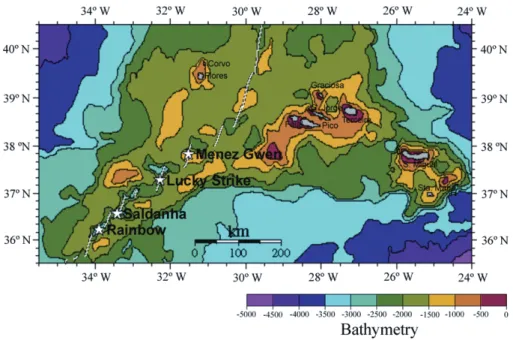
As a result of these cruises, the detailed bathymetry of the ridge, its geophysical signature, the composition of erupted basalts, and the large-scale distribution of chemical anomalies in the water column are well known within the MOMAR area. A principal objective of these programs was to locate hydrothermal sites and to study their physical, chemical and biological characteristics. This objective was remarkably successful, as four active hydrothermal sites have been discovered in the Azores region since 1992: the Menez Gwen site at 37°45'N, the Lucky Strike site at 37°15'N, the Saldanha site at 36°34'N, and the Rainbow site at 36°13.8'N. These four sites differ by (i) their depth (from 850 m to 2800 m), (ii) the composition of their host rocks (mantle-derived serpentinized peridotite or basalt), (iii) the nature of associated volcanism (explosive at depths shallower than 900 m, effusive at greater depths), and (iv) their tectonic setting (in the centre of ridge segments, or within axial discontinuities). The ecosystems associated with these four sites are also distinct, the biodiversity and biomass being greatest at the Lucky Strike site.
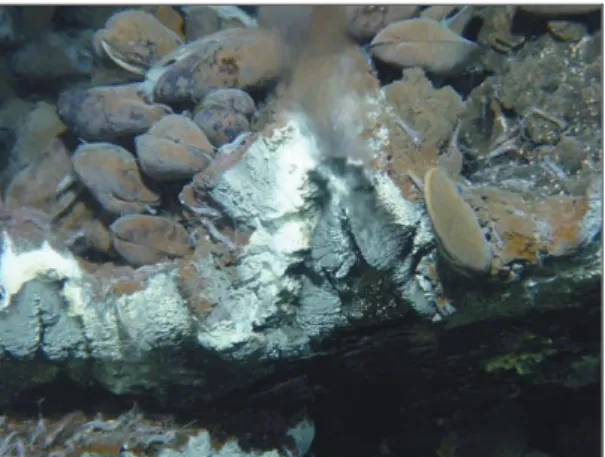
The Lucky Strike vent field is one of the largest hydrothermal areas known in the modern ocean, with 21 active chimney sites. It is relatively shallow (1700 m) and the maximum temperature of hydrothermal fluids (320°C) is just beneath the boiling point at that depth (340°C). Mussels dominate all other vent species, but the bio-diversity (66 species have been identified) and biomass are significantly higher than at the Menez Gwen site (35 identified species) (Fig. 1).
Fig. 1. The Mussel Bathymodiolus azoricus, dominate all other vent species in the Menez Gwen vent field. Crabs - Segonzacia
mesoatlantica; small limpets Lepetodrilus
sp.). Photo: © ATOS - IFREMER
The Menez Gwen vent field is very shallow (850 m) and the temperature of the hydrothermal fluids (278°C) is also close to the boiling point at that depth. Mussel beds are extensive and dominate all other species. Deep-sea scavengers (crabs) are also frequent at this site, possibly because fluid effluents have
Ricardo Serrão Santos, Ana Colaço, Sabine Christiansen (eds.)
been boiled and are therefore less toxic than at other hydrothermal sites of the Atlantic. Surrounding basalt is highly vesicular and shows evidence for emplacement through explosive volcanic processes, an unusual characteristic for mid-ocean ridge basalts that is most probably related to shallow eruption depths. Geological observations suggest that hydrothermal activity at this site initiated quite recently, which gives a unique opportunity to monitor the early stages of hydrothermal activity at a slow-spreading ridge.
Fig. 2. Highly vesicular basalts at the Lucky Strike lava lake. Photo: © ATOS - IFREMER
Lucky Strike and Menez Gwen are two off shore hydrothermal vent fields inside the Portuguese EEZ. Due to its proximity to the Azores and its relatively shallow location, numerous scientific expeditions and programmes focus on the investigation of the temporal and spatial geological and biological variability. Given the small surface of the actual vent sites, a need for management of activities
became particularly important.
As observatory type studies expend, so will the need to combine both the needs of purely observational investigations and those in situ experiments and instrumentation and the removal of specimens for collections and laboratory studies.
Concern about the impact of scientific research goes beyond the resolution of conflicts between different research programs. As vent sites become the focus of intensive, long-term investigation, oversight organisations will need to introduce appropriate measures to combine preservation of habitat and scientific interference such as sampling.
Since 1997, InterRidge has maintained the Hydrothermal Vent Ecological Reserves web page in order to allow scientists to post the location of vent sites that they request remain undisturbed for a specified length of time. To date, ecological reserves have been proposed at the Mid-Atlantic Ridge, East Pacific Rise and Juan de Fuca Ridge (DANDO &
JUNIPER 2000). In addition, a request has
been made to delay mining operations at western Pacific vents in order to allow for scientific study. The reserve postings vary in breadth and scope; at Juan de Fuca the Canadian government has proposed the Endeavour vent field as a pilot marine protected area, while the reserves at the other areas consist of requests from individual scientists conducting experiments at those areas. In 2001, the Endeavour hydrothermal vents
marine protected area management plan was created and then the area regulation was established.
The World Wide Fund for Nature (WWF) has proposed Lucky Strike a potential OSPAR Marine Protected Area (http://triton.ori.u-tokyo.ac.jp/~intridge/
luckystrike.pdf). Annex V of OSPAR
contains provisions with regard to the protection and conservation of the ecosystems and biological diversity in the marine area of the North-East Atlantic.
In 2000, InterRidge organized a workshop: “Management and Conservation of Hydrothermal vent ecosystems” (http://triton.ori.u-tokyo.ac.
jp/~intridge/ventrep.pdf). Lucky Strike is
considered a potential marine protected area.
Moreover, in the next years, the bases for an observatory at the MOMAR region (Menez Gwen; Lucky Strike, Rainbow and Saldanha hydrothermal vent fields) are being considered by the scientific community.
Aware of these facts and issues, the Regional Government of the Azores decided to create the opportunity of a workshop aiming the feasibility of creating MPA’s at Lucky Strike and Menez Gwen.
The workshop was organized by the IMAR - Centro da Universidade dos Açores and was convened by the president of the Intersectorial Oceanographic Commission Prof. Mário
Ruivo. Dr. Helder Marques da Silva, Regional secretary of the Environment sponsored this workshop.
The goals of this meeting were:
To characterise the threats to the sites (threat defined as an activity that will compromise sustainable use of the ecosystem, or diminish, or adversely affect, the use or value of the resource)
To entail a zonation plan of the area.
To develop and enforce co-operation and co-ordination. To create a code of conduct To design a full management plan To combine the conservation of the
sites with the users activities (tourism, scientific research, etc). In order to achieve these goals, the workshop was divided in two parts. At first, key interveners made presentation, focusing the state of the art of scientific knowledge the vent fields, aspects of management of high sea and other marine protected areas. These sessions were intended to provide a common basis of understanding of the needs, the law, and the different management instruments available.
The second part of the workshop was dedicated to thematic working groups. Three groups were established:
1- Legal and Institutional Considerations 2- Zonation
Ricardo Serrão Santos, Ana Colaço, Sabine Christiansen (eds.)
WORKING GROUP RECOMMENDATIONS AND RESULTS Working Group 1
MPA’s - Legal background. Institutional arrangements and procedures for management
Convenors: Lyle Glowka & Sabine Christiansen Rapporteur: Maria Pitta Gróz
Members: Mário Ruivo, Isabel Noronha, Dinah Sobral, Marjaana Kokkonen
The first steps of this working group were to create an analytical checklist of considerations and outstanding issues that could be used in internal governmental discussions based on:
Sources/status of existing international, European, national and regional laws Adequacy/implications of the legal and institutional capacities for creating and
managing the MPA and dealing with access to the MPA
Secondly, establish the issues that need to be considered before definitive conclusions are reached on the adequacy/implications of existing legal and institutional framework. At this point four issues were established:
Clarify geographical boundaries, e.g. square area or other regular shape, keeping in mind ecological considerations, not forgetting the 3rd and 4th component which includes the seabed/subsurface and water column
Clarify the management objectives for the MPA Clarify the activities that will be subject to control
Clarify relationship between national and regional laws/competences Two “streams” of legal and institutional issues were examined:
1. Creation and management of the MPA; 2. Access to the MPA.
1. MPA Creation and Management Stream
The indicatives sources of law were studied at the different hierarchical levels. International level, in which were included the UNCLOS (United Nations Convention of the Law of the Sea); the
Development, Chapter 17 of Agenda21 (Protection of the oceans, all kinds of seas, including enclosed and semi-enclosed seas, and coastal areas and the protection, rational use and development of their living resources; (www.un.org/
esa/sustdev/agenda21text.htm); the CBD
Biodiversity); OSPAR Convention (Convention for the Protection of the Marine Environment of the North-East Atlantic); World Heritage.
At a European level the Habitat Directive (Council Directive 92/43/EEC of 21 May 1992 on the conservation of natural habitats and of wild fauna and flora) was considered of being of special implications.
At a national level, MPA’s can be created under two categories: Marine Park or Marine Reserve. However a question rises if the proposed MPA can fit one or a combination of these categories.
At a Regional level, the protected areas legislation is under review. Nevertheless it is not clear if the regional law competence can extend to the limits of the EEZ.
This has led to the question of how to consolidate the authority of the regional government within the framework of the national legislation applying to MPA’s?
1.1 Legal Status of the MPA Management Plan
Two possibilities where raised concerning the issues on legal status and management plan:
An informal agreement to implement the management plan (a kind of instrument of cooperation). However, an informal agreement do not have a legal binding character, and might have implications for international and
European designation (e.g., World Heritage List and EU NATURA 2000), not allowing access to technical and financial resources.
A formal law that creates the MPA area and specifies management objectives and principles that would then provide the legal basis to establish and implement the management plan (MP is an operational-type document that would be kept under periodic reviews)
The code of conduct was inserted on the discussion, mainly in terms of its role. The main conclusions were that a “Code of Conduct” must be developed to apply in the interim period before formal law and management plan are applied, and that these code of conduct could be a source of permit conditions later on, especially when there are delays of technical/political order.
Ideally the law, the marine protected area and the code of conduct should be developed in parallel.
1.2 MPA Management Authority
A very important issue is the management authority for the MPA. There is a strong need to determine the structure, function and components of this authority. There is a need to clarify which are the national/regional responsibilities. Those responsibilities include the implementation, administration, coordination, etc.
If the MPA will be managed at the regional level, which Institutions will be responsible for that?
Ricardo Serrão Santos, Ana Colaço, Sabine Christiansen (eds.)
1.3 Compliance/Enforcement
Regarding the compliance and/or enforcement, there were doubts concerning which governmental level/institutions assure compliance and enforcement.
The initiatives that might want to get access to the MPA will be both foreign and domestic initiatives. Consistency of approach in decision making for foreign and domestic initiatives must be ensured.
Knowing that this is a complex area, a strong need of legal and institutional clarification is needed, like the sources of law (e.g. UNCLOS; EU related legislation; Existing national level laws). 2. Access Stream
The access stream is a major issue that needs to be addressed at an early stage, due to the fact that inside an MPA not all the type of access is allowed. There is a need to identify the possible activities that may require access to the MPA.
The identified ones were:
Research and monitoring activities
At present time a foreign vessel clearance procedures (Foreign Office) exists. However, a process must be established in order to homogenize the different procedures that the different legal institutions require to have access to the MPA. This can be characterised by existing consultation process, which would likely include the MPA competent authority
Bioprospecting Mining
Fishing activities
Tourism (acknowledging that foreign vessels are involved with this and that procedures applicable may be similar if not identical to clearance of foreign research vessels)
However how to ensure proper/full consideration of MPA in Foreign Office’s decision-making process? Is this related to the legal status of the competent authority’s comments?
The solution to be found needs to be consistent.
Working Group 2
MPA’s - Scientific basis: Objectives, criteria for zonation
Convenors: Fernando Barriga & David Dixon Rapporteur: Frederico Cardigos
Members: Daniel Desbruyères, Yves Fouquet, Ana Colaço, Gabriela Queiroz, Armando Almeida, Pedro Ferreira, Stephan Luther
This working group was in charged to use scientific bases to define the MPA’s areas and classifying them. The first point focused was the difference between these areas and the already proposed MPA “Endeavour segment”. It is not possible to use the same model system. These two vent fields at Portuguese EEZ are in a zone where chemistry is unique. Menez Gwen (MG) is the shallowest deep-sea hydrothermal vent in the planet, while Lucky Strike (LS) is one of the largest known vent fields. It is not possible to treat them as simple interchangeable system being distinct from the EPR (East Pacific Rise), due to reduced and contrasting depth conditions
The hydrothermal vents have a dependence on external sources in terms of dispersal of reproductive propagules. Moreover, these communities have a natural resistance to natural disturbance (perturbation) as a high reproductive output and a fast growth rate (cf. rest of deep sea). Water column is very important because there is a strong linkage between the seabed, the water column and the subsurface.
2.1 Why management measures at this two hydrothermal vent fields?
Vent sites are windows for Evolution of life (prebiotic synthesis, relict species,)
Hydrothermal vent will be a focus for future research and technological development - coordination between groups of scientists is a prerequisite to avoid conflicts
They are unique and visually spectacular, they are generating a widespread public interest
A basic requirement is to conserve biological diversity to the next generations
Potential value for biotechnological
industry (extremozymes, detoxication, repair mechanisms…)
Taking into account the scientific knowledge of the two vent fields and these reasons, the conservation requirements are:
Implementation of different conservation plans within the vent fields and not between vent fields as it is done at the Endeavour segment. Exploitation of mineral deposits
(threats to vent ecosystems) // better understanding of the genesis of ore deposits on land
The conservation needs to depend on good practice, sharing of samples, etc.
Ricardo Serrão Santos, Ana Colaço, Sabine Christiansen (eds.)
Despite the fishing gears be local hooked based limiting the fishing interferences, the development of other gears might cause a problem, and also the natural toxicity of the environment make us suggest that fishing should not be allowed
Mineral mining is a major potential threat for the future.
There was an on going discussion above the zonation criteria. First the degrees of disturbance and human influence were defined:
Fig. 3. Chemical sensors sampling a vent chimney at Lucky Strike vent field. Photo: © ATOS - IFREMER
Disturbance:
1. No entrance
2. Monitoring and measures (no sampling)
3. Non destructive sampling (chemical probes, biological sampling)
4. Destructive sampling (over sampling)
Human Influence:
1. Light
Fig. 4. Traps for macrobiological collection, e.g. shrimps, crabs and fishes. Photo: © ATOS - IFREMER
2. Chemical sensors (Fig. 3) 3. Non intrusive sampling
4. Macro biological collection (Fig. 4), drilling
Lucky Strike is of the largest hydrothermal vent field in the world; however the biological communities cover a small / restricted area. Menez Gwen is quite small. This WG worked on the definition of boundaries and zonation for both sites. Zonation took into account scientific pressure and the geographic conditions.
5. Fishing bottom trawling, military exercises
It was almost of general consensus that an area of no disturbance is needed, to have as reference in the future. The precautionary approach needs to be taken, even if dealing with activities, which there is no knowledge of the possible impact.
2.2 Zonation 2.2.1 Lucky Strike
Marine Protected Area - Latitude 37º12’ to 37º22’N, Longitude 32º15’ to 32º22’W, including the water column, the seabed and the subsurface.
The remaining area, but respecting the Code of Conduct and the indications of the MOMAR Steering Committee…
Tourism
Not inside MPA Fisheries
Not inside MPA Core area - Latitude 37º17’ to
37º18’N, Longitude 32º15’50’’ to 32º17’15’’W
Mining
Not inside MPA
Regulated scientific activities are the only activities permitted inside the MPA
Integral Reserve (observation)
2.2.2 Menez Gwen
Bairro Alto and Elisabeth until the Lava Lake. Latitude - 37º17’29’’- 40’’N
and Longitude 32º17’ - 16’50’’W. Marine Protected Area - Latitude 37º47’ to 37º52’N, Longitude 31º28’ to 31º35’W, including the water column, the seabed and the subsurface.
This area will respect the natural state of the environment (natural condition). Evolution of vent areas will be observed
in these areas. 37º51’N, Longitude 31º30’ to 31º31.8’W. Core area - Latitude 37º49.8’ to
Fig. 5. The Bairro Alto area where the natural conditions will be preserved. Photo: © SEHAMA
Fig. 6. General Menez Gwen vent field aspect. Photo: © ATOS - IFREMER
Conservation Area (Non-intrusive observation, non-destructive sampling allowed)
Reserve (observe, monitor)
LS ET and Sintra.
Ricardo Serrão Santos, Ana Colaço, Sabine Christiansen (eds.)
volcano and the coral reefs. Between parallel oblique lines defined by points: line 1. A1- 37º51.8’N and B1- 37º50.1’N and line 2. A2- 37º51.6’N and B2- 37º49.8’N.
Regulated Sampling
The remaining area, but respecting the Code of Conduct and the indications of the MOMAR Steering Committee …
Tourism
Not inside MPA Fisheries
Not inside MPA Mining
Not inside MPA
Regulated scientific activities are the only activities permitted inside the MPA
Note:
The coordinates proposed by this working group were considered preliminary and need to be readjusted. It was also agreed that the
water column must be an integrated part of the MPA.
This group also made some thoughts on the issue of code of conduct. It was considered that a scientific code of conduct is a must. A few key rules were raised:
Rule 1 - Submit the study plan to MOMAR Steering Committee;
Rule 2 - Respect the ongoing experiments, not disturbing them; Rule 3 - To share samples;
Rule 4 - Not destroy the active vents; Rule 5 - Respect the zonation.
(MOMAR Steering Comity can change zonation according to new and important scientific information) Rule 6 - Disseminate the code of
conduct and its implications among research scientist involved in the research missions.
Working Group 3
Elements for a voluntary code of conduct and other approaches/ instruments
Convenors: Susan Gubbay & Manuel Biscoito Reporter: André Silva
Members: Liberato Fernandes, Deborah Hassler, Pierre-Marie Sarradin, Freitas Artilheiro, Marina Cunha, Luís Menezes Pinheiro, & Ricardo Serrão Santos
Approach to the discussion
For the purposes of this task, the group considered that any future management of the hydrothermal vents should consider the ecosystem as a whole (geological, geochemical and biological aspects integrated) as well as its dynamics, structure and function.
All measures adopted should have, as final goal, the preservation of diversity,
senso latu (geo and biodiversity) and productivity.
Moreover, the MPA should promote outreach activities relating to environmental education.
This code of conduct needs to be widely publicized (goes with the permit, is on the different sites on the Web). A difference must be established between voluntary code of conduct and statutory code of conduct.
At this stage no distinction was made between proposals that should be put in a Code, and those that might require legislation or other mechanisms. Suitable ordering can be done at the next stage.
No proposals were rejected so the discussions could be kept as broad as possible. The group examined 4 major activities (current and potential) using the InterRidge report as a guide. These were: Scientific research, Fisheries, Tourism, Commercial exploitation (mineral, geo-thermal and biotechnological)
Management ideas were proposed for each, both within the proposed MPA and more generally in the EEZ, trying to take account of existing requirements and practice (e.g. Observer programmes, permit systems, fisheries box proposal). We recommend that explanations be given for the different elements in the code.
3.1 Scientific research
Research activities should be in accordance to the approved MPA’s
Management Plan and any other local and international regulations.
The PIs must provide to the MPA all accurate and relevant information in
Ricardo Serrão Santos, Ana Colaço, Sabine Christiansen (eds.)
order to obtain clearance for the research. After any cruise a list of samples (species (or type), preservation methods, numbers, destination, person/lab responsible) should be sent to the MPA Management Committee.
The MPA administration is aware of the need to protect unpublished data with respect to authorship. The MPA encourages the publication of the results.
The MPA must keep a public record of planned and completed research. It should also have communication channels permanently open to InterRidge, MOMAR, IOC, etc. Research should be publicized in order to avoid conflicts of interest.
The MPA management committee should publish an annual summary of research carried out in the area, directed mainly to general public.
The MPA encourages interdisciplinary research teams. Not only one discipline.
The PIs should report collection of non-target samples (not initially covered by the approved research programme).
Research should not pollute the area (e.g. ballast disposal). Presence of non-natural materials should be communicated to the MPA.
No disposal of sampling material at sea outside the area of collection (prevent contamination).
In the MPA research proposals need a statement to indicate possible environmental impacts.
Biological transplantation should be
MPA and discouraged elsewhere (risks of disrupting genetic integrity, disease dissemination and introduction of alien species).
Scientific equipment deployed on the sea floor must be reported in order to avoid conflicts of interest (DIXON et al.
2001, 2002) (Fig. 7).
Fig. 7. Retrievable cages with mussels at Menez Gwen, for later study at LabHorta. Photo: © ATOS - IFREMER
Voucher specimens and reference collections should be deposited in a Natural History Museum in accordance to the InterRidge Biological Exchange Agreement (e.g. Museu Municipal do Funchal (História Natural)), which in turn should keep updated public records.
3.2 Fisheries
No experimental as well as commercial fisheries should take place inside the boundaries of the MPA (Fig. 8).
The MPA Committee should develop and maintain information programmes
fishermen communities, involving their local organizations and other agents.
Fig. 8. Fisheries should not take place inside the boundaries of the MPA. Photo: © FPorteiro - ImagDOP
3.3 Tourism
Although tourism is not, for the moment, an important activity in the area, there are elements that indicate that this activity could increase in the future, with associated increased risk of impact. Extra
caution should therefore be exerted if this activity is to be permitted.
As a minimum:
Access should be prohibited in the defined zones shown in the accompanying maps i.e. experimental areas and highly sensitive areas. Other areas will also have restrictions relating to mode of operation, type and size of vehicle, etc.
MPA officers should be required on board tourism vessels to explain the MPA, describe work being undertaken and have enforcement duties.
During tourist trips collection of specimens will be prohibited. Photographic and video images should be used only for private use.
A fee should apply to professional photographers and copies of the images should be given to the MPA data bank. Publication of photographic material should refer to the MPA.
Tourism enterprises should submit independent Environment Impact Assessments (EIA). The activity should not impact or degrade the area in any way. Presence of non-natural materials should be communicated to the MPA.
Tourism trips and vessels will be licensed and such licenses will be revoked, if they violate the management objectives of the MPA.
A license fee, which will contribute to the management of the MPA, should be considered.
Ricardo Serrão Santos, Ana Colaço, Sabine Christiansen (eds.)
3.4 Commercial exploitation (Mineral, geo-thermal and biotechnological)
All commercial exploitation on the above topics shall be forbidden inside the boundaries of the MPA. Exploitation outside the MPA, which might affect the MPA, should be subject to strict independent environmental assessment and maybe prohibited.
Related research should follow the Code of Conduct.
Nevertheless a recommendation of this working group is that the code of conduct (voluntary or statutory) shall not be just a blind statement but shall also explain the reasons of the forbidden points.
Closing plenary session
At the closing plenary session, the results from the different working groups where presented and one point raised an enthusiastic discussion, the tourism.
Several concerns about tourism were raised. The impact it might have can not be quantified at this point. Tourism shall be restricted, and have strict rules. If there is a willing to make an open tourism, than this commission stands against the tourism activity on the MPA.
Another raised issue was the case of the professional photographers and
filmmakers. They cannot be considered has tourist, but has commercial exploitation.
Further issues
A very important point, raised by the representative of the fishermen association, not directly related the hydrothermal vents MPA’s was related with the opening of the European seas to European fishing fleets. In the case of the Azores this may lead to immediate dangers of sudden over-exploitation of the fragile and sensible deep-sea fisheries grounds at the seamounts of the Azorean EEZ. Fisheries on the Azores have been for years confined to artisanal line and hook, which have resulted already in some detrimental effects on some fish stocks. Higher technologies and deep-sea nets may deteriorate the state of the demersal and deep-sea fisheries and related biodiversity irreversibly.
The conveners recognised the concerns and were solidarity with the questions raised, and that these deserved to be brought and discussed in depth.
Future developments
The 2 areas will be submitted in June 2003 as candidates to integrate the OSPAR network of MPA’s (Appendix I).
The outside boundary limits of the Lucky Strike Marine Protected Area (LSMPA) are defined by a square which limits are: Latitude 37º12’ to 37º22’N, Longitude 32º15’ to 32º22’W, including the water column, the seabed and the subsurface.
The outside boundary limits of the Menez Gwen Marine Protected Area (MGMPA) are defined by a square which limits are: Latitude 37º47’ to 37º52’N, Longitude 31º28’ to 31º35’W, including the water column, the seabed and the subsurface.
Both of the Marine Protected areas are inside the Portuguese EEZ. LSMPA has a surface of 19218 ha and the MGMPA has a surface of 9520 ha.
The LSMPA and MGMPA comprise not only the rocky bottom, as also the subsurface, the water column and the resources there included.
Ricardo Serrão Santos, Ana Colaço, Sabine Christiansen (eds.)
PART II
LUCKY STRIKE AND MENEZ GWEN MARINE PROTECTED AREAS: TOWARDS A MANAGEMENT PLAN FOR THE SITES
1. Introduction
The purpose of this document is to outline the scientific and legal bases for the management plan for the Menez Gwen and Lucky Strike hydrothermal vent fields under their classification as Marine Protected Areas.
Marine Protected Areas (MPA) is an important instrument for the conservation of marine habitats and associated biodiversity. They may also be considered important tools in view to contribute for the restoration of habitats where needed.
An effective management in this context is essential in ensuring that the objectives of an MPA are matched and that they can be adjusted to potential changes in the alignment of the MPA.
Marine offshore features and ecosystems have a minor priority at present in the process of designating MPA's and thus should be given special attention.
2. Background
Hydrothermal vents such as Lucky Strike represent an exceptional offshore feature in the world oceans. Hot vents are formed on the seafloor spreading ridges where tectonics plates diverge and new
flows under the crust, gets heated by the nearby magma and flows on the water column as superheated plumes. Those plumes are hot mineral-rich water. When the hot water mixes with the cold deep ocean water, some of the minerals in the stream like sulphur, copper, gold and iron precipitate and build the chimney-like vents through which the hot water continues to flow. Black smokers with temperatures over 300ºC precipitate dissolved minerals and metals on the seafloor as polymetallic sulphide chimneys. In this manner, they play an important role in the regulation of the water temperature and the chemical balance of the oceans. Cooler water below 100ºC supports abundant microbial and animal life. Microorganisms that use chemical reaction energy from the fluids, a process called chemosynthesis, support this rich ecosystem. This process, based on geothermal energy is unique on earth. Its study and understanding has led to new theories about the origin of life. Hydrothermal vents host one of the highest levels of microbial diversity on the planet. The high production rates feeds a large number of animals, but the hostile conditions (high temperature, high heavy metals concentrations, high levels of gases like methane sulphide and carbon dioxide) have required unusual
The Sintra Statement, a political document that was adopted together with Annex V at the OSPAR Ministerial Meeting in 1998, specifically provided that the OSPAR Commission was expected to “promote the establishment of a network of marine protected areas to ensure the sustainable use and protection of marine biological diversity and its ecosystems in the maritime area.” (Sintra Statement, Summary Record of the Ministerial Meeting, Doc. OSPAR 98/14/1, Annex 45 available at
www.law.uu.nl/english/isep/nilos/paper/b iodiversity.PDF)
number of animals are new to science and, some of them, until present, can only be found on this environment. Due to the living conditions, these ecosystems provide support for an exceptional faunal community with many species being endemic to vent systems in general or even to one particular vent field.
Two sets of guidelines have been developed and approved to assist the Contracting Parties:
Guidelines for the identification and selection of MPA’s in the OSPAR Maritime Area;
Fig. 9. The hot water plumes are very rich in
minerals. Photo: © SEHAMA Guidelines for the management of
MPA’s in the OSPAR Maritime Area. (Thus far three workshops have been convened on MPA’s under the auspices of the OSPAR Biodiversity Committee. The draft guidelines are contained in the Annexes to the summary record of the third workshop on MPA’s in the OSPAR Area convened 11-14 June 2001 (Doc. MPA 01/8/1) (http://www.law.uu.nl/english/isep/
nilos/paper/biodiversity.PDF).
The Lucky Strike and Menez Gwen vent fields are two out of eight vent fields known to date in the North-East Atlantic. As they are located close to the Azores and in relatively shallow waters, they are frequently visited for scientific research without any site-specific measures to regulate the anthropogenic use and impact. Given the small surface of the actual vent sites, a need for management of the ongoing and potential prospective
activities became particularly evident. The Guidelines provide that OSPAR MPA’s are intended to serve three distinct purposes:
In October 2001 the Regional Secretary of the Environment of the Azores, proposed to designate the Lucky Strike vent field and Menez Gwen as Marine Protected Areas (MPA).
Protect, conserve and restore species, habitats and ecological processes, which are adversely
Ricardo Serrão Santos, Ana Colaço, Sabine Christiansen (eds.)
affected as a result of human activities;
Prevent degradation of and damage to species, habitats and ecological processes following the precautionary approach; and
Protect and conserve areas, which best represent the range of species, habitats and ecological processes in the OSPAR area.
There are a number of reasons to select Lucky Strike and Menez Gwen as MPA, which include the:
Unique habitat - active seafloor-spreading zone where tectonic plates diverge and new oceanic crust is formed, above a hotspot; Extreme conditions-areas have
large, hot black smokers and diffusers, chimney like structures venting water with temperature typically in excess of 300ºC, high concentration of gases like CO2; CH4 and H2S;
Abundance of fauna supported by chemosynthetic organisms that rely on seafloor geothermal energy; Species that do not exist, at present
knowledge, anywhere else in the world;
Significant research and on-going long term monitoring opportunities; Due to the fact that there is little experience in the designation of the MPA status for offshore areas like hydrothermal vent fields the legislative authority for the plan is not clear yet.
law were studied at the different levels and are given here as an example. The international one, in which were included the UNCLOS (United Nations Convention of the Law of the Sea); the United Nations Sustainable Development, Chapter 17 of Agenda21 (Protection of the oceans, all kinds of seas, including enclosed and semi-enclosed seas, and coastal areas and the protection, rational use and development of their living resources); the CBD (Convention on Biological Diversity; Jakarta Mandate on Marine and Coastal Biodiversity); OSPAR Convention (Convention for the Protection of the Marine Environment of the North-East Atlantic); World Heritage.
At a European level there is just the Habitat Directive (Council Directive 92/43/EEC of 21 May 1992 on the conservation of natural habitats and of wild fauna and flora).
At a national level, MPA’s can be created under two categories: Marine Park or Marine Reserve. However a question rises if the proposed MPA can fit one or a combination of these categories.
At a Regional level, the protected areas legislation is under review. Nevertheless it is not clear if the regional law competence can extend to the limits of the EEZ.
3. Description of the areas
The field is located within the EEZ of Portugal thus falling within the limits of
3.1 The Azores Triple Junction
The Azores triple junction (Fig. 10), a point where the American, Eurasian and African lithospheric plates meet, dominates the tectonic setting of the Azores region. The Azores islands rise from the Azores platform, an irregular submarine area limited by the 2000 bathymetric line. Both the islands, and this anomalous elevated submarine platform, have been created over the past 10-20 million years from persistent volcanic activity. Anomalous high temperatures in the earth’s mantle beneath the Azores, the so-called Azores hot spot, cause this long lasting volcanic activity.
3.2 Menez Gwen (37°51’N; 31º31’W)
The Menez Gwen area (37º 50,8 - 37º 51,6 N; 31º 30 - 31º 31,8W) was discovered during the French cruise DIVA1. It is located in the volcanic segment north of Lucky Strike (FOUQUET
et al. 1995). One of the characteristics of this segment is the absence of a central rift. The main volcanic feature is a circular volcano at the central part of the segment. This volcano is 700 meters high, with a diameter of 17 km. At its top, there is an axial graben 6 km long, 2 km wide and 300 meters deep. The graben is open at both its northern and southern parts, and thus, is not considered a simple caldera system. A new volcano (600 meters diameter and 120 meters high) is growing at the northern end of the graben. The Menez Gwen site is situated near the top of the
young volcano at the bottom of the graben at 840-870 meters depth (Figure 11). The volcano is composed entirely of extremely fresh pillow lava with no sediment cover (FOUQUET et al. 1995).
Several active sites were located on the southeast and east slopes of one small volcano growing at the northern end of the bottom of the graben at depths ranging from 840 to 865 m. Chimneys are typically small and essentially composed of white anhydrite, formed by the mixing of seawater and hydrothermal fluid. Around these small chimneys, some mounds with hot water diffusing through all surfaces are found (FOUQUET
et al. 1995). Menez Gwen vents exhibit temperatures between 265º C and 281º C with pH values between 4.2 and 4.8. The H2S contents are low compared to other hydrothermal fields (< 2mmol/kg). The fluid is gas enriched with CH4 values two times higher than at East Pacific Rise (EPR). The fluid is depleted in sulphide and metals.
At “PP 10/F 11” site hydrothermal precipitates cover an area of about 50 m in diameter. Anhydrite chimneys up to 2 m high are present at the summit of this low elevated hydrothermal mound being called “Homem em Pé” (standing men in Portuguese). A few patches (500 cm2 each) of mussels were present (COLAÇO
et al. 1998). A few Geryonidae crabs (Chaceon affinis) were present in the vicinity. A second and more important site (markers D9, PP 11, F 12) is located in an escarpment on the slope, between 860 and 842 m depth. It is bordered in the upper part by of pillow lava and
Ricardo Serrão Santos, Ana Colaço, Sabine Christiansen (eds.)
laterally by crumbled rocks. Hydrothermal deposits, occupy the centre of the site from which a 10 - 40ºC refringent fluid diffuses. An active chimney situated on the northwest escarpment belched out fluid at 277ºC. The site’s periphery was occupied by a little dense belt of hydroids. Numerous bathyal species have been found around the site: Chaunax sp., Trachyscorpia
cristulata echinata, Neocyttus helgae, Epigonus telescopus and Beryx splendens
(SALDANHA & BISCOITO 1997). Several
chimneys and areas of diffuse venting were found on the slope, where patches of mussels are over anhydrite and barite precipitates. In the border between pillow lava and the anhydrite deposits, there were important mussel’s colonies. Specimens sampled showed a maximum shell length of 111 mm. There were no
commensal scale-worms inside these mussels. Numerous patelliform gastropods were present on the mussels' shells, in particular Protolira valvatoides and one new species of the genus
Lepetodrilus. These mytilid populations
consisted mainly of large individuals (l >40 mm), but the two younger cohorts (modes 4 and 18 mm) were also present and represented ca. 20% of the population (COMTET & DESBRUYÈRES
1998). Extensive bacterial mats covered some of these populations. On the active deposits (chimney walls) and amongst mussels, important populations of C.
chacei and M. fortunata were found. This
species were observed on larger densities near the chimneys base. S. mesatlantica was the dominant indigenous predator, while many C. affinis came to feed on the mussels.
850 850 950 950 950 850 1000 10 00 1000 1000 750 850 850 950 950 950 850 1000 10 00 1000 1000 750 PP30, PP31 PP32, PP33 D9, PP11 F12 PP10 F11 31°31.8W 31°31.6 31°31.4 31°31.2 31°31 31°30.8 31°30.6 31°30.4 31°30.2 31°30 37°51N 37°51.8 37°51.6 37°51.4 37°50.2 37°50 0 500 1000 m
Fig. 11. Menez Gwen hydrothermal vent field (DESBRUYÈRES et al. 2001). At the PP 32/33 markers, the faunal
characteristics were similar to the above. Mussel populations were very important and covered virtually all-available rock surfaces. In contrast with previously studied sites, the size of mussels in this population was heterogeneous. Some mussels carried the commensal
Branchipolynoe seepensis. Numerous
gastropods were present on the mussels.
Geryonidae population around and inside
the site was important. A single specie of the genus Gaidropsarus was observed inside a crevice amongst mussels
(DESBRUYÈRES et al. 2001) (Fig 12).
3.3 Lucky Strike (37º18’N; 32º16’W)
Lucky Strike is one of the largest known active vent field in the modern ocean The Lucky Strike vent field is comprised between 37º17-37º18N; 32º16-32º17W. During a French American Ridge Atlantic program (FARA) cruise a dredge (D15) was made unexpectedly at an active hydrothermal field. A sulphide deposit covered with live organisms characteristic of hydrothermal vent communities was sampled. Thus originating the name “Lucky Strike”
(LANGMUIR et al. 1992). The Lucky
Strike segment is the third segment south of the Azores platform. It is approximately 65 km long, with depths ranging between 1550 m and 3000 meters. It is rectangular in shape, with a rift valley 11 km (uniform) in width The most prominent feature of this
vent field is the presence of bathyal fauna (fishes, cephalopods and crabs) making incursions to the vent field area, possibly to feed.