Guidelines Towards Information-driven Mobility
Management
Rute C. Sofia1,2,∗
1 Cognitive and People-centric Research Unit (COPELABS), University Lusofona de Humanidades e
Tecnologias, 1749-024 Lisbon, Portugal; [email protected]
2 ISTAR-IUL - Information Sciences, Technologies and Architecture Research Center, ISCTE - IUL, 1649-026
Lisbon, Portugal
† Current address: COPELABS, University Lusofona, Campo Grande 388, 1749-024 Lisbon, Portugal. Version May 7, 2019 submitted to Future Internet
Abstract: The architectural semantics of Information-Centric Networking bring in interesting 1
features in regards to mobility management: Information-Centric Networking is content-oriented, 2
connection-less, and receiver-driven. Despite such intrinsic advantages, the support for node 3
movement is being based on the principles of IP solutions. IP-based solutions are, however, 4
host-oriented, and Information-Centric Networking paradigms are information-oriented. By 5
following IP mobility management principles, some of the natural mobility support advantages of 6
Information-Centric Networking are not being adequately explored. This paper contributes with an 7
overview on how Information-Centric Networking paradigms handle mobility management as of 8
today, highlighting current challenges and proposing a set of design guidelines to overcome them, 9
thus steering a vision towards a content-centric mobility management approach. 10
Keywords:Mobility management, ICN. 11
1. Introduction
12
Internet traffic is consumed and produced by heterogeneous sets of mobile, resource-constrained 13
end-user devices which are interconnected via fixed or wireless/cellular infrastructures. Moreover, 14
the evolution of the Internet infrastructure, of which 5G is a relevant part, brings in new requirements, 15
such as the need to support large-scale Internet of Things (IoT) environments; strict end-to-end latency 16
requirements; service-oriented model support [1]. Mobility management plays a key part in this 17
evolutionary step of the Internet, and IP-based mobility solutions have been evolving towards the 18
support of network decentralisation, to be able to cope with high topological variability, among other 19
issues. Being based on the principles of IP networks only, current mobility management solutions 20
face limitations such as, for instance, the lack of integrated security; the need for an end-to-end path 21
between consumers and producers; being focused on host reachability, instead of on data reachability. 22
Several engineering workarounds have been assisting the evolution of such mobility management 23
solutions towards more complex, large-scale environments. 24
Information-Centric Networking (ICN) architectures, such as the Named Data Networking (NDN) 25
architecture, have intrinsic features that are better suited to support environments with a high degree 26
of mobility. For instance, ICN focuses on content and not on hosts as the addressable entities, thus 27
providing better communication support while devices are on the move. Its connection-less nature and 28
interface abstraction model are interesting features to support many-to-many communications, even 29
if connectivity is intermittent [2]. Its per packet pull-based communication model is, at a first sight, 30
sufficient to support consumer node mobility. On the other hand, its pull-based receiver-driven model 31
does not support well mobility of producer nodes, as shall be explained further in section 4.4. Producer 32
mobility is being handled by anchor-based proposals that mimic, in some aspects, IP-based mobility 33
management and consequently, are following a host-reachability mobility management model, instead 34
of a content-centric one. 35
To better understand how to develop future mobility management solutions, it is necessary to 36
think about the different mobility management functions, and how they are served (or not served) by 37
ICN. 38
This work contributes to the debate on how to evolve mobility management, in a way that truly 39
becomes content-centric: 40
• To highlight the functions that compose mobility management, based on the main architectural 41
solutions developed so far (section 3). 42
• To explain ICN mobility management efforts, highlighting challenges to overcome (sections 4, 5). 43
• To provide a set of architectural guidelines aiming at providing a content-centric approach to 44
mobility management and yet, assisting interoperability needs(sections 5, 6). 45
For this purpose, section2 covers related work explaining our contributions, while section 46
3provides a debate on mobility management functional aspects. Section 4covers ICN mobility 47
management. Guidelines towards a content-centric mobility management solution are provided in 48
section5, being the paper concluded in section 6, where future directions for research on this topic are 49
also provided. 50
2. Related Work
51
Mobility management comprises a wide set of related work, including an extensive set of 52
proposals that has been developed to support mobility from the perspective of different OSI layers [3]. 53
Out of the available solutions, IP-based solutions are today the basis of mobility management in 54
cellular and wireless environments. The most recent evolution of such category of solutions concerns 55
distributed mobility management and is being steered by the Internet Engineering Task Force (IETF) 56
Distributed Mobility Management (DMM) Working Group [4]. Decentralisation of IP-based mobility 57
management relates mostly with the integration of these approaches in large-scale heterogeneous 58
environments (such as 5G) as well as with support towards flatter networking architectures [5]. The 59
debate on decentralisation covers a wide set of topics, including decoupling of data and control planes; 60
better management of mobility anchor points, etc. 61
ICN introduced a relevant simplification, namely: information-centricity instead of 62
host-reachability. The capability to store status and data in routers (store-and-forward) provides the 63
grounds to better support mobility of devices in a network. In this context, a thorough overview 64
on mobility aspects for one of the existing ICN architectures, Named Data Networking (NDN), has 65
been provided by Zhang et al. [2]. The authors approach advantages and disadvantages in different 66
scenarios with the aim of further assisting the support of mobility. Their analysis is compared to 67
IP-based approaches in terms of architectural design. Zhu et al. provide a global overview on the NDN 68
design and mobility support, alerting to the need to consider a better support for producer mobility 69
[6]. In fact, most related work has been focused on improving producer mobility, i.e., supporting 70
movement of devices that provide data. Auge et al. provide a relevant overview on mobility support 71
in particular for environments focused on the interoperability of ICN and IP, proposing an anchor-less 72
solution to support mobility coupled to a routing protocol [7]. Kite is a mobility solution for NDN 73
which exploits NDN forwarding state to keep track of moving producers and their whereabouts. Kite 74
follows IP-based approaches by considering a “Rendez-Vous point” which assists in tracing where 75
data is, while the producer performs reattachment to a new location [8]. 76
Chen et al. describe steps towards a reference model for mobility-driven networks, debating on 77
evolutionary principles such as the decoupling of service and device entity, for vertical handovers, 78
and entity/locator identifiers, for horizontal handovers [9]. Tyson et al. provide a survey on ICN 79
mobility issues from an architectural perspective, highlightig potential benefits brought by the ICN 80
networking semantics[10]. Our paper closely follows the line of work that is focused on assisting in 81
further evolving mobility management in an interoperable way, by learning from prior approaches, 82
while at the same time by trying to keep the beneficial properties of ICN design (content-centricity). 83
A contribution of our work is a clarification on different functional aspects of an abstract model of 84
mobility management derived from prior learning. A second contribution is a clarification on the 85
different functional entities (mobile node, correspondent node) and where they fit ICN architectures. 86
A third contribution concerns an analysis of current mobility management approaches, and guidelines 87
to assist a consolidated design of future mobility management approaches. 88
3. Mobility Management Functional Aspects
89
Mobility management is a relevant network function in today’s Internet, and yet it is still one 90
of the most challenging. The purpose of mobility management is to provide support for active 91
communication in a way that allows services to be active with the least interruption, while users 92
are on the move. For that purpose, mobility management handles three main processes: i) location 93
management; ii) handover management; iii) multi-homing. 94
Location management has as main purpose to allow data to flow adequately between source and 95
destinations, independently of the whereabouts of the involved devices. Location management is 96
supported by binding mechanisms, that support the mapping between mobile nodes to specific 97
identifiers, both before, during, and after a move occurs. 98
Handover management concerns being able to identify new points of attachment for mobile nodes, 99
and to allow data and signalling to flow to the new whereabouts of devices, while these are moving. 100
From an end-user perspective, Multi-homing concerns support for a device to use simultaneously 101
its multiple interfaces, in order to increase performance and/or reliability of data transmission. From a 102
network perspective, multi-homing concerns supporting one or multiple services, via two or more 103
distinct network regions (or segments), towards consumers. 104
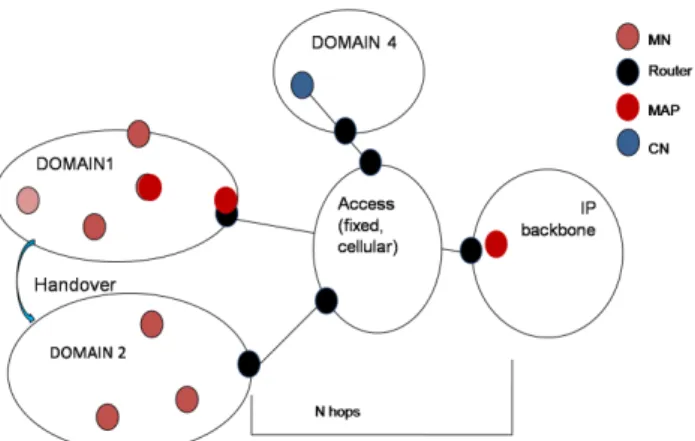
In a pursuit to support these three processes, IP-based mobility management solutions share 105
three main functional entities: i) Mobile Nodes; ii) Correspondent Nodes; iii) Mobility Anchor Points. The 106
placement of this functional entities is illustrated in Figure1. Such entities can then be co-located with 107
different devices, depending on the selected mobility management approach [11]. 108
The Mobile Node (MN) corresponds to a functional entity that is part of an end-user device. Today, 109
it is often located in a portable, battery-constrained device which is wireless or cellular enabled. The 110
MN is the mobile or static entity that triggers communication. 111
The MN has an active communication towards peers over the internet, known as the MN 112
Correspondent Nodes (CNs). The MN has one (or more) identifiers, i.e., IPv6 addresses such as occurs in 113
Mobile IPv6 (MIPv6) and its extensions; URIs for a mobility management solution such as the Session 114
Initiation Protocol (SIP); a locator-id based identifier for a solution such as the Host Initiation Protocol 115
(HIP). The MN functional role resides both on the data and control plane. 116
The CN represents an “active partner” of the MN. The CN as defined in IETF RFC4885 [12] is 117
"Any node that is communicating with one or more MNs. A CN could be either located within a 118
fixed network or within a mobile network, and could be either fixed or mobile.". Today, it is an entity 119
residing in a mobile device and is the receiver of a communication process started by the MN. In ICN, 120
the functional representation of MN vs. CN could be simplified by considering a single entity, as we 121
shall further explain in sections 4 and 5. The reason to still differentiate between these two functional 122
entities relates with the evolution of the Internet: at first, mobility management approaches were 123
developed to support service and session continuity for the consumer of that service. This was the 124
MN. The signalling required to support handovers was devised having in mind that particular entity, 125
and assuming that all other elements in the network would be static. Later, with the introduction 126
of two-way real-time communication in mobile environments, the solutions developed integrated 127
extensions to handle CN mobility, as well as to attempt to handle simultaneous mobility by all of the 128
involved parties. 129
Figure 1.High-level representation of mobility management main entities, the MN, the CN, and the MAP. The MAP is often co-located with different devices, including end-user devices.
The Mobility Anchor point (MAP) is a functional control plane entity that may reside in a network 130
element (e.g., in a router) or in an end-user element (e.g., end-user equipment, server). The MAP 131
controls the main functionality of mobility management, namely: handover management; traffic 132
offloading; location management; bindings and address translation; Quality of Service (QoS) and 133
forwarding policies. 134
Learning from the evolution of prior solutions, and from the extension required to support 135
additional features such as simultaneous mobility, it is relevant to consider that any future mobility 136
management architecture needs to be designed already having in mind that any node on the network 137
can move. Furthermore, it needs to consider that due to the way the Internet is evolving, these 138
functional entities can reside in any type of device, even embedded ones. 139
To further debate on how such support can be provided, the functional design of today’s solutions 140
can be split into different blocks [11]: 141
• Identification. For IP-based solutions such as MIPv6, this would correspond to the mapping of a 142
network interface to an IPv6 address; in SIP this would be a mapping between an URI (known 143
address) and one or multiple IPs; in HIP this corresponds to a Locator Id. 144
• Database control, control functionality usually provided by a central entity, which assists in a 145
quicker mapping of the different identifiers. Usually, this functionality is part of the MAP entity. 146
• MAP selection, which is a control function that assists in a better deployment of MAPs having in 147
mind to improve reachability of MNs. In centralised solutions, such selection is often performed 148
in a static and centralised way. 149
• Binding registration, control plane function that signals the first registration of a MN in a mobile 150
system. For instance, in MIP it is the first Binding Update message sent to a MAP or to a CN. In 151
SIP it is the REGISTER message sent to the Registrar server. 152
• Binding update, control plane function that signals an update a record in the Identification control. 153
Binding updates are used when the unique identifier of a device changes. 154
• Routing or forwarding: it is the process of intercepting the packets destined to the known-address, 155
encapsulating them with the real-address, and forwarding them. In MIP this is performed by 156
the MAP or by the first access router in the path (Home Agent, HA); in SIP this process can be 157
performed by an external element, for instance, an RTP translator. 158
• Handover negotiation: the process taken when the device has its identifier changed, to allow active 159
communications to be held with the least disruption. In MIP, the handover negotiation may be 160
anticipated with e.g., mechanisms such as the Fast Handover extension. SIP does not implement 161
any anticipation, performing a re-negotiation after the connection between peers is lost. 162
• Resource management, the process that assists in guaranteeing the quality of a connection while 163
devices perform a handover. Most solutions as of today do not integrate QoS support, recurring 164
to external mechanisms to provide such support. 165
• Mobility anticipation: it is the procedure of performing a handover before an active connection 166
experiences a break. For instance, anticipation is partially supported in MIPv6 via the extension 167
Fast Handovers for MIP. 168
• Security and privacy: it refers to every security mechanism to assure the integrity of both data and 169
channel for the active communication, as well as for the signalling of the mobility management 170
system. Current centralised solutions require external security support to protect data, channel, 171
as well as involved signalling. 172
The evolution of mobility management towards information-centricity (and hence, better service 173
support) requires looking into these different functional blocks, and understanding whether or not 174
they can be simplified. To further assist such evolution it is also relevant to remind that IP-based 175
mobility management approaches have been designed having in mind support of mobility from a 176
source-driven perspective. On later phases, adjustments of the centralised solutions for support of 177
simultaneous mobility [13] as well as non-simultaneous mobility have been introduced. This is the case, 178
for instance, of the Return Routability Procedure for MIPv6 solutions, intended to assist CN mobility. 179
As also stated in section 2., efforts towards the evolution of IP-based mobility management is 180
approaching a distributed vision, having in mind the support of mobility for the different entities, 181
where IPv6 is the underlying protocol. In such context, solutions have looked into MAP selection and 182
discovery; forwarding path and signalling management; exchange of control information to assist 183
faster handovers (e.g., better selection of identifiers to use on the new attachment locations). 184
4. Mobility in ICN
185
4.1. Mobile Nodes, Correspondent Nodes, and MAPs in ICN 186
The ICN architecture embodies a publish/subscribe pull-based communication model. Producer 187
nodes correspond to devices that send data (Data packets), once they get an expression of interest by 188
consumer nodes (Interest packets). Data is sent back following ICN forwarding strategies, and based on 189
the network state left by Interest packets in routers along the way. 190
From a functional and interoperable mobility management perspective, producer nodes and 191
consumer nodes may be associated with both the MN or the CN functionality. At a first glance, 192
and from an abstract, functional perspective, mobility management entities could be reduced from 193
MN vs. CN into a single MN entity, for instance. However, ICN is receiver-driven, while IP mobility 194
management solutions are source-driven. Furthermore, ICN does not require the functional concept of 195
a MAP to support mobility, as binding is directly performed to content and not to hosts, as shall be 196
explained next. 197
4.2. Architectural Design Advantages 198
ICN integrates several features that are beneficial from a mobility management perspective. To 199
assist in the understanding of such advantages, Table1provides an overview on how the different 200
mobility management functional blocks described in section3are supported via the most emblematic 201
mobility management solutions of today. 202
From a mobility management perspective, a first advantage of the architectural design of ICN 203
against its IP-based counterparts is the focus on content, instead of on host reachability. In ICN 204
paradigms content becomes the addressable entity, instead of a host identifier. Content is also the 205
routing target, which serves better the handover process: there is no need for a database identifier 206
control process, for instance. 207
A second advantage of ICN is its interface abstraction, Face. Faces provide a better support 208
for multi-homing, including security [14]. Faces are also relevant in the support of distributed 209
mobility management. The Face abstraction provides the means for applications to seamlessly and 210
securely interact with multiple physical and virtual interfaces, as there is no dependency on interface 211
identifiers nor or on host identifiers. Adding to the Face abstraction, Forwarding strategies serve 212
better multi-homed devices, as Interest packets can be forwarded having in mind specific requirements 213
for multi-homed environments. Forwarding strategies are based on the information stored in the 214
Forwarding Information Base (FIB) and additional traffic measurement. The Pending Interest Table (PIT) 215
stores Name Prefixes for which consumers expressed interest. Data packets simply follow the state left 216
in the PITs. 217
Table 1.Mobility management functional blocks, support in different mobility management solutions .
Functional blocks
MIP [15] SIP [16] HIP [17] M-SCTP [18] ICN [2]
Identification IP address (interface) URI (unique, associated with user) Locator Id (device)
IP and port Name prefix (content) Id database control MAP Centralised, controlled by the provider. access through the MAP
MAP None Not required
MAP Centralised solution, located in the provider premises (HA, access router) Centralised solution, located in the provider premises Proxy SIP (server) Centralised solution, located in the provider premises Centralised solution, located in the provider premises Not required Binding mechanism Periodic Binding Update message, MN to HA, MAP or CN REGISTER message, MN to Registrar Server or Outbound Proxy - - Pull-based Interest packet approach; in-network caching Routing/ forwarding IP based (shortest-path) Proxy or RTP translator Dual, based on locator and on IP IP-based Data-based routing, forwarding strategies adapted to mobility Handover negotiation Make- before-break, with FMIP access routers negotiation Break- before-make, RE-INVITE message, MN to CN Make before break Break before make, requires setup of new TCP connection No need for consumers; required for producers Resource management
None None None None Forwarding
strategies Security/privacy Not integrated Not integrated Yes, intrinsic to
HIP
Not integrated Yes
Handover Anticipation
Partial, e.g., FMIPv6
No No No No
Thirdly, the pull-based communication model of NDN, where data is only sent if Interest packets 218
are first transmitted, allows for a binding signalling reduction during the handover process. 219
A fourth advantage of the architectural design proposed in ICN concerns the flexible forwarding 220
strategies and the routing, which is data-oriented. Such approach provides better support for 221
multi-homing environments, as well as for the support of frequent movement by devices. 222
4.3. Mobility Management in Different ICN Solutions 223
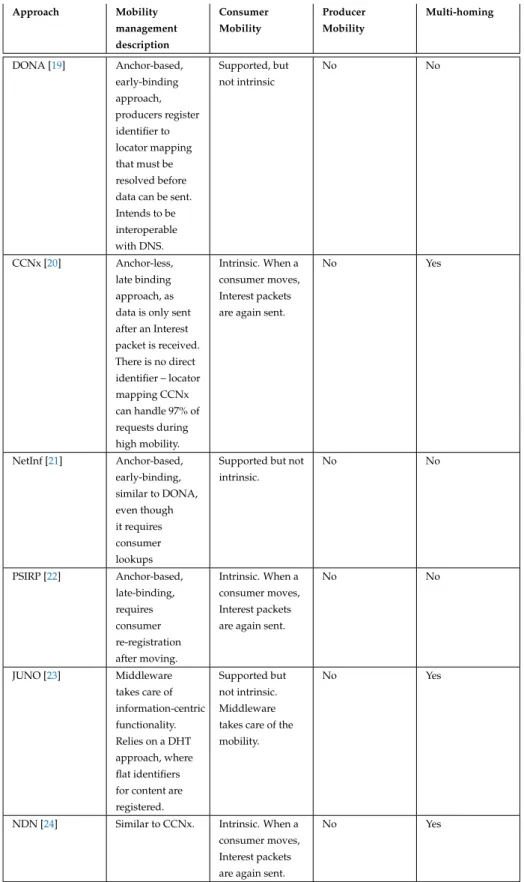
Table 2.ICN main approaches, mobility challenges.
Approach Mobility management description Consumer Mobility Producer Mobility Multi-homing DONA [19] Anchor-based, early-binding approach, producers register identifier to locator mapping that must be resolved before data can be sent. Intends to be interoperable with DNS. Supported, but not intrinsic No No CCNx [20] Anchor-less, late binding approach, as data is only sent after an Interest packet is received. There is no direct identifier – locator mapping CCNx can handle 97% of requests during high mobility. Intrinsic. When a consumer moves, Interest packets are again sent.
No Yes NetInf [21] Anchor-based, early-binding, similar to DONA, even though it requires consumer lookups
Supported but not intrinsic. No No PSIRP [22] Anchor-based, late-binding, requires consumer re-registration after moving. Intrinsic. When a consumer moves, Interest packets are again sent.
No No JUNO [23] Middleware takes care of information-centric functionality. Relies on a DHT approach, where flat identifiers for content are registered.
Supported but not intrinsic. Middleware takes care of the mobility.
No Yes
NDN [24] Similar to CCNx. Intrinsic. When a consumer moves, Interest packets are again sent.
No Yes
While ICN approaches have in common the advantages described in the previous section, different 224
approaches tackle mobility management in different ways. To assist in a better understanding of 225
the current situation, Table2describes whether/how producer mobility, consumer mobility, and 226
multi-homing are supported by reference approaches. 227
As described in Table 2, none of the main ICN architectures provides seamless producer mobility 228
support. As for consumer mobility, existing approaches either take care of such support based on 229
anchor-based approaches, following IP-based learning, or via anchor-less approaches. Furthermore, 230
multi-homing is supported only in JUNO, CCNx and NDN. 231
These aspects are further debated on the next sections. The description provided is focused on 232
the line of work derived from CCNx, including NDN . 233
4.4. Multi-homing 234
ICN supports end-user device multi-homing via the Face abstraction. Support for networked 235
multi-homing is achievable via ICN multi-path forwarding strategies, and routing. The Face abstraction 236
brings in the possibility to jointly explore data transfer to multiple services and applications as well 237
as to physical interfaces. Moreover, multi-homing is supported with fine-grained control: the ICN 238
per packet pull-based model provides better support for resource management aspects, such as 239
load-balancing (based on packets instead of flows). The ICN forwarding strategies are applied on a 240
local basis: different nodes and/or regions of nodes can have different forwarding strategies, which 241
strengthens multi-homing support capability via ICN. 242
Therefore, multi-homing is a mobility management process that is naturally supported by ICN 243
approaches. In comparison, prior solutions required additional support of, for instance, Quality of 244
Service (QoS) mechanisms. 245
4.5. Consumer Mobility 246
In order to explain how ICN supports consumer mobility, this section provides two examples: 247
MN acting as consumer; CN acting as consumer. The explanation provided is based on the functional 248
entities described in section 3, which are the basis for today’s mobility management reference 249
architectures, onto ICN. The purpose is to explain limitations that may arise from such mapping. 250
MN is an ICN producer that is directly connected to the NDN router B, and in active communication 251
with a consumer CN. Both MN and CN reside in mobile nodes. Connectivity can be intermittent. 252
4.5.1. MN as Consumer 253
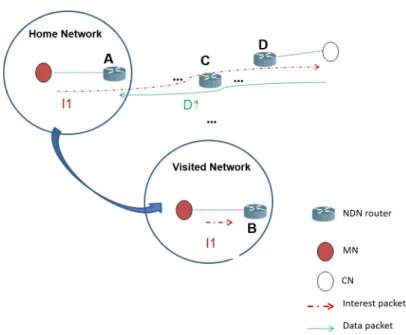
Figure2illustrates a scenario where a MN is attached to its original network, the home network. 254
A, B, C and D represent routers. As ICN is receiver-oriented, data transmission for this example starts 255
when the consumer entity expresses interest on a specific content, i.e., MN sends an Interest packet 256
I1 with a specific Name Prefix. The Interest packet is stored in the PIT of ICN devices along the path 257
(routers A, C, D), until it reaches a node that has the requested content, the producer, or a router that 258
already cached the respective content in its Content Store (CS). In the meanwhile, and while packet I1 is 259
being transmitted, MN starts to move and reattaches to router B, that serves a Visited Network. Based 260
upon ICN principles, once reattachment occurs, MN again sends an Interest packet with the same 261
Name Prefix (I1). When this packet reaches router C, this router already has the content requested 262
stored (D1) and therefore, the forwarding of Interest packet I1 stops. The subsequent data exchange is 263
directly handled between MN and any device that holds content requested by MN. 264
4.5.2. CN as Consumer 265
In this second example, illustrated in Figure3, the CN entity is the consumer, while MN is a 266
producer of information. In terms of consumer mobility, the situation is similar to the one described in 267
the previous section: CN as a consumer expresses interest (sends an Interest packet, represented by I1) 268
carrying a Name Prefix for specific content, which in our example is being produced by MN. In the 269
meanwhile and either before receiving data, or already after receiving some data packets, CN moves to 270
a new location, performing reattachment to NDN router B. The receiver-driven design of ICN implies 271
Figure 2.MN as consumer node. The MN starts by expressing interest in content (Interest packet I1). This packet reaches the CN, which replies with data packet D1. In the meanwhile the MN moves, and does not receive D1. Upon reattachment, the MN sends I1 again.
Figure 3.CN as Consumer. CN expresses interest by sending packet I1 and then moves. On the new location, CN again emits I1. Therefore, subsequent data packets reach CN at the visited network.
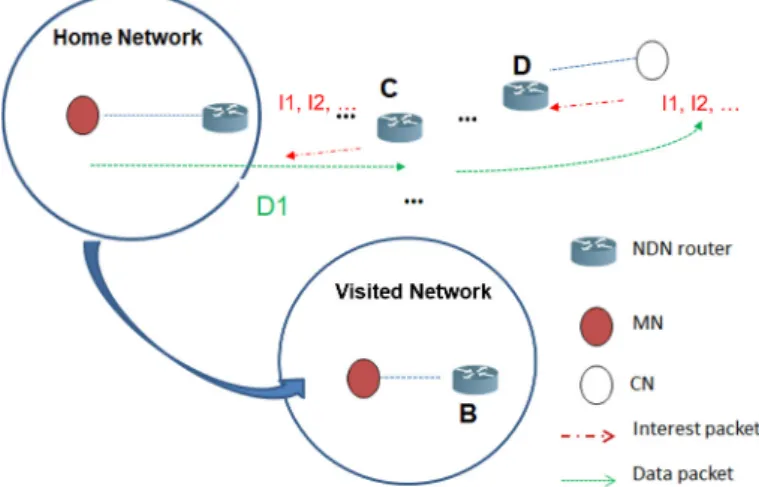
Figure 4.Producer mobility example. The MN is a producer node on the move. Some data packets are sent before handing over. Once the MN attaches to the visited network, no data packets are sent, as the MN does not get Interest packets.
that once CN reconnects to a new node (in our example, router B), it starts sending Interest packets to 272
get the desired content, based on the respective application requirements and settings. Therefore, the 273
pull-based receiver-driven nature of ICN is beneficial for the case of consumer mobility, independently 274
of the entity that is moving. In other words: for the case of consumer mobility, there is no need to 275
distinguish between a MN and a CN entity, in future mobility management solutions. 276
4.5.3. Consumer Mobility Discussion 277
As the pull-based model relies on a per packet approach, even if a consumer already received some 278
data chunks and then moves, transmission can be immediately re-established once the consumer (MN 279
or CN) can send data to a neighbour. In our examples, this is synonymous with the consumer being in a 280
state that allows it to forward Interest packets again. At a first glance, ICN supports consumer mobility 281
well. Nevertheless, in large-scale networks and environments where consumers move frequently 282
and fast (e.g., vehicular networks, personal Internet of Things environments) data transmission may 283
still be affected by frequent movement. Even though the in-network caching provided by ICN can 284
counter-balance such situations, the performance of the data transmission is highly dependent on 285
aspects such as the type of topology, type of movement, and speed of nodes. 286
4.6. Producer Mobility 287
Producer mobility is still a major challenge for ICN. To better exemplify the issues with producer 288
mobility, let us consider the scenario previously addressed and illustrated in Figure4, where MN, 289
after receiving an Interest packet I1 from its respective CN forwarded to MN via router A, sends 290
back packet D1. MN then starts a handover to router B. In this situation and again depending on the 291
topology, the CN will keep on sending Interest packets to get subsequent data chunks. Routers in 292
between shall keep on looking up their FIBs and as there is already an entry towards the respective 293
Name Prefix, routers shall forward the CN Interest packets towards the respective Face (to router 294
A). This process can result in significant latency. To circumvent this issue there is the need to rely on 295
additional mobility management solutions. 296
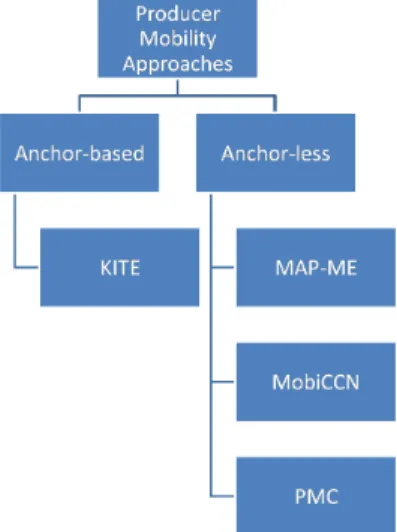
Producer mobility is currently being handled via anchor-based approaches and anchor-less approaches, 297
as illustrated in Figure4. Anchor-based mechanisms, of which the most relevant is KITE [2,8], follow 298
IP-based approaches and often recur to the use of a “Rendez-Vous” (RV) functional entity to temporarily 299
assist data transmission. KITE tries to exploit the forwarding states to keep track of nodes in movement. 300
KITE considers that applications can send Interest packets to a routable and static anchor entity (an 301
Figure 5. Categorisation of mobility management approaches that provide support for producer mobility.
RV) to create the PIT entries as breadcrumbs. The RV is therefore a mediating entity, host-driven. Via 302
this RV-based approach, Interest packets can reach a producer on the move. 303
This approach requires additional structures in routers - a separate FIB or PIT - as well as additional 304
state to be kept. Furthermore, in current approaches the RV is considered to be static - mobility of 305
the RV is not handled. Therefore, while such approaches may be relevant from a perspective of 306
interoperability towards IP-based mobility solutions, the overhead introduced can be significant. 307
In what concerns anchor-less solutions, producers push a notification once a move occurs. Such 308
notification can be based on Interest packets or on Data packets, being currently the preferred choice 309
to rely on a special Interest packet known as Interest Update. This is the case, for instance, of MAP-ME 310
[7], or of MobiCCN [25]. Interest Updates allow for arbitrary small data to be placed in Interest 311
packets as a name component. Such packet is not registered in PITs, as no data is expected to be 312
sent back. Time-to-completion can be reduced by relying on different strategies, such as occurs in 313
MobiCCN, where a specific Name Prefix “greedy:/” supports communication based on a greedy routing 314
protocol. Or, a make-before-break approach can be followed, as occurs in the Publisher Mobility Support in 315
Content-centric Networks (PMC) solution [26]. 316
5. Moving Towards Content-centric Mobility Management
317
The benefits provided by the ICN architectural design in regards to mobility support are the basis 318
to rethink mobility management widely, having in mind a data-centric (and not host-centric) goal. 319
ICN de-centralised, asynchronous and pull-based model removes the need for a functional 320
centralised or de-centralised MAP. Its architecture can support consumer mobility naturally; however, 321
there is still the need to understand performance impact derived from the type of movement as well as 322
from the types of underlying topologies. In what concerns consumer mobility, the pull-based nature of 323
ICN gives the means to prevent serious packet loss; nevertheless, latency impact is still not clear, and 324
requires future work on performance aspects under highly variable scenarios. 325
Producer mobility, on the other hand, is still a challenge to be overcome. Related work argues 326
that producer mobility is a small subset of mobility. That has been the case up until recently. With the 327
advent of IoT and with the growth of environments involving autonomous vehicles, producer mobility 328
becomes as relevant as consumer mobility. 329
5.1. The Relevancy of Context-aware Proactive Caching 330
Proactive strategies for in-network caching can assist both consumer and producer mobility, as 331
they support make-before-break strategiesi.e., before a handover takes place. While in-network caching 332
approaches per se may not suffice to support mobility [7], proactive caching can be coupled with an 333
anchor-less strategyto improve mobility support . The key aspect to consider in such approaches is 334
to decide when and where to cache content. Furthermore, reactive caching approaches are useful in 335
the context of host-oriented ICN mobility management approaches, as they assist in reducing packet 336
loss while a node transits to a new location. It should be highlighted that while in IP-based solutions 337
caching is used in regards to the first router in the path, in ICN caching refers to the content of the 338
moving node and/or NDN routers in between. 339
Having in mind the support of data-oriented mobility management, proactive approaches assist 340
in caching the node’s content before a handover occurs (make-before-break). The data to cache and 341
when to cache it can benefit from mobility anticipation mechanisms as well as from network context 342
awareness, e.g., history of requests and producer neighbourhood context [27,28]. 343
Measures of neighbour availability and centrality, as well as measures concerning similarity (for 344
instance, similarity in types of requests), and mobility awareness (e.g., handover frequency; estimation 345
of time-to-handover) can be easily provided via an external agent [29]. Such information can assist in 346
anticipating handovers, and selecting beforehand a “best” neighbour to cache producer content. 347
5.2. Guidelines 348
ICN is a relevant architecture to be integrated into large-scale mobile environments. While current 349
mobility management proposals aim at solving specific issues under specific scenarios, for instance, 350
producer mobility, future solutions need to consider the following: 351
• Producer and consumer mobility do not necessarily need to be treated independently, as has 352
been done (by necessity) in prior approaches, which handled MN and CN mobility recurring to 353
distinct mechanisms. In other words, the process of handling handovers should be the same for 354
any node: any node becomes a MN. This can be supported by adding push-based communication 355
support to ICN, via handover anticipation, for instance. 356
• Mobility anticipation mechanisms derived from context-awarenesscan be based on a MN’s/CN’s 357
prior history and neighbourhood. Such concept is relevant to assist make-before-break 358
handovers, thus eventually reducing the required signalling. In such cases producers can 359
perform data push towards a “best” neighbour based on a proactive caching strategy. Via 360
this mechanism, packet loss can be reduced at the expense of a (potentially) small increase in 361
overhead. 362
• The relevant aspect in an ICN context is “when” a move may occur, and not “where to” the node 363
shall move. ICN provides global naming, so the location where nodes are should not be the key 364
aspect, from a content-centric mobility management perspective. 365
• A proactive caching approach towards a “best” neighbour of a node can benefit from being 366
associated with a specific Name Prefix, or specific metadata associated with the content to be 367
transmitted. For instance, a timeout (TTL, TLV), or priority numbering. 368
• Once a move occurs, nodes should emit a notification. While this is the common procedure 369
for consumers, producers can emit an Interest Update notification as envisioned in the original 370
ICN/CCNx design. This notification allows for a faster routing re-establishment. 371
• Naming in ICN is hierarchical and independent of location. Nevertheless, today it is common 372
to consider a naming space associated with routing domains, e.g. “/lusofona.pt/videos/”. 373
While such choice does not impact mobility management, it may negatively impact route 374
aggregation, when producers move. ICN applications would benefit from a set of guidelines for 375
the development of the naming space. 376
6. Conclusions and Future Research Directions
377
The benefits provided by the intrinsic ICN architectural design in regards to mobility are the basis 378
to rethink mobility management widely and from a content-centric perspective. The ICN architectural 379
design removes the need for a functional centralised or de-centralised mobility anchor-point. As such, 380
anchor-less approaches seem to be a relevant approach as they reduce the need for additional state, 381
and allow ICN to support mobility management in a data-centric way. 382
Consumer mobility is well supported from a network architectural perspective, but there is the 383
need to understand performance impact derived from the type of movement as well as from the 384
types of topologies. The pull-based nature of ICN gives the means to prevent serious packet loss; 385
nevertheless, consumer mobility may still result in large time-to-completion intervals. 386
In what concerns producer mobility, the support is not intrinsic, and the receiver-driven, 387
pull-based ICN approach requires adjustments to fully support producer mobility. Multi-homing is 388
well support. 389
While ICN has relevant architectural properties which seem to provide a better and integrated 390
support for mobility management, there are a few aspects requiring further research. A first future 391
research direction concerns a better support for mobility management via NDN routing. By devising 392
routing approaches that are sensitive to node movement [30], Interest packets can be forwarded in a 393
way that is automatically based on individual and collective roaming habits of devices, eventually 394
reducing the need to perform re-registration once nodes reattach. This can be done by developing 395
forwarding strategies based on mobility prediction, or by integrating routing support based on 396
context-awareness [31]. A second research direction is to perform an analysis of the ICN mobility 397
support support in highly variable topologies, where anchor-less strategies may not suffice to 398
adequately support producer mobility. For this case, both producer and consumer need to be 399
considered as mobile entities and therefore, any future mobility management approach should simply 400
look into the support of a single mobile entity, instead of supporting, as previously, a MN and a CN 401
entity separation. 402
Funding: Work developed in this paper is funded by FCT strategic project COPELABS, references
403
UID/MULTI/04111/2013, UID/MULTI/04111/2016, and UID/MULTI/04111/2019.
404
Acknowledgments: Rute Sofia thanks the insightful exchange of ideas concerning ICN and IoT held in 2017/2018
405
with Chris Winkler (Siemens AG); Hans-Peter Huth (Siemens AG); Jan Seeger (Siemens AG and Technical
406
University of Munich); Georg Carle (Technical University of Munich).
407
Conflicts of Interest:The author declares no conflict of interest.
408
7. References
409
410
1. Ravindran, R.; Chakraborti, A.; Amin, S.O.; Azgin, A. 5G-ICN : Delivering ICN Services over 5G using
411
Network Slicing. IEEE Communications Magazine 55.5 2017, pp. 101–107,[arXiv:1610.01182v1].
412
2. Afanasyev, A.; Burke, J.; Zhang, L. A Survey of Mobility Support in Named Data Networking. inProc.
413
IEEE Conference on Computer Communications Workshops (INFOCOM WKSHPS) 2016, pp. 83–88.
414
3. Chen, S.; Shi, Y.; Hu, B.; Ai, M. Mobility Management: Principle, Technology and Applications; Springer, 2016.
415
4. Liu, D.; Zuniga, J.; Seite, P.; Chan, H.; Bernardos, C. Distributed Mobility Management: Current Practices
416
and Gap Analysis. IETF DMM Working Group, RFC 7429 2015.
417
5. Liu, D.; Seite, P.; Yokota, H.; Korhonen, J. Requirements for Distributed Mobility Management. IETF DMM
418
Working Group, RFC 7429aug. doi:10.17487/rfc7333.
419
6. Zhu, Z.; Afanasyev, A.; Zhang, L. A new perspective on mobility support. Named Data Networking Project
420
Technical Report 13, USA 2013, pp. 1–6.
421
7. Auge, J.; Carofiglio, G.; Grassi, G.; Muscariello, L.; Pau, G.; Zeng, X. MAP-Me: Managing Anchor-Less
422
Producer Mobility in Content-Centric Networks. IEEE Transactions on Network and Service Management
423
2018, 15, 596–610. doi:10.1109/TNSM.2018.2796720.
424
8. Zhang, Y.; Zhang, H.; Zhang, L. Kite: A mobility support scheme for NDN. inProc. of the 1st international
425
conference on Information-centric networking - INC ’14 2014, pp. 179–180. doi:10.1145/2660129.2660159.
426
9. Chen, S.; Shi, Y.; Hu, B.; Ai, M. Mobility-driven Networks (MDN): From Evolution to Visions of Mobility
427
Management. IEEE Network 2014, 28, 66–73. doi:10.1109/MNET.2014.6863134.
10. Tyson, G.; Sastry, N.; Rimac, I.; Cuevas, R.; Mauthe, A. A survey of mobility in information-centric
429
networks: Challenges and research directions. Proceedings of the 1st ACM workshop on Emerging
430
Name-Oriented Mobile Networking Design-Architecture, Algorithms, and Applications. ACM, 2012, pp.
431
1–6.
432
11. Nascimento, A.; Sofia, R.; Condeixa, T.; Sargento, S. A Characterization of Mobility Management in
433
User-centric Networks. inProc. of the 11th international conference and 4th international conference on
434
Smart spaces and next generation wired/wireless networking; Springer-Verlag: Berlin, Heidelberg, 2011;
435
NEW2AN’11/ruSMART’11, pp. 314–325.
436
12. Ernst, T.; Lach, H. Network Mobility Support Terminology. IETF Network Working Group, RFC 4885
437
(informational). 2007.
438
13. Wong, K.D.; Dutta, A.; Schulzrinne, H.; Young, K. Simultaneous mobility: Analytical framework, theorems
439
and solutions. Wireless Communications and Mobile Computing 2007, 7, 623–642. doi:10.1002/wcm.389.
440
14. Schneider, K.M.; Mast, K.; Krieger, U.R. CCN forwarding strategies for multihomed mobile terminals.
441
inProc. International Conference and Workshops on Networked Systems (NetSys). IEEE, 2015, pp. 1–5.
442
doi:10.1109/NetSys.2015.7089075.
443
15. Perkins, C.E.; Johnson, D.B.; Arkko, J. IETF RFC 6275 - Mobility Support in IPv6. IETF Network Working
444
Group RFC 6275 2011.
445
16. Rosenberg, J.; Schulzrinne, H.; Camarillo, G.; Johnston, A.; Peterson, J.; Sparks, R.; Handley, M.; Schooler, E.
446
Session Initiation Protocol. IETF Network Working Group RFC 3261 2002.
447
17. Nikander, P.; Moskowitz, R. Host Identity Protocol (HIP) Architecture. IETF Network Working Group RFC
448
4423 2006.
449
18. Koh, S.J. Mobile SCTP for IP Mobility Support in All-IP Networks. Proceedings of CIC (Cellular and
450
Intelligent Communications), 2003.
451
19. Koponen, T.; Chawla, M.; Chun, B.G.; Ermolinskiy, A.; Kim, K.H.; Shenker, S.; Stoica, I. A data-oriented
452
(and beyond) network architecture. ACM SIGCOMM Computer Communication Review 2007, 37, 181,
453
[1282402]. doi:10.1145/1282427.1282402.
454
20. Gusev, P.; Burke, J. CICN - Content Centric networking Community, 2017. doi:10.1145/2810156.2810176.
455
21. Dannewitz, C.; Kutscher, D.; Ohlman, B.; Farrell, S.; Ahlgren, B.; Karl, H. Network of information
456
(NetInf)-An information-centric networking architecture. Computer Communications 2013, 36, 721–735.
457
doi:10.1016/j.comcom.2013.01.009.
458
22. Dimitrov, V.; Koptchev, V. PSIRP project – publish-subscribe internet routing paradigm. Proceedings of the
459
11th International Conference on Computer Systems and Technologies and Workshop for PhD Students
460
in Computing on International Conference on Computer Systems and Technologies - CompSysTech ’10;
461
ACM Press: New York, New York, USA, 2010; p. 167. doi:10.1145/1839379.1839409.
462
23. Tyson, G.; Mauthe, A.; Kaune, S.; Grace, P.; Taweel, A.; Plagemann, T. Juno. ACM Transactions on Internet
463
Technology 2012, 12, 1–28. doi:10.1145/2390209.2390210.
464
24. Zhang, L.; Estrin, D.; Burke, J.; Jacobson, V.; Thornton, J.D.; Smetters, D.K.; Zhang, B.; Tsudik, G.; Massey,
465
D.; Papadopoulos, C.; Wang, L.; Crowley, P.; Yeh, E. Named Data Networking (NDN) Project. October
466
2010, pp. 1–26. doi:10.1145/2656877.2656887.
467
25. Wang, L.; Waltari, O.; Kangasharju, J. MobiCCN: Mobility support with greedy routing in Content-Centric
468
Networks. inProc. GLOBECOM - IEEE Global Telecommunications Conference 2013, pp. 2069–2075.
469
doi:10.1109/GLOCOM.2013.6831380.
470
26. Dookyoon Han.; Lee, M.; Cho, K.; Kwon, T. Cho, Y. Publisher Mobility Support in Content Centric
471
Networks. inProc. Information Networking (ICOIN), 2014 International Conference on. IEEE, 2014 2014, pp.
472
214–219.
473
27. Vasilakos, X.; Siris, V.A.; Polyzos, G.C.; Pomonis, M. Proactive selective neighbor caching for enhancing
474
mobility support in information-centric networks. Proceedings of the second edition of the ICN workshop on
475
Information-centric networking - ICN ’12 2012, p. 61. doi:10.1145/2342488.2342502.
476
28. Lehmann, M.B.; Barcellos, M.P.; Mauthe, A. Providing producer mobility support in NDN through
477
proactive data replication. inProc. of the NOMS 2016 - 2016 IEEE/IFIP Network Operations and Management
478
Symposium 2016, pp. 383–391. doi:10.1109/NOMS.2016.7502835.
29. Sofia, R.C.; Santos, I.; Soares, J.; Diamantopoulos, S.; Sarros, C.A.; Vardalis, D.; Tsaoussidis, V.; D’Angelo,
480
A. UMOBILE D4.5: Report on Data Collection and Inference Models. Technical report, COPELABS,
481
University Lusofona; Senception Lda, 2017.
482
30. Chama, N.; Sofia, R.C.; Sargento, S. A Discussion on Mobility Awareness of Multi Hop Routing in
483
User-Centric Environments. Technical Report COPE-SITI-TR-05-15, COPELABS, University Lus{ó}fona,
484
University of Aveiro, 2015.
485
31. Mendes, P.; Sofia, R.C.; Tsaoussidis, V.; Diamantopoulos, S.; Sarros, C.A.; Borrego, C.;
486
Borrell, J. Information-centric Routing for Opportunistic Wireless Networks. Internet-Draft
487
draft-mendes-icnrg-dabber-02, Internet Engineering Task Force, 2019. Work in Progress.
488
c
2019 by the author. Submitted to Future Internet for possible open access publication
489
under the terms and conditions of the Creative Commons Attribution (CC BY) license
490
(http://creativecommons.org/licenses/by/4.0/).