Ciências da Saúde
Medical Students Working on Disaster Relief
Analysis of their competences
Maria Helena Ferreira da Silva
Dissertação para obtenção do Grau de Mestre em
Medicina
(ciclo de estudos integrado)
Orientador: Dr. Luís Patrão
Dedicated
to
Everyone that was, is or will be at Oinofyta Refugee Camp. A place I will
never forget.
Acknowledgement
To my parents and sister, no words fit better to thank you than quoting Jessica Alexander on her book Chasing Chaos: “(…) if I didn’t have such a solid home to return to, I may not have had the courage to go so far. I love you”
To my boyfriend, for supporting all my decisions with unconditional love, for a relationship that gives me wings instead of moorings and for always understanding that I need to be where I think I am needed the most.
To my family for being proud of my actions and saying it so often.
To my friends on Sê(de)+ for growing with me on the values that I wish to spread, I would not be who I am without you.
To the Fac Friends as we call it, my family on this city as I like to think of it. Thank you for making Covilhã feel like home. I am so proud to have shared the past 6 years with you: Sofia, Joana, Martinha, Maru, Sara, Bé, Laiginhas, Tiago, Ninja, Daniel and Nuno, thank you with all my heart, I couldn’t possibly wish for better friends.
To the amazing Lisa Campbell, for being an incredible human being and a true mother to all the residents of the camp she manages. You truly are a real-life hero.
To Markus Alt, for accepting me as a volunteer in the first place and for the amazing job he served as health coordinator at the camp. And to Paulina Grace and John Burgess who followed impeccably.
To Michael-John Von Hörsten for being the doctor I hope to be someday.
To Sara Sofia Almeida, for inspiring my journey and showing me how to get there, your kindness amazes me.
To all my friends at the Oinofyta Refugee Camp, you are always in my prayings and you will never leave my heart, after all تسا ناتسود اب ابیز یگدنز
To Engineer Bilal Hashimi, I wish your loving memory prevails forever on this book as your friendship will live forever in my heart. You dreamt of having doctors on Afghanistan helping and volunteering in a hospital you were going to build, maybe this thesis will inspire some of them to go there and accomplish your dreams.
To all the volunteers I had a chance to work with and meet at the camp. Thank you very much for your hard work and efforts.
To Professor Miguel Castelo Branco and to Professor Luiz Santiago for allowing me to replace my Primary Care Internship of the 5th year for this amazing experience, which allowed me to
be there for one month instead of two weeks the first time I went.
To Dr. Luís Patrão, my supervisor who had the idea for this thesis after my experience on Greece, who motivated me and helped me all the way through here. Thank you very much. To Faculdade de Ciências da Saúde da Universidade da Beira Interior where I acomplished my dream of becoming a doctor.
To Universidade Federal da Paraíba, for letting me study there for four months and feel as a real doctor for the first time, I truly learnt a lot.
To C’a Tuna aos Saltos because you can never ever have enough music and fun in your life. To MedUBI, despite the short journey, especially for letting me work on the magazine
Preface
Meraki (μεράκί) -
Greek-(n) The soul, creativity, or love put into something;
the essence of yourself put into your work pronunciation: mA-‘rak-E
Resumo
Introdução: Num mundo que se depara com crescentes necessidades humanísticas,
estudantes de medicina são chamados a colaborar. Depois de ter passado dois meses como voluntaria num campo de refugiados na Grécia, enquanto aluna do 5º ano, e de ter feito inúmeras tarefas sozinha, iniciei esta análise. O objetivo deste estudo é avaliar se os currículos médicos estão a preparar estudantes que se queiram voluntariar no socorro a catástrofes e se os estudantes que o fazem se sentem preparados para tal.
Métodos e Materiais: 50 estudantes de medicina de todo o mundo que se voluntariaram em
campos de refugiados foram entrevistados usando um inquérito num formulário do Google® que consistia de um questionário inicial sobre informações pessoais e sobre as suas escolas médicas, uma segunda secção com 18 questões sobre o trabalho específico enquanto voluntário e tarefas desempenhadas, uma última secção com duas questões sobre o currículo das suas escolas e uma questão final que pretende uma avaliação do trabalho efetuado enquanto voluntário e um comentário livre. IBM SPSS® Statistics 22 foi usado para analisar os dados para caracterização da população e teste do qui-quadrado. Fiz ainda uma entrevista ao Dr. Michael-John von Hörsten, médico experiente que trabalha em socorro a catástrofes.
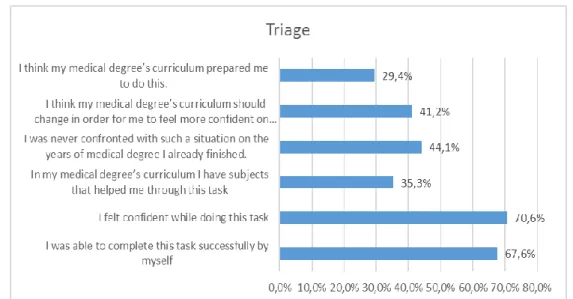
Resultados: Relativamente a triagem, a opção mais selecionada foi “Senti-me confiante nesta
tarefa” (n=24; 70.6%). Na tarefa histórias clínicas a opção mais selecionada foi “No meu currículo médico tenho disciplinas que me ajudaram nesta tarefa.” (n=24; 60%). Sobre os procedimentos diagnósticos a opção mais selecionada foi “Penso que o meu currículo médico devia mudar para me sentir mais confiante nesta tarefa” (n=9; 60%). Na tarefa aconselhamento a opção mais selecionada foi “No meu currículo médico tenho disciplinas que me ajudaram nesta tarefa” (n=11; 50%). Sobre prescrição ou aconselhamento terapêutico, as opções mais selecionadas foram “No meu currículo médico tenho disciplinas que me ajudaram nesta tarefa” (n=10; 41.7%) e “Penso que o meu currículo médico devia mudar para me sentir mais confiante nesta tarefa.” (n=10; 41.7%). Relativamente a emergência a opção mais selecionada foi “No meu currículo médico tenho disciplinas que me ajudaram nesta tarefa (n=6; 42.9%). Quanto a prevenção, a opção mais selecionada foi “Senti-me confiante nesta tarefa” (n=11; 73.3%).
Discussão: Na maioria das tarefas há mais estudantes a achar que o currículo deve mudar
para se sentirem mais preparados do que o oposto. Apesar disso, também há mais estudantes que pensam terem cadeiras no seu currículo que os ajudam nas tarefas realizadas
(conhecimento teórico).
Conclusão: Currículos médicos preparam parcialmente os estudantes para se voluntariarem
nestes contextos, especialmente no que toca a conhecimento teórico. Os estudantes não se sentem preparados ou pelo menos confiantes. A minha sugestão depois desta investigação é adicionar-se aos currículos de todas as escolas médicas um curso básico de skills e implementar um curso específico para voluntários.
Abstract
Introduction: After volunteering as a 5th year medical student for two months in a refugee
camp and do various medical tasks on my own, I started this analysis. The objective of this study was to evaluate if medical curriculum is preparing students to work on disaster relief and if those students feel prepared.
Materials and Methods: 50 medical students from around the world who had been
volunteering in refugee camps were interviewed using a Goggle
®
Form survey consisting of: an initial questionnaire on personal information and information on the medical school, a second section with 18 questions about the specific tasks performed as volunteer, one last section with two questions about the medical curriculum with one last question as final evaluation of the work done while volunteering and a free commentary. IBM SPSS® Statistics 22 was used to analyze data for population characterization and chi-square test. I also interviewed Michael-John von Hörsten on experience as a doctor who works on disaster relief.Results: Relative to triage, the most selected option was “I felt confident while doing this
task” (n=24; 70.6%). On medical histories, the most selected option was “In my medical degree’s curriculum I have subjects that helped me through this task” (n=24; 60%). About diagnostic procedures the most selected option was “I think my medical degree should change for me to feel more confident on this task” (n=9; 60%). On counseling the most selected option was “In my medical degree’s curriculum I have subjects that helped me through this task” (n=11; 50%). About therapeutic advice/prescription the most selected options were “In my medical degree’s curriculum I have subjects that helped me through this task” (n=10; 41.7%) and “I think my medical degree’s curriculum should change for me to feel more confident on this task” (n=10; 41.7%). Relative to emergency care, the most selected option was “In my medical degree’s curriculum I have subjects that helped me through this task” (n=6; 42.9%). Relative to preventive care, the most selected option was “I felt confident
while doing this task” (n=11; 73.3%).
Discussion: Through most tasks, there are more students stating their curriculum should
change for them to feel more prepared than the opposite. Despite that, there are more students thinking they have subjects helping them through performed tasks (theoretical-knowledge).
Conclusion: Medical curriculums are partially preparing students to work on disaster relief,
especially in what comes to theoretical knowledge. Students don’t feel prepared or at least confident. My suggestion after this investigation it’s on adding this practical skills course to the curriculum of all universities and implementing a volunteer specific course.
Index
Introduction 1
Concept Clarification 1
The 2015 refugee crisis details 1
Methods and Materials 3
My personal experience volunteering in a refugee camp 3
Objective 8 Methods 8 Materials 9 Results 11 Discussion 43 Study Limitations 55 Conclusions 57 Bibliography 59 Attachments 61 Attachment 1: Images 61
Attatchment 2: Online Survey 67
Attachment 3: Questions from the interview to Doctor Michael-John Von Hörsten 73
Table Index
Table 1: Age 11
Table 2: Universities per country and number of students per university. 13
Table 3: Association between feeling confident while doing triage and successfully completing
the task by themselves. 16
Table 4: Association between having subjects that resembled the task triage and feeling their
medical curriculum prepared them to do so 16
Table 5: Association between having subjects that resembled the task triage and feeling
confident while doing so 17
Table 6: Association between thinking the curriculum should change and stating never being
confronted with such situation, for triage. 17
Table 7: Association between the time spent volunteering and the degree of confidence while
doing triage. 17
Table 8: Association between feeling confident while collecting medical histories and
successfully completing the task by themselves. 18
Table 9: Association between having subjects that resembled collecting medical histories and
feeling their medical curriculum prepared them to do so 18
Table 10: Association between having subjects that resembled the collecting medical histories
and feeling confident while doing so 19
Table 11: Association between thinking the curriculum should change and stating never being
confronted with such situation, for collecting medical histories. 19
Table 12: Association between the time spent volunteering and the degree of confidence
while collecting medical histories 19
Table 13: Association between feeling confident while performing a physical exam and
successfully completing the task by themselves. 20
Table 14: Association between having subjects that resembled performing physical exam on
patients and feeling confident while doing so 21
Table 15: Association between thinking the curriculum should change and stating never being
confronted with such situation. 21
Table 16: Association between having subjects that resembled performing physical exam on
patients and feeling their medical curriculum prepared them to do so 21
Table 17: Association between thinking the curriculum should change and stating never being
confronted with such situation, for physical examination. 22
Table 18: Association between the period volunteering and the degree of confidence while
performing physical examination 22
Table 19: Association between feeling confident applying diagnostic procedures and
successfully being able to do so by themselves. 23
Table 20: Association between having subjects that resembled applying diagnostic procedures
Table 21: Association between feeling confident applying diagnostic procedures having
subjects that resemble the task. 24
Table 22: Association between thinking the curriculum should change and stating they were
never confronted with a situation resembling this task. 25
Table 23: Association between the time spent volunteering and the degree of confidence
while applying diagnostic procedures 25
Table 24: Association between feeling confident counselling and successfully being able to
perform the task by themselves. 26
Table 25: Association between feeling prepared to do counselling and recognizing subjects
that resemble the task. 27
Table 26: Association between feeling confident counselling and recognizing subjects that
resemble this task. 27
Table 27: Association between feeling the curriculum should change and stating they were
never confronted with a situation that resembled this task, for counselling. 28
Table 28: Association between the time spent volunteering and the degree of confidence
while counselling 28
Table 29: Association between feeling confident prescribing and successfully being able to
perform the task by themselves. 29
Table 30: Association between feeling prepared to prescribe and recognizing subjects that
resemble the task. 29
Table 31: Association between feeling confident prescribing and recognizing subjects that
resemble this task. 30
Table 32: Association between feeling the curriculum should change and stating they were never confronted with a situation that resembled this task, for therapeutic
advice/prescription. 30
Table 33: Association between the time spent volunteering and the degree of confidence
while prescribing 30
Table 34: Association between feeling confident doing emergency care and successfully being
able to perform the task by themselves. 31
Table 35: Association between feeling prepared to do emergency care and recognizing
subjects that resemble the task. 32
Table 36: Association between feeling confident doing emergency care and recognizing
subjects that resemble this task. 32
Table 37: Association between feeling the curriculum should change and stating they were
never confronted with a situation that resembled this task, for emergency care. 32
Table 38: Association between the time spent volunteering and the degree of confidence
while doing emergency care. 33
Table 39: Association between feeling confident doing preventive care and successfully being
Table 40: Association between feeling prepared to do preventive care and recognizing
subjects that resemble the task. 35
Table 41: Association between feeling confident doing emergency care and recognizing
subjects that resemble this task. 35
Table 42: Association between feeling the curriculum should change and stating they were
never confronted with a situation that resembled this task, for preventive care. 35
Table 43: Association between the time spent volunteering and the degree of confidence
while doing preventive care. 36
Table 44: Number of students that think their curriculum should change and number of
students who think it prepared them. 36
Table 45: Number of students that think they have subjects that helped them and number of
students who think they were never confronted with such a situation. 36
Table 46: Subjects that students of each university think are valuable on their curriculum. In
grey the answers from students who worked exclusively as “non-medical” volunteers. 37
Table 47: Subjects that students of each university think are lacking on their curriculum. In
grey the answers from students who worked exclusively as “non-medical” volunteers. 39
Table 48: JUST’s curriculum for the first three years. 46
Table 49: JUST’s curriculum for the last three years. 47
Table 50: Possible Curriculum for a Spanish University 49
Table 51: Core Topics on Portuguese Medical Curriculum’s 50
Table 52: Core Topics on UK’s medical school’s curriculum 53
Graphic Index
Graphic 1: Distribution of students by age 11
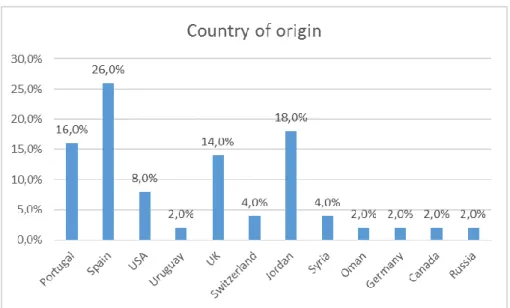
Graphic 2: Distribution of students by country of origin 11
Graphic 3: Distribution of students by gender 12
Graphic 4: Country representation based on the aggrupation of the number of students per
universities on that country 12
Graphic 5: Number of medical schools accordingly to number of years in curriculum 13
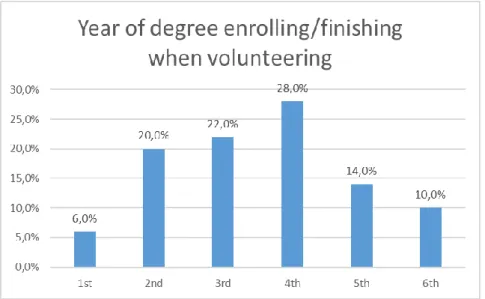
Graphic 6: Year of degree enrolling/finishing when volunteering 14
Graphic 7: Location of the volunteering program (camp and country) 14
Graphic 8: Location of the volunteering program (country) 14
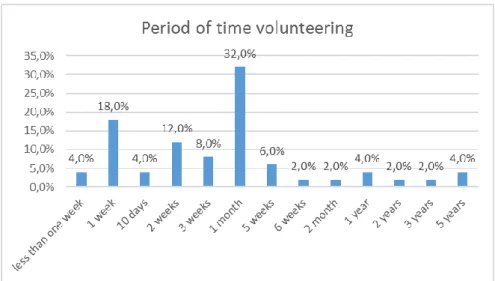
Graphic 9: Period of time students volunteered for. 15
Graphic 10: Tasks performed by students as volunteers 15
Graphic 11: Tasks performed by students as volunteers, by themselves 15
Graphic 12: Answers from students who performed “Triage” as volunteers 16
Graphic 13: Answers from students who collected “Medical Histories” as volunteers 18
Graphic 14: Answers from students who performed “Physical Examination” as volunteers 20 Graphic 15: Answers from students who performed “Diagnostic Procedures” as volunteers 23
Graphic 16: Answers from students who performed “Counselling” as volunteers 26
Graphic 17: Answers from students who performed “Therapeutic Advice/ Prescription” as
volunteers 29
Graphic 18: Answers from students who performed “Emergency Care” as volunteers 31
Graphic 19: Answers from students who performed “Preventive Care” as volunteers 34
Graphic 20: Percentage of students who consider their work as medical students who were
volunteers valuable and percentage of students who didn’t feel useful. 41
Introduction
Concept Clarification
According to the Oxford English Dictionary1, the word refugee means: “A person who has been
forced to leave his or her home and seek refuge elsewhere, especially in a foreign country, from war, religious persecution, political troubles, the effects of a natural disaster, etc.; a displaced person.”
According to theOffice of the United Nations High Commissioner for Refugees, UNHCR2,
“refugees are people fleeing conflict or persecution. They are defined and protected in international law, and must not be expelled or returned to situations where their life and freedom are at risk.”
According to the same dictionary 1, the word migrant means: One who moves, either
temporarily or permanently, from one place, area, or country of residence to another. According to UNHCR, “internally displaced people (IDPs) have not crossed a border to find safety. Unlike refugees, they are on the run at home. While they may have fled for similar reasons, IDPs stay within their country and remain under the protection of its government, even if that government is the reason for their displacement.” 2
The 2015 refugee crisis details
According to the International Organization for Migration - IOM’s publication Fatal Journey’s: “Over the last 20 years, it is likely that more than 60,000 migrants have embarked on fatal journeys around the world, never to return to their loved ones.”3 and this accounts only for
the deaths that are recorded by this organization; in many cases the bodies are never found or identified.
Global forced displacement reached record-high numbers in 2015. According to UNHCR’s publication: Global Trends, “By the end of the year, 65.3 million individuals were forcibly displaced worldwide as a result of persecution, conflict, generalized violence, or human rights violations. This is 5.8 million more than the previous year (59.5 million).” 4
Analyzing the numbers, we reach a total of 65.3 million individuals displaced worldwide with 21.3 million persons being refugees, 40.8 million of internal displaced persons and 3.2 asylum seekers. With an average of 24 people being displaced from their homes, every minute of every day during 2015. 4
According to the same, UNHCR’s publication, “Unaccompanied or separated children in 78 countries – mainly Afghans, Eritreans, Syrians, and Somalis – lodged some 98,400 asylum applications in 2015.” 4
According to IOM’s publication, Fatal Journeys: “The International Organization for Migration estimates that at least 5,400 migrants died or went missing on migratory routes across the globe, with an additional 3,100 losing their lives in the first five months of 2016. 2015 was the deadliest year on record for the Mediterranean, with at least 3,770 persons lost at sea.” 3
This numbers, for the first semester of 2016, represent an increase in 28% when compared to the same period of 2015, and a 52% increase from the same period in 2014.5 According to IOM,
the real number is actually unknown as many deaths are never registered. 3
Before reaching the Mediterranean many refugees make dangerous journeys and take hard routes as crossing the Sahara Desert in order to get to Italy and walking through the Middle East to reach Greece which were the prevalent migration routes to Europe in the first six months of 2016. 5 The primary dangers on this roots were: harsh natural environments that
lead to drowning, asphyxiation, suffocation and hypothermia, lack of food and shelter and violence inflicted by smugglers and national authorities, for example gun violence inflicted by
guards on the Syria-Turkey border. 5–7
Across Europe uncountable official and non-official refugee camps provide shelter to millions
of the previous referred people.
Thinking of medical students that, as me, like to work in disaster relief and volunteer on this situation and had already volunteered on this camps, I propose to investigate if medical curriculums are preparing students to do this kind of work or if they need to be revised taking in consideration the refugee crisis which is a reality in Europe right now.
Methods and Materials
My personal experience volunteering in a refugee camp
The 2015 refugee crisis moved me in a particular way since the beginning. After some discussions about it and after some compelling Facebook® posts I decided that helping should be more than that. However, it took me almost one year to realize what I could do and how far could I go.It was the 22nd of March 2016, I had just turned 23 years old and was a 5th grade medical student, as I woke up and turned on the television I saw the news about the Brussels bombing8 and that was it for me. I wanted to help the ones involved in the refugee
crisis, but what compelled me was that I wanted to fight terrorism. As I own no weapons and I have no fighting skills, the only thing I could do was helping people escaping war and moving on into Europe, as refugees. So I decided to go. I applied to many institutions and organizations, I sent my curriculum and tried to be accepted, as a medical student, to a refugee camp somewhere in Greece. That’s why I wanted to become a doctor in the first
place, so why not starting ?
Adventist Help1 was the first yes I got, and I will never forget that day. I received an email
saying they would love to have me on the team as soon as possible. I booked my flight and
arrived Oinofyta Refugee Camp on the 19th May 2016.
I was informed that the next day, my first day, I was going to be the “doctor on call” since I was the only volunteer available to work on the clinic on that day. Me, a 5th year medical student with no practice but some supervised medical assistance. I was going to be a doctor, and more than that, the doctor “on call” which implied not only the regular opening hours of the clinic (from 9am to 5pm) but also any emergency that could come along at any hour. I took the challenge, conscious that on these kinds of scenarios we do what we can and that I would do what I learned, only what I knew and was confident on doing, and most of all… no harm. I took the challenge hopping that on the next days I would have more volunteers arriving and that if there was anything I couldn’t do I would have the Greek Health System, overload with not only the Greek population but also all the refugees, to back me up. The camp had, at that moment, nearly 150 habitants, most of them children and Adventist Help was the organization providing medical care to all of them, using an old bus that was turned into a clinic2. Most of the things equipping the bus were donated, including medicines,
and we worked with a pretty amazing range of diagnose equipment: stethoscopes, scales, temperature scales, blood pressure meters, ECG machine, a portable ultrasound machine, fetal doppler, glucometers, monitoring devices;3 we also had some emergency care machines
1 http://adventisthelp.org/
2 See images 1 and 2 on the first attachment 3 See images 3, 4 and 5 on the first attachment
that later were used to equip a full ambulance4.
The language was the first problem I had to deal with. It’s hard to take an accurate medical history when you need to have the details translated twice, since many refugees couldn´t speak English or Portuguese and I couldn’t as well speak their languages. I had to find ways to overcome that difficulty and make sure they could understand what I was telling them to do, the medications I was handing them and advising them to take. So I started drawing it on a card with a time schedule and numbering the pills in bags so that it could be understood in any language.5 The first weeks I was there we had no translator on the team and, a 13 and a
15 year old refugee girls and a 17 years old refugee boy, all self-taught English speakers, were
my huge help at the clinic and that way we made it through.
If it’s already hard, facing a different culture, needing to learn how to behave culturally in order not to be disrespectful it’s even harder trying to figure out ways to communicate without speaking while practicing medicine… By the end of my first month in Greece I could already use some Farsi medical terms and understand the basic answers to that. My first days went down calmly and most of the work I did as a doctor was primary care, measuring blood sugar, treating simple respiratory tract infections and wound caring. However, had the first need to prescribe on a patient that was having seizures after his epilepsy usual medication had finished. I had to use the medication we had from donations since we didn’t have it on our stock and couldn’t buy it without a prescription or fix a neurologist appointment on the Greek system in such a hurry (usually it takes weeks/months). Advising on medication was one of the things that bothered me the most. As a medical student, I can’t prescribe but over there we had a full stock of medication that can and cannot be sell without prescription and that was donated from all over the world to, and for, the refugees. It’s their medication, and they could use it has they wish but they decided on their best interest to let the clinic have it and let us advise them on what to take. Five days after my arrival we had the first real emergency on the clinic. I was not alone anymore; a neurosurgeon female doctor had arrived the day before and we were just preparing to go home when a 10-year-old girl entered the bus telling she had taken a handful of pills. If I was alone that day I would only have called an ambulance and sent her to the hospital because I had no knowledge and it was the moment I felt the most unsure since I was on the camp. I had an emergency internship on a hospital but what can you do when you are not on a hospital? Which subject, on the medical curriculum, prepares us for that? We are instructed to call the emergency number and all of us know that, but we were 1 hour away from Athens and all the times we called the ambulance we were instructed that we should drive the patients ourselves. So, what to do? That was when I learnt about charcoal and its uses. That was what that prepared and experienced on emergency fields doctor used to make the little girl throw up all the intact pills she had just took. A simple compound I never ever
heard of on medical school.
4 See image 6 on the first attachment 5 See image 7 on the first attachment
The next days were also calm and steady and after the incident with the girl we went back to the usual primary care, diabetes and hypertension evaluation, basic respiratory tract
infections, virus and wound care.
As my experience revealed to me, empathy is a magic word on this cases, more than being a doctor you need to be the person who gets to know all the tragedy on this lives. You need to learn how to see the big picture, how depression hides in every smile, how background affects decisions, how grief is a constant pain that numbs a lot of symptoms, you need to learn that this people walked through more kilometers than you can imagine, with no water or food, feeling neither hot nor cold, moved by fear and willing to live. After that you need to think that they found themselves in new countries and crossed into Greece in a plastic boat, some of them had accidents, some of them watched family members being killed by smugglers or drowning. All of them suffered unbearable things. And then you need to think of that and get that into your system every time you try to make a history because, if you choose to treat them as regular everyday-basis primary care patients, you will miss a lot of important things. “Your bedside manner”, as I heard many times in the camp, matters more for everyone in general, and for this people in specific, than the pills you choose to give. On the 31st of May, we moved from the bus to a much cooler, bigger and well equipped
donated IsoBox®. This transference happened just at the right moment, when the camp was increasing the resident’s number and as we needed more means to provide the best care
possible. 6
On the first day working full time on the new clinic, instead of the bus, we had a 35-year-old 5 months pregnant lady having tonic-clonic seizures lasting approximately 2-3 minutes by her tent, with tongue biting but no urinary incontinence. Worried about the possibility of eclampsia we took a medical history from the husband after monitoring her on the clinic. All the blood pressure measurements were normal and as the husband informed us that has been happening for the last 8 years and that she is not medicated, we understood that was a case of non-diagnosed epilepsy. Since we had no EEG machine or the possibility of doing brain imaging, diagnose needed to be based on the history and she started on an anti-epileptic that day.
On the 3rd of June, I was alone at the clinic again, the only volunteer, and the doctor on call,
the working day was soft but once home the emergency phone rang and I had to rush to the camp because of a 49-year-old type-2 diabetic and asthmatic female with a high fever. It turned out to be a urinary infection but having to diagnose and choose treatment alone and without the best possible means to do it since I had no possibility of doing a bacterial culture,
scared me a lot.
She was one of the patients I used to see as primary care because of the poorly controlled diabetes, medicated before on Afghanistan it stopped working as she crossed to Europe and she was struggling with it on the camp. I couldn’t remember all the steps on type-2 diabetic’s treatment so I read all the guidelines once I went home. I had been in touch with the
guidelines before in my Primary Care Internship so I already knew where to search which was
a great asset.
By the 5th of June I was consulting around 40 patients per day in the clinic, all alone, and in a
lot of different specialties: from post-traumatic stress or even psychotic bursts to head trauma sequelae, eye inflammations7, skin rashes, spider bites8, pregnant women and
gynecological infections, cardiac arrhythmias9, emergency care, post-natal care, childhood
diseases as chickenpox or viral infections and, of course, primary care as diabetic and hypertensive guidance. At medical school, I usually have one Internship at a time so it was hard having to deal with all the specialties at the same time, every day I would go home with
new things to study and review.
As practical skills, I needed to be able to use all the diagnose methods available and to perform some procedures as placing catheters for IV medication, administering IM and IV injections and suturing which I had also never done but was confident on doing as I was
familiar with some skills by a simulation based training.
Another thing I used to do, and had to do, at the camp was ultrasound to all the pregnant ladies. I had watched a lot of ultrasounds being performed on pregnant ladies in all trimesters but I had never performed one myself, so when I realized we had 7 pregnant ladies in the camp I decided to study and practice ultrasound. At first I couldn’t even find the heart and I would rather use the McDonnald’s rule to find the gestational age, and the Doppler to find the heartbeat instead of the ultrasound machine, but when a Psychiatrist with Gynecological training came to volunteer in the camp we called every pregnant female on the clinic and I
practiced until I could even guess the gender.
And on the 7th June night we received an emergency call from one of those pregnant ladies,
the water broke and she was having contractions, we went to the camp again and called the ambulance, as we were informed it would take a while for the ambulance to arrive we started preparing the clinic for an eventual delivery and when assessing the mother, we noticed there was meconium on the water. We drove her to the hospital ourselves then and she had a caesarian section but, the possibility of having to assist a delivery made me anxious one more time. Again, that was one of the things I simply watched while in my medical student Internship I had never ever even simulated it so what if I needed to do it? What if it happened when I was alone at the clinic? What if I go on the street on my regular life in Portugal and I must assist a delivery in a public place for some reason? I was not prepared and I am not prepared because I never trained it, but I may need to do it… I went back home on the 16th of June for my final 5th year university exams with a bought
ticket to go back to Greece, to the same camp, on the 16th July, once I was done with my
finals.
This second time on the camp I was not working in the clinic anymore but I still was consulted
7 See image 11 on the first attachment 8 See image 12 on the first attachment 9 See image 13 on the first attachment
by some residents since they knew me as a medical student from my previous time there. I was dealing with administrative procedures and logistics, since I was replacing the camp manager while she was on vacations, so it was my job to talk to all the new arrivals and check for signs of infectious diseases, I had to do quick questions to all of them and look for head lice, scabies, chicken pox, tuberculosis, hepatitis, among others… And I was able to diagnose
some of that.
Despite not doing only medical tasks I think my medical curriculum, which includes a Leadership and Management subject prepared me a little bit for the job I had to do on this second time on Greece, being able to coordinate various teams volunteering at the camp and being able to manage all the problems of the residents and attend their logistic needs, that I think I own a little bit to this subject and to my medical curriculum as well. During my second time on the camp, the number of camp occupants increased from nearly 200 to 750 and medical assistance became even more needed as lots of them had been staying in camps before with less conditions and presented with skin rashes, bloody diarrheas, head lice, scabies, and severe dehydration, among other conditions. All the help was needed and I had to step in lots of times even to provide quarantine for some patients since that was a logistic task that was simplified by the fact that I was a medical student and could
understand the real needs behind every isolation.
Among this new occupants we had some particular cases as drugs withdrawal, cancer or dementia, problems that are already hard to face and deal with in regular conditions, and even more when you are in a refugee camp, with a well-equipped medical clinic but not all
the needed things to support this particular cases.
I came back home on the 10th August and have been in Portugal ever since. Despite that I
communicate with the camp and with the camp occupants almost every day. My life, not only as a medical student, changed forever by this experience and I truly think that more students should be able to do this.
Objective
After my experience of two months volunteering in a refugee camp, I had as objective to understand if medical students who volunteered in refugee camps felt prepared to do so, and if they think their medical school’s curriculum is preparing them to feel comfortable on these situations.
Methods
I prepared an online survey using Google Forms ® that I wanted to apply to my population in study: medical students who had or were volunteered with refugees. Using 28 social media pages 9–36 of volunteers related to the refugee crisis I shared a post asking for medical
students who had volunteered with refugees and wanted to collaborate on this study and asking to being contacted by email or Facebook® message. After that I started being contacted by medical students themselves who wanted to participate and who knew other medical students who also had volunteered to those I sent by email or Facebook® message the URL link to my Google® form survey. I was also contacted by managers of organizations who were volunteering on the camps and started applying the online Google® form survey I
had prepared to their medical student volunteers.
The inclusion criteria were being a medical student from any university around the world, or a first-year doctor, so that the only year completed on formation was years of medical school (from 1st to 6th) and had previous history of volunteering with refugees at any time, in any
place, for any period or being an active volunteer at the time of the survey. The exclusion criteria were being a graduated doctor or answering the questionnaire with
only “this doesn’t apply to my questions” answers.
54 answers from volunteers were received, from 20th December 2016 until 27th January 2017,
from all around the globe, from those I excluded four and started analyzing data from a total of 50 answers. The exclusions were made based on the previously defined criteria, one because he was already a graduated doctor, two because they only answered the questionnaire with “this doesn’t apply to my questions.” And another one because his answers of tasks didn’t match the answers given latter.
After collecting the survey information, I analyzed the statistical data to evaluate the results. I used IBM SPSS® Statistics 22 and started by analyzing each variable separately, measuring frequencies and percentages when the variables were nominal/categorical. Then I analyzed further frequencies for separate variables and to compare variables performing the chi-square
test when relating nominal/categorical variables.
The results were considered significant statistically valid if the p value on the chi-square test or t-test was inferior to 0.05.
I also interviewed Michael-John von Hörsten, chief medical officer at International SOS, an experienced doctor who does disaster relief all around the world to understand what difficulties medical students face, while volunteering on these scenarios so that I could confront his answers with the ones of the survey.
Materials
An online Google form survey10 consisting of the following sections was applied to the
volunteers:
An initial questionnaire on personal information and information on the medical school the student is enrolling.
A second section with 18 questions about the specific work while volunteering.
One last section with two questions about the medical curriculum at their medical schools with one last question which is a final evaluation of the work done while volunteering.
A free commentary
An interview to Doctor Michael-John von Horsten11, consisting of 5 questions about his
experience as a doctor who works on disaster relief and with volunteers from all around the world was also applied
10 See attachment 2 11 See attachment 3
Results
These results were obtained with the survey answers:
Table 1: Age
Mean (Standard Deviation) Minimum/Maximum Age (n=50) 23.02 (2.99) 19/35
Graphic 1: Distribution of students by age
Graphic 3: Distribution of students by gender
Graphic 4: Country representation based on the aggregation of the number of students per universities on that country
From 8 different countries, 22 universities are represented on this study. The country that has more universities represented is UK with 8 universities and one student from each university answering the questionnaire (n=8; 16%), but the major country representation based on universities is from Jordan with a single university represented “Jordan University of Science and Technology” but a total of 14 students out of 50. (n=14; 28%). Syria, Oman, Germany and Russia were countries represented on the nationalities that we don’t see represented o the universities list of countries because the students with these nationalities answered the survey are studying on different countries.
Of this 22 universities, there are 6-years curriculum medical schools (n=13, 59%); 5-year curriculum medical schools (n=3; 14%) and 4-year curriculum medical schools (n=6; 27%).
Table 2: Universities per country and number of students per university.
Country University Number of
students:
Portugal
Departamento de Ciências Biomédicas e Medicina da Universidade
do Algarve 1
Faculdade de Ciências da Saúde da Universidade da Beira Interior 3
Universidade Nova de Lisboa 4
Spain
Euskal Herriko Unibertsitatea / Universidad del País Vasco 1
Universidad de Navarra 10
University of Barcelona 2
USA
The George Washington University School of Medicine 1
UConn School of Medicine 1
David Geffen School of Medicine 1
Uruguay Universidad de la Republica 1
UK
University of Liverpool: Liverpool Medical School 1
University of Cambridge 1
Barts and the London 1
Edinburgh Medical School 1
Swansea Medical School 1
University of Leicester 1
University of Dublin, Trinity College 1
University of Oxford 1
Switzerland University of Zurich 1
University of Basel 1
Jordan Jordan University of Science and Technology 14
Canada University of Sydney 1
Graphic 6: Year of degree enrolling/finishing when volunteering
Graphic 7: Location of the volunteering program (camp and country)
Graphic 9: Period of time students volunteered for.
Graphic 10: Tasks performed by students as volunteers
On a total of 34 students (n=34) who claimed to have performed triage while volunteering, the answers on Graphic 14 were obtained:
Graphic 12: Answers from students who performed “Triage” as volunteers
There is no correlation between students who felt more confident doing triage and those who could complete the task successfully by themselves. (X2=14.695)
Table 3: Association between feeling confident while doing triage and successfully completing the task by themselves.
Confident Successfully TOTAL: X2 (p)
No Yes
No 8 (23.5%) 2 (5.9%) 10 (29.4%)
14.695 (12)
Yes 3 (8.8%) 21 (61.8%) 24 (70.6%)
TOTAL: 11 (32.4%) 23 (67.6%) 34 (100%)
Those who felt their curriculum prepared them to do “triage” didn’t recognize having subjects on their curriculum that resembled the task. (X2=1.342; p=0.247)
Table 4: Association between having subjects that resembled the task triage and feeling their medical curriculum prepared them to do so
Prepared Subjects TOTAL: X2 (p)
No Yes No 17 (50.0%) 7 (20.6%) 24 (70.6%) 1.342 (0.247) Yes 5 (14.7%) 5 (14.7%) 10 (29.4%) TOTAL: 22 (64.7%) 12 (35.3%) 34 (100%)
12 It was not possible to obtain p value since 1 cell (25%) was expected to have a value < 5.
Those who felt confident doing triage didn’t recognize having subjects on their curriculum that helped them through the task. (X2=0.174)
Table 5: Association between having subjects that resembled the task triage and feeling confident while doing so
Subjects Confident TOTAL: X2 (p)
No Yes
No 7 (20.6%) 15 (44.1%) 22 (64.7%)
0.174 (13)
Yes 3 (8.8%) 9 (26.5%) 12 (35.3%)
TOTAL: 10 (29.4%) 24 (70.6%) 34 (100%)
Those who claimed their medical curriculum should change for them to feel more prepared didn’t state they were never confronted with such a situation. (X2=1.638; p=0.201)
Table 6: Association between thinking the curriculum should change and stating never being confronted with such situation, for triage.
Change Never TOTAL: X2 (p)
No Yes
No 13 (38.2%) 7 (20.6%) 20 (58.8%)
1.638 (0.201)
Yes 6 (17.6%) 8 (23.5%) 14 (41.2%)
TOTAL: 19 (55.9%) 15 (44.1%) 34 (100%)
Those who volunteer for a greater time didn’t feel increasingly confident doing triage. (X2=4.163)
Table 7: Association between the time spent volunteering and the degree of confidence while doing triage.
Period Confident TOTAL: X2 (p)
No Yes
1 month or more 8 (23.5%) 10 (29.4%) 18 (52.9%)
4.163 (14)
less than 1 month 2 (5.9%) 14 (41.2%) 16 (47.1%)
TOTAL: 10 (29.4%) 24 (70.6%) 34 (100%)
13 It was not possible to obtain p value since 1 cell (25%) was expected to have a value < 5.
Minimum count expected is 3.53.
14 It was not possible to obtain p value since 1 cell (25%) was expected to have a value < 5.
On a total of 40 students (n=40) who claimed to have taken medical histories while volunteering, the answers on Graphic 15 were obtained:
Graphic 13: Answers from students who collected “Medical Histories” as volunteers
Those students who felt confident history-taking could complete the task successfully by themselves. (X2=
4.639; p= 0.031
)Table 8: Association between feeling confident while collecting medical histories and successfully completing the task by themselves.
Confident Successfully TOTAL: X2 (p)
No Yes
No 11 (27.5%) 6 (15.0%) 17 (42.5%)
4.639 (0.031)
Yes 7 (17.5%) 16 (40.0%) 23 (57.5%)
TOTAL: 18 (45.0%) 22 (55.0%) 40 (100%)
Those who felt their medical curriculum prepared them to history taking didn’t recognize subjects on their medical curriculum helped them through that task. (X2=
19.710)
Table 9: Association between having subjects that resembled collecting medical histories and feeling their medical curriculum prepared them to do so
Prepared Subjects TOTAL: X2 (p)
No Yes No 16 (40%) 7 (17.5%) 23 (57.5%) 19.710 (15) Yes 0 (0%) 17 (42.5%) 17 (42.5%) TOTAL: 16 (40%) 24 (60%) 40 (100%)
15 It was not possible to obtain p value since 0 cells were expected to have a value < 5.
Those who felt confident history taking recognized some subjects on their medical curriculum helped them through that task. (X2= 4.365; p= 0.037)
Table 10: Association between having subjects that resembled the collecting medical histories and feeling confident while doing so
Subjects Confident TOTAL: X2 (p) No Yes No 10 (25.0%) 6 (15.0%) 16 (40.0%) 4.365 (0.037) Yes 7 (17.5%) 17 (42.5%) 24 (60.0%) TOTAL: 17 (42.5%) 23 (57.5%) 40 (100%)
Those who claimed their medical curriculum should change for them to feel more prepared didn’t state they were never confronted with such a situation. (X2= 0.328)
Table 11: Association between thinking the curriculum should change and stating never being confronted with such situation, for collecting medical histories.
Change Never TOTAL: X2 (p)
No Yes
No 25 (62.5%) 6 (15%) 31 (77.5%)
0.328 (16)
Yes 8 (20.0%) 1 (2.5%) 9 (22.5%)
TOTAL: 33 (82.5%) 7 (17.5%) 40 (100%)
Students who spent more time volunteering didn’t feel increasingly confident while history-taking (X2 = 0.175; p=0.676)
Table 12: Association between the time spent volunteering and the degree of confidence while collecting medical histories
Period Confident TOTAL: X2 (p)
No Yes
1 month or more 10 (25.0%) 12 (30.0%) 22 (55.0%)
0.175 (0.676)
Less than 1 month 7 (17.5%) 11 (27.5%) 18 (45.0%)
TOTAL: 17 (42.5%) 23 (57.5%) 40 (100%)
16 It was not possible to obtain p value since 1 cell was expected to have a value < 5.
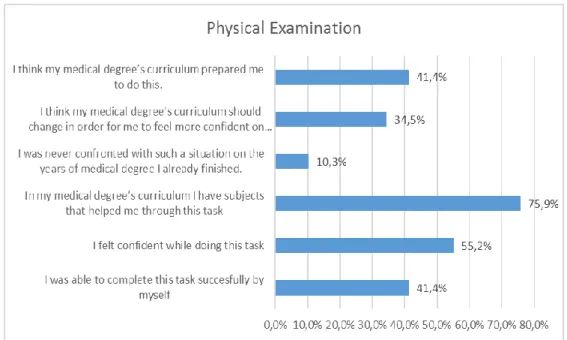
On a total of 29 students (n=29) who claimed to have performed physical exams while volunteering, the answers on Graphic 16 were obtained:
Graphic 14: Answers from students who performed “Physical Examination” as volunteers
There is no statistical correlation between felling confident performing physical examination and successfully completing the task by themselves (X2 = 6.564)
Table 13: Association between feeling confident while performing a physical exam and successfully completing the task by themselves.
Confident Successfully TOTAL: X2 (p)
No Yes No 11 (37.9%) 2 (6.9%) 13 (44.8%) 6.564 (17) Yes 6 (20.7%) 10 (34.5%) 16 (55.2%) TOTAL: 17 (58.6%) 12 (41.4%) 29 (100%)
17 It was not possible to obtain p value since 0 cells were expected to have a value < 5.
Those who felt confident history taking didn’t recognize subjects on their medical curriculum that helped them through that task. (X2= 6.237)
Table 14: Association between having subjects that resembled performing physical exam on patients and feeling confident while doing so
Subjects Confident TOTAL: X2 (p) No Yes No 6 (20.7%) 1 (3.4%) 7 (24.1%) 6.237 (18) Yes 7 (24.1%) 15 (51.7%) 22 (75.9%) TOTAL: 13 (44.8%) 16 (55.2%) 29 (100%)
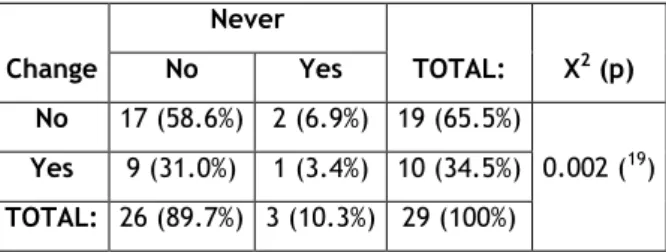
Those who claimed their medical curriculum should change for them to feel more prepared performing physical examinations didn’t state they were being confronted with such a situation on their curriculum. (X2=0.002)
Table 15: Association between thinking the curriculum should change and stating never being confronted with such situation.
Change Never TOTAL: X2 (p) No Yes No 17 (58.6%) 2 (6.9%) 19 (65.5%) 0.002 (19) Yes 9 (31.0%) 1 (3.4%) 10 (34.5%) TOTAL: 26 (89.7%) 3 (10.3%) 29 (100%)
Those who felt their medical curriculum prepared them to physical examination didn’t recognize subjects on their medical curriculum helped them through that task (X2= 6.513)
Table 16: Association between having subjects that resembled performing physical exam on patients and feeling their medical curriculum prepared them to do so
Prepared Subjects TOTAL: X2 (p)
No Yes No 7 (24.1%) 10 (34.5%) 17 (58.6%) 6.513 (20) Yes 0 (0%) 12 (41.4%) 12 (41.4%) TOTAL: 7 (24.1%) 22 (75.9%) 29 (100%)
18 It was not possible to obtain p value since 2 cells (50%) were expected to have a value < 5.
Minimum count expected is 3.14.
19 It was not possible to obtain p value since 2 cells (50%) were expected to have a value < 5.
Minimum count expected is 1.03.
20 It was not possible to obtain p value since 2 cells (50%) were expected to have a value < 5.
Those who claimed their medical curriculum should change for them to feel more prepared didn’t state they were never confronted with such a situation for physical examination (X2=
0.022)
Table 17: Association between thinking the curriculum should change and stating never being confronted with such situation, for physical examination.
Change Never TOTAL: X2 (p) No Yes No 17 (58.6%) 2 (6.9%) 19 (65.5%) 0.002 (21) Yes 9 (31.0%) 1 (3.4%) 10 (34.5%) TOTAL: 26 (89.7%) 3 (10.3%) 29 (100%)
Students who spent more time volunteering didn’t feel increasingly confident while history-taking (X2 = 0.909; p=0.340)
Table 18: Association between the period volunteering and the degree of confidence while performing physical examination
Period Confident TOTAL: X2 (p)
No Yes
1 month or more 8 (27.6%) 7 (24.1%) 15 (51.7%)
0.909 (0.304)
Less than 1 month 5 (17.2%) 9 (31.0%) 14 (48.3%)
TOTAL: 13 (44.8%) 16 (55.2%) 29 (100%)
21 It was not possible to obtain p value since 2 cells (50%) were expected to have a value < 5.
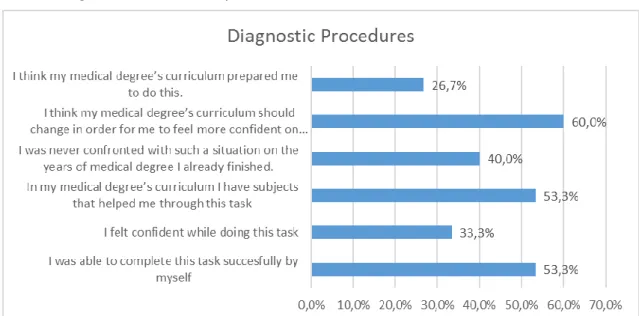
On a total of 15 students (n=15) who claimed to have performed diagnostic procedures while volunteering, the answers on Graphic 17 were obtained:
Graphic 15: Answers from students who performed “Diagnostic Procedures” as volunteers
There is no significant association between those who felt more confident applying diagnostic procedures and those who could complete the task successfully by themselves. (X2 = 1.759)
Table 19: Association between feeling confident applying diagnostic procedures and successfully being able to do so by themselves.
Confident Successfully TOTAL: X2 (p)
No Yes No 7 (46.7%) 4 (26.7%) 11 (73.3%) 1.759 (22) Yes 1 (6.7%) 3 (20.0%) 4 (26.7%) TOTAL: 8 (53.3%) 7 (46.7%) 15 (100%)
22 It was not possible to obtain p value since 2 cells (50%) were expected to have a value < 5.
There is also no association between those who felt their medical curriculum prepared them to apply diagnostic procedures and recognizing some subjects on their medical curriculum helped them through that task. (X2=0.603)
Table 20: Association between having subjects that resembled applying diagnostic procedures and feeling their medical curriculum prepared them to do so
Prepared Subjects TOTAL: X2 (p) No Yes No 7 (46.7%) 5 (33.3%) 12 (80.0%) 0.603 (23) Yes 1 (6.7%) 2 (13.3%) 3 (20.0%) TOTAL: 8 (53.3%) 7 (46.7%) 15 (100%)
Those who felt confident performing diagnostic procedures didn’t recognize subjects on their medical curriculum that helped them through that task. (X2=6.234)
Table 21: Association between feeling confident applying diagnostic procedures having subjects that resemble the task.
Subjects Confident TOTAL: X2 (p) No Yes No 8 (53.3%) 0 (0%) 8 (53.3%) 6.234 (24) Yes 3 (20.0%) 4 (26.7%) 7 (46.7%) TOTAL: 11 (73.3%) 4 (26.7%) 15 (100%)
23 It was not possible to obtain p value since 2 cells (50%) were expected to have a value < 5.
Minimum count expected is 1.40
24 It was not possible to obtain p value since 2 cells (50%) were expected to have a value < 5.
There is also no correlation between students that considered curriculum should change for them to feel more prepared applying diagnostic procedures, and stating that in their medical curriculum they were never confronted with such a situation. (X2=6.667)
Table 22: Association between thinking the curriculum should change and stating they were never confronted with a situation resembling this task.
Change Never Total X2 (p)
No Yes
No 6 (40.0%) 0 (0%) 6 (40.0%)
6.667 (25)
Yes 3 (20.0%) 6 (40.0%) 9 (60.0%)
Total 9 (60.0%) 6 (40.0%) 15 (100.0%)
Students who spent more time volunteering didn’t feel increasingly confident doing diagnostic procedures (X2 =1.519)
Table 23: Association between the time spent volunteering and the degree of confidence while applying diagnostic procedures
Period Confident Total X2 (p)
No Yes
1 month or more 9 (60.0%) 2 (13.3%) 11 (73.3%)
1.519 (26)
less than 1 month 2 (13.3%) 2 (13.3%) 4 (26.7%)
Total 11 (73.3%) 4 (26.7%) 15 (100%)
25 It was not possible to obtain p value since 3 cells (75%) were expected to have a value < 5.
Minimum count expected is 2.40
26 It was not possible to obtain p value since 3 cells (75%) were expected to have a value < 5.
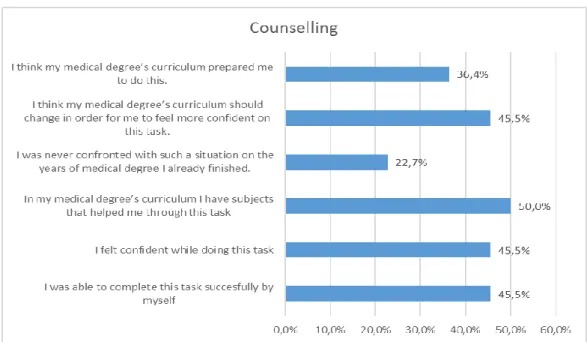
On a total of 22 students (n=22) who claimed to have performed counselling while volunteering, the answers on Graphic 18 were obtained:
Graphic 16: Answers from students who performed “Counselling” as volunteers
There is no statistical correlation between feeling confident while counselling and being able to successfully complete that task by themselves. (X2 = 1.564)
Table 24: Association between feeling confident counselling and successfully being able to perform the task by themselves.
Confident Successfully TOTAL: X2 (p)
No Yes No 8 (36.4%) 4 (18.2%) 12 (54.5%) 1.564 (27) Yes 4 (18.2%) 6 (27.3%) 10 (45.5%) TOTAL: 12 (54.5%) 10 (45.5%) 22 (100%)
27 It was not possible to obtain p value since 1 cell (25%) was expected to have a value < 5.
Those who felt their medical curriculum prepared them to counselling didn’t recognized subjects on their medical curriculum that helped them through that task. (X2= 12.571)
Table 25: Association between feeling prepared to do counselling and recognizing subjects that resemble the task.
Prepared Subjects TOTAL: X2 (p)
No Yes
No 11 (50.0%) 3 (13.6%) 14 (63.6%)
12.571 (28)
Yes 0 (0%) 8 (36.4%) 8 (36.4%)
TOTAL: 11 (50%) 11 (50%) 22 (100%)
Those who felt confident counselling didn’t recognized subjects on their medical curriculum that helped them through that task. (X2=6.600)
Table 26: Association between feeling confident counselling and recognizing subjects that resemble this task.
Subjects Confident TOTAL: X2 (p)
No Yes No 9 (40.9%) 2 (9.1%) 11 (50.0%) 6.600 (29) Yes 3 (13.6%) 8 (36.4%) 11 (50.0%) TOTAL: 12 (54.5%) 10 (45.5%) 22 (100%)
28 It was not possible to obtain p value since 2 cell (50%) were expected to have a value < 5.
Minimum count expected is 4.00
29 It was not possible to obtain p value since 0 cells were expected to have a value < 5.
Related to counselling, there is no statistical correlation between students that considered curriculum should change and those stating that in their medical curriculum they were never confronted with such a situation. (X2= 0.078)
Table 27: Association between feeling the curriculum should change and stating they were never confronted with a situation that resembled this task, for counselling.
Change Never TOTAL: X2 (p) No Yes No 9 (40.9%) 3 (13.6%) 12 (54.5%) 0.078 (30) Yes 8 (36.4%) 2 (9.1%) 10 (45.5%) TOTAL: 17 (77.3%) 5 (22.7%) 22 (100%)
Students who spent more time volunteering didn’t feel increasingly confident counselling. (X
2=0.006)
Table 28: Association between the time spent volunteering and the degree of confidence while counselling
Period Confident TOTAL: X2 (p)
No Yes
1 month or more 7 (31.8%) 6 (27.3%) 13 (59.1%)
0.006 (31)
less than 1 month 5 (22.7%) 4 (18.2%) 9 (40.9%)
TOTAL: 12 (54.5%) 10 (45.5%) 22 (100%)
30 It was not possible to obtain p value since 2 cell (50%) were expected to have a value < 5.
Minimum count expected is 2.27.
31 It was not possible to obtain p value since 2 cell (50%) were expected to have a value < 5.
On a total of 24 students (n=24) who claimed to have done therapeutic advice/prescription while volunteering, the answers on Graphic 19 were obtained:
Graphic 17: Answers from students who performed “Therapeutic Advice/ Prescription” as volunteers
There is no statistical correlation between feeling confident while doing therapeutic advice and being able to successfully complete that task by themselves. (X2 = 0.359)
Table 29: Association between feeling confident prescribing and successfully being able to perform the task by themselves.
Confident Successfully TOTAL: X2 (p)
No Yes
No 14 (58.3%) 5 (20.8%) 19 (79.2%)
0.359 (32)
Yes 3 (12.5%) 2 (8.3%) 5 (20.8%)
TOTAL: 17 (70.8%) 7 (29.2%) 24 (100%)
Those who felt their medical curriculum prepared them to do therapeutic advice didn’t recognize subjects on their medical curriculum that helped them through that task. (X2 =
6.720)
Table 30: Association between feeling prepared to prescribe and recognizing subjects that resemble the task.
Prepared Subjects TOTAL: X2 (p)
No Yes No 14 (58.3%) 6 (25.0%) 20 (83.3%) 6.720 (33) Yes 0 (0%) 4 (16.7%) 4 (16.7%) TOTAL: 14 (58.3%) 10 (41.7%) 24 (100%)
32 It was not possible to obtain p value since 2 cell (50%) were expected to have a value < 5.
Minimum count expected is 1.46
33 It was not possible to obtain p value since 2 cell (50%) were expected to have a value < 5.
Those who felt confident doing therapeutic advice didn’t recognize subjects on their medical curriculum that helped them through that task. (X2=0.873)
Table 31: Association between feeling confident prescribing and recognizing subjects that resemble this task.
Subjects Confident TOTAL: X2 (p)
No Yes
No 12 (50.0%) 2 (8.3%) 14 (58.3%)
0.873 (34)
Yes 7 (29.2%) 3 (12.5%) 10 (41.7%)
TOTAL: 19 (79.2%) 5 (20.8%) 24 (100%)
There is no correlation between students that considered curriculum should change and those who stated that in their medical curriculum they were never confronted with such a situation. (X2 = 0.343)
Table 32: Association between feeling the curriculum should change and stating they were never confronted with a situation that resembled this task, for therapeutic advice/prescription.
Change Never TOTAL: X2 (p)
No Yes
No 10 (41.7%) 4 (16.7%) 14 (58.3%)
0.343 (35)
Yes 6 (25.0%) 4 (16.7%) 10 (41.7%)
TOTAL: 16 (66.7%) 8 (33.3%) 24 (100%)
There is also no correlation between students who spent more time volunteering and feeling increasingly confident doing therapeutic advice. (X2=0.007)
Table 33: Association between the time spent volunteering and the degree of confidence while prescribing
Period Confident TOTAL: X2 (p)
No Yes
1 month or more 11 (45.8%) 3 (12.5%) 14 (58.3%)
0.007 (36)
less than 1 month 8 (33.3%) 2 (8.3%) 10 (41.7%)
TOTAL: 19 (79.2%) 5 (20.8%) 24 (100%)
34 It was not possible to obtain p value since 2 cell (50%) were expected to have a value < 5.
Minimum count expected is 2.08
35 It was not possible to obtain p value since 2 cell (50%) were expected to have a value < 5.
Minimum count expected is 3.33
36 It was not possible to obtain p value since 2 cell (50%) were expected to have a value < 5.