ORIGIN
AL RESEAR
CH
Laboratório de Análise do Movimento (LAM), Faculdade de Fisioterapia, Universidade Federal de Juiz de Fora (UFJF) – Juiz de Fora (MG), Brasil.
1Graduanda do Departamento de Fisioterapia da Universidade Federal de Juiz de Fora (UFJF) – Juiz de Fora (MG), Brasil.
2Fisioterapeuta, discente do Programa de Pós-Graduação Strictu Senso em Ciências da Reabilitação e Desempenho Físico Funcional
da Universidade Federal de Juiz de Fora (UFJF) – Juiz de Fora (MG), Brasil.
3Fisioterapeuta, Docente titular no Programa de Pós-Graduação Strictu Senso em Ciências da Reabilitação e Desempenho Físico
Funcional da Universidade Federal de Juiz de Fora (UFJF) – Juiz de Fora (MG), Brasil.
278
Corresponding address: Diogo Carvalho Felício – Universidade Federal de Juiz de Fora (UFJF), Faculdade de Fisioterapia – Rua Eugênio do Nascimento, s/n, Bairro Dom Bosco – Juiz de Fora (MG), Brasil – Zip Code: 36038-330. E-mail: [email protected] – Financing source: Nothing to declare – Conflict of interests: Nothing to declare – Presentation: Oct. 10th 2017 Accepted for publication: Apr. 24th2018– Approved by the Ethics Committee of UFJF under protocol no. 1.803.411.
ABSTRACT | In Brazil, running is the second most practiced sport, and it can cause musculoskeletal injuries. Studies on the subject are important to guide prevention and intervention strategies. Therefore, the objective of the study was to investigate the prevalence of injuries and associated factors in road runners in the city of Juiz de Fora-MG-Brazil. This is an observational cross-sectional study. A convenience sampling was adopted. This study included amateur runners of both sexes, aged between 18 and 60, training in the city of Juiz de Fora-MG. Participants with history of fracture and osteosynthesis in lower limbs or who performed sports practices other than weight training were excluded. Student’s t-tests, Mann-Whitney and X² (α = 0,05) were used to analyze the data. Participants were allocated in Injury Group (IG, n=37) and Without Injury Group (WIG, n=113). Injury prevalence was 24.7%. The IG had been practicing running for a longer time (76.2±9.1 X 36.7±39.0 months, p<.01); had their weekly training frequency increased (49.5% vs. 54.2%, P=.04); stretched less before training (48.6% X 75.2%, P=.02); presented a higher percentage of gait analysis for footwear selection (62.1% X 43.3%, P=.04) and insole use (35.1% X 14.1%, P=<.01). Injury prevalence was low and those who have been running longer than others had a higher risk of injury even without an increase in weekly frequency. Stretching was protective and the prescription of indiscriminate footwear and insole did not guarantee satisfactory results.
Keywords | Running/injuries; Prevalence.
RESUMO | No Brasil, a corrida de rua é o segundo esporte mais praticado; entretanto, pode ocasionar lesões musculoesqueléticas. Estudos sobre o tema são importantes para nortear estratégias de prevenção e intervenção. Assim, o objetivo foi investigar a prevalência de lesões e os fatores associados em corredores de rua da cidade de Juiz de Fora(MG). Trata-se de um estudo observacional do tipo transversal. A amostra foi selecionada por conveniência. Foram incluídos corredores amadores, entre 18 e 60 anos e que realizavam treinos em diferentes locais da cidade. Foram excluídos participantes com histórico de fratura e osteossíntese em membros inferiores ou que praticassem outro esporte que não fosse a musculação. Para analisar os dados, foram utilizados os testes t de Student, Mann-Whitney e X2 (α=0,05). Os participantes
foram alocados em grupo lesão (GL, n=37) e grupo sem lesão (GSL, n=113). A prevalência de lesão foi de 24,7%. O GL praticava a corrida há mais tempo (76,2 ± 9,1 × 36,7 ± 39,0 meses; P<.01), teve menor aumento da frequência semanal do treinamento (49,5% × 54,2%; P=.04), realizou menos alongamento prévio (48,6% × 75,2%; P=.02), apresentou maior percentual de análise da marcha para escolha do calçado (62,1% × 43,3%; P=.04) e uso de palmilha (35,1% X 14,1%; P=<.01). A prevalência de lesões foi baixa. Os que correm há mais tempo têm maior risco de contusão mesmo sem incremento na frequência semanal. O alongamento foi protetor e a prescrição
Injury prevalence and associated factors in runners
from the city of Juiz de Fora (MG)
Prevalência de lesão e fatores associados em corredores de rua da cidade de Juiz de Fora (MG)
La prevalencia de lesión y los factores asociados en corredores callejeros de la ciudad de Juiz
de Fora (MG)
Arlete dos Reis Roth
1, Wyngrid Porfírio Borel
2, Bárbara Palmeira Rossi
2, José Elias Filho
2,
INTRODUCTION
Regular running practice improves cardiorespiratory
fitness in inactive people, resulting in improved quality
of life, reduction in the percentage of fat and in the
concentration of blood elements
1-3. Its ease of execution
and low cost
4helps making it the second most practiced
sport in Brasil
5. However, when practiced inappropriately
or without guidance, it can cause lesions on the
musculoskeletal system
2.
The increase in the number of sports injuries is
closely related to intrinsic and extrinsic factors
6,7. The
intrinsic factors are age, gender, experience, aptitude and
anatomical changes. The extrinsic factors are, directly
or indirectly, related to the preparation or practice of
running, involving the activity type, footwear, surface
on which training occurs, etc
8.
Musculoskeletal impairment can be a challenge to
regular practice and work leave for extended periods, in
addition to high costs
9. A prospective cohort study with
1,696 participants investigated the economic burden
of lesions in runners. With converted values, health
care costs and absenteeism of work activities reached
R$303.00
10-12. In Brazil, no data on the topic was found;
therefore, it is not possible to infer that this value is
approximate. Thus, the objective of this study was to
investigate the prevalence of injuries and associated
factors in road runners in the municipality of Juiz de
Fora (MG).
METHODOLOGY
Study design and ethical aspects
This is an observational, cross-sectional study, approved
by the Research Ethics Committee (CEP) from the
Federal University of Juiz de Fora (UFJF) (registered No.
1.803.411/2016). All participants signed the Informed
Consent Form (IFC).
Sample
Convenience sampling was performed. The sample size
was calculated by using the formula n = Z*Z[P(1-P)]/
(D*D), where:
Z = Value of the standard normal distribution
corresponding to the desired level of confidence (Z=1.96
for 95% Confidence Interval), P = Prevalence Expected
and D = Maximum Acceptable Error for Estimate
13. The
expected prevalence was of 15% (P=0.15), with 95% CI
range of 12% (D=0.06), this way: n=1.96
2(0.15 (1-0.15))/
(0.06
2) = 136 people.
Data collection was conducted at training sites and
in competitions of the
Ranking de Corridas de Rua
(Road Running Ranking) of Juiz de Fora/MG. Amateur
runners of both sexes were included, aged between 18
and 60 years and who were training in different places
de calçado e palmilha indiscriminados não garantiram resultados satisfatórios.
Descritores | Corrida/lesões; Prevalência.
RESUMEN | En Brasil, la carrera callejera es el segundo deporte más practicado; mientras tanto, puede ocasionar lesiones musculo esqueléticas. Estudios sobre el tema son importantes para orientar estrategias de prevención e intervención. Así, el objetivo ha sido investigar la prevalencia de lesiones y los factores asociados en corredores callejeros de la ciudad de Juiz de Fora (MG). Se trata de un estudio observacional del tipo transversal. La muestra ha sido seleccionada por conveniencia. Han sido incluidos los corredores amadores, entre 18 y 60 años y que realizaban entrenos en distintos locales de la ciudad. Han sido excluidos los participantes con historial de fractura y osteosíntesis en miembros inferiores o que practicaran otro deporte que no fuera la musculación.
Para analizar los datos, han sido utilizadas las pruebas t de Student, Mann-Whitney y X2 (α=0,05). Los participantes han sido
asignados en grupo lesión (GL, n=37) y grupo sin lesión (GSL, n=113). La prevalencia de lesión ha sido del 24,7%. El GL practicaba la carrera hacía más tiempo (76,2 ± 9,1 × 36,7 ± 39,0 meses; P<.01), ha tenido menor incremento de la frecuencia semanal del entrenamiento (el 49,5% × el 54,2%; P=.04), ha realizado menos tiramiento previo (el 48,6% × el 75,2%; P=.02), ha presentado mayor porcentual de análisis de la marcha para escoja del calzado (el 62,1% × el 43,3%; P=.04) y uso de plantilla (el 35,1% × el 14,1%; P=<.01). La prevalencia de lesiones ha sido baja. Los que corren hace más tiempo tienen mayor riesgo de contusión aunque sin incremento en la frecuencia semanal. El tiramiento ha sido protector y la prescripción de calzado y plantilla indiscriminados no ha garantizado resultados satisfactorios.
of the city, and were excluded participants with prior
history of fracture and internal fracture fixation in lower
limbs or who performed non-bodybuilding-based sports.
For analysis of associated factors, the participants were
allocated into Injury Group (IG) and Without Injury
Group (WIG).
Procedures
Analysis of injury prevalence
To categorize the sample, information regarding
age, gender, education level, height and body mass was
collected. For analysis of injury prevalence, any pain or
injury that has limited or prevented the athlete from
participating in training and/or competitions in the last
six months was considered
8.
Analysis of associated factors
With respect to the associated factors, data was
collected on the variables of training. Investigation was
focused on whether there was an increase in weekly
frequency, distance traveled and duration of daily
practice, in addition to the practice time, distance
and average daily duration, use of specific shoes
for running, period shoes were used, if the period
corresponded to kind of footstep and if there was more
than a pair, plus the use of orthopedic insole, during
the last six months. Stretching and warm-ups before
practice, cooldown after practice, weight training and
whether the participant had guidance for training were
also aspects analyzed. If true, which professional(s)
were involved and whether assessment regarding the
identification of risk factors for injury while running
was made.
Statistical analysis
The characterization of the sample was conducted
by descriptive statistics. To evaluate the differences
between groups, Student’s t-test, Mann-Whitney U
and Chi-squared were used for independent groups. For
inferential analyses, a significance level of 0.05% was
considered. The data were analyzed using the software
SPSS® version 15.0.
RESULTS
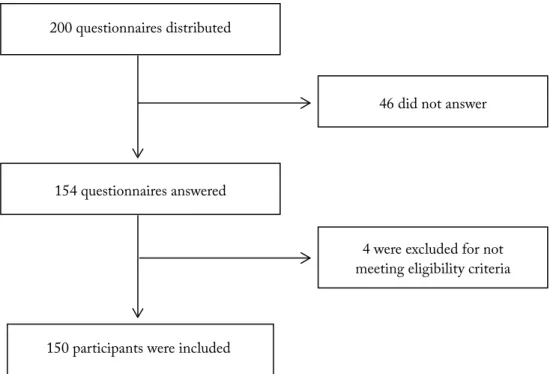
Figure 1 represents sample recruitment.
A total of 150 individuals participated in this study,
the majority males (52%). Table 1 presents demographic
and anthropometric characteristics of the sample. Injury
prevalence was of 24.7% (n=37)
Table 2 presents the differences between the
characteristics of training of the IG and WIG.
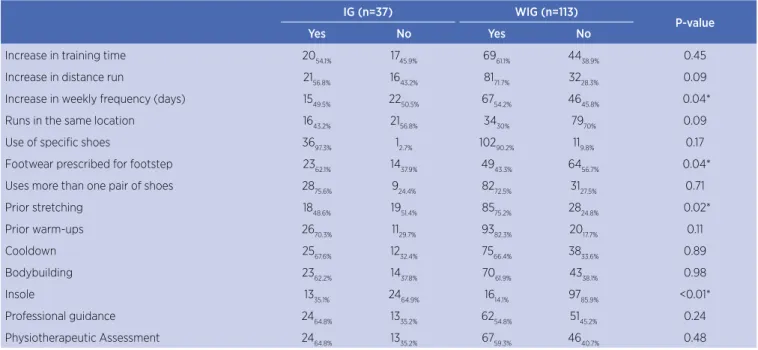
Table 3 presents the factors associated with injuries.
200 questionnaires distributed
154 questionnaires answered
46 did not answer
4 were excluded for not
meeting eligibility criteria
150 participants were included
Table 1. Mann-Whitney U test used to verify demographic and anthropometric characteristics (n = 150)
IG (n=37) WIG (n=113) P-value
Age (years) 34±11.1 35.8±9.9 0.52
Education level (years) 15.5±4.8 14.7±3.5 0.52
BMI (Kg/m ²) 23.8±3.9 23.7±3.4 0.49
Caption: IG = Injury Group; WIG= Without Injury Group; BMI = Body Mass Index
Table 2. Mann-Whitney U test used to verify training characteristics (n = 150)
IG (n=37) WIG (n=113) P-value
Practice time (months) 76.2±99.1 36.7±39.0 0.01*
Weekly frequency (days) 3.5±2.0 3.3±1.3 0.51
Training distance (km) 11.6±14.8 9.0±5.8 0.61
Training time 230.5±98.7 56.6±25.4 0.33
Caption: IG = Injury Group; WIG = Without Injury Group; KM = Kilometers
Table 3. Chi-squared test to verify factors associated with injuries (n=150)
IG (n=37) WIG (n=113)
P-value
Yes No Yes No
Increase in training time 2054.1% 1745.9% 6961.1% 4438.9% 0.45
Increase in distance run 2156.8% 1643.2% 8171.7% 3228.3% 0.09
Increase in weekly frequency (days) 1549.5% 2250.5% 6754.2% 4645.8% 0.04*
Runs in the same location 1643.2% 2156.8% 3430% 7970% 0.09
Use of specific shoes 3697.3% 12.7% 10290.2% 119.8% 0.17
Footwear prescribed for footstep 2362.1% 1437.9% 4943.3% 6456.7% 0.04*
Uses more than one pair of shoes 2875.6% 924.4% 8272.5% 3127.5% 0.71
Prior stretching 1848.6% 1951.4% 8575.2% 2824.8% 0.02*
Prior warm-ups 2670.3% 1129.7% 9382.3% 2017.7% 0.11
Cooldown 2567.6% 1232.4% 7566.4% 3833.6% 0.89
Bodybuilding 2362.2% 1437.8% 7061.9% 4338.1% 0.98
Insole 1335.1% 2464.9% 1614.1% 9785.9% <0.01*
Professional guidance 2464.8% 1335.2% 6254.8% 5145.2% 0.24
Physiotherapeutic Assessment 2464.8% 1335.2% 6759.3% 4640.7% 0.48
Caption: IG = Injury Group; WIG = Without Injury Group; * = Significant Difference
DISCUSSION
The objective of this study was to investigate the
prevalence of injuries and associated factors in road
runners in the municipality of Juiz de Fora (MG). Injury
prevalence was of 24.7% Among the associated factors,
the IG had practiced running for a longer time; increased
weekly training less (49.5% × 54.2%); had less prior
stretching (48.6% X 75.2%); showed higher percentage
of gait analysis for shoes choice (62.1% X 43.3%) and
use of insoles (35.1% X 14.1%).
The sample was constituted by 150 volunteers,
where most were of male sex. This higher percentage
was observed in prior studies
7,14and is related to social
construction, since women present double work shift
15.
Injury prevalence was 24.7% and the literature
presents a variability between 24 and 65%
16, explained
by the distinct characteristics of the samples and by the
definition of injury. Injury rates can be overestimated or
underestimated by using a broad definition. It is therefore
necessary that there be a standard term
17.
With respect to the training characteristics, it was
observed that the IG has been running for a longer time,
which corroborates with the study by Rangel et al.
18stating
a positive relationship between practice time and injury
occurrence. There is evidence that running for a longer
period is an important predictive factor of injury, as it is
associated with overlapping repeated trauma
2,19.
injury, due to a chronic state of fatigue caused by imbalance
between regeneration time and the sports practice
2,19. In
this study, WIG participants increased the percentage of
weekly training. The descriptive data explain the occurred
since, despite having increased the training week in the
past six months, the average of WIG was 3.3 days in
week (sustainable period for tissue recovery).
In this study, 62.1% of IG wore footwear prescribed for
their kind of footstep. Systematic reviews have concluded
that no injury can be prevented with the use of specific
footwear
20,21. These findings are contradictory, given that
other studies have concluded that the use of specific
shoes for different types of footsteps prevents injuries
due to the cushioning and absorption of impact forces
between foot and soil
22. A review study with a sample of
423 individuals concluded that the use of specific shoes
offers a protective effect only on volunteers with flatfeet,
while those with neutral footstep and talipes cavus did
not have any benefits. It can be concluded that there are
gaps on the subject
18.
In addition, in the IG, the percentage of insole use
was higher, thus being shown as a factor associated with
injury. Considering that the purpose of the insole is to
generate corrective reflexes, it is not always prescribed
judiciously and individually
23.
In this research, stretching was a protective factor.
This occurs because stretching retracted muscles increases
their ability to generate force and torque, which benefits
amateur runners
25. This discussion still has gaps, since other
studies have indicated that stretching done immediately
before training leads to injury predisposition, since it
decreases muscle performance
25-29.
Among the limitations of this study there is the
use of structured questionnaire, which is susceptible to
memory bias and misinterpretation. Future studies are
encouraged to evidence the causality relationship between
these elements.
CONCLUSION
The prevalence of injuries in amateur runners in Juiz de
Fora/MG was low. Having practiced running for longer
time increases the risk of injury even when there is no
increase in weekly frequency. Stretching was a protective
measure against injury prevalence. Among associated
factors that influence the appearance of lesions are: practice
time of running, increase in weekly training frequency,
indiscriminate prescription of footwear and insoles.
REFERENCES
1. Aaltonen S, Karjalainen H, Heinonen A, Parkkari J, Kujala UM. Prevention of sports injuries: systematic review of randomized controlled trials. Arch Intern Med. 2007;167(15):1585-92. doi: 10.1001/archinte.167.15.1585
2. Augusti M, Aguiar CM. Corrida de rua e sociabilidade. Lect educ fis deportes [Internet]. 2011 [citado em 5 set. 2018];16(159). Disponível em: <https://bit.ly/Q5AadE>.
3. Baxter C, Naughton LRM, Sparks A, Norton L, Bentley D. Impact of stretching on the performance and injury risk of long-distance runners. Res Sports Med. 2017;25(1):78-90. doi: 10.1080/15438627.2016.1258640
4. Bonanno DR, Landorf KB, Munteanu SE, Murley GS, Menz HB. Effectiveness of foot orthoses and shock-absorbing insoles for the prevention of injury: a systematic review and meta-analysis. Br J Sports Med. 2017;51(2):86-96. doi: 10.1136/ bjsports-2016-096671.
5. Dallari MM. Corrida de rua: um fenômeno sociocultural contemporâneo. [dissertação]. São Paulo: Universidade de São Paulo; 2009. doi: 10.11606/T.48.2009.tde-02092009-145957 6. Feitoza JE, Martins J. Lesões desportivas decorrentes da prática
do atletismo. Rev Educ Fís 2000;11(1):139-47.
7. Fernandes D, Lourenço TF, Simões EC. Fatores de risco para lesões em corredores de rua amadores do estado de São Paulo. RBPFEX [Internet]. 2014 [citado em 6 set. 2018];8(49):656-63. Disponível em: <https://bit.ly/2NUaMpi>.
8. Ferreira AC, Dias JMC, Fernandes RM, Sabino GS, Anjos MTS, Felício DC. Prevalência e fatores associados a lesões em corredores amadores de rua do município de Belo Horizonte, MG. Rev Bras Med Esporte. 2012;18(4):252-5. doi: 10.1590/ S1517-86922012000400007
9. Hespanhol Junior LC, van Mechelen W, Verhagen E. Health and economic burden of running-related injuries in Dutch trailrunners: a prospective cohort study. Sports Med. 2017;47(2):367-77. doi: 10.1007/s40279-016-0551-8.
10. Hespanhol Junior LC, van Mechelen W, Postuma E, Verhagen E. Health and economic burden of running-related injuries in runners training for an event: a prospective cohort study. Scand J Med Sci Sports. 2016;26(9):1091-9. doi: 10.1111/sms.12541. 11. Hespanhol Junior LC, Huisstede BM, Smits DW, Kluitenberg
B, van der Worp H, van Middelkoop M, et al. The NLstart2run study: economic burden of running-related injuries in novice runners participating in a novice running program. J Sci Med Sport. 2016;19(10):800-4. doi: 10.1016/j.jsams.2015.12.004. 12. Hespanhol Junior LC, Costa LOP, Carvalho ACA, Lopes AD.
A description of training characteristics and its association with previous musculoskeletal injuries in recreational runners: a cross-sectional study. Rev Bras Fisioter. 2012;16(1):46-53. doi: 10.1590/S1413-35552012000100009
13. Lucas-Cuevas AG, Pérez-Soriano P, Priego-Quesada JI, Llana-Belloch S. Influence of foot orthosis customisation on perceived comfort during running. Ergonomics. 2014;57(10):1590-6. doi: 10.1080/00140139.2014.938129
15. Macera CA, Pate RR, Powell KE, Jackson KL, Kendrick JS, Craven TE. Predicting lower-extremity injuries among habitual runners. Arch Intern Med. 1989;149(11):2565-68. doi:10.1001/ archinte.1989.00390110117026
16. Malisoux L, Chambon N, Delattre N, Gueguen N, Urhausen A, Theisen D. Injury risk in runners using standard or motion control shoes: a randomised controlled trial with participant and assessor blinding. Br J Sports Med. 2016;50(8):481-7. doi: 10.1136/bjsports-2015-095031.
17. Murley GS, Landorf KB, Menz HB, Bird AR. Effect of foot posture, foot orthoses and footwear on lower limb muscle activity during walking and running: a systematic review. Gait Posture. 2009;29(2):172-87. doi: 10.1016/j.gaitpost.2008.08.015. 18. Rangel GMM, Farias JM. Incidência de lesões em
praticantes de corrida de rua no município de Criciúma, Brasil. Rev Bras Med Esporte. 2016;22(6):496-500. doi: 10.1590/1517-869220162206128114
19. Oliveira DG, Santo GE, Souza IS, Floret M. Prevalência de lesões e tipo de treinamento de atletas amadores de corrida de rua. Corpus sci [Internet]. Jun. 2012 [citado em 6 set. 2018];8(1):51-9. Disponível em: <https://bit.ly/2wOdKFq>.
20. O’Leary K, Vorpahl KA, Heiderscheit B. Effect of cushioned insoles on impact forces during running. J Am Podiatr Med Assoc. 2008;98(1):36-41. doi: 10.7547/0980036
21. Pazin J, Duarte MFS, Poeta LS, Gomes MA. Corredores de rua: características demográficas, treinamento e prevalência de lesões. Rev Bras Cineantropom Desempenho Hum. 2008;10(3):277-82.
22. Pileggi P, Gualano B, Souza M, Caparbo VF, Pereira RMR, Pinto ALS, Lima FR. Incidência e fatores de risco de lesões osteomioarticulares em corredores: um estudo de coorte
propectivo. Rev Bras Educ Fís Esporte. 2010;24(4):453-62. doi: 10.1590/S1807-55092010000400003
23. Smits DW, Huisstede B, Verhagen E, van der Worp H, Kluitenberg B, van Middelkoop M, et al. Short-term absenteeism and health care utilization due to lower extremity injuries among novice runners: a prospective cohort study. Clin J Sport Med. 2016;26(6):502-9. doi: 10.1097/ JSM.0000000000000287
24. Schelde J. Facts and fiction about running shoes. Ugeskr Laeger. 2012;174(48):3011-3.
25. Saragiotto BT, Yamato TP, Lopes AD. What do recreational runners think about risk factors for running injuries? A descriptive study of their beliefs and opinions. J Orthop Sports Phys Ther. 2014;44(10):733-8. doi: 10.2519/jospt.2014.5710.
26. Shehab R, Mirabelli M, Gorenflo D, Fetters MD. Pre-exercise stretching and sports related injuries: knowledge, attitudes and practices. Clin J Sport Med. 2006;16(3):228-31. doi: 10.1097/00042752-200605000-00007
27. Silva SPS, Sandre-Pereira G, Salles-Costa R. Fatores sociodemográficos e atividade física de lazer entre homens e mulheres de Duque de Caxias/RJ. Cienc Saude Colet [Internet]. 2011 [citado em 6 set. 2018];16(11):4493-501. Disponível em: <https://bit.ly/2wQkZg6>.
28. Simões NVN. Lesões desportivas em praticantes de atividade física: uma revisão bibliográfica. Rev Bras Fisioter. 2005;9(2):123-28.