ECONOMIC FEASIBILITY OF LETTUCE INTERCROPPED WITH ROCKET IN
FUNCTION OF SPACING AND GROWING SEASON
1CAROLINA SENO NASCIMENTO2*, CAMILA SENO NASCIMENTO2,
ARTHUR BERNARDES CECÍLIO FILHO2
ABSTRACT - Intercropping is a production system that can reduce the production cost and increase the
profitability of vegetable producers, since it permits more efficient land and agricultural inputs use. In order to evaluate the effect of lettuce plant density on the economic feasibility of lettuce-rocket intercropping system
over two growing seasons (winter and summer), two experiments were conducted in the field at São Paulo State University “Júlio de Mesquita Filho” (UNESP), Jaboticabal, São Paulo, Brazil. The treatments consisted of five lettuce-rocket intercrops with spacing between lettuce rows of: 0.20; 0.25; 0.30; 0.35 and 0.40 m, five
sole crop of lettuce in the same spacing between rows adopted in the intercropping system, and a sole cropping of rocket with spacing between rows of 0.20 m. The statistical design adopted was the complete randomized block with four replicates. During winter, higher profitability was achieved with the highest population density. Highest profitability of the crops in both seasons was obtained in summer.
Keywords: Eruca sativa. Lactuta sativa. Profitability. Growth system.
VIABILIDADE ECONÔMICA DO CONSÓRCIO DE ALFACE E RÚCULA EM FUNÇÃO DO ESPAÇAMENTO E ÉPOCA DE CULTIVO
RESUMO - A consorciação de culturas é um sistema de produção capaz de reduzir os custos produtivos e
aumentar a rentabilidade dos produtores de hortaliças, uma vez que ele possibilita o uso mais eficiente da área e dos insumos agrícolas. Com o objetivo de avaliar o efeito da densidade de plantas de alface na viabilidade econômica do consórcio de alface e rúcula, em duas épocas de cultivo (inverno e verão), dois experimentos foram instalados em campo, na Universidade Estadual Paulista “Júlio de Mesquita Filho” (UNESP), Jaboticabal, São Paulo, Brasil. Os tratamentos corresponderam a cinco consórcios de alface com rúcula nos espaçamentos entre linhas da alface de: 0,20; 0,25; 0,30; 0,35 e 0,40 m, cinco cultivos solteiros de alface nos mesmos espaçamentos adotados em consórcio, e um cultivo solteiro de rúcula no espaçamento entre linhas de
0,20 m. O delineamento experimental utilizado foi em blocos casualizados completos, com quatro repetições.
No inverno, maior rentabilidade é obtida com a maior densidade populacional. Maior rentabilidade das culturas, em ambas épocas de cultivo é obtida no verão.
Palavras-chave: Eruca sativa.Lactuca sativa. Rentabilidade. Sistema de cultivo.
__________________
*Corresponding author
1Received for publication in 01/31/2017; accepted in 04/19/2017.
2Department of Plant Production, Universidade Estadual Paulista “Júlio de Mesquita Filho”, Jaboticabal, SP, Brazil;
Rev. Caatinga
INTRODUCTION
The high demand and requirements of national and international markets for high quality products grown in a sustainable way, has made the vegetable growers seek the adoption of new production technologies without losing sight of the economic feasibility (ZANG et al., 2015). Among some possibilities, the intercropping system stands out, because this production system increases the profitability of the activity, since it increases the yield per unit area, and promotes more efficient land, labor and agricultural inputs use (BHATTI et al., 2013; YANG et al., 2013). However, for proper analysis of the efficiency of this system, evaluation of the economic feasibility of intercropping in relation to sole cropping is necessary, besides the quantitative evaluation, considering the quality of the vegetables produced and the variations in the production costs and in the sale price which vary according to the production seasonality (REZENDE et al., 2009; CECÍLIO FILHO et al., 2015). This evaluation is necessary because, although an increase in the yield of intercropping system was observed, when compared with the sole crop, factors such as reduction in the secondary crop population and production of vegetables with inferior quality and reduced marketing value may occur, negatively affecting the profitability of the system (CECÍLIO FILHO et al., 2008; CECÍLIO FILHO et al., 2011). So, the profitability obtained in the intercropping system will not always validate the yield advantage observed in the intercropping in relation to the sole cropping system (REZENDE et al., 2009).
Several studies aiming to evaluate the economic feasibility of intercropping system of vegetables have been carried out in previous years, showing promising results (CECÍLIO FILHO et al., 2008; SILVA et al., 2008; COSTA et al., 2008; BARROS JÚNIOR et al., 2009; REZENDE et al., 2009; REZENDE et al., 2011; BEZERRA NETO et al., 2012; CECÍLIO FILHO et al., 2015). Nevertheless, information on the management factors
of this system are necessary in order to optimize the complementary effect between the species and minimize the competition effects of the environment resources (water, light, nutrients and space) which can reduce the yield and quality of the final product (LI et al., 2011). Among the management factors, the establishment season is an important factor to be considered, since the crop yield can be affected by the period of their coexistence (CECÍLIO FILHO; MAY, 2002). In addition, the population density is another factor of great importance for the success of this system, since the larger or smaller plants population influences plant characteristics, such as architecture, mass, quality and yield (SILVA et al., 2000).
There are several vegetables combinations that can be used in intercropping, with the lettuce being a crop frequently used (COSTA et al., 2007; REZENDE et al., 2011; MOTA et al., 2012; CECÍLIO FILHO et al., 2013; CECÍLIO FILHO et al., 2015). Among the leafy vegetables, rocket is a crop that can be used as an intercrop, due to its erect growth and high marketing price, presenting a great combination with lettuce (BARROS JÚNIOR et al., 2011; OLIVEIRA et al., 2010; BARBOSA et al., 2015).
This study aimed to evaluate the economic feasibility of lettuce intercropped with rocket, in function of the lettuce population densities over two growing seasons.
MATERIAL AND METHODS
Two experiments were carried out in the field during two growing seasons (winter - 08/11 to
09/25/2011 and summer - 01/12 to 02/24/2012), at
São Paulo State University “Júlio de Mesquita Filho” (UNESP), Jaboticabal, São Paulo (21°15’22” South, 48°18’58” West and altitude of 575 m). The meteorological data during the experimental period are shown in Table 1.
Table 1. Average temperature (AT), maximum temperature (MaxT), minimum temperature (MinT), cumulative rainfall (CR) and relative humidity of the air (RH) during the winter and summer experiments.
AT MaxT MinT CR RH
(°C) (°C) (°C) (mm) (%)
Winter 22.3 31.3 15.1 11.8 48.9 to 56.3
Summer 23.9 30.3 19.4 189.5 72.4 to 82.0
The soil of the area was classified as Eutrophic Red Latosol, with very clayey texture (EMBRAPA, 2006). The soil analysis was done before the commencement of each experiment (Table 2).
The soil preparation consisted of plowing, two harrowing and construction of beds with a bed
The treatments constituted of five lettuce-rocket intercrops with spacing between
lettuce rows of: 0.20, 0.25, 0.30, 0.35 and 0.40 m; five sole crops of lettuce with the same spacing used in the intercropping, and a sole crop of rocket with spacing between rows of 0.20 m. The experimental design used in the experiments was a complete randomized block with 11 treatments and four replicates. In the intercropping, the experimental unit consisted of nine lettuce rows with four plants in the transverse direction of the bed and eight rocket rows were allocated between the lettuce rows. In the sole crop of lettuce, the plot consisted of nine rows with four plants, and in the sole crop of rocket, it consisted of eight rows. The total area was variable according to the spacing. As useful area, the five central lettuce rows were considered, excluding one plant of each end, and for the rocket, 2 m2 of the four central rows was considered.
The lettuce cultivar used was Vera of the curly leaves group without head formation, and the rocket cultivar was the Folha Larga. The lettuce was sown in polyethylene trays with 288 cells filled out with organomineral substrate of the brand Bioplant®. The seedlings were transplanted when they presented four leaves, following the line spacing established in the treatments and the space between plants of 0.25 m.
The rocket was sown on the same day of the lettuce transplant, directly at the bed, and the thinning was carried out at 10 and 13 days after sowing (DAS), in winter and summer experiments, respectively, leaving one plant per pit in the spacing between plants of 0.05 m. In the intercropping, the rocket was sown in furrows located in the middle of the space between the lettuce rows.
Fertilization was the same in the intercropping and sole cropping of lettuce and rocket, according to the soil analysis and recommendation of Trani, Passos and Azevedo Filho (1997). The cover fertilization with N (urea), according to these authors, followed the recommendation for each crop (0.80 g plant-1 for lettuce and 3.0 g m-1 for rocket)
and its subdivision was carried out three times; for the lettuce at 10, 20 and 30 days after the transplant, and for the rocket at 7, 14 and 21 DAS. In the intercropping system, the third fertilization in the two experiments was not carried out with the spacing of
0.20; 0.25 and 0.30 m between lettuce rows, because the crops totally covered the soil, making fertilization impossible.
Weed control was carried out by manual weeding whenever it was necessary. As crop handling, three fungicides and insecticides applications for the diseases and pests control were carried out.
Irrigation was performed by the sprinkler
system, using Asbrasil ZE-30D sprinklers with
nozzles of 4.5 x 5.5 mm diameter, with spacing of 18 x 18 m, and with a 5 mm blade per day
Determination of total operational cost
To determine the total operational cost (TOC), the structure of the operational cost of production proposed by Matsunaga et al. (1976) was used.
In the calculation of TOC of the sole crop of lettuce and intercrop, the fixed operational costs (FOC) of items and operations common to all treatments, such as soil preparation, liming, planting fertilization, irrigation system, herbicide, insecticide and fungicide were taken into consideration. In the variable operational costs (VOC), the items that varied with spacing, such as common labor, machinery and / or equipment costs, transplantation, manual weeding, cover fertilization, harvesting, washing and packaging in the marketing boxes, were considered.
The nominal prices of the items of production were corrected through the updating of the values, using the General Price Index - Internal Availability
(IGP-DI), for values in reais (R$) of August 2015
and January 2016. The unit values of each item were calculated as follows:
a) Cost of labor
The monthly salary of the common laborer (CL) and tractor driver (TDL) was obtained from the Union of Rural Workers of Jaboticabal, for the first experiment (winter) which is R$ 846.94 and R$ 967.57, and for the second experiment (summer), it was R $ 891.10 and R $ 1,019.52, respectively, for a monthly workload of 220 hours, plus social charges, assumed by the employer, equivalent to 43% of the salary value.
b) Prices of machinery and implements
Table 2. Results of soil chemical analysis of the winter and summer experiments.
pH O.M. P resin K Ca Mg H+Al SB T V
CaCl2 g dm-3 mg dm-3 ………..….mmolc dm-3……….. %
Winter
5.5 22.0 96.0 3.8 33.0 9.0 18.0 45.8 63.8 72.0
Summer
Rev. Caatinga
The following items were considered for the cost and depreciation of the machine hour: Massey Ferguson tractor (MF) - 275 (77 cv), bed maker
machine of 1.20 m with six spades, limestone distributor, bar sprayer (600 L), motor pump of 20 cv, plow with 3 discs of 26", grille with 28 discs of 18” and four-ton truck.
c) Cost and depreciation of the machine hour, implements and operations costs
In the machines hour cost (MHC), the costs
of fuels (f), in addition to an estimated value for repairs (r), maintenance (m), garage (g) and insurance rate (i) were considered as follows: MHC = i + g + r + m + f. The insurance, garage and repairs were, respectively 0.75; 1 and 10%, per year of the machine value, considering 1,000 hours of machine use, in addition to maintenance costs. In the calculation of the maintenance of the MF 275 tractor (77 cv), the cost of lubricants (oils and greases) and machine maintenance items (filters) were considered, taking into consideration, the manufacturer's suggested replacement period. For the cost-hour of
implements (CHI), the consumption of grease and repairs was considered and calculated using the following formula: CHI = r + gr; where r = repairs, corresponding to 10% per year of the implement value, and gr = grease. The depreciation was calculated using the straight-line method, where
the good is depreciated over its useful life at a
constant rate, according to the following formula: D = (Iv - Fv) /N.H; Where: D = depreciation in
R$ hour-1 or day-1; Iv = initial value (new); Fv = final
value; N = useful life (years) and H = hours of use in the year. A final value for the tractor was considered to be equal to 20% of the new value, while for the implements, it was considered to be equal to zero. In the operations hour cost, the sum of the costs-hour
with tractor, implements and fuel spent in each operation was used.
d) Determination of operational profit
The operational profit (OP) is the difference between gross revenue and TOC. The gross revenue is the result of the product between the production and the price of the product. In intercropping, the calculation was done for each crop by adding the final values. The yield (kg ha-1) of the crops in both
cropping systems was obtained through the production of fresh mass in the experimental unit and the plant population of each treatment. The prices of the lettuce and rocket were those applied in the wholesale sector of the Company of Warehouses and General Warehouses of São Paulo (CEAGESP) in September, 2015 and February, 2016 by deducting 30% corresponding to the expenses of the growers with packaging, shipment, loading and unloading, special contribution of the rural social security (ECRSS) and commissions.
RESULTS AND DISCUSSION
Tables 3 to 9 present the technical coefficients and the TOCs of the intercropped crops in the five spacing, sole crop of lettuce and rocket.
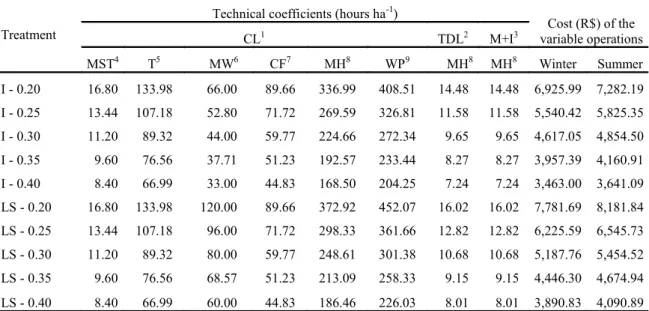
Table 3. Technical coefficients of the items that vary with the plant population for 1 hectare in lettuce production, sole cropping (LS) and intercropping (I), used in the calculations of the total operational costs (TOCs).
1CL – Common labor; 2TDL- tractor driver labor; 3M+I – expenses for machines and / or implements, 4MST- mark the site for transplant; 5T- transplant; 6MW– manual weeding (2x);
7CF – cover fertilizer; 8MH – manual harvest; 9WP – washing and packing. Treatment
Technical coefficients (hours ha-1)
Cost (R$) of the variable operations
CL1 TDL2 M+I3
MST4 T5 MW6 CF7 MH8 WP9 MH8 MH8 Winter Summer
I - 0.20 16.80 133.98 66.00 89.66 336.99 408.51 14.48 14.48 6,925.99 7,282.19
I - 0.25 13.44 107.18 52.80 71.72 269.59 326.81 11.58 11.58 5,540.42 5,825.35
I - 0.30 11.20 89.32 44.00 59.77 224.66 272.34 9.65 9.65 4,617.05 4,854.50
I - 0.35 9.60 76.56 37.71 51.23 192.57 233.44 8.27 8.27 3,957.39 4,160.91
I - 0.40 8.40 66.99 33.00 44.83 168.50 204.25 7.24 7.24 3,463.00 3,641.09
LS - 0.20 16.80 133.98 120.00 89.66 372.92 452.07 16.02 16.02 7,781.69 8,181.84
LS - 0.25 13.44 107.18 96.00 71.72 298.33 361.66 12.82 12.82 6,225.59 6,545.73
LS - 0.30 11.20 89.32 80.00 59.77 248.61 301.38 10.68 10.68 5,187.76 5,454.52
LS - 0.35 9.60 76.56 68.57 51.23 213.09 258.33 9.15 9.15 4,446.30 4,674.94
The item with the greatest impact on the cost of variable operations in the sole crop of lettuce and lettuce-rocket intercrop in all the spacings in both
crops was related to the common labor, specifically the activities related to the harvest and post-harvest
by consuming about 71 and 69.6% of the labor time of the common labor, in the winter and summer, respectively (Tables 3 and 4). Costa et al. (2008) evaluated the economic feasibility of groups of lettuce and rocket in the intercropping system over
two growing seasons and observed that the activities of the harvest and post-harvest represented more than
50% of total work time.
It was observed that the VOC in the summer experiment was higher than that of the winter experiment in all the spacings in both the intercropping and the sole cropping of lettuce (Table 3).
Table 4. Technical coefficients of the items related to the rocket which varies with the population of plants of 1 hectare in the production of lettuce + rocket in the intercropping system, used in the calculations of the total operational costs (TOCs).
1CL – Common labor; 2TDL - tractor driver labor; 3M+I – expenses for machines and / or implements, 4DS – direct sowing; 5T- thinning; 6ADCR – cover fertilizer (3x); 7MHR – manual harvest of rocket; 8LAR - washing and packing of rocket.
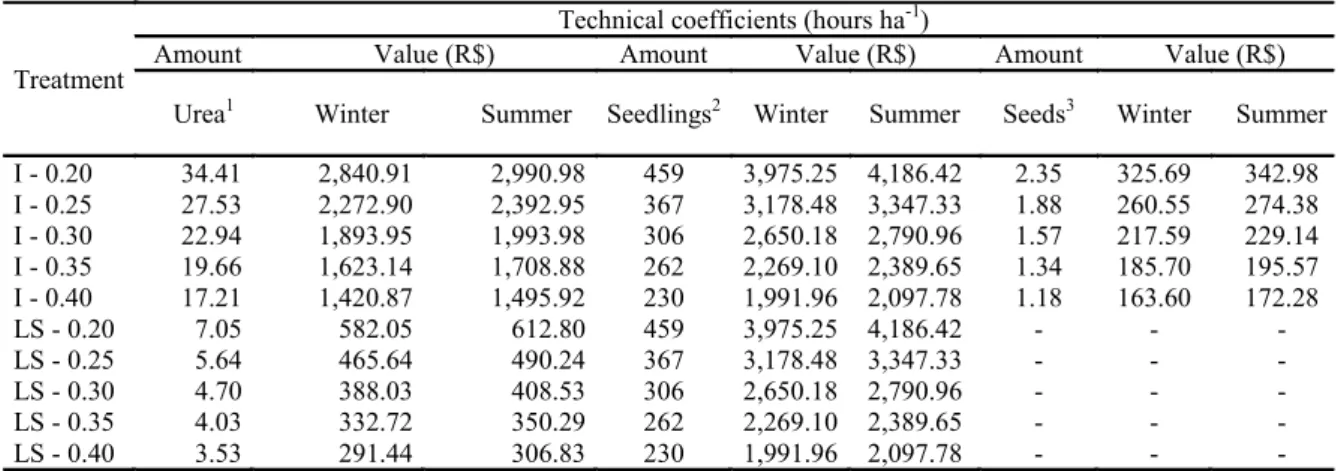
Among the inputs and materials for consumption, the lettuce seedlings were the components that had the highest increase in costs of the activity during the winter and summer experiments, followed by urea and rocket seeds. The
intercropping with smaller spacing presented higher production costs in relation to the sole crop, especially in relation to the urea cost, due to the increase in the amount used (Table 5).
Table 5. Costs of inputs and materials that vary with the plant population of 1 hectare in the lettuce production in sole cropping (LS) and intercropping (I), used in calculations of the total operational costs (TOCs).
1Bag of 50 kg; 2tray of 288 cells; 3kg Treatment
Technical coefficients (hours ha-1)
Cost (R$) of the variable operations
CL1 TDL2 M+I3
DS4 T5 CFR6 MHR7 WPR8 MHR7 MHR7 Winter Summer
I - 0.20 19.83 131.25 37.86 136.03 222.57 5.75 5.75 3,390.28 3,564.17
I - 0.25 15.86 105.00 30.29 108.82 178.06 4.60 4.60 2,712.21 2,851.31
I - 0.30 13.22 87.50 25.24 90.68 148.38 3.83 3.83 2,259.92 2,375.85
I - 0.35 11.33 75.00 21.64 77.73 127.19 3.29 3.29 1,937.63 2,037.02
I - 0.40 9.91 65.63 18.93 68.01 111.29 2.88 2.88 1,695.46 1,782.43
Treatment
Technical coefficients (hours ha-1)
Amount Value (R$) Amount Value (R$) Amount Value (R$)
Urea1 Winter Summer Seedlings2 Winter Summer Seeds3 Winter Summer
I - 0.20 34.41 2,840.91 2,990.98 459 3,975.25 4,186.42 2.35 325.69 342.98
I - 0.25 27.53 2,272.90 2,392.95 367 3,178.48 3,347.33 1.88 260.55 274.38
I - 0.30 22.94 1,893.95 1,993.98 306 2,650.18 2,790.96 1.57 217.59 229.14
I - 0.35 19.66 1,623.14 1,708.88 262 2,269.10 2,389.65 1.34 185.70 195.57
I - 0.40 17.21 1,420.87 1,495.92 230 1,991.96 2,097.78 1.18 163.60 172.28
LS - 0.20 7.05 582.05 612.80 459 3,975.25 4,186.42 - - -
LS - 0.25 5.64 465.64 490.24 367 3,178.48 3,347.33 - - -
LS - 0.30 4.70 388.03 408.53 306 2,650.18 2,790.96 - - -
LS - 0.35 4.03 332.72 350.29 262 2,269.10 2,389.65 - - -
Rev. Caatinga
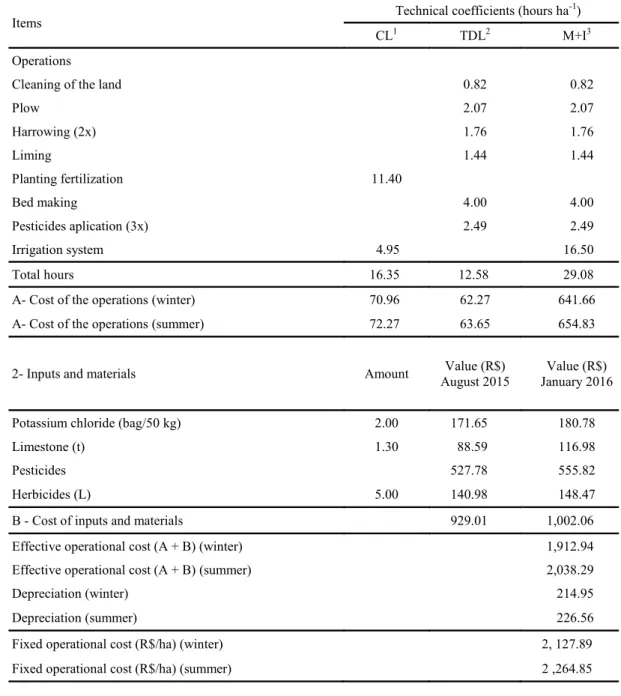
It was verified that the FOC of the summer cultivation was 6.4% higher than that of the winter cultivation (Table 6).
The intercropping with the smallest spacing showed higher TOC than the sole cropping with the same spacing (Tables 7 and 8). This is due to the increase in the use of labor for planting, crop
handling and harvesting and post-harvesting
activities, in addition to the increase in the use of the agricultural inputs. Silva et al. (2017), evaluating arrangements of coriander and rocket cultivars bi cultivated in intercropping with carrot cultivars, also
observed an increase in TOC in the intercropping system. Inputs and materials were the items that contributed most to the increase in costs of TOC in the intercropping system (Table 7). On the other hand, in the sole crop, the variable operational costs was higher (Table 8). An increase was observed in the TOCs in the summer cultivation when compared with the winter cultivation in both cropping systems. This can be due to the increase in the prices of the inputs, materials, labor and salary in the summer cultivation season.
Table 6. Technical coefficients and fixed operational cost of 1 hectare in the production of lettuce in the sole cropping and intercropping systems for the treatments with 0.20; 0.25; 0.30; 0.35 and 0.40 m, corresponding to all fixed costs, used in the calculations of total operational costs.
1CL – Common labor; 2TDL- tractor driver labor; 3M+I – expenses for machines and / or implements.
Items Technical coefficients (hours ha
-1)
CL1 TDL2 M+I3
Operations
Cleaning of the land 0.82 0.82
Plow 2.07 2.07
Harrowing (2x) 1.76 1.76
Liming 1.44 1.44
Planting fertilization 11.40
Bed making 4.00 4.00
Pesticides aplication (3x) 2.49 2.49
Irrigation system 4.95 16.50
Total hours 16.35 12.58 29.08
A- Cost of the operations (winter) 70.96 62.27 641.66
A- Cost of the operations (summer) 72.27 63.65 654.83
2- Inputs and materials Amount Value (R$)
August 2015
Value (R$) January 2016
Potassium chloride (bag/50 kg) 2.00 171.65 180.78
Limestone (t) 1.30 88.59 116.98
Pesticides 527.78 555.82
Herbicides (L) 5.00 140.98 148.47
B - Cost of inputs and materials 929.01 1,002.06
Effective operational cost (A + B) (winter) 1,912.94
Effective operational cost (A + B) (summer) 2,038.29
Depreciation (winter) 214.95
Depreciation (summer) 226.56
Fixed operational cost (R$/ha) (winter) 2, 127.89
Table 7. Total operational cost of 1 hectare in the production of lettuce and rocket, according to the spacing between lettuce rows in the intercropping system.
Lettuce - rocket intercrop
Costs
Spacing (m)
0.20 0.25 0.30 0.35 0.40
Fixed operational cost (winter) 2,127.89 2,127.89 2,127.89 2,127.89 2,127.89
Fixed operational cost (summer) 2,264.85 2,264.85 2,264.85 2,264.85 2,264.85
Variable operational cost (winter) 6,925.99 5,540.42 4,617.05 3,957.39 3,463.00
Variable operational cost (summer) 7,282.19 5,825.35 4,854.50 4,160.91 3,641.09
Inputs and materials (winter) 7,141.85 5,711.93 4,761.71 4,077.95 3,576.43
Inputs and materials (summer) 7,520.38 6,014.66 5,014.08 4,294.10 3,765.99
TOCs (R$ ha-1) winter 16,195.73 13,380.22 11,506.66 10,163.22 9,167.31
TOCs (R$ ha-1) summer 17,067.41 14,104.85 12,133.43 10,719.85 9,671.94
Table 8. Total operational cost of 1 hectare in lettuce production in sole cropping, according to spacing between the rows.
Sole crop of lettuce
Costs
Spacing (m)
0.20 0.25 0.30 0.35 0.40
FOC1 (winter) 2,127.89 2,127.89 2,127.89 2,127.89 2,127.89
FOC (summer) 2,264.85 2,264.85 2,264.85 2,264.85 2,264.85
VOC2 (winter) 7,711.65 6,197.51 5,187.76 4,466.36 3,925.85
VOC (summer) 8,108.03 6,516.14 5,454.52 4,696.09 4,127.80
Inputs and materials (winter) 4,557.31 3,644.12 3,038.21 2,601.82 2,283.40
Inputs e materials (summer) 4,799.22 3,837.57 3,199.49 2,739.94 2,404.61
TOCs (R$ ha-1) winter 14,396.85 11,969.53 10,353.85 9,196.08 8,337.13
TOCs (R$ ha-1) summer 15,172.09 12,618.56 10,918.86 9,700.88 8,797.27
1FOC – Fixed operational cost, 2VOC – variable operational cost.
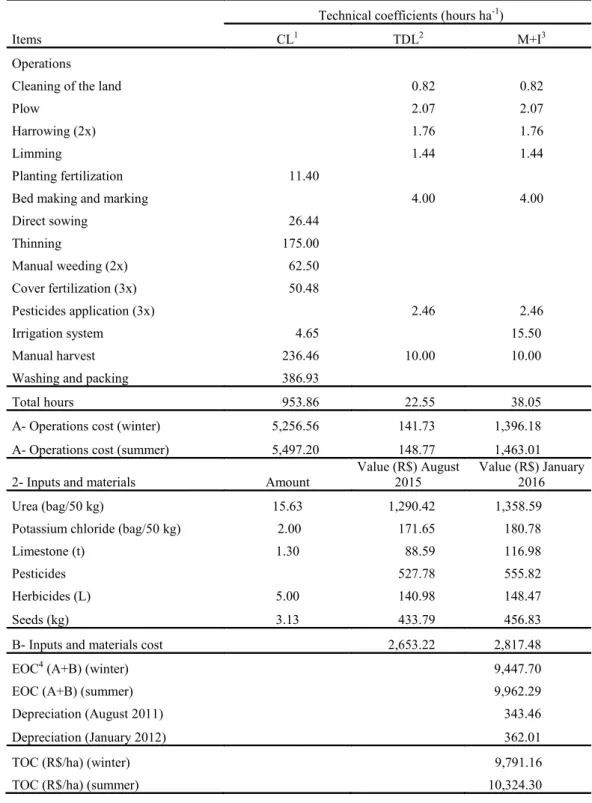
The TOC of the sole cropping of rocket is approximately 5% higher in the summer cultivation than in the winter cultivation; this is due to the increase in the price of inputs, materials, and costs of operations (Table 9). It was observed that the TOC of the rocket sole crop is approximately 65, 36.7, 17.5 and 4% lower than the TOC obtained in intercropping with 0.20, 0.25, 0.30, and 0.35 m between lettuce rows, respectively, in both growing seasons. It was verified that except when compared with the spacing 0.40 m, the sole crop of rocket had higher TOC (6.4%) than intercropping. Among the components that are part of the TOC of the sole crop of rocket, the costs with operations and common labor accounted for approximately 69 and 77%, respectively, of the cost of operations in both growing seasons. Cecílio Filho, Rezende and Costa (2010), evaluating the economic feasibility of the
lettuce-tomato intercropping, also found that
common labor was the most representative item in the increase of the cost of TOC, mainly due to the
demand in the manual operations of harvesting and post-harvest.
Rev. Caatinga
Table 9. Technical coefficients and total operational cost of 1 hectare in the production of sole crop of rocket.
1CL – Common labor; 2TDL- tractor driver labor; 3M+I – expenses for machines and / or implements; 4EOC - effective operational cost.
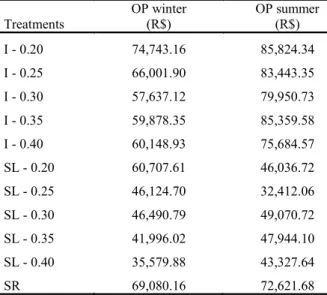
The OPs of the intercropping system in the winter and summer experiments varied from R$ 57,637.12 to R$ 74,743.16 ha-1 and from R$ 75,684.57 to R$ 85,824.34 ha-1, respectively. It was
higher than the profits obtained in the sole crops of
lettuce (Table 11). The sole crop of rocket also presented lower OP as compared to that obtained in the intercropping system with the spacing of 0.20 m in the winter experiment and in all the spacing in the summer experiment.
Technical coefficients (hours ha-1)
Items CL1 TDL2 M+I3
Operations
Cleaning of the land 0.82 0.82
Plow 2.07 2.07
Harrowing (2x) 1.76 1.76
Limming 1.44 1.44
Planting fertilization 11.40
Bed making and marking 4.00 4.00
Direct sowing 26.44
Thinning 175.00
Manual weeding (2x) 62.50
Cover fertilization (3x) 50.48
Pesticides application (3x) 2.46 2.46
Irrigation system 4.65 15.50
Manual harvest 236.46 10.00 10.00
Washing and packing 386.93
Total hours 953.86 22.55 38.05
A- Operations cost (winter) 5,256.56 141.73 1,396.18
A- Operations cost (summer) 5,497.20 148.77 1,463.01
2- Inputs and materials Amount
Value (R$) August 2015
Value (R$) January 2016
Urea (bag/50 kg) 15.63 1,290.42 1,358.59
Potassium chloride (bag/50 kg) 2.00 171.65 180.78
Limestone (t) 1.30 88.59 116.98
Pesticides 527.78 555.82
Herbicides (L) 5.00 140.98 148.47
Seeds (kg) 3.13 433.79 456.83
B- Inputs and materials cost 2,653.22 2,817.48
EOC4 (A+B) (winter) 9,447.70
EOC (A+B) (summer) 9,962.29
Depreciation (August 2011) 343.46
Depreciation (January 2012) 362.01
TOC (R$/ha) (winter) 9,791.16
Table 10. Revenues obtained in 1 hectare of sole cropping of rocket (SR), sole cropping of lettuce (SL) and intercropping (I), with the spacing of 0.20, 0.25, 0.30, 0.35 and 0.40 m between lettuce rows.
Treatments Winter revenue (R$) Summer revenue (R$)
Lettuce Rocket Total Lettuce Rocket Total
I - 0.20 26,811.61 63,948.79 90,760.40 26,586.82 75,840.09 102,426.91
I - 0.25 26,256.45 53,097.75 79,354.20 30,150.17 66,975.67 97,125.83
I - 0.30 22,966.67 46,153.09 69,119.76 36,387.51 55,353.42 91,740.93
I - 0.35 24,880.03 45,140.32 70,020.35 51,097.30 44,716.11 95,813.41
I - 0.40 30,812.08 38,629.70 69,441.78 46,919.90 38,215.53 85,135.42
SL - 0.20 75,074.40 - 75,074.40 61,394.86 - 61,394.86
SL - 0.25 58,069.25 - 58,069.25 45,185.36 - 45,185.36
SL - 0.30 56,823.03 - 56,823.03 60,123.48 - 60,123.48
SL - 0.35 51,172.91 - 51,172.91 57,763.95 - 57,763.95
SL - 0.40 43,899.60 - 43,899.60 52,232.80 - 52,232.80
SR - 78,850.88 78,850.88 - 82,340.67 82,340.67
Table 11. Operational profit (OP) obtained in 1 hectare of sole cropping of rocket (SR), sole crop of lettuce (SL) and intercropping (I) with spacing of 0.20, 0.25, 0.30, 0.35 and 0.40 m between lettuce rows.
Treatments
OP winter (R$)
OP summer (R$)
I - 0.20 74,743.16 85,824.34
I - 0.25 66,001.90 83,443.35
I - 0.30 57,637.12 79,950.73
I - 0.35 59,878.35 85,359.58
I - 0.40 60,148.93 75,684.57
SL - 0.20 60,707.61 46,036.72
SL - 0.25 46,124.70 32,412.06
SL - 0.30 46,490.79 49,070.72
SL - 0.35 41,996.02 47,944.10
SL - 0.40 35,579.88 43,327.64
SR 69,080.16 72,621.68
The maximum operational profit obtained for lettuce was R$ 85,824.34 ha-1; this was obtained in
the summer experiment, by combining the intercropping system with a spacing of 0.20 m.
The sole cropping of rocket in the summer was about 5% more profitable than in the winter. In the summer experiment, the intercropping system performed higher than the sole cropping, in all the spacings. On the other hand, in the winter experiment, the sole cropping of rocket was only superior in the spacing of 0.20 m. Costa (2006) observed superiority of the operational profit of the lettuce-rocket intercropping (R$ 25,123.24 ha-1)
over the sole cropping of the curly lettuce (R$18,008.38 ha-1) in the autumn
-winter season.
Cecílio Filho, Rezende and Costa (2010), evaluating the economic feasibility of the tomato-lettuce
intercropping, also observed a greater economic
advantage in the intercropping system, since it presented an increase of 14.8% in the net profit than the sole cropping of tomato, and in relation to the sole cropping of lettuce, this increase was 850%. Rezende et al. (2011) analyzed the economic feasibility of the cucumber-lettuce intercropping and
also observed a higher operational profit in the intercropping system than in the sole cropping system.
CONCLUSIONS
The profitability of intercropping in relation to sole cropping of rocket and lettuce was shown to be dependent on the growing season and population density of lettuce.
Rev. Caatinga
intercropped crops generally occurred in the summer cultivation.
During winter, the highest profitability of intercropping over the sole cropping occurred with higher population of lettuce.
In the two growing seasons, lettuce-rocket
intercropping was more profitable than the sole cropping of lettuce.
In the smaller spacing, the labor cost increased the operational cost of the crops, both in the intercropping and sole cropping systems.
The intercropping system allowed the optimization of the operations and inputs by increasing the profitability as compared to the sole cropping.
ACKNOWLEDGMENT
The authors thank the Foundation for
Research Support of State of São Paulo (FAPESP - 2011 / 10784-3), for the scholarship
granted the second author.
REFERENCES
BARBOSA, A. P. et al. An agronomic and economic evaluation of lettuce cultivars intercropped with
rocket over two cultivation seasons. African
Journal of Agricultural Research, Lagos, v. 10, n. 10, p. 1083–1090, 2015.
BARROS JÚNIOR, A. P. et al. Análise econômica da alface americana em monocultura e consorciada com pepino japonês em ambiente protegido.
Bioscience Journal, Lavras, v. 25, n. 4, p. 82-89,
2009.
BARROS JÚNIOR, A. P. et al. Nitrogen fertilization on intercropping of lettuce and rocket. Horticultura Brasileira, Brasília, v. 29, n. 3, p. 398-403, 2011.
BEZERRA NETO, F. et al. Assessment of
agroeconomic indices in polycultures of lettuce, rocket and carrot through uni and multivariate
approaches in semi-arid Brazil. Ecological
Indicators, New York, v. 14, n. 1, p. 11-17, 2012.
BHATTI, I. H. et al. Agronomic performance of mash bean as an intercrop in sesame under different planting patterns. Emirates Journal of Food and Agriculture, Abu Dhabi, v. 25, n. 1, p. 52-57, 2013.
CECÍLIO FILHO, A. B; MAY, A. Produtividade das culturas de alface e rabanete em função da época de estabelecimento do consórcio, em relação a seus monocultivos. Horticultura Brasileira, Brasília, v. 20, n. 3, p. 501-504, 2002.
CECÍLIO FILHO, A. B.; REZENDE, B. L. A.; COSTA, C. C. Economic analysis of the intercropping of lettuce and tomato in different seasons under protected cultivation. Horticultura Brasileira, Brasília, v. 28, n. 3, p. 326-336, 2010.
CECÍLIO FILHO, A. B. et al. Viabilidade produtiva e econômica do consórcio entre chicória e rúcula em função da época de plantio. Horticultura Brasileira, Brasília, v. 26, n. 3, p. 316-320, 2008.
CECÍLIO FILHO, A. B. et al. Agronomic efficiency
of intercropping tomato and lettuce. Anais da
Academia Brasileira de Ciências, Rio de Janeiro, v. 83, n. 3, p. 1109-1119, 2011.
CECÍLIO FILHO, A. B. et al.Indices of competition
and bio-agroeconomic efficiency of lettuce and
tomato intercrops in greenhouses. Australian
Journal of Crop Science, Lismore, v. 7, n. 6, p. 809
-819, 2013.
CECÍLIO FILHO, A. B. et al. Indices of bio
-agroeconomic efficiency in intercropping systems of
cucumber and lettuce in greenhouse. Australian
Journal of Crop Science, Lismore, v. 9, n. 12, p. 1154-1164, 2015.
COSTA, C. C. Consórcio de alface e rúcula:
aspectos produtivos e econômicos. 2006. 83 f. Tese (Doutorado em Produção Vegetal: Área de
Consorciação de Culturas) – Universidade Estadual Paulista “Júlio de Mesquita Filho”, Jaboticabal,
2006.
COSTA, C. C. et al. Viabilidade agronômica do consórcio de alface e rúcula, em duas épocas de cultivo. Horticultura Brasileira, Brasília, v. 25, n. 1, p. 34-40, 2007.
COSTA, C. C. et al. Viabilidade econômica dos consórcios de grupos de alface com rúcula, em duas épocas de cultivo. Bioscience Journal, Uberlândia,
v. 24, n. 2, p. 27-42, 2008.
EMPRESA BRASILEIRA DE PESQUISA
AGROPECUÁRIA - EMBRAPA. Sistema
brasileiro de classificação de solos. 2. ed. Brasília, DF: Embrapa Solos, 2006. 306 p.
LI, Q. Z. et al. Overyielding and interspecific interactions mediated by nitrogen fertilization in strip intercropping of maize with faba bean, wheat and barley. Plant and Soil, The Hague, v. 339, n. 1, p. 147–161, 2011.
MOTA, W. F. et al. Agronomic and economic viability of intercropping onion and lettuce.
Horticultura Brasileira, Brasília, v. 30, n. 2, p. 349
-354, 2012.
OLIVEIRA, E. Q. et al. Produtividade de alface e rúcula, em sistema consorciado, sob adubação
orgânica e mineral. Horticultura Brasileira,
Brasília, v. 28, n. 1, p. 36-40, 2010.
REZENDE, B. L. A. et al. Custo de produção e rentabilidade das culturas de alface, rabanete, rúcula e repolho em cultivo solteiro e consorciadas com pimentão. Ciência e Agrotecnologia, Lavras, v. 33,
n. 1, p. 305-312, 2009.
REZENDE, B. L. A. et al. Economic analysis of cucumber and lettuce intercropping under
greenhouse in the winter-spring. Anais da
Academia Brasileira de Ciências, Rio de Janeiro, v. 83, n. 2, p. 705-717, 2011.
SILVA, V. F. et al. Comportamento de cultivares de alface em diferentes espaçamentos sob temperatura e
luminosidade elevadas. Horticultura Brasileira,
Brasília, v. 18, n. 3, p. 183-187, 2000.
SILVA, G. S. et al. Viabilidade econômica do cultivo da alface crespa em monocultura e em consórcio com pepino. Ciência e Agrotecnologia, Lavras, v. 32, n. 5, p. 1516-1523, 2008.
SILVA, J. N. et al. Combinations of coriander and salad rocket cultivars in bicropping systems
intercropped with carrot cultivars. Revista
Caatinga, Mossoró, v. 30, n. 1, p. 125–135, 2017.
TRANI, P. E.; PASSOS, F. A.; AZEVEDO FILHO, J. A. Alface, almeirão, chicória, escarola rúcula e agrião d’agua. In: RAIJ, B. V. et al. (Eds.).
Recomendação de adubação e calagem para o estado de São Paulo. Campinas, SP: IAC, 1997, p. 285. (Boletim Técnico, 100).
YANG, W. et al. Crop yield nitrogen acquisition and sugarcane quality as affected by interspecific competition and nitrogen application. Field Crops Research, Amsterdam, v. 146, n. 3, p. 44-50, 2013.
ZANG, Y. et al. Row ratios of intercropping maize and soybean can affect agronomic efficiency of the
system and subsequent wheat. PlosOne, São