Cognitive Reflection Abilities and Accounting Practice: A Two-Way Road of Influences
Leonardo Portugal Barcellos
This dissertation paper seeks to accomplish the requirements for the degree of Doctor of Philosophy (Ph.D.) in Management with emphasis on
Behavioral and Decision Science Applied to Accounting at Brazilian School of Public and Business Administration (EBAPE)
of the Getulio Vargas Foundation (FGV)
Ficha catalográfica elaborada pela Biblioteca Mario Henrique Simonsen/FGV
Barcellos, Leonardo Portugal
Cognitive reflection abilities and accounting practice: a two-way road of influences / Leonardo Portugal Barcellos. – 2017.
114 f.
Tese (doutorado) - Escola Brasileira de Administração Pública e de Empresas, Centro de Formação Acadêmica e Pesquisa.
Orientador: Alexandre Linhares. Inclui bibliografia.
1. Contadores. 2. Auditores. 3. Contabilidade. 4. Cognição. 5. Julgamento (Ética) I. Linhares, Alexandre. II. Escola Brasileira de Administração Pública e de Empresas. Centro de Formação Acadêmica e Pesquisa. III. Título.
Acknowledgements
First and foremost, I thank EBAPE’s faculty and staff members for investing so much in me and making my doctoral experience nothing less than life-changing. Thanks for the inspiring seminars from (and interaction with) brilliant professors such as Ricardo Cardoso, Cesar Zucco, Rafael Goldszmidt, Eduardo Andrade, Fabio Caldieraro, and Alexandre Linhares, and for the encouragement (and funding) to pursue the boldest goals I’ve ever had. My especial gratitude to Ricardo, who has given me great pieces of advice, encouragement, and intensive training. I’m also grateful to the very supportive peers that I had throughout the course and to the extremely nice and helpful EBAPE’s staff.
Second, I thank Thomas Hemmer not only for the great seminar that I attended at Fucape but also for connecting me to Emory University, where I spent a year as a visiting scholar during 2016. Thomas’ generosity opened many new doors for me. During my time at Emory, I attended several seminars from scholars whose papers I used to read and cite in all my essays. Eventually, I’m also very grateful to Kristy Towry, Kathryn Kadous, Grace Pownall, and Jeffrey Hales for making me a better researcher and for opening new promising doors for me. Still, many thanks to Emory’s PhD students, who welcomed me so warmly and helpfully.
Finally, I thank the most generous, nice, and beautiful woman on Earth, my wife
Amanda, who has vigorously supported me in all moments. I owe her more than I can pay in one single life. Thanks to my parents, who overcame serious social barriers caused by poverty to give me opportunities to thrive. Finally, thanks to my sons for figuring as my reason for setting a good example.
Table of Contents
Abstract ... 6
Chapter 1: Introduction ... 7
Chapter 2: An Assessment of CPAs’ Cognitive Reflection Abilities ... 11
Introduction ... 11
Theoretical Background ... 12
Methods ... 20
Results ... 22
Conclusions ... 29
Chapter 3: Job Complexity and Cognitive Aging: What Can We Learn from Accounting Practice? ... 31
Introduction ... 31
Hypotheses Development ... 35
Methods ... 45
Empirical Results and Supplementary Analysis ... 52
Discussion and Conclusions ... 58
Chapter 4: Do Professional Judgments Impact Financial Reports Comparability under IFRS? The Effects of Cognitive Ability and Work Experience ... 63
Introduction ... 63
Hypotheses Development ... 69
Methods ... 78
Empirical Results and Supplementary Analysis ... 83
Discussion and Conclusions ... 93
Chapter 5: Concluding Remarks ... 98
Abstract
This dissertation paper gathers three studies on the relationship between accounting practice and certified public accountants’ (CPAs) cognitive reflection abilities (CR-ability). The first chapter summarizes the three studies, presenting contextual information about how the research ideas and identification strategies relate to my doctoral studies. The study in the second chapter maps Brazilian CPAs’ CR-abilities to demographic characteristics, providing not only the foundational insights for the studies in the next chapters but also evidence that male and younger CPAs tend to present higher CR-abilities than female and older CPAs, as well as that employer firm size may determine CR-abilities of preparers and managers. The study in the third chapter applies a quasi-experimental approach to examine whether auditing practice is more likely to prevent CR-abilities decline than financial reports elaboration practice. The paper explores the unique counterfactual opportunity provided by the accounting setting to find that aging leads human beings to adapt information processing strategies towards Type 1 of reasoning in detriment of Type 2. But auditing practice may curb this trend. These findings make several contributions to psychology and accounting fields. The paper in the fourth chapter examines the influence of stable CPAs’ individual characteristics, i.e., CR-ability and professional experience in pressured firms, on the professional judgments behind the recognition of assets and cash flows arising from audiovisual content (content). The findings suggest that CR-ability drives differential AV-content assets and cash flows classification at recognition and, ultimately, incomparable financial statements, but professional experience in pressured firms is likely to refrain such differences in the case of assets. Finally, I present my concluding remarks in the fifth chapter.
Keywords: cognitive reflection ability, certified public accountants, cognitive aging, professional judgment
Cognitive Reflection Abilities and Accounting Practice: A Two-Way Road of Influences
Chapter 1: Introduction
This dissertation paper gathers three studies on the relationship between accounting practice and certified public accountants’ (CPAs) cognitive reflection abilities (CR-ability). The data used in all three studies come from a national internet-based survey applied by the Brazilian Institute of CPAs (BICPA) addressing active CPAs. The BICPA agreed to embed the Frederick’s (2005) cognitive reflection test (CRT) and some accounting tasks in the questionnaire that
yielded the CPAs’ Profile, edition 2012/13 (Pesquisa perfil do profissional da contabilidade 2012/13) (CFC, 2013).1
The first study (see Chapter 2) maps Brazilian CPAs’ CR-abilities to demographic characteristics such as gender, age, educational and income levels, career, and employer firm size. The paper’s results suggest that selection into accounting career does not attenuate gender differences regarding CR-abilities, contradicting previous conjectures in this direction.
Additionally, the findings suggest that aging negatively affects CR-ability and auditors are more reflective than CPAs pursuing other careers. So, the study in Chapter 2 not only fosters a grasp on the data set used in the two following studies but also explores the predictors of CR-ability for professionals who share very similar educational backgrounds. To the best of my knowledge, this is the first study mapping cognitive reflection abilities of individuals within a single profession comprehensively.
The second study (see Chapter 3) was born from both curiosity towards the aging patterns found in the first paper and amazement towards the idea of using quasi-experimental methods to
1 The studies in Chapter 3 and Chapter 4 employ subsamples of these respondents tailored in line with the research
identify causal moderation effects. Testable hypotheses on the slower cognitive decline in auditors than in preparers naturally emerged from the combination of the cognitive aging literature with the CPAs routines portrayed by academic and professional papers. Also, I
detected an opportunity to add to the existing research from several perspectives. First, there is a dearth of studies addressing aging patterns of CR-ability, which has been shown to be a
consequential determinant of judgment and decision-making (JDM). Second, existing research neglects important factors that are likely to bias their findings, such as the educational
background heterogeneity and the mismatch between education and career. Third, the accounting setting allows a clearer definition of job complexity than the self-reported rates used in prior studies. Fourth, while previous studies look at cognitive aging at late adulthood, my paper addresses early adulthood. Thus, the study in Chapter 3 applies quasi-experimental contrasts between two branches of a single profession, i.e., preparers and auditors, across age subgroups to examine the effects of job complexity on cognitive aging. The findings support the “use it or lose it” hypothesis, suggesting that auditing practice prevents cognitive aging. The study theorizes that auditing superior demand for engagement in behaviors that inhibit cognitive aging drives the findings. In addition to the contributions to the cognitive aging literature, the study contributes to the accounting profession and research since it presents evidence that older preparers are
relatively more susceptible to the biases arising from excessive reliance upon Type 1 of reasoning, which has been shown to be detrimental in several instances.
The third study (see Chapter 4) examines the influence of CPAs’ CR-abilities and professional experience in pressured firms (PEPF) on the classification of assets and cash flows arising from audiovisual content (AV-content) produced by entities that negotiate the related exhibition rights as their principal revenue-producing activities. The paper explores the
overlapping IFRS guidance to AV-content to hypothesize and find that low CR-ability CPAs are likely to jump into first intuitive answers that pop up in mind when classifying AV-content assets and cash flows, while high CR-ability CPAs tend to overcome these intuitive judgments. The results suggest that CPAs use professional experience in listed, large, and(or) audited firms (PEPF) as a cue for engaging in deep reflective reasoning, irrespectively of CR-abilities, when exerting judgment and decision-making (JDM) on financial reporting tasks. It leads low CR-ability CPAs who lack PEPF to decide significantly different from other professionals.
Moreover, the paper in Chapter 4 reports that low CR-ability CPAs faced with the classification of cash flows from the sale of AV-content are more likely than high CR-ability CPAs to neglect information on the entity's principal revenue-producing activity. Thus, low CR-ability CPAs are likely to classify AV-content cash flows as from operating (investing) activities whenever they classify the associated asset as inventory (intangible) because it fits the clear-cut and cohesive instruction of IAS 7. Contrary to the expectations, PEPF seems to be ineffective in providing a cue for reflective reasoning activation in cash flows contexts. These findings are of interest to academics, practitioners, regulators, and standard-setters, responding to a call for research into the potential impacts of professional judgment on financial reports comparability.
In a nutshell, the three studies amounting to this dissertation paper provide a couple of informative pieces of evidence. First, gender imbalances in CR-ability outlive selection into accounting careers. Second, CR-abilities decrease over aging and exerting cognitively demanding jobs such as auditing may slow this process. Third, individual differences in CR-ability drive differential AV-content assets and cash flows classification at recognition and, ultimately, incomparable financial statements, but professional experience in pressured firms is likely to curb such differences in the case of assets.
In agreement with the Ebape’s doctoral course regulation, three independent but correlated scientific articles in submission format add up to this dissertation paper. Since the three papers stem from the same data collection, readers will encounter pieces of information that are common to two or even to all the papers, such as collection procedure, CR-ability foundations, CRT, and others. I apologize for the inconvenience, hoping to provide a pleasant reading despite the repetition. The good side is that the structure of this dissertation paper informs the reader about my process of maturation as an independent researcher. Notice that I depart from simple correlational analyses to more sophisticated investigations of causal mechanisms, resembling the sequence in which I got introduced to more refined identification strategies. Likewise, the ideas and theoretical foundations for the second and third papers were heavily influenced by my visiting period at Emory University. It reflects how much I am
indebted to the brilliant faculty members who have contributed to my Ph.D. education, especially Ricardo Cardoso, Cesar Zucco, Rafael Goldszmidt, Eduardo Andrade, Fabio Caldieraro,
Alexandre Linhares, Thomas Hemmer, Kristy Towry, Kathryn Kadous, Grace Pownall, and Jeffrey Hales.
Chapter 2: An Assessment of CPAs’ Cognitive Reflection Abilities
Introduction
We report results of an exploratory analysis of the individual characteristics that predict certified public accountants’ (CPAs) cognitive reflection abilities (CR-abilities) measured via Frederick’s (2005) cognitive reflection test (CRT). The CRT is a simple three questions test that arises automatic, effortless and usually wrong first answers in mind, but a further conscious and deliberate reasoning effortlessly conducts respondents to correct answers. Social sciences such as economics, finance, and accounting have successfully explored CRT scores as predictors of behavior and decision-making (Bergman, Ellingsen, Johannesson, & Svensson, 2010; Noussair, Trautmann, & van de Kuilen, 2014; Viator, Bagley, Barnes, & Harp, 2014). Oechssler, Roider, and Schmitz (2009) and Hoppe and Kusterer (2011), for instance, present results from laboratory experiments connecting CRT scores to the tendency to follow heuristics and biases in judgment and decision-making (JDM).
Prior research on CR-ability measured by CRT has mostly explored data from college students and heterogeneous professionals (Frederick, 2005; Hoppe & Kusterer, 2011; Oechssler et al., 2009; Moritz, Hill, & Donohue, 2013). Our paper differs from these previous studies to the extent that participants in our study are professionals who share an educational background in the very same area, i.e., accounting. The data from 4,902 Brazilian CPAs (1.6% of the population) was collected via an electronic questionnaire nationally applied by the Brazilian Institute of CPAs (BICPA). Our analysis reveals that male Brazilian CPAs tend to be more reflective than their female counterparts and that CPAs tend to become less reflective and, consequentially, more intuitive as they age. We also present evidence that preparers and managers working for larger companies tend to be less reflective than their counterparts working for smaller firms.
Additionally, our results suggest that auditors’ scores on CRT are significantly higher than preparers’, analysts’, managers’ and professors’ scores, raising interesting questions for future research.
This paper contributes to both accounting and psychology literature, as well as to practice, especially to those interested in understanding how CR-ability relates to demographic characteristics within the accounting field. Since CR-ability significantly affects JDM quality, as reported in previous studies, the importance of our findings connects to the remarkable role that JDM plays in several fields of accounting activity. For instance, the International Financial Reporting Standards (IFRS) require the disclosure of judgments and estimates that have significant effects on the amounts presented in the financial statements (IASB, 2016a). Accordingly, the training materials prepared by the IFRS Foundation’s Education Initiative emphasize the most significant judgments and estimates necessary to correctly applying either Full IFRSs (IASB, 2016b; IFRS Foundation, 2015) or IFRS for SMEs (IASB, 2015). However, as we further discuss throughout the next section, the role of CR-ability on accounting JDM is not limited to the elaboration of financial reports. Rather, CR-ability tends to influence
managers’ decisions, analysts’ recommendations, auditors’ reports, and professors’ lessons. Hence, once simple demographic characteristics may help to predict CPA’s CR-ability, our analyses are likely to forward accounting JDM in a relevant direction.
Theoretical Background
Accounting practice and cognitive reflection ability. Accounting research, like many
other social fields, recognizes that professionals may incur in biases and heuristics that steer them to unexpected decision-making. Consequently, there exist a growing consensus that
deviations from normative optimal choices are not necessarily driven by greed. Rather, these deviations are often caused by human imperfections (e.g. March & Simon, 1958; Kahneman & Tversky, 1979). Not surprisingly, behavioral research in accounting has acquired a notorious importance (see Birnberg, 2011; Trotman, Tan, & Ang, 2011 for reviews). Such research aims to improve accounting JDM quality by avoiding misleading impacts of factors emerging from task, environment, and personal dimensions on CPAs’ performance (Bonner & Lewis, 1991; Libby & Luft, 1993; Bonner, 2008). This literature acknowledges that task complexity and environmental surroundings play a decisive role in JDM in tandem with knowledge, experience, memory retrieval, and abilities in general. We focus on the latter, i.e., general abilities, by exploring the individuals’ ability to suppress first impulsive responses to engage in deeper reflection.
The timeline for the cognitive capacities research indicates that, although previous studies had pointed out impulsivity as a cause for low JDM performance (Stanovich & West, 2000; Kahneman, 2003; Hogarth, 2005), scholars lacked a reliable measure for reflection ability. To overcome this issue, Frederick (2005) proposed a three simple questions test named cognitive reflection test (CRT). After exhaustive experimentation, psychology literature has treated CRT as a potent predictor of the tendency to miserly process information (Hoppe & Kusterer, 2011; Toplak, West, & Stanovich, 2011; West, Meserve, & Stanovich, 2012). The CRT scores interpretation relies on dual-process theories, which differentiate Types 1 and 2 of cognition in human beings’ information processing (Epstein, Lipson, Holstein, & Huh, 1992; Sloman, 1996; Stanovich & West, 2000). CRT is designed to raise impulsive, fast, effortless, and wrong first answers in respondents’ minds, allowing researchers to measure the frequency in which
reasoning. We refer to the number of times that Type 2 prevails. i.e., the sum of correct answers, as CRT score.
Although CRT consists of simple numeric questions, its capacity to measure the
individuals’ ability to override heuristic processes goes beyond simple correlation with numeracy and general knowledge (Campitelli & Labollita, 2010; Toplak et al., 2011; Moritz et al., 2013). CRT score has been found to be a major determinant of JDM by studies in psychology,
economics, and in other related social fields (Cokely & Kelley, 2009; Bergman et al., 2010; West et al., 2012).
The thinking disposition predicted by CRT was of interest to accounting studies preceding Frederick’s (2005) CRT, but they usually applied scores on selected elements from Graduate Record Examination (GRE) as a proxy for problem-solving ability (e.g. Bonner & Lewis, 1990; Bonner, Davis, & Jackson, 1992; Bonner & Walker, 1994; Libby & Tan, 1994; Tan & Libby, 1997; Dearman & Shields, 2005). We interpret this trend as a symptom that, because they lacked a reliable and straightforward measure for CR-ability, scholars explored an ill-defined construct for cognitive ability.
Recent accounting studies also support the relevance of both CR-ability and a reliable measure to this construct. For instance, Farrell, Goh, and White (2014) used functional magnetic resonance imaging (fMRI) to provide evidence that brain regions associated with Type 1 of reasoning are more responsive when managers have affective reactions to decision contexts than when they do not. They also show that performance-based contracts do not suppress affective reactions. Rather, these contracts activate additional brain regions associated with Type 2. In turn, Viator et al. (2014) presented experimental evidence that more reflective MBA students (CRT score greater than or equal to 2) are more likely to benefit from feedback than more
intuitive participants. Motivated by recent developments in JDM research, Griffith, Kadous, and Young (2016) propose dual-process theories as a promising framework to examine and improve auditors’ judgments. Also, several other recent studies published in top accounting journals suggest that the ability to override first intuitive responses before exerting JDM is determinant in different areas of accounting profession (Brown, 2014; Capps, Koonce, & Petroni, 2016).
In sum, CR-ability seems to be a determinant factor of accounting JDM, especially when considering the current scenario of the global trend towards the IFRS adoption.2 Notably, major changes emerge in adopter countries such as Brazil and many others, in which the previously enforced accounting standards are based on bright-lines rules influenced by tax authorities (Nobes, 1998; Gray, 1988). As research and practice agree upon, IFRS require a significant portion of judgment from CPAs due to its principles-based approach (Schipper, 2003; Alexander & Jermakovitz, 2006). Hence, a shift from a rules-based system of accounting standards to IFRS is likely to hinge on CPAs capacity to timely activate Type 2 of reasoning. However, CPAs in a number of IFRS adopter countries may be not trained to reflect deeply about judgments and estimates because they have learned in their everyday practice that more important than
faithfully represent the substance of transactions is the compliance with detailed codes (Arden, 1997; Colasse, 1997; Hulle, 1997). By mapping Brazilian CPAs’ CR-ability over several demographic characteristics, this paper provides preliminary cues on Brazilian CPAs’
preparedness to face the large demand for judgment that is likely to arise from IFRS adoption.
2 In fact, approximately 120 countries require or permit the adoption of the IFRS for domestic entities, among them
European Union’s nations and most of the Latin-American, Asian and Oceania countries. The United States has signaled a potential adoption through, for instance, the Concept Release on Allowing U.S. Issuers to Prepare
Financial Statements in Accordance with International Financial Reporting Standards (SEC, 2007). Nevertheless,
the Work Plan for the Consideration of Incorporating International Financial Reporting Standards into the
Financial Reporting System for U.S. Issuers (SEC, 2012) gave no specific course of action, and there is no estimated
date for SEC’s decision. Due to the joint efforts made by FASB and IASB to reduce the differences between USGAAP and IFRS, the USGAAP has also become more principles-oriented.
Cognitive reflection test. Frederick’s (2005) CRT is a criterion to measure how
intuitively or reflectively people make decisions. The CRT consists of the three following questions:
1. A bat and a ball cost $1.10. The bat costs $1.00 more than the ball. How much does the ball cost?
2. If it takes 5 machines 5 minutes to make 5 widgets, how long would it take 100 machines to make 100 widgets?
3. In a lake, there is a patch of lily pads. Every day, patch doubles in size. If it takes 48 days for the patch to cover the entire lake, how long would it take for the patch to cover half of the lake?
The impulsive and correct answers are:
1. Bat & ball: Impulsive answer: $10; correct answer: $ 5.
2. Widgets: Impulsive answer: 100 minutes; correct answer: 5 minutes. 3. Lily pads: Impulsive answer: 24 days; correct answer: 47 days.
The impulsive answers for CRT are attributed to the Type 1 of reasoning because it is the first answer that respondents’ minds suggest. Thus, if this immediate tempting answer is not identified being wrong, the Type 2 is not activated. However, if respondent reflectively tests whether the first answer is wrong, the correct answer is very likely to emerge (Toplak et al., 2011). Importantly, the usage of Type 1 or Type 2 of reasoning cannot be considered bad or good. Rather, the quality of judgment and decision-making mostly depends on the context in which each type of cognitive processing is applied. Athletes, cab and bus drivers, and other professionals in jobs requiring fast and repetitive patterns of decision-making are likely to develop accurate Type 1 usage to perform their everyday activities. For instance, an athlete is
likely to rely on Type 2 to adjust a particular movement to improve performance, but after long practice such adjustment will be part of the athlete’s Type 1, waiving Type 2 activation. In contrast, workers devoted to professions involving few repetitions are likely to often activate Type 2 as a mean to avoid mistakes.
Research questions. In this section, we develop research questions for each of the five
CPAs’ demographic characteristics examined in this study. Our preference for research questions over directional hypotheses reflects, in most cases, the exploratory nature of this study, as well as the contradictory pieces of evidence from prior research.
Gender. Previous studies provide evidence that men score significantly higher than
women on CRT (Frederick, 2005; Hoppe & Kusterer, 2011; Oechssler et al., 2009), but none of these studies used participants sharing similar educational backgrounds, working environments, routines, so on. As one may infer from Croson and Gneezy (2009), males and females who are similar regarding CR-ability may jump into accounting career driven by non-observable factors that are correlated with CR-ability (see also Johnson & Powell, 1994; Birley, 1989). If true, this process would cause a balance between male and females CPAs in terms of CR-ability.
However, psychology research has shown that CR-ability measured via CRT is a unique
construct, uncorrelated with other sorts of thinking disposition that may determine life outcomes such as career choice (Campitelli & Labollita, 2010; Frederick, 2005; Toplak et al., 2011). Given these contradicting pieces of evidence, we raise the first research question.
RQ1. Do male and female CPAs differ in terms of CR-ability?
Age. Kahneman (2011) points out that performing similar tasks over the years is likely to
systems. Kahneman’s conjecture is in line with cognitive aging research, which has
systematically documented that human fluid cognitive abilities (reasoning, memory, and other novel problem-solving capacities) start decaying from early adulthood (Salthouse, 2012; Verhaeghen & Salthouse, 1997). Such decay takes place together with the rise of crystallized cognitive abilities, i.e., knowledge acquired through experience, culture, and education (Salthouse, 2004). It is an adaptive rational response of the human body to save energy since fluid cognitive abilities are significantly more taxing. Nevertheless, we have not found previous empirical findings either on CR-ability aging patterns or cognitive aging among specialized professionals such as CPAs. From this, we state our second research question.
RQ2. Do CPAs’ CR-abilities decrease with age?
Education and income levels. Prior studies suggest that CRT scores are uncorrelated
with numeracy and general knowledge (Campitelli & Labollita, 2010; Toplak et al., 2011; Moritz et al., 2013). From this, one would straightforwardly infer that educational level is unrelated to CPAs’ CR-abilities, but education is likely to affect CR-ability through income level. That is, more educated individuals tend to have larger incomes, whereas larger income individuals tend to have greater and more complex responsibilities. Thus, assuming that high CR-ability
individuals are more likely to assume more complex responsibilities and that more complex responsibilities may stimulate CR-ability, we predict that income may work as a mediator for the relationship between educational level and CR-ability. However, we lack identification
mechanisms to adequately address this prediction because of the simultaneous causality between the pairs education-income and income-CR-ability. For this reason, we keep the focus of our analyses on correlations between these variables.
RQ4. Does the effect of educational level on CPAs’ CR-abilities remain after including
income level in the model?
Larger Companies’ CPAs. Listed, large, and(or) audited firms are likely to experience
relative greater pressure arising from high ownership dispersion and high
ownership-management segregation (Hope, Langli, & Thomas, 2012). But while one may argue that it tends to lead them to provide high-quality accounting information, a plausible counterargument is that incentives to meet capital market’s earnings expectations, as well as equity-based compensation thresholds, tend to push managers to provide low-quality information (Graham, Harvey, & Rajgopal, 2005). Notably, in both theoretical hypotheses, the environmental pressure is likely to lead CPAs who work for public, large, and(or) audited firms (pressured firms) to exert a more careful and holistic consideration of all possible alternatives before jumping into any financial reporting conclusion. From this perspective, we may expect CPAs who work for larger firms to present higher CR-abilities than CPAs who work for smaller firms. However, the organizational structure of such listed, large, and(or) audited firms are likely to be highly departmentalized, leading CPAs to perform repetitive tasks that mostly require Type 1 of reasoning. In this regard, cognitive aging research suggests that such specialized and repetitive labor routine leads people to adapt their information processing strategies accordingly to the demand for cognitive abilities (Mata & Nunes, 2010; Queen & Hess, 2010). In addition, we expect CPAs from small-sized companies to work in a different environment since the lower number of employees is likely to force them to develop a more comprehensive set of tasks, requiring a higher use of CR-ability. Hence,
RQ5. Do CPAs who labor for large-sized companies differ from CPAs who labor for
Methods
To map CPAs’ CR-abilities, we collect CRT scores and demographic characteristics from 4,902 Brazilian CPAs. In this section, we describe the data collection and sampling procedures, as well as the regression models used in our analyses.
Data collection and sampling. We collect data through a national survey applied by the
BICPA, which allowed us to embed our research questions in an electronic questionnaire
delivered via institutional electronic message. Beyond the Frederick’s (2005) CRT questions, the participants answered demographic questions such as age, gender, formal instruction level, income, and detailed information about the firm in which they labor.3
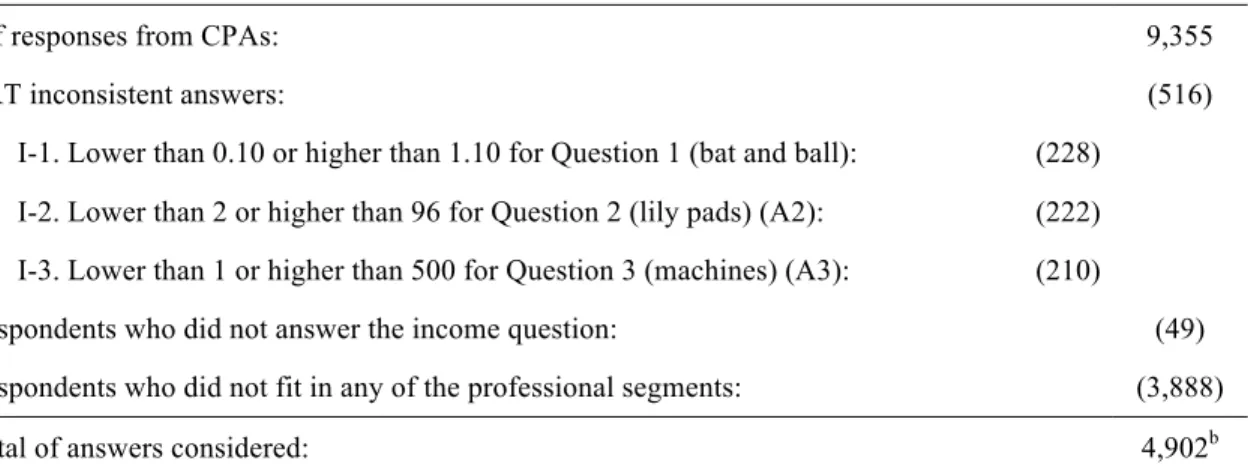
Table 1. Sample selection.
Total of responses from CPAs: 9,355
(-) CRT inconsistent answers: (516)
(-) I-1. Lower than 0.10 or higher than 1.10 for Question 1 (bat and ball): (228) (-) I-2. Lower than 2 or higher than 96 for Question 2 (lily pads) (A2): (222) (-) I-3. Lower than 1 or higher than 500 for Question 3 (machines) (A3): (210)
(-) Respondents who did not answer the income question: (49)
(-) Respondents who did not fit in any of the professional segments: (3,888)
(=) Total of answers considered: 4,902b
According to the CFC database, the population of interest was 302,697 in June 2012, implying that our sample comprises 1.6% of the population of interest (CFC, 2013).
I-1, I-2, and I-3 add up to 516, representing the union of inconsistent answers since some respondents answered inconsistently more than one question.
A total of 9,355 bachelor CPAs answered the questionnaire. As a check against random responses, we eliminated observations containing unreasonable answers for CRT, as well as observations containing incomplete answers for the demographic questions. As a result, the final
sample comprises 4,902 CPAs (see Table 1), corresponding to 1.6% of the Brazilian CPAs’ population, which was 302,697 individuals in June 2012. To our knowledge, ours is the biggest sample of the literature addressing CR-ability. For instance, Frederick (2005) himself surveyed 3,428 individuals.
The model and variables description. To map the CR-abilities of the Brazilian CPAs,
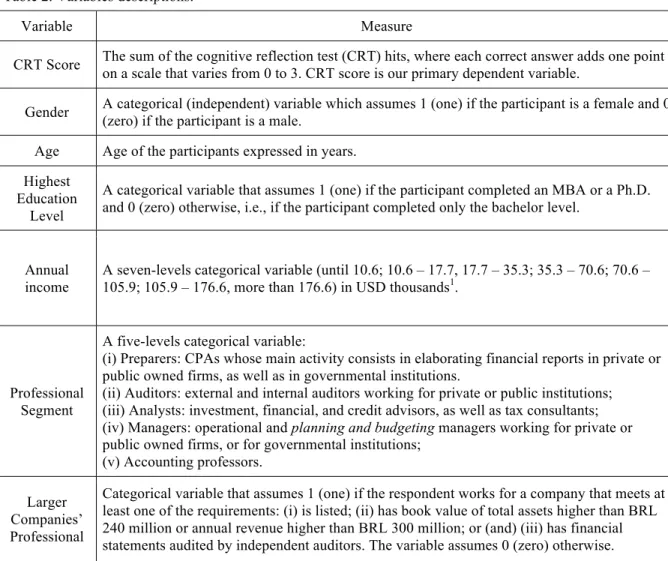
we explore several participants’ individual characteristics besides their CR-abilities measured by CRT. Table 2 presents detailed information on each of the variables of interest.
Table 2. Variables descriptions.
Variable Measure
CRT Score The sum of the cognitive reflection test (CRT) hits, where each correct answer adds one point on a scale that varies from 0 to 3. CRT score is our primary dependent variable.
Gender A categorical (independent) variable which assumes 1 (one) if the participant is a female and 0 (zero) if the participant is a male.
Age Age of the participants expressed in years. Highest
Education Level
A categorical variable that assumes 1 (one) if the participant completed an MBA or a Ph.D. and 0 (zero) otherwise, i.e., if the participant completed only the bachelor level.
Annual income
A seven-levels categorical variable (until 10.6; 10.6 – 17.7, 17.7 – 35.3; 35.3 – 70.6; 70.6 – 105.9; 105.9 – 176.6, more than 176.6) in USD thousands1.
Professional Segment
A five-levels categorical variable:
(i) Preparers: CPAs whose main activity consists in elaborating financial reports in private or public owned firms, as well as in governmental institutions.
(ii) Auditors: external and internal auditors working for private or public institutions; (iii) Analysts: investment, financial, and credit advisors, as well as tax consultants; (iv) Managers: operational and planning and budgeting managers working for private or public owned firms, or for governmental institutions;
(v) Accounting professors. Larger
Companies’ Professional
Categorical variable that assumes 1 (one) if the respondent works for a company that meets at least one of the requirements: (i) is listed; (ii) has book value of total assets higher than BRL 240 million or annual revenue higher than BRL 300 million; or (and) (iii) has financial statements audited by independent auditors. The variable assumes 0 (zero) otherwise.
Besides analyzing simple descriptive statistics, we estimate three different regression models aiming to grasp better how CRT scores correlate with CPAs’ demographic
characteristics. Given the nature of our data, we use ordered logistic regression (ologit) models. Although the interpretation is not as straightforward as for simple linear models, odds ratio analyses combined with margins analyses provides an informative approach.
Following the intuition borrowed from prior studies on human cognitive abilities, we first estimate a simple model (Model 1) including only gender, age, and education level. Then, we deepen our analysis by including, in Model 2, the variables shaped for CPAs, i.e., professional segment and large company, as well as income intervals. Finally, to further explore how CPAs’ cognitive abilities relate to demographic characteristics contingent on the professional segment, we run Model 3 separately for preparers, auditors, analysts, managers, and professors.
(Model 1)
(Model 2)
(Model 3)
Results
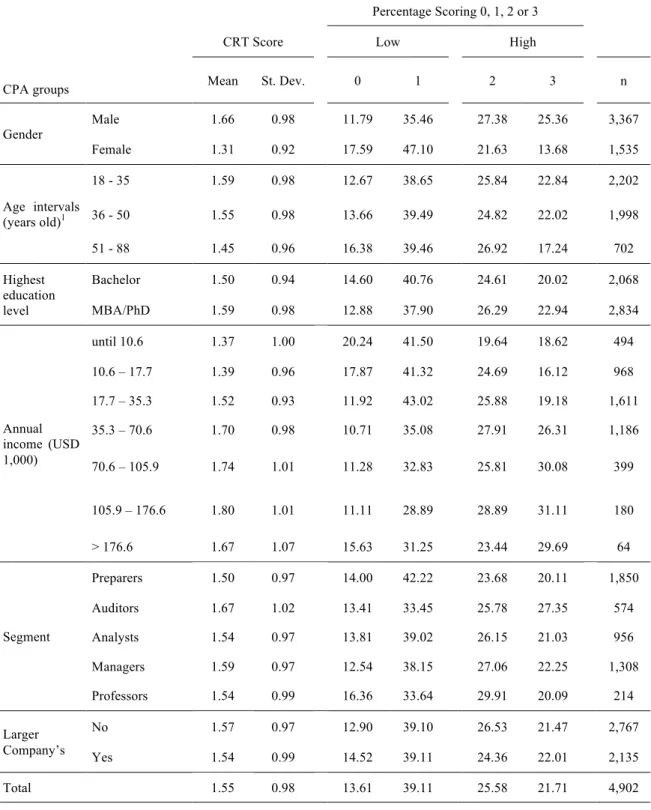
Descriptive statistics. Table 3 presents the frequency of correct responses for CRT along
with CRT score mean and standard deviation sorted by demographic characteristics of interest. The mean CRT score of Brazilian CPAs (1.55) is slightly higher than the mean CRT score of 313 American supply chain managers employed at Fortune 500 supply-chain-intensive firms from
Cognitive Score = α0+ α1Gender + α2Age + α3Formal Education Level + ε
Cognitive Score = α0+ α1Gender + α2Age + α3Formal Education Level + α4Income intervals
+ α5Professional segment + α6Larger Company’s Professional + ε
Cognitive Score = α0+ α1Gender + α2Age + α3Formal Education Level +
the USA (1.51), as reported by Moritz et al. (2013). Except for Moritz et al., prior research mostly reports CRT scores from college students (Frederick, 2005; Hoppe & Kusterer, 2011; Oechssler et al., 2009; Toplak et al., 2011). Surprisingly, Brazilian CPAs had higher mean CRT scores than the 3,428 individuals reported by Frederick (2005, Table 1). That is, of the eleven sample populations in Frederick’s (2005) study, only the student population from MIT and Princeton University had higher average CRT scores than Brazilian CPAs. In turn, Oechssler et al. (2009) found a striking 2.05 CRT mean for 1,250 individuals (90% of college students) whose mean age was 24 years. Importantly, the mean age of the professionals in our sample is 40 years old and none of them is a college student.
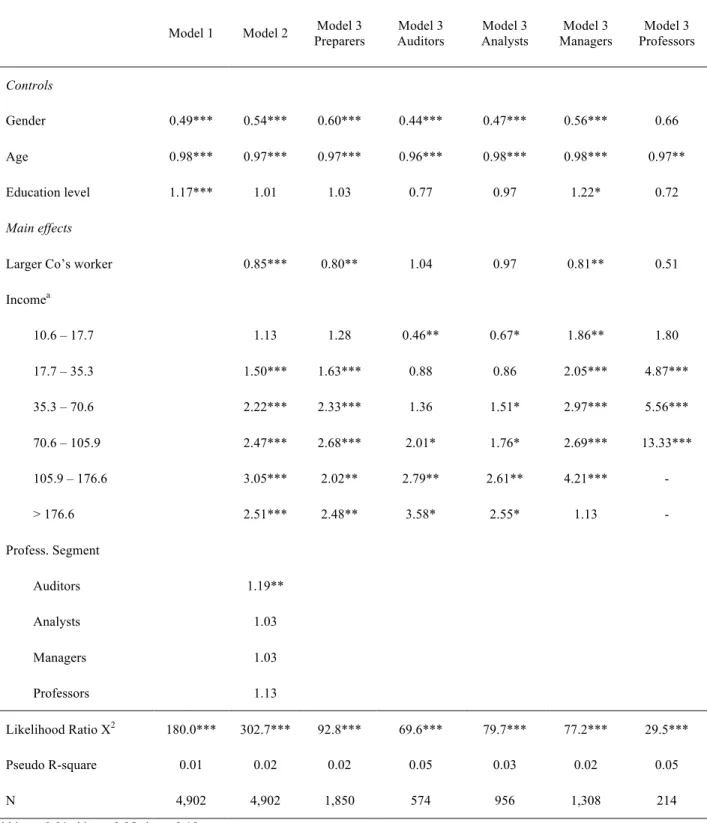
Multivariate analysis. Table 4 presents the results of estimations of the three models that
we propose. The margin analysis when setting all predictors at mean values suggests that the probabilities of scoring 0, 1, 2, and 3 on CRT are 13, 40, 26, and 21%, respectively. The estimations of the three models do not violate the proportional odds assumption, except the Model 2. We estimate Model 2 using the generalized ordered logistic approach and find similar results. Thus, to facilitate interpretation, we report only the ologit results for Model 2.
Gender (RQ1). In line with previous research (Frederick, 2005; Hoppe & Kusterer, 2011;
Oechssler et al., 2009), the results suggest that men score significantly higher than women on CRT. The apparent large average difference between males (1.66) and females (1.31) is found significant via ologit estimations. The odds ratio in Model 2 indicates that holding the other covariates constant, the probability of a CPA reaching the higher CRT (3) score is 0.54 times lower if the CPA is a woman. This result hold for all model estimations, except for professors, to which the statistical results indicate that the 0.27 average difference may be only by chance.
Table 3 – Descriptive Statistics: CRT Scores for each CPA group.
Percentage Scoring 0, 1, 2 or 3
CPA groups
CRT Score Low High
Mean St. Dev. 0 1 2 3 n Gender Male 1.66 0.98 11.79 35.46 27.38 25.36 3,367 Female 1.31 0.92 17.59 47.10 21.63 13.68 1,535 Age intervals (years old)1 18 - 35 1.59 0.98 12.67 38.65 25.84 22.84 2,202 36 - 50 1.55 0.98 13.66 39.49 24.82 22.02 1,998 51 - 88 1.45 0.96 16.38 39.46 26.92 17.24 702 Highest education level Bachelor 1.50 0.94 14.60 40.76 24.61 20.02 2,068 MBA/PhD 1.59 0.98 12.88 37.90 26.29 22.94 2,834 Annual income (USD 1,000) until 10.6 1.37 1.00 20.24 41.50 19.64 18.62 494 10.6 – 17.7 1.39 0.96 17.87 41.32 24.69 16.12 968 17.7 – 35.3 1.52 0.93 11.92 43.02 25.88 19.18 1,611 35.3 – 70.6 1.70 0.98 10.71 35.08 27.91 26.31 1,186 70.6 – 105.9 1.74 1.01 11.28 32.83 25.81 30.08 399 105.9 – 176.6 1.80 1.01 11.11 28.89 28.89 31.11 180 > 176.6 1.67 1.07 15.63 31.25 23.44 29.69 64 Segment Preparers 1.50 0.97 14.00 42.22 23.68 20.11 1,850 Auditors 1.67 1.02 13.41 33.45 25.78 27.35 574 Analysts 1.54 0.97 13.81 39.02 26.15 21.03 956 Managers 1.59 0.97 12.54 38.15 27.06 22.25 1,308 Professors 1.54 0.99 16.36 33.64 29.91 20.09 214 Larger Company’s No 1.57 0.97 12.90 39.10 26.53 21.47 2,767 Yes 1.54 0.99 14.52 39.11 24.36 22.01 2,135 Total 1.55 0.98 13.61 39.11 25.58 21.71 4,902 1. Although the age intervals were applied in this table using a range format, age is a quantitative variable.
Table 4 – Coefficients estimated for ordered logistic regression models from Equations 1, 2 and 3.
Model 1 Model 2 Preparers Model 3 Auditors Model 3 Analysts Model 3 Managers Model 3 Professors Model 3
Controls
Gender 0.49*** 0.54*** 0.60*** 0.44*** 0.47*** 0.56*** 0.66 Age 0.98*** 0.97*** 0.97*** 0.96*** 0.98*** 0.98*** 0.97** Education level 1.17*** 1.01 1.03 0.77 0.97 1.22* 0.72
Main effects
Larger Co’s worker 0.85*** 0.80** 1.04 0.97 0.81** 0.51 Incomea 10.6 – 17.7 1.13 1.28 0.46** 0.67* 1.86** 1.80 17.7 – 35.3 1.50*** 1.63*** 0.88 0.86 2.05*** 4.87*** 35.3 – 70.6 2.22*** 2.33*** 1.36 1.51* 2.97*** 5.56*** 70.6 – 105.9 2.47*** 2.68*** 2.01* 1.76* 2.69*** 13.33*** 105.9 – 176.6 3.05*** 2.02** 2.79** 2.61** 4.21*** - > 176.6 2.51*** 2.48** 3.58* 2.55* 1.13 - Profess. Segment Auditors 1.19** Analysts 1.03 Managers 1.03 Professors 1.13 Likelihood Ratio X2 180.0*** 302.7*** 92.8*** 69.6*** 79.7*** 77.2*** 29.5*** Pseudo R-square 0.01 0.02 0.02 0.05 0.03 0.02 0.05 N 4,902 4,902 1,850 574 956 1,308 214 *** p < 0.01; ** p < 0.05; * p < 0.10. a. Annual income in thousands of USD.
Further, the margin analysis suggests that the probability of scoring zero is 18.1 and 10.7% if the average professional CPA is a female and a male, respectively. The probabilities of scoring 1, 2, and 3 on CRT are 44.9, 22.3, and 14.7% for females and 37.3, 27.9, and 24.1% for males, respectively. Hence, female CPAs are more likely than male CPAs to score zero or 1, and this pattern reverts for scores 2 or 3.
These results are in line with the findings of Frederick (2005), which found a mean CRT score of 1.47 for males and 1.03 for females even after controlling for sampling problems, differences in attention, effort expended to answer, and mathematical ability. Our findings
suggest that sharing the same educational background and the same working environment are not enough to equalize females and males CPAs in terms of CR-ability.
Age (RQ2). In line with the descriptive statistics in Table 3, the ologit estimations in
Table 4 suggest that older CPAs perform significantly worse than young CPAs. The odds ratios in Table 4 indicate that, for each additional-year-old, the CRT scores of Brazilian CPAs tend to decrease by 0.03, if all other variables are held constant. These results hold across all the models. The margin analysis suggests that, for each incremental-year-old, the probability of an average CPA achieving the maximum score decreases by 0.46%, while the probability of achieving the minimum score increases 0.3% each year added to CPAs age. Notice, however, that one should exert caution with such inference since research on cognitive aging lacks investigations on CR-ability measured by CRT.
Education and income levels (RQ3 and RQ4). The results for Model 1 estimation
high CRT scores. However, the estimations of Models 2 and 3 reveal that the coefficient for education level is significant only for estimations that do not include income level, supporting the mediating effect of income on the relationship between education and CR-ability. But caution must be exerted to analyzing and making inferences using these results given the endogenous two-way relationship between education and income, as well as between income and CR-ability.
Surprisingly, education level remains marginally significant for managers (Model 3) even after including income variables. This result may indicate that MBA programs may impact managers differently since such programs are often tailored for them.
The findings for income level suggest that high-income CPAs tend to make reflective decisions more frequently than the low-income professionals. Even though we have no theoretical support, we conjecture that it is driven by the fact that positions of greater
responsibility tend to be better rewarded. Hence, since professionals in high-responsibility levels are likely to be demanded by more complex JDM, professionals in such jobs tend to be more required in terms CR-ability. In contrast, CPAs in the lower income levels, who probably hold less intensive responsibilities, must develop less complex activities, implying little demand to exert reflection while performing their duties.
Larger Companies’ Professional (RQ5). We find evidence that the probability of scoring
the highest CRT score is around 0.80 times lower if the CPA works for a larger firm, holding constant the other variables (see Table 4, Model 2). Analyses for professional segments (Model 3) present analogous results for preparers and for managers. For the preparers’ subsample, the probability of scoring 3 on CRT is 0.80 times lower if the CPA works for a large company. Similarly, for managers, the probability of getting the highest CRT score is 0.81 times lower for
CPAs who work for large companies. The margin analysis for the whole sample suggests that the probability of getting a score zero is 11.9 and 13.7% for average CPAs who do not work and work for a large company, respectively. This pattern flips when performing a similar analysis for the highest CRT score. The probabilities of scoring 3 on CRT for average CPAs who do not work and do work for large companies 22.0 and 19.2%, respectively. The results are similar for margin analyses performed for the preparers’ and managers’ subsamples.
This pattern of results is coherent with the idea that large firms are highly
departmentalized companies and it may lead CPAs who work for these firms to be less required in terms of CR-ability. The results of the professional segments analyses provide further support for this rationale. That is, preparers and managers seem to be more exposed to the effect of high detailed and repetitive duties, while the work assignments of auditors, analysts, and professors tend to have broader scope even within larger companies. However, as we previously adverted, one should exert caution while making such inferences since cognitive aging research has not addressed CR-ability so far.
Professional segment results and future research. An interesting piece of information in
our results is that auditors present the highest average CRT score followed by managers, professors, analysts, and preparers (see Table 3). Besides, inferential outputs from Model 2 depicted in Table 4 point out that, holding the preparers as the reference level, the only statistically significant coefficient is for auditors. The odds ratio analysis indicates that the probability of scoring 3 on CRT is 1.20 times higher if the CPA is an auditor. No other
4, Model 2). Additionally, the CRT score seems less sensitive to income level for auditors than for other professional categories (Model 3).
Several fertile questions for future research arise from these findings. First, do selection processes for audit jobs pick the most skilled professionals regarding CR-ability? Second, do age and gender affect CR-ability differently according to the professional category in which the CPA labors? Third, how does it affect professional judgments?
Conclusions
This paper maps the Brazilian CPAs’ CR-abilities measured by Frederick’s (2005) CRT. To our knowledge, our study is the first to assess how individual demographic characteristics predict CRT scores looking at professionals who share very similar educational backgrounds and professional experiences. Besides, we use the largest data set that we are aware of.
In spite of the expectation that selection into career together with similar background could lead male and female CPAs to neutralize the gender differences found in previous studies, our findings suggest that male CPAs are more reflective than female CPAs. In other words, male CPAs outperform female CPAs in terms of CRT score. Aligned with prior research on cognitive aging, we present evidence that, CPAs become less reflective as they age. In addition, the results suggest that educational and income levels are positively associated with CR-ability, and that income mediates the relationship between education and CR-ability. However, given the difficulties to set a suitable identification strategy, one should exert caution to make inferences based on such analysis. Interestingly, we find that preparers and managers working for larger companies tend to be less reflective than their counterparts working for smaller firms. As expected, this pattern of results does not hold for auditors, analysts, and professors. Finally, our
results suggest that auditors’ CRT scores are significantly higher than preparers’, analysts’, managers’, and professors’ scores, raising interesting questions for future research.
This paper contributes not only to the literature in accounting and psychology but also to practitioners interested in understanding how CR-ability relate to demographic characteristics within the accounting field. Since CR-ability significantly affects JDM quality, as reported in previous studies, our findings connect to the remarkable role that JDM plays in several fields of accounting activity.
Further research should investigate whether the findings of this paper are contingent on cultural or regional aspects. Moreover, a promising avenue is to explore whether CR-ability constitutes a relevant predictor for heuristics and biases in accounting JDM since several compelling empirical research questions arise from this. First, is the interpretation of verbal probabilities (Doupnik & Richter, 2003, 2004; Doupnik & Riccio, 2006) contingent on CPAs’ CR-abilities? Second, do the classification of economic events following vague standards (Penno, 2008; Cardoso & Aquino, 2009) hinge on CPAs’ CR-abilities? Third, does the ability to interpret graphical information (Cardoso, Leite, & Aquino, 2016) rely on CR-ability?
Chapter 3: Job Complexity and Cognitive Aging: What Can We Learn from Accounting
Practice?
The man whose whole life is spent in performing a few simple operations, of which the effects are perhaps always the same, or very nearly the same, has no occasion to exert his understanding or to exercise his invention in finding out expedients for removing
difficulties which never occur. He naturally loses, therefore, the habit of such exertion, and generally becomes as stupid and ignorant as it is possible for a human creature to become.
-Adam Smith, The Wealth of Nations, 1776.
Introduction
In the 18th century classic The Wealth of Nations, Adam Smith noted that labor division causes workers to become “stupid and ignorant” as a result of the low cognitive exertion required by simple, repetitive, and lasting activities. Research has dramatically polished such rough understanding on the influence of environmental opportunities and constraints on lifespan cognitive development (see Lindenberger, 2014 for a review). According to the prevalent cognitive-enrichment perspective, social engagement, exercising, and other effort-consuming behaviors attenuate the adverse effects of aging on cognitive functioning (Hertzog, Kramer, Wilson, & Lindenberger, 2009).4 Although psychology research documents extensive evidence supporting such explanation (Schooler, Mulatu, & Oates, 1999; Fisher et al., 2014), this literature neglects not only lifespan changes in the mind functioning explained by dual-process theories
4 The cognitive-enrichment perspective is an extension of the hypothesis popularly described by the adage “use it or
lose it.” According to this hypothesis, the stimulus generated by exercising the cognitive functions via cognitively demanding tasks preserves one’s mind from aging (Hultsch, Hertzog, Small, & Dixon, 1999; Salthouse, Berish, & Miles, 2002).
but also the methodological threats arising from occupational and educational heterogeneity. In this paper, we explore the uniqueness of the accounting setting along with the prominence of the cognitive reflection ability (CR-ability) to bridge these gaps.5
Auditors and preparers are forged in the same furnace, coping with identical
environments and requirements during the time they spend in school. We explore the resulting educational homogeneity together with the particularities of the Brazilian context for fresh graduates to predict and find that auditors’ and preparers’ CR-abilities do not differ at early career stages. However, we rely on the differences in career-specific environmental opportunities and constraints faced by certified public accountants (CPAs) laboring as preparers and auditors to predict and find that cognitive decline over time affects preparers significantly more than auditors. We build on cognitive-enrichment theoretical perspective to reason that the most plausible mechanism to these findings is the fact that auditors’ and preparers’ careers differ fundamentally in terms of engagement in behaviors that inhibit cognitive aging.
Specifically, preparers usually work within specialized functions (e.g. receivables,
payables, taxes, and others), performing repetitive and cyclical tasks for extended periods of time either working for an outsourcing firm or a firm’s internal accounting department. In contrast, auditors generally work in different client firms, testing whether clients’ control systems are operating effectively and whether clients’ financial statements are free from material
misstatement. It implies that auditors need to frequently update their perspectives to perform recurrent duties, such as internal controls assessment and substantive procedures adjustments (Trotman, 2014, 203). Besides, a prerequisite for auditing practice is the constant exercise of professional skepticism. The professional skepticism definition as “indicated by auditor
5 By cognitive reflection ability, we mean the individual ability to properly activate Type 1 or Type 2 of reasoning as
judgments and decisions that reflect a heightened assessment of the risk that an assertion is incorrect, conditional on the information available to the auditor” (Nelson, 2009) gives us a hint of how cognitively demanding it is. Hence, the contrasting demands to which CPAs with similar backgrounds are exposed ground our hypotheses.
To test our hypotheses, we use data collected by the Brazilian Institute of CPAs (BICPA) through a national survey.6 Among the demographic questions in the internet-based survey, we embedded the CRT, which allows a simple and effective measure of CR-ability (Toplak, West, & Stanovich, 2014). CRT is a performance-based three-question test that measures individuals’ abilities to overcome impulsive, fast, and effortless wrong answers to engage in logical, slow, conscious, and deliberate reasoning that leads to correct answers. The CRT score, i.e., the sum of correct answers, is a potent predictor of decision-making (Oechssler, Roider, & Schmitz, 2009; Hoppe & Kusterer, 2011) and varies irrespectively of intelligence (Toplak, West, & Stanovich, 2011; Liberali et al., 2012; Campitelli & Gerrans, 2014).
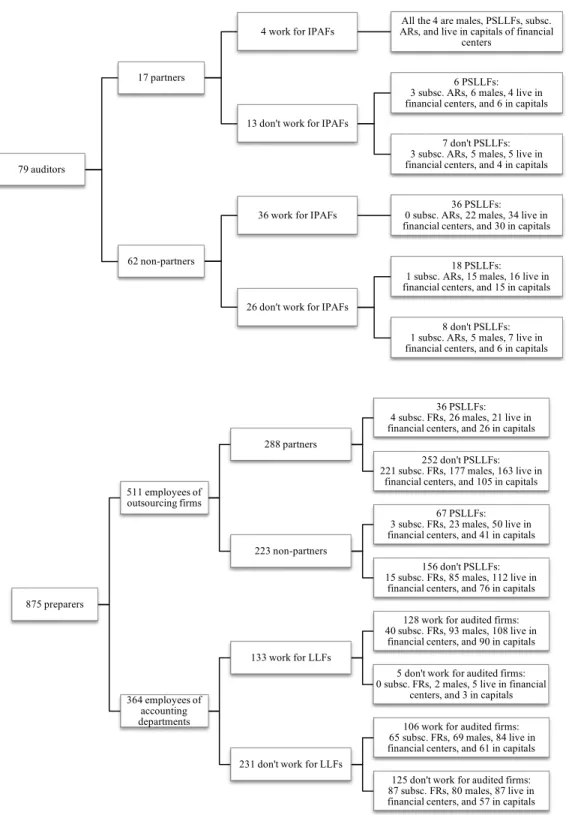
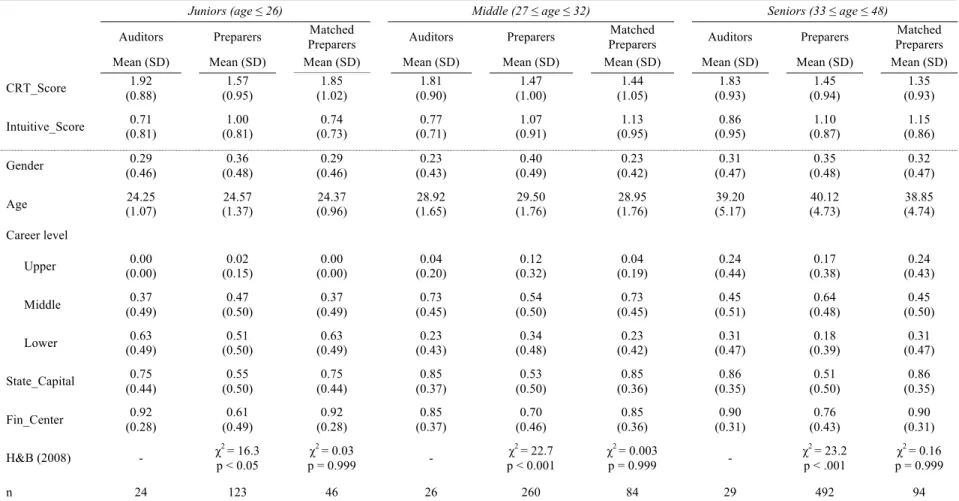
Our data consists of responses from 954 CPAs, of which 79 are external auditors, and 875 are preparers. We refer to preparers as the CPAs exclusively committed to preparing financial reports within firms’ internal accounting departments, or within accounting outsourcing firms. To investigate the moderating effect of career on the relationship between aging and CR-ability, we match preparers to auditors within age subgroups (Juniors, Middle, and Seniors), as
suggested by Green and Stuart (2014). While the quasi-experimental contrast for CPAs at early career stages suggests non-significant differences between preparers and auditors in terms of CR-ability, similar contrasts for CPAs at later career stages suggest that differences in CR-ability become significant due to the cognitive decay of preparers. These results are robust to several
6 The Brazilian Institute of CPAs (Conselho Federal de Contabilidade – CFC) is a federal agency whose goal is to
alternative model specifications that control for detail-rich occupational and personal demographics, mitigating selection concerns.
These findings make several contributions. First, to the best of our knowledge, this study is the first to present evidence that aging leads human beings to adapt information processing strategies towards Type 1 of reasoning in detriment of Type 2. It allows us to reconcile a set of conflicting results from prior studies on comparative decision-making performance of young and old adults.
The second contribution of this paper emerges from our quasi-experimental approach, which contrasts cross-sectional CR-ability assessments from auditors and preparers across age subgroups. This research design permits us to rule out concerns related to the response biases that longitudinal assessments of CR-ability are likely to generate. Additionally, the research design enables us to overcome the construct validity issues typical of prior studies assessing job complexity via workers’ self-reported rates of complexity for very heterogeneous occupations.
Third, our counterfactual approach disentangles the effects of job complexity from the potential confoundings arising from the mismatch between educational background and career. Unlike prior studies, our design allows us to compare individuals who hold identical
backgrounds and perform jobs focused on the very same matter, i.e., financial reports. In addition, we compare auditors and preparers occupying compatible jobs regarding career level and geographical location. It allows us an uncommon counterfactual since treatment (auditors) and control (preparers) groups are strongly balanced across several dimensions unless career.
Finally, our findings are informative to the accounting profession and research in several ways. First, we present evidence that older preparers are susceptible to the biases arising from excessive reliance upon Type 1, and accounting research has shown that such excessive reliance
may be consequential (Farrell, Goh, & White, 2014; Viator, Bagley, Barnes, & Harp, 2014). Second, our findings provide guidance for continuing professional education programs, which should focus on CR-abilities training and maintenance, especially for CPAs responsible for financial reports elaboration. Third, our paper sheds light on a promising avenue for future research on the impacts of preparers’ CR-ability decay across aging on professional judgments required by financial reports elaboration.
The rest of this paper is organized into four sections. The next section raise hypotheses grounded on dual-process theories and cognitive aging literature. Then, we present the
identification strategies in the third section and the results in the fourth. Finally, we conclude by discussing the practical and theoretical implications of our findings.
Hypotheses Development
Dual-process theories. Dual-process theories gather evidence that human beings process
information following two different modes. First, the fast, intuitive, affect-based, and
autonomous Type 1. Second, the slow, reflective, conscious, and deliberative Type 2 (Epstein, 1994; Evans, 2008). To account for how Type 1 and Type 2 synchronize, we affiliate with the default-interventionist approach (Stanovich, 1999; Kahneman, 2011). According to this approach, Type 1 of processing drafts default intuitive judgments that need to be endorsed by Type 2. Type 1 is constantly ready and running in the same frequency whenever we are awake, whereas Type 2 works in a low-effort mode with only part of its capacity in use. This process is an adaptive effort saving mechanism given that Type 2 relies on taxing working memory processes to decouple complex operations and to generate hypotheses, while Type 1 works
independently of working memory (Evans & Stanovich, 2013).7 Type 1 continuously generates and submits intuitions that are often sufficiently good to convince Type 2 to endorse them with little or no modification of its capacity in use. However, Type 2 is fully mobilized when an imminent error is detected or when Type 1 is not able to generate intuitions about a target judgment.
It implies that good judgment and decision-making (JDM) is likely to emerge from the balance between Type 1 and Type 2 of information processing. For instance, to apply the
algorithms and the methods for basic operations taught in school, a student needs to fully activate Type 2 while learning the arithmetical tools and solving the first practice exercises. But
repetitive practice tends to lead the student to master such arithmetical tools to the extent that they become available as Type 1 intuitions. It explains why young students strive to correctly apply procedures for calculations that arise effortlessly in the mind of more experienced students.
Even though Type 1 intuitions as those from basic arithmetic operations allow humans to achieve satisfactory cognitive performances at low levels of effort and time consumption, Type 1 is responsible for systematic and predictable errors. The literature on heuristics and biases
documents several cases of individuals jumping into mistaken conclusions in decision-making events to which information is scarce and (or) hard to process.8 The individual capacity to
override these misleading conclusions arising from Type 1 heuristic processes is called cognitive reflection ability (CR-ability). To measure such ability, research has largely used the Frederick’s (2005) cognitive reflection test (CRT) (Bergman, Ellingsen, Johannesson, & Svensson, 2010; West, Meserve, & Stanovich, 2012). CRT is a potent predictor of heuristics and biases
7 Engle, Tuholski, Laughlin, and Conway (1999) define working memory as a system of processes and stores used to
maintain information during processing.
8 See Kahneman (2011) for a comprehensive review of heuristics and biases, and Griffith, Kadous, and Young
comprising three simple questions that arise automatic, effortless, and wrong first answers in mind.9 But a further deliberate reasoning on CRT questions easily leads the respondent to the correct answers independently of numeracy skills (Liberali et al., 2012; Campitelli & Gerrans, 2014). Thus, the CRT score, which ranges from zero to three, assesses the individual ability to overcome the tendency of engaging in the path of least effort that causes Type 2 to endorse poor intuitive answers.
Dual-process studies applying the CR-ability measured by CRT as a right-hand variable are popular not only in psychology literature but also across several related fields, such as economics (Bergman et al. 2010), finance (Noussair, Trautmann, & van de Kuilen, 2014), and accounting (Viator et al., 2014). Still, little is known about lifespan changes in the dynamics of Type 1 and Type 2 described by dual-process theories (Peters, Hess, Västfjäll, & Auman,
2007).10 To the best of our knowledge, this study is the first to investigate the effects of aging on CRT performance. Thus, to raise our hypotheses, we borrow theoretical underpinnings from the cognitive life-span development literature.
Cognitive life-span development theories. Cognitive aging research documents two age-related
trends. First, human fluid cognitive abilities – i.e., general problem-solving and reasoning capacities also called novel processing – decline over the lifespan starting from early adulthood. Second, crystallized abilities – i.e., previously learned reasoning and knowledge acquired over experience, culture, and education – increase with age (Salthouse, 2012). Consequently, older adults are more susceptible than younger adults to base their judgments on automatic forms of
9 Please refer to the next section for the CRT questions.
10 Peters et al.’s (2007) review covers “age differences in processes related to decision making that have been well
studied in younger adults but little studied in older adults,” focusing on affective information processes. Peters and colleagues point out the lack of tests on whether mind functioning explained by dual-process theories varies along the life span (p. 12).
knowledge, relying more on affective and environmental cues than in complex information that requires effortful reasoning (Besedes et al., 2012; Mata & Nunes, 2010; Mata, Schooler, & Rieskamp, 2007; Queen & Hess, 2010). It suggests that individuals adapt information processing strategies as a function of age, replacing the full activation of Type 2 by experience-based Type 1 problem-solving strategies.
Heckhausen and colleagues reviewed the relevant literature and proposed a further account for such adaptation strategy named motivational theory of life-span development (MTLD) (Heckhausen, Wrosch, & Schulz, 2010). MTLD posits that humans are evolutionarily prompted to strive to control the environment (primary control) and the self (secondary control) to reach their goals. Once one of the central goals of modern society is the professional success, individuals are likely to attempt hard to master career development. But primary control
(environment) is tricky in this setting since workers have limited capacity to shape careers’ demands. Then, individuals tend to engage in secondary control, regulating their development to meet the job requirements needed to thrive. It entails that motivation toward professional success leads workers to shape their cognitive disposition accordingly.
Hence, while one stream of previous results suggests that aging causes people to adapt their information processing strategies toward Type 1 usage, another stream suggests that
developmental goals may shield workers often required to timely activate Type 2 from this trend. Therefore, workers who are frequently exposed to tasks that intensely demand deliberate
reasoning are likely to develop and maintain the capacity to accurately activate Type 2 as a mean to succeed in their jobs. Likewise, workers exposed to uniform and repetitive tasks tend to
master intuitive Type 1 responses to succeed. In both cases, the development of a set of cognitive skills may come at the expense of the other.
Consistent with this notion, research has shown that working in complex and mentally demanding jobs is associated with a slower cognitive decline over age (Bosma et al., 2003; Andel et al., 2007; Potter, Helms, & Plassman, 2008; Fisher et al., 2014; Smart, Gow, & Deary, 2014). This literature investigates longitudinal datasets from large and influential studies, such as the Swedish Adoption/Twin Study of Aging (Sweeden), the Health and Retirement Study
(United States), and the Lothian Birth Cohort (Scotland). Although this body of research provides compelling findings, it fails to address three essential factors concerning the investigation of the relationship between job complexity and cognitive decline.
The first factor is the lack of studies on lifespan changes in CR-ability. The dearth of studies on cognitive aging applying measures of CR-ability is surprising not only because such ability has been largely used to successfully predict performance on heuristics-and-biases tasks (Oechssler et al., 2009; Hoppe & Kusterer, 2011), but also because prior studies document conflicting results on how decision-making performance evolve over aging. For instance, older adults are more likely to deviate from optimal choices as the number of alternatives increases (Besedes et al., 2012), and to perform worse on tasks such as Applying Decision Rules and Resistance to Framing (Bruine de Bruin, Parker, & Fischhoff, 2012). Conversely, older adults are better at resisting to the attraction effect of irrelevant options (Kim & Hasher, 2005) and more likely than younger adults to discontinue investments to avoid the sunk-cost bias (Strough, Mehta, Mcfall, & Schuller, 2008). Our study differs from these prior studies to the extent that, rather than assessing decision-making towards specific tasks, we assess CR-ability via CRT score, which is a powerful predictor of the general tendency to follow heuristics and biases. In our view, the construct validity of job complexity measures constitutes the second essential factor that the existing research fails to address. Studies often rely on the categorical
coding of heterogeneous oc cupations to measure job complexity. That is, from self-reported items, researchers extract job complexity factors via factorial analysis; a process susceptible to measurement issues, such as scale reliability, convergent validity, and discriminant validity.11
The third factor concerns the neglect of educational background heterogeneity, as well as the potential effects of the mismatch between education and career. For instance, an engineer and a librarian may be susceptible to different cognitive decay rates depending on whether both work for a library or for a software development company. Our study bridges these gaps by
capitalizing on the singularity of CPAs’ occupations. As we further elaborate in the next section, this singular setting allows us both to hold individuals’ educational backgrounds constant and to control for job complexity with relative precision.
Auditors and preparers: Educational background and career development. Accounting
undergraduate courses in Brazil, as in many other countries, provide a general and uniform academic background independently of the students’ intended career. Also, prospective CPAs must pass the very same CPA examination regardless of whether they seek a position as an auditor or as a preparer. In effect, prospective auditors and preparers are likely to be, on average, very similar in terms of cognitive reflection ability (CR-ability) unless if novice CPAs choose and (or) are chosen based on CR-ability. That is, one may argue that a high CR-ability CPA may self-select into audit career because such high CR-ability makes him or her inclined towards cognitively effortful activities. But it’s unlikely to be the case since inclination towards effortful
11 Measurement issues are usually related to scale reliability (i.e., the proportion of variance attributable to the true
score of the factor), convergent validity (i.e., the similarity between measures of theoretically related constructs), and discriminant validity (i.e., the absence of correlation between measures of unrelated constructs) (DeVellis, 2003).