Repositório ISCTE-IUL
Deposited in Repositório ISCTE-IUL:
2018-07-20Deposited version:
Publisher VersionPeer-review status of attached file:
Peer-reviewedCitation for published item:
Dos-Santos, M. J. P. L., Candeias, T. & Diz, H. (2017). Analysing the Trump and Brexit voters. In Demetris Vrontis, Yaakov Weber, Evangelos Tsoukatos (Ed.), 10th Annual Conference of the EuroMed Academy of Business.: EuroMed Press.
Further information on publisher's website:
--Publisher's copyright statement:
This is the peer reviewed version of the following article: Dos-Santos, M. J. P. L., Candeias, T. & Diz, H. (2017). Analysing the Trump and Brexit voters. In Demetris Vrontis, Yaakov Weber, Evangelos Tsoukatos (Ed.), 10th Annual Conference of the EuroMed Academy of Business.: EuroMed Press.. This article may be used for non-commercial purposes in accordance with the Publisher's Terms and Conditions for self-archiving.
Use policy
Creative Commons CC BY 4.0
The full-text may be used and/or reproduced, and given to third parties in any format or medium, without prior permission or charge, for personal research or study, educational, or not-for-profit purposes provided that:
• a full bibliographic reference is made to the original source • a link is made to the metadata record in the Repository • the full-text is not changed in any way
ANALYSING THE TRUMP AND BREXIT VOTERS
Dos-Santos, Maria José Palma Lampreia dos Santos1; Candeias, Teresa2; Diz, Henrique3
1Deparment of Economics, ISCTE-IUL-DINÂMIA´CET, Institute University of Lisbon, ESCS-IPL, Lisbon,
Portugal
2Department of Management, Universidade Lusófona do Porto, ULP, Porto, Portugal 3Department of Economics and Management. Universidade de Aveiro, UA, Aveiro, Portugal
ABSTRACT
This paper refers to two recent political phenomena: the Brexit, separation of the United Kingdom from the European Union, and the election of Donald Trump as President of the United States. It is important to note that the results on both occasions did not meet the expectations based on opinion polls, on one hand, and, on the other, seemed to be influenced by the adoption of populist attitudes by some of the people and parties involved. It is therefore necessary to deepen the knowledge about the two situations, their fundamentals and their outcomes. That is the objective of this paper. To gather published information and try to use it for the understanding of the results based on existing theories and thoughts.
Keywords: Brexit; Trump; elections; socio-economic; populism
INTRODUCTION
The political geography seems to be changing (Buhaug, et al., 2016) with the Brexit, that will lead to the separation between the United Kingdom and the European Union, as well as with Donald Trump’s victory in the American presidential elections at the end of 2016. Disruptive phenomena are normally associated with economic stagnation or depression in the past. These create conditions for strong expansionist programs, where redistribution is the key word, as stated in the initial work of Dornbush and Edwards (1990). But that was not the case in the two situations mentioned, even though both the UK and the United States have suffered the effects of both the sub-prime crisis initiated in the USA in 2007 and had been hit by the progressive globalization and commercial openness, with social consequences that are being evaluated. Traditionally, international commerce has been described by economic theories as a source of progress and increase in efficiency among countries (Gilpin, 2016; Broadberry, et al., 2016; Clarke et al., 2017). However, the experiences of Brexit and, even more strongly, the election of Donald Trump in the United States, should drive our attention to the sensation of many citizens that feel being excluded by the system that may not have protected them as they were expecting. As a matter of fact, negativity towards the institutions of formal politics is currently a concern across much of the democratic world (Clarke and Ricketts, 2017).
Europe and the United States have beneficiated from half a century of prosperity and growth practically since the end of the Second World War until the sub-prime crisis. The increased liberalization of the world trade and the globalization of the economy resulted in strong gains for the economies of these two countries, only momentarily interrupted by the oil crisis that occurred in between. And both the USA and the UK recovered quickly from the sub-prime crisis, as the improvement in economic indicators shows. Thus, the general economic situation of both countries when the referendum on Brexit and the election of Donald Trump occurred were good. Those weren’t, in fact, periods of economic recession or accelerated unemployment. Other factors emerged, namely populism, with long time prospects that should be studied. In fact, the current surge of populism in Europe and the US is a significant challenge not only for mainstream political parties but, more importantly, for the prosperity and political stability of advanced economies across the world (Andersen et al., 2017). Since 2016 and 2017, there is a proficient literature about the Brexit phenomenon and the Donald Trump election on USA from various field of science, but none of these deals with the social-economic fundamentals and the citizen’s attitudes that are in the basis of Brexit and Trump’s election.
The problem of this paper is how to prevent "new" populist movements and what causes / theories are at their origin. Do the current theories explain these phenomena or not?
The objective of this study is then to contribute to the identification of the causes that originated these social attitudes in such different social and political contexts as were lived in the UK and the USA at the time and find the theories that may explain the observed changes.
FROM THE LATIN AMERICAN POPULISM TO THE PROTEST VOTE IN THE
UK AND THE TRUMP’S ELECTION
The pioneering work from Dornbusch and Edwards, (1990) about macroeconomic populism analysed the two populist economic programs, in Chile, during Allende’s Unidad Popular (1970-1973) government, and Peru, under Alan Garcia´s rule. According to these authors, the initial condition for the implementation of both programs was the dissatisfaction of citizens with the country’s growth performance. Most typically, though not always, the countries had experienced moderate growth, stagnation or outright depression as a result of previous stabilization attempts. Once the debate was initiated, a number of studies were developed, mainly in Latin America, with the aim of determining the main causes and the consequences of populist policies. Damill, et al. (2015) analysed macroeconomic policy in Argentina in the period starting in 2002. The results, based on panel time-series data and analysis, confirm the prediction that recently elected governments coming into power after periods of political dictatorship, and which are faced with demand for redistribution, end up
engaging in populist (or redistributive) policies, which tend to lead to high inflation and overall poor macroeconomic performance. Fonseca (2011) confirmed these results for Brazil in the time of Vargas' economic populism. According to this author, the Second Vargas Administration in Brazil (1951-1954) is commonly associated with the phenomenon of populism. The author concludes that “besides, based on this historic experience, it is advocated that there is no incompatibility between developmentalism and the adoption of macroeconomic stability-oriented measures”. With the recent economic crisis, conditional lending and mandatory structural reforms arrived in the European Union. On the opposite way in European countries “with the recent economic crisis, conditional lending and mandatory structural reforms arrived in the European Union. Greece and a number of other crisis countries were subjected to a rigorous process of economic adjustment in exchange for emergency credits from the troika (European Commission, European Central Bank, and International Monetary Fund)” (Hermann, 2016). With the recent economic crisis, conditional lending and mandatory structural reforms arrived in the European Union. (Hermann, 2016).
Populism is conceived of as a political style essentially displaying proximity of the people, while at the same time taking an anti-establishment stance and stressing the (ideal) homogeneity of the people by excluding specific population segments. Second, it is pointed out that defining populism as a style enables one to turn it into a useful concept that has too often remained vague and blurred. (Jagers, and Walgrave, 2007; Abts and Rummens, 2007). Although these phenomena were initially associated with economic recession or depression, instability, and inflation in Latin America, their political geography changed to North America and Europe, the most recent examples being Brexit, Trump’s elections, but also the growth of populist parties in The Netherlands, France, Austria, Italy, Germany, Hungary and so on, despite the fact that macroeconomic and social conditions are substantially different from the ones that were in the basis of the populist movements in South America. Scholars of contemporary Europe's Mediterranean strategy note that efforts by Europe to link with its southern neighbors do more than simply establish norms for external relations. They are also used to define what (and where) Europe is (Steinberg, 2016). However, in recent times, the warlike conflicts in the Mediterranean countries and the growing wave of migrants have somehow conditioned the policies in Europe and had effects in Trump voters. According to Steinberg (2016), Notwithstanding this dream of free and peaceful commerce across a tamed inland sea, whenever there is interaction there is also the potential for hostility. As such, just as the designation of the Arctic as a Polar Mediterranean is used to promote a vision of Europe (and North America) peacefully extending its frontiers, it is also used to suggest a vision of the inland sea as an arena of conflict. In the last three years, the number of deaths from war has once again risen, mainly due to the bloody civil war in Syria (Gleditsch, Nordås, 2014). This war has had profound impacts at the European and American political level, which is difficult to predict at
the level of the voters' sense of voting. States had engaged in a variety of border enforcement practices to reassert control over migration and territory in spite of international human rights obligations. State responses to asylum seeking are illustrative of the subsequent movement and proliferation of borders far from the territorial borderline (Gorman, 2017).
METHODOLOGY AND DATA
The methodology includes a qualitative and quantitative analysis. At the quantitative level analysis, a study was carried out of all scientific papers published in the SCOPUS indexed database and the Social
Science Citation Index and Web of Science, which included 116 papers in the different scientific areas
published between 2016 and 2017. After were selected all those scientific papers included in the Social Sciences / Economic / Econometric / Miscellaneous / and Management scopes. All these works are duly analysed and referenced in this work. At the level of the quantitative analysis, two types of analysis were performed: a univariate analysis and an econometric analysis with the ARIMA model (in progress). Univariate analysis includes two distinct procedures. First, the macroeconomic indicators were analysed on the basis of OECD databases; The World Bank and the European Commission, referring to the years 2009 and 2016. Secondly, the data concerning the Ipsos Public Affairs Inquiry for the database on the economic situation in UK and USA were analyzed. The ARIMA Econometric model was based on data referring to the years 2009 to 2016 regarding the socio-economic and political conditions that foster these populist movements. The variables include a formed panel data based on quantitative indicators for 32 European countries and the United States as a comparative term. The variables include economic indicators relating to educational levels (EDU) of citizens; Indicators for economic growth (GDP) (GDP growth rate); Employment scientific (SE). At the level of investment of GDP in R&D, as well as social data such as average annual average income and by category (YA). In addition, we created a dummy variable that evoked the existence of extreme phenomena in 2016 (EX), as well as a trend variable @TREND. The econometric model was based on Choi and Varian (2009) made use of simple autoregressive models augmented by the index taking the following form: AR-1 model yt=b1yt-1 +b9yt-9 +eu for the period 2009 a 2016.
(1)
Where yt is the value of the series under investigation year t; yt-1 is the value of that series in the previous year yt-9 is the value of the serie of 9 years earlier and xt is the value of the series of 9 years earlier and xt value of the dummy trends query for the terms associated with the series.
Because simple fixed annual dummies may offer an alternative approach to the modelling of the populism movements in the studied countries, for each data term we began with a general unrestricted
model (2) according Choi and Varian (2009) that included a secular time trend (TREND) and fixed annuals dummies (Sj) as well as the 1-period and 9-period lags of the dependent variable (POPU) and the value of the relevant value of populism searched.
(2)
RESULTS AND DISCUSSION
Socio-Economic conditions in the UK and the USA
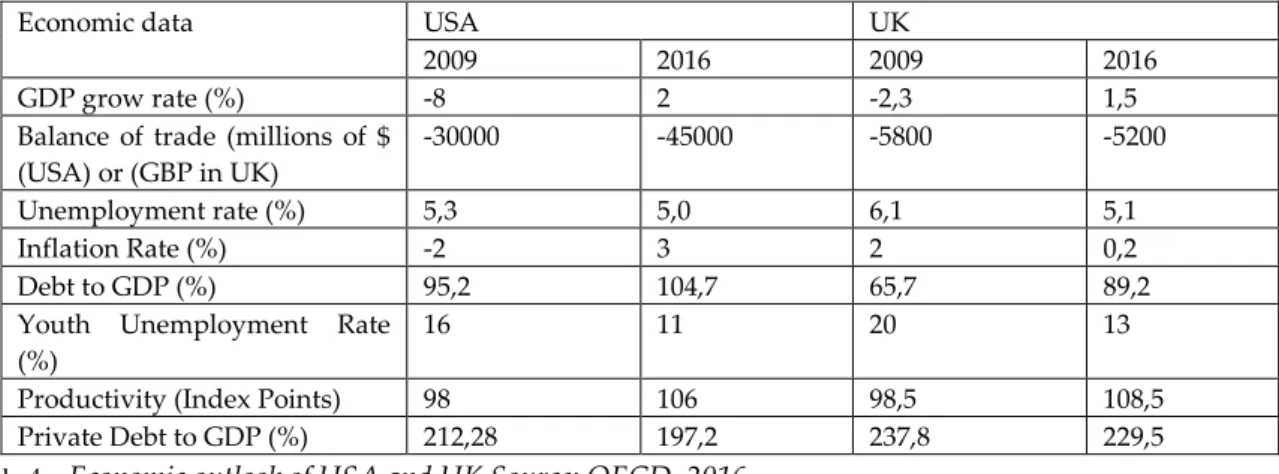
Table 1 presents the main economic indicators in USA and UK in 2009 and 2016, during and after the subprime crisis. Recession in the USA reached -8% of GDP, -2.3% in the United Kingdom. Results started to improve in 2010, though, and it could be said that there is now a moderate economic growth. Unemployment among young people was strongly affected, reaching 16 and 20%, respectively, in the United States and the UK, in 2009. And it decreased to 11 and 13% after 2010. Despite the improvement, the rate of young people that cannot find a job is still 6 to 8 points higher than general unemployment in those countries. On the other hand, trade balance was always negative, increasing 50% in the USA from 2009 to 2016. The UK performed better, with a decrease of around 10% along the same period.
Economic data USA UK
2009 2016 2009 2016
GDP grow rate (%) -8 2 -2,3 1,5
Balance of trade (millions of $ (USA) or (GBP in UK)
-30000 -45000 -5800 -5200
Unemployment rate (%) 5,3 5,0 6,1 5,1
Inflation Rate (%) -2 3 2 0,2
Debt to GDP (%) 95,2 104,7 65,7 89,2
Youth Unemployment Rate (%)
16 11 20 13
Productivity (Index Points) 98 106 98,5 108,5
Private Debt to GDP (%) 212,28 197,2 237,8 229,5 Table 4. Economic outlook of USA and UK Source: OECD, 2016.
Socio-Economics Characteristics of the Brexit voters
As for the socio-economic characteristics of the voters favouring Brexit, it is possible, according to Brooks et al., 2016 and O'Reilly et al., (2016), to distinguish them by socio-professional characteristics, such as the profession associated with educational level, level of wealth (heritage) and religious factors. Nearly two thirds of manual workers (64%) voted “Leave”, and their voice was augmented by approximately half of the middle classes with the same behaviour. The majority of the professionals and managerial classes (57%) voted “Remain”. An observation of the housing characteristics of “Leave” voters illustrates this unusual 'contradictory coalition'. Most of those who owned their own home,
without a mortgage (most likely older voters and the very rich), and two thirds of council and housing association tenants voted “Leave”. Homeowners with a mortgage voted “Remain”.
Gender divisions did not prove evident, but ethnic divisions were; and they were also fractured. White voters were slightly more likely to vote “Leave” (53%) than to vote “Remain” (47%). Two thirds (67%) of those describing themselves as Asian voted to remain, as did three quarters (73%) of black voters. Nearly 6 in 10 (58%) of those describing themselves as Christians voted to leave, while 7 in 10 Muslims voted “Remain”. However, some migrants from the Commonwealth voted “Leave” only because they wanted a fairer system of migration that did not give preferential treatment to East Europeans over people from their own countries (Parveen, 2016; O'Reilly et al., 2016). The economic crisis, the refugee crisis, pressures on the Euro and immigration, combine to stress the shortcomings of the EU. Brexit is also one kind of expression of democracy. Inglehart and Norris (2016) analyses whether populist support is associated with economic or cultural variables. Their results confirm that cultural values are consistent predictors of support for populist parties strengthened by anti-immigrant attitudes, mistrust of global and national governance, support for authoritarian values, and left-right ideological self-placement. According to Andersen et al. (2016), economic indicators are not reliable predictors. It thus seems likely that economic policies have not directly led to a populist backlash, but have indirectly reinforced it, by creating a world of greater labour mobility, and growing prominence of supranational government. The current surge of populism in Europe and the US is a significant challenge, not only for mainstream political parties but, more importantly, for the prosperity and political stability of advanced economies across the world.
The main factor that explains the Brexit was the lower educational level of the population and lack of investment in education (Streeck, 2014). In fact, UK, together with Greece, has the lowest share of secondary education students learning two or more languages, below 10% and decreasing since 2009. (EUROSTAT, 2016; Streeck, 2014). Meanwhile, good reasons existed for some section of the population to vote for Brexit. If the EU and the elites do not protect citizens from the crisis and economic difficulties, why bother? The Brexit vote most importantly underlines income and territorial inequalities, a growing cleavage between globalization winners and losers and a profound Brexistential crisis about the future of the Union European (Le Galès, 2016).
Socio-economics characteristics and attitudes of the Trump voters
As for the socio-economic characteristics and attitudes of the voters of Trump election (Table 2 and Table 3), it is possible to distinguish them by socio-professional characteristics, such as gender, race, age, education, geographical location of the voters, religion, the profession associated with educational level, and attitudes about the situation and the future of the country, immigration and openness to international trade and mistrust towards mainstream politicians: voters have serious mistrust about the
qualities of the politician in which they vote and political ideology is mainly conservative in Trump voters. Trump voters are mainly politically conservative, male (52%), 45-64 years old (53%) and 65 and over years (53%), less educated (51% of people having high school or lower degrees, and 52% of those some college/associate degree), 50% of voters with average income in the $50,000 - $99,999 bracket. The low-income voters, receiving under $30,000 or between 30,000 - $49,999$ voted mainly for Clinton. One other characteristics of Trump was place of residence - the majority lives in suburbs (50%) and small city or rural areas (62%) - religion - Protestant or other Christian (58%) or Catholic (52%), while Clinton attracted 62% of voters with no religion and 69% of those with other religious belief. As far as attitudes and values, 69% of the Trump voters consider that the direction of the country is seriously off track, they are mainly concerned with the emigration (64%) and worried about the economic situation of the country (42%). When asked about the family financial situation, they consider that it is worse today (78%) and expect for the next generation of Americans to have a worse life than today (63%). About 65% consider that the effect of trade openness with other countries on U.S. jobs takes jobs away from American workers, 86% agree with the construction of the wall along the entire U.S. border with Mexico and 84% strongly agree with the deportation of illegal immigrants working in the U.S.A. For 84% of Trump voters the most important candidate quality is that he can bring needed change. These results seem to indicate that Trump voters correspond, on one hand, to those excluded from globalization and the system, and, on the other, probably to the revolt of the elites towards the political system. They are thus willing to take more risk and vote for a candidate with no political experience and outside the political mainstream.
Voter's Socio-economic characteristics
Gender Male Female
Gay, lesbian, bisexual or transgender
Trump (%) 53 42 14
Clinton (%) 41 54 78
Race White Black Hispanic/Latin Asian
Trump (%) 58 8 29 37
Clinton (%) 37 88 65 56
Age 18-29 30-34 45-64 65 and over
Trump (%) 37 42 53 53
Clinton (%) 55 50 44 45
Education W Some college/ associate degree College graduate Postgraduate study Trump (%) 51 52 45 37 Clinton (%) 45 43 49 58 Income ($ /year) Under $30,000 $30,000 - $49,999 $50,000 - $99,999 $100,000 - $199,999 $200,000 - $249,999 $250,000 or more Trump (%) 41 42 50 48 49 48
Clinton (%) 53 51 46 47 48 46 Residence City over 50,000 Suburbs Small city or rural
Trump (%) 35 50 62
Clinton (%) 59 45 34
Religion Protestant or other
Christian Catholic Jewish Something else None
Trump (%) 58 52 24 29 26
Clinton (%) 39 45 71 62 69
Table 5. Socio-economic characteristics of the Trump and Hilary Clinton Voters. Source: from Fuchs, C. (2017) and Huang, J., Jacoby, S., Lai, R., and Strickland, M., (2016).
Voter's attitudes Trump (%) Clinton (%)
Direction of country Generally right direction 8 90
Seriously off track 69 25
Most important issue
Foreign policy 34 60
Immigration 64 32
The economy 42 42
Terrorism 57 39
Condition of the nation's economy
Excellent 16 83
Good 19 76
Fair 55 39
Poor 79 15
Family financial situation
Better today 24 72
Worse today 78 19
About the same 46 46
What do you expect for the next generation of Americans?
Better than life today 38 59
Worse than life today 63 31
Condition of the nation's economy
Excellent 16 83
Good 19 76
Fair 55 39
Poor 79 15
Effect of trade openness with other
countries on U.S. jobs Takes away jobs 65 31
What should happen to most illegal
immigrants working in the U.S.? Deport 84 14
Building a wall along the entire U.S.
border with Mexico Support 86 10
Best description of vote I like my candidate but with reservations 49 48 Most important candidate quality Can bring needed change 83 14
Political ideology Conservative 81 15
Liberal 84 10
Table 6. Attitudes of the Trump and Hilary Clinton Voters. Source: from Fuchs, C. (2017) and Huang, J., Jacoby, S., Lai, R., and Strickland, M., (2016).
Results about the attitudes and perceptions of the citizens from UK and USA about the economic situation of the country
Data are taken from Ipsos Public Affairs (2017). Citizens in the UK, USA and other 23 countries assessed the current state of their country’s economy. The first question was: “Now, thinking about our economic situation, how would you describe the current economic situation in? Is it...”. The answers should be given in a modified Likert scale, with four possible results: Very good; Somewhat good; Somewhat bad and Very bad. The number of answers was a thousand in each of the countries involved. In Figure 1 one can see the results for the UK. Globally, the results show that 49% of the respondents consider the economic situation somewhat bad. The social-economic characterization of these respondents shows that there is a difference according to gender. More than 52% of women and only about 46% of man gave that answer. Other characteristics include 54% of people in the 50-64 years age bracket, 44% of those under 35 years old and 50% of respondents aged between 35-49.Also, 51% of the persons who answered somewhat bad were unemployed; 52% of the people with high salaries and 44% of those with medium and low incomes gave this answer; 52% were married, from whom 52% did not have a chief income earner; 52% did not occupy a senior executive place. It should be noted that only 37% of people in high hierarchical position were in this group of respondents. For 39% of the people inquired, the economic situation in the UK is somewhat good. 41% of these respondents were male, 37% female. This answer is equal for the highest age groups, with 37%, but only 34% of people under 35 years old voted this way, probably as a result of high unemployment in this age group; 39% belonged to a low income household, 44% to a high income. Votes were independent of marital status. Citizens sharing this opinion had mainly, 44%, low education levels. Only 34 % of medium and 39% of highly educated people agreed with this answer; finally, 41% of chief income earners shared the same opinion, against 37% of not chief income earners and business owners. The economic situation is very bad only for a total of 8% of the respondents. There is no evidence for a gender discrepancy. But, on the other hand, it seems that it is within the bracket age under 35 and lower education levels that this answer is mostly chosen. The contrasting choice, the economy is very good, is chosen by only 4% of the persons, mainly among men with lower education but high income households, including business owners and chief income earners.
In conclusion: the majority of the sample, 57%, in the United Kingdom considers that the economic situation of the country is bad or very bad. It is mainly among women, with medium educational level or unstable employment and lower hierarchical positions, low income, part-time jobs and risk of unemployment, within the age bracket 35-49, that this opinion prevails. These results confirm the findings of O’Reilly et al. (2016) that two thirds of the voters in favour of the Brexit were manual
workers and that their voice was reinforced by approximately half of the middle class (Stewart et al., 2016).
The same question was asked in the United States to a sample of 1000 inhabitants according to Ipsos Public Affairs (2017) methodology. The results, shown in Figure 3, confirm significant differences in the perception of American citizens when compared to their British counterparts. As a matter of fact, 52% of the people submitted to the questionnaire considers that the economic situation in the USA is good or very good. It mainly is among males (59%), aged under 35 (63%) – in contrast to the 48% of those between 35 and 49, or 43% older than 49 – married (52%), living within high income households, and with a Chief Income Earner (77%), Business Owners or Senior Executives (78%), with higher education (67%) that this opinion prevails. As far as geography is concerned, these results are favorable especially in the US Midwest Region (54%), US South Region (53%) and US West Region (53%), being smaller in the US Northeast Region (48%).
Figure 2. Economic situation in USA, 2017 (Source: Ipsos Public Affairs (2017). Possible explanations of the results
Several authors tried to forward explanations for the results of the elections: Clarke, and Ricketts, (2016) through the return of the Jacksonian tradition; (Newmann, 1957; Neumann et al., 2013).) using the critical theory. Clarkeand Ricketts (2016) concluded that in many respects, the 2016 presidential race witnessed the return of Jacksonian sentiment to center stage in American politics to challenge the post-Cold War consensus on foreign policy. Although these results refer to the UK, their conjugation with the factors based on the Jacksonian theory, may partly explain Trump’s election, which cannot be based on the economic factors, since, as previously stated, most the respondents to the Ipsos Public Affairs inquiry (2017) considers them to be good or very good. It may be added that they also express that the economy is not their main source of worries, since the negative effects of the subprime crisis seem to be surpassed. On the contrary, in the UK, the inquiry shows that the majority (57%) of the respondents consider the economic situation in the country bad or very bad. On the other hand, economic indicators show that the subprime crisis negatively affected the economy. Young people were among the most affected, despite their academic qualifications and thus the Prospect Theory was not confirmed. However, older less educated persons opted to vote for Brexit, as their American counterparts voted for Trump. It may be concluded that the Jacksonian Theory may be applied in both situations, with people expressing negative feelings towards formal political institutions, be them national, in the case of the USA and UK, or supranational, in the case of the UK. At economic level the Prospect Theory proposed by
Kahneman, and Tversky, (1979) could explain these electoral or referendum phenomena. Choices among risky prospects exhibit several pervasive effects that are inconsistent with the basic tenets of utility theory. In particular, people underweight outcomes are merely probable in comparison with
outcomes that are obtained with certainty. This tendency, called the certainty effect, contributes to risk aversion in choices involving sure gains and to risk seeking in choices involving sure losses. The application of the Prospect Theory to the results of the Presidential Elections in the United States and the Brexit referendum in the United Kingdom would justify that voters who faced negative experiences in the past are more receptive to vote in a riskier proposal (whose consequences they do not entirely know), but that offers them higher potential of additional gains, instead of choosing a safer alternative with smaller potential advantages. Fuchs, (2017) based on Neumann, (1957) and Neumann et al., (2013) explain the Trump election on the basis of the Critical Theory, namely, in such situations, the “fear of social degradation […] creates for itself ‘a target for the discharge of the resentments arising from damaged self-esteem’”. persecutory anxiety can lead to ego-surrender in the mass through affective identification with a leader.
Consequences of the Brexit and Trump’s Election
The analysis of the Brexit referendum reveals that the regions that voted strongly for Leave tended also to be those with the greatest levels of dependency on European Union markets for their local economic development (Galbraith, 2017). Donald Trump's victory showed how market reaction to populism is hard to predict. Globally, populist policies are focused more on immigration, trade, and governance, which are typically market negative. As such, populist electoral victories would imply modest downward revisions to baseline growth forecasts and risk greater instability. It has not been the case so far. Populist electoral victories in Europe would result in unsettling brinksmanship and provide an existential threat to the EU, though compromise is the most likely outcome since subsequent risks are two-sided.
CONCLUSION
The election of Donald Trump as President of the United States and the Brexit, separation of the United Kingdom from the European Union must be seen as the result of a complex situation involving social, political and economic aspects. Firstly, it is evident that there is a growing mistrust of a large part of the citizens on traditional institutions, political parties and long term politicians, be them national, in the case of the United States, or national and supranational, in the case of the United Kingdom. Secondly, citizens tend to feel that, in some way, they have been abandoned by the state to the effects of globalization and immigration without any effort being made to protect them. This in turn justifies the support for policies based on isolation and the growing believe that, on their own, with restrictive trade and immigration policies, both the United States and the United Kingdom would perform better. Finally, it is also evident from the study that the groups that favored Trump’s election and the Brexit
are those who think have more to lose with the current policies and are, therefore, open to try other ways, even if they may doubt the outcome.
REFERENCES
Abts, K., and Rummens, S. (2007), “Populism versus democracy”, Political Studies, 55(2), 405-424.
Abdelkader, E. (2016), “When Islamophobia turns violent: The 2016 U.S. Presidential Elections, The bridge initiative: A Georgetown University research project”, available at: http://bridge.georgetown.edu/when-islamophobia-turnsviolent-the-2016-u-s-presidential-elections/
Andersen, T. M., Bertola, G., Driffill, J., Fuest, C., James, H., Sturm, J. E., and Uroševic, B. (2017), “Economic Policy and the Rise of Populism–It’s Not So Simple”, EEAG Report on the European Economy, 50-66.
Broadberry, S., Ghosal, S., and Proto, E. (2016), “Anonymity, efficiency wages and technological progress”, Journal of Development Economics, In Press.
Buhaug, H., McConnell, F., Sharp, J., Sidaway, J. D., and Steinberg, P. E. (2016), “Changes at Political Geography”, Political Geography, 50, A1-A2.
Brooks, C., Manza, J., and Cohen, E. D. (2016), “Political Ideology and Immigrant Acceptance”, Socius, 2, 1-12. Buhaug, H., McConnell, F., Sharp, J., Sidaway, J. D., and Steinberg, P. E. (2016), “Changes at Political Geography”, Political Geography, 50, A1-A2.
Clarke, N., Jennings, W., Moss, J., and Stoker, G. (2017), “Changing spaces of political encounter and the rise of anti-politics: Evidence from Mass Observation's General Election diaries”, Political Geography, 56, 13-23.
Clarke, M., and Rickett, A. (2017), “Understanding the Return of the Jacksonian Tradition”, Orbis, 61(1), 13–26. Choi, H., & Varian, H. (2012), “Predicting the present with Google Trends”. Economic Record, 88(s1), 2-9.
Dornbusch, R., and Edwards, S. (1990), “Macroeconomic populism”, Journal of Development Economics, 32(2), 247-277.
Damill, M., Frenkel, R., and Rapetti, M. (2015), “Macroeconomic Policy in Argentina During 2002–2013”, Comparative Economic Studies, 57(3), 369-400.
Duchesne, S., Frazer, E., Haegel, F., Van Ingelgom, V., and Van Ingelgom, V. (Eds.) (2013), Citizens' reactions to European integration compared: Overlooking Europe. Springer.
EUROSTAT (2016), Foreign language learning statistics - Statistics Explained – European, available at: http://ec.europa.eu/eurostat/statistics-explained/index.php/Foreign_language_learning_statistics
Fonseca, P. C. D. (2011), “O mito do populismo econômico de Vargas”, Revista de Economia Política, 31(1), 56-76. Fuchs, C. (2017), “Donald Trump: A Critical Theory-Perspective on Authoritarian Capitalism”, tripleC: Communication, Capitalism & Critique, 15(1), 1-72.
Galbraith, J. (2017), “Europe and the World after Brexit”, Globalizations, 14(1), 164-167. Gilpin, R. (2016), The political economy of international relations, Princeton University Press.
Gleditsch, N. P., and Nordås, R. (2014), “Conflicting messages? The IPCC on conflict and human security”, Political Geography, 43, 82-90.
Gorman, C. S. (2017), “Redefining refugees: Interpretive control and the bordering work of legal categorization in US asylum law”, Political Geography, 58, 36-45.
Hermann, C. (2016), “Another ‘Lost Decade’? Crisis and Structural Adjustment in Europe and Latin America”, Globalizations, 1-16.
Home Office Statistical Bulletin (2016), Hate Crime, England and Wales, 2015 to 2016, 30.
Huang, J., Jacoby, S., Lai, R., and Strickland, M., (2016), “Election 2016: Exit polls”, New York Times, 8th November, available at: http://www.nytimes.com/interactive/2016/11/08/us/politics/election-exit-polls.html. Inglehart, R. F., and Norris, P. (2016), Trump, Brexit, and the Rise of Populism: Economic Have-Nots and Cultural Backlash, Harvard University, John F. Kennedy School of Government.
Ipsos Public Affairs Inquiry (2017), Database not published, available at:
https://www.ipsos.com/en/solution/social-research-corporate-reputation-ipsos-public-affairs?language_content_entity=en
Jagers, J., and Walgrave, S. (2007), “Populism as political communication style: An empirical study of political parties' discourse in Belgium”, European Journal of Political Research, 46(3), 319-345.
Le Galès, P. (2016),” Brexit: UK as an exception or the banal avant garde of the disintegration of the EU?”, in: O'Reilly, J., Froud, J., Johal, S., Williams, K., Warhurst, C., Morgan, G., ... and Frerichs, S. (2016), “Brexit: understanding the socio-economic origins and consequences”, Socio-Economic Review, 14(4), 807-854.
Kahneman, D., and Tversky, A. (1979), “Prospect theory: An analysis of decision under risk”, Econometrica: Journal of the econometric society, 263-291.
Neumann, F. L. (1957), The democratic and the authoritarian state: essays in political and legal theory, H. Marcuse (Ed.), Glencoe, IL: Free Press.
Neumann, F., Marcuse, H., and Kirchheimer, O. (2013), Secret reports on Nazi Germany: The Frankfurt School contribution to the war effort, Princeton University Press.
O’Reilly, J., Lain, D., Sheehan, M., Smale, B., and Stuart, M. (2011), “Managing uncertainty: the crisis, its consequences and the global workforce”, Work, employment and society, 25(4), 581-595.
O'Reilly, J., Froud, J., Johal, S., Williams, K., Warhurst, C., Morgan, G., and Frerichs, S. (2016), “Brexit: understanding the socio-economic origins and consequences”, Socio-Economic Review, 14(4), 807-854.
OECD, (2016) “Trade Economics” available at: http://www.tradingeconomics.com/united-kingdom/private-debt-to-gdp
Parveen, N. (2016), “Why Do Some Ethnic Minority Voters Want to Leave the EU?” The Guardian, vailable at: http://www.theguardian.com/politics/2016/jun/01/british-asians-viewseu- reeferendum-figures-brexit on August 7, 2016.
Streeck, W. (2014), “The politics of public debt: Neoliberalism, capitalist development and the restructuring of the state”, German Economic Review, 15(1), 143-165.
Steinberg, P. E. (2016), “Europe's ‘Others’ in the Polar Mediterranean”, Tijdschrift voor economische en sociale geografie, 107(2), 177-188.
Stewart, K., Dubow, T., Hofman, J., and van Stolk, C. (2016), “Social change and public engagement with policy and evidence”, available at http://www.nuffieldfoundation.org/sites/default/files/files/RAND_RR1750.pdf Szczerbiak, A., and Taggart, P. (2008), Opposing Europe?: The Comparative Party Politics of Euroscepticism: Volume 2: Comparative and Theoretical Perspectives (Vol. 2), Oxford University Press.