35
ABSTRACT
Objective: Previous studies have shown controversial relationships between ACE and ACTN3 gene polymor-phisms and sports performance. Thus, the aim of our study was to assess anaerobic and aerobic performance indicators of young female soccer players with different ACE/ACTN3 gene profiles. Methods: Twenty-seven female soccer players aged 16-18 underwent acceleration, speed, strength, anaerobic power and aerobic endurance tests and had their ACE and ACTN3 polymorphisms determined. Results: Based on genetic analysis, they were divided into the following groups: ACE II (n=2), ACE ID (n=11), ACE DD (n=14), ACTN3 XX (n=5), ACTN3 RR (n=7) and ACTN3 RX (n=15). ACE DD and ACE ID groups differed significantly in terms of results achieved on the 5 m sprint test (1.15±0.05 s vs 1.10±0.05 s, P=0.42). ACTN3 RR and RX achieved better results than the ACTN3 XX group in seven continuous vertical jumps (26.57±1.59 cm vs 25.77±2.51 cm vs 22.86±1.16 cm, respectively; P=0.007 for RR vs XX and P=0.021 for RX vs XX). Conclusion: High prevalence of ACE DD and ACTN3 RX genotypes in our subjects may suggest that faster and more powerful young females tend to perform better in soccer. Nevertheless, the absence of differences in most of the physical test results indicates that different genotypes are compatible with high-level soccer performance, meaning that it is the phenotype-genotype interaction that makes a successful female soccer player. Level of Evidence I, Prognostic studies — Investigating the effect of a patient characteristic on disease outcome.
Keywords:Genes; Sports performance; Soccer; Physical endurance.
RESUMO
Objetivo: Estudos anteriores mostraram relações controvertidas entre os polimorfismos dos genes ACE e ACTN3 e desempenho esportivo. Assim sendo, o objetivo deste estudo foi avaliar os indicadores de desempenho anaeróbico e aeróbico de jovens futebolistas do sexo feminino com diferentes perfis dos genes ACE/ACTN3. Métodos: Vinte e sete jogadoras com idade entre 16 e 18 anos realizaram testes de aceleração, velocidade, força, potência anaeróbica e resistência aeróbica e os polimorfismos de seus genes ACE e ACTN3 foram determinados. Resultados: Com base na análise genética, elas foram divididas nos seguintes grupos: ACE II (n = 2), ACE ID (n = 11), ACE DD (n = 14), ACTN3 XX (n = 5), ACTN3 RR (n = 7) e ACTN3 RX (n = 15). Os grupos ACE DD e ACE ID diferiram significativamente quanto aos resultados obtidos no sprint test de 5 metros (1,15 ± 0,05 s vs. 1,10 ± 0,05 s, P = 0,42). Os grupos ACTN3 RR e RX atingiram resultados melhores do que o grupo ACTN3 XX em sete saltos verticais contínuos (26,57 ± 1,59 cm vs. 25,77 ± 2,51 cm vs. 22,86 ± 1,16 cm, respectivamente; P = 0,007 para RR vs. XX e P = 0,021 para RX vs. XX). Conclusão: A alta prevalência de genótipos RX em ACE DD e ACTN3 em nossa amostra pode sugerir que as jovens atletas mais rápidas e com maior potência tendem a ter melhor desempenho no futebol. No entanto, a ausência de diferença na maioria dos resultados dos testes físicos indica que genótipos distintos são compatíveis com o desempenho futebolístico de alto nível, o que significa que é a interação fenótipo-genótipo que faz uma jogadora de futebol ser bem-sucedida.Nível de Evidência I, Estudos prognósticos – Investigação do efeito de característica de um paciente sobre o desfecho da doença.
Descritores:Genes; Desempenho atlético; Futebol; Resistência física.
RESUMEN
Objetivo: Estudios anteriores mostraron relaciones controvertidas entre los polimorfismos de los genes ACE y ACTN3 y desempeño deportivo. Siendo así, el objetivo de este estudio fue evaluar los indicadores de desempeño anaeróbico y aeróbico de jóvenes futbolistas del sexo femenino con diferentes perfiles de los genes ACE/ACTN3. Métodos: Veintisiete jugadoras con edad entre 16 y 18 años realizaron tests de aceleración, velocidad, fuerza, potencia anaeróbica y resistencia aeróbica y fueron determinados los polimorfismos de sus genes ACE e ACTN3. Resultados: Con base en el análisis genético, ellas fueron divididas en los siguientes grupos: ACE II (n = 2), ACE ID (n = 11), ACE DD (n = 14), ACTN3 XX (n = 5), ACTN3 RR (n = 7) y ACTN3 RX (n = 15). Los grupos ACE DD y ACE ID difirieron significativamente cuanto a los resultados obtenidos en el sprint test de 5 metros (1,15 ± 0,05 s vs. 1,10 ± 0,05 s, P = 0,42). Los grupos ACTN3 RR y RX alcanzaron resultados mejores que el grupo ACTN3 XX en siete saltos verticales continuos (26,57 ± 1,59 cm vs. 25,77 ± 2,51 cm vs. 22,86 ± 1,16 cm, respectivamente; P = 0,007 para RR vs. XX y P = 0,021 para RX vs. XX). Conclusión: La alta prevalencia de genotipos RX
ACE/ACTN3 GENETIC POLYMORPHISMS AND ATHLETIC
PERFORMANCE OF FEMALE SOCCER PLAYERS`
POLIMORFISMOS GENÉTICOS EM ACE/ACTN3 E DESEMPENHO ATLÉTICO DE ATLETAS DE
FUTEBOL FEMININO
POLIMORFISMOS GENÉTICOS EN ACE/ACTN3 Y DESEMPEÑO ATLÉTICO DE ATLETAS DE
FÚTBOL FEMENINO
Dejan Jeremic1
(Physician)
Ivana Zivanovic Macuzic1
(Physician) Maja Vulovic1
(Physician) Jelena Stevanovic2
(Physician)
Dragan Radovanovic3
(Physician) Vladimir Varjacic4
(Physician) Dusica Djordjevic2
(Sports professional)
1. University of Kragujevac, Faculty of Medical Sciences, Department of Anatomy, Serbia.
2. University of Kragujevac, Faculty of Medical Sciences, Department of Physical Medicine and Rehabilitation, Serbia. 3. University of Nis, Faculty of Sports and Physical Education, Department of Physiology, Serbia. 4. University of Kragujevac, Faculty of Medical Sciences, Department of Physiology, Serbia.
Correspondence:
Dusica Djordjevic. Department of Physical Medicine and Rehabilitation, Faculty of Medical Sciences, University of Kragujevac, Svetozara Markovica 69, 34 000 Kragujevac, Republic of Serbia. [email protected]
ORIGINAL ARTICLE
ARTIGO ORIGINAL
36
en ACE DD y ACTN3 en nuestra muestra puede sugerir que las jóvenes atletas más rápidas y con mayor potencia tienden a tener mejor desempeño en el fútbol. Sin embargo, la ausencia de diferencia en la mayoría de los resultados de los tests físicos indica que genotipos distintos son compatibles con el desempeño futbolístico de alto nivel, lo que significa que es la interacción fenotipo-genotipo que hace que una jugadora de fútbol sea exitosa. Nivel de Evidencia I, Estudios pronósticos – Investigación del efecto de característica de un paciente sobre el desenlace de la enfermedad.
Descriptores: Genes; Rendimiento atlético; Fútbol; Resistencia física.
Article received on 11/09/2017 accepted on 10/03/2018 DOI: http://dx.doi.org/10.1590/1517-869220192501187684
INTRODUCTION
During the last two decades, there has been considerable interest in finding the genetic factors responsible for human sport capabilities. However, the findings on the relations between genetic polymorphisms and sports performance are frequently controversial.1 Race and sex
seem to strongly affect the results, as well as the sporting modality. The most explored genes that are suggested to influence physi-cal performance are the angiotensin converting enzyme (ACE) and α-actinin-3 (ACTN3). After the discovery of ACE insertion/deletion (I/D) polymorphism,2 i.e. its three genotypes (II homozygote, ID
het-erozygote and DD homozygote), ACE gene became the first genetic element suggested to have substantial impact on human physical performance.3 Although there is some inconsistency in the literature,
majority of studies have shown that the I allele is associated with improved performance in endurance sports, while the deleted form of the variant (D allele) is associated with enhanced performance in sports requiring sprinting or short bursts of power.4
The ACTN3 gene encodes for the synthesis of α-actinin-3 in skeletal-muscle fibres, a sarcomeric protein necessary for producing explosive, powerful contractions.1 A genetic variation in the ACTN3 gene that
results in the replacement of an arginine (R) with a stop codon (X) at amino acid 577 (R577X, rs1815739) can create different versions of the ACTN3 gene. Ma and colleagues1 analyzed 88 articles focused on
ACTN3 and athletic performance and concluded that ACTN3 R allele is significantly associated with power performance, while ACTN3 XX might be postulated to contribute to endurance performance. Although a significant amount of papers on the relationship between ACE/ACTN3 genes and sports achievement was published during past 15 years, this topic is still considered unexplored.5 The lack of
repeat-ability and variations in study design and the population studied pre-vent a final conclusion to be drawn from current literature data.6 Since
ethnicity, gender, sport modality and other factors may influence the results, we conducted a study that explores the relationship between the abovementioned genes and athletic performance in a very specific group of subjects: young elite female football players. The aims of the study were to assess if certain ACE/ACTN3 genotype prevails in this cohort and if players with different ACE/ACTN3 genotypes achieve significantly different results in basic speed, power and endurance tests.
METHODS
The study was conducted among 27 female football (soccer) players pertaining to the Serbian national U18 team (16-18 years old). All par-ticipants and their parents gave a written informed consent (EFT) for data collection and participation in the study. The study was approved by the local Ethical committee (01-10988) and performed according to the principles of World Medical Association’s Declaration of Helsinki. The first part of the study was directed towards the genetic analyses (ACE and ACTN3 genes), performed by trained personnel in laboratory at School of Medicine, University of Belgrade, Serbia. Using sterile swabs, buccal cells samples were collected from all the tested
sub-jects. Genomic DNAs from buccal samples were extracted manually, using the commercial kit (PureLink genomic DNA, Invitrogen). ACE and ACTN3 genetic polymorphisms were determined by HRM-PCR, using an “in house” developed and validated method.
After analysis of ACE polymorphism, subjects were divided into three groups: 1) ACE IIgroup, 2) ACE ID group,3) ACE II group. Furthermore, ba-sed on analysis of ACTN3 gene, subjects were divided into three groups: 1) ACTN3 XX group, 2) ACTN3 RR group, 3) ACTN3 RX group.
Analysis of athletic capabilities of subjects was conducted a week before the start of the National league using six performance tests: 1) sprinting 5m (acceleration), 2) sprinting 20m (speed), 3) zig-zag test (agility), 4) squat jump (power), 5) seven continuous vertical jumps (anaerobic power), 6) Yo-Yo test (endurance). Subjects were familiarized with the testing protocol, and performed every test twice (better result was chosen for further analy-ses). All performance tests were conducted in Serbian Institute of Sport and Sports Medicine facilities, by Strength and Conditioning specialists.
Sprinting 20m with transitory time on 5m. Subject started running from the upper starting position, after auditory signal. Time needed to run 20m was used for estimation of speed, while time needed to pass the first 5m was used for estimation of acceleration ability of subjects.7 Time was measured using FITRO light gates (Fitronics.r.o.,
Slovakia) and results expressed in 1/100 seconds.
Zig-Zag test. Agility was estimated according to result achieved on Zig-zag agility test that consists of four 5-m sections set out at the angle of 100 degrees.7 Subject starts running from the upper starting
position, after visual signal. Time was measured using FITRO light gates (Fitronics.r.o., Slovakia). Results are expressed in 1/100 seconds.
Squat jump. Explosive strength was estimated using squat jump, the test that measures concentric phase of contraction of body extensors.8
Starting position includes semisquat (90 degrees of flexion in knees) and arms on hips. After two seconds spent in this position, subjects jumps vertically and lands to similar semisquat. The height of jump was measured using FITRO jumper (Fitronics.r.o., Slovakia).
Seven continuous jump with bent legs. Anaerobic power of subjects
was estimated using continuous jumping for 15 seconds.9 Subject
places arms on hips and starts jumping after auditory signal. Contact phase with ground (landing phase) includes knee flexion of about 90 degrees. Jump height was measured using FITRO jumper (Fitronics.r.o., Slovakia), and measured with accuracy of 1mm.
Yo-Yo test. Aerobic endurance was estimated using Yo-Yo test level 1.10
This test involves continuous running between two lines 20m apart. The subjects start with their foot behind one of the lines, and begin running when instructed. They continue running between the two lines, turning when signaled by the recorded beeps. After each minu-te, the pace gets quicker. If the line is not reached in time the subject must run to the line turn and try to catch up with the pace within two more “beeps”. The test is stopped if the subject fails to catch up with the pace within the two ends. The athlete’s score is the total distance covered before they were unable to keep up with the recording.
37
program 21.0 for Windows. Results are expressed as mean ± standard error of the mean (on Figures), or mean ± standard deviation (in bra-ckets). The differences between three groups were assessed using Kruskal-Wallis test, followed by Mann Whitney test, if the difference between two groups was significant (probability set at 5% level).
RESULTS
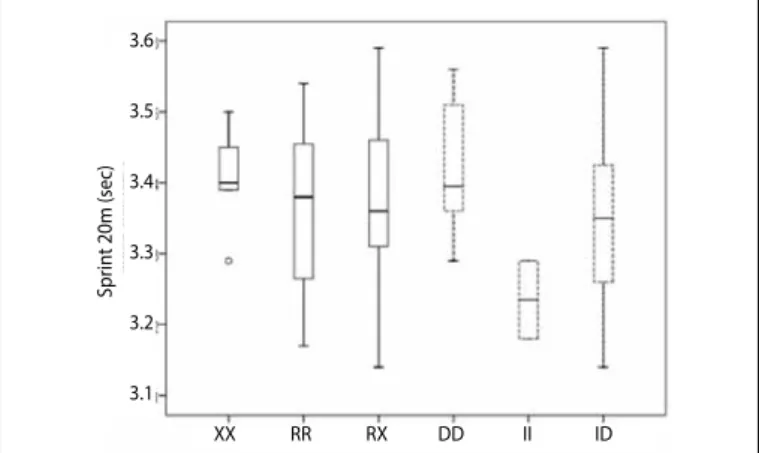
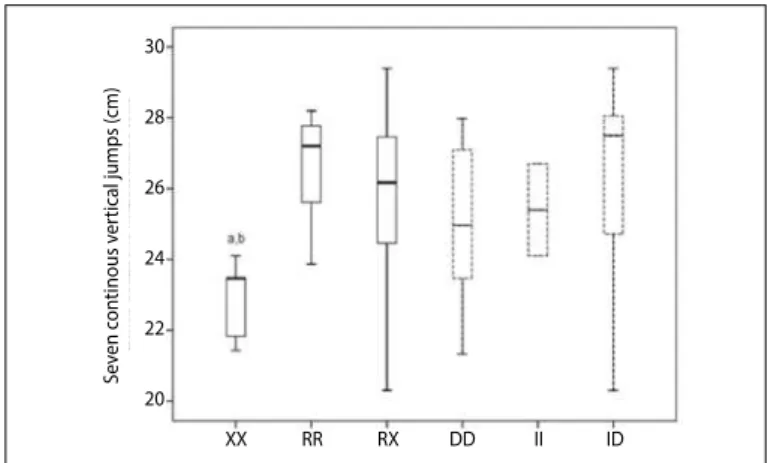
The performance test boxplot results for subjects with different ACE-and ACTN3 genes version are presented in Figures 1 to 6 (median,
the 1st and 3rd quartile, maximum and minimum values). ACE DD
genotype was found in 14 subjects, ACE ID in 11 and ACE II in only two subjects. ACTN3 RR genotype was found in seven, ACTN3 XX in five and ACTN3 RX in 15 subjects.
Since ACE II genotype was found in only two subjects, this group was excluded from the statistical analysis, but their results are pre-sented on the Figures for the descriptive purposes. ACE DD and ACE ID groups significantly differed only in results achieved on 5m sprint test (1.15±0.05 s vs 1.10±0.05 s, P=0.042).
Difference between ACTN3 groups was found only in test of seven continuous jumps (P=0.022). ACTN3 RR and RX groups achieved significantly better result than ACTN3 XX group (26.57±1.59 cm vs 25.77±2.51 cm vs 22.86±1.16 cm, respectively; P=0.007 for RR vs XX and P=0.021 for RX vs XX).
DISCUSSION
The concept that genetics are strongly associated with human physi-cal performance has been widely accepted in the last decades.5
Pre-vious studies were mostly performed on athletes from pure strength/ power oriented sports (swimmers, sprinters, etc.), or endurance-based
Figure 1. Boxplot: results that subject with different ACTN3 genotype (XX, RR, RX) and ACE genotype (DD, II, ID) achieved on “5m sprint” acceleration test.
Figure 3. Boxplot: results that subject with different ACTN3 genotype (XX, RR, RX) and ACE genotype (DD, II, ID) achieved on “Zig-Zag” agility test.
Figure 2. Boxplot: results that subject with different ACTN3 genotype (XX, RR, RX) and ACE genotype (DD, II, ID) achieved on “20m sprint” speed test.
Figure 4. Boxplot: results that subject with different ACTN3 genotype (XX, RR, RX) and ACE genotype (DD, II, ID) achieved on “Squat jump” powertest.
sports (marathon runners, rowers, etc.), which is the most likely the best way to study the relationship between genes that are suggested to affect mechanisms responsible for anaerobic/aerobic capabilities. In our study, we explored the possibility that genetic polymorphism would be related to results in a number of performance tests usually used for testing athletes from team sports, more specifically football. In this context, we assessed in 27 young female elite football players, the relationship between two genes (ACE and ACTN3) and results obtained in six performance tests. Our results do not show significant relationship between ACE/ACTN3 polymorphism and performance in different tests of physical abilities of young female football players. The ACE gene was the first gene whose polymorphism was suggested to affect athletic performance, and the one mostly studied. ACE is a part of complicated cascade of molecules known as the renin-angio-tensin system, thereby directly influencing blood pressure and fluid balance and indirectly influencing cardiovascular and musculoskeletal structure and function.11,12 A number of studies have shown that the
ACE I/D polymorphism affects athletic performance and exercise du-ration in a variety of populations (athletes, adolescents, older people, pulmonary and cardiovascular patients, etc.). However, despite the numerous studies positively associating ACE gene polymorphisms with performance, other studies failed to find any association.13–16
With respect to the rapid increase in the number of original rese-arches in this area, review articles4,17,18 and meta-analyisis were
re-cently published.1 A systematic review and meta-analysis by Ma and
coworkers,1 in which 366 articles about the relationship between
ACE gene and athletic performance were analyzed, concluded that there was no statistically significant association between ACE I allele and endurance sport events (but it was very close to be so), while
XX RR RX DD II ID
XX RR RX DD II ID XX RR RX DD II ID
XX RR RX DD II ID
Spr
in
t 5m (sec)
Squa
t jump (cm)
Zig-zag ag
ilit
y t
est (sec)
Spr
in
t 20m (sec)
1.3
1.2
1.2
1.1
1.1
1.0
27.5
25.0
22.5
20.0
17.5
15.0 6.2
6.0
5.8
5.6
5.4
3.6
3.5
3.4
3.3
3.2
38
a significant association between ACE II genotype and endurance group was observed. The results of our study show that our subjects with ACE DD genotype, which is suggested to be related to power and speed, achieved worse result that those with ACE ID genotype in test of acceleration (5m sprint). A similar study was performed by Micheli et al19 on young male football players, and they reported that
the ID genotype of ACE was associated with the best performances in squat jump and countermovement jump. We did not compare the results that ACE II group achieved with other two groups due to small number of subjects with ACE II genotype (just two subjects). Such low frequency of ACE II genotype is in consent with some previous reports of ACE genotype distribution in Serbian population, such as around 16% in a study by Stankovic et al.20 That ACE II genotype is
the least frequent genotype in population of football players was sho-wn by many previous studies,21–23 proving the notion that although
aerobic metabolism dominates the energy delivery during a football game, power and strength play a greater role in the determination of success in football.24
Unlike ACE, which is often connected with endurance sports, rese-archers generally concentrate on association between ACTN3 and
power sports. Numerous studies have confirmed associations betwe-en the ACTN3 R577 allele and muscle power phbetwe-enotypes in humans (i.e. sprint time, fiber type), suggesting that at least one copy of the ACTN3 R577 allele is beneficial for participation in sprint and power sports,25 while there is consistently strong association between RR
genotype and elite power performance.12,26–29 This was confirmed
by Alfred and colleagues17 who conducted a meta-analysis on the
published association between ACTN3 and athletic status. That ACTN3 RR genotype determines anaerobic abilities of football players was
shown by Pimenta et al,30 whose subjects with genotype ACTN3 RR
were the fastest in short distances and presented higher jumping potential. Our subjects carried in most cases RX type of ACTN3 gene (15 subjects), followed by RR version (7 subjects) and XX version of the gene (5 subjects). Ulucan et al22 also reported the lowest frequency
of ACTN3 XX genotype in Turkish football players, as well as Egorova et al23 in Russian football players, but contrary to our results, ACTN3
RR genotype was the most frequent genotype in many studies on male football players.22,23,31The results of our study do not support the
hypothesis on relationship between ACTN3 and anaerobic abilities of subjects, except in case of anaerobic power manifested through seven continuous vertical jumps. Subjects with ACTN3 XX genotype performed worse than both RR and RX groups, confirming that at least one R577 allele is enough to make difference in anaerobic disciplines. The frequencies of ACE and ACTN3 genotypes observed in our study imply that, in female football, anaerobic abilities are more significant than aerobic abilities. However, such low frequency of the endurance--related ACE and ACTN3 genotypes in our subjects represents a limi-tation of the study, since comparison between groups was precarious. Anyway, our results represent the real state in the field, since we tested 27 members of the national football team.
CONCLUSIONS
Prevalence of ACE DD and ACTN3 RX genotypes in our subjects su-ggests that faster and more powerful girls distinguish in this sport. However, subjects with different ACE/ACTN3 genotype significantly differed in only one out of six performance tests, suggesting that assessing these specific genes polymorphisms in young elite female football players may not give important information regarding their physical abilities, and thus their use as one of factors for talent identi-fication is questionable. Although genetics may predispose a subject for some sport, it is the interaction of the phenotype with genotype that makes the final result. Athletic performance is the result of many different factors, such as training characteristics, anthropometric and morphometric characteristics of the athlete, etc. These phenotypes are influenced by a variety of other processes and cellular pathways which are eventually influenced by a large number of individual and relevant genes.
ACKNOWLEDGEMENTS
Authors would like to thank dr Nikola Atanasijevic and dr Tijana Dur-mic from Institute of Forensic Medicine, School of Medicine, Belgrade, for help in genetic analyses.
All authors declare no potential conflict of interest related to this article
Figure 5. Boxplot: results that subject with different ACTN3 genotype (XX, RR, RX) and ACE genotype (DD, II, ID) achieved on “Seven continuous jumping test” (aSignificantly
different than ACTN3 RX, bSignificantly different than ACTN3 RR).
Figure 6. Boxplot: results that subject with different ACTN3 genotype (XX, RR, RX) and ACE genotype (DD, II, ID) achieved on “Yo-Yo” endurance test (estimated VO2max
(mean±SD) based on ran distance: ACTN3 XX group 44.72±3.06, ACTN3 RR group: 44.35±2.84, ACTN3 RX group: 45.34±2.79 ml/kg, ACE DD group 43.60±3.11, ACE II group: 44.65±2.93, ACE ID group: 45.62±2.62 ml/kg).
AUTHORS’ CONTRIBUTIONS: Each author made significant individual contributions to this manuscript. DJ (0000-0001-9089-9467)*: conception and design of the study, final approval of the manuscript version to be published; IZM (0000-0001-6860-7237)*: analysis and interpretation of the study; critical review of the article and its intellectual content; MV (0000-0002-8288-3497)*: writing, interpretation of the study; JS (0000-0002-3836-9706)*: acquisition, writing of the study; DR (0000-0002-1690-2127)*: conception and design of the study, final approval of the manuscript version to be published; VV (0000-0003-3416-8381)*: acquisition, critical review of the article and its intellectual content; DDJ (0000-0002-7071-8937)*: acquisition, writing, agreeing to take responsibility for all aspects of the study. *ORCID (Open Researcher and Contributor ID).
XX RR RX DD II ID
XX RR RX DD II ID
Sev
en c
on
tinous v
er
tical jumps (cm)
Yo
-y
o endur
anc
e t
est (m)
30
28
26
24
22
20
1750
1500
1250
1000
750
39
REFERENCES
1. Ma F, Yang Y, Li X, et al. The association of sport performance with ACE and ACTN3 genetic polymorphisms: a systematic review and meta-analysis. PLoS One. 2013;8(1):e54685.
2. Montgomery HE, Marshall R, Hemingway H, Myerson S, Clarkson P, Dollery C, et al. Human gene for physical performance. Nature. 1998;393(6682):221-2.
3. Keogh JWL, Palmer BR, Taylor D, Kilding AE. ACE and UCP2 gene polymorphisms and their association with baseline and exercise-related changes in the functional performance of older adults. PeerJ. 2015;3:e980. 4. Puthucheary Z, Skipworth JRA, Rawal J, Loosemore M, Van Someren K, Montgomery HE. The ACE gene
and human performance. Sport Med. 2011;41(6):433-48.
5. Davids K, Baker J. Genes, environment and sport performance: why the nature-nurture dualism is no longer relevant. Sports Med. 2007;37(11):961-80.
6. de Mello Costa MF, Slocombe R. the use of angiotensin-i converting enzyme i/d genetic polymorphism as a biomarker of athletic performance in humans. Biosensors. 2012;2(4):396-404.
7. Little T, Williams AG. Specificity of acceleration, maximum speed, and agility in professional soccer players. J strength Cond Res. 2005;19(1):76-8.
8. Markovic G, Dizdar D, Jukic I, Cardinale M. Reliability and factorial validity of squat and countermovement jump tests. J Strength Cond Res. 2004;18(3):551-5.
9. Tossavainen M. Testing athletic performance in team and powersports. Newtest; 2004.
10. Krustrup P, Mohr M, Amstrup T, Rysgaard T, Johansen J, Steensberg A, et al. The Yo-Yo intermittent recovery test: physiological response, reliability, and validity. Med Sci Sport Exerc. 2003;35(4):697-705. 11. Ostrander EA, Huson HJ, Ostrander GK. Genetics of athletic performance. Annu Rev Genomics Hum
Genet. 2009;10(1):407-29.
12. Chiu L-L, Chen T-W, Hsieh SS, Hsieh L-L. ACE I/D, ACTN3 R577X, PPARD T294C and PPARGC1A Gly482Ser polymorphisms and physical fitness in Taiwanese late adolescent girls. J Physiol Sci. 2012;62(2):115-21. 13. Rankinen T, Wolfarth B, Simoneau JA, Maier-Lenz D, Rauramaa R, Rivera MA, et al. No association between the angiotensin-converting enzyme ID polymorphism and elite endurance athlete status. J Appl Physiol. 2000;88(5):1571-5.
14. Muniesa CA, Gonzalez-Freire M, Santiago C, Lao JI, Buxens A, Rubio JC, et al. World-class performance in lightweight rowing: is it genetically influenced? A comparison with cyclists, runners and non-athletes. Br J Sports Med. 2010;44(12):898-901.
15. Cohen D, Voss C, Taylor M, Delextrat A, Ogunleye A, Sandercock G. Ten-year secular changes in muscular fitness in English children. Acta Paediatr Int J Paediatr. 2011;100(10):175-7.
16. Taylor RR, Mamotte CD, Fallon K, van Bockxmeer FM. Elite athletes and the gene for angiotensin-converting
enzyme. J Appl Physiol. 1999;87(3):1035-7.
17. Alfred T, Ben-Shlomo Y, Cooper R, Hardy R, Cooper C, Deary IJ, et al. ACTN3 genotype, athletic status, and life course physical capability: meta-analysis of the published literature and findings from nine studies. Hum Mutat. 2011;32(9):1008-18.
18. Zilberman-Schapira G, Chen J, Gerstein M. On sports and genes. Recent Pat DNA Gene Seq. 2012;6(3):180-8. 19. Micheli ML, Gulisano M, Morucci G, Punzi T, Ruggiero M, Ceroti M, et al. Angiotensin-converting enzyme/ vitamin d receptor gene polymorphisms and bioelectrical impedance analysis in predicting athletic performances of italian young soccer players. J Strength Cond Res. 2011;25(8):2084-91.
20. Stanković A, Zivković M, Alavantić D. Angiotensin I-converting enzyme gene polymorphism in a Serbian population: a gender-specific association with hypertension. Scand J Clin Lab Invest. 2002;62(6):469-75. 21. Gineviciene V, Jakaitiene A, Tubelis L, Kucinskas V. Variation in the ACE, PPARGC1A and PPARA genes
in Lithuanian football players. Eur J Sport Sci. 2014;14(sup1):S289-95.
22. Ulucan K, Sercan C, Biyikli T. Distribution of angiotensin-1 converting enzyme insertion/deletion and α-actinin-3 codon 577 polymorphisms in turkish male soccer players. Genet Epigenet. 2015;7:1-4. 23. Egorova ES, Borisova AV, Mustafina LJ, Arkhipova AA, Gabbasov RT, Druzhevskaya AM, et al. The
polygenic profile of Russian football players. J Sports Sci. 2014;32(13):1286-93.
24. Bangsbo J, Nørregaard L, Thorsø F. Activity profile of competition soccer. Can J Sport Sci. 1991;16(2):110-6. 25. Deschamps CL, Connors KE, Klein MS, Johnsen VL, Shearer J, Vogel HJ, et al. The ACTN3 R577X Polymorphism is associated with cardiometabolic fitness in healthy young adults. PLoS One. 2015;10(6):e0130644.
26. Paparini A, Ripani M, Giordano GD, Santoni D, Pigozzi F, Romano-Spica V. ACTN3 genotyping by real-time PCR in the Italian population and athletes. Med Sci Sports Exerc. 2007;39(5):810-5.
27. Papadimitriou ID, Papadopoulos C, Kouvatsi A, Triantaphyllidis C. The ACTN3 gene in elite Greek track and field athletes. Int J Sports Med. 2008;29(4):352-5.
28. Eynon N, Ruiz JR, Femia P, Pushkarec VP, Cieszcyk P, Maciejewska-Karlowska A, et al. The ACTN3 R577X polymorphism across three groups of elite male European athletes. PLoS One. 2012;7(8):e43132. 29. Eynon N, Hanson ED, Lucia A, Houweling PJ, Garton F, North KN, et al. Genes for elite power and sprint
performance: ACTN3 leads the way. Sport Med. 2013;43(9):803-17.
30. Pimenta EM, Coelho DB, Veneroso CE, Barros Coelho EJ, Cruz IR, Morandi RF, et al. Effect of ACTN3 gene on strength and endurance in soccer players. J Strength Cond Res. 2013;27(12):3286-92. 31. Santiago C, Gonzalez-Freire M, Serratosa L, Morate FJ, Meyer T, Gómez-Gallego F, et al. ACTN3 genotype