Fragmenta entomologica, Roma, 41 (1): 15-67 (2009)
The salTopTeRan fauna of poRTugal: new RecoRds and biogeogRaphical aspecTs
(orthopteroidea)
geRhaRd h. schmidT † (*), ana paula maRTinho (**) and maRia Rosa paiva (**)
inTRoducTion
for the iberian peninsula, most faunistic studies of saltatoria refer to spanish populations. The orthopteroid fauna of portugal is still poorly known. In the first half of the 20th century, De Seabra (1942) presented the first survey of the Portuguese Saltatoria, as well as a list of the litera -ture then available, including a study of the orthopteran species of Setúbal peninsula (cordeiro 1914) and a list of the species kept at the museum of the University of Coimbra, with an identification key (Aires & Me -nano 1916). ebner (1941) reported on 40 species found at monchique.
fernandes (1959a, 1959b, 1960) found some species new for the por-tuguese fauna; since then, no intensive survey was carried out in Portugal. However, Harz published two valuable books entitled “The Orthoptera of europe” (1969, 1975), in which the orthopteroidea (ensifera and caelif-era) of Portugal were related to the European fauna. Schmidt & Lilge (1997) reported on the distribution of the subfamily oedipodinae in eu-rope and adjacent regions, discussing the orgin of some species. Ragge & Reynolds (1998) added the male songs to the morphology and distribution of the western European species, as a further species-specific character, but without checking the portuguese populations, except for Callicrania selligera (charpentier), syn. Platystolus (Neocallicrania) selliger (char-pentier) (compare pfau 1996). furthermore, two short notes were recent-ly published on grasshoppers found in the province of Baixo Alentejo by Gonzáles Garcia (1985) and Hochkirch (1999). Lock (1999) conducted a
(*)
(**)
Gottfried Wilhelm Leibniz, Universität Hannover, FB Biologie, LG Zoologie-Entomologie, Herrenhäuser Straße, 2 D-30419 Hannover, Germany.
For reprints: Ludger Schmidt, Brakenweg 5, D-31535 Neustadt a.Rbge.-Empede. e-mail: [email protected]
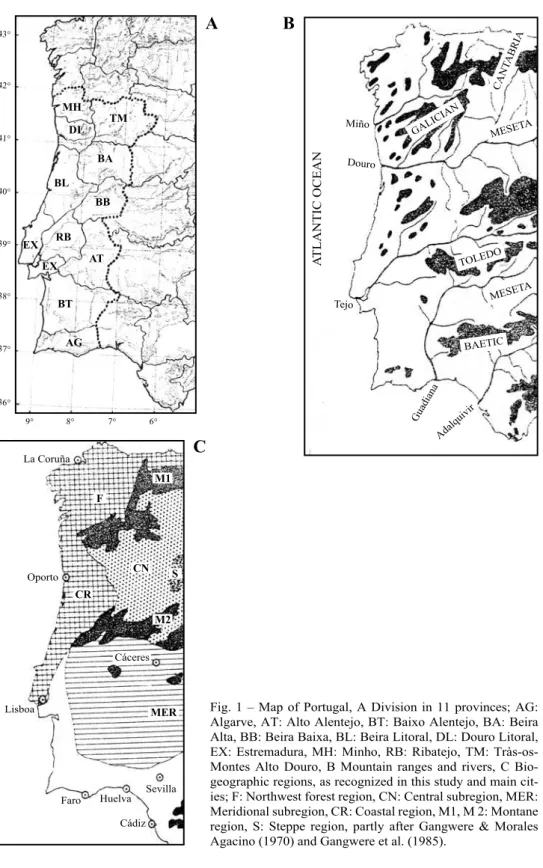
study over nine months (October-June 1996/97), near the southern coast, mainly in parque natural da Ria formosa, and in parts of serra da estrela (BB+BA in fig. 1); twelve localities were visited in which 62 species were collected, and Miranda-Arabolaza & Barranco (2005) reported on 64 spe -cies found in ne of portugal, near Rio sabor (Tràs-os-montes and alto Douro, TM in fig.1) during the years 1991-2000.
To our knowledge, to date no work has been compiled considering specially the saltatorian fauna of portugal, in relation to neighbour regions, like Spain and North Africa. For Morocco, papers have been produced by Werner (1932), Chopard (1943), Louveaux & Ben Halima (1987). Our studies present a further contribution to this neglected subject.
geogRaphy, climaTe and vegeTaTion of poRTugal in RelaTion To The
salTaToRiafauna
Portugal covers about one fiftth of the Iberian Peninsula and is limit -ed to the west and south by the atlantic ocean. The coastline is high and rugged, however indented by bays and beaches. The northern and eastern regions of portugal border the central iberian plateau of castilla, where powerful natural barriers, like mountain ranges, punctuate the surface and some river basins drain the arid countryside. The country is divided in eleven provinces (fig. 1A), the southern ones being mostly flat and the northern ones more mountainous, with heights of up to 2000 m a.s.l.
The climate of Portugal is strongly influenced by the Atlantic Ocean currents and by the prevailing westerly winds, that carry eastwards their warm moist effects resulting in moderate temperatures and rainfalls. warmer and dryer airstreams occasionally blow from the sahara and a general absence of cloud cover and rich insulation characterize the sum -mer, while scattered mountain ranges influence the temperature, rainfall and humidity. Tab. 1 shows some climatic differences for coastal areas in the north and south of portugal.
in our work soil types were not considered in detail, since their im-portance is not decisive for the distribution of Orthopteroidea species
sensu Kukalova-Peck (1991). It is sufficient to note that more mature and
humus enriched soils are present in the centre and northern parts of por-tugal, while south of the valley of the Tagus river soils are generally thin, with high Al contents and P deficient, prone to salinization and mostly inappropriate for agriculture. Soils of river basins are alluvial and fertile, while a mosaic of forest and mountainous soils have a low humic content and are prone to erosion. The vegetation is extremly important for the bi -oecology of orthopteroid insects, since it provides food and shelter and determines microclimatic conditions. Climate, vegetation, soil and orog -raphy result into an unusual rich mosaic of ecotones and consequently, partly due to edge effects, into the presence of a high number of saltop-teran species.
Portugal has a diversified flora and fauna containing elements from paleartic, mediterranean, maghrebian and ethiopian origin, as a result of its location, having formerly been the bridge that linked Europe and Af -rica. furthermore, its isolation in the upper miocene was responsible for the development of an extraordinary number of autocthonous forms.
The original cover has been strongly modified by anthropogenic pres -sures, resulting in an impoverishment of the woody associations and trans -formation into more open and arid types of ecosystems. such changes re-flected in alterations of the available humidity, heat, wind and light, which favoured the development of bare ground, scrub and grassland orthop -teroids, and impaired the diversification of their arboreal counterparts.
Regarding the study of orthopteroids, a subdivision of Portugal can be considered into two arbitrary phytogeographic regions: southern and northern (fig. 1C).
Provinces MH, DL, BL, and EX of the western Atlantic coast are place (city) Region altitude
mostly forested, extending between oporto and lisbon, with some coast-al slopes. The climate is mild, with heavy rainfcoast-all and high humidity per -sisting throughout the year, and having a potential climax vegetation of deciduous broad-leaved species such as oaks, alders, chestnuts and pop -lars; however pines, and particularly Pinus pinaster are now dominant throughout the region. Extensive fertile meadows, dominated by grasses and evergreen shrubs, occupy mainly the valleys. The peninsular condi -tions, typifying the entire region, are well represented in galicia and tend to disappear southwards, towards the Douro valley.
In the southern coastal region, the provinces AG, BT and EX have a mild winter climate and hot summers, but still exhibit significant climat -ic and phytogeograph-ic differences at local level. Cultivated citrus fruits, olives, figs, almonds, grapes, and vegetables ,as well as exotic palms, are abundant.
To the eastern side of both regions, extensive mountain ranges and arid plains are distributed in the provinces of TM, BE and BB, up to Cen -tral and meridional spain and ranging the mediterranean regions in aT and Rb. for the iberian peninsula, further details are reported by gang-were & Morales Agacino (1970).
maTeRialandmeThods
The work described was developed between 1992 and 2000, result -ing from a collaboration established between the Department of Zool -ogy-Entomology, University of Hannover, Germany, and DCEA/FCT, New University of Lisbon, Portugal. Extensive travelling took place in Portugal to collect Orthoptera in southern and northern regions in vari -ous seasons. In 1993 a group 18 persons mostly students, stayed near Lis -bon (sobreda: Quinta de são pedro) for 14 days studying the insect fauna of various biotopes, mainly grasshoppers. During field trips, orthopteran species were located visually, as well as auditively and additionally a net was used to catch specimens. In areas with high vegetation, a net was dragged through the herbaceous layer and stones were over-turned; all orthopteran specimens found were recorded (rec.), collected (leg.) and registered. most of the specimens sampled are kept in the collection of the first author.
now in the Zoological State Collection, Munich (ZSM) and of the Museo de ciencias naturales, madrid, spain.
For several of the species captured the songs of the males were re -corded. The male specimens of ensifera were placed inside a net of ny-lon-gauze with a diameter of 30 cm, and all song recordings were made under laboratory, or indoor conditions, with background noise reduced to a minimum. for the caelifera specimens, the songs were recorded under natural conditions. air temperatures were always measured, since their influence may be considerable. All recordings were made using an UHER 4000 report monitor tape recorder and UHER M 53 microphone, setting the tape speed to 19 cm/s. The microphone was placed on the ground at about 10-20 cm from the subject. The songs were analysed on a dual-beam oscillograph, type 502, together with a special photocamera (Re-cordine). The film speed was 20 cm/sec in all cases. A filter of 1000 Hz was used to attenuate background noise. song descriptions were based on the oscillograms. in some cases a computer Tl-programme (Turbolab combined with neurolab) was used partly with reduced type speed of 9,5 cm/s and a filter of 2000 Hz.
The terminology of Elsner (1974), Schmidt & Schach (1978), Heller (1988), and Ragge & Reynolds (1998) was followed: a calling song is a stridulation produced by an isolated male. a courtship song is produced when a male is sitting close to a female. A rivalry song is produced by two, or more males, reacting to each other. a chirp or echeme is a part of a song sequence separated by an interval, and consists of a variable number of syllables. a syllable is a sound produced by one complete movement of the elytra, or of the hind legs.
Whenever possible, the nymphs collected were reared to the adult stage to confirm the species‘s identification.
The species RecoRded
TeTTigonioidea PhaneroPTeridae
Phaneroptera nana nanaFieber, 1853
maTeRial examined. Leiria, Mata Nacional de Leiria, 18.08.1998. 1♀; Abrantes,
Vila Real: Serra do Alvão, 800 m a.s.l., 15.-23.08.2000, 2♂♂, as nymphs (all leg. A.P. Martinho); Serra do Alvão, 800 m a.s.l., 04.09.2000, 1♀ (leg. G.H. Schmidt).
The species was found throughout the mediterranean region (ceba-da & Novoa 1983; Pinedo & Llorente 1987; Schmidt 1989, 1996a; Pardo et al. 1993), known from Portugal by Lock (1999) at Ria Formosa and Miranda-Arabolaza & Barranco (2005) for NE of Portugal.
Tylopsis lilifolia (Fabricius, 1793)
maTeRial examined. Montemor-o-Novo, 25.04.1992, 1♀, as nymph (leg. G.H.
schmidt).
widespread and common in the mediterranean region and north af-rica (schmidt 1989, 1996a); known from spain, but not mentioned for portugal (herrera 1982).
odontura (odontura) spinulicauda Rambur, 1839
maTeRialexamined. Montemor-o-Novo, 25.04.1992, 1♂, 1♀ (leg. G.H. Schmidt).
Known from South Portugal and Morocco (Bolivar 1908, Harz 1969, Herrera 1982, Llorente & Pinedo 1990, Lock 1999).
odontura (odonturella) aspericauda (Rambur, 1839)
maTeRialexamined. Vila Real: Serra do Alvão, 8oo m a.s.l., 04.09.2000, 1♀ (leg.
a.p. martinho).
This small green species is known from spain and portugal (serra da Estrela: Covilhã) (Harz 1969, Lock 1999).
MeconeMaTidae
cyrtaspis scutata(charpentier, 1825)
maTeRialexamined. Grândola/Ribeiro Abeixo (BT), Aug. 1998, 1♂ (leg. P. Oliveira).
conocePhalidae
ruspolia nitidula(scopoli, l786)
maTeRial examined. Herdade do Pinheiro, Alcácer do Sal, 23.08.1996, 1♀ (leg.
A.P.Martinho); Leiria, Aug. 1998, 1♂ (leg. P. Oliveira).
South of latitude 50° N, near wet biotopes, down to Africa (Harz 1969, Cebada & Novoa 1983, Pinedo & Llorente 1987, Schmidt 1989, 1996a, Pardo et al. 1993); found in Portugal (Ria Formosa) by Lock (1999).
conocephalus conocephalus(linnaeus, l767)
maTeRialexamined. Grândola/Ribeiro Abeixo (BT), Aug. 1998, 1♂ (leg. P. Oliveira).
locally found in parts of southern europe, near the mediterrane-an coast (Pinedo & Llorente 1987, Schmidt 1989, 1996a, Pardo et al. 1993)(African species); not mentioned for Portugal. The species is al -ways found near lakes and rivers.
TeTTigoniidae
Tettigonia viridissima linnaeus, 1758
maTeRial examined. Vila Real: 30 km NE-Cevives, 16.06.1999, 3♂♂, 3♀♀ , as nymphs; Serra do Alvão, 800 m a.s.l.,17.06.1999, 1♂, 1♀, as nymphs (all leg. g.h. schmidt); Grândola/Ribeiro Abeixo (BT), Aug. 1998, 1♂ (leg. P. Oliveira); Vila Real:
Serra do Alvão, 800 m a.s.l., 20.08.2000, 1♂ (leg. A.P. Martinho).
Distributed in the whole Mediterranean region (Cebada & Novoa 1983, Pinedo & Llorente 1987, Schmidt 1989, Pardo et al. 1993), also found in Morocco (Chopard 1943); mentioned from Portugal (Ria For -mosa) by Lock (1999) and for TM province by Miranda-Arabolaza & barranco (2005).
decticus albifrons(fabricius, 1775)
maTeRial examined. Montemor-o-Novo, 25.04.1992, 1♂, as nymph (leg. G.H.
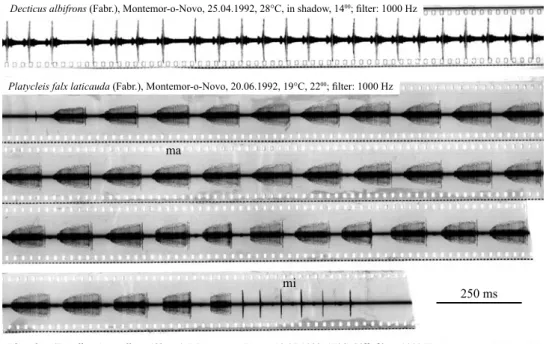
The song of the male found in Montemor-o-Novo (fig. 2) differs from that of the males collected in italy (schmidt 1996a, abb. 12). The loud calling song consisted of a series of very short syllables, sometimes repeated fairly regularly, at a rate of about 16/s at relatively high temper -atures. The interval between successive syllables was very short (about 30-110 ms). The song continued for indefinite periods, often for many minutes. The oscillographic analysis showed that diplosyllables were emitted. The opening stroke is always faint and clear, but the audible sound is produced by the closing stroke of the elytra. The loud part of the hemisyllable lasts for about 5 ms. Ragge & Reynolds (1998) also report -ed some differences in the songs of males collect-ed in france.
distributed in the whole mediterranean region and north africa (Werner 1932, Chopard 1943, Pardo et al. 1993); reported from Portugal (Ria Formosa, Castelo Branco) by Lock (1999) and the TM province by Miranda-Arabolaza & Barranco (2005).
Platycleis (Platycleis) albopunctata albopunctata (Goeze, 1778)
maTeRialexamined. bragança: montesinho natural park 1200 m a.s.l., 20.07.1998, 2♀; Vila Real: Cevives, 17.06.1999, 1♂, 16.06.1999, 1♀, as nymph; Serra do Alvão, 800 m a.s.l., 04.09.2000, 1♂; Leiria, Mata Nacional de Leiria, 20-21.06.1999, 2♂♂, 3♀♀ , (all
leg. G.H. Schmidt); Vila Real: Serra do Alvão, 800 m a.s.l., 20.08.2000, 4♀♀ (leg. A.P. martinho).
This subspecies occurs in the westernmost part of Europe (Cebada & Novoa 1983, Heller 1988, Pardo et al. 1993, Ragge & Reynolds 1998), in north europe up to sweden (ahlen 1998) and north africa (werner 1932, Chopard 1943); known from Portugal (Miranda-Arabolaza & Bar -ranco 2005).
Platycleis (Platycleis) intermedia intermedia (Serville, 1839)
maTeRialexamined. Vila Real: Serra do Alvão, 800 m a.s.l., 17.06.1999, 1♂, as
nymph (leg. g.h. schmidt); Grândola/Ribeiro Abeixo (BT), Aug. 1998, 1♂ (leg. P.
Ol-iveira).
Platycleis (Platycleis) affinis Fieber, 1853
maTeRialexamined. Grândola/Ribeiro Abeixo (BT), Aug. 1998, 1♂ (leg. P. Oliveira).
Occurs in large parts of the Mediterraen region (Pardo et al. 1993), including North Africa (Werner 1932, Chopard 1943) and eastwards to Turkey and southern Russia, a little further north than P. intermedia
(Schmidt & Schach 1978), mentioned for Portugal (Castelo Branco) by Lock (1999) and the TM province by Miranda-Arabolaza & Barranco (2005).
Platycleis falx laticauda brunner, 1882
maTeRial examined. Montemor-o-Novo, 25.04.1992, 1♂, adult, 1♂, 2♀♀ , as
nymphs (leg. g.h. schmidt).
The calling song of two males was recorded (one viewed in fig. 2). It consists of a long sequence of echemes (chirps) lasting several seconds (6 s), comprising about 32-43 macrosyllables and often ending with 5-6 microsyllables. within one echeme the syllables are fairly uniform in duration and are repeated at the rate of about 30 ms. The analysis of the oscillogram shows that opening hemisyllables are absent, as reported by Ragge & Reynolds (1998) for males from southern France. The closing macrosyllables lasted for 105-110 ms and the microsyllables 5-10 ms at 19°c, at night (22oo).The macrosyllables were repeated at an
ascend-ing rate from 45 to 60 ms. The microsyllable sequence, at the end of an echeme, lasted for 0.6 s at the most. The echemes began quietly, reaching a maximum, and remaining at this intensity, after four to eight syllables, until the call ended. almost all macrosyllables ended with one, or two, strong strokes. The song shows some similarities with that of P. affinis (see Schmidt & Schach 1978).
The species is distributd in the western part of the mediteranean re-gion (Harz 1969): Italy (Herrera 1982), southern France (Heller 1988), Spain (Gangwere & Morales Agacino 1970, Pardo et al. 1993), North Africa (Chopard 1943); unknown from Portugal.
Platycleis (Platycleis) sabulosa Azam, 1901
maTeRialexamined. Grândola/Ribeiro Abeixo (BT), Aug. 1998, 1♂ (leg. P.
Mar-tinho): Sesimbra, on meadow, 15.06.1995, 1♀ ; Leira, 20.06.1999, 1♂ (both leg. G.H. schmidt).
Distributed in western Europe, near the coastal areas (Pinedo & Llorente 1987, Pardo et al. 1993, Schmidt 1996a) and Morocco (Chop -ard 1943); mentioned from Portugal (Ria Formosa) by Lock (1999) and the TM province by Miranda-Arabolaza & Barranco (2005).
Platycleis (Tessellana) tessellata(charpentier, 1825)
maTeRialexamined. Montemor-o-Novo, 25.04.1992, 2♂♂, as nymphs; serra da ar-rábida, 07.06.1996, 1♀, as nymph; Castro Verde, 11.07.1997, 1♂; 30 km to Vila Real: Ce-vives, 16.07.1998, 2♂♂; leiria, mata nacional de leiria, 21.06.1999, 1♂ (all leg. G.H.
Schmidt); Vila Real: Serra do Alvão, 1000 m a.s.l., 17.06.1999, 1♂ (leg. A.P. Martinho).
The male calling song was recorded at a relatively low temperature (17°C), after moulting to the adult stage at Hannover, and was some -what irregular (fig. 2). The quiet diplosyllables, each lasting for about 165-175 ms, are composed of an opening hemisyllable lasting for about 40 ms and a little louder closing hemisyllable, lasting for 100-120 ms, separated by a short interval of about 10 ms. The rate of repetition of the syllables was irregular, occuring at about 1-2/s, for long periods. The male calling songs recorded in france and spain reported by Ragge (1990) differ somewhat from those presented by schmidt (1989) for Italian individuals.
The species is widespread in the western mediterranean region (Llorente del Moral 1980, Cebada & Novoa 1983, Schmidt 1989, 1996a, Pardo et al. 1993) extending northwards to central France and southern germany, and eastwards to southern Russia and asia minor (herrera 1982, Ragge & Reynolds 1998), and North Africa (Werner 1932, Chop -ard 1943); known from Portugal (Ria Formosa) at least by Lock (1999) and the TM province by Miranda-Arabolaza & Barranco (2005).
Thyreonotus bidensBolivar, 1887
maTeRial examined. Vila Flor, 120 km N Vila Real, 16.07.1998, 1♂, 1♀ (leg.
P.M. Seixal); Sesimbra-Ferraria, 09.10.1998, 1♂ , 20.10.1998, 1♀, 02.11.1998, 1♀, 07.08.2000, 1♂ 1♀ as nymphs, 28.08.2000, 1♀, as nymph; Apostiça-Lagoa de Albufeira, 25.-29.08.1998, 2♀♀, as nymphs; Leiria,18.08.1998, 1♀; Abrantes, 06.09.1999, 2♀♀, as nymphs, 21.10.1999, 1♂, 1♀ (all leg. A.P.Martinho); Grândola/Ribeiro Abeixo (BT), Aug. 1998, 1♂ (leg. P. Oliveira). Most of the specimens were found in flight traps, used for collecting males of Thaumetopoea pityocampa (Denis & Schiffermüller, 1775), the
Distributed in central and southern Spain and Portugal (Harz 1969, Llorente del Moral 1980, Herrera 1982, Pardo et al. 1993, Barranco et al. 1996, Miranda-Arabolaza & Barranco 2005).
rhacocleis grallata(pantel, 1886)
maTeRialexamined. Ferraria, near Sesimbra, 07.08.2000, 1♂, 28.08.2000, 1♀ (both
leg. A.P. Martinho). Both specimens were found in flight traps set up to collect males of
T. pityocampa.
This long-legged species is distributed in the iberian peninsula and known from Portugal (TM) (Miranda-Arabolaza & Barranco 2005).
Pterolepis spoliataRambur,1839
maTeRial examined. Leiria, 18.08.1998, 1♀ (leg.A.P. Martinho); Vila Real:
Ce-vives, 18.06.1999, 1♀, as nymph (leg. G.H . Schmidt).
distributed in south spain (granada, cartagena, algerias, malaga) (Harz 1969, Llorente del Moral 1980), known from Portugal.
antaxius spinibrachius (Fischer, 1853)
maTeRial examined. 30 km to Vila Real: Cevives, 16.07.1998, 2♂♂, 2♀♀,
16-18.06.1999, 2♂♂, 2♀♀, as nymphs (leg. G.H.Schmidt); Abrantes, 03.05.1998, 1♂,
11.10.1999; 1♀; Bragança, 20.07.1998, 1♀; Vila Real: Serra do Alvão, 800 m a.s.l., 15.-23.08.2000, 5♂♂, 10♀♀ (all leg. A.P. Martinho).
Known from central Spain and Portugal (Harz 1969, Herrera 1982, Pardo et al. 1993), Galicia (Cebada & Novoa 1983) and the TM province by Miranda-Arabolaza & Barranco (2005).
Fig. 3 represents the calling song of a male found in Serra do Al-vão.
ctenodecticussp. a
maTeRialexamined. Abrantes, 03.05.1999, 1♀ nymph, (leg. A.P. Martinho).
ctenodecticus sp. b
maTeRialexamined. Vila Real: Serra do Alvão, 800 m a.s.l., 07.05.1999, 1♀ nymph
(leg. a.p. martinho).
not known from portugal.
BradyPoridae
Uromenus (Steropleurus) pseudolus(Bolivar, 1878) (fig. 4 A, B)
maTeRialexamined. Troia/Rio Sado, pine stand, on bushes, 09.06.1996, 1♀, (leg.
g.h. schmidt).
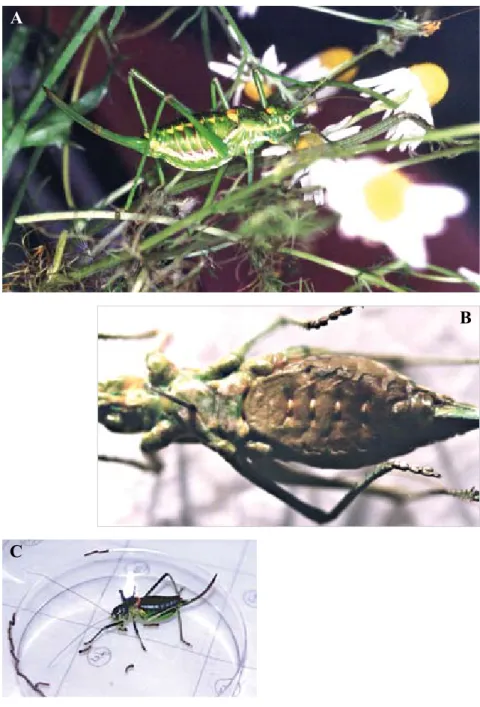
The brightly coloured female collected was bigger and somewhat different from reported by Harz (1969). Measurements (mm): length of body 32, hind femur 25, hind tibia 24, pronotum 7.0, ovipositor 30. Col -ouration: body generally green, abomen above light brown patterned, be -low almost white to ochreous; head with oblique white stripe be-low eyes; paranota laterally white-yellow bordered; abdominal tergites laterally white stripe pattern (viewed in fig. 4A); elytra yellow with a row of dark brown to black cells near distal border, disc eith light brownish cells; sterna brillant white-yellow (fig. 4B); ovipositor green, brown tipped.
Known from s spain (andalusia) and s portugal, up to serra da es-trela (Harz 1969, Herrera 1982).
Uromenus (Steropleurus) asturiensis(Bolivar, 1898)
maTeRialexamined. Vila Real: Serra do Alvão, 800 m a.s.l., 21.08.1999, 1♀,
15-23.08.2000,2♂♂, 4♀♀, 20.08.2000, 1♀, as nymph, 04.09.2000, 1♂ (all leg. A.P. Martin-ho).
The type material of this species was collected in asturias, spain (cangas de Tineo), but the species is also known from portugal (mata do Fundão) (Harz 1969) and the TM province by Miranda-Arabolaza & barranco (2005).
Ragge & Reynolds (1998) recorded male calling songs, produced during sunny days, consisting of very brief echemes. The specimens were collected in Spain (León, Orense). In Portugal (Serra do Alvão), males were sampled which produced either short echemes (with 6-7 or 9-11 syl-lables) or echemes with 14-16 syllables (fig. 5). This calling behaviour was individual-specific and temperature dependant, occuring only around noon. The echemes were repeated at intervals of 6-8s. The oscillograph -ic analysis showed that each echeme begins with increasingly loud and short syllables (opening hemisyllables). Only the last 2-3 were diplosyl -lables, with very brief closing hemisyllables followed immediately by a longer diplosyllable, in which the closing stroke is three times longer than the opening stroke. in all cases, only the long echemes were fol-lowed by one, or two, diplosyllables after short intervals of about 0.5-1 s.
Uromenus (Steropleurus) a n a p a u l a e n. sp. g.h. schmidt
(figs 4C, 6)
diagnosis. Regarding the male and following the key of Harz (1969)
the determination ended with U. brunnerii (Bolivar). The morphologi -cal description of U. brunnerii almost fits the male specimens found in
portugal, but the structures of the cerci and titillator are different. strong differences were found in the stridulation. heller (1988) recorded for U. brunnerii, collected in spain (cuenca), syllables (50-70 ms) singly pro-duced at intervals of 1.5-3 s (at >25°C). Echemes of several syllables were not recorded, as shown in fig. 7.
(Bolivarius) ortegai (pantel), which was found in spain (cuenca, ciu-dad) and has a somewhat longer (15.5-17 mm) ovipositor than the new species found in Portugal. The ovipositor of U. brunnerii (Bol.ivar) is
much longer (20.5-24 mm). The main difference, in relation to all other
Uromenus species, was a large whitish callousity found in the 7th ab-dominal sternit surrounding partly the subgenital plate. This morphologi-cal character differs most between U. anapaulae and U. brunnerii. in the latter the callousity of the 7th sternite is clasp-shaped.
in both sexes, the clear differences detected allowed for the separa-tion of the new species, named after the second author, who collected the holo- and allotype in leiria, as non-target catch in traps aimed a collect-ing Thaumetopoea males.
maTeRialexamined. Leiria (EX), 14.11.1998, 1♀ (holotype), 08.08.2000, 1♂
(al-lotype) (both leg. A.P. Martinho, coll. G.H. Schmidt in ZSM); Grândola/Ribeiro Abeixo (BT), Aug. 1998, 2♂♂ (leg. P. Oliveira, coll. G.H. Schmidt in ZSM).
sampling sites are situated about 100 km apart, thus the two males caught in grândola cannot be considered as paratypes.
descRipTion. In both sexes, fastigium verticis narrow, short-conical,
tip rounded, dorsally weakly grooved (fig. 6); pronotum saddle-shaped, strongly wrinkled, front border upraised and concavely rounded, prozona as long as metazona (in allotype metazona longer than prozona), 1st trans -verse sulcus deep, half-circled black, crossed by black longitudinal fur -row in midth (cross-like) (well visible in light-b-rown specimens), meta -zonal disc vaulted, coarsely rasped above and raised up to behind; scored lateral carinae almost parallel to slightly diversing to behind reaching hind margin of pronotum, weakly carinated in midth, stuffed bordered on side, forming right angle to paranota, carinated from 1st sulcus to hind margin weak-concavely rounded to almost straight; lower margin of par -anota sinuously arranged (fig. 6); elytra small, light brown, almost total -ly covered by metazona, cells of e-lytron disc small and dark 10th tergite deep-roundly incised, epiproct round-angularly arranged (fig. 6A).
length, at tip roundly thickened and excurved (fig. 6A), not visible under epiproct.
female: cerci short, broad-conical; subgenical plate distally notched forming an obtuse angle, laterally transversally rounded, on base roundly depressed, hind margin concavely rounded; sterna narrow and callous, 1st sternum brearing two small spines, 7th sternum more oval, with a horse-shoe shaped callousity (fig. 6B), light coloured and slightly dark spotted, callousity rounding subgenital plate proximally and laterally; ovipositor in proximal half straight, apically slightly upcurved and weak -ly rasped.
Colouration of both sexes, olive-brown from above, green from be -low, head with green spots, if dried-up bown to dark brown.
Male and female show similar characters (♂/♀): body length (mm) 22/23, pronotum 5.5-6/5.5, elytra 1.5/1, hind femur 18/20, hind tibia 20/19, ovi -positor 14.
Males required sunshine and temperatures >25°C to sing (fig. 7).
Platystolus (neocallicrania) lusitanicus (Aires & Menano, 1916)
maTeRial examined. Bragança, 10 km E, 16.07.1998, 1♂ (fig. 8A) (leg. G.H.
Schmidt); Bragança, Montesinho Natural Park, 1200 m a.s.l., 20.07.1998, 1♀(fig. 8C) (leg.a.p. martinho).
Distributed in southern Spain and northern Portugal (Pinedo & Llorente 1987, Pfau 1996). Lock (1999) identified specimens collected at Covilhã (Serra da Estrela) as Callicrania miegi (Bolivar, 1873), with -out considering the revision of Pfau (1996).
fig. 9 represents the male calling song.
Platystolus (neocallicrania) serratus(Bolivar, 1885)
maTeRialexamined. Setúbal: Ferraria, 02.11.1998, 1♀; Leiria, Mata Nacional de
Leiria, 26.07.1999, 1♀ , 08.08.2000, 1♂ (all leg. A.P. Martinho).
Distributed in the southern part of Portugal (Harz 1969, Herrera 1982, Pfau 1996, Lock 1999). However, we found this species 150 km north of lisbon.
16.07.1998, 1♂ fig. 8E)(leg. G.H. Schmidt); Vila Real: Serra do Alvão, 800 m a.s.l., 15.08.2000, 1♀ (leg. A.P. Martinho).
This species was studied in detail by pfau (1996), who separated two subspecies locally distributed in the north of portugal. P. selliger sell-iger was found in serra do gerês and P. selliger meridionalis south of the river Douro.
fig. 10 shows the calling song of the male collected.
grylloidea gryllidae
gryllus campestris linnaeus, 1758
maTeRialexamined. Grândola/Ribeiro Abeixo (BT), Aug. 1998, 2♂♂ (leg. et coll. P.
Oliveira): Vila Real: Serra do Alvão, 1000 m a.s.l., 17.06.1999, 1♂ (leg. A.P. Martinho); Vila Real, 30 km E-Cevives, 18.06.1999, 1♀ (leg. G.H. Schmidt).
Widespread in Europe and North Africa (Werner 1932), including the Mediterranaen region (Schmidt 1989, Pardo et al. 1993), mentioned for Portugal by Lock (1999) and the TM province by Miranda-Arabolaza & Barranco (2005).
Sciobia lusitanica Rambur, 1839
maTeRialexamined. Grândola/Ribeiro Abeixo (BT), Aug. 1998, 2♂♂ (leg. et coll.
P. Oliveira).
Distributed in Spain, Portugal, Morocco (Harz 1969, Herrera 1982, Pardo et al. 1993, Barranco et al. 1996, Lock 1999, Miranda-Arabolaza & Barranco 2005).
MogoPliSTidae
arachnocephalus vestitusa. costa, 1855
maTeRial examined. Setúbal: Sesimbra, 29.07.1998, 1♀; Setúbal: Ferraria,
29.07.1998, 1♀, 11.08.1998, 1♂ (leg. A.P. Martinho).
1996a), Sardinia (Schmidt & Herrmann 1999), Greece (Willemse 1984) and North Africa (Chopard 1943).
Mogoplistes brunneus Serville, 1839
maTeRialexamined. Sesimbra, 11.08.1998, 1♀ (leg. A.P. Martinho).
Distributed near the Mediterranean coast in all departments (Harz 1969, willemse 1984, schmidt 1989, 1996a, barranco et al. 1996); un-known from Portugal. Recently, Gorochov (1995) described a similar species, as Pseudomogoplistes vicentae, from lisbon area and morocco!
oecanThidae
oecanthus pellucens (Scopoli, 1763)
maTeRialexamined. Vila Real: Serra do Alvão, 800 m a.s.l., 21.08.2000, 1♂, 1♀
(leg. a.p. martinho).
The species is well known, being distributed from southern europe to siberia, and in n africa; mentioned for portugal (Ria formosa) by Lock (1999) and the TM province by Miranda-Arabolaza & Barranco (2005).
TeTrigoidea TeTrigidae
Tetrix ceperoi(Bolivar, 1887)
maTeRialexamined. Vila Real: Serra do Alvão, 1000 m a.s.l., 31.03.1999, 1♀ (leg.
a.p. martinho).
widespread in south europe (schmidt 1989) and north africa (cho-pard 1943); known from Portugal and Spain (Llorente del Moral 1980, Llorente & Presa 1981, Cebada & Novoa 1983, Barranco et al. !996, Mi -randa-Arabolaza & Barranco (2005).
Tetrix subulata(linnaeus, 1758)
maTeRialexamined. Setúbal: Lagoa de Albufeira, 17.-20.06.1995, 1♀, as nymph
distributed throughout europe (schmidt 1989, 1996a), southwards to Spain (Llorente & Presa 1981); to our knoledge, first record from Por -tugal.
Paratettix meridionalis (Rambur, 1838)
maTeRialexamined. Montemor-o-Novo, 25.04.1992, 1♂, 2♀♀; Landeira/Ribeira da
Marateca, 26.04.1992, 1♂, 2♀♀; Setúbal: Pinheiro/Rio Sado, 25.04.1992, 1♂ (all leg. G.H. Schmidt); Ferragudo, April 1994, 1♂ (leg. A. Melber).
Widespread in wet areas of South Europe (Llorente & Presa 1981, Cebada & Novoa 1983, Pinedo & Llorente 1987, Schmidt 1989, 1996a, Hochkirch 1999) and North Africa (Werner 1932, Chopard 1943); known from portugal at least by lock (1999).
Tetratettix undulata(sowerby, 1866)
maTeRialexamined. Ferraria, 09.10.1998, 1♂ (leg. A.P. Martinho).
Distributed in Europe and North Africa (Chopard 1943, Harz 1975), known from Spain and North Portugal (Llorente & Presa 1981, Cebada & Novoa 1983, Gómez Ladron de Guevara et al. 1992, Lock 1999, Mi -randa-Arabolaza & Barranco 2005).
Mishtshenkotetrix brachyptera (lucas, 1849)
maTeRialexamined. Landeira/Ribeira da Marateca, 26.04.1992, 3♀♀ (leg. G.H.
schmidt).
Occurs mainly near rivers of the Atlantic coast of the Iberian Penin -sula and North Africa (Harz 1975, Llorente & Presa 1981, Herrera 1982, Cebada & Novoa 1983, Gómez Ladron de Guevara et al. 1992, Barranco et al. 1996).
TridacTyToidea TridacTylidae
Xya iberica Günther, 1990
maTeRialexamined. Landeira/Ribeira da Marateca, 24.04.1992, 6♂♂, 8♀♀ (leg.
Known from SW Spain and Portugal (Günther 1990, Hochkirch 1999); found in wet and sandy areas.
acridoidea
PyrgoMorPhidae
Pyrgomorpha conica(Oliver, l791)
maTeRial examined. Leiria, Mata Nacional de Leiria, 13.06.1998, 1♀ (leg. A.P.
martinho).
Widespread in South Europe (Presa & Monserrat 1978b, Llorente del Moral 1980, Gonzales Garcia 1981, Willemse 1984, Clemente Es -pinosa et al. 1985, Gómez Ladron de Guevara et al. 1992, Barranco et al. 1996), West Africa (Mestre & Chiffaud 1997) and North Africa (Cho -pard 1943); records from Portugal by Lock (1999) from Ria Formosa, Hochkirch (1999) from Baixo Alentejo (BT) and the TM province by Miranda-Arabolaza & Barranco (2005).
caTanToPidae
Pezotettix giornae(p. Rossi, 1794)
maTeRial examined. Almada, Sobreda: Quinta de São Pedro, 10.10.1993, 3♂♂,
3♀♀; Castro Verde, 11.07.1997, 1♀; Setúbal/Rio Sado, 07.06.1995, 3♀♀ (all leg. G.H. Schmidt); Lisbon-S, 05.10.1993, 3♀♀ (leg. A. Klause-de-Pupka); Setúbal, Sesimbra-Fer-raria, 08.10.1998, 2♂♂, 2♀♀; Leiria, Mata Nacional de Leiria, 24.10.1998, 1♂, 1♀ (all leg. a.p. martinho).
Known from South Europe and North Africa (Werner 1932, Chop -ard 1943, Presa & Monserrat 1978b, Llorente del Moral 1980, Gonzáles garcia 1981, schmidt 1989, 1996a, barranco et al. 1996); mentioned for portugal by hochkirch (1999). lock (1999) found the species near south-ern coastal areas (Setúbal, Odemira, Monchique), Ria Formosa, and in Porto Covo, Baixo Alentejo province, and , Miranda-Arabolaza & Bar -ranco (2005) at Tm.
calliptamus wattenwylianus (pantel, 1896)
maTeRialexamined. Setúbal, Sesimbra, 29.07.1998, 1♀; Castro Verde, 11.07.1997,
1♀; Almada, Caparica, 07.06.1996, 3♂♂, as nymphs; Leiria, Mata Nacional de Leiria, 20.06.1999, 3♂♂ (all. leg. G.H. Schmidt); Leiria, Mata Nacional de Leiria, 20.06.1999, ♂ + ♀ (rec. G.H. Schmidt); Lagos/Algarve, 30.08.1998, 2♀♀ (leg. A.P. Martinho).
Widespread in Spain (Louveaux & Ben Halima 1987), Portugal (Harz 1975, Herrera 1982, Lock 1999, Miranda-Arabolaza & Barranco 2005) and southern france (foucart 1997), also known from morocco and other countries of North Africa (Werner 1932, Chopard 1943).
calliptamus barbarus barbarus(Costa, 1836)
maTeRialexamined. Bragança: Montesinho Natural Park, 20.07.1998, 5♂♂, 1♀;
Vi-la Real: Cevives, 16.06.1999, 1♂; ViVi-la Real: Serra do Alvão, 1000 m a.s.l., 03.09.2000, 1♂ (leg. G.H. Schmidt); Vila Real: Serra do Alvão, 1000 m a.s.l., 20.08.2000, 4♂♂, 6♀♀ (leg. a.p. martinho).
most common Calliptamus species in europe (schmidt 1989, 1996a); known from Spain and Portugal (Harz 1975, Llorente del Mor -al 1980, Gónz-ales Garcia 1981, 1985, Cebada & Novoa 1983, Clemente Spinosa et al. 1985, Garcia & Presa 1985, Pinedo & Llorente 1987, Bar -ranco et al. 1996, Lock 1999, Miranda-Arabolaza & Bar-ranco 2005) and North Africa (Chopard 1943). Clemente et al. (1987) referred to the tax -onomic value of morphometric and pigmentary characters in this species that presents a wide morphological variation.
anacridium aegyptium(linnaeus, l764)
maTeRial examined. Setúbal: Pinheiro/Rio Sado, 20.04.1992, 1♀ (leg. G.H.
Schmidt); Lisbon-S, 5.10.1993, 1♀ (leg. A. Klause-de-Pupka).
Widespread in South Europe (Presa & Monserrat 1978b, Llorente del Moral 1980, Pinedo & Llorente 1987, Schmidt 1989, 1996a, Barran -co et al. 1996) and North Africa (Chopard 1943), hibernates as adult. The species was often seen in parks, in Lisbon, during the winter (M.R.Paiva, personal observations). Reported from Portugal by Hochkirch (1999), Lock (1999) and Miranda-Arabolaza & Barranco (2005).
acrididae
Truxalis nasuta(linnaeus, 1758)
bank, 11.06.1996, 1♂ (both leg. G.H. Schmidt); Abrantes, 03.09.1998, 1♂ (leg. A.P. Mar-tinho).
distributed in the southern parts of the iberian peninsula (dirsh 1950, Presa & Monserrat 1978b, Llorente del Moral 1980, Garcia & Pre -sa 1985, Gómez Ladrón de Guevara et al. 1992, Barranco et al. 1996) and North Africa (Chopard 1943); recorded from Portugal (Ria Formosa, castelo branco) by lock (1999).
locusta migratoria cinerascens(fabricius, l781)
maTeRial examined. Almada: Caparica, 17.04.1995, 1♀; Setúbal/Rio Sado,
18.04.1995, 1♂ (both leg. A.P. Martinho), 17.04.1996, 1♂ (leg. M.R. Paiva). All speci-mens were used for breeding experiments.
distributed in south europe, mainly in damp biotopes (schmidt 1989, 1996a), known from Spain (Presa & Monserrat 1978b, Llorente del Moral 1980, González Garcia 1981, Garcia & Presa 1985, Barranco et al. 1996), reported from Portugal by Schmidt & Lilge (1997), Lock (1999) and Miranda-Arabolaza & Barranco (2005). However, Lock did not identify the subspecies.
oedaleus decorus(germar, 1826)
maTeRial examined. Vila Real: Serra do Alvão, 1000 m a.s.l., 20.08.2000, 1♂,
1♀ (leg. A.P.Martinho); Serra do Alvão, 1000 m a.s.l., 03.09.2000, 2♂♂, 1♀ (leg. G.H. schmidt).
The species is widespread in southern europe, north africa and Asia Minor, it prefers mountainous uncultivated areas with low vegeta -tion (Schmidt & Lilge 1997).On the Iberian Peninsula, the species was recorded mainly in the eastern part, near the mediterranean sea. in por-tugal, found by Miranda-Arabolaza & Barranco (2005) iat TM.
oedipoda caerulescens(linnaeus, 1758)
maTeRial examined. Setúbal: Sesimbra, 15.06.1995, 1♀; Setúbal/Rio Sado,
(leg. A. Klause-de-Pupka); Vila Real: Serra do Alvão, 1000 m a.s.l., 20.08.2000, 4♂♂, 6♀♀ (leg. A.P. Martinho).
Common in Europe from sea level up to 3000 m a.s.l.(Schmidt 1989, 1996a,1999, Schmidt & Lilge 1997), known from the Iberian Peninsula (Llorente del Moral 1980, Gonzáles Garcia 1981, 1985, Herrera 1982, Cebada & Novoa 1983, Clemente Espinosa et al. 1985, Garcia & Presa 1985, Pinedo & Llorente 1987, Barranco et al. 1996, Lock 1999), Mi -randa-Arabolaza & Barranco (2005), on places with scarce vegetation; widespread in North Africa (Werner 1932, Chopard 1943).
oedipoda fuscocincta caerulea saussure,1884
maTeRialexamined. bragança: montesinho natural park, 1200 m a.s.l., 20.07.1998, 1♂, 3♀♀; Setúbal: Sesimbra, 15.06.1995, 1♀ 23.08.1998, 1♂, 3♀♀ (all leg. G.H. schmidt).
This subspecies is distributed in spain and portugal (llorente del Moral 1980, Herrera 1982, Garcia & Presa 1985, Pinedo & Llorente 1987, Schmidt & Lilge 1997, Miranda-Arabolaza & Barranco 2005), and North Africa (Werner 1932, Chopard 1943).
Sphingonotus azurescens(Rambur,1838)
maTeRialexamined. Lisbon-S, 05.10.1993, 1♀ (leg. A. Klause-de-Pupka); Setúbal/
Rio Sado, 17.06.1997, 3♂♂, 4♀♀; Setúbal: Seixal, 16.06.1996, 1♂; Castro Verde, 11.07.1997, 2♂♂; Setúbal: Sesimbra, 23.07.1998, 5♂♂, 7♀♀ (all. leg. G.H. Schmidt); Leiria, Mata Nacional de Leiria,19.08.1999, 1♀ (leg. A.P. Martinho).
Known from Spain (Presa & Monserrat 1978b, Gonzáles Garcia 1981, Herrera 1982, Pinedo & Llorente 1987, Barranco et al. 1996), of -ten found on sandy-damp biotopes, and North Africa (Werner 1932, Cho -pard 1943), extending to East Africa (Schmidt & Johnsen 1999); men -tioned from Portugal by Schmidt & Lilge (1997), Lock (1999) and Mi -randa-Arabolaza & Barranco (2005).
Sphingonotus rubescens (walker, 1870)
maTeRialexamined. Setúbal: Serra da Arrábida, 300 m a.s.l., 06.10.1993, 1♂ (leg.
G.H. Schmidt); Lagos, 30.08.1998, 1♀ (leg. A.P. Martinho).
afri-ca (Werner 1932, Mestre & Chiffaud 1997, Schmidt & Johnsen 1999); known from Spain and Portugal (Herrera 1982, Garcia & Presa 1985, Pinedo & Llorente 1987, Gómez Ladrón de Guevara et al. 1992, Schmidt & Lilge 1997, Lock 1999).
Sphingonotus caerulans corsicusChopard, 1923
maTeRial examined. Setúbal: Serra da Arrábida, 06.10.1993, 1♀ (leg. G.H.
schmidt).
The species is mainly distributed in the southern regions of europe and North Africa (Louveaux & Ben Halima 1987); this subspecies is known from Corsica, Sardinia (Schmidt & Herrmann 2001) and Spain (Presa & Monserrat 1978b, Herrera 1982, Garcia & Presa 1985, González Garcia 1985, Pinedo & Llorente 1987, Barranco et al. 1996); mentioned from Portugal (Schmidt & Lilge 1997).
Jacobsiella imitans(brunner, 1882)
maTeRial examined. Setúbal/Rio Sado, 17.06.1995, 4♂♂, 5♀♀, two as nymphs;
Setúbal: Comporta-Troia/Rio Sado, 12.07.1997, 11♂♂, 5♀♀, 10.09.2000, 1♀; Leiria, Mata Nacional de Leiria, 21.06.1999, 3♂♂, 3♀♀ (all leg. G.H. Schmidt); Leiria, Mata Nacional de Leiria, 19.08.1998, 2♀♀, 21.06.1999, 1♂, 1♀ (leg. A.P. Martinho).
Occurs on sandy areas near rivers and coastal areas of Spain (Llorente del Moral 1980, Herrera 1982) and Portugal (González Garcia 1985, Schmidt & Lilge 1997).
acrotylus insubricus (scopoli, l786)
maTeRialexamined. Lisbon-S, 05.10.1993, 1♂ (leg. A. Klause-de-Pupka):
Alma-da, Sobreda: Quinta de São Pedro, 10.10.1993, 1♂, 1♀; Vila Real: Serra do Alvão, 800 m a.s.l., 04.09.2000, 1♂, 2♀♀ (leg. G.H. Schmidt); Ferragudo/Algarve, April 1994, 1♂ (leg. A. Melber);. Setúbal: Apostiça, 01.09.1998, 1♂, 1♀; Vila Real: Serra do Alvão, 31.03.1999, 1♂, 1♀ (leg. A.P. Martinho).
acrotylus patruelis(Herrich-Schäffer, 1838)
maTeRialexamined. Setúbal, on medows, 15.06.1995, 1♀; Setúbal, near Rio Sado,
17.06.1995, 1♂; Setúbal: Seixal, 11.06.1996, 1♂; Almada, Sobreda: Quinta de São Pedro, 16.10.1993, 1♂, 1♀; Setúbal, near Alfarim, 08.10.1993, 2♀♀ (all leg. G.H. Schmidt); Lisbon-S, 10.10.1993, 1♂ (leg. A. Klause-de-Pupka); Setúbal: Lagoa de Albufeira, 01.09.1998, 1♂, 1♀ (leg. A.P. Martinho).
Mainly distributed in lower parts of the Iberian Peninsula (Presa & Llorente 1979, Llorente del Moral 1980, Garcia & Presa 1985, Pinedo & llorente 1987. schmidt 1996b, lock 1999); distributed in southern eu-rope (Schmidt 1989, 1996a) and the whole of Africa (Werner 1932, Mes -tre & Chiffaud 1997, Schmidt & Lilge 1997, Schmidt & Johnsen 1999). The biology and behaviour of the species were described by Schmidt (1980, 1988).
Acrotylus fischeri Azam, 1901
maTeRialexamined. Almada, Sobreda: Quinta de São Pedro, 200m a.s.l., 10.10.1993,
1♂ (leg. G.H. Schmidt).
mainly found in mountainous parts of the iberian peninsula, up to France (Presa & Llorente 1979, Cebada & Novoa 1983, Garcia & Presa 1985, Schmidt 1996b, Schmidt & Lilge 1997, Schmidt 2000) and Moroc -co (Atlas region) (Chopard 1943); known from Portugal (Herrera 1982, Lock 1999, Miranda-Arabolaza & Barranco 2005).
Morphacris fasciata sulcataThunberg, 1905
maTeRialexamined. Setúbal: Seixal, 18.09.1995, 1♀, as nymph (leg. A.P.
Martin-ho); Setúbal: Comporta, near Rio Sado, 11.07.1997, 1♀ (leg. G.H. Schmidt).
This species occurs in africa in different forms with red, orange and yellow hind wings (alae); the latter form is distributed in morocco and was named 'sulcata' (Chopard 1943). In Europe, it was recorded from the province of Cadiz (Spain) by Presa & Monserrat (1978a,b) and in Por -tugal on the Atlantic coast, near rice fields (Schmidt & Lilge 1997, Lock 1999).
aiolopus thalassinus (fabricius, 1781)
Setú-bal: Lagoa de Albufeira, 17.-20.06.1995, 1♂; Almada, Sobreda: Quinta de São Pedro, 10.10.1993, 1♀; Setúbal, medows near the sea, 06.10.1993,1♀; Estuário do Sado, 06.10.1993, 1♀; Rio Sado, near Setúbal, 17.06.1995, 1♂, 2♀♀ (leg. G.H. Schmidt); Setúbal: Lagoa de Albufeira - Apostiça, 01.09.1998, 1♂, 3♀♀ (leg.A.P. Martinho).
Distributed in the southernmost areas of Europe (Presa & Monserrat 1978b, Llorente del Moral 1980, Pinedo & Llorente 1987, Schmidt 1989, 1996a, Barranco et al. 1996, Schmidt & Lilge 1997, Lock 1999, Miran -da-Arabolaza & Barranco 2005), and whole Africa (Werner 1932, Hollis 1968, Mestre & Chiffaud 1997, Schmidt & Johnsen 1999), mainly in wet biotopes.
aiolopus strepens(latreille, 1804)
maTeRialexamined. Lisbon-S, 05.10.1993, 2♀♀ (leg. A. Klause-de-Pupka); Setúbal:
Sesimbra - Ferraria, 08.10.1998, 1♀; Leiria, Mata Nacional de Leiria, 19.08.1998, 1♀; Vi-la Real: 30 km E-Cevives, 31.03.1999, 1♀, 18.06.1999, 1♀; Serra do Alvão, 31.03.1999, 1♀; Setúbal: Lagoa de Albufeira, 07.05.1999, 1♂, 1♀ (all leg. A.P. Martinho); Vila Real, Cevives, 16.06.1999, 1♀ (leg. G.H. Schmidt).
Widespread in South Europe (Presa & Monserrat 1978b, Llorente del Moral 1980, Clemente Espinosa et al. 1985, Garcia & Presa 1985, Pinedo & Llorente 1987, Schmidt 1989, 1996a, Barranco et al. 1996) and Africa (Chopard 1943), mainly in mountainous areas; known from Portugal (Schmidt & Lilge 1997, Hochkirch 1999, Lock 1999, Miranda-Arabolaza & Barranco 2005). Adults were found both in the winter and spring.
Paracinema tricolor bisignata(charpentier, 1825)
maTeRialexamined. Near Setúbal - Rio Sado, 17.06.1995, 1♂ (leg. G.H. Schmidt).
widespread in southern europe, distributed as far as the balcans and the mediterranean region of North Africa (Harz 1975, Pinedo & Llorente 1987, Schmidt 1996a, Schmidt & Lilge 1997, Schmidt & Herrmann 2001); not previously mentioned for Portugal.
calephorus compressiformis (latreille, 1804)
maTeRialexamined. Setúbal: Quinta do Conde, 30.08.1996, 2♂♂ (leg. A.P.
found in the whole iberian peninsula and on the atlantic coast of France (Llorente del Moral 1980, González Garcia 1981, Cebada Novoa 1983, Schmidt & Lilge 1997). Widespread in North, West and East Af -rica (Chopard 1943, Mestre & Chiffaud 1997, Schmidt & Johnsen 1999); known from Portugal (González Garcia 1985, Lock 1999, Miranda-Arab -olaza & Barranco 2005).
arcyptera (arcyptera) tornosi Bolivar, 1884
maTeRialexamined. Vila Real: 30 km E-Cevives, 18.06.1999, 3♂♂,1♀, as nymph
(leg. g.h. schmidt).
Found in Portugal (Lock 1999, Miranda-Arabolaza & Barranco 2005) and in the central mountains of Spain (González Garcia 1981, Her -rera 1982); the taxonomic characters were described and the male song recorded (Garcia et al. 1996, Ragge & Reynolds 1998).
dociostaurus (Kazakia) jagoi occidentalis soltani, 1978
maTeRialexamined. Setúbal: Quinta do Conde, August.1996, 1♂ (leg. A.P.
Martin-ho); Setúbal/Rio Sado, 17.06.1995, 3♂♂, 7♀♀; Castro Verde, 11.07.1997, 2♂♂, 1♀; Vila Real: Serra do Alvão, 800-1000 m a.s.l., 03-04.09.2000, 3♂♂, 5♀♀ (all leg. G.H.Schmidt); Lagos, 30.08.1998. 1♀; Vila Real: Serra do Alvão, 1000 m a.s.l., 20.08.2000, 4♂♂, 6♀♀
(all leg. a.p. martinho).
Widely distributed in the Iberian Peninsula (Herrera 1982, Garcia & Presa 1985, Pinedo & Llorente 1987, Gómez Ladron de Guevara 1992, Garcia et al. 1994, Barranco et al. 1996, Ragge & Reynolds 1998, Miran -da-Arabolaza & Barranco 2005), and Sardinia (Baccetti 1991, Schmidt & Herrmann 1999). Lock (1999) identified his specimens as D. genei
(Ocskai, 1832) without considering the revision of Soltani (1978).
omocestus (dirshius) raymondi(Yersin, 1863)
maTeRialexamined. Setúbal: Fonte da Telha, 11.10.1993, 3♂♂, 2♀♀; Nature
The male calling song was presented by Ragge (1986) and is shown in fig. 10 (two echemes). The calling song of a male is an echeme last -ing for about 1.0-1.5/s and constist-ing of about 20-22 syllables repeated at a rate of about 18-20/s (fig. 11). Each echeme begins quietly, rapidly increasing in intensity. The öscillographic analysis shows that the down-stroke hemisyllables have a characteristic pattern of gaps, which often become obscured towards the end of the echeme. The echemes are often produced singly and repeated at irregular intervals, as Ragge & Reynolds (1998) reported.
Widespread in the Iberian Peninsula (Presa & Monserrat 1978b, González Garcia 1981, Cebada & Novoa 1983, Garcia & Presa 1985, Pinedo & Llorente 1987, Nadig 1988, Clemente et al 1990, Barranco et al.1996) southern france, west italy (schmidt 1996a), and north africa (Chopard 1943); known from Portugal (Hochkirch 1999, Lock 1999, Mi -randa-Arabolaza & Barranco 2005).
Omocestus rufipes(Zetterstedt, 1821)
maTeRial examined. Abrantes, 03.05.1999, 1♀; Vila Real: Serra do Alvão, 800
m a.s.l., 07.05.1999, 1♀, 31.05.1998, 1♂, 30 km NE-Cevives, 18.06.1999, 1♂ (leg. A.P.Martinho); Vila Real: Serra 0do Alvão, 17.06.1999, 2♂♂; Leiria, Mata Nacional de Leiria, 21.06.1999, 1♂, 1♀ (leg. G.H. Schmidt)
widespread in europe (schmidt 1989) and north africa (chopard 1943); known from Spain and Portugal (Harz 1975, Cebada & Novoa 1983, Clemente et al. 1990, Lock 1999, Miranda-Arabolaza & Barranco 2005).
The species occurs often in more shaded habitats (Ragge 1986).
omocestus panteli (Bolivar, 1887)
maTeRial examined. Vila Real: Cevives-Vila Pouca de Aguiar, 16.07.1998, 1♂,
Ragge (1986) and schmidt (1999) reported the male calling song of this species from different sites where it was collected, either in spain or portugal.
The different song types are shown in figs. 11 and 12. The male call -ing song is an echeme last-ing for about 1.0-1.5/s and consist-ing of 28-35 syllables repeated at the rate of about 20 syllables/s, at 30°C. Each echeme begins quietly, some times starting with a loud syllable and soon reaching maximum intensity. at the beginning some incomplete hemi-syllables were produced, after which syllable repeatition was similar dur-ing the course of the echeme.
The courtship song is quite different. sitting obliquely head-to-head the male stridulates intensively producing a quiet sound of a long mono -tone echeme, lasting for up to 6 s, and which is probably influenced by temperature. At 17°C, 11 syllables/s were produced. In total, up to 74 syllables per echeme could be counted. its structure was similar to that of the calling song.
The species is confined to the Iberian Peninsula, where it is wide -spread and very common (Llorente del Moral 1980, González Garcia 1981, Cebada & Novoa 1983, Pinedo & Llorente 1987, Clemente et al. 1990, barranco et al. 1996); known from portugal by lock (1999) and Miranda-Arabolaza & Barranco 2005).
Stenobothrus festivus Bolivar, 1897
maTeRialexamined. bragança: montesinho natural park, 1200 m a.s.l., 20.07.1998,
1♀ (leg. G.H. Schmidt).
Widespread in the Iberian Peninsula and locally in France (González Garcia 1981, Herrera 1982, Pinedo & Llorente 1987, Clemente et al. 1989, Gómez Ladrón de Guevara et al. 1992), mainly found in moun -tain areas, known from Portugal (Harz 1975). Ragge (1987) recorded the male calling songs.
Stenobothrus stigmaticus stigmaticus (Rambur, 1838)
maTeRialexamined. Abrantes, 03.05.1998, 2♂♂, 1♀; Vila Real: 30 km E-Cevives,
This small fully winged species is widespread on the iberian penin-sula (González Garcia 1981, Cebada & Novoa 1983, in Galicia, Clem -ente et al. 1989), also in western and central europe, but not reaching as far North as Scandinavia; its range of distribution extends to Europe -an Russia -and asia minor (Ragge 1987) -and it is known from morocco (Chopard 1943). In southern Europe, it occurs in the mountainous parts of the Iberian Peninsula (Miranda-Arabolaza & Barranco 2005).
Myrmeleotettix maculatushispanicusHarz, 1975
maTeRialexamined. Vila Real: Cevives, 07.05.1999, 1♀, 16.06.1999, 2♂♂, 2♀♀
(leg. A.P. Martinho), 16.-18.06.1999, 3♀♀ ; Vila Real: Serra do Alvão, 1000 m a.s.l., 03.09.2000, 1♂, 3♀♀ (leg. G.H. Schmidt).
The species is widespread in europe, and the subspecies extends down to central and northern Spain (Cebada & Novoa 1983, Clemente et al. 1989); known from Sierra Nevada as M. m. australis Harz, 1975;
mentioned for Portugal (Miranda-Arabolaza & Barranco 2005), and Mo -rocco (Chopard 1943).
chorthippus jucundus (Fischer, 1853)
maTeRial examined. Vila Real: Cevives-Vila Pouca de Aguiar, 16.07.1998, 1♂,
2♀♀, Vila Real: Serra do Alvão, 800 m a.s.l., 04.09.2000, 1♂ (leg. G.H. Schmidt).
Known from the Iberian Peninsula (González Garcia 1981, Cebada & Novoa 1983, Garcia & Presa 1985, Pinedo & Llorente 1987, Miran -da-Arabolaza & Barranco 2005), southern France and Morocco (Werner 1932, Chopard 1943).
chorthippus parallelus erythropusfaber, 1958
maTeRialexamined. Vila Real: 30 km E - Cevives, 18.06.1999 1♂,1♀; Vila Real:
Serra do Alvão, 1000 m a.s.l., 20.08.2000, 1♂, 4♀♀ (leg. A.P. Martinho); Leiria, Mata Nacional de Leiria, 20.06.1999, 1♂; Vila Real: Serra do Alvão, 1000 m a.s.l., 04.09.2000, 2♂♂ (leg. G.H. Schmidt).
chorthippus (glyptobothrus) apicalis (Herrich-Schäffer, 1840)
maTeRialexamined. Montemor-o-Novo, 25.04.1992, 8♂♂, 9♀♀; Setúbal: Serra da
Arrábida, 07.06.1996, 1♂, 4♀♀; Vila Real: Serra do Alvão, 17.06.1999, 1♂ (leg. G.H. Schmidt); Lagos, Ferragudo, April 1994, 1♂ (leg. A. Melber); Abrantes, 03.05.1998, 1♂, 2♀♀; Lagos, 30.08.1998, 3♂♂, 3♀♀ (leg. A.P. Martinho).
The song of the males of this species presented large variations, par -ticulary when compared with those recorded for males caught near ma-drid (Ragge & Reynolds 1998) and fig. 11. However, in both cases, the male calling song consists of a series of echemes, lasting for about 1.0-1.7 s each, at 30°C, made up of about 29-31 syllables repeated for un -defined periods, at a rate of 15-17/s. In contrast to the males from Ma -drid, each echeme begins at a low pitch reaching maximum intensity af-ter about 1/3 of its duration. The oscillographic analysis showed that the sound consists of both upstroke and downstroke syllables, the later being longer and louder and lasting for 35 ms. The upstroke lasted for 20 ms and could always be recognized.
This species shows large morphological variations and is distributed throughout the Iberian Peninsula (Presa & Monserrat 1978b, González Garcia 1981, Cebada Novoa 1983, Garcia & Presa 1985, Barranco et al. 1996), parts of france, the western mediterranean islands (sardinia) (Baccetti 1991) and Morocco (Werner 1932, Chopard 1943); mentioned for Portugal by Hochkirch (1999), Lock (1999).and Miranda-Arabolaza & Barranco (2005).
chorthippus (glyptobothrus) vagans (Eversmann, 1848)
maTeRialexamined. Vila Real: 30 km E - Cevives, 18.06.1999, 1♀; Setúbal: Lagoa
de Albufeira - Apostiça, 01.09.1998, 1♂; Setúbal: Sesimbra - Ferraria, 08.10.1998, 1♀; Leiria, Mata Nacional de Leiria, 19.08.1999, 3♀♀; Vila Real: Serra do Alvão, 800 m a.s.l., 20.08.2000, 7♂, 7♀♀ (all leg. A.P. Martinho).
Common in the Iberian Peninsula (González Garcia 1981, Cebada & Novoa 1983, Garcia & Presa 1985, Pinedo & Llorente1987, Barranco et al. 1996, Lock 1999. Miranda-Arabolaza & Barranco 2005).and wide -spread in the whole mediterranean region, with a characteristic male song (Schmidt 1996a, Ragge & Reynolds 1998).
chorthippus (glyptobothrus) binotatus binotatus (charpentier, 1825)
de São Pedro, 16.04.1996, 1♀ (leg. G.H. Schmidt); Vila Real: Serra do Alvão, 1000 m a.s.l., 20.08.2000, 2♂♂, 4♀♀ (leg. A.P. Martinho).
Kown from Portugal and Spain (Llorente del Moral 1980, González Garcia 1981, Herrera 1982, Cebada & Novoa 1983, as Ch. b. dilutus Ebn -er, 1941, Garcia & Presa 1985, Garcia et al. 1995, Lock 1999, Miranda-Arabolaza & Barranco 2005), France and Morocco (Grand Atlas) (Cho -pard 1943, Harz 1975). The species appears to be very variable (Ragge & Reynolds 1998, Schmidt 1999).
chorthippus (glyptobothrus) jacobsi Harz, 1975
maTeRialexamined. Lisbon-S, 05.10.1993, 2♂♂, 2♀♀ (leg. A.Klause-de-Pupka):
Almada, Sobreda: Quinta de São Pedro, 10.10.1993, 5♂♂, 3♀♀; Setúbal: Serra da Ar-rábida, 07.06.1996, 1♂; Setúbal/Rio Sado, 26.04.1992, 1♂; Bragança: Montesinho Nat-ural Park, 1200 m a.s.l., 20.07.1998, 1♀; Vila Real: Cevives - Vila Pouca de Aguiar, 16.07.1998, 1♂, 16.06.1999, 2♀♀; Leiria, Mata Nactonal de Leiria, 21.06.1999, 2♀♀ (all leg. G.H. Schmidt); Vila Real: 30 km E - Cevives, 18.06.1999, 1♀; Abrantes, 03.05.1999, 1♀ (leg. A.P. Martinho).
The male calling song and taxonomic measurements were presented by Ragge & Reynolds (1988), showing that the species is closely related to C. (G.) brunneus which is distributed in central europe beyond the pyr-enees and in italy, as a special form. fig. 10 presents some echemes of the portuguese males. The male calling song is a sequence of usually 5-8 short echemes, each lasting for about 0.5s. The echemes usually consist of 5 syllables without recognisable intervals, but a short gap appears before the ending of the downstroke. up- and downstrokes are not clearly sepa-rated (fig. 10), as found in indivuals from Sierra Nevada (Schmidt 1999). similarly to what happens between the related species, C. (G.) brun-neus, and C. (G.) jacobsi, which are sympatric in the Pyrenees, rival -ry singing between two males often takes place, as shown in fig. 11. In such songs the echemes are shorter than in the male calling songs. in the present case, the males alternatedf at intervals of 1 s.
only known from the iberian peninsula where it is widespread (Gómez Ladrón de Guevara et al. 1992, Ragge & Reynolds 1998); men -tioned for portugal (southern coastal areas) by lock (1999) and in Tm province by Miranda-Arabolaza & Barranco (2005).
chorthippus (glyptobothrus) yersini Harz, 1975
Sesim-bra-Ferraria, 08.10.1998, 1♀; Leiria, Mata Nacional de Leiria, 19.06.1998, 2♂♂, 2♀♀; 24.10.1998, 2♀♀ (leg A.P. Martinho); Vila Real: Serra do Alvão, 17.06.1999, 2♂♂, 1♀ (leg. g.h. schmidt).
The male song was presented by Ragge & Reynolds (1988), togeth -er with taxonomic measurements, thus allowing for separation from the former species. The species is closely related to C. (G.)biguttulus; both species occur in the pyrenees.
The species was mainly sampled in mountainous regions of the ibe-rian Peninsula (Garcia & Presa 1985, Pinedo & Llorente 1987, Gómez Ladrón de Guevara et al. 1992); known from Portugal (TM) (Miranda-Arabolaza & Barranco 2005).
euchorthippus chopardi descamps, 1968
maTeRialexamined. Vila Real: Cevives - Vila Pouca de Aguiar, 16.07.1998, 2♂♂,
4♀♀ (leg. G.H. Schmidt).
The species occurs widely in the iberian peninsula and it range ex-tends north-eastwards into the french departments near the mediterrane-an sea, known from portugal (leiria: serra d’aires e cmediterrane-andeiros) (Ragge & Reynolds 1984) and TM province (Miranda-Arabolaza & Barranco 2005). for this species, a strong longitudinal striped colour pattern is typ-ical which almost always lacks in e. pulvinatus.
euchorthippus pulvinatus gallicusmarân, 1957
maTeRialexamined. Castro Verde, 11.07.1997, 1♂, 1♀; Setúbal, on medows, near
the sea, 06.10.1993, 1♀; Setúbal/Rio Sado, 17.06.1995, 2♀♀; Setúbal: Lagoa de Albufei-ra, 17.-20.07.1998, 1♀; Bragança: Montesinho National Park, 1200 m a.s.l., 20.07.1998, 2♀♀ (all leg. G.H. Schmidt); Setúbal: Quinta do Conde, August 1996, 1♀; Vila Real: Ser-ra do Alvão, 600 m a.s.l., 20.08.2000, 3♂♂, 4♀♀ (all leg. A.P. Martinho).
The subspecies is distributed in central and southern france reaching the Iberian Peninsula. It is known from Portugal (Leiria, Lisboa, Setúbal, TM) (Ragge & Reynolds 1984) and (Castelo Branco, Malcato) (Lock 1999) and Miranda-Arabolaza & Barranco (2005), as E. elegantulus gal-licus marân, 1957.
-sula. To date it is only known from north africa. The taxonomic meas-urements presented by Ragge & Reynolds (1984) for individuals of E. albolineatus are similar to those of our samples from portugal: prono-tum often longer than head, elytra extending sometimes beyond tips of hind femora, male subgenital plate short and blunt. It is very difficult to discriminate between the african specimens and some of those found in portugal described as E. pulvinatus and E. chopardi.
Gomez-Ladrón de Guevara et al. (1992) mentioned E. chopardi and
E. pulvinatus gallicus from sierra del Taibilla (alicante) but not E. albo-lineatus.
discussionandconclusions
The records presented concern faunistic studies of orthopteroidea caught in Portugal at different altitudes, from sea level up to about 1400 m. In total, 76 species,- 31 Ensifera (E) and 45 Caelifera (C) - were re -corded. For the region, a relatively high C/E quotient of 1.45 was ascer -tained. From the data of Lock (1999), a similar C/E of 1.47 was calcu -lated for the natural park of Ria formosa, and a higher quotient of 1,56 (25 E/39 C) for NE Portugal (Basin of Rio Sabor) by Miranda-Arabola -za & Barranco (2005). Taking into acount all saltopteran species known for Portugal, in total 130 species (67 Ensifera and 63 Caelifera), a C/E of 0.94 results, a value lower than found by us. In our partial survey, we did not sample intensively the warmer regions of south-eastern Portugal. On the other hand, catching caelifera is generally easier than ensifera.
-Fig. 1 – Map of Portugal, A Division in 11 provinces; AG: Algarve, AT: Alto Alentejo, BT: Baixo Alentejo, BA: Beira alta, bb: beira baixa, bl: beira litoral, dl: douro litoral, EX: Estremadura, MH: Minho, RB: Ribatejo, TM: Tràs-os-Montes Alto Douro, B Mountain ranges and rivers, C Bio-geographic regions, as recognized in this study and main cit-ies; f: northwest forest region, cn: central subregion, meR: meridional subregion, cR: coastal region, m1, m 2: montane region, S: Steppe region, partly after Gangwere & Morales agacino (1970) and gangwere et al. (1985).
43° 42° 41° 40° 39° 38° 37° 36° Mh TM dl Bl Ba BB eX eX rB aT BT ag
9° 8° 7° 6°
a
B
canT abRia
galician meseTa
fig. 2 – male calling songs of three decticinae: Decticus albifrons produced a loud andresonant strid-ulation consisting of a syllable rate of 15/s. The closing stroke is much louder than the opening stroke, as shown by the oscillographic analysis. The song can last for many seconds; a section of the song se-quence is presented. The song of Platycleis falx laticauda consists of long fairly uniform sequences of echemes., each lasting for up to 5.5 s. The echeme presented shows 38 macrosyllables (ma) and ends
with 6 microsyllables (mi). The oscillographic analysis reveals that opening hemisyllables are usually absent and that closing macrosyllables last about 85-110 ms, repeated at a rate of 7 ma/s. Platycleis (Tessellana) tessellata - song consists of a series of low intensity irregulardiplosyllables produced at long intervals. Three syllables of the song sequence were presented at relatively low temperature. The
calling songs of the Platycleis species were recorded at a colder temperature in Hannover, after
moult-ing to the adult stage, the insects bemoult-ing kept in a nylon net.
Decticus albifrons (Fabr.), Montemor-o-Novo, 25.04.1992, 28°C, in shadow, 1400; filter: 1000 Hz
Platycleis falx laticauda (Fabr.), Montemor-o-Novo, 20.06.1992, 19°C, 2200; filter: 1000 Hz
Platycleis (Tessellana) tessellana (Charp.), Montemor-o-Novo, 12.07.1992, 17°C, 2200, filter: 1000 Hz
250 ms ma
Fig. 3 – Antaxius spinibrachius: a long series of well separated diplosyllables of the quiet nocturnal calling song of a male, lasting for about 6 s. oscillographic analysis shows that the opening hemisyllables last for less than half of the duration of the closing hemisylla-bles. The interval between two successive syllables lasts for about 190-250 ms. The rate of repetition of the song varied between 2-4 s at 24°C.
5 s
200 ms
10400 10600 10800 11000 11200 t [ms]
25000
0
-25000 μV
T
fig. 4 – Uromenus (Steropleurus) pseudolus: a - the female collected, B - ventral side of
the freeze-dried female showing the small callous sternal patches (light coloured) and the sclerotized bridge between 7th sternum and SGP, C - Uromenus (Steropleurus) anapaulae
n. sp., female (holotype), collected at leiria, feeding on l1 caterpillars of Thaumetopoea pityocampa forming a procession on the rim of the petri dish.
a
B
fig. 5 – Uromenus (Steropleurus) asturiensis, male calling song, long echeme consisting of l6 (14-16) syllables, recorded on 21.09.2000, 20°C at l330 h, evaluated at a velocity of 9.5 cm/s, filter 2000 Hz, by
pc programme. The echemes lasted for 800-900 ms. The same male produced on 21.09.2000, 24°c at 1300 echemes consisting of 11-12 syllables (4 records).
2500 3000 t [ms]
100
0
-100 mv
laut
3500 4000
fig. 6 – Uromenus (Steropleurus) anapaulae n. sp., A: male - fastigium verticis (f), pronotum (p),
par-anotum (pa), tip of abdomen with cercus (c), titillator (t), b: female - sternite pattern with horse-shoe-shaped callousity near sgp.
B
2 mm
a
2 mm
1 mm
2 mm 1 mm
f
p
pa
fig. 7 – Uromenus (Steropleurus) anapaulae n. sp., male (allotype) collected in leiria, calling song, recorded on 14.10.2000, 26°c at 1400 h, with sunshine. The echemes lasted for 270-310 ms consisting
of 11-13 syllables (7 records). The syllable sequence of an echeme lasted about 18 ms. After 3-4 very quiet syllables, the repetition became louder with a crescendo during the next 5-6 syllables to a maxi-mum of 2-3 syllables after 2/3 of the echeme. The last syllable was about twice as long as the previ-ous one; the repetition rate of the echemes varied between 8-12 s, evaluated by a PC programme at a speed of 9.5 cm/s, filter 2000 Hz.
5200 5400 t [ms]
100
0
-100 mv
laut
5600 5800
fig. 8 – Platystolus (Neocallicrania) lusitanicus male (A) (body length 37 mm) and the grass green
female (C) (l = 30 mm), both collected near Bragança, and an olive green P. (N.) selliger male (e) (l = 22 mm) found near vila Real; from both males, songs were recorded and are partly presented in figs 9 and 10.
a
c
fig. 9 – Platystolus (N.) lusitanicus initial male song consisting of 8-12 syllables lasting for about 1.8-2.2 s and showing a crescendo during the first 3-4 s. All the long closing hemisyllables, produced at night (2200), lasted slightly longer than 100 ms at 28°c,
simi-larly to the intervals between them, which became a little shorter towards the end of the song. The echemes were repeated at variable intervals.
fig. 10 – Platystolus (N.) selliger sellige male calling song consisting of echemes last-ing between 2-3.8 s. Each echeme begun with a series of 10-24 very brief syllables (12 echemes of the same male were studied) of which the first 3-4 were diplosyllables pro-duced at a rate of about 10/s and showing a crescendo during the first few. The brief sylla-bles are followed immediately by (3)-4 much longer closing hemisyllasylla-bles. These may in turn be followed by 3-4 shorter sounds, if a female is not present. Each of the short closing hemisyllables lasted for about 30 ms and the longer ones 200 ms. In the song of the male studied, the echemes were separated by variable intervals of 8-12 s.
6000 7000 8000 9000 t [ms]
100
0
-100 μV
T
on
100 ms
23000 24000 25000 26000 t [ms]
100
0
-100 μV
T
on
100 ms
fig. 11 – oscillograms of male calling songs of four gomphocerine species; Omocestus (Dirshius) raymondi. two echemes of different individuals (1, 2) lasting for little longer than 1 s. Each echeme
be-gins quietly, rapidly increasing in intensity. both echemes show a characteristic pattern of gaps in the downstroke. Omocestus panteli: the echeme of the male calling song lasts for about 1-2 s and is more intensive than the courtship song shown in Fig. 11. The syllables (di: diplosyllable) were repeated at a rate of 20/s. The echeme begins quietly, sometimes with incomplete hemisyllables, but soon reach-ing maximum intensity. Chorthippus (Glyptobothrus) apicalis produces echemes of about 1.5 s. The syllables (di: diplosyllables) were repeated at a rate of 17-18/s.Chorthippus (Glyptobothrus) jacobsi, three individuals, a- Calling songshowing 4-5 syllables (compare Ragge & Reynolds 1998), b1, b2 and
c1, c2 two echemes of the rivalry song of two males b and c.
Omocestus panteli (Bolivar), Pinheira/Rio Sado, 26.04.1992, 30°C, 1030; filter: 1000 Hz
100 ms
100 ms
Omocestus (Dirshius) raymondi (Yersin), Lisbon, Fonte da Telha, 12.10.1993, 30°C, 1300, filter: 1000 Hz
Chorthippus (Glyptobothrus) apicalis (H.-S.), Montemor-o-Novo, 25.04.1992, 30°C, 1100, filter: 1000 Hz