DISTANCE LEARNING
FEATURED ARTICLES
0
1
S
ERVICEL
EARNINGINO
NLINEE
DUCATION J. Nicholls Eastmond and Neal Legler0
9
C
OLLABORATIVEL
EARNINGINH
IGHERE
DUCATION: T
HEU
SEOFW
IKISINL
ANGUAGEC
LASSESPedro Reis
15
T
HER
ELATIONSHIPB
ETWEENO
NLINEC
OURSEO
RGANIZATIONANDL
EARNERO
UTCOME: A P
ILOTS
TUDYVartouhi Asherian
26
E
NHANCINGT
EACHERP
ERFORMANCEW
ITHO
NLINEP
ROGRAMSDoug Barnard and Terry Hutchins
31
C
HALLENGES IND
ISTANCEL
EARNINGFORTHE
H
IGHERE
DUCATIONS
ECTORINTHER
EPUBLICOFC
ONGOBanza Nsomwe-a-nfunkwa
34
L
EARNINGM
ATHEMATICSATAD
ISTANCEINP
AKISTAN: S
TUDENTS’ O
PINIONSShahinshah Babar Khan
41
C
USTOMIZINGO
NLINEL
EARNING Irving H. Buchen45
U
NIFIEDL
EARNINGANDC
OLLABORATION:
M
EETING THEN
EEDSOFE
DUCATIONANDT
RAININGIN THET
WENTY-F
IRSTC
ENTURY Gary Dietz49
T
HEG
LOBALC
AMPUS: E
XAMININGTHEI
NITIATIVEF
ROMTHEP
ERSPECTIVEOFD
IFFUSIONT
HEORYKevin E. Johnson
55
S
TUDENTP
REPARATIONFORD
ISTANCEE
DUCATIONMark Taormino
61
S
OCIALN
ETWORKINGINE-L
EARNINGE
NVIRONMENTSRobert Gibson
69
E
NSURINGH
IGHERO
RDERT
HINKINGS
KILLSD
EVELOPMENT IND
ISTANCEL
EARNINGTeresa Nichols
73
USDLA A WCOLUMNS
E
NDSANDM
EANSThree Approaches for Developing Digital
Portfolios 77 —by Natalie B. Milman
T
RYT
HISReality-Based Education: Teaching Your Course
Beyond the Course 81 —by Errol Craig Sull
A
SKE
RROL 87 —by Errol Craig SullA
NDF
INALLY…
PURPOSE
Distance Learning, an official publication of the United States Distance Learning Association (USDLA), is sponsored by the USDLA, by the Fischler School of
Education and Human Services at Nova Southeastern University, and by Information Age Publishing. Distance Learning is published four times a year for leaders, practitioners, and decision makers in the fields of distance learning, e-learning,
telecommunications, and related areas. It is a professional magazine with information for those who provide instruction to all types of learners, of all ages, using telecommunications
technologies of all types. Articles are written by practitioners for practitioners with the intent of providing usable information and ideas for readers. Articles are accepted from authors with interesting and important information about the effective practice of distance teaching and learning
.
SPONSORS
The United States Distance Learning (USDLA) is the professional organization for those involved in distance teaching and learning. USDLA is committed to being the leading distance learning
association in the United States. USDLA serves the needs of the distance learning community by providing advocacy, information, networking and opportunity. www.usdla.org
The Fischler School of Education and Human Services (FSEHS) of Nova Southeastern University is dedicated to the enhancement and continuing support of teachers, administrators, trainers and others working in related helping professions throughout the world. The school fulfills its commitment to the advancement of education by serving as a resource for practitioners and by supporting them in their professional self development. The school offers alternative delivery systems that are adaptable to practitioners’ work schedules and locations. School programs anticipate and reflect the needs of practitioners to become more effective in their current positions, to fill emerging roles in the education and related fields, and to be prepared to accept changing
responsibilities within their own organizations. FSEHS—NSU 1750 NE 167th St.
North Miami Beach, FL 33162 800-986-3223
www.schoolofed.nova.edu
INFORMATION AGE
PUBLISHING
11600 North Community House Road, Ste. 250 Charlotte, NC 28277 (704) 752-9125 (704) 752-9113 Fax www.infoagepub.com
SUBSCRIPTIONS
Members of the United States Distance Learning Association receive Distance Learning as part of their membership. Others may subscribe to Distance Learning.
Individual Subscription: $60 Institutional Subscription: $150
Student Subscription: $40
DISTANCE LEARNING
RESOURCE INFORMATION:
Visit http://www.usdla.org/ html/resources/dlmag/ index.htm
Advertising Rates and Information:
800-275-5162, x11 Subscription Information: Contact USDLA at 800-275-5162 [email protected]
EDITOR
Michael Simonson [email protected]
MANAGING EDITOR Charles Schlosser [email protected]
ASSISTANT EDITOR Anymir Orellana [email protected]
EDITORIAL ASSISTANT Khitam Azaiza [email protected]
COPY EDITOR Margaret Crawford [email protected]
ASSOCIATION EDITOR John G. Flores [email protected]
PUBLISHER
Information Age Publishing 1600 North Community
House Road, Ste. 250 Charlotte, NC 28277 (704) 752-9125 (704) 752-9113 Fax www.infoagepub.com
ADVERTISING
United States Distance Learning Association 8 Winter Street, Suite 508
Boston MA 02108 800-275-5162 x11
EDITORIAL OFFICES
Fischler School of Education and Human Services Nova Southeastern
University 1750 NE 167th St. North Miami Beach, FL
DISTANCE LEARNING MAGAZINE
SPONSOREDBYTHE U.S. DISTANCE LEARNING ASSOCIATION
FISCHLER SCHOOLOF EDUCATION, NOVA SOUTHEASTERN UNIVERSITY AND INFORMATION AGE PUBLISHING
MANUSCRIPT PREPARATION GUIDELINES
Distance Learning is for leaders,
practitioners, and decision makers in the fields of distance learning, e-learning, telecommunications, and related areas. It is a professional journal with applicable information for those involved in providing instruction of all kinds to learners of all ages using telecommunications technologies of all types. Articles are written by practitioners for practitioners with the intent of providing usable information and ideas. Articles are accepted from authors with interesting and important information about the effective practice of distance teaching and learning. No page costs are charged authors, nor are stipends paid. Two copies of the issue with the author’s article will be provided. Reprints will also be available.
1. Your manuscript should be written in Microsoft Word. Save it as a .doc file and also as a .rtf file. Send both versions on a CD.
2. Single space the entire manuscript. Use 12 point Times New Roman (TNR) font.
3. Laser print your paper.
4. Margins: 1” on all sides.
5. Do not use any page numbers, or embedded commands. Documents that have embedded commands, including headers and footers, will be returned to the author.
6. Include a cover sheet with the paper’s title and with the names, affiliations and addresses, telephone, and e-mail for all authors.
7. Submit the paper on a CD that is clearly marked. The name of the manuscript file should reference the author. In addition, submit two paper copies. A high resolution .jpg photograph of each author is required. Send the CD and paper copies to: Michael R. Simonson
Editor
Distance Learning
Instructional Technology and Distance Education
Nova Southeastern University
Fischler School of Education and Human Services
1750 NE 167th Street
North Miami Beach, FL 33162 [email protected]
(954) 262-8563
The Manuscript
To ensure uniformity of the printed proceedings, authors should follow these guidelines when preparing manuscripts for submission. DO NOT EMBED
INFORMATION. YOUR PAPER WILL BE RETURNED IF IT CONTAINS EMBEDDED COMMANDS OR UNUSUAL FORMATTING INFORMATION.
Word Processor Format
Manuscripts should be written in Microsoft Word.
Length
The maximum length of the body of the paper should be about 3000 words. Layout
Top and bottom margins: 1.0” Left and right margins: 1.0” Text
Regular text: 12 point TNR, left justified Paper title: 14 point TNR, centered Author listing: 12 point TNR, centered Section headings: 12 point TNR, centered Section sub-heading: 12 point TNR, left justified
Do not type section headings or titles in all-caps, only capitalize the first letter in each word. All type should be single-spaced. Allow one line of space before and after each heading. Indent, 0.5”, the first sentence of each paragraph. Figures and Tables
Figures and tables should fit width 6½”
and be incorporated into the document. Page Numbering
Do not include or refer to any page numbers in your manuscript. Graphics
800.446.1365
www.specialty-books.com
Specialty Books delivers
responsive online bookstore solutions
customized for your distance learning programs
I
N
U
PCOMING
I
SSUES
Nine Spanish Language Articles Dealing With Distance Education in the Americas
Various Authors
One Campus Geographically Dispersed: Utah State University Regional Campus and Distance Education and New Opportunities for Students
JIm Barta
The Road to Increasing Distance Learning at Smaller Colleges and Universities
Joan M. Kern
Sharing the Obstacles to Distance Learning at the University of Kinshasa
Banza Nsomwe-a-nfunkwa
Service Learning
in Online Education
Opportunities to Promote Meaning
and Harness Student Energy
J. Nicholls Eastmond and Neal Legler
I
NTRODUCTIONf the last decade of technological growth and innovation has taught online educators anything, it is that learners separated by time and space need not work in isolation. Significant resources have been devoted to developing tools and best practices that effectively connect stu-dents to their instructors and their peers. The payoff has been great, as online educa-tion has arguably begun to adapt many of
the benefits of face-to-face learning, with the added advantage of flexibility for the student.
Yet with this growth and innovation, another type of isolation has remained largely overlooked; namely the isolation of the student, as a participating citizen, from his or her local, national, and worldwide community. A growing number of online courses succeed in connecting learners to each other, yet too many still fall short in
I
J. Nicholls Eastmond,
Department of Instructional Technology and Learning Sciences, Utah State University, 2830 Old Main Hill, Logan, UT 84322.
Telephone: (435) 797-2642. E-mail: [email protected]
Neal Legler,
Department of Information Technology, Utah State University,
connecting students to the realities of the communities in which they will operate.
Since at least the time of John Dewey, educators have taken growing interest in the principles of experiential learning as it relates to service (Giles & Eyler, 1994). Over time the notion and practice of service learning has evolved with application pri-marily in face-to-face contexts. While there are many definitions of service learning (Furco, 1996), each varying in its empha-sized outcome, a good general definition is that provided by Eberly (1997): “the inte-gration of community service with educa-tional growth” (p. 19).
For our purposes, we will add that ser-vice learning is an approach that harnesses student energy and puts it to work on socially worthwhile projects, rather than assignments that have no practical value other than providing “practice.” Howe (1997) summarized the experiential bene-fits of service learning as follows:
It is based on active learning, which is characterized by very different behaviors on the part of both teachers and students. Both are engaged in planning what is to be done and how; both carry it out together, often outside the classroom in the world of reality—families, communi-ties, groups with particular needs, institu-tions with adequate resources and dependent on volunteer assistance; both get together to evaluate what has been accomplished and to suggest changes that will produce better service. (p. vi)
As online collaboration technologies emerge and become established, the barri-ers to providing service learning activities to online students become fewer and fewer. With some innovation, we believe service learning can become an integral part of the online learning experience.
E
XAMPLES OFP
ASTS
ERVICEL
EARNINGA
CTIVITIESOver the past decade, Nick Eastmond has attempted to integrate service learning
projects into his face-to-face classes (East-mond & Vitale, 2002). For the purpose of promoting ideas for worthy service learn-ing activities, we provide the followlearn-ing recap of several of the projects that have been successful in his classes. It is our belief that several of these could be imple-mented, in some form, in an online class. Note that, for practicality’s sake, we make no distinction between projects that are done on a volunteer basis or projects that are done under contract with monetary gain involved:
• A formative evaluation of distance edu-cation, using the two-way interactive EdNet video system in Utah, under-taken by an evaluation class and involv-ing telephone interviews with the then-current group of students;
• A needs assessment study of the curric-ulum of the Department of Instructional Technology at Utah State University, done in preparation for an accreditation visit of the National Council on Teacher Education (NCATE), combining the efforts of an on-campus class with those of a distance education cohort taught face to face;
• An effort, spanning three terms of an honors course, to raise funds for the building of a school in the Republic of South Africa. The course addressed the topic of race and communication in the United States and the new South Africa. Students raised $8,354 of the $15,000 needed to build the school. That dona-tion was supplemented by the New Zion Baptist Church of Philadelphia to build a four-room schoolhouse in the former Transkei, near Port St. Johns. One student from the final class, while on an internship in South Africa with her husband, visited the remote school and sent back pictures;
with proceeds used to start an endow-ment for student internships in overseas locations;
• A qualitative evaluation study of the reasons teachers terminate their teach-ing contracts early, done as part of the Teacher Supply and Demand Study for the State of Utah (a paid project); • An evaluation of the impact of the
fed-erally funded Reading First Program on the training of preservice teachers around the Navajo Nation. Over spring break, we took a handful of students and traveled to the Four Corners region of the United States to conduct inter-views and focus groups with faculty and students at three universities (also a paid project);
• Three articles completed by student groups for submission to a special issue of the International Review of the Edu-cational Technology Research and Develop-ment (ETR&D) journal. The project was unpaid, but a contribution was made to the profession; and
• A building project, culminating in a 16-foot bridge across a local canal and a wooden stairway, plus a trail a quarter mile in length. The project opened a new route for foot traffic to access the university campus. The class raised half of the funds to pay for the project, with the other half donated by a private foundation. Once again, the project was part of an honors class addressing race and communication in the United States and Africa. Building a bridge was a highly symbolic project for such a class (Packer, 2008).
While these examples deal mostly with education and social issues, numerous examples exist in other curriculum areas as well. The following are some ideas that others have suggested or implemented:
• For courses dealing with nutrition, Ber-man (2006) suggests that students can be involved working in local
commu-nity facilities such as soup kitchens or food pantries. Students should make the arrangements with the agencies and identify what their needs are and what the duties will be. Ideally, a project such as this would give students an opportu-nity to apply their skills in things such as menu planning, food preparation, and so on (Berman, 2006).
• Brigham Young University regularly has its senior communications students develop, as a capstone project, an advertising or public relations campaign for a nonprofit cause. Recently, a gradu-ating advertising cohort was publicly recognized by the Office of National Drug Control for its work in developing an antidrug campaign (Nibley, 2004). • Colorado State University has been
known to offer service learning semi-nars for pre-med students. One such seminar focuses on the history and biol-ogy of HIV-AIDS, then gives students the opportunity to serve in nonprofit agencies focusing on HIV-AIDS preven-tion, educapreven-tion, and care (McCarthy, 1996).
• As part of a current events, political, or social science course, Berman (2006) suggests that students can work together to form a communications organization that gathers information about pending legislation and dissemi-nates the information to the community, collects information from the voters, and sends the information to the local, state, or national legislators.
returning Peace Corp volunteers: “I learned more than I contributed” (p. 20).
Some of these examples could more fea-sibly be carried out in an online course than others. Those involving combined student effort on a physical structure or in a shared physical location would, no doubt, be difficult to achieve online. How-ever, if students share access to similar communities, community services, or part-ners, wherever they may be located, they can be encouraged to serve where they are located and share their experiences with their online colleagues. Likewise, commu-nities in need of assistance often exist beyond physical regions, extending online, for example. And today it almost goes without saying that the growing and ever more accessible suite of communication tools available to online learners can pro-vide the means necessary for collaboration on shared projects and connection to online communities. What is most needed for identifying appropriate online service learning opportunities is ingenuity and a good understanding by instructors of the nature of their students and the communi-ties they do or could have access to.
S
ERVICEL
EARNINGO
NLINE:
T
RANSCRIPTIONA
CTIVITYE
XAMPLEService learning activities implemented online do not need to be large in scale or expense to result in positive outcomes, including increased student investment in the class. One fairly simple example, which we recently implemented in an educa-tional research course, demonstrates this point. The online course is media-intensive and designed to immerse educators in the research process through guided-design activities. While evaluating the course, we identified a need to make it more accessi-ble to the hearing impaired by providing transcripts to the online course videos. Pro-viding transcripts, we believed, would not only benefit hearing impaired students but would also increase the value of the course
for all students by providing another means of reviewing the content.
The course contained roughly 20 hours of video, spread across 5- to 15-minute clips introducing activities and readings. We saw this as an opportunity to employ the help of our students in transcribing the videos as an alternative service learning activity, with the understanding that they would be doing so to assist future students who might have unique accessibility requirements.
We chose to make the transcription activity optional, as an alternative to an online institutional review board (IRB) cer-tification assignment, which would suit some students’ professional interests better than others. Providing options meant we needed to attempt to measure out an equivalent workload for students, no mat-ter which option they selected. The full IRB option generally took students 4 to 6 hours to complete.
To achieve equity in completion time, we identified a standard range of minutes the students would need to transcribe and also created an abbreviated IRB assign-ment (estimated 40 minutes to complete) so that students would still be exposed to the core concepts of research ethics. We were careful to provide the alternative early in the course, before major projects and activities got under way. As such, it provided a useful introduction to the course and the activities that would follow.
I
MPLEMENTATIONuniversity (for a master’s thesis or PhD work) were counseled against doing the short IRB and service learning option, since they would be required to complete the full IRB certification for their own research. Given these options, students had to make a choice. If their choice was service learning, they had to contact the teaching assistant for a specific video tran-scription assignment.
In both the 2008 and 2009 classes, we found that about a third to half of the stu-dents were eager to take the transcription option—more than we anticipated, to the point where we started to worry whether we would have enough videos to go around. There were several reasons for the demand. Some students appeared to find the service option a favorable alternative in terms of the requirements. One reported that he did not think it would take as long to complete (although he said he had decided otherwise by the time he fin-ished). Others had more intrinsic motiva-tions. For example, one student noted her connection to a family member who was hearing impaired, whom she felt would benefit from the sort of work she was help-ing with.
Of the students who responded regard-ing their experience with the activity, reac-tions were overwhelmingly positive. One of our hopes was that the activity would help exemplify the need and process of improving instruction over time through evaluation of existing needs and the imple-mentation of solutions (one of the intended learning outcomes of the course). One student said that through the activity, she “[became] more aware of designing with accessibility in mind. Because of your awareness and drive to make this class more accessible—I have found myself con-sidering these ideas as I design things at work.”
Others said the simple activity helped them get more out of the class. One stu-dent reported that “the experience was enjoyable because it led me to learn more
about what I was transcribing. I think it absolutely added to my experience in the course. I don't feel as if I missed out on the assignment that I replaced by doing the transcription. It is always good to feel like you can help others learn. Thank you for the opportunity.”
Another enterprising student, who wanted the experience to be a true service exercise, completed both options. She said transcribing helped her focus better on what the instructor was saying, while helping her feel rewarded for the opportu-nity to help out.
As a final point of feedback, one student who chose not to do the service learning option expressed appreciation that she was given a choice. For her, the alternative cer-tification option fit her professional goals better, and the service alternative seemed a little overwhelming.
C
ONCLUSIONSThe transcription activity provided a small example of the sort of thing that can be done to add service learning to an online course, yet it revealed some useful anec-dotes. For one, it reminded us that stu-dents often welcome opportunities to participate in service-oriented activities, especially when the activity relates to their own life experience, observations, or per-sonal relationships. Some research sug-gests that a majority (64%) of college-age students are already involved in volunteer activities of some sort (Jacoby, 1996a), while other studies show a drop in the level of volunteerism from high school to college (Bringle & Hatcher, 1996). This sug-gests that students have the will to serve their communities but are dependent on others, particularly their instructors and institution, for the opportunity to incorpo-rate service into their complicated sched-ules (Bringle & Hatcher, 1996).
other-wise. If done right, service learning can have a unifying effect on all involved. Eberly (1997) wrote, “[Service learning] can be a unifying force among those who serve. With the exception of the parent-child relationship, there is probably noth-ing that binds people together more strongly than working together in a com-mon cause” (p. 29). This sentiment was echoed by a student who participated in the bridge building project noted earlier. He reported that, “Before the project, we didn’t interact a lot as a class. After the project we became friends” (Packer, 2008).
Imagine the potential of such an out-come among students of diverse back-grounds. As one Black student noted in reference to the school-building project in Africa, “It is quite easy to start a conversa-tion when you are working side by side on something you both believe in” (Eastmond & Vitale, 2002).
Student feedback in our educational research course indicated that service learning can help students view their edu-cation in broader terms—beyond benefit-ing themselves and toward benefittbenefit-ing others. This broader focus can have a last-ing impact on their thinklast-ing that is both motivating and instructive. Students who experience service benefits in a class set-ting, we believe, will be more likely to engage in service to their local, national, or world community in the future, and will be more sophisticated in searching out these opportunities.
Students will also learn valuable lessons about community and practical activities along the way. Referring to the bridge-building activity mentioned earlier, a stu-dent involved in obtaining permissions from the three organizational entities with proprietary interest in the bridge stated, “Obtaining permission was a more difficult process than actually building the bridge.” That is a lesson about the community that will last far longer and be felt more deeply than reading the same conclusions in a textbook chapter.
These and other benefits of service learning can and will be achieved more often in online instruction as instructors, administrators, and designers find new and innovative ways to integrate service into their curriculum and course design. Efforts to bring service learning online could most likely to be championed, as observed by Eberly (1997), by professors who have had previous experience with service learning and know from experi-ence its benefits, either through U.S. Peace Corps service or other activities.
R
ECOMMENDATIONSTo those wishing to try service learning in their own online instruction, we offer some practical recommendations, based on experience.
1. Align the activity, literally or symboli-cally, with the educational objectives of the course. Provide opportunities for students to apply, focus, or reflect on the content and aims of the course, and where possible, involve them in the decisions about what the service project will be.
2. Find ways to align the activity with student interests and experiences and be sure that it meets a relevant need. Students will be more likely to find motivation and meaning when the activity has relevance and affects something or someone they know and care about. Where possible, involve students in defining the project. 3. Depending on the nature of the
activ-ity and its criticalactiv-ity to the course aims, service learning can be offered as an alternative optional activity. Online students tend to appreciate options, and service taken as an option can be more meaningful than a mandatory assignment for all.
than you might expect. Have enough work available to meet a high demand. 5. Fit your conception of community to the realities of the online course. Ser-vice learning endeavors are histori-cally more challenging to implement successfully in nonresidential colleges (Bringle & Hatcher, 1996) because stu-dents are less capable of engaging in activities outside of the classroom. Online courses, where students are dispersed geographically and across time, are likely to share this challenge to a greater extent. In identifying a community to service and a commu-nity partner, if any, to engage with, be sure that it is a community, type of community, or partnering organiza-tion that all students have access to— be it an online, regional, national, worldwide, or demographic commu-nity. Where an online course provides additional variables in successfully connecting with a community or com-munity partner from location to loca-tion, it may be wise to provide alternative activities or requirements should one or more students struggle to get started.
6. Provide easy-to-use tools for student collaboration and be sure students are properly trained through orientation modules and instructor outreach to use the tools. Asynchronous communi-cation tools are necessary for online students, who struggle to find a com-mon time to meet online. However, real-time communication tools, such as videoconferencing or chat, can prove useful at times for allowing students to work as groups or for allowing the instructor to touch base with groups or individuals.
7. Have a solid plan and structure in place for managing the service-learn-ing activity (Berman, 2006). Any time online students are expected to collab-orate together in achieving an end result, delays, setbacks, and pushed
deadlines are to be expected. Have clear directions and contingency plans in place.
8. Provide opportunities for reflection on the activity (Berman, 2006; Jacoby, 1996b). Reflection is one of the keys to successful experiential learning. In our experience, students are much less likely to find meaning in a project or connect the service activity with the objectives of the course unless they are encouraged to reflect upon their experience. Reflection can come in the way of journaling, discussing, creating papers or presentations, or even completing a simple evaluation or responding to a feedback request.
We have reached a time when students can be expected to interact throughout their lives in a broadened, global commu-nity, facilitated by modern communica-tions technologies. The time has therefore come to extend service-learning opportu-nities from the live classroom to the virtual classroom and the online world. It is our hope that more educators will find ways to integrate service learning into their online programs. We look forward to hearing the success stories!
R
EFERENCESBerman, S. (2006). Service learning: A guide to planning, implementing, and assessing student Projects. Thousand Oaks, CA: Corwin Press. Bringle, R. G., & Hatcher, J. A. (1996).
Imple-menting service learning in higher educa-tion. The Journal of Higher Education, 67, 221-239.
Eastmond, N., & Vitale, T. (2002). From class-room discussion to funding a school. Retrieved from the Utah State Today Archives: http://www1.usu.edu
/utahstatetoday/archives/december2002 /12-05-02/feature-12-05-02.cfm
Enos, S. L., & Troppe, M. L. (1996). Service learning in the curriculum. In B. Jacoby (Ed.), Service learning in higher education (pp. 156-181). San Francisco, CA: Jossey-Bass. Furco, A. (1996). Service-learning: A balanced
approach to experiential education. Retrieved from the Florida Campus Com-pact website: http://kea.uovs.ac.za/faculties/ documents/14/Service-Learning_Resources/ Articles/-Furco_1996_A_Balanced_Approach .pdf
Giles, D. E., Jr., & Eyler, J. (1994). The theoretical roots of service-learning in John Dewey: Toward a theory of service-learning. Michi-gan Journal of Community Service Learning , 1(3), 77-85.
Howe, H. (1997). Foreword. In J. Schine (Ed.), Service learning (pp. iv-vi). Chicago, IL: Uni-versity of Chicago Press.
Jacoby, B. (Ed.). (1996a). Service learning in today’s higher education. In Service learning in higher education (pp. 3-25). San Francisco, CA: Jossey-Bass.
Jacoby, B. (Ed.). (1996). Service learning in higher education. San Francisco, CA: Jossey-Bass. McCarthy, M. D. (1996). One-time and
short-term service learning experiences. In B. Jacoby (Ed.). Service learning in higher educa-tion (pp. 113-134). San Francisco, CA: Jossey-Bass.
Nibley, J. (2004, July 1). Student ad campaign gets national acclaim. Retrieved from http:// newsnet.byu.edu/story.cfm/51086
Packer, C. (2008, November 3). Building a bridge towards service. Utah Statesman, p. 6.
Collaborative Learning
in Higher Education
The Use of Wikis in Language Classes
Pedro Reis
L
EARNINGT
HEORIESANDP
EDAGOGICALP
RACTICEn this article, socioconstructivism and, more recently, connectivism are acknowledged as the learning theo-ries that most influence our information and communication technology (ICT) ped-agogical practice as e-learning course deliverers at Fernando Pessoa University.
Constructivism is based on basic princi-ples such as: knowledge is not transmitted, but constructed actively by the student; learning is, simultaneously, an active and
reflective process; the interpretation that students make of the new experience is influenced by their previous knowledge; the social interactions introduce multiple perspectives in the learning process; learn-ing requires the understandlearn-ing of the whole as well as of the parts, and these will have to be understood in the context of the whole. Consequently, learning must be centered on contexts and not on isolated facts.
If constructivist theory considers that learning is an active process of knowledge construction, as a result of the interaction of man with the environment, in this con-text, the tutor participates as a facilitator or stimulator of the learning process. The e-learning projects, which adopt this model, generally allow students to learn from a basic content that will have to be reconstructed in accordance with their pre-vious luggage and rhythm. Students are stimulated to appeal to their own resources to carry out the proposed tasks. In this model, the hypertext resources, sim-ulators and collaboration tools (chat, dis-cussion, forums, whiteboard, wiki, etc.) are some of the main tools of computer science that can be used in distance education (Schlosser & Simonson, 2002).
However, the increasing complexity of knowledge, as well as the rise of educa-tional networks gives origin to a social con-structivist approach, which considers generic skills of collaboration, problem solving, and creating new knowledge as very important goals. Finally,
connectiv-I
Pedro Reis,
ism, a new learning theory proposed by Siemens (2004), is characterized by the “amplification of learning, knowledge and understanding through the extension of a personal network.”
In accordance with this theoretical back-ground, in this article I shall focus on instructional practices that tend to replace learning models based on individual learn-ing by those based on cooperation and aiming at acquiring basic social compe-tences and, especially, communicative strategies, social abilities, negotiation, and leadership skills. Likewise, these experi-ences seem to prove a shift in the role of the teacher, changing from being a mere contents transmitter to a learning adviser who facilitates the access to information, its transformation into knowledge, and its practical application to new changing con-texts (Garrison & Anderson, 2003; Moore & Anderson, 2003).
More specifically, I shall refer to two dif-ferent occasions where the wiki, a Web 2.0 learning tool, was used in language classes: a class of intermediate Portuguese for college students whose mother tongue is Spanish, and a class of Portuguese com-munication techniques for Portuguese stu-dents. In the first class—nursing under-graduates—learners were divided into small groups and were instructed to create a glossary of health and medical terms. In the second class, a postgraduation course for nurses, students were asked to write branching stories, in which readers actively participate in the story plotline.
W
IKI—W
EB2.0 L
EARNINGT
OOLTOP
ROMOTEC
OLLABORATIVEW
ORKNowadays, language instructors can bene-fit from the affinity of learners for social networking through a wide range of Inter-net tools to promote those skills in an edu-cational setting in order to maximize student-student interactions outside the classroom.
As a Web 2.0 tool, wikis can be generally described as collaborative websites in which information can be rapidly added, modified, or deleted. Extrapolating this practice to the classroom, several positive pedagogical applications and benefits can be achieved: wikis can be used as writing practice exercises, allowing both individual work and group work.
One of the greatest advantages of a wiki lies in its collaborative nature; that is, stu-dents share a common goal and each one feels the need to contribute with his or her best to a project. Thus, students do not compete. On the contrary, they collabo-rate, enhancing mutual help and solidarity. It also allows the development of account-ability, since each student knows that oth-ers and the final product depend on his or her contribution.
The use of wikis relies on the notion of learning as a social process, which, as such, takes place when interaction between teacher and students, but also among stu-dents, is intensified (Alexander, 2006; Eber-sbach, 2006; Peña-López, Córcoles, & Casado, 2006).
M
ETHODOLOGYThe general purpose of this article is two-fold: (1) to examine learners’ perception of possible advantages in the use of wikis in language courses and (2) to examine learn-ers’ perception of the quality and quantity of collaboration that wikis do, in fact, promote. The pool of participants for this study considered 27 Spanish college students from several third-year Portuguese lan-guage classes (winter term 2007) (Experi-ence 1), and 18 Portuguese postgraduate college students of a Portuguese communi-cation techniques class (spring term 2009) (Experience 2). Every class had the same instructor.
blended-learning courses. They were asked to use the wiki tool inside the plat-form. (Note: The Sakai project develops and distributes the open-source Sakai CLE, an enterprise-ready collaboration and courseware management platform that provides users with a suite of learning, portfolio, library and project tools: http:// sakaiproject.org/portal. The Sakai plat-form has been adopted at UFP-UV–Uni-versidade Virtual, since 2004: https:// elearning.ufp.pt/portal)
T
HEE
XPERIENCESIn both experiences, learners were asked to form groups of four to five members.
For the glossary project, one purpose of using a wiki was to promote collaborative work. Students were not competing, since they were not doing exactly the same thing, but each student knew he or she was contributing to a common project and the fulfilment of the project relied on each student’s participation. This strategy increases, in every student, the notion of accountability, since each one is responsi-ble for part of the work, and nobody wants
to be to blamed for the failure of the proj-ect. Additionally, using a wiki, each step of the work is shared by everybody involved (teacher and students). Consequently, the work of each student is perceptible, not only to the teacher, as often happened in more conventional teaching strategies, but also to their colleagues.
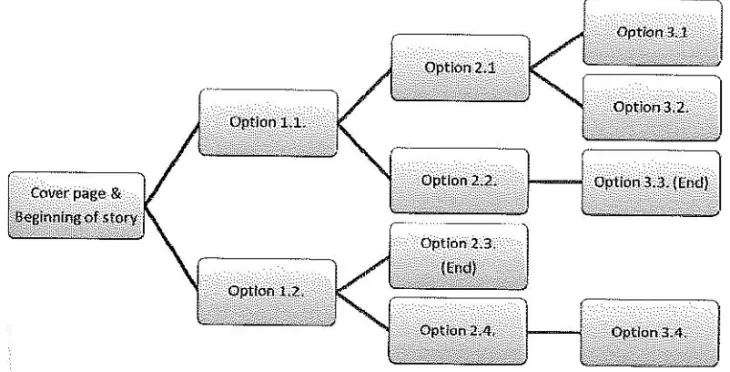
In Experience 2 learners were given time to brainstorm ideas for the main plot of their story. Figure 1 shows the blueprint that was shown to the students as a model structure for their branching stories.
In a branching story, the reader begins reading a story but does not progress page after page until reaching the end of the narrative. Rather, the reader is constantly presented with a series of choices that determine the outcome of the plot. Thus, although one can certainly talk about sequentiality, it would not be correct to characterize it as linear.
In fact, each selection the reader makes will take him or her to a random page in the book. This wiki branching story begins with an initial paragraph, which includes in itself the first set of internal links from which the reader selects one to set the
next action in the story. Each choice the reader makes will take him or her to a new entry and then a new set of choices is presented. Besides promoting collabora-tive work, another major purpose of this work was to practice narrative skills inspired by episodes of students’ profes-sional experience.
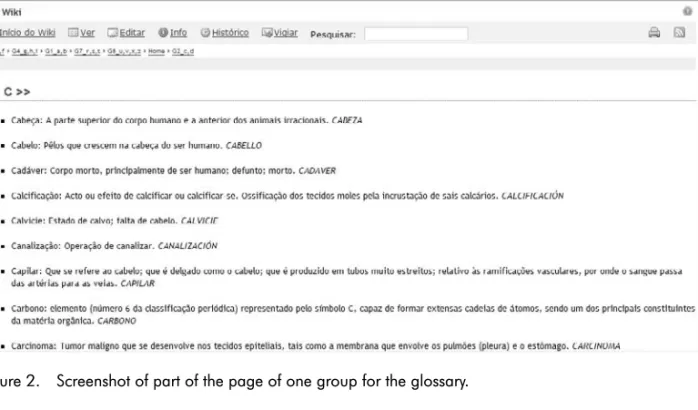
In both experiences, the duration of the project was one month. Each group had 2 weeks to prepare a first draft. Then, correc-tions were gradually included according to the instructor’s comments. Figure 2 shows
a screenshot of part of the page of one group for the glossary.
Figure 3 presents a screenshot of the first page of the branching story created by one group (the first set of choices available to the reader appear as hyperlinks).
Participants filled out an online ques-tionnaire on their perceptions about their linguistic gains with the experience as well as about the success rate of group work interaction while working on the wiki proj-ect. There were nine questions, for which the possible answers were strongly agree,
Figure 2. Screenshot of part of the page of one group for the glossary.
agree, neutral, disagree, and strongly dis-agree:
1. I enjoyed participating in the wiki project;
2. The wiki project was a learning experi-ence;
3. My group colleagues and I collabo-rated well together;
4. I would have preferred individual work;
5. I was able to use the target language and what was covered in class (gram-mar, vocabulary, cultural contents ); 6. I consulted/checked with resources
other than our class textbook to figure out language specific questions (gram-mar);
7. One of the students in my group (that can include you) took over a leader-ship role;
8. Everybody in my group was equally involved in the process and the cre-ation of wiki content; and
9. My group was successful in creating an informative webpage.
R
ESULTSAccording to the responses to Questions 1 and 2 on the learner’s opinion about the learning experience, more than half of the participants (62%) enjoyed participating in the wiki project and over three quarters (78%) claimed to have learned something as a result of their participation in the proj-ect.
Questions 3 and 4 fell upon students’ perceptions of the collaborative nature of the task. The answers to Question 3 reflect that 85% of all participants think that they collaborated well with their colleagues, while question 4 indicates that neverthe-less, 32% of the students would have pre-ferred individual work.
Questions 5 and 6 aimed to find out how useful the project was to enhance par-ticipants’ linguistic skills. An overwhelm-ing majority (92%) stated that they were
able to use the structures and content that they had been learning in class for the development of their wiki. A similar num-ber of students confirmed that they had sought help from external sources to edit their wiki.
Questions 7, 8, and 9 tapped into partic-ipants’ perception of how well group work was divided among team members. Responses showed that more than two thirds had a leader in the group who divided up the work and made sure that they were on track and complying with the set deadlines. In reply to question 8, a large majority of students declared that the work was well divided among group members. Finally, an even larger majority of participants considered that they were successful in generating a quality end product.
C
ONCLUSIONSGiven the answers to the questionnaire, as well as the products achieved, these wikis proved to be positive learning experiences in general terms: participants enjoyed working on a project in which they could use their language knowledge, in a flexible manner and have the cooperation and comradeship of their colleagues. In terms of gains in linguistic knowledge, students replied positively to the possibility of using grammar structures and content that they had learned in class.
eventu-ally have put more time and effort into the project. These may have felt that the grad-ing system was not fairly evaluatgrad-ing each participant’s contribution.
Acknowledgment: The support from Fundação Fernando Pessoa and Nova Southeastern University is gratefully acknowledged.
R
EFERENCESAlexander, B. (2006). Web 2.0: A new wave of innovation for teaching and learning? Edu-cause Review, 41(2), 32-44.
Ebersbach, A. (2006). Wiki: Web collabora-tion. Berlin, Germany: Springer.
Garrison, R., & Anderson, T. (2003). E-learning in the 21st century: A framework for research and practice. London, England: Routledge. Moore, M. G., & Anderson, W. G. (2003).
Hand-book of distance education. Mahwah, NJ: Erl-baum.
Peña-López, I., Córcoles, C., & Casado, C. (2006). El profesor 2.0: Docencia e investi-gación desde la Red. Retrieved from http:// www.uoc.edu/uocpapers/3/dt/esp/
pena_corcoles_casado.pdf
Schlosser, L. A., & Simonson, M. (2002). Dis-tance education: Definition and glossary of terms. Bloomington, IN: Association for Educa-tional Communications and Technology. Siemens, G. (2004). Connectivism: A learning
the-ory for the digital age. Retrieved from http:// www.elearnspace.org/Articles/connectivism .htm
The Relationship
Between Online
Course Organization
and Learner Outcome
A Pilot Study
Vartouhi Asherian
I
NTRODUCTIONnline education, sometimes referred to as distance education, is a fast growing delivery mode for course content. Students are accus-tomed to learning online. Their expecta-tion is that educaexpecta-tional opportunities are available to them 24 hours a day, 7 days a
week. This expectation grows out of mod-ern busy schedules that include the pres-sures of childcare, and jobs that require travel or odd hours. Some students cannot attend school and pursue a degree if this mode of delivery is not available. The online learning environment facilitates participation in education because it is practical to the users. It provides instruc-tors with unique opportunities in present-ing course material. Educational institu-tions can enjoy the reduced stress online education places upon their physical facili-ties. For these reasons and more one can expect online distance education to grow. So if this mode of instructional delivery is so desirable and widely available, then why do many students who take online courses drop out?
I taught online classes and assisted fac-ulty in designing online classes for over 8 years. It is a challenging process due to constant changes in technology. However, despite improvements in technology one common reoccurring issue that faces fac-ulty and administration is the retention of students. It is observed that online dents drop out at a higher rate than do stu-dents taking traditional courses. Why is this so? This article is a single case and will examine the relationship between the
O
Vartouhi Asherian,
Senior Analyst, Instructional Designer, and Instructor, College of Southern Nevada, 6375
structure of the online course and the learner’s experience in an attempt to answer this question. It is assumed that if the student has a more positive experience, then retention rates for online courses can increase and individual students will gain more from their online learning experi-ence.
S
TUDYD
ETAILSThe observation setting is the an “Orienta-tion to Online Learning” online classroom. The participants in this classroom were professional teachers looking for credits that allow them to move up in their pay scale. This course was a prerequisite for a 15-credit certificate program. Completion of the 15 credits awarded the participants with an “Online Teaching and Learning” certificate. The online classroom was designed using WebCT 4.1, which served as the course management tool. The course was an accelerated two-week course. An Internet connection and a browser such as Internet Explorer, Firefox, or Netscape was required for students to participate.
A volunteer was selected from this group of students. The volunteer had to be willing to install (CamStudio) recording software on his or her computer. This recorded the volunteer’s navigation steps within the course using the recording soft-ware and a webcam to record facial expres-sions. The volunteer also had to be willing to install Skype for the interview process.
Spradley (1980, p. 48) warns us not to jump into challenging situations until we have learned the lessons about “gaining access.” Based on this, Ms. H. was selected to participate in the current study because she was highly motivated to learn new online techniques. She was willing to download new software on her computer to record the sessions. Ms. H. is a single working mother in her mid-40s. She has taken classes online before and has solid computer skills. From June 15-19, 2007, four 10- to 15-minute sessions of
her online course navigation were recorded. The sessions captured her expe-rience with the course in real time. She recorded her online navigation using a webcam and the CamStudio program. These experiences were used to structure a follow-up interview. On June 22, 2007, she was interviewed (using Skype) con-cerning her experience navigating through the above course. The interview was recorded using Power Gramo online recorder.
R
ESEARCHERR
OLEAs Glesne (2006) states, “you need to clearly define your research roles” (p. 46). In this study the researcher’s role was that of an observer. The researcher was hidden from the subject and did not drive the direction of the study participant (Mer-riam, 1998). The observation was con-ducted using a webcam and recorded with CamStudio software (see Figure 1 for a snapshot of the video taken during obser-vation). The think aloud session was later transcribed and analyzed by the researcher.
O
BSERVATIONonline course. She can be considered an advanced user. Ms. H. found this course fairly easy to navigate. However, the audio clip that welcomed her to the course was a new feature for her. She was excited and pleasantly surprised by it.
Her navigation from one screen to another was smooth. She did think that the communication tools that grouped mail and discussion board may be confus-ing for first time users. However, she com-mented that the course would lose its overall intuitive quality by changing it.
Observation:
Okay, here I am on my course I think I should click where it says welcome pause
Okay, I am waiting play okay I have to hit play. Oh, it is an audio. That is my teacher.
Interview:
V: when you were listening to the welcome I could see your face lighting up thinking wow this is my instructor.
H: Yeah this is the first time I had an audio welcome message. I have not had audio welcome message before they all have just been something you read.
H: I think the communication icon being actually broken down into other icons. Which it does once you click on communication. It does break down into discussion board and mail. But if you are a first time user it might be helpful to actually see those things first and not have to click and see that just that old thing as “everything hanging off the end of your nose.” Ha ha … but that is pretty much the only thing of that as a first time user having it right there and maybe not make a logical connection of oh communication mail ha …
V: Okay, I see your point
N
ARRATIVEThe interview reviewed the experiences captured in the recording of the four seg-ments of live online work or interaction with the course. It was a surprise to dis-cover that Vygotsky’s communication the-ory or inner speech was captured in the recorded observation.
As a result the interview covered several topics that focused upon the intuitiveness and flow of the course. The interview started with a brief coverage on overall ease of navigation and course organiza-tion. It then evolved into a discussion on specific topics. It appeared that Ms. H. was using her prior knowledge at times “I guess I can click on the browse button and click it …” and at times she was using the computer as a tool to guide and learn “OK” in the pop up window I recognize the first name, in there is my instructor.” Ms. H. dis-cussed the value of the home page’s orga-nization and how the syllabus clearly sets the course expectations. The use of the icons on the home page also made it easier for her to figure out where to start (see Fig-ure 2 for an example of the home page). The select use of icons and the syllabus helped her stay on track and progress through the course in a logical fashion. Specifically she discussed how the opening of one icon led her to then open another in a logical and guided progression. Addi-tionally, she discussed how the audio greeting found on the home page
pro-vided her with a sense of having received a personal touch from the instructor. It gave her a sense that the instructor was avail-able to her.
Ms. H. was asked about potential changes to the course. She did not have anything specific to add. She was satisfied with the course structure. She stated that in her past experiences with online educa-tion she had to search for informaeduca-tion because her instructor did not create links and provide clear references. Having easy access to resources was a clear incentive to taking another online course. Therefore the current course overcame these objec-tions. A complete transcript of the inter-view is found in Appendix A.
D
EVELOPMENT OFI
SSUESCarswell and Venkatesh (2002) conducted a study on web-based methods of instruc-tion. Specifically, they investigated learn-ing outcomes associated with the asynchronous distance education format. They gathered quantitative data and aug-mented it with qualitative data. The study made use of two theoretical perspectives from the technology literature and from the education literature to predict student reactions to this learning environment. The study included approximately 1,800 part-time graduate students that yielded 540 useful responses. The results from the qualitative portion of the survey were
dis-Observation:
H: Let us look at WebCT mail. How do I send a message? Compose message?
H: how do I know who to send it to, I guess I can click on the browse button and click it. Okay, In the pop up window I recognize the first name, in there is my instructor. But I do not recognize the other names. So I click on the first name and highlight it and click select see what happens, oh it put it right into my send to spot. So this is going straight to my instructor and it has as send button here as well. I’ll come back when I actually have something to send.
Interview:
V: How did you feel about the audio vs. the written message? Was it better for you and your style of learning or …
appointing in that they did not reach sta-tistical significance. This may have been due to inadequacies in the learning out-come measures they selected.
However, the results from the qualita-tive portion of the survey were interesting. They found that if students are willing to use online learning technology, then the use of various forms of technology does not create an issue for students. A stu-dent’s sense of satisfaction and perfor-mance is not altered if they are willing to make use of the technology. To students the issue is not so much the course learn-ing environment, but rather the way the course is organized and taught. They want a course that is intuitive and where the
resources for their success are readily avail-able. Also, the instructor needs to be seen by the students as providing additional value. The instructor should not be seen as a taskmaster who merely asks for assign-ments to be completed, or a parrot that repeats the readings.
Carswell and Venkatesh organized stu-dent comments into five categories. These five categories provide the students’ insights into what makes the online envi-ronment effective and are described below.
1. Course Organization: Students were concerned about the ease of finding materials and information about
assignments such as requirements and due dates.
2. Instructor Characteristics: The instruc-tor’s responsiveness and perceived value to add something to the learning experience above and beyond what is provided in the course readings was seen as important by students.
3. Learning Style: If a student felt the course and medium matched their personal learning style and prefer-ences then participating in an online environment was seen as a good match.
4. Student Interaction: Students perceived value in the course if interactions with other students provided something in addition to the readings and the instructions.
5. Social Presence: The relative availability of the instructor and fellow students was also seen as important to students. This could be either online or through other means.
Carswell and Venkatesh’s categorization of student comments is especially interest-ing because of their relation to the com-ments made by Ms. H. during the course of her interview. She specifically commented on the following:
1. A clean and well-organized home page that made it easy to figure out where to start. She further commented that this was useful to her because her learning style was more visual than auditory.
2. The logical nesting of icons to guide the learner through the steps required to complete the course.
3. A well-written syllabus that provides clear expectations.
4. An audio greeting that makes the instructor appear to be more available and personable.
5. Clear links to resources and informa-tion that is required for completing
assignments and making the most of the course.
6. The availability of the instructor who in this course held virtual office hours, rather than held office hours at his or her physical office or substituted e-mail exchanges for set hours.
Four of the five Carswell and Venkatesh categories were spontaneously discussed by Ms. H. The only one she did not discuss was the availability of other students to interact with and facilitate the learning process (see Table 1). Ms. H.’s issues con-cerning an online course is aligned with those students who participated in the Carswell and Venkatesh study.
C
LOSINGC
OMMENTSClearly the present investigation is a case study that includes only one subject. The results may tell us more about Ms. H. than about other online learners. However, insomuch as her general topics parallel those made by subjects in a larger study there is reason to lend credibility to her insights. The case study approach allows us to probe and study course design specif-ics in detail to further uncover how to best facilitate user intuitiveness by improving course design, increasing the perception of instructor availability, and making better use of student learning styles. Since this case study was done at the beginning of the course, the data are lacking. There needs to be further observations at mid-point and at the end of the course to pro-vide an overall picture of the course’s design. Therefore, further research needs to be conducted.
A
PPENDIXA
Interview transcript
Ms. H interview for Pilot study 6-22-07 by Vartouhi Asherian
H: Hello.
V: How are you this morning?
H: I am doing great.
V: Now just because we are recording this session it’s not going to work. But Mur-phy’s Law you know …
V: I have couple of windows popping up here. And you are Ms. H for the interview.
V: I want to ask you couple of questions because it was very interesting when I went back and looking at the observation where you clicked and how you clicked in the course. First of all, is this your first online course that you have taken?
H: No, no this is not.
V: How many classes have you taken before?
H: Oh my goodness.
V: Just roughly.
H: 20
V: 20 online classes?
H: Perhaps, perhaps
V: Wow
V: So I would consider you definitely an advanced user.
H: I think so. <giggle>
V: Let me ask you this. Compared to these online classes you had taken, how differ-ent or similar this course was organized?
H: Eh pritty similar, it had a home page. It had the start here syllabus eh … you know course content laid out your assignments the emails the discussion boards and then the grades where you are able to look up your grades and kind of keep track on how you are doing in the course.
V: So it did not trough you off when you see the communication tools you figured there should be some other tools in there such as mail and discussion in there.
H: You know once it dawned on me because some of my courses have said communication and some have had sepa-rate icons for email WebCT discussion board etc. It just, I guess, it doesn’t really through you off it just looks different and you have to remember oh yeah communi-cation logically that would be any type of communication so I probably should look here for WebCT mail and for discussion
Table 1. Ms. H Interview Summary
Course Organization
Instructor Characteristics
Learning Style
Student Interaction
Social Presence
Clean and well organized homepage
x x
Nesting of icons x x
Clear instructions (syllabus)
x x
Audio message x x x
Clear links x x
Availability of instructor
board. It does not through you off but it lets you think and pause for a minute.
V: The other question I had is that when you were listening to the welcome mes-sage it was kind of … I could see your face light up thinking, “Wow this is my instruc-tor.”
H: Yeah this is the first time I had an audio welcome message. I have not had audio welcome message before they all have just been something you read.
V: How did you feel about the audio vs. the reading was it better for you and your style of learning?
H: I read well and comprehend well so I do fine with the reading. The audio is just nice because it gives you a bit more insight or a little bit more personality of the instructor. Where you can get some of that personality with the text but not a lot, it is pretty cut and dry. But yeah with the voice and the audio you kind of get a feel of your instructor more … more personal.
V: Okay interesting.
V: And when you looked at the course if can think back about the homepage. What do you think when you look at the homep-age. Like what do you have in mind to start looking at first? To search for what is it that you want to look at first and search if it is not on the homepage.
H: If it is obvious of course it would be an icon that the instructor puts up that says start here or welcome. I think that’s were you should go first if such one exists. If it does not the syllabus … first place, I would go because then usually the welcome is embedded somewhere in the syllabus, if nothing else and then the bio of the instructor and then of course what is expected in the course. So that is the place I would start.
V: Did you feel overwhelmed when you were looking at the course homepage?
H: No, no. It was pretty not necessarily self-explanatory but it was clean it was not cluttered. It was not a cluttered home page. You could clearly see where to go. There was plenty of blank space as in the fact that it was not wall to wall icons. So it was easy to follow. Which is nice. And also, because it was not wall to wall icons you are not overwhelmed thinking oh my gush I got to click on all every icons there is much to do. So I like that. Some that have wall to wall icons you just look at it and feel like you are behind and you have not even yet started.
V: How about what did you find helpful to guide you in the course what was the most helpful thing in the course as you got started on it?
H: It kind of there were directions within the syllabus it lets you know where you could find other things. Then when you went to the communications tool the other icons then popped up to be more special-ized for exactly for what you were looking at. So it kind of progressed in a logical way. You did not really have to hunt and search kind of thing necessarily. You did have to stop and think because it was not at the end of your nose but it was right there.
V: Okay
V: When you first look at the course. Imag-ine this. This is something you may want to take a minute to think. But when you first look at the course where do your eyes go to start looking for information? Do you look right top left, bottom left or right bot-tom? Where does normally you have a ten-dency of looking at when you are navigating? And after that, which direction do you go? Is there a sequence to the mad-ness here is what I am looking for.
go to the right and usually I have found the syllabus to be in the left hand side in the first row. That is what I have generally found. Either the syllabus or welcome to be to be there. Then you proceed across either 3, 4, 5 icons depending and then underneath possibly another row. But that is what I have generally found it to be. Occasionally … here has been a welcome kind of … right in the center. But it is gen-erally there is … there is some kind of pat-tern.
V: From the student point of view on this course particularly. What would you think would be helpful if it was changed? Like icon location or information wise. If you can think back I know you may have for-gotten it already but just thinking back is there something you may want to have changed to pop up easier for maybe some-one not as experienced as you?
H: I think the communication icon being actually broken down into other icons. Which it does once you click on communi-cation. It does break down into discussion board and mail. But if you are a first time user it might be helpful to actually see those things first and not have to click and see that just that old thing as “everything hanging off the end of your nose.” Ha ha … but that is pretty much the only think of that as a first time user having it right there and maybe not make a logical connection of oh communication mail ha …
V: Okay, I see your point.
H: But then you’ll have more icons on the homepage.
V: I think one other question again from the learner perspective. Do you have more tendency of clicking on the homepage icons or clicking on the left hand side course menu which is a more of a sequen-tial list?
H: I use both. Unfortunately I have found in some courses one works and one doesn’t, which it should not be. They
should both work. I do like the icons just because I also like pictures. I am a very visual. I am text base but I do like pictures. I guess I do have a tendency to use the icons on the home page.
V: Do you think that is a learning style preference or is it a …
H: I think it is a learning style preference one the visual, and then too I think some perhaps the first time users may not know to click on the words so they will go to the pictures. Or vise versa, I do not know that first time users would know without inves-tigating. That they can use either or. Once I get into the course and am going between page to page. I find it easier using the course menu then always going back to the homepage finding the cute little icons and moving on.
V: That makes sense.
H: Yeah.
V: So it can be used interchangeably depending on where you are in the course.
H: Definitely, definitely I like having the option of both.
V: I know I am jumping around here at this point. I was looking at the observation notes when you read through the part that office hours are online. You kind of chuck-led and you were kind of happy about that. Can you elaborate on that?