Prevalence of cognitive
impairment and associated
factors among the elderly in
Bagé, Rio Grande do Sul, Brazil
Prevalência de déicit cognitivo e
fatores associados entre idosos de
Bagé, Rio Grande do Sul, Brasil
Adriana Winter HolzI
Bruno Pereira NunesII
Elaine ThuméIII
Celmira LangeIII
Luiz Augusto FacchiniIV
IUniversidade Federal de Pelotas – Pelotas (RS), Brazil.
IIDepartament of Social Medicine; Postgraduate Program of Epidemiology of
the Medical School at Universidade Federal de Pelotas – Pelotas (RS), Brazil.
IIINursing Department; Postgraduate Nursing Program at Universidade Federal
de Pelotas – Pelotas (RS), Brazil.
IVDepartment of Social Medicine; Postgraduate Program of Epidemiology of the
Medical School at Universidade Federal de Pelotas – Pelotas (RS), Brazil.
Corresponding author: Adriana Winter Holz. Rua Mariz e Barros, 434, Barrinha, CEP 96170-000, São Lourenço do Sul, RS, Brasil. E-mail: [email protected]
Conlict of interests: nothing to declare.
Abstract
It is estimated that until 2020 the elderly will represent 13% of the total Brazilian population, and there is increasing concern about healthy aging and low rates of cognitive impairment. his cross-sectional study aimed to identify the prevalence of cognitive impairment, using the Mini-Mental State Examination (MMSE) in a sample of 1,593 elderly aged 60 years old and more who were living in the community of the city of Bagé, Southern Brazil, in 2008. he Poisson regression model was used for estimating crude and adjusted prevalence ratios; their related 95% conidence intervals and p-values lower than 0.05 were considered statistically significant. The prevalence of cognitive impairment was of 34% and statis-tically associated with gender (female), age (older), schooling (less educated), lower economic classes, without retirement, with depression and functional limitation. he high magnitude with increased occur-rence among poor and vulnerable groups contributes to the implementation of public policies in order to improve care, prevent diseases and promote the independence and autonomy of the elderly population.
Resumo
As estimativas para 2020 indicam que os idosos representarão 13% da população do Brasil e é crescente a preocupação com a manutenção da capacidade cognitiva desta população. O objetivo deste estudo foi identiicar a preva-lência e fatores associados ao déicit cognitivo em idosos residentes na área de abrangên-cia dos serviços de atenção básica em saúde no município de Bagé, Rio Grande do Sul. O estudo epidemiológico de base populacional foi realizado em 2008. O Miniexame do Estado Mental (MEEM) foi aplicado, no domicílio, a 1.593 idosos. A análise dos fatores associados foi reali-zada através de regressão de Poisson a partir de um modelo hierárquico. Associações com valor p menor que 0,05 foram consideradas estatisticamente signiicativas. A prevalência de déicit cognitivo foi de 34,1%. Idosos do sexo feminino, indivíduos mais velhos, de cor da pele preta ou amarela/parda/indígena, com menor escolaridade, de classes sociais mais pobres, sem aposentadoria, com depressão e incapacidade para Atividades Instrumentais da Vida Diária (AIVD) tiveram maior pro-babilidade de apresentar déficit cognitivo (p < 0,05). A elevada magnitude com possibi-lidade de ocorrência aumentada entre grupos mais pobres e vulneráveis contribui para a implementação de políticas públicas de modo a qualificar o atendimento, a prevenção de agravos e a promoção da independência e autonomia da população idosa.
Palavras-chave: Saúde do Idoso. Cognição. Atenção primária à saúde. Estudos Transversais. Envelhecimento. Saúde mental.
Introduction
he population aging will require changes in the current Brazilian health system, espe-cially because the increase of life expectancy in the country is not followed by the improve-ment in the general life conditions1-4. In order
for the individual to remain independent and active while growing old, conditions of access to health services, social protection, leisure, practice of physical activities and education must be ofered. In 2009, the elderly repre-sented 11.3% of the Brazilian population, and the projections for 2020 indicate that about 30 million people will be 60 years old or older, representing 13.0% of the total population5.
his can represent an increase in the number of people with morbidities, inabilities or with need to use health services6.
Facing population aging, dementia becomes an important health indicator among the elderly, with incidence rate of 13.8/1,000 inhabitants a year among the elderly living in the community7. hus, it has become increasingly
important for the Brazilian society, especially among the older age groups. A study conducted with 2,143 people aged 60 years old or more in São Paulo found a prevalence of cognitive dete-rioration of 6.9%, being 4.2% for people aged 60 to 74 years old and 17.7% for those aged 75 years old or more8.
Dementia syndromes are characterized by the presence of progressive cognitive impair-ment, especially memory loss and aphasia, apraxia, agnosia or disturbance in executive function9, which interferes with social and
occupational activities10.
Methods
A population-based epidemiological study with cross-sectional design in which elderly people aged 60 years old or more were inter-viewed, living in private households in the area assisted by the Primary Health Care of the urban zone of the city of Bagé, Rio Grande do Sul, from July to November 2008.
Data were collected by questionnaires structured with pre-codiied questions. For cognitive assessment, the Mini-Mental State Examination (MMSE) was used, which is comprised of several questions grouped into categories to assess speciic cognitive func-tions: temporal orientation (5 points), spatial orientation (5 points), immediate memory (3 points), calculation (5 points), evoking memory (3 points), naming (2 points), repeti-tion (1 point), command (3 points), reading (1 point), sentence (1 point), drawing (1 point), accounting for 30 points11. In order to deine
the presence of cognitive impairment, the cut-of point used in the analysis was 22/23, with sensitivity = 75.6% and speciicity = 71.1%12.
he used independent demographic and socioeconomic variables were: gender (male/ female), age in years (60 – 64/65 – 69/70 – 74/75 – 79/80 or older), self-reported skin color (white/ black/ yellow/mixed and indig-enous), marital status (married or with a partner/single, separated, widow), schooling in full years (no schooling/1 to 3/ 4 to 7/ 8 or more), economic class (A and B/C/D and E), according to the Brazil Criteria of Economic Classiication, of the National Association of Research Companies (ANEP), retirement (no/yes), health insurance (no/yes).
he independent variables of health status were depression, cardiovascular condition (hypertension and/or stroke and/or heart problems) and instrumental daily life activities (IDLA). he Geriatric Depression Scale was used to assess the presence of depression symptoms, and the results were dichotomized (present: score from 0 to 5/absent: score ≥ 6)13. In order
to establish functional inability for IDLA, the Lawton and Brody scale was used14. he elderly
who reported needing help for at least one of the activities were considered with inability.
The adjusted analysis was performed with the objective of controlling possible confusion factors in relation to the variables of the same level and those of the prior level. The Poisson regression model15 was used,
with robust variance estimation, maintaining variables with p value lower than 0.20 in the model. Associations with p value lower than 0.05 were considered to be statistically signii-cant. Data analysis was conducted with with the software Stata, version 12.0 (Stata Corp, College Station, Texas, USA).
A schematic conceptual model was used to determine the factors associated with the outcome. The variables of both levels were included simultaneously, with a level by level backward selection. Level 1 included demo-graphic and socioeconomic variables (gender, age, skin color, marital status, schooling, ANEP, retirement and health insurance). he second level was composed of health condition vari-ables (depression, cardiovascular problems and IDLA).
The project was approved by the OF. 015/08 at the Ethics Committee of the Medical School of UFPel. he ethical principles were insured by the informed consent of the interviewers, the assurance of the right to not participate in the research and the anonymity of the subjects. The precepts of Resolution n. 196/96, which regards the ethical aspects of research involving human beings, were respected.
Results
In the study, 1,593 elderly people were interviewed, out of which 1,514 answered the MMSE questions, representing 5.0% of losses.
(38.9%). Practically half of the elderly (51.3%) was composed of married participants or with partners. Retired people represented 71.7% of the total, and 35.4% were covered by a health insurance. In relation to health problems, 14.9% presented with depression, 64.4% had some cardiovascular problem, and 34.2% presented inability for IDLA. From all of the elderly participants, 34.1% (95%CI 31.7 – 36.5) presented positive tracking for cognitive impairment (Table 1).
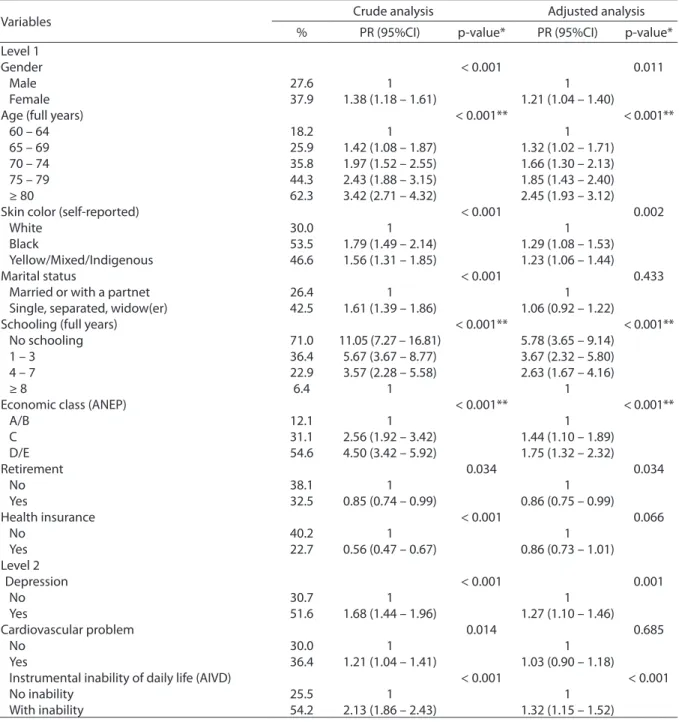
In crude analysis, the possibility of pre-senting with cognitive impairment (p < 0.05) was higher among female elderly individuals, older people, with black or yellow skin, mixed or indigenous, without a partner, with lower schooling, from poorer social classes, with no health insurance, with depression, car-diovascular problem and inability for IDLA. he retirement variable was not statistically associated with the outcome, both in the crude and the adjusted analyses (Table 2).
Table 1 - Sample description according to sociodemographic and health conditions. Bagé, Rio Grande do Sul, 2008.
Tabela 1 - Descrição da amostra de acordo com as características sociodemográicas e condições de saúde. Bagé, Rio Grande do Sul, 2008.
*Variable with higher number of losses n = 1,512
*Variável com maior número de perdas n = 1.512
Variables n = 1593 %
Gender
Male 593 37.2
Female 1.000 62.8
Age (full years)
60 – 64 400 25.1
65 – 69 374 23.5
70 – 74 322 20.2
75 – 79 229 14.4
≥ 80 268 16.8
Skin color (self-reported)
White 1.252 78.6
Black 139 8.7
Yellow/Mixed/Indigenous 202 12.7
Marital status
Married or with a partnet 816 51.3
Single, separated, widow(er) 776 48.7
Schooling (full years)
No schooling 372 23.7
1 – 3 384 24.4
4 – 7 474 30.1
≥ 8 342 21.8
Economic class (ANEP)
A/B 429 27.1
C 615 38.9
D/E 537 34.0
Retirement
No 451 28.3
Yes 1.142 71.7
Health insurance
No 1.025 64.6
Yes 561 35.4
Presence of health issues
Depression* 225 14.9
Cardiovascular problem 1.026 64.4
Instrumental inability of daily life (AIVD) 518 32.7
In the adjusted analysis, the variables marital status, health insurance and cardio-vascular problem lost their association with the outcome. Nonetheless, it was observed that female elderly people had 21% more chances of presenting with cognitive impairment. he
increment of age showed the linear increase in cognitive impairment, therefore, elderly people aged 80 years old or more had 2.45 times more occurrences of the outcome. Individuals with black skin or those with yel-low skin, mixed and indigenous participants,
Table 2 - Crude and adjusted analysis between cognitive impairment by sociodemographic and health conditions. Bagé, Rio Grande do Sul, 2008.
Tabela 2 - Análise bruta e ajustada entre déicit cognitivo e variáveis sociodemográicas e de condições de saúde. Bagé, Rio Grande do Sul, 2008.
Variables Crude analysis Adjusted analysis
% PR (95%CI) p-value* PR (95%CI) p-value* Level 1
Gender < 0.001 0.011
Male 27.6 1 1
Female 37.9 1.38 (1.18 – 1.61) 1.21 (1.04 – 1.40)
Age (full years) < 0.001** < 0.001**
60 – 64 18.2 1 1
65 – 69 25.9 1.42 (1.08 – 1.87) 1.32 (1.02 – 1.71)
70 – 74 35.8 1.97 (1.52 – 2.55) 1.66 (1.30 – 2.13)
75 – 79 44.3 2.43 (1.88 – 3.15) 1.85 (1.43 – 2.40)
≥ 80 62.3 3.42 (2.71 – 4.32) 2.45 (1.93 – 3.12)
Skin color (self-reported) < 0.001 0.002
White 30.0 1 1
Black 53.5 1.79 (1.49 – 2.14) 1.29 (1.08 – 1.53)
Yellow/Mixed/Indigenous 46.6 1.56 (1.31 – 1.85) 1.23 (1.06 – 1.44)
Marital status < 0.001 0.433
Married or with a partnet 26.4 1 1
Single, separated, widow(er) 42.5 1.61 (1.39 – 1.86) 1.06 (0.92 – 1.22)
Schooling (full years) < 0.001** < 0.001**
No schooling 71.0 11.05 (7.27 – 16.81) 5.78 (3.65 – 9.14)
1 – 3 36.4 5.67 (3.67 – 8.77) 3.67 (2.32 – 5.80)
4 – 7 22.9 3.57 (2.28 – 5.58) 2.63 (1.67 – 4.16)
≥ 8 6.4 1 1
Economic class (ANEP) < 0.001** < 0.001**
A/B 12.1 1 1
C 31.1 2.56 (1.92 – 3.42) 1.44 (1.10 – 1.89)
D/E 54.6 4.50 (3.42 – 5.92) 1.75 (1.32 – 2.32)
Retirement 0.034 0.034
No 38.1 1 1
Yes 32.5 0.85 (0.74 – 0.99) 0.86 (0.75 – 0.99)
Health insurance < 0.001 0.066
No 40.2 1 1
Yes 22.7 0.56 (0.47 – 0.67) 0.86 (0.73 – 1.01)
Level 2
Depression < 0.001 0.001
No 30.7 1 1
Yes 51.6 1.68 (1.44 – 1.96) 1.27 (1.10 – 1.46)
Cardiovascular problem 0.014 0.685
No 30.0 1 1
Yes 36.4 1.21 (1.04 – 1.41) 1.03 (0.90 – 1.18)
Instrumental inability of daily life (AIVD) < 0.001 < 0.001
No inability 25.5 1 1
With inability 54.2 2.13 (1.86 – 2.43) 1.32 (1.15 – 1.52) *Wald test for heterogeneity; **Wald test of linear tendency.
presented 1.29 and 1.23 times more impair-ment when compared to white individuals. hose with no schooling presented 5.78 times more occurrences of cognitive impairment when compared to those with eight schooling years or more, and this association presented inverse linear tendency. Elderly people from the class C had more chances of cognitive impairment (PR = 1.44) when compared to those in class A. his probability increased for individuals in classes D/E (PR = 1.75). Finally, elderly people with depression and inability for IDLA presented approximately 30% more occurrence of cognitive impairment.
Discussion
he prevalence of cognitive impairment was similar to that of other studies conducted in Brazil. Among the elderly participating in the Municipal Program of Seniors in Viçosa, Minas Gerais, the prevalence of cognitive impairment was of 36.5%16. A study
con-ducted with hypertensive elderly assisted in a geriatric outpatient clinic associated with Universidade Federal do Rio de Janeiro found a 32.2% prevalence17. Other studies bring more
diverging prevalence. In Belo Horizonte, the prevalence of cognitive impairment among elderly restricted to the household was of 22.8%18. In a population-based cross-sectional
study conducted in Florianópolis, the preva-lence found was of 46.8%19.
In the comparison of the results of the studies about cognitive assessment with MMSE, it is important to consider the ana-lyzed population, the used cutoff points and the type of version of the instrument. In the SABE project, conducted in the city of São Paulo, the cognitive assessment used a reduced version of MMSE, validated in Brazil from the modiied and validated ver-sion of Chile20. his reduced version
estab-lished the cutof point 12/13, and cognitive deterioration was indicated by 12 points or less21. he application of higher cutof points
allows to increase the sensitivity of the scale in order to detect more cases, considering that the MMSE is an instrument used to track cognitive impairment22.
he female gender presented more preva-lence of cognitive deicit, as already described in other studies16,23,24. he higher life
expec-tancy for women in Brazil contributes to this reality. In 2010, life expectancy for men was 69.7 years old, while among women the age was 77.3 years old25. Besides, as this study
showed more frequent cognitive impairment among the older age groups, other authors already observed that this prevalence increases with age21,24,26.
he black skin color showed more preva-lence of cognitive impairment. No studies were found to prove such relationship. However, a factor that contributes for the highest preva-lence among black-skinned individuals is schooling. Among the elderly, in 2010 half of the population had less than four schooling years5.
he prevalence by schooling conirms that the higher the schooling of the individuals, the better their performance in the MMSE27.
Among the elderly of a reference center of elderly care, the mean score at MMSE was also higher according to more schooling years28,
as well as among the elderly of a population-based study conducted in Minas Gerais29.
With regard to economic classes, the prob-ability of cognitive impairment increases with lower classes. Another study that assessed the economic level by per capita income demon-strated that the prevalence of cognitive impair-ment is higher among those receiving 0.6 to 1 minimum wage30. herefore, individuals in
a less favorable economic situation present more risks of cognitive impairment.
As to health insurance, a lower probability was found for impairment when the elderly people were covered by a health insurance in the crude analysis. After the adjustment, the association did not continue to present a bordering p value. Nonetheless, the possible protection of this socioeconomic indicator shows concerning health inequities, once, in Brazil, in 2008, 70.3% of the individuals aged 65 years old or more depended on the assistance of public health services31.
of 1.81 in relation to those without cognitive impairment32. Another study concluded that
elderly diagnosed with depression present with important cognitive and functional changes33.
Even though cardiovascular problems are considered as strong factors associated with dementia and Alzheimer’s disease34, this
relationship with cognitive impairment is not clear yet. A study with 99 elderly people with cognitive impairment did not ind a signii-cant association among those aged between 65 and 79 years old; however, among older people, there was a major inverse associa-tion17. Among the elderly of a community in
a city of the State of São Paulo, the association was not found either35.
Elderly people with dependency for IDLA had more chances of presenting with cognitive impairment. A study conducted in a city of Bahia, with 222 women, concluded that elderly women with damaged cognitive function had 4.4 more chances for inabilities in IDLA in relation to those who did not have cogni-tive damage, even when controlled for the performance of physical and leisure activities in the past36. Another study conducted with
elderly people assisted by teams of the Family Health Strategy in Goiânia observed that one of the statistically signiicant associated fac-tors for dependency in IDLA was cognitive impairment (PR = 1.76)37.
he MMSE is universally used to track cog-nitive impairment; however, it has a serious educational bias. After being applied in low schooling populations, results can overesti-mate the prevalence of the problem. On the other hand, among high schooling popula-tions, the test may not detect the deicit.
he used design does not allow the conduc-tion of a causal inference in some associaconduc-tions,
for instance, cognitive impairment with IDLA and cardiovascular problems. Nonetheless, the representativeness of the target-population of the study, the use of a validated instrument to measure the outcome and the reduction of biases due to the used methodological crite-ria are strengths that ratify the found results.
Conclusion
The factors associated with cognitive impairment were female gender, older age group, black skin and yellow/mixed/indig-enous, low schooling, lower economic class, without retirement, presence of depression and IDLA. his proile is related to elderly peo-ple who should be more frequently assessed for cognitive impairment.
The strong influence of schooling in cognitive impairment shows health inequities that should be minimized with more politi-cal and inancial incentives to increase the permanence of individuals in school, and, consequently, increasing the years of study.
17. Cavalini LT, Chor D. Inquérito sobre hipertensäo arterial e déficit cognitivo em idosos de um serviço de geriatria. Rev Bras Epidemiol 2003; 6(1): 7-17.
18. Ursine PGS, Cordeiro HA, Moraes CL. Prevalência de idosos restritos ao domicílio em região metropolitana de Belo Horizonte (Minas Gerais, Brasil). Ciênc Saúde Coletiva 2011; 16(6): 10.
19. Medeiros FL, Xavier AJ, Schneider IJC, Ramos LR, Sigulem D, d’Orsi E. Inclusão digital e capacidade funcional de idosos residentes em Florianópolis, Santa Catarina, Brasil (EpiFloripa 2009-2010). Rev Bras Epidemiol 2012; 15(1): 106-22.
20. Icaza MG, Albala C. Minimental State Examinations (MMSE) del estudio de demencia en Chile: análisis estadístico. Washington: Organización Panamericana de la Salud; 1999.
21. Cerqueira ATAR. Deterioração cognitiva e depressão. In: Lebrão ML, Duarte YAO. O Projeto Sabe no município de São Paulo: uma abordagem inicial. Brasília: OPAS; 2003.
22. Almeida OP. Mini exame dos estado mental e o diagnóstico de demência no Brasil. Arq Neuropsiquiatr 1998; 56(3B): 605-12.
23. Santos CS, Cerchiari EAN, Alvarenga MRM, Faccenda O, Oliveira MAC. Avaliação da confiabilidade do Mini-Exame do Estado Mental em idosos e associação com variáveis sociodemográficas. Cogitare Enferm 2010; 15(3): 406-12.
24. Rosset I, Roriz-Cruz M, Santos JLF, Haas VJ, Fabrício-Wehbe SCC, Rodrigues RAP. Diferenciais socioeconômicos e de saúde entre duas comunidades de idosos longevos. Rev Saúde Pública 2011; 45(2): 10.
25. Instituto Brasileiro de Geografia e Estatística [Internet]. Tábuas Completas de Mortalidade - 2010. Rio de Janeiro: 2010. Disponivel em: http://www.ibge.gov.br/home/ estatistica/populacao/tabuadevida/2010/default.shtm. (Acessado em 15 de julho de 2012).
26. Herrera Jr E, Caramelli P, Nitrini R. Estudo
epidemiológico populacional de demência na cidade de Catanduva, estado de São Paulo, Brasil. Rev Psiquiatr Clín 1998; 25(2): 70-3.
27. Diniz BSO, Volpe FM, Tavares AR. Nível educacional e idade no desempenho no Miniexame do Estado Mental em idosos residentes na comunidade. Rev Psiquiatr Clín 2007; 34(1): 13-7.
28. Paulo DLV, Yassuda MS. Queixas de memória de idosos e sua relação com escolaridade, desempenho cognitivo e sintomas de depressão e ansiedade. Rev Psiquiatr Clín 2010; 37(1): 23-6.
29. Valle EA, Castro-Costa E, Firmo JOA, Uchoa E, Lima-Costa MF. Estudo de base populacional dos fatores associados ao desempenho no Mini Exame do Estado Mental entre idosos: Projeto Bambuí. Cad Saúde Pública 2009; 25(4): 918-26.
1. Organização Mundial da Saúde. Envelhecimento ativo: uma política de saúde. Brasília: OPAS; 2005.
2. Brasil. Ministério da Saúde. Envelhecimento e saúde da pessoa idosa. Brasília; 2006.
3. Areosa SVC, Areosa AL. Envelhecimento e dependência: desafios a serem enfrentados. Textos & Contextos 2008; 7(1): 138-50.
4. Pasinato MTM. Envelhecimento, ciclo de vida e mudanças socioeconômicas: novos desafios para os sistemas de seguridade social [tese de doutorado]. Rio de Janeiro: Instituto de Medicina Social da Universidade do Estado do Rio de Janeiro; 2009.
5. Instituto Brasileiro de Geografia e Estatística. Síntese de indicadores sociais: uma análise das condições de vida da população brasileira 2010. Rio de Janeiro; 2010.
6. Veras R. Envelhecimento populacional contemporâneo: demandas, desafios e inovações. Rev Saúde Pública 2009; 43(3): 548-54.
7. Nitrini R, Caramelli P, Herrera Jr E, Bahia VS, Caixeta LF, Radanovic M, et al. Incidence of dementia in a community-dwelling Brazilian population. Alzheimer Dis Assoc Disord 2004; 18(4): 241-6.
8. Lebrão ML, Laurenti R. Saúde, bem-estar e
envelhecimento: o estudo SABE no Município de São Paulo. Rev Bras Epidemiol 2005; 8(2): 15.
9. American Psychiatric Association. Manual Diagnóstico e Estatístico de Transtornos Mentais (DSM – IV – TR). 4ª ed. Porto Alegre: Artes Médicas; 1995.
10. Neto JG, Tamelini MG, Forlenza OV. Diagnóstico diferencial das demências. Rev Psiq Clín 2005; 3(32): 119-30.
11. Brucki SMD, Nitrini R, Caramelli P, Bertolucci PHF, Okamoto IH. Sugestöes para o uso do mini-exame do estado mental no Brasil. Arq Neuropsiquiatr 2003; 61(3B): 777-81.
12. Lourenço RA, Veras RP. Mini-Exame do Estado Mental: características psicométricas em idosos ambulatoriais. Rev Saúde Pública 2006; 40(4): 712-9.
13. Sheikh J, Yesavage J. Geriatric Depression Scale (GDS): Recent evidence and development of a shorter version. New York: Hayworth; 1986.
14. Lawton MP, Brody EM. Assessment of older people: self-maintaining and instrumental activities of daily living. Gerontologist 1969; 9(3): 179-86.
15. Barros AJ, Hirakata VN. Alternatives for logistic regression in cross-sectional studies: an empirical comparison of models that directly estimate the prevalence ratio. BMC Med Res Methodol 2003; 3(21).
16. Machado JC, Ribeiro RCL, Leal PFG, Cotta RMM. Avaliação do declínio cognitivo e sua relação com as características socioeconômicas dos idosos em Viçosa-MG. Rev Bras Epidemiol 2007; 10(4): 592-605.
30. Alvarenga MRM. Avaliação da capacidade funcional, do estado de saúde e da rede de suporte social do idoso atendido na Atenção Básica [tese de doutorado]. São Paulo: Escola de Enfermagem da Universidade de São Paulo; 2008.
31. Instituto Brasileiro de Geografia e Estatística. Pesquisa Nacional por Amostra de Domicílios. Um panorama da saúde no Brasil: acesso e utilização dos serviços, condições de saúde e fatores de risco e proteção à saúde 2008. Rio de Janeiro; 2010.
32. Lima MTR, Silva RS, Ramos LR. Fatores associados à sintomatologia depressiva numa coorte urbana de idosos. J Bras Psiquiatr 2009; 58(1): 1-7.
33. Ávila R, Bottino CMC. Atualização sobre alterações cognitivas em idosos com síndrome depressiva. Rev Bras Psiquiatr 2006; 28(4): 316-20.
34. World Health Organization. Dementia: a public health priority. Geneva; 2012.
35. Di Nucci FRCF, Coimbra AMV, Neri AL, Yassuda MS. Ausência de relação entre hipertensão arterial sistêmica e desempenho cognitivo em idosos de uma comunidade. Rev Psiquiatr Clín 2010; 37(2): 52-6.
36. Virtuoso Júnior JS, Guerra RO. Incapacidade funcional em mulheres idosas de baixa renda. Ciênc Saúde Coletiva 2011; 16(5): 2541-48.
37. Nunes DP, Nakatani AYK, Silveira EA, Bachion MM, Souza MR. Capacidade funcional, condições socioeconômicas e de saúde de idosos atendidos por equipes de Saúde da Família de Goiânia (GO, Brasil). Ciênc Saúde Coletiva 2010; 15(6): 2887-98.