w w w. s b f g n o s i a . o r g . b r / r e v i s t a
Original
Article
In
vitro
and
in
vivo
antifungal
activity,
liver
profile
test,
and
mutagenic
activity
of
five
plants
used
in
traditional
Mexican
medicine
Jorge
Cornejo-Garrido
d,
Martha
Salinas-Sandoval
b,
Arely
Díaz-López
b,
Patricia
Jácquez-Ríos
c,
Myriam
Arriaga-Alba
a,
Cynthia
Ordaz-Pichardo
d,∗aHospitalJuárezdeMéxico,México,D.F.,Mexico
bUnidadAcadémicaMultidisciplinariaReynosa-Aztlán,UniversidadAutónomadeTamaulipas,Tamaulipas,Mexico cHerbarioIZTA,UniversidadNacionalAutónomadeMéxicoCampusIztacala,Tlalnepantla,EstadodeMéxico,Mexico
dLaboratoriodeBiologíaCelularyProductosNaturales,EscuelaNacionaldeMedicinayHomeopatía,InstitutoPolitécnicoNacional,México,D.F.,Mexico
a
r
t
i
c
l
e
i
n
f
o
Articlehistory: Received 11 June 2014 Accepted10December2014 Availableonline14February2015
Keywords: Antifungalactivity Berberishartwegii Hameliapatens Zanthoxylumcaribaeum
a
b
s
t
r
a
c
t
BerberishartwegiiBenth.,Berberidaceae,HameliapatensJacq.,Rubiaceae,Dendropanaxarboreus(L.)Decne &Planch.,Araliaceae,ErythrinaherbaceaL.,Fabaceae,andZanthoxylumcaribaeumLam.,Rutaceae,acetone extractswereselectedonthebasisoftheiruseintraditionalMexicanmedicinetotreatscabiesorskin diseases.Anti-dermatophyteactivityinvitrowasevaluatedusingtheagardilutionassay,andthe thera-peuticefficacyofB.hartwegiiandZ.caribaeumweretestedagainstexperimentaltineapedis.Theinfected animalsweretreatedintragastricallydailyforsevendayswith2.5and5mg/kgofacetoneextracts.The acetoneextractofH.patensexhibited100%growthinhibitionagainstT.mentagrophytesandE.floccosum
at100.0and50.0g/ml,respectively,andB.hartwegiiinhibitedgrowthofM.canisandT.mentagrophytes
at100.0g/ml.Effectivetreatmentswith2.5mg/kgofZ.caribaeumandB.hartwegiiextractwere
com-parablewith1mg/kgofclotrimazoleinmice.Liverprofiletestsandhistologicalanalysesdidnotexhibit anysignsoftoxicityandtheAmestestindicatedthatbothextractsweresafewhenevaluatedinstrains TA98,TA100andTA102.Ourresultssuggestthepotentialforthefuturedevelopmentofnewantifungal drugsfromB.hartwegiiorZ.caribaeum.
©2014SociedadeBrasileiradeFarmacognosia.PublishedbyElsevierEditoraLtda.Allrightsreserved.
Introduction
Skin, hair and nail fungal infections are common and
widespread.Theseinfectionsarecausedbythreegroupsoffungi:
dermatophytes, yeasts and molds (Schwartz, 2004).
Dermato-phytes are the primary cause of these infections, particularly
Trichophytonrubrum(MorenoandArenas,2010).Dermatophytes
caninvade severalkeratinized tissuesand usethe keratinas a
carbon,nitrogenandsulfursource.Inhumansandotheranimals,
thesefungicanproduceaninfectionknownasdermatophytosis
(Vermoutetal.,2008;WeitzmanandSummerbell,1995). Superficialmycosesarenotlife-threateningbutareaserious problemforthequalityoflifebecausetheseinfectionscancause seriousdiscomfortandcosmeticdeformities(Koga etal.,2012).
Thesediseasesareobservedworldwideandaffect20–25%ofthe
world’spopulation(Havlickovaetal.,2008).Theincidencesofthese
∗ Correspondingauthor.
E-mail:[email protected](C.Ordaz-Pichardo).
infectionshavenotchangedwithinthelastthreedecades(Borman etal., 2007;Havlickova etal., 2008), althoughmany antifungal drugswithpotentactionagainstthisspecieshavebeenintroduced
intothemarket(BrennanandLeyden,1997;KumarandKimball,
2009).Currenttreatmentisbasedontheuseoftopicalantifungal agents,orsystemictreatmentsinthecaseofextendedorrecurrent infections(Bell-Syeretal.,2012;Diketal.,2003).Thedrugsthat
aremostcommonlyusedagainstthesediseasesinclude
ampho-tericinB,ketoconazole,fluconazole,terbinafineandclotrimazole (KhanandAhmad,2011).Thesedrugsaresometimesinefficient
and often present nephrotoxicity and hepatotoxicity (Andriole,
1999;Somchitetal.,2004;Zapata-Garridoetal.,2003).In addi-tion,thedermatophyteresistancetoantifungaldrugshasresulted intheneedfornovelantimycoticagentswithabroadspectrumand fewersideeffects(Duraipandiyanetal.,2012;Giroisetal.,2006; KhanandAhmad,2011).Thus,amorepotenttherapeuticdrugthat iscapableofshorteningtreatmentdurationandimprovingpatient adherenceratewouldbebeneficial(Kogaetal.,2012).
Medicinalplantsareasourceofbioactivecompoundsusedto
treatmanydiseases.Manyplantspossessantimicrobialagentsand
http://dx.doi.org/10.1016/j.bjp.2014.12.003
exhibit antifungal activity (Lemos et al., 2005).Several invitro
and in vivo studies using plant products traditionally used in
ethnomedicinehavedemonstratedpromisingantifungalactivity
withoutany side effects (Bajpai et al., 2009; Park et al., 2007; SokovicandGriensven,2006).
TheaimofthisstudywastoevaluateMexicanplantsforactivity againstdermatophytestrains,particularlyT.rubrum.Plantswere selectedonthebasisoftheiruseintraditionalmedicinetotreat scabiesordiseaseswithrelatedsymptoms,suchasskindiseases. Acetoneextractsfromfiveplantspecieswereevaluatedfor antifun-galactivityusingtheagardilutionassayand“experimentaltinea pedis”modelinBALB/cmice.Inaddition,experimentaltoxicology studies,includingliverprofiletestsandtheAmestest,were
per-formedtodeterminetherisktobenefitratioandthemutagenic
activityoftheextracts.
Materialsandmethods
Plantmaterial
We select five medicinal plants used in traditional
Mexi-can medicine.Berberis hartwegii Benth., Berberidaceae,Hamelia
patensJacq.,Rubiaceae,Dendropanaxarboreus(L)Decne&Planch.,
Araliaceae,ErythrinaherbaceaL.,Leguminosae,and Zanthoxylum
caribaeum Lam., Rutaceae, were collected by Cynthia Ordaz-PichardoPh.D.in2010inGómezFarías,Tamaulipasstate,Mexico. PlantidentificationswereperformedbyM.C.PatriciaJácquez-Ríos
atthe“IZTA Herbarium”at theIztacalacampusof theNational
AutonomousUniversityofMexico(UNAM).Aspecimenof each
plantwasdepositedintheherbariumwithvouchernumbers:B.
hartwegii(1759),D.arboreus(1652),E.herbacea(1650),H.patens
(1649)andZ.caribaeum(1651).Plantswereair-driedand
pow-dered.
Extractpreparations
AcetoneextractsfromtheleavesofB.hartwegiiandH.patens, barksofD.arboreusandZ.caribaeum,androotsfromE.herbacea
wereproducedbydirectmacerationofdryandpowderedplant
material(25g)forfivedaysatroomtemperaturein250mlof ace-tonefivetimes.Theextractswerefilteredandevaporatedunder lowpressuretodrynessat40◦C.Thecollectedextractswerestored at−20◦Cuntilfurtheruse.
Dermatophytesspecies
Dermatophytes(Epidermophytonfloccosum,Microsporumcanis, Trichophytonmentagrophytes,Trichophytonrubrumand Trichophy-ton tonsurans) are well-characterized clinical isolates from the straincollectionoftheHospitalJuárezdeMexicoandweredonated byQ.F.B. MisaelGonzálezIbarra, thechief oftheLaboratory of
ImmunologyandMedicalMycology.
Inoculumpreparationforbiologicalassay
Allof thestrainswerecultured inSabourauddextrosebroth
(Bioxon) at 28◦C until the maximal numbers of conidia were
formed(15–20days).Theconidiawererecoveredby
centrifuga-tionat2795×gfor 20minat4◦C.Thepelletwassuspendedin sterilizeddistilledwaterandwasadjustedto105conidia(invitro) or106conidia(invivo)permlforuseastheinoculum.Theconidia
werequantifiedusingaNeubauerquantificationchamberundera
microscope.
Agardilutionassay
TheassaywascarriedoutaccordingtothemethodofHufford
withsomemodifications(Huffordetal.,1975).Agarplateswere preparedbyadding10mlofSabourauddextroseagarinPetridishes (9cmindiameter).Next,100,50or25gofextractwereadded
in100L ofdimethylsulfoxide(DMSO)andcontrolagarplates
with1%ofDMSOand100gofclotrimazolewereincluded.The
plateswereincubatedfor10minatroomtemperatureandwere
subsequentlyinoculatedwitheachofthetestfungiintriplicate. Theplateswereincubatedat28◦Cfor12days.Theseresultswere expressedasthepercentageofinhibitionofhyphalelongation com-paredtothenegativecontrols.
Determinationoftherapeuticefficacyagainstexperimentaltinea pedisinBALB/cmice
MaleBALB/ceight-week-oldmiceweighing25±5gwereused
andtenmicewereassignedtoeachgroup.Themicewereplaced
instainlesssteelcages,whichweremaintainedat25◦Cina12h dark–lightcycleandprovidedwithfoodandwateradlibitum.Allof
theexperimentswereperformedaccordingtotheMexicanOfficial
NormforAnimalCareHanding(NOM-062,1999).
Proceduresforinfection
Theassaywascarriedoutaccordingtothemethodof González-Ávila(González-Ávila,2002).Onesideofa paperdisk(6mmin
diameter,AntibioticAssayPaper,Whatman#1)wascoveredwith
apieceofaluminumfoil,andtheothersidewasfreetocarrythe
inoculumsuspension.Thediscswereinoculatedwith106conidia
ofT.rubrumandwerefixedtothesolesofthefeetofanimalwith adhesiveelastictape.Thediscswereremovedondays7,14and21, andeachsolewasexaminedforclinicalsignsofdermatophytosis. Therightlegofeachanimalwasinfected,andtheleftlegservedas theuninfectedcontrol.
Macroscopicobservation
TheskinlesionscausedbyT.rubrumwereobserved
macroscop-icallyondays7,14and21andwereassessedusingthefollowing
scoresystem:0, nosignsor normal;1, asmallnumber ofpink
erythematouspapulesandlessthan25%ofdesquamationatthe
site;2,moderateintensepinkerythemaspreadovertheentiresite
accompaniedby25–50%desquamationaninflammatoryresponse;
3, patchesof intensered erythema with50–80%desquamation
andcrusting;and4,severecarminerederythemawith80–100%
desquamation and severe crusting.The average score for each
groupwascalculatedtodeterminetheaveragelesionscore.
Treatment
Fromday14post-infection,themiceweretreated intragastri-cally(IG)dailyforsevendayswith100LDMSO:H2O1:3servingas avehicle.Allgroupswerekeptunderconstantobservationtodetect anychangesinbehaviororchangesinwaterandfoodintake.
Theanimalsweredividedintofivegroups:groupAwasthe
non-treated infected control, group B was the positive control
(treatedwith1mg/kgofclotrimazoleIG),groupsCandDwerethe infectedgroupstreatedwith2.5and5mg/kgofacetoneextractof B.hartwegiiorZ.caribaeum,respectively,andgroupEconsistedof non-infectedanimalstreatedwith10mg/kgofextracttodetermine thepotentialtoxiceffectsofextracts.
After treatment, the mice were anesthetized with 60mg/kg
ofintraperitonealsodiumpentobarbitalandsacrificedbycardiac
J.Cornejo-Garridoetal./RevistaBrasileiradeFarmacognosia25(2015)22–28
Table1
InvitroactivityagainstE.floccosum,M.canis,T.mentagrophytes,T.rubrumandT.tonsurans(percentageofgrowthinhibition).
g/ml Epidermophytonfloccosum Microsporumcanis Trichophytonmentagrophytes Trichophytonrubrum Trichophytontonsurans
Berberishartwegii 25 20.0±0.3 85.0±0.0 6.7±0.4 26.7±0.0 26.7±2.1
50 36.7±6.7 88.3±5.9 26.7±2.1 46.7±0.0 78.3±2.2
100 78.3±6.8 100.0±0.0 100.0±0.0 65.0±0.0 85.0±5.8
Dendropanaxarboreus 25 23.3±0.0 0.0±0.0 0.0±0.0 18.3±0.6 40.0±.0.0
50 36.7±0.0 20.0±0.0 23.3±1.8 56.7±3.8 60.0±0.0
100 50.0±0.0 28.3±1.1 77.0±0.0 75.0±0.0 90.0±0.0
Erythrinaherbacea 25 20.0±0.0 0.0±0.0 3.3±0.2 16.7±1.1 40.0±0.0
50 20.0±0.0 75.0±0.0 13.3±0.9 36.7±3.3 70.0±0.0
100 46.6±5.1 85.0±0.0 33.3±2.9 78.3±5.8 95.0±0.0
Hameliapatens 25 50.0±0.0 70.0±0.0 80.0±0.4 10.0±0.0 73.0±8.7
50 100.0±0.0 83.3±5.4 90.0±0.3 26.7±1.1 90.0±0.3
100 100.0±0.0 97.0±2.9 100.0±0.0 46.7±5.0 92.7±5.9
Zanthoxylumcaribaeum 25 13.3±0.9 1.7±0.1 10.0±0.0 6.7±0.4 80.0±0.0
50 56.7±5.8 26.7±4.2 40.0±0.0 20.0±0.0 90.0±0.0
100 75.0±0.0 55.5±5.8 60.0±0.0 75.0±0.0 93.0±0.0
Clotrimazole 100 100.0±0.0 100.0±0.0 100.0±0.0 100.0±0.0 100.0±0.0
DMSO 100L 0.0±0.0 0.0±0.0 0.0±0.0 0.0±0.0 0.0±0.0
blood was carefully collected for a liver profile test. The mice wereeuthanizedaccording totheofficial Mexicanstandard for thehumanekillingofanimals(NOM-033,1995).Allanimalswere euthanized,andthevitalorgansweremacroscopicallyanalyzed.
Histologicalanalyses
Representativefragments of the kidney, lungs and liver (to
observethetoxiceffectsofextracts)fromthreemicewerefixed ina 10% solutionof formalin and enclosedin paraffin. Paraffin blockswerepreparedaftercompletingtissueprocessingin differ-entgradesofalcoholandxylenes.Sections(5m)wereprepared
fromparaffinblocks using a microtome,and thesectionswere
stainedwithhematoxylin–eosin(H&E).
Mutagenicityassay
ASalmonellamutagenicitytestusingtheincorporationmethod
wasperformedaspreviouslydescribed(MaronandAmes,1983),
usingtheSalmonellatyphimuriumstrainsTA98,TA100andTA102
andtheS9fractionobtainedfromtheliverofamaleWistarrat
inducedwithAroclor1254(NewEnglandNuclear,NorthHaven,
Conn)asthemetabolicactivationsystem.S.typhimuriumstrains
werecultured for 16h at37◦C in a shaking water bathset at
90rpm.In a steriletube containing2ml ofsoft agar(at45◦C), thebacterialcultures(100L)wereexposedtofinalextract con-centrations of 0.78, 1.56, 3.12, 6.25, 12.5, 25.0, 50.0, 100 and
200.0g/ml, or to 10l of DMSO as a negative control.
Sub-sequently, the suspension mixture was placed in a Petri dish
containingVogel–Bonnerminimal medium.Afterincubation for
48hat37◦C, therevertantcolonies(His+)werequantified.The mutagenesispositivecontrolsusedforeachstrainwerepicrolonic acid,methyl-N-nitro-N-nitrosoguanidine,mitomycinC, 2-amino-anthraceneandcyclophosphamide,aspreviouslydescribed(Maron andAmes,1983).
Statisticalanalysis
GraphPad Prism5.0 (GraphPadSoftware, Inc.) was used for
statisticalanalysis. The averagelesion score on thelast day of
macroscopicobservationwasanalyzedusingone-wayANOVA
non-parametrictestandDunnettposthocanalysis.Thedifferencesofthe
meansofthegroupswerecomparedwiththenon-treatedgroup
andwereconsideredsignificantwhenp<0.05.
Themutagenicitywasevaluatedusingatwo-wayANOVAtest
andBonferroniposthocanalysis.Thedifferencesofthemeansofthe
groupswerecomparedwiththecorrespondingpositivecontroland wereconsideredtobesignificantwhenp<0.05.
Results
TheacetoneextractsfromB.hartwegii,D.arboreus,E.herbacea, H.patens and Z. caribaeum(yields of 4.1, 2.5, 2.7,3.7 and 2.1% respectively)wereevaluatedforactivityagainstE.floccosum,M. canis,T.mentagrophytes,T.rubrumandT.tonsurans(Table1).The
acetone extract of H. patens exhibited 100% growth inhibition
againstT.mentagrophytesandE.floccosumat100.0and50.0g/ml, respectively,andB.hartwegiiinhibitedgrowthofM.canisandT. mentagrophytesat100.0g/ml.Noneoftheextractsinhibited100% growthofT.tonsurans,butalloftheextractsexhibitedgood
activ-ity,with85–95%growthinhibitionat100.0g/ml.The1%DMSO
didnotaffectthegrowthofthefungi.
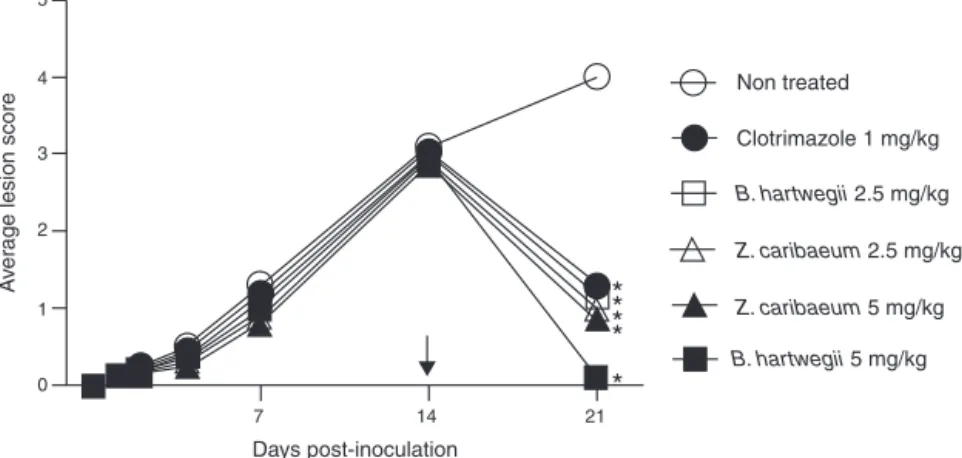
Themacroscopicobservationresultsinthetineapedismodelare showninFig.1.Atday7post-infection,allofthegroupsexhibited
asmallnumberofpinkerythematouspapulesandlessthan25%
ofdesquamation.Atday14post-infection,thediseaseprogressed uniformlyinallgroups,withpatchesofintenserederythemaand
50–80%ofscalesandcrusting.Atday21post-infection(7days
oftreatment), themicetreatedwithB.hartwegii (2.5mg/kg)or Z.caribaeum(2.5and5mg/kg)showedimprovementinthesoles (Fig.2),withalevelofdamagesimilartoday7post-infection,while
themicetreatedwithB.hartwegii(5mg/kg)showedan
improve-mentof100%withnosignsofdisease.Comparedtothenon-treated
group, there wasa statisticallysignificant improvement in the
lesionstreatedwithB.hartwegiiandZ.caribaeumacetoneextracts. Thenon-infectedanimalstreatedwith10mg/kgofB.hartwegii orZ.caribaeumdidnotexhibitsignsoftoxicity,suchaspiloerection, alterationinlocomotoractivityormortality.Theinternalorgansdid notexhibitanygrossmorphologicallesions.
The results of the liver profile test showed that the values
of serumglutamic pyruvic transaminase(56.1±9.9UI/l), serum
glutamicoxaloacetictransaminase(160.2±64.1UI/l),total biliru-bin (0.74±0.25mg/dl), direct bilirubin (0.67±0.28mg/dl), and indirectbilirubin(0.90±0.56)didnotpresentanysignificant dif-ferencebetweenthetreatedgroupsandcontrolgroup,indicating anabsenceofliverdamagecausedbytreatment.
Kidneysectionsfromanimalstreatedwithacetoneextractsof
B.hartwegiiorZ.caribaeum(10mg/kgforsevendays)showeda
normalrenalcortexwithanormalappearanceoftheglomerulus,
*
**
**
14 7
0 1 2 3 4 5
A
ver
age lesion score
Days post-inoculation
Non treated
Clotrimazole 1 mg/kg
Z. caribaeum 5 mg/kg
Z. caribaeum 2.5 mg/kg
B. hartwegii 2.5 mg/kg
B. hartwegii 5 mg/kg
21
Fig.1. The macroscopic improvement of skin lesions in experimental tineapedisin Balb/c mice treated with 2.5 and 5 mg/kg of B.hartwegiior Z.caribaeumacetone extracts. Intragastric treatment was started on day 14 post-inoculation (↓) and was continued once daily for seven consecutive days. *p < 0.05 versusthe non-treated group (One-way ANOVA nonparametric test and Dunnett posthocanalysis).
Mutagenicity studies by the incorporation method showed
thattheacetoneextractsofB.hartwegii,D.arboreus,E.herbacea, H.patens andZ. caribaeum atconcentrations between0.78 and 200g/ml(only0.78,12.5,25.0,50.0and200.0g/mlareshowed)
withorwithoutametabolicsystem(S9mixture)didnotproduce
frame-shiftmutationsinS.typhimuriumHis−strainTA98.The ace-toneextractsdidnotinducemutationsbybase-pairsubstitutions
instrainTA100anddidnotproducemutationsduetooxidative
damageinstrainTA102(Table2).
Discussion
The anti-dermatophyte in vitro activities of several herbal
extractshavebeenexaminedinpreviousreports(Machadoetal., 2009; Ponnusamyet al.,2010; Sule et al.,2012).However,the
extractsdisplayedmuchweakeractivitythanthecommonlyused
syntheticanti-dermatophytedrugs,andonlya smallnumberof
theseextractshavebeenevaluatedinexperimentalmodels,which limitsthe useof theseextracts as potentialtherapeutic agents (Evronetal.,1990;Mikaeilietal.,2012).
Inourexperiments,wefoundthatB.hartwegii andH.patens
extracts have the most optimal therapeutic potential because
these extracts exhibit comparable or even higher efficiencies
than the reference drugs against E. floccosum, M. canis and
T.mentagrophytes.
Otherplantextractsusedintraditionalmedicinehaveshown
similar activities; for example, the hydroalcoholic extract of
Berberis aristata has activity against ten species of yeasts and
molds, includingT.rubrum (MICof2.5g/ml),Candida albicans
(MIC 1.25g/ml), Cryptococcus albidus (MIC 1.25g/ml), Blas-toschizomycescapitatus(MIC22g/ml),Fusariummoniliforme(MIC 12g/ml),andFusariumsemitectum(MIC15g/ml),andagainst
five species of Aspergillus with MIC values between 0.3 and
10g/ml(Sharmaetal.,2008;Singhetal.,2007).The hydroalco-holicextractsofspecies,suchasBerberisasiatica,havereported activityagainstC.albicansand Aspergillusflavus (MIC=1.25and 0.62g/ml,respectively);BerberischitiraagainstAspergillus nidu-lans,C.albidusandA.flavus(MIC=1.25g/ml);andBerberislycium againstAspergillusterreusandAspergillusspinulosus(MIC=0.31and 0.62g/ml,respectively)(Singhetal.,2007).
J.Cornejo-Garridoetal./RevistaBrasileiradeFarmacognosia25(2015)22–28
Table2
MutagenicityofacetoneextractsonS.typhimuriumusingtheAmestest(plateincorporationassay),inpresenceorabsenceofmetabolicactivation.
Testsubstance Conc/ml Strainsandmetabolicsystem(S9)
TA98 TA100 TA102
−S9 +S9 −S9 +S9 −S9 +S9
B.hartwegii 12.5g 23.9±1.9 25.8±1.3 167.6±14.3 194.7±9.3 313.0±25.4 356.9±39.4
25.0g 25.4±1.2 27.0±1.6 204.1±12.4 200.8±9.3 322.6±21.5 350.4±23.5
50.0g 22.0±0.9 23.6±1.8 175.6±12.5 199.7±8.2 271.9±18.1 320.4±28.1
D.arboreus 12.5g 30.8±3.3 33.9±4.5 184.6±13.6 177.1±13.0 366.9±19.5 382.8±72.5
25.0g 30.1±6.0 33.4±3.7 199.9±13.0 165.0±10.2 384.2±23.2 422.2±67.5
50.0g 35.3±4.6 31.2±4.2 183.1±9.3 188.8±13.5 398.1±5.0 315.6±62.5
E.herbacea 12.5g 26.3±1.4 30.1±1.9 199.3±13.1 173.3±9.5 312.3±36.7 352.8±17.4
25.0g 26.4±1.5 32.2±1.8 214.2±5.2 163.3±9.5 394.6±36.9 374.2±22.9
50.0g 31.6±2.1 33.3±1.8 199.7±8.2 175.9±3.8 283.7±19.8 402.9±26.4
H.patens 12.5g 25.9±1.7 31.7±2.5 186.0±5.6 159.0±4.2 334.2±43.7 361.7±37.0
25.0g 26.4±1.5 30.6±1.7 183.4±11.9 164.3±6.8 294.9±21.5 452.7±47.5
50.0g 24.6±3.5 30.4±2.2 189.7±7.7 194.8±11.4 285.8±27.6 362.6±35.9
Z.caribaeum 12.5g 23.9±1.8 33.8±2.1 213.4±7.4 179.9±6.9 333.2±24.8 352.0±25.8
25.0g 22.7±1.3 34.2±1.0 197.3±7.3 178.1±12.1 357.8±20.6 429.7±22.3
50.0g 24.3±2.3 35.0±2.2 200.3±4.3 201.9±12.6 352.4±26.1 516.7±16.7
PA 82.0g 422.2±30.9* 2055.1±347.6*
2AA 10.0g 4910.4±187.8*
MNNG 10.0 g 13,248.3 ± 1036.6*
CP 500 g 558.8 ± 21.5*
Mit C 2.0 ng 4386.9 ± 248.7*
DMSO 10.0.l 24.0±2.1 33.7±1.4 207.0±5.6 195.2±13.7 343.0±33.7 417.3±19.9
Datarepresentthemean±SDofthenumberofhistidinerevertantcoloniesbyplateineachtreatment;threeindependentexperimentalseriescarriedoutintriplicatewere performed. Incubations were made in presence (+S9) and absence (−S9) of rat liver microsomal mix. PA, picrolonic acid; 2AA, 2-amino-anthracene; MNNG, methyl-N -nitro-N-nitrosoguanidine; CP, cyclophosphamide; Mit C, mitomycin C and DMSO, dimethyl sulfoxide.
* p< 0.05 (two-way ANOVA test and Bonferroni posthocanalysis).
Thisstudyis thefirst reportdescribing the invitro antifun-galactivityofH.patensandisthefirsttoreportthisactivityin aspeciesofthegenusHamelia.However,otherbiological activ-ities have beenpreviously reported, includingthe antibacterial
activityof the methanolicextract from the leavesof H. patens
againstE.coliandPseudomonasaeruginosawithMIC=2.5mg/ml
(Camporese et al.,2003).The cytotoxic activitiesof this specie
havebeenreportedagainsthumanepithelioidcervixcarcinoma
cells(HeLa),CI50=13.3g/ml;humanprostatecancercells(PC-3),
CI50=41g/ml;breastcancerhumancells(MCF7and
MDA-MB-231), CI50=63 and 45g/ml;breast cancermouse cells (4T-1), CI50=31g/ml; colon carcinoma cells (HT-29), CI50=34g/ml;
and mouse leukemic monocyte macrophage cells (RAW-267),
CI50=9g/ml (Mena-Rejon et al.,2009; Taylor et al., 2013).H. patens displayed anti-inflammatory activity against Croton oil-inducedearedema(Sosaetal.,2002)andincreasedthebreaking
strength in a double incision wound healing bioassay model
(Gomez-Belozetal.,2003).Avarietyofalkaloidsthatare poten-tiallyresponsibleforthesebiologicalactivitieshavebeendescribed,
andthemostabundantalkaloidsareisopteropodine,rumberine,
palmirine,maroquine,(−)-hameline,aricine,pteropodine, uncar-ineFandspeciophylline(Paniagua-Vegaetal.,2012;Reyes-Chilpa etal.,2004).Manyalkaloidshaveantifungalproperties(Cimanga etal.,1998;Huetal.,2014;Zhouetal.,2003),andalkaloidscan constituteupto90%ofthemetabolitesinH.patensextracts;thus, weproposethatthistypeofcompoundisalsoresponsibleforthe observedantifungalactivity.
TodeterminetheactivityagainstT.rubruminthe
experimen-talmodel,wechosetostudythespeciesB.hartwegiibecausethis plantshowedgoodactivityagainstthefivedermatophytes
evalu-ated,andweexaminedZ.caribaeumduetothewideuseofthis
plantin traditionalmedicineforthetreatmentofskindiseases. Moreover,bothspecieswereselectedduetothehighavailability oftheseplants.
B.hartwegiiandZ.caribaeumacetoneextractsadministeredat differentconcentrationsimprovedtheskinlesionsof experimen-taltineapedis.Dosesof2.5mg/kgofZ.caribaeumandB.hartwegii
extractshadcomparableefficacyto1mgofclotrimazole.
Further-more, treatmentwithB.hartwegii (5mg/kg) extractcompletely
healedthemycologicalinfectionafter7daysoftreatment;thus, this natural extractexhibited betteractivitythan thereference drug.
Currently,therehavebeennoreportsofanystudyonthespecies B.hartwegii;however,otherspeciesofthesamegenus,suchasB. aristata,B.asiatica,Berberiscriteria,B.lycium,Berberisthunbergii, Berberis heterophylla and Berberis aetnensis, have demonstrated activityagainstalargenumberofpathogenicstrainsofthe gen-eraAspergillusandCandida(Freileetal.,2003;Iauketal.,2007; Liet al.,2007; Sharmaetal., 2008;Singh etal.,2007). Berber-ine,thecompoundresponsibleforthisantifungalactivity(Freile et al., 2003; Soffar et al., 2001; Zhang et al., 2013a), has a synergisticeffectwithketokonazole(Zhouetal.,2012), micona-zole(Wei et al.,2011), fluconazole (Iwazaki et al., 2010; Quan etal.,2006)andamphotericin B(HanandLee,2005).This
syn-ergisticactivityisdue totheup-regulationof CDR1mRNAand
the transport function of Cdr1p induced by fluphenazine (Zhu
et al., 2014). Recent studies have found that berberine azoles
exhibitedgoodantimicrobialactivityagainstCandidamycoderma
(Zhang et al., 2013c), andberberine triazoles has good activity
againstC. mycodermaand C. albicans.Thisactivitywas
compa-rable or betterthan the reference drugs berberine, norfloxacin
andfluconazole(Zhangetal.,2013b).Thus,theantifungal
activ-ity observed in B. hartwegii could be due to the presence of
berberine.
There have been no reports on the antifungal activity of
Z. caribaeum, but there have been reports on the activity of
thegenus Zanthoxylum. The methanolicextract of Zanthoxylum
alatumexhibitedpotentantifungalactivityagainstAlternaria alter-nata, Alternaria brassicae, and Curvularia lunata (Guleria et al., 2013), and Zanthoxylum capense exhibited antifungal activity againstAspergillusfumigatus(Adamuetal.,2012).Extractsfrom
theleaf, fruit, stem, barkand root of Zanthoxylum americanum
(Bafi-Yeboaetal.,2005).Inothercases,alkaloidshavebeen demon-stratedtoberesponsiblefortheantifungalactivityofZanthoxylum plants;forexample,threealkaloidswithantifungalactivityhave
been isolated from Zanthoxylum nitidum (dictamnine,
gamma-fagarine,and5-methoxydictamnine)(YangandChen,2008),and
eightactivealkaloidshavebeenisolatedfromZanthoxylumrhetsa andZanthoxylumchiloperone(Krohnetal.,2011;Soriano-Agaton etal.,2005).AlkaloidalextractofZ.chiloperonevar.angustifolium hasactivityagainstC.albicans,A.fumigatusandT.mentagrophytes, beingresponsibleforthebiologicalactivitytwoalkaloids
(canthin-6-one and 5-methoxycanthin-6-one). The canthin-6-one has a
broadantifungalspectrumagainsttwelvespecies(MICsbetween
12.8and56.1M/l)(Thouveneletal.,2003).Thus,alkaloidsmust beresponsibleforthebiologicalactivityobservedinZ.caribaeum.
Medicinal plants and their derivatives have been used as
alternatives in allopathic medicine in many countries. Despite
the widespread use of medicinal plants, few scientific studies
havebeenperformedtoexaminethesafety andefficacyof
tra-ditionalremediesorpurecompounds(Silvaetal.,2011).Several drugsfordermatophytosis,suchasketokonazole,itraconazoleand terbinafinetreatment,cancausehepatotoxicity(Andriole,1999; Somchitetal.,2004;Zapata-Garridoetal.,2003);thus,itis impor-tanttoevaluatethepotentialtoxiceffectsofextractsandnatural compounds.
Theresultsoftheliverprofiletestdidnotdemonstrateany sig-nificantdifferencesbetweenthegroupstreatedwithB.hartwegiior Z.caribaeumandthecontrolgroup,indicatinganabsenceofliver
damagecausedbytreatment.Liverhistologicalsectionsshowed
normal hepaticarchitecture,normal hepatocytes,normal portal
triad and normal central vein. These observations, as well as
theserumlevelsofbilirubinandtransaminases, establishedthe
absenceofhepatocellular damageinducedby theextracts.
His-tological analysis and biochemical parameters are essential for
evaluatingthetoxicologicalriskofsubstanceswithbiological
activ-ity because anychanges in one of theseparameters in animal
studiescanprovideahighpredictivevalueofpotentialdamagein humans(Carvalhoetal.,2011;Olsonetal.,2000;Silvaetal.,2011).
Mutageniccompoundsarepotentially hazardoustohumans.
Substancesthataremutagenicforbacteriaarelikelytobe carcino-genicinanimals.Thus,allsubstancesmustbeanalyzedtoestablish therisk-benefitratio.Ausefulproceduretodetectmutagenic sub-stancesisthestandardplateincorporationtest(Amesetal.,1973).
Certain substances are not mutagenicby themselves; thus,the
Amestestincludesametabolicsystem(mixtureofliverenzymes
S9).
Noneofthetestedstrains(TA98,TA100andTA102)revealed
mutagenicpotential.Alloftheresultsweresignificantlylowerthan
thoseofthecorrespondingpositivecontrol(Two-wayANOVAtest
andBonferroniposthocanalysis).Moreover,thenumberof
rever-tantcoloniesperplatecontainingthetested substancemustbe
atleastmorethantwicethenumberof spontaneousrevertants
(MaronandAmes,1983)forasubstancetobeconsidered
muta-genic, which wasnever observedin thetestswiththeacetone
extractsofB.hartwegii,D.arboreus,E.herbacea,H.patensandZ. caribaeum.Inaddition,nodose-dependenteffectswere demon-strated.
Insummary,B.hartwegiiandZ.caribaeummightbeusefulagents againstTrichophytoninfectionsbecausetheseextractsexhibited goodactivityininvitroandinvivoevaluationswithnosignsof genotoxicityorhepatotoxicity.
OurfindingsjustifytheuseofB.hartwegiiandZ.caribaeumin Mexicantraditionalmedicineforthetreatmentoffungalskin infec-tions.Theseresultsincombinationwiththeabsenceofhepatotoxic
ormutageniceffects indicated thatthesetwo specieshave
sig-nificantpotentialforthedevelopmentofnewanti-dermatophyte
drugs.
Conflictsofinterest
Theauthorsdeclarenoconflictsofinterest.
Authors’contributions
JCGcontributedtoanalysisthedata,draftedthepaperand bio-logicalstudies.MSSandADLcontributedtobiologicalstudies.PJR contributeinplantidentificationandherbariumconfection.MAA contributetoAmestestanalysis.COPasheadoftheresearchteam organizedandsupervisedtheresearchproject.Alltheauthorshave readthefinalmanuscriptandapprovedthesubmission.
Acknowledgment
ThisresearchwasfinanciallysupportedbyprojectFOMIXof
COTACyTTAMPS-2005-C08-13.
References
Adamu, M.,Naidoo,V.,Eloff,J.N.,2012.SomesouthernAfricanplantspeciesusedto treat helminth infections in ethnoveterinary medicine have excellent antifungal activities. BMC Complement. Altern. Med. 12, 213.
Ames, B.N., Durston, W.E., Yamasaki, E., Lee, F.D., 1973. Carcinogens are mutagens: a simple test system combining liver homogenates for activation and bacteria for detection. Proc. Natl. Acad. Sci. U. S. A. 70, 2281–2285.
Andriole, V.T., 1999. The 1998 Garrod lecture. Current and future antifungal therapy: new targets for antifungal agents. J. Antimicrob. Chemother. 44, 151–162. Bafi-Yeboa, N.F., Arnason, J.T., Baker, J., Smith, M.L., 2005. Antifungal constituents of
northernpricklyashZanthoxylumamericanumMill.Phytomedicine12,370–377. Bajpai,V.K.,Yoon,J.I.,Kang,S.C.,2009.Antifungalpotentialofessentialoiland vari-ousorganicextractsofNandinadomesticaThunb.againstskininfectiousfungal pathogens.Appl.Microbiol.Biotechnol.83,1127–1133.
Bell-Syer,S.E.,Khan,S.M.,Torgerson,D.J.,2012.Oraltreatmentsforfungalinfections oftheskinofthefoot.CochraneDatabaseSyst.Rev.10,CD003584.
Borman,A.M.,Campbell,C.K.,Fraser,M.,Johnson,E.M.,2007.Analysisofthe der-matophytespeciesisolatedintheBritishIslesbetween1980and2005and reviewofworldwidedermatophytetrendsoverthelastthreedecades.Med. Mycol.45,131–141.
Brennan,B.,Leyden,J.J.,1997.Overviewoftopicaltherapyforcommonsuperficial fungalinfectionsandtheroleofnewtopicalagents.J.Am.Acad.Dermatol.36, S3–S8.
Camporese,A.,Balick,M.J.,Arvigo,R.,Esposito,R.G.,Morsellino,N.,DeSimone,F., Tubaro, A., 2003. Screening of anti-bacterial activity of medicinal plants from Belize (Central America). J. Ethnopharmacol. 87, 103–107.
Carvalho, A.L., Annoni, R., Silva, P.R., Borelli, P., Fock, R.A., Trevisan, M.T., Mauad, T., 2011. Acute, subacute toxicity and mutagenic effects of anacardic acids from cashew (Anacardiumoccidentale Linn.) in mice. J. Ethnopharmacol. 135, 730–736. Cimanga, K., De Bruyne, T., Pieters, L., Totte, J., Tona, L., Kambu, K., Vanden Berghe, D., Vlietinck, A.J., 1998. Antibacterial and antifungal activities of neocryptolepine, biscryptolepine and cryptoquindoline, alkaloids isolated from Cryptolepis san-guinolenta. Phytomedicine 5, 209–214.
Dik,A.J.,vanderGaag,D.J.,vanSlooten,M.A.,2003.Efficacyofsaltsagainstfungal diseasesinglasshousecrops.Commun.Agric.Appl.Biol.Sci.68,475–485. Duraipandiyan,V.,Al-Harbi,N.A.,Ignacimuthu,S.,Muthukumar,C.,2012.
Antimi-crobialactivityofsesquiterpenelactonesisolatedfromtraditionalmedicinal plantCostusspeciosus(Koenex.Retz.)Sm.BMCComplement.Altern.Med.12, 13.
Evron,R.,Guizie,M.,Zehavi,U.,Polacheck,I.,1990.ActivityofcompoundG2isolated fromalfalfarootsinexperimentaldermatophyteinfection.Antimicrob.Agents Chemother.34,1600–1601.
Freile,M.L.,Giannini,F.,Pucci,G.,Sturniolo,A.,Rodero,L.,Pucci,O.,Balzareti,V., Enriz,R.D.,2003.Antimicrobialactivityofaqueousextractsandofberberine isolatedfromBerberisheterophylla.Fitoterapia74,702–705.
Girois,S.B.,Chapuis,F.,Decullier,E.,Revol,B.G.,2006.Adverseeffectsofantifungal therapies in invasive fungal infections: review and meta-analysis. Eur. J. Clin. Microbiol. Infect. Dis. 25, 138–149.
Gomez-Beloz, A., Rucinski, J.C., Balick, M.J., Tipton, C., 2003. Double incision wound healing bioassay using Hameliapatensfrom El Salvador. J. Ethnopharmacol. 88, 169–173.
González-Ávila, M., 2002. Estudio sobre los mecanismos de las actividades fungicida y antitóxica de Rhoeodiscolor, y establecimiento de un modelo invivode micosis Biología Celular. Centro de Investigación y de Estudios Avanzados del Instituto Politécnico Nacional, México D.F., pp. 75.
Guleria,S.,Tiku,A.K.,Koul,A.,Gupta,S.,Singh,G.,Razdan,V.K.,2013.Antioxidantand antimicrobialpropertiesoftheessentialoilandextractsofZanthoxylumalatum growninNorth-WesternHimalaya.ScientificWorldJournal2013,790580. Han,Y.,Lee,J.H.,2005.BerberinesynergywithamphotericinBagainstdisseminated
J.Cornejo-Garridoetal./RevistaBrasileiradeFarmacognosia25(2015)22–28
Havlickova,B.,Czaika,V.A.,Friedrich,M.,2008.Epidemiologicaltrendsinskin mycosesworldwide.Mycoses51(Suppl4),2–15.
Hu,J.,Shi,X.D.,Chen,J.G.,Mao,X.,Zhu,L.,Yu,L.,Shi,J.Y.,2014.AlkaloidsfromToddalia asiaticaandtheircytotoxic,antimicrobialandantifungalactivities.FoodChem. 148,437–444.
Hufford,C.D.,Funderburk,M.J.,Morgan,J.M.,Robertson,L.W.,1975.Two antimi-crobialalkaloidsfromheartwoodofLiriodendrontulipiferaL.J.Pharm.Sci.64, 789–792.
Iauk,L.,Costanzo,R.,Caccamo,F.,Rapisarda,A.,Musumeci,R.,Milazzo,I.,Blandino, G.,2007.ActivityofBerberisaetnensisrootextractsonCandidastrains. Fitoter-apia78,159–161.
Iwazaki, R.S., Endo, E.H., Ueda-Nakamura, T., Nakamura, C.V., Garcia, L.B., Filho, B.P., 2010. In vitro antifungal activity of the berberine and its synergism with flu-conazole. Antonie Van Leeuwenhoek 97, 201–205.
Khan, M.S., Ahmad, I., 2011. Antifungal activity of essential oils and their synergy with fluconazole against drug-resistant strains of Aspergillusfumigatusand Tri-chophytonrubrum. Appl. Microbiol. Biotechnol. 90, 1083–1094.
Koga, H., Nanjoh, Y., Kaneda, H., Yamaguchi, H., Tsuboi, R., 2012. Short-term therapy with luliconazole, a novel topical antifungal imidazole, in guinea pig models of tineacorporisand tineapedis. Antimicrob. Agents Chemother. 56, 3138–3143. Krohn,K.,Cludius-Brandt,S.,Schulz,B.,Sreelekha,M.,Shafi,P.M.,2011.Isolation,
structureelucidation,andbiologicalactivityofanewalkaloidfromZanthoxylum rhetsa.Nat.Prod.Commun.6,1595–1596.
Kumar,S.,Kimball,A.B.,2009.Newantifungaltherapiesforthetreatmentof ony-chomycosis.ExpertOpin.Invest.Drugs18,727–734.
Lemos,J.A.,Passos,X.S.,Fernandes,O.F.L.,Paula,J.R.,Ferri,P.H.,Souza,L.K.H.,Lemos, A.A.,Silva,M.R.R.,2005.AntifungalactivityfromOcimumgratissimumL.towards Cryptococcusneoformans.Mem.Inst.OswaldoCruz100,55–58.
Li,A.R.,Zhu,Y.,Li,X.N.,Tian,X.J.,2007.Antimicrobialactivityoffourspeciesof Berberidaceae.Fitoterapia78,379–381.
Machado,K.E.,CechinelFilho,V.,Cruz,R.C.,Meyre-Silva,C.,Cruz,A.B.,2009. Antifun-galactivityofEugeniaumbellifloraagainstdermatophytes.Nat.Prod.Commun. 4,1181–1184.
Maron, D.M., Ames, B.N., 1983. Revised methods for the Salmonellamutagenicity test. Mutat. Res. 113, 173–215.
Mena-Rejon, G., Caamal-Fuentes, E., Cantillo-Ciau, Z., Cedillo-Rivera, R., Flores-Guido, J., Moo-Puc, R., 2009. Invitrocytotoxic activity of nine plants used in Mayan traditional medicine. J. Ethnopharmacol. 121, 462–465.
Mikaeili, A., Modaresi, M., Karimi, I., Ghavimi, H., Fathi, M., Jalilian, N., 2012. Anti-fungal activities of AstragalusverusOlivier. against Trichophytonverrucosumon invitroand invivoguinea pig model of dermatophytosis. Mycoses 55, 318–325. Moreno, G., Arenas, R., 2010. Other fungi causing onychomycosis. Clin. Dermatol. 28,
160–163.
NOM-033,1995.NormaOficialMexicanaNOM-033-ZOO-1995:Sacrificio human-itariodelosanimalessilvestresydomésticos.DiarioOficialDeLaFederación México.
NOM-062,1999.NormaOficialMexicanaNOM-062-ZOO-1999:Especificaciones técnicasparalaproducción,cuidadoyusodelosanimalesdelaboratorio.Diario OficialDeLaFederaciónMéxico.
Olson,H.,Betton,G.,Robinson,D.,Thomas,K.,Monro,A.,Kolaja,G.,Lilly,P.,Sanders, J.,Sipes,G.,Bracken,W.,Dorato,M.,VanDeun,K.,Smith,P.,Berger,B.,Heller,A., 2000.Concordanceofthetoxicityofpharmaceuticalsinhumansandinanimals. Regul.Toxicol.Pharmacol.32,56–67.
Paniagua-Vega,D.,Cerda-Garcia-Rojas,C.M.,Ponce-Noyola,T.,Ramos-Valdivia,A.C., 2012.AnewmonoterpenoidoxindolealkaloidfromHameliapatens microprop-agatedplantlets.Nat.Prod.Commun.7,1441–1444.
Park, M.J., Gwak, K.S., Yang, I., Choi, W.S., Jo, H.J., Chang, J.W., Jeung, E.B., Choi, I.G., 2007. Antifungal activities of the essential oils in Syzygiumaromaticum (L.) Merr. Et Perry and Leptospermum petersonii Bailey and their constituents against various dermatophytes. J. Microbiol. 45, 460–465.
Ponnusamy, K., Petchiammal, C., Mohankumar, R., Hopper, W., 2010. Invitro anti-fungal activity of indirubin isolated from a South Indian ethnomedicinal plant WrightiatinctoriaR. Br. J. Ethnopharmacol. 132, 349–354.
Quan, H., Cao, Y.Y., Xu, Z., Zhao, J.X., Gao, P.H., Qin, X.F., Jiang, Y.Y., 2006. Potent invitrosynergismoffluconazoleandberberinechlorideagainstclinicalisolates ofCandidaalbicansresistanttofluconazole.Antimicrob.AgentsChemother.50, 1096–1099.
Reyes-Chilpa,R.,Rivera,J.,Oropeza,M.,Mendoza,P.,Amekraz,B.,Jankowski,C., Campos,M.,2004.MethanolextractsofHameliapatenscontainingoxindole
alkaloidsrelaxKCl-inducedcontractioninratmyometrium.Biol.Pharm.Bull. 27,1617–1620.
Schwartz,R.A.,2004.Superficialfungalinfections.Lancet364,1173–1182. Sharma,R.S.,Mishra,V.,Singh,R.,Seth,N.,Babu,C.R.,2008.Antifungalactivityof
someHimalayanmedicinalplantsandcultivatedornamentalspecies. Fitoter-apia79,589–591.
Silva,M.G.,Aragao,T.P.,Vasconcelos,C.F.,Ferreira,P.A.,Andrade,B.A.,Costa,I.M., Costa-Silva,J.H.,Wanderley,A.G.,Lafayette,S.S.,2011.Acuteandsubacute tox-icityofCassiaoccidentalisL.stemandleafinWistarrats.J.Ethnopharmacol.136, 341–346.
Singh,M.,Srivastava,S.,Rawat,A.K.,2007.AntimicrobialactivitiesofIndianBerberis species. Fitoterapia 78, 574–576.
Soffar, S.A., Metwali, D.M., Abdel-Aziz, S.S., el-Wakil, H.S., Saad, G.A., 2001. Evaluation of the effect of a plant alkaloid (berberine derived from Berberisaristata) on Trichomonasvaginalisinvitro. J. Egypt. Soc. Parasitol. 31, 893–904, +891 p., plate. Sokovic, M., Griensven, L.L.D., 2006. Antimicrobial activity of essential oils and their components against the three major pathogens of the cultivated button mush-room, Agaricusbisporus. Eur. J. Plant Pathol. 116, 211–224.
Somchit, N., Norshahida, A.R., Hasiah, A.H., Zuraini, A., Sulaiman, M.R., Noordin, M.M., 2004. Hepatotoxicity induced by antifungal drugs itraconazole and fluconazole inrats:acomparativeinvivostudy.Hum.Exp.Toxicol.23,519–525. Soriano-Agaton,F.,Lagoutte,D.,Poupon,E.,Roblot,F.,Fournet,A.,Gantier,J.C.,
Hoc-quemiller,R.,2005.Extraction,hemisynthesis,andsynthesisofcanthin-6-one analogues.Evaluationoftheirantifungalactivities.J.Nat.Prod.68,1581–1587. Sosa,S.,Balick,M.J.,Arvigo,R.,Esposito,R.G.,Pizza,C.,Altinier,G.,Tubaro,A.,2002. Screeningofthetopicalanti-inflammatoryactivityofsomeCentralAmerican plants.J.Ethnopharmacol.81,211–215.
Sule,A.,Ahmed,Q.U.,Latip,J.,Samah,O.A.,Omar,M.N.,Umar,A.,Dogarai,B.B., 2012.AntifungalactivityofAndrographispaniculataextractsandactive prin-ciplesagainstskinpathogenicfungalstrainsinvitro.Pharm.Biol.50,850–856. Taylor,P.,Arsenak,M.,Abad,M.J.,Fernandez,A.,Milano,B.,Gonto,R.,Ruiz,M.C., Fraile,S.,Taylor,S.,Estrada,O.,Michelangeli,F.,2013.ScreeningofVenezuelan medicinalplantextractsforcytostaticandcytotoxicactivityagainsttumorcell lines. Phytother. Res. 27, 530–539.
Thouvenel, C., Gantier, J.C., Duret, P., Fourneau, C., Hocquemiller, R., Ferreira, M.E., Rojas de Arias, A., Fournet, A., 2003. Antifungal compounds from Zanthoxylum chiloperonevar. angustifolium. Phytother. Res. 17, 678–680.
Vermout, S., Tabart, J., Baldo, A., Mathy, A., Losson, B., Mignon, B., 2008. Pathogenesis of dermatophytosis. Mycopathologia 166, 267–275.
Wei, G.X., Xu, X., Wu, C.D., 2011. In vitrosynergism between berberine and miconazole against planktonic and biofilm Candidacultures. Arch. Oral Biol. 56, 565–572.
Weitzman,I.,Summerbell,R.C.,1995.Thedermatophytes.Clin.Microbiol.Rev.8, 240–259.
Yang,G.,Chen,D.,2008.AlkaloidsfromtherootsofZanthoxylumnitidumandtheir antiviralandantifungaleffects.Chem.Biodivers.5,1718–1722.
Zapata-Garrido,A.J.,Romo,A.C.,Padilla,F.B.,2003.Terbinafinehepatotoxicity.Acase reportandreviewofliterature.Ann.Hepatol.2,47–51.
Zhang,L.,Chang,J.J.,Zhang,S.L.,Damu,G.L.,Geng,R.X.,Zhou,C.H.,2013a.Synthesis andbioactiveevaluationofnovelhybridsofmetronidazoleandberberineas newtypeofantimicrobialagentsandtheirtransportationbehaviorbyhuman serumalbumin.Bioorg.Med.Chem.21,4158–4169.
Zhang,S.L.,Chang,J.J.,Damu,G.L.V.,Fang,B.,Zhou,X.D.,Geng,R.X.,Zhou,C.H.,2013b. Novelberberinetriazoles:synthesis,antimicrobialevaluationandcompetitive interactionswithmetalionstoHumanSerumAlbumin.Bioorg.Med.Chem.23, 1008–1012.
Zhang, S.L., Chang, J.J., Damu, G.L.V., Geng, R.X., Zhou, C.H., 2013c. Berberine azoles as antimicrobial agents: synthesis, biological evaluation and their interactions with human serum albumin. MedChemComm 4, 839–846.
Zhou, C.X., Liu, J.Y., Ye, W.C., Liu, C.H., Tan, R.X., 2003. Neoverataline A and B, two antifungal alkaloids with a novel carbon skeleton from Veratrumtaliense. Tetra-hedron 59, 5743–5747.
Zhou, Y., He, P., Liu, A., Zhang, L., Liu, Y., Dai, R., 2012. Drug-drug interactions between ketoconazole and berberine in rats: pharmacokinetic effects benefit pharmaco-dynamicsynergism.Phytother.Res.26,772–777.