Rev Saúde Pública 2004;38(3) www.fsp.usp.br/rsp
Tuberculosis contact tracing among children
and adolescents, Brazil
Zelina M R Caldeira, Clemax C Sant’Anna and M iguel Abdom Aidé
Universidade Federal Fluminense. Niterói, RJ, Brasil
Correspondence to: Zelina M R Caldeira
Rua Mariz e Barros, 279/702 Icaraí 24220-120 Niterói, RJ, Brasil E-mail: [email protected]
Received on 20/4/2002. Reviewed on 1/8/2003. Approved on 11/11/2003.
Keywords
Tuberculosis, pulmonar, diagnosis. Tuberculosis, pulmonar, prevention control. Contact tracing. Tuberculin test. BCG vaccine. Mycobacterium tuberculosis. Cross-sectional studies.
Abstract
Objective
To detect tuberculosis (TB) disease or infection among contacts of pulmonary TB patients.
Methods
Cross-sectional study in a Primary Healthcare unit in Rio de Janeiro (Brazil) with 184 child and adolescent contacts of pulmonary TB patients between March 1995 and March 1997. Subjects underwent clinical evaluation, chest radiographs, and tuberculin skin tests (TST); sputum smears were performed whenever possible. TB cases found were submitted to treatment and infected patients to chemoprophylaxis. Tuberculin converters, who tested positive for TST eight weeks after an initial negative result, received chemoprophylaxis.
Results
The sample included 98 boys and 86 girls; age ranged from 0 to 15 years; 26.9% were malnourished according to the Gomez criteria. Concerning the source of infection, 170 cases (92.4%) had household contacts, of which 66.5% were the child’s parents. BCG vaccination was verified in 98.4% of children, and 14.7% of children had been revaccinated. Strong TST reactions were observed in 110/181 children. Seventy-six children (41.3%) were considered as infected by M. tuberculosis and 25 cases (13.6%) of TB were detected, of which seven (28%) were asymptomatic. There was greater occurrence of disease when the contact lived with more than one source of infection (p=0,02).
Conclusions
The detection of TB disease and infection was high in the studied population. Contact control must be emphasized, for it allows for the diagnosis of TB in children who are still asymptomatic, in addition to identifying infected subjects who may profit from chemoprophylaxis.
INTRODUCTION
Controlling contacts of patients with pulmonary tuberculosis (TB) has played an important role in the identification of cases of TB infection and disease, especially among children. Furthermore, it allows for the detection of new sources of infection, thus mak-ing it possible to identify patients in initial stages of
the disease, when they are still poorly infective and morbidity still is low.19
inter-Rev Saúde Pública 2004;38(3) www.fsp.usp.br/rsp
Controle de comunicantes de tuberculose Caldeira ZMR et al
retariat of Health partner clinic, diagnoses being made jointly by a radiologist and by the physician who referred the patient. Sputum was collected from pa-tients able to expectorate at the MHC, and smears were performed at the municipal reference laboratory. Smear results were classified according to MoH rec-ommendations. Based on the results of tuberculin testing, chest radiographs, and sputum smears, chil-dren were classified as uninfected, infected, and with disease. Uninfected subjects were referred to expect-ant conduct, infected subjects were evaluated for re-ceiving isoniazid chemoprophylaxis for a six-month period, and subjects with disease were treated accord-ing to MoH recommendations.6
Data was analyzed using the Hypothesis test for comparison of two proportions. Epi Info v. 6.0 soft-ware was used. P-values below 0.05 were considered as significant.
RESU LTS
Study population comprised 98 boys and 86 girls. Age ranged from zero to 15 years, as follows: 12 (6.5%) < 1 year, 59 (32%) 1-4 years, 68 (37%) 5-9 years, and 45 (24.5%) 10-15 years. 47 children (26.9%) were malnourished according to the Gomez classification. The source of infection was internal (household source) in 170 cases (92.4%) – of which 113 (66.5%) were the child’s parents and 17 (10%) had contact with more than one relative with TB – and external (non-house-hold) in 14 cases (7.6%). As to sputum smears, 163 index cases (88.6%) were tested positive for direct spu-tum bacilloscopy, 6 (3.3%) tested negative, and infor-mation could not be obtained for 15 cases (8.1%). BCG vaccination was verified in 98.4% of children; 27 schoolchildren (14.7%) had been revaccinated. In all vaccinated children the first dose was given at birth. Among revaccinated schoolchildren, the interval be-tween the second dose of BCG and tuberculin testing varied between 3 and 48 months.
Tuberculin tests were performed on 181 children, of which 110 (59.8%) were strongly reactive and 35.9% (N=66) had tuberculin reactions = 15mm (Table 1).
Table 2 presents the outcomes of tuberculin tests fere with the probability of the patient becoming
in-fected or ill.3
Child TB has its highest incidence among the con-tacts of bacilliferous adults.3 The present study was motivated by the increase in the number of TB cases in Rio de Janeiro since the 1990’s, which was also observed among children.1 Its aim was to detect TB infection or disease among the contacts of patients with pulmonary TB. As our study was carried out in a basic healthcare unit in the city of Rio de Janeiro, our results may provide a stimulus for public network healthcare professionals to investigate the contacts of TB patients, especially children.
M ETH O D S
This is a descriptive, cross-sectional study, with pro-spective data collection, carried out at a municipal healthcare center (MHC) in Rio de Janeiro. We investi-gated 184 consecutive cases of children and adoles-cents aged 0-15 years, who were contacts of patients with pulmonary TB, and who visited the healthcare facility through their own will between March 1995 and March 1997. Twelve contacts who did not return to the MHC with the exams requested during the first appointment were excluded. TB diagnosis was ascer-tained through clinical examination, tuberculin skin tests (TST), chest radiographs, and, whenever possi-ble, sputum smears.18 A clinical form was filled for each child. TSTs were performed and read at the MHC by trained nurses, as recommended by the Brazilian Ministry of Health (MoH). Cutaneous test were con-sidered as positive if = 10mm in individuals not vacci-nated with BCG or vaccivacci-nated more than two years prior to testing, and if = 15mm in individuals in any stage of vaccination.5 Children initially non-reactive to tuberculin tests were submitted to further testing after 8-10 weeks in order to verify tuberculin conver-sion; conversion was defined as an increase greater than 10mm in tuberculin response when the previous test was non-reactive.14
Children with BCG scars were considered as vacci-nated; the remainder were considered as unvaccinated.
Chest radiographs were taken at a Municipal
Sec-Table 1 - Correlation between BCG and tuberculin skin tests in 184 child contacts of tuberculosis patients. Rio de Janeiro, 1995-1997.
Tuberculin test
Vaccination N on- W eakl y Strongl y reacti ve N ot Total
BCG reacti ve reacti ve 10-14mm ≥15mm tested
U nvacci nated 2 - - 1 - 3
BCG-1 dose 50 14 32 55 3 154
BCG-2 doses 3 2 12 10 - 27
!
Rev Saúde Pública 2004;38(3) www.fsp.usp.br/rsp
Controle de comunicantes de tuberculose Caldeira ZMR et al
according to the subject’s immunization status. Of the schoolchildren revaccinated with BCG (n=27), 11% (N=3) were non-reactive to tuberculin testing, 7.5% (N=2) were weekly reactive, 44.5% had reac-tions between 10 and 14mm, and 37% (N=10) had reactions = 15mm. By contrast, it is surprising that 25 out of 55 non-reactors were children under age 4 years, in spite of these children having received BCG vaccination at birth.
As to the source of infection, 60.6% (N=103) of household contacts were strongly reactive to tuber-culin testing. As to the number of sources in the house-hold, 75.6% (N=17) of children with more than one source of infection and 59.5% (N=153) of children with a single source of infection were strong reactors (Table 3).
Tuberculin conversion was observed in 15 children. 138 contacts (75%) were asymptomatic, and in the
remaining 46 (25%) contacts coughing was the most common symptom. Expectant conduct was adopted for 105 subjects (57%).
Seventy-six children were considered as infected, of which 54 (29.4%) were submitted to isoniazid (INH) chemoprophylaxis with for six months. Chemo-prophylaxis indication was more frequent among underfives.
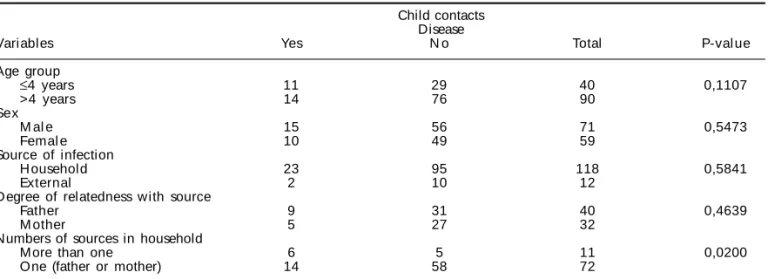
Of the contacts living with more than one relative with TB, 35.3% had developed the disease, whereas among subjects in contact with a single source of infection, even if this source was the subject’s father/ mother, 11% had developed TB.
Twenty-five cases of TB-disease were detected (13.6%), of which seven (28%) were asymptomatic and six (24%) had coughing as the single symptom. Coughing, alone or associated with fever or weight
Table 4 - Clinical data and conditions related with the source of infection among child and adolescent contacts of tuberculosis patients. Rio de Janeiro, 1995-1997.
Child contacts Disease
Variables Yes N o Total P-val ue
Age group
≤4 years 11 29 40 0,1107
>4 years 14 76 90
Sex
M al e 15 56 71 0,5473
Femal e 10 49 59
Source of infection
H ousehold 23 95 118 0,5841
External 2 10 12
Degree of relatedness with source
Father 9 31 40 0,4639
M other 5 27 32
Numbers of sources in household
More than one 6 5 11 0,0200
One (father or mother) 14 58 72
Table 2 - Tuberculin skin test distribution by age group in 184 contacts of tuberculosis patients. Rio de Janeiro, 1995-1997.
Tuberculin testing
Age N on- W eakl y Strongl y reacti ve N ot Total
group reacti ve reacti ve 10-14mm ≥15mm tested
< 1 5 1 3 - 3 12
1-4 20 2 8 29 - 59
5-9 21 6 15 26 - 68
10-15 9 7 18 11 - 45
Total 55 16 44 66 3 184
Table 3 - Correlation between tuberculin testing and source of infection in 184 child contacts of tuberculosis patients. Rio de Janeiro, 1995-1997.
Tuberculin testing (mm) Age group
Source 0-4 5-9 10-14 ≥15 Not tested Total
H ousehold
1 source 45 15 38 53 2 153
>1 source 5 - 3 9 - 17
External 5 1 3 4 1 14
" Rev Saúde Pública 2004;38(3) www.fsp.usp.br/rsp
Controle de comunicantes de tuberculose Caldeira ZMR et al
loss, was the symptom most frequently reported among subjects with disease. Mediastinal adenomegaly was the most frequent radiological finding (48%). Table 4 describes clinical and source-related findings. No sta-tistically significant difference was observed between children under and above age four years, nor between sexes (Table 4). A greater frequency of illness was ob-served among children in contact with more than one household source (p=0.02).
TB diagnosis was made based on epidemiologi-cal, cliniepidemiologi-cal, and radiological data in 14 (56%) of the 25 children with disease. The other 11 cases (44%) were also confirmed by sputum culture. All children with disease had been vaccinated with BCG at birth. No disseminated forms of the disease were observed. Subjects with disease were treated accor-ding to MoH recommendations.
D ISCU SSIO N
The present study – in which 75% of contacts were asymptomatic – identified 25 cases of TB (13.6%) through contact investigation, a high rate when com-pared to other studies conducted in Brazil. In a study conducted in São Paulo, Morrone and Solha15 re-ported a 3.8% TB incidence among contacts aged 0-15 years. However, higher rates were observed in other countries. In Canada (0-15-year-old contacts) and South Africa (underfive contacts), 38% and 34% TB occurrence were reported, respectively.9
Malnutrition is a risk factor for TB, since malnour-ished children tend to have weaker immunological response and general defense mechanisms.9 In the present study, 26.9% of children were malnourished, a prevalence similar to that encountered by Beyers et al.9 in South Africa.
Most of the children included in the present study came from low-income families; 92.4% were house-hold contacts and 88.6% of cases were bacilliferous, which indicates a high risk of transmission between contacts. This happened in spite of BCG vaccination having been verified in 98.4% of cases. Several stud-ies have recognized the importance of contact prox-imity in case of contacts with positive sputum smears.17 In a study conducted in Texas, Chapman and Dyerly10 highlight that, in poorer households, crowding and poor living standards favor TB transmission.
In the present sample, father and mother were equally frequent as sources of infection. The impor-tance of household transmission has been described previously in the literature, relating disease severity with the child’s age and with the proximity of
con-tact, especially when the source is the mother.9,12,13,16
No disseminated forms of TB were observed in the present study; all 25 children with disease had re-ceived a dose of BCG vaccine at birth. Despite this high coverage, it must be considered that individuals exposed to bacilliferous patients, even though im-munized, are considered as being at high risk of in-fection, and that recently infected individuals have a greater probability of developing the disease.23 Beyers et al.9 reported that 34% of underfive contacts had the disease and 14% were infected, despite 98.7% of them having received BCG vaccination.
In the present sample, tuberculin skin tests were performed on 181 contacts, of which 60.8% were strong reactors and 36.5% of these had reactions = 15mm. Tuberculin reactions may be due to infec-tion by M. tuberculosis, BCG vaccinainfec-tion, and in-fection by other mycobacteria. It is believed, how-ever, that the possibility of a cross reaction decreases when the diameter of the induration exceeds 10mm.24 The American Thoracic Society4 and the American Academy of Pediatrics2 consider as positive tuber-culin reactions those = 5mm in children at high risk of infection, such as those exposed to bacilliferous patients; reactions = 15mm are considered as posi-tive in any individual. Sant’Anna et al18 consider tu-berculin reactions larger than 10mm in individuals un-vaccinated with BCG or who received the vaccine more than two years prior to testing as suggestive of TB infec-tion, as are those larger than 15mm, regardless of having received a first dose of BCG. A positive tuberculin test must be interpreted as a marker of infection, even in previously vaccinated individuals. In our sample, 60.8% (N=110) of vaccinated children (181) were strongly re-active to tuberculin. In order to detect TB infection, in addition to the size of the reaction, child age and time since vaccination were also considered.18 Of the revaccinated children, 44.5% had reactions = 10mm and 37% had reactions = 15mm. Although reactions larger than 15mm are more probably correlated with infection by M. tuberculosis,21 tuberculin reactivity may be influenced by prior vaccination.11
#
Rev Saúde Pública 2004;38(3) www.fsp.usp.br/rsp
Controle de comunicantes de tuberculose Caldeira ZMR et al
demonstrated, based on a mathematical model, that BCG vaccination at that stage of life did not affect infection risk calculations, thus qualifying the TST for that purpose.7 On the other hand, since the present study involved only contacts of TB patients, and con-sidering that M. tuberculosis elicits a more potent and long-lasting immunogenic response than BCG vaccination,7 one can assume that more intense tu-berculin reactions are a sign of TB infection, and that the role of BCG has been minimized. Likewise, revaccination with BCG, ongoing in Rio de Janeiro since 1994, is not likely to have interfered with TST results in the present study. Revaccination, which would promptly restore tuberculin allergy in children vaccinated with BCG at birth, but would not interfere in the cutaneous reactivity of TB-infected children,8,11 had been given only to a small share of children at the time of data collection. We chose, in the present study, not to consider children revaccinated with BCG who were reactive to the test as infected for purposes of chemoprophylaxis eligibility.
For 56% of the TB cases in our study, diagnosis was made without bacteriological confirmation, since, according to Starke,22 positive TSTs, abnormal radio-graphs, and history of contact with adults with TB form the ‘triad’ responsible for most child TB diag-noses worldwide, due to the low efficacy of, and tech-nical difficulties involved in child TB diagnostics.
Mediastinal adenomegaly was the most important radiological finding among contacts in the present study. Of the 25 children with altered chest radio-graphs, seven (28%) were completely asymptomatic and six (24%) had coughing as their only symptom. These cases would probably not have been detected were it not for contact tracking. The rareness and unspecificity of TB symptoms hinder the diagnosis of pulmonary TB in children.20 Similarly, López et al.,12 in Madrid, report that 38.2% of 149 cases of child TB studied had been diagnosed through his-tory of contact with adults with TB and radiological alterations, despite being asymptomatic.
Of the 76 children considered as infected in the present study, 54 underwent chemoprophylaxis accord-ing to the official recommendations valid at the time. The remaining children – all of which were above age five years and vaccinated with BCG – once the possi-bility of disease was discarded, were referred to expect-ant conduct, that is, were advised to return to the healthcare facility for evaluation in case of respiratory symptoms, fever, or weight loss. The indication of
pre-ventive therapy for vaccinated children or for children older than five years was due to these children – some of which were also malnourished – being in intimate contact with bacilliferous adults, and to tuberculin conversion. 7,18 The MoH currently recommends pre-ventive therapy for children under age 15 years who are contacts of bacilliferous TB patients, have no sign of active TB, and have not received BCG vaccination but are TST reactive at = 10mm, or who have received BCG but are reactive at = 15mm.14
Of the 25 cases of TB in the present study, 23 were household contacts, which highlights the importance of contact proximity to the risk of infection. The child’s parents were the most frequent source of infection. However, a greater percentage of disease was observed in cases of more than one source of infection in the household in comparison with cases with a single source, even if the latter was one of the child’s parents. Among children who were household contacts of more than one person with TB, 35.3% developed the disease. When the source of infection was the child’s mother or father, 12.4% of children developed the disease. It has been shown that the probability of infection is proportional to the con-centration of bacilli in the environment.17
There are numerous difficulties in controlling TB contacts in the Brazilian scenario. Although official norms recommend that all contacts of TB patients be screened, 6 the lack of resources for healthcare, typi-cal of developing countries, in which TB incidence is high, causes a shift in attention to the treatment of the existing cases of the disease. Children fail to be evaluated due to cultural and socioeconomic factors and to failures in healthcare management. Limita-tions inherent to the healthcare system prevent the early diagnosis of a large number of TB cases, thereby increasing disease transmission. In São Paulo, Arantes et al,6 report that diagnoses of TB cases among con-tacts in healthcare facilities represented only a small share (2-3%) of the total cases diagnosed, which sug-gests that the control among this risk group is almost entirely absent.
$ Rev Saúde Pública 2004;38(3) www.fsp.usp.br/rsp
Controle de comunicantes de tuberculose Caldeira ZMR et al
REFEREN CES
1. Alves R, Sant’anna CC, Cunha AJL. A Epidemiologia da tuberculose infantil na cidade do Rio de Janeiro, RJ. Rev Saúde Pública 2000;34:409-10.
2. American Academy of Pediatrics. Screening for tuberculosis in infants and children. Pediatrics 1994;93:131-4.
3. American Thoracic Society. Control of tuberculosis in the United States. Am Rev Resp Dis 1992;146:1623-33.
4. American Thoracic Society. Diagnostic standards and classification of tuberculosis. Am Rev Respir Dis 1990;142:725-35.
5. American Thoracic Society. Preventive therapy of tuberculous infection. Am Rev Resp Dis
1974;110:371-6.
6. Arantes GR, Almeida MMMB, Nogueira PA,
Belluomini M, Lima MM, Nassar J. Monitorização das ações anti-tuberculose: implantação de uma sistemá-tica experimental em São Paulo, Brasil. Bol Pnemol Sanit 1995;3:10-25.
7. Arantes GR, Nardy SM, Weiler RMG, Belluomini M, Nogueira PA. Estimativa do risco de infecção tuberculosa em populações vacinadas pelo BCG. Rev Saúde Pública 1992;26:96-107.
8. Arantes GR, Nardy SMC, Nogueira PA. Influência dói BCG aplicado no primeiro ano de vida no perfil tuberculínico à idade escolar. Medicina (Ribeirão Preto) 1990;23:232-41.
9. Beyers N, Gie RP, Schaaf HS, Van Zyl S, Talent JM, Nel ED, Donald PR. A prospective evaluation of children under the age of 5 years living in the same household as adults with recently diagnosed pulmonary tuberculosis. Int J Tuberc Lung Dis 1997;1:38-43.
10. Chapman JS, Dyerly MD. Social and other factors in interfamilial transmission of tuberculosis. Am Rev Resp Dis 1964;90:48-60.
11. Lee VK. Revisão bibliográfica: teste tuberculínico nos dias de hoje. Bol Pneumol Sanit 1998;6:58-80.
12. Lopez MLV, Marin MJC, Miguel MJG, Andrés CB, Martin FC,Gómez MJ. Tuberculosis pulmonar en la infancia: a propósito de 149 casos. An Esp Pediatr 1990;32:15-9.
13. Maniar BM. Prevention of tuberculosis in infancy. Indian J Pediatr 1993;60:659-67.
14. Ministério da Saúde. Fundação Nacional de Saúde. Tuberculose: guia de vigilância epidemiológica. Brasília (DF); 2002.
15. Morrone N, Solha MSS. Incidência de tuberculose -doença e de teste tuberculínico positivo em crianças expostas a pacientes com tuberculose. Importância dos fatores ligados à fonte e à criança, até mesmo vacinação prévia com BCG intradérmico. Rev Assoc Med Brasil 1983;29:182-8.
16. Nemir RL, O’Hare D. Tuberculosis in children 10 years of age and younger: three decades of experience during the chemoterapeutic era. Pediatrics 1991;88:236-41.
17. Perry S, Starke JR. Adherence to prescribed treatment and public health aspects of tuberculosis in children. Semin Pediatr Inf Dis 1993;4:291-8.
18. Sant’anna CC, Bethlem N, March MFBP, Alves R. Conduta diagnóstica em tuberculose na criança. J Pneumol 1993;19:91-5.
19. Sass P. Tuberculosis infection and disease in children. Am Fam Physician 1996;53:2087-94.
20. Schaaf HS, Beyers N, Gie RP, Nel ED, Smuts NA, Scott FE et al. Respiratory tuberculosis in childhood: the diagnostic value of clinical features and special investigations. Ped Infec Dis J 1995;14:189-94.
21. Sewell EM, O’Hare D, Kending EL. The tuberculin test. Pediatrics 1974;54:650-2.
22. Starke JR. Tuberculose na infância: diagnóstico e tratamento. An Nestlé 1998;56:10-24.
23. Starke JR, Taylor-Watts KT. Preventable childhood tuberculosis in Houston, Texas, 1985. Am Rev Resp Dis 1990;141(Suppl):A336.
24. Tuberculosis Committee. Canadian Thoracic Society. Clinical practice guidelines essentials of tuberculosis control for the practising physician. Can Med Assoc J 1994;150:1561-71.
25. Udani PM. BCG vaccination in India and tuberculosis in children: newer facets. Indian J Pediatr