Giovâni Firpo Del DucaI Marcelo Cozzensa da SilvaII Pedro Curi HallalI
I Programa de Pós-Graduação em
Epidemiologia. Faculdade de Medicina. Universidade Federal de Pelotas (UFPel). Pelotas, RS, Brasil
II Programa de Pós-Graduação em Educação
Física. Escola Superior de Educação Física. UFPel. Pelotas, RS, Brasil
Correspondence: Giovâni Firpo Del Duca
R. Marechal Deodoro, 1160 - 3º piso, Centro 96020-220 Pelotas, RS, Brasil
E-mail: [email protected] Received: 10/14/2008 Revised: 2/10/2009 Approved: 7/27/2009
Disability in relation to basic
and instrumental activities
of daily living among elderly
subjects
ABSTRACT
OBJECTIVE: To assess the prevalence of disability and associated factors in elderly, by focusing on basic and instrumental activities of daily living.
METHODS: This was a cross-sectional study on 598 subjects aged 60 years or over who were selected through two-stage cluster sampling in Pelotas, Southern Brazil, between 2007 and 2008. Basic and instrumental activities were evaluated using the Katz Index and the Lawton Scale, respectively. Disability relating to each domain was deined as the need for partial or total assistance to perform at least one activity of daily living. Poisson regression with robust variance was used in the crude and adjusted analyses, taking the cluster sampling into account.
RESULTS: The prevalence of disability relating to basic activities was 26.8% (95% CI: 23.0; 30.8). The lowest proportion of independence was in relation to controlling the urination and/or evacuation functions. In relation to instrumental activities, the prevalence of disability was 28.8% (95% CI: 24.5; 33.1), particularly in relation to moving around using means of transportation. A high proportion of the elderly subjects (21.7%) presented more than one instrumental activity with disability. In relation to basic activities, the greatest proportion presented dependence for only one activity (16.6%). In the adjusted analysis, disability relating to basic activities was associated with non-white skin color (p=0.01) and increasing age (p<0.001). Disability relating to instrumental activities was only associated with increasing age (p<0.001).
CONCLUSIONS: The association between disability relating to basic and instrumental activities and increasing age is an indicator of importance for enabling the health services to plan actions that aim to prevent or delay the occurrence of disability, thereby ensuring independence and better quality of life among the elderly.
DESCRIPTORS: Aged. Aging. Physical Fitness. Disabled Health. Disability. Activities of Daily Living. Cross-Sectional Studies.
INTRODUCTION
there were almost 400 million people aged 60 years or over living in developing countries in 2002. It has been estimated that this number will increase to around 840 million in 2025, representing 70% of the elderly people in the world.
Among the impairments that come with advancing chronological age is disability, which is characterized as any limitation in performing an activity within the range that is considered normal for human life.12 Studying functional capacity is useful for assessing elderly people’s state of health, in view of their incre-ased life expectancy and the new repercussions on these individuals’ day-to-day routines.14 Functional capacity can be evaluated by focusing on two domains: basic activities of daily living, also known self-care activities1 or personal care activities;8 and instrumental activities of daily living, also known as mobility skills1 or activities for maintaining the environment.8 The basic activities are connected with individuals’ self-care, such as feeding, having a bath/shower and dres-sing themselves. On the other hand, the instrumental activities encompass tasks of greater complexity that often relate to individuals’ social participation, such as shopping, answering the telephone and using means of transportation.
Concern for diagnosing disability in epidemiological surveys is relatively recent, especially involving analysis of both basic and instrumental activities in the same study. Such data are fundamental for creating, implementing and updating speciic care programs for elderly people, since functional capacity is an important indicator of their state of health.15 Declining functional capacity is associated with mortality within this age group.3
The prevalence of disability is also affected by elderly people’s lifestyles. In view of the concentration of population-based investigations in developed countries, which provide living conditions and healthcare that are better adapted for the elderly population, studies on this topic in developing countries like Brazil are necessary.
The present study had the aim of estimating the preva-lence and factors associated with disability in relation to basic and instrumental activities of daily living among elderly people.
a Ministério da Saúde. Departamento de Informática do Sistema Único de Saúde. Cadernos de Informações de saúde: Município Pelotas, RS, Brasil. Pelotas; 2009[cited 2009 Feb 10]. Available from: tabnet.datasus.gov.br/tabdata/cadernos/RS/ RS_Pelotas_Geral.xls
b Instituto Brasileiro de Geografia e Estatística. Cartograma municipal dos setores censitários: situação 2000 [CD-ROM]. Rio de Janeiro; 2000.
c Gazalle FK. Prevalência e fatores associados a sintomas depressivos na população de 60 anos ou mais em Pelotas, RS [master’s dissertation]. Pelotas: Universidade Federal de Pelotas; 2002.
d Ministério da Saúde. Secretaria de Atenção à Saúde. Departamento de Atenção Básica. Envelhecimento e saúde da pessoa idosa. Brasília; 2006.
METHODS
A cross-sectional population-based study was conducted in the urban zone of Pelotas, Southern Brazil, from October 2007 to January 2008. This municipality currently has a population of around 49,000 individuals aged 60 years and over.a
A two-stage cluster sampling process was used, taking the census tracts deined by the Instituto Brasileiro de
Geograia e Estatística (IBGE – Brazilian Institute for Geography and Statistics)b in the 2000 census, as the primary sampling units. The tracts were drawn systematically, with probabilities proportional to the number of households and stratiication according to the mean family income of the families’ heads. From each census tract drawn, an average of 11 households was systematically sampled. In the end, 126 census tracts and 1,534 households were included in the study. In each household sampled, all individuals aged 60 years or over were considered eligible for the study.
In the sample size calculations for the prevalence of and factors associated with disability in relation to basic and instrumental activities, the largest estimated sample required was 511 subjects, resulting from the association between disability in relation to basic acti-vities and schooling level. This was obtained from the following parameters and estimates: 95% conidence interval, power of 80%, estimated prevalence of disa-bility relating to basic activities of 20% and additional quantities of 10% for losses and refusals and 15% for adjusted analyses. A previous studyc conducted on the elderly population of Pelotas showed a ratio of 0.37 elderly people per household in the urban zone of the municipality, thus indicating that 1,381 households would need to be included in the sample.
and eight instrumental activities (using the telephone, going to distant places by using a means of transporta-tion, shopping, tidying up the home, washing clothes, preparing meals, taking medications and managing money). For each activity of daily living evaluated, three alternative responses were proposed, relating to the categories of independence, need for partial assis-tance or need for full assisassis-tance/inability to perform the activity. In cases in which the interviewee said that he did not perform a given activity during his day-to-day routine, he was asked to think about doing this on a public holiday or weekend. If the doubt persisted, because the interviewee really did not carry out the activity under investigation, he was asked whether, if it were necessary, he would do that activity without another person’s assistance. Disability relating to the basic and instrumental activities was deined in the same manner: need for partial or full assistance for at least one of the daily activities investigated.
The independent variables studied were the following: sex (male or female); age (categorized into ive groups: 60-64; 65-69; 70-74; 75-79; or ≥ 80 completed years); self-reported skin color (white or mixed/black/others); current marital status (dichotomized into single/ separated/widowed or married/stable partnership); schooling level (categorized into four groups: 0-4; 5-8; 9-11; or ≥ 12 completed years); and economic level (in accordance with the standardized questionnaire of the Brazilian Association of Survey Companies,a from which scores divided into quintiles were obtained).
Descriptive statistics were used to calculate propor-tions and their respective 95% conidence intervals (95% CI) for categorical variables, along with means, amplitudes and standard deviations (SD) for numerical variables. In the crude analysis, the Pearson chi-square and linear trend tests were used, and values with p ≤ 0.05 were taken to be statistically signiicant. In the adjusted analysis, Poisson regression with robust variance was used and the results were expressed as prevalence ratios.2 For statistical modeling, the stra-tegy of backward selection and a critical level of p ≤ 0.20 were used for variables to remain in the model, to control for confounding factors. All the analyses took into consideration the cluster sampling design.
The Epi Info software, version 6.04d was used for double data entry, with the aim of checking for possible inconsistencies. The data analysis was performed using the Stata software, version 9.0.
The research protocol was approved by the Research Ethics Committee of the School of Medicine of the Universidade Federal de Pelotas and the ethical criteria of the Declaration of Helsinki were respected.
RESULTS
Out of the 644 eligible subjects, 46 (7.1%) were consi-dered to be losses or refusals (23 men and 23 women). Among the 598 subjects interviewed, 91.8% answered the questionnaire by themselves and the others were aided by a caregiver or other person responsible for the elderly subject.
A majority of the participants were women (62.9%). The subjects’ ages ranged from 60 to 104 years, with a mean age of 69.4 years (SD = 7.5) for the men and 71.0 years (SD = 9.3) for the women. Just over 16% of the elderly people were 80 years old or over, and there were twice as many women as men in this age group. Most of the interviewees said that their skin color was white (80.1%). Regarding their current marital status, men and women had different frequencies: while 80.2% of the men said they were married or in a stable relationship, only 34.7% of the women were in this category. Regarding schooling, 27.5% of the men had attended school for nine years or more, while 18.4% of the women had done this. Table 1 shows the description of the whole sample and the stratiication according to sex for the independent variables studied.
Table 2 presents each of the basic and instrumental acti-vities of daily living in relation to the elderly subjects’ degrees of dependence. Among self-care activities, the lowest proportions of independence were observed in relation to controlling the functions of urination and/ or evacuation (78.7%), followed by getting dressed (90.1%) and having a bath/shower (91.1%). Regarding the instrumental activities, the elderly people were least independent in relation to moving around using a means of transportation (82.4%), shopping (83.9%) and washing clothes (84.1%).
The Figure shows the frequencies of activities in which the elderly subjects presented disability in relation to the basic and instrumental domains. It was noted among the individuals with disabilities that the presence of this outcome in just one basic activity was much more frequent than the presence of this outcome in just one instrumental activity (16.6% versus 7.4%). Among the 99 elderly subjects (16.6%) who presented disability relating to just one basic activity, 85 (85.9%) reported that they could not fully control the functions of urination and/or evacuation. On the other hand, greater accumulations of instrumental activities for which they present disability were observed, such that 10.4% of the subjects reported disabilities relating to two to four activities and 11.3% presented ive or more instrumental activities for which they were disabled.
The prevalence of disability relating to basic activities was 26.8% (95% CI: 23.0;30.8) and for instrumental
a Associação Brasileira de Empresas de Pesquisa. Critério de Classificação Econômica Brasil. São Paulo; 2003[cited 2007 Jun 16]. Available
activities, it was 28.8% (95% CI:24.5;33.1). The intraclass correlation coeficients were, respectively, 0.015 and 0.073, with design effects of 1.10 and 1.36. A majority of the elderly subjects (60%) did not present disabilities relating to any of the domains, while 11% presented dependence only for basic activities, 13% presented dependence only for instrumental activities and 16% presented disabilities in both domains.
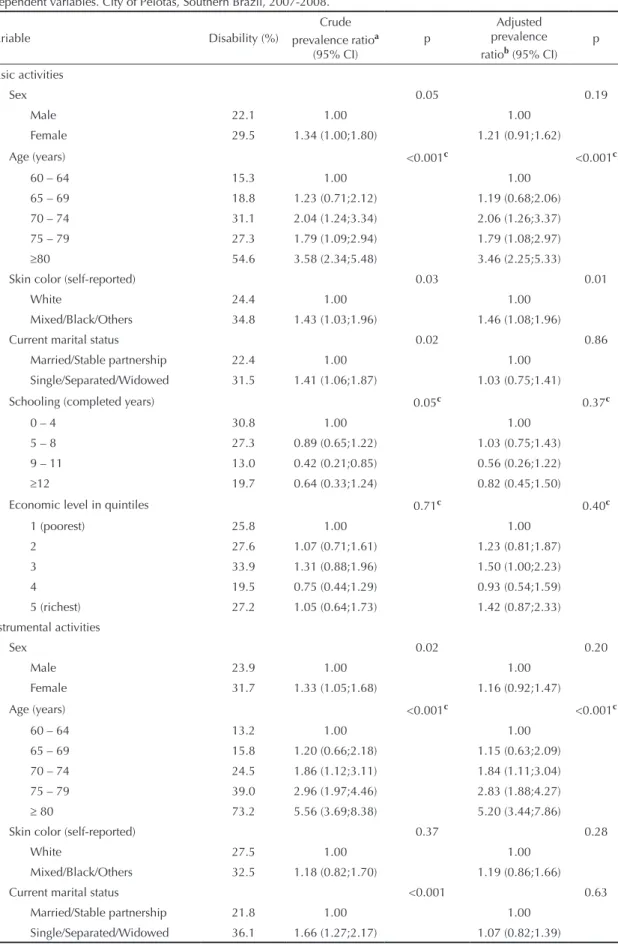
Given that the factors associated with disability rela-ting to basic and instrumental activities were similar between the sexes, only analyses for the whole sample were presented. In the crude analysis on disability rela-ting to basic activities, the following were associated with the outcome: female sex, mixed/black/other skin color and current marital status of being single/sepa-rated/widowed. In the same analysis, disability was seen to present a direct association with age and an inverse association with schooling level. However, in the adjusted analysis, the outcome was only associated with mixed/black/other skin color (p = 0.01) and with increasing age (p < 0.001). Thus, the prevalence of disa-bility in relation to basic activities among individuals
aged 80 years or over was 3.46 times higher than the prevalence among those aged 60 to 64 years.
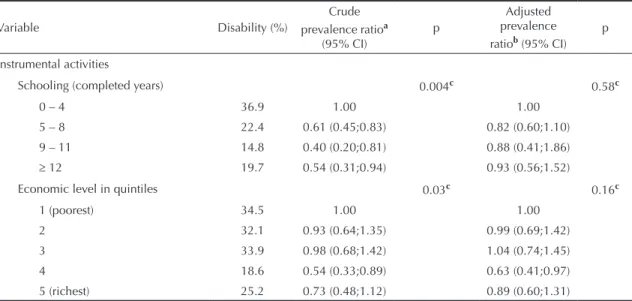
In the crude analysis on disability relating to instru-mental activities, female sex and conjugal situation of being single/separated/widowed presented greatest risk of the outcome. Furthermore, tendencies towards increased prevalence of the outcome with increasing age and decreasing economic and schooling levels were demonstrated. However, after adjustment, disability relating to instrumental activities was only associated with increasing age (p < 0.001).
DISCUSSION
The process of determining the presence of and inter-preting disability is complex because of the great variety and lack of standardization between the instruments used,13 along with differences in the cutoff points used in analyzing the results. This ends up adding dificulty to interpretations and comparisons of the indings.
A recent study17 carried out in seven countries in Latin America and the Caribbean among elderly people aged
Table 1. Sociodemographic characteristics of the elderly people studied. City of Pelotas, Southern Brazil, 2007-2008.
Variable Men (n = 222) Women (n = 376) Total (n = 598)
n % n % n %
Age (years)
60 – 64 75 33.8 115 30.6 190 31.8
65 – 69 44 19.8 84 22.3 128 21.4
70 – 74 47 21.2 59 15.7 106 17.7
75 – 79 34 15.3 43 11.4 77 12.9
≥ 80 22 9.9 75 20.0 97 16.2
Skin color (self-reported)
White 185 83.7 291 78.0 476 80.1
Mixed/Black/Others 26 16.3 82 22.0 118 19.9
Current marital status
Married/Stable partnership 178 80.2 130 34.7 308 51.6
Single/Separated/Widowed 44 19.8 245 65.3 289 48.4
Schooling (completed years)
0 – 4 91 41.0 211 56.3 302 50.6
5 – 8 70 31.5 95 25.3 165 27.6
9 – 11 26 11.7 28 7.5 54 9.1
≥ 12 35 15.8 41 10.9 76 12.7
Economic level in quintilesa, b
1 (poorest) 37 17.1 83 22.6 120 20.5
2 43 19.8 91 24.7 134 22.9
3 41 18.9 74 20.1 115 19.7
4 54 24.8 59 16.0 113 19.3
5 (richest) 42 19.4 61 16.6 103 17.6
75 years or over found that the greatest prevalences of disability relating to basic activities were in Chile (34.7%), Mexico (30.2%), Argentina (32.1%) and Brazil (28.6%). With regard to instrumental activities, the occurrences of disability were greatest in Brazil (33.8%), Chile (30.3%), Argentina (27.6%) and Cuba (26.7%). The variation in the prevalences of the outcomes studied among the countries was explained by differences in the numbers of years of schooling among the target population, the environmental characteristics of the infrastructure provided for elderly people in the cities investigated and cultural factors relating to the protec-tion provided for elderly people in certain places.
In a comparison between different regions of Brazil,14 greatest prevalence of disability was found among elderly women in the northern region (19.6%). The lowest prevalence was in the southern region (14.7%). These indings were probably due to regional dispari -ties relating to disability, depending on demographic, socioeconomic, behavioral and health proiles of these two populations.
In the present study, the prevalences of disability relating to basic and instrumental activities were very similar, and this was also found in a study on elderly people living in the city of São Paulo, Southeastern Brazil.17 Because of the use of different cutoff points in the literature, comparisons between the prevalences
of disability relating to the two types of activity are complex. Previous Brazilian studies5,16 found that more than half of elderly people were completely indepen-dent regarding basic activities of daily living, and the indings from the present study are in line with those results. However, in our study, the proportions of indi-viduals with disability relating just to basic or instru-mental activities stood out. Thus, it becomes important to evaluate the different domains of functional capacity, since a considerable proportion of our elderly subjects did not present aggregation of disability between basic and instrumental activities.
With regard to self-care activities, the highest preva-lence of disability related to controlling the functions of urination and/or evacuation, followed by the acts of getting dressed and having a bath/shower. Among the individuals with disability relating to basic activities, the great majority presented disability in only one activity. Most of these cases consisted of urinary and/ or fecal incontinence, which generally are seen erro-neously as part of the natural process of aging among the population. Among the instrumental activities, the most frequent occurrences of disability were in relation to moving around using a means of transportation, shopping and washing clothes, respectively. Contrary to what was seen in relation to basic activities, disability relating to instrumental activities mostly occurred in an accumulated manner, which depicts the complexity
Table 2. Description of the degree of dependence in relation to the basic and instrumental activities of daily living among elderly people. City of Pelotas, Southern Brazil, 2007-2008.
Activity Independent individuals
Individuals needing partial assistance
Individuals needing full assistance or unable to
perform the activity
n % n % n %
Basic activities
Having a bath/shower 545 91.1 16 2.7 37 6.2
Getting dressed 539 90.1 29 4.9 30 5.0
Going to the bathroom 567 94.9 14 2.3 17 2.8
Lying down on and getting up from
bed/chair 552 92.3 31 5.2 15 2.5
Feeding 581 97.2 9 1.5 8 1.3
Urination and/or evacuation 471 78.7 108 18.1 19 3.2
Instrumental activities
Using the telephonea 522 87.4 28 4.7 47 7.9
Using means of transportation 493 82.4 35 5.9 70 11.7
Shopping 502 83.9 25 4.2 71 11.9
Tidying the home 509 85.2 21 3.5 68 11.4
Preparing meals 533 89.1 13 2.2 52 8.7
Washing clothes 503 84.1 16 2.7 79 13.2
Managing money 528 88.2 29 4.9 41 6.9
Taking medications 520 86.9 35 5.9 43 7.2
Table 3. Crude and adjusted analysis on disability in relation to basic and instrumental activities of daily living, according to independent variables. City of Pelotas, Southern Brazil, 2007-2008.
Variable Disability (%)
Crude prevalence ratioa
(95% CI)
p
Adjusted prevalence ratiob (95% CI)
p
Basic activities
Sex 0.05 0.19
Male 22.1 1.00 1.00
Female 29.5 1.34 (1.00;1.80) 1.21 (0.91;1.62)
Age (years) <0.001c <0.001c
60 – 64 15.3 1.00 1.00
65 – 69 18.8 1.23 (0.71;2.12) 1.19 (0.68;2.06)
70 – 74 31.1 2.04 (1.24;3.34) 2.06 (1.26;3.37)
75 – 79 27.3 1.79 (1.09;2.94) 1.79 (1.08;2.97)
≥80 54.6 3.58 (2.34;5.48) 3.46 (2.25;5.33)
Skin color (self-reported) 0.03 0.01
White 24.4 1.00 1.00
Mixed/Black/Others 34.8 1.43 (1.03;1.96) 1.46 (1.08;1.96)
Current marital status 0.02 0.86
Married/Stable partnership 22.4 1.00 1.00
Single/Separated/Widowed 31.5 1.41 (1.06;1.87) 1.03 (0.75;1.41)
Schooling (completed years) 0.05c 0.37c
0 – 4 30.8 1.00 1.00
5 – 8 27.3 0.89 (0.65;1.22) 1.03 (0.75;1.43)
9 – 11 13.0 0.42 (0.21;0.85) 0.56 (0.26;1.22)
≥12 19.7 0.64 (0.33;1.24) 0.82 (0.45;1.50)
Economic level in quintiles 0.71c 0.40c
1 (poorest) 25.8 1.00 1.00
2 27.6 1.07 (0.71;1.61) 1.23 (0.81;1.87)
3 33.9 1.31 (0.88;1.96) 1.50 (1.00;2.23)
4 19.5 0.75 (0.44;1.29) 0.93 (0.54;1.59)
5 (richest) 27.2 1.05 (0.64;1.73) 1.42 (0.87;2.33)
Instrumental activities
Sex 0.02 0.20
Male 23.9 1.00 1.00
Female 31.7 1.33 (1.05;1.68) 1.16 (0.92;1.47)
Age (years) <0.001c <0.001c
60 – 64 13.2 1.00 1.00
65 – 69 15.8 1.20 (0.66;2.18) 1.15 (0.63;2.09)
70 – 74 24.5 1.86 (1.12;3.11) 1.84 (1.11;3.04)
75 – 79 39.0 2.96 (1.97;4.46) 2.83 (1.88;4.27)
≥ 80 73.2 5.56 (3.69;8.38) 5.20 (3.44;7.86)
Skin color (self-reported) 0.37 0.28
White 27.5 1.00 1.00
Mixed/Black/Others 32.5 1.18 (0.82;1.70) 1.19 (0.86;1.66)
Current marital status <0.001 0.63
Married/Stable partnership 21.8 1.00 1.00
Single/Separated/Widowed 36.1 1.66 (1.27;2.17) 1.07 (0.82;1.39)
To be continued
of carrying out these activities. These results resemble those of a recent Brazilian study,19 which among various activities of daily living, found greatest frequencies of disability relating to the following basic activities: cutting toenails, having a bath/shower and getting dressed; and to the following instrumental activities: shopping, going up and down stairs and taking medi-cines at the right time.
Among the independent variables investigated, an association was found between disability relating to
basic activities and mixed/black/other skin color. In the speciic case of the population studied, which was from a developing country, this inding needs to be inter -preted with caution, given the social inequalities that permeate society, thereby differentiating the exposures over the course of life according to ethnic differences. One hypothesis for such an association would be that it is inluenced by socioeconomic level, but even after adjusting for economic and schooling levels in the analyses, the association persisted. In addition, the interaction between skin color and economic level was tested and no interaction was found (p = 0.98).
Both for basic activities and for instrumental activities, advancing age was associated with greater occurrences of disability. Chronological age progression, along with the aging process itself are directly related to higher levels of disability, and this has been well described in the literature.3,8,18,19
Like some other studies,9,18 the present study did not ind that disability relating to basic and instrumental activities did not present any association with female sex, or even with worse economic and schooling levels. The signiicant effect observed in the crude analysis in relation to women and individuals with worse socioeconomic conditions disappeared in the adjusted analysis because of the presence of the confounding factor of age.
A recent publication from WHO focusing on population aging20 sought to give advice aimed at active longevity, based on the trio of participation, health and security. Participation should be continuous with regard to social, economic, spiritual and civic questions, and ≥
≥
≥
Table 3 continuation
Variable Disability (%)
Crude prevalence ratioa
(95% CI)
p
Adjusted prevalence ratiob (95% CI)
p
Instrumental activities
Schooling (completed years) 0.004c 0.58c
0 – 4 36.9 1.00 1.00
5 – 8 22.4 0.61 (0.45;0.83) 0.82 (0.60;1.10)
9 – 11 14.8 0.40 (0.20;0.81) 0.88 (0.41;1.86)
≥ 12 19.7 0.54 (0.31;0.94) 0.93 (0.56;1.52)
Economic level in quintiles 0.03c 0.16c
1 (poorest) 34.5 1.00 1.00
2 32.1 0.93 (0.64;1.35) 0.99 (0.69;1.42)
3 33.9 0.98 (0.68;1.42) 1.04 (0.74;1.45)
4 18.6 0.54 (0.33;0.89) 0.63 (0.41;0.97)
5 (richest) 25.2 0.73 (0.48;1.12) 0.89 (0.60;1.31)
a Crude prevalence ratio b Adjusted prevalence ratio c Linear trend
Figure 1. Frequencies of activities in which the elderly sub-jects presented disability in relation to the basic and instru-mental domains (basic activities of daily living, BADLs, and instrumental activities of daily living, IADLs). City of Pelotas, Southern Brazil, 2007-2008.
73,2
71,2 7,4
6,3 16,6
10,4
3,8 11,3
0% 20% 40% 60% 80% 100% AIVD
ABVD
Sematividade
Uma atividade
Duas a quatro atividades
not just regarding the capacity to be physically active or to be part of the labor force. Concerning health, the WHO publication emphasizes the importance of low occurrences of disabilities and chronic diseases, along with access to social and health services for those who really need assistance. Regarding social, physical and inancial security, the perspective that should be taken is one that aims to ensure protection, dignity and assistance for the most elderly segment of the population. In Brazil, federal laws such as the Statute for the Elderlya have been created with the intention of guaranteeing comprehensive care and attention through the Sistema Único de Saúde (Brazilian National Health System), with emphasis on promoting healthy aging and maintaining elderly people’s functional capacity, among other aspects. Such actions are indicative of growing concern among healthcare bodies regarding attention towards elderly people’s health and living conditions, and especially towards preservation of functional capacity.
One important point that should be taken into considera-tion regarding the present study is the low percentage of non-respondents (7.1%). This minimized the selection bias and contributed towards the internal validity of the study. Moreover, evaluation of the two domains of functional capacity enabled greater comprehension of prevalences, associated factors and relationships between accumulations of disabilities relating to self-care and instrumental activities.
Nonetheless, certain limitations of the present study need to be noted. Firstly, it was decided not to analyze certain behavioral and health-related variables of elderly people as potential factors associated with disability. In addition, non-inclusion of individuals living in long-term institutions for elderly people may have underestimated the prevalences of the outcomes.
However, after checking the unpublished records of the Municipal Health Department of Pelotas, it was seen that there were around 400 elderly people living in such institutions, thus representing less than 1% of this age group within the municipality. Furthermore, in the instrument applied, it was implicit that the activities investigated would form part of the interviewees’ day-to-day routine. Although it was rare for this perspective not to be conirmed, the elderly individuals in such cases were encouraged to think of the possibility of whether, if necessary, they would perform such tasks without help from another person.
The conirmation that the human process of population aging is growing exponentially in middle and low-income countries strengthens the need for preventive actions focusing on the health and living conditions of the elderly population. Public facilities with adequate and safe infrastructure for leisure activities, along with promotion of physical activity groups for elderly people, are options that have been proven to provide improvements in such individuals’ quality of life.4
Disability is a strong predictor of mortality among elderly populations.3 This should therefore be taken into account in routine diagnostic assessments made by healthcare professionals who deal with this target population. Elderly people’s functional capacities are an important indicator of their degree of independence, and of the need for preventive measures or even therapeutic interventions that reduce the mechanisms affecting the decline in individuals’ abilities to perform different day-to-day physical and mental functions. The great challenge for public health over the coming decades lies in diagnosing and preventing the possible risks associated with disability, within the search for longe-vity with greater independence, autonomy and quality of life for elderly people.
a Brasil. Lei no 10.741, de 1º de outubro de 2003. Dispõe sobre o Estatuto do Idoso e dá outras providências. Diario Oficial Uniao. 3 out
1. Aijänseppä S, Notkola IL, Tijhuis M, van Staveren W, Kromhout D, Nissinen A. Physical functioning in elderly Europeans: 10 year changes in the north and south: the HALE project. J Epidemiol Community Health.
2005;59(5):413-9. DOI: 10.1136/jech.2004.026302 2. Barros AJ, Hirakata VN. Alternatives for logistical
regression in cross-sectional studies: an empirical comparison of models that directly estimate the prevalence ratio. BMC Med Res Methodol. 2003;3:21. DOI: 10.1186/1471-2288-3-21
3. Ben-Ezra M, Shmotkin D. Predictors of mortality in the old-old in Israel: the Cross-sectional and Longitudinal Aging Study. J Am Geriatr Soc. 2006;54(6):906-11. DOI: 10.1111/j.1532-5415.2006.00741.x 4. Benedetti T, Gonçalves L, Mota J. Uma proposta de
política pública de atividade física para idosos. Texto
Contexto Enferm. 2007;16(3):387-98. DOI: 10.1590/
S0104-07072007000300003
5. Coelho Filho JM, Ramos LR. Epidemiologia do envelhecimento no Nordeste do Brasil: resultados de inquérito domiciliar. Rev Saude Publica.
1999;33(5):445-53. DOI: 10.1590/S0034-89101999000500003
6. Costa MFFL, Uchoa E, Guerra HL, Firmo JO, Vidigal PG, Barreto SM. Estudo de Bambuí sobre saúde e envelhecimento: metodologia e resultados preliminares de coorte de estudo de idosos no Brasil.
Rev Saude Publica. 2000;34(2):126-35. DOI: 10.1590/
S0034-89102000000200005
7. Deschamps V, Astier X, Ferry M, Rainfray M, Emeriau JP, Barberger-Gateau P. Nutritional status of healthy elderly persons living in Dordogne, France, and relation with mortality and cognitive or functional decline. Eur J Clin Nutr. 2002;56(4):305-12. DOI: 10.1038/sj.ejcn.1601311
8. Espejo Espejo J, Martinez de la Iglesia J, Aranda Lara JM, Rubio Cuadrado V, Enciso Berge I, Zunzunegul Pastor MV, et al. Capacidad funcional en mayores de 60 anos y factores sociosanitarios asociados (proyecto ANCO). Aten Primaria. 1997;20(1):3-11.
9. Giacomin K, Peixoto S, Uchoa E, Lima-Costa M. Estudo de base populacional dos fatores associados à incapacidade funcional entre idosos na Região Metropolitana de Belo Horizonte, Minas Gerais, Brasil. Cad Saude Publica. 2008;24(6):1260-70. DOI: 10.1590/S0102-311X2008000600007
10. Katz S, Ford AB, Moskowitz RW, Jackson BA, Jaffe MW. Studies of Illness in the Aged. the Index of Adl: a Standardized Measure of Biological and Psychosocial Function. JAMA. 1963;185:914-9.
11. Lawton MP, Brody EM. Assessment of older people: self-maintaining and instrumental activities of daily living. Gerontologist. 1969;9(3):179-86.
12. Murray C, Lopez A, editors. The global burden of disease. Boston: Harvard University Press; 1996. 13. Paixão Jr CM, Reichenheim ME. Uma revisão sobre
instrumentos de avaliação do estado funcional do idoso. Cad Saude Publica. 2005;21(1):7-19. DOI: 10.1590/S0102-311X2005000100002
14. Parahyba MI, Veras R, Melzer D. Incapacidade funcional entre as mulheres idosas no Brasil. Rev
Saude Publica. 2005;39(3):383-90. DOI: 10.1590/
S0034-89102005000300008
15. Ramos LR. Fatores determinantes do envelhecimento saudável em idosos residentes em centro
urbano: Projeto Epidoso, São Paulo. Cad Saude
Publica. 2003;19(3):793-8. DOI:
10.1590/S0102-311X2003000300011
16. Ramos LR, Rosa TE, Oliveira ZM, Medina MC, Santos FR. Perfil do idoso em área metropolitana na região sudeste do Brasil: resultados de inquérito domiciliar.
Rev Saude Publica. 1993;27(2):87-94. DOI: 10.1590/
S0034-89101993000200003
17. Reyes-Ortiz CA, Ostir GV, Pelaez M, Ottenbacher KJ. Cross-national comparison of disability in Latin American and Caribbean persons aged 75 and older.
Arch Gerontol Geriatr. 2006;42(1):21-33. DOI:
10.1016/j.archger.2005.06.006
18. Rosa TE, Benicio MH, Latorre MR, Ramos LR. Fatores determinantes da capacidade funcional entre idosos.
Rev Saude Publica. 2003;37(1):40-8. DOI: 10.1590/
S0034-89102003000100008
19. Tavares DMS, Pereira GA, Iwamoto HH, Miranzzi SSC, Rodrigues LR, Machado ARM. Incapacidade funcional entre idosos residentes em um município do interior de Minas Gerais. Texto Contexto
Enferm. 2007;16(1):32-9. DOI:
10.1590/S0104-07072007000100004
20. World Health Organization. Envelhecimento ativo: uma política de saúde. Trad. de S Gontijo. Brasília: Organização Pan-Americana da Saúde; 2005.
REFERENCES