Francisco I BastosI Neilane BertoniI Mariana A HackerI,II Grupo de Estudos em
População, Sexualidade e Aids*
I Laboratório de Informações em Saúde. Instituto de Comunicação e Informação Científi ca e Tecnológica em Saúde. Fundação Oswaldo Cruz (Fiocruz). Rio de Janeiro, RJ, Brasil
II Laboratório de Hanseníase do
Departamento de Micobacterioses. Instituto Oswaldo Cruz. Fiocruz. Rio de Janeiro, RJ, Brasil
* (Study Group on Population, Sexuality and AIDS) members: Elza Berquó, Francisco Inácio Pinkusfeld Bastos, Ivan França Junior, Regina Barbosa, Sandra Garcia, Vera Paiva, Wilton Bussab.
Correspondence: Francisco I. Bastos
Laboratório de Informações em Saúde Instituto de Comunicação e Informação Científi ca e Tecnológica em Saúde Fundação Oswaldo Cruz
Av. Brasil, 4.365 - Pavilhão Haity Moussatché 21040-900 Rio de Janeiro, RJ, Brasil E-mail: [email protected] ocruz.br Received: 7/31/2007 Reviewed: 2/8/2008 Approved: 3/25/2008
Drug and alcohol use: main
fi ndings of a national survey,
Brazil 2005
ABSTRACT
OBJECTIVE: To assess alcohol and drug use in a representative sample of the
urban Brazilian population and their correlation with sexual and reproductive health.
METHODS: Data from a national population-based survey with a complex
sampling, performed in 2005 was used. A total of 5,040 individuals from both genders, in the age group from 16 to 65 years old, were interviewed. Issues regarding drug and alcohol use and sexual behavior were assessed. Bivariate and multivariate analyses were used.
RESULTS: Alcohol was the most frequently used substance, with reports
of regular use in the lives of 18% of interviewees. Use of illegal drugs was mentioned by 9% of the interviewees especially marijuana and snorted cocaine; injected drugs use was not frequent. There was a decrease in snorted cocaine use and an increase in marijuana use (in the last 12 months), compared to results of a similar survey conducted in 1998. History of sexual abuse was a risk factor for drug use and regular alcohol use. Interviewees mentioning the role of religion in their background, being White, and female were less likely to use alcohol in a regular way, which is especially prevalent among elderly males.Leisure activities and absence of current religious practice were associated with drug use.
CONCLUSIONS: The regular or irregular alcohol use is prevalent in the urban
Brazilian population, whereas injected drug use is rare. Over the last decade there was a decline in cocaine use. A history of sexual abuse was central to later use of alcohol and drugs.
DESCRIPTORS: Alcohol Drinking. Street Drugs. Risk factors. Socioeconomic Factors. Sexual Violence. Health Knowledge, Attitudes, Practice. Population Studies in Public Health. Brazil. Cross-sectional Studies.
INTRODUCTION
The abuse of alcohol and other psychoactive substances is a relevant problem in contemporary societies. Regarding illicit psychoactive substances, such as cocaine, there is a social clamor and overexposure of the issue in the media concerning their correlation with urban violence.2
Consistent empirical data are needed to guide the formulation of public policies and constitute a baseline for assessing the impact of interventions. In the context of the analysis of sexual behavior of Brazilians and HIV/AIDS prevention, it is essential to assess patterns of alcohol and drug use, since there is a direct relationship between needle sharing and HIV dissemination,13 and a modulating
The objective of the present study was to describe and measure patterns of alcohol and drug use in a repre-sentative sample of the urban Brazilian population, as well as to assess sociodemographic and behavior factors associated with alcohol and drug use by comparing results with a similar survey conducted in 1998.
METHODS
The analyses refer to fi ndings of the survey “Compor-tamento Sexual e Percepções da População Brasileira sobre HIV/Aids”a (Sexual behavior and perceptions of
the Brazilian population regarding HIV/AIDS), carried out in 2005, compared with a similar survey carried out in 1998.b A total of 5,040 men and women aged 16 to
65 years were interviewed. The survey methods are described in Bussab.3 The previous 1998 survey had the
same objectives and its fi ndings were summarized in a publication of the Brazilian Ministry of Health.b
Both surveys analyze data from representative samples of Brazilian urban population, based on the microare-as defi ned by the Instituto Brmicroare-asileiro de Geografi a e Estatística (IBGE – Brazilian Institute of Geography and Statistics). Using a stratifi ed multi-stage sampling, census tracts, private households and individuals over 16 were randomly drawn successively in each micro-region. Data assessed here refer to post-stratum, based on weighted estimates that correct the probability of household inclusion in the sample.3
Weighted estimates related to sample design were obtai-ned using “svy” commands (survey commands) of the statistical package Stata that take into account weight, stratum and primary unit of the sample.
Two outcome variables were used: one related to the regular use of alcohol, and the other to illicit drug use. The fi rst was obtained from the question: “Have you ever drunk regularly (more than 4 times a week)?” The second refers to the question: “Apart from alcohol and tobacco have you ever used any other drugs?” These variables were dichotomized as 1 for yes and 0 for no answers to the questions above.
Variables regarding sociodemographic characteristics were investigated (e.g. age, gender, marital status, age group, skin color/ethnicity), as well as religion-related issues (e.g. if they were raised in a religious household, current religion, the importance of religion in their li-ves) and personal life issues (e.g. leisure time activities, sexual violence), among others.
The 2005 survey fi ndings were analyzed using biva-riate models of logistic regression to assess simple associations between the covariates and each one of
a Research coordinated by Centro Brasileiro de Análise e Planejamento (Cebrap) and Brazilian Ministry of Health.
b Berquó E, coordenador. In: Comportamento sexual da população brasileira e percepções do HIV/AIDS. Brasília (DF): Ministério da Saúde, Secretaria de Políticas de Saúde, Coordenação Nacional DST e Aids; 2000. (Série avaliação, 4).
the outcomes separately. Multiple logistic regression was then conducted including the variables that were signifi cant (at 10% level) in the previous analyses of bivariate models. Additional variables described in the literature were also tested, checking for their potential interaction with the remaining variables.
The analyses were performed separately for each one of the outcomes (regular use of alcohol and illicit drug use). Categorical variables were entered into the models as dummies.
The 2005 survey fi ndings were compared with those from the 1998 survey when specifi c questions were found to be similar in both surveys.
The project of the survey “Comportamento Sexual e Percepções da População Brasileira Sobre HIV/Aids” was approved by the Ethics Committee of Faculdade de Saúde Pública of Universidade de São Paulo.
RESULTS
Ever-use of alcohol was reported by 86.7% of the inter-viewees. Of them, 26.5% stated they stopped drinking, 37.1% said they rarely drank, 2.7% consumed alcoholic drinks twice a week, and 4.9% reported drinking three or more times a week (Table 1).
Mean age of alcohol use for the fi rst time was 17±4.68 years. Interviewees started to drink regularly at a mean age of 24±8.38 years and the average number of daily do-ses (among those who drank regularly) was 5.7±6.28.
Overall, 17.9% interviewees used alcohol regularly (over four times a week) in some period of their lives. Of these, 26.3% (2.9% of all interviewees) continued to drink regularly, 68.1% (7.6%) reported they drank moderately, 3.4% (0.3%) reported they had stopped but then started drinking regularly again, and 2.2% (0.2%) said they had completely stopped drinking. In contrast with the proportion of those who said they had stopped drinking, 60% of the interviewees that drank regularly said they had considered stop drinking.
Among those interviewees who identifi ed themselves as Black or Indians (native Brazilians), there was a greater proportion of individuals reporting having used alcohol regularly, in addition to greater use of alcohol compared to other interviewees (data not shown).
Ever-use of drugs (other than alcohol and tobacco) was reported by 8.9% of interviewees (Table 1). Among them, 80.1% used marijuana/hashish when they used illicit drugs for the fi rst time. Other drugs frequen-tly mentioned were “inhalants” (6.9%) and snorted powder cocaine (6%). When they fi rst used drugs, 79.6% reported they got them from friends, relatives or acquaintances; 8.3% from low-level street dealers, and 5.8% at school. Drugstores/physicians, parties and prostitution places were rarely reported.
Among those reporting previous drug use, 40% (3.5% of all interviewees) reported they had used drugs in the 12 months prior to the interview. Marijuana/hashish (65.3%) were the most frequently used drugs in the last 12 months, with decreasing proportions for snor-ted cocaine (14.5%) and solvents mix – “cheirinho da loló”, “lança perfume” – (5%). Among interviewees who reported ever-use of drugs (0.1%), 1.1% reported to have injected drugs in the last 12 months.
The proportion of interviewees who ever used drugs (other than alcohol and tobacco) was higher among men (13.2%) than women (5%). This use appears to be higher among younger subjects in the age groups 16-24 and 25-36 (11.7% and 12.1%, respectively) when compared to those in older age groups (8.8% in those aged 34-46 years and 3.1% in those age 47-65 years).
In the Southeast region, there was a greater proportion of subjects reporting drug use (10.8%), with decreasing proportions of drug use among interviewees living in the Center-West region (9.2%), Northeast and South regions showed similar proportions – 6.5% and 6.4%, respectively, and with lower proportions among inter-viewees in the North region (5.8%).
When data from the 1998 survey were compared to those from 2005, there was a decrease in the proportion of subjects who ever used drugs (other than alcohol and tobacco), from 12.5%, in 1998, to 8.9%, in 2005 (Figure). This tendency was seen among men (from 18.1%, in 1998, to 13.2%, in 2005) and women (7.4%, in 1998, and 5.0%, in 2005).
The proportion of subjects who used drugs in the 12 months prior to the 2005 interview (3.5%) was lower than that seen in 1998 (5.5%). Considering illicit drugs used in the 12 months prior to the interview, there was an increase in the proportion of those using marijuana (41.0%, in 1998, and 65.3%, in 2005), and a decrease in the proportion of those reporting use of cocaine (21.4% in 1998 and 14.5% in 2005) during the same period. Because there were questions that allowed multiple answers, the total did not make 100% (Figure).
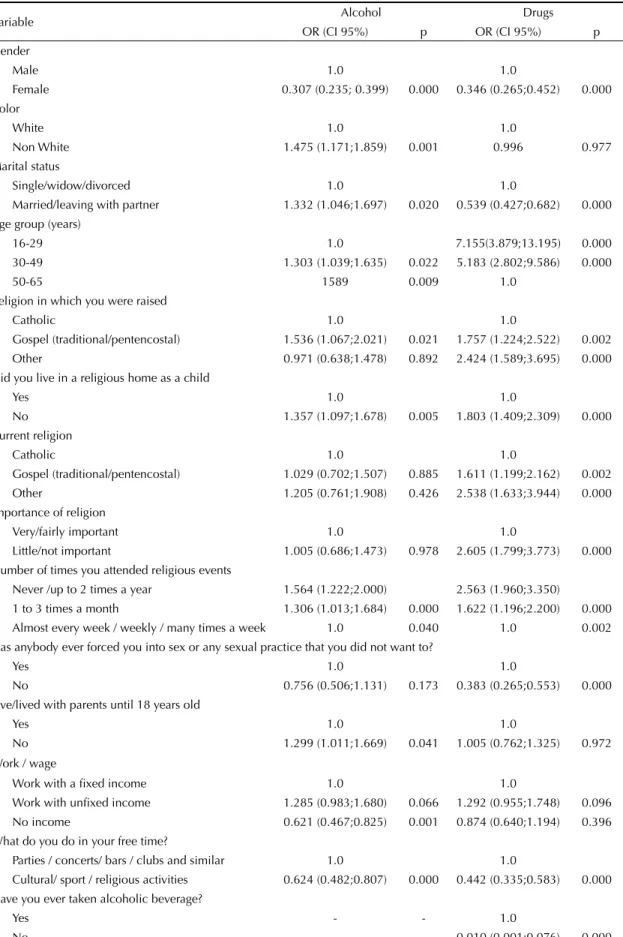
Results of bivariate regression models are presented in Table 2. Results of the logistic regression are presented in Table 3 (alcohol use) and Table 4 (drug use), as coeffi -cient estimates and their respective standard errors and
Table 1. Alcohol and drug use in the Brazilian population.
2005.
Alcohol use %
Have you ever had alcoholic beverages?
Yes 86.7
No 13.2
Does not know/refused to answer 0.1
How often do you drink?
Tried only once 1.6
Rarely 37.1
Every month, at least once a week 10.2
Once to twice a week 19.5
3 or more times a week 4.9
Does not drink any longer 26.5
Does not know/refused to answer 0.2
Have you ever drunk regularly?
Yes 17.9
No 82.0
Does not know/refused to answer 0.1
Have you forgotten to use condoms because you were under the effect of alcohol?
Yes 8.2
No 75.3
Has never used condom 11.1
Has never had sexual intercourse 5.1
Does not know/refused to answer 0.3
How does alcohol affect your sexual performance?
Improves the performance 16.7
Worsens the performance 20.4
Does not affect 56.3
Does not know/refused to answer 6.6
Drug use
Apart from alcohol and cigarette, have you ever used any type of drugs?
Yes 8.9
No 91.0
Does not know/refused to answer 0.1
In the last 12 months, have you had sexual intercourse with someone that had taken injection drugs?
Yes 0.8
No 98.5
Does not know/refused to answer 0.7
What was the fi rst drug you have used?
Marijuana/hashish 80.1
Solvents mix (“cheirinho da loló”,
“lança perfurme”) 6.9
Snorted cocaine 6.0
Appetite inhibitors/amphetamines/inhalants 2.9
Other calming drugs/ tranquillizers/ crack/
heroin/ ecstasy/ LSD) 3.1
Does not know/refused to answer 1.0
Where and how did you get the drug the fi rst time?
Friends/relatives/acquaintances 79.4
Low-level street dealers 8.3
School 5.8
Others 5.8
Table 2. Results of the application of bivariate logistic models on the regular use of alcohol (more than 4 times a week) and drug use in the Brazilian population, with the respective adjusted odds ratio (OR) and confi dence interval (CI 95%) and p-values, 2005.
Variable Alcohol Drugs
OR (CI 95%) p OR (CI 95%) p
Gender
Male 1.0 1.0
Female 0.307 (0.235; 0.399) 0.000 0.346 (0.265;0.452) 0.000
Color
White 1.0 1.0
Non White 1.475 (1.171;1.859) 0.001 0.996 0.977
Marital status
Single/widow/divorced 1.0 1.0
Married/leaving with partner 1.332 (1.046;1.697) 0.020 0.539 (0.427;0.682) 0.000
Age group (years)
16-29 1.0 7.155(3.879;13.195) 0.000
30-49 1.303 (1.039;1.635) 0.022 5.183 (2.802;9.586) 0.000
50-65 1589 0.009 1.0
Religion in which you were raised
Catholic 1.0 1.0
Gospel (traditional/pentencostal) 1.536 (1.067;2.021) 0.021 1.757 (1.224;2.522) 0.002
Other 0.971 (0.638;1.478) 0.892 2.424 (1.589;3.695) 0.000
Did you live in a religious home as a child
Yes 1.0 1.0
No 1.357 (1.097;1.678) 0.005 1.803 (1.409;2.309) 0.000
Current religion
Catholic 1.0 1.0
Gospel (traditional/pentencostal) 1.029 (0.702;1.507) 0.885 1.611 (1.199;2.162) 0.002
Other 1.205 (0.761;1.908) 0.426 2.538 (1.633;3.944) 0.000
Importance of religion
Very/fairly important 1.0 1.0
Little/not important 1.005 (0.686;1.473) 0.978 2.605 (1.799;3.773) 0.000
Number of times you attended religious events
Never /up to 2 times a year 1.564 (1.222;2.000) 2.563 (1.960;3.350)
1 to 3 times a month 1.306 (1.013;1.684) 0.000 1.622 (1.196;2.200) 0.000
Almost every week / weekly / many times a week 1.0 0.040 1.0 0.002
Has anybody ever forced you into sex or any sexual practice that you did not want to?
Yes 1.0 1.0
No 0.756 (0.506;1.131) 0.173 0.383 (0.265;0.553) 0.000
Live/lived with parents until 18 years old
Yes 1.0 1.0
No 1.299 (1.011;1.669) 0.041 1.005 (0.762;1.325) 0.972
Work / wage
Work with a fi xed income 1.0 1.0
Work with unfi xed income 1.285 (0.983;1.680) 0.066 1.292 (0.955;1.748) 0.096
No income 0.621 (0.467;0.825) 0.001 0.874 (0.640;1.194) 0.396
What do you do in your free time?
Parties / concerts/ bars / clubs and similar 1.0 1.0
Cultural/ sport / religious activities 0.624 (0.482;0.807) 0.000 0.442 (0.335;0.583) 0.000
Have you ever taken alcoholic beverage?
Yes - - 1.0
confi dence intervals (95%), and adjusted odds ratios, with their respective confi dence intervals (95%).
Characteristics of subjects using only alcohol regularly were quite different from those using other drugs.
Regarding regular alcohol use, those raised in non-re-ligious households were more likely to engage in this behavior. Another relevant factor was past history of sexual abuse. Those who suffered sexual abuse were more likely to use alcohol regularly. Sociodemographic characteristics, such as age, gender and skin color were associated to this pattern of use. The older they were, the more likely they would use alcohol regularly. Being female and White were protective factors respecting this outcome (OR= 0.303 and 0.686, respectively).
Current religion, number of times they attended reli-gious services, and leisure time activities were asso-ciated with illicit drug use. Those whose main leisure activity was going to parties, bars, clubs were 73.3% more likely of using drugs than those who engaged in cultural, sport and religious activities. Likewise, being sexually abused was independently associated with the outcome (OR=3.279). On the other hand,, skin color was not independently associated with the outcome.
DISCUSSION
Population-based household surveys are essential sour-ces of data in public health and have been systematically used in the assessment of drug and alcohol use.4 These
surveys, called in the United States National Surveys on Drug Use & Health, are yearly conducted nationwide.
According to Colliver et al4 (2006), these surveys are a
valuable source of data from a cross-sectional and serial perspective and, if the appropriate modeling strategy is used, may help to build future scenarios.
Although accuracy and validity of population-based surveys fi ndings have been questioned, these studies are usually not prone to systematic errors that may com-promise comparisons and contrasts, once non-systema-tic errors are minimized and their sampling strategy is handled in a proper way, as well as the reliability and validity of the instruments used.
The most relevant criticism about surveys refers to the subjective nature of information and the chance of inter-viewees hiding information for fear of being criticized or punished for engaging in criminal and stigmatized behaviors. However, using laboratory testing to detect drug use would lead to additional embarrassment since these procedures may document illicit behaviors.
Similarly, the interaction of interviewees with inter-viewers they do not know, especially in their hou-sehold, may make them hide or underreport behaviors or events they may fi nd embarrassing, as shown by Simões et al12 (2006) in a study in a Brazilian center
for alcohol and drug users. On the other hand, popula-tion-based household surveys provide additional data vis-à-vis the assessment of sociodemographic and behavioral data from populations from institutions (such as students) or convenience samples (such as outpatients), frequently used in the formulation and evaluation of drug policies in Brazil.
With the necessary caution regarding comparisons be-tween population-based studies with different sampling
Table 3. Results of the logistic model on the regular use of alcohol (more than 4 times a week) in the Brazilian population with
estimates of coeffi cients and respective standard error and confi dence interval (CI 95%) and adjusted OR (OR CI 95%). 2005.
Variable Coeffi cient Standard error CI 95% OR CI 95%
Constant -1.122 0.250 -1.164; -0.630
-Age group (years)
16-29 - - - 1.0
30-49 0.355 0.121 0.116;0.594 1.426 (1.123;1.810)
50-65 0.648 0.183 0.288;1.007 1.911 (1.334;2.738)
Gender
Male - - - 1.0
Female -1.195 0.139 -1.468;-0.922 0.303 (0.230;0.398)
Color
White - - - 1.0
Non-White 0.376 0.123 0.134;0.619 1.457 (1.143;1.857)
Did you live in a religious home as a child?
Yes, it was a religious home - - - 1.0
No, religion was not important 0.282 0.112 0.061;0.503 1.326 (1.063;1.654)
Has anybody ever forced you into sex or any sexual practice that you did not want to?
Yes - - - 1.0
strategies, some comparisons can be made between the fi ndings of the present study and those of Galduroz et al5,6 (2003, 2005).
The fi rst household survey performed in 1999 by Gal-duroz et al,6 with a representative sample of individuals
aged 12 to 65 years from the 24 largest cities in the state of São Paulo, found that 53.2% of interviewees who reported ever-use of alcohol, which is lower than that found in the present survey (almost 87%) conducted nationwide in 2005.
0 10 20 30 40 50 60 70
%
1998 2005
0.2 1.1 Use of injecting
drugs in the last 12 months 12.5
8.9
Lifetime drug use
18.1 13.2
Lifetime drug use - men
7.4 5.0
Lifetime drug use - women
5.5 3.5
Use of drugs in the last 12 months
41.0 65.3
Use of marijuana in
the last 12 months
21.4
14.5
Use of cocaine in
the last 12 months
Figure. Drug use in the Brazilian population. 1998 and 2005.
Table 4. Results of the logistic model on the use of drugs in the Brazilian population with estimates on coeffi cient and respective
standard error and confi dence interval (CI 95%) and adjusted OR (OR CI 95%). 2005.
Variable Coeffi cient Standard error CI 95% OR (CI 95%)
Constant -2.221 0.411 -3.029; -1.414
-Age group (years)
16-29 1.322 0.323 0.686;1.958 3.330 (1.693;6.552)
30-49 1.203 0.344 0.526;1.879 3.751 (1.986;7.086)
50-65 - - - 1.0
Gender
Male - - - 1.0
Female -1.159 0.169 -1.491; - 0.826 0.314 (0.225;0.438)
Current religion
Catholic - - - 1.0
Gospel (traditional/pentencostal) 0.943 0.209 0.532;1.353 2.566 (1.703;3.868)
Other 1.263 0.258 0.755;1.771 3.535 (2.127;5.874)
What do you do in your free time?
Parties / concerts/ bars / clubs and similar - - - 1.0
Cultural/ sport / religious activities -0.549 0.181 -0.906;-0.193 0.577 (0.404;0.825)
Number of times you attended religious events
Never /up to 2 times a year 0.667 0.203 0.267; 1.066 1.948 (1.307;2.905)
1 to 3 times a month 0.413 0.205 0.011; 0.815 1.512 (1.011;2.260)
Almost every week / weekly / many times a week - - - 1.0
Has anybody ever forced you into sex or any sexual practice that you did not want to?
Yes - - - 1.0
The proportion of interviewees reporting drug use
(other than alcohol and tobacco) in Galduroz et al6
survey was 11.6% in the cities of São Paulo, whereas the present survey found a proportion 8.9% for the Brazilian population. However, the national survey reported higher rates of alcohol use in the Southeast region (10.8%) compared to other Brazilian regions.
In short, although there are differences regarding al-cohol use, rates of drug use, other than alal-cohol and to-bacco, in the cities of São Paulo6 are in general similar
to the rates reported in the present study for the urban population living in Southeast Brazil. Marijuana and cocaine were predominant in both studies, and the use of inhalants in the São Paulo study is remarkable. This category of drugs was not approached in the national study, although references to substances in this group (such as “solvents” or “glue”) were recorded. In a later
survey (2001) Galduroz et al5 studied a sample from
the Brazilian population with similar ages and living in cities with over 200,000 inhabitants and found that 19.4% reported ever-using drugs (other than alcohol and tobacco). The most frequently reported drug in this
study5 was marijuana, followed by inhalants.
The use of drugs in the last 12 months was reported by 4.6% of the interviewees in Galduroz et al5 study
conducted in major Brazilian cities, a slightly higher proportion than that seen in the present study (3.5%). Ever-use of alcohol was reported by 68.7% of the interviewees in the most comprehensive survey by Galduroz et al.5
Bearing in mind that both the present study and Gal-duroz et al studies5,6 are, strictly speaking,
non-compa-rable, it seems that alcohol use is increasing over the years, especially among men. However, this cannot be corroborated or refuted by the comparison of the na-tional studies from 1998 and 2005 since the questions regarding this issue are different.
The fi ndings of the present study suggest a decrease in the use of some drugs, when compared to Galduroz et al5 fi ndings as well as when compared with the national
study from 1998. Contrasting trends over time were found regarding marijuana and cocaine use, with ex-pressive increase in marijuana use from 1998 to 2005, and a decrease (not so pronounced) of the reported use of cocaine during the same period.
These fi ndings should be further investigated using population-based studies specifi cally targeting these issues and qualitative studies so that information can be triangulated, which is essential in a fi eld that involves stigma and criminalization.
Despite the emphasis given to illicit drugs, the use of alcohol is a key public health problem. Alcohol abuse lead to different harms and has a modulating effect on sexual practices, favoring unsafe behaviors of an expressive part of the sexually active population.1
The analysis of predictors of regular alcohol use and illicit dugs shows the relevant role of sexual abuse during childhood, corroborating previous studies.14,16
Specifi c programs for sexual abuse victims should be implemented. Regular use of alcohol was relatively prevalent in the general population, mostly among
non-White men over 30, corroborating the national5,6
and international7,8 literature, which should inform the
design of culturally appropriate programs. Religious background was a protective factor regarding the later regular use of alcohol; this issue has been explored in the international literature.10
The use of illicit drugs is strongly associated with religious practices and leisure options. This fact is in accordance with the development of patterns of use over time and with social values, as fi rst described by Zinberg15 (1984), and this broad perspective has been
1. Bastos FI, Bertoni N, Hacker MA, Grupo de Estudos em População, Sexualidade e Aids. Consumo de álcool e drogas: principais achados de pesquisa de âmbito
nacional, Brasil 2005. Rev Saude Publica. 2008;
42(Supl 1):109-17.
2. Bastos FI, Caiaffa W, Rossi D, Vila M, Malta M. The children of Mama Coca: Coca, cocaine and the fate
of harm reduction in South America. Int J Drug Policy.
2007;18(2):99-106.
3. Bussab W de O, Grupo de Estudos em População, Sexualidade e Aids. Plano amostral da Pesquisa Nacional sobre Comportamento Sexual e Percepções
sobre HIV/Aids, 2005. Rev Saude Publica.
2008;42(Supl 1):12-20.
4. Colliver JD, Compton WM, Gfroerer JC, Condon T. Projecting drug use among aging baby boomers in
2020. Ann Epidemiol. 2006;16(4):257-65.
5. Galduróz JC, Noto AR, Nappo SA, Carlini EA. Household survey on drug abuse in Brazil: study involving the 107 major cities of the country-2001.
Addict Behav. 2005;30(3):545-56.
6. Galduróz JC, Noto AR, Nappo SA, Carlini EL. First household survey on drug abuse in Sao Paulo,
Brazil, 1999: principal fi ndings. Rev Paul Med.
2003;121(6):231-7.
7. Galvan FH, Caetano R. Alcohol use and related problems among ethnic minorities in the United States.
Alcohol Res Health. 2003;27(1):87-94.
8. Mahalik JR, Burns SM, Syzdek M. Masculinity and perceived normative health behaviors as
predictors of men’s health behaviors. Soc Sci Med.
2007;64(11):2201-9.
9. Markos AR. Alcohol and sexual behaviour. Int J STD
AIDS. 2005;16(2):123-7.
10. Michalak L, Trocki K, Bond J. Religion and alcohol in the U.S. National Alcohol Survey: How important
is religion for abstention and drinking? Drug Alcohol
Depend. 2007;87(2-3):268-80.
11. Miller M. The dynamics of substance use and sex
networks in HIV transmission. J Urban Health.
2003;80(4 Suppl 3):iii88-96.
12. Simoes AA, Bastos FI, Moreira RI, Lynch KG, Metzger DS. A randomized trial of audio computer and in-person interview to assess HIV risk among drug and
alcohol users in Rio de Janeiro, Brazil. J Subst Abuse
Treat. 2006;30(3):237-43.
13. Strathdee AS, Bastos FI. Intertwining epidemics: injection drug use and HIV infection. In: Breslow L, editors. Encyclopedia of public health. Nova York: Macmillan; 2002. p.636-9.
14. Widom CS, Marmorstein NR, White HR. Childhood victimization and illicit drug use in middle adulthood.
Psychol Addict Behav. 2006;20(4):394-403.
15. Zinberg NE. Drug, set and setting: the basis for controlled intoxicant use. New Haven: Yale University Press; 1984.
16. Zlotnick C, Johnson DM, Stout RL, Zywiak WH, Johnson JE, Schneider RJ. Childhood abuse and intake
severity in alcohol disorder patients. J Trauma Stress.
2006;19(6):949-59.
REFERENCES
Study funded by the Brazilian Ministry of Health, with additional resources provided by a donation from the Ford Foundation and the PAPES IV program of Fiocruz.
Article based on the data from the survey “Comportamento sexual e percepções da população brasileira sobre HIV/Aids (Sexual behavior and perceptions of Brazilian population on HIV/AIDS)”, sponsored by the Brazilian Ministry of Health through the Centro Brasileiro de Análise e Planejamento (Process n. ED 213427/2004).
This article followed the same peer-review process as any other manuscript submitted to this journal, anonymity was guaranteed for both authors and reviewers.