173
Brazilian Journal of otorhinolaryngology 79 (2) March/april 2013 http://www.bjorl.org / e-mail: [email protected]
Fat deposition of parotid glands
Abstract
Davi Sousa Garcia1, Ivo Bussoloti Filho2
1 Otorhinolaryngologist (Fellow in Rhinology - Otorhinolaryngology Department - Santa Casa de São Paulo). 2 PhD in Otorhinolaryngology. Adjunct Professor and Director - Department of Otorhinolaryngology - Santa Casa de São Paulo.
Otorhinolaryngology Department - Irmandade da Santa Casa de Misericórdia de São Paulo.
Send correspondence to: Davi Sousa Garcia. Rua Dr. Cesário Mota Júnior, nº 112, Pavilhão Conde de Lara - 4º Andar. Vila Buarque. São Paulo - SP. Brazil. CEP: 01221-020. Paper submited to the BJORL-SGP (Publishing Management System - Brazilian Journal of Otorhinolaryngology) on September 7, 2012;
and accepted on January 12, 2013. cod. 10442.
P
arotid gland parenchyma histology may be altered by local or systemic, pathological or non-pathological conditions.Objective: This paper aims to highlight the fatty degeneration of the parotid gland, a not well-known non-pathological condition.
Method: In a retrospective study, we collected a series of 6 patients which presented a swelling of the parotid, but even after extensive research, a diagnosis was not reached.
Results: Through the retrospective analysis of records we found fatty degeneration of the parotid in an MRI scan of all patients.
Conclusion: This condition, despite being physiological and expected with aging, may be related to clinical and radiological swelling of these glands.
ORIGINAL ARTICLE
Braz J Otorhinolaryngol. 2013;79(2):173-6.
BJORL
Keywords:
fats;
magnetic resonance imaging;
parotid gland.
.org
174
Brazilian Journal of otorhinolaryngology 79 (2) March/april 2013 http://www.bjorl.org / e-mail: [email protected] INTRODUCTION
Parotid gland parenchyma is subject to chan-ges in its histological characteristics because of local or systemic conditions. Hypertriglyceridemia may be associated with fat infiltration in the parotid without inflammatory activity1. The drop in ovarian hormones
after ovariectomy in rats showed fat degeneration in the parotid glands2. In Sjögren’s syndrome, there is
parenchyma heterogeneity because of adipose de-generation and lymphocytic infiltration3. In patients
with the Human Immunodeficiency Virus (HIV), there may be parotid gland enlargement and, histologically, besides the fat infiltration, one may see lymphocytic aggregates, lymphoepithelial cysts or lymphadenopa-thy4. Moreover, in alcoholics and diabetics, there is a
reduction in the rate of fat tissue in the stroma5. On
the other hand, studies with rats have shown an in-crease in lipids and degeneration of secretory granules associated with an age-related decline in the secretory activities of the parotid glands6, without it representing
a disease process.
In the stomatology ward of our institution, we had patients in whom we saw an increase in the vo-lume of the parotid glands, eventually associated with complaints resembling those of a Sjögren’s syndrome, but after broad diagnostic investigation, such condition was ruled out, based on current diagnostic criteria (European-American Consensus, 2002)7. By the same
token, any other local or systemic conditions, such as sarcoidosis8 and lymphoma9, which would explain
that situation, have just been discarded by means of pertaining propaedeutic. Nonetheless, during the diagnostic investigation process through an MRI, we noticed that a common point to them is the finding of liposubstitution of the parotid glands.
Therefore, this study aimed at informing about this pathology, which makes patients with this little--known pathology seek physicians.
METHOD
This is a historical cross-sectional cohort study, carried out with the charts of 6 patients seen in the stomatology ward of our institution, between February of 2009 and January of 2012.
The inclusion criterion was patients who had clinical signs of volumetric increase of the parotid glands, without any local or systemic conditions that
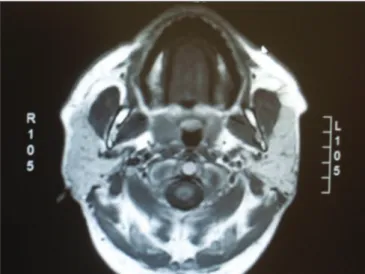
would justify them, after the pertaining diagnostic investigation, by means of an image exam, laboratorial and/or anatomic-pathological tests (Figure 1). In the-se cathe-ses, our investigation encompasthe-ses a complete blood count, antiSSB, anti-nucleus factor, rheumatoid factor, HIV, anti-HCV, Schirmer test, minor salivary gland biopsy, neck MRI, scintigraphy and, in selected cases: sialography.
Figure 1. Patient with bilateral parotid enlargement and liposubstitution seen upon MRI.
As for inclusion criterion, we defined the cases which were truly unilateral through the MRI.
Since it is a retrospective study based on information from patients’ charts, without patient identification, there was no need for informed consent forms.
The project was approved by the Clinical Board and by the Ethics in Research Committee of the insti-tution, under protocol # 49.444/12.
RESULTS
Within the time frame considered (February of 2009 through January of 2012), we admitted 483 new patients in our ward, of whom 64 (13.25%) had enlar-ged parotids as their main complaint, and six (1.24%) fit the inclusion criteria.
Upon MRI, the fat deposits on the parotids was seen by a T1 hypersignal; in fat suppression sequences, the suppressed sites are identified by hyposignal (T1 with contrast and T2)10 (Figures 2 and 3).
175
Brazilian Journal of otorhinolaryngology 79 (2) March/april 2013 http://www.bjorl.org / e-mail: [email protected]
Figure 2. Axial section in T1 without contrast, showing hypersignal from the parotids.
Figure 3. Axial section in T1 with contrast and fat suppression, showing hyposignal in the areas in which fat was suppressed.
Table 1. Information from the patients who it the inclusion criteria.
1st visit Gender Age of onset Complaint Alcoholism Smoking Physical exam MRI
02/21/09 M 58
Parotid bulging for 8 months, recurrent, bilateral and painful,
with xerostomy
No No
Mild bilateral enlargement of the parotids, larger on the
left, ibroelastic
Bilateral parotid volume enlargement, with fat
substitution signs, without nodules
10/06/09 M 68
Bilateral parotid bulging for 1 year, without salivary complaints
No No
Bilateral salivary gland bulging, especially the
parotids
Parotid parenchyma replacement for fat, with some small lymph nodes 10/06/09 F 46 Bilateral parotid bulging
for 1 year No Yes
Diffuse parotid
enlargement, ibroelastic
Liposubstitution and pa-rotid volume enlargement
05/10/11 F 33
Right parotid bul-ging for 3 years, mild
xerostomy
No No Right-side parotid volu-me enlargevolu-ment
Volume enlargement and parotid liposubstitution
11/29/11 M 55 Parotid bulging for 4
months, with xerostomy Yes No
Mild bilateral and ibro -elastic parotid
enlar-gement
Diffuse parotid enlargement, with
liposubstitution
01/31/12 F 46
Recurrent right side, painful bulging for 2
years
No No
Right-side parotid enlargement, mildly painful upon palpation
Parotid liposubstitution and small intraparotid
lymph nodes
The data collected point to three male patients and three females; therefore, there was no gender dis-tinction. Age of onset varied between 33 and 68 years, with a mean age of 51 (± 12.06) years. The trait was recurrent in two patients (33.33%), being constant in the others. In all the patients, the parotid consistency was firm/fibroelastic, without irregularities or inflam-matory signs, although mildly painful in one patient. We stress that xerostomy was complained by three patients (50%), confirmed upon clinical exam; notwi-thstanding, these patients were submitted to parotid gland scintigraphy, without any change in the tests. As far as habits are concerned, one patient (16.67%)
reported being an ex-smoker and one patient (16.67%) reported mild alcohol consumption. In all the patients we found signs of liposubstitution of the parotid glands upon the MRI in both parotids, although in two cases they were unilateral.
176
Brazilian Journal of otorhinolaryngology 79 (2) March/april 2013 http://www.bjorl.org / e-mail: [email protected] DISCUSSION
Parotid liposubstitution is a frequent radiologic finding; however, the literature does not have papers correlating idiopathic parotid bulging with its presence. It is known that this is a natural physiological pro-cess, like aging6 (we stress that the mean age of our
sample was 51 years); however, subject to variations in accordance with the presence of subjacent clinical conditions1-5. In fact, the parotid liposubstitution with
the Sjögren’s syndrome is known, after having been demonstrated by Niemela et al.11, in a study involving
26 patients with the primary form of the disease, and changes (nodules or adipose degeneration in the pa-renchyma) were seen in 81% of the cases.
On the other hand, our series was made up of individuals without local or systemic diseases, exhaustively investigated, they presented parotid liposubstitution as a common denominator, which leads us to think that, in some cases, this is not a mere histological transformation as per expected with the gland aging, having a clinical and radiological manifestation of parotid enlargement. Parotid bulging was recurrent in two patients, which is not expected for a supposedly slow and gradual process. And fi-nally, there are issues which still cannot be cleared up, especially since this is a theme with very little presence in the medical literature.
CONCLUSION
Parotid liposubstitution, although a physiologi-cal process - expected with aging, may be associated with a bilateral enlargement of the glands in indivi-duals who do not have systemic or local causes for such condition. However, some issues related to this association, remain open, and may be investigated in new studies.
REFERENCES
1. Sheikh JS, Sharma M, Kunath A, Fritz DA, Glueck CJ, Hess EV. Re-versible parotid enlargement and pseudo-Sjögren´s syndrome se-condary to hypertriglyceridemia. J Rheumatol. 1996;23(7):1288-91. 2. Shiraishi H, Oiki H, Murata K. Fatty degeneration of the paro-tid gland after ovariectomy. Nihon Jibiinkoka Gakkai Kaiho. 2000;103(5):539-46.
3. Civibal C, Canpolat N, Yurt A, Kurugoglu S, Erdamar S, Bagci O, et al. A child with primary Sjögren syndrome and a review of the literature. Clin Pediatr (Phila). 2007;46(8):738-42.
4. Kabenge C, Ng S, Muyinda Z, Ameda F. Diagnostic ultrasound patterns of parotid glands in human immunodeficiency virus--positive patients in Mulago, Uganda. Dentomaxillofac Radiol. 2010;39(7):389-99.
5. Merlo C, Bohl L, Carda C, Gómez de Ferraris ME, Carranza M. Parotid sialosis: morphometrical analysis of the glandular paren-chyme and stroma among diabetic and alcoholic patients. J Oral Pathol Med. 2010;39(1):10-5.
6. Kim SK. Changes in the secretory acinar cells of the rat parotid gland during aging. Anat Rec. 1984;209(3):345-54.
7. Vitali C, Bombardieri S, Jonsson R, Moutsopoulos HM, Alexander EL, Carsons SE, et al.; European Study Group on Classification Criteria for Sjögren´s Syndrome. Classification criteria for Sjögren’s syndrome: a revised version of the European criteria proposed by the American-European Consensus Group. Ann Rheum Dis. 2002;61(6):554-8.
8. Sahu SK, Srivastava P, Kusum A, Kishore S, Sachan PK, Bahl DV. Parotid Sarcoidosis. Internet J Surg. 2007;9(1).
9. Dispenza F, Cicero G, Mortellaro G, Marchese D, Kulamarva G, Dispenza C. Primary Non-Hodgkins lymphoma of the parotid gland. Braz J Otorhinolaryngol. 2011;77(5):639-44.
10. Takagi Y, Sumi M, Sumi T, Ichikawa Y, Nakamura T. MR micros-copy of the parotid glands in patients with Sjogren’s syndrome: quantitative MR diagnostic criteria. AJNR Am J Neuroradiol. 2005;26(5):1207-14.