167 167 167 167 167 Mem Inst Oswaldo Cruz, Rio de Janeiro, Vol. 101(Suppl. I): 167-177, 2006
A bacterial artificial chromosome library for
Biomphalaria
glabrata
, intermediate snail host of
Schistosoma
mansoni
Coen M Adema/
+, Mei-Zhong Luo*, Ben Hanelt, Lynn A Hertel
†, Jennifer J Marshall,
Si-Ming Zhang, Randall J DeJong/
++, Hye-Ran Kim*, David Kudrna*, Rod A Wing*,
Cari Soderlund**, Matty Knight***, Fred A Lewis***, Roberta Lima Caldeira****,
Liana K Jannotti-Passos****, Omar dos Santos Carvalho****, Eric S Loker
Department of Biology, University of New Mexico, Albuquerque, NM, US *Arizona Genomics Institute, Department of Plant Sciences **Arizona Genomics Computational Laboratory, BIO5 Institute, University of Arizona, Tucson, US ***Biomedical Research Institute, Rockville, MD, US ****Laboratório de Helmintoses Intestinais, Centro de Pesquisas
René-Rachou-Fiocruz, Belo Horizonte, MG, Brasil
To provide a novel resource for analysis of the genome of Biomphalaria glabrata, members of the international
Biomphalaria glabrata Genome Initiative (biology.unm.edu/biomphalaria-genome.html), working with the Arizona Genomics Institute (AGI) and supported by the National Human Genome Research Institute (NHGRI), produced a high quality bacterial artificial chromosome (BAC) library. The BB02 strain B. glabrata, a field isolate (Belo Horizonte, Minas Gerais, Brasil) that is susceptible to several strains of Schistosoma mansoni, was selfed for two generations to reduce haplotype diversity in the offspring. High molecular weight DNA was isolated from ovotestes of 40 snails, partially digested with HindIII, and ligated into pAGIBAC1 vector. The resulting B. glabrata BAC library (BG_BBa) consists of 61824 clones (136.3 kb average insert size) and provides 9.05 × coverage of the 931 Mb genome. Probing with single/low copy number genes from B. glabrata and fingerprinting of selected BAC clones indicated that the BAC library sufficiently represents the gene complement. BAC end sequence data (514 reads, 299860 nt) indicated that the genome of B. glabrata contains ~ 63% AT, and disclosed several novel genes, transpos-able elements, and groups of high frequency sequence elements. This BG_BBa BAC library, availtranspos-able from AGI at cost to the research community, gains in relevance because BB02 strain B. glabrata is targeted whole genome sequencing by NHGRI.
Key words: genomics - gene discovery - fingerprinting - schistosomiasis - medical malacology
The application of molecular approaches contin-ues to contribute novel insights into the biology, includ-ing genomics of molluscs (Zhang et al. 2004, Mitta et al. 2005). To date, several mitochondrial genomes of molluscs have been sequenced (DeJong et al. 2004, Mizi et al. 2005), but the nuclear genome of a representative of the Phylum Mollusca remains to be fully characterized. In fact, lophotrochozoan protostomes of which mollusca repre-sent the largest group (Rouse 1999), are underreprerepre-sented among the animals from which the current assembly of fully sequenced genomes has been obtained. Thus, ge-nomic data from a mollusc will help fill a gap in the infor-mation on the evolutionary history of animal life (Collins et al. 2003).
Financial support: the production and distribution of the BG_BBa BAC library at AGI was supported by the funding from the National Human Genome Research Institute under the BAC Library Production program (grant 5U01HG002525; RAW). Parts of this study were supported by NIH grants AI024340 (ESL), AI052363 (CMA), and Fiocruz
+Corresponding author: [email protected]. †Deceased 2 April 2005
++Present address: Laboratory of Malaria and Vector Research,
NIAID/NIH, Twinbrook III, Room 2E-20 MSC 8132 Bethesda, MD 20892, US
Received 25 May 2006 Accepted 26 June 2006
Molluscs are a highly diverse group that includes some of the largest, longest living, and most intelligent invertebrates. Genome information will instruct on sev-eral remarkable properties of molluscs such as shell for-mation (biomineralization; Milet et al. 2004), the evolution of body asymmetry (Schilthuizen & Davison 2005), and hermaphrodism (Paraense & Corrêa 1988). Molluscs are also being used to study pharmo-toxicology (Terlau & Olivera 2004); neuroendocrinology (Altelaar et al. 2005); parthenogenesis (Jokela et al. 2003); and the molecular basis of behavior and learning (Williamson & Chrachri 2004, Zhurov et al. 2005). Molluscs serve as bioindicators for monitoring of the environment (Zhao et al. 2005), and (snails especially) are useful for understanding how natu-ral selection operates (Vermeij 2002). Furthermore, mol-luscs are economically important as a major source of food, can destroy crops, colonize and impact new habitats as invasive species (Pointier et al. 2005), and transmit medi-cally important pathogens.
168 168 168 168
168 B. glabrata BAC library • Coen M Adema et al.
distribution of S. mansoni in the Neotropics (Paraense 1986, DeJong et al. 2003). Genetic determinants affect the susceptibility of B. glabrata for S. mansoni (Lewis et al. 2001), and heterogeneity in genetic composition of B. glabrata on smaller scales may further influence the trans-mission patterns of schistosomiasis (Theron & Coustau 2005). More comprehensive genome sequence data for B. glabrata would enable novel investigative approaches to study determinants of transmission, especially in light of an advancing genome project for S. mansoni (Loverde et al. 2004).
B. glabrata also hosts a variety of other digenetic trematodes and has been adopted as the most commonly used model host to study the basic biology of digenean-snail interactions (Lie 1982, Adema & Loker 1997, Vergote et al. 2005). As one example, B. glabrata has been found to produce after exposure to digeneans a unique family of hemolymph molecules termed FREPs (fibrinogen-related proteins). FREPs consist of a juxtaposition of fibrinogen and immunoglobulin superfamily domains, and have proven to be remarkably diverse in their composition. B. glabrata thus serves as a new model system to examine the nature and diversity of non-self recognition molecules produced by invertebrates (Zhang et al. 2004).
Information on the genome of B. glabrata will also have relevance for several other Biomphalaria species and for yet other species of molluscs which serve as hosts for schistosomes and for a number of other trematode, and some nematode, infectious agents. Besides schisto-somiasis, diseases such as fascioliasis, clonorchiasis, and paragonimiasis represent only a few of the snail transmit-ted diseases with worldwide medical and economic im-pact (Lockyer et al. 2004a).
In 2001, an international consortium, “the Biom-phalaria glabrata genome initiative” was founded to develop genome-type projects for this particular pulmo-nate gastropod species (http://biology.unm.edu/ biomphalaria-genome/index.html). Members of this con-sortium have contributed several gene discovery projects (Jones et al. 2001, Miller et al. 2001, Schneider & Zelck 2001, Raghavan et al. 2003, Lockyer et al. 2004b, Nowak et al. 2004, Jung et al. 2005, Mitta et al. 2005), the full-length sequence of the mitochondrial genome of B. glabrata
(DeJong et al. 2004), and an estimate of 931 Mb for the size of the nuclear genome of B. glabrata (Gregory 2003). A novel resource for genomic studies became avail-able when the National Human Genome Research Insti-tute (NHGRI) awarded a white paper application (http:// w w w. ge n o me .g ov/Pages/R es earch/Sequen cing/ BACLibrary/ BgBACprops.pdf) for funding of the pro-duction a high quality bacterial artificial chromosome (BAC) library for B. glabrata (http://www.genome.gov/ page.cfm ?pageID=10001852). Such a library provides ac-cess to large regions of the genome of B. glabrata, in an experimentally manageable fashion. Significantly, the NHGRI support guaranteed high quality standards for the finished library, and also made the BAC library publicly available at cost to the research community. The actual development of the BAC library was a collaboration be-tween the Arizona Genomics Institute (AGI; part of the National Institutes of Health BAC Resource Network) and
members of B. glabrata genome initiative. The genomic DNA from a recent B. glabrata field isolate from a schis-tosomiasis endemic area in Brazil, shown to be suscep-tible to S. mansoni, was used to ensure that the BAC library provides data that are relevant in the context of parasite-snail compatibility. This report describes the B. glabrata strain used, and both the production and char-acterization of the BAC library. Lastly, analysis of se-quence data obtained provides first glimpses into the genomic make-up of B. glabrata.
MATERIALS AND METHODS
Snails, species identification and susceptibility for schistosome infection - B. glabrata snails were collected from a small stream in an endemic site for transmission of
S. mansoni, in the south east of Brazil, Barreiro, Minas Gerais, (19oS 59 min/44oW 02 min). Offspring of these snails are maintained as a laboratory strain designated as BB02 (Biomphalaria from Belo Horizonte, Minas Gerais, Brazil 2002).
The species identity of BB02 snails was determined by PCR-RFLP. The ITS1-5.8S-ITS2 sequence region was PCR amplified from DNA of individual snails using prim-ers (all primprim-ers are shown 5' -3' ) ETTS2: TAA CAA GGT TTC CGT A GG TGA A and ETTS1: TGC TTA AGT TCA GCG GGT. The amplicons were digested with DdeI and restrictions patterns obtained from BB02 snails were com-pared to the characteristic banding pattern specific for B. glabrata (Vidigal et al. 1998). Also sequences from the 16SrDNA and ND1 genes of one BB02 snail were ampli-fied by PCR, using primer pairs 16Sar: CGC CTG TTT ATC AAA AAC AT - 16Sbr: CCG GTC TGA ACT CAG ATC ACG T (Palumbi et al. 1996) and SNDF1F2: CGR AAA GGA CCT AAY AGT TGG - SND1R4: ART CRA ATG GYG CHC GAT TAG, respectively. (R=A/G Y=C/T H= A/C/T). The sequences from these amplicons were obtained by direct sequencing and analyzed relative to previously generated phylogenies of Biomphalaria isolates, all ac-cording to DeJong et al. (2003). The sequences of 16S
rDNA and NADH dehydrogenase 1 were deposited in GenBank under accession numbers AY737280 and AY737281, respectively.
Members of the F1 generation derived from field col-lected snails were tested for susceptibility to two differ-ent S. mansoni strains (LE, SJ) at the Section of Molluscs Rearing at the Centro de Pesquisas René-Rachou in Belo Horizonte, Brazil. Groups of 50 juvenile snails (3-6 mm) were exposed individually to 10 miracidia. The parasite-susceptible BB01 strain of B. glabrata(maintained over 10 years in the laboratory in Brazil) was used as a control for miracidial infectivity. At 4 weeks post exposure, snails were exposed to artificial light for 30 min and the shed-ding of cercariae was recorded. Non-shedshed-ding snails were dissected to check for developing sporocysts. BB02 B. glabrata were similarly tested for susceptibility to the NMRI strain of S. mansoni at the Biomedical Research Institute (MD, US).
sus-169 169 169 169 169 Mem Inst Oswaldo Cruz, Rio de Janeiro, Vol. 101(Suppl. I), 2006
pensions as required to obtain high molecular weight DNA (Luo & Wing 2003). However, the DNA yield from a single snail was insufficient to generate a BAC library. B. glabrata is a simultaneous hermaphrodite and offspring were generated by selfing to minimize haplotype diver-sity. One newly hatched BB02 snail (< 3 mm shell diam-eter) was kept in isolation to generate F1 progeny by self-fertilization (sF1). A selfed F2 generation (sF2) derived from the sF1 was similarly obtained.
High molecular weight (HMW) genomic DNA was iso-lated from forty sF2 snails (10-12 mm shell diameter). Fol-lowing cleaning and removal of shells, live snails were kept briefly in ½199 medium (physiological buffer for snail cells; medium 199 (Sigma) diluted 1:1 [v/v] with distilled water) until all snails were processed. From 4 snails at a time, the ovotestes were dissected and pooled in 800 µl of ½199 in 1.7 ml Eppendorf tubes on ice. All the following manipulations were performed gently to minimize damage to cells and mechanical shearing of DNA. The tissues were disrupted with 3 strokes of a polypropylene pellet pestle (Kontes). The resulting cell suspensions were pooled in a 50 ml Falcon tube on ice. No sediment was evident after 1 h. Cells were pelleted (400 g, 5 min at 4°C) and the cleared supernatant fluid was reduced to 600 µl. The cells were resuspended uniformly by tapping the side of the tube and incubated for 3 min at 42C. Then, 600 µl of 1% Seakem agarose (FMC) in ½199, (pre-warmed to 42°C) was mixed with the cells using minimal agitation. The monocellular cell suspension in agarose was transferred (using a cut-off, wide bore pipette tip) into disposable CHEF plug moulds (Bio-Rad) to obtain plugs with uni-form cell numbers embedded in an agarose matrix, and placed on ice for 20 min. The 13 resulting plugs were trans-ferred to 50 ml NDS (0.5 M EDTA, 10 mM Tris, 1% w/v N-lauroyl sarcosine, pH 9.5 (NaOH), supplemented with 1 mg/ml proteinase K (Invitrogen) and incubated overnight at 50°C in a rotary hybridization oven. This treatment ly-sed the cells while the agarose matrix protected high mo-lecular weight genomic DNA from mechanical shearing. The medium was replaced by NDS and again incubated overnight at 50°C with rotation. DNA quality and suscep-tibility to HindIII digestion were evaluated by contour-clamped homogeneous electric field (CHEF) gel electro-phoresis.
Generation of the BG_BBa BAC library - The meth-ods of Luo and Wing (2003) were used to produce the BAC library. Briefly, following testing to determine opti-mal conditions, HMW DNA embedded in plugs was par-tially digested with HindIII. Following separation on CHEF gels twice, DNA fragments in the 150-300 kilobase (kb) range were eluted and ligated into pAGIBAC1. This BAC vector carries a resistance marker for chloramphenicol and incorporates a high signal for blue/white screening of non-insert transformants. The resulting constructs were intro-duced into DH10B-T1 phage resistant Escherichia coli
cells by electroporation and plated on LB containing 12.5 µg/ml chloramphenicol and 80 µg/ml X-gal, 100 µg/ml IPTG for blue/white screening. Guided by video recognition of successful transformants, clones were picked and gridded into 384 well plates by a Q-bot (Genetix). Clones were
stored as glycerol cultures at –80°C. Also, the clones from the BAC library were inoculated on four 22.5 × 22.5 cm Hybond N+ filters (Amersham) in high density, double spots and 4 × 4 patterns with a Q-bot (Genetix). The re-sulting filters a, b, c each contained 18432 clones in dupli-cate in six fields, the last filter (d) held 6528 clones in the same layout. The membranes were placed on LB agar plates containing 12.5 µg/ml chloramphenicol and incu-bated overnight to obtain colonies of 1 to 2 mm diameter. The membranes were placed (colony side up) on absor-bent filter paper (Whatman Cat. No. 3030 700) soaked in the following solutions: (1) solution 1 (0.5 N NaOH, 1.5 M NaCl) for 7 min; (2) solution 2 (1.5 M NaCl, 0.5 M Tris-HCl, pH 8.0), 7 min; (3) air dry for more than 1 h; (4) solution 3 (0.4 N NaOH), 20 min; (4) solution 4 (5X SSPE), 7 min, and air dried overnight. The complete library (as frozen stocks), high density filters, and individual clones are available at cost from AGI. Protocols for screening of high density BAC library filters and address determination of positive signals are publicly available from AGI (www.genome. arizona.edu).
Isolation and sequencing of BAC DNA - At AGI, BAC DNA was isolated from 1.2 ml 2 × YT (Fisher) overnight cultures using alkaline lysis (96-well format) with a Quadra 96 Model 320 (Tomtec). Both ends of BAC inserts were sequenced using T7: TAA TAC GAC TCA CTA TAG GG as ‘‘forward’’ primer and BES_HR: CACT CAT TAG GCA CCC CA as the ‘‘reverse’’ primer. Cycle sequencing (BigDye Terminator v 3.1, Applied Biosystems) was per-formed using PTC-200 thermal cyclers (MJ Research) in 384-well format applying 150 cycles of 10 s at 95°C, 5 s at 55°C, and 2.5 min at 60°C. Extension products were puri-fied by CleanSeq magnetic beads (Agencourt). Samples were eluted into 20 µl of ddH20 and separated on ABI 3730xl capillary sequencers with default conditions. Se-quence data were collected by data collection software (Applied Biosystems), and transferred to a UNIX work-station. Sequences were base-called using the program Phred (Ewing & Green 1998, Ewing et al. 1998); vector and low-quality (Phred value <16) sequences were removed using the program Lucy (Chou & Holmes 2001). The meth-ods applied at UNM included Montage BAC96 (Millipore) and Perfectprep BAC 96 (Eppendorf) for isolation of BACs. BAC ends were sequenced (Big Dye v. 3.1, ABI), also with T7 and BES_HR primers, using Biometra T-gradient thermal cyclers in 96 well format. The temperature profile was 1 min at 94°C, 100 cycles of 30 s at 94°C, 1 min at 55°C, 1 min at 72°C, and 7 min at 72°C. Following cleanup (Mon-tage SEQ96; Millipore), extension products were read on an ABI 3700. Sequencher (GC codes) was used to remove vector sequences and edit chromatograms by eye.
170 170 170 170
170 B. glabrata BAC library • Coen M Adema et al.
The non-redundancy of BAC inserts was tested by sequencing (AGI) both termini of a random set of 192 clones. The clones were arbitrarily selected from wells A01, A02, A03 from plates 1-32, and well B23 from plates 1-96 in which the library is stored.
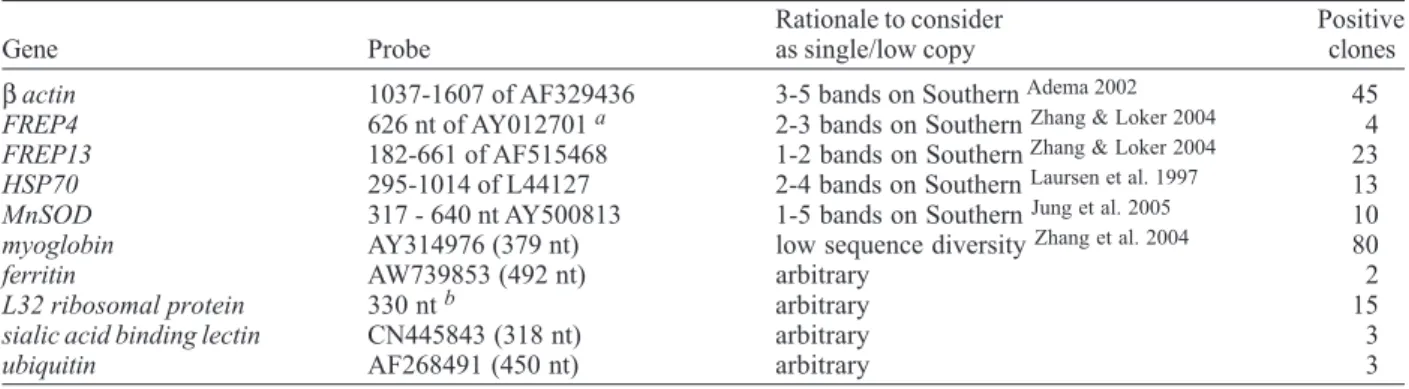
The representation of the genome of B. glabrata in the BAC library was investigated by screening the BAC library for sequences representing low- or single copy genes of B. glabrata (UNM). The probe sequences were selected from the literature, or chosen arbitrarily (see Table II). The probes were amplified by PCR from genomic or cDNA templates, labeled with 32P α dCTP (Perkin Elmer) by random priming (Prime-it RT, Stratagene), and used as hybridization probes to screen filters that contained spot-ted BAC clones. The initial screening of high density fil-ters representing the whole library (as available from AGI) was performed with two sets of five pooled probes (see http://www.genome.arizona.edu/information/protocols/ index.html). The filters were prehybridized at 65°C for at least 4 h with hybridization buffer (0.5 M sodium phos-phate pH 7.2, 7% SDS, 1 mM EDTA, 10 µg/ml sheared salmon DNA). After an exchange with fresh buffer, pre-hybridization was continued for 2 h. The probes were added and hybridized (>18 h, 65°C). The filters were washed sequentially with 2X SSC, 1X, and 0.1X SSC (all containing 0.1% SDS), 2 times each (20 min, 65°C), then autoradiography was performed. Positive clones were iden-tified and obtained from AGI as bacterial stab cultures. These clones were used to manually prepare macroarrays (96 well format) applying similar methods as described above for the high density filters. The macroarrays were screened with individual probes to determine which clones contained specific target sequence. The BAC clones were also end-sequenced.
Contig alignment of BACs by fingerprinting - The BACs from clones that strongly hybridized the low- or single copy probes were subjected to the fingerprinting methods described by Luo et al. (2003). The resulting di-gestion patterns were compared for similarities to identify and contiguously align (partially) overlapping BACs us-ing FPC software for the contig assembly (Soderlund et al. 2000). Also see http://www.genome.arizona.edu/ BAC_special_projects/
Computational analysis and annotation of BAC end sequences - A contig analysis of the BAC end sequences
was performed using Sequencher (GC codes). The clus-tering criteria were arbitrarily set at 98% identity over 100
nucleotides. The AT content was calculated for all non-redundant (sequence contigs were used instead of indi-vidual cluster mates) BAC end sequence data combined. BLAST searches were used to investigate the likelihood that BAC inserts were of snail origin, as well as to un-cover similarities between BAC end sequences and the protein and nucleotide databases of GenBank, with spe-cial consideration of sequence entries from B. glabrata. E-values ≤ 10–4 were considered significant. Discrepan-cies in sequence similarities between genomic and cDNA sequences were analyzed for the presence of non-coding sequences, including introns. Repetitive sequences were identified by direct inspection of sequence data and by analysis of results from BLAST searches. The BAC end sequence data were submitted as genome survey se-quences (GSS) to GenBank under accession numbers CZ547921-CZ548269; DX360039-DX360203.
RESULTS
Characteristics of the BB02 strain of B. glabrata
-Snails of the field isolate collected in September 2002, morphologically consistent with being B. glabrata, were identified as the species B. glabrata by PCR-RFLP (Fig. 1). Additionally, the 16S rDNA (GenBank accession AY737280) and NADH dehydrogenase 1 (ND1; accession AY737281) sequences from one BB02 snail were each 99% identical to previously characterized sequences from other
B. glabrata isolates. Phylogenetic analysis based on these sequences placed the BB02 strain within the “B1” Brazil-ian clade of B. glabrata that was designated by DeJong et al. (2003). Bootstrap support was 85-98%, depending on the use of distance, maximum parsimony, or maximum likelihood methods. Phylogenetic trees are not shown; they were essentially identical to those presented in DeJong et al. (2003).
BB02 snails proved highly susceptible to three differ-ent strains of S. mansoni. At 4 weeks following experi-mental exposure, 89.6% or more of the snails harbored viable parasite infections (Table I).
Generation of the BG_BBa BAC library- The genomic DNA sample form 40 twice-selfed BB02 snails yielded suf-ficient quantity of HMW DNA (Fig. 2). The cloning of fragments ranging from 150-300 kb (partial HindIII digest) allowed isolation of 61,824 transformants, which were dis-tributed over 161 plates with 384 wells. The BAC library was designated BG_BBa (“BG” is the first letter of genus and species, the “B” is for BB02 strain, the second “B” designates BAC library, “a” is the first library made).
TABLE I
BB02 Biomphalaria glabrata: susceptibility for different strains of Schistosoma mansoni
Snail Parasite strain Positive/negative/died % susceptible
F1 LE 43/5/2 89.6
F1 SJ 40/4/6 90.9
Selfed F2 NMRI 47/1/2 97.9
171 171 171 171 171 Mem Inst Oswaldo Cruz, Rio de Janeiro, Vol. 101(Suppl. I), 2006
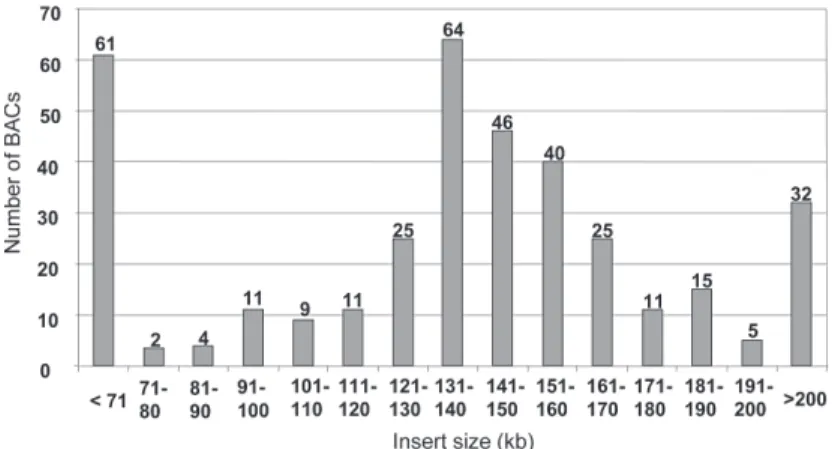
Properties of the BG_BBa BAC library - The average insert size observed from clones of the BG_BBa library was 136.3 kb (n=361). The distribution of different insert size categories is shown in Fig. 3. Over 90% (or 328) of the BACs had an insert size greater than 100 kb. No empty clones (vector without insert) were recorded. The BG_BBa library consists of 61824 clones with an average insert of 136.3 kb. This provides a 9.05-fold coverage of the ge-nome of B. glabrata based on a size estimate of 931 Mb (Gregory 2003). The sequencing of BAC ends of 192 clones yielded 349 reads totaling 242270 nucleotides (nt; desig-nated the AGI set). Contig analysis indicated that all of the sequences obtained from this random sample were unique. Some BAC inserts (1.4% of the total) shared highly similar sequences at one terminal end, but differed from each other on the other side of the insert. These BACs were BG_BBa0012A03 and BG_BBa0064N23 (GenBank accessions of the sequence reads from the termini are CZ548214 and CZ548008, respectively) displaying 12 dif-ferences over 770 nt; and BG_BBa0023A03 (CZ548090), BG_BBa0095B23 (CZ548268), BG_BBa0024B23 (CZ548158) that shared a 464 nt sequence (6 differences) that was highly similar to a transposable element (GenBank XP_791680).
All 10 low- or single copy probes hybridized with clones on the high density filters representing the com-plete BAC library. Verification of putative positives by colony hybridization (using macroarrays) identified some false positives but also confirmed the representation of each target sequence in the BAC library (see Table II).
Contig alignment of BACs by fingerprinting - Analy-sis of the multiple restriction patterns of 55 BAC clones provided data that were sorted into 13 contigs. Two of these contigs (numbers 2 and 8) combined BACs that had hybridized different probe sequences. In total, 11 differ-ent contigs provided alignmdiffer-ent of BACs that had each hybridized with the same probe sequence. These assem-blies revealed the relative position of several BAC clones within the genome of B. glabrata (Fig. 4, for all contigs see http://www.genome. arizona.edu/cgi-bin/ BAC_ special_proj).
Fig. 1: molecular identification of BB02 strain snails as Biomphalaria glabrata through PCR-RFLP on a polyacrylamide gel. The DdeI digestion pattern of the ITS region (amplified by PCR) is the same for reference B. glabrata from Jacobina, state of Bahia, Brazil (BA), from Esteio, state of Rio Grande do Sul, Brazil (RS) and for BB02 B. glabrata. Markers indicated in bp.
Fig. 2: high molecular weight DNA from BB02 Biomphalaria glabrata, separated on a CHEF gel. MW markers (Lambda ladder from New England Biolabs) indicated in kb.
172 172 172 172
172 B. glabrata BAC library • Coen M Adema et al.
Analysis of sequence data from BAC ends - The end
sequencing of the BAC clones used for macroarrays yielded another 165 sequence reads totaling 62402 nt (des-ignated as the UNM set). These BACs were not chosen randomly; rather they were selected based on the first screening of high density filters with 2 different pools of 5 probes representing single- or low copy sequences as described above. Nevertheless, the majority of BAC end sequences recovered from this group was unique. In some cases, multiple clones had identical insert sequence from at least one of their termini; these were DX360154-DX360158 and DX360097- DX360114 (both BACs of the latter combination reacted with the FREP13 probe). Two sequence reads from BACs that bound the myoglobin probe (DX360049, DX360199) combined into a 639 nt contig, consistent with the grouping of these BAC in-serts in “contig 5” resulting from the fingerprinting ap-proach.
All the BAC end sequences are considered to derive from the nuclear genome of the snail because a direct sequence comparison showed no similarities with the mi-tochondrial genome of B. glabrata (NC_005439; DeJong
et al. 2004). Thus, the base usage determined from these BAC end sequences (Table III) indicated that the nuclear genome of B. glabrata has an AT content of just over 63%.
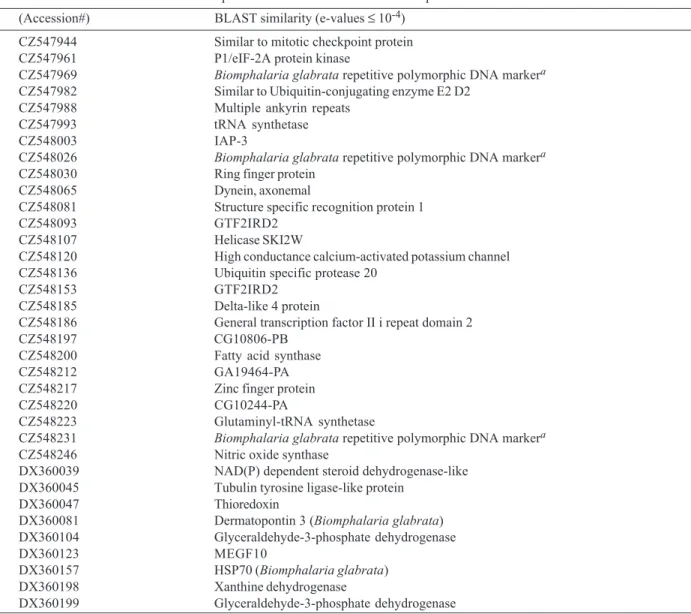
BLAST analysis showed that the majority (430 or 83.7%) of the 514 BAC end sequences were novel; they did not display significant similarity with previously known sequences. However, several putative gene se-quences were identified that had not been recorded pre-viously from B. glabrata. Sequences from five BAC ends most resembled previous entries derived from B. glabrata
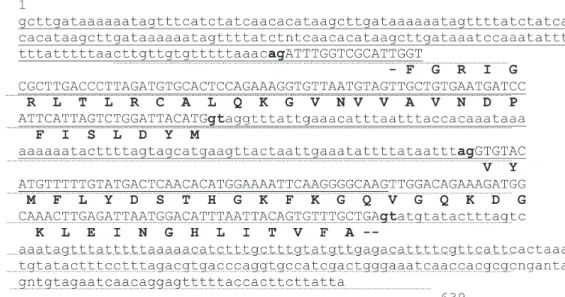
(summarized in Table IV). Two segments of the contig of BAC end sequences DX360049 and DX360199 showed BLAST similarities to glyceraldehy3-phosphate de-hydrogenase in a way that also revealed intron-exon struc-ture, with splice sites that display the general GT-AG con-sensus (Fig. 5).
Several types of sequence repeats were observed di-rectly from the BAC-derived sequences. These included simple dinucleotide microsatellites (e.g a string of TA peats in DX360102), but also more complex sequence peats such as CZ548151 that showed 18 almost exact re-peats of “ACCCTGGTATGCCTTAGTGCTTGTATTGG”. Furthermore, BLAST results indicated the presence of various transposable elements in 50 BAC end reads (9.7% of the total).
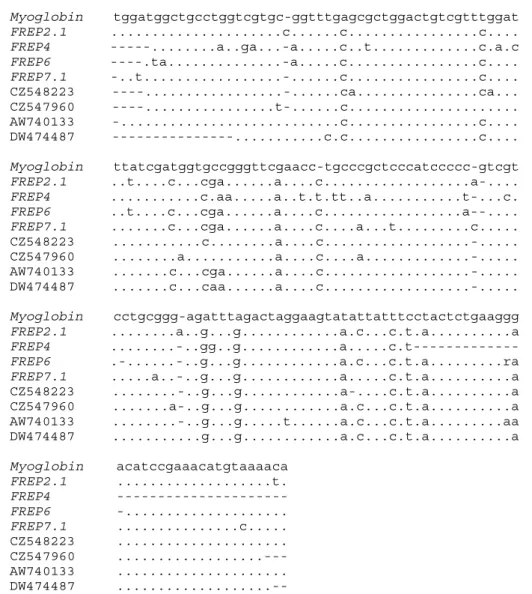
Remarkably, the genomic sequence collected here also contained an enigmatic type of high frequency sequence elements (HFSE). Stretches of between about 60 and 250 nucleotides embedded within almost 12% of the BAC end sequences showed significant similarity to (non protein-encoding) intron sequences of two separate kinds of B. glabrata genes for which full-length sequences have been provided previously; myoglobin and several fibrinogen-related protein genes (FREP2.1; FREP3.1; FREP4;
FREP6, FREP7.1, FREP13.1). Thus similarities were tected only at nucleotide level (BLASTN), not at the de-TABLE II
Representation of single/low copy genes in the BAC library
Rationale to consider Positive
Gene Probe as single/low copy clones
βactin 1037-1607 of AF329436 3-5 bands on Southern Adema 2002 45
FREP4 626 nt of AY012701 a 2-3 bands on Southern Zhang & Loker 2004 4
FREP13 182-661 of AF515468 1-2 bands on Southern Zhang & Loker 2004 23
HSP70 295-1014 of L44127 2-4 bands on Southern Laursen et al. 1997 13
MnSOD 317 - 640 nt AY500813 1-5 bands on Southern Jung et al. 2005 10
myoglobin AY314976 (379 nt) low sequence diversity Zhang et al. 2004 80
ferritin AW739853 (492 nt) arbitrary 2
L32 ribosomal protein 330 nt b arbitrary 15
sialic acid binding lectin CN445843 (318 nt) arbitrary 3
ubiquitin AF268491 (450 nt) arbitrary 3
These sequences were selected as likely single or low copy genes of Biomphalaria glabrata. These were used to probe the BG_BBa BAC library to check for representation of less common gene sequences. Indicated are name of the source gene, the region used as probe (partial interval or full length of GenBank entries), rationale for assumption as likely single or low copy number gene (or arbitrary decision), the number of clones in the BAC library that hybridized the probe. a:only the coding sequences from the gene positions 921-6074 were amplified from cDNA. b: sequence amplified PCR using primers (5' -3' ) QCL32F AAA GAA ACA AGA AGT TTA TTC GC and QCL32R GGG ATT TGT CAC TTT AAT GGC.
173 173 173 173 173 Mem Inst Oswaldo Cruz, Rio de Janeiro, Vol. 101(Suppl. I), 2006
TABLE III
Base content of BAC end sequence data sets
AGI UNM Combined
349 reads, 238576 nt a 165 reads, 60219 nt a 514 reads, 298795 nt a
Base number (% of total) number (% of total) number (% of total)
A 76474 (32.05) 18605 (30.89) 95079 (31.82)
T 75823 (31.78) 18769 (31.16) 94592 (31.65)
C 43270 (18.13) 10586 (17.57) 53856 (18.02)
G 42973 (18.01) 10986 (18.24) 53959 (18.05)
N 36 ( 0.15) 1273 ( 2.08) 1309 ( 0.44)
AT = 63.86% AT = 62.05% AT = 63.47%
Nucleotide content calculated for the BAC end sequence data from Biomphalaria glabrata (GenBank accession numbers CZ547921
-CZ548269; DX360039-DX360203). Because of the use of different methods, results are also shown separately for sequence data from the Arizona Genomics Institute (AGI), the University of New Mexico (UNM). The number of A, T, C, G nucleotides is indicated, and the percent of the total number of nucleotides; N: unresolved nucleotides; a: number of non-redundant nucleotides, this excludes duplicate sequences.
TABLE IV
Sequence similarities within BAC end sequence reads
(Accession#) BLAST similarity (e-values ≤ 10-4)
CZ547944 Similar to mitotic checkpoint protein
CZ547961 P1/eIF-2A protein kinase
CZ547969 Biomphalaria glabrata repetitive polymorphic DNA markera CZ547982 Similar to Ubiquitin-conjugating enzyme E2 D2
CZ547988 Multiple ankyrin repeats
CZ547993 tRNA synthetase
CZ548003 IAP-3
CZ548026 Biomphalaria glabrata repetitive polymorphic DNA markera
CZ548030 Ring finger protein
CZ548065 Dynein, axonemal
CZ548081 Structure specific recognition protein 1
CZ548093 GTF2IRD2
CZ548107 Helicase SKI2W
CZ548120 High conductance calcium-activated potassium channel CZ548136 Ubiquitin specific protease 20
CZ548153 GTF2IRD2
CZ548185 Delta-like 4 protein
CZ548186 General transcription factor II i repeat domain 2
CZ548197 CG10806-PB
CZ548200 Fatty acid synthase
CZ548212 GA19464-PA
CZ548217 Zinc finger protein
CZ548220 CG10244-PA
CZ548223 Glutaminyl-tRNA synthetase
CZ548231 Biomphalaria glabrata repetitive polymorphic DNA markera
CZ548246 Nitric oxide synthase
DX360039 NAD(P) dependent steroid dehydrogenase-like DX360045 Tubulin tyrosine ligase-like protein
DX360047 Thioredoxin
DX360081 Dermatopontin 3 (Biomphalaria glabrata) DX360104 Glyceraldehyde-3-phosphate dehydrogenase
DX360123 MEGF10
DX360157 HSP70 (Biomphalaria glabrata)
DX360198 Xanthine dehydrogenase
DX360199 Glyceraldehyde-3-phosphate dehydrogenase
174 174 174 174
174 B. glabrata BAC library • Coen M Adema et al.
duced aminoacid level (BLASTX). A comparison disclosed that parts of the introns of myoglobin and FREPs share regions with considerable sequence similarities. These particular sequence regions generated a surprisingly high number of significant BLAST hits when compared against genomic and cDNA sequences of B. glabrata (Fig. 6). BLAST analysis showed that the different HFSE do not share significant similarities with known sequences from other organisms, either at nucleotide or deduced amino acid levels.
DISCUSSION
The development of genomic projects for B. glabrata
will inform on the biology of molluscs in general. But of course, such an effort must also be considered in light of schistosomiasis. The medical importance of a better un-derstanding of snail-parasite interactions and the possi-bility of gaining novel insights into the transmission of schistosomiasis by B. glabrata was part of the motiva-tion for NHGRI to support the producmotiva-tion of a high qual-ity BAC library. Importantly, the NHGRI support also makes the library available at cost to the research commu-nity as a resource for the research commucommu-nity to enable advanced level study as a complement to ongoing re-search into the biology of B. glabrata, both in the labora-tory and in the field.
Before generating the BAC library, it was of paramount importance to confirm that snails collected from the field were indeed B. glabrata. Two independent methods, PCR-RFLP analysis of nuclear sequences (Vidigal et al. 1998) and phylogenetic analysis of sequence segments from mitochondrial genes (DeJong et al. 2003) each confirmed that BB02 snails were B. glabrata. Likewise, different re-search groups tested and confirmed that BB02 B. glabrata
is susceptible to infection by various strains of S. mansoni.
Several research groups in the US, the UK and in Brazil now maintain the BB02 snails. This also minimizes the risk of accidental loss of the strain.
The isolation of sufficient amounts of good quality, HMW DNA from B. glabrata proved to be a challenge. Routine methods for DNA extraction from whole snail bodies yielded DNA fragments ≤ 50 kb, too low for gen-eration of large inserts in a BAC library. The methods of Luo and Wing (2003), originally developed for plant tis-sues, did produce HWM DNA > 800 kb, but only from the ovotestis of B. glabrata and not in adequate amounts from a single snail. The additional snails needed were generated by selfing. This is possible because B. glabrata
is a simultaneous hermaphrodite that can self fertilize (pro-ducing both male and female gametes) to produce off-spring. Although this does not equate to cloning snails, the haplotype diversity of selfed progeny is thus lowered compared to that of outcrossing snails.
175 175 175 175 175 Mem Inst Oswaldo Cruz, Rio de Janeiro, Vol. 101(Suppl. I), 2006
sistency of retrieving relevant, related sequences in the genome context from the BAC library. The apparent di-versity of BACs (failure to form a single contig) recov-ered after screening with the myoglobin sequence must be considered against a rapid increase of (hemo)globin-like EST sequences in GenBank (85 entries in February 2006). Myoglobin may be a low copy sequence, but the abundance of now available information suggests a high likelihood for cross-reactivity with sequences from other genes.
Already, the BAC library has provided new informa-tion on the B. glabrata genome. The BAC end sequence data not only identified several genes, but as shown in Fig. 5, also provided information regarding intron-exon structure of genes. The latter is relevant since most B. glabrata genes are only characterized from cDNA. The
large amount of BAC end sequence data indicated that the genome of B. glabrata has a 63% AT content. This is higher than previously estimated, based on the reported 54% AT content for the related B. alexandrina (Nabih & El Ansary 1980). However, it is not as high as the 74.6% AT content of the mitochondrial genome of B. glabrata
(DeJong et al.2003).
The sequence data provided an indication of abun-dance of mobile elements: these occurred in 9.7% of the BAC ends characterized. This sampling is incomplete, but 9.7% is low compared to the genome of S. mansoni that may consist of 50% mobile elements (Laha et al. 2005). Another surprise were the groups of HFSEs, embedded within BAC end sequences, introns of myoglobin and
FREP genes and shared with cDNA sequences (Fig. 6). Perhaps HFSEs are a peculiarity of the genome of B.
Myoglobin tggatggctgcctggtcgtgc-ggtttgagcgctggactgtcgtttggat FREP2.1 ...c...c...c.... FREP4 ---...a..ga...-a...c..t...c.a.c FREP6 ----.ta...-a...c...c.... FREP7.1 -..t...-...c...c.... CZ548223 ----...-...ca...ca... CZ547960 ----...t-...c... AW740133 -...c...c.... DW474487 ---...c.c...c....
Myoglobin ttatcgatggtgccgggttcgaacc-tgcccgctcccatccccc-gtcgt FREP2.1 ..t....c...cga...a....c...a-.... FREP4 ...c.aa...a..t.t.tt..a...t-...c. FREP6 ..t....c...cga...a....c...a--.... FREP7.1 ...c...cga...a....c....a...t...c... CZ548223 ...c...a....c...-... CZ547960 ...a...a....c....a...-... AW740133 ...c...cga...a....c...-... DW474487 ...c...caa...a....c...-...
Myoglobin cctgcggg-agatttagactaggaagtatattatttcctactctgaaggg FREP2.1 ...a..g...g...a.c...c.t.a...a FREP4 ...-..gg..g...a...c.t---FREP6 .-...-..g...g...a.c...c.t.a...ra FREP7.1 ...a..-..g...g...a...c.t.a...a CZ548223 ...-..g...g...a-....c.t.a...a CZ547960 ...a-..g...g...a.c...c.t.a...a AW740133 ...-..g...g...t...a.c...c.t.a...aa DW474487 ...g...g...a.c...c.t.a...a
Myoglobin acatccgaaacatgtaaaaca FREP2.1 ...t. FREP4 ---FREP6 -... FREP7.1 ...c... CZ548223 ... CZ547960 ...---AW740133 ... DW474487
176 176 176 176
176 B. glabrata BAC library • Coen M Adema et al.
glabrata, possibly these are transcriptionally active re-gions that function in regulation of gene expression (e.g. Claverie 2005, Mattick 2005). Likely, elucidation of the ori-gin and function of these will benefit from continued ge-nome level investigations of B. glabrata.
In conclusion, a high quality BAC library for B. glabrata is now available. This helps to keep pace with similar research developments for S. mansoni such that this parasite-snail interaction can be analyzed at the genomics level. Because the current full genome sequenc-ing project also employs the BB02 strain B. glabrata (http:/ /genome.wustl.edu/genome.cgi?GENOME=Biomphalaria %20glabrata), the usefulness of the BG_BBa BAC library as a research resource will continue to increase by mak-ing the B. glabrata genome accessible to study snail bi-ology in novel ways.
ACKNOWLEDGMENTS
Ulrike Zelck (Tûbingen University, Germany) provided helpful discussion for selection of low copy genes. At the Uni-versity of Arizona, Chris Mueller, Kristi Collura, Nick Sisneros, Marina Wissotski, Dan Smart, David Campos and Kiran Rao provided excellent technical assistance. At the University of New Mexico, George Rosenberg assisted with sequencing of BACs, technical support was provided by the Molecular Biol-ogy Facility, which is supported by NIH grant number 1P20RR18754 from the Institute Development Development Award (IDeA) Program of the National Center for Research Resources.
REFERENCES
Adema CM 2002. Comparative study of cytoplasmic actin DNA sequences from six species of Planorbidae (Gas-tropoda: Basommatophora). J Molluscan Stud68: 17-23.
Adema CM, Loker ES 1997. Specificity and immunobiology of larval digenean-snail associations. In B Fried, TK Graczyk (eds), Advances in Trematode Biology, CRC Press, Boca Raton, FL, p. 230-263.
Altelaar AF, van Minnen J, Jimenez CR, Heeren RM, Piersma SR 2005. Direct molecular imaging of Lymnaea stagnalis
nervous tissue at subcellular spatial resolution by mass spectrometry. Anal Chem 77:735-741.
Chou HH, Holmes MH 2001. DNA sequence quality trimming and vector removal. Bioinformatics17: 1093-1104.
Claverie J-M 2005 Fewer Genes, More Noncoding RNA. Sci-ence 309: 1529-1530.
Collins FS, Green ED, Guttmacher AE, Guyer MS 2003. A vision for the future of genomics research. Nature422: 835-847.
Chitsulo L, Loverde R, Engels D, Barakat R, Colley D, Cioli D, Engels D, Feldmeier H, Loverde P, Olds GR, Ourna J, Rabello A, Savioli L, Traore M, Vennerwald B2005. Schis-tosomiasis.Nat Rev Microbiol2: 12-13.
DeJong RJ, Emery AM, Adema CM 2004. The mitochondrial genome of Biomphalaria glabrata (Gastropoda: Basom-matophora), intermediate host of Schistosoma mansoni. J Parasitol90: 991-997.
DeJong RJ, Morgan JAT, Wilson WD, Al-Jaser MH, Appleton CC, Coulibaly G, D’andrea PS, Doenhoff MJ, Haas W, Idris MA, Magalhães LA, Moné H, Mouahid G, Mubila L,
Pointier J-P, Webster JP, Zanotti-Magalhães EM, Paraense WL, Mkoji GM, Loker ES 2003. Phylogeography of
Biomphalaria glabrata and B. pfeifferi, important interme-diate hosts of Schistosoma mansoni in the New and Old World tropics. Mol Ecol 12: 3041-3056.
Ewing B, Green P 1998.Base-calling of automated sequencer traces using Phred: II. Error probabilities. Genome Res8: 186-194.
Ewing B, Hillier L, Wendl MC, Green P 1998. Base-calling of automated sequencer traces using Phred: I. Accuracy as-sessment. Genome Res8: 175-185.
Gregory TR 2003. Genome size estimates for two important freshwater molluscs, the zebra mussel (Dreissena
polymorpha) and the schistosomiasis vector snail
(Biomphalaria glabrata). Genomics 46: 841-844.
Jokela J, Lively CM, Dybdahl MF, Fox JA 2003. Genetic varia-tion in sexual and clonal lineages of a freshwater snail. Biol J Linn Soc Lond79: 165-181.
Jones CS, Lockyer AE, Rollinson D, Noble LR 2001. Molecu-lar approaches in the study of Biomphalaria glabrata
-Schistosoma mansoni interactions: linkage analysis and gene expression profiling. Parasitology 123 (Suppl. S): S181-S196.
Jung Y, Nowak TS, Zhang S-M, Hertel LA, Loker ES, Adema CM 2005 Manganese superoxide dismutase from
Biomphalaria glabrata. J Invertebr Pathol90: 59-63.
Laha T, Kewgrai N, Loukas A, Brindley PJ 2005 Characteriza-tion of SR3 reveals abundance of non-LTR retrotransposons of the RTE clade in the genome of the human blood fluke,
Schistosoma mansoni. BMC Genomics6: 154.
Laursen JR, di Liu H, Wu XJ, Yoshino TP 1997 Heat-shock response in a molluscan cell line: characterization of the response and cloning of an inducible HSP70 cDNA.
J Invertebr Pathol70: 226-233.
Lewis FA, Patterson CN, Knight M, Richards CS 2001. The relationship between Schistosoma mansoni and Biom-phalaria glabrata: genetic and molecular approaches. Para-sitology 123 (Suppl. S): S169-S179.
Lie KJ 1982.Survival of Schistosoma mansoni and other trema-tode larvae in the snail Biomphalaria glabrata - a discus-sion of the interference theory.Trop Geogr Med 34: 111-122.
Lockyer AE, Jones CS, Noble LR, Rollinson D 2004a Trema-todes and snails: an intimate association. Can J Zool82: 251-269.
Lockyer AE, Noble LR, Rollinson D, Jones CS 2004b. Schisto-soma mansoni: resistant specific infection-induced gene ex-pression in Biomphalaria glabrata identified by fluores-cent-based differential display. Exp Parasitol 107: 97-104.
LoVerde PT, Hirai H, Merrick JM, Lee NH, El-Sayed N 2004.
Schistosoma mansoni genome project: an update. Parasitol Int 53: 183-192.
Luo M, Wing RA 2003. An improved method for plant BAC library construction. In E Grotewold, Plant Functional Genomics: Methods and Protocols, Humana Press, Totowa, NJ, p. 3-19.
177 177 177 177 177 Mem Inst Oswaldo Cruz, Rio de Janeiro, Vol. 101(Suppl. I), 2006
High-throughput fingerprinting of bacterial artificial chro-mosomes using the snapshot labeling kit and sizing of re-striction fragments by capillary electrophoresis. Genomics 82: 378-389.
Mattick JS 2005. The Functional Genomics of Noncoding RNA.
Science 309: 1527-1528.
Milet C, Berland S, Lamghari M, Mouries L, Jolly C, Borzeix S, Doumenc D, Lopez E, 2004. Conservation of signal mol-ecules involved in biomineralisation control in calcifying matrices of bone and shell Source. C R Palevol 3: 493-501.
Miller AN, Raghavan N, FitzGerald PC, Lewis FA, Knight M 2001. Differential gene expression in haemocytes of the snail Biomphalaria glabrata: effects of Schistosoma mansoni infection. Int J Parasitol 31: 687-696.
Mitta G, Galinier R, Tisseyre P, Allienne JF, Girerd-Chambaz Y, Guillou F, Bouchut A, Coustau C 2005. Gene discovery and expression analysis of immune-relevant genes from
Biomphalaria glabrata hemocytes. Dev Comp Immunol 29: 393-407.
Mizi A, Zouros E, Moschonas N, Rodakis GC 2005. The com-plete maternal and paternal mitochondrial genomes of the Mediterranean mussel Mytilus galloprovincialis: implica-tions for the doubly uniparental inheritance mode of mtDNA. Mol Biol Evol 22: 952-967.
Morgan JAT, DeJong RJ, Snyder SD, Mkoji GM, Loker ES 2001. Schistosoma mansoni and Biomphalaria: past his-tory and future trends. Parasitology 123 (Suppl. S): S211-S228.
Nabih I, El Ansary A 1980. Genetic-studies on fresh-water snails specific intermediate hosts for schistosomiasis .2. Isolation and base composition determination of deoxyribonucleic-acid. Cell Mol Biol 26: 455-458.
Nowak TS, Woodards AC, Jung Y, Adema CM, Loker ES 2004. Identification of transcripts generated during the response of resistant Biomphalaria glabrata to Schistosoma mansoni
infection using suppression subtractive hybridization. J Parasitol 90: 1034-1040.
Paraense WL 1986. Distribuição dos caramujos no Brasil. In FA Reis, I Faria, N Katz (eds), Modernos Conhecimentos sobre
Esquistossomose Mansônica, Suplemento dos Anais
1983/84, vol. 14, Academia Mineira de Medicina, Belo Hori-zonte, p. 117-128.
Paraense WL, Corrêa L 1963. Variation in susceptibility of popu-lations of Australorbis glabratus to a strain of Schistosoma mansoni. Rev Inst Med Trop Sã Paulo 5: 15-22.
Paraense WL, Corrêa LR 1988. Self-fertilization in the fresh-water snails Helisoma duryi and Helisoma trivolvis. Mem Inst Oswaldo Cruz 83: 405-410.
Pointier JP, David P, Jarne P 2005. Biological invasions: the case of planorbid snails. J Helminthol 79: 249-256.
Raghavan N, Miller AN, Gardner M, FitzGerald PC, Kerlavage
AR, Johnston DA, Lewis FA, Knight M 2003. Compara-tive gene analysis of Biomphalaria glabrata hemocytes pre-and post-exposure to miracidia of Schistosoma mansoni.
Mol Biochem Parasitol 126: 181-191.
Rouse GW 1999. Trochophore concepts: ciliary bands and the evolution of larvae in spiralian metazoa. Biol J Linn Soc Lond 66: 411-464.
Schilthuizen M, Davison A 2005. The convoluted evolution of snail chirality. Naturwissenschaften 92: 504-515.
Schneider O, Zelck UE 2001. Differential display analysis of hemocytes from resistant and schistosome-susceptible intermediate hosts. Parasitol Res 87: 489-491.
Soderlund C, Humphrey S, Dunhum A, French L 2000. Contigs built with fingerprints, markers and FPC V4.7. Genome Res 10: 1772-1787.
Terlau H, Olivera BM 2004. Conus venoms: A rich source of novel ion channel-targeted peptides. Physiol Rev 84:41-68.
Theron A, Coustau C 2005. Are Biomphalaria snails resistant to Schistosoma mansoni? J Helminthol 79: 187-191.
Vergote D, Bouchut A, Sautiere PE, Roger E, Galinier R, Rognon A, Coustau C, Salzet M, Mitta G 2005. Characterisation of proteins differentially present in the plasma of Biom-phalaria glabrata susceptible or resistant to Echinostoma caproni. Int J Parasitol 35: 215-224.
Vermeij GJ 2002. Characters in context: molluscan shells and the forces that mold them. Paleobiology 28: 41-54.
Vidigal TH, Spatz L, Nunes DN, Simpson AJ, Carvalho OS, Dias Neto E 1998. Biomphalaria spp: identification of the intermediate snail hosts of Schistosoma mansoni by poly-merase chain reaction amplification and restriction enzyme digestion of the ribosomal RNA gene intergenic spacer. Exp Parasitol 89: 180-187.
Williamson R, Chrachri A 2004. Cephalopod neural networks.
Neurosignals 13: 87-98.
Zhao X, Zheng M, Liang L, Zhang Q, Wang Y, Jiang G 2005. Assessment of PCBs and PCDD/Fs along the Chinese Bohai Sea coastline using mollusks as bioindicators. Arch Environ Contam Toxicol 49: 178-185.
Zhang S-M, Loker ES 2004. Representation of an immune re-sponsive gene family encoding fibrinogen-related proteins in the freshwater mollusc Biomphalaria glabrata, an inter-mediate host for Schistosoma mansoni. Gene 341: 255-266.
Zhang S-M, Adema CM, Kepler TB, Loker ES 2004. Diversifi-cation of Ig superfamily genes in an invertebrate. Science 305: 251-254