Genome-wide analysis of
EgEVE_1
, a transcriptionally active endogenous
viral element associated to small RNAs in
Eucalyptus
genomes
Helena Sanches Marcon
1,2, Juliana Costa-Silva
3, Alan Péricles Rodrigues Lorenzetti
4, Celso Luis Marino
2and Douglas Silva Domingues
1,31
Departamento de Botânica, Instituto de Biociências,
Universidade Estadual Paulista “Júlio de Mesquita Filho” (UNESP), Rio Claro, SP, Brazil.
2
Departamento de Genética, Instituto de Biociências,
Universidade Estadual Paulista “Júlio de Mesquita Filho” (UNESP), Botucatu, SP, Brazil.
3
Programa de Pós-graduação em Bioinformática, PPGBIOINFO,
Universidade Tecnológica Federal do Paraná, Cornélio Procópio, PR, Brazil.
4
Programa de Pós-graduação em Genética e Biologia Molecular, Universidade Estadual de Londrina,
Londrina, PR, Brazil.
Abstract
Endogenous viral elements (EVEs) are the result of heritable horizontal gene transfer from viruses to hosts. In the last years, several EVE integration events were reported in plants by the exponential availability of sequenced genomes.Eucalyptus grandis is a forest tree species with a sequenced genome that is poorly studied in terms of evo-lution and mobile genetic elements composition. Here we report the characterization ofE. grandis endogenous viral element 1 (EgEVE_1), a transcriptionally active EVE with a size of 5,664 bp. Phylogenetic analysis and genomic dis-tribution demonstrated thatEgEVE_1 is a newly described member of the Caulimoviridae family, distinct from the re-cently characterized plant Florendoviruses. Genomic distribution ofEgEVE_1 and Florendovirus is also distinct. EgEVE_1 qPCR quantification in Eucalyptus urophylla suggests that this genome has more EgEVE_1 copies than E. grandis. EgEVE_1 transcriptional activity was demonstrated by RT-qPCR in five Eucalyptus species and one intrageneric hybrid. We also identified thatEucalyptus EVEs can generate small RNAs (sRNAs),that might be in-volved inde novo DNA methylation and virus resistance. Our data suggest that EVE families in Eucalyptus have dis-tinct properties, and we provide the first comparative analysis of EVEs inEucalyptus genomes.
Keywords: Pararetrovirus, horizontal transfer, Eucalyptus, Caulimovirus, insertion.
Received: April 25, 2016; Accepted: October 10, 2016.
Introduction
In the last years, the burst of plant genome sequences has uncovered innumerable cases of horizontal gene trans-fer (HGT). HGT is the DNA flow between unrelated spe-cies. For many years, HGT events were considered rare and uncommon, but numerous genome analyses have since re-vealed the wide extent of HGT in plants (Richardson and Palmer, 2007; Yueet al., 2012). Viruses play important roles in HGT, once many studies detected viral sequences integrated into several plant genomes (Bertschet al., 2009; Geering et al., 2014; Fonseca et al., 2016). These viral DNA sequences present within the genomes of non-viral organisms are known as Endogenous Viral Elements (EVEs; Holmes, 2011). EVEs can consist of an entire viral
genome or only a partial fragment (Chuet al., 2014). The function of EVEs remains unclear, but some studies sug-gest a relationship between viral fragments in genomes and antiviral immunity (Aswad and Katzourakis 2013; Fonseca
et al., 2016). Genomic EVE regions can also act as genera-tors of several types of virus-derived small RNAs (sRNAs; Sharmaet al., 2013) in some plant species (Becheret al., 2014; Fonsecaet al., 2016). The most abundant virus inte-grations in plants are from Caulimoviridae, a Pararetrovirus family. Using comparative genomics approaches, Caulimovirus-related sequences were identified in several angiosperms (Chabannes and Iskra-Caruana, 2013), in-cludingEucalyptus grandis, and they comprise a signifi-cant fraction of these plant genomes (Geeringet al., 2014).
Previous works have already reported the serendipi-tous discovery of EVEs in plants during large-scale annota-tion of LTR retrotransposons (LTR-RTs) (Piednoëlet al., 2013) or during next generation sequencing analyses of
Send correspondence to Douglas Silva Domingues. Departamento de Botânica, Instituto de Biociências, UNESP, Av. 24-A, 1515, 13506-900, Rio Claro, SP, Brazil. E-mail: [email protected]
genomes and transcriptomes (Villacreseset al., 2015; Fon-secaet al., 2016). A similar case happened during the anno-tation of transcriptionally active LTR-RTs inEucalyptus
(Marconet al., 2015). AnE. camaldulensisEST (GenBank accession FY783514), firstly identified because it contains a reverse transcriptase sequence, was in fact the fragment of aCaulimovirus. Alignment analysis of this sequence in the
E. grandisgenome (Myburget al., 2014) led us to the iden-tification of a new EVE family in this genus. In this study, using publicly available genomic and transcriptomic E. grandisresources, we report the molecular characterization of this new EVE family, namedE. grandisendogenous vi-ral element 1 (EgEVE_1). We extendedin silicoanalyses of
EgEVE_1, carrying out comparative quantitative copy number analyses in twoEucalyptusspecies and performing transcriptional analysis in fiveEucalyptusspecies and one intrageneric hybrid. We also compared EgEVE_1 to the Caulimoviridae genus called `Florendovirus’, recently identified in theE. grandisgenome (Geeringet al., 2014), in terms of phylogenetic position, genomic distribution and the capacity of generating sRNAs.
This study is the first fine-scale analysis of EVEs in
Eucalyptusand an important step in the molecular charac-terization of mobile genetic elements in this woody plant genus.
Material and Methods
Virus-like sequences inEucalyptus grandisgenome
During the characterization of transcriptionally active LTR-RTs in theEucalyptusgenus (Marconet al., 2015), we found a reverse transcriptase fragment in an E. camaldulensis EST sequence (GenBank accession FY783514). Similar to Piednoëlet al.(2013), after careful checking using CENSOR implemented in RepBase (Kohanyet al., 2006), we discovered that this reverse tran-scriptase is in fact a partial sequence from aCaulimovirus.
Using the reverse transcriptase sequence of E. camaldulensisEST as a query, we identified a genomic re-gion with high similarity (85% in BLASTN) inE. grandis
genome scaffold 7. After manual checking of this hit using CENSOR and Repbase, we defined position 10,999,785 to 11,005,448 as a reference for further analyses. For a com-parative analysis, we included four consensus
Florendovirussequences recently identified inE. grandis
genome (Geeringet al., 2014).
Conserved domains were identified using the CDD tool from NCBI (http://www.ncbi.nlm.nih.gov/Struc-ture/cdd/wrpsb.cgi) and were manually inspected.
Comparative analyses and endogenous viral family name assignment
To verify the relationships among EVEs, reverse transcriptase (RVT) regions were used to build a phylogen-etic tree. RVT sequences for this analysis were the same as
the ones used in a previous analysis of EVE sequences in the “Maqui Berry” genome (Villacreseset al., 2015). Nu-cleotide sequences were aligned using MUSCLE (Edgar, 2004) with default parameters, and the phylogenetic trees were generated using MEGA 7.0 (Kumaret al., 2016), ap-plying the Maximum Likelihood method, with 1,000 boot-strap replicates. After performing a model test in MEGA, the General Time Reversible substitution model with Gamma distributed Invariant sites (GTR+I) was used. Gap positions were excluded when present in more than 5% of the sequences.
The new EVE found inE. grandisformed a novel lin-eage within the Caulimoviridae family and was, thus, namedEgEVE1(E. grandisEndogenous virus element 1). The Florendoviruses previously identified inE. grandis ge-nome were named as EgFLOR (Florendovirus from E. grandis) 1 to 4.
Copy number determination inE. grandisgenome and diversity analysis
The copy number ofEgEVE1and of four Florendo-virus families found inE. grandisgenome was determined using MEGABLAST similar to Marconet al.(2015), using the 2.0 genome version deposited at Phytozome (https://phytozome.jgi.doe.gov/pz/portal.html). For copy number estimation, we considered only the ones that cov-ered over 80% of the query and with nucleotide similarity over 80% after manual inspection.
The average divergence (Pi) in RVTs amongEgEVE
members was calculated using DnaSp program (Librado and Rozas 2009).
Eucalyptusspp EST screening
For an initial evaluation of the transcriptional activity of EgEVE1 and EgFLOR1-4, reference sequences were used as BLASTN queries againstEucalyptusESTs from the EUCANEXT database (Nascimento et al., 2011;
Salazar et al., 2013;
http://bioinfo03.ibi.unicamp.br/eucalyptusdb/), in a ap-proach similar to that of Marconet al.(2015).
EgEVE1relative quantification and transcriptional analysis
A comparative quantification by qPCR ofEgEVE1
reverse transcriptase was performed between theE. grandis
and E. urophylla genomes, using a single-copy gene (DUR3) as a reference. Primers forEgEVE1quantification were: EgEVE_RVT_F 5’-CCAAGATGATAAGTTCCC TTTACC-3’ and EgEVE_RVT_R 5’-GGTGGAATTTG GAATAGATGTGG-3’. We followed the same procedures used in a previous study from our group (Marconet al., 2015). We also evaluated the transcriptional activity of
EgEVE1reverse transcriptase inE. grandis,E. brassiana, E. saligna, E. tereticornis,E. urophyllaand in one hybrid
RT-qPCR was used to identify transcriptional activity in leaves, stalks and secondary roots, in physiological condi-tions and under osmotic stress. Overall procedures for the qPCR assays, including normalization, and plant harvest-ing, were the same as those described in Marcon et al.
(2015).
RT-qPCR efficiency was calculated using Linreg v. 2013.0 (Ruijter et al., 2009), and reactions with effi-ciency > 90% were considered for further analysis. Rela-tive expression was calculated using theDDCt method (Livak and Schmittgen, 2001) with the formula (1 + E)DDCt, where E represents the efficiency. Statistical anal-ysis was performed using Assistat 7.7 beta (Silva and Azevedo, 2009). We used one-way analysis of variance (ANOVA), and in cases where significant differences were found, the Least Square Deviation (LSD) method for multiple comparisons was applied. Results were con-sidered significant at P < 0.05. The tissue or organ with the lowest expression (highest Ct) was used as calibrator (expression value = 1).
Small RNA mapping analysis
Public data fromE. grandissmall RNA sequencing (Levyet al., 2014, NCBI accession GSE58367) was used to map small RNAs against virus-like sequences to check if they may be regulated by post-transcriptional pathways. This is the only publicly available sRNA sequencing data for this genus, comprising 6,891,830 valid reads, obtained from 14-day sterile seedlings.
Raw read quality was assessed using FastQC version 0.10.1 (http://www.bioinformatics.babraham.ac.uk/pro-jects/fastqc/). Trimmomatic version 0.35 (Bolger et al., 2014) was used to preprocess raw reads. In summary, se-quencing adapters, overrepresented sequences and reads < 16nt or > 28nt were removed. Only reads with average phred quality > 30 were maintained. Using the FASTQ/A
Collapser tool from FASTX-Toolkit
(http://hannonlab.cshl.edu/fastx-toolkit), we obtained non-redundant small RNA sequences. This set was filtered using Bowtie 2 (Langmead and Salzberg, 2012) under stringent parameters to remove sequences from chloro-plasts, mitochondria, tRNAs, rRNAs and snoRNAs. Non-reduntant sequences were mapped against E. grandis
chloroplast (GenBank Accession NC_014570) and ribo-somal units obtained in the SILVA riboribo-somal RNA gene database (Quast et al., 2013), Gossypium barbadense, Solanum lycopersicum and Vitis vinifera mitochondria (GenBank accessions AFYB00000000, NC_028254 and NC_012119), Populus tricocharpa and Vitis vinifera
tRNAs from GtRNAdb (Chan and Lowe, 2009) and
snoRNAs from the Plant snoRNA database
(http://bioinf.scri.sari.ac.uk/cgi-bin/plant_snorna/home).
Sequences that matched these references were discarded for further analysis. After this filtering, a total of 615,801 non-redundant sequences were mapped against EgEVE1
and EgFLOR1-4 sequences under stringent parameters, with no gaps and mismatches, using Bowtie2.
Results
Identification of a novel EVE inEucalyptus grandis
genome
We identified a sequence highly similar to an endoge-nous caulimovirus in theE. grandisgenome using anE. camaldulensisEST as query. After manual annotation of a reference region (scaffold7: 10999785 to 11005448), we determined an EVE region of 5,664 nucleotides (nt), named
EgEVE_1.
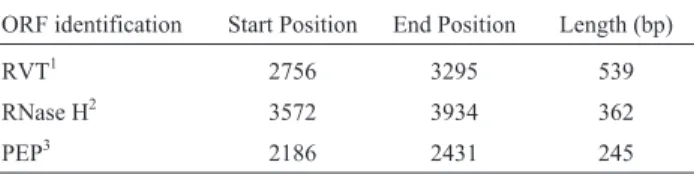
EgEVE_1has three retroviral domains: a reverse tran-scriptase (RVT- cd01647) with 539 nt, a ribonuclease H (RNase H - cd09274) with 362 nt, and a pepsin-like aspartate protease (PEP - cd00303) with 245 nt (Table 1). All domains were in the same reading frame of the sense strand.
Comparative phylogenetic structure shows that
EgEVE_1is not related to Florendoviruses
We classifiedEgEVE_1 among viral families using the RVT sequences from previous studies on plant EVEs (Geeringet al., 2014; Villacreseset al., 2015) (Figure 1).
EgEVE_1is highly related to the Caulimoviridae family, especially with Petuvirus, clustering withPVCVandAcV1
(Villacreses et al., 2015). This position suggests that
EgEVE_1may be considered part of the same genus (Fig-ure 1), although a more comprehensive characterization us-ing related virus sequences and experimental assays are needed to better corroborate this hypothesis. More impor-tantly, we could demonstrate that E. grandis
Florendoviruses (EgFLOR1-4, Figure 1, Figure S1), the soleEucalyptusEVEs identified up to date, belong to an-other clade. In this way we confirmed thatEgEVE_1is a new family of pararetroviruses identified in theE. grandis
genome.
To further confirm thatEgEVE_1belongs to a new family, we identified complete sequences inE. grandis ge-nome.
Table 1-EgEVE_1domains and related gene products.
ORF identification Start Position End Position Length (bp)
RVT1 2756 3295 539
RNase H2 3572 3934 362
PEP3 2186 2431 245
EgEVE_1distribution in theE. grandisgenome: a comparative analysis with Florendoviruses
We identified six copies of EgEVE_1 in the E. grandisgenome on fourE. grandis chromosomes. Copy numbers forEgFLORfamilies ranged from 2 to 26
(Ta-ble 2), reinforcing that they belong to another group of EVEs. Among Florendoviruses, EgFLOR_1has the highest copy number, whileEgFLOR_3has only two copies (Table 2). In Table S1 (supplementary material) we detail coordi-nates of each complete copy for theEgEVEandEgFLOR
families.
The diversity (Pi) ofEgEVE_1complete sequences was higher than the one observed for EgFLOR families (Table 2), reinforcing that they have dissimilar genomic features.
Comparative genomic quantification betweenE. grandisandE. urophylla
Since we were able to find EVEs inE. grandisusing a congeneric species sequence as a query, we hypothesized that a qPCR analysis in a conserved region ofEgEVE_1
would allow a comparative quantification of this EVE fam-ily amongEucalyptusspecies. In this way, having in mind thatin silicoanalyses were based on theE. grandisgenome, we used this species to run a comparative quantification of
EgEVE_1RVT domain by qPCR inE. urophylla,similar to the one performed by Marconet al.(2015), using a sin-gle-copy gene as a reference.Our analyses suggest thatE. urophylla could have more EgEVE_1 copies than E. grandis(Figure 2).
EgEVE_1transcriptional activity inEucalyptus
species and in different organs
This is the first report on transcriptional activity of EVEs in forest trees. We BLAST searched the transcriptome of six Eucalyptusspecies deposited in the
EUCANEXT database (Nascimentoet al., 2011; Salazaret al., 2013), usingEgEVE_1andEgFLOR1-4as queries. We did not find any hit for EgFLOR1-4, indicating that Florendoviruses are not transcriptionally active in Eucalyp-tusgenomes.EgEVE_1only showed similarity with ESTs fromE. calmadulensis(Supplementary material Table S2).
We also analyzedEgEVE_1transcriptional levels us-ing RT-qPCR for three tissues (leaves, stalk and secondary roots) from five Eucalyptus species (E. brassiana, E. grandis,E. saligna,E. tereticornisandE. urophylla) and one intrageneric hybrid (E. grandisxE. urophylla– termed “E. urograndis” to facilitate discussion). We also evaluated secondary roots fromE. grandisunder osmotic stress im-posed by PEG treatment (Rodrigueset al., 2013) (Figure 3). The highest transcriptional levels forEgEVE_1were found in stalks and roots from E. urograndis andE. saligna
(Figure 3). Interestingly, EgEVE_1 displayed low trans-criptional activity in leaves (Figure 3). Considering that most transcriptome analyses use leaves, this may explain the lack of EgFLOR in expressed sequences. EgEVE_1
transcriptional levels were repressed in roots submitted to osmotic stress by PEG treatment (Figure 3).
EucalyptusEVEs as sources of small RNAs
There is evidence that EVEs might act as sources of sRNAs, probably shaping epigenic features and/or having a role on antiviral defenses (Becheret al., 2014; Geeringet al., 2014; Fonsecaet al., 2016). To check if Eucalyptus
EVEs could be involved in sRNA production, we mapped filtered non-redundant sRNAs ranging from 16 to 26 nt with zero mismatches to consensus EVE sequences (EgEVE_1 and EgFLOR1-4). Although the numbers of sRNAs matches are probably underestimated due to poly-morphisms between reference copies and genomic se-quences, this analysis can provide an initial overview of sRNA production inEucalyptusEVEs.
We mapped a total of 727 sRNA reads (Figure 4; Ta-ble S3).EgEVE_1was the element with most mapped reads (434) and EgFLOR2 had the lowest number of mapped reads (16), and the most abundant class for all EVEs was 24-nt sRNAs (Supplementary material Table S3; Figure 4), a class usually associated to transposable elements and re-petitive sequences and involved in RNA-directed DNA methylation (Zhang and Zhu, 2011; Parentet al., 2012). Table 2- Genomic distribution and diversity of EVE families.
EVE family Copy Number Chromosomes Diversity (Pi)
EgEVE_1 6 7, 9, 10, 11 0.37 ±0.0092
EgFLOR_1 26 1, 2, 3, 4, 5, 6, 7, 8, 9, 11 0.27 ±0.0001
EgFLOR_2 13 1, 2, 3, 4, 5, 6, 7, 8, 9, 11 0.28 ±0.0009
EgFLOR_3 2 5, 7 0.12 ±0.25
EgFLOR_4 23 1, 2, 3, 4, 5, 6, 7, 8, 9, 11 0.28 ±0.0001
24 nt sRNAs have already been associated to plant-integrated pararetroviruses (Becheret al., 2014).
In all EVEs, most sRNAs were mapped in the 3’ re-gion. In the caseEgEVE_1, we observed a clustered map-ping of sRNAs in RVT and RNAseH regions (Figure 5), suggesting a prominent role of these regions in sRNA regu-lation.
Discussion
Our data report the first transcriptionally active EVE in theE. grandisgenome,EgEVE_1, using bioinformatics and experimental approaches. Similar to EVEs that were recently described in several plant genomes (Chabannes and Iskra-Caruana, 2013; Becheret al., 2014; Villacreseset al., 2015),EgEVE_1is also classified as being close to the genusPetuviruswithin the Caulimoviridae.
We could not recover theGagdomain ofEgEVE_1in any of its genomic copies. Such arrangements of frag-mented copies dispersed at several genomic loci have been also described in EVEs fromMusaandNicotianaspecies (Chabannes and Iskra-Caruana, 2013). On the other hand,
EucalyptusFlorendoviruses (EgFLORfamilies) are bigger thanEgEVE_1(7731 to 7854 bp), with similar size when compared to other pararetroviruses (Calvertet al., 1995; Villacreseset al., 2015).
EgEVE_1is clearly distinct from theEgFLOR fami-lies by phylogenetic (Figure 1) and genomic (Table 1) anal-ysis. Floredoviruses also contain a domain that encodes a putative protein of unknown function (Figure 5).
The quantification of genomic repetitive units by comparative qPCR has been performed in several species (Baruch and Kashkush, 2012; Yaakovet al., 2013; Marcon
et al., 2015). The genomes ofE. grandis(1C = 630 Mb) and
E. urophylla(1C = 640 Mb) are of similar size and diverged < 20 Mya (Myburget al., 2014), making them a good con-generic pair for comparative analyses ofEgEVE_1 distribu-tion in the two genomes.EgEVE_1showed more copies (approximately four times more) in the E. urophylla ge-nome than inE. grandis, suggesting recombination and/or recurrent invasion of this EVE family.
The transcriptomic data associated with EgEVE_1
and EgFLOR families gave an initial overall picture of transcriptional activity of these elements in Eucalyptus
genomes.EgFLORfamilies seem to have a very low trans-criptional activity, since we could find transcripts for only one family. Further experimental analyses using other or-gans should better address the question of whether these el-ements are in fact “silent” components of Eucalyptus
genomes.
To our knowledge,EgEVE_1is the transcriptionally most active EVE found in aEucalyptusgenome up to date. Furthermore, RT-qPCR analyses also showed that
EgEVE_1 has transcriptional activity differences among
Eucalyptusspp. tissues and species (Figure 3).
of transcription associated to asymptomatic plants under normal growth conditions (Noreenet al., 2007; Villacreses
et al., 2015). In support of this hypothesis, our sRNA analy-sis showed that the “24 nt pattern” is prevalent in all ana-lyzed of EVEs, which are known to be associated to viral siRNA pathways (Sharmaet al., 2013) andde novoDNA methylation (Blevinset al., 2015), thus also explaining the observed low transcriptional activity ofEgFLORfamilies due to methylation. In this way, EVE sequences integrated in theEucalyptus genome may have roles in both DNA methylation patterns, as well as virus-plant interactions, warranting further studies on the impact of EVEs under bi-otic stress conditions.
In summary, this first fine-scale analysis of EVE in-tegration in Eucalyptus species highlighted the
impor-tance of mobile elements in reshaping genomes and pro-viding molecular tools to confer viral resistances in a tree genome.
Acknowledgments
We thank Drs. Ivan de Godoy Maia and Juliana Pe-reira Bravo for their assistance in transcriptional analyses and for providing plant material; to Izabel Gava and Shinitiro Oda who kindly provided access to plant material at Suzano Papel e Celulose. This work was supported by a CNPq grant (474123/2010-3). HSM was also supported by fellowships from CAPES and CNPq. CLM and DSD are re-search fellows of CNPq.
Figure 4- Size variation of sRNAs (16 to 26 nucleotiotides) according to EVE. (A)EgEVE_1, (B)EgFLOR_1, (C)EgFLOR_2, (D)EgFLOR_3,(E)
References
Aswad A and Katzourakis A (2013) Paleovirology and virally de-rived immunity. Trends Ecol Evolu 27:627-636.
Baruch O and Kashkush K (2012) Analysis of copy-number varia-tion, insertional polymorphism, and methylation status of the tiniest class I (TRIM) and class II (MITE) transposable element families in various rice strains. Plant Cell Rep 31:885-893.
Becher H, Ma L, Kelly LJ, Kovarik A, Leitch IJ and Leitch AR (2014) Endogenous pararetrovirus sequences associated with 24 nt small RNAs at the centromeres of Fritillaria imperialis L. (Liliaceae), a species with a giant genome. Plant J 80:823-833.
Bertsch C, Beuve M, Dolja VV, Wirth M, Pelsy F, Herrbach E and Lemaire O (2009) Retention of the virus-derived sequences in the nuclear genome of grapevine as a potential pathway to virus resistance. Biol Direct 4:21.
Blevins T, Podicheti R, Mishra V, Marasco M, Tang H and Pikaard CS (2015) Identification of Pol IV and RDR2-dependent precursors of 24 nt siRNAs guidingde novoDNA methylation inArabidopsis.eLife 4:e09591.
Bolger AM, Lohse M and Usadel B (2014) Trimmomatic: A flexi-ble trimmer for Illumina sequence data. Bioinformatics 30:2114-2120.
Calvert LA, Ospina MD and Shepherd RJ (1995) Characterization of cassava vein mosaic virus: A distinct plant pararetrovirus. J Genet 76:1271-1276.
Chabannes M and Iskra-Caruana ML (2013) Endogenous para-retroviruses - a reservoir of virus infection in plants. Curr Opin Virol 3:8-13.
Chan PP and Lowe TM (2009) GtRNAdb: A database of transfer RNA genes detected in genomic sequence. Nucleic Acids Res 37:D93-D97.
Chu H, Jo Y and Cho WK (2014) Evolution of endogenous non-retroviral genes integrated into plant genomes. Curr Plant Biol 1:55-59.
Edgar RC (2004) MUSCLE: Multiple sequence alignment with high accuracy and high throughput. Nucleic Acids Res 32:1792-7.
Fonseca GC, Oliveira LFV, Morais GL, Abdelnor RV, Nepomuceno AL, Waterhouse PM, Farinelli L and Margis R (2016) Unusual RNA plant virus integration in the soybean Figure 5-Eucalyptus grandissmall RNA reads distribution along EVE reference sequences. (A)EgEVE_1, (B)EgFLOR_1, (C)EgFLOR_2,(D)
genome leads to the production of small RNAs. Plant Sci 246:62-69.
Geering ADW, Maumus F, Copetti D, Choisne N, Zwickl DJ, Zytnicki M, McTaggart AR, Scalabrin S, Vezzulli S, Wing RA, et al. (2014) Endogenous florendoviruses are major components of plant genomes and hallmarks of virus evolu-tion. Nat Commun 5:5269.
Holmes EC (2011) The evolution of endogenous viral elements. Cell Host Microbe 10:368-377.
Kohany O, Gentles AJ, Hankus L and Jurka J (2006) Annotation, submission and screening of repetitive elements in Repbase: RepbaseSubmitter and Censor. BMC Bioinformatics 7:474. Kumar S, Stecher G and Tamura K (2016) MEGA7: Molecular
Evolutionary Genetics Analysis version 7.0 for bigger datasets. Mol Biol Evol 33:1870-1874.
Langmead B and Salzberg SL (2012) Fast gapped-read alignment with Bowtie 2. Nat Methods 9:357-359.
Levy A, Szwerdszarf D, Abu-Abied M, Mordehaev I, Yaniv Y, Riov J, Arazi T and Sadot E (2014) Profiling microRNAs in Eucalyptus grandisreveals no mutual relationship between alterations in miR156 and miR172 expression and adventi-tious root induction during development. BMC Genomics 15:524.
Librado P and Rozas J (2009) DnaSP v. 5: A software for compre-hensive analysis of DNA polymorphism data. Bioinfor-matics 25:1451-2.
Livak KJ and Schmittgen TD (2001) Analysis of relative gene ex-pression data using real-time quantitative PCR and the 2-DDC
Tmethod. Methods 25:402-408.
Marcon HS, Domingues DS, Silva JC, Borges RJ, Matioli FF, Fontes MRM and Marino CL (2015) Transcriptionally ac-tive LTR retrotransposons inEucalyptusgenus are differen-tially expressed and insertionally polymorphic. BMC Plant Biol15:198.
Myburg AA, Grattapaglia D, Tuskan GA, Hellsten U, Hayes RD, Grimwood J, Jenkins J, Lindquist E, Tice H, Bauer D,et al. (2014) The genome of Eucalyptus grandis. Nature 5410:356-362.
Nascimento LC, Lepikson JN, Salazar MM, Camargo ELO, Mar-ques WL, Gonçalves DC, Vidal RO, Pereira GAG and Carazzolle MF (2011) An integrated database ofEucalyptus spp. genome project. BMC Proc 5:170.
Noreen F, Akbergenov R, Hohn T and Richert-Pöggeler KR (2007) Distinct expression of endogenous Petunia vein clearing virus and the DNA transposon dTph1 in two Petu-nia hybrida lines is correlated with differences in histone modification and siRNA production. Plant J 50:219-229. Parent J-S, Martínez de Alba AE and Vaucheret H (2012) The
ori-gin and effect of small RNA signaling in plants. Frontiers Plant Sci 3:179.
Piednoël M, Carrete-Veja G and Renners S (2013) Characteriza-tion of the LTR retrotransposon repertoire of a plant clade of six diploid and one tetraploid species. Plant J 75:699-709. Quast C, Pruesse E, Yilmaz P, Gerken J, Schweer T, Yarza P,
Peplies J and Glöckner FO (2013) The SILVA ribosomal RNA gene database project: Improved data processing and web-based tools. Nucleic Acids Res 41:590-596.
Richardson AO and Palmer JD (2007) Horizontal gene transfer in plants. J Exp Bot 58:1-9.
Rodrigues MR, Bravo JP, Sassaki FT, Severino FE and Maia IG (2013) The tonoplast intrinsic aquaporin (TIP) subfamily of Eucalyptus grandis: Characterization of EgTIP2, a root-specific and osmoticstress-responsive gene. Plant Sci 213:106-113.
Ruijter JM, Ramakers C, Hoogaars WMH, Karlen Y, Bakker O, Van Den Hoff MJB and Moorman AFM (2009) Amplifica-tion efficiency: Linking baseline and bias in the analysis of quantitative PCR data. Nucleic Acids Res 37:1-12. Salazar MM, Nascimento LC, Camargo ELO, Gonçalves DC,
Lepikson Neto J, Marques WL, Teixeira PJPL, Mieczkowski P, Mondego JMC,et al.(2013) Xylem tran-scription profiles indicate potential metabolic responses for economically relevant characteristics ofEucalyptusspecies. BMC Genomics 14:201.
Sharma N, Sahu PP, Puranik S and Prasad M (2013). Recent ad-vances in plant-virus interaction with emphasis on small in-terfering RNAs (siRNAs). Mol Biotechnol 55:63-77. Silva FAS and Azevedo CAV (2009) Principal components
anal-ysis in the software assistat-statistical attendance. In: 7 World Congress on Computers in Agriculture. American Society of Agricultural and Biological Engineers, Reno, USA.
Villacreses J, Rojas-Herrera M, Sanchez C, Hewstone N, Undurraga SF, Alzate JF, Manque P, Maracaja-Coutinho V, Polanco V (2015) Deep sequencing reveals the complete ge-nome and evidence for transcriptional activity of the first vi-rus-like sequences identified inAristotelia chilensis(maqui berry). Viruses 7:1685-1699.
Yaakov B, Ben-David S and Kashkush K (2013) Genome-wide analysis of stowaway-like MITEs in wheat reveals high se-quence conservation, gene association, and genomic diversi-fication. Plant Physiol 161:486-496.
Yue J, Hu X, Sun H, Yang Y and Huang J (2012) Widespread im-pact of horizontal gene transfer on plant colonization of land. Nat Commun 3:1152.
Zhang H and Zhu JK (2011) RNA-directed DNA methylation. Curr Opin Plant Biol 14:142-147.
Supplementary material
The following online material is available for this ar-ticle:
Table S1 - Distribution of EVE elements in Eucalyp-tus grandisgenome.
Table S2 - Expressed sequence tags (ESTs) matching to EVE elements.
Table S3 - sRNAs mapped toEucalyptusEVEs. Figure S1 - Phylogenetic analysis of reverse tran-scriptase domain fromEgEVEcopies.
Associate Editor: Marcia Pinheiro Margis