ESSAYS ON SUBJECTIVE WELL-BEING
A Ph.D. Dissertation
by
TUGBA ZEYDANLI
European Doctorate in Economics Erasmus Mundus (EDE-EM)
Paris School of Economics, Universit`e Paris I:
Panth`eon-Sorbonne
Nova School of Business and Economics, Universidade Nova de
Lisboa
ABSTRACT
ESSAYS ON SUBJECTIVE WELL-BEING
ZEYDANLI, Tugba
Ph.D., Department of Economics
Supervisor: Prof. Dr. Jean-Marc Bonnisseau
Supervisor: Assoc. Prof. Dr. Pedro Vicente
May 2015
This dissertation consists of three essays on subjective well-being.
The first essay examines whether aggregate job satisfaction in a certain labor
market environment can have an impact on individual-level job satisfaction.
We seek an answer to this question using two different datasets from the United
Kingdom characterizing two different labor market environments: Workplace
Employment Relations Survey (WERS) at the workplace level (i.e., narrowly
defined worker groups) and British Household Panel Survey (BHPS) at the
local labor market level (i.e., larger worker groups defined in industry×region cells). Implementing an original empirical strategy to identify spillover effects,
we find that one standard deviation increase in aggregate job satisfaction leads
to a 0.42 standard deviation increase in individual-level job satisfaction at the
workplace level and 0.15 standard deviation increase in individual-level job
are sizable and should not be ignored in assessing the effectiveness of the
policies designed to improve job satisfaction.
Individuals tend to self-report higher subjective well-being levels on certain
days of the weeks than they do on the remaining days, controlling for observed
variation. The second essay tests whether this empirical observation suffers
from selection bias by using the 2008 release of the British Household Panel
Survey. In other words, we examine if subjective well-being is correlated with
unobserved characteristics that lead the individuals to take the interview on
specific days of the week. We focus on two distinct well-being measures: job
satisfaction and happiness. We provide convincing evidence for both of these
measures that the interviews are not randomly distributed across the days of
the week. In other words, individuals with certain unobserved characteristics
tend to take the interviews selectively. We conclude that a considerable part
of the day-of-the-week patterns can be explained by a standard “non-random
sorting on unobservables” argument rather than “mood fluctuations”. This
means that the day-of-the-week estimates reported in the literature are likely
to be biased and should be treated cautiously.
In Sub-Saharan Africa, some scholars identify ethnicity as a cause of
instabil-ity and poor economic growth, which is due to worse public policies. Eifert, Miguel, and Posner (2010) show that ethnic identification is more prominent during competitive election periods in comparison to other identifying
cate-gories such as gender, religion, and class/occupation. The third essay utilizes
from the Afrobarometer. It asks if individual subjective well-being changes in
the run up to competitive elections. We find strong evidence that individual
subjective well-being does change. It is positively related to the proximity to
an election and this proximity effect depends on the competitiveness of the
election. We further investigate the background mechanisms behind this
posi-tive relationship i.e.: to what extent does well-being of the individual change if
the party that the individual supports wins the election, and is there a change
in well-being of the individual before and after the election? In addition, we
document that ethnic identification also has a positive impact on individual
well-being after controlling for electoral cycle variables. Policy makers should
internalize these positive externalities driven from politically-induced ethnic
identification.
JEL codes: C25, C31, D60, D62, I31, J28, O55, O15.
Keywords: Subjective well-being; social interactions; spillovers; hierarchical
model; day-of-the-week effects; self-selection; treatment effects; ethnicity;
ACKNOWLEDGEMENTS
First and foremost I offer my sincerest gratitude to my supervisors, Jean-Marc
Bonnisseau and Pedro Vicente, who have supported me throughout my thesis
with their patience and knowledge while allowing me the room to work in my
own way. I am also indebted to my co-authors; Semih Tumen and Alexander
Hijzen, who gave their time and provided worthy guidance. I am also indebted
to Andrew Clark and Claudia Senik for their insightful comments throughout
my thesis study. I would like to thank Olivier Bargain and Roxana
Guti´errez-Romero, who are the examining committee members, and provided detailed
helpful comments and suggestions on my thesis. I also would like to thank
and Louis L´evy-Garboua and Ana Balcao Reis for very helpful comments, and
constructive attitude.
I would like to thank European Doctorate in Economics – Erasmus Mundus
(EDE-EM) for its financial support during my study. I also would like to thank
to administrative office of both universities and the EDE-EM.
Special thanks to my graduate friends for their generous help, invaluable smile
and close friendship. Life would have been just too tedious without delighted
support. I cannot ask for more from my family, as they are perfect. I am
waking up to a world where I am simply happy.
However, while grateful to them, I bear the sole responsibilities for all the
TABLE OF CONTENTS
ABSTRACT . . . iii
TABLE OF CONTENTS . . . viii
LIST OF TABLES . . . xi
LIST OF FIGURES . . . xiii
CHAPTER 1: INTRODUCTION . . . 1
1.1 Social Interactions in Job Satisfaction . . . 3
1.2 Selection Correction on Day-Of-The-Week . . . 5
1.3 Competitive Elections and Ethnic Identification . . . 8
1.4 Thesis Outline. . . 10
CHAPTER 2: SOCIAL INTERACTION IN JOB SATISFAC-TION . . . 12
2.1 Related Literature . . . 18
2.2 Model and Theoretical Background . . . 22
2.2.1 The Empirical Model of Social Interactions . . . 23
2.2.2 The Hierarchical Model. . . 27
2.3.2 British Household Panel Survey (BHPS) . . . 33
2.3.3 Reference Groups . . . 35
2.4 Results and Discussion . . . 38
2.4.1 Hierarchical Model . . . 39
2.4.1.1 Marginal Effects . . . 39
2.4.1.2 The Role of Heterogeneity . . . 44
2.4.1.3 Linear-in-Means Model. . . 46
2.4.1.4 π= 0 Model . . . 47
2.4.2 Robustness Checks . . . 48
2.4.2.1 An Alternative Formulation of Group-Level Vari-ables . . . 49
2.4.2.2 Group Fixed Effects . . . 50
2.4.2.3 Endogenous Group Sorting . . . 52
2.4.2.4 Dependent Variable Check . . . 53
2.4.2.5 WERS—Industry× Region . . . 54
2.4.2.6 Alternative Formulation of Reference Group . . 55
2.4.2.7 Establishment Size . . . 56
2.4.2.8 Job Satisfaction Components . . . 56
2.4.3 Policy Implications . . . 57
2.5 Concluding Remarks . . . 59
CHAPTER 3: DAY-OF-THE-WEEK EFFECTS IN SUBJEC-TIVE WELL-BEING: DOES SELECTIVITY MAT-TER? . . . 77
3.2 Data . . . 83
3.3 Econometric Framework . . . 87
3.3.1 Selection Correction . . . 90
3.3.2 Treatment Effects . . . 91
3.3.3 The Exclusion Restriction . . . 93
3.4 Results and Discussion . . . 95
3.5 Concluding Remarks . . . 100
CHAPTER 4: ELECTIONS AND SUBJECTIVE WELL-BEING IN SUB-SAHARAN AFRICA . . . 115
4.1 Introduction . . . 115
4.2 Data and Methodology . . . 122
4.2.1 Data and Summary Statistics . . . 122
4.2.2 Empirical Methodology . . . 126
4.3 Results and Discussion . . . 128
4.3.1 Effects of Proximity to Competitive Elections . . . 128
4.3.2 Effects of Ethnic Identification. . . 130
4.3.3 The Salience of Ethnicity. . . 132
4.3.4 Background Mechanisms of Elections and Subjective Well-Being . . . 133
4.3.5 Effects of Individual-level Variables on Subjective Well-Being . . . 138
4.4 Concluding Remarks and Discussion . . . 139
LIST OF TABLES
2.1 Summary Statistics—WERS . . . 61
2.2 Summary Statistics—BHPS . . . 62
2.3 Summary Statistics—Job Satisfaction score over re-gion . . . 63
2.4 Estimation results—WERS. . . 64
2.5 Estimation results—BHPS . . . 65
2.6 Group-level interaction terms—WERS . . . 66
2.7 Linear-in-means model—WERS . . . 67
2.8 π=0—WERS . . . 68
2.9 Group means exclude i—WERS . . . 69
2.10 Group means exclude i, firm fixed effects included—WERS . . . 70
2.11 Group means exclude i, industry-region cell fixed effects in-cluded—BHPS . . . 71
2.12 Job Satisfaction Score (7-35)—WERS . . . 72
2.13 Aggregation of Job Satisfaction Components—WERS 73 2.14 Aggregation of Job Satisfaction Components—BHPS 74 2.15 Industry × Region—WERS . . . 75
3.1 Summary statistics—BHPS (1992-2009) . . . 103
3.2 Day orderings . . . 104
3.3 Bunching the days . . . 105
3.4 Day patterns conditional on observed variation. . . . 107
3.5 Probit regression. . . 108
3.6 Second step (job satisfaction). . . 109
3.7 Second step (happiness) . . . 110
3.8 Estimated treatment effects . . . 111
3.9 Estimated treatment effects for education categories112 3.10 Estimated treatment effects for sub-groups . . . 113
4.1 Summary Statistics-Afrobarometer, Round 1-2-3-4 . . 142
4.2 Economic and Political Characteristics of Countries143 4.3.1Your Living Conditions and Electoral Cycle . . . 145
4.3.2Your Living Conditions Compared to Others and Elec-toral Cycle . . . 145
4.3.3Mental Health and Electoral Cycle . . . 146
4.4 Personal Identification and Subjective Well-Being . 146 4.5 The Salience of Ethnic Identification . . . 147
4.6.1Before the election . . . 148
4.6.2Public Expenditures . . . 149
4.6.3Winning the election . . . 149
4.6.4Interested in Public Affairs . . . 150
4.6.5Illegitimacy of Elections . . . 150
LIST OF FIGURES
3.1 Interviewer ID (job satisfaction) . . . 106 3.2 Interviewer ID (happiness) . . . 106 3.3 Treatment effects by age categories (job
satisfac-tion). . . 114 3.4 Treatment effects by age categories (happiness). . . 114 4.1 Electoral Proximity and Subjective Well-Being, by
CHAPTER 1
INTRODUCTION
For such a long time, economists have ignored researching individual subjective
well-being. They left the study of happiness to other disciplines, especially
psychology. When the science of economics was founded by the classics, they
thought that happiness can be measured and used to determine whether a
particular economic policy raises or lowers the happiness of the people affected.
Thereby, Jeremy Bentham for instance assumed that utility reflects pleasures
and pains, and Isidor Edgeworth believed that happiness can be measured by a
hedonometer. The situation started to change with the normative economics
that what the outcome of the public policy ought to be. It was followed
by “New Welfare Economics”, which was a normative branch of economics.
John Hicks demonstrated that human behavior, and in particular, the demand
for commodities can be explained on the basis of relative utility. Welfare
judgements can be made by resorting to the Pareto criterion, and therefore,
no comparison of welfare levels among individuals is required. This approach
However, today there is a dramatical change in economists’ thinking.
Psychol-ogists have launched new ways of measuring utility [Kahneman, Diener, and Schwarz (1999)]. One way makes it possible to approximate individual util-ity in a satisfactory way by posing one question—or a combination of several
question— in representative surveys. This question enables researchers to
ob-tain indications of individuals’ evaluations of their life satisfaction/happiness.
In general, as in the literature, the terms “happiness”, “well-being”, and “life
satisfaction” are used interchangeably.
Moreover, there is a vast literature that proves that the measures of reported
subjective well-being can serve as a proxy for individual utility. From then
onwards, there has been steadily increasing research in subjective well-being
on the side of economists. Subjective well-being research adds a considerable
number of new insights to well-known theoretical proportions. However, it
is still debatable to what extent these “traditional” measures of subjective
well-being accurately capture the various notions of individual utility. On the
other hand, subjective well-being enables testing different aspects of life-events
which could not be solved with using revealed preferences.
This dissertation consists of three essays on subjective well-being. The first and
the third essay address the new possibilities offered by subjective well-being.
The first one tries to understand whether individual subjective well-being can
change with social interactions and the third one analyzes the relationship
between personal identities such as ethnicity and political competition from a
trust subjective well-being data given it’s subject to “mood fluctuations”.
More specifically, in order to analyze labor market phenomena, the first essay
makes use of job satisfaction data with an interest on social interaction by
utilizing the British Household Panel Survey Data (BHPS)1
and the
Work-place Employment Relations Survey (WERS)2
. The second essay investigates
whether the day-of-the-week effect estimates reported in the empirical
sub-jective well-being literature suffer from selectivity bias in large panel dataset
(BHPS). Finally, the last essay investigates subjective well-being in the
frame-work of political and development economics. It examines the impact of
com-petitive elections and ethnic identification on subjective well-being in
Sub-Saharan Africa.
The following subsections give brief description about chapters, and outline
the thesis.
1.1
Social Interactions in Job Satisfaction
In most research, job satisfaction is documented as being positively correlated
with worker performance and productivity. But whether there are any visible
footprints of social interactions in job satisfaction or not is an unanswered
question. How do my colleagues job satisfaction levels in the workplace affect
mine? To what extent does the job satisfaction of people with whom I am
1
The BHPS provides information on individual, household, and job/employer-related characteristics from 1991 to 2008 in England, Scotland, Wales, and Northern Ireland.
2
working within the same industry and region influence my job satisfaction?
What kind of group-level interactions can affect my job satisfaction level?
An-swers to these questions may be important for designing policies to increase
job satisfaction. Overall, this study examines whether aggregate job
satis-faction level in a certain labour market environment can have an impact on
individual-level job satisfaction. If the answer is yes, then policies aimed to
increase job satisfaction can increase productivity through social interactions
as well.
This study conducts the analysis at two aggregation levels using two
differ-ent datasets from the UK. First, the 2004 Workplace Employmdiffer-ent Relations
Survey (WERS) is to test the existence of job satisfaction spillovers at the
workplace level. In the workplace-level analysis, the reference group that the
social forces are effective is the set of workers in each workplace. Second, the
2004 British Household Panel Survey (BHPS) is to form industry-region cells
for the purpose of testing the existence of spillovers at the local labour
mar-ket level. The second exercise tries to capture social processes that involve
collective aspects of community and work life. The conclusion of the paper is
that there are sizable social interactions in job satisfaction that should not be
ignored in assessing policy effectiveness.
An increase in aggregate job satisfaction level leads to three times higher
in-crease in individual-level job satisfaction at the workplace than at the local
labour market. Contextual social effects also have a significant impact on
individual-level goes up when a larger fraction of male and older workers are
present. At the local labour market level, the findings say that individual-level
job satisfaction score goes down as the fraction of workers with greater access
to promotion opportunities goes up in each industry-region cell. There are
significant income-comparison effects at the workplace, but not at the local
labour market. In particular, individual-level job satisfaction goes down with
average earnings and the fraction of high earners that is, those who earn above
the median wage within the relevant worker population in the workplace.
These results suggest first, that there are large gains to policy interventions
to increase individual-level job satisfaction, as there are significant positive
feedback effects from group-level job satisfaction toward individual-level job
satisfaction in the form of spillover externalities. Second, failing to account
for the spillover externalities in job satisfaction may lead to an incorrect
as-sessment of the effectiveness of job satisfaction policies. Thus, policy-makers
should internalise these externalities. Third, job satisfaction spillovers are
much stronger at the workplace level than local labour market level: therefore,
designing and enforcing job satisfaction policies at the workplace level will
likely be more effective than implementing such policies at the local labour
market level.
1.2
Selection Correction on Day-Of-The-Week
Empirical studies document that individuals tend to report lower levels of
satisfaction levels on Fridays and/or Saturdays than the other days of the week,
controlling for observed variation [Taylor(2006),Akay and Martinsson(2009), and Helliwell and Wang (2013)]. These results are based on the main micro-level datasets such as the British Household Panel Survey (BHPS), the German
Socio-Economic Panel Survey (GSOEP), and the Gallup/Healthways polls as
well as several small-scale surveys. This literature suggests that subjective
well-being varies significantly across the days of the week.
Are people’s mood really sensitive to the day-of-the-week or do people actually
select the day-of-the-week that they take the survey depend on their daily
routine and/or their unobserved characteristics? As an example, self reported
job satisfaction is the highest on Fridays and Saturdays, it may be the case
that hard-working individuals —already highly satisfied jobwise— have only
time left to fill the survey on days like Friday or Saturdays since they are
occupied with work during the week. Alternatively, individuals, who are not
working hard throughout the week can prefer to take the survey on Sundays
instead of resting or Monday, which can be a good reason for procrastination
due to the overload go beginning of new week. These types of individuals can
be already unsatisfied with their jobs or lives in general. Overall, if selectivity
is in action, then this would weaken the argument of “mood” fluctuations over
the days of the week.
To summarize, the main hypothesis we test in this essay is: the
day-of-the-week estimates reported in the empirical literature may be contaminated with
for economic modeling. If the selection bias is significant and, as a result,
the day-of-the-week effects disappear after selection correction, then this will
cast doubt on the relevance of the “mood fluctuations” argument. Thus, the
shadow hypothesis we test is the relevance of the “neoclassical stable
prefer-ences assumption” against preferprefer-ences subject to “mood fluctuations”.
This study finds significant positive selection both for job satisfaction and
hap-piness, utilizing the 2008 release of British Household Panel Survey (BHPS).
For job satisfaction, the ones who are interviewed on Fridays or Saturdays tend
to report higher job satisfaction and for happiness, those who are interviewed
on Sundays or Mondays tend to report lower happiness levels than a random
sample drawn from the population of employed workers with a comparable set
of observed characteristic would report. The conclusion of the paper is that
the magnitude of the selection bias originating from these compositional shifts
is so large that there is only little room for the “mood fluctuations” argument.
After selection correction, the estimated treatment effects for job satisfaction
are higher among males, non-married workers, workers with permanent jobs,
public sector workers, workers in large firms, union members, workers with
good health, workers who prefer to work less, workers with higher relative
in-come, workers with higher education, and middle-aged workers. The patterns
are similar for happiness as well.
These findings provide evidence that the existence of weekly cycles in
individ-ual subjective well-being may not be as relevant as the literature documents.
determin-ing well-bedetermin-ing scores, and the compositional changes in interviewees in terms
of these heterogeneous factors drive most of the observed differences is
self-reported subjective well-being across the days of the week.
We do not totally rule out the state-dependent nature of utility. Utility may
be changing across states if these states reflect some fundamental feature of
individual utility; such as employment status, marital status, etc. We rather
argue that day-to-day shifts in agents’ valuation of economic objects do not
have strong empirical basis, when selectivity is controlled for.
1.3
Competitive Elections and Ethnic
Identi-fication
Ethnic identity in Africa is formed the individual’s life settings. The relevance
of ethnic identification is controversial; some scholars argue that the source
is culture, and for others is politics. Recently Eifert, Miguel, and Posner (2010) stated, the source of ethnic salience comes from political competition: in other words, proximity to competitive elections increases the strength of
ethnic attachments.
In ethnically diverse countries, political parties have used ethnic identity to
mobilize voters and to establish political alliances, leading in some cases to
violent ethnic conflicts. In competitive elections this can result in the loss
heterogeneity and slow growth in Sub-Saharan Africa (SSA). Some scholars
point out ethnicity as a cause of instability and poor economic growth, which
is due to worse public policies.
This study poses the following questions “How does the competitive election
affect happiness of the people?”, “Does a competitive election make them
hap-pier than a landslide election?”, “If a competitive election makes the people
happier, what is the underlying mechanism?, and “How happy are the
peo-ple if they identify themselves ethnically?” Answering these questions may be
important for policies as opposed to politically-induced ethnic identification.
Overall, the first aim of the study is to determine how competitive elections
affect the individual subjective well-being when they are proximate. As the
second aim, since competitive elections increase the salience of ethnic
identi-fication, this study investigates the relationship between ethnic identification
and subjective well-being after controlling for electoral cycle variables.
We conduct the analysis with several well-being questions, which the
Afro-barometer includes, across 12 African countries over 40,000 respondents. The
results show that for every month closer a country is to a competitive election,
on average individual-level subjective well-being has a 0.015 standard
devi-ation increase. There are several possible mechanisms that account for this
positive relationship. The more prominent ones are winning the election;
sub-jective well-being of the individual gets positively stronger if the party that the
individual support wins the competitive election, and the asymmetrical effects
related to subjective well-being, but the impact before the election is greater
than that after the election. The result of the second aim is that if individuals
identify themselves ethnically, this is positively correlated with individual-level
subjective well-being after controlling for electoral cycle variables.
These findings suggest that positive externalities exists from competitive
elec-tions and ethnic identification to the individual subjective well-being. These
results should be taken into consideration when implementing policies opposed
to politically induced ethnic identification. Ethnicity can help to develop
so-ciety, both socially and economically, by mobilizing people to initiate
develop-ment projects in their communities. However, one should be cautious about
that these findings are only affected in short-term, the effects of long-term are
unknown.
1.4
Thesis Outline
Chapter 2 examines whether there is any visible footprints of social interaction
in job satisfaction by utilizing two different dataset and social environment.
Chapter 3 first replicates the literature findings about relationship between
subjective well-being and days-of-the-week and then asks if these
day-of-the-week estimates for job satisfaction and happiness measures suffer from selection
bias in large panel dataset. Chapter 4 investigates how competitive elections
affect individual subjective well-being when they are proximate and how the
ethnic identification is related to subjective well-being.
work of Chapter 2 [Tumen and Zeydanli (2014)] is forthcoming at Journal of Happiness Studies. Chapter 3 is forthcoming at Social Indicators Research.
The ideas contained in this thesis aim at contributing subjective well-being
literature and shall not be associated with views of any of the aforementioned
institutions nor their policies. Any errors are mine.
Each chapter is a self-contained manuscript. For the reader’s convenience, the
CHAPTER 2
SOCIAL INTERACTION IN JOB
SATISFACTION
Job satisfaction is a direct measure of utility an employed worker derives from
his/her current job [Clark and Oswald (1996)]. It has extensive behavioral consequences. For example, job satisfaction is a significant determinant of
la-bor market mobility—in particular, the quitting behavior.1
It is also shown
to be related to relative pay comparisons among peer groups in the
work-place.2
Most importantly, and this is mainly why labor economists should be
interested in job satisfaction, it is documented to have a positive correlation
with labor productivity and worker performance.3
In particular, Boeckerman and Ilmakunnas (2012) document that job satisfaction has a causal effect on productivity.4
To get the feel of the magnitude, Boeckerman and Ilmakunnas 1
See, e.g.,Freeman(1978),Akerlof et al.(1988),Clark et al.(1998), andClark(2001). 2
See, for example,Clark et al.(2009) andCard et al.(2012). 3
Other studies documenting this positive relationship include, but are not limited to,
Iaffaldano and Muchinsky(1985), Ostroff (1992), Brown and Peterson (1994),Ryan et al.
(1996),Sloane and Williams(2000),Argyle(2001),Judge et al.(2001),Harter et al.(2002),
Schneider et al. (2003), Patterson et al. (2004), Green and Tsitsianis (2005), Otis and Pelletier(2005),Christen et al.(2006),Ghinetti (2007), andWegge et al. (2007). Zelenski et al. (2008) and Oswald et al. (2014) argue that happiness and life satisfaction are also positively correlated with productivity.
4
(2012) find that one standard deviation increase in job satisfaction within the plant increases productivity per hours worked by 6.6 percent.
Although several aspects of job satisfaction have been studied extensively in
the empirical literature, whether there exist spillover externalities in job
satis-faction—i.e., whether individual-level job satisfaction is affected by the
aggre-gate job satisfaction in a certain labor market environment—or not remains
as an unanswered question. This is a relevant question because job
satisfac-tion is often associated with workplace attitudes such as involvement in the
organization, relatedness with co-workers/customers/managers, attachment,
motivation, shirking, tendency to slow down work, absenteeism, etc. These
attitudes form a workplace “atmosphere” and jointly contribute to the
for-mation of worker satisfaction and performance. Therefore, the aggregate job
satisfaction level in a certain work environment can be regarded as a “social”
variable and may, in turn, affect individual-level job satisfaction.
Our ultimate goal in this paper is to investigate if there exist any visible
foot-prints of social interactions in job satisfaction. Answering this question is
also important for policy. If there exist positive spillovers in job satisfaction,
then policies targeted to increase job satisfaction can boost productivity not
only directly, but through spillover externalities too. When these social
inter-actions effects are sizable, ignoring them may lead to mis-assessment of the
effectiveness of the policies designed to improve job satisfaction in various work
environments.
We perform our empirical analysis at two aggregation levels using two different
data sets from the United Kingdom. First, we use the Workplace Employment
Relations Survey (WERS) to test the existence of job satisfaction spillovers at
the workplace level (or establishment-level).5
In the workplace-level analysis,
the reference group that the social forces are effective is the set of workers in
each workplace. Second, we use the British Household Panel Survey (BHPS) to
form industry×region cells for the purpose of testing the existence of spillovers at the local labor market level. In this second exercise, we try to capture more
general social effects in larger reference groups. The main purpose is to focus on
social processes that involve collective aspects of community and work life. In
both of these exercises, we concentrate on estimating the correlation between
the group-level and individual-level job satisfaction scores, controlling for a
large set of observed covariates. Drawing a distinction between the workplace
and local labor market level analyses is useful, because it will allow us to make
precise statements on whether it is more effective to enforce job satisfaction
policies at the establishment level (i.e., as firm-specific policies) or local labor
market level (i.e., in the form of broader institutional measures).
Our econometric framework will be a version of the canonical linear-in-means
model, which is a base for the bulk of empirical work on social interactions.6
The main problem with the linear-in-means model is that it necessitates
em-ploying a carefully-designed identification strategy to separate endogenous
ef-5
The terms “workplace” and “establishment” will be used interchangeably throughout the paper.
6
See Blume et al. (2011) for an in-depth background information on linear-in-means models, including a comprehensive discussion on micro-foundations and econometric iden-tification. Also seeBlume and Durlauf (2001), Brock and Durlauf(2001b), andSoetevent
fects from the contextual effects [Manski (1993)]. It will perhaps be useful at this point to clearly define the terms “endogenous social effects” and
“contex-tual social effects.”7
The endogenous effect refers to the effect of the
group-level outcome on the individual-group-level outcome. Within the context of our
paper, this corresponds to the effect of the group-level mean of job satisfaction
on the individual-level job satisfaction. The contextual effect, on the other
hand, refers to the effect of the group-level counterparts of the individual-level
observables on the individual-level outcome variable; in our paper, this
corre-sponds to the effect of, say, group-level average age or average education on
the individual-level job satisfaction score.
At the center of our identification strategy lies an insight from the
hierarchi-cal (or multilevel) statistihierarchi-cal models of social processes: social groups describe
“ecologies” in which decisions are made and matter because different ecologies
induce different mappings from the individual determinants of these decisions
to the associated outcomes [Raudenbush and Sampson(1999)]. Based on this conceptualization, we construct an empirical model in which contextual effects
(i.e., the “ecologies” in our model) alter the coefficients linking individual
char-acteristics to outcomes. This corresponds to allowing for multiplicative
inter-actions between the contextual effects and the remaining explanatory terms
within the linear-in-means model. We formally show that introducing these
cross-product terms induces non-linearities that resolve the reflection problem
Manski(1993) describes [see Section 2.3]. Such a setup secures the economet-ric identification of social interactions and enables us to separate endogenous
7
effects from the contextual effects [Blume and Durlauf (2005)]. Although, this approach is rather simple and intuitive, it is surprisingly under-utilized in the
literature.
There are two more potential threats to identification. The first one is the
possibility of sorting into reference groups based on unobserved factors [ Man-ski (1993)]. The sorting can be conducted two ways; one is via group-level unobserved factors and the other is via sorting into reference groups. These
two can also be potentially related to each other. If group-level unobserved
factors that determine individual-level job satisfaction exist and are also
cor-related with group-level job satisfaction, then the resulting estimates would
be biased. Our empirical approach also allows us to address this problem, at
least partially, by controlling for group-level unobservables in various ways.
Endogenous sorting would occur in several dimensions. It may be the case
that group-level unobserved factors trigger the selection but do not determine
the individual-level satisfaction. This relationship can also work inversely, i.e.,
group-level unobserved factors may be more recent than the sorting. However,
there are several limitations in solving endogenous group selection that we will
discuss later. And, second, it is well-documented in the literature that the
rel-ative income structure within the reference group is an important determinant
of the job satisfaction level in the peer group [Card et al. (2012)]. We also control for the pay-comparison effects in our calculations.
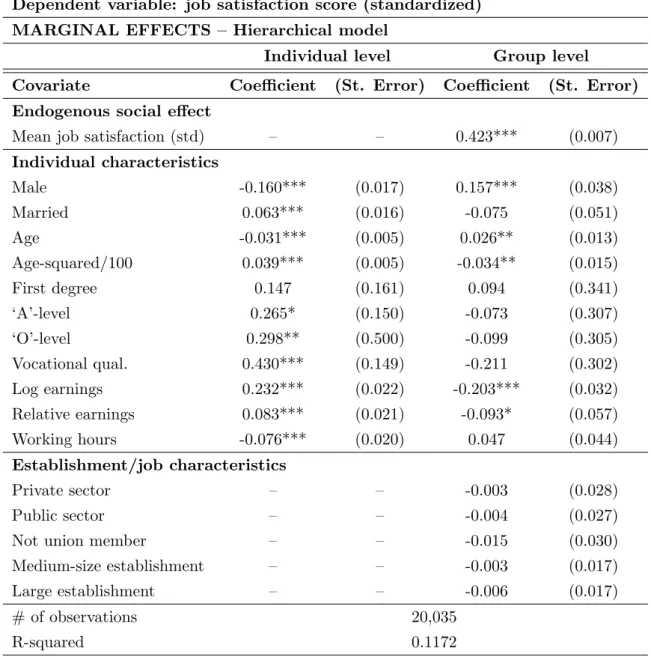
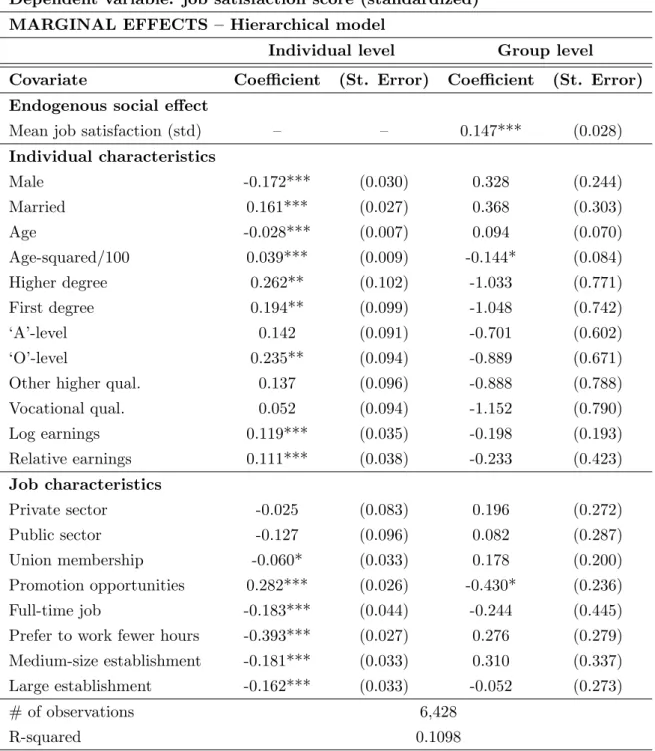
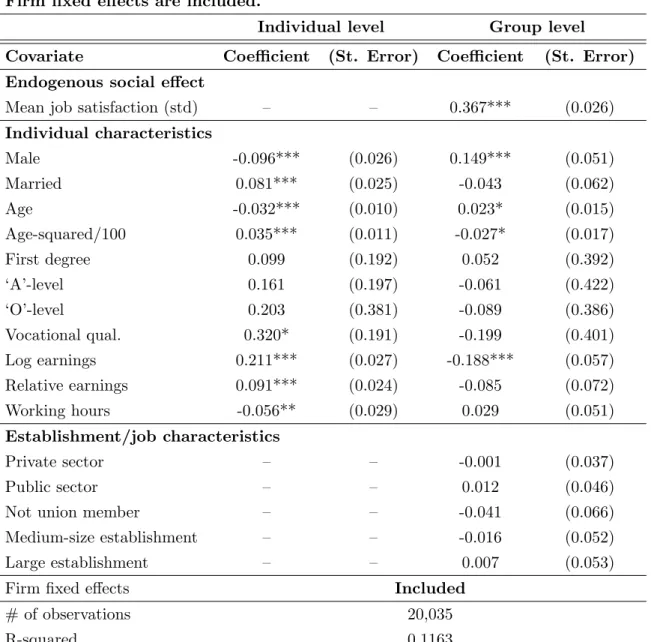
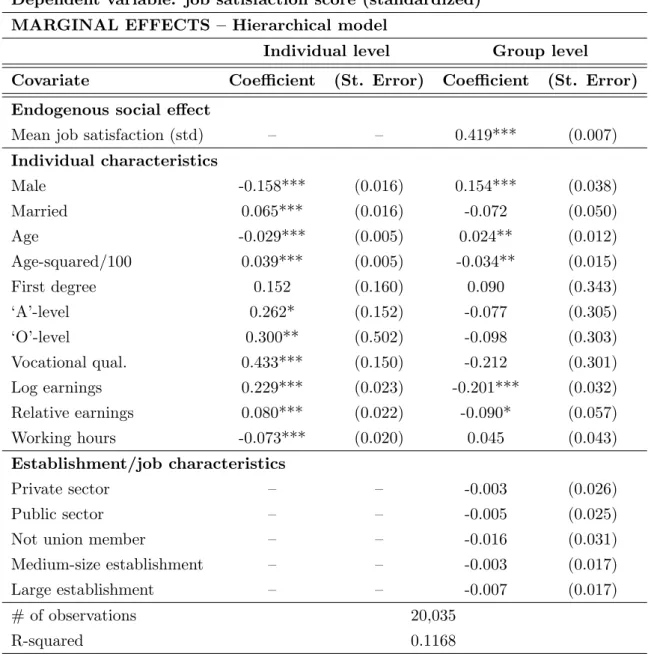
We find that one standard deviation increase in aggregate job satisfaction
satis-faction score at the workplace level and a 0.15 standard deviation increase in
individual-level job satisfaction score at the local labor market level. In other
words, we report that statistically significant job satisfaction spillovers exist
both at the establishment level and local labor market level; and, the estimated
spillovers are approximately three times larger at the establishment level than
those at the local labor market level. These estimates can be restated in terms
of the social multiplier: the corresponding social multipliers are [1/(1 - 0.42)≈] 1.72 and [1/(1 - 0.15)≈] 1.18 at the workplace and local labor market levels, respectively.8
Simple calculations yield the result that the Boeckerman and Ilmakunnas(2012) estimates—which say that one standard deviation increase in job satisfaction within the plant increases productivity per hours worked by
6.6 percent—would be revised up to 11.4 percent at the workplace level and 7.8
percent at the local labor market level after accounting for the job satisfaction
spillovers. To summarize, these results suggest that (1) failing to account for
the spillover externalities in job satisfaction may lead us to mis-assess the
effec-tiveness of job satisfaction policies; thus, the policy maker should internalize
these externalities, and (2) job satisfaction spillovers are much stronger at the
workplace level than local labor market level; therefore, designing/enforcing
job satisfaction policies at the workplace level will likely be more effective than
implementing such policies at the local labor market level.
We also report estimates for contextual social effects. At the workplace level,
we find that individual-level job satisfaction goes up with the fraction of male
and older workers in the workplace. At the local labor market level, however,
8
gender and age do not have any statistically significant contextual effect;
in-stead, we only find that individual-level job satisfaction score goes down as the
fraction of workers with greater access to promotion opportunities goes up in
each industry × region cell. We also document that there are significant “in-come comparison effects” at the workplace, but not at the local labor market.
In particular, we find that individual-level job satisfaction goes down with (i)
average earnings and (ii) fraction of high earners—i.e., those who earn above
the median wage within the relevant worker population—in the workplace.
We discuss these results further in Section 2.5, where we also present detailed
robustness exercises to prove that our estimates are not excessively sensitive
to relaxing some of the main assumptions behind the empirical model.
The plan of the paper is as follows. Section 2.1 relates and compares our work
to the relevant papers in the literature. Section 2.2 explains the details of
the econometric model and the identification strategy we employ. Section 2.3
provides an overview of the data sets we use and justifies the construction of our
reference groups in different work settings. Section 2.4 presents the estimates,
discusses in detail the results, performs robustness checks, and elaborates on
the policy implications. Section 2.5 concludes.
2.1
Related Literature
Our paper can be placed into the literature investigating social interactions
in labor markets. There is a large body of literature testing the existence of
absenteeism, and learning (or knowledge spillovers). The results are mixed.
For example, using grocery scanner data from a large supermarket chain,Mas and Moretti (2009) perform a field experiment among low-wage earners to analyze if the individual-level effort is influenced by a permanent increase in
the productivity of co-workers and find reasonably large peer effects. Falk and Ichino (2006) study the behavior of high school students performing a simple task in a laboratory experiment to understand if individual-level performances
are directly affected by the existence of other individuals doing the same task
and they also document moderate peer effects. Ichino and Maggi (2000) find that group-level peer absenteeism increases individual absenteeism. In a field
study, Bandiera et al. (2009) find that individual-level productivity responds to the level of a friend working nearby, but does not respond to the
skill-level of a non-friend working around. Guryan et al. (2009), on the other hand, find employing a random assignment exercise on a golf tournament data
that individual-level performance is not influenced by the playing partners’
ability. Cornelissen et al.(2013) report only small peer effects in wages among co-workers.9
While Azoulay et al. (2010) andJackson and Bruegmann (2009) document significant knowledge spillovers among co-workers,Waldinger(2012) shows that those spillovers are weak, if they ever exist.
There are also several papers investigating contagion effects in subjective
well-being measures. Using Chinese rural survey data, Knight and Gunatilaka (2009) examine whether happiness is infectious or not at the village level. Their results show that happiness is infectious in narrowly-defined reference
9
groups. They exploit the panel feature of their data set to remove the reflection
problem and identify the relevant social effects. Papers in the psychology
literature also find that happiness might be contagious in small environments.10
However, these studies do not address the reflection problem, which might bias
the results. Tumen and Zeydanli (2014), on the other hand, find that these contagion effects might disappear in more broadly defined reference groups.
Our paper differs from this body of work and contributes to the related
lit-erature in three ways. First, this is the first paper in the litlit-erature
estimat-ing spillover effects in job satisfaction. We show that there exist statistically
and economically significant job satisfaction spillovers in various work
environ-ments. Second, we show that the degree of these spillover externalities may
change at different aggregation levels. Using two different data sets from the
United Kingdom, we construct our reference groups at two aggregation levels:
workplace level and local labor market level. The former defines peer effects in
narrowly defined work settings, while the latter defines the social environment
in larger ecological settings that embed more general aspects of community
and working life. We document that the job satisfaction spillovers exist in
both environments; but, they are much stronger at the workplace level than
local labor market level. We further argue that this may have important
pol-icy implications. And, third, motivated by the hierarchical models of social
processes, we develop an original identification strategy to separate
endoge-nous effects from the contextual effects, controlling for group-level unobserved
heterogeneity.
10
See, e.g.,Hatfield et al. (1994),Sato and Yoshikawa (2007), and Fowler and Christakis
There are also several papers criticizing the empirical literature on peer
ef-fects.11
In particular, Angrist (2014) has pointed out that many papers in the literature falsely interpret the observed correlations between
individual-and group-level outcomes as causal relationships. He argues that the
instru-mental variable (IV) estimates reported in this literature “often ... produce
findings that look like a peer effect, even in a world where behavioral influences
between peers are absent.” In this paper, we do not use the IV approach;
in-stead, we rely on a non-linear model of social interactions—which is motivated
by hierarchical statistical models—to obtain econometric identification. The
non-linear models are not free of problems, either. The most common criticism
is that, most of the time, the non-linear structure used to identify peer effects
is hard to justify. The non-linear specification that we use in this paper has
two appealing features. First, the non-linearity is simply obtained by including
certain interaction terms between the regressors of a standard linear-in-means
model. The use of interaction terms is quite common in regression analysis and
are never regarded as strange or unjustified. Second, the inclusion of
interac-tion terms into linear-in-means models is theoretically justified by the “social
ecologies” viewpoint in a strand of the sociology literature.12
See Raudenbush and Sampson (1999) and Blume and Durlauf (2005) for further motivation and references. Next, we present the details of our non-linear model of social
interactions and describe our identification strategy.
11
See, e.g.,Moffitt(2001), andAngrist(2014). 12
2.2
Model and Theoretical Background
The econometric framework that we employ in this paper is a version of the
canonical linear-in-means model of social interactions. Our ultimate goal is
to estimate social interactions in job satisfaction. In particular, we would like
to estimate the effects of (1) group-level job satisfaction—the “endogenous
social effect”—and (2) group-level exogenous characteristics—the “contextual
effects”—on individual-level job satisfaction, controlling for group-level
hetero-geneity. The linear-in-means model of social interactions is plagued with the
well-known “reflection problem,” which masks the econometric identification
of social interactions [Manski(1993)]. The simplest way to resolve this issue is to use an appropriately formulated instrumental variables strategy. When an
instrument is not available, it is necessary to invoke non-linearities to identify
social interactions [Brock and Durlauf (2001a),Blume et al. (2011)].
In this paper, we use an empirical strategy that allows us to convert the
stan-dard linear model into a nonlinear one. The motivation comes from the
hier-archical models of social processes. This hierhier-archical structure secures
iden-tification of social interactions via introducing cross-product terms into the
standard model. This section provides a detailed description of our
economet-ric model for the purpose of familiarizing the reader with the basic concepts
we frequently mention throughout the paper. Section 2.2.1 presents our
em-pirical model and the associated technical issues (i.e., the reflection problem)
including a formal statement of the conditions required to identify social
how we achieve identification.
2.2.1
The Empirical Model of Social Interactions
Each individual i ∈ I is a member of a group g ∈ G, where I is the number of individuals in the worker population and G is the number of groups, with I >G. The following linear-in-means equation is an empirical tool commonly used in the literature:
ωig =β0+β1Xig +β2Yg+Jmg+ug+ǫig, (2.1)
where the dependent variable, ωig, is the individual-level job satisfaction for
person iin groupg, Xig is a vector of individual-level observed characteristics
of i in group g, Yg is a vector of group-level observed characteristics of group
g,mg =E[ωig|g, Fig] is the mean job satisfaction in group g,ug is a group-level unobserved factor common across the members of groupg, andǫig is a random
error term with E[ǫig|g, Fig] = 0. In our notation, Fig corresponds to the empirical distribution of individuals in groupg and this distribution is possibly
different for each group. The distinction between β2 (contextual effects) and
J (endogenous effect) is the key notion in this model. The former measures
the effect of exogenous group-level variables on the individual-level outcome,
while the latter measures the effect of endogenous group-level outcome on
the individual-level outcome. Our ultimate goal is to clearly distinguish β2
from J and to separately identify the effects of group-level variables on the
issue in this standard setting. In what follows, we shut down the group-level
unobserved effect ug for notational simplicity. It will reappear in our final
equation.
To define the identification problem, we take the conditional mathematical
expectations of both sides of the linear-in-means equation, where the
condi-tioning is ong and Fig, for all i and g. This gives us
mg =β0+β1Xg+β2Yg+Jmg, (2.2)
where Xg = E[Xig|g, Fig]. Xg can be named as the group-level mean of individual-level observed characteristics and it may or may not coincide with
Yg. Notice that mg appears in both sides of Equation (2.2). Solving for mg yields the result that
mg =
β0
1−J + β1
1−JXg+ β2
1−JYg. (2.3)
The reflection problem states that if the dimensions of the vectors Xg and
Yg are the same, then linearity masks the econometric identification of the
(endogenous) social interactions parameter J.
To formalize this statement, we plug Equation (2.3) into Equation (2.1), which gives us the estimating equation
ωig =
β0
1−J +β1Xig + Jβ1
1−JXg+ β2
When the reflection problem is in effect, J and β2 cannot be distinguished
from each other, which implies that social interactions cannot be identified.
To see this, set Xg =Yg, which yields the equation
ωig =
β0
1−J +β1Xig +
Jβ1+β2
1−J Yg+ǫig. (2.5)
It is obvious that, in this equation, it is impossible to separate J from β2
econometrically. One solution is the existence of an additionalXg which is not
inYg. If such an Xg exists, then endogenous social interactions (J)—and also
all the other model parameters—are identified by applying simple ordinary
least-squares method on Equation (2.4). In other words, one individual-level variable, the mean of which cannot be regarded as a group-level variable, is
required for identification of social interactions.
Unfortunately, most of the large data sets—such as BHPS, GSOEP, WERS,
etc.—do not include a variableXg that can naturally fit into the IV definition
provided above. One popular alternative to IV is to introduce non-linearities
into the linear-in-means specification. To demonstrate how non-linearities
se-cure identification, we modify the standard model as follows:
ωig =β0+β1Xig +β2Yg+Jφ(mg) +ǫig, (2.6)
rearranging the terms in such a way that the terms with mg appears on the
left and the rest of the variables on the right, we get the equation
Φ(mg) =β0+β1Xg+β2Yg, (2.7)
where Φ(mg) = mg − Jφ(mg). The functions φ(·) and Φ(·) has the same properties, therefore we can invert Φ(·) to get
mg = Φ−
1
(β0+β1Xg+β2Yg) (2.8)
and plugging this into the original estimating equation we get
ωig =β0+β1Xig +β2Yg+Jφ
Φ−1
(β0+β1Xg+β2Yg)
+ǫig. (2.9)
In such a setting, we can identify β2 and J separately without a further need
for an exclusion restriction (or an IV). One problem with this framework is
that there is no systematic way of choosing the functional form ofφ(·). In this paper, we propose an estimation strategy that introduces a systematic way to
embed non-linearities into the standard empirical specification. To be specific,
we construct a hierarchical model, which has the additional advantage of being
consistent with our definition and conceptualization of social interactions in
2.2.2
The Hierarchical Model
Suppose that the Equation (2.1) is modified as follows:
ωig =α0(Yg) +α1(Yg)Xig +αJ(Yg)mg+ug+ǫig. (2.10)
In words, the coefficients α0, α1, and αJ are stated as functions of the
con-textual variables, Yg, which define the “social context.” In other words, the
contextual variables describe the properties of the environments that the
in-dividuals live in. Setting up the regression coefficients in this way implies
that social groups describe ecologies in which decisions are made and matter
because different ecologies induce different mappings from the individual
de-terminants of these behaviors and choices.13
To convert this setting into an
empirical equation that we can estimate, we make the following simplifying
assumptions:
α0(Yg) =β0+β2Yg,
α1(Yg) =β1+bYg,
αJ(Yg) =J +πYg.
13
Plugging these expressions into Equation (2.10) yields
ωig =β0+β1Xig +β2Yg+Jmg+πYgmg+Yg′BXig +ug+ǫig, (2.11)
where B is the matrix form of the coefficient vector b. This equation looks
very similar to our original linear-in-means specification except that we include
interaction terms in the form of cross products motivated by the hierarchical
model.
Note that the nature of the unobserved group-level effect ug is a crucial issue.
There are two alternatives: random effects versus fixed effects. If the true
unobserved group-level effect can be controlled for up to a random error term,
then a common way to resolve this issue is to assume thatug is itself random
rather than fixed. Assuming that ug is random is equivalent to saying that it
is uncorrelated with the regressors. However, group-level unobserved factors
can easily be argued to be correlated with, say, group-level job satisfaction.
When this is the case, not being able to control group fixed effects will yield
erroneous results. In our baseline analysis, we assume that ug is a random
term. We then relax this assumption and control for group-level fixed effects
to check if the results differ [see Section 2.4]. We also cluster standard errors
at the group level, which means that we account for within-group correlations
in the error structure.
To demonstrate how this model is identified, we take the conditional
for mg, which gives us
mg =
β0+β1Xg +β2Yg+Yg′BXg
1−J−πYg
. (2.12)
Notice that, very similar to the motivation behind the nonlinear model, this
model also introduces non-linearity betweenmg and the other regressors, even
when Xg =Yg. There is no need for an exclusion restriction and econometric
identification of social influences is immediate, given standard conditions on
individual- and group-level observed covariates [seeBlume and Durlauf(2005) for further details]. This formulation is consistent with our hypothesis and our
definition of social interactions.
At the end, we estimate Equation (2.11) to separately identify β2 and J. In
this setup, the endogenous social effect is J +πY¯g, where Y¯g are the sample
means of group-level variables, i.e., the endogenous effect is no more J since
we have cross-product terms in the regressions. The same logic applies to the
contextual effects we estimate. The estimates we report and discuss in Section
2.4 directly refer to these “marginal effects.”
2.3
Data and Reference Groups
In this section, we provide a detailed description of the two data sets we use in
our empirical analysis: Workplace Employment Relations Survey and British
Household Panel Survey. Both of these surveys are nationally
detail the construction of our reference groups for both of these data sets. We
focus on the 2004 editions of both data sets.
2.3.1
Workplace Employment Relations Survey (WERS)
WERS is a national survey of British employees constructed for the purpose
of collecting information on employment relations in Britain.14
The survey
provides information about workers, working conditions, and industrial
rela-tions from all sectors except primary industries and private households with
domestic staff. WERS 2004—the version that we use in our analysis—is the
fifth among a series of surveys. Previous surveys are conducted in 1980, 1984,
1990, and 1998. In the 2004 cross-section, there are around 2,300 workplaces,
1,000 employee representatives, and 22,500 employees.
We construct the job satisfaction scores using the following seven question in
the WERS-2004 data set. How satisfied are you with
1) the sense of achievement you get from work?
2) the scope for using your own initiative?
3) the amount of influence you have over the job?
4) the training you receive?
5) the amount of pay you receive?
6) the job security?
7) the work itself?
14
The responses are based on a five-point scale with 1 representing “very
satis-fied,” 2 “satissatis-fied,” 3 “neither satisfied nor dissatissatis-fied,” 4 “dissatissatis-fied,” and 5
“very dissatisfied.” For each of the seven questions listed above, we construct
a binary variable for the positive responses—taking the value 1 for the “very
satisfied” or “satisfied” responses and 0 otherwise—and, then, we construct a
sum of the seven binary variables for each individual to form an index with
values from 0 to 7 [see also Jones et al.(2009), Jones and Sloane (2010), and Mumford and Smith (2013)].15
We use this aggregate measure as the “job
satisfaction score” in our analysis. The average job satisfaction score in our
sample is 4.20 and the standard deviation is 2.13. The BHPS data set, which
we describe in the following subsection, has a 1–7 scale constructed based on
different principles. For the sake of comparability of the estimates, we
stan-dardize the main job satisfaction measures in both WERS and BHPS around
zero mean and unit variance. Thus, the dependent variable in our analysis will
be the “standardized job satisfaction.”
We control for a large set of individual- and job-related characteristics. To
achieve consistency between the two data sets, we construct the WERS
vari-ables similar to their counterparts in the BHPS data set. After excluding
miss-ing information on our control variables and droppmiss-ing workplaces with less than
two employees, the WERS data set includes 1,673 workplaces/establishments
and, in each workplace, up to 25 randomly-chosen employees taking the
ques-15
tionnaire.16
We start with describing the education variables. Since this is
a workplace-level data set, “No Qualification” category includes only a very
small number of observations; thus, we drop the observations in this category
and concentrate on the following education levels: “Higher Degree” (refers
to postgraduate education), “First Degree” (refers to college education),
“A-level,” “O-level” (both referring to different classes of high-school education),
and “Vocational Qualification.”17
Earnings variable in the WERS is reported
in 14 pre-specified intervals,18
and, following Mumford and Smith (2009), we use the midpoints of these intervals as our earnings variable for each individual.
The last interval is open ended, so it does not have a midpoint; instead, we use
the mean earnings for the last interval. In our sample, the average weekly log
earnings is around 5.7. We also include relative earnings as a dummy variable
taking 1 if the employee earns more than the mean earnings in the sample.
We categorize the job status under three sector categories: private sector job,
public sector job, and other. An establishment size variable is generated from
the question of “Currently, how many employees do you have on the payroll at
this establishment?” The answer varies from 5 to 10,000. We construct three
variables for establishment size; small establishment (less than 50 employees),
medium-size establishment (between 50 and 200 employees), and large
estab-lishment (more than 200 employees). Working hours are simply represented
16
For consistency, the individuals in the BHPS data set who work in firms with less than two employees are correspondingly dropped.
17
To be concrete, after constructing our sample, we observed that only two individuals remained in the data with no school degrees. We think that dropping these two observations would be more reasonable than generating a new education category called “no degree.” Such a category, on the other hand, exists in our BHPS sample since the number of individuals with no degree is non-negligible in the BHPS data.
18
as a dummy variable taking 1 if the actual hours worked is above the sample
mean and 0 otherwise.
Among 20,035 employees and 1,673 establishments in our sample, the average
age is 42, 47 percent are male, and 68 percent are married. Higher degree
has the lowest fraction, whereas vocational qualifications have the highest. 46
percent of the employees are union members. 55 percent of the workplaces
are publicly owned. Regarding the establishment size, the shares of small,
medium, and large establishments are 0.32, 0.32, and 0.36, respectively. See
Table (2.1) for detailed summary statistics for our WERS sample.
2.3.2
British Household Panel Survey (BHPS)
The BHPS provides information on individual-, household-, and
job/employer-related characteristics from 1991 to 2008 in England, Scotland, Wales, and
Northern Ireland. It yearly follows the same representative sample of
house-holds interviewing every adult member of sampled househouse-holds. Eighteen waves
of data are available. To make the two data sets comparable and compatible,
we focus on the 2004 cross-section of the BHPS.
The individual-level job satisfaction in the BHPS data set is reported based
on a seven-point scale ranging from 1 (not satisfied at all) to 7 (completely
satisfied). The employed workers are asked to rate the job satisfaction levels
regarding the total income, job security, the actual work itself, and hours
worked. The last question about job satisfaction is “Overall, how satisfied
the 1–7 scale and used as the “job satisfaction score” in our analysis. As we
explain above, we standardize the job satisfaction score around zero mean and
unit variance to achieve consistency across the job satisfaction measures we
use for the WERS and BHPS data sets.
For the individual-level observed characteristics, we control for gender, age,
education level, marital status, earnings, and pay comparisons. We collapse
the education-levels into seven broad groups as follows: higher degree refers
to postgraduate education, first degree refers to college education, A-level,
O-level, and other higher qualification refer to high school graduates of different
types (consistent with the education system in the UK), vocational
qualifica-tion refers to teaching, nursing, commercial, apprenticeship, and the certificate
of secondary education (CSE), and, finally, the ones withno qualification. The
earnings variable—usual gross pay per month: current job—is recorded as the
actual amount received and, thus, we simply take the natural logarithm of
this variable in our analysis. We also consider the “taste for working hours”
variable. Promotion opportunities is described by the binary variable taking
1 if the worker has access to promotion opportunities and 0 otherwise. The
rest of the variables—firm size, job status, relative earnings, and union
mem-bership—are constructed similar to their counterparts in our WERS sample.
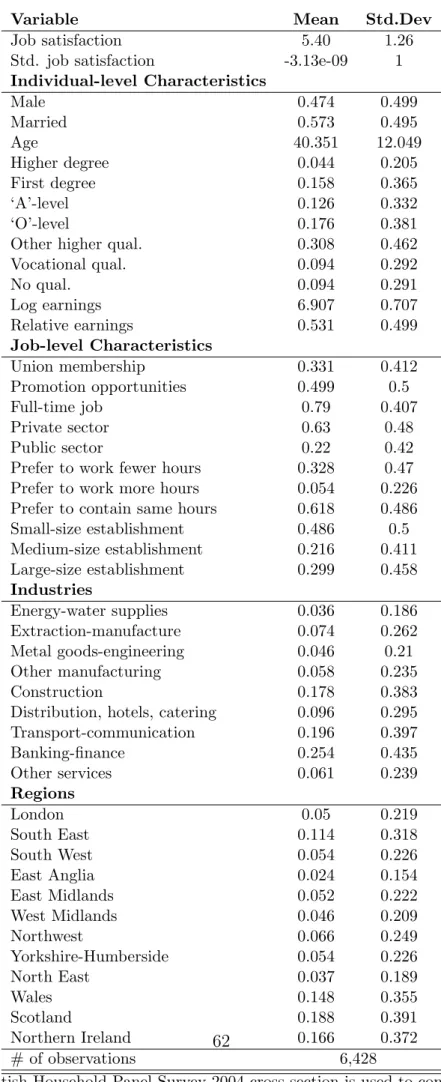
Table (2.2) presents the summary statistics of the sample that we use in our analysis. In order to be included into our sample, the respondent have to be
employed and report a job satisfaction score. The mean age of the respondents
married, 4.4 percent have higher degree, 15.8 percent have first degree, another
12.6 percent have A-level degree, 17.6 percent have O-level degree, 30.8 percent
have other higher qualifications, 9.4 percent have vocational qualifications, and
the remaining 9.4 percent have no qualifications. Before standardization, the
mean job satisfaction score is approximately 5.4 out of 7, with a standard
deviation of 1.26. 79 percent are employed in full-time jobs. 63 percent are
employed in privately-owned firms. 32.8 percent prefer to work fewer hours.
48.6 percent are employed in small-size firms. See Table (2.2) for further information on region- and industry-specific details. We generate group-level
variables based on our reference groups constructed as industry×region cells. Below we describe how we construct our reference groups both in the WERS
and BHPS data sets.
2.3.3
Reference Groups
Our primary objective is to separately identify endogenous social effects and
contextual social effects in job satisfaction within a formal empirical model of
social interactions. We conceptualize the social interactions that we estimate as
the existence of “spillovers” in the society in the sense that the group-level job
satisfaction in one’s reference group affects the individual worker’s perception
of own job satisfaction. We perform this task at two levels with two different
data sets from the United Kingdom. First, we use the WERS data set to
estimate spillovers at the workplace level. And, second, we use the BHPS data
set to estimate job satisfaction spillovers at the local labor market level. The
interacting. The BHPS data set, on the other hand, captures social effects
among individuals who are potentially interacting indirectly. As Bramoulle et al. (2009) clearly state, this type of social effects is based on the idea that “neighbors in the neighborhood do not affect me directly; what matters is the
neighborhood itself.”
WERS. The WERS data sets naturally offers establishment-level reference
groups; that is, all workers employed in a given establishment constitute the
reference group for each of the workers employed in that establishment. There
are 1,673 establishments in our WERS sample. Thus, the number of reference
groups is 1,673. The average group size is approximately 12 worker per
es-tablishment. This setting defines narrow reference groups hypothesizing that
social forces operate at the workplace level: workers in a given establishment
are exposed to similar work-specific conditions that shape their job satisfaction
perceptions. The group-level counterparts of the individual-level variables are
constructed taking averages at the workplace level. Similarly, the endogenous
social variable (the group-level job satisfaction score) is calculated by averaging
the job satisfaction scores within the workplace.
BHPS. For the BHPS data set, we construct industry × region cells as our
reference groups. In terms of our conceptualization of social interactions, this
means that we try to capture the social forces that operate among workers
who are geographically close to each other and who are potentially exposed
to similar local labor market conditions specific to the industries they belong
social interactions studies, particularly the ones handling large data sets. For
example, Luttmer (2005) utilizes the outgoing rotation groups feature of the Current Population Survey and constructs industry × occupation cells to es-timate the neighborhood effects of income on individual-level happiness.
Sim-ilarly, Ferrer-i-Carbonell (2005) uses the German Socio-Economic Panel and constructs education×age ×region cells to estimate the impact of the group-level income on individual-group-level subjective well-being. In a similar context,
Glaeser et al.(1996) construct region-specific cells on a lattice to estimate the impact of neighbors’ criminal-activity decisions on the agent’s own decision to
participate in crime. In another example, Stutzer and Lalive (2004) use data from Switzerland cantons and construct canton-level cells to estimate the effect
of social norm to work—roughly, the rate of employment in one’s
neighbor-hood—on how quickly the unemployed individual finds a job, probably due to
social pressure. The examples can be extended further. In all of these papers,
large reference groups are constructed to capture the peer influences in broad
social settings.
In our BHPS sample, the following twelve regions describe the geographical
clustering: 1) London, 2) South East, 3) South West, 4) East Anglia, 5) East
Midlands, 6) West Midlands, 7) North West, 8) North East, 9) Yorkshire &
Humberside, 10) Wales, 11) Scotland, and 12) Northern Ireland. Nine industry
categories are selected at one-digit level as follows: 1) energy & water supplies,
2) extraction of minerals & manufacture of metal goods, mineral products &
chemicals, 3) metal goods, engineering & vehicles, 4) other manufacturing