A Work Project presented as part of the requirement for Award of a masters degree in Economics from the Faculdade de Economia da Universidade Nova de Lisboa
Environmental Remediation Project of Cunha Baixa Mining Area
Cost Benefit Analysis
Daniel Luís Martins Quintas, no. 407
A Project carried out on the Economics course, under the supervision of
Environmental Remediation Project of Cunha Baixa Mining Area
Abstract
In the present time it has been growing a conscience about environmental problems. In
this project it is intended to perform a Cost Benefit Analysis (CBA) of a specific
environmental problem: Uranium mining exploration. The selected project was the
Environmental Remediation of Cunha Baixa’s Mining Area. From this CBA it will be
possible to understand the economic reliability of this sort of project using one criteria
of efficiency. The CBA performed show a wide variety of interpretations given the
Table of Contents
1. Introduction ... 4
2. Project Description... 5
2.1 Geographical and Historical Context ... 5
2.2 Objectives of the Project ... 5
2.3 Project Definition... 7
3. Baseline... 8
3.1 Soil ... 8
3.2 Water... 9
3.2.1 Surface Water... 10
3.2.2 Ground and Underground Water ... 11
3.3 Air ... 11
3.4 Social and Economic Aspects ... 12
4. Costs... 13
5. Benefits ... 14
6. Results ... 19
7. Sensitivity Analysis... 22
7.1 Base Scenario... 22
7.1.1 Water ... 22
7.1.1 Ecological and Landscape Impact ... 22
7.1.1 Discount Rate ... 23
7.2 2nd and 3rd Scenarios... 23
7.1.1 Health Risk... 23
7.1.1 Discount Rate ... 24
8. Conclusion... 24
1. Introduction
In the present time it has been growing a conscience about environmental problems
creating the need to understand them better and find a way to solve or at least minimize
them. The case of mining exploration is no exception since there are negative impacts
depending on the type of exploration that have been done. New legislation in Portugal,
Decree Law no. 198-A/2001 of 6th July, appeared to try to minimize the impacts of
mining exploration and especially to solve the problem that comes after it, what
happens to the areas where there was extraction.
The Uranium mines were explored in Portugal between the years of 1907 and 2001
being “Empresa Nacional de Urânio” the last entity responsible for it. The different
techniques used created several environmental impacts, more specifically in the waters,
soils, air and landscape.
In this project it is intended to perform a Cost Benefit Analysis (CBA) of a specific
case, the project of Environmental Remediation of Cunha Baixa’s Mining Area. All the
information presented in order to perform it is collected from the Environmental Impact
Study (EIS) and Project Description both performed by COBA unless stated otherwise.
From this CBA it will be possible to understand the economic reliability of this sort of
project using one criteria of efficiency.
It is also important to see that a tool like CBA also have its weaknesses and since it
takes into consideration efficiency by seeing if there is room for Pareto improvement it
will not take into consideration equity issues.
The problem of equity will also try to be explored in this project and try to understand if
2. Project Description
2.1 Geographical and Historical Context
The most important Portuguese Uranium deposits of the 20th are located in the region of
Beira Alta and they started being explored since 1907 for the production of radio and
later for the exploration of uranium. The mining area of Cunha Baixa was discovered by
the Junta de Energia Nuclear (that does not operate in the present time) in the year of
1957 and it is located in the district of Viseu, county of Mangualde and parish of Cunha
Baixa.
The works of mining recognition started in 1967 and the subterranean exploitation was
made between 1970 and 1987. The main open sky exploration started in the year of
1971 followed by more three and finished in 1991.
From both takedowns there was extraction of a Uranium compound that amounted to
approximately 901 tons.
Also between the periods of 1983 and 1993 there was also static leaching in situ of
H2SO4 in both types of works and the main purpose was the recuperation of the
mineralization of the poorest areas of the takedown. The methods used in this mining
process were the major contributors for the contamination of the waters, especially the
subterranean, and it was obtained from this process 76 tons of U3O3. Another
consequence of it was the acidification of the waters existent after the mining area.
2.2 Objectives of the Project
The project of environmental remediation that is proposed searches the solution of the
1st - There are big volumes of acid effluents that need treatment and control;
2nd - There is a need of control physically the communication between the underground
hydro resources, the surface ones and their respective influences;
3rd - The dimension, morphology and nature of the waste dumps and old mud deposits
that exist;
4th - The dimension of the cuts that result from the open sky exploration;
5th - The relations that exist between the open sky area and the mine;
6th - The fact that there were used methods of acid leashing for the extraction of the ore
created that the water in the mines is really acid (a ph under 3);
7th - The proximity to the population of Cunha Baixa causes concerning to their public
health.
It is important to mention that there is no evidence that the populations’ health is being
affected but, in the current situation, there is risk since there is absolute no control.
When solving the problems described above the effects will be a better quality of the
water, rehabilitation of the soils and landscape and increase in the population well being
by decreasing the risk of health problems due to contaminations.
The solution of problems one to three and also six makes possible the use of the water
for irrigation (around 86% of water use in the area), and problems four and five will
2.3 Project Definition
The Cunha Baixa’s mines are included in the list of Uranium mines that are recognized
as public interest for public intervention. The nearest population is the parish of Cunha
Baixa and has a population of around one thousand people. This parish is located at a
distance of one hundred meters of the mines.
The project of environmental remediation consists in a series of constructions and
cleanings that will have the duration of two years. Within the project it is important to
create a distinction between two processes, the remediation and the post remediation
process. The need for this separation is due to the fact that different impacts will derive
from the two processes referred. During the remediation process negative impacts will
appear due to the movements and constructions and it is only after the remediation that
the so called benefits will appear.
The first part of the project can be separated in nine different construction phases and
they are described as the following:
- Phase 0: pumping test in open sky I and complementary geotechnical prospecting. It
is also necessary to dimension in a definitive form the flow of the pumping to install.
All the works are destined to obtain information about the conditions.
- Phase 1: preparation of the open sky IV and surrounding area for the deposition of
sludge, waste dump materials, material from the areas to clean up and demolition
residuals. Sealing of mining galleries, creation of landfills and collocation of a basal
clay layer to seal the bottom.
- Phase 2: removal of the material coming from the sludge deposits to the deposition
- Phase 3: cleaning of the sanitizing areas. Continuation of the side cuts sealing system.
- Phase 4: total removal of the waste dumps, the sanitized materials due to the high
radiometry and from the resulting products of the demolition of old buildings to the
deposition cell at the open sky IV. Conclusion to the side cut sealing system.
- Phase 5: conclusion of the sealing of the open sky IV with a waterproofing system of
double layer and improvement of the existent paths.
- Phase 6: Construction of the well pumping in the area of the old mining well number
9 and construction of the damping basin at the area of open sky I. Sealing of old wells
and chimneys.
- Phase 7: Construction of the new MWTP. Model the waste dumps and treatment of
open skies II and III. Waterproofing of the remaining opens skies.
- Phase 8: Close down of the existing MWTP. Landscaping works and sealing the
intervention area.
In the second part of the project, more specifically, after the construction of the Mining
Water Treatment Plant (MWTP) it is possible to start seeing the positive impacts, i.e.,
environmental benefits of the project. There is a cost here of control and observation.
3. Baseline
3.1 Soil
In this section it is intended to describe the soils presented in the mining area and the
ones that are affected by the project. For it a brief description of their general
The study area is characterized by presenting two types of soils, the ones presented in
greater quantities being dominant in the area of study that are the classified as
“Udorthent” and there are also the presence of soil of the type “Fluvic” that appear in
the valley of “Ribeira do Castelo”.
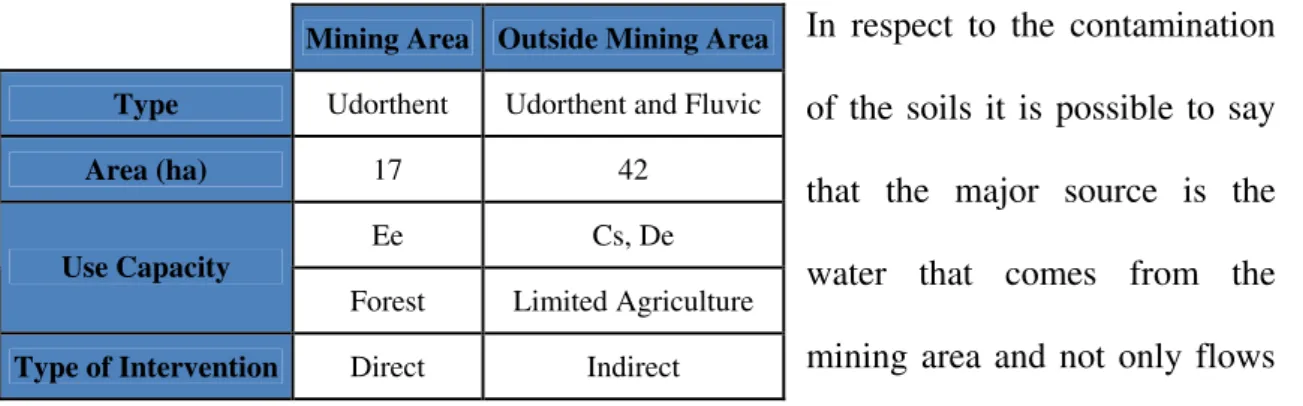
According to the usage capacity it is possible to say that most of the soils are classified
as unfit for agricultural and pasture purposes or with really severe limitations being
especially fit for wild and forestry vegetation. From them we can distinguish the ones
that exist near the water lines that can be used for low intensive agriculture.
Table 1 – Soil Characteristics
In respect to the contamination
of the soils it is possible to say
that the major source is the
water that comes from the
mining area and not only flows
near agricultural lands but also
it is illegally used for irrigation purposes. Besides the mining area it is possible to see
contamination near “Ribeira da Cunha Baixa” almost till it reaches “Ribeira do
Castelo”.
Mining Area Outside Mining Area
Type Udorthent Udorthent and Fluvic
Area (ha) 17 42
Ee Cs, De
Use Capacity
Forest Limited Agriculture Type of Intervention Direct Indirect
The soils present inside the mining area do not have a purpose of agricultural usage,
since their characteristics do not allow it. The other soils are going to be decontaminated
in an indirect way, this is, through the cleaning of the waters and it is predicted that, in a
medium run they will be decontaminated, given that the owners of the lands comply
with some restrictions of usage.
This section reflects one of the most import resources in the study because it has effects
over the remaining, with the exception of the air. The waters are distinguished in three
different types: superficial, given by two waterlines; groundwater that are given by
water wells; and underground given by piezometer pairs and “boreholes”. Another
important aspect is the fact that underground waters in the area come from infiltration
making that it is possible to recover them when the water lines will be treated.
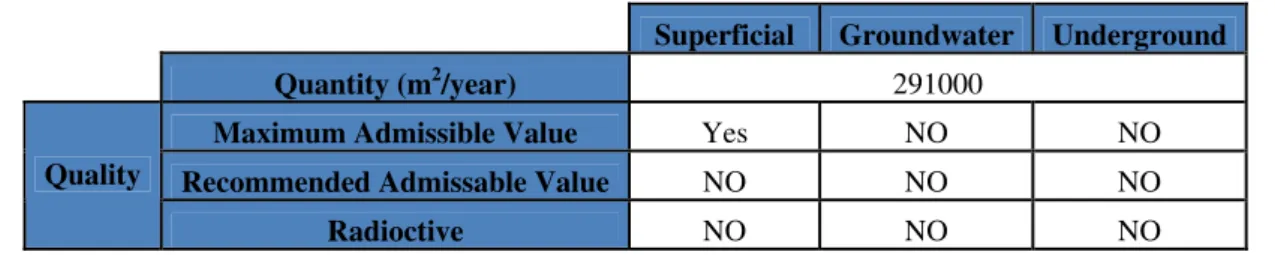
The reference for the water quality is the values predicted by the decree law no. 236/98
for irrigation purposes. In this decree law two different references are assumed, the
maximum admissible value and the recommended admissible value. In table 2 it is
presented in which tests the water passed.
Superficial Groundwater Underground
Quantity (m2/year) 291000
Maximum Admissible Value Yes NO NO
Recommended Admissable Value NO NO NO
Quality
Radioctive NO NO NO
Table 2 – Water Characteristics
The reference for the radioactive levels is based on the American Normative since the
Portuguese legislation does not predict this kind of contamination
3.2.1 Superficial Water
The superficial waters are in two water lines, one that is temporary, this is, during the
hot periods it gets completely dry and another one that is not. The analysis made to the
two water lines is very similar in terms of quality and because of that they are treated as
one.
Although all the tests are inside the maximum admissible values they are not in the
radiations, in the case tested especially for Radio and Uranium always pass the value
that is predicted for usage by the American Normative.
3.2.2 Groundwater and Underground waters
The ground and underground waters did not pass in almost every sample that was taken
the quality levels predicted by the Portuguese legislation and also the American
normative. Since these waters in the region appear by infiltration the reason that appears
to be more precise about the poorest quality of these waters compared to the water in the
water lines is due to the fact that the soils are contaminated and when this process of
infiltration occurs they absorb the waste that are present in the soils of the mine, not
only the radioactive waste, but also, due to the type of exploration that was used, static
leashing, also the acid.
3.3 Air
The global air quality of the region is given by the “Air Quality Index (IQar)” as so as
the data collected from “Fundão’s Station” since it is the one in the region that best
reflects characteristics of the region. This index is given by an arithmetic average of the
measured pollutants, in this case Carbon Monoxid (CO), Nitrogen Dioxide (NO2),
Sulfur Dioxide (SO2), Ozone (O3) and fine particles or inhalable. The index will vary
from Very Good to Bad of each pollutant.
A characterization of the area of study
is presented in order to understand the
real effects of it and the contamination
that exists due to the mines. First of all
it is given by table 4, the concentration Global Air Quality
Very Good 22.31%
Good 58.17%
Medium 16.73%
Weak 2.39%
Bad 0,40%
of radon in the Cunha Baixa’s Mining area and after, making possible to understand the
values given a comparison with another area with uranium mines but where there were
no mining activities is done (table 5).
Place
SPP2 cps (min-max)
SPP2 cps (average)
Radon Bq.m-3 (min-max)
Radon Bq.m-3 (average)
Waste Dump 450-550 483 110-175 152
Open Sky and surrounding area 300-1250 733 110-195 146
Muds ND 2500 ND 570
Perifery 220-250 235 75-85 80
Table 5
Table 4
From table 5 it is possible to understand taking into
account that the maximum admissible value is 1
mSv/year that in the Cunha Baixa’s mines this value
is passed by almost by 50%. This means that inside
the mining area the reference values admissible for
a rural population are being passed and it is not
admissible that people would live or go there in the
present time.
Effective added dosis CA (mSv/year)
PARTIAL
External Radiation 0,93
Radon 0,24
Water 0,1
Agriculture products 0,18
TOTAL 1,45
It is also important to take into account that the mining area is inside a region where the
air quality is considered majorly Good and Very Good according to the IQar index.
3.4 Socio Economic Aspects
In this section it is intended to characterize the population that lives near the area of
study and compare it, every time it is possible to the population of Portugal. Also it is
intended to precise as best as possible to the region that is more affected, in this case
Table 6
As it is possible to see
the population in the last
10 years has been
decreasing and ageing,
since the mortality rate is
higher than the birth rate.
When looking to the
unemployment and type
of economic activities we can see that the unemployment rates are lower than the
national ones, but respect to economic activities the values for the Primary and
Secondary sectors are higher than the ones of Portugal. Portugal Mangualde
Cunha Baixa 1981 9833014 21438
1991 9867147 21808 1276 Population
2001 10356117 20990 1133
Mortality Rate 2005 9,8 8,7
Natality Rate 2005 9,4 12
1991 6,1% 5,1% Unemployment
2001 6,7% 4,4% Primary
Sector 5,0% 7,1% Secondary
Sector 35,1% 44,8% Economic
Activities
Terciary
Sector 59,9% 48,1%
4. Costs
The costs associated to this project are mainly financial and according to the
Environmental Impact Study (EIS) all the negative impacts of the project are not
globally significant and with the appropriate measures of control they can be attenuated.
Because these control measures are considered in the project these costs are included in
the financial analysis.
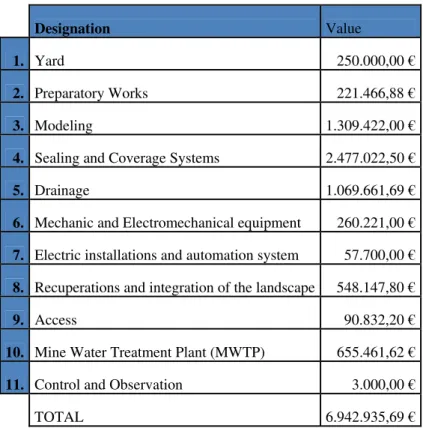
The financial costs can be separated in eleven different parts, each of them with
different purposes. The information relative to the financial costs is all presented in
Designation Value
1. Yard 250.000,00 €
2. Preparatory Works 221.466,88 €
3. Modeling 1.309.422,00 €
4. Sealing and Coverage Systems 2.477.022,50 €
5. Drainage 1.069.661,69 €
6. Mechanic and Electromechanical equipment 260.221,00 € 7. Electric installations and automation system 57.700,00 € 8. Recuperations and integration of the landscape 548.147,80 €
9. Access 90.832,20 €
10. Mine Water Treatment Plant (MWTP) 655.461,62 € 11. Control and Observation 3.000,00 €
TOTAL 6.942.935,69 €
Table 7 – Project Costs
5. Benefits
The benefits that we can take from the project are environmental benefits making that
they are non market goods (with the exception of the agricultural lands).
In order to evaluate the benefits of the project a need to create a base scenario appeared
since there is uncertainty about the results due to the fact that some of them will depend
on the choices of the population that lives near the mining area.
In the base scenario several assumptions are made and this would be the best scenario
that could happen from the project. The assumptions that are made are that the
population will comply with all the restrictions that will be made to their agricultural
activities in the medium run making that in the deadline of 15 years the soils around the
mining area will be completely decontaminated and also that in the present do not exist
Another assumption is made referring the time frame of the project, this is since there is
a natural decontamination process the project impact will be considered only during the
time that would take for the decontamination to happen naturally. In the EIS there is no
reference for the time that it would take being stated that only a high long term would
take to clear the area. For sake of simplicity it is assumed that it would take the time of
a generation, this is, according to the Portuguese life expectancy, 82 years.
5.1 Soil
The area affect by the intervention directly is characterized, as referred in the baseline
by soil suitable for forest land growing and the impact of the project according to the
EIS is considered positive.
The value used for evaluating this impact was the one used as reference by “Gabinete
Técnico Florestal” of “Câmara Municipal de Mangualde”. This reference refers to the
lands that can’t be used for agricultural purposes being only fit for the growing of wild
vegetation.
The reference value for this sort of land is 5000€ per hectare making that the total value
of the decontamination of the soils inside the mining area is equal to 85000€.
5.2 Water
The valuation of the water is made based on its future purpose, in this case for
irrigation. The main reason for only considering this purpose is because there is no
evidence that the water, after the intervention, can be used for any other purpose as it
was referred in the baseline. By other words, all the standards of quality that this project
aims for it to comply with the national index for irrigation waters presented in the
To do so it was used the methodology of revealed preferences, using the prices of the
land from another location with similar characteristics. The location chosen was
“Oliveira do Hospital” and the main reason for it was because it shares the same type of
soils and also because it has Uranium mines but that have never been explored given not
only a very good reference for the prices comparison but also it is very useful to
understand the impact of the human activities during the mining exploration in Cunha
Baixa.
All the data was gathered from local real estate agencies. At this point it is important to
refer that in both regions due to the size of the populations the real estate business is
made by the owners or by local agencies. Another important aspect to refer is the
limitation of the data since the land for sale is not very abundant.
It was necessary to filter the collected data trying to distinguish which lands had an
agricultural purpose and which ones did not. When looking to the data it was possible to
take that the average price for an agricultural land where there is presence of water is
2,07€ per square meter and without 0,63€. From these prices it was possible to take an
approximate value for the decontamination of the lands of the difference between the
two, 1,44€/m2.
The value of the water will reflect the increase in prices from the base scenario; this is
as if no water would be available. As it was said before the increase in prices due to the
presence of water is equal to 1,44€/m2 making that the total value of the
decontamination of the water is equal to 606867,84€.
5.3 Ecological and landscape impact
the intervention the air quality will increase substantially and it will be possible to go to
the mining area. It is intended in the project that the mining area will became a picnic
park.
The evaluation of the this impact is based on the usage that the population could give to
it and, based on that, the value will be given taking into account the value of time if the
population of the area.
From the “National Institute of Statistics” (INE) it was possible to take the income of
the people that work in each sector. The average monthly incomes of each sector are
551€, 703€ and 821€ in the primary, secondary and tertiary sectors respectively. Given
distribution of the population in each sector (referred in the baseline) it is possible to
compute and average monthly salary 0,071×551+0,448×703+0,481×821=748,97€.
From here we can take that the average salary per minute will be 0,07€.
In order for an element of the population to go between the center of the village to the
center of the mining area it takes between 10 to 15 minutes.
Here a new assumption is made, and that is that the entire population of Cunha Baixa
will go to this park once a year. The main reason for this assumption is because it does
not exist in the village any kind of place for outdoor activities so it is reasonable to
assume that it will be used. Because the population is constituted by more elderly
people the time used to arrive to the park will be the maximum that was referred, this is
15 minutes making that if someone would like to go there it will take 30 minutes to go
and come back.
Given the assumption made it is possible to evaluate this impact of the project of
per year.
∫
=1133
€ 30 , 2379 1
5.4 Health Risk
When accounting for the risk to the health of the population due to the mining activities
one of the assumptions that were made in the base scenario will be relaxed. In this
section it is considered that agricultural production exists. The effects of the exposition
to the radiation through food are going to be accounted.
First it is important to distinguish between the two types of radiation exposition that
exist, chronic and acute, and in the case the one that reflects better the situation is
chronic. Chronic exposition considers small amounts of radiation during long periods of
time and according to the US Nuclear Regulatory Commission the estimate of the
probability of developing a fatal cancer is 1 in 2500, this is 0,04%. It is important to
refer that this probability is value with big uncertainty since there several exogenous
factors that can affect it like food habits, smoking and propensity to develop cancers and
also because of the difficulty to distinguish between normal cancers and the ones that
are due to the radiation.
In order to attribute a value to this risk, the value of a statistical life (VSL) considered
by the European Union (DG Environment) was used, this is 1,4 million euro (prices of
2000). Because all of the remaining values are in 2011 prices an actualization of the
value was made making that the VSL is equal to 1801178,04€.
From here it is possible to take willingness to pay of eliminating this risk, that is the
product between the VSL and the probability of occur a cancer that is 720,47€. This
value means that each element of the population should be willing to pay 560€ in order
to eliminate the probability to have cancer.
interval goes from the population of Cunha Baixa to all the population of Mangualde.
These two levels of population are referred in the results section as 2nd and 3rd scenarios
respectively. A higher interval is not considered since the level of potential production
could not reach more population.
6. Results
The benefits that come from the project can be unpredictable since they depend on the
Human interaction after the development of the same. Because of this, in this section
several hypotheses will be presented in order to try to cover the most possible situations
that can come from it. The hypotheses made are the ones referred in the benefits section
as base, 2nd and 3rd scenarios.
In the EIS it is said that the contamination of the soils that are affected indirectly depend
on the fact that people restrict their agricultural activities for a medium term. This is a
strong assumption since people, in the present time use the waters that are contaminated
for irrigation purposes even though they are informed that they are not proper for it and
it is illegal to do so.
The discount rate that was used to compute the values is 4,3% and the reason for this
choice was since all the benefits of the project are environmental it would make sense to
use a rate that normally is used to environmental problems, in this case the rate
suggested by Nordhaus to compute the prices of carbon emissions.
A time line is introduced based on the fact that natural decontamination (without
Human intervention) can occur. Although that is not referred in the EIS the exact time
in a high long term, and for sake of simplicity it is considered the life time of an average
person in Portugal, this is 82 years.
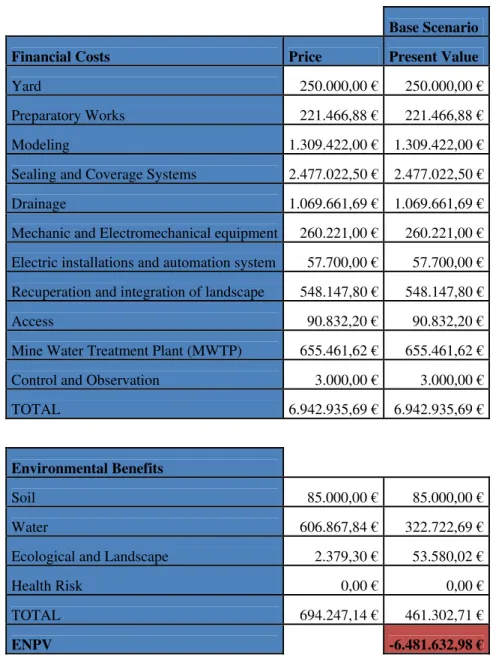
Given the base scenario that was referred in the benefits section, it is possible to
compute the Economic Net Present Value of the project testing it for economic
efficiency. The values used for this computation are given by table 8.
Looking to them it is possible to see that the project does not pass the test of efficiency
having a negative ENPV of 6481632,98€.
Base Scenario
Financial Costs Price Present Value
Yard 250.000,00 € 250.000,00 €
Preparatory Works 221.466,88 € 221.466,88 €
Modeling 1.309.422,00 € 1.309.422,00 €
Sealing and Coverage Systems 2.477.022,50 € 2.477.022,50 €
Drainage 1.069.661,69 € 1.069.661,69 €
Mechanic and Electromechanical equipment 260.221,00 € 260.221,00 € Electric installations and automation system 57.700,00 € 57.700,00 € Recuperation and integration of landscape 548.147,80 € 548.147,80 €
Access 90.832,20 € 90.832,20 €
Mine Water Treatment Plant (MWTP) 655.461,62 € 655.461,62 € Control and Observation 3.000,00 € 3.000,00 €
TOTAL 6.942.935,69 € 6.942.935,69 €
Environmental Benefits
Soil 85.000,00 € 85.000,00 €
Water 606.867,84 € 322.722,69 €
Ecological and Landscape 2.379,30 € 53.580,02 €
Health Risk 0,00 € 0,00 €
TOTAL 694.247,14 € 461.302,71 €
ENPV -6.481.632,98 €
As it was referred, in order to evaluate the other scenarios, some assumptions are
relaxed and a new benefit is introduced, the reduction of the risk of the population that
now will not take the value of zero.
2nd Scenario 3rd Scenario
Financial Costs Price
Yard 250.000,00 € 250.000,00 € 250.000,00 €
Preparatory Works 221.466,88 € 221.466,88 € 221.466,88 € Modeling 1.309.422,00 € 1.309.422,00 € 1.309.422,00 € Sealing and Coverage Systems 2.477.022,50 € 2.477.022,50 € 2.477.022,50 € Drainage 1.069.661,69 € 1.069.661,69 € 1.069.661,69 € Mechanic and Electromechanical equipment 260.221,00 € 260.221,00 € 260.221,00 € Electric installations and automation system 57.700,00 € 57.700,00 € 57.700,00 € Recuperation and integration of landscape 548.147,80 € 548.147,80 € 548.147,80 €
Access 90.832,20 € 90.832,20 € 90.832,20 €
Mine Water Treatment Plant (MWTP) 655.461,62 € 655.461,62 € 655.461,62 € Control and Observation 3.000,00 € 3.000,00 € 3.000,00 € TOTAL 6.942.935,69 € 6.942.935,69 € 6.942.935,69 €
Environmental Benefits
Soil 85.000,00 € 85.000,00 € 85.000,00 €
Water 606.867,84 € 322.722,69 € 322.722,69 €
Ecological and Landscape 2.379,30 € 53.580,02 € 53.580,02 €
Health Risk 720,47 € 816.293,89 € 15.122.690,82 €
TOTAL 694.247,14 € 1.277.596,59 € 15.583.993,53 €
ENPV -5.665.339,10 € 8.641.057,84 €
Table 9 – Results of 2ndand 3rdScenarios
As it is possible to see, when accounting the value of the health risk the results have a
great variation, being this variable the one with higher significance. The second and
third scenarios reflect an interval of population that can be affected by the project and
when accounting for all the population of Mangualde the project becomes efficient
1133 to 20990 people) the quantity of the population will be subject to a sensitivity
analysis in order to be possible to understand the significance of one extra person be
added to the effects of the project.
7. Sensitivity Analysis
7.1 Base Scenario
7.1.1 Water
The best possible outcome value for the water of 606867,84€ per year was established,
or if based on the current prices of the lands, people would be willing to pay more 1,44€
per square meter in order to have access to water.
In order to be possible a non negative result considering the give assumptions it would
be necessary that people would be willing to pay more 30,47€ per square meter in order
to have access to clean water.
7.1.2 Ecological and Landscape Impact
In the base scenario the price considered for the landscape impact is equal to 2,10€ per
person and per year, meaning that each person is willing to pay this amount to be able to
use the park assuring not only a better visual impact but also the air quality in the area.
In order to the project have a positive value this value would have to increase till
251,80€ per person and per year otherwise, given everything else constant the project
7.1.3 Discount Rate
When testing the value of the project sensitivity to the discount rate first it is checked
which value of this rate would have to be for this project to be positive. The discount
rate would need to be equal to be negative (-5,78%) in order for the project be efficient.
From this result we can see that the influence of the discount rate does not have
significance in the project, meaning that only if the future was valued higher than the
present, under the assumptions made the project could be positive.
7.2 2nd and 3rd Scenarios
7.2.1 Health Risk
The health risk represents a variable that has a great impact in the results. First, given
the VSL, the project would be efficient if it 8996 people could be affect by the
exposition to radiation, this is consumed products that are produced in the surroundings
of the mining area.
In the second scenario the price attributed to the health risk would need to rise till
5720,77€ for the ENPV to be positive. This means that VSL would need to be equal to
14301926,26€ that is not reasonable value. Looking to the third scenario, since the
project is positive it was calculated the minimal willingness to pay of the population for
the ENPV remain positive that is the value of 308,80€. This value reflects a VST of
771990,59€ much lower than the one suggested by the European Union making that
7.2.2 Discount Rate
The discount rate variations only make sense to analyze under the perspective of the
third scenario, since in the second the values do not differ significantly from the base
scenario. In the third scenario it is interesting to see that even using a discount rate that
tends to infinity, valuing only the present, the project would be positive.
8. Conclusion
The CBA performed show a wide variety of interpretations given the assumptions
made, becoming clear the great impact that Human decisions can have. It can be seen
when comparing the results with and without the assumption of no agricultural
production (as it is recommended).
The variable with greater impacts was the one accounting for the health risk of the
population, given that all the others have really local effects not being able to justify the
costs associated with a project of this magnitude. And even so, this variable, as it was
said before only exists given some assumptions, this is, that people do not respect or are
not properly informed, of the appropriate conduct to have facing this sort of situation.
In a situation where all the recommendations and restrictions are being followed by the
population there is no justification for the project but in the case where it does not
happen or an investment in control and information would be advisable (instead of the
project) or if it would not be possible then the project starts to make sense to exist
achieving efficiency depending on the quantity of people that can be affected.
However, given the conditions of uncertainty it can make sense for the development of
Bibliography
Boardman, Anthony, David Greenberg, Aidan Vining and David Weimer. 2005. Cost
Benefit Analysis: Concepts and Practice. Prentice Hall
Hanley, N. and C.L.Splash. 1993. Cost-Benefit analysis and the environment.
Aldershot. Edward Elgar.
COBA. 2008. Estudo de impacte ambiental – Projecto de remediação ambiental da
área mineira da Cunha Baixa.
COBA. 2008. Projecto de execução – Projecto de remediação ambiental da área
mineira da Cunha Baixa.
Cropper, Maureen, James K. Hammit and Lisa A. Robinson. 2011. Valuing Mortality
Risk Reduction. Washington. Resources for the future.
2001. “Economic Valuation of Mortality Risk Reduction: Assessing the State of the Art
for policy Applications.” Paper presented at International Perspectives on Valuing
Mortality risk, The Holiday Inn, Silver Spring.
Kuosmanen, Timo and Mika Kortelainen. 2007. “Valuing Environmental Benefits in
Cost-benefit analysis.” In Ecological Economics, 56-65. Elsevier.
Instituto Nacional de Estatística. 2011. Instituto Nacional de Estatística. www.ine.pt
NRC. 2011.US Nuclear Regulatory Commission. www.nrc.gov
INAG. 2011. Instituto da Água. www.inag.pt
Câmara Municipal de Mangualde. 2011. Câmara Municipal de Mangualde.