"%
From the Vascular Surgery Service, Hospitaldas Clínicas, Faculty of Medicine University of São Paulo.
AORTOFEMORAL THROMBOENDARTERECTOMY
Eduardo Toledo de Aguiar, Alex Lederman, Cid José Sitrângulo Júnior and Pedro Puech-Leão
RHCFAP/3087
AGUIAR ET et al. - Aortofemoral thromboendarterectomy. Rev. Hosp. Clín. Fac. Med. S. Paulo 57(4):147-160, 2002.
PURPOSE: To study whether endarterectomy is feasible in all patients with aortofemoral atherosclerotic obstruction,
considering early and late results.
METHODS: A clinical, prospective, and descriptive study carried out in a university hospital. Inclusion criteria were
atherosclerotic aortofemoral obstructive disease, clinical status compatible with major surgery, and absence of prior restorative procedure. Exclusion criteria were aneurysm, inflammatory arterial disease, and prior restorative procedure found during surgery. Eighty patients entered the protocol, but 9 were excluded (11.2%). Seventy-one patients, mean age of 57.3 years, underwent endarterectomy. Operative indications were intermittent claudication and critical ischemia. A ring-stripper endarterectomy technique was employed in all patients. Results were related to age, gender, symptoms, presence of diabetes mellitus, extension of endarterectomy, and extent of obstructive disease. Chi square or Fisher exact tests were used when appropriate, and the Wilkoxon (Gehan) test was used to compare survival curves.
RESULTS: Sixty-eight (100%) endarterectomies were patent at discharge. The mortality rate was 4.2%. The amputation
rate (4.3%) was higher in diabetic patients and when there was associated femoropopliteal obstruction. The 5-year survival rate was 83.3%, and late deaths were mostly cardiovascular. Diabetes mellitus, age above 65 years, and associated femoropopliteal obstruction lowered the survival rate. The 5-year patency rate was 87.0%. Critical ischemia and less extensive endarterectomies were associated with a lower patency rate. There were no anastomotic aneurysms or deep infections.
CONCLUSIONS: Aortofemoral thromboendarterectomy is feasible in 90% of patients, early mortality rate is low,
diabetic patients and those with associated femoropopliteal obstructive disease have a higher mortality rate, amputation rate is low, late deaths are mostly cardiovascular, and late patency rate is high, and even higher in the intermittent claudication group.
DESCRIPTORS: Aorta. Iliac artery. Endarterectomy. Atherosclerosis. Arterial reconstructive surgery.
INTRODUCTION
The first thromboendarterectomy was performed by Dos Santos in 1947, and after a few years, it was accepted as a treatment for aortoiliac atheroscle-rotic obstructions1-3. Technical
diffi-culties induced most surgeons to sub-stitute prosthetic aortoiliac bypass, an easier procedure, for endarterectomies. During the 1950s, arterial prosthe-sis development caused a great ad-vance in vascular surgery4. These
ar-terial substitutes made aneurysm and
arterial occlusion surgical treatment much easier and were employed indis-criminately to correct all chronic ob-structions, regardless of the artery in-volved. Earlier results showed that these synthetic arterial grafts were not suitable for small caliber arteries, so for these vessels the saphenous vein became the ideal substitute. Dacron grafts became the ideal substitute for
larger arteries and are widely used to treat the Leriche syndrome.
Unfortunately, patients with an ar-terial prosthesis are always at risk of complications developing after the graft implant. Anastomotic aneurysms and graft infections may occur at any time, and their surgical treatment is fol-lowed by high mortality in cases of graft infection5-9. Even with all the
im-provements in technology and surgi-cal procedures, these complications are not preventable.
endarterec-"&
tomy techniques to treat arterial occlu-sive disease. When reviewing the litera-ture regarding the early and late com-plications of this technique, one finds instances of occlusion of the treated segment, but instances of infection and anastomotic aneurysms are not found.
In our service, thromboendarterec-tomy is rarely used, and the treatment of choice for aortoiliac occlusive disease is the aortofemoral Dacron bypass10,11.
Dur-ing the past few decades, frequently oc-curring graft infections that jeopardize the prosthesis and the patient’s limb and life induced us to use an autogenous substitute and thus return to the use of thromboendarterectomy.
The objective of this study is to analyze whether thromboendarterec-tomy is feasible in all aortoiliac-femo-ral occlusions and whether early and late results are comparable to results from other techniques.
METHODS
This is a clinical prospective and
descriptive study. Inclusion criteria were aortoiliac-femoral obstructions due to atherosclerosis with or without femoropopliteal occlusions, patient’s clinical status allowing major vascu-lar surgery, and absence of previous ar-terial aortoiliac-femoral and femoro-popliteal reconstruction. Exclusion criteria were aneurysm diagnosed dur-ing surgery, arterial inflammatory dis-ease diagnosed during surgery, or pre-vious arterial surgery not mentioned prior to the operation and that was di-agnosed during surgery.
Patients were randomly selected to participate in the protocol from the surgical ward of the university hospi-tal. Patients who were admitted under the author’s care and met inclusion cri-teria were then included. All patients had a preoperative angiography to study the infrarenal abdominal aorta, iliac arteries, and arteries of the lower limbs to the feet.
Ring-stripper endarterectomy under general anesthesia was performed on all patients. The aorta and iliac and femo-ral bifurcations were dissected.
Dissec-tion of the aorta’s left side, aortic bifur-cation, and left common iliac artery was avoided. A clamp was located at the femoral bifurcation, and a transverse in-cision was made 1 centimeter above the clamp. The endarterectomy ring was in-troduced until the iliac bifurcation was reached. At this point, another arteri-otomy of the common iliac artery was made 1 centimeter above the bifurca-tion, and the core was taken out. The internal iliac artery was then exposed, and any plaque that needed to be re-moved was taken out with the help of a Moynihan clamp. The ring was then introduced through the common iliac artery until it reached the aortic bifur-cation. The same procedure was done on the other side. Aortic endarterectomy was completed with infrarenal cross-clamping, longitudinal aortotomy, and “open endarterectomy”. The common iliac core was removed through aortotomy. Closure of the aorta, iliac, and femoral arteriotomies was done sequentially, with clamp removal after each suture (Fig. 1).
The following parameters were
Figure 1 - Aortofemoral thromboendarterectomy steps. A – Incisions. B – Beginning of endarterectomy at common femoral artery. C – Ring stripper through common femoral artery. D – Atheroma plaques and thrombus. E – Longitudinal aortotomy and tranverse right iliac arteriotomy closed.
A
B
C
D
"'
analyzed: early and late mortality,early and late amputation rates, early reoperations (during first 30-day pe-riod), survival rate, late obstruction rate (verified by femoral pulse loss and duplex-scan), suture line aneurysms (physical examination and duplex-scan), deep surgical infection (verified by the patient’s clinical status and spe-cific cultures for agent isolation).
All patients were followed with du-plex-scan at 3 months after surgery and at least once a year after that.
The outcomes were then related to age, gender, symptoms, presence of diabetes mellitus, thromboendarterec-tomy extension, and occlusive disease extension into the aortoiliac-femoral territory, associated or not with femoro-popliteal obstructive disease.
Chi-square and Fisher’s Exact test were applied with a significance of 5%. Survival curves were built for late death and late arterial occlusion. The Wilcoxon (Gehan) test was applied with a significance level of 5%.
All statistical analyses were made using the SPSS for Windows program.
PATIENTS
Eighty patients were initially in-cluded. Nine (11.2%) had to be ex-cluded due to intraoperative findings – 7 with abdominal aortic aneurysm, 1 with an aneurysm at the origin of the external iliac artery, and 1 with a
pre-viously stented left common iliac ar-tery (the stent did not show up on aor-tography because of subtraction tech-nique).
Seventy-one patients were in-cluded. The mean age was 57.3 ± 9.9 years; 54 (76.1%) were male and 17 (23.9%) female. Twelve (16.9%) were diabetic patients, 34 (47.9%) were hy-pertensive patients, 70 (98.6%) were smokers, 29 (40.8%) had critical limb ischemia (rest pain with or without ischemic lesions), 42 (59.2%) had in-termittent claudication, 19 (26.8%) had coronary artery disease, 12 (16.9%) had carotid stenosis, and 32 (45.1%) had femoropopliteal-associated occlusions. The endarterectomy extension was aorto-bifemoral (3 with associated femoropopliteal restoration, 1 of which bilateral) in 52 (73.2%) patients, aortoiliac on one side and aortofemoral on the other in 3 (4.2%), and iliac-femoral (two bilateral and one with as-sociated femoropopliteal bypass) in 9 (12.6%).
Aorto-bifemoral and aortoiliac on one side and aortofemoral on the other were classified in one group (aortofemoral), and aortoiliac and iliac-femoral endarterectomies in another.
RESULTS
At hospital discharge, 68 (100%) patients had patent restorations (3 early deaths excluded). The preoperative and
postoperative angiograms of a patient with juxtarenal aortic occlusion in which the disease extended throughout the iliac arteries reaching the common femoral arteries are shown in figure 2. Thirteen (18.3%) patients had immedi-ate occlusion. One patient died of meta-bolic disorders, and the other 12 had a successful redo operation.
Reoperations were due to superfi-cial femoral artery flaps (5), deep femo-ral artery occlusion caused by flaps (2), thrombosis due to hypotension (2), in-complete external iliac artery endarter-ectomy (2), and incomplete common iliac artery endarterectomy (1).
Three (4.5%) patients had to un-dergo fasciotomy and developed neu-rological sequelae that disappeared within 6 months. One diabetic patient, after reoperation, developed a wound infection, calf abscess, and sepsis. De-spite all complications, there was no compromise of arterial restoration.
There was no statistically signifi-cant association of reoperation rates with age group, gender, presence of diabetes, symptom type, endarterec-tomy extension, and presence of asso-ciated femoropopliteal occlusion.
Three amputations had to be done (amputation rate of 4.2%): 2 at femoral level and 1 transmetatarsal (caused by atheroembolism on the contralateral limb after iliac-femoral endarterectomy). Acute small artery occlusion occurred during ring endarterectomy of the left common iliac artery to the aorta. The
pré
pós
pós
#
other 2 amputations were due to exten-sive gangrene after aortoiliac-femoral thromboendarterectomy. Even with a successful arterial restoration, the ischemic lesion continued to develop in one patient. The other patient devel-oped gaseous gangrene after surgery. Neither of these patients was diabetic.
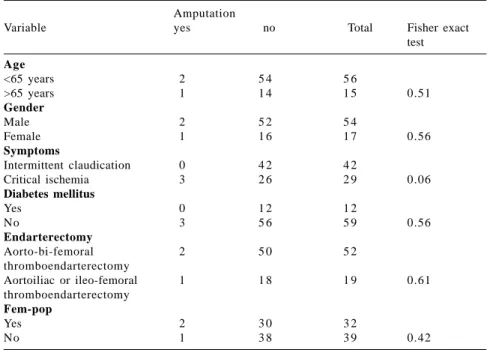
There was no statistically signifi-cant association of amputation rates with age group, gender, presence of diabetes, or endarterectomy extension. A statistically significant association of amputation with type of symptom was found; amputations occurred only after operations done for critical ischemia.
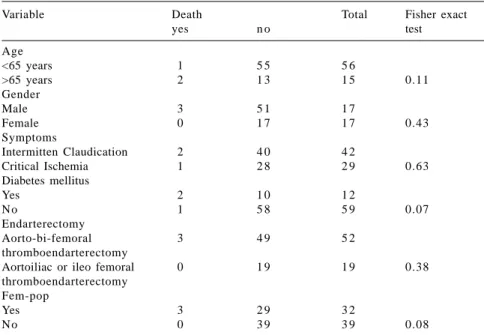
Three patients died in the immedi-ate postoperative period. All were male, 2 were older than 65 years of age, and 2 were diabetics. The mortality rate was 4.2%. The causes of death were me-senteric thrombosis in a diabetic patient and mio-nephrotic-metabolic syndrome in 2 patients (one had an immediate postoperative thromboendarterectomy occlusion, and the other was a diabetic with a bilateral femoropopliteal ob-struction with a clamping time greater than 2 hours due to technical difficul-ties). Two of these patients had surgery due to intermittent claudication, and the third one was due to critical ischemia. All 3 patients had aortoiliac-femoral thromboendarterectomy. There was no statistically significant associa-tion of mortality rates with age, gender, thromboendarterectomy extension, or patient’s symptoms (Table 3). However, patients with diabetes and with associ-ated femoropopliteal occlusions had a higher immediate death rate.
The life table shows a 5-year pat-ency of 87.0% ± 5.6% (Fig. 3); late reoperations were not included. Eight occlusions occurred after endarterec-tomy (through an inguinal incision only): 4 aortoiliac-femoral, 3 aortoiliac, 1 ileo-femoral. Five patients underwent reoperations successfully. Two years af-ter primary surgery, the first patient
de-veloped occlusion of both common femoral arteries to the origin of the deep femoral artery where endarterectomy was finished. Intimal hyperplasia was observed at that point. Correction by profundaplasty and thrombectomy was
successful. The second case had an ex-ternal iliac artery endarterectomy 1 1/2 years after primary aortoiliac endarter-ectomy. The third patient had an aortic aneurysm occlusion after a bilateral ileofemoral endarterectomy done
Table 2 - Immediate post-operative amputation rate by variables studied.
Amputation
Variable yes no Total Fisher exact
test Age
<65 years 2 5 4 5 6
>65 years 1 1 4 1 5 0.51
Gender
Male 2 5 2 5 4
Female 1 1 6 1 7 0.56
Symptoms
Intermittent claudication 0 4 2 4 2
Critical ischemia 3 2 6 2 9 0.06
Diabetes mellitus
Yes 0 1 2 1 2
No 3 5 6 5 9 0.56
Endarterectomy
Aorto-bi-femoral 2 5 0 5 2
thromboendarterectomy
Aortoiliac or ileo-femoral 1 1 8 1 9 0.61
thromboendarterectomy Fem-pop
Yes 2 3 0 3 2
No 1 3 8 3 9 0.42
Fem-pop: Femoropopliteal obstruction associated with aortoiliac-femoral obstruction.
Table 1 - Immediate reoperation rate by variables studied.
Immediate reoperation Qui square or
Variable yes n o Total Fisher exact
test Age
<65 years 1 1 4 5 5 6
>65 years 2 1 3 1 5 0.15
Gender
Male 8 4 6 5 4
Female 5 1 2 1 7 0.44
Symptoms
Intermittent claudication 8 3 4 4 2
Critical ischemia 5 2 4 2 9 0.84
Diabetes mellitus
Yes 1 1 1 1 2
No 12 4 7 5 9 0.30
Endarterectomy
Aorto-bi-femoral 11 4 1 5 2
thromboendarterectomy
Aortoiliac or ileo-femoral 2 1 7 1 9 0.25
thromboendarterectomy Fem-pop
Yes 7 2 5 3 2
No 6 3 3 3 9 0.48
#
through inguinal incisions. Diagnosiswas done during reoperation 11 months after first surgery, and an aortofemoral “Dacron” bypass was performed. The fourth patient developed a left common iliac artery occlusion 5 years after pri-mary surgery. During preoperative arte-riography, a right common iliac artery stenosis was diagnosed. Ring endarter-ectomy was successful in treating the left-side occlusion. A balloon
angio-plasty of the right-side stenosis was complicated by arterial rupture, and a Dacron tube was interposed. The fifth patient also developed a left-side com-mon iliac artery stenosis that was suc-cessfully treated with balloon angio-plasty that occluded at the 40th
postop-erative day. A new thromboendarte-rectomy of this segment was successful. A sixth patient refused to undergo redo surgery 9 years after an
aortoiliac-femo-ral endarterectomy. Two other patients are still under evaluation for possible reoperations (one with previous aortoiliac-femoral thromboendarte-rectomy and the other with aortoiliac thromboendarterectomy).
There was no statistically signifi-cant association of late patency with gender, presence of diabetes, age, or femoropopliteal-associated disease.
A statistically significant differ-ence was observed when endarterec-tomy length was analyzed: 91.9% ± 5.5% of aortoiliac-femoral thrombo-endarterectomies were patent after 5 years compared to 73.9% ± 13.8% of others (Fig. 4).
There was a statistically significant association of the patency rate with the type of symptom (intermittent claudication or critical limb ischemia). A 5-year patency of 95.0% ± 4.8% was observed for patients with intermittent claudication, while patients with criti-cal limb ischemia had a 73.7% ± 12.4% patency rate (Fig. 5).
Six patients died during follow up. Causes of death were acute myocardial infarction (3), ischemic cerebrovascu-lar accident (1), leukemia (1), and in-testinal perforation during gyne-cologic surgery (1). The life table shows the 5-year survival rate of 85.3% ± 5.8% (Fig. 6).
There was no statistically signifi-cant difference in the incidence of mortality when patients were grouped according to gender, endarterectomy length, or symptom type (intermittent claudication or critical ischemia).
Statistically significant differences in the 5-year survival rates were observed when patients were grouped according to presence of diabetes (71.5% ±14.1% versus 88.2% ± 6.3% for non-diabetic patients), age (77.7% ± 11.3% for >65 years old versus 87.9% ± 6.2% for <65 years old), and femoropopliteal-associ-ated disease (78.2% ± 7.9% versus 93.3% ± 6.4% for patients without femoropopliteal occlusions) (Figs. 7,8,9).
Table 3 - Immediate mortality by variables studied.
Variable Death Total Fisher exact
yes n o test
Age
<65 years 1 5 5 5 6
>65 years 2 1 3 1 5 0.11
Gender
Male 3 5 1 1 7
Female 0 1 7 1 7 0.43
Symptoms
Intermitten Claudication 2 4 0 4 2
Critical Ischemia 1 2 8 2 9 0.63
Diabetes mellitus
Yes 2 1 0 1 2
No 1 5 8 5 9 0.07
Endarterectomy
Aorto-bi-femoral 3 4 9 5 2
thromboendarterectomy
Aortoiliac or ileo femoral 0 1 9 1 9 0.38
thromboendarterectomy Fem-pop
Yes 3 2 9 3 2
No 0 3 9 3 9 0.08
Fem-pop: Femoropopliteal obstruction associated with aortoiliac-femoral obstruction.
Number of operations included in the peiod:
7 1 5 3 4 1 3 2 2 2 1 5 1 2 8 6 2 1
Number of occlusions in the period:
1 1 1 2 0 2 0 1 0 0
#
Number of operations included in the peiod: Aorto-femoral:
5 2 3 9 3 2 2 5 1 6 1 1 8 6 4 2 1
Other:
1 9 1 4 9 7 6 4 4 2 2
Number of occlusions: Aorto-femoral:
0 0 1 1 0 2 0 1 0 0
Other:
1 1 0 1 0 0 0 0 0
p Wicoxon (Gehan) = 0.07 Figure 4 - Patency by length of thromboendarterectomy.
Number of operations included in the peiod: Claudication:
4 2 3 2 2 5 2 2 1 7 1 2 9 6 4 1 1
Critical ischemia:
2 9 2 1 1 6 1 0 5 3 3 2 2 1
Number of occlusions: Claudication:
0 0 0 1 0 2 0 1 0 0
Critical ischemia:
1 1 1 1 0 0 0 0 0 0
#!
Número de doentes no período: < 65 anos:
5 6 4 5 3 5 2 9 2 0 1 4 1 3 8 7 2 1
> 65 anos:
1 5 9 7 5 3 1 1
Número de eventos: < 65 anos:
1 2 0 0 1 0 0 0 1 0
> 65 anos:
3 0 0 0 0 0 1
p Wicoxon (Gehan) = 0.02
Figure 7 - Survival of the surgically treated population by age. Number of patients included in the peiod:
7 1 5 4 4 2 3 4 2 3 1 5 1 4 8 7 2 1
Number of deaths:
4 2 0 0 1 0 1 0 1 0
#"
Number of patients included in the peiod: Non-diabetic:
5 9 4 5 6 7 2 9 2 0 1 2 1 2 6 5
Diabetic:
1 2 9 5 5 3 3 2 2 2 2 1
Number of deaths: Non-diabetic:
2 1 0 0 1 0 1 0 1
Diabetic:
2 1 0 0 0 0 0 0 0 0
p Wicoxon (Gehan) = 0.03 Figure 8 - Survival of the surgically treated population by diabetes mellitus.
Number of patients included in the peiod: Femoro-popliteal disease absent:
3 9 3 1 2 5 2 2 1 8 1 1 1 0 5 4
Femoro-popliteal disease present:
3 2 2 3 1 7 1 2 5 4 4 3 3 2 1
Number of deaths:
Femoro-popliteal disease absent:
0 0 0 0 1 0 1 0 1
Femoro-popliteal disease present:
4 2 0 0 0 0 0 0 0
p Wicoxon (Gehan) = 0.08
##
DISCUSSION
This study was initially designed to prove that endarterectomy is feasi-ble for all atherosclerotic aortoiliac-femoral obstructions. Therefore, it is a prospective study that respects all in-clusion and exin-clusion criteria. There are a few prospective studies in the lit-erature12-15. All patients complaining of
Leriche´s syndrome who were admit-ted under the author’s care were pre-pared for ring-stripper thrombo-endarterectomy; patient selection ex-clusively on arteriography was not done. Of the 80 patients included, there were 9 excluded because of di-agnosis of intraoperative aneurysm and the finding of a common iliac artery stent during surgery. The stent was not visualized on arteriography because of technicalities of the digital subtraction techniques. One important fact became very clear: thromboendarterectomy was not feasible in 10% of patients with Leriche´s syndrome. Some authors had mentioned this fact before and at-tributed this to technical difficulties such as calcified atheroma plaques and not to aneurysms or previous proce-dures16-18.
Our study population of 71 pa-tients is smaller than other study populations reported in the literature, but it is similar in age, gender distri-bution, associated risk factors, cardio-pathy, and distal occlusive disease. These similarities allow comparative studies of our results and those in the literature14,17,19-21.
The surgical technique employed deserves special attention. A trans-peritoneal access was used because we had significant previous experience with this approach. However, retroperi-toneal access to the abdominal aorta has recently become accepted in our department and is now routinely em-ployed; this was not the case at the be-ginning of this study22,23.
Wylie´s (1952) ring
endarterec-tomy technique was employed.3
Distal-to-proximal artery endarterectomy di-minishes aortic cross-clamping time, and a transverse arteriotomy at the ar-terial bifurcation makes it easier to su-ture, resulting in lower stenosis rates and no need for patches. Longitudinal arteriotomies frequently need patch-ing14,17,19,20.
At hospital dismissal time, all thromboendarterectomies were patent, even if reoperation was needed. The immediate reoperation rate was high. According to Gaspard et al. (1972) there are 4 factors that should be con-sidered before starting an endarterec-tomy: 1) artery diameter (the smaller the arterial lumen the more difficult it is), 2) kinking of the artery, 3) calcifi-cations, and 4) “almost normal” arter-ies, which are more difficult to endarte-rectomize (especially when the com-mon femoral and comcom-mon iliac arter-ies are compromised and external iliac artery is spared)10. Recent data shows
a reoperation rate of 1.2% even in more extensive thromboendarte-rectomy14,19,24,25. As already described,
as surgeons become more experienced, mortality and reoperation rate dimin-ishes26.
These are reasons why most sur-geons opt for endarterectomy only when lesions are limited to aorta and common iliac arteries27-33. According to
Brewster and Darling (1978), limited obstruction occurs in 10% of patients with aortoiliac occlusion, and these are the cases in which endarterectomy should be indicated because it is an autogenous repair, a great advantage over a prosthetic graft34.
According to results presented here, there is no influence of the stud-ied variables on the reoperation rate. Technical difficulties such as cores left within the arteries or flaps left at the origin of the superficial femoral artery occurred at the beginning of the study. There were 3 immediate amputa-tions despite patent restoraamputa-tions. In the
literature, there are citations of cases in which amputations were necessary after endarterectomy or aortofemoral bypass surgery for intermittent claudi-cation, and all amputations were due to postoperative occlusion of the re-stored arterial segment (graft or endar-terectomy)35-37.
However, amputation does not nec-essarily occur only after occlusion of the arterial repair. Gaspard et al. (1972) reports 3 diabetic patients that evolved to amputation with normal postoperative femoral pulse12. Barret et
al. (1985) observed the same in 2 of 424 aortofemoral restorations38.
Most postoperative amputation oc-curs in patients with critical ischemia30,39,40. Immediate postoperative
amputation rate is low, varying from zero to 6.3% after surgery on aortoiliac-femoral territory obstruction20,28,30,35,39.
This study’s amputation rate falls into the accepted range. None of the ampu-tations were due to endarterectomy fail-ure. Two patients underwent amputa-tion: one due to progression of gan-grene and the other due to infection. The third amputation case was a transmetatarsal amputation on the con-tralateral side due to atheroembolism. This last case illustrates a major com-plication of this technique. This study reveals a high amputation risk for pa-tients complaining of critical ischemia. The mortality rate was 4.2% in this study. The mortality rate cited in the lit-erature varies from 1.1% to 6.9%13,14,19,25,36. It is very important to
emphasize that this statistic is related only to ring-stripper endarterectomy, since the usual technique employed to treat aortoiliac-femoral occlusions is syn-thetic bypass. The reported mortality rate following aortobifemoral bypass surgery ranges from 2% to 5%28, 33,37,41-43.
#$
report a decrease in complication and mortality rates as the surgeon’s experi-ence increases20,44,45. Immediate death
analysis reveals that all 3 patients had associated femoropopliteal occlusion, and 2 were diabetic. All 3 had an aortoiliac-femoral thromboendarte-rectomy. Statistical analysis revealed a significant difference when diabetes and femoropopliteal occlusions were analyzed. This means that when present, these variables increase imme-diate postoperative mortality risk. Ac-cording to Brewster (1991), multisegment disease usually occurs in older patients—mostly males, who are diabetics with coronary and cerebral and visceral artery involvement/occlu-sions27. Other authors report an increase
in mortality associated with age, female gender, femoropopliteal disease — es-pecially when there is critical ischemia — and associated with the extent of the endarterectomy14,28.
Mesenteric thrombosis was the cause of death of a diabetic patient with associated femoropopliteal occlu-sion. Deaths in the other cases were as-sociated with technical difficulties during aortoiliac-femoral thrombo-endarterectomy. These data support an extensive preoperative patient evalu-ation, especially if diabetes and distal artery occlusions are present. No early postoperative deaths occurred in the aortoiliac and iliofemoral thrombo-endarterectomy group. Similar results have been reported by other sur-geons35.
Late patency is an important fac-tor to be analyzed in arterial repair. Five years after initial thrombo-endarterectomy, the patency rate was 87.3% ± 6.9% (late reoperations are not included). All 6 cases of late oc-clusions could be treated — 4 by thromboendarterectomy and 2 by Dacron bypass. Causes of occlusion were intimal hyperplasia and progres-sion of atherosclerotic disease distal to prior thromboendarterectomy. Intimal
hyperplasia is a very important issue still under study, especially in angio-plasties, and cannot be avoided46-50
Published data shows a 5-year patency rate of 64.9% to 91% for aortofemoral repair9,24,28,33,37,38,51,52. Factors such as
age, gender, diabetes, type of repair (thromboendarterectomy or bypass) did not influence these results, but pa-tient complaint was very important. In our study, 91.3% ± 8.3% of thromboendarterectomies associated with intermittent claudication were patent after 5 years versus only 81.3% ± 10.2% of thromboendarterectomies associated with critical ischemia. These results were statistically significant and agree with those of other reported studies14,27,28,43. These excellent results
support the use of surgical interven-tion in patients with intermittent clau-dication and good clinical status on preoperative evaluations35,52,53.
Another important result is that longer thromboendarterectomies have longer patency times than shorter ones do. Darling and Linton (1964) and Wylie (1976) have already called atten-tion to the fact that thrombo-endarterectomy should be “complete”; that is, all plaques should be removed, and if necessary, thromboendarte-rectomy should be extended to the first branch of the deep femoral artery. This theory supports the criteria used in our service to always employ aortofemoral bypass for aortoiliac occlusions, since small lesions not bypassed may com-promise the arterial repair after-wards19,45,54. Reports in the literature
support that patients with limited le-sions, especially aortoiliac, evolve with good results on late evaluations26,38,44,45.
But the present article is highly sugges-tive that late occlusions develop from smaller atheroma plaques on distal ar-teries that were not considered during aortoiliac or iliac-femoral thrombo-endarterectomy.
The survival rate of our study popu-lation shows that 87.5% ± 4.5% of
pa-tients were still alive after 5 years. A similar study for aortofemoral bypass performed in our service had a 75.6% survival rate after 5 years4. Neugebauer
and Heyn (1982) estimated that 78% of patients who underwent surgery for aortoiliac occlusions were alive after 5 years55. Szilagyi et al. (1986)
esti-mated that only 59% of patients were alive after 5 years (same diagnoses and treatment)33. The cause of death was
primarily cardiovascular, especially acute myocardial infarc-tion16,26,28,29,33,37,38,42,56.
There were no deaths related to late complications of thromboendarte-rectomy, in contrast to what occurs with aortofemoral prosthetic bypass. Previ-ous studies done in this hospital have demonstrated that a high risk of devel-oping infection and anastomotic aneu-rysm exists when Dacron prostheses are used, and that use of these devices is associated with some deaths; the sec-ond most frequent cause of late death is complications related to the use of prosthetic graft6,7,9,57,58. The same results
are reported from different vascular centers59-64. Raptis et al. (1995) report a
1% per year postsurgical complication rate associated with aortofemoral by-pass for up to 10 years after surgery65.
The 5-year survival rate of this study is higher than previous survival rates of the population we treated with aorto-femoral bypass. It is also higher than survival rate of most authors except for Barret et al. (1985) who report an 89%, 5-year survival rate for patients with aortofemoral Dacron bypass12. The
small number of patients studied here and the better cardiologic follow-up to-day than before certainly influenced this result. Nevertheless, uncertainty persists regarding whether late compli-cations and reoperations associated with using a prosthetic graft can be avoided, which would result in dimin-ished late mortality9.
#%
and patient complaint, no significantstatistical differences emerged. Some authors report that women may not evolve as well as men, especially younger women in the premenopausal period66. This observation becomes
more evident with repairs below the inguinal ligament, but is not that evi-dent when the aorta is involved67,68.
Crawford et al. (1981) reports a 949 patient series whose survival rate is lower when critical ischemia, older age, and diabetes are present28. The
sta-tistically significant differences found in this study suggest that older age,
presence of diabetes, and associated femoropopliteal occlusion are all fac-tors contributing to a lower 5-year sur-vival rate.
In conclusion, thromboendarterec-tomy is feasible for 90% of aortoiliac-femoral occlusions and should be kept in the surgical arsenal, since it is au-togenous and has no extension limits. In the past few years, angioplasty has increased its popularity, but it still is not feasible for more extensive le-sions, and stents are often needed, re-sulting in the higher rates of compli-cations that are associated with the use
of Dacron prosthetic grafts44,69,70.
We conclude that thromboendarte-rectomy is an adequate technique to treat 90% of aortoiliac-femoral athero-sclerotic occlusions, early mortality rate is similar to that of other aortoiliac repairs, mortality is higher in patients who have diabetes mellitus and femoropopliteal-associated occlusion, early amputation rate is low and fre-quently associated with critical ischemia, there is a high reoperation rate, most late deaths are due to car-diovascular causes, and it is a durable restoration.
RESUMO RHCFAP/3087
AGUIAR ET e col. - Trombendarte-rectomia aorto-femoral. Rev. Hosp.
Clín. Fac. Med. S. Paulo 57(4):
147-160, 2002.
OBJETIVO: Estudar a
exeqüibi-lidade da trombendarterectomia em to-dos os portadores de obstrução aortilíaco-femoral aterosclerótica, seus resultados imediatos e tardios.
MÉTODO: Trabalho clínico,
pros-pectivo e descritivo feito em hospital universitário. Os critérios de inclusão foram: obstrução aortilíaco-femoral aterosclerótica associada ou não a obs-truções fêmoro-poplíteas, condições clínicas para suportar cirurgia de
gran-de porte e ausência gran-de restaurações ar-teriais nos territórios aortofemoral e fêmoro-poplíteo. Os critérios de exclu-são foram: aneurismas, doença arterial inflamatória e restauração arterial pré-via reconhecidos apenas no ato cirúr-gico. Foram incluídos 80 doentes. Nove (11,2%) foram excluídos. Parti-ciparam do estudo 71 doentes, 54 ho-mens (76,1%) e 17 mulheres (23,9%), com média de idades igual a 57,3+9,9 anos. As indicações cirúrgicas foram claudicação intermitente e isquemia crítica. A técnica da trombendar-terectomia com anéis foi empregada em todos doentes. Os resultados foram re-lacionados: a idade, sexo, queixa,
di-abetes mellitus, extensão da trom-bendarterectomia, extensão da doença obstrutiva arterial. Para a análise esta-tística foram empregados os testes de Qui quadrado ou exato de Fisher quan-do necessários e Wilkoxon (Gehan) para comparação de curvas de sobre-vivência.
RESULTADOS: Sessenta e oito
mor-#&
talidade foi 4,2% e aumentou signifi-cativamente nos pacientes diabéticos e nos que apresentaram obstruções fêmoro-poplíteas associadas. Após cin-co anos 87,0±5,6% das restaurações estavam pérvias; isquemia crítica e endarterectomias aorto-ilíacas ou ilíaco-femorais estavam associadas à durabilidade menor. Após cinco anos 85,3±5,8% dos doentes estavam
vi-vos; diabetes, idade acima de 65 anos e obstruções fêmoro-poplíteas associ-adas estavam relacionassoci-adas à diminui-ção da sobrevida dos pacientes.
CONCLUSÕES: A
trombendar-terectomia pode ser aplicada em apro-ximadamente 90% dos casos de obstru-ções ateroscleróticas aortilíaco-femorais, a mortalidade imediata é acei-tável, a taxa de amputações maiores
imediatas é baixa, a taxa de reoperações imediatas é mais alta, os óbitos tardios são de causa cárdio-vascular na sua maioria, a restauração é durável princi-palmente quando indicada para trata-mento da claudicação intermitente.
DESCRITORES: Aorta. Artéria
ilíaca. Endarterectomia. Ateros-clerose. Restauração arterial.
REFERENCES
1. DOS SANTOS JC - Sur la désobstruction des thromboses artérielle anciennes. Mem Acad Chir. 1947; 73:409-12.
2. BAZY L & REBOUL H - Technique del’endartériectomie desoblitérante. J Int Chir 1950; 65:196-8.
3. WYLIE EJ - Thromboendarterectomy for arteriosclerotic thrombosis of major arteries. Surgery 1952; 23:275-9. 4. BLAKEMORE AHP & VOORHEES AB - The use of tubes
constructed from vinyon “N” cloth in bridging arterial defects - Experimental and clinical. Ann Surg 1954; 140:324-34. 5. AGUIAR ET, ALBERS MTV, LANGER B et al. - Incidência de
infecções comprometendo próteses arteriais. Rev Paul Med 1985; 103:239-42.
6. AGUIAR ET, ALBERS MTV, LANGER B et al. - Reoperação para correção de aneurismas anastomóticos femorais sequentes a derivações aorto-femorais. Rev Assoc Med Bras 1977; 23:209-10.
7. AGUIAR ET, ALBERS MTV, LANGER, B et al. -Tratamento cirúrgico de infecções comprometendo próteses arteriais em posição aorto-femoral. Rev Hosp Clin Fac Med S Paulo 1993; 48:76-81.
8. AGUIAR ET, LANGER B & LOBATO, A.C. - Le risque de survenue de faux anévrysme et d’infection prothétique après pontage prothétique aorto-fémoral. Étude retrospective. A propos de 211 cas. J Mal Vasc 1996; 21:36-9.
9. ALBERS M, MANASTERSKI J, AGUIAR ET et al. - Resultados tardios e complicações específicas das derivações aorto-femorais. Cir Vasc Angiol 1996; 11:86-91.
10.PUECH-LEÃO LE, BOUABCI AS, WOLOSKER, M et al. - A durabilidade da restauração vascular nas oclusões crônicas aortoilíacas. Rev AMB 1971; 17:407-12.
11.PUECHLEÃO LE, WOLOSKER M, CINELLI JR. M et al. -Considerações cirúrgicas sobre 126 casos de oclusão crônica aorto-ilíaca. Rev Paul Med 1967; 70:275-87.
12.GASPARD DJ, COHEN JL & GASPAR MR- Aortoiliofemoral thromboendarterectomy vs bypass graft. A randomized study. Arch Surg 1972; 105:898-901.
13.NASH T - Aortoiliac occlusive vascular disease: a prospective study of patients treated by endarterectomy and bypass procedures. Aust NZJ Surg 1979; 49:223-7.
14.OERTLI D, WIGGER J, LANDMANN J et al. - Long-term results after semiclosed thrombendarterectomy for aortoiliac occlusive disease. Eur J Vasc Endovasc Surg 1996; 11:432-6. 15.PASSMAN MA, TAYLOR LM, MONETA GL et al. - Comparison
of axillofemoral and aortofemoral bypass for aortoiliac occlusive disease. J Vasc Surg 1996; 23:263-71.
16.BLONDEAU PH & SAUTOT J - Les résultats éloignés de la chirurgie artérielle restauratrice de l’aorte sous-rénale. J Chir (Paris) 1967; 94:183-242.
17.IMPARATO A.M, SANOUDOS G, EPSTEIN HY et al. - Results in 96 aortoiliac reconstructive procedures: Preoperative angiographic and functional classifications used as prognostic guides. Surgery 1970; 68:610-6.
18.AGRIFOLIO G, AGUS GB & CASTELLI P - La trombo-endoarterectomia del segmento aortoiliaco-femorale. Min Med 1979; 70:2193-7.
19.DARLING RC & LINTON RR - Aortoiliofemoral endarterectomy for atherosclerotic occlusive disease. Surgery 1964; 55:184-94.
#'
21.WAIBEL PP & DUNANT JH - Late results of aorto-iliac reconstructive surgery. J Cardiovasc Surg 1973; 14:492-4. 22.PECK JJ, McREYNOLDS DG, BAKER DH et al. - Extraperitoneal
approach for aortoiliac reconstruction of the abdominal aorta. Amer J Surg 1986; 151:620-3.23. REILLY JM - Retroperitoneal aortoiliac reconstruction. Surg Clin N Amer 1995; 75:679-90. 24.OSKAM J, VAN DEN DUNGEN JJAM & BOONTJE AH -Thromboendarterectomy for occlusive disease of the common iliac artery. Cardiovasc Surg 1996; 4:356-9.
25.PERDUE GD, LONG WD & SMITH RB - Perspective concerning aorto-femoral arterial reconstruction. Ann Surg 1971; 173:940-4.
26.DEAN RH & FOSTER JH - Aortoiliac occlusive disease: fifteen years’ operative experience. Southern Med J 1973; 66:813-7. 27.BREWSTER DC - Clinical and anatomical considerations for surgery in aortoiliac disease and results of surgical treatment. Circulation 1991; 839(suppl.I):42-52.
28.CRAWFORD ES, BOMBERGER RA, GLAESER DH et al. -Aortoiliac occlusive disease: Factors influencing survival and function following reconstructive operation over a twenty-five-year period. Surgery 1981; 90:1055-67.
29.KUSABA A, INOKUCHI K, KAMORI M et al. - Long-term results of reconstructive surgery for aorto-iliac arterial occlusive lesions. Jpn J Surg 1980; 10:238-44.
30.PILCHER DB, BARKER WF & CANNON JA - An aortoiliac endarterectomy case series followed 10 years or more. Surgery 1970; 67:5-17.
31.PUECH-LEÃO LE, BOUABCI AS & TOLEDO OM - Complicações pós-operatórias da cirurgia vascular. Rev AMB 1964; 10:299-304.
32.PUECH-LEÃO LE, BOUABCI AS, WOLOSKER M et al. - A durabilidade da restauração vascular nas oclusões crônicas aortoilíacas. Rev AMB 1971; 17:407-12.
33.SZILAGYI DE, ELLIOTT JP, SMITH RF et al. - A thirty-year survey of the reconstructive surgical treatment of aortoiliac occlusive disease. J Vasc Surg 1986; 3:421-36.
34.BREWSTER DC & DARLING RC - Optimal methods of aortoiliac reconstruction. Surgery 1978; 84:739-48.
35.KING RB, MYERS KA, SCOTT DF et al. - Aortoiliac reconstructions for intermittent claudication. Br J Surg 1982; 69:169-72. 36.KOUCHOUKOS NT, LEVY JF, BALFOUR JF et al. - Operative
therapy for aortoiliac arterial occlusive disease. A comparison of therapeutic methods. Arch Surg 1968; 96:628-35. 37.NEVELSTEEN A, SUY R, DAENEN W et al. - Aortofemoral
grafting: factors influencing late results. Surgery 1980; 88:642-53.
38.BARRET A, PRADÈRE B, COSTECALDE M et al. - Réflexions a propos de 180 pontages aorto-bifémoraux pour artérite chronique oblitérante. J Mal Vasc 1985; 10:141-6.
39.GALLAND RB, HILL DA, GUSTAVE R et al. - The functional results of aorto-iliac reconstruction. Brit J Surg 1980; 67:344-6 .
40.GOLDSTEIN M, FLAMAND JP, BELENGER J et al. - Early and late results of aortic and iliac reconstructive operations. J Cardiovasc Surg (Torino) 1972; 13:454-8.
41.MALONE JM, MOORE WS & GOLDSTONE J - The natural history of aorto-bilateral femoral bypass grafts for lower extremity ischemia. J Cardiovasc Surg 1976; 17:83. 42.BREWSTER DC – Current controversies in the management of
aortoiliac occlusive disease. J Vasc Surg 1997; 25:365-79. 43.FIORANI P, SPARTERA C & PISTOLESE GR – Indicazioni al
trattamento chirurgico delle lesioni aortoiliache: il bypass aorto-femorale. Min Med 1979; 70:2189-92.
44.SEDWITZ MM, HYE RJ, FREISCHLAG JA et al. - Zero operative mortality rate in 109 consecutive elective aortic operations performed by residents. Surg Gynec Obstet 1990; 170:385-9. 45.WYLIE E.J, OLCOTT IV C & STRING ST - Aortoiliac thromboendarterectomy. In: Varco RL & Delaney JP -Controversy in Surgery. Philadelphia, Saunders, 1976. p.437-50.
46.ERDOES LS, BERNHARD VM & BERMAN SS - Aortofemoral graft occlusion: strategy and timing of operation. Cardiovasc Surg 1995; 3:227-83.
47.HAIART DC, CALLAM MJ, MURIE JÁ et al. - Reoperations for late complications following abdominal aortic operation. Br J Surg 1991; 78:204-6.
48.NIKKARI ST & CLOWES AW - Restenosis after vascular reconstruction. Ann Med 1994; 26:95-100.
49.TAPPER SS, EDWARDS WH, EDWARDS JR. WH et al. - Recurrent aortic occlusion. Am Surg 1994; 60:148-50.
50. TINGAUD R, SERISE JM, LE HERON D et al. - Late reoperations after aorto-iliac restaurations. J Cardiovasc Surg 1980; 21:665-8. 51.ALLEN BT, RUBIN BG, REILLY JM et al. - Limb salvage and
patency after aortic reconstruction in younger patients. Amer J Surg 1995, 170:188-92.
52.SLADEN JG, GILMOUR JL & WONG RW - Cumulative patency and actual palliation in patients with claudication after aortofemoral bypass. Amer J Surg 1986; 152:190-5. 53.REGENSTEINER JG, HARGARTEN ME, RUTHERFORD RB et
al. - Functional benefits of peripheral vascular bypass surgery for patients with intermittent claudication. Angiology 1993; 44:1-10.
54.PUECHLEÃO LE, WOLOSKER M, CINELLI JR. M et al. -Considerações cirúrgicas sobre 126 casos de oclusão crônica aorto-ilíaca. Rev Paul Med 1967; 70:275-87.
55.NEUGEBAUER J & HEYN G - Survival rates after reconstructions in the aorto-iliac region. J Cardiovasc Surg 1982; 23:229-30. 56.LORENZI G, DOMANIN M, COSTANTINI A et al. - Role of bypass, endarterectomy, extra-anatomic bypass and endovascular surgery in unilateral iliac occlusive disease: a review of 1257 cases. Cardiovasc Surg 1994; 2:370-3. 57.AGUIAR ET, VOLKOFF AC, SANTOS JL et al. - Sobrevivência
$
58.AGUIAR ET, LANGER B, ALBERS MTV et al. - Infecção compromentendo próteses arteriais: quadro clínico, etiologia e fatores predisponentes. Rev Hosp Clin Fac Med S Paulo 1993; 48:8-12.
59.BERGQVIST D, BJÖRKMAN H, BOLIN T et al. – Secondary aorto-enteric fistulae - Changes from 1973 to 1993. Eur J Vasc Endovasc Surg 1996; 11:425-8.
60.CHOPIN D, THEBAULT S & LAGNEAU P - Faux anévrysmes prothétiques. Évaluation des facteurs étiologiques. J Chir (Paris) 1983; 120:603-9.
61.FERNANDES RA; DI MARIA G, FOURMESTRAU X et al. -Falsos-aneurismas anastomóticos aórticos em próteses aorto-bifemorais – importância do diagnóstico. Cir Vasc Angiol 1994; 10:87-93.
62.HAIART DC, CALLAM MJ, MURIE JÁ et al. - Reoperations for late complications following abdominal aortic operation. Br J Surg 1991; 78:204-6.
63.VAN BAALEN JM, KLUIT AB, MAAS J et al. - Diagnosis and therapy of aortic prosthetic fistulas: trends over a 30-year experience. Brit J Surg 1996; 83:1729-34.
64.VAN DEN AKKER PJ, BRAND R, VAN SCHILFGAARDE R et al. - False aneurism after prosthetic reconstructions for aortoiliac obstructive disease. Ann Surg 1989; 210:658-66.
65.RAPTIS S, FARIS I, MILLER J et al. - The fate of the aortofemoral graft. Eur J Vasc Endovasc Surg 1995; 9:97-102.
66.BROOMÉ A, CHRITENSON JT, EKLÖF B et al. – Aorto-iliac disease in premenopausal women. Acta Chir Scand 1980; 146:555-7.
67.ENZIER MA, RUOSS M, SEIFERT B et al. - The influence of gender on the outcome of arterial procedures in the lower extremity. Eur J Vasc Endovasc Surg 1996; 11:446-52. 68.CRONENWETT JL, DAVIS JR. JT, GOOCH JB et al. - Aortoiliac
occlusive disease in women. Surgery 1980; 88:775-84. 69.CORMIER F. – Chirurgie retauratrice aorto-iliaque.
Endartérectomies. Encycl. Méd. Chir (Elsevier, Paris), Techniques chirurgicales – Chirurgie vasculaire, 43-032, 1997, 26 p.
70.MARZELLE J, CHAUFOUR X, LUYZI F et al. – Chirurgie restauratrice aorto-iliaque: revascularisations endovasculaires (II). Encycl. Méd. Chir. (Elsevier, Paris), Techniques chirurgicales – Chirurgie vasculaire, 43-038-B, 1998, 6p.