1 ByrneRA and Kastrati A. Polymer-Free Drug-Eluting Stents – an inVEST(A)ment for the Future? Rev Bras Cardiol Invas. 2009;17(1).
Polymer-Free Drug-Eluting Stents –
an inVEST(A)ment for the Future?
Rev Bras Cardiol Invas. 2009;17(1).
Robert A. Byrne
1, Adnan Kastrati
1Editorial
1 Deutsches Herzzentrum and Technische Universität, Munich, Germany.
Correspondence: Adnan Kastrati, MD. Deutsches Herzzentrum, Technische Universität
Lazarettstrasse 36 - 80636 - Munich, Germany - Phone: +49-89-1218-4577; Fax: +49-89-1218-4053 E-mail: [email protected]
Received on: 12/03/2009 • Accepted on: 13/03/2009
See related article in this issue
C
oronary stent thrombosis following stent im-plantation is best classified according to the time point post index intervention at which it occurs. Early stent thrombosis (< 28 days) is typically related to lesion and procedural characteristics as well as individual response to antiplatelet therapy and, aside from the increased complexity of treated lesions, its incidence is unlikely to be affected by the adoption of drug-eluting stent (DES) technology. Late stent thrombosis (>28 days), on the other hand, appears to be linked to a process of delayed arterial healing and its incidence may be related to the type of stent implanted. While the etiology of such delayed healing is multifactorial, the persistence of permanent polymer in the coronary milieu after its useful function (i.e. drug-release control) has been served may play a central role1.Against this background significant advances have already been realized in the development of DES plat-forms devoid of permanent polymer. The main challenge associated with these nascent stent technologies lies in the conservation of optimal antirestenotic efficacy – a process strongly related to the control of release kinetics of the active drug. Among potential approaches thus far explored are: (i) utilization of self-degrading biopo-lymer2,3; (ii) substitution for other more biocompatible vehicles for delaying drug-release (e.g. hydroxyapatite) (iii) employment of mechanical methods to enhance polymer-free loading and delay drug release (micropo-rous stent surfaces, drug reservoirs)4,5; and (iv) com-pensation for some erosion of antirestenotic efficacy by incorporation of a second active drug targeted at an additional element of the restenotic response cascade (e.g. probucol6, estrogen7, pimecrolimus8).
The report of Chamié et al.9 is the latest study to emerge from a research group that has been prominently involved in DES innovation since the inception of this technology. The VESTAsync stent described by the investigators is a notable addition to next generation
DES devices. Of its 3 core components, both the stent backbone (thin-strut 316L stainless steel) and the active agent (sirolimus) are widely proven elements of con-temporary DES platforms. The microporous hydro-xyapatite nanocoating, on the other hand, is a novel stent constituent. Hydroxyapatite is a naturally occurring form of calcium apatite with the chemical formula Ca10(PO4)6(OH)2. It comprises up to 70% of bone tissue, is a large component of tooth enamel and also plays a role in vascular calcification. It has extensively-proven biocompatibility in orthopedic and dental surgery. In addition to allowing drug-loading, it may also be asso-ciated with thromboresistant and anti-inflammatory effects10. While its role as a DES component seems promising, long-term experience with its use in vascular prosthetics remains limited. An additional noteworthy feature of the VESTAsync platform is the utilization of a substantially reduced sirolimus dose (55 µm/cm2). While sirolimus is acknowledged to have a relatively wide therapeutic index, the usage of lower loading dosages might possibly facilitate improved re-endothe-lialization11. In actual fact, the release kinetics of a drug may be more important for efficacy than the total loading dose.
2
ByrneRA and Kastrati A. Polymer-Free Drug-Eluting Stents – an inVEST(A)ment for the Future? Rev Bras Cardiol Invas. 2009;17(1).
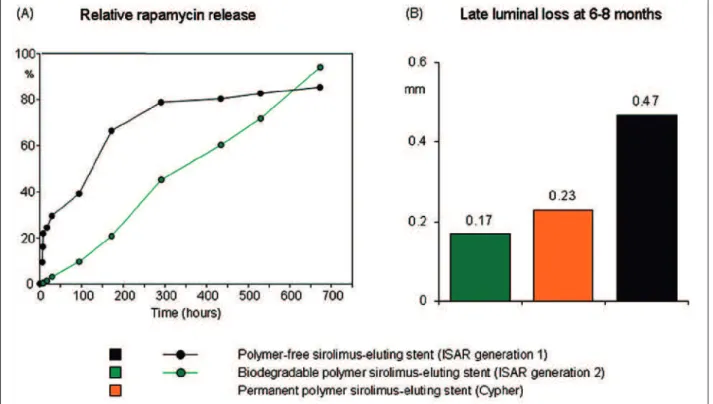
drug-load (60 days as compared to 30 days with Cypher), half of the drug is released within the first 10 days. In the ISAR-TEST-3 randomized trial we experienced a similar phenomenon: a more rapid release of sirolimus in the first 10 days resulted in an inferior performance efficacy compared to the Cypher stent; whereas a re-tardation of sirolimus release (via the incorporation of a biodegradable polymer) resulted in a similar anti-restenotic efficacy to Cypher (Figure 1)2.
A degree of ongoing LLL beyond 4-months is seen with both stents. Although small in absolute terms such “late luminal creep” is nonetheless a consistent feature of DES technology – something not seen in the bare metal stent era. For example, in a large cohort of DES-treated patients with complex lesion morphology we found a mean delayed LLL of 0.12 mm between 6-8 months and 2 years14. This may be regarded as further indirect evidence of systematic delayed healing; persistent vessel wall inflammation is the central driving force behind ongoing neointimal hyperplasia. Of interest, in our study, this effect seemed attenuated in platforms devoid of durable polymer. The disconnect between angiographic LLL and the intravascular ultrasound parameter of percentage intimal hyperplasia obstruction (%IH) is also worthy of comment, though perhaps best interpreted in light of the recent report from the same authors suggesting late loss as a more accurate predictor of target lesion revascularization than %IH15, as well as
other reports suggesting only modest correlation between angiographic and intravascular measures of restenosis16.
A number of limitations should be acknowledged in discussing the generalizability of the authors’ current findings. Firstly, although the choice of the Cypher stent as comparator may be particularly apposite in view of its widely-proven excellent antirestenotic efficacy, the comparison is limited by its non-randomized nature and by the drawbacks inherent in the use of a historical control group. Secondly, the lesions studied may be regarded as typical “vanilla lesions” – i.e. non-complex coronary stenosis. The reported findings may be regarded as proof of efficacy under ideal settings rather than of clinical effectiveness in a real-world situation. Confirmation of antirestenotic efficacy in large num-bers of patients with real-world lesion complexity will determine the role of this device in the future arma-mentarium of the interventional cardiologist. Thirdly, though long-term safety is the main motivation behind the development of a technology such as this, this report does not address this issue. The more interesting results will be those in larger patient cohorts with clinical follow-up beyond 2 years. Nevertheless, even allowing for a marginally lower suppression of neo-intimal hyperplasia with VESTAsync than the current market leaders, the potential trade-off in terms of enhanced long-term safety (and potentially a reduced duration of dual antiplatelet therapy) is attractive and
3 ByrneRA and Kastrati A. Polymer-Free Drug-Eluting Stents – an inVEST(A)ment for the Future? Rev Bras Cardiol Invas. 2009;17(1).
may well prove preferable for both patients and physicians.
Drug-eluting stents are most certainly a work-in-progress. The higher antirestenotic efficacy associated with DES technology allows more room for maneuver in comparison with bare metal stents when it comes to refinements aimed at improving patient and operator outcomes. Although polymer-free platforms offer po-tential for improved safety outcomes as compared with first generation DES devices, there remain many more paths to be explored before we can be fully satisfied with contemporary stent technology.
ACKNOWLEDGEMENTS
RAB acknowledges support by a Research Fellow-ship in Atherothrombosis from the European Society of Cardiology.
CONFLICT OF INTEREST
None of the authors have any conflict of interest to declare in respect to this manuscript.
REFERENCES
1. Luscher TF, Steffel J, Eberli FR, Joner M, Nakazawa G, Tanner FC, et al. Drug-eluting stent and coronary thrombo-sis: biological mechanisms and clinical implications. Circu-lation. 2007;115(8):1051-8.
2. Mehilli J, Byrne RA, Wieczorek A, Iijima R, Schulz S, Bruskina O, et al. Randomized trial of three rapamycin-eluting stents with different coating strategies for the reduction of coronary restenosis. Eur Heart J. 2008;29(16):1975-82.
3. Windecker S, Serruys PW, Wandel S, Buszman P, Trznadel S, Linke A, et al. Biolimus-eluting stent with biodegradable polymer versus sirolimus-eluting stent with durable polymer for coronary revascularisation (LEADERS): a randomised non-inferiority trial. Lancet. 2008;372(9644):1163-73. 4. Hausleiter J, Kastrati A, Wessely R, Dibra A, Mehilli J,
Schratzenstaller T, et al. Prevention of restenosis by a novel drug-eluting stent system with a dose-adjustable, polymer-free, on-site stent coating. Eur Heart J. 2005;26(15):1475-81. 5. Serruys PW, Sianos G, Abizaid A, Aoki J, den Heijer P, Bonnier H, et al. The effect of variable dose and release kinetics on neointimal hyperplasia using a novel paclitaxel-eluting stent platform: the Paclitaxel In-Stent Controlled Elution Study (PISCES). J Am Coll Cardiol. 2005;46(2):253-60.
6. Byrne RA, Mehilli J, Iijima R, Schulz S, Pache J, Seyfarth M, et al. A polymer-free dual drug-eluting stent in patients with coronary artery disease: a randomized trial vs. polymer-based drug-eluting stents. Eur Heart J. 2009. doi:10.1093/eurheartj/ ehp044.
7. Adriaenssens T, Mehilli J, Wessely R, Ndrepepa G, Seyfarth M, Wieczorek A, et al. Does addition of estradiol improve the efficacy of a rapamycin-eluting stent? Results of the ISAR-PEACE randomized trial. J Am Coll Cardiol. 2007; 49(12):1265-71.
8. Verheye S. Randomized, multi-center evaluation of the pimecrolimus-eluting and the dual pimecrolimus/paclitaxel-eluting coronary stent system in patients with de novo lesions of the native coronary arteries: GENESIS trial 6 month results. J Am Coll Cardiol. 2008;51:B8.
9. Chamié D, Costa Jr. JR, Abizaid A, Silva JFA, Feres F, Mattos LA, et al. Stents liberadores de sirolimus com e sem cobertura polimérica: análise seriada com angiografia e ultra-som intracoronário tridimensional. Rev Bras Cardiol Invas. 2009; 17(1).
1 0 . Mani G, Feldman MD, Patel D, Agrawal CM. Coronary stents: a materials perspective. Biomaterials. 2007;28(9): 1689-710.
11. Joner M, Nakazawa G, Finn AV, Quee SC, Coleman L, Acampado E, et al. Endothelial cell recovery between com-parator polymer-based drug-eluting stents. J Am Coll Cardiol. 2008;52(5):333-42.
12. Grube E, Silber S, Hauptmann KE, Mueller R, Buellesfeld L, Gerckens U, et al. TAXUS I: six- and twelve-month results from a randomized, double-blind trial on a slow-release paclitaxel-eluting stent for de novo coronary lesions. Circu-lation. 2003;107(1):38-42.
13. Stone GW, Ellis SG, Cannon L, Mann JT, Greenberg JD, Spriggs D, et al. Comparison of a polymer-based paclitaxel-eluting stent with a bare metal stent in patients with com-plex coronary artery disease: a randomized controlled trial. JAMA. 2005;294(10):1215-23.
14. Byrne RA, Iijima R, Mehilli J, Pinieck S, Bruskina O, Schomig A, et al. Durability of anti-restenotic efficacy in drug-eluting stents with and without permanent polymer. J Am Coll Cardiol Interv. (in press).
15. Lasave LI, Costa JR Jr., Costa R, Abizaid A, Feres F, Staico R, et al. Correlation between quantitative angiographic and intravascular ultrasound parameters in patients treated with sirolimus analogous-eluting stents. Int J Cardiovasc Imaging. 2009. doi:10.1007/s10554-009-9431-8