(1) Universidade Federal de Santa Maria – UFSM. Santa Maria/RS – Brasil.
Conlict of interest: non-existent
Quality of life and aspects of hearing of collective urban
transport workers
Qualidade de vida e aspectos auditivos de trabalhadores
do transporte coletivo urbano
Lícia Assunção Cogo(1)
Elenir Fedosse(1)
Valdete Alves Valentins dos Santos(1)
Received on: September 03, 2015 Accepted on: October 31, 2015
Mailing address: Lícia Assunção Cogo
Av. Mons. Pascoal Gomes Libreloto, 199 Parque Dom Antônio Reis
Santa Maria – RS – Brasil CEP: 97065-290
E-mail: [email protected]
doi: 10.1590/1982-0216201618112715
ABSTRACT
Purpose: to evaluate the quality of life of workers in the urban public transport, in association to its
atten-tion and complaints about hearing, tinnitus and dizziness.
Methods: descriptive, qualitative and transversal. Data collection was performed at the University Hospital
of Santa Maria, with sample of 26 professionals, who underwent abbreviated version of quality of life assessment questionnaire - WHO Quality of Life-Bref Questionnaire (WHOQOL - Bref) - and a question-naire about knowledge and complaints related to hearing, dizziness and tinnitus. Data were analyzed using the software Statistica version 9.0, considering a 5% signiicance level.
Results: the sample was characterized by 100% of males, with a mean age of 38.03 years and mean
duration of 11.29 years of service; 88.46% of the subjects worked in direct contact with urban trafic and exposed to noise in the external environment to the company. As for the audio proile, 88.46% repor-ted good hearing. As for the complaints: 23.07% 26.92% reporrepor-ted tinnitus and dizziness. With regard to hearing loss prevention habits, 73.07% reported not taking any conduct. The WHOQOL-Bref responses showed a good perception of quality of life of these subjects.
Conclusion: the workers of public transport in the present study showed a good level of quality of life,
considerable knowledge and limited complaints with regard to hearing issues, tinnitus and dizziness.
Keywords: Quality of Life; Hearing; Dizziness; Tinnitus; Workers
RESUMO
Objetivo: avaliar a qualidade de vida de trabalhadores do transporte coletivo urbano, associadamente ao
seu conhecimento e queixas sobre audição, zumbido e tontura.
Métodos: descritivo, qualitativo e transversal. A coleta foi realizada no Hospital Universitário de Santa
Maria, com amostra de 26 proissionais, submetidos à versão abreviada do questionário de avaliação de qualidade de vida - WHO Quality of Life-Bref Questionnaire (WHOQOL - Bref) – e a um questionário sobre
conhecimento e queixas relacionadas a audição, tontura e zumbido. Os dados foram analisados por meio do Software Statística versão 9.0, considerando um nível de signiicância de 5%.
Resultados: a amostra caracterizou-se por 100% de indivíduos do sexo masculino, com média de idade
de 38,03 anos e tempo médio de serviço de 11,29 anos; 88,46% dos sujeitos trabalhavam em contato direto com o trânsito urbano e expostos a ruídos no ambiente externo à empresa. Quanto ao peril audi-tivo, 88,46% referiram ouvir bem. Quanto às queixas: 23,07% relataram zumbido e 26,92% tontura. Com relação aos hábitos de prevenção de perda auditiva, 73,07% referiram não adotar nenhuma conduta. As respostas do WHOQOL-Bref evidenciaram uma boa percepção de qualidade de vida destes sujeitos.
Conclusão: os trabalhadores do transporte coletivo avaliados no presente estudo apresentaram um bom
nível de qualidade de vida, consideráveis conhecimentos e limitadas queixas no que diz respeito aos temas audição, zumbido e tontura.
Descritores: Qualidade de Vida; Audição; Tontura; Zumbido; Trabalhadores
Original articles
INTRODUCTION
Worker Health is deined as a set of practices which
aim to promote, protect, recover and rehabilitate the health of workers exposed to the risks and hazards from working conditions1. The quality of life of the
worker can be considered a relection of his health
condition. Modern life has brought some changes in
habits and behaviors that modiied lifestyles and this
change brought with it an intense increase of urban noise, which interferes with the quality of life2.
The World Health Organization (WHO) deines
quality of life as the perception that the subject has about his position in life, in relation to the culture and values in which they live and in relation to their objec-tives, expectations, standards and concerns3. Work can
present a satisfactory or an unsatisfactory impact on the health of the subject, depending on conditions; it can represent dissatisfaction, suffering, decline, physical attrition and emotional stress4.
The work of urban bus drivers is directly related to the environment in which it is performed.
Environmental factors, social interaction and trafic
interfere in psychophysiological state of the driver5.
The systematic exposure to high sound pressure levels
directly inluence on his quality of life and this may be
associated with the onset of signs and symptoms such as hearing loss, dizziness and tinnitus6.
Hearing is a complex sense that provides us to identify, locate and process sounds7. Dizziness is
deined as a sensation of imbalance, caused by the sensory conlict or interference with the normal
functioning of the vestibular, visual and proprioceptive8
systems. On the other hand, tinnitus is an auditory
phenomenon, deined as the impression of sounds
unrelated to an external source of stimulation9.
Dizziness and tinnitus are symptoms that can result from multiple etiologies or unknown cause; they can occur isolated or simultaneously; they might interfere
with life in several ways, inluencing negatively the
quality of life6,10. In a study on the prevalence of auditory
and vestibular symptoms in workers exposed to occupational noise, the authors emphasize the impor-tance of research and evaluation of these complaints, as well as the adoption of preventive measures, individual and collective ones11. Collective measures can include
control of emission in the main source of exposure, control of the agent propagation in the workplace or administrative control12. In the case of noise, some
alternatives may include enclosing the sound source,
periodic maintenance of equipment, longer intervals in work schedules and rotation function.
The quality of life of the worker can be quantitatively evaluated by the WHOQOL collection instrument, a questionnaire that produces a quantitative score of physical, psychological, social and environmental domains, ending with a score of quality of life3.
The Occupational Health National Policy aims at the development of comprehensive care to the health of the worker and, among its objectives, the maintenance and guarantee of the quality of life of the worker13.
The aim of this study is evaluating the quality of life of workers in a bus transportation company, as well as their knowledge and complaints on hearing, tinnitus and dizziness issues.
METHODS
This study was characterized as descriptive, quanti-tative and transversal. It was approved by the Research Ethics Committee (REC) of Universidade Federal de Santa Maria, on 04.10.2013 section, under the protocol number 306039.
Data collection started by a conversation with the workers about noise, dizziness and tinnitus, and it was carried out in collective living environment of a company of urban public transport in the municipality of Santa Maria - RS. After this initial conversation, workers were referred to audiological evaluation at the University Hospital, where they also answered the questionnaires of this research.
The sample consisted of 26 professionals from the private sector of a bus transportation company, being the age group ranging from 19 to 64 years old, male, after agreeing to participate in the research by reading and signing the informed consent form – ICF.
For the composition of the sample, some inclusion criteria were adopted: being an employee of the permanent staff of the company, presenting cognitive conditions to answer to the proposed questionnaires, having read and signed the ICF.
These professionals were submitted to the abbre-viated version of a quality of life assessment question-naire – named WHO Quality of Life-Bref Questionquestion-naire (WHOQOL - Bref), which was composed of 26 multiple-choice questions, categorized by physical, psycho-logical, environmental and social domain - which in the end produced a quality of life index score for each
participating subject, relecting his situation in the last
the proile of the subjects (age, gender, function and
length of service in the function), to the knowledge and hearing about complaints (if he could hear, if he knows what it is, if he presents, if he knows what it, if he presents any complaints, side and pitch); issues
related to the harm caused by noise of trafic, sensitivity
to noise, if he thinks his home and job environments are noisy, if it generates noise in the day-to-day and he tries to protect his hearing in some way (by indicating which way). After collection and analysis of data, a feedback on individual correspondence was performed
Data were tabulated on Excel spreadsheet type and afterwards they were statistically analyzed. In the statistical method, the descriptive critical analysis, were performed - ANOVA Kruskal Wallis test to compare the
domains followed by post hoc Tukey test; correlation between the variables by using the Spearman corre-lation test through the Statistica software version 9.0,
considering a 5% of signiicance level.
RESULTS
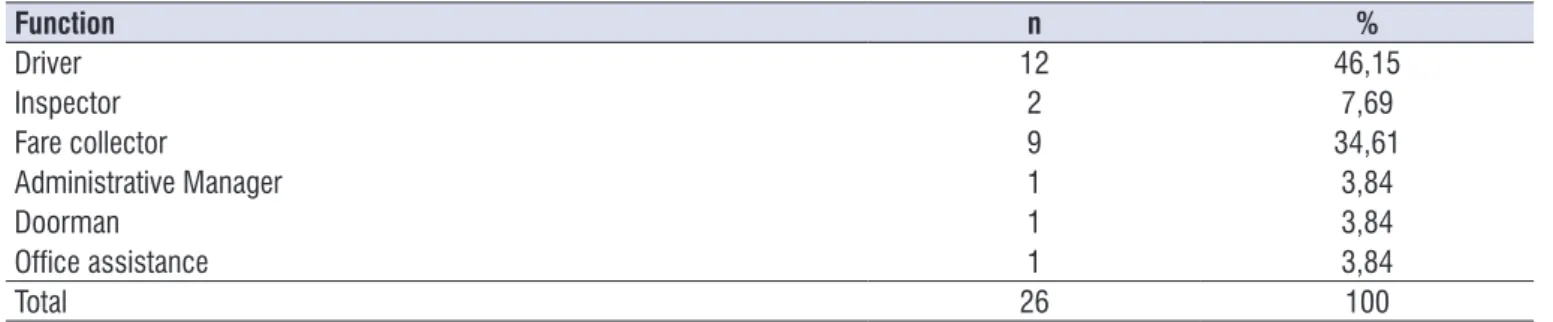
A sample of 26 subjects, workers of an urban transport company in the private sector, was charac-terized by 100% male, with a mean age of 38.03 years (± 13.39) and average length of service in the function of 11.29 years (± 11.41). The distribution by function is demonstrated in Table 1, highlighting that 88.46% of the
subjects work in direct contact with the urban trafic and
they are exposed to noise in the external environment to the company.
Table 1. Distribution of the subjects regarding their function
Function n %
Driver 12 46,15
Inspector 2 7,69
Fare collector 9 34,61
Administrative Manager 1 3,84
Doorman 1 3,84
Ofice assistance 1 3,84
Total 26 100
In relation to the auditory proile which was identiied
through the open questionnaire, 88.46% of them reported good hearing and only 11.54% reported
presenting hearing dificulties, all of them in the right
ear.
Regarding the prior knowledge of subjects on the topics covered: 96.15% mentioned they have heard about tinnitus, 65,38%of them know what is tinnitus, 23.07% reported having tinnitus; being 66.66% of them reporting high pitch and the other did not mention the pitch, 50% in the left ear and 33% in both ears, 16.66% did not report the side of tinnitus; 96.15% of the subjects have heard of dizziness, 92.3% know what dizziness and 26.92% have dizziness complaints, 71.42% of them describe the type of dizziness as imbalance and the others do not know to describe the type.
In relation to the individual perception about their listening habits, 84.61% believe they are exposed to noise every day; 15.38% reported being sensitive to noise, 15.38% consider their home environment as noisy; the work is considered noisy by 76.92% and
46.15% of them consider generate noise in their day-to-day. The majority of the participants (92.3%) is aware that exposure to noise can be a factor which may cause hearing loss, as well this loss can be caused by noise
generated by trafic (76.92%). Trafic noise can generate
tinnitus in the understanding of 80.76% of the subjects and dizziness in 50% of them.
With regard to hearing loss prevention habits, 73.07% of the interviewees mentioned that they did not take any preventive practice, 23.09% adopt noise reduction practice or maintaining silence as a form of own hearing protection, and only 3.84% said they make use of protective equipment when available and out of the workplace.
The answers of the WHOQOL-Bref questionnaire (Table 2) evidenced a good quality of life of these subjects, as none of the evaluated domains showed lower score than 50%.
Table 2. Results of the World Health Organization Quality of Life questionnaire
WHOQOL n Mean Minimum Maximum Standard
Deviation
Physical domain 26 74,99 32,10 100,00 17,61
Psychic domain 26 76,44 41,70 100,00 14,66
Social domain 26 75,32 41,70 100,00 16,58
Environmental domain 26 63,34 40,60 87,50 13,06
Quality of life Score 26 72,52 43,90 94,80 13,26
Table 3. Correlation between age and domains, age and quality of life score
WHOQOL n Spearman P
Age and Physical Domain 26 0,09 0,64
Age and Psychic Domain 26 0,27 0,17
Age and Social Domain 26 0,11 0,59
Age and Environmental Domain 26 0,04 0,82
Age and Quality of life Score 26 0,14 0,46
Spearman Correlation Test p ≤ 0,05
Table 4. Correlation between time of service and domains, time of service and quality of life score
WHOQOL n Spearman p
Time of service and Physical Domain 26 -0,05 0,78
Time of service and Psychic Domain 26 0,07 0,72
Time of service and Social Domain 26 0,14 0,48
Time of service and Environmental Domain 26 -0,13 0,50
Time of service and Quality of life Score 26 0,03 0,88
Spearman Correlation Test p ≤ 0,05
In comparison among drivers, fare collectors and other workers on the domains related to the quality of life through ANOVA Kruskal Wallis test revealed a
statistically signiicant difference (p = 0.0026) in the
environmental domain. With the Tukey post-hoc test it was found that this difference was between collectors
and drivers (p = 0.04) and drivers and other workers (p = 0.005).
DISCUSSION
Studies that evaluate the population of professionals who work at the road (drivers, conductors, motorcy-clists), in general, found in this category a totality of male subjects, as in Sanches and collaborators research (2015)14. Other authors reported similar data regarding
the predominance of males in this profession15,16. Also
in relation to the proile of the sample, the mean age
in this study was 38, corroborating other study that ranged from 33.4 to 41.2 years5,14-16.
The average service time in the function was 11.29 years, higher than the data found by Teixeira et al. (2015)16, who revealed that the workers were for ive
years or more in the function. Differently from other authors, who found that 84% of the interviewed workers
held a formal labor contract for less than ive years15.
In relation to the distribution of function, 46.15% were
drivers, as similar to the data veriied by Assumption
and Medeiros (2015)15 who identiied that 53% of them
were drivers.
element20 and, as such, the quality of life of the subject
committed to it, the worker, not restricted to the place and time of labor activity, but it has relationship with the family and their extra-functional interactions, involving his personal satisfaction, relationships and leisure time21.
In the evaluation of the quality of life by
WHOQOL-Bref questionnaire, it was identiied a good
level of quality of life of the subjects of this study, which was revealed by the mean of 72.52%, data that disagrees with this survey carried out with motorcycle
taxi drivers who identiied a general quality of life index
of 27.7% by using the same collection instrument. This difference can be attributed to the particularities of each profession, despite both being road professionals of
the urban trafic16. However, the data from both studies
agree that the environmental domain is the most disad-vantaged. The precarious working conditions, such as noise, smoke, excessive cold/heat are environmental
factors that may directly inluence on the quality of
life of bus drivers and motorcycle taxi drivers. A study carried out on noise inside a city bus found that besides being a risk factor to health, it was pointed as a great displeasure generator, thus affecting the quality of life of the subjects inside the vehicle22.
We did not ind research that performed similar
comparisons with the present study, regarding the
inluence of age and length of service in the quality of
life.
The data show that the quality of life was not affected by the age and time of service variables. This is a positive factor for this population, despite working under adverse or unhealthy conditions; this does not
negatively relect in their overall quality of life through
the years.
Quality of life and the hearing aspects related to work deserve the attention of health professionals, researchers and administrators in public and private sectors, in order to implement actions and policies that aim to promote health and improve the quality of life of workers.
CONCLUSION
Workers of public transport in our study presented a good level of quality of life, considerable knowledge and limited complaints with regard to hearing issues, tinnitus and dizziness.
and noise exposure time are signiicant factors in their
ability to harm hearing6.
In the evaluation of the hearing proile of the partici -pants of this study 11.53% reported some hearing loss, all of them in the right ear; 23.07% reported tinnitus and 26.92% complained of dizziness. In a survey of 338 workers of collective transport of Rio Branco - AC, in order to check the loudness within the urban public transportation and possible related disorders, it was
identiied that 0.59% of subjects presented hearing
complaints and 4.17% presented tinnitus complaints; being the oldest workers the ones who showed more disorders14, which may explain the difference of this
research which showed that a majority of young subjects (mean age of 33.4 years). In contrast, a study carried out with drivers of the urban public transport of Florianópolis - SC, 47.6% of them reported incidence of tinnitus5.
Numerous studies have identiied the perception of trafic noise as a deteriorating factor to the health15-17.
A survey performed with drivers showed that 57.1% of them felt uncomfortable with the noise and they
identiied the engine as the sound source5. Noise is
one of the most common occupational risk factors, because the indices which are harmful to health can
be easily identiied and prevented11. Considering the
complexity of the urban environment, the reduction of working hours would be an alternative to reduce the exposure time of the worker to this factor18. The
discomfort caused by noise can go beyond the
workplace; researchers obtained reports of dificulty
in understanding speech and the need to turn up the domestic TV volume after the end of the workday5.
With regard to dizziness, any research related to this complaint was found in the studied literature, not even associated with other symptoms.
Research on noise pollution demonstrates that the population is aware of the losses arising from the exposure to urban noise and it must resort to preventive measures19. This data is conirmed by this research, in
which 23.09% of the workers reported adopting some preventive practice for their own hearing, even if the use of personal protective equipment is not a habit standard (3.84%). Noise is often seen as a “necessary evil” by the workers, who end up “getting used” to the situation, as it does not cause a visible injury, it is often overlooked14.
13. BRASIL. Portaria Nº 1.823, de 23 de agosto de 2012. Política Nacional de Saúde do Trabalhador e da Trabalhadora.
14. Sanches CGF, Ferreira CRT, Schimer J, Rodrigues PF, Silva RPM. Níveis de intensidade sonora no transporte coletivo urbano de Rio Branco - AC. Journal of Amazon Health Science. 2015;1(1):82-7. 15. Assunção AA, Medeiros AM. Violência a motoristas
e cobradores de ônibus metropolitanos, Brasil. Rev Saúde Pública. 2015;49(11):1-10.
16. Teixeira JRB, Boery EM, Casotti CA, Araújo TM, Pereira R, Ribeiro IJS et al. Aspectos psicossociais do trabalho e qualidade de vida de mototaxistas. Cad Saúde Pública. 2015;31(1):97-110.
17. Oliveira CF, Lessa EM, Domingos JS, Moura VA. A qualidade de vida dos rodoviários nas empresas de Transporte público de salvador de 2013 e 2014. In: Aliger dos Santos Pereira; Fabiano Viana Oliveira (organizadores). Administração além da sala de aula. Salvador: IBES, 2015. p. 82-97.
18. Zannin PHT. Occupational noise in urban buses. Int Journal Ind Ergonom. 2006;36(10):901-5.
19. Berglund B, Lindval T, Schwela DH (editors). Guidelines for community noise. Stockholm: Stockholm University , Karolinska Institute; 1990. 20. Moretti S. Qualidade de vida no trabalho x
autorealização Humana. Instituto Catarinense de Pós-Graduação. 2015.
21. Nahas MV. Atividade física, saúde e qualidade de vida: conceitos e sugestões para um estilo de vida ativo. 3. ed. Londrina: Midiograf, 2003.
22. Silva LF, Correia FN. Avaliação da exposição de passageiros ao ruído no interior de ônibus do transporte público do município de Itajubá. Rev CEFAC. 2012;14(1):57-64.
REFERENCES
1. BRASIL. Lei nº 8.080, de 19 de setembro de 1990. Dispõe sobre as condições para a promoção, proteção e recuperação da saúde, a organização e o funcionamento dos serviços correspondentes e dá outras providências.
2. Mishra RK, Shukla A, Parida M, Rangnekar S. Eia
based comparative urban trafic noise analysis
between operational and under construction phase
public transport corridor. Int J Trafic and Transp
Eng. 2014;4(3):352-62.
3. THE WHOQOL GROUP. The World Health Organization Quality of Life Assessment (WHOQOL): position paper from the World Health Organization. Soc Sci Med. 1995;41(10):1403-9. 4. Minayo MCS, Assis SG, Oliveira RVC. Impacto das
atividades proissionais na saúde física e mental
dos policiais civis e militares do Rio de Janeiro. Cien Saude Colet. 2011;16(4):2199-209.
5. Battiston M, Cruz RM, Hoffmann MH. Condições de trabalho e saúde de motoristas de transporte coletivo urbano. Estud. psicol. 2006;11(3):333-43. 6. Antas LOFS, Silva BC, Mascarenhas VD, Souza
VM, Andrade WTL. Incômodo Gerado pelo Ruído Urbano entre Comerciantes dos Arredores de um Mercado Público da Cidade de João Pessoa/PB. Rev Bras de Ciên da Saúde. 2014;18(2):97-102. 7. Fernandes AS. Estudo das características
auditivas e vestibulares em indivíduos expostos ocupacionalmente a mercúrio metálico e ruído [dissertação]. Rio de Janeiro (RJ): Universidade Federal do Rio de Janeiro/Instituto de Estudos em Saúde Coletiva; 2009.
8. Tiensoli LO, Couto ER, Mitre EI. Fatores associados à vertigem ou tontura em indivíduos com exame vestibular normal. Rev CEFAC. 2004;6(1):94-100. 9. Santos Filha VAV, Matas CG. Potenciais
evocados auditivos tardios em indivíduos com queixa de zumbido. Braz J Otorhinolaryngol. 2010;76(2):263-70.
10. Vieira PP, Marchori LL de M, Melo JJ. Estudo da possível associação entre zumbido e vertigem. Rev CEFAC. 2010;12(4):641-5.
11. Ogido R, Costa EA, Machado HC. Prevalência de sintomas auditivos e vestibulares em trabalhadores expostos a ruído ocupacional. Rev Saúde Pública 2009;43(2):377-80.