(1) Universidade Federal do Rio Grande do Sul/UFRGS – Porto Alegre (RS), Brasil. Conlict of interest: non-existent
Applicability of Burden of Disease methodology
in human communication disorders
Aplicabilidade dos estudos de carga de doença
nos distúrbios fonoaudiológicos
Bárbara Niegia Garcia de Goulart(1) Nágila Soares Xavier Oenning(1)
Received on: October 06, 2015 Accepted on: May 16, 2016
ABSTRACT
The burden of disease methodology is composed by the calculation of speciic indicators, and proposes to measure the effects of diseases on the physical, emotional and social welfare, either from the effects of premature death and morbidity, as well as comorbidities on the health conditions of the population. This study aimed to verify the possibility of application of the concept of the burden of disease in the study of human communication disorders in an attempt to introduce new methodologies and better characterize the setting of these diseases. This study involved an integrative literature review in Scielo, Lilacs and Pubmed bases, with presentation of concepts and a critical analysis of burden of disease’s indicators and their potential applications in the ield of speech, language and hearing sciences. The indings indicate a lack of studies using the concepts related to burden of disease as applied to human communication and its disorders as well as their implications on the life of the subject according to the methodology proposed by the World Health Organisation. There are opportunities to apply the burden of disease concept and methodology in the ield of communication disorders, both, to identify the impact of diseases on the indi-vidual, as for the evaluation of the quality and also to measure the effectiveness of interventions in the ield of speech-language disorders.
Keywords: Speech, Language and Hearing Sciences; Quality-Adjusted Life Years; Prevalence; Incidence;
Review
RESUMO
INTRODUCTION
Human communication comprises encoding and decoding capability of the written and spoken system of a language through language, motor and auditory skills. The speech-language disorders are charac-terized as any restriction or lack of ability (resulting from a limitation in communication) to carry out a normal activity and are associated with several factors: environ-mental, biological and also appear as pathological events. It is therefore of paramount importance to study these disorders, their understandable background as well as to identify possibilities of detection, prevention and treatment for the different populations.
In the 90s the World Health Organization (WHO) initiated the use of disease burden estimates (burden of disease) through the project “Global Burden of Disease and Risks Factors”, providing global estimates of this indicator, and preliminary results published in 1993 in which Murray was the head researcher1. The measurement methodology of disease burden, comprising the calculation of speciic indicators, proposes to measure the effects of diseases (or diseases) on the physical well-being, emotional and social development of an individual, whether from the effects of premature death and morbidity and comor-bidity on the health conditions of the population2. Studies of this type of measurement include ive main measures: prevalence, incidence, Disability Adjusted Life-Years (DALYs), Quality-adjusted life year (QALY) and years of life lived with disability (YLD).
A recent study compared the global burden of a list of 291 diseases between the years 1990 and 2010 and in this role, there are listed the speech disorders in the description of diseases. Although not listed, commu-nication disturbances observed clearly the burden of cardiovascular disease, which clearly have as one of its consequences the Communication disorders3.
Studies of communication disorders, in most cases, have been used epidemiological methods for easier access and lower costs, as prevalence studies in speciic population groups. With the perspective of chronic events, however, the analysis of YLD may be the most effective measure to describe the phenomenon of speech disorders, but research that compared YLD considering consequences on the communication disorders have not been cited, even these are relevant from the point of view of cardiovascular post-event comorbidity, for example, strokes4.
Given this context, it is clear that the indicators of the methodology of the disease burden studies can be used to study the occurrence of speech disorders, being isolated or concomitant, enabling the analysis of its consequences (comorbidities), limitations and disabilities. This study aims to determine, from the literature, the possibility of application of the burden of disease concepts in the study of human commu-nication disorders, in an attempt to increase new methodologies and provide better characterization of the setting of these diseases.
METHODS
After the search of articles and following the rules of the integrative review inclusion and exclusion criteria were established. Inclusion criteria: (a) research inves-tigating burden of disease versus communication disorders; (B) articles without limitation publication date and court date in June 2015 (in general revisions close to a period between 5 and 10 years, and all the studies found, regardless of their date of publication); (C) articles in English, Portuguese or Spanish; (D) articles with DALY measures of disease; (E) QALY measures of disease; (F) conceptual articles on the subject. Exclusion criteria: (a) items which not treat exclusively of disease burden and its variables.
Initially 518 articles were identiied: pre-sorting was performed by headings, eliminating the repeated
ones. With the reading of abstracts (and application of predeined inclusion and exclusion criteria 86 articles were selected. With the subsequent reading of the studies it was possible to reine the further search, leaving 21 articles for this article reference composition.
LITERATURE REVISION
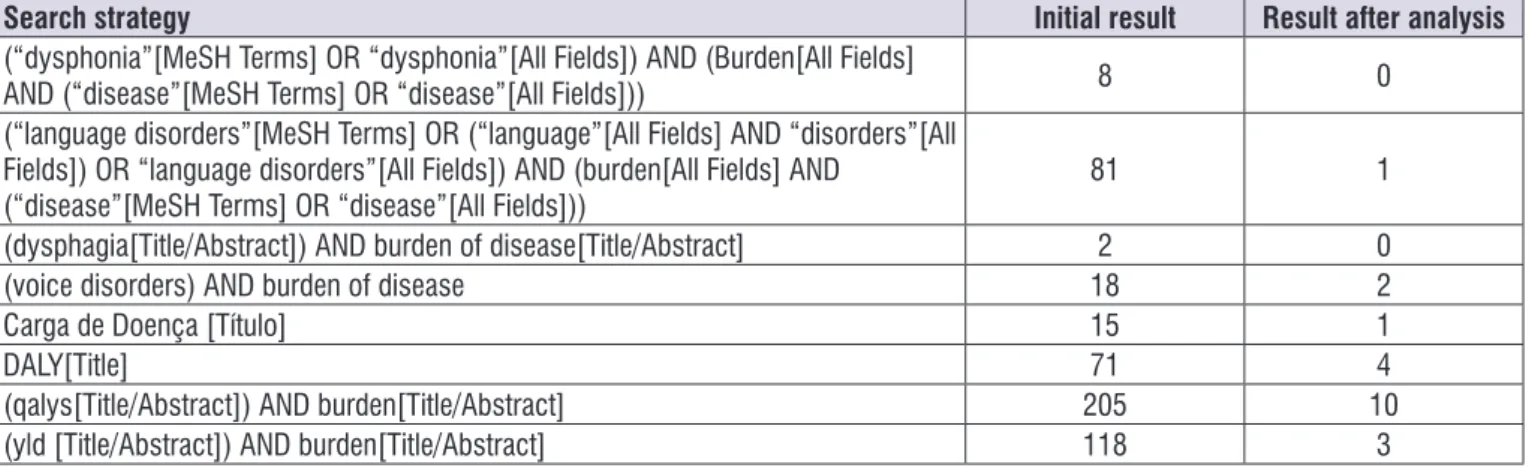
The focus of this work is an analysis of the concepts of the methodology for measuring the global burden of disease, through its indicators and verifying their implementation in the ield of communication disorders, enabling better use of this methodology in future studies. A summary of the survey can be found in Figure 2.
Search strategy Initial result Result after analysis
(“dysphonia”[MeSH Terms] OR “dysphonia”[All Fields]) AND (Burden[All Fields]
AND (“disease”[MeSH Terms] OR “disease”[All Fields])) 8 0
(“language disorders”[MeSH Terms] OR (“language”[All Fields] AND “disorders”[All Fields]) OR “language disorders”[All Fields]) AND (burden[All Fields] AND
(“disease”[MeSH Terms] OR “disease”[All Fields])) 81 1
(dysphagia[Title/Abstract]) AND burden of disease[Title/Abstract] 2 0
(voice disorders) AND burden of disease 18 2
Carga de Doença [Título] 15 1
DALY[Title] 71 4
(qalys[Title/Abstract]) AND burden[Title/Abstract] 205 10
(yld [Title/Abstract]) AND burden[Title/Abstract] 118 3
Study Jounal year of
publication Authors Title of the article Description
1
Journal of Health Economics
1997
Murray CJL;
Acharya AK. Understanding DALYs
Review of the method to quantify the burden of disease using the measure of years lost due to disability - DALY.
It highlights the advantage of the measure differ only in sex and age, for
non-fatal health events.
2 Journal of Public Economics
1993 Broome J. QALYs
Theoretical survey of the QALY measure, pointing out some dificulties
as the generalization of the measure for all disabilities.
3 Annu. Rev. Public Health 2002
Gold RM, Stevenson D, Fryback GD.
HALYs and QALYs and DALYs, oh my:
similarities and differences in summary measures of population
health
Review of the methods used for the disease burden measures (DALY, Haly and QUALY) and it notes that such measures help to understand the impact of diseases in speciic populations and enables the economic
analysis of health programs.
4
Bulletin of the World Health Organization
1994 Murray CJL.
Quantifying the burden of disease: the technical
basis for disability-adjusted life years
It brings important considerations for a new load condition indicator, thereby
providing a formula for calculating DALY. It emphasizes the variables of the calculation, and discusses advantages and disadvantages of the
method.
5 Social Science & Medicine 2003
Allotey P, Reidpth D, Kouamé A, Cummins RD.
Context and the determinants of the severity of disease: an exploratory comparison of paraplegia in Australia
and Cameroon.
The study shows the Burden of Disease with DALY in paraplegia, demonstrating that these measures may vary according to the context in
which the affected individual is.
6 Journal of Health Economics
1997 Arnand S, Hanson K.
Disability-adjusted life years: a critical review
It mentions that the DALY has emerged to measure the burden that the disease imposes a certain population affected
by a particular disease. The paper considers that the technical basis of the measure is lawed because it considers so the age factor the age factor in variables as well as the
measure does not distinguish the way of measuring the burden and the
capacity.
7
Revista Portuguesa de Saúde Pública
2003 Ferreira LNE.
Utilities, QALYs and measurement of quality
of life
It reviews QALY measurement method and cites the instrument measuring
the quality of life using the EQ-5D questionnaire generic health status.
8
Relatório da Fundação Osvaldo Cruz
(FIOCRUZ) 2005
Leite CI, Joaquim GV, Scramm AMJ et al..
Final report of the Global Burden of Disease project in Minas Gerais
State
The report shows the results of the burden of disease study in Minas Gerais in 2005, reporting the effects
of the disease both in mortality and disability by disease group and age
Study Jounal year of
publication Authors Title of the article Description
9 Revista de Saúde Pública 1999
Nedel BF, Rocha M, Pereira J.
Years of life lost due to mortality:one of the components of Burden
Disease
Initially, the paper reviews the DALY method; then shows measures of years of life lost due
to premature death, one of the components of Disease Burden in the states of Rio Grande do Sul and Santa Catarina, compared to some results in
Brazil.
10 Social Science & Medicine
1989 Carr-Hill RA.
Assumptions of the QALY Procedure
It mentions that the measure of QALY is a useful measure for health care management, it allows a better decision on what the most effective
program to be followed is. It Emphasizes theoretical assumptions
that underpin the technique.
11
Acta Neurologica Taiwanica
2007 Tseng MC, Lin HJ.
Health-related qulity of life after stroke: review of the literature and implications for future
research
The article provides a review of the methods used to assess DALYs, QALYs and Halys, it considers the economic and medical technology assessment for these resources.
12 Revista de Psiquiatria Clínica 2007
Daltio SC, Mari JJ, Ferraz BM.
Studies on pharmaconomy and
Burden Disease in schizophrenia.
Review on publications in Medline database on main studies on pharmaconomy in schizophrenia.
13 Jounal of Voice 2015 RM, Wright C, Miller KL, Roy N, Tanner K, Merrill Kendall KA.
Descriptive Epidemiology of Voice Disorders in Rheumatoid
Arthritis: Prevalence, Risk
Factors, and Quality of Life Burden.
It estimates the prevalence of communication disorders and checks
the relation to the quality of life in speciic group
(Rheumatoid arthritis patients). Discusses the risk factors relating to QALY, although not applying the
concept directly.
14 Ann Otol
Rhinol Laryngol. 2015
Tanner K, Pierce JL, Merrill RM, Miller KL,
Kendall KA, Roy N.
The Quality of Life Burden Associated With Voice Disorders in Sjögren’s Syndrome.
It estimates the prevalence of communication disorders and the
relation with the quality of life in speciic group
(Patients with Sjogren syndrome). It discusses the risk factors relating
to QALY, although not applying the concept directly.
15 Lancet 2012 Vos T et al.
Years lived with disability (YLDs) for 1160 sequelae of 289 diseases
and injuries 1990-2010: a systematic analysis for the Global Burden of
Disease Study 2010
Comparative analysis of years lived with disability in the decades of 90 and 2000. There 1160 sequelae of 289 diseases and speech disorders
are not included in the list.
16 Lancet 2012 Murray CJ et al.
Disability-adjusted life years (DALYs) for 291 diseases and injuries in
According to the literature, in the late twentieth century, the World Health Organization (WHO) launched the Global Burden of Disease initiative, which has compiled a set of simple measures of overall health. These measures seek to contemplate at one time the effects of premature death and morbidity on the health conditions of the population, the so-called studies disease burden 7,8.These studies analyze the measures described below.
Prevalence: deined as the ratio of a group of people who have an endpoint (clinical condition or injury) at a speciic point in time9.
Incidence deined as the ratio of a irst group free of a clinical condition that develops over a certain period of time. That is, the incidence refers to new cases occurring in a irst population free of disease or new outcomes such as disability or death, occurring in patients with a speciic disease9.
Disability Adjusted Life-Years (DALY) - year of healthy life lost – it is an indicator that considers the impact of measures of disease, both in terms of morbidity and in relation to mortality. The DALY considers the total years of healthy life lost due to a disease (or a risk factor) and calculation includes both the age at death, and the duration and severity of any current inability2.
For example, its application can show the conditions with the potential to become chronic, depicting the expectations of an unhealthy state in a population. A comprehensive study on 306 diseases in 188 countries (GBD201310) pointed out that the ive leading causes of DALYs were ischemic heart disease, lower respiratory infections, cerebrovascular disease, lumbar diseases, sore throat and trafic accidents.
Quality-Adjusted Life Years (QALY) - adjusted life years for quality of life - captures in a single measure gains in quantity and in quality of life. It is a generic tool for assessing the health status by providing objective measures of quality of life and interventions11. For example, this measurement can be used for results veriication in interventions. In study12 to evaluate the effectiveness of interventions for the management of cardiovascular risk, the comparability of cost-effectiveness measurements was performed from this indicator, and the indings showed that the money was greater for actions performed by women (compared to actions with the male audience), with greater gain in QALYs versus pounds invested in the female audience.
Years Lived with Disability (YLD) - years of life lost due to illness and / or disability - is the quantii-cation of years lived with disability from a grievance11.
Study Jounal year of
publication Authors Title of the article Description
17 HealthPolicy Plan. 2006 Sassi F.
Calculating QALYs, comparing QALY and
DALY calculations
Methodological discussion, describing the technical aspects of the calculations with positive and negative
weighting
18 Eur J Health Econ.
2015
Tilling C, Krol M, Attema AE, Tsuchiya A, Brazier J,
van Exel J, Brouwer W.
Exploring a new method for deriving the monetary
value of a QALY.
Methodological discussion of alternative proposition to calculate the
monetary value of QALY.
19 Int J Stroke. 2009 Gattinoni M, Candelise LBersano A, Burgio F,
Aphasia burden to hospitalized acute stroke patients: need for
an early rehabilitation programme
It estimates the prevalence of aphasia in speciic group. (Stroke patients). It discusses some ideas of disease burden, although not applying the
concept directly
20 Int J Public Health. 2014
Devleesschauwer B, Havelaar AH, Maertens de
Noordhout C, Haagsma JA, Praet N, Dorny P, Duchateau L, Torgerson
PR, Van Oyen H, Speybroeck N.
DALY calculation in practice: a stepwise
approach.
Systematization of the methodology, making a critical relection on the dificulties for a closer estimate of the
real number.
21 coletiva [online]. 2004Ciênc. saúde Schramm, JMA et al. Epidemiological transition and the study of burden
for minimizing the effects of hearing loss in communi-cative, educational, social and psychological aspects.
Among the surveyed studies, a literature review19on the method of measuring disease burden speciies some disadvantages: lack of theoretical sedimentation and the fact that this is such a global measure to gener-alize variables for all diseases. However, since the initiative of the World Health Organization to measure the global burden of disease, this is the method that has been used for a general mapping of illness.
Inferring in the ield of speech therapy, it must be considered that an involvement as complex as the communication disorders, implications of large measurements and individual variable to individual, can not get as many generalizations to obtain objective measures of their consequences. However, the method is currently the only proposed to measure disease burden.
Considering the disadvantages of the method and adding the fact that the prevalence of hearing loss is high in the context of human communication disorders, studies that intend to carry out such measures would be of great impact as objective measures can quanti-tatively translate states that often are only described qualitatively. Numbers, as objectively measure, add to that descriptor greater impact, facilitate the devel-opment of databases for studies and aim reporting for raising health resources, in other words they are able to optimize curative interventions of certain diseases.
In the panorama of national literature, one study8 conducted disease burden measures in the state of Minas Gerais, being the only one to perform the burden of disease measures speciied by disease group and age group, by specifying each component of the DALY measures .This study points out that there are limita-tions on the quality of the information for estimating the required parameters, i.e., in its conclusions it highlights the importance of studies of this type, but includes data limitations. The speech-language disorders were not analyzed, however, when the study explains the weight of occurrence, hearing loss is one of the aspects considered. Thus, the analysis of that aspect raises a relection on future research in relation to hearing impairment, in case necessary information is available for implementing the measures or even, if possible, include a survey on the variables involved in the measures of disease burden in hearing impairment. For example, this indicator can be used for survival
demonstration. In GBD201310 the increasing socio-demographic status was associated with a change in Years of Life Lost (YLL) - for YLD, driven by declines in YLLs and YLD increases of musculoskeletal disorders, neurological diseases and mentally disorders caused by the use of chemicals.
It can be seen that the mapping initiative of global burden occurred after two decades of the irst publica-tions on the subject. Date of 1976 the irst time that the methodology was employed, Zeckhauser and Shepard used it to check health outcomes compared to quality life issues13.
The interest in quantifying not only morbidity but also quality of life can be attributed to the increased life expectancy, which leads people affected by diseases to remain more time exposed to them and hence to use longer service health, leading to the need for devel-opment of more speciic and effective health policies and programs, so that the costs are rationalized and minimized.
The object of some Studies14,15 has been the method of review that seeks to check the impact of the disease, retaking its manifestation and its limitations to the application of measures to burden disease. These measures are mentioned in other studies7,14,16-18, and the authors, unanimously, put the best indicator to express the disease burden is the DALYs (Disability Adjusted Life-years) which shows a broadening of the concept of years lost due to non-fatal events. Thus, the DALYs for a disease or condition, consists of the sum of years lost due to premature death (YLL- Years of Life Lost) and years of life lost due to disability (YLD- Years Lost due Disability), resulting in the formula of disease burden DALY = YLL + YLD.
communication disorders and levels of quality of life. However, it is observed that studies are not made in the general population, i.e., they are targeted to speciic groups. In Brazil, disease information systems and health problems such as those of violence, reportable diseases, chronic diseases do not include communi-cation disorders, possibly because they are comorbid-ities resulting from diseases and disorders, preventing more global analysis, making those studies targeted to speciic audiences (clinics, hospitals, health centers).
A possibility of using QALY tool in the ield of speech disorders is the generation QALYs with or without intervention, relating, for example, the amount of QALYs gained by intervention on conditions such as dysphagia, dysphonia, labyrinthine or rehabilitation. The comparison of the QALY under the conditions with and without intervention in these cases would identify when and which applied intervention would lead to a state of better health in the individual, implying even when lack of intervention would result in faster deterio-ration of activities and quality of life of the individual.
The indicators that estimate the disease burden become relevant in the grounds scenario for health investment plans: an article 25 reports the literature review with the economic approach of disease burden, especially in schizophrenia, highlighting the high load rates disease in this disorder to society, demonstrating the importance of these indings in the economy and health policies. In Holland26, for example, a survey explored an alternative approach to estimate the monetary value of a QALY, and the results were evaluated as promising, but without neglecting the possible methodological weaknesses.
It is observed24,27 an initiative of approaching disturbances studies of speech and the method-ology to estimate the burden of disease, but as previ-ously discussed, attempts apply to speciic groups of individuals with a given disease, where the disorder human communication is a result of the injury. An Italian27 survey estimated aphasia burden in patients who suffered stroke, in order to establish parameters for early rehabilitation, suggesting the importance of checking the burden of aphasia in a broad population of patients hospitalized with acute stroke, for forming impairment residual estimates and the consequent impact on the deinition of speciic programs for early rehabilitation.
The magnitude of the use of disease burden estimation methodology is clear, just quickly check the latest publications in high impact journals, yet in the country, the environment, gender and the
socio-economic conditions. In this study, there is a relevance of the impact of disease in individuals with different realities, indicating how each operation is changed face to an involvement. This study highlights the importance of developing indicators for the burden of disease in intervention actions in order to seek a common denom-inator in interventions for different realities. As authors discuss18 to ind a guiding covering the different realities, whether of gender, age or social status, is of paramount importance in speech disorders, since accessing and obtaining curative actions could be more uniform, prior-itizing the individuality that each affected person has, emphasizing especially how they live with the impacts inherent in the grievance. Once again, one can under-stand the importance of these studies as guidelines for research of people suffering from disabilities of any kind and degree. It is through them that you can set priorities as necessary as they relate to health policy to understand any degree of complexity.
Among the studies that emerged from this research, the studies relating to QALYs measures11,15,21 are highlighted as it is a simple utility, but effective for understanding the consequences of the individuals´11 bad quality of life of. An individual´s healthy year corre-sponds to one QALY. In this sense, a year of life with a low level of health, for example x, where x <1, applies to x QALYs. Adjusting the value of a year of future life to a current value at one rate r, it is possible to calculate the current value of expected QALYs by an individual, considering their health proile and their future life11.
An important aspect regarding the application of the QALY is the basic notion that permeates that for any individual the prospect of Y living year with less than full health can be equated with the prospect of X living years in full health when x < Y 22. Given the hypothesis that different settings (proiles) of survival duration in many health states may be converted to their equiv-alent “full years of healthy life,” the QALY measures can be used to assist in cases of decision which different therapeutic options can produce different combinations of survival and diverse qualities of life22.On the other hand, although it is possible to aggregate and compare the valuations in relation to health and quality of life in different scenarios, it must be considered that the perception of health, disease and limitation involves the subjectivity of each subject and each context.
pesquisa clinica na prática.3. ed. Porto Alegre(RS): Artmed, 2008.p.49-58.
3. Murray CJL. Quantifying the burden of disease: the technical basis for DALYs. Bull. World Health Organ.1994;72:429-45.
4. Leite CI, Valente JG, Scramm JMA, Oliveira AF,Costa MFS,Daumas RP et al. Relatório inal do projeto Carga Global de Doenças do Estado de Minas Gerais. Relatório da Fundação Osvaldo Cruz (FIOCRUZ). 2005.
5. Moreno-Altamiro ACDM, López- Moreno SMC, Corcho-Berdugo A. Principales medidas em Epidemiologia. Salud Pública Méx. 2000;42(4):1-85.
6. Ferreira LNE. Utilidades, QALYs e medição da qualidade de vida. Rev. Port. Saúde Pública. 2003;volume temático(3):51-63.
7. Murray CJ, Vos T, Lozano R, Naghavi M, Flaxman AD, Michaud C et al. Disability-adjusted life years (DALYs) for 291 diseases and injuries in 21 regions, 1990-2010: a systematic analysis for the Global Burden of Disease Study 2010. Lancet. 2012;380(9859):2197-223. Erratum in: Lancet.2013;381(9867):628.
8. Vos T, Flaxman AD, Naghavi M, Lozano R, Michaud C, Ezzati M et al. Years lived with disability (YLDs) for 1160 sequelae of 289 diseases and injuries 1990-2010: a systematic analysis for the Global Burden of Disease Study 2010. Lancet. 2012;380(9859):2163-96.Erratum in: Lancet. 2013;381(9867):628.
9. Broome M. Integrative literature reviews for the desenvolopmemnt of concepts. In: Rodgers Bl, Castro AA. A revisão sistemática e meta-análise. 2006. Disponivel em: http://www.metodologia.org. 10. Murray CJ, Barber RM, Foreman KJ, Abbasoglu
Ozgoren A, Abd-Allah F, Abera SF et al. Global, regional, and national disability-adjusted life years(DALYs) for 306 diseases and injuries and healthy life expectancy (HALE) for 188 countries, 1990-2013: quantifying the epidemiological transition. Lancet. 2015;386(10009):2145-91.
11. Mendes KDS, Silveira RCCP, Galvão CM. Revisão integrativa: método de pesquisa para a incorporação de evidências na saúde e na enfermagem. Texto & Contexto Enferm. 2008;17(4):771-9.
the Speech Therapy needs to appropriate of their measures. The practicality and applicability of DALYs were evidenced in study28 which established steps for the calculation: (1) deinition of the population; (2) conceptual model of outcomes; (3) data collection; (4) analysis of the data; (5) calculation of the DALY. Despite the simplistic systematization, dificulties in quality of data access are placed as the greatest difi-culty in using the methodology.
Brazil is on the scene of major studies on burden disease29 with an overview of chronic degenerative diseases, parasitological, external causes, among others. It is evident therefore, the challenge of imple-menting the methodology for assessing the burden of speech disorders.
CONCLUSION
With this scenario, the application of the tools to establish the burden of disease provides an oppor-tunity to assess the impact of intervention actions to minimize the impact of the limitations and implications of speech disorders, providing not only data on the effects of interventions on this grievance, but allowing also featuring a gold standard measure to measure the results of the actions in this ield. It can be inferred that the methodology draws an important overview for planning and evaluation of intervention, however, it is necessary that the researcher becomes aware of its limitations and be able to evaluate what better indicator applies to their studies.
It is possible to infer that there is a lack of studies using the concepts related to disease burden applied to human communication and its disorders, as well as their implications in the life of the subject from the methodology proposed by the World Health Organization. Thus, there are opportunities of appli-cation of QALYs, DALYS and its variants, both to provide the impact of injuries on the individual, and for the evaluation of quality, and for measuring the effec-tiveness of interventions.
REFERENCES
hospitalised acute stroke patients: need for an early rehabilitation programme. Int. J. Stroke. 2009;4(6):443-7.
28. Devleesschauwer B, Havelaar AH, Maertens de Noordhout C, Haagsma JA, Praet N, Dorny P, Duchateau L, Torgerson PR, Van Oyen H, Speybroeck N. DALY calculation inpractice: a stepwise approach. Int. J. Public Health. 2014;59(3):571-4.
29. Schramm JMA, Oliveira FA, Leite IC, Valente JG, Gadelha AMJ, Portela MC et al. Transição epidemiológica e o estudo de carga de doença no Brasil. Ciênc. saúde coletiva. 2004;9(4):897-908. primary care.Southampton (UK): NIHR Journals
Library. 2016; n 4.3.
13. Sassi F. Calculating QALYs, comparing QALY and DALY calculations.Health Policy Plan. 2006;21(5):402-8.
14. Gold MR, Stevenson D, Fryback DG. HALYS and QALYs and DALYs, Oh My: Similarities and differences in summary measures of population health. Ann. Rev. Public Health. 2002;23:115-34. 15. Broome J. Qalys. J Public Econ. 1993;50(2):149-67. 16. Tseng MC, Lin HJ. Health-related qulity of life after stroke: review of the literature and implications for future research. Acta Neurol. Taiwan. 2007;16(1):7-12.
17. Nedel BF, Rocha M, Pereira J. Anos Perdidos por mortalidade: um dos componentes da carga das doenças. Rev. Saúde Pública. 1999;33(5):460-9. 18. Murray CJL, Acharya AK. Understanding DALYs. J.
Health Econ. 1997;16(6):703-30.
19. Arnand S, Hanson K. Disability-adjusted life years: a critical review. J. Health Econ. 1997;16(6): 602-85. 20. Allotey P, Reidpth D, Kouamé A, Cummins RD.
Context and the determinants of the severity of disease: an exploratory comparison of paraplegia in Australia and Cameroon. Soc. Sci. Med.2003;57(5):949-58.
21. Carr-Hill RA. Assumptions of the QUALY procedure. Soc. Sci. Med. 1989;29(3):467-77.
22. Loomes G, Mckenzie L. The use of QALYs in health care decision making. Soc. Sci. Med. 1989;28(4):299-308.
23. Roy N, Tanner K, Merrill RM, Wright C, Miller KL, Kendall KA. Descriptive Epidemiology of Voice Disorders in Rheumatoid Arthritis: Prevalence, Risk Factors, and Quality of Life Burden. J. voice. 2015 [Epub ahead of print]. Disponível em URL <doi:10.1016/j.jvoice.2015.02.011>
24. Tanner K, Pierce JL, Merrill RM, Miller KL, Kendall KA, Roy N. The Quality of Life Burden Associated With Voice Disorders in Sjögren’s Syndrome. Ann. Otol. Rhinol. Laryngol. 2015;124(9):721-7.
25. Daltio SC, Mari JJ, Ferraz BM. Estudos farmacoeconômicos e carga de doença em esquizofrenia. Rev psiquiatr clín. 2007;34(2):208-12. 26. Tilling C, Krol M, Attema AE, Tsuchiya A, Brazier J, van Exel J, Brouwer W. Exploring a new method for deriving the monetary value of a QALY. Eur. J. Health econ. 2015; Aug 20:1-9.