MEDIA INFLUENCE ON THE PEDAGOGICAL
LOOK AT STUTTERING: INITIAL REFLECTIONS
Inluência da mídia sobre o olhar pedagógico da gagueira:
relexões iniciais
Letícia Corrêa Celeste(1), Lourene Cristina Russo(2), Luciene Mendes de Souza Fonseca(3)
(1) Speech Therapist; Professor at Department of Speech Pathology and Audiology of Universidade de Brasília, Bra-sília, Brasil; PhD on Linguistics (Universidade Federal de Minas Gerais).
(2) Speech Therapist of Clinicar – Centro de Especialidades Médicas, Contagem, MG, Brasil; Graduate on Speech The-rapy and audiology (FEAD).
(3) Speech Therapist; Chief of audiology of Policlinica
Amazo-components should be well balanced for verbal
luency to be achieved.
According to Brandi3, luency is characterized
by sequence, duration, speed and rhythm. These four parameters are frequently altered in stuttered speech.
Formerly, disluency was often seen as an
error or defect of speech. Today, however, it is no
longer regarded thus, since disluency is known to allow time for the speaker to solve momentary dificulties concerning “what to speak” or “how to speak”. Disluencies are present in the speech of all speakers; those who are considered to be luent simply produce a low amount of disluencies4.
Two types of disluencies can be distinguished: normal disluencies, which are produced by all speakers, and stuttered disluencies. The most common disluencies are hesitancies, interjections,
revisions, interrupted words and repetitions of
INTRODUCTION
Language is a form of communication distinctive of humans. It is a means of conveying information
and permeates interpersonal relations, expressing individual thinking and conduct. Language enables
individuals to interact1; in the process of language
acquisition, different linguistic components are gradually established and used productively2. These
ABSTRACT
Purpose: to verify the media inluence on the knowledge of teachers in the municipal, state and
private schools about stuttering, especially in childhood stuttering and describe the posture of teachers towards it. Method: the irst experiment was carried from October 2009 to March 2011 with 300 teachers from the state, municipal and private schools. It was applied a questionnaire with questions
on the knowledge and posture of teachers toward stuttering. It was made a descriptive statistical analysis and chi-square test (p<0,05). The second experiment was descriptive in which a survey was
conducted about media and campaigns that could have reached the teachers participating in the research. Results: there was no statistically signiicant difference in responses by type of school and
teacher training. Most teachers answered “do not know” on issues speciic to stuttering. The majority, 95% believed that stuttering can be cured and the speech therapist is the professional most often
mentioned for referral for children who stutter. Two not-governmental campaigns and nine programs about stuttering in the studied region were found. Conclusion: the content questioned to the teachers was presented to the public at different moments by specialized professionals, however it seems it has
not been enough to signiicantly modify the teachers’ perception on stuttering.
beyond three repetitions per utterance,
prolonga-tions, blocks, and long and tense pauses5.
When stuttered disluencies account for more than 2% of the speech, they are considered
stuttering. Stuttering is currently regarded as a
universal speech luency disorder. Its prevalence in the Brazilian population is 5%, i.e., nearly 2 million
individuals. The same prevalence rate is found worldwide and across social classes6. Andrade7
categorizes stuttering into three types: neurogenic, psychogenic, and developmental. According to that
author, neurogenic stuttering affects luent speakers as a result of vascular or traumatic brain injury.
This subtype occurs mostly when the brain lesion is diffuse. Psychogenic stuttering is caused by an
identiiable psychological event that may have been
triggered by a traumatic occurrence or an emotional
conlict, or it may be related to a psychiatric
condition. Developmental (or idiopathic) stuttering
can be deined as a result of some dysfunction in the
central nervous system, which is responsible for the motor and temporal control of speech. This type of stuttering has a genetic basis and, as it progresses, can be the cause of psychological impact and
poor social adjustment by virtue of personal and environmental factors not suficiently understood to date. According to Jakubovicz8, developmental
stuttering tends to begin in childhood, as early as 18 months of age, although onset is more common between 2 and 5 years of age. Typically, it becomes more severe in the period of fast growth and into adulthood, unless remission is achieved—sponta-neously or with treatment.
In childhood, as a result of the complex process
of language acquisition and development, a period
of disluency is normal; it is characterized by
hesitancies, and repetitions of sounds, syllables or
words. This form of disluency occurs in around 80%
of children, may arise as late as 12 years of age and
lasts no longer than six months. In particular cases (family history of stuttering, disluency associated
with other communication disorders, or psycho-logical characteristics that may be predisposing
factors, e.g., shyness), this disluency may progress
to a chronic condition, which is termed childhood or developmental stuttering 9.
A supportive environment can minimize the manifestations of stuttering; however, it cannot prevent stuttering. Despite this predominantly
neurolinguistic perspective, the inluence of other factors is still taken into consideration; therefore, the
idea of multicausality for developmental stuttering remains in place8.
The high prevalence of stuttering in children
prompts a relection on the relationship between
stuttering and school, since the latter is present
in the child’s activities of daily life from the irst appearance of disluencies until stuttering becomes
a chronic condition. Studies have shown that the process of learning in school, as well as the primary and secondary socialization of children, can be disturbed by human communication disorders such as stuttering10. Developmental stuttering involves
genetic predisposition9,11 and develops during childhood7,9.According to the literature, the school is a privileged space for the development of language.
Socialization problems and even dificulties in
school can be attenuated through pedagogical inter-ventions leading to the early treatment of stuttering12.
Teachers have a prominent role in the teaching-learning process; with the assistance of speech-therapy specialists as a part of a continuing education initiative, they could be worthy allies in designing strategies to foster the communication
skills of the students and facilitate the early detection
of any disorder they might manifest. Therefore, it
is crucial that teachers have scientiic knowledge
of stuttering to prevent common sense ideas from interfering with their relationship with the children who stutter. Nevertheless, studies have shown that, in many instances, the relations between the teacher and the child who stutters is compromised
by nonscientiic information4,12.
The objective of the present study was to assess the inluence of the media on the level of information
of teachers in municipal, state and private schools on stuttering, particularly childhood stuttering, and describe the attitudes of those teachers.
METHOD
The present research is a part of a larger project denominated “Getting to Know Stuttering”. Two experiments were undertaken, and will be reported
separately.
Experiment 1
This was a cross-sectional descriptive study
conducted from October 2009 through November 2011 with 300 teachers in the age range of 2360 years from state (42%), municipal (45%) and private (13%) schools in Belo Horizonte and its metropolitan
area.
The schools were randomly selected and the following inclusion criteria were adopted: teachers
working in the metropolitan area of Belo Horizonte;
teachers who responded to all the questionnaire items; teachers who agreed to participate in the study by signing an informed consent form. Teachers without a degree in Education or equivalent were
In order for this study to be undertaken, the
principal of each school signed an Approval Letter; all the teachers who agreed to participate in this study were required to sign an informed consent document. Subsequently, a Questionnaire for Teachers comprising 11 questions—two open-ended and nine multiple-choice—prepared by the investigators was administered.
The irst question elicited personal and profes -sional data, such as school system (municipal, state or private), grade level with which the teacher
worked, academic background and age. Question
2 sought to assess whether the teacher had ever
knowingly taught students who stutter. The aim of
questions 3 to 5 was to gather information on the
teachers’ level of information regarding the normal disluency of childhood (NDC). The etiological factors were asked in question 6, while the cure for
stuttering was addressed in question 7. Question 8
was intended to reveal the teacher’s attitude towards a stuttering student. Questions 9 and 10 referred to the promotion of knowledge and government incentives for stuttering prevention. A inal question
-naire item sought to ind out how teachers deined
stuttering.
In the pilot study conducted with 80 teachers, the questionnaires were handed to a represen-tative of each school, who was made responsible for distributing them to the teachers and returning the questionnaires after completion. This method resulted in substantive sample loss, given the small number of completed questionnaires. In view of this, the procedure was changed: the investigator distributed the questionnaires in the schools at the time of change of shift and retrieved them immedi-ately after completion.
Experiment 2
In order to better understand the information that could be available to the teachers during the study
period (late 2009 to late 2011), an exploratory study was undertaken of the media and of awareness
campaigns that could have reached the teachers participating in the study. The inclusion criteria for the media survey were the following: a) news
reports in Portuguese; b) interviews with experts of the television medium (print or exclusively online
material not accepted); c) television shows with national or regional broadcasting (including the Belo Horizonte metropolitan area), and d) shows with full interviews available on the internet, free of charge. The following inclusion criteria were established for health promotion and prevention campaigns:
a) campaigns developed in the study region (Belo Horizonte metropolitan area); b) campaigns with or without government support, and c) campaigns with repercussion in the media, whether through inter-views or media coverage of the event.
Both the study of the media and that of campaigns encompassed the years 2010 and 2011. The content covered by the media and campaigns was assessed, and divided into a) epidemiology and cause; b) concepts and general characteristics of stuttering, and c) attitudes related to stuttering.
This study was approved by the Human Research Ethics Committee of the home institution
under protocol no. 122/2009.
The EPinfo 6.04 software was used for data storage. The statistical analysis involved measures of descriptive statistics, as well as means, medians and standard deviations, and the chi-square test was
used with a 95% level of conidence for comparisons
between the samples.
RESULTS
The study comprised 300 teachers aged between
23-60 years. Of the total, 135 (45%) teachers taught in municipal schools, while 126 (42%) worked in state, and 39 (13%) in private schools of Belo
Horizonte and metropolitan area. The age groups are outlined in Table 1 and the distribution for
teacher academic background, in Table 2.
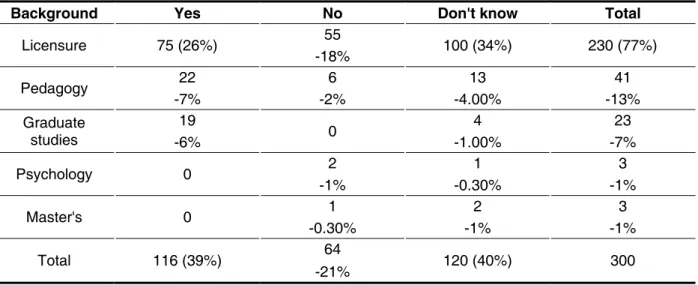
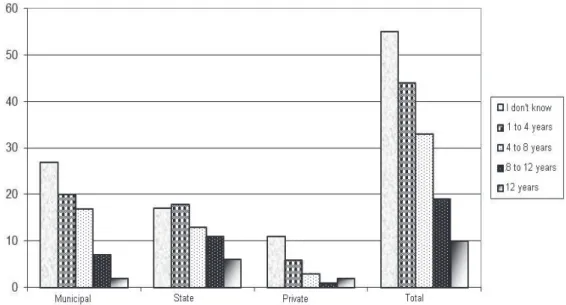
The results of the questionnaires regarding the NDC, etiology, and cure of stuttering are given in Tables 3, 4 and 5, and Figures 1 and 2. The responses regarding the course of action when
stuttering is identiied in a student are seen in
Figure 3.
Of the 300 teachers, only ive reported that an
event focused on stuttering was held in their school.
When asked about government aid to work with stuttering children, 1.3% of the teachers responded
that they were receiving such aid.
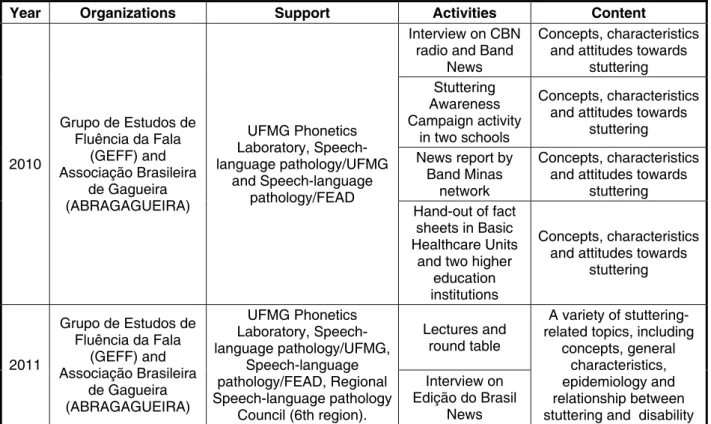
No campaigns with government support, incentive or funding were found in the study area. However, two nongovernmental campaigns with open-access reports online and repercussion in the media were found, as shown in Figure 4. In addition,
nine TV news shows on the subject of stuttering
Table 1 – Sample data for teacher age and grade level
Faculty data
Age (years) Grade taught N (Percentage)
Minimum 23 Preschool 153 (51%)
Mean 38.17 Elementary 111 (37%)
Standard deviation 10.65 Secondary 36 (12%)
Maximum 60 Total 300 (100%)
Table 2 – Sample data for teacher academic background
Teachers (%) N Academic background
77 230 Teaching licensure
14 41 Pedagogy
8 23 Graduate studies
1 3 Psychology
1 3 Master's
100 300 Total
Table 3 – Sample data for academic background vs. perception of the normal disluency of childhood
Background Yes No Don't know Total
Licensure 75 (26%) 55 100 (34%) 230 (77%) -18%
Pedagogy 22 6 13 41
-7% -2% -4.00% -13%
Graduate studies
19
0 4 23
-6% -1.00% -7%
Psychology 0 2 1 3
-1% -0.30% -1%
Master's 0 1 2 3
-0.30% -1% -1%
Total 116 (39%) 64 120 (40%) 300 -21%
Table 4 – Etiology of stuttering according to teachers
System/Etiology Genetic Emotional Personality Social Doesn't know Other
Municipal 34 120 25 39 2 8
State 29 103 19 41 12 2
Private 12 27 3 10 1 1
Total (N) 75 250 47 90 15 11
Is it curable? Schooling
Up to16 years More than 16 years Total
Yes 180 (85%) 21 (10%) 201 (95%)
No 9 (5%) 0 9 (5%)
Total 189 (90%) 21 (10%) 210
Table 5 – Opinion of sample regarding cure
Chi-square test with p<0.05 x²n=1.9=3.8
Figure 1 – Teachers’ responses, in percent values, with respect to the age when the normal disluency
Figure 2 – Teachers’ responses, in percent values, regarding the duration of the normal disluency
of childhood
Figure 3 – Course of action reported by teachers when a child who stutters is identiied in the
Year Organizations Support Activities Content
2010
Grupo de Estudos de Fluência da Fala
(GEFF) and Associação Brasileira
de Gagueira (ABRAGAGUEIRA)
UFMG Phonetics Laboratory, Speech-language pathology/UFMG
and Speech-language pathology/FEAD
Interview on CBN radio and Band
News
Concepts, characteristics and attitudes towards
stuttering Stuttering
Awareness Campaign activity
in two schools
Concepts, characteristics and attitudes towards
stuttering
News report by Band Minas
network
Concepts, characteristics and attitudes towards
stuttering Hand-out of fact
sheets in Basic Healthcare Units
and two higher education institutions
Concepts, characteristics and attitudes towards
stuttering
2011
Grupo de Estudos de Fluência da Fala
(GEFF) and Associação Brasileira
de Gagueira (ABRAGAGUEIRA)
UFMG Phonetics Laboratory, Speech-language pathology/UFMG,
Speech-language pathology/FEAD, Regional Speech-language pathology
Council (6th region).
Lectures and round table
A variety of stuttering-related topics, including
concepts, general characteristics, epidemiology and relationship between stuttering and disability Interview on
Edição do Brasil News
Figure 4 – Campaigns about stuttering with reports available on the internet in 2010 and 2011, with media repercussion
Broadcasting
Corporation Date Broadcast Network
Themes Epidemiology
and cause
Concepts and
characteristics Attitudes
Globo News 02/11/2010 National Pay TV
Globo 08/01/2010 National Open
Band Minas 10/08/2010 Regional Open
GNT 06/19/2011 National Pay TV
Rede TV 03/18/2011 National Open
Rede Vida 04/11/2011 National Pay TV
TV Gazeta 04/22/2011 National Pay TV
TV Tem 07/01/2011 Regional Pay TV
Meio Norte 10/21/2011 National Pay TV
is not properly tackled, aggravation may entail
chronicity, and the individual becomes a stutterer9. Of the teachers who considered to be normal for
a child to stutter for a period of time (46% of the total sample), 69 believed that the onset of the NDC
occurs between 1 and 4 years of age. Thirty-three of
them taught in municipal schools; 31 worked for the
state and 5 were private school teachers. The NDC
resolves between 1 and 4 years of age for 28% (39) of the teachers, while 35% (48) were unable to give an opinion (Fig.1). Research indicates that disluency
is a disorder arising in early childhood13,14. However,
there is no consensus in the literature regarding the
exact onset—ages between 23 years5, or 57 years
until 12 years15 have been proposed.
A variety of responses were noted regarding the etiology of stuttering. Most of the answers referred either to an emotional cause for stuttering or the social environment of the child, with the genetic factor
coming next (Table 4). Eleven teachers suggested
that the cause of stuttering could be something
else, e.g., anxiety, embarrassment, a disorder,
vocal fold dysfunction, a scare, health problems or
insecurity. This corroborates the indings by Ferriolli
et al.15, who reported that 100% of the teachers in
their study mentioned emotional factors as the most
likely cause of stuttering. The most widely accepted
etiology, particularly with regard to developmental stuttering, is the genetic factor8,9.
The teachers in the present study were also
inquired as to the duration of the normal disluency
of childhood. Their answers can be found in Fig. 2. Question 7 of the questionnaire concerned
the cure of stuttering. In this regard, 73% of the
respondents stated that stuttering is curable and
only 1.5% of the sample afirmed that it is incurable. Jakubovicz8, who translated and summarized
excerpts from a work by Schwartz, agrees with that
author and postulates that stuttering is curable,
since disluent individuals can organize themselves so as to develop luent speech; therefore, it can be
said that they are cured. The age limit for treatment
was also asked, and answers varied. The teachers
surveyed believed that, ideally, stuttering should be treated as soon as the problem is detected, preferably in childhood.
For the statistical analysis, the groups were divided considering programs with up to 16 years
of schooling (bachelor’s degree with teaching
licensure, pedagogy and psychology) and programs with more than 16 years of schooling (graduate
studies). Based only on the “yes” and “no” answers,
it was found that none of the teachers with more than 16 years of schooling believe stuttering is incurable
(Table 5). No statistically signiicant difference was
found with respect to the years of schooling and
DISCUSSION
The results will be discussed in two parts: irst, the teachers’ responses with regard to stuttering will be discussed, and next, a relection on the possible inluence of the media on teachers’ conceptions will
be presented.
The mean age of the surveyed teachers was 38
years (Table 1). No statistically signiicant difference
was found when the variables school system (municipal, state or private) and teacher academic
background were compared. This inding shows that, regardless of the school and academic background
of the teachers, the answers concerning stuttering were homogeneous.
The majority of the teachers taught preschool (51%), followed by elementary school teachers (37%), comprising children from 5 to 14 years of
age. For clarity, the sample was divided according to the types of teaching licensure programs and to distinguish them from the other academic programs.
Thus, 77% of the sample was composed of profes
-sionals with a bachelor’s degree and teaching licensure, followed by pedagogy (14%) and graduate studies (8%), as shown in Table 2. The analysis of the academic background by teaching institution showed that 40% of the private school teachers had
a graduate degree (Table 2).
Stuttering is a disorder aflicting approximately 5% of Brazilians, which corresponds to nearly 2 million individuals. This projection is also found
worldwide, with stuttering being regarded as a disorder of high incidence6. Thus, it is not surprising
that most teachers stated that they had already taught children who stuttered.
To start the investigation on the knowledge of the teachers about stuttering, more speciically devel -opmental stuttering, their perception of the normality
of the common childhood disluency was elicited.
Most respondents were unable to give an opinion, or considered normal for a child to stutter at some
point in their development (Table 3). This inding is
in line with that of Carvalho and Galvão12, in whose
study 52% of the sample declared that they believed
stuttering was normal at some point in childhood. In Table 3, the sample is discriminated with
respect to the teachers’ academic background. No statistically signiicant differences were found
in the responses, with 116 teachers regarding
stuttering as normal. By contrast, 21% of the sample
believes that stuttering is not a normal occurrence.
The disluency of childhood is both a frequent and
normal alteration of speech for a period of time in childhood; if adequately treated, total remission is
The same response pattern was seen when the
teachers were asked if they received any assis -tance from the government to deal with children
who are disluent in school: four (1.3%) teachers— two (0.6%) in municipal and two (0.6%) in state schools—responded afirmatively. A number of authors observed that the knowledge teachers have
on stuttering comes largely from common sense,
thus lacking scientiic basis, or is empirical, for being
close to someone who stutters, or someone who coped with stuttering15,17.
Nothing was found in the literature in terms of government intervention regarding the issue of stuttering. A search of the government websites
located educational primers, which are not suficient to raise teachers’ awareness regarding this subject.
Studies have shown that health promotion has yet to be reviewed and could be improved nationwide19,20.
To conclude the questionnaire, a deinition
of stuttering was elicited from the teachers. The answers were diverse. The most prevalent
responses mentioned speech dificulties, repetition
of letters, syllables or words, an emotional or
genetic disorder, dificulty in organizing thinking, emotional factors related to speaking in public, or
a biological factor, namely, the involvement of the brain hemisphere responsible for language. Merçon and Nerm21 acknowledge the dificulty in diagnosing
stuttering and, consequently, conceptual dificulties.
Ferriolli et al.15 conclude that teachers should be
clearly informed about the possible causes of stuttering and everything it involves. The authors elaborate on the importance of prevention programs in the school. Dinville14 inds that lack of information
is the major exacerbating factor of stuttering.
So far, the discussion has focused on how the teachers in the present study perceive stuttering, as well as their attitudes towards children who stutter.
The indings showed that the campaigns and news
reports involving stuttering encompassed all the content that had been elicited from the teachers. However, the results were not yet satisfactory in that teachers persist with misguided attitudes and misconceptions with regard to stuttering.
One might ask, “Could these results be due to a meager inluence of the media on teachers?”
Studies of the media impact on the population have
been undertaken from different perspectives. The
relationship between education and the media was
one of these aspects, and all the indings pointed
to a common denominator: there is indeed a strong
inluence of the media on the conceptions of the
population22-24. Despite the fact that no speciic
studies were found on the inluence of the media knowledge of the cure. These responses followed
a pattern throughout the study, which shows that, as mentioned by Ferrioli et al. 15, teachers lack the
scientiic knowledge pertaining to the most common
disorders in children. Many of these teachers rely
on common sense, which explains why the years of schooling had no inluence on the quality of the
answers given. These professionals are in direct contact with the child; not only their conduct, but
also the body of knowledge underlying their attitudes
directed and shaped the path of the students. In their study, Simões and Assencio-Ferreira16 advocate
the importance of investing in teacher education, since the treatment of stuttering becomes much
more expensive than investments in academic background and information regarding child devel -opment and its disorders.
When teachers notice the onset of disluency
in a child, the attitude most frequently observed in municipal and state schools is the teacher-parent meeting; in the private schools, the most cited course of action was to refer the problem to the head of the school. The third most frequently mentioned
approach was to make a referral to a specialist. In
this case, 33 respondents would refer the children to a speech-language pathologist, 12 would refer them to a psychologist, one, to a neurologist and
one, to an otolaryngologist. Regarding the teachers’ attitudes towards a disluent student, Chiquetto17
noted that, in their attempts to help, teachers take
measures that are not always adequate, and this is
largely due to the lack of information on stuttering
and how to approach it. The same author reports that teachers, especially because of a fragmented
view of the problem, seem to have some dificulty in
recognizing stuttering, as it could even be a normal
disluency. Once the problem is acknowledged,
however, Luz and Campiotto18 veriied that the
teachers’ concern is genuine, and as soon as the problem is identiied, most of them make sure to
contact the family or proceed the proper referrals. Despite the high incidence of stuttering in the
population and its impact on children, only ive (1.6%) teachers of the 300 surveyed reported
having had any school event related to stuttering. The reported event was a theater play to promote
information on stuttering. The other 295 teachers (98.4%) informed there never was, or they were not
aware of, any educational event about stuttering in their school. Ferriolli et al.15 assert that educational
initiatives play a key role in school, in that they
enable teachers and students to enhance their
rapport to mutual beneit. This guidance is important
One dificulty perceived by the teachers was the lack of government support and/or the lack of effec -tiveness concerning the information made available to these schools. The only schools that reported some event dedicated to conveying information on stuttering were the private schools; however, the
information delivered was not suficient to produce a change in the response patterns. The lack of
a specialized professional in these institutions
who could orient these events in order to extend consistent knowledge and allow a change of attitude
on the part of the teachers was made clear in the present study.
Therefore, it is justiied to raise questions
concerning prevention programs in schools and other educational institutions to enhance the
knowledge of the professionals who spend the
most time in contact with the children. This could generate behaviors and attitudes that would prevent
an exacerbation of the problem and the progression of a disluency to chronicity.
Furthermore, the results of the present study showed that different news reports and interviews were brought to the general public in the study period. It should be stressed that the search for such
media output was exploratory. The content elicited
from the teachers was presented to the public on different occasions by specialists; however, it does
not seem to have been suficient to signiicantly change teacher’s perception on stuttering. It is
suggested that other types of media, such as TV commercials, soap operas and comedy shows,
should also be examined in order to better under
-stand the inluence of the media on the population
with regard to stuttering.
inluenced by the media regarding their conceptions
and attitudes as high school22 or college23 students,
for example, should be considered. It should be noted, however, that it is not possible to afirm here the extent of the media inluence on the study
population or on teachers in general.
A second tentative explanation for the incon
-sistency between the inding in the media and the teachers’ conceptions could be the timing factor. The inluence of the media is clearly substantive on
the public22-25; however, the notions that the media
disseminates take some time to be taken in by the
population, it is an evolutionary process25. Therefore,
this type of analysis would require a study with a historical design of stuttering in the media.
Finally, it is worthy of note that the inluence of
the media is not limited to the shows mentioned in the present study. The reach of the media included streams other than the news. Commercials, soap
operas and comedy shows are examples of a possible inluence of the media on the population
and should also be investigated.
CONCLUSION
No statistically signiicant differences were found
when the variables school system (municipal, state
or private) and teacher academic background were
compared. This fact shows that the responses given about stuttering were homogeneous regardless of the school governance and teacher education.
The results also showed that the teachers tended to base their answers on common sense more than
11. Wittke-thompson JK, Ambrose N, Yairi ER, Cook EH, Ober C, Cox NJ. Genetic studies of stuttering in
a founder population. Journal of Fluency Disorders. 2007; 32(1):33-50.
12. Carvalho APG, Galvão VS. Concepção e Atitudes
de Sujeitos Gagos Sobre a Gagueira. Revista de Iniciação Cientíica da FFC. 2006;5(1/2/3):15-24. 13. Yairi E, Ambrose NG. Early chilhood stuttering
I: persistency and Recovery rates. Journal of Speech, Language, and Hearing Research.
1999;42(5):1097-112.
14. Yairi E, Ambrose NG. A longitudinal study of
stuttering in children: a preliminary report. Journal of Speech, Language, and Hearing Research.
1992;35(4):755-60.
15. Ferriolli BHVM, Leitão PM, Pereira FLF. O conhecimento e as atitudes dos professores frente a gagueira. JBF Jornal Brasileiro de Fonoaudiologia 2005;5(22):321-30.
16. Simões JM, Assencio-Ferreira VJ. Avaliação de aspectos da intervenção fonoaudiológica
junto a um sistema educacional. Rev CEFAC. 2002;4(2):97-104.
17. Chiquetto MM. Relexões sobre a gagueira: concepções e atitudes dos professores. 1992.
Dissertação (Mestrado em Fonoaudiologia): Universidade Federal de Santa Catarina,
Florianópolis, SC, 1992.
18. Luz SEM, Campiotto AR. Avaliação sobre as informações que o educador pré-escolar possui
REFERENCES
1. Silca SP, Arcanjo JG, Souza HCB, Silva RMS,
Souza CO, Lucena CS et al. Literatura de cordel: linguagem, comunicação, cultura, memória e interdisciplinariedade. Raído. 2010;4(7):303-22.
2. Bei-lopes DM, Paula EM. Habilidades de resolução de conlito e ocorrência de disluências
comuns em crianças em desenvolvimento normal de linguagem. Rev Soc Bras Fonoaudiol. 2008;13(3):272-8.
3. Brandi ESM. Voz falada: estudo, avaliação,
tratamento. Rio de Janeiro: Atheneu; 1990.
4. Barbosa LMG, Chiari BM. Gagueira: etiologia, prevenção e tratamento. 2. ed. Barueri: Pró-Fono; 2005.
5. Andrade CRF. Protocolo para avaliação da
luência da fala. Pró-Fono. 2000;12(2):131-4. 6. Instituto Brasileiro de Fluência. Epidemiologia da gagueira. 2007-2009. Disponível em: http://www. gagueira.org.br/conteudo.asp?id_conteudo=31.
7. Andrade CRF. Diagnóstico e intervenção precoce no tratamento das gagueiras infantis. Carapicuíba,
SP: Pró-Fono, 1999.
8. Jakubovicz R. A gagueira: teoria e tratamento de adultos e crianças. Rio de Janeiro: Revinter; 1992. 9. Andrade CRF. Gagueiras Infantis – Diagnóstico e
Intervenção Precoces. Editora Pró-Fono, 2006. 10. Villani VG, Curriel DT, Oliveira CMC. O que pensam os professores em formação inicial sobre
RESUMO
Objetivo: veriicar a inluência da mídia sobre o conhecimento de professores das redes municipal,
estadual e particular sobre a gagueira, em especial a gagueira na infância e descrever as atitudes desses professores. Método: o primeiro experimento foi realizado de Outubro de 2009 a Março de 2011 com 300 professores de escolas estaduais, municipais e particulares. Foi aplicado questionário com questões sobre o conhecimento e atitudes de professores sobre a gagueira. Foi realizada análise
de estatística descritva e teste qui-quadrado (p<0,05). O segundo experimento teve caráter descritivo
no qual foi realizada uma pesquisa midiática e de Campanhas que pudessem ter atingido os profes-sores participantes da pesquisa. Resultados: não houve diferença estatisticamente signiicante nas respostas quanto ao tipo de escola e formação dos professores. A maior parte dos professores
res-pondeu “não sei” nas questões especíicas de gagueira. A maioria, 95%, acredita que a gagueira tem cura e o fonoaudiólogo é o proissional mais citado para encaminhamentos de crianças com gagueira.
Foram encontradas duas campanhas não-governamentais e nove programas sobre gagueira com alcance na região estudada. Conclusão: o conteúdo questionado aos professores foi apresentado
ao público em diferentes momentos por proissionais especializados, porém parece não ter sido sui
-cientes para alterar de forma signiicante a percepção dos professores sobre a gagueira.
19. Brites LS, Souza APR, Lessa AH.
Fonoaudiólogo e agente comunitário de saúde: uma
experiência educativa. Rev. Soc. Bras. Fonoaudiol.
2008;13(3):258-66.
20. Carvalho AI, Bodstein RC, Hartz Z, Matida AH. Concepções e abordagens na avaliação em promoção da saúde. Rev Saúde Col.
2004;9(3):521-9.
21. Merçon SMA, Nerm K. Gagueira e disluencia
comum na infancia: Análise das manifestações clínicas nos seus aspectos quantitativos e
qualitativos . Rev. CEFAC 2007;9(2):174-9.
22. Castro SA. Diagnóstico sobre a inluência da
mídia no conhecimento escolar e no cotidiano
Received on: January 17, 2012 Accepted on: May 06, 2012
Mailing address: Leticia Correa Celeste
QNN 14 Área Especial, Guariroba, Ceilândia Sul Brasília – DF
E-mail: [email protected]
de alunos do ensino médio. Rev. Horiz. Cient. 2011;5(2):1-26.
23. Alvarenga MS, Dunker KLL, Philippi ST,
Scagliusi FB. Inluência da mídia em universitárias
brasileiras de diferentes regiões. J. bras. psiquiatr.
2010;59(2):111-8.
24. Fabris C, Steiner Neto PJ, Toaldo AMM.
Evidências empíricas da inluência da família, mídia,
escola e pares nos antecedentes e no comportamento de separação de materiais para reciclagem. Rev. Adm. Contemp. 2010;14(6):1134-57.
25. Machado M. A retórica da reeleição: mapeando os discursos dos Programas Eleitorais (HGPE) em