223
Refractive profile of presbyopic people
in the brazilian Amazon
Perfil refracional dos présbitas na Amazônia brasileira
Cláudia Maria Osório Chaves
1, Cláudio do Carmo Chaves Filho
1, Cláudio do Carmo Chaves
2A
BSTRACTObjective: To determine the refractive profile of presbyopic people in the western brazilian Amazon, establishing as the pilot cities Manaus and other nine of sixty-one cities in the state of Amazonas. Methods: Retrospective analysis of medical records of 8.225 patients. People who were over the age of 40 in 10 cities in the state of Amazonas (Manaus and 09 municipalities in the hinterland) were examined from september/2008 to december/2011. The data were classified by age, sex, economic activity (retired or not), type of refractive error and visual acuity for distance and near with and without correction. The method consisted of routine eye examination that included refraction test. The statistical analysis used quantitative studies. Results: Among the patients studied, 53.0% were female; the most prevalent age group was 51-60 years; 66.0% are not retired and still engage themselves in some labor activity; the higher prevalence of refractive errors was recorded for various astigmatism (43.0%) and visual acuity at distance, without correction, was 15.0% with 20/200 and, with correction, was 45.0% with 20/30 or more; compared to the near vision , visual acuity was 40.0% for J6, without correction, and 82.0% for J1 and J2, with correction; additions were used in 75.0% of +2.50 diopters or more; and 52,0% of consultations were held in Manaus. Conclusion: This study, in examining people from low-income areas in the brazilian Amazon, corroborates that the lack of glasses to correct near vision constitutes an important public health problem in people over 40, especially those who have difficulty accessing Ophthalmology services.
Keywords: Presbyopia; Refraction; Amazon; Brazil
R
ESUMOObjetivo: Determinar o perfil refracional dos présbitas na Amazônia ocidental brasileira, estabelecendo-se como piloto a cidade de Manaus e nove das sessenta e uma cidades do interior do estado do Amazonas. Métodos: Estudo retrospectivo dos prontuários de 8.225 pacientes. Foram examinadas pessoas maiores de 40 anos, em 10 cidades do estado do Amazonas (Manaus e 09 municípios da hinterlândia), no período de setembro/2008 a dezembro/2011. Os dados foram classificados por faixa etária, sexo, atividade econô-mica (aposentados ou não), tipo de ametropia e acuidade visual para longe e perto com e sem correção. O método consistiu no exame oftalmológico de rotina que incluiu o exame de refração. A análise estatística dos dados utilizou estudos quantitativos. Resultados: Dos pacientes atendidos, 53,0% eram do sexo feminino; a faixa etária mais prevalente era de 51 a 60 anos; 66,0% não são aposentados e ainda desenvolvem alguma atividade laborativa; a maior prevalência das ametropias registrada foi de astigmatismos diversos (43,0%) e a acuidade visual para longe, sem correção, foi de 15,0% com 20/200 e, com correção, foi de 45,0% com 20/30 ou mais; em relação à visão para perto, a acuidade visual foi de 40,0% para J6, sem correção e, de 82,0% para J2 e J1, com correção; as adições utilizadas em 75,0% foram de +2,50 dioptrias ou mais; e 52,0% dos atendimentos foram realizados em Manaus. Conclusão Esta pesquisa, ao examinar populações pobres da Amazônia brasileira, corrobora que a falta de óculos para corrigir a visão para perto constitui-se em importante problema de saúde pública nas pessoas acima dos 40 anos, principalmente naquelas que têm dificuldade de acesso a serviços de Oftalmologia.
Descritores: Presbiopia; Refração; Amazônia; Brasil
1Preceptor, Specialisation Course and Medical Residency in Ophthalmology, Manaus Institute of Ophthalmology (IOM). Professor of
Ophthalmology, Medical School, UniNilton Lins University, Manaus/AM, Brazil.
2Ph.D., Associate Professor of Ophthalmology, Federal University of Amazonas (UFAM), Manaus/AM, Brazil.
Manaus Institute of Ophthalmology, Manaus/AM, Brazil.
The authors declare no conflict of interest.
Received for publication: 26/3/2012 - Accepted for publication: 25/3/2013
O
RIGINALA
RTICLE224
Urban area / River Number of patients (%)
Manaus / Negro 4248 (51,6)
Coari / Solimões 207 (2,5) Eirunepé / Juruá 267 (3,2) Humaitá / Madeira 394 (4,8) Itacoatiara / Amazonas 422 (5,1)
Lábrea / Purus 728 (8,9)
Manacapuru / Solimões 446 (5,4) Manicoré / Madeira 325 (4,0) Maués / Amazonas 621 (7,6) Parintins / Amazonas 567 (6,9)
Table 1
Distribution of patients by urban area (according to visit site)
I
NTRODUCTIONP
rogressive loss of visual accommodation with age is defined as presbyopia (from Greek presbys, old + ops, sight). Presbyopia is an inevitable condition that generally occurs in persons over 40 years of age due to the physiological loss of visual accommodation. However, other situations may also cau-se partial or complete loss of visual accommodation, such as trauma, certain types of encephalitis (e.g., exanthematic), and drugs with parasympatholytic effects. Although the first studies on the pathophysiology of presbyopia were conducted more than four centuries ago(1), obtaining a better understanding of its aetiology is still one of the challenges of vision science.The mechanism of presbyopia involves changes both in the contraction and relaxation capacity of the ciliary muscle and in the lens, such as: loss of elasticity of the lens capsule and fibres, increased volume and thickness, changes in protein composition, formation of high molecular weight aggregates, changes in the insertion point on the zonule, shortened radius of curvature of the anterior surface, and decreased light transmission capacity(2-8). Although much is known about the pathophysiology of presbyopia, little or practically nothing is known about its prophylaxis.
The most effective treatment for presbyopia is optical correction, with eye glasses being the most commonly-used method. Other therapeutic alternatives are contact lenses and refractive surgery(9-12).
Despite the lack of consensus on the surgical correction of presbyopia, with poor results reported in the literature, refractive surgery can be indicated to patients who adapt well to monovision with contact lenses.
The lack of optical correction for a presbyopic patient is incapacitating and significantly affects their daily life and occupational activities, compromising their working capacity(13,14). The lack of eye glasses among poor populations in large cities and distant urban areas such as those studied here — along the Amazon River, also called Solimões in the region stretching from the Brazilian-Peruvian border until its confluence with the Negro River, and some of its tributaries (Negro, Juruá, Purus, and Madeira rivers) — is an important socioeconomic factor and a public health issue(15-17).
Any consideration on the Amazon region should emphasise its diversity, including its physical/natural, demographic, cultural, ethnical, social, and economic diversity, as this is one of its most prominent macroregional characteristics. Due to the difficulty of access to and lack of specialist ophthalmology services, the condition often progresses without treatment. As a result, simple cases which could be easily treated with reading glasses become serious public health problems, with patients being unable to perform their occupational activities (e.g. fishing, extractive activities, and home chores such as sewing and cooking, amongst others).
Other poor and socially-excluded populations in Brazil (in the Northeast and Central-West Regions), Latin America, Africa, and Asia are certainly in a similar situation.
The Amazon region represents 5% of the world’s surface area and 8.5% its inhabitable area. Of the Amazon’s 7.5 million square kilometres, two thirds (i.e. 5 million square kilometres) are in Brazil and 32% (1.6 million km2) are in the state of Amazonas. This study aimed to determine the refractive profile of persons with presbyopia living in the city of Manaus and in another 9 of the 61 urban areas in the state of Amazonas, in the western Brazilian Amazon.
M
ETHODSRetrospective study of 8225 patients actively visited (as part of the Ministry of Health’s Programme for Presbyopia) by staff and resident physicians of the Manaus Institute of Ophthalmology (IOM) and medical students of the Federal University of Amazo-nas (UFAM) and the UniNilton Lins/AM university. This sample represents 0.9% of the population over 40 years of age in the State of Amazonas and 2.7% in the visited towns.
Inclusion criteria: over 40 years of age, good ocular health, difficulty with near vision only, no history of using eye glasses, and poor socio-economic condition.
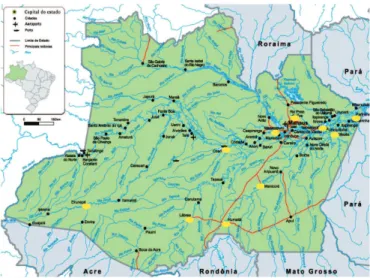
Exclusion criteria: under 40 years of age, no difficulty with near vision, currently using reading glasses, having the financial capacity to obtain eye glasses if necessary, and other eye disorders. We only examined presbyopic patients over 40 years of age. The visits took place between September 2008 and December 2011 in ten urban areas in the state of Amazonas, the largest federative unit in the Brazilian Amazon, namely: Manaus (state capital, located along the Negro River); Coari and Manacapuru (Solimões River); Eirunepé (Juruá River); Humaitá and Manicoré (Madeira River); Lábrea (Purus River); and Itacoatiara, Maués and Parintins (Amazon River)
Figure 1 - Map of the State of Amazonas; visit sites are highlighted.
Chaves CMO, Chaves Filho CC, Chaves CC
225
Table 2
Distribution of patients by age group
Figure 2:Medical record of study participants
Age group Number of patients ( %)
40 – 50 years 1283 (15,6)
51 – 60 years 3562 (43,3)
61 – 70 years 2296 (27,9)
71 – 80 years 896 (10,9)
> 80 years 188 (2,3)
R
ESULTSA total of 2019 patients (24.5%) were emmetropic. The most common refractive error was astigmatism (49.4%) of various types, followed by hyperopia (13.2%) and myopia (12.9%) (Table 3).
Table 3
Distribution of patients according to the type of refractive error
Refractive error Number of patients ( %)
Astigmatism 4.064 (49,4) Hyperopia 1.089 (13,2) Myopia 1.058 (12,9) Emmetropia 2.014 (24,5)
Uncorrected far visual acuity was 20/80 or worse in 52.7% of patients, 20/80 to 20/40 in 19.5%, and 20/40 to 20/20 in 27.8%; corrected far visual acuity was 20/80 or worse in 0.8% of patients, 20/80 to 20/40 in 10.3%, and 20/40 to 20/20 in 88.9% (Table 4).
Table 4
Distribution of patients according to far visual acuity
Visual acuity Uncorrected Corrected
Snellen’s chart Number of patients(%) Number of patients(%)
20/80 ou menos 4.334 (52,7) 66 ( 0,8) > 20/80 a 20/40 1.604 (19,5) 847 (10,3) > 20/40 a 20/20 2.287 (27,8) 7.312 (88,9)
Uncorrected near visual acuity was J5 or worse in 58.0% of patients, J4 or J3 in 38.0%, J2 in 4.0%, and J1 in zero patients. Corrected near visual acuity was J1 in 57.4% of patients, J2 in 26.0%, and J3 in 16.6% (Table 5).
Visual acuity Uncorrected Corrected Jaegger’s chart Number of patients(%) Number of patients(%)
J6 e J5 4.771 (58,0) 0 (0,0)
J4 e J3 3.125 (38,0) 1.365 (16,6) J2 e J1 329 (4,0) 6.860 (83,4)
The additions used for near vision were e”3.00 D in 42% of patients, <3.00 to e”2.50 D in 33.0%, <2.50 to e”2.00 D in 15.7%, <2.00 to e”1.50 D in 9.1%, and <1.50 to 1.00 D in 0.2%.
There were no cases of early presbyopia, i.e. before 40 years of age. Also, a significant number of patients (19.6%) only became presbyopic after 45 years of age.
Refractive profile of presbyopic peoplein the brazilian Amazon
Rev Bras Oftalmol. 2013; 72 (4): 223-6 The statistical methodology consisted of quantitative data
analysis.
Table 5
Distribution of patients according to near visual acuity
The patients underwent a routine eye examination consisting of medical history, assessment of near and far visual acuity (with and without correction), refraction test, biomicroscopy, tonometry, and ophthalmoscopy, based on a standard protocol (Figure 2). All patients with visual loss not due to presbyopia, with or without refractive errors, were excluded from the study. Patients were classified according to their age (Table 2), sex, and economic activity (economically active vs. retired).
D
ISCUSSIONNear vision in humans is essential for professional and intellectual activities such as reading. Specifically among the inhabitants of distant regions in the Amazon, where most men work in the fishing and extractive industries and women perform domestic activities — cooking, sewing and other household cho-res —, the loss of near vision seriously affects their survival.
The onset of presbyopia in the fifth decade of life is inevitable and irreversible and causes a large number of people worldwide to be unable to work(8).
After the age of 40 years, nearly 100% of the population progressively loses their visual accommodation capacity, and optical correction with eye glasses is the first therapeutic choice for most patients(15). It is important to emphasize that universal access to ophthalmic examination and the provision of eye glasses for poor populations is essential from the fifth decade of life.
226
Correspondence adrress:
Cláudia Maria Osório Chaves Av. 7 de setembro, nº 1613 – Centro CEP 69005-141 – Manaus (AM), Brasil E-mail: [email protected]
Chaves CMO, Chaves Filho CC, Chaves CC
Rev Bras Oftalmol. 2013; 72 (4): 223-6
and the significant number of cases where the onset of presbyopia occurred after the age of 45 years may be related to the subjects’ occupations, which do not require them to use their maximum near vision efficiency in daily activities, or to nutritional factors related to the intake of fruits typically found in the region such as buriti and camucamu, which have been shown to be rich in vitamins A and E (buriti) and C (camucamu). As this was a pioneering study, its results cannot be extrapolated to the gene-ral population; also, we were unable to correlate these results with those of other studies in equatorial regions, as there are no such studies. Hence, the associations between our results and the region’s mesology are mere inferences. The lack of access to eye glasses to correct near vision impairment is an important public health problem among poor populations, and this study supports this assertion.
The Brazilian state of Amazonas represents about 20% of the country’s territory and contains the largest portion of both the Brazilian Amazon and the South American Amazon. This last frontier needs to be further studied in its many aspects as regards its epidemiological characteristics in all areas of medicine, including vision science, of which presbyopia is a study topic.
Programmes to develop research and extension activities in ophthalmic science are very helpful in the search for sociomedical solutions to this public health problem, i.e., the lack of access to corrective lenses for near vision among poor populations.
Studies like this confirm the importance of conducting research in primary health care focused on cause/effect correlations and, in particular, on informing public policy with regard to the problems and needs of populations.
R
EFERENCES1. Atchison DA. Accommodation and presbyopia. Ophthalmic Physiol Opt. 1995;15(4):255-72.
2. Gilmartin B. The aetiology of presbyopia: a summary of the role of lenticular and extralenticular strucures. Ophthalmic Physiol Opt. 1995;15(5):431-7.
3. Cook CA, Koretz JF, Pfahnl A, Hyun J, Kaufman PL. Aging of the human crystalline lens and anterior segment. Vision Res. 1994;34(22):2945-54.
4. Bron AJ, Vrensen GF, Koretz J, Maraini G, Harding JJ. The ageing lens. Ophthalmologica. 2000;214(1):86-104. Review.
5. Strenk SA, Semmlow JL, Strenk LM, Munoz P, Gronlund-Jacob J, DeMarco JK. Age-related changes in human ciliary muscle and lens: a magnetic resonance imaging study. Invest Ophthalmol Vis Sci. 1999;40(6):1162-9.
6. Vargas MA, Rodrigues ML. Perfil da demanda em um serviço de Oftalmologia de atenção primária. Rev Bras Oftalmol. 2010;69(2):77-83.
7. Santos-Neto E, Alves MR. New concepts in accommodation and presbyopia. Rev Bras Oftalmol. 2011;70(5):306-11.
8. Werner L, Trindade F, Pereira F, Werner L. Fisiologia da acomodação e presbiopia. Arq Bras Oftalmol. 2000;63(6):487-93. 9. Sant’Anna NV, Schor P, Lipener C, Uras R. Comparação da função visual e do índice de qualidade de vida com uso de óculos ou de lente de contato progressiva. Arq Bras Oftalmol. 2006;69(3):349-59.
10. Lui Netto A, Alves MR, Lui AC, Lui GA, Giovedi Filho R, Lui TA, et al. Avaliação clínica comparativa de lentes progressivas na correção da presbiopia. Rev Bras Oftalmol. 2009;68(3):129-33. 11. Rezende Flávio, Bisol RR, Bisol T. Troca do cristalino com finalidade
refrativa (TCR). Rev Bras Oftalmol. 2009;68(3):180-7. 12. Ferraz CA, Allemann N. Técnicas cirúrgicas para correção da
presbiopia em pacientes fácicos. Arq Bras Oftalmol. 2004;67(3):559-62.
13. Ramke J, Brian G, Naduvilath T. Refractive error and presbyopia in timor-leste: the impact of 5 years of a national spectacle pro-gram. Invest Ophthalmol Vis Sci. 2012;53(1):434-9.
14. Borrelli M, Rehder JR, Squarcino IM, Gonçalves AM, Piaia FA, Fernandes PK, et al. Avaliação da qualidade da visão, na prática da leitura diária, em relação à formatação dos textos. Rev Bras Oftalmol. 2010;69(2):114-20.
15. Romani FA. Prevalência de transtornos oculares na população de idosos residentes na cidade de Veranópolis, RS, Brasil. Arq Bras Oftalmol. 2005;68(5):649-55.
16. Verçosa IC, Maia EF. Perfil oftalmológico dos alunos do programa alfabetização solidária em quatro municípios do Ceará. Arq Bras Oftalmol. 2003;66(2):193-7.