Original Article
Copyright © 2015 Revista Latino-Americana de Enfermagem
This is an Open Access article distributed under the terms of the Creative Commons Attribution Non-Commercial License (CC BY-NC).
This license lets others distribute, remix, tweak, and build upon your work non-commercially, and although their new works must also acknowledge you and be non-commercial, they don’t have to license their derivative works on the same terms.
Corresponding Author:
Rosalina Aparecida Partezani Rodrigues
Universidade de São Paulo. Escola de Enfermagem de Ribeirão Preto Departamento de Enfermagem Geral e Especializada
Av. Bandeirantes, 3900 Bairro: Monte Alegre
CEP: 14040-902, Ribeirão Preto, SP, Brasil E-mail: rosali
1 PhD, Full Professor, Escola de Enfermagem de Ribeirão Preto, Universidade de São Paulo, PAHO/WHO Collaborating Centre for Nursing Research Development, Ribeirão Preto, SP, Brazil.
2 PhD, Full Professor, Universidade Federal de Santa Catarina, Florianópolis, SC, Brazil. 3 PhD, Full Professor, Universidade Federal da Bahia, Salvador, BA, Brazil.
4 PhD, Full Professor, Universidade Federal de São Paulo, São Paulo, SP, Brazil.
Doctoral Theses from Nursing Postgraduate Programs in Brazil and
their Association with the Millennium Development Goals
Rosalina Aparecida Partezani Rodrigues
1Maria Lúcia do Carmo Cruz Robazzi
1Alacoque Lorenzini Erdmann
2Josicélia Dumet Fernandes
3Alba Lucia Bottura Leite de Barros
4Flávia Regina Souza Ramos
2Objectives: The Millennium Development Goals are centered around combatting poverty
and other social evils all over the world. Thus, this study seeks to identify the Millennium
Development Goals as an object of study in theses from Postgraduate Nursing Programs in
Brazil scoring 5 (national excellence) and 6 or 7 (international excellence), and evaluate the
association between the score for the program and achieving the Millennium Development Goals.
Method: Exploratory descriptive document research. Data were collected from the Notes on
Indicators/Coordination for Higher Education Personnel Improvement for the 15 Postgraduate
Nursing Courses scoring between 5 and 7 in the three-year-period of 2010/2012. Results: of the
8 Millennium Development Objectives, 6 were dealt with in the theses. There was an association
(Fisher’s exact test p-value=0.0059) between the distribution of the theses and the program
scores in relation to the Millennium Development Objectives (p-valor=0.0347) Conclusion: the
doctoral theses were slightly related to the Millennium Development Objectives, covering the
population’s economic development, health conditions and quality of life. It is recommended
that Postgraduate Programs in Nursing pay closer attention to the Millennium Development
Objectives..
Descriptors: Nursing; Millennium Development Goals; Education, Nursing, Graduate. Rev. Latino-Am. Enfermagem
2015 May.-June;23(3):395-403
DOI: 10.1590/0104-1169.0667.2565
Introduction
The mission of the United Nations Development
Program (UNPD), established by the United Nations (UN)
is to collaborate in development and eliminate poverty,
as well as contributing to achieving the Millennium
Development Goals (MDG)(1). These objectives aim to
improve the destiny of humanity in this century and
involve the areas of social public policy and commitment
to development on all continents(1).
In 2000, though the UNPD, Brazil and another
188 nations signed up to an agreement to combat
extreme poverty and other evils of world society. This
commitment was explained using the eight MDGs to be
attained by 2015. Part of the United Nations Millennium
Declaration, the goals are a series of commitments
aiming to improve the fate of humanity in this century.
There are 8 goals, namely: 1) reduce poverty/hunger/
misery by half; 2) achieve universal access to primary
education; 3) promote gender equality; 4) reduce infant
mortality; 5) improve maternal health; 6) combat HIV/
AIDS, malaria and other diseases; 7) quality of life
and guaranteed environmental sustainability and 8)
establishing development partnerships(1).
Brazil and the other countries have been seeking
to achieve these objectives, fulilling their commitment.
The place of universities in this search stands out, as
they are a space in which excellence in higher education
is promoted, in which young citizens committed to ethics,
to social responsibility and to sustainable development
are trained, in which teaching, research and extension
are developed, in which technological advances are
made, and knowledge and techniques socially necessary
for developing human well-being are produced/
disseminated, as are economic and social policies, as
well as being a place in which science is generated(2-6),
among other things.
University, then, is an instrument for social
change and it is assumed that Postgraduate Programs,
especially those with international impact and gaining
the highest scores, should meet the demands of
research and training researchers committed to making
the advances necessary to society. It is expected that
these Postgraduate Programs are committed to the UN
UNPD, producing knowledge that can have an impact
on achieving the MDGs, showing their social relevance.
Within the university, the Area of Nursing is a
science which views the person (individuals, families,
communities), the environment and health as central, at
any point of the lifecycle, when one falls ill, the severity
and conditions (7). Nursing seeks to provide the individual
with comprehensive care, conducting interventions
dependent on or independently of other health care
professionals and team members, producing knowledge
about care processes, managing the care environment
and the nursing professionals involved there, as well as
public management.
The issues raised in national and international
agreements can be viewed as tools for analyzing the
knowledge produced in this area. Thus, the 24 Ministry
of Health priority agendas and the MDGs, with their
22 aims and 48 indicators for global development can
be used as tools for relection, so long as they are not
viewed as linear, mandatory demands, decontextualized
from the Brazilian reality of the speciic ield of nursing.
The policy of investing in studies with lines of
research aiming at reducing social inequality and
promoting social inclusion has received attention in
Nursing Postgraduate Programs (PGPNur)
This is the perspective used in this study,
recognizing the MDGs as important international
guidelines for the ield of health care, considering the
strategic role of the University and of Postgraduation, as
well as bearing in mind that the area of Nursing should
value multiple references, beyond the theoretical and
policy frameworks when planning interventions and
commitment to producing knowledge.
In the Brazilian Postgraduate system, programs
are generally evaluated by the Coordination for Higher
Education Personnel Improvement - Coordenação de
Aperfeiçoamento de Pessoal de Nível Superior (CAPES),
receiving scores that range from 3 to 7, with those
scoring 3 to 4 meeting national requisites, but excluding
internationalization.
In the Area of Nursing, Programs scoring 5
(national excellence), 6 and 7 (international excellence)
are those that receive the highest scores and meet
the CAPES indicators and criteria, of which some
categories stand out, namely: Solidarity, Nucleation,
Leadership and Internationalization. Solidarity refers
to cooperation with other programs, working as part of
a network, advisory services for formulating proposals
for new national or international courses, participating
in joint projects with as yet unconsolidated research
groups, among other indicators. Nucleation indicates
the capacity of the program to train postgraduates
and turn them into educators, researchers and leaders
in health care, speciically in nursing. Leadership is
represented by the draw of students and lecturers, of
and PhD internships. Internationalization refers to
student and lecturer participation in international
exchange programs, organizing international events,
establishing cooperation agreements, as well as
producing international scientiic output of national
impact on public policy, among others (10).
For this set of categories, the PGPNur scoring 5, 6
and 7 for CAPES should be guided along two principals,
namely, knowledge and research and teaching, allowing
knowledge exchange between researchers, lecturers
and students, whose academic activity should be linked
to concrete social problems and needs, such as health,
education, violence, human rights or the environment,
among others.
It is likewise the responsibility of these programs
to consider the contribution of nursing in achieving the
MDGs in Brazil, with a critical. In-depth awareness of the
discourse and goals proposed in the broader agendas
and global documents.
In light of such considerations, the need arises
for this study, which takes the following question as its
starting point: are the MDGs an object of study in theses
from Brazilian Postgraduate Programs in Nursing scoring
5,6, and 7?
The hypothesis established was that there was an
association between the distribution of theses produced
from the Nursing Programs evaluated with the highest
CAPES scores and their relationship with the MDGs.
The aim of this study, then, is to identify the presence
of the MDGs as an object of study in theses produced
by PGPNur with scores of 5 (national excellence), 6 and
7 (international excellence) in Brazil and evaluate the
association between the program score and whether or
not the MDHs are covered.
As of this moment, there are no similar studies in
the literature examined. It is hoped that this study may
contribute to guiding the health care area, speciically
that of nursing in Brazil, in the future.
Method
This was a descriptive, exploratory documentary
study. Between September and October 2014, data
were taken from the CAPES Notes on Indicators for
Postgraduate Programs in Nursing for Doctorate
courses awarded scores of 5 to 7 by the Nursing
Evaluation Commission. (11) The data referred to the
2010-2012 period.
These programs were selected due to their
better performance in the regular CAPES evaluations,
with consolidated national and international positions
and robust scientiic output, as well as meeting the
requirements for solidarity, nucleation and leadership
described above (10).
Firstly, all of the stricto sensu Nursing
Postgraduate Programs were accessed on the CAPES
site. Of the 28 PGPNur, 15 scored between 5 and 7,
above the average; and these included those deemed
excellent (scores of 6 or 7), for their international
consolidation and visibility. Doctoral theses defended
were examined for the above mentioned
three-year-period in the 15 programs identiied (scores of 5-7)
and titles were obtained.
After obtaining the titles, the abstracts of these
theses were sought in the online thesis and dissertation
archives at the universities which delivered the PGPNur,
as well as the CAPES online thesis library.
A printed record was used to collect the data,
including the following information: name of the program,
institution to which it belongs, titles and abstract of the
theses defended in the period in question.
We identiied 15 PGPNur with scores of 5,6 and 7, of which ten scored 5 and ive scored 6 or 7. The
Programs were allocated a number (1,2,3…) to preserve
the anonymity required for such a study.
Information was inputted into two spreadsheets,
the irst containing the titles and abstracts of the theses
and the second the eight MDGS. The titles and abstracts
were used to identify the object of study of the theses.
Next, any correspondence of the object of study with the
MDGs was identiied.
The objects of study were classiied/categorized
according to the MDGs recorded in the second
spreadsheet. The theses whose objects of study did not
explicitly include the MDGs were denominated “No MDG
identiied”.
Corresponding the thesis to the MDS was done by
each of this study’s authors irst individually, and later
in a group, until concordance was reached concerning
the categorization of each doctoral theses’ object of
study’s correspondence to the eight MDGs. Theses
whose abstracts and titles itted into more than one of the MDGs were classiied in only one of them.
The data were transferred onto an Excel
spreadsheet and then underwent descriptive analysis
and interpretation in light of the selected literature,
aiming to achieve the proposed objective. Fisher’s
exact test was used to analyze whether or not the
theses studied covered an MDG and the level of
This study was not submitted to the Research
Ethics Committee, as the data analyzed are available
on the oficial CAPES site(11)and in the online libraries of the Universities and are thus considered information in
the public domain, the participants in the study are not
identiied and there is no direct involvement of human
beings as research subjects, following National Health
Council recommendations and those of the Universities
from whence came the theses analyzed.
Results
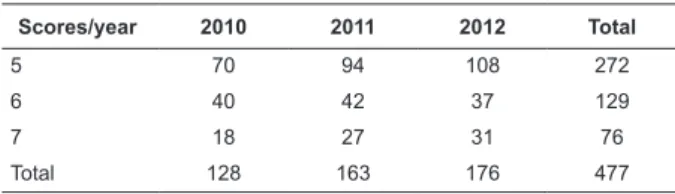
The analysis identiied a total of 15 PGPNur, of which 66.6% scored 5, 20% scored 6 and 13% scored 7. These Programs were located in the Northeast (6.6%), Southeast (80%) and South (13.3%) of Brazil. Of the
477 theses produced in these Programs in the period
studied, 272 (57.02%) were defended in Programs scoring 5, 129 (27.04%) in those scoring 6 and 76 (15.93%) in those scoring 7. These data are shown in
Table 1 below.
Table 1 – Distribution of the doctoral theses according
to year and the respective scores of the Postgraduate
Programs in Nursing. Ribeirão Preto, SP, Brazil, 2014
Scores/year 2010 2011 2012 Total
5 70 94 108 272
6 40 42 37 129
7 18 27 31 76
Total 128 163 176 477
Source: www.capes.gov.br
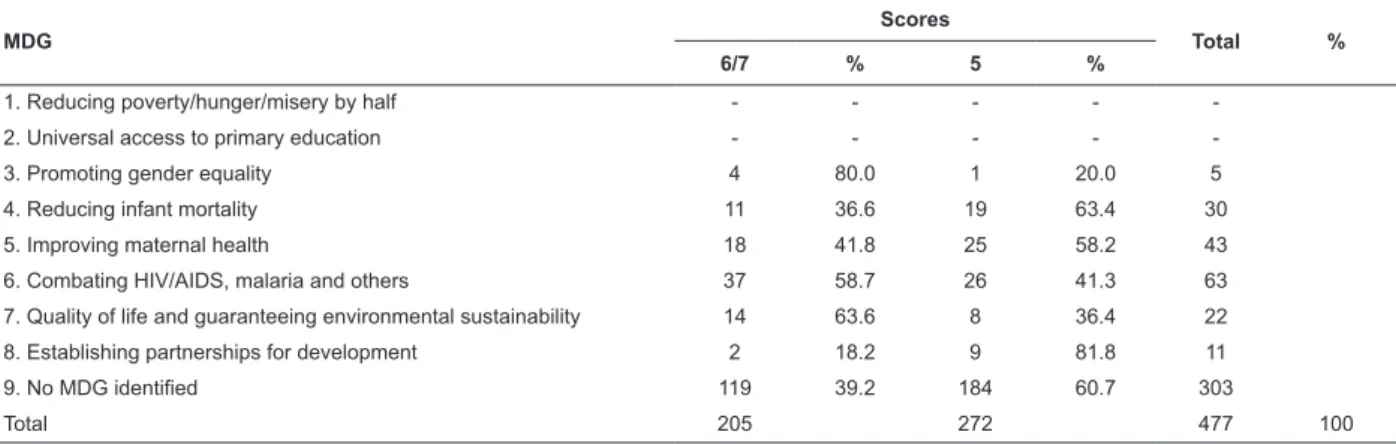
Data showing the theses’ inclusion of the MDGs are
shown in Table 2.
When Fisher’s exact test was applied to the data in
Table 2 the result was p-value=0.0059, in other words,
lower than 0.05, conirming the hypothesis that there is
a link between the distribution of the theses produced
in the Nursing Programs awarded the highest CAPES
scores and their link with the MDGs.
The lack of studies explicitly identiied as adhering
to MDG 1 (reducing poverty/hunger/misery) by half)
and 2 (universal access to primary education) does not
mean lack of interest in these topics as there are studies
which, indirectly, approach not only the link between
economic development and health conditions and
quality of life in the population, but also the contribution
to universal access to primary education and reducing
poverty/hunger/misery.
Although MDG number 8 (establishing partnerships
for development), 3 (promoting gender equality), 4
(reducing infant mortality) and 7 (quality of life and
guaranteed environmental sustainability) are covered in the theses analyzed, they still lack greater investment,
considering their importance in improving the quality of
life and health of the population.
The inclusion of MDGs 5 (improving maternal
health) and 6 (combating HIV/AIDS, malaria and other
diseases) in the theses is shown through studies of professional practice in the areas of women’s health,
children’s health and adult health, with emphasis on
public health care and understanding the multiple
aspects involved in nursing care. These studies, which
cover the MDGs, relect the presence of research into
chronic illness and complications related to aging and
chronicity, as well epidemiological and demographic
changes to the proile of the population.
The theses which were not identiied as associated with the MDGs, 303 of 477, equal to 63.52% and
include studies which demonstrate Nursing practice
in diverse contexts and with different populations. To
the authors if this study, it appears that the researcher
opted to conduct research according to their vocation as
researcher and to the line of research of each PGPNur.
These theses included studies related to health in
workers and in the elderly, topics relevant to current
society, as the demographic transition in the country is
gathering pace and working life has changed in recent
years. Other research also attracted attention, such as
use of language system and humanized care at different
stages of the life cycle. Methodological concerns were
also shown to be objects adding value to research in
the area and advancing the process of constructing
knowledge. Table 3 shows the presence of the theses in the PNPNur
with scores of 5,6 and the MDGs, as well as the p-value found.
Given the results shown in Table 3 and the p-value
of 0.0347 found using Fisher’s exact test, the hypothesis
is conirmed that there is an association between
scores of 5, 6 or 7 for the PGPNur and the distribution
of doctoral theses and presence or not of the MDG as
objects of study in the theses evaluated.
It was shown, then, that the Fisher’s exact test
(p-value=0.0059) conirmed the hypothesis that there
is an association between the distribution of theses
produced by the PGPNur according to their scores and
the MDGs included in them, as well as the p-value 0.0347
which also showed that there was an association between
the scores for these Programs and the distribution of the
theses and covering the MDGs or otherwise.
6 (combating HIV/AIDS, malaria and other diseases); 43
(24.71%) covered MDG 5 (improving maternal health) and
30 (17.24%) included MDG 4 (reducing infant mortality).
On the other hand, no studies were found with objectives
compatible with MDG 1 (reducing poverty/hunger/misery
by half) or 2 (universal access to primary education).
Table 2 – Distribution of doctoral theses produced in Nursing programs scoring 5, 6 and 7 and their relationship with
the Millennium Development Goals 2010/2012. Ribeirão Preto, SP, Brazil, 2014
MDG
Scores
Total %
6/7 % 5 %
1. Reducing poverty/hunger/misery by half - - - -
-2. Universal access to primary education - - - -
-3. Promoting gender equality 4 80.0 1 20.0 5
4. Reducing infant mortality 11 36.6 19 63.4 30
5. Improving maternal health 18 41.8 25 58.2 43
6. Combating HIV/AIDS, malaria and others 37 58.7 26 41.3 63
7. Quality of life and guaranteeing environmental sustainability 14 63.6 8 36.4 22
8. Establishing partnerships for development 2 18.2 9 81.8 11
9. No MDG identified 119 39.2 184 60.7 303
Total 205 272 477 100
Source: www.capes.gov.br
Table 3 – Distribution of doctoral theses and presence, or
otherwise, of Millenium Development Goals, according
to Postgraduate Programs in Nursing awarded scores of
5, 6 and 7. Ribeirão Preto, SP, Brazil, 2014
MDG* Score 6/7 Score 5 Total p-value
Yes 86 88 174 0,0347
No 119 184 303
Total 205 272 477
*MDG: Millennium Development Goals
Source: www.capes.gov.br
Discussion
In the context of the domains, properties, coverage
and depth of scientiic knowledge produced, expected of
the output of doctoral training and advanced research,
it is complicated to make comparisons or judgements
on their importance and relevance when the focus is on
meeting or following one or more of the 8 MDGs. These
MDGs a priori are not presented in order of importance
of priority, nor do they represent the speciic needs of
each and every nation or country but are all, in some
way, important and necessary for improving the health of
humanity in this century. They represent a set of needs
to guide the efforts of all nations, within or beyond their
own borders.
Brazil is a large and complex country which has
undergone rapid economic, social and environmental
change. There have been signiicant advances in
health status and life expectancy recorded (12). In
spite of this, regional differences remain in terms
of economic and social development, impacting on
the education and health of the population. Some of
these impacts are tangential to the MDGs. It should
be pointed out that human resources in health care
remain insuficient. The Ministries of Health and
Education are investing heavily in Undergraduate
Programs in nursing and dentistry, with the focus on
primary care. This focus is in line with the proposed
national Health Care System, The Uniied Health Care
System (SUS)(12).
The PGPNur respond to this trend, seeking the
answers to social issues relevant to this country, as
already mentioned. Results presented at the most recent
Brazilian Nursing Congress (CEBEN show that, in relation
to the tree of knowledge proposed by the National Council
for Technological and Scientiic Development - Conselho
Nacional de Desenvolvimento Tecnológico e Cientíico (CNPq) and coordinators of the Postgraduate programs
to substitute the current one (13), the greatest demand for
resources is in the area of Public Health (30%), followed by Adult and Elderly Nursing (22%)and Nursing in Child and Adolescent Care (16%). Resources are being directed
to the different calls from this research agency. As for
greatest demand are non communicable diseases, health
in the workplace and biosecurity(14).
As Nursing is a ield of knowledge in health care, it
is both important and necessary to recognize and value
the discipline and its particular knowledge, its interface
and coverage of domains including health care science
and other parallel and complementary disciplines and
partnerships with common foundations. Moreover,
training doctorates with greater dominion of basic and
clinical and translational research and other advances
in the process of constructing inter-disciplinary
knowledge should result in greater contributions to
solving health care problems and the socio-political
implications of promoting health and better quality of
life for the citizens (15) .
This adherence to objects and foci of intervention
in the ield of health may explain the lack of or small
number of theses related to MDGs 1, 2 and 8. These
are goals whose contents are of a basically intersectoral
and economic nature, such as reducing poverty/hunger/
misery and establishing partnerships for development,
or else traditionally linked to the ield of education, such
as universal access to primary education. There is no
denying the link between economic development and any
analysis of health conditions, but this was not deemed a
priority object of research in nursing. Development, the
economy and primary education are rather contextual
elements, or those which interface with the most varied
objects of study in Nursing.
Another MDG with which few doctoral theses were
linked was number 3 (promoting gender equality) which,
although not restricted to the ield of health care, is
obviously related. Thus, topics such as violence against
women, sexuality and speciic social vulnerability were the object of ive (5) theses which, with different
focuses, seem to contribute to promoting health with
greater gender equality.
MDGs 4 and 7 were slightly better represented,
although with a low number of doctoral theses, 30 and 22,
respectively. The former, reducing infant mortality, may
perhaps be attributed to a long history of public policies
of investment in this focus. Thus, mortality of under 5s
in Brazil declined by 4.8% per year since 1990, when the requirement was a 4.2% drop, meaning that by 2011
this objective was on the way to being met (12). The latter,
quality of life and guaranteed environmental sustainability,
has increased in prominence over the last two decades
and still requires intense investment. The doctoral theses
in Nursing approach this in a more particular was, quality
of life from the point of view of speciic populations, such as the elderly, children, adolescents or those with speciic,
especially chronic, health problems.
The existence of theses in the three years studies
which focus on the issue of the environment, relect the
interface between health and the environment as an
important demand for health promotion and education
actions, as well as the need to encourage development
of responsible actions minimizing environmental
impact in different contexts, from education in
communities(16-17)to hospital work(18).
MDG 5, improving maternal health, was in greater
evidence with 43 doctoral theses identiied, exploring
traditional topics of professional practice linked to
maternity (antenatal, birth, postpartum, breastfeeding),
to public health problems, such as prevention, follow
up and care for women with breast and cervical cancer
and abortion; through foci constructed on a clinical or
epidemiological approach, or even an approach covering
the multiple aspects involved in nursing care.
MDG 6, combatting HIV/AIDS, malaria and other
diseases, was the goal linked with the highest number
of theses, a total of 63. However, one must take into
account the small number of studies on HIV/AIDS and
that none were on malaria. Most of the doctoral theses
evaluated referred to “other diseases”, which covers
those of epidemiological importance in Brazil, such
as tuberculosis, leprosy, schistosomiasis and sexually
transmitted diseases, as well as chronic diseases
such as diabetes mellitus, arterial hypertension, heart
disease and others such as Alzheimer’s, Parkinson’s,
mental illness and problems linked to drug addiction
and mental health.
Although the MDG does not list which other
diseases are included, when the aims to be achieved are
explained, tuberculosis and leprosy are mentioned, as
well as HIV/AIDS and malaria. It is therefore important
to analyze this strong interest in topics related to
chronic illness, recognizing the trends for changes in the
epidemiological and demographic proile of the Brazilian
population which indicate the great importance of health
problems related to ageing and chronicity.
Health policy innovations in Brazil and their impact
on health conditions indicate that HIV prevalence
preventable through vaccination (polio, measles and
diphtheria), were almost completely eradicated, as
were diarrhea and Chagas disease. Simultaneously,
on the topic of infectious diseases, there was partial
success in controlling hepatitis A and B, tuberculosis
and malaria and failure to control dengue or visceral
leishmaniasis(12). Thus, the concern of Brazilian nurses
with diseases such as tuberculosis is consistent, and it
is also worth pointing out the lack of studies on malaria.
Perhaps given the concentration of cases in the Amazon
region, which is just where there is the greatest lack
of research in Nursing and no PGPNur. However, this
reasoning is not applicable to leishmaniasis and dengue,
which affect almost all the states of Brazil.
The objects of study of the 63 doctoral theses,
in terms of what is covered by this broad spectrum
(other diseases), includes a variety of
theoretical-methodological approaches, target population or way of
approaching the “diseases”, mainly for the concern with
analyzing the relation of clinical and cultural knowledge
with the intervention and the role of nursing in individual
and collective health care practice.
This analysis corroborates the social need for
research conducted in the Postgraduate Programs,
considering the complexity of health care and of the
systems responsible for providing qualiied services
and actions, for promoting health and preventing and
treating disease. Moreover, research in Nursing is
essential in order to preserve, promote and renew the
scientiic basis of the discipline, in the face of social
dynamism (19).
Finally, on the majority of the doctoral theses (303
of 477, or 63.52%) in which no clear evidence was identiied of a link with any of the MDGs, we have to
bear in mind that this lack of link does not mean that the
issues researched are not relevantly formulated, or not
in adherence to problems in the real context of the life
and health of Brazilians, but only that the MDGs cannot
be applied, linearly, to any context and may indicate,
or not, priorities for each country. By signing up for the
MDGs, Brazil reafirmed its commitment to contributing
to achieving them on a global scale, even if some of
them were not the focus of priority intervention.
From another point of view, it falls to each
profession, especially in the health care ield, to relect
on the compatibility, or otherwise, of its objectives and
lines of research with the MDGs, because, as has been
stated above, not all are located, strictly speaking, in
this ield. It is essential to recognize that Nursing will
always be exclusively responsible for conducting studied
on objectives inherent to itself, capable of broadening
the body of knowledge and capacity to respond to
old and new questions raised by the work. In other
words, the theses which were not explicitly linked to
the MDGs are focused on content which is important
for advances in the science/discipline of Nursing, by
exploring care technologies in Nursing, knowledge and
professional practice, working conditions, care and
service organization, the problem solving potential
of the speciic or multi-professional work and of the
experiences of the subjects who are the object of their
professional activity, among many other topics.
The PGPNur are guided by academic teaching,
research and extension activities linked to the concrete
social problems and wants, although terminology is
still weakly directly linked to those of the MDGs. This
does not mean, however, that these studies are not
linked to actions that seek to reduce social inequality
and promote social inclusion. On the contrary, they
are studies seeking to improve the fate of humanity,
through contributing to solving health problems and
the socio-political implications of promoting health and
better quality of life for citizens.
The policies used to evaluate Postgraduate
Programs in this country, established by the Ministry
of Education Coordination for Higher Education
Personnel Improvement, encourage social, political
and technological responsibility in training human
resources with excellence. Moreover, advances in the
area of Nursing have been marked by reducing regional
inequalities in the distribution of courses in almost
all regions of the country, as well as by their better
qualiication (10).
The limits to initially becoming closer should also
be recognized, as permitted by analyzing the theses
based on their titles and abstracts and in the relatively
recent timeframe used (the last 3 years), which did not
allow light to be shed on important points of relection
on the trends and perspectives of lines of research and
research priorities in Nursing in Brazil.
It is worth pointing out that the results of this
study cannot be generalized. Moreover, the results do
not relect the total scientiic output of Brazilian PGPNur
Conclusion
The presence of MDGs as an object of study in the
477 doctoral theses from the PGPNur with scores of 5
(national excellence), 6 and 7 (international excellence)
between 2010 and 2012 in Brazil is still relatively slight,
in other words, 174 (36.48%), despite their addressing
the link between economic development and health
conditions and quality of life for the population.
Fisher’s exact test was used to test the association
between the Program’s score and whether or not the
MDGs were covered, yielding p-value=0.0059, showing
that the hypothesis was conirmed that there is a link
between the distribution of theses produced in the
PGPNur, according to scores and the relation with the
MDGs present.
It was also conirmed that there was an association
between the scores from these Programs and the
distribution of the theses and whether or not they
included the MDGs(p-value 0.0347).
PGPNur are recommended to become closer to the
MDGs, ensuring nursing responsibility in conducting
studies capable of increasing knowledge and caring for
concrete social demands and needs.
Referências
1. Instituto de Pesquisa Econômica Aplicada e Secretaria
de Planejamento e Investimentos Estratégicos. Grupo
Técnico para o acompanhamento dos ODM. Objetivos
de Desenvolvimento do Milênio: Relatório Nacional de
Acompanhamento. Brasília: Ipea; 2014. [acesso 25 nov
2014]. Disponível em: http://www.pnud.org.br/Docs/5_
RelatorioNacionalAcompanhamentoODM.pdf
2. Souza A Filho. O ideal de universidade e sua missão.
In: Moll J, Sevegnani P, organizadores. Universidade e
Mundo do Trabalho. Brasília-DF: INEP; 2001. p. 173-84.
3. Silva NA, Camillo SO. A educação em enfermagem à
luz do paradigma da complexidade. Rev Esc Enferm USP.
2007;41(3):403-10.
4. Brito MB. O que é universidade? Flash UCG. 2012.
[acesso 2 jul 2012]. Disponível em: http://www2.ucg.
br/flash/artigos/OQueEUniversidade.htm
5. Marcovitch J. Estudos avançados na universidade.
Estud Avançados. 2011;25(73):127-31.
6. Pinho JGT. Cozinhando a geometria de redes de
pesquisa com apropriações em ciência: conexões
apetitosas para candidatos a gourmet. Ciênc Cognição.
2005;4(2):42-54.
7. Fawcett J, De Santo M. Contemporary Nursing
Knowledge: analysis and evaluation of contemporary
nursing knowledge: Nursing models and theories. 3rd
Philadelphia: Davis Company; 2013. 149 p.
8. Ministério da Saúde (BR). Departamento de Ciência e
Tecnologia, Secretaria de Ciência, Tecnologia e Insumos
Estratégicos. Pesquisa em Saúde no Brasil. Rev Saúde
Pública. 2008;42(4):77-85.
9. Ministério da Saúde (BR). Secretaria de Ciência,
Tecnologia e Insumos Estratégicos. Departamento de
Ciência e Tecnologia. Agenda nacional de prioridades de
pesquisa em saúde. 2ª ed. Brasília: Editora do Ministério
da Saúde; 2008. 44 p.
10. Erdmann AL, Fernandes JD, Lunardi VL, Robazzi
MLCC, Rodrigues RAP. O alcance da excelência por
programas brasileiros de pós-graduação stricto sensu
com doutorado em enfermagem. Texto Contexto Enferm.
2012;21(1):130-9.
11. Coordenação de Aperfeiçoamento de Pessoal de Nível
Superior [Internet]. Brasília: CAPES; 2014. [acesso 20
set 2014]. Disponível em: http://www.capes.gov.br.
12. Victora CG, Barreto ML, Leal MC, Monteiro CA,
Schmidt MI, Paim J et al. Health conditions and
healthpolicy innovations in Brazil: the way forward.
Lancet 2011; 377(9782):2042-53.
13. Oliveira DC, Ramos FRS, Barros ALBL, Nóbrega MML.
Classificação das áreas de conhecimento do CNPq e o
campo da Enfermagem: possibilidades e limites. Rev
Bras Enferm. 2013;66(esp):60-5.
14. Barros ALBL, Nóbrega ML, Santos RS, Cesar Vaz
MR, Scochi CGS, Lopes CT, et al. Protagonismo da
enfermagem na pesquisa.. Anais do 66° Congresso
Brasileiro De Enfermagem, 2014. Belém do Pará: ABEN;
2014. (No prelo)
15. Engler MB, Austin JK, Grady P. The National Institute
of Nursing Research Graduate Partnerships Program
(NINRGPP): An opportunity for PhD students. Nurs
Outlook. 2014;62(6):469–74.
16. Bruzos GAS, Kamimura HM, Rocha AS, Jorgetto
TAC, Patricio KP. Meio ambiente em Enfermagem: suas
interfaces e inserção no ensino de graduação. Saúde
Soc. 2011; 20(2):462-9.
17. Souza CL, Andrade CS. Saúde, ambiente e territórios:
uma discussão necessária na formação em saúde. Ciênc
18. Camponogara S, Ramos FRS, Kirchhof ALC. Reflexivity,
knowledge and ecological awareness: premises for
responsible action in the hospital work environment.
Rev. Latino-Am Enfermagem. 2009;17:103-6.
19. Hill NL, Yevchak A, Kolanowski AM, Penrod J, Milone
Nuzzo PF, Sawyer AM, et al. What it takes: perspectives
from developing nurse scientists. J Nurs Educ.
2014;53(7):403-9.