Artigo Original
Copyright © 2015 Revista Latino-Americana de Enfermagem This is an Open Access article distributed under the terms of the Creative Commons Attribution Non-Commercial License (CC BY-NC).
This license lets others distribute, remix, tweak, and build upon your work non-commercially, and although their new works must also acknowledge you and be non-commercial, they don’t have to license their derivative works on the same terms.
Corresponding Author: Mª José López-Montesinos
Universidad de Murcia. Facultad de Enfermería Campus de Espinardo
CP: 30100, Murcia, España E-mail: [email protected]
1 PhD, Professor, Departamento de Enfermería, Universidad de Murcia, Murcia, Spain.
2 PhD, Professor, Departamento de Enfermería, Universidad de Alicante, Alicante, Spain.
Doctorate nursing degree in Spain
Mª José López-Montesinos
1Loreto Maciá-Soler
2Analytical and descriptive study of the process of change being experienced in the Spanish
university system over the last decade (2005-2014). Objective: To describe the structural
changes occurring in Nursing Education in Spain, reaching access to doctoral studies from the
European Convergence Process and the subsequent legislative development. Methodology:
Bibliographical review of royal decrees and reference literature on the subject of study and
descriptive analysis of the situation. Results: Carries various changes suffered in the curricula of
nursing education in the last decade, the legislation of the European Higher Education sets the
guidelines for current studies of Masters and Doctorates. Conclusions: The implementation of the
Master and Doctorate stages after a basic degree, which is now possible with the new legislation.
A formal beginning made of scientific nursing in order to generate their own lines of research led
by Doctors of nursing who can integrate in research groups under the same condition as other
researcher, yet now, from the nursing discipline itself.
Descriptors: Education, Nursing, Graduate; Nursing. Rev. Latino-Am. Enfermagem
2015 May.-June;23(3):372-8
DOI: 10.1590/0104-1169.0512.2567
Introduction
The development of a profession that is in progress
for over 200 years needs to be accompanied by the best
professionals in the management and academic sector.
Serving for the nursing area and the population, it is
important that the degree is taught at the highest level
of education, i.e. the university’s environment in order to
get a curriculum development, where each individual can,
if desired, obtain a degree with a basic level of grade, and
continue to deepen their knowledge through a Masters or
specialty and always ending it as voluntarily. Learning to
investigate, so that, at the stage of learning throughout life, they contribute their evidence to scientiically clinical nursing centres in order to improve the health
population. The last level of education is achieved when
the University awards the highest academic degree of
Doctor(1), meaning that a doctorate is obtained, after
elaborating the doctoral thesis.
Worldwide the processes experienced in nursing
studies to complete this degree spectrum are varied. The
work which is represented, is a summary of the situation in
Spain, where the research was present in the hospital for
30 years. Starting with nurses who were studying abroad;
they were specialized in other disciplines, especially in
the environment of social sciences, or their work were
placed in areas where research was present. However, an
own development in order to obtain the highest academic
degree of Doctor was not possible until 2005(1).
Since 1978 until now, while nursing studies were in the framework of the University, this was a inal degree of university graduation without the possibility
of its own academic development, from head to toe
self-knowledge, nursing(2).
The Spanish legislation in the last decade which has
led to graduation, has been conditioned to the process
of European Convergence(1) and its development. Along
with the result of this process, it has been the current
structure of nursing studies in Spain(3-4), including those
of doctoral(5-21).
The axis of change centralized on the teachers
methods, focused on ‘the teaching based on learning’,
harnessing the level of student participation and
involvement in the process of designing their own
activities, derived from the curricula(13-14). The structure
of university education is incorporated in the degree (irst cycle degree) and postgraduate (second cycle: Master’s Degree and third cycle: Doctorate degree)(1,14,18)
As the fundamental objective of the European
Convergence Process, an establishment of a “Europe
of Knowledge” is present to favour growth and social
cohesion through education and graduation, united with
a quality education system always in parallel with the
investigation, it has become reference in competitiveness
and internationality(16).
The aforementioned process is raised in turn as a
goal; a more competitive and dynamic economy based
on knowledge, building a European Higher Education as
fundamental to the development of European cultural
dimension strategy.
Spain pledged to meet the requirements requested
by the Convergence Act, establishing by the Ministry of
Education and Science Spanish (MEC). A schedule of
actions that has permitted the European Studies Higher
Education Area (EHEA), and to the current situation the
Degree in Nursing.
It is from the promulgation of Royal Decree 56/2005
of January 21st(1), under the Spanish University System
Reform when the structure of university degrees is modiied. This reform positively affects nursing studies that can, if they wish, go beyond a University degree and
in pursue of a postgraduate culminating into a doctorate.
A situation that breaks with the previous academic
“ceiling” that prevented access to a second (Master) and
third cycle (Doctorate) university degree for nursing.
Our documentary analysis focuses on the present stage of scientiic nursing in Spain, started in 2005(1) and its structural progression consists like other university
degrees in three degree levels Bachelor, Master and
Doctorate, without exception(18).
Between 2005 and 2011 the legislation has been modiied and affecting the structure of the titles while retaining the 3 levels above(20-21). Recently allowing the appearance of the irst programs of speciic doctoral nursing discipline, as is Program Nursing Science of the
University Jaume I of Castellón(22), and adjusted to the
new Doctorate Regulations(21).
Target
The aim of our study is to expose the structural
changes occurring in nursing education in Spain,
reaching access to doctoral studies with the European
convergence process and its subsequent legislative
development.
Method
After a review on the Process of the European
degrees of European Studies in Higher Education and
its application in the Spanish state, an analysis of
the general legislation on the convergence process is performed, and a speciic document review of doctoral programs was enacted in Spain since 1998.
For the review of the four doctoral main royal decrees
on the topic and related literature documentary sources were used as relevant oficial journals of the Spanish State and Law and Oficial, Spanish and European documentation. As inclusion criteria of the documental
analysis reviews has been made related to the origin
and evolution that has followed the whole process of
European Convergence until the implementation of the
new doctoral degree in Spain. With current access to
our professionals from the discipline itself and selecting
the document review, the date of publication of the
documents were within the timeframes in which the facts
have occurred under a study (1998-2011), excluding in turns all documentation not accredited by oficials.
Results
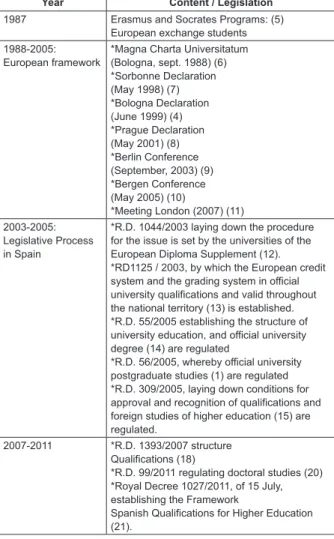
The evolution followed up to the enactment of the
new doctoral studies in Spain (Figure 1) has forced
structural and content changes in university curricula.
Plans that have been moving towards competitiveness
and improvements in teaching quality and research,
adapting in turn to the needs and social demands of the
nursing profession.
After the European Region Action Scheme for
the Mobility of University Students in 1987(5) in which
it contemplates the Plan of Action of the European
Community for the Mobility of University Students,
and the previous presentation of the Magna Charta
Universitatum of 1988(6) in Bologna when the uniication
of the European Higher Education started, was being
projected in May 1998 at the Sorbonne Declaration(7),
the design of the European Higher Education System.
The cited project became reality a year later with
the Bologna Declaration(4) established in 1999; a lexible system of qualiications, increased job opportunities for students, greater international competitiveness of the
European higher education system, and an adopting
system based on two cycles: Undergraduate and
Postgraduate.
With the previous European meetings held in
Prague(8), Berlin(9), Bergen(10) and London(11) new
aspects of its content were incorporated. Forming what
would be in the Spanish legislation, the procedure
for knowledge by the universities of the European
Diploma Supplement(12) being; The European credit system and qualiications in university degrees(13), the structure established by universities and degree
regulations(14), Postgraduate(1) and the conditions of approval and recognition of foreign qualiications and studies of Higher Education(15) until the inal document
of the European Studies Higher Education (EHEA)(16).
This with the consequent structural reform (division
and duration of the educational stages), curricular reform (deinition, development and curriculum design) and education reform (development of the teaching /
learning processes).
Year Content / Legislation
1987 Erasmus and Socrates Programs: (5)
European exchange students 1988-2005:
European framework
*Magna Charta Universitatum (Bologna, sept. 1988) (6) *Sorbonne Declaration (May 1998) (7) *Bologna Declaration (June 1999) (4) *Prague Declaration (May 2001) (8) *Berlin Conference (September, 2003) (9) *Bergen Conference (May 2005) (10)
*Meeting London (2007) (11) 2003-2005:
Legislative Process in Spain
*R.D. 1044/2003 laying down the procedure for the issue is set by the universities of the European Diploma Supplement (12). *RD1125 / 2003, by which the European credit system and the grading system in official university qualifications and valid throughout the national territory (13) is established. *R.D. 55/2005 establishing the structure of university education, and official university degree (14) are regulated
*R.D. 56/2005, whereby official university postgraduate studies (1) are regulated *R.D. 309/2005, laying down conditions for approval and recognition of qualifications and foreign studies of higher education (15) are regulated.
2007-2011 *R.D. 1393/2007 structure
Qualifications (18)
*R.D. 99/2011 regulating doctoral studies (20) *Royal Decree 1027/2011, of 15 July, establishing the Framework
Spanish Qualifications for Higher Education (21).
Figure 1 - Stages of European Higher Education Area
(EHEA)
The mechanisms to achieve this was focused on a lexible but comparable basic structure of qualiications as well as a common system of learning assessment
credits (ECTS) as a most suitable way to promote and
enable a wide mobility of students, with the creation of
ECTS credits contain between 25-30 hours / credit,
including class time and any other academic activity
performed by the student, distributing the ECTS (credits)
cited in 60 ECTS per academic year(17). This change
encourages and facilitates student mobility between
member countries of the European Union involved in this
reform process.
University degree studies are organized by
governments(14) in a very lexible way containing basic and general knowledge of the teaching qualiication, developing most of them in four years, and 240 ECTS
(60 ECTS per year), and Postgraduate studies an
understanding of the second and third cycle leading in
obtaining the Master’s and Doctor respectively(1).
The responsibility of organizing these graduate
programs is the universities one, with the authorization of
the Ministry of Education and the Autonomous Community
in addition to the accreditation of the National Agency
for Quality Assessment (ANECA)(19). This giving way to a more lexible model that allows various methodologies and actions for development according to the degree and proile of each university and not elaborating, initially, catalogues of postgraduate programs.
Regarding the title of Master, the fundamental
characteristic is the specialization of the student within
their academic, professional or as a research initiation.
As a must in order to gain access, a Bachelor degree or
equivalent is required and to pass the Master, students
must take between 60 and 120 ECTS, depending on
their prior degree of each program(18).
As for the title of Doctor, the objectives focus on
advanced training in research methods and techniques.
It is required to have completed between undergraduate and graduate in oficial programs, 300 ECTS and requires the development and presentation of a doctoral thesis
within a determined time period(20) in order to access.
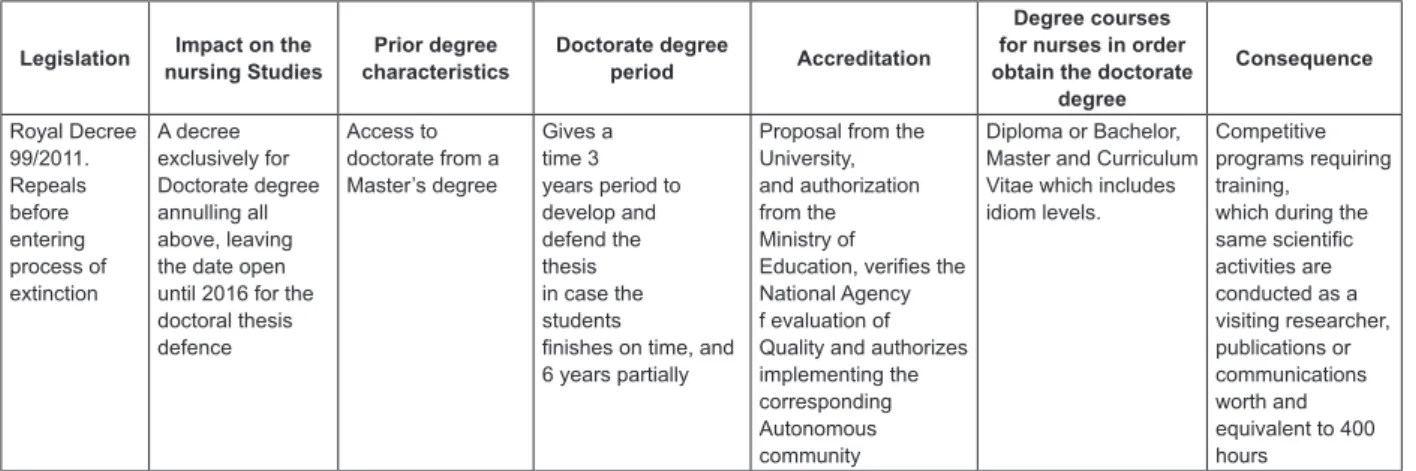
Following the above, we present a summary,
(Figure 2), the four royal decrees, as mentioned above,
related to the developments in the Spanish legislation
on doctoral studies, but now joined its characteristics
and impact on nursing studies.
Adaptable to changes and consistent academic
improvement which puts the nurse training in equal opportunities with better qualiications in the academic and research world, has not always been an easy task,
because they have had to overcome internal and external dificulties in their profession, but it has made it possible to get something as important as access to nurses, the
formation of a Third Cycle - the doctoral studies, from
the nurse discipline itself.
Legislation Impact on the nursing Studies Prior degree characteristics Doctorate degree period Accreditation Degree courses for nurses in order obtain the doctorate
degree
Consequence
Royal Decree 778/1998 of 30 April (2)
Nurses would have a certification of 3 years
(Bachelor degree) without a 2nd
possibility of a study / degree
Graduate, architect or engineer. Degree of 5 years
2 years for doctorate and a undefined time for the elaboration of the thesis
University proposal and authorization from the Ministry of Education
Anthropology Humanities Psychology among others.
In general the social science area
University studies focusses on the social sciences, leaving out the biological part of humans and diseases. Royal Decree 56/2005, dated January 21 (1) Structures all the universities degree in Spain, Bachelor and postgraduate (Master and Doctorate)
The academic grade access is a diploma, degree, architect or engineer between 60 and 120 credits training
For Masters the period for elaboration and doctoral thesis will begin and have no time limit
Proposal from the University, national accreditation for the graduation program of the Ministry of education and the Autonomous community
Nursing and a Master diploma
Implants of the first masters and doctorates in the nursing science department at Spanish universities Royal Decree 1393/2007 (18) The degree structure is clearly defined in three levels: Degree of 4 years and 240 ECTS, Master between 60 to 120 ECTS and
Doctorate Degree
The academic grade access for the Doctorate is the Master’s degree
Once admitted for Master, the students on the doctoral program do not have a time limit for their thesis
Proposal from the University, and authorization from the Ministry of education and the Autonomous community
Diploma or nursing degree and Masters
This produces an expansion for doctorate programs directed by nurses in all the Spanish universities
Discussion
Noting the synthesis presented in Figure 2, we
can say that the transition from legislation of Doctoral
programs in Spain in recent years(1-2,18,20), has a logical
sense from the perspective of the European convergence
and Spanish University System Reform walking towards
the comparability and quality. However, for nursing
studies these changes form an ongoing challenge for
the needs and demands in these new programs. In ten
years, nursing has gone from not having access to its
own Doctorate and have to meet very high requirements for a speciic program of Nursing.
Proof of this is what happened in the new doctoral
program taught at the University Jaume I of Castellón(22), speciic to nursing accredited under the legislation of 2011, which has not been without problems before the inal approval in the process for veriication and authorization. This forced nursing research groups from
different parts of Spain through collaboration agreement
to gathering to achieve the requirements of the National
Agency for Quality Accreditation(2. 3).
With the law of 2005(1) doctoral programs were implemented in the ields of nursing. However, the legislation of 2007(18) and the current 2011(20) be it for strategic or dificulty, have led to the presence of programs with name “Health Sciences” where the
nursing research is included in the program along with
other related research lines.
There are very few speciic “Nursing Science” programs associated with the current law. However, through speciic lines of research they can provide doctoral thesis based on the nurses research and
production contribution in future generations and an
improvement to both the profession and the health care
activity and by extension. Thanks to nursing we will
bring improvements to the lives of people with scientiic evidence.
Over the past 30 years nursing research has been
present in the professional and academic activity with
different initiatives.
In the health sector, the Health Institute Carlos III
through INVESTEN group(24) has promoted exchanges
between national and international research institutions
with excellent results for evidence-based practice among
others.
In hospitals and accredited research centres,
nurses have participated in advanced research
equipment. You can highlight the research conducted
by the nurses of the Hospital Clinic of Barcelona among
others(25-29).
The process towards its own investigation that
reverts around the care, started its 30 years. Current
legislation requires more and sometimes leading to a favourable outcome to generate scientiic evidence and the proper scope environment, caring for people. From
Doctoral programs led by advanced nurses involving
other professionals, such as the new case of PhD
program of Nursing Science of the University Jaume I
of Castellón(22) shown in Spain, is a better opportunity
for clinical practice improvement, completing a course
of study that began in 1998(2).
Conclusion
Currently, in the whole of Spanish Universities
Doctoral programs are covered by different legislation.
However programs legislation of 2011 with focus on
nursing, are quite rare.
The general academic and research is that a
high percentage of nurses holds a basic degree or a
specialized degree. Another smaller group, have masters
Legislation Impact on the nursing Studies
Prior degree characteristics
Doctorate degree
period Accreditation
Degree courses for nurses in order obtain the doctorate
degree
Consequence
Royal Decree 99/2011. Repeals before entering process of extinction
A decree exclusively for Doctorate degree annulling all above, leaving the date open until 2016 for the doctoral thesis defence
Access to doctorate from a Master’s degree
Gives a time 3 years period to develop and defend the thesis in case the students
finishes on time, and 6 years partially
Proposal from the University, and authorization from the Ministry of
Education, verifies the National Agency f evaluation of Quality and authorizes implementing the corresponding Autonomous community
Diploma or Bachelor, Master and Curriculum Vitae which includes idiom levels.
Competitive programs requiring training,
which during the same scientific activities are conducted as a visiting researcher, publications or communications worth and equivalent to 400 hours
degrees and a very small group obtain doctorates and
lead research projects.
The new scheme would place nursing in the same
stage of other professional groups with more clinical
tradition, teachers and research. That is to normalize
the situation of the nursing profession and the results
of the process launched almost ten years ago. This will
allow the next decades to increase the nurse minority
presented today with training in a third cycle or doctoral level with consistent proit academic and professional nurses in all functions (teaching, research, management
and assistance).
References
1. Real Decreto 56/2005 (ES). 21 de enero, por el que se
regulan los estudios universitarios oficiales de posgrado.
Boletin Oficial del Estado. [Internet]; 25 enero 2005
[acesso 28 ago 2014]. p. 2846. Disponível em: http://
www.boe.es/diario_boe/txt.php?id
2. Real Decreto 778/1998 (ES). 30 abril por el que
regula el Tercer Ciclo de estudios universitarios. Boletin
Oficial del Estado. [Internet]; 01 mayo 1998 [acesso 20
ago 2014]. p. 14689. Disponível em: https://www.boe.
es/diario_boe/txt.php?id=BOE-A-1985-2755
3. López Montesinos MJ. La construcción del Espacio
Europeo de Educación Superior. Rev Esc Enferm USP.
2007;41(1):7-12.
4. Ministerio de Educación, Cultura y Deporte. Educación
(ES). Declaración de Bolonia [Internet]. 1999. [acesso
21 ago 2014]. Disponível em: http://www.educacion.
gob.es/boloniaensecundaria/img/Declaracion_Bolonia.
5. European Region Action Scheme for the Mobility of
University Students. Plan de Acción de la Comunidad
Europea para la Movilidad de Estudiantes Universitarios
[Internet]. 1987. [acesso 7 ago 2014]. Disponível em:
http://www.erasmusproject.com/
6. Ministerio de Educación y Ciencia (ES). Magna
Charta Universitatum [Internet]. 1988. Bolonia hacia la
unificación del Espacio Europero de Educación Superior.
[acesso 7 ago 2014]. Disponível em: http://www.mecd.
gob.es/dctm/boloniaeees/documentos/09grupotrabajo/
b o l o n i a - y - l a - m a g n a - c h a r t a - u n i v e r s i t a t u m .
pdf?documentId=0901e72b8004aaa9
7. Ministerie van Onderwijs en Vorming (BE). Declaración
de la Sorbona. Declaración conjunta para la armonización
del diseño del Sistema de Educación Superior Europeo
[Internet]. 1998. [acesso 9 ago 2014]. Disponível
em: http://www.ond.vlaanderen.be/hogeronderwijs/
bologna/links/language/1998_Sorbonne_Declaration_
Spanish.pdf
8. Ministerio de Educación, Cultura y Deporte. Educación
(ES). Declaración de Praga Hacia el Área de la Educación
Superior Europea Declaración del encuentro de los
Ministros Europeos en funciones de la Educación
Superior [Internet]. mayo 2001. [acesso 24 ago 2014].
Disponível em: http://tecnologiaedu.us.es/mec2011/
htm/mas/2/21/11.pdf
9. Ministerio de Educación y Ciencia (ES). Conferencia
de Berlín [Internet]. Proceso de Bolonia: Realizando
el Espacio Europeo de Educación Superior. sep
2003. [acesso 25 ago 2014]. Disponível em: http://
www.educacion.gob.es/boloniaensecundaria/img/
Comunicado_berlin.pdf
10. Conferencia de Bergen (2005). El Espacio Europeo
de Educación Superior-Alcanzando las metas [Internet].
mayo 2005. [acesso 23 ago 2014]. Disponível em: http://
www.ond.vlaanderen.be/hogeronderwijs/bologna/links/
language/2005_Bergen_Communique_Spanish.pdf
11. Conferencia de Londres. Hacia el Espacio Europeo
de Educación Superior: respondiendo a los retos de un
mundo globalizado [Internet]. mayo 2007. [acesso 23
ago 2014]. Disponível em: http://www.ond.vlaanderen.
be/hogeronderwijs/bologna/documents/GRP_for_MC/
BolognaSecretariatReport_May07.pdf
http://www.ond.vlaanderen.be/hogeronderwijs/
bologna/links/language/2007_London_Communique_
Spanish.pdf
12. Real Decreto 1044/2003 (ES). 1 ago 2003, por el
que se establece el procedimiento para la expedición
por las universidades del Suplemento Europeo al
Título. Boletin Oficial del Estado. [Internet]. nº. 218,
de 11 de septiembre, p. 33848 a 33853. [acesso 13
ago 2014]. Disponível em: http://www.boe.es/boe/
dias/2003/09/11/pdfs/A33848-33853.pdf
13. Real Decreto 1125/2003, de 5 de septiembre, por
el que se establece el sistema europeo de créditos y el
sistema de calificaciones en las titulaciones universitarias
de carácter oficial y validez en todo el territorio nacional.
Boletin Oficial del Estado. [Internet]. nº. 224, de 18
sep 2003, p. 34355 a 34356. [acesso 13 ago 2014].
Disponível em: http://www.boe.es/diario_boe/txt.
php?id=BOE-A-2003-17643
14. Real Decreto 55/2005 (ES), de 21 de enero, por
el que se establece la estructura de las enseñanzas
universitarias y se regulan los estudios universitarios
oficiales de Grado. Boletin Oficial del Estado. [Internet].
ago 2014]. Disponível em: http://www.boe.es/boe/
dias/2005/01/25/pdfs/A02842-02846.pdf
15. Real Decreto 309/ 2005, por el que se regulan
las condiciones de homologación y convalidación de
títulos y estudios extranjeros de Educación Superior.
Boletin Oficial del Estado. [Internet]. nº 67, de 19
marzo 2005, p. 9643 a 9645. [acesso 25 ago 2014].
Disponível em:https://www.boe.es/diario_boe/txt.
php?id=BOE-A-2005-4574
16. Espacio Europeo de Educación Superior. Agencia
Nacional de Evaluación de la Calidad y Acreditación.
Bolonia hacia la convergencia [Internet]. 2008. [acesso
28 ago 2014]. Disponível em:http://www.eees.es/es/
eees-bolonia-hacia-la-convergencia
17. Agencia Nacional de Evaluación de la Calidad y
Acreditación. El programa de Convergencia Europea:
el Crédito Europeo [Internet]. [acesso 28 ago 2014].
Disponível en:
http://www.aneca.es/Documentos-y- p u b l i c a c i o n e s / O t r o s - d o c u m e n t o s - d e - i n t e r e s /
Convergencia-Europea
18. Real Decreto 1393/2007 (ES), de 29 de octubre,
por el que se establece la ordenación de las enseñanzas
universitarias oficiales. Boletin Oficial del Estado.
[Internet]. 2007; p. 44037. [acesso 24 ago 2014].
Disponível em: https://www.boe.es/diario_boe/txt.
php?id=BOE-A-2007-18770
19. Agencia Nacional de Evaluación de la Calidad y
Acreditación El programa de Convergencia Europea
de la ANECA. (ES). [Internet]. 2003-2006). [acesso
28 ago 2014]. Disponível em: http://www.aneca.es/
Documentos-y-publicaciones/Otros-documentos-de-interes/Convergencia-Europea
20. Real Decreto 99/2011 (ES), de 28 de enero, por el
que se regulan las enseñanzas oficiales de doctorado en
España. Boletin Oficial del Estado. [Internet]. 2011, p.
13909. [acesso 24 ago 2014]. Disponível em: http://
www.boe.es/buscar/doc.php?id=BOE-A-2011-2541
21. Real Decreto 1027/2011, de 15 de julio, por el
que se establece el Marco Español de Cualificaciones
para la Educación Superior. Boletin Oficial del Estado.
2011;(185):87912-8.
22. Universidad Jaume I. Castellón de la Plana (ES). Web
Doctorado Ciencias de la Enfermería. [acesso 28 ago
2014]. Disponível em: http://www.uji.es/bin/infoest/
estudis/doctorat/prog/cinfer.pdf
23. Macia Soler L, Orts Cortes I, Galiana Sanchez E,
Ors Montenegro A. Simultaneous implementation of
the Bachelor, Masters and PhD degrees in nursing in
the Universidad Jaume I. Castellón de la Plana, Spain.
Invest Educ Enferm. 2013;31(2): 305-14.
24. Ministerio de Economía y Competitividad (ES).
Unidad de Investigación en Cuidados de Salud. Instituto
de Salud Carlos III. Investen-isciii [Internet]. [acesso
30 ago 2014]. Disponível em: http://www.isciii.es
25. Hospital Clínic de Barcelona [Internet]. [acesso 30
ago 2014]. Disponível em: http://www.hospitalclinic.
org/
26. Giménez M, Conget I, Jansà M, Vidal M, Chiganer
G, Levy I. Efficacy of continuous subcutaneous insulin
infusion in Type 1 diabetes: a 2-year perspective using
the established criteria for funding from a National
Health Service. Diabet Med. 2007 Dec;24(12):1419-23.
27. Pozo-Rodríguez F, Alvarez CJ, Castro-Acosta A,
Melero Moreno C, Capelastegui A, Esteban C, et al.
Clinical audit of patients admitted to hospital in Spain
due to exacerbation of COPD (AUDIPOC study):
method and organisation]. Arch Bronconeumol. 2010
Jul;46(7):349-57. doi: 10.1016/j.arbres.2010.04.004.
Epub 2010 May 31.
28. Navarro García O, Cester García V, Cuxa Ainaud
N, Fernández Caneiro R, Hernández Carcereny C,
Ligero Martínez C, et al. [Intra-arterial catheterization
and monitoring in infants]. Rev Enferm. 1985
Jul-Aug;8(84-85):21-7.
29. Wübker A, Zwakhalen SM, Challis D, Suhonen R,
Karlsson S, Zabalegui A, et al. Costs of care for people
with dementia just before and after nursing home
placement: primary data from eight European countries.
Eur J Health Econ. 2014 Jul 29. Epub 2014 Jul 29.
Received: Sept 2nd 2014