w w w . r b o . o r g . b r
Case
report
Experience
of
a
Brazilian
surgeon
in
a
hand
transplant
case:
“What
I
saw,
what
I
learned”
夽,夽夽
João
Bosco
Rezende
Panattoni
Filho
a,
Tsu-Min
Tsai
b,
Huey
Tien
b,
Joseph
Kutz
b,∗aDepartmentofOrthopaedicSurgery,SaintLouisUniversity,St.Louis,USA
bKleinertKutzHandCareCenter,ChristineM.KleinertInstituteforHandandMicrosurgery,Louisville,Kentucky,USA
a
r
t
i
c
l
e
i
n
f
o
Articlehistory:
Received30August2012 Accepted9November2012
Keywords: Amputation Hand Therapy Transplantation
a
b
s
t
r
a
c
t
TheLouisvilleVCA(VascularizedCompositeAllograft)Programisoneofthelargesthand transplantprogramsintheworld.DuringmyhandsurgeryfellowshipattheChristineM. KleinertInstitute,theteamperformedtheeighthhandtransplantontheseventhrecipient inLouisville.TheLouisvilleVCAProgramhasdone9handtransplantsin8recipientswith onebilateralcase.Amongthesearethefirst5handtransplantcasesintheUnitedStates. Thefirstcasewasdonein1999andhastheWorld’slongestfollow-up.Theseventhcasewas performedina36-year-oldmaleonJuly10,2011.Theresultachievedsofarcanbe consid-eredexcellentwithaverygoodpatientsatisfaction.Thereisalargemultidisciplinaryteam involvedinsuchprocedureswithallmembersplayingacrucialrolefortheachievementof thebestresultpossible.Thepresentpaperfocusesonthesurgicalprocedureforthe sev-enthrecipient,whichwasuniqueduetothelevelofamputationoftherecipient’shand, withpreservationofnervetothethumb.
©2013SociedadeBrasileiradeOrtopediaeTraumatologia.PublishedbyElsevierEditora Ltda.Allrightsreserved.
Experiência
de
um
cirurgião
brasileiro
em
cirurgia
de
transplante
de
mão:
“O
que
vi,
o
que
aprendi”
Palavras-chave: Amputac¸ão Mãos Terapia Transplante
r
e
s
u
m
o
OProgramadeEnxertoAlográficoVascularizadoComposto(VascularizedComposite Allo-graftouVCAProgram)deLouisvilleéumdosmaioresdetransplantedemãonomundo. DuranteomeufellowshipemcirurgiadamãonoChristineM.KleinertInstitute,ogrupofez ooitavotransplantedemãonosétimoreceptoremLouisville.OVCAProgramdeLouisville jáfeznovetransplantesdemãoemoitoreceptores(umcasobilateral).Entreessesestãoos primeiroscincocasosdetransplantedemãonosEstadosUnidosdaAmérica.Oprimeiro foifeitoem1999,oqueteveomaislongoseguimentoemtodoomundo.Osétimocasofoi feitoemumpacientedosexomasculinode36anosem10dejulhode2011.Oresultado
夽
Pleasecitethisarticleas:PanattoniFilhoJBR,TsaiT-M,TienH,KutzJ.Experiênciadeumcirurgiãobrasileiroemcirurgiadetransplante demão:“Oquevi,oqueaprendi”.RevBrasOrtop.2013;48:567–573.
夽夽
WorkperformedattheChristineM.KleinertInstituteforHandandMicrosurgery,Louisville,Kentucky,USA. ∗ Correspondingauthor.
E-mail:[email protected](J.Kutz).
2255-4971/$–seefrontmatter©2013SociedadeBrasileiradeOrtopediaeTraumatologia.PublishedbyElsevierEditoraLtda.Allrightsreserved.
seráfocadonoprocedimentocirúrgicofeitonosétimoreceptor,quefoiconsideradoum casoespecial,porcausadoníveldaamputac¸ãodamãodopaciente,compreservac¸ãodo nervoparaopolegar.
©2013SociedadeBrasileiradeOrtopediaeTraumatologia.PublicadoporElsevier EditoraLtda.Todososdireitosreservados.
Introduction
Transplantationhasagreatfutureinthefieldofhandsurgery andreconstructivemicrosurgery.Sofar,72handtransplants havebeenperformedonatotalof51patientsaroundtheworld (30patientshadonehandtransplantedand21hadboth trans-planted)(www.handregistry.com).
Handtransplantationsurgeryisstillconsideredtobean experimentalprocedure but isa rapidlyexpanding typeof treatment.Itisnowperformedsuccessfullyinmorethan a dozenspecializedcentersworldwide1 andinfivecentersin theUnitedStates.2
Thepostoperativeresultsarevery promising,withgood patientsatisfaction,especially because ofrecoveryofgood functioninthetransplantedhand.Themainadvantagesof handtransplantation,incomparisonwithaprosthesis,are therecoveryofsensitivity,thecosmeticaspectandthe“heat” ofthetransplantedhand.3
Thefirstcaseofhand transplantation performedinthe modern era ofimmunosuppressionwas inFrance in 1998. Thetransplantedhandhadtobeamputatedtwoyearslater, afterthepatientdecidedtostoptakingimmunosuppressant drugs.4
Less than a year later, the Louisville VCA (Vascularized CompositeAllograft)Programperformedthefirsthand trans-plantationintheUnitedStates,inJanuary1999.Therecipient continuestobewelltothepresentday,withgoodrecoveryof functioninthetransplantedhand.Thelong-termfunctional resultexceededtheinitialexpectations.5
The Louisville VCA Program is a collaboration between thesurgeonsandteamsofKleinertKutzHandCareCenter, Jewish Hospital(now part ofKentucky One Health), Chris-tine M. Kleinert Institute and the University of Louisville. Thegrouphasnowperformedhandtransplantationsurgery on eight patients (one bilateral case) and hashad to deal withcomplicationssuchashiposteonecrosis,diabetes(due touse ofsteroids) and onecaseof graft lossnine months after the transplantation, due to vasculopathy.6 Despite theseproblems, sevenofthe eightpatientscontinue tobe very well. Even the patient who lost the graft wishes to undergoasecondtransplantation.Complicationsrelatingto immunosuppressionhavebeencontrolleduptothepresent day.
Inthefuture,itcanbeexpectedthatmoreandmore cen-terswillstarttoperformhandtransplantationsurgery,and that this procedure willcease tobe experimentaland will becomestandard.Moreover,withtheeconomicgrowththat Brazilisundergoing,webelievethatitisimportantforsurgery ofthistypetobeperformedinthiscountry,whichwouldmake
BrazilthelocationforthefirsthandtransplantationinSouth America.
Itisimportanttoemphasizethathandtransplantationis aprocedurethatdependslargelyonamultidisciplinaryteam forafavorableresulttobeobtained.Thisteamiscomposedof handsurgeons,transplantationsurgeons,psychiatrists,social workers,occupationaltherapists,nurses,immunologistsand coordinators.However,thepresentarticlefocusesonthe sur-gicaltechniqueusedinthecaseofpatientnumbersevenand howtheteamwasorganizedatthesurgicalcenter. Informa-tionontheimmunosuppressiontherapy(requiredfortherest ofthepatient’slife)andthepostoperativeoccupational ther-apyprotocolwillbediscussedinaseparatearticle.
TheseventhLouisvillepatientreceivedhishandtransplant on July10,2011.Therecipientwasa36-year-old manwho hadsufferedanindustrialaccidentonMarch9,1998.Inthe accident,bothofhisarmsbecametrappedinapress(chopping machine).Hisrighthand(dominanthand)wascrushedand hislefthandwaspartiallyamputated,distallytothewrist.The patientwasleftwithpartofhisleftthumbandleftwristwith adequatemovement(Fig.1).Therighthandsufferedsequelae ofmusclehypotrophybecauseofinjurytotheulnarnerve,but amputationwasnotrequired.
Thesurgical teamwas composedof16 surgeons (seven chiefsandninefellows).Oneofthechiefs(Dr.Kutz)wasthe leadingsurgeon:hefollowedupeverystepoftheprocedure andalsoorganizedhowthesurgicalteamswouldrotate.The firstauthor,Dr.JoãoPanattoni,fromCampinas(SP),Brazil,was presentandparticipatedintheproceduresasoneofthesenior fellows.
The anesthesia team was composed ofone anesthetist and one nurse who was an anesthesia specialist. General anesthesia was induced, with additional regional brachial plexusblock,forgreatervasodilatationandpostoperativepain control.Thenursingteamcomprisedthreenursesandtwo instrumenttechnicians.
Atthestartoftheoperation,twosurgicalteamsworked concomitantlyinthesamesurgicalroom.Theteamworking ontherecipientstartedfirst,whilethesecondteamharvested thelimbfromthedonor.Efficientcommunicationbetweenthe teamsisimportant,inordertoensurethatthelimbfromthe donorisinagoodconditionbeforeanesthesiaisinducedand surgeryisperformedontherecipient.
Surgicaltechnique
Figure1–Preoperativeappearance.
Source:ChristineM.KleinertInstitute.
Limbharvesting
Withtheaimofreducingthedurationofhotischemia, har-vestingandtransportationofthelimbfromthedonorwere doneasquicklyaspossible.Whenpossible,thehand harvest-ingteamgoes infirstanduses atourniquettoremovethe handorhands beforecross-clampingand organharvesting areperformedonthedonor.
Thebrachialarterywasidentifiedandprotectedandthe limbwas amputated atthe elbow joint.Preservation solu-tion(University ofWisconsin solution)at4degreesCelsius wasinfusedinto thebrachialarteryandtheopenareawas keptmoistusingcompressessoakedinphysiologicalserum. Thelimbwasthenplacedinaninsulatedplasticbag,which was then placed in an insulated box with ice. When the limbarrivedatthesurgicalcenter,wheretherecipientwas, infusionofpreservationsolutionwasstoppedandtheentire procedurewasperformedwiththe transplantpiecekeptat 0–4degreesCelsius(icebagsinsidesterilegloves)(Fig.2).
Surgicalincision
Whilethegraft from thedonorwas beingpreparedonthe surgicaltable,theskinofthedonorwasraisedbymeansoftwo incisions:onemediallyandonelaterally.Adelicatedissection wasperformedinordertoidentifythestructures.Depending onthetypeofinjurypresentedbytherecipient,theskinmay
Figure2–Maintenanceofthelimbinicewhilethe structureswerebeingidentified.
Figure3–Identificationandlabelingofthestructures.
Source:ChristineM.KleinertInstitute.
beraisedsoastoformaninterpositionflapwithfourstitches (twoonthedonorandtwoontherecipient).7
Oneveryimportantinitialstepwastoidentifythe struc-tures by stitching labels onto them. This is a very valid investmentofsurgicaltime,sinceitmakestheprocedureless confusingafterthelimbhasbeenconnectedbythebone.A goodwaytodothisishavetwosetsofsterileplasticatedlabels (oneforthedonorandonefortherecipient)withallthenames ofthestructures(tendons,nervesandvessels)(Fig.3).
However,dependingontherecipient’soriginalinjurythat causedtheamputation,identifyingthestructuresmaybevery challenging,whichmaycauseconfusionandleadtodelayed dissection.Thisisparticularlysoincasesofpatientswhoare victimsofburnsorinjuriescausedbyexplosives.Inourcase, delicateexplorationofthestructureswasdone,withspecial attentiontopreservationofthevessels(volaranddorsal ves-sels),whichpotentiallycouldbeusedinanastomoses.
Bone
Theboneneedstobestabilizedrapidlyandefficiently.Bone fixationwasdoneafterfinishingidentifyingallthestructures. Ifthetimelimitforthetourniquetisapproaching,itcanbe releasedaftergoodexposureofthebonehasbeenachieved, andtheplateisthenappliedwiththetourniquetdeflated.
Apediatricnasogastriccannulacanbeusedtoconnectthe recipient’sarterytothedonatedlimb,soastoenablegreater timeforperformingbonefixation.IntheseventhLouisville case,thiswasnotdonebecausebonefixationwascompleted
Figure4–Measurementoftheosteotomylocation.
Source:ChristineM.KleinertInstitute.
withinagood timeand theteam judgedthatashunt was unnecessary.
Amicrosawwasusedtocutthebonetransversallyinthe recipientandinthedonor.Oneadvantageinthispatientwas that hestillhad hiswristjoint.Thisgreatlyfacilitated the measurements:6cmwassubtractedfromtherecipientand thesamelengthwasobtainedinthepartofthedonorlimb thatwastobeconnected(Fig.4).Incasesinwhichthepatient haslostpartoftheforearm,carefulmeasurementsaremade based on the contralateral forearm and elbow joint before proceedingwithosteotomy.Itisimportanttonotethatthe ideaofcuttingoneforearmboneatatimedoesnotworkwell. Itispreferabletocuttheradiusandulnaonbothlimbsand then performbonefixation. Another optionistoplace the plateonthedonorbeforeperformingtheosteotomy,butthis wasnotdoneontheseventhLouisvillecase.
A3.5mmplate(LowContact-DynamicCompression Lock-ing Plate, Synthes) was used for both bones.8 In cases of transplantation moredistally, a 2.7mm plate forthedistal ulna and radiuscanbeused.Amini-image intensifierwas usedthroughoutourprocedure,inordertocheckforadequate platepositioningandbonereduction.
Vessel1
lactate,inaninfusionpumpat20mL/h.Dextranwasnotused, eitherduringoraftertheprocedure.
Thefirstarterydonewastheulnar.Thetechniqueusedwas “backwallfirst”, with8–0 monofilamentsuturing(Ethilon). The vena comitante was then done using 9–0 suturing (Ethilon),bymeansofthesametechnique.
Theteam’sopinionwasthatoncethetourniquethadbeen released afterarterial anastomosis had been performed, it couldnotbeinflatedagain,sincethiscouldputthe anasto-mosisatriskthroughformationofthrombi.Fromthattime onwards,thelimbwaskeptwarmed,withdampcompresses, andwasintermittentlyirrigatedwithwarmedphysiological serum.
Aftertheanastomosis ofthe first arteryhad been com-pleted,itwasimportanttoallowsomebleedingofthelimb foraround15min,soasto“washout”thepotentiallytoxic preservationsolutionthathadbeeninfusedduring harvest-ing.Duringthis waitingtime, theulnar nerve wassutured undermagnificationusingasurgicalmicroscope,using8–0 suturingthread(Ethilon),withoutusingfibringlue.Lastly,the radialarteryanditsvenacomitantewereanastomosedusing thesametechniqueandsamesizeofsuturingthreadasthat usedfortheulnararteryanditsvenacomitante.Thelargest ofthevenaecomitanteswasusedforeachartery(radialand ulnar),atthedistalleveloftheforearm.Thevenaecomitantes shouldnotbereliedonaloneforvenousdrainage,but they certainlyhelppreventcongestion.
Itwasimportanttotakecareregardingwristpositioning duringtheanastomosis.Giventhat,uptothatpoint,no ten-donshadbeenrepaired,thewristcouldeasilyhavebeenleft inahyperextendedposition,therebycausingtheanastomosis toberedundant,withtheriskofkinking.
Atthismoment,themicroscopewasremovedandthe ten-donrepairswerestarted.Specialattentionwasgiventothe patient’s vital signs, especially considering that the dorsal veins(whichhadnotyetbeenanastomosed)couldbe poten-tialsitesofmajorbloodloss.Itispreferabletomaintainthe patient’sarterialblood pressurehigherthan100×60mmHg
and the temperature of the operating theater above 25◦C.
Tendon
Theflexorandextensortendonswere connectedbymeans ofthePulvertafttechnique.10Allthetendonswererepaired proximallytotheretinaculum,inordertoavoidlimitations ofmobilityand“bowstring” deformity.Aninterwoven con-nection wasstabilized using X-format sutures withTycron 4.0 thread (Fig. 5). Since immediate aggressive postopera-tive therapy was envisaged, the suturing was reinforced usingFiberloop4.0thread(Arthrex),similarlytotheBecker technique.11Calibrationofthetendonsmaybedifficultand, here,the assistant’srole isimportantformaintaining ade-quatetensioninthetendonsandcorrectlypositioningthem onthefingersandwrist.
Theextensortendonswereconnectedafterfinishingthe nerveanastomoses(seebelow).Justlikewiththeflexors,the same Pulvertaft technique with Becker reinforcement was usedfortheextensortendons.10,11
Figure5–Pulvertafttechniqueontheextensortendon.
Source:ChristineM.KleinertInstitute.
Nerve
The median nerve was anastomosed after connecting the flexortendons.Forthispatient,oneadvantagewasthathestill hadpartofthisthumb.Therefore,itwassoughttomaintain themaximumlengthofmediannervepossibleinthe recip-ient. Themotorbranchwasanastomosedveryclosetothe thenarmuscles(targetmuscles),soastoenablerapid reinner-vation.Microscopicsurgerywasusedforthisprocedure,which wasdoneusing9–0monofilamentsuturingthread(Ethilon).
Asmentioned earlier,the ulnar nervewas repairedjust afterperformingthefirstarterialanastomosis,whilewaiting forthepreservationsolutiontobe“washedout”.Following this,thevolarskinwasbroughttogetherwithouttensioning it and,inordertoprotecttherecentlyrepairedvessels,the forearmwaspronated.Adorsal-radialaccessenabled anas-tomosisofthesensorybranchoftheradialnerve,whichwas doneusingsuturingthreadofsize9–0(Ethilon).Theextensor tendonswerethenconnected.
Vessel2
As many venous anastomoses as possible should be per-formed,inordertopreventgraftcongestion.Afterfinishing the extensor tendons,attention was giventorepairing the veins.Thismaybeoneofthebiggestchallengesofthehand transplantationprocedure.Theconditionoftherecipientand themechanismoftheoriginalinjurywilldefinehowdifficult thispartoftheoperationwillbe.
Atthistime,skinflapsweredeveloped.Theincisionsfor theskinflapsweremadecarefully,soastopreserveasmany veins as possible,even the small subcutaneousveins. The veinsthatpotentiallycouldbeusedweremarkedwith vas-cularclips.
volarvein).
Allthevenousanastomoseswereperformedunder mag-nificationusingasurgicalmicroscope,usingthe “backwall first”techniqueandmonofilamentsuturingthread(Ethilon). Asstated earlier, the venaecomitantes were anastomosed using9–0suturingthread.Becauseofthesmallersizeofthe subcutaneousveins,10–0suturingthreadhadtobeused.For thecephalicvein,8–0suturingthreadwasgoodenough.
Lastly,theskinwasclosedcarefullyinordertoprotectthe recentlyanastomosedveins.Non-compressivedressingswere appliedwithgauze,sterilecolonwoolandaplaster-castsplint extendingfromtheaxillatothepalmofthehand.
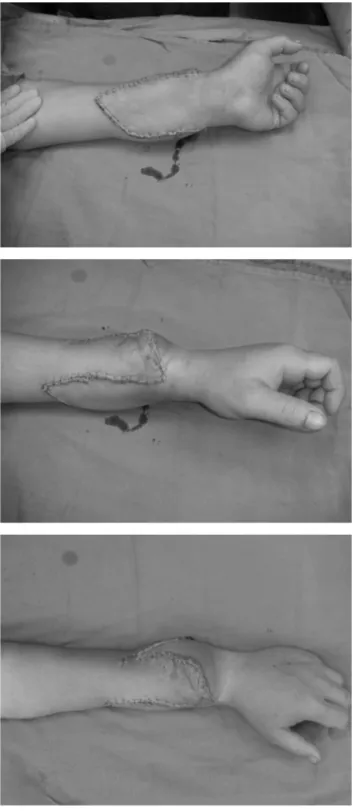
Theoperationtook14.5handtherewerenointraoperative complications.Therewere nosignsofarterialinsufficiency orvenouscongestion aftertheoperationandthereforethe patientdidnothavetobetakenbacktothesurgicalcenter (Fig.6).
Postoperativecare
Thepatienttoleratedtheoperativeprocedurewelland,after post-anesthesiarecovery,wastakentotheward.Theroom waskeptheated(at least25degreesCelsius).Theflapwas monitoredthrough observationson its color, capillary per-fusioninthefingersandtemperature.Theintervalbetween checkswashourlyonthefirstpostoperativedayandspaced outonsubsequentdays.Furthermore,anoximeterwasplaced ononeofthefingersofthetransplantedlimb,withcontrol doneonthecontralateralside.12
Thepatientwaskeptinhospitalfor14daysafterthe oper-ation, in order to control the pain and continue with the immunosuppressant medication.The occupationaltherapy servicestarted itswork withthepatient whilehewas still inthehospital.Thefirstchangeofdressingswasperformed threedaysaftertheoperation.
Discussion
Thepossibilityofobservingandparticipatinginhand trans-plantationsurgeryisarareeventandwasaspecialfeature ofthehandsurgeryfellowshipprogramattheChristineM. KleinertInstitute.Theseventhpatienttoreceiveatransplant (eighthtransplantedlimb)atthiscentercanbeconsideredto havebeenagreatsuccess.Patientselectioncertainlyhadan importantroleinthisresult.Thepatientwaswell-motivated anddisciplined.Moreover,theamputationlevelcanalsobe consideredtohavebeenanadvantage.Sincethe transplanta-tionwasdoneatwristlevel,therecipient’snerveswerekept aslong aspossible.Inaddition,the amputationlevel facil-itatedthe bonework andenabled fasterrecoveryofmotor function.
OnekeycomponentinthesuccessoftheLouisvillegroup is the availability ofa large group of well-trained special-ized surgeons. Thisenabledrotation duringthe procedure, so as always to have a surgeon resting for a different part of the surgery. Another advantage is that a surgeon
Figure6–Immediatepostoperativeresult.
Source:ChristineM.KleinertInstitute.
who was more specialized and had an interest in a cer-tain stage of the operation could perform his part and leaveanothersurgeontocontinuewiththenextstepofthe surgery.
thesuccessofthesurgery.Beingtheleaderwascertainlya verydifficulttask,sinceheneededtobepresentthroughout theprocedure,whichwouldnotnecessarilyapplytotheother surgeons.
Conclusion
Hand transplantation surgery produces very promising results. Therefore, it can be expected that this procedure willstarttobeperformedmoreandmoreoftenaroundthe world.
Withregardtothesurgicaltechnique,itisimportanttobe attentivetorefinementsandtechnicaladvancesofthe surgi-calprocedureandmakeacriticalanalysisinordertoassess whetheragivensurgicalservice/countryhastheconditions requiredtoperformit.
WiththecurrenteconomicgrowthoftheBrazilian econ-omy, the chances that this will be the location for the first hand transplantation in SouthAmerica are becoming greater.
Funding
Thepresentarticlewasbasedonworkthatwaspartlyfunded by the Medical Research Department of the UnitedStates Army,throughfundsW81XWH-07-2-0092and W81XWH-07-1-0185,andbytheNavyResearchDepartment,throughfund N000140610084. The opinions, interpretations, conclusions andrecommendationsare thoseoftheauthors anddonot necessarilyrepresentthose ofthe UnitedStatesArmyand Navy.
Conflicts
of
interest
Theauthorsdeclarenoconflictsofinterest.
r
e
f
e
r
e
n
c
e
s
1.PetruzzoP,LanzettaM,DubernardJM,MargreiterR,Schuind F,BreidenbachW,etal.Theinternationalregistryonhand andcompositetissuetransplantation.Transplantation. 2008;86(4):487–92.
2.RavindraKV,GorantlaVS.Developmentofanupper extremitytransplantprogram.HandClin.2011;27(4):531–8.
3.KaufmanCL,BlairB,MurphyE,BreidenbachWB.Anew optionforamputees:transplantationofthehand.JRehabil ResDev.2009;46(3):395–404.
4.DubernardJM,OwenE,HerzbergG,LanzettaM,MartinX, KapilaH,etal.Humanhandallograft:reportonfirst6 months.Lancet.1999;353(9161):1315–20.
5.JonesJW,GruberSA,BarkerJH,BreidenbachWC.Successful handtransplantation.Oneyearfollowup.LouisvilleHand TransplantTeam.NEnglJMed.2000;343(7):468–73.
6.KaufmanCL,OusephR,BlairBW,KutzJE,TsaiTM,Scheker LR,etal.Graftvasculopathyinclinicalhandtransplantation. AmJTransplant.2012;12(4):1004–16.
7.HartzellTL,BenhaimP,ImbrigliaJE,ShoresJT,GoitzRJ,Balk M,etal.Surgicalandtechnicalaspectsofhand
transplantation:isitjustanotherreplant?HandClin. 2011;27(4):521–30.
8.CavadasPC,LandinL,IbanezJ.Bilateralhandtransplantation: resultat20months.JHandSurgEurVol.2009;34(4):434–43.
9.LandinL,CavadasPC,Garcia-CosmesP,ThioneA, Vera-SempereF.Perioperativeischemicinjuryandfibrotic degenerationofmuscleinaforearmallograft:functional follow-upat32monthsposttransplantation.AnnPlastSurg. 2011;66(2):202–9.
10.BidicSM,VarshneyA,RuffMD,OresteinHH.Biomechanical comparisonbetweenlasso.Pulvertaftweave,andside-by-side tendonrepairs.PlastReconstrSurg.2009;124(2):567–71.
11.ChungKC,JunBJ,McGarryMH,LeeTQ.Theeffectofthe numberofcross-stitchesonthebiomechanicalpropertiesof themodifiedBeckerextensortendonrepair.JHandSurgAm. 2012;37(2):231–6.