Fast-track protocols in devascularization for cirrhotic portal
hypertension
YANG FEI1*, GUANG-QUAN ZONG2*, JIAN CHEN3, REN-MIN LIU4
1M.D – Professor. Department of General Surgery, the 81st Hospital of P.L.A., Nanjing,China 2M.D – Professor. Department of General Surgery, the 81st Hospital of P.L.A., Nanjing,China 3M.D – Professor. Department of General Surgery, the 81st Hospital of P.L.A., Nanjing,China 4M.D – Professor. Department of General Surgery, the 81st Hospital of P.L.A., Nanjing,China
SUMMARY
Study conducted at the 81st Hospital of P.L.A, Nanjing, China
Article received: 7/27/2014 Accepted for publication: 10/22/2014
*Correspondence: Address: 34 Biao Lane Nanjing – China Postal code: 210000 [email protected]
http://dx.doi.org/10.1590/1806-9282.61.03.250
Conflict of interest: none
Introduction/objective: fast-tract surgery (FTS) has been rapidly embraced by surgeons as a mechanism for improving patient care and driving down complica-tions and costs. The aim of this study was to determine if any improvement in out-comes occurred after FTS protocol for selective double portazygous disconnec-tion with preserving vagus (SDPDPV) compared with non-FTS postoperative care. Methods: patients eligible for SDPDPV in the period January 2012-April 2014 were randomly selected for the FTS group or non-FTS group. A designed proto-col was used in the FTS group with emphasis on an interdisciplinary approach. The non-FTS group was treated using previously established standard procedures. The number of postoperative complications, time of functional recovery and du-ration of hospital stay were recorded.
Results: patients in the FTS group (n=59) and non-FTS group (n=57) did not dif-fer in terms of preoperative data and operative details (p>0.05). The FTS proce-dure led to significantly better control and faster restoration of gastrointestinal functions, food tolerance, rehabilitation and hospital discharge (p<0.05). Postop-erative complications, including nausea/vomiting, severe ascites, wound infection, urinary tract infection and pulmonary infection were all significantly lower in the FTS group (p<0.05). According to the postoperative morbidity classification used by Clavien, overall complications and grade I complications were both significant-ly lower in the FTS group compared with the non-FTS group (p<0.05).
Conclusion: adopting the FTS protocol helped to recover gastrointestinal func-tions, to reduce frequency of postoperative complications and to reduce hospital stay. The FTS strategy is safe and effective in improving postoperative outcomes.
Keywords: medicare, portal hypertension, postoperative care, protocols, length of stay.
I
NTRODUCTIONAs a care strategy introduced to facilitate earlier discharge, fast-track surgery (FTS) programs, described by Kehlet et al.,1 have been developed by combining anesthesic
man-agement, innovational surgical technique, pre-/intra-/ post-operative management and nursing.2-5 Recently, FTS
were applied to major surgeries, including colectomy, hep-atectomy and urologic procedures to greatly accelerate recovery, limit physiologic stress response, reduce mor-bidity and shorten hospital stay or hospital cost of sur-gical patients.6-8 Despite the clear benefit of FTS
proto-cols in these surgeries, the combination between surgery and FTS protocols for cirrhotic portal hypertension (PHT) has not been well studied.
O
BJECTIVEM
ETHODSPatients and study design
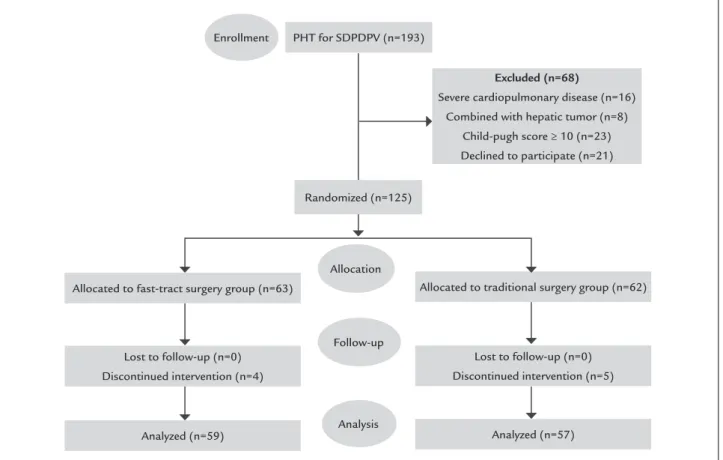
This prospective, monocentric, unblinded, randomized study included 193 patients who underwent SDPDPV from January 2012 to April 2014. All eligible patients were enrolled in the study. The inclusion criteria were: (1) SDPD-PV for PHT; (2) not combined with hepatic tumor; (3) with-out severe cardiopulmonary disease; (4) Child-Pugh score <10. Patients fulfilling inclusion criteria and consenting to participate in the study were randomized into one of two groups: FTS (63 patients) and non-FTS (62 patients). Simple unrestricted randomization using the standard envelope method was performed. Randomization was done by a nurse who was not involved in this study, when the patients were considered suitable to be included. Num-bered envelopes containing a sequence of included pa-tients determined their random distribution into the FTS or non-FTS groups. According to the envelope content, the patient was assigned to one of the monitored groups on the day of admission.
The preoperative evaluation and preparation for anes-thesia and surgery consisted of standard liver function tests, and preoperative endoscopic and ultrasonographic evalua-tions. Decisions on the patients’ treatment strategies were multidisciplinary. Patients’ demographics, body mass index (BMI), American Society of Anesthesiologists (ASA) grades, diagnoses, liver function tests and details of surgical proce-dures were recorded. The number of postoperative compli-cations, time of functional recovery and duration of hospi-tal stay were studied as well. Clavien grading, which ranks complications based on therapeutic consequences was used.9
The study was approved by the institutional review board of the 81st Hospital of P.L.A. Patient’s decision to
participate in the study was voluntary, and informed con-sent was obtained for randomization and treatment.
Surgical technique
The technique of SDPDPV was applied as described by Zong et al.10 The same operative setup and standardized
technique were applied for all patients. Procedures were performed by the same team of specialists in gastrointes-tinal and hepatobiliary surgery.
FTS and non-FTS group protocol
The FTS protocol in our institution consisted of pre/in-tro/postoperative management, and its details are shown in Table 1.
Patients randomized into the non-FTS group were instructed in the standard manner. Conventional infor-mation on PHT were informed to the patients.
Preop-erative respiratory physiotherapy was not offered to them. Four hours before operation, avoidance of oral fluid intake was carried out. Antibiotic prophylaxis was not performed in the patients. During the course of op-eration, ultrasound knife and reabsorbable clips were not used for dissection and vessel ligation. Patients had a feeding tube inserted if they agreed to this process, and they fasted from the midnight before surgery. The type of anesthesia was general anesthesia. Postoperative an-algesia comprised continuous epidural anan-algesia using local anesthetics combined with epidural morphine or subcutaneous morphine. Both methods were supple-mented by bolus administration of metamizol or diclof-enac. Insertion of gastric drainage tube, intra-abdominal drains and urinary catheter was routine. Postoperative oral intake and rehabilitation proceeded in the standard manner.
H
OSPITAL DISCHARGE CRITERIAPatients were fit for discharge when they had met the fol-lowing criteria, according to Fearon and our experience:11
1. Return of bowel function, passage of flatus or stool; 2. Tolerance of fluids and solid diet;
3. Pain control via oral analgesic; 4. Adequate patient mobility;
5. Wound healed well without seroma;
6. Curing hypersplenism and/or upper gastrointestinal hemorrhage;
7. Being happy to be discharged with adequate home support.
Discharge criteria were the same in both groups and at all time periods during this study.
Statistical analysis
Continuous data were described as medians (range) and analyzed with Student’s t-test. Categorical data were de-scribed as numbers and percentages and analyzed using Chi-square test. A p-value of less than 0.05 was consid-ered statistically significant. Statistical analysis was per-formed using statistical package for the social sciences Categorical data version 15.0 (SPSS Inc., Chicago, IL, USA).
R
ESULTSClinical characteristics
pa-tients were analyzed in the FTS group and 57 papa-tients in the control non-FTS group.
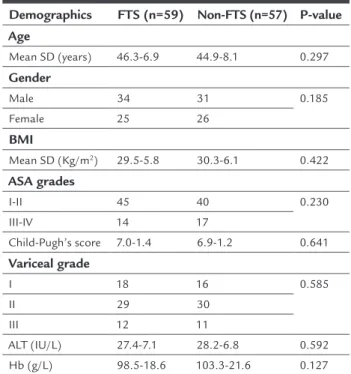
Baseline demographic characteristics of the two groups are shown in Table 1. There were no significant difference between the groups with respect to age, gender, BMI, ASA grades, Child-Pugh’s score, variceal grade, alanine amino-transferase (ALT) and hemoglobin (Hb) (p <0.05) (Table 2).
TABLE1 Fast-track surgery program of patients.
Preoperative management
1. Detailed information given to the patient regarding the therapeutic course, preoperative patient education focusing on recovery expectations
2. Preoperative respiratory physiotherapy
3. Avoidance oral fluid intake 12 hours before operation
Intraoperative management
1. Keep warm temperature in the operating room, warm normal saline to wash the abdominal cavity, and drip administration at a controlled temperature
2. Ultrasound knife and reabsorbable clips were used for dissection and vessel ligation
3. Antibiotic prophylaxis
4. Anesthetic protocol: insertion of epidural catheter (level T8-T9) 5. Adjusted hydration: replacement of blood loss and imperceptible
loss at the rate of 6-8 mL/kg/h
6. Control infusion fluid, especially excessive crystalloid solution
Postoperative protocol
1. Catheter with local anesthetics in continued perfusion, and removal of epidural analgesia 48 hours postoperatively
2. Respiratory physiotherapy and atomizing inhalation of Ambroxol during the first 72 hours
3. Removal of the abdominal drains after 48 hours if no more bloody fluid is observed
4. Discontinuation of gastric decompression by 8 a.m. the day after surgery 5. Patients are encouraged to drink immediately after recovery from
anesthesia. After flatus and oral tolerance is reached, a gradual transition from semi-liquid diet to soft diet/low fiber solid food 6. Removal of foley catheter on the third postoperative day 7. Intravenous injection furosemide (20mg /q.d) .during the first 72
hours. Thereafter, change to oral furosemide (20mg b.i.d.). 8. Prokinetic and somatostatin
9. Mobility, as much as possible from the first postoperative day (moving patients to a chair).
10. An emphasis on minimization of intravenous fluids to keep patients at their baseline weight.
11. Supplement plasma or human albumin on the basis of liver function and albumin values discretionarily to maintain concentration of
serum albumin not less than 30g/L
TABLE 2 Baseline patient demographics.
Demographics FTS (n=59) Non-FTS (n=57) P-value
Age
Mean SD (years) 46.3-6.9 44.9-8.1 0.297
Gender
Male 34 31 0.185
Female 25 26
BMI
Mean SD (Kg/m2) 29.5-5.8 30.3-6.1 0.422
ASA grades
I-II 45 40 0.230
III-IV 14 17
Child-Pugh’s score 7.0-1.4 6.9-1.2 0.641
Variceal grade
I 18 16 0.585
II 29 30
III 12 11
ALT (IU/L) 27.4-7.1 28.2-6.8 0.592 Hb (g/L) 98.5-18.6 103.3-21.6 0.127
ASA: American Society of Anesthesiologists; BMI: body mass index; FTS: Fast-track surgery.
Intraoperative data
There were no significant differences in the operative de-tails, including operative time and intraoperative blood loss between the FTS group and the non-FTS group (p=0.314, p=0.395). The difference of free portal pressure (FPP) between the two groups were not significant before splenectomy and after devascularization (p=0.261, p=0.192). Furthermore, no difference in the number of patients who had to be transfused was observed between the two groups (p=0.868) (Table 3).
Postoperative data
None of the patients died in the postoperative course within 30 days, and no patients were readmitted within 30 days of surgery.
Based on the protocol of FTS, the abdominal drain was removed much earlier in the FTS group than in the non-FTS group of patients. The difference was statisti-cally significant (p=0.002) (Table 4).
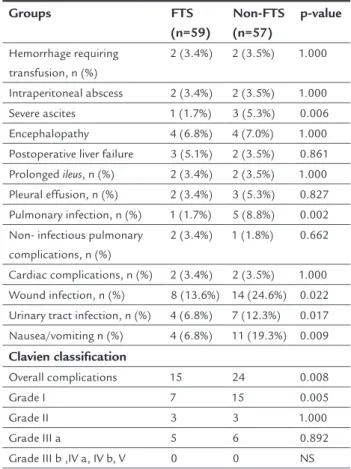
fi-protocol and in three patients (5.3%) treated with non-FTS protocol; the difference between the two groups was significant (p=0.006). Other complications, including non-infectious pulmonary complications, cardiac com-plications, prolonged ileus, pleural effusion and hemor-rhage (requiring transfusion) were similar in both recov-ery protocols (p >0.05).
Overall complications according to the postoperative morbidity classification used by Clavien are shown in Ta-ble 5; they were significantly lower in the FTS group (25.4%, 15/59) compared with the non-FTS group (42.1%, 24/57), (p=0.008). Grade I complications were much less frequent in the FTS group (11.9%, 7/59) compared with the non-FTS group (26.3%, 15/57) (p=0.005). Grade II postopera-tive complications in FTS group and non-FTS group were 5.1% (3/59) versus 5.3% (3/57), respectively (p=1.000). The result of grade III complications was similar to that of grade II (p=0.892). There were no grade IIIb, IVa, IVb and V com-plications in any of the two groups (Table 5).
TABLE 5 Postoperative complications.
Groups FTS
(n=59)
Non-FTS (n=57)
p-value
Hemorrhage requiring transfusion, n (%)
2 (3.4%) 2 (3.5%) 1.000
Intraperitoneal abscess 2 (3.4%) 2 (3.5%) 1.000 Severe ascites 1 (1.7%) 3 (5.3%) 0.006 Encephalopathy 4 (6.8%) 4 (7.0%) 1.000 Postoperative liver failure 3 (5.1%) 2 (3.5%) 0.861 Prolonged ileus, n (%) 2 (3.4%) 2 (3.5%) 1.000
Pleural effusion, n (%) 2 (3.4%) 3 (5.3%) 0.827 Pulmonary infection, n (%) 1 (1.7%) 5 (8.8%) 0.002 Non- infectious pulmonary
complications, n (%)
2 (3.4%) 1 (1.8%) 0.662
Cardiac complications, n (%) 2 (3.4%) 2 (3.5%) 1.000 Wound infection, n (%) 8 (13.6%) 14 (24.6%) 0.022 Urinary tract infection, n (%) 4 (6.8%) 7 (12.3%) 0.017 Nausea/vomiting n (%) 4 (6.8%) 11 (19.3%) 0.009
Clavien classification
Overall complications 15 24 0.008 Grade I 7 15 0.005 Grade II 3 3 1.000 Grade III a 5 6 0.892 Grade III b ,IV a, IV b, V 0 0 NS
D
ISCUSSIONFTS is a multidisciplinary approach aimed at minimiz-ing perioperative stress determinants to reduce postop-ber diet (3.9 0.6 days) more quickly than those in the
non-FTS group (6.3 1.8 days) (p=0.016), as recorded in Table 4. With respect to length of hospital stay, the patients in the FTS group were discharged from hospital significant-ly earlier than the non-FTS group (p=0.005). (Table 4).
TABLE 3 Operative details.
Demographic FTS
(n=59)
Non-FTS (n=57)
P-value
Operative time (min) 242.1-69.7 232.5-72.2 0.314 Intraoperative blood loss
(mL)
569.5-62.1 581.2-74.9 0.395
FPP before splenectomy (mmHg)
36.9-3.6 38.2-3.5 0.261
FPP after devascularization (mmHg)
22.4-3.2 23.8-3.6 0.192
Patients transfused, n (%) 3 4 0.868
FTS: fast-track surgery; FPP: free portal pressure.
TABLE 4 Short-term operative outcomes.
Outcomes (mean SD) FTS
(n=59)
Non-FTS (n=57)
p-value
Duration of abdominal drain (days)
2.6-1.9 5.8-2.4 0.002
Duration to first flatus (days) 1.7-0.5 2.8-0.7 0.021 Duration to first bowel
movement (days)
4.1-1.4 6.0-1.5 0.027
Duration to tolerating soft/low fiber diet (days)
3.9-0.6 6.3-1.8 0.016
Length of hospital stay (days) 17.3-5.5 23.6-7.3 0.005
FTS: fast-track surgery.
Postoperative complications
By univariate analysis, infectious complications includ-ing wound infection, urinary tract infection, pulmonary infection and intraperitoneal abscess were recorded (Ta-ble 5). The wound infection rates for the FTS group
ver-sus non-FTS group were 13.6 and 24.6%, respectively
erative complications and the time of recovery until “dai-ly normal activities” can be resumed.12 Evidence in
fast-track surgery suggests that it is associated with a re-duction in costs and risk of medical complications.13 Since
the early 1990s, minimally invasive surgical approaches have been investigated heavily in addition to anesthesi-ology stress-free techniques and postoperative fast reha-bilitation programs.14,15 However, utilizations of FTS
ap-proach in portal hypertension surgery to improve outcomes, reduce postoperative complications, and re-duce the length of hospital stay were not extensive; the benefits of fast-track portal hypertension surgery are not well recognized. In our study, we found that the FTS group had a significantly improved speed of gastrointestinal re-covery with respect to time to tolerate soft/low fiber diet, first flatus and first bowel movement. More importantly, this group showed decreased morbidity and a shorter hos-pital stay, which is consistent with data from other FTS literature.16-18
The key to FTS was reducing stress to patients. Pa-tients can benefit from evaluation and education to re-duce stress preoperatively.19 After receiving perioperative
information, patients could understand the aim to FTS protocol and course of treatment. Thus, patients would not only feel relaxed, without fear or anxiety, but also be in favor of FTS protocol. Better patient cooperation brings better recovery outcomes. A successful FTS program re-quires the formation of a multidisciplinary team consist-ing of surgeons, anesthesiologists and nurses. The team requires full commitment of all individuals to perform the specific tasks of the FTS program. Specialized nurs-es may even reduce mortality and failure-to-rnurs-escue ratnurs-es.20
Insulation in the operating room can prevent stress from rewarming after hypothermia which might lead to blood coagulation dysfunction and reperfusion injury. Proper analgesia not only can reduce the pain-related stress response, but also increase the confidence of pa-tients to overcome the disease.21
It has been verified that patients who suffer from less postoperative nausea and vomiting normally have earli-er recovearli-ery of ileus and shorter length of hospital stay. 22-24 However, many factors influence the incidence of
post-operative nausea and vomiting. The use of volatile anesthetics, nitrous oxide25 and intra/post-operative
opi-oids are risk factors related to anaesthesia.26,27 One
com-ponent we could influence was the choice of anesthesia. Epidural anesthesia was used in FTS group to exclude the effect from volatile components. Starvation and thirst are potential risk factors of postoperative nausea and vomiting that need to be further investigated.28 Our
peri-operative design also aimed to minimize these influenc-es (e.g. avoiding preoperative oral fluid intake and early postoperative oral intake of both fluid and food). Long-term indwelling gastric tube is another risk factor,29 so
discontinuation of gastric decompression by 8 a.m. the day after surgery was performed in the FTS group. The results showed that there was significantly less nausea and vomiting in the FTS group as compared to the non--FTS group. Early enforced mobilization is a critical step in the FTS protocol. To have a successful early mobiliza-tion, adequate pain control and good nursing care are important. Epidural catheter with local anesthetics in continued perfusion allows patients to move soon after surgery. A good FTS protocol can result in significantly less stress, less postoperative complication and better comfort for patients after surgery. Patients who suffer from less postoperative nausea and vomiting normally have earlier recovery of ileus and shorter length of hospi-tal stay. 30,31
Postoperative infection was one of the most impor-tant reasons that could increase the length of hospital stay.32,33 It is well known that moving as much as
possi-ble postoperatively not only promotes gastrointestinal motility and reduces the incidence of urinary retention, but also accelerates recovery of lung function and wound healing.30,34,35 Then, the rate of pulmonary, urinary tract
and wound infection would decrease. Based on that, pa-tients in the FTS group were encouraged to perform am-bulation early. Wichmann et al. found that FTS led to a better-preserved cell-mediated immune function (T cells, T-helper cells, natural killer cells), while the pro-inflammatory response (C-reactive protein, interleu-kin-6) remained unchanged.36 It was beneficial to promote
wound healing and reduce the probability of infection. In our study, the difference of wound infection, urinary tract infection and pulmonary infection in the FTS group
versus non-FTS group was significant. Furthermore, ear-ly removal of foley catheter and respiratory physiother-apy/atomizing inhalation of Ambroxol in FTS group can also reduce infection in the urinary and respirato-ry tracts.
Ascites was sometimes difficult to be controlled post-operatively.37 The mechanisms include a high hydrostatic
pressure of portal hypertension leading to increased pro-duction and transudation of hepatic and splanchnic lymph into the peritoneal cavity. The ascitogenic effect of dissec-tion with lymphatic interrupdissec-tion may also explain the high-er rate of early postophigh-erative ascites afthigh-er ophigh-eration.38,39
might be damaged. So, we tried to control ascites postop-eratively by using diuretics and supplying human albumin at an early stage. This was beneficial for patients on early ambulation, recovering their gastrointestinal function.
In our study, grade I postoperative complications, which needn’t pharmaceutical treatment or any other in-terventions, could be reduced by FTS protocol. The ap-pearance of complications had significant implications for the length of hospitalization. So FTS protocol could effectively reduce the length of hospitalization.
FTS is an ongoing conducted, and can be improved at all times. For example, laparoscopic procedure on de-vascularization and splenectomy has been commended.40
For an experienced surgeon, laparoscopic SDPDPV is safe with acceptable morbidity and mortality. Laparoscopic SDPDPV can significantly reduce stress response, speed up the rehabilitation of patients and lead to shorter length of hospital stay after surgery. However, in this study, we only compared open SDPDPV with or without FTS pro-gram. Further studies are needed with a focus on the in-fluence of laparoscopic SDPDPV with FTS program af-ter surgery.
FIGURE 1 Flowchart of participants through each stage.
C
ONCLUSIONRehabilitation using the FTS protocol was faster com-pared with non-FTS protocol after SDPDPV. Gastroin-testinal function was also restored sooner, which may be associated with forced early oral intake, and more fre-quent time spent out of bed. Lower frequency of postop-erative complications may be the result of significantly less use of intervention inlets in the FTS group. Further-more, FTS procedures led to significantly shorter hospi-tal stays. The FTS strategy is safe and effective in improv-ing postoperative outcomes.
R
ESUMOProtocolos rápidos em desvascularização para hiperten-são portal por cirrose.
Objetivo: a cirurgia fast-track (FTS) foi rapidamente abra-çada por cirurgiões como um mecanismo para melhorar o atendimento ao paciente e reduzir complicações e cus-tos. O objetivo deste estudo foi determinar se qualquer melhoria nos resultados de um protocolo FTS para
des-PHT for SDPDPV (n=193)
Randomized (n=125) Enrollment
Allocation
Follow-up
Analysis
Allocated to fast-tract surgery group (n=63) Allocated to traditional surgery group (n=62)
Analyzed (n=59) Analyzed (n=57)
Lost to follow-up (n=0) Discontinued intervention (n=4)
Lost to follow-up (n=0) Discontinued intervention (n=5)
Excluded (n=68)
Severe cardiopulmonary disease (n=16) Combined with hepatic tumor (n=8)
conexão seletiva dupla porta (SDPDPV), quando compa-rado ao cuidado pós-operatório não FTS.
Métodos: pacientes candidatos a SDPDPV, no período de janeiro de 2012 a abril de 2014, foram selecionados aleatoriamente para o grupo FTS ou grupo não FTS. Um protocolo projetado foi utilizado no grupo FTS, com ên-fase em uma abordagem interdisciplinar. O grupo não FTS foi tratado por meio de procedimentos padrão, es-tabelecidos previamente. O número de complicações pós--operatórias, o tempo de recuperação funcional e o
tem-po de internação hospitalar foram registrados.
Resultados: os pacientes do grupo de FTS (n=59) e gru-po não FTS (n=57) não diferiram em termos de dados pré-operatórios e detalhes cirúrgicos (p>0,05). O proce-dimento FTS levou à melhora significativa do controle e à restauração mais rápida das funções gastrointestinais, tolerância alimentar, reabilitação e alta hospitalar (p<0,05). Complicações pós-operatórias, incluindo náuseas/vômi-tos, ascite grave, infecção da ferida, infecção urinária e in-fecção pulmonar foram significativamente menores no grupo FTS (p<0,05). De acordo com a classificação de morbidade pós-operatória utilizado por Clavien, compli-cações gerais e complicompli-cações de classe I foram ambas sig-nificativamente mais baixas no grupo de FTS em compa-ração com o grupo não FTS (p<0,05).
Conclusão: a adoção do protocolo FTS ajudou a recupe-rar as funções gastrointestinais, reduzir a frequência de complicações pós-operatórias e reduzir tempo de inter-nação hospitalar. A estratégia FTS é segura e eficaz para melhorar os resultados pós-operatórios.
Palavras-chave: medicare, hipertensão portal, cuidados
pós-operatórios, protocolos, tempo de internação.
R
EFERENCES1. Bardram L, Funch-Jensen P, Jensen P, Crawford ME, Kehlet H. Recovery after laparoscopic colonic surgery with epidural analgesia, and early oral nutrition and mobilisation. Lancet. 1995; 345(8952):763-4.
2. Veenhof AA, Vlug MS, van der Pas MH, Sietses C, van der Peet DL, de Lange-de Klerk ES, et al. Surgical stress response and postoperative immune function after laparoscopy or open surgery with fast track or standard perioperative care: a randomized trial. Ann Surg. 2012; 255(2):216-21.
3. Zargar-Shoshtari K, Paddison JS, Booth RJ, Hill AG. A prospective study on the influence of a fast-track program on postoperative fatigue and functional recovery after major colonic surgery. J Surg Res. 2009; 154(2):330-5. 4. Muehling B, Schelzig H, Steffen P, Meierhenrich R, Sunder-Plassmann L,
Orend KH. A prospective randomized trial comparing traditional and fast-track patient care in elective open infrarenal aneurysm repair. World J Surg. 2009; 33(3):577-85.
5. Hübner M, Schäfer M, Demartines N, Müller S, Maurer K, Baulig W, et al. Impact of restrictive intravenous fluid replacement and combined epidural analgesia on perioperative volume balance and renal function within a Fast Track program. J Surg Res. 2012; 173(1):68-74.
6. Mechet-Boillot I, Bongiovanni JP. [Fast tract rehabilitation in colonic surgery]. Ann Chir. 2005; 130(3):141-3.
7. van Dam RM, Hendry PO, Coolsen MM, Bemelmans MH, Lassen K, Revhaug A, et al. Initial experience with a multimodal enhanced recovery programme in patients undergoing liver resection. Br J Surg. 2008; 95(8):969-75. 8. Raue W, Haase O, Junghans T, Scharfenberg M, Müller JM, Schwenk W.
‘Fast-track’ multimodal rehabilitation program improves outcome after laparoscopic sigmoidectomy: a controlled prospective evaluation. Surg Endosc. 2004; 18(10):1463-8.
9. Clavien PA, Barkun J, de Oliveira ML, Vauthey JN, Dindo D, Schulick RD, et al. The Clavien-Dindo classification of surgical complications: five-year experience. Ann Surg. 2009; 250(2):187-96.
10. Zong GQ, Fei Y, Chen J, Liu RM. Selective double disconnection for cirrhotic portal hypertension. J Surg Res. 2014; 192(2):383-9.
11. Fearon KC, Ljungqvist O, Von Meyenfeldt M, Revhaug A, Dejong CH, Lassen K, et al. Enhanced recovery after surgery: a consensus review of clinical care for patients undergoing colonic resection. Clin Nutr. 2005; 24(3):466-77. 12. Kehlet H, Wilmore DW. Fast-track surgery. Br J Surg. 2005; 92(1):3-4. 13. Kehlet H, Wilmore DW. Evidence-based surgical care and the evolution of
fast-track surgery. Ann Surg. 2008; 248(2):189-98.
14. Carli F, Kehlet H, Baldini G, Steel A, McRae K, Slinger P, et al. Evidence basis for regional anaesthesia in multidisciplinary fast-track surgical care pathways. Reg Anesth Pain Med. 2011; 36(1):63-72.
15. Kehlet H. Multimodal approach to control postoperative pathophysiology and rehabilitation. Br J Anaesth. 1997; 78(5):606-17.
16. Larson DW, Batdorf NJ, Touzios JG, Cima RR, Chua HK, Pemberton JH, et al. A fast-track recovery protocol improves outcomes in elective laparoscopic colectomy for diverticulitis. J Am Coll Surg. 2010; 211(4):485-9. 17. Jakobsen DH, Sonne E, Andreasen J, Kehlet H. Convalescence after colonic
surgery with fast-track vs conventional care. Colorectal Dis. 2006; 8(8):683-7. 18. Basse L, Thorbøl JE, Løssl K, Kehlet H. Colonic surgery with accelerated
rehabilitation or conventional care. Dis Colon Rectum. 2004; 47(3):271-7; discussion 277-8. Erratum in: Dis Colon Rectum. 2005; 48(8):1673. Dis Colon Rectum. 2004; 47(6):951.
19. Wilmore DW. From Cuthbertson to fast-track surgery: 70 years of progress in reducing stress in surgical patients. Ann Surg. 2002; 236(5):643-8. 20. Darrab AA, Fan J, Fernandes CM, Zimmerman R, Smith R, Worster A, et al.
How does fast track affect quality of care in the emergency department? Eur J Emerg Med 2006; 13(1):32-5.
21. Carrive P, Churyukanov M, Le Bars D. A reassessment of stress-induced “analgesia” in the rat using an unbiased method. Pain. 2011; 152(3):676-86. 22. Kariv Y, Delaney CP, Senagore AJ, Manilich EA, Hammel JP, Church JM, et al. Clinical outcomes and cost analysis of a “fast track” postoperative care pathway for ileal pouch-anal anastomosis: a case control study. Dis Colon Rectum. 2007; 50(2):137-46.
23. Farquhar M, Higginson IJ, Booth S. Fast-track trials in palliative care: an alternative randomized controlled trial design. J Palliat Med. 2009; 12(3):213. 24. French JJ, Mansfield SD, Jaques K, Jaques BC, Manas DM, Charnley RM.
Fast-track management of patients undergoing proximal pancreatic resection. Ann R Coll Surg Engl. 2009; 91(3):201-4.
25. Apfel CC, Kranke P, Katz MH, Goepfert C, Papenfuss T, Rauch S, et al. Volatile anaesthetics may be the main cause of early but not delayed postoperative vomiting: a randomized controlled trial of factorial design. Br J Anaesth 2002; 88(5):659-68.
26. Junger A, Hartmann B, Benson M, Schindler E, Dietrich G, Jost A, et al. The use of anesthesia information management system for prediction of antiemetic rescue treatment at the postanesthesia care unit. Anesth Analg 2001; 92(5):1203-9. 27. Stadler M, Bardiau F, Seidel L, Albert A, Boogaerts JG. Difference in risk factors
for postoperative nausea and vomiting. Anesthesiology. 2003; 98(1):46-52. 28. Palazzo M, Evans R. Logistic regression analysis of fixed patient factors for
postoperative sickness: a model for risk assessment. Br J Anaesth 1993; 70(2):135-40.
29. Nygren J, Thacker J, Carli F, Fearon KC, Norderval S, Lobo DN, et al. Enhanced Recovery After Surgery (ERAS) Society, for Perioperative Care; European Society for Clinical Nutrition and Metabolism (ESPEN); International Association for Surgical Metabolism and Nutrition (IASMEN). Guidelines for perioperative care in elective rectal/pelvic surgery: Enhanced Recovery After Surgery (ERAS(®)) Society recommendations. World J Surg. 2013; 37(2): 285-305.
30. Padilla Alarcón J, Peñalver Cuesta JC. Experience with lung resection in a fast-track surgery program. Arch Bronconeumol. 2013; 49(3):89-93. 31. Jayne DG, Thorpe HC, Copeland J, Quirke P, Brown JM, Guillou PJ.
laparoscopically assisted versus open surgery for colorectal cancer. Br J Surg 2010; 97(6):1638-45.
32. Markou T, Chambers DJ. Lung injury after simulated cardiopulmonary bypass in an isolated perfused rat lung preparation: Role of mitogen-activated protein kinase/Akt signaling and the effects of theophylline. J Thorac Cardiovasc Surg. 2014; 148(5): 2335-44.
33. Cogbill TH, Cofer JB, Jarman BT. Contemporary issues in rural surgery. Curr robl Surg. 2012; 49(5):263-318.
34. Ryan AT, Luscombe-Marsh ND, Saies AA, Little TJ, Standfield S, Horowitz M, et al. Effects of intraduodenal lipid and protein on gut motility and hormone release, glycemia, appetite, and energy intake in lean men. Am J Clin Nutr. 2013; 98(2):300-11.
35. Khan S, Wilson T, Ahmed J, Owais A, MacFie J. Quality of life and patient satisfaction with enhanced recovery protocols. Colorectal Dis. 2010; 12(12):1175-82.
36. Wichmann MW, Eben R, Angele MK, Brandenburg F, Goetz AE, Jauch KW. Fast-track rehabilitation in elective colorectal surgery patients: a prospective clinical and immunological single-centre study. ANZ J Surg. 2007; 77(7):502-7. 37. Di Carlo I, Toro A. Correct indication for surgery can prevent postoperative ascites in cirrhotic patients affected by hepatocellular carcinoma. World J Surg. 2012; 36(7):1719-20.
38. Hoekstra LT, Wakkie T, Busch OR, Gouma DJ, Beuers U, van Gulik T. Predictors of posthepatectomy ascites with or without previous portal vein embolization. Dig Surg. 2012; 29(6):468-74.