FREE THEMES
1 Departamento de Saúde Coletiva, Faculdade de Ciências Médicas, Universidade Estadual de Campinas. R. Tessália Vieira de Camargo 126, Cidade Universitária. 13083-887 Campinas SP Brasil. [email protected]
Survival of patients with AIDS and co-infection with the
tuberculosis bacillus in the South and Southeast regions of Brazil
Abstract The study investigates the survival of patients with co-infection AIDS-TB through a re-trospective study of a cohort of individuals aged 13 or more and the diagnosis of AIDS reported in the years 1998-99 and following 10 years. Of the 2,091 AIDS cases, 517 (24.7%) had positive diagnosis for tuberculosis, and 379 (73.3%) were male. The risk among co-infected patients was 1,65 times the not co-infected. Have been com-pared the exposed and non-exposed through the Kaplan-Meier and Cox method. The variables as-sociated with longer survival were: female gender
(HR = 0.63), educational level ≥ eight years (HR
= 0.52), CD4 diagnostic criteria (HR = 0.64); and
shorter survival: age ≥ 60 years (HR = 2.33), no
use of HAART (HR = 8.62), no investigation to Hepatitis B (HR = 2.44) and opportunistic
in-fections ≥ two (HR = 1.97). The average survival
rate, related to TB infection was 69 months for the Southeast region and 73 months for the South. AIDS and tuberculosis require monitoring and treatment adherence and they are markers of the
quality of care and survival of patients in Brazil.
Key words AIDS, Survival analysis, Tuberculosis Márcio Cristiano de Melo 1
Maria Rita Donalisio 1
M
elo MC
Introduction
The survival and evolution of AIDS patients’ clinical and laboratorial conditions improved considerably after Brazil’s Health Ministry start-ed offering Highly Active Antiretroviral Therapy (HAART) in 1996. In addition, it has been no-ticed a decrease in internment of people living with HIV/AIDS, as well as fewer opportunistic infections and an increase in chronic diseases, such as hepatic, cardiovascular, renal, among others1-5.
Despite the positive impact in patients’ sur-vival, the lack of access to medication, to health care – mainly specialized assistance – and diffi-culties referring to treatment adhesion still have a negative impact in case outcomes, influenced by socioeconomic situation1,6,7. Besides social and medical-assistance factors, opportunistic in-fections also relate to AIDS prognostic, such as tuberculosis and comorbidities.
The study on survival of people with AIDS is a way to evaluate the epidemic situation, par-ticularly the impact of intervention policies and measures. In a cohort of patients, from south and southeast regions, diagnosed in 1998 and 1999, 59,4% of the adults survived 108 months2. These estimates were greater than what have been found in a national study of notified patients from 1996, with mean survival of 58 months3, and even greater if compared to estimated sur-vival of 5,1 months back in the beginning of the epidemic, from 1982 to 1989, before the antiret-roviral therapy8.
AIDS-Tuberculosis co-infection cases are of-ten reported in several places worldwide9, partic-ularly in regions with high prevalence of tuber-culosis, reaching mainly marginalized and poor segments from society10,11.
The Brazil presented the highest number of tuberculosis (TB) cases in Latin America in 2013. Although a TB morbidity and mortality decrease tendency has been observed, the country12-14 pre-sented an incidence of 46 cases per 100.000 in-habitants in that year15.
It is possible to consider that AIDS pandem-ic resulted in a great impact in TB epidemiology. The co-infection is of great concern due to the fact that HIV is the greatest risk factor for TB development10,16, a disease yet to be controlled in developing countries, even there being means to diagnose and cure.
Among AIDS related diseases, TB is partic-ularly important because it is contagious, treat-able, and frequently one of the earliest clinical
manifestations of immunologic deficiency. Up-holds itself as one of the main AIDS defining dis-eases, topping pneumonia caused by
Pneumocys-tis jiroveci since 2001 17.
There are, in Brazil, great differences in TB incidence and mortality, particularly higher in regions with greater prevalence of HIV infec-tions 18,19. Besides, AIDS-Tuberculosis co-infec-tion is identified as an associated factor in TB internment cases 20. Other variables have been considered for co-infection prognostic better understanding, particularly CD4 levels in other regions of the world 13,14,21,22.
Tuberculosis is a high prevalence disease in Brazil. However, there are few population based studies about associated factors on patient sur-vival with co-infection and its mortality impact 6,23-25.
The objective of this study was to analyze patient survival time with AIDS-Tuberculosis co-infection, according to sociodemographic, epidemiologic, clinical, and health care use traits in South and Southeast regions of Brazil.
Method
This is a retrospective cohort study of medical records sample of individuals with an AIDS di-agnosis of 13 years or more, reported to Notifica-tion Harm InformaNotifica-tion System (SINAN) in 1998 and 1999, with a 10-year following.
The regions studied were South and South-east, which have populations of 29.016.114 and 85.115.623 inhabitants, and territorial area of 576.773,368 km2 and 924.616,968 km2, re-spectively26. The Studied cohort was assembled through sortition of cities from the regions, where there have been more than 40 cases through the year, totaling 33 and 90 cities, respectively, in the South and Southeast regions 2.
As a study inclusion criteria, should be point-ed out the case confirmation according to cur-rent definition stated by Brazil’s Health Ministry, by the time of this study conduction, that is, an adapted Center of disease control (CDC), Rio de Janeiro/Caracas, CDC Exceptional Criteria, Death Exceptional Criteria, Antiretroviral Excep-tional use Criteria (ARC) + Death and T-CD4 cell count (less than 350/mm3, independent of symptoms)27. These criteria observation was ver-ified during medical records analysis.
e C
ole
tiv
a,
22(11):3781-3792,
2017
cases first diagnosed because of death, ARC crite-ria + death and ignored critecrite-ria.
Were identified 29.600 and 8.979 cases, dis-tributed through 90 and 33 cities in Southeast and South regions, respectively. Sample sizes planned for Southeast and South regions were of 1.484 and 898 patients. These numbers would allow to consider statistically significant differences of 5 and 9 months of median survival between groups compared in each region. An uneven sharing of the sample by strata (region) was chosen in order to lower differences between sample fractions2.
In each region, sampling by gathering was utilized in two stages: cities (or city groups) and patients. The sample primary units sortition was made with proportional probability to notifica-tion number. Cities that did not have a minimal notification number were grouped to larger ones.
The sample fractions were of 1/13,369 to Southeast region, and of 1/6,873 to South re-gion, being picked 18 primary sample units in the Southeast and 10 in the South, corresponding to 14 and 9 cities, respectively. To compensate for different selection probabilities in the regions, data collected were pondered, being that the weight for each patient was given by the inverse sample fraction of the region he or she belonged.
The medical reports analysis granted regis-try of sociodemographic variables, skin color, schooling in years, age group; epidemiological: HIV exposure category, sexual practice, mates number. Clinical variables were also utilized, such as comorbidity presence, antiretroviral regular use, AIDS defining criteria, a cancer diagnose, opportunistic diseases. Some variables related to use and clinical follow up: presence of multi-professional team, beyond nurses and physicians, Hepatitis B serum markers collection, TB and Pneumonia by Pneumocystis jiroveci prophylaxis, at the health care service where the patient was taken care of.
Cases were classified according to TB diag-nose presence in any clinical form. To calculate survival were considered AIDS diagnosis date, death date (fail), follow up drop off (censorship) and end of study (programmed censorship)29.
The information was collected by healthcare professionals (nurses and physicians) linked to services where patients were taken care of. The information was checked by research field coor-dinators and revised by the research team regard-ing to inclusion criteria, diagnosis criteria, and data consistency concerning the study. After data compilation, data base elaboration and incon-sistencies correction, the data was explored
re-garding patient survival with AIDS-tuberculosis co-infection and co variables of interest possibly associated to mortality.
Initially, were compared cases with or with-out death with-outcome, between groups with the co-infection or without it. The lethal coefficient in the studied population was estimated taking as numerator deaths, and as denominator the amount of individuals at the beginning of the co-infected and non co-infected cohorts fol-lowed in the study28. Pearson chi-squared asso-ciation tests were utilized and Fisher exact test, when necessary, with a 5% significance. For sur-vival analysis, it was considered as response vari-able time spent from AIDS notification to death or drop off event, or end of the study, the others being predictor variables.
After checking the proportionality of the se-lected variables by the “Log minus Log” test, the analysis of the survival curves was performed using the Kaplan-Meier method and Log-rank test29, with significance level of 5%, with accumu-lated survival probability in months, according to each variable of interest. To calculate hazard ratio (HR), Mantel Hanzel analysis was utilized. After univariate analysis, Cox multiple regression model was adjusted, with trust interval of 95%. It was assumed that HR for an independent analy-sis is proportional through time29, thus allowing inclusion of several simultaneous co variables in survival time modeling30.
For all tests of survival comparing and anal-ysis, all “no information” categories of all study variables were ignored. For survival calcula-tion according to skin color, whites and blacks/ browns were compared, ignoring other referred categories due to reduced number of individuals. Because there were patients with more than one type of TB diagnosed, severe cases were consid-ered of survival curve calculation related with disease clinical form.
Computer programs Microsoft Excel 2013 and Software IBM SPSS Statistics 21 for windows were utilized for statistical analysis.
The study was approved by São Paulo State Secretary`s Reference and Training in STD/AIDS Center Research Ethics Committee and by Uni-camp Research Ethics Committee - Campinas Campus.
Results
M
elo MC
with at least one of the infection clinical forms, being 379 (73.3%) males. Men/women ratio was 2,7:1 among co-infected, and 1,6:1 among not co-infected. It was noticed a higher percentage of deaths among patients that showed at least one clinical form of TB (Table 1).
As to age group, even though most cases were between 26 and 39 years old at the moment of diagnosis, no difference between co-infected and not co-infected was noticed. (Table 1).
As to referred skin color, comparing whites to blacks/browns, there was a greater share of whites among not co-infected, 853 (54.2%) (p < 0,01). Significant differences were seen with greater proportion among women, schooling greater than 8 years, sexual transmission and ho-mossexual practice among not co-infected indi-viduals (Table 1).
The Table 2 displays some clinical variables of use by health care services. It was noticed that a large amount of people was in regular use of ART in both groups, higher than 85%. As to diagnos-tic criteria for AIDS, CD4 counting, percentage among co-infected, 203 (39.3%), was inferior to not co-infected, 931 (59.1%).
Frequency of cancer diagnosis wasn’t differ-ent between groups (p = 0.18), however, it was observed a greater percentage of opportunistic diseases among patients with TB diagnosis (p = 0.03) (Table 2).
Variables associated to patient follow up and access to other professionals are presented in Ta-ble 2. It was noticed that 1.020 (64.8%) of not co-infected patients received care by other pro-fessionals, not only physicians and nurses, less frequent that co-infected patients (74.3%). As to hepatitis B, there was no statistical difference in exam request. (Table 2).
Kaplan Meier survival curve analysis (Figure 1-A) suggests that co-infected patients had low-er survival up to 60 months aftlow-er AIDS diagnosis compared with not co-infected ones. Accumulat-ed survival was of 70% for not co-infectAccumulat-ed and 58% for co-infected. Survival curves comparison using Log-rank (Mantel-Cox) survival distribu-tion equality test showed a difference between groups (p < 0,01).
After adjusting Cox multiple model, accu-mulated survival was of 71% for co-infected and 81% for not co-infected after 60 months of diag-nosis (Figure 1-B). Mean survival related to TB co-infection was of 69 months for Southeast re-gion and 73 months for South rere-gion.
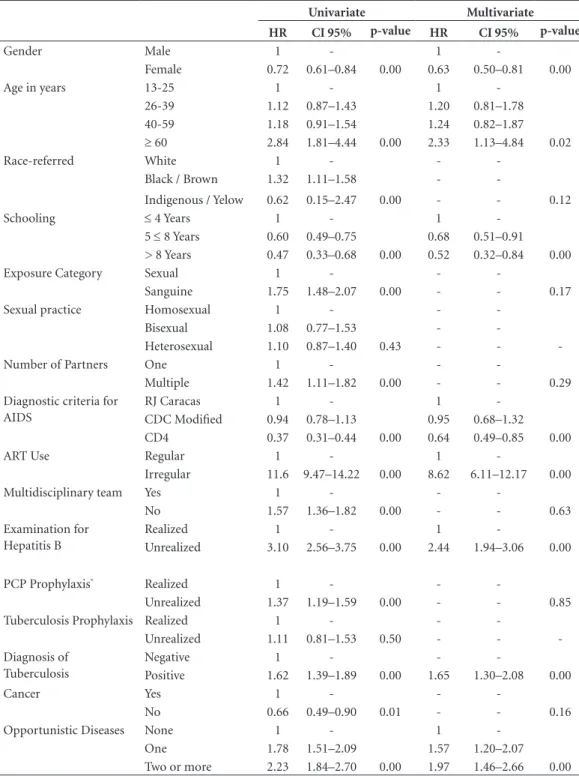
The Table 3 presents risk estimator in univar-iate and multiple analysis using Cox model, via
stepwise. Risk among AIDS-tuberculosis
co-in-fected was of 1.65 (IC95%: 1.30-2.08) times the not infected in multiple model.
Variables presented in positive association to greater survival were: female sex (HR = 0,63 and IC95%: 0.50–0.81), schooling greater than five years (HR = 0.68 and IC95%: 0,51–0,91), CD4 diagnosis criteria (HR = 0.64 IC95%: 0.49–0.85). Variables associated negatively with survival were: age group greater than 60 years old (HR = 2.33 IC95%: 1.13–4.84), non regular use of ART (HR = 8.62 IC95%: 6.11–12.17), no hepatitis B investigation (HR = 2.44 IC95%: 1.94–3.06), TB diagnosis (HR = 1.65 IC95%: 1.30–2.08) and two of more opportunistic diseases (HR = 1.97 IC95%: 1.46–2.66) (Table 3).
Lower accumulated survival was noticed in 60 months in patients presenting clinical form of disseminated/extrapulmonary/not cavitary TB infection (55%). Followed by cavitary pulmo-nary tuberculosis (58%), ganglionar/non specif-ic TB (68%). Comparison between curves using Log-rank test showed no difference among them (p < 0,00) (Figure 2).
Discussion
This study has shown that survival of diagnosed patients in 1998 and 1999, in 10 years, was supe-rior to patients diagnosed before this period of time6,8. It was registered lethality of 46.8% and 32.5% in patients with and without co-infection, respectively (p < 0,01). In both regions, mortality among co-infected topped that of not co-infect-ed. Groups also presented distribution differenc-es in sociodemographic, epidemiological, clinical and health care use variables.
After 60 months of AIDS diagnosis, no dif-ference was observed in accumulated survival between South and Southeast regions. Mortality among AIDS-tuberculosis co-infected patients was greater in both regions, 39.5% in South re-gion and 42% in southeast rere-gion. The associa-tion between these diseases justify the statement that, in all patients with TB, HIV must be tested for. On the other hand, for every patient with HIV infection, TB must be tested9.
e C
ole
tiv
a,
22(11):3781-3792,
2017
do Rio Preto, SP, 17.5% in Campinas, SP, and 14.5% in Vitória, ES25,31-33.
The infection reactivation by Mycobacterium
tuberculosis due to immunity drop, as well as new
infections can occur in individuals with AIDS. Unequal distribution of deaths between co-infected and not co-infected was seen at the period, with lethality of 46.8% and 32.5%, re-spectively (p < 0,01). Groups also displayed dis-tribution differences in sociodemographic,
ep-idemiological, clinical and health care use vari-ables.
Survival at 60 months was similar between both South (78%) and Southeast (79%) regions, given that for those with TB diagnosis, in both regions, the survival dropped at the period, even in the presence of co variables. Particularly among patients with disseminated/extrapulmo-nary/not cavitary TB co-infection, survival at 60 months was significantly lower, agreeing with Table 1. Distribution of AIDS cases with and without tuberculosis, according to death (lethality),
sociodemographic variables, exposure category, sexual practice, blood transmission and number of partners, South and Southeast regions, Brazil 1998-2008 cohort.
Tuberculosis
No (N = 1574) Yes (N = 517) Total (N = 2091)
Freq % Freq % Freq % p-value
Death Yes 511 32.5 242 46.8 753 36.0
No 1063 67.5 275 53.2 1338 64.0 0.00*
Gender Male 978 62.1 379 73.3 1357 64.9
Female 596 37.9 138 26.7 734 35.1 0.00*
Age in years 13-25 186 11.8 46 8.9 232 11.0
26-39 892 56.7 318 61.5 1210 57.9
40-59 464 29.5 144 27.9 608 29.1
≥ 60 32 2.0 9 1.7 41 2.0 0.17
Race-referred White 853 54.2 242 46.8 1095 52.4
Black 104 6.6 53 10.3 157 7.5
Yelow 3 0.2 1 0.2 4 0.2
Brown 180 11.4 82 15.9 262 12.5
Indigenous 2 0.1 2 0.4 4 0.2
No information 432 27.4 137 26.5 569 27.2 0.00
Schooling ≤ 4 years 870 55.3 307 59.4 1177 56.3
5 ≤ 8 years 305 19.4 78 15.1 383 18.3
> 8 years 129 8.2 22 4.3 151 7.2
No information 270 17.2 110 21.3 380 18.2 0.00*
Exposure Category Sexual 1105 70.2 283 54.7 1388 66.4
Sanguine 282 17.9 158 30.6 440 21.0
No information 187 11.9 76 14.7 263 12.6 0.00*
Sexual practice Homosexual 211 13.4 46 8.9 257 12.3
Bisexual 119 7.6 40 7.7 159 7.6
Heterosexual 995 63.2 313 60.5 1308 62.6
No information 249 15.8 118 22.8 367 17.6 0.09
Blood transmission IDU 266 16.9 154 29.8 420 20.1
Others*** 13 0.8 2 0.4 15 0.7
No information 1295 82.3 361 69.8 1656 79.02 0.00
Number of Partners One 245 15.6 58 11.2 303 14.5
Multiple 690 43.8 233 45.1 923 44.1
No information 639 40.6 226 43.7 865 41.4 0.30
M
elo MC
severity and disease spread on an immunosup-pressive state.
Kaplan-Meier curves, as well as multiple model, showed significant differences in patient survival with and without co-infection. TB aside, the presence of opportunistic diseases also abbre-viated the studied population survival5,6.
An hypothesis to explain lower survival among AIDS-Tuberculosis co-infected is TB treatment drop off due to adverse events: drug
interaction from combined therapies, as well ass alcohol, smoking, opportunistic diseases, T-CD4 count lower than 200/mm3 as TB treatment drop off predictors, dealing prognostic impact to the patient13,24.
Cases of AIDS with or without TB diagnosis are more prevalent among males, as seen in other studies1-3,19. The strong relation with poverty, low schooling and TB may explain the greater risk of dying among individuals up to four years of Table 2. Percentage distribution of AIDS cases with and without tuberculosis according to clinical variables (diagnostic criteria, antiretroviral use, presence of cancer and opportunistic diseases) and variables of use and follow-up in health services, South and Southeast regions, Brazil 1998-2008 cohort.
Tuberculosis No (N = 1574) Yes (N = 517)
Freq % Freq % p-value
Diagnostic criteria for AIDS RJ Caracas 262 16.6 186 36.0
CDC Modified 348 22.1 120 23.2
CD4 931 59.1 203 39.3
No information 33 2.1 8 1.5 0.00*
ART Use Regular 1366 86.8 442 85.5
Irregular 116 7.4 54 10.4
No information 92 5.8 21 4.1 0.03*
Cancer** Yes 58 3.7 26 5.0
No 1516 96.3 491 95.0 0.18
Opportunistic Diseases*** None 864 54.9 250 48.4
One 491 31.2 182 35.2
Two or more 219 13.9 85 16.4 0.03*
Examination for Hepatitis B Realized 815 51.8 273 52.8
Unrealized 275 17.5 98 19.0
No information 484 30.7 146 28.2 0.65
PCP Prophylaxis**** Realized 637 40.5 247 47.8
Unrealized 937 59.5 270 52.2 0.00*
Tuberculosis Prophylaxis Realized 67 4.3 43 8.3
Unrealized 1507 95.7 474 91.7 0.00*
Multidisciplinary team***** Yes 1020 64.8 384 74.3
No 554 35.2 133 25.7 0.00*
* The Pearson’s Chi-Square statistic is significant at the 0.05 level. ** Forms of cancer that were considered: invasive cervical cancer, non-Hodgkin lymphoma, primary lymphoma of the brain and Kaposi’s sarcoma. *** The opportunistic diseases that were considered: candidiasis (esophagus, trachea, bronchi and lung), cytomegalovirus (in place other than the eye, liver, spleen, lymph nodes), extrapulmonary cryptococcosis, cryptosporidiosis, mycobacterium disease (other than tuberculosis) Mucosal herpes simplex, disseminated histoplasmosis, isosporiasis, progressive multifocal leukoencephalopathy, neurotoxoplasmosis, Pneumocystis
jiroveci pneumonia, cytomegalovirus retinitis, salmonellosis, pneumonia (except Pneumocystis jiroveci pneumonia). **** Prophylaxis
for Pneumocystis jiroveci pneumonia. ***** Other health professionals who were considered: psychologist, dentist, social worker,
e C
ole
tiv
a,
22(11):3781-3792,
2017
study6,12. This variable is a socioeconomic marker of the population, even though quite frequently not available in medical records and notification files7,9,12,34.
It is worth mentioning the differences found in referred skin color in AIDS-tuberculosis co-infected patients, being blacks/browns more
prevalent. The use of race/referred skin color as an analytical variables has contributed to a better understanding of disadvantages and inequalities black people face when accessing proper health care resources. The study on women tested pos-itive for HIV in São Paulo registered a vulnera-bility situation and little access to health care Figure 1. Kaplan-Meier survival curves according to co-infection AIDS-tuberculosis (A) and adjusted Cox model with co-variables* (B) in South and Southeast regions, Brazil 1998-2008 cohort.
* Variables adjusted in Cox multiple model were: sex, age in years, schooling, AIDS diagnostic criteria, use of ART, serology for Hepatitis B and opportunistic diseases.
Tempo em meses
120 100
80 60
40 20
0
So
br
ev
iv
ên
ci
a
ac
um
ul
ad
a
1,0
0,8
0,6
0,4
0,2
0,0
Censura Censura Com tuberculose Sem tuberculose
Log-rank (Mantel-Cox) p < 0,01
Page 1 Log-rank test p < 0,01
Tuberculosis No Yes Censure Censure
Tempo em meses
120 100
80 60
40 20
0
So
br
ev
iv
ên
ci
a
ac
um
ul
ad
a
1,0
0,9
0,8
0,7
0,6
0,5
Com tuberculose Sem tuberculose
Page 1 Tuberculosis
No Yes
C
um
ulat
iv
e s
ur
vi
val
Time in months
C
um
ulat
iv
e s
ur
vi
val
Time in months A
M
elo MC
services, as well as greater schooling and compre-hension difficulties about the disease and exams requested35. Although significant in univariable model and greater prevalence of black/ brown patients among co-infected, this variable did not remain linked to death risk in the final
multi-ple model after adjusting with “schooling years” variable, suggesting a greater socioeconomical condition relevance in survival, independently from referred skin color. It is worth mentioning the interpretation limitations and reliability of this information, particularly in medical records. Table 3. Hazard rate and ratio of variables associated with survival in univariate and multivariate model (Cox) in patients with AIDS, South and Southeast regions, Brazil 1998-2008 cohort.
Univariate Multivariate HR CI 95% p-value HR CI 95% p-value
Gender Male 1 - 1
-Female 0.72 0.61–0.84 0.00 0.63 0.50–0.81 0.00
Age in years 13-25 1 - 1
-26-39 1.12 0.87–1.43 1.20 0.81–1.78
40-59 1.18 0.91–1.54 1.24 0.82–1.87
≥ 60 2.84 1.81–4.44 0.00 2.33 1.13–4.84 0.02
Race-referred White 1 - -
-Black / Brown 1.32 1.11–1.58 -
-Indigenous / Yelow 0.62 0.15–2.47 0.00 - - 0.12
Schooling ≤ 4 Years 1 - 1
-5 ≤ 8 Years 0.60 0.49–0.75 0.68 0.51–0.91
> 8 Years 0.47 0.33–0.68 0.00 0.52 0.32–0.84 0.00
Exposure Category Sexual 1 - -
-Sanguine 1.75 1.48–2.07 0.00 - - 0.17
Sexual practice Homosexual 1 - -
-Bisexual 1.08 0.77–1.53 -
-Heterosexual 1.10 0.87–1.40 0.43 - -
-Number of Partners One 1 - -
-Multiple 1.42 1.11–1.82 0.00 - - 0.29
Diagnostic criteria for AIDS
RJ Caracas 1 - 1
-CDC Modified 0.94 0.78–1.13 0.95 0.68–1.32
CD4 0.37 0.31–0.44 0.00 0.64 0.49–0.85 0.00
ART Use Regular 1 - 1
-Irregular 11.6 9.47–14.22 0.00 8.62 6.11–12.17 0.00
Multidisciplinary team Yes 1 - -
-No 1.57 1.36–1.82 0.00 - - 0.63
Examination for Hepatitis B
Realized 1 - 1
-Unrealized 3.10 2.56–3.75 0.00 2.44 1.94–3.06 0.00
PCP Prophylaxis* Realized 1 - -
-Unrealized 1.37 1.19–1.59 0.00 - - 0.85
Tuberculosis Prophylaxis Realized 1 - -
-Unrealized 1.11 0.81–1.53 0.50 - -
-Diagnosis of Tuberculosis
Negative 1 - -
-Positive 1.62 1.39–1.89 0.00 1.65 1.30–2.08 0.00
Cancer Yes 1 - -
-No 0.66 0.49–0.90 0.01 - - 0.16
Opportunistic Diseases None 1 - 1
-One 1.78 1.51–2.09 1.57 1.20–2.07
Two or more 2.23 1.84–2.70 0.00 1.97 1.46–2.66 0.00
e C
ole
tiv
a,
22(11):3781-3792,
2017
Worse life conditions make health care access, correct medication use comprehension, prop-er nutrition care and othprop-er genprop-eral orientations more difficult36.
A study performed in Rio de Janeiro showed that survival is strongly influenced by CD4 count above 100 cells/mm3, lowering opportunistic dis-eases incidence37. Regular use of antiretroviral medication improved considerably, 8.62 times the life expectancy in this cohort and changed the immunologic profile of patients with TB co-in-fection due to immunity recovery. Similar results were registered in several regions worldwide, emphasizing the greater impact of combined an-tiretroviral therapies (three anan-tiretroviral usage) since year 2000 and consequent CD4 cells recov-ery5,6,38-43.
Some variables were included in this study with the objective of analyzing survival with pa-tient care association, such as prophylaxis usage, hepatitis B serology request and multiprofession-al care, which would indirectly indicate service adhesion, clinical follow up and integral patient management.
Among health care related variables, although associated to univariable analysis, only hepatitis B serology request remained as a greater survival predictor of patients with AIDS managed in the
cities. The request of these exams denotes a treat-ment comprising other chronic diseases investi-gation, one of them being preventable and both being of clinic and therapeutic follow up.
A study evaluated the care of patients with AIDS in Brazil, emphasizing the heterogeneity of health care assistance and infrastructure, even though there are medication availability, clinical follow up exams, as well as infectology special-ized physician in most services44.
Although prophylaxis with isoniazida has reduced TB active infection in individuals with AIDS, treatment adhesion, drug resistance and toxicity have limited this high risk measure. In-tegrated care and decentralization of preventive actions, screening and TB treatment for people living with HIV can reduce co-infection and lim-it drug resistance.
A few limitations in this study can be evi-denced, such as the quality of registered infor-mation in medical records, which are not always reliable and may vary in different regions of the country. The 10 year analysis from past decade (1998-2008) may not reflect the epidemic dy-namic nowadays, considering changes in patient profiles like age group, decrease in injecting drug users, availability of new antiretroviral drugs and more powerful and easier to use associations.
Figure 2. Kaplan-Meier survival curves of patients with AIDS aged 13 years or old, according to clinical forms of tuberculosis in South and Southeast regions, Brazil 1998-2008 cohort.
Tempo em meses
120 100
80 60
40 20
0
So
br
ev
iv
ên
ci
a
ac
um
ul
ad
a
1,0
0,8
0,6
0,4
0,2
0,0
Censura Censura Censura
Ganglionar/não-especificada Pulmonar/cavitária Disseminada/extrapulmonar/ não-cavitária
Log Rank (Mantel-Cox) p < 0,05
Page 1 Clinical forms of tuberculosis
Disseminated/extrapulmonary/non-cavitary Pulmonary/cavitary
Ganglionar/unspecified Censure
Censure Censure
Log-rank (Mantel-Cox) p < 0,05
C
um
ulat
iv
e s
ur
vi
val
M
elo MC
However, it is a population based study with survival estimates which contribute to registra-tion of parameters and post-HAART epidemic indicators, relevant to monitoring the disease in Brazil.
Conclusions
Patient survival post-HAART has increased among patients studied. These results show the investments made by STD/AIDS national, state
and municipal programs, aiming universal access to treatment and clinical follow up of patients with AIDS. Despite advancements in policies and health care service to affected individuals, some challenges remain, such as overcoming inequalities related to early diagnosis and avail-ability and adhesion to treatment for both AIDS and TB. AIDS and TB are two chronic diseases that demand clinical follow up and adhesion to treatment and can be analyzed as marker of diffi-culties to overcoming limitations still existing in patient survival in Brazil.
Collaborations
MC Melo participated in the design of the study, analysis of the data, revision of the text, discus-sion of the results and in the writing of the man-uscript. MR Donalísio participated in the con-ception of the study, data collection and analysis, revision of the text, discussion of the results and in the writing of the manuscript. RC Cordeiro participated in the analysis of the data, revision of the text, discussion of the results and in the writing of the manuscript.
Acknowledgment
e C ole tiv a, 22(11):3781-3792, 2017 References
1. Menesia EO, Passos C, Dinis A, Monteiro ME, Dal-Fa-bbro AL, Laprega MR. Sobrevivência de pacientes com AIDS em uma cidade do Sudeste Brasileiro. Rev Panam
Salud Pública 2001; 10(1):29-36.
2. Guibu IA, Barros MBA, Donalísio MR, Tayra A, Alves MCGP. Survival of AIDS patients in the Southeast and South of Brazil: analysis of the 1998-1999 cohort. Cad
Saude Publica 2011; 27(Supl. 1):S79-S92.
3. Marins JRP, Jamal LF, Chen SY, Barros MB, Hudes ES, Barbosa AA, Chequer P, Teixeira PR, Hearst N. Dra-matic improvement in survival among adult Brazilian AIDS patients. AIDS 2003; 17(11):1675-1682.
4. Sterne JAC, Hernán MA, Ledergerber B, Tilling K, Weber R, Sendi P, Rickenbach M, Robins JM, Egger M; Swiss HIV Cohort Study.Long-term effectiveness of potent antiretroviral therapy in preventing AIDS and death: a prospective cohort study. Lancet 2005; 366(9483):378-384.
5. Lima VD, Hogg RS, Harrigan PR, Moore D, Yip B, Wood E, Montaner JS. Continued improvement in survival among HIV-infected individuals with new-er forms of highly active antiretroviral thnew-erapy. AIDS 2007; 21(6):685-692.
6. Padoin SMM, Zuge SS, Santos ÉEP, Primeira MR, Al-drighi JD, Paula CC. Adesão à terapia antirretroviral para HIV/AIDS. Cogitare Enferm 2013; 18(3):576-581. 7. Pereira AGL, Matos HJ, Escosteguy CC, Marques
MVRE, Medronho RA. Sobrevida de pacientes com Síndrome da Imunodeficiência Adquirida em hospital geral no Rio de Janeiro, a partir de dados da vigilância epidemiológica. Cad Saúde Colet 2013; 21(2):160-167. 8. Chequer P, Hearst N, Hudes ES, Castilho E, Rutherford
G, Loures L, Rodrigues L. Determinants of survival in adult Brazilian AIDS patients, 1982-1989. The Brazil-ian State AIDS Program Co-Ordinators. AIDS 1992; 6(5):483-487.
9. Santos JS, Beck ST. A coinfecção tuberculose e HIV: um importante desafio - Artigo de revisão. Rev Bras Anal Clin 2009; 41(3):209-215.
10. Santos Neto M, Silva FL, Sousa KR, Yamamura M, Po-polin MP, Arcêncio RA. Clinical and epidemiological profile and prevalence of tuberculosis/HIV co-infec-tion in a regional health district in the state of Maran-hão, Brazil. J Bras Pneumol 2012; 38(6):724-732. 11. Escombe AR, Moore DA, Gilman RH, Pan W,
Navinco-pa M, Ticona E, Martínez C, Caviedes L, Sheen P, Gon-zalez A, Noakes CJ, Friedland JS, Evans CA. The In-fectiousness of Tuberculosis Patients Coinfected with HIV. PloS Med 2008; 5(9):e188.
12. Guimarães RM, Lobo AP, Siqueira EA, Borges TFF, Melo SCC. Tuberculosis, HIV, and poverty: temporal trends in Brazil, the Americas, and worldwide. J Bras
Pneumol 2012; 38(4):511-517.
13. Whalen CC, Nsubuga P, Okwera A, Johnson JL, Hom DL, Michael NL, Mugerwa RD, Ellner JJ. Impact of pulmonary tuberculosis on survival of HIV-infected adults: a prospective epidemiologic study in Uganda. AIDS 2000; 14(9):1219-1228.
14. Taarnhøj GA, Engsig FN, Ravn P, Johansen IS, Larsen CS, Røge B, Andersen AB, Obel N.Incidence, risk fac-tors and mortality of tuberculosis in Danish HIV pa-tients 1995-2007. BMC Pulm Med 2011; 11:26
15. World Health Organization (WHO). WHO global tu-berculosis report 2014. The burden of disease caused by TB (Chapter 2). Geneva, Switzerland; 2014. [acessa-do 2015 Abr 05]. Disponível em: http://apps.who.int/ iris/bitstream/10665/137094/1/9789241564809_eng. pdf.
16. Mendes AM, Fensterseifer LM. Tuberculose: porque os pacientes abandonam o tratamento? Bol Pneumol Sanit 2004; 12(1):27-38.
17. Soares ECC, Saraceni V, Lauria LM, Pacheco AG, Du-rovni B, Cavalcante SC. Tuberculosis as a disease defin-ing acquired immunodeficiency syndrome: ten years of surveillance in Rio de Janeiro, Brazil. J Bras Pneumol 2006; 32(5):444-448.
18. Brasil. Secretaria de Vigilância em Saúde (SVS).
Pro-grama Nacional de DST e Aids.Boletim Epidemiológico
2014 - Aids e DST. Brasília: SVS; 2014.
19. Batista JAL, Albuquerque MFPM, Maruza M, Ximenes RAA, Santos ML, Montarroyos UR, Miranda-Filho DB, Lacerda HR, Rodrigues LC. Incidence and Risk Factors for Tuberculosis in People Living with HIV: Cohort from HIV Referral Health Centers in Recife, Brazil. PLos ONE 2013; 8:5.
20. Perrechi MCT, Ribeiro SA. Outcomes of tuberculosis treatment among inpatients and outpatients in the city of São Paulo, Brazil. J Bras de Pneumol 2011; 37(6):783-790.
21. Waitt CJ, Squire SB. A systematic review of risk factors for death in adults during and after tuberculosis treat-ment. Int J Tuberc Lung Dis 2011; 15(7):871-885. 22. Gupta A, Wood R, Kaplan R, Bekker LG, Lawn SD.
Prevalent and incident tuberculosis are independent risk factors for mortality among patients accessing an-tiretroviral therapy in South Africa. PLos ONE 2013; 8(2):e55824.
23. Golub JE, Durovni B, King BS, Cavalacante SC, Pache-co AG, Moulton LH, Moore RD, Chaisson RE, Saraceni V. Recurrent tuberculosis in HIV-infected patients in Rio de Janeiro, Brazil. AIDS 2008; 22(18):2527-2533. 24. Maruza M, Albuquerque MFPM, Coimbra I, Moura LV,
Montarroyos UR, Miranda Filho DB, Lacerda HR, Ro-drigues LC, Ximenes RA. Risk factors for default from tuberculosis treatment in HIV-infected individuals in the state of Pernambuco, Brazil: a prospective cohort study. BMC Infect Dis 2011; 11:351.
25. Saita NM, Oliveira HB. Tuberculosis, AIDS and tuber-culosis-AIDS co-infection in a large city. Rev latino am
enferm 2012; 20(4):769-777.
26. Instituto Brasileiro de Geografia e Estatística[home-page na internet]. Censos demográficos: 2000 e 2010. Contagem Populacional: 1996. Estimativas preliminares para os anos intercensitários dos totais populacionais, estratificadas por idade e sexo pelo MS/SGEP/Datasus: 1992-1999, 2001-2006. Estimativas elaboradas no âmbi-to do Projeâmbi-to UNFPA/IBGE (BRA/4/P31A) - População e Desenvolvimento. Coordenação de População e Indi-cadores Sociais: 2007-2009. Estimativas populacionais enviadas para o TCU, estratificadas por idade e sexo pelo
MS/SGEP/Datasus: 2011-2012. [acessado 2015 Abr 15].
M
elo MC
27. Brasil. Ministério da Saúde (MS). Critérios de definição de casos de aids em adultos e crianças. Brasília: MS; 2004. 28. Szklo M, Javier Nieto F. Measuring Disease Occurrence.
Epidemiology Beyond the Basics. 3th ed. Burlington:
Jones & Bartlett Learning; 2014.
29. Kleinbaum DG, Klein M. Survival Analysis. 3th ed. New York: Springer; 2012.
30. Cox DR. Regression models and life tables. J R Stat Soc
Ser B Methodol 1972; 34(2):187-220.
31. Pedro HSP, Pereira MIF, Goloni MRA, Pires FC, Olivei-ra RS, da Rocha MAB, Conceição LM, FOlivei-raga VD, Fen-ley JC, Cordeschi T, Machado RL, Franco C, Rossit AR. Mycobacterium tuberculosis in a HIV-1-infected pop-ulation from Southeastern Brazil in the HAART era.
Trop Med Int Health 2011; 16(1):67-73.
32. Reis DC, Almeida TAC, Quites HFO, Sampaio MM. Epidemiological profile of tuberculosis in the city of Belo Horizonte (MG), from 2002 to 2008. Rev Bras
Epidemiol 2013; 16(3):592-602.
33. Pinto Neto LFS, Vieira NFR, Cott FS, Oliveira FMA. Prevalência da tuberculose em pacientes infectados pelo vírus da imunodeficiência humana. Rev Soc Bras
Clin Méd 2013; 11(2):118-122.
34. Villarinho MV, Padilha MI, Berardinelli LMM, Bo-renstein MS, Meirelles BHS, Andrade SR. Public health policies facing the epidemic of AIDS and the assistance for people with the disease. Rev Bras Enferm 2013; 66(2):271-217.
35. Lopes F, Buchalla CM, Ayres JRCM. Mulheres negras e não-negras e vulnerabilidade ao HIV/Aids no estado de São Paulo, Brasil. Rev Saude Publica 2007; 41(Supl. 2):39-46.
36. Rodrigues ILA, Monteiro LL, Pacheco RHB, Silva SÉD. Abandonment of tuberculosis treatment among pa-tinets co-infected with TB/HIV. Rev Esc Enferm USP 2010; 44(2):383-387.
37. Gadelha AJ, Accacio N, Costa RLB, Galhardo MC, Cotrim MR, Souza RV, Morgado M, Marzochi K, Lourenço MC, Rolla VC. Morbidity and survival in advanced AIDS in Rio de Janeiro, Brazil. Rev Inst Med
Trop São Paulo 2002; 44(4):179-186.
38. Tancredi MV. Sobrevida de pacientes com HIV e AIDS nas eras pré e pós terapia antirretroviral de alta potência [tese]. São Paulo: Universidade de São Paulo; 2010. 39. Pereira JC, Silva MR, Costa RR, Guimarães MDC, Leite
ICG. Profile and follow-up of patients with tuberculo-sis in a priority city in Brazil. Rev Saude Publica 2015; 49(6):1-12.
40. Ferreira BE, Oliveira IM, Paniago AMM. Qualidade de vida de portadores de HIV/AIDS e sua relação com lin-fócitos CD4+, carga viral e tempo de diagnóstico. Rev
Bras Epidemiol 2012; 15(1):75-84.
41. Geocze L, Mucci S, de Marco MA, Nogueira-Martins LA, Citero VA. Qualidade de vida e adesão ao trata-mento anti-retroviral de pacientes portadores de HIV.
Rev Saúde Publica 2010; 4(44):743-749.
42. Mocroft A, Ledergerber B, Katlama C, Kirk O, Reiss P, d’Arminio Monforte A, Knysz B, Dietrich M, Phillips AN, Lundgren JD, EuroSIDA study group. Decline in the AIDS and death rates in the EuroSIDA study: an observational study. Lancet 2003; 362(9377):22-29. 43. Lai D, Hardy RJ. An update on the impact of HIV/AIDS
on life expectancy in the United States. AIDS 2004; 18(12):1732-1734.
44. Melchior R, Nemes MI, Basso CR, Castanheira ER, Alves MT, Buchalla CM, DoniniAA. Evaluation of the organizational structure of HIV/AIDS outpatient care in Brazil. Rev Saude Publica 2006; 40(1):143-151.
Article submitted 04/12/2015 Approved 29/03/2016