Escola de Enfermagem de Ribeirão Preto - USP
Mailing address: Suzana Alves de Moraes – Av. Santa Luzia 440/81 - 14025-090-Ribeirão Preto, SP - Brazil
Objective – To analyze the trends of specific,
standardi-zed coefficients of mortality due to ischemic heart disease according to sex and age during the years 1980 and 1994 in the municipality of Goiania, GO, Brazil.
Methods – Data on deaths were retrieved from the
In-formation on Mortality System of the Ministry of Health; population data were obtained from the Foundation of the Brazilian Institute for Geography and Statistics (IBGE). The trends of the specific coefficients were analy-zed by triennia of the historical series, including individu-als of both sexes from 25 years of age on, partitioned into 6 age groups of ten years intervals. The population data corresponding to the year 1980 were used as the standard for the calculation of each age group coefficient. Analyses were carried out by straight linear regression.
Results – Coefficients were greater for males in each
triennium of the series and increased with age in both sexes. The study of the trends of the specific age coefficients of both sexes revealed a stable pattern of evolution up to the age of 65-74 years (P>0.05). From 75 years on, a clear-cut decline in mortality due to ischemic heart disease was shown by both sexes. The standardized coefficients also showed a significant decline (p≤0.05).
Conclusion – The municipality of Goiânia is at
pre-sent in a stage of epidemiological transition similar to that of developed countries, even though the observed de-cline is predominantly influenced by the mortality of older individuals (75 years of age or older).
Key words: mortality, myocardial ischemia, trend studies
Arq Bras Cardiol, volume 74 (nº 6), 498-502, 2000
Suzana Alves de Moraes, Márcia Helena Vieira de Rezende, Isabel Cristina Martins de Freitas
Ribeirão Preto, SP - Brazil
Trends in Mortality Due to Ischemic Heart Disease in the
Municipality of Goiania, Brazil, during the Years between
1980 and 1994
Ischemic heart disease results in high mortality rates;
since the beginning of the second half of the 20th century, it
has stood out as one of the major causes of death in the majority of developed and developing countries.
Yet, during the last 40 years, after a practically stationa-ry period, the trend of these rates has been to decline in the US, Canada, Australia, Japan, the United Kingdom and
other West European countries 1.
In Brazil, the trend towards a decline in mortality due to ischemic heart disease was first recognized in the municipa-lity and state of São Paulo at the end of the nineteen
seven-ties 2-4. Between 1979 and 1989, this decline was also
repor-ted in other Brazilian capitals like Salvador, Belém, Belo
Ho-rizonte and Curitiba 4,5.
Considering the existence of regional differences in Brazil, it can be intuitively concluded that not all of these
re-gions are going through the 4th stage of epidemiological
transition, which, according to Onram6 , is characterized by
trends towards a decline in cardiovascular disease. With this perspective in mind, we proposed to identify the transitional characteristics of the trends in mortality caused by ischemic heart disease in the historic period fal-ling between 1980 and 1994 in Goiânia, a metropolitan capital located in midwestern Brazil.
Methods
The study is classified as the ecological picture of a
historical series type. 7
Information on deaths of residents of Goiânia was re-trieved from the CD-Rom-1996: Mortality Information
Sys-tem (SIM) 8 distributed by DATASUS-CENEPI-FNS of the
Health Ministry. Data that were not yet definitive (1993 and
1994), were updated directly by DATASUS-CENEPI 9.
Dea-ths were considered of interest when classified between codes 410 and 414.9 of the International Disease
Classifica-tion CIDRevision IX10. Population data for the period under
Geo-grafia e Estatística (FIBGE) 11,12 - Goiás Sector, in Goiânia;
po-pulation estimates for intercensus years of the period were calculated by interpolation according to Arriaga, using the
Population Analysis with Spreadsheet (PAS) Program 13 .
According to the proposal of the FIBGE 11,12,
indivi-duals between 25 and 75 years or over, were grouped in age intervals of ten years.
Specific coefficients of mortality were calculated by sex and age group for each triennium of the historic series stu-died; general coefficients standardized by age and sex were calculated using the age structure of the population of the
1980 census as standards 14.
Databanks with information about the deaths of resi-dents of Goiânia between 1980 and 1994 arranged according to basic causes between 1980 and 1994 were retrieved from
the Mortality Information System (SIM) 8 tested using
Fox-pro version 2.6 software 15 by routines for recodification
and creation of new variables of interest for the study as follows: sex, age, year of death and death by ischemic heart disease. Electronic mapping was developed for the calcula-tion of specific and standardized coefficients using Excel
version 7.0 software 16.
Deaths by ischemic heart disease were classified ac-cording to sex and age using Epiinfo version 6.04c
software 17.This information was fed into electronic
mappings developed with Excel version 7.0 software. For tendency analyses, straight linear regressions were used;
hypotheses were tested using a significance level α=0.05;
processing was done with the SPSS program for Windows
version 7.0 18 .
Results
Mortality indicators for ischemic heart disease were applied to individuals from 25 years of age on because no deaths from this cause were found in younger age groups. To minimize possible bias related to the International Disease Classification, the work was conducted using the
historical series during which only IX Revision 10 was in effect.
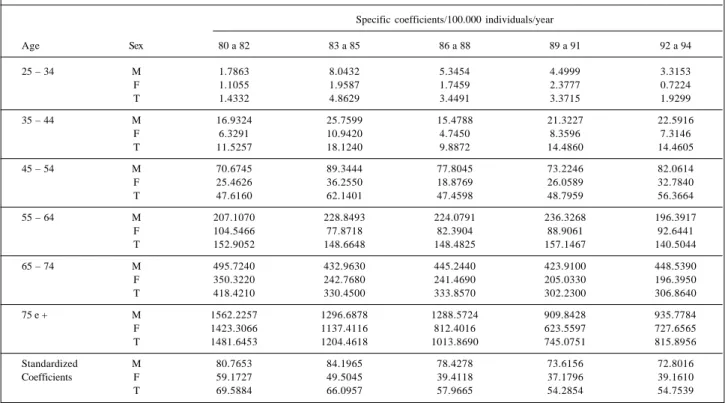
Table I shows specific mortality coefficients of ischemic heart disease according to sex and age as well as general standardized coefficients according to sex for each triennium. Figures 1 to 6 depict the tendencies of specific mortality coefficients in the historic series between 1980 and 1994 for each of the age groups studied according to sex. Figure 7 sho-ws the tendency of standardized coefficients by age and sex.
Discussion
The results presented in table I allowed us to conclude that in each triennium the size of the coefficients was greater for males and increased with aging in both sexes. From 65 years onwards, the size of the coefficients for females ten-ded to fall closer to those of males; these findings have
be-en corroborated by various authors 2-5.
The trends of the specific coefficients of the historical series studied (figs. 1 to 6) illustrate a specific situation of epi-demiological transition for the municipality of Goiânia. Ac-cording to this trend, it was possible to identify significant declines in the coefficients in both sexes, but only from 75 years of age onwards (P<0.05). It should be noted that in age
Table I - Specific, standardized mortality coefficients by DIC/100.000 individuals/ year-in the municipality of Goiânia in each triennium of the historical series (1980-1994).
Specific coefficients/100.000 individuals/year
Age Sex 80 a 82 83 a 85 86 a 88 89 a 91 92 a 94
25 – 34 M 1.7863 8.0432 5.3454 4.4999 3.3153
F 1.1055 1.9587 1.7459 2.3777 0.7224
T 1.4332 4.8629 3.4491 3.3715 1.9299
35 – 44 M 16.9324 25.7599 15.4788 21.3227 22.5916
F 6.3291 10.9420 4.7450 8.3596 7.3146
T 11.5257 18.1240 9.8872 14.4860 14.4605
45 – 54 M 70.6745 89.3444 77.8045 73.2246 82.0614
F 25.4626 36.2550 18.8769 26.0589 32.7840
T 47.6160 62.1401 47.4598 48.7959 56.3664
55 – 64 M 207.1070 228.8493 224.0791 236.3268 196.3917
F 104.5466 77.8718 82.3904 88.9061 92.6441
T 152.9052 148.6648 148.4825 157.1467 140.5044
65 – 74 M 495.7240 432.9630 445.2440 423.9100 448.5390
F 350.3220 242.7680 241.4690 205.0330 196.3950
T 418.4210 330.4500 333.8570 302.2300 306.8640
75 e + M 1562.2257 1296.6878 1288.5724 909.8428 935.7784
F 1423.3066 1137.4116 812.4016 623.5597 727.6565
T 1481.6453 1204.4618 1013.8690 745.0751 815.8956
Standardized M 80.7653 84.1965 78.4278 73.6156 72.8016
Coefficients F 59.1727 49.5045 39.4118 37.1796 39.1610
ranges below 75 years, the trend was for these coefficients to remain stable during the period, a significant decline for the 65-74 age group only being noticed in females (P<0.05).
Analysis of the trends of standardized coefficients (fig.7) showed a significant decline for both sexes (P<0.05) over the period.
Lolio et al. 3 studying the trends of standardized
coefficients of mortality due to ischemic heart disease in the
municipality of São Paulobetween 1970 and 1983 detected a
significant decline in the specific coefficients from 50 years of age onwards in both sexes.
The findings regarding the trends of standardized coefficients in the present study agree with those of Lolio et
al.5 for the municipalities of São Paulo, Belém and Belo
Hori-SEX
Total: beta= -0,0498 p=0,858
Male: beta=0,0485 p=0,926
Female: beta= -0,0347 p=0,895
TRIENNIUM
TRIENNIUM: 1=80-82; 2=83-85; 3=86-88; 4=89-91; 5=92-94
coefficient/100.000
Fig.1 - Tendency of specific coefficients according to sex. Age group 25-34 years in 5 Triennia.
SEX
Total: beta=0,223 p=0,858
Male: beta=0,688 p=0,674
Female: beta= -0,0611 p=0,947
TRIENNIUM
TRIENNIUM: 1=80-82; 2=83-85; 3=86-88; 4=89-91; 5=92-94
coefficient/100.000
Fig.2 - Tendency of specific coefficients according to sex. Age group 35-44 years in 5 Triennia.
SEX
Total: beta=0,416 p=0,872
Male: beta=0,665 p=0,820
Female: beta=0,445 p=0,868
TRIENNIUM
TRIENNIUM: 1=80-82; 2=83-85; 3=86-88; 4=89-91; 5=92-94
coefficient/100.000
Fig.3 - Tendency of specific coefficients according to sex. Age group 45-54 years in 5 Triennia.
SEX
Total: beta= -1,632 p=0,484
Male: beta= -1,395 p=0,829
Female: beta= -1,277 p=0,751
TRIENNIUM
TRIENNIUM: 1=80-82; 2=83-85; 3=86-88; 4=89-91; 5=92-94
coefficient/100.000
Fig.4 - Tendency of specific coefficients according to sex. Age group 55-64 years in 5 Triennia.
SEX
Total: beta= -25,133 p=0,070
Male: beta= -10,342 p=0,296
Female: beta= -34,559 p=0,043
TRIENNIUM
TRIENNIUM: 1=80-82; 2=83-85; 3=86-88; 4=89-91; 5=92-94
coefficient/100.000
Fig.5 - Tendency of specific coefficients according to sex. Age group 65-74 years in 5 Triennia.
SEX
Total: beta= -179,089 p=0,015
Male: beta= -163,974 p=0,016
Female: beta= -190,515 p=0,030
TRIENNIUM
TRIENNIUM: 1=80-82; 2=83-85; 3=86-88; 4=89-91; 5=92-94
coefficient/100.000
zonte during the period between 1979 and 1989. Similar
re-sults have been reported by other authors: Sá et al. 19 in
Por-tugal in the eighties, Osler et al. 20 in Denmark from 1982 to
1992, Salomaa et al.21 in Finland between 1983 and 1988 and
Beaglehole et al. 22 in New Zealand between 1983 and 1993.
Various authors have recognized the contribution of medical assistance and primary prevention measures as va-riables capable of explaining the observed decline in
morta-lity 23,24. Goldman and Cook 24 detected a 60% decline in
mortality due to ischemic heart disease in the United States between 1968 and 1976 related to changed life styles, in par-ticular, reduction in serum cholesterol levels and control of smoking; a 40% decrease was attributed to specific medical interventions in these cases.
Although several studies have been made in Brazil, the participation of factors responsible for the decline in mortality due to ischemic heart disease is not precisely known. Absence of studies of historical series, of protection from or incidence of risk factors, as well as of analytical studies aimed at testing their association with mortality have as yet offered limited desirable explanations for the obser-ved decline in the incidence of the disease.
In the case of Goiânia, however, the improved quality of more complex medical assistance (coronary care units, angioplasty and myocardial revascularization) rather than a desirable decrease in risk factors may have contributed to
the decreased mortality 4 in individuals with greater risk of
having fatal complications (higher age groups) and may perhaps be a better explanation for the observed decline. Because ischemic heart disease has a long latency period, programs for intervention on risk factors do not appear to have influenced incidence and mortality in younger seg-ments of this population.
Concerning recommendations for the standardization of these coefficients for the study of mortality trends during periods when extreme modifications of respective age pyra-mids are observed, it is worth noting that the significant de-cline in these standardized coefficients is mainly due to the contribution of older age groups, as clearly evidenced by the evolution of the specific coefficients of this population (figs. 1 to 6).
An important factor related to the quality of the infor-mation collected when performing mortality studies on his-torical series is the percentage of ill-defined causes,
classi-fied in chapter XVI of the CID-IX Revision 10. Lolio 25
recom-mends that the proportion of ill-defined causes should not run over 10%. Records from the midwestern region of Brazil show more than 10% of deaths are of the ill-defined group; we therefore decided to perform a study of the proportional tendency towards mortality due to ill-defined causes in indi-viduals older than 25 years in Goiânia for the historical
period between 1980 and 1994 26. Figure 8 indicates the
re-sults of this trend: the average values expressed by the ad-justed straight line varied between 16 and 10% for the begin-ning and the end of the period studied, respectively, sho-wing a significant decline for this group of causes (p<0.05). These findings speak in favor of a real decline in mortality due to ischemic heart disease. Standardized coefficients presented in figure 7 suggest that the decline in the percen-tages of ill-defined causes over the period must have occur-red due to notifications of deaths from causes other than is-chemic heart disease. It is also worth pointing out that the distribution of the percentages of ill-defined causes was not concentrated in specific age bands over the historical series studied. This appears to validate the results related to the pattern of evolution of mortality by ischemic heart disease in specified age groups shown in figures 1 to 6.
Descriptive mortality studies are recognized as impor-tant sources for the planning and evaluation of health ser-vices at all levels of assistance. It is known that they genera-te explanatory hypotheses of causal degenera-terminants for ingenera-ter- inter-ventions in individual and collective health. For example,
Laurenti (2nd National Meeting of the Sub-System of
Mortality Information – Brasília, 1987 reports that the use of statistical mortality data enabled knowledge acquisition about trends towards the decline in mortality coefficients due to ischemic heart disease following a period of increase in industrialized countries. It consequently generated the need to evaluate the effect of interventions on aggravating risk factors.
Despite some limitations related to mortality due to basic causes, the trend observed in the Goiânia municipality between 1980 and 1994 seems to indicate an epidemiological
SEX
Total: beta= -4,148 p=0,015
Male: beta=-2,651 p=0,054
Female: beta=-5,235 p=0,044
TRIENNIUM
TRIENNIUM: 1=80-82; 2=83-85; 3=86-88; 4=89-91; 5=92-94
coefficient/100.00
Fig.7 - Tendency of specific coefficients according to sex Age group 75 years and (+) in 5 Triennia.
beta= -0,451 p=0,005
YEAR
% of III-defined causes
transition pattern similar to that of developed regions (4th
period of epidemiological transition 6), even though the
de-cline in mortality due to this group of causes is predominan-tly occurring in individuals 75 years or older.
It is hoped that the results pointed out by this study
1. Beaglehole R. International trends in coronary heart disease mortality, morbidi-ty, and risk factors. Epidemiologic Reviews 1990; 12: 1-15.
2. Lólio CA, Laurenti R. Mortalidade por doença isquêmica do coração no Municí-pio de São Paulo. Evolução de 1950 a 1981 e mudanças recentes na tendência. Arq Bras Cardiol 1986; 46: 153-6.
3. Lólio CA, Souza JMP, Laurenti R. Decline in cardiovascular disease mortality in the city of São Paulo, Brasil, 1970 to 1983. Rev Saúde Pública 1986; 20: 454-64.
4. Lotufo PA, Lolio CA. Tendência da mortalidade por doença isquêmica do coração no Estado de São Paulo: 1970-1989. Arq Brasil Cardiol 1993; 61: 149-53. 5. Lólio CA de, Lotufo PA, Lira AC, Zaneta DMT, Massad E. Tendência da
mortali-dade por doença isquêmica do coração nas capitais de regiões metropolitanas do Brasil, 1979 - 1989. Arq Brasil Cardiol 1995; 64:195-9.
6. Omram AR. The Epidemiologic Transition in the Americas. Washington, PAHO-The University of Maryland at College Park, 1996.
7. Hennekens CH, Buring JE. Epidemiology. In: Medicine. Boston: Little Brown and Co, 1987.
8. Brasil, Ministério da Saúde. DATASUS - CENEPI. Sistema de informação sobre mortalidade - CD-ROM. Brasília, maio, 1996.
9. Brasil, Ministério da Saúde. Mortalidade Brasil, 1995, Brasília, Coordenação de Comunicação, Educação e Documentação, 1996: 553p.
10. Organização Mundial da Saúde. Manual de Classificação Estatística Interna-cional de Doenças, Lesões e Causas de Óbitos, 9ª Revisão, 1975. São Paulo, Centro da OMS para Classificação de Doenças em Português/Ministério da Saúde/Universidade de São Paulo/Organização Pan Americana da Saúde, 1985, vol.1.
11. Fundação Instituto Brasileiro de Geografia e Estatística. Censo demográfico: Goiás. Rio de Janeiro, 1994. (10º Recenseamento Geral do Brasil, 1991). 12. Fundação Instituto Brasileiro de Geografia e Estatística. Censo demográfico:
Goiás. Rio de Janeiro, 1982. (9º Recenseamento Geral do Brasil, 1980). 13. Arriaga EE. Population Analysis with Microcomputers. New York: New York
University Press. Vol I e II. November, 1993.
References
14. Laurenti R, Mello Jorge MHP, Lebrão ML, Gotlieb SLD. Estatísticas de Saúde. São Paulo, EPU/EDUSP, 1985.
15. Fox Holdings Inc. Foxpro vs.2.6.C/S. [software] Pat.Pend. American Edition, 1991. 16. Microsoft Corporation. Microsoft Excel. 1995 para Windows 95. Excel vs. 7.0
Copyright 1985-1995.
17. Dean J, et al. Epiinfo – computer programs for Epidemiology. Atlanta, Division of Surveillance and Epidemiology Studies, Epidemiology Programs Office, Cen-ter for Disease Control, 1997.
18. SPSS-Statistical Package in Social Science: Release 7.0. CopyrightÓ SPSS Inc., 1996.
19. Sá PD, Dias JA, Miguel JMP. Evolução da mortalidade por doença isquêmica car-díaca e doenças cerebro-vasculares em Portugal, na década de 80. Acta Medica Portuguesa 1994; 7: 71-81.
20. Osler M, Sorensen TIA, Sorensen S, et al. Trends in mortality incidence and case-fatality of ischaemic heart disease in Denmark, 1982-1992. Int J Epidemiol 1996; 25: 1154-9.
21. Salomaa V, Arstila M, Kaarsalo E, Ketonen M, Kuulasmaa K. Trends in the inci-dence and mortality from coronary heart disease in Finland, 1983-1988. Am J Epi-demiol 1992; 136: 1303-14.
22. Beaglehole R, Stuwart AW, Jackson R, et al. Decline rates of coronary heart disea-se in New Zealand-Australia, 1983-1993. Am J Epidemiol 1997; 145: 707-13. 23. Havlik RJ, Feinleib M. Proceedings of the Conference on the Decline in Coronary Heart Disease Mortality Bethesda. National Institute of Health, 1979 (NIH publ 79-1610).
24. Goldman L, Cook EF. The decline in heart disease mortality rates in analysis of the comparative effects of medical intervention and changes in lifestyle. Ann In-tern Med 1984; 101: 825-36.
25. Lólio CA. Mortalidade por doenças do aparelho circulatório em capitais de regiões metropolitanas do Brasil, 1979-1989. (Tese Livre Docência), Universi-dade de São Paulo - São Paulo, 1994.
26. Brasil, Ministério da Saúde. Datasus-CENEPI. Sistema de Informação sobre Mortalidade-CD-ROM. Brasília, julho, 1997.