A Work Project, presented as part of the requirements for the Award of a Master‟s degree in Management from the NOVA – School of Business and Economics.
APPENDIX SECTION
INTERNATIONALIZATION STRATEGY OF LABIRINTO
SHOES TO SYDNEY (AUSTRALIA)
Maria Madalena Sousa Machado Calvente Barahona | #1444
A Project carried out on the SME Competitiveness: Internationalization strategy Field Lab, under the supervision of:
Prof. Sónia Dahab
Contents
Appendix 1 – Portuguese Footwear Industry Trends ... 1
Appendix 2 – Filipe Shoes Milestones ... 4
Appendix 3 –Knowledge transfer between generations in Filipe Shoes’ Firm ... 5
Appendix 4 –Filipe Shoes’ Financial data ... 6
Appendix 5 – Resources of Filipe Shoes ... 7
Appendix 6 - Footwear Assembling Process ... 10
Appendix 7 –Filipe Shoes’ organizational Chart ... 11
Appendix 8 – Country Selection Simplified Grid ... 12
Appendix 9 – Population density in Australia & distribution per age and sex ... 12
Appendix 10 –Spending patterns of consumers of Labirinto’s target market ... 14
Appendix 11 – Sales Volume & Value in Australia and Expected growth ... 15
Appendix 12 – Documents needed for Australia to import goods ... 16
Appendix 13 –Evolution of Australia’s currency fluctuation compared to the Euro ... 17
Appendix 14 – More on the PESTEL analysis – Economic Force: ... 17
Appendix 15 – More on the PESTEL analysis – Socio-Cultural Force: ... 18
Appendix 16 –Australia’s E-commerce Statistics ... 20
Appendix 17 –Australia’s Climate ... 21
Appendix 18 –Australia’s import processing charge ... 21
Appendix 19 – More on the PESTEL analysis – Legal Force: ... 22
Appendix 20 –Australia’s Footwear international trade in 2013-2014 ... 22
Appendix 21 –Drivers of Porter’s Five Forces in Australia’s Footwear industry ... 23
Appendix 22 –Suggested brand identity and brand positioning for “Labi” ... 25
Appendix 23 – Modes of entry ... 28
Appendix 24 – Tips on how to find the ideal distributor ... 30
Appendix 25 – Export Process of Filipe Shoes ... 33
Appendix 26 – Supply Chain Management ... 34
Appendix 27 – Resource Commitment ... 36
Appendix 28 – Implementation Plan Proposal with required tasks & timeframe ... 38
Appendix 29 – Financial Calculations ... 40
Appendix 30 – Pricing in Australia ... 44
Appendix 31 – Calculations of Market Dimension (population) ... 45
Appendix 32 – Sales growth ... 46
Appendix 33 – Demonstration of price Calculations for 1st year of sales ... 46
Appendix 34 – Initial Investment ... 47
Appendix 35 – Business Model Financials ... 48
Appendix 36 – Optimistic Scenario ... 49
Appendix 37 – Pessimistic Scenario... 50
1
Appendix 1 – Portuguese Footwear Industry Trends
In the last decade, the world has been facing a turbulent macroeconomic framework, which could have severely harmed the footwear industry as it mainly sells to foreign markets. More specifically, during 2012 the exports within Europe were 94,5% of total exports, with Oceania receiving the least amount of Portuguese footwear (a mere 0,4%). Nonetheless, the Portuguese footwear industry
has actually increased its contribution to the country‟s economy. In fact, their positive performance can be seen bellow, through the growth
of the number of companies, employment, production and value of this sector over the past years. Figure 1 – Portuguese Footwear Industry Trend
Source: APPICAPS 2013 Report: “Statistical Study –Footwear, Components and Leather Goods.”
2
This footwear cluster is mainly located in the North of Portugal, with most of the production happening in São João da Madeira, Santa Maria da Feira and Felgueiras. The latter is considered the Portuguese capital of footwear, having a workforce of 12 104 employees in 2011. Regarding the types of footwear, Portugal is specialized in producing leather footwear; 90% of production is made using this input. Moreover, there is a slightly higher focus on female footwear which represents 43% of the sales value in comparison to men‟s footwear with 34%.
Also notable is the increase of the average export price, which in 2012 reached its highest, 23 Euros. Despite the increasingly rivalry coming from low-cost production countries (mostly located in Asia), Portugal has managed to distinguish itself by defining a strategy motivated by a significant investment in technology, innovation and on design.
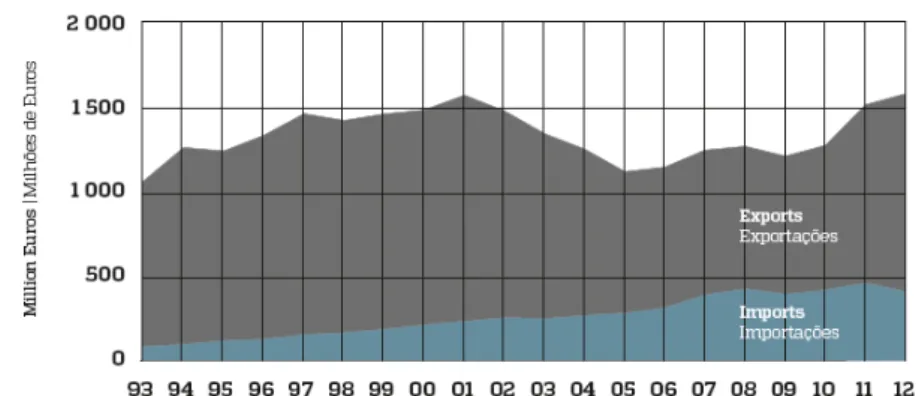
The Portuguese footwear industry has seen three stages in regards to its trade balance. During the 1990‟s, the trade balance was extremely positive as the exports had a higher significance than imports. By the end of this decade, in 2001, the value was of
€ 1,362 million. However, after this, a huge proportion of manufacturing facilities were
closed and the Asian market gained importance. This resulted in an abrupt decrease of exports until 2005, whilst on the other hand imports kept increasing, reaching a surplus
of around € 850 million in 2005. However starting in 2005, as stated previously, the
industry was restructured and focused their strategy in differentiation rather than cost advantage, thus enabling an improvement in the trade balance, reaching its highest value of € 1,193 million in 2012.
Figure 2 – External trade of the Portuguese Footwear Industry (1993-2012)
Source: APPICAPS 2013 Report: “Statistical Study –Footwear, Components and Leather Goods.”
3
footwear exported by a country in comparison to its total exports, meaning the footwear industry is the one that most contributes to the Portuguese trade balance. In fact, Portugal exports footwear around 5,5 more times than any other good.
Source of all data above: APPICAPS 2013 Report: “Statistical Study – Footwear, Components and
4
Appendix 2 – Filipe Shoes Milestones
5
Appendix 3 –Knowledge transfer between generations in Filipe Shoes‟ Firm
Ikujiro Nonaka‟s article describes two outlooks on the organizations;
“information processing machines” (believed by western management, Frederick Taylor, Herbert Simon) or organizations as “knowledge-creators”. On the one hand, the first chain of thought supports that company‟s knowledge is mostly a result of quantifiable data and thus their success can equally be measured via quantifiable methods (ex: increased efficiency, lower costs, and improved return on investment). On the other hand, the second believes that in this constantly changing environment in order to succeed companies must develop the capabilities to “consistently create new
knowledge, disseminate it widely throughout the organization, and quickly embody it in
new technologies and products, providing continuous innovation. These companies
have become famous for their ability to respond quickly to customers, create new
markets, rapidly develop new products, and dominate emergent technologies”. Once studying Filipe Shoes firm, it is possible to see that the education of the generations in fact combines both these approaches. It is proved through the organizational changes throughout their history that Filipe Shoes knows how to adapt quickly; flexibility is crucial.
Moreover, knowledge can decomposed into; explicit knowledge and tacit knowledge. Explicit knowledge is related to quantifiable and systematic information which is easy to share (ex: product specifications). This happens in the generation‟s transfers. A big proportion of knowledge is explicit as it is linked to manufacturing skills within the firm so by observation, imitation and practice enabled by overlapping the generations for a period of 6 years this transfer and learning is possible.
6
1. From tacit to tacit; initially the new generations become familiarized with the business through observation and practice.
2. From explicit to explicit; managers will inherit this tacit, quantifiable knowledge and share it with the remaining workers.
3. From tacit to explicit; this knowledge is embodied in the ways of doing business in Filipe Shoes by all employees.
4. From explicit to tacit. Given the experience of day-to-day business and the business environments faces, employees are frequently exposed to new explicit knowledge that they use to develop their tacit knowledge and internalize it. This is what allows constant change.
Appendix 4 –Filipe Shoes‟ Financial data
The following data was provided via our primary source (i.e. one of the firm‟s managers) as well as through secondary sources of information:
Every manager has 33% share of firm1
95% exports and 5% sales volume in Portugal
5% sales of their own brand abroad (in countries such as Japan, Korea, Australia and other less mature markets in terms of the shoe market)
Sales value in 2013 of € 7,736,899.662
Sales volume growth over the last years:
- 5% compared to last year - 7% compared to 2 years ago - 10% in the last 3 years
- The reason for this growth is that there has been a growing trend to favor quality products, made of natural products such as leather instead of synthetic materials.
1 Free-Report presented in the online platform (www.einforma.pt)
7
Appendix 5 – Resources of Filipe Shoes
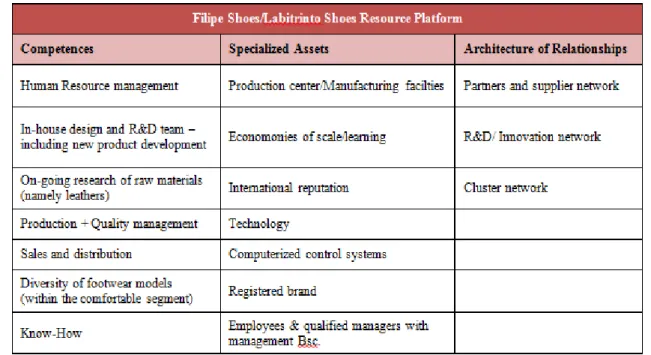
Competencies – this is a reflection of the combination of the capabilities and human resources of a firm – anchored by technology/systems, processes and values – which give origin to knowledge creation. Moreover, is it a core competency if it contributes to either a unique cost advantage and/or a unique customer benefit, thus giving origin to a competitive advantage.
Specialized assets– These are represented by tangible or intangible assets which given their characteristics are not always available to other competitors at the same level. This is to say that, in case they are available, it is probably the case that it will cause such an increase in costs that it will impede the firm to gain abnormal returns.
Architecture of relationships – The resources belonging to this category will also contribute to knowledge creation, but this time through internal and external relationship networks between the firm and other industry players. This resource may also add flexibility and adaptability to the firm, helping them adjust to different environments.
Figure 4 – Filipe Shoes Organizational Resources
8
In-house R&D and design: Regarding this competency, Filipe Shoes has three internal designers who are responsible for keeping up to date with the industry trends and also acknowledge client‟s preferences, adapting to their needs. In terms of R&D, Filipe Shoes recognize the importance of this as it will contribute to better products in the long-run. By acquiring new machinery which is more precise or faster at performing the jobs they will be contributing to the increase the quality of final output and/or production capacity.
On-going research of raw materials: The firm attributes great importance to this competence. The reason for this is tied to the fact that the main input of Filipe Shoes footwear is leather and it represents the majority of the marginal cost of production. As such, in order to avoid price fluctuations to cover the costs of leather, Filipe Shoes must ensure that the suppliers of leather are always selling this raw material at a fairly constant price and with exceptional quality as this is also reflected in the quality of the footwear.
9
Economies of scale: Filipe Shoes has a margin over its products of only 20% meaning
they sell their footwear at an average of 24€3 for normal shoes and 60€4
for boots. As such, given that Filipe Shoes has good quality footwear at a low price for private labels, the firm Filipe Shoes is able to sell their products to many brands. Whether they are lower end brands and in that case the final price to consumers is not high as the markup placed by these brands is low or even to middle/high-end brands which simple place a high mark-up on the products. In this case, having such a vast portfolio does not harm the brand image as Filipe Shoes is never visible to final consumers. Hence, by selling to a multiplicity of brands, Filipe Shoes gains in scale. This means, their production capacity is such that it enables them to reduce their costs by diluting fixed costs.
International reputation: Filipe Shoes already has agreements with more than 300 brands internationally thus having significant brand awareness and reputation. Also, Filipe Shoes can reap benefits of Portuguese footwear reputation, as this is a category it belongs to. In fact, the reputation in regards to quality and design of footwear is so high that Portugal has been able to have the world‟s 2nd highest price in this category, after Italy (APPICAPS, 2013).
Technology: Portuguese footwear is number 1 in technology (APPICAPS, 2013). Moreover, the agreements with CTCP are extremely influential in this respect. More specifically, this competency involves activities which are performed by CTCP as is the case of technical and technological training of Filipe Shoes‟ staff and physical and chemical tests to contribute to innovation and quality improvement of footwear. Another example is the norms applied by this entity and the quality control certificates,
in addition to CTCP‟s investment in good practices to avoid damaging the environment.
Cluster network: Being part of the Portuguese cluster with entities such as APPICAPS and CTCP, the information is shared amongst all players thus providing them with the tools to make the most informed decisions. This industry and cluster is so important for the Portuguese economy that it received a great deal of financial aid for its
3
20 (i.e. marginal production cost)*1,2 4
10
developments. An example of this is seen is the Portuguese Shoes website, with news
that states “this sector will reinforce its investment in the internationalization process,
with a fund of € 12 million to help do so in more than 30 countries” (Portugueseshoes.pt, 2014).
Furthermore, according to Footure 2020 by APPICAPS, the cluster network allows for a fast response and flexibility, it has increased the quality standards of the products and has reinforced the capability of product development by upgrading the footwear offer in terms of design. Additionally, the accumulated know-how of the cluster and its geographic concentration contributes to a fast diffusion of knowledge, for instance on how to act in foreign markets.
Appendix 6 - Footwear Assembling Process
1. Cutting
- Manual cutting process
- Balancés (most used – represents 90% of the cutting process) Requires iron molds (that are very expensive)
- Automatic cutting machines (10% of the cutting process)
Advantage: does not require a minimum production volume to pay back the investment. This allows for a greater variety of products within one collection.
2. Sewing
- Pre-sewing: this is where the leather is standardized – cleaning, smoothening and preparation of the leather
- Sewing (manual or automated)
3. Assembly
- Giving the shoe its final shape/form - Shoes are placed inside the mold
- Footwear is placed inside machines that enable the assembly of the front and back part of the shoes
- The shoes enter an oven and the “cardadeiras” (manual and/or
automatic)
11
- After gluing the sole to the shoe, they then pass through a fridge to conclude this gluing stage.
4. Finishing touches
- Attaching the footbeds to inside of the shoes
- Footwear is cleaned and special products are used to embellish the final product (brushing, brightening or any other relevant product or process, depending on the type of shoes)
- Placed inside the final shoe boxes
- Labeling (sent digitally by the private labels and Filipe Shoes just has to print them)
Primary Source; Filipe Shoes‟ manager
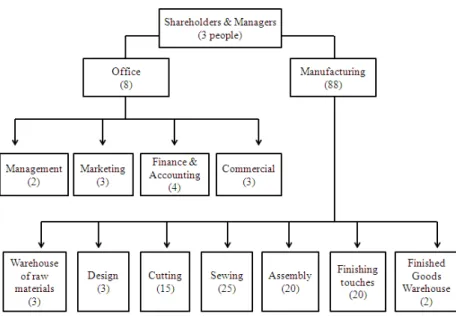
Appendix 7 – Filipe Shoes‟ organizational Chart
12
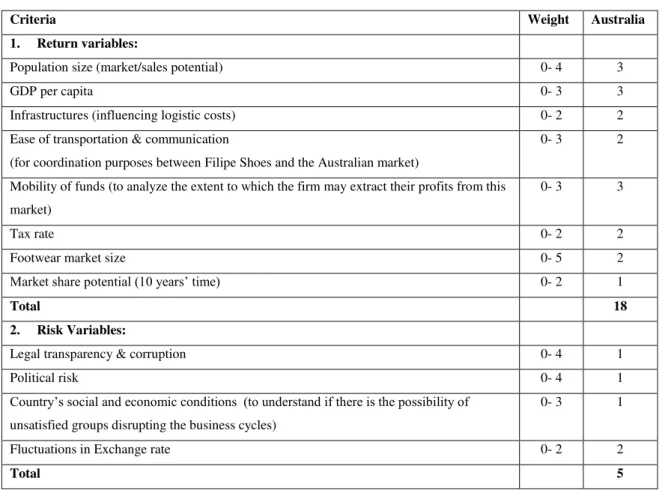
Appendix 8 – Country Selection Simplified Grid
Criteria Weight Australia
1. Return variables:
Population size (market/sales potential) 0- 4 3
GDP per capita 0- 3 3
Infrastructures (influencing logistic costs) 0- 2 2
Ease of transportation & communication
(for coordination purposes between Filipe Shoes and the Australian market)
0- 3 2
Mobility of funds (to analyze the extent to which the firm may extract their profits from this
market)
0- 3 3
Tax rate 0- 2 2
Footwear market size 0- 5 2
Market share potential (10 years‟ time) 0- 2 1
Total 18
2. Risk Variables:
Legal transparency & corruption 0- 4 1
Political risk 0- 4 1
Country‟s social and economic conditions (to understand if there is the possibility of unsatisfied groups disrupting the business cycles)
0- 3 1
Fluctuations in Exchange rate 0- 2 2
Total 5
Appendix 9 – Population density in Australia & distribution per age and sex
13
Figure 7 – Age and sex distribution („000) in Australia, 2013 Source: Australian Bureau of Statistics, 2013
As seen in the figure above, Australia does not have an ageing population. In fact, the
distribution of age is favorable to Labirinto Shoes as the highest proportion of population
coincides with Labirinto‟s target market, i.e. population aged between 25 and 39, with
approximately a total of 1,25million males and 1,2 million females in 2013.
Even more specifically, one can analyze the distribution of Sydney‟s population per age
segment, as this will reveal useful for Filipe Shoes‟ financial projections to test the validity of
targeting a certain age segment. As such, from the figure bellow, one can see that in June 2011,
the age segment between 25-39 was roughly 11,5% for males and 12,25% for females in greater
Sydney.
14
Figure 9 – Males per 100 females in Australia, 2013 Source: Australian Bureau of Statistics, 2011
The figure above shows that the eastern coastal area is the only part of Australia which has an even distribution of males to females, with exception of cities as Brisbane, Sydney and Melbourne that have a slightly higher proportion of females. The rest of the country has a higher proportion of males than females and this is most evident in the states of Western Australia, Northern Australia and part of Queensland, with a ratio of 110 males or more per 100 females.
Appendix 10 – Spending patterns of consumers of Labirinto‟s target market
Note: this data is of 2009-10 and since then these patterns have changed. However, this is the
latest data available.
15 (a) Spending per category (in percentage of total spending)
(b) Household type: reference person is below 35 years old
Figure 11 – Spending Patterns (a) of young couple households (b) Source: Australian Bureau of Statistics, 2010
(a) Spending per category (in percentage of total spending) (b) Household type: oldest child is below 5 years old
(c) One family households
The figures above are representative of the spending patterns of Labirinto‟s target market, the young adults. As one can see, clothing and footwear is not the most relevant category, accounting only for 4% of total spending in 2009/2010.
Appendix 11 – Sales Volume & Value in Australia and Expected growth
Figure 12 – Sales of Footwear by Category: Volume 2008-2013
Source: Euromonitor International from official statistics, trade associations, trade press, company research, store checks, trade interviews, trade sources
Figure 13 – Sales of Footwear by Category: Value 2008-2013
16
Figure 14 – Forecast Sales of Footwear by Category: Value 2013-2018
Source: Euromonitor International from official statistics, trade associations, trade press, company research, store checks, trade interviews, trade sources
Figure 15 – Forecast Sales of Footwear by Category: % Volume Growth 2013-2018 Source: Euromonitor International from official statistics, trade associations, trade press, company
research, store checks, trade interviews, trade sources
Appendix 12 – Documents needed for Australia to import goods
According to data retrieved from the Ease of doing business in Australia (2014) which stated that the time to import is registered as 8 days, with 7 required documents and a cost to import per container equal to US$ 1,170 (€ 974.965).
Procedures to import Time (days) Cost in US$
Documents preparation 3 200
Customs clearance and technical control 1 170
Ports and terminal handling 2 400
Inland transportation and handling 2 400
Total 8 1,170
5
All conversions through the appendix section of this work project were done on the 3rd of January 2014 on the following websites:
17
Documents to Import Bill of landing
Commercial invoice
Customs import declaration
Packing declaration
Packing list
Release order
Technical standard/health certificate
Appendix 13 – Evolution of Australia‟s currency fluctuation compared to the Euro
Figure 16 – currency fluctuation: EUR per 1 AUD Source: (Xe.com, 2014)
The currency fluctuation saw a huge appreciation of the Australian dollar around 2008, after the financial crisis and it rose until reaching its highest in mid-2012. Since then, the AU$ has started losing value in comparison to the Euro, although with slight fluctuations.
Appendix 14 – More on the PESTEL analysis – Economic Force:
Australia‟s top three export destination countries are China, Japan and Republic of Koreas whereas the top three import sources are China, United Stated and Japan, respectively.
Regarding trade relations with Portugal in 2013, Australia mainly imported
vehicles (€ 11,47m), cork (€ 9,44m) and footwear (€ 8,10m) and exported Aircraft,
spacecraft & parts (€ 2m) and hand or machine tools (€ 1,35m). The trade balance
18
ranks as the 59th import source and 101st export destination. However, using Portugal as the benchmark, Australia ranks as 40th export destination, receiving 0,2% of Portuguese exports, which is not very significant especially when compared to Spain (Portugal‟s top export destination) which receives more than one fifth of all Portuguese exports.6
The following figures also state that in 2011, 26% of footwear imported by
Australia was of leather origin. Australia was classified as the world‟s 16th
largest importer in value with US$ 1.333 million (€ 899 m) and as seen bellow this value has been growing exponentially since 2001. Thus, one may suspect that this tendency is expected to continue in the future.
Figure 17 –Australia‟s Footwear Industry Source: World footwear 2012 Yearbook. APPICAPS
Another relevant factor is that it takes 14 days to enforce a contract. Ranking 68th in Protecting investors and 18th in resolving insolvency, there are reduced the incentives for FDI (foreign direct investment).7
Appendix 15 – More on the PESTEL analysis – Socio-Cultural Force:
Hofstede defines cultures according to several dimensions; nonetheless the most significant results for Australia are obtained in the individualism and indulgence dimensions. In concern to individualism, Australia scores an astonishing 90, thus signaling independent individuals who are not as easily influenced by groups (which may in turn influence the types of marketing campaigns chosen by firms). Finally, scoring 71 in the indulgence category reflects the population‟s way of living in the
6
Source: Portugal Fact Sheet retrieved from the Australian Government – Department of Foreign Affairs and Trade
7
19
sense that they are less concerned than many countries in controlling their impulses and desires. The Australian society enjoys life and leisure time.
Regarding leisure time, the Australian Bureau of Statistics (ABS) reported 8.2 million people going abroad in 2012; a huge rise when compared to 2011 (7.8 million) and even more surprising when related to 2002 (3.5 million). Expedia also registered the populations‟ propensity to opt for historical/cultural destinations. In fact, this same
report stated that “37% of Aussies listed sightseeing vacations focused on history and
culture as their preferred holiday”.
Moreover, generation Y (the young population of Australia who embodies the future target of Labrinto Shoes) is said to shift their spending priorities into experiences (as is the case of travelling) instead of searching for housing or purchasing significantly expensive assets.
20
Appendix 16 –Australia‟s E-commerce Statistics
21
Appendix 17 –Australia‟s Climate
Figure 19 –Australia‟s Climate Classification Source: Australian Government, Bureau of Meteorology
Appendix 18 –Australia‟s import processing charge
For imports between A$1,000 and 10,000 (€ 6.74,4 2 and € 6.744,27):
- Maritime transportation with an electronic import declaration: A$ 50.00 (€ 33,72) - Maritime transportation with an electronic import declaration: A$65.75 (€ 44,34) Imports > A$10,000 (€ 6.744, 27):
- Maritime transportation independently of the type of import declaration: A$152.60 (€ 102,91)
22
Appendix 19 – More on the PESTEL analysis – Legal Force:
Australia belongs to the Organization for Economic Cooperation and Development (OECD) and to the World Trade Organization (WTO).
Being as Labirinto Shoes is a Portuguese based brand, the “European Union –
Australia Partnership Framework” is relevant. Namely, in what concerns objective II of this agreement. It entails promoting trade liberalization as it supports the premise that exchanges between the EU and Australia are beneficial for world economy‟s development. This Framework includes actions such as discussions regarding policies towards free trade agreements (FTAs) for instance.
Regarding the Bilateral relationships, Portugal is represented through the Portuguese embassy located in Canberra and the Consulate in Sydney. Portugal and Australia are tied, but not directly though bilateral trade agreements. Their interests are connected for other reasons; Timor-Leste. Portugal and Australia are both concerned in guaranteeing the stability in Timor-Leste and thus bring together assistance to this country.
Appendix 20 –Australia‟s Footwear international trade in 2013-2014
23
Appendix 21 – Drivers of Porter‟s Five Forces in Australia‟s Footwear industry
Figure 21 – Drivers of Buyer Power in the footwear market in Australia, 2013 Source: Marketline
24
Figure 23 –Factors influencing the prospect of footwear‟s new entrants in Australia, 2013 Source: Marketline
25
Figure 25 – Drivers of degree of rivalry in the footwear market in Australia, 2013 Source: Marketline
Appendix 22 – Suggested brand identity and brand positioning for “Labi”
Notes for launching an own brand
According to Kapferer products may become obsolete whereas brands are eternal. With time, products will adapt to the new needs of the constantly changing business environment and carry a visible change, but the name that stands behind this new product (i.e. the brand) will remain. Thus, one must know how to build a brand as it must be coherent and represent a certain culture in which its portfolio will fit. A brand
is a “credibility tag” that will reflect the characteristics of its products and the benefits
consumers should get from them. This reinforces the importance of defining a clear brand strategy for Labirinto Shoes in its early ages.
26
Brand identity prism
Brand Identity is core. It is the central aspect that will define all other elements of the brand; representing what the brand stands for and what makes it unique. This tool
clarifies the brand‟s meaning along with the associations that the brand managers desire
to create and maintain over time. Using Kapferer‟s identity prism as the model to define
Labirinto‟s brand identity it is necessary to take into account six different dimensions:
Physic: this dimension includes the most salient brand features, which may be intangible. This also includes physical features consumers evoke when thinking of the brand and it may even embrace the logo or a flagship product that represents what the brand stands for (European Institute for Brand Management, 2014).
Relationship: it is how the brand interacts with consumers, what it delivers to them. This is extremely important in order to create a need for the product.
Customer Reflection: consists of the brand‟s projected/desired consumer type. It is not necessarily a synonym of the target group‟s characteristics, as the latter may be much wider than the customer-reflection group. In order to define this aspect, advertising campaigns may help. However, in the case of exporting to Australia through an intermediary, the latter is in fact in the hands of the distributor.
Personality is the answer to the following question: if the brand were a person, what type of person would it be?
Culture: is according to Kapferer the most important element of brand identity. It is the story that the brand conveys, it is where the brand comes from (i.e. its roots).
Self-image: is what managers expect consumers to feel when using the brand.
27
Labi
Personality:
Young adults (25-39 years old) with an enthusiastic spirit. Easy-going, open
minded, tough, travelers, happy &
simple. Middle class Portuguese Culture:
manufacturing heritage, innovative and
design driven
Self-image:
“I am an optimist!”, “I know
how to have fun”, “I am able to
establish a great
work/life balance”
Customer reflection:
Active – both
city/outdoorsy, quality, Relationship: friendly, loyal, trustworthy/ honesty, accomplishment and achievement
Physical: leather footwear, simplicity, logo,
comfortable
Figure 26 – Labirinto Shoes suggested brand identity Prism (Kapferer)
Brand positioning is another complement to the brand management strategy and embodies what the managers want consumers to think about the brand or how the brand is different from its competitors. Thus, the suggested positioning statement for Labirinto Shoes is as follows:
“For young and active people who enjoy travelling [target], Labi is a quality leather footwear brand [frame of reference, POP] that sells versatile and comfortable footwear
at the best price-quality ratio, [POD] because of their manufacturing superiority,
gained through their years of experience and partnerships with institutions as CTCP
[Reason to believe]”
More ideas regarding positioning and more specifically in terms of packaging; show the
heritage behind the shoes and/or showcase a city in each box. According to McKinsey‟s
Consumer Decision Journey (2009), the moment of purchase, which defines which brand
28
Appendix 23 – Modes of entry
1. Indirect exporting consists in an agreement with an intermediary from the
firm‟s home market (i.e. Export Management Company or an Export Trading
Company) that will deal with all the export documents and process. This is a common strategy used by firms who have recently started their internationalization process, which is not the case of the one being studied. Filipe Shoes already has an international presence, although not with the brand Labirinto, the managers still have the knowledge and know-how of the internationalization process.
2. Direct exporting; in this case an intermediary is also used though this time in the foreign market, usually distributors, agents, retailers or even online. On one hand, agents are paid via commissions or royalties to provide insights on the new market‟s local reality, i.e. support services regarding marketing/advertising, product features, legal requirements, etc. On the other hand, distributors are intermediaries who buy the footwear and then make the product reach the foreign market consumers by selling to wholesalers or/and retailers. Finally, a company may also choose to export directly to a foreign retailer, eliminating the amount of intermediaries and reaching the storefronts directly.
Pros:
Knowledge of the foreign market given through the foreign intermediaries
Potential profits are higher when compared to indirect exporting
Quick access to market
Limited resource commitment so the firm may focus on its core competencies
Still relatively low risk due to low financial commitment
Given the low commitments by the firm there is still a high degree of flexibility
Cons:
Not in full control on activities such as distribution, marketing, etc.
Management team may get distracted due to bureaucracies
Implies more costs as the firm Filipe Shoes has to incur in the distribution costs
29
and collaborate. All in all, it is a loose form of joint venture which may include the integration of marketing & distribution only or full integration.
Even though it may have several advantages, because this is a fluid form of an agreement, it is especially hard to create control mechanisms hence contributing to trust and confidence issues. Consequently, it is also not a good option for Filipe Shoes‟ own brand. (Gomes et al, 2011)
4. Licensing & Franchising is an agreement in which a firm concedes to another (i.e. the licensee or franchisee) the authorization and access to the use of intellectual property in exchange of a payment, usually a fee or royalty during a certain period.
This form of internationalization is beneficial because it consists in a cost effective way to enter a new market that would also enable Filipe Shoes to work with the Australian population, gaining know-how and allowing them to establish relationships with the local networks. However, it has its pitfalls. The most crucial problem which declines this option is the fact that Filipe Shoes does not even have a patent to license neither does it have enough brand awareness to attract a licensee partner or open Labirinto Shoes‟ stores. Additionally, even if it did, the manufacturing process would have to be conducted elsewhere through outsourcing, reducing the level of control, which is especially important for quality reasons. All in all, it is not adequate due to “problems of quality control, lack of control over technology and inability to realize experience curve economies” (Hill, 2008).
30
6. Joint Venture; All in all this is simply another type of FDI which consists in two or more companies that have joint equity ownership and control, allowing the member companies to have separate legal identity. Joint ventures may include the integration of marketing & distribution only or be fully integrated.
FDI and joint ventures are a means to surpass certain legal & political constraints to merger activities and once again would give insights on knowledge regarding the Australian way of doing business. Nevertheless, they are not the most adequate for Filipe Shoe‟s internationalization process to Australia as they would require too much financial and resource commitment. Not only so but these methods do not allow complete control over technology and operations, also creating indirect costs and risks related to the incapability of integrating all the firm‟s activities with foreign companies (Gomes et al, 2011). Last but not least, there may be conflicts between the companies involved, although this may be true for all types of internationalization processes.Overall, this method implies too many risks as Australia is a new market for the firm to explore and thus there is a need to test the market before making such a commitment. Filipe Shoes needs to focus on developing its resources and its strategy to this country first. Moreover, if this was done it would make Filipe Shoes very dependent on Australia.
Appendix 24 – Tips on how to find the ideal distributor
Dealing with distributors is not always easy, especially in the case of Australia which is a new market and Labirinto Shoes has no past experience with distributors in this geographic area. As such, the following key points are presented to help with this process.
31
besides contribution in networking efforts. Increasingly, paying close attention to the footwear industry media can help Labirinto Shoes establish contacts. Another source of information is obviously foreign government trade offices as their core business is to help promote exports as well as trade fairswhich will help in meeting potential contacts.
Last but certainly not least it is critical to know which retailers the distributors have agreements with and to study these likely distributors. In other words, this means Labirinto Shoes should aim to analyze the following checklist:
Key Features to
analyze Indicators
Sales force Size; is the sales force able to take on the project of selling Labirinto Shoes? Sales history Market share; sales volume; average sales volume per employee
Local territory exploration Is the distributor present in Sydney? Are the retailers with whom the distributor has contracts in Sydney recognized? Does the distributor have short or long term plant to expand in Sydney?
Distributor’s product portfolio
What retailers does the distributor have agreements with? What kind of product lines/brands does the distributor have? Are they in line with Labirinto Shoes’ positioning? Does the distributor have contracts with other Portuguese brands? What size does the order have to be for the distributor to agree to sell Labirinto Shoes? Does the financial projection fulfill to this volume and is it actually feasible taking into account Sydney and its respective demographic/social factors?
Distributor’s facilities What kind of warehouse facilities does the distributor have (i.e. size, location, etc.)? How does the distributor control its stock?
Distributor’s Marketing Plans
What is the distributor’s sales strategy? How do they track their sales? What kind of communication channels are employed by the distributor (ex. Website, brochures, etc.)? Will the distributor provide data that may be helpful for Labirinto Shoes’ forecasts?Will Labirinto Shoes have to contribute monetarily for marketing initiatives done by the distributors? Distributor’s experience & reputation with institutions (clients, banks, etc.)
How to negotiate with Australians
Now that the tips on how to find the ideal distributor have been presented, Labirinto Shoes must pay attention to certain aspects once they have selected their potential distributor and want to move on to the negotiation stage. More specifically, the managers of this brand must be aware of the cultural differences felt in terms on relationships, communication, negotiations and in the establishment of agreements/contracts.
32
personal side as the business relations grow. Moreover, Australians favor an egalitarian society which means they are likely to show more empathy with an average individual rather than those who exhibit more authority.
In terms of communication, this should not be a major problem for Labirinto Shoes as the native language is English. Nonetheless, Australian English may require a slightly greater effort to understand as it may be spoken fast and there may be use of popular expressions. Extremely important is to adhere to Australian‟s communication style which is very direct. Furthermore, in terms of cultural differences, Labirinto Shoes managers should avoid being insulted in case they are mocked as this may actually be a sign that the distributor is establishing a favorable relationship. Also, note that thumbs-up with a rising movement of the arm can be offensive in Australia.
Regarding negotiations, Labirinto Shoes should be aware of the individualistic nature of the Australian population. This means that if two Australian individuals from the same team disagree, Labirinto Shoes may still stand a chance of convincing one who will then play against the other team member in agreeing. Also, although status is not extremely important, Filipe Shoes should still use employees with a higher hierarchy to engage with Australian counterparts as this signals that the firm considers this negotiation important. Filipe Shoes should initially use the formal titles of Mr./Ms.
before the family name to address to the counterparts and only use their first name after they have been offered to. Australians also value punctuality.
Regarding presentations, when the firm is presenting Labirinto Shoes notice it is okay and actually advisable to showcase not only all the positive aspects of this brand but point out possible weaknesses. The reason this is so important is because
Australians tend to suspect such “perfect” products, brands or services.
Australians follow a cooperative negotiation style (aiming at win-win outcomes), which means they are able to compromise if proved that this is beneficial for both sides and consider in information sharing a fundamental part of negotiations. Notice however that Australians do not bargain aggressively as they see considerable
concessions as a reflection of being „ripped off.‟ Concerning decisions, Filipe Shoes has
33
that Australians enjoy taking risks from time to time which gives opportunities to non-established brands as is the case of Labirinto Shoes.
Finally, only once a contract has been signed by both parties does this reflect a final agreement and requests to make adjustments after this will translate distrust and be viewed negatively.
Overall, independently of the nationality being dealt with, the most important is to; learn about the way of doing business, to be patient and be prepared. The ultimate goal is to find the best possible deal for both parties as this will help reach an agreement. (Katz, 2007)
Appendix 25 – Export Process of Filipe Shoes
Figure 27 – Supply Chain Management Diagram to Australia
1–www.apiccaps.pt/ 2-www.ctcp.pt/ 3-www.portugalglobal.pt/ 4- Labirinto Shoes‟ freight forwarder that uses the maritime route via Singapore to reach Sydney.5- For financial aid 6- http://www.austrade.gov.au/Local-Sites/Spain
7- [email protected] 8-http://www.iapmei.pt 9-http://www.portugal.embassy.gov.au/lbon/home.html
10-Footwear brands in present in Sydney. Although many other brands may be considered as they can be reached via
e-commerce. 11- Government of NSW, which includes Sydney; https://www.nsw.gov.au/ 12 – To be chosen by Filipe Shoes‟ firm 13- Chosen by the distributor 14- Curious, adventurous young adults who enjoy travelling and purchase comfortable footwear for this purpose 15 - http://www.dfat.gov.au/trade/ 16- http://www.portrade.com.au/
17-Footwear fair in Sydney; www.australianshoefair.com;18-http://www.leffler.com.au/cla.htm;19 – Standards
Australia; http://www.standards.org.au/Pages/default.aspx . 20- National Footwear Retailers Association;
34
On the left hand side of the figure above, one may find the Portuguese entities which help reduce the entry barriers. One of the ways to do this is by providing the Firm Filipe Shoes with financial aid and/or help deal with legal affairs. On the right hand side, one can see the influential entities in the Australian market.
Appendix 26 – Supply Chain Management
Incoterms are essentially rules and conditions that parties have to fulfill once they engage in trades. The contracts established between the entities summarize the conditions under which the sales of goods worldwide must be completed and provide direction to those involved in the international trade (i.e. importers, exporters, lawyers, transporters, insurers, etc.). There are 11 incoterms available (ICC), sub-divided into two categories from which one must choose from:
For any type of transportation:
Ex Works (EXW)
The seller solely has to be concerned with packaging the items. The buyer
has to collect the goods at the seller‟s premises once they are available.
Minimum risk for the seller.
Free Carrier (FCA) The seller conveys the goods to the transporter‟s premises, being
accountable for paying the carriage until this point of delivery.
Carriage Paid To (CPT) The seller has to arrange and cover the costs of the carriage
transportation.
Carriage & Insurance Paid
To (CIP)
The seller is additionally responsible to contract and pay a minimum
insurance to cover the buyer‟s transportation risks during the bulk of the
journey.
Delivered at Terminal
(DAT)
The seller has the responsibility of covering the costs until the
terminal/port destination, without devising delivery to final destination
and the import customs.
Delivered at Place (DAP) The only concern the seller is exempted from is the import customs.
35 For maritime or waterway transportation:
Free Alongside Ship (FAS) The seller solely has to carry the goods until the loading port and cover the respective costs.
Free On Board (FOB)
The seller is accountable for transporting the goods until the port from
which they are going to be exported and loading the goods on the
boarding vessel. From that point on the risks are carried by the buyer.
Cost & Freight (CFR) Seller must also arrange and pay for the necessary freight so goods reach
the destination port.
Cost, Insurance & Freight
(CIF) Similar to CFR but the seller also has to cover the insurance risk.
The information above can be summarized with the following graphic illustration of the costs incurred by each party:
36
Appendix 27 – Resource Commitment
The following table describes Labirinto Shoe‟s resources, how important they are in the market they will enter (i.e. the Strategic Importance) and how well Labirinto Shoes or the firm Filipe Shoes performs in respect to the same resources (i.e. Relative Strength).
Figure 29 –Organizational Resources‟ strategic importance & relative strength
One may see that the resources that need most commitment are increasing the
37
improving design capabilities and accumulating management know-how as they are currently key weaknesses. This means they‟re relative strength in the market is significant (i.e. they are important to succeed in Australia) however, Labirinto Shoes is still underdeveloped in these aspects (meaning their relative strength is comparatively lower than for other resources).
38
Appendix 28 – Implementation Plan Proposal with required tasks & timeframe
Objectives:
1. Prepare Labirinto shoe‟s brand internally (i.e. define the brand identity,
positioning, portfolio and communication channels)
2. Select one trustful distributor, after conducting due diligence on at least 3 3. Partnership with at least 4 retailers in the first 5 years
4. Obtain a 1,55% market share in the 1st year of sales (i.e. 2017) and 2,20% after 8 years
5. Recover the investment in 4/5 years
6. Maintain the business running for a period of at least 10 years
7. Use this entrance to test the potential of the Australian market and analyze the possibility of expanding to another city
Tasks:
P
re
-ent
ry
Definition of product portfolio and brand strategy (Labirinto Shoes designers + Labirinto‟s brand manager)
Develop the communication channels of the brand (Labirinto‟s brand manager + outsourcing to brand creator) Attend Sydney‟s annual Shoe Fair in March (2 of Filipe Shoes managers)
Analyze competitors & prospective partnerships (Commercial team) Costs and sales forecast (Filipe Shoes finance team)
Invest time to network with potential distributors and select one distributor (Filipe Shoes managers)
Contact AICEP, PORTRADE, Portuguese embassy, etc. to help with legislation – licenses & export documentation (Filipe Shoes manager)
Establish distributor contract (Filipe Shoes managers)
E
ntr
y
Contact local retailers and establish agreements (distributor)
Ensure production and on-time stock delivery to the port of Leixões + maritime transportation to Sydney
(under the FOB contract the first part is Filipe Shoes obligation, more specifically the logistics employee of the commercial
team whilst the maritime transportation is the distributor‟s responsibility)
Transport the stock from Sydney‟s port to inside the city and deliver to retailers ( under FOB: distributor – operations manager)
Establish the marketing means and commercial efforts (distributor)
Sell footwear to end consumers (retailers‟ Salesforce in stores) Evaluate operations and activity reports (financial + commercial team)
P
o
st
-ent
ry
Request feedback from distributor and opinions from end consumers (available through communication between distributor and Filipe Shoes managers)
Maintain regular communication and information flow with the distributor (Filipe Shoes managers and distributor) Research the possibility of new retailers and partners (distributor)
Revisit the business plan + make financial forecasts of sales and costs (commercial + financial team)
39
40
Appendix 29 – Financial Calculations
In order to conduct the financial analysis, some things must be considered. To
begin with, it is crucial to determine the market dimension (i.e. the size of the potential
buyers of Labirinto brand). For this purpose, four steps were taken:
1º The total population of Sydney was measured according to the Australian
Bureau of Statistics (both male and female);
2º Within Sydney‟s population, the population who enjoyed travelling (which is in
line with Labirinto‟s brand identity) was computed according to a statistics
retrieved from ABS (government statistics);
3º The population who spends in pre-travelling expenses, more specifically with
footwear purchases was then considered given data retrieved from Expedia.
4º Finally, the previous potential market was then reduced to solely the middle
income class giving a final market dimension of around 124,15 thousand
people.
Notice that in this stage, some assumptions had to be made, namely:
Sydney‟s population is considered constant over the years;
Given that the statistics retrieved are averages, one assumed that they are valid
for both males and females.
The next step taken was to consider the market share the brand wants or should
reach in both female and male segments to incur in a profitable project. Note
however that one must consider the knowledge of Filipe Shoes firm in regards to
footwear manufacturing skills. The firm is currently producing an output which is 85%
dedicated to male footwear, whereas only 15% is destined for male footwear. As such,
41
of the firm, without incurring in extra costs with training these market shares will be
such that when multiplied by the market potential there will be higher sales
quantities for the female segment rather than the male. Regarding sales growth, it is
assumed that it will only grow until 2020. The reason for this is that during the first few
years of Labirinto Shoes presence in Australia their awareness will grow relatively fast
and thus has an impact on sales vales. However, brand awareness takes a long time to
achieve and thus after this initial growth, it will start being hard to gain significant
increases in brand awareness, leading to a stabilization of sales values (i.e. sales growth
for the remaining years is so insignificant that one will consider it as 0%).
Once deriving the sales quantities, one must compute all costs associated to the
manufacturing process to obtain the COGS per unit. These COGS include the costs with
raw materials, labor, transportation costs, storage costs and allocated overheads as is the
case of energy costs with machinery used for production for instance. In Filipe Shoes case, according to their manager, the firm is presently spending € 15 solely in regards to
costs with raw materials and transportation costs thus the energy, labor and
transportation costs must be added. For transportation costs the freight forwarder
Worldwide Logistics Portugal (WLP) was contacted to obtain the total costs
associated to our delivery sizes8, which was then divided by the total units sold to Australia to obtain a cost of transportation per unit sold. Regarding energy and salaries,
the total annual salaries (Pordata.pt, 2014) and energy costs (Filipe Shoes‟ IES 2013)
were consideredand then according to the fraction used for the size delivery considered,
the proportion of costs was calculated on a unit basis. For this purpose, the formulas
used were the following:
8
42
Per unit Costs Formulas
Energy costs [(Annual energy costs)×(sales volume to Australia]÷(total footwear output per year) Salary costs [(Annual salary costs × sales volume to Australia)]÷(total footwear output per year)
Adding these calculations, and taking into account the Portuguese inflation rate
(Pordata.pt, 2014 – using an average of the last two years), the COGS per footwear
were of €17,5 in 2017. Note that here another two important assumption were made.
First, although the costs of female and male footwear are different, in this case the
values considered are an average. Thus, the COGS are a single figure for both
kinds of collections. Secondly, in terms of total wages, one additional worker was
considered as the implementation plan requires hiring a new employee assigned to
a new unit which is responsible for helping in customer relationship management, in
the internationalization process and after-sales duties. One is then in position to use the
following formulas:
Price Formula used to compute price
Merchandize price (i.e. price charged to distributor) GOGS/(1-profit margin)
Distribution price (i.e. price charged to the retailers) marginal cost to the distributor 9 * (1+distributor markup)
Retail price (i.e. price in-store for end consumers) Distribution price*(1+ retail markup)*(1+ GST)
Hence, using the first formula of the merchandize price and considering the goal
of increasing the profit margin of this brand to 40%, the final merchandize price for
2017 (i.e. the first year of sales) is €29,2.
In respect to distribution, their marginal cost was also computed according to
data provided by WLP whilst fashion retailing sources revealed that the markup charged
by retailer is usually 100% and the markup assumed for the distributor was of 70%.
9
43
Therefore, the distribution price and retail price obtained for 2017 is of €62,7 and
€ 137,9, respectively.
Once these figures are all obtained, it is possible to construct a business model
for the launching of Labirinto Shoes as an own brand. However, first the following was
determined;
Initial investment, which in this case are the costs incurred to attend the
footwear fair in Sydney as well as the branding costs as this is a new brand
which has to define its packaging, logos, slogan, etc. and also the costs of
registering the trademark in Australia. Here, the initial investment will occur
in both 2015 (year 0) and 2016 (year 1). The only difference is that in 2015 all
costs are included in the initial investment whereas in 2015 the branding costs
and trademark registration have already occurred, hence only the costs related to
Sydney‟s fair are included.
Regarding depreciation, as this project takes advantage of unused capacity, no
new machinery was purchased. The depreciation of machinery occurs
independently of incurring in this project and thus is considered a sunk cost.
Hence, the depreciation value is zero.
Starting in 2015, the tax rate imposed will be 21%.
The discount rate used to discount the project cash flows (i.e. the WACC which
depends on the firm‟s capital structure). According to Filipe Shoes manager
44
Appendix 30 – Pricing in Australia
Main Footwear Retailers in Australia and their respective brand portfolio 10
Footwear
Wholesalers Retailers Brands Type of Footwear Price range (€)
11 Approx. Average Price (€) Fusion Retail Brands Pty Ltd Mather
Colorado Adventure wear, quality footwear for outdoors 90,0 – 130,95 110,48
Hush
Puppies Comfortable and casual everyday shoes 117 - 160,21 138,61
Roc Mainly leather boots for several purposes, ranging from school to casual footwear
Not available
online -
Williams
Colorado - 90,0 – 130,95 110,48
Roc - - -
RCG Corporation Ltd RCG Brands Pty Ltd Chaco
Adventure shoes whose core input is leather, slightly sporty and targeted to a young audience
64,29 - 120,54 92
Cushe Not available online -
Merrel 94,40 – 139,90 116,9
Betts Group Pty
Ltd
Airflex
“High quality leather fashionable footwear with a key focus on comfort and durability that features
unique technologies” (Airflex website) 63,11 - 119,23 91
Betts Comfortable and versatile footwear for youngsters 49,09 - 84,19 67
Pacific Brands Limited
Clarks Elegant good quality casual footwear 90,12 - 161,35 125,74 Hush
Puppies - 117 - 160,21 138,61
Julius Marlow
Leather shoes mostly destined for business-casual
work environments 90,10 - 140,24 115,17
Planet Shoes12
Clarks - 90,12 - 161,35 125,74
Dansko
All day comfort shoes with a modern twist made of several types of leather, ranging from sandals to
high heels, flats or boots
Not available
online -
Ecco Affordable quality, comfortable and good-looking
shoes 105,17 - 273,47 189
Fly London Unconventional fashionable shoes, mostly with
heels or wedges 136,77 - 157,81 147
Jambu
Vegan products made with eco-friendly designs. Their slogan says “Life is a journey, step into your
comfort zone”, reflecting the features of their footwear
55,40 - 230,72 143
Merrel - 94,40 – 139,90 116,9
Naot Leather shoes for both male and female – boots,
sandals, clogs. Also sell footbeds. 139,51 - 244,68 192
10
Notice there are so many retailers that only the most related to footwear were selected and within retailers, given the 1amount of brands, only the most similar to the brand Labirinto Shoes were considered as these will act as the direct competitors in the Australian Market.
11Prices are an estimate as they were retrieved online from the brands‟ websites, accessed on the 11th of November
2014 and thus may not correspond to the real prices presented in stores. Conversions of the currency to Euro was done on the 12th of November 2014 in the website http://www.x-rates.com/calculator/?from=AUD
12
45
Timberland Producer of quality leather shoes for outdoor activities for the adventurous spirits 100,96 - 260,13 181
Wolky Footwear designed for walking 108,36 - 260,13 184
Figure 30 –Retailer‟s Market shares in Australia Source: IbisWorld.com.au
Within the brands analyzed, one may conclude that the brands which are most similar to Labirinto Shoes, having the same concept of comfortable footwear are brands like Merrell and Timberland. However, these brands invest in simple and consistent designs, not presenting breaking innovations between collections and are slightly more athletic, as they are traditionally dedicated to outdoors sports and activities. The brand Labirinto Shoes on the other hand is able to provide leather quality shoes with a modern touch by playing with textures, shoe formats and colors while delivering good value for money price tags. Labirinto Shoes is great for people who want comfortable shoes but want to wear them in many types of environments, not only in outdoor activities but also and mainly whilst wondering through cities (as daily basis, versatile footwear).
46
Appendix 32 – Sales growth
47
48
Appendix 35 – Business Model Financials
Figure 31 – Projected Business model scenario
49
Appendix 36 – Optimistic Scenario
This scenario assumes a 20% higher sales growth rate in each year, meaning the following growth rates; 12%, 14,4% and 18% for the first three years of sales, respectively. With everything else constant, the following results are obtained:
Figure 32 – Optimistic Business model scenario
50
Appendix 37 – Pessimistic Scenario
This scenario assumes a 20% lower sales growth rate in each year, meaning the following growth rates; 8%, 9,6% and 12% for the first three years of sales, respectively. With everything else constant, the following results are obtained.
Figure 33 – Pessimistic Business model scenario
As expected this leads to a lower NPV of € 71.321,89 as well as IRR which is now equal to 23%. Nonetheless, even in this pessimistic
51
Appendix 38 – Sensitivity Analysis
Figure 34 – Projected Cash Flow Analysis of the Project Figure 35 – Sensitivity Analysis to Initial Investment