Comparative Value of Four Measures of
Retention in Expert Care in Predicting Clinical
Outcomes and Health Care Utilization in HIV
Patients
Kelly R. Reveles1, Timothy R. Juday2, Matthew J. Labreche3, Eric M. Mortensen4, Jim M. Koeller1, Daniel Seekins2, Christine U. Oramasionwu5, Mary Bollinger6, Laurel A. Copeland7, Xavier Jones6, Christopher R. Frei1*
1The University of Texas at Austin, Austin, Texas, United States of America; and The University of Texas Health Science Center at San Antonio, San Antonio, Texas, United States of America,2Bristol-Myers Squibb Company, Plainsboro, New Jersey, United States of America,3The Johns Hopkins Hospital, Baltimore, Maryland, United States of America,4VA North Texas Health Care System and The University of Texas Southwestern Medical Center, Dallas, Texas, United States of America,5University of North Carolina at Chapel Hill, Chapel Hill, North Carolina, United States of America,6South Texas Veterans Health Care System, San Antonio, Texas, United States of America,7Central Texas Veterans Health Care System and Scott & White Healthcare, Center for Applied Health Research, Temple, Texas, United States of America
Abstract
This study compared the ability of four measures of patient retention in HIV expert care to predict clinical outcomes. This retrospective study examined Veterans Health Administra-tion (VHA) beneficiaries with HIV (ICD-9-CM codes 042 or V08) receiving expert care (de-fined as HIV-1 RNA viral load and CD4 cell count tests occurring within one week of each other) at VHA facilities from October 1, 2006, to September 30, 2008. Patients were18 years old and continuous VHA users for at least 24 months after entry into expert care. Re-tention measures included: Annual Appointments (2 appointments annually at least 60 days apart), Missed Appointments (missed25% of appointments), Infrequent Appoint-ments (>6 months without an appointment), and Missed or Infrequent Appointments
(missed25% of appointments or>6 months without an appointment). Multivariable
nomi-nal logistic regression models were used to determine associations between retention mea-sures and outcomes. Overall, 8,845 patients met study criteria. At baseline, 64% of patients were virologically suppressed and 37% had a CD4 cell count>500 cells/mm3. At 24
months, 82% were virologically suppressed and 46% had a CD4 cell count>500 cells/mm3.
During follow-up, 13% progressed to AIDS, 48% visited the emergency department (ED), 28% were hospitalized, and 0.3% died. All four retention measures were associated with virologic suppression and antiretroviral therapy initiation at 24 months follow-up. Annual Appointments correlated positively with CD4 cell count>500 cells/mm3. Missed
Appoint-ments was predictive of all primary and secondary outcomes, including CD4 cell count
500 cells/mm3, progression to AIDS, ED visit, and hospitalization. Missed Appointments was the only measure to predict all primary and secondary outcomes. This finding could be
OPEN ACCESS
Citation:Reveles KR, Juday TR, Labreche MJ, Mortensen EM, Koeller JM, Seekins D, et al. (2015) Comparative Value of Four Measures of Retention in Expert Care in Predicting Clinical Outcomes and Health Care Utilization in HIV Patients. PLoS ONE 10 (3): e0120953. doi:10.1371/journal.pone.0120953
Academic Editor:Giuseppe Vittorio De Socio, Azienda ospedaliero-universitaria di Perugia, ITALY
Received:April 16, 2014
Accepted:February 10, 2015
Published:March 20, 2015
Copyright:© 2015 Reveles et al. This is an open access article distributed under the terms of the
Creative Commons Attribution License, which permits unrestricted use, distribution, and reproduction in any medium, provided the original author and source are credited.
Data Availability Statement:Data are available from the Veterans Health Administration Institutional Data Access / Ethics Committee for researchers who meet the criteria for access to confidential data.
useful to health care providers and public health organizations as they seek ways to opti-mize the health of HIV patients.
Introduction
According to the Centers for Disease Control and Prevention (CDC), nearly 900,000 people in the United States (U.S.) were living with diagnosed human immunodeficiency virus (HIV) in-fection by the end of 2010. The estimated incidence of HIV in the U.S. during the same year was 49,300 infections [1]. The advent of highly active antiretroviral therapy (HAART) in the mid-1990s has greatly increased the estimated life expectancy of patients with HIV following diagnosis, from 5.6 years in 1993 to 24.2 years in 2006 [2,3].
HIV expert care is defined as HIV-1 RNA viral load and CD4 cell count tests occurring within one week of each other. Retention in expert care is a critical component in optimizing the health outcomes of HIV patients, by closely monitoring markers of HIV severity and pro-gression. Research has demonstrated that retention in HIV care is associated with improve-ment in CD4 cell count, reduction in HIV viral load, reduction in opportunistic infections, and improved survival [4–9]. Retention might also improve acceptance of HIV status and promote social support through intrapersonal relationships, each of which might also be important for improved health outcomes [10].
It is estimated that only about half of all HIV patients in the U.S. routinely receive HIV-fo-cused care [11]. Prior studies have demonstrated that 34–60% of HIV patients miss appoint-ments with their HIV care provider and 39% of patients do not have regular follow-up [6,8,9]. In low- to middle-income countries, studies have reported substantial loss of patients, from HIV testing to treatment initiation [12]. These data suggest that linkage and retention in HIV expert care are significant barriers to optimizing health outcomes among patients with HIV.
Several organizations, including the National Committee for Quality Assurance (NCQA), National Quality Forum (NQF), and the Human Resources and Services Administration HIV/ AIDS Bureau (HRSA HAB) include retention in HIV expert care as a marker of quality care; however, there is no standard definition for measuring retention. A number of different mea-sures have been used in published studies in an attempt to quantify patient retention in HIV expert care [13–15]. Patient retention is most commonly reported as: 1) appointments missed, 2) medical visits at regularly defined intervals, or 3) a combination of these two measures [14]. The NCQA defined retention in HIV expert care as patients being seen by their provider at least twice annually at least 60 days apart [13]. Similarly, the HRSA HAB defined retention in HIV expert care as at least two appointments annually at least 90 days apart. In addition, reten-tion measures vary widely in low- to middle-income countries. These measures, which often include various amounts of elapsed time between visits, have made it difficult to make compar-isons across programs [16,17].
Few studies have compared the predictive value of these retention in care measures among HIV patients. The aim of this study was to assess which measure of retention in HIV expert care was most predictive of patient outcomes in a national cohort of U.S. Veterans Health Ad-ministration (VHA) patients. We hypothesized that each of the studied retention measures would be predictive of patient outcomes and health care utilization, and that certain measures would have a greater effect on outcomes.
Methods
Study design and data source
This was a retrospective cohort study of patients initiating HIV expert care at any U.S. VHA fa-cility between October 1, 2006 and September 30, 2008 with an additional 24 months of fol-low-up. The VHA is the largest integrated health care system in the U.S. and includes more than 150 hospitals and 850 clinics. In 2006, there were approximately 23 million VHA enrollees in the U.S. [18] Data for this study were obtained from the VHA electronic medical record sys-tem which includes administrative, clinical, laboratory, and pharmacy data repositories. Four national VA databases were used: the VA Medical SAS Datasets (both inpatient and outpa-tient), the VA Vital Status File, the VA Decision Support System Datasets, and the VHA Annu-al Enrollment Files. The VA MedicAnnu-al StatisticAnnu-al AnAnnu-alysis System (SAS) Inpatient Dataset includes patient demographics, diagnoses, procedures, and discharge status. The VA Vital Sta-tus File contains date of birth, date of death, and gender for each veteran. The VA DSS inte-grates data from clinical and financial systems to create National Data Extracts (NDEs). NDEs for clinical data include laboratory results and both inpatient and outpatient pharmacy records. Finally, the VHA Annual Enrollment Files contain eligibility information used to create priori-ty groups. The Universipriori-ty of Texas Health Science Center at San Antonio Institutional Review Board (San Antonio, TX) and the South Texas Veterans Health Care System Research and De-velopment Committee (San Antonio, TX) approved this study. This study design did not re-quire patient informed consent to view medical records. Patient medical information was anonymized and de-identified prior to analysis.
Patient eligibility
The study population included HIV patients managed at VHA health care facilities between October 1, 2006 and September 30, 2010. Patients were included in the study sample if: (1) they entered into expert care (defined as HIV-1 RNA viral load and CD4 cell count tests occur-ring within one week of each other) between October 1, 2006 and September 30, 2008; (2) were diagnosed with HIV/acquired immune deficiency syndrome (AIDS) (defined as an ICD-9-CM code of 042 or V08 in any position on at least one outpatient or inpatient medical encounter) within six months of entry into expert care (between April 1, 2006 and March 31, 2009); (3) were at least 18 years old on the date of entry into expert care; (4) had HIV-1 RNA viral load and CD4 cell count tests occurring within one week of each other at 24 ± 3 months after the date of entry into expert care; and (5) were a continuous VHA user for at least 24 months after entry into expert care. The latter two inclusion criteria were chosen to ensure that the patient was still receiving HIV expert care in the two years following study entry and to allow adequate time to assess patient outcomes and healthcare utilization. A 24-month follow-up period has been used in prior studies that evaluated the association of retention measures and patient out-comes [19,20].
Definitions
were expected per year [21]. Missed Appointments was defined as missing at least 25% of ap-pointments. This proportion was derived from the number of appointments for which the vet-eran had a“no show”divided by the total number of "no shows" plus the number of actual appointments.“No shows”are those appointments that are missed without prior notification or rescheduling. This methodology has been used in prior studies that assessed retention in HIV expert care [8,22].
Missed Appointments was further divided into appointments missed at any clinic and those missed at infectious diseases (ID) clinics. Infrequent Appointments represents gaps in care and was defined as>6 months without an appointment. Finally, Missed or Infrequent
Appoint-ments was determined by combining two of the variables (missed25% of appointments or
>6 months without an appointment).
Covariates included demographic measures, treatment facility, and VHA Priority status, a categorization from 1–8 describing why the veteran was eligible for VHA care. Priority 1 veter-ans are 50%-100% disabled by a military service-related condition and have no co-pays for care or prescription medications. Priority 2–6 veterans have medication co-pays. Priority 7–8 veter-ans have agreed to pay co-pays for care and medications and are ineligible under Priorities 1–6. Priority status correlates with both higher illness severity and lower socioeconomic status, and has been validated with VHA administrative data [23–26].
Patient outcomes
The primary outcomes were: HIV-1 RNA viral load and CD4 cell count at 24 months post-baseline. HIV-1 RNA viral load was stratified into two groups:<500 copies/mL versus500 copies/mL [21]. This HIV-1 RNA viral load threshold was chosen because all sites employed an assay with at least a minimum detection value of 500 copies/mL throughout the study peri-od [27]. CD4 cell count was stratified into four groups: CD4 cell count<200, 200–349, 350–
500, or>500 cells/mm3. These are the cutoff values for initiation of HAART and opportunistic
infection prophylaxis according to the current guidelines [21,28]. Furthermore, these values are commonly used to determine the stage of HIV illness [29,30].
Secondary analyses assessed five patient outcome measures over 24 months of follow-up: (1) incidence of AIDS-defining conditions, (2) all-cause emergency department (ED) visits, (3) all-cause hospitalizations, and (4) initiation of antiretroviral therapy (ART). ART initiation was defined as the receipt of any antiretroviral medication used to treat HIV [31]. Progression to AIDS was defined as a CD4 cell count<200 cells/mm3and/or evidence of one or more of
the CDC AIDS-defining conditions [32]. Patients already on ART were excluded from the ART outcome analysis. Likewise, patients who already had a diagnosis of AIDS at baseline were excluded from the AIDS outcome analysis. We had originally planned to study patient mortality as an additional outcome in our secondary analyses; however, there were insufficient numbers of deaths to assess the predictive value of the measures for death.
Data and statistical analysis
SAS 9.2 and JMP 9.0 (SAS Corp., Cary, NC) were used for all analyses. Continuous variables are presented as means and standard deviations (SD). Categorical variables are presented as the number and percentage of subjects in each category.
We utilized logistic regression models to evaluate the association of retention in care mea-sures with patient outcomes. Categorical covariates included: sex, race, marital status, VHA priority group, HIV-1 viral load (dichotomized to<500 copies/mL and500 copies/mL), CD4 cell count (dichotomized to500 cells/mm3and>500 cells/mm3), and treatment facility;
ICD-9-CM codes and were dichotomized (yes/no). We also calculated the Charlson comorbid-ity score as a continuous variable according to Deyo et al. [33]. All covariates were collected at baseline and were tested for multicollinearity using the Spearman rank correlation test. Each of these covariates was chosen because they have been previously shown to be associated with clinical outcomes among patients with HIV [34–37]. Missing data were excluded from analy-ses. Results are presented as adjusted odds ratios (OR) and p-values. The retention measure most predictive of patient outcomes was identified by comparing the ORs of the associations within the regression models.
Results
Baseline characteristics
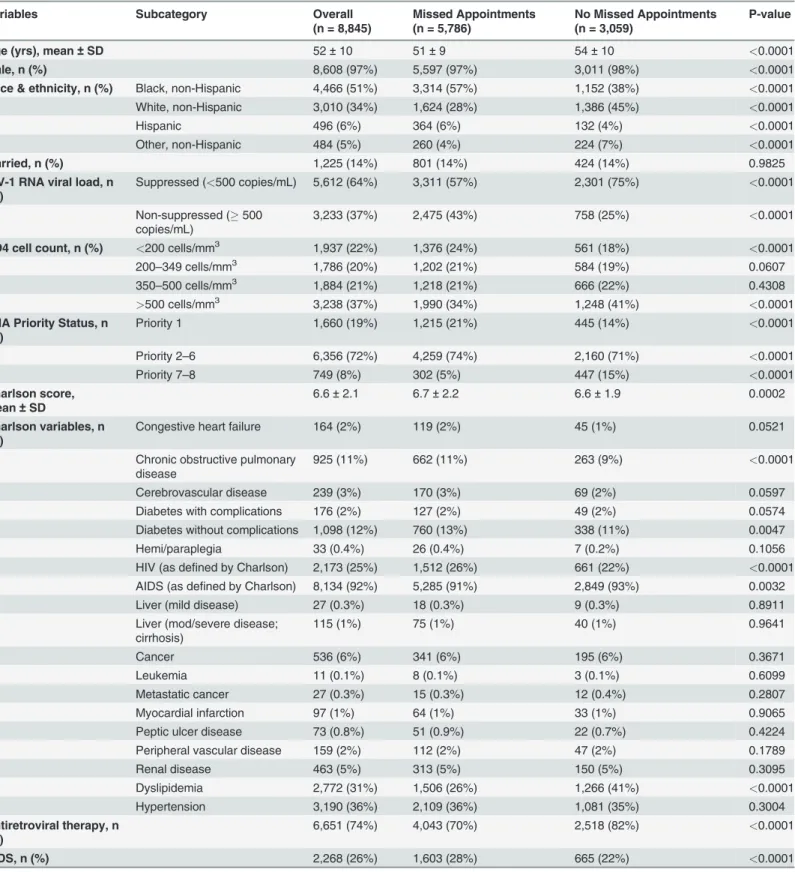
Overall, 8,845 patients met study inclusion criteria.Table 1describes the patients’baseline characteristics. Patients had a mean age of 52 ± 10 years. Patients were predominately male (97%) and of Black race (51%). The mean Charlson comorbidity score was 6.6 ± 2.1 (the score weights HIV as 2 points and AIDS as 6 points). Common comorbidities included: hypertension (36%), dyslipidemia (31%), and diabetes (14%). Of the baseline characteristics included, no set of variables had a correlation coefficient greater than 0.2, indicating low multicollinearity among study variables. The majority of patients (74%) were receiving ART at baseline. Also at baseline, 64% of patients were virologically suppressed and 37% had a CD4 cell count>500
cells/mm3. AIDS (26%) was present in some of our patients at baseline. Approximately 7% of patients also had an AIDS-defining condition at baseline. Patients with Missed Appointments differed from those without Missed Appointments with regard to baseline demographics, CD4 cell count, HIV-1 RNA viral load, and several comorbidities.
Retention measures
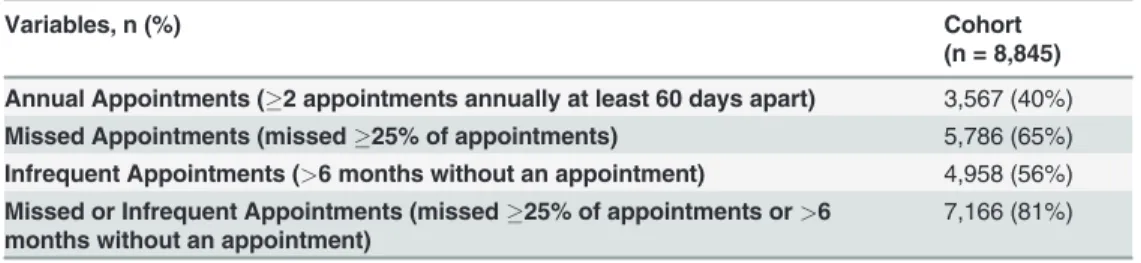
Retention measures at 24 months are presented inTable 2. Overall, 3,567 patients (40%) had Annual Appointments, 5,786 (65%) had Missed Appointments, 4,958 (56%) had Infrequent Appointments, and 7,166 (81%) had Missed or Infrequent Appointments. When the analyses were limited to Missed Appointments for infectious diseases clinics, the numbers were 36% for Missed Appointments and 68% for Missed or Infrequent Appointments.
Patient outcomes
The proportion of patients with CD4 cell counts>500 cells/mm3increased from 37% at
base-line to 46% at 24 months (p<0.0001) (Tables1and3). The proportion of patients with
virolog-ic suppression also increased from baseline (64%) to follow-up (82%) (p<0.0001). During
follow-up, 13% of patients progressed to AIDS and<1% died. Herpes simplex-associated
chronic ulcers (4%) and pneumonia (3%) were the most common AIDS-defining conditions. Nearly half (48%) of all patients had at least one ED visit over the study period and 28% were hospitalized.
Each of the four retention measures was associated with one or more patient outcomes. In unadjusted logistic regression models, all four retention measures were associated with virolog-ic response. Additionally, Missed Appointments and Appointments Missed or Infrequent were negatively associated with CD4 cell count>500 cells/mm3and positively associated with ART
initiation, progression to AIDS, hospital admission, and ED visits.
Table 1. Patient baseline characteristics.
Variables Subcategory Overall
(n = 8,845)
Missed Appointments (n = 5,786)
No Missed Appointments (n = 3,059)
P-value
Age (yrs), mean±SD 52±10 51±9 54±10 <0.0001
Male, n (%) 8,608 (97%) 5,597 (97%) 3,011 (98%) <0.0001
Race & ethnicity, n (%) Black, non-Hispanic 4,466 (51%) 3,314 (57%) 1,152 (38%) <0.0001
White, non-Hispanic 3,010 (34%) 1,624 (28%) 1,386 (45%) <0.0001
Hispanic 496 (6%) 364 (6%) 132 (4%) <0.0001
Other, non-Hispanic 484 (5%) 260 (4%) 224 (7%) <0.0001
Married, n (%) 1,225 (14%) 801 (14%) 424 (14%) 0.9825
HIV-1 RNA viral load, n (%)
Suppressed (<500 copies/mL) 5,612 (64%) 3,311 (57%) 2,301 (75%) <0.0001
Non-suppressed (500 copies/mL)
3,233 (37%) 2,475 (43%) 758 (25%) <0.0001
CD4 cell count, n (%) <200 cells/mm3 1,937 (22%) 1,376 (24%) 561 (18%) <0.0001
200–349 cells/mm3 1,786 (20%) 1,202 (21%) 584 (19%) 0.0607
350–500 cells/mm3 1,884 (21%) 1,218 (21%) 666 (22%) 0.4308
>500 cells/mm3 3,238 (37%) 1,990 (34%) 1,248 (41%) <0.0001
VHA Priority Status, n (%)
Priority 1 1,660 (19%) 1,215 (21%) 445 (14%) <0.0001
Priority 2–6 6,356 (72%) 4,259 (74%) 2,160 (71%) <0.0001
Priority 7–8 749 (8%) 302 (5%) 447 (15%) <0.0001
Charlson score, mean±SD
6.6±2.1 6.7±2.2 6.6±1.9 0.0002
Charlson variables, n (%)
Congestive heart failure 164 (2%) 119 (2%) 45 (1%) 0.0521
Chronic obstructive pulmonary disease
925 (11%) 662 (11%) 263 (9%) <0.0001
Cerebrovascular disease 239 (3%) 170 (3%) 69 (2%) 0.0597
Diabetes with complications 176 (2%) 127 (2%) 49 (2%) 0.0574
Diabetes without complications 1,098 (12%) 760 (13%) 338 (11%) 0.0047
Hemi/paraplegia 33 (0.4%) 26 (0.4%) 7 (0.2%) 0.1056
HIV (as defined by Charlson) 2,173 (25%) 1,512 (26%) 661 (22%) <0.0001
AIDS (as defined by Charlson) 8,134 (92%) 5,285 (91%) 2,849 (93%) 0.0032
Liver (mild disease) 27 (0.3%) 18 (0.3%) 9 (0.3%) 0.8911
Liver (mod/severe disease; cirrhosis)
115 (1%) 75 (1%) 40 (1%) 0.9641
Cancer 536 (6%) 341 (6%) 195 (6%) 0.3671
Leukemia 11 (0.1%) 8 (0.1%) 3 (0.1%) 0.6099
Metastatic cancer 27 (0.3%) 15 (0.3%) 12 (0.4%) 0.2807
Myocardial infarction 97 (1%) 64 (1%) 33 (1%) 0.9065
Peptic ulcer disease 73 (0.8%) 51 (0.9%) 22 (0.7%) 0.4224
Peripheral vascular disease 159 (2%) 112 (2%) 47 (2%) 0.1789
Renal disease 463 (5%) 313 (5%) 150 (5%) 0.3095
Dyslipidemia 2,772 (31%) 1,506 (26%) 1,266 (41%) <0.0001
Hypertension 3,190 (36%) 2,109 (36%) 1,081 (35%) 0.3004
Antiretroviral therapy, n (%)
6,651 (74%) 4,043 (70%) 2,518 (82%) <0.0001
AIDS, n (%) 2,268 (26%) 1,603 (28%) 665 (22%) <0.0001
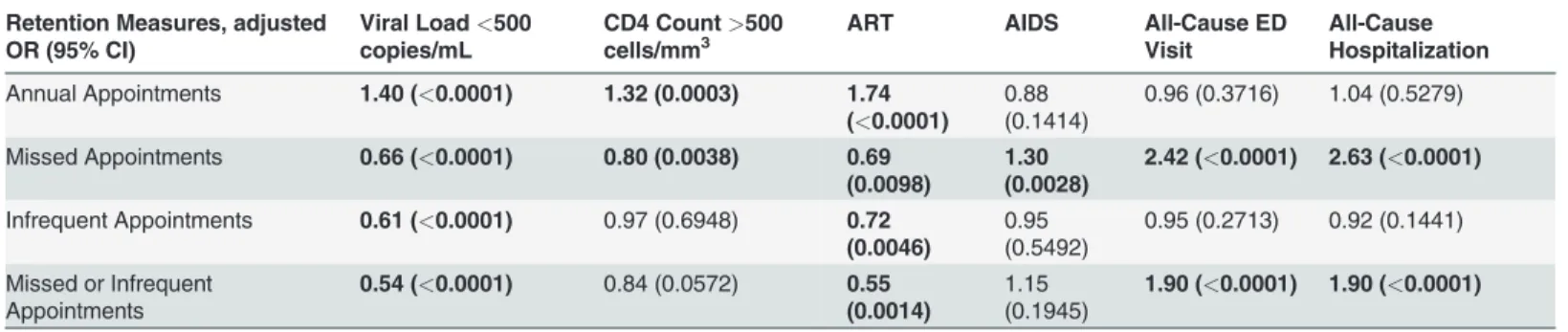
three retention measures were negatively associated with virologic response. Similarly, all four retention measures predicted ART initiation at follow-up. Annual Appointments also pre-dicted CD4 cell count>500 cells/mm3. Importantly, Missed Appointments was significantly
associated with all clinical outcomes, including CD4 cell count>500 cells/mm3(negative
pre-dictor), progression to AIDS, ED visit, and hospitalization. Finally, Missed or Infrequent Ap-pointments was also associated with ED visits and hospital admission.
Discussion
This is one of the first studies to compare clinical outcomes in patients using different measures for retention in HIV expert care in the U.S., a high-income country. Our study provides evi-dence that each of the four retention measures in this study has clinical value; however, Missed Appointments was the only measure to predict all of our primary and secondary outcomes. This is important because the definition chosen to measure retention in HIV expert care might have implications for patient health outcomes, forward HIV transmission, and comparison of various HIV programs. Our study is strengthened by the use of data from the largest integrated health care system in the U.S. and its national scope.
Studies assessing the comparative value of HIV retention measures are limited. Mugavero et al. recently evaluated commonly used retention measures in predicting viral load suppres-sion at six academic HIV clinics [22]. Retention measures included count and dichotomous missed visits, visit adherence, 6-month gap, 4-month visit constancy, and the HRSA HAB re-tention measure. Among 10,053 patients included in the study, all six rere-tention measures were significantly associated with viral load suppression at 12 months follow-up; however, there was variation in the correlation of each measure with viral load suppression. The authors suggested that their findings indicate no clear gold standard for measuring retention. Our study similarly found that all retention measures assessed were associated with virological suppression; Table 1. (Continued)
Variables Subcategory Overall
(n = 8,845)
Missed Appointments (n = 5,786)
No Missed Appointments (n = 3,059)
P-value
AIDS-defining condition, n (%)
610 (7%) 428 (7%) 182 (6%) 0.0106
AIDS = acquired immune deficiency syndrome; HIV = human immunodeficiency syndrome; SD = standard deviation
Note: Priority 1 veterans are 50%–100% disabled by a military service-related condition and have no co-pays for care or prescription medications; Priority
2–6 veterans have medication co-pays; Priority 7–8 veterans have agreed to pay co-pays for care and medications and are ineligible under Priorities 1–6.
Note: Charlson score defines HIV/AIDS using ICD-9-CM code 042 and does not include asymptomatic HIV infection (ICD-9-CM code V08)
doi:10.1371/journal.pone.0120953.t001
Table 2. Retention measures at 24 months.
Variables, n (%) Cohort
(n = 8,845)
Annual Appointments (2 appointments annually at least 60 days apart) 3,567 (40%)
Missed Appointments (missed25% of appointments) 5,786 (65%)
Infrequent Appointments (>6 months without an appointment) 4,958 (56%) Missed or Infrequent Appointments (missed25% of appointments or>6
months without an appointment)
7,166 (81%)
however, we further assessed several other important clinical outcomes. Our data suggest that Missed Appointments might be the best measure of retention in HIV expert care.
Another recent study, by Yehia et al. sought to identify measures associated with retention in HIV expert care [38]. This was a large, multicenter, prospective cohort study of more than 17,000 HIV infected adults in the U.S. Three retention measures were assessed: gaps in care of
>6 months between successive outpatient visits, quarterly visits, and having2 visits at least 90 days apart annually. Each of these three measures correlated with retention in expert care (correlation coefficient ranged from 0.67 to 0.88). Additionally, all measures demonstrated similar patterns of associations with baseline characteristics (demographics and clinical vari-ables). Although this study suggests that each of the three measures produces approximately similar estimates of HIV retention in expert care, the investigators did not evaluate clinical Table 3. Patient outcomes at 24 months.
Variables Subcategory Cohort (n = 8,845)
HIV-1 RNA viral load, n (%) Suppressed (<500 copies/mL) 7,235 (82%)
Not suppressed (500 copies/mL) 1,610 (18%)
CD4 cell count, n (%) <200 cells/mm3 1,101 (12%)
200–349 cells/mm3 1,680 (19%)
350–500 cells/mm3 2,015 (23%)
>500 cells/mm3 4,049 (46%)
Initiation of ART, n (%)* 1,581/2,284 (69%)
Incidence of AIDS, n (%)* 853/6,577 (13%)
ED visit, n (%) 4,249 (48%)
ED visits, mean±SD 1.5±3.0
Hospitalizations, n (%) 2,494 (28%)
Hospitalizations, mean±SD 0.8±1.9
Death, n (%) 26 (0.3%)
*Patients who had these characteristics at baseline were excluded from these results.
ED = emergency department; ART = antiretroviral therapy; AIDS = acquired immune deficiency syndrome; SD = standard deviation
doi:10.1371/journal.pone.0120953.t003
Table 4. Multivariable nominal logistic regression models for patient outcomes at 24 months: OR (p-value), n = 8,845a,b,c,
Retention Measures, adjusted OR (95% CI)
Viral Load<500 copies/mL
CD4 Count>500 cells/mm3
ART AIDS All-Cause ED
Visit
All-Cause Hospitalization
Annual Appointments 1.40 (<0.0001) 1.32 (0.0003) 1.74 (<0.0001)
0.88 (0.1414)
0.96 (0.3716) 1.04 (0.5279)
Missed Appointments 0.66 (<0.0001) 0.80 (0.0038) 0.69 (0.0098)
1.30 (0.0028)
2.42 (<0.0001) 2.63 (<0.0001)
Infrequent Appointments 0.61 (<0.0001) 0.97 (0.6948) 0.72 (0.0046)
0.95 (0.5492)
0.95 (0.2713) 0.92 (0.1441)
Missed or Infrequent Appointments
0.54 (<0.0001) 0.84 (0.0572) 0.55 (0.0014)
1.15 (0.1945)
1.90 (<0.0001) 1.90 (<0.0001)
aCovariates were: patient age, sex, race, marital status, priority group, baseline viral load, baseline CD4 count, Charlson comorbidity score, and
treatment facility.
bPatients with outcome of interest at baseline were excluded from these analyses cBold indicates statistical signi
ficance
AIDS = progression to acquired immune deficiency syndrome; ED = emergency department; ART = antiretroviral therapy initiation
outcomes associated with each measure. Our study took the next step in assessing which reten-tion measures are most likely to predict clinical outcomes. We also analyzed missed appoint-ments, which could not be captured with the prior study design.
In our study, 36% of HIV patients missed appointments in ID clinics and 65% missed ap-pointments in any clinic. Prior HIV studies have produced similar estimates of missed appoint-ments (34 to 60%) [8,9]. Furthermore, our study suggests that missed appointappoint-ments might be the most useful retention measure for predicting clinical outcomes. Patients might miss ap-pointments if they feel poorly (worsening health) or are unmotivated to keep up with HIV-re-lated care, both of which suggest worse clinical status [39]. Alternatively, patients who experience symptom improvement following initiation of ART might also miss appointments [40].
This association between missed appointments and clinical outcomes in HIV-infected pa-tients has been demonstrated previously. Berg et al. conducted a retrospective cohort analysis in 995 HIV-infected patients at a single urban community health center [4]. The study exam-ined the association of appointments missed in the prior year with suppression of HIV viral load and progression to AIDS. In this study, the number of missed appointments significantly predicted a detectable HIV viral load and an AIDS-defining CD4 cell count. In another study, Mugavero et al. conducted a prospective analysis of HIV patients receiving care at two outpa-tient university HIV treatment centers [8]. The primary outcome of this study was HIV viral load suppression. Among 676 patients evaluated, each missed appointment significantly pro-longed the time to HIV viral load suppression. Conversely, visit adherence also significantly predicted lower cumulative HIV viral load. Finally, Lucas et al. conducted a retrospective anal-ysis of 273 HIV-infected patients at a single HIV clinic to determine factors associated with failure to achieve virologic suppression [7]. Higher rates of missed clinic appointments were as-sociated with virologic suppression at one year.
The results of these studies are in line with our own findings—missed appointments result in poorer clinical outcomes in HIV patients. These studies differed from ours in that they all evaluated only one measure of retention in care and they only included a limited number of outcome variables. Furthermore, some of these studies were limited in size and did not include patients from a nationally representative sample [7]. Finally, data collection was often limited to one year of follow-up; whereas our study followed patients for two years [4,7]. Despite these limitations, these studies strengthen the evidence that missed appointments are important pre-dictors of clinical outcomes in HIV patients in high-income countries like the U.S.
Other measures of retention in HIV expert care have been shown to correlate with clinical outcomes. Giordano et al. demonstrated that patients who completed four appointments (at least one per quarter) within the year had significantly lower mortality compared to those with appointments in only one of the four quarters [5]. Additionally, patients who completed three or four appointments within the year had a significantly greater improvement in CD4 cell count and reduction in HIV viral load from baseline as compared to those with only one or two appointments within the year.
appointments might also have poorly managed comorbid conditions [43]. Finally, missed ap-pointments might limit the opportunity for patients to receive proper prophylactic therapy for other HIV-related illnesses. Each of these factors could lead to poorer clinical outcomes and creased resource utilization. Indeed, our study demonstrated increased resource utilization, in-cluding ED visits and hospitalizations, in patients who missed appointments.
Programs aimed at preventing missed appointments might be especially important given the results of our study. Practices could implement policies to track“no show”rates. They could then direct retention efforts to these patients to prevent no shows, such as a follow-up call after a missed appointment to express concern for the patient’s well-being and encourage them to come into the clinic. This approach has been useful in patients at high risk for suicide [44]. Other interventions should target factors commonly associated with patient adherence: health literacy, education, interpersonal relationships, patient-provider relationships, location of care, patient attitudes, and cultural variations [45]. Additionally, future research should focus on the development and testing of strategies to retain patients in care to maximize health outcomes.
Retaining HIV patients in expert care should continue to be a major priority for providers and public health organizations. Our findings suggest that the definition chosen to measure re-tention in HIV expert care might have implications for patient health outcomes. Missed ap-pointments has been one of the most widely used retention measures in the literature [4,8,9]; however, variation in retention assessment can greatly hinder comparison of the effectiveness of various HIV programs [16]. Incorporating missed appointments into the NCQA, NQF, or HRSA HAB measure might aid in improving consistency of measures when evaluating reten-tion across studies and settings and, ultimately, improving health outcomes among patients with HIV. Development of standardized national quality measures for HIV retention in care might also streamline care across the health care system and aid in reimbursement procedures for organizations who receive federal funding from the Centers for Medicare and Medicaid Ser-vices or HRSA.
This study has limitations. We studied a VHA population; therefore, study findings might not be generalizable to non-VHA care settings. VHA patients are mostly male, more likely to be African-American, and generally sicker than patients in other health care systems [46]. In addition, electronic medical data are created for the purpose of patient care, not for research, and might contain errors. There might be variation in the extent of physician reporting of pa-tients’medical conditions and this variability might lead to inaccuracy of the Charlson comor-bidity score as well as other variables. We were also unable to determine patients’prior HIV status, disclosure of status, care experiences prior to study inclusion, socioeconomic status, drug or substance abuse, or clinical severity. Furthermore, few (14%) patients in this study were married, suggesting possibly low social support. Each of these factors could have affected retention in care and possibly biased the retention measure-outcome relationship. Finally, the inclusion criteria for 24 month continuous care might bias this sample toward a better retained population or a higher population of early linkers. This could limit the generalizability of our study findings to other populations.
Author Contributions
Conceived and designed the experiments: KRR TRJ MJL EMM JMK DS CUO MB LAC XJ CRF. Performed the experiments: KRR CRF. Analyzed the data: KRR CRF. Wrote the paper: KRR TRJ MJL EMM JMK DS CUO MB LAC XJ CRF.
References
1. Centers for Disease Control and Prevention. HIV Surveillance Report, 2011. Available:http://www.cdc. gov/hiv/topics/surveillance/resources/reports/. Accessed 12 July 2013.
2. Hellinger FJ. The lifetime cost of treating a person with HIV. JAMA. 1993; 270: 474–478. PMID:
8320787
3. Schackman BR, Gebo KA, Walensky RP, Losina E, Muccio T, Sax PE, et al. The lifetime cost of current human immunodeficiency virus care in the United States. Med Care. 2006; 44: 990–997. PMID:
17063130
4. Berg MB, Safren SA, Mimiaga MJ, Grasso C, Boswell S, Mater KH. Nonadherence to medical appoint-ments is associated with increased plasma HIV RNA and decreased CD4 cell counts in a community-based HIV primary care clinic. AIDS Care. 2005; 17: 902–907. PMID:16120506
5. Giordano TP, Gifford AL, White AC Jr., Suarez-Almazor ME, Rabeneck L, Hartman C, et al. Retention in care: a challenge to survival with HIV infection. Clin Infect Dis. 2007; 44: 1493–1499. PMID:
17479948
6. Lo W, MacGovern T, Bradford J. Association of ancillary services with primary care utilization and re-tention for patients with HIV/AIDS. AIDS Care. 2002; 14 Suppl 1: S45–57. PMID:12204141
7. Lucas GM, Chaisson RE, Moore RD. Highly active antiretroviral therapy in a large urban clinic: risk fac-tors for virologic failure and adverse drug reactions. Ann Intern Med. 1999; 131: 81–87. PMID:
10419445
8. Mugavero MJ, Lin HY, Willig JH, Westfall AO, Ulett KB, Routman JS, et al. Missed visits and mortality among patients establishing initial outpatient HIV treatment. Clin Infect Dis. 2009; 48: 248–256. doi:10.
1086/595705PMID:19072715
9. Park WB, Choe PG, Kim SH, Jo JH, Bang JH, Kim HB, et al. One-year adherence to clinic visits after highly active antiretroviral therapy: a predictor of clinical progress in HIV patients. J Intern Med. 2007; 261: 268–275. PMID:17305649
10. Mugavero MJ, Amico KR, Horn T, Thompson MA. The state of engagement in HIV care in the United States: from cascade to continuum to control. Clin Infect Dis. 2013; 57: 1164–1171. doi:10.1093/cid/
cit420PMID:23797289
11. Gardner EM, McLees MP, Steiner JF, Del Rio C, Burman WJ. The spectrum of engagement in HIV care and its relevance to test-and-treat strategies for prevention of HIV infection. Clin Infect Dis. 2011; 52: 793–800. doi:10.1093/cid/ciq243PMID:21367734
12. Rosen S, Fox MP. Retention in HIV care between testing and treatment in sub-Saharan Africa: a sys-tematic review. PLoS Med. 2011; 8: e1001056. doi:10.1371/journal.pmed.1001056PMID:21811403
13. Horberg MA, Aberg JA, Cheever LW, Renner P, O'Brien Kaleba E, Asch SM. Development of national and multiagency HIV care quality measures. Clin Infect Dis. 2010; 51: 732–738. doi:10.1086/655893
PMID:20715924
14. Horstmann E, Brown J, Islam F, Buck J, Agins BD. Retaining HIV-infected patients in care: Where are we? Where do we go from here? Clin Infect Dis. 2010; 50: 752–761. doi:10.1086/649933PMID:
20121413
15. Mugavero MJ, Davila JA, Nevin CR, Giordano TP. From access to engagement: measuring retention in outpatient HIV clinical care. AIDS Patient Care STDS. 2010; 24: 607–613. doi:10.1089/apc.2010.0086
PMID:20858055
16. Chalker J, Andualem T, Minzi O, Ntaganira J, Ojoo A, Waako P, et al. Monitoring adherence and de-faulting for antiretroviral therapy in 5 East african countries: an urgent need for standards. J Int Assoc Physicians AIDS Care. 2008; 7: 193–199. doi:10.1177/1545109708320687PMID:18626124 17. Chi BH, Yiannoutsos CT, Westfall AO, Newman JE, Zhou J, Cesar C, et al. Universal definition of loss
to follow-up in HIV treatment programs: a statistical analysis of 111 facilities in Africa, Asia, and Latin America. PLoS Med. 2011; 8: e1001111. doi:10.1371/journal.pmed.1001111PMID:22039357
19. Mugavero MJ, Amico KR, Westfall AO, Crane HM, Zinski A, Willig JH, et al. Early retention in HIV care and viral load suppression: implications for a test and treat approach to HIV prevention. J Acquir Im-mune Defic Syndr. 2012; 59: 86–93. doi:10.1097/QAI.0b013e318236f7d2PMID:21937921 20. Rich ML, Miller AC, Niyigena P, Franke MF, Niyonzima JB, Socci A, et al. Excellent clinical outcomes
and high retention in care among adults in a community-based HIV treatment program in rural Rwanda. J Acquir Immune Defic Syndr. 2012; 59: e35–42. doi:10.1097/QAI.0b013e31824476c4PMID:
22156912
21. Panel on Antiretroviral Guidelines for Adults and Adolescents. Guidelines for the use of antiretroviral agents in HIV-1-infected adults and adolescents. DHHS. 2011: 1–166. Available:http://www.aidsinfo.
nih.gov/ContentFiles/AdultandAdolescentGL.pdf. Accessed 1 August 2011.
22. Mugavero MJ, Westfall AO, Zinski A, Davila J, Drainoni ML, Gardner LI, et al. Measuring retention in HIV care: the elusive gold standard. J Acquir Immune Defic Syndr. 2012; 61: 574–580. doi:10.1097/
QAI.0b013e318273762fPMID:23011397
23. Kazis LE, Miller DR, Clark J, Skinner K, Lee A, Rogers W, et al. Health-related quality of life in patients served by the Department of Veterans Affairs: results from the Veterans Health Study. Arch Intern Med. 1998; 158: 626–632. PMID:9521227
24. Pugh MJ, Copeland LA, Zeber JE, Cramer JA, Amuan ME, Cavazos JE, et al. The impact of epilepsy on health status among younger and older adults. Epilepsia. 2005; 46: 1820–1827. PMID:16302863 25. Schneeweiss S, Seeger JD, Maclure M, Wang PS, Avorn J, Glynn RJ. Performance of comorbidity
scores to control for confounding in epidemiologic studies using claims data. Am J Epidemiol. 2001; 154: 854–864. PMID:11682368
26. Shen Y, Hendricks A, Zhang S, Kazis LE. VHA enrollees' health care coverage and use of care. Med Care Res Rev. 2003; 60: 253–267. PMID:12800686
27. Braithwaite RS, Kozal MJ, Chang CC, Roberts MS, Fultz SL, Goetz MB, et al. Adherence, virological and immunological outcomes for HIV-infected veterans starting combination antiretroviral therapies. AIDS. 2007; 21: 1579–1589. PMID:17630553
28. Panel on Opportunistic Infections in HIV-Infected Adults and Adolescents. Guidelines for the prevention and treatment of opportunistic infections in HIV-infected adults and adolescents: recommendations from the Centers for Disease Control and Prevention, the National Institutes of Health, and the HIV Medical Association of the Infectious Diseases Society of America. Available:http://aidsinfo.nih.gov/ contentfiles/lvguidelines/adultoi.pdf. Accessed 29 July 2013.
29. Lau B, Gange SJ, Moore RD. Risk of non-AIDS-related mortality may exceed risk of AIDS-related mor-tality among individuals enrolling into care with CD4+ counts greater than 200 cells/mm3. J Acquir Im-mune Defic Syndr. 2007; 44: 179–187. PMID:17075385
30. Moore RD, Keruly JC. CD4+ cell count 6 years after commencement of highly active antiretroviral thera-py in persons with sustained virologic suppression. Clin Infect Dis. 2007; 44: 441–446. PMID:
17205456
31. Hellinger FJ, Encinosa WE. The cost and incidence of prescribing errors among privately insured HIV patients. Pharmacoeconomics. 2010; 28: 23–34. doi:10.2165/11313810-000000000-00000PMID:
20014874
32. Schneider E, Whitmore S, Glynn KM, Dominguez K, Mitsch A, McKenna MT, et al. Revised surveillance case definitions for HIV infection among adults, adolescents, and children aged<18 months and for
HIV infection and AIDS among children aged 18 months to<13 years—United States, 2008. MMWR
Recomm Rep. 2008; 57: 1–12. PMID:19052530
33. Deyo RA, Cherkin DC, Ciol MA. Adapting a clinical comorbidity index for use with ICD-9-CM administra-tive databases. J Clin Epidemiol. 1992; 45: 613–619. PMID:1607900
34. Meditz AL, MaWhinney S, Allshouse A, Feser W, Markowitz M, Little S, et al. Sex, race, and geographic region influence clinical outcomes following primary HIV-1 infection. J Infect Dis. 2011; 203: 442–451.
doi:10.1093/infdis/jiq085PMID:21245157
35. Miller CJ, Baker JV, Bormann AM, Erlandson KM, Huppler Hullsiek K, Justice AC, et al. Adjudicated morbidity and mortality outcomes by age among individuals with HIV infection on suppressive antiretro-viral therapy. PLoS One. 2014; 9: e95061. doi:10.1371/journal.pone.0095061PMID:24728071
36. Kposowa AJ. Marital status and HIV/AIDS mortality: evidence from the US National Longitudinal Mor-tality Study. Int J Infect Dis. 2013; 17: e868–874. doi:10.1016/j.ijid.2013.02.018PMID:23562356 37. Rodriguez-Penney AT, Iudicello JE, Riggs PK, Doyle K, Ellis RJ, Letendre SL, et al. Co-morbidities in
38. Yehia BR, Fleishman JA, Metlay JP, Korthuis PT, Agwu AL, Berry SA, et al. Comparing different mea-sures of retention in outpatient HIV care. AIDS. 2012; 26: 1131–1139. doi:10.1097/QAD.
0b013e3283528afaPMID:22382143
39. Park WB, Kim JY, Kim SH, Kim HB, Kim NJ, Oh MD, et al. Self-reported reasons among HIV-infected patients for missing clinic appointments. Int J STD AIDS. 2008; 19: 125–126. doi:10.1258/ijsa.2007.
007101PMID:18334069
40. McGuire M, Munyenyembe T, Szumilin E, Heinzelmann A, Le Paih M, Bouithy N, et al. Vital status of pre-ART and ART patients defaulting from care in rural Malawi. Trop Med Int Health. 2010; 15 Suppl 1: 55–62. doi:10.1111/j.1365-3156.2010.02504.xPMID:20586961
41. Sethi AK, Celentano DD, Gange SJ, Moore RD, Gallant JE. Association between adherence to antire-troviral therapy and human immunodeficiency virus drug resistance. Clin Infect Dis. 2003; 37: 1112–
1118. PMID:14523777
42. Giordano TP, White AC Jr., Sajja P, Graviss EA, Arduino RC, Adu-Oppong A, et al. Factors associated with the use of highly active antiretroviral therapy in patients newly entering care in an urban clinic. J Acquir Immune Defic Syndr. 2003; 32: 399–405. PMID:12640198
43. Rintamaki LS, Davis TC, Skripkauskas S, Bennett CL, Wolf MS. Social stigma concerns and HIV medi-cation adherence. AIDS Patient Care STDS. 2006; 20: 359–368. PMID:16706710
44. Motto JA, Bostrom AG. A randomized controlled trial of postcrisis suicide prevention. Psychiatr Serv. 2001; 52: 828–833. PMID:11376235
45. Martin LR, Williams SL, Haskard KB, Dimatteo MR. The challenge of patient adherence. Ther Clin Risk Manag. 2005; 1: 189–199. PMID:18360559
46. Morgan RO, Teal CR, Reddy SG, Ford ME, Ashton CM. Measurement in Veterans Affairs Health Ser-vices Research: veterans as a special population. Health Serv Res. 2005; 40: 1573–1583. PMID: