i
Francisco José de Vilhena Leitão Gregório
Ubiquitous and context-aware computing modelling:
Study of devices integration in their environment
i
MEGI
2018
Ubiquitous and context-aware computing modelling: Study of devices integration in their environment Title:
Subtitle:
iii NOVA Information Management School
Instituto Superior de Estatística e Gestão de Informação Universidade Nova de Lisboa
UBIQUITOUS
AND
CONTEXT-AWARE
COMPUTING
MODELLING: STUDY OF DEVICES INTEGRATION IN THEIR
ENVIRONMENT
by
Francisco Gregório
Advisor: Vítor Santos, PhD
iv ABSTRACT
In an almost imperceptible way, ubiquitous and context-aware computing make part of our everyday lives, as the world has developed in an interconnected way between humans and technological devices. This interconnectedness raises the need to integrate humans’ interaction with the different devices they use in different social contexts and environments. In the proposed research, it is suggested the development of new scenario building based on a current ubiquitous computing model dedicated to the environment context-awareness. We will also follow previous research made on the formal structure computation model based on social paradigm theory, dedicated to embed devices into different context environments with social roles developed by Santos (2012/2015). Furthermore, several socially relevant context scenarios are to be identified and studied. Once identified, we gather and document the requirements that devices should have, according to the model, in order to achieve a correct integration in their contextual environment.
KEYWORDS
Context-aware computing, ubiquitous computing, pervasive computing, social paradigms, organization theory
v ACKNOWLEDGEMENTS
I would first like to thank my thesis advisor Dr. Vítor Santos of the Information Management School at NOVA University. The door to Prof. Santos' office was always open whenever I ran into any doubt or had a question about my research/writing. He steadily allowed this paper to be my own work, always steering me in his best point of view of the right direction whenever he thought I needed it. Finally, I must also express my very profound gratitude to my parents (they are the ultimate role models), my two siblings, my grandmother, and to my partner, whose love and guidance are with me in whatever I pursue. I also want to thank to all of them for providing me with constant support and continuous encouragement throughout my years of study and through the process of researching and writing this thesis. This accomplishment would not have been possible without them.
vi INDEX
1. Introduction ... 1
1.1. General framing and society implications of Ubiquitous and mobile computing ... 2
1.2. Research Objectives ... 4
2. Literature review ... 5
2.1. Ubiquitous computing ... 5
2.1.1. Mobile computing concept ... 5
2.1.2. Pervasive computing concept ... 6
2.1.3. Current applicable technologies ... 7
2.2. Ubiquitous Computing models ... 14
2.3. Social paradigms system in ubiquitous and pervasive computing ... 15
3. Research methodolgy ... 17
3.1. Design Science Research ... 17
3.2. Methodology and research strategy ... 19
3.3. Graphical representation and simulation ... 20
3.4. Process ... 21
4. Model ... 23
4.1. Scenario identification ... 24
4.2. Scenario building ... 25
4.2.1. School scenario (outdoor & indoor) ... 25
4.2.2. Gymnasium scenario (indoor) ... 28
4.3. Scenario Simulation ... 31
4.4. Results and discussion ... 35
5. Conclusion ... 36
5.1. Summary of the developed work ... 36
5.2. Work limitations ... 38
vii TABLE OF FIGURES
Figure 1 - DSR Solution and Problem matrix (Gregor and Hevner, 2013) ...18
Figure 2 - DSR results applied to this research ...19
Figure 3 - Methodology process flow ...20
Figure 4 - Social paradigms structure (Santos, V, Santos, C., Cardoso, T., 2015) ...24
Figure 5 - External Ownership (SCHOOL) ...25
Figure 6 - Execution Responsibility Chart (SCHOOL) ...26
Figure 7 - Partial Ownership (SCHOOL) ...26
Figure 8 - Breaking down chart (SCHOOL) ...26
Figure 9 - Relation between roles(SCHOOL) ...27
Figure 10 - Contract characterization (SCHOOL) ...27
Figure 12 - Execution Responsibility Chart (GYM) ...28
Figure 13 - Partial Ownership (GYM) ...29
Figure 14 - Breaking down chart (GYM) ...29
Figure 15 - Relation between roles(GYM) ...29
Figure 16 - Contract characterization (GYM) ...29
Figure 17 - Client X - electronic gates' interaction ...31
Figure 18 - Client X - Personal Trainer interaction ...31
Figure 19 - Personal trainer - Client X information exchange ...32
Figure 20 - Client Y- Gym exercise machine interaction ...32
Figure 21 - user devices and master server interaction ...33
Figure 22 - user devices general availability interaction ...33
Figure 23 - Classroom devices' interaction ...34
1
1. INTRODUCTION
At the present time, technological advances in computation, sensing, storage, and communications are changing the current mobile devices’ state and transforming it from near-ubiquitous devices into a global sensing device that is aware of the environment, as studied by Campbell et al. (2008).
Therefore, the emerged concept of a device that is aware of its environment starts to play an interesting role on how technology can aid human beings to perform their activities of daily life, thus benefiting their social and technological relationships. Bardram (2004, 2005), in his studies, developed Java based frameworks and application based interfaces that represented context-awareness in clinical/hospital settings, and Bardram and Hansen (2010) developed the AWARE architecture to support context awareness and management regarding a user’s working context. Therefore, this signals the applicability of context-aware and ubiquitous computing, being that already exist frameworks to support posterior developments onto the area of ubiquitous and context-aware technology. Moreover, Attard and Scerri and Riviera and Handschuh (2013), developed a technique that enabled automatic situation recognition and its performance evaluation in real user situational tests and perceived contextual information, distinguishing itself by its ontology-based nature. Besides the development of the above mentioned technological applicability, emerged a newly conceptualization of the importance that social paradigms have in the connection between human interaction with technology. Henceforth, Santos, V. and Santos, C. and Cardoso, T. (2015) provide a detailed analysis on the applicability of the social paradigms theory and underlying concepts for Smart Cities accessibility improvement, thus being a very relevant contribution to a challenge faced at the present time.
Additionally, research made by Kamberov et al. (2017), Santos (2012) and Santos et al. (2015) references ontology and social paradigms’ application to systems’ design. The used ontology and social paradigms concepts combine social reasoning, ontology models, and the organization theory notions in a context-aware behaviour of mobile devices in a computing system with a cooperative structure having several responsibilities for a device. Henceforth, our research will directly impact their work and provide specific insights into how the concepts used in the research can be applied in real-life situations.
This research focuses on ubiquitous computing and context-aware computing with the center on social paradigms theory, and with the aim to study the current models of the subject matter and the advancements made so far. It is also proposed to conceptualize new applicable scenarios for a relevant and chosen model in ubiquitous and context-aware computing, using social paradigms theory. The scenarios identified are intended to be realistic and relevant to society. Moreover, it is also proposed to study, discover and recommend the requirements a device should have in these different scenarios so that it is apt for embedding itself on the
2 environment with other devices, considering that all can collaborate among each other.
1.1. GENERAL FRAMING AND SOCIETY IMPLICATIONS OF UBIQUITOUS AND MOBILE COMPUTING
“Context is any information that can be used to characterize the situation of an entity. An entity is a person, place, or object that is considered relevant to the interaction between a user and an application, including the user and applications themselves.” (Dey, 2001)
Ubiquitous computing area has, as the main objective, a transparent usage of computation on the computers available to a user through the creation of a physical environment, however making it effectively invisible to the user (Weiser, 1991, 1993). The focus is on the human being (user), the task he wants to do or goals he wants to accomplish, hence enabling the user to dedicate to questions of its major interest and letting the pervasive environment be the responsible for the execution of secondary tasks.
As the user might enter in several and different environments, emerges the need to insert context recognition in the environment, in order for a recognition process to establish what is the current environment the user is at and in what activities it is currently active on. This is what is called a context-aware ubiquitous computing environment, where context can be used to interpret explicit acts, making communication more efficient, referring to the physical and social situation in which devices are embedded (Moran & Dourish 2001), where the devices’ functions/tasks are enabled per the context that the user is experiencing. If this can be embedded in the user’s everyday life, it stands as a natural fit and becomes invisible (Norman et al., 2004).
A topic that remains very sensitive from the appearance of ubiquitous computing concepts is digital security, with a specific concern on individuals' privacy across the different networks.
Another fear, as expressed by Abowd and Mynatt (2000), is the possible loss of control over what the devices might be performing, with a suspicion on self-aware machines in an almost imperceptible way, raising the need to make it visible that the devices might be performing some activity, such as monitoring or sensing individuals, by using any signaling indicator of such.
One fact we can take for granted is that while technology is evolving, people are also being more aware of the constant and new innovations, where people compare the benefits perceived against ubiquitous computing costs of using these technologies. The future seems to be headed to human centered computation, through ubiquitous computing modelling, being available everywhere such as batteries and power sockets, thus making it not needed to carry devices personally, where computation is brought to us, whenever needed and wherever a user is at. Devices could then adopt
3 a user's information personality, while however respecting its privacy desires and security (Jenifer, M. 2008).
Moreover, technology must be serving a real human need, as noted by Weiser (1993), being the sole purpose of ubiquitous computing to provide applications that can serve people, providing the base in order to evaluate different systems on people's Activities of Daily Life (ADL), as coined by Philiposeetal, M. (2004). This means there exists a need for advancements in research on how to develop a device capable to adapt to the different environment and social context it is at a certain moment. Hence, this need can both be in terms of device's requirements and specifications but also in terms of the different purposes and usability that it can infer from different contexts, with the latter requiring social context interpretation, and where social paradigms theory might be of extreme importance.
A Note on Privacy
This research does not directly address privacy issues, which are outside of the scope of this document.
4 1.2. RESEARCH OBJECTIVES
The main research goal is to investigate current ubiquitous computing models, based in social paradigms, to focus on one and develop several scenarios on ubiquitous and context-aware environments that enhance the carrying of human daily life activities. This research proposes to evaluate the current state of the art under the ubiquitous and context-aware computing in terms of existing models and theory. Upon the identified models, we propose to evaluate their reasoning and to gather relevant aspects, culminating with the creation and definition of scenarios applicable to the implementation of a model, with the objective to advance it under social paradigms theory reasoning, being able to serve the user's needs in different contextual environments. These social scenarios are created with the purpose to serve as a base to specify devices’ requirements for acting on specific environments, with the objective to assure that the device is embedded in a perfect form, following ubiquitous theory and its user needs in any environment it is at.
To achieve the research goal, the following specific objectives are defined:
1. Exploration of current models already conceptualized under the ubiquitous and context-aware computing;
2. Analyze the most relevant ontologies;
3. Evaluate current models, identify and gather a set of characterization aspects for further use in new scenarios' conceptualization;
4. Definition of scenarios, its concepts and requirements;
5. Description of the processes required for the scenarios to create;
6. Instantiation of available models or/and architectures based in social paradigms on the scenarios identified;
7. Identification, after concepts and requirements creation, of social scenarios; 8. Scenario building, where its usage and application can be of advantage to
society;
9. Definition and supply of the base requirements and technological specifications of a generic device for the posterior computational web-development of applications.
5
2. LITERATURE REVIEW
2.1. UBIQUITOUS COMPUTING
Ubiquitous computing term, or ubicomp, coined by Mark Weiser, appeared with the third era of modern computing. The early research on this area started in 1980s, by Xerox Palo Alto Research Center (PARC), IBM Research, Tokyo University, University of California (UC) Berkely, OLivetti Research, HP Labs, Gerogia Institute of Technology and MIT Laboratory. It followed the mainframe computer and the portable computer eras, being that these were used only by organizations or personal entities. On the third, and still what is considered the current era, ubiquitous computing represents the huge appearance of small portable devices all networked, in the form of smartphones and small computing devices. This impacted the way on how computers were used on persons' everyday lives or on what are called the "ADL"s - and reaching a point where almost every person owns a multiple number of different computer types, in order to integrate and synchronize to everyday needs. (Krumm, John, 2010).
Per its definition, ubiquitous computing appears to be transparent and not perceived in the environment, thus needing to foresee human actions and act proactively to offer expected assistance (Schilit, Hilbert & Trevor, 2002) in all the contexts, interlacing themselves into people's everyday lives with the objective to be indistinguishable from it (Weiser, Mark 1991). More so, this requires the implementation of context-aware, or pervasive computing, to define and store contextual information in a machine-understandable way (Kamberov et al., 2017).
2.1.1. Mobile computing concept
Ubiquitous computing also comprehends the field of mobile computing, that fundamentally consists about physically moving computing services in a portable way with an individual. This way, the computer is considered an ever-present device, that expands people´s capacity to inscribe, remember, communicate, and reason independently of its location. This can be done through the portability of a device or through a broadband network infrastructure access by the devices (Kalle Lyytinen and Youngjin Yoo, 2002). Mobile computing allowed for the continuous transportation of devices by each individual, transforming people´s way of conducting their general ADLs.
One significant limitation in mobile computing is that the computing model in itself does not change while individuals move. And this is derived by the fact that the device is not able to instantly obtain information on the context in which the computing action is taking place and adjust the computing models accordingly. A solution for this is to overpass the limitation by taking manual input configurations on the devices that, through it, adjust the context of the device while users move and
6 perform different tasks. However, this is an action that most users don't like and don't want to perform.
2.1.2. Pervasive computing concept
On the present time, visions of context-awareness are a reality in everyday products, with devices being equipped with sophisticated capabilities such as sensing, motion state, location and environmental state capture. However, this has not been overpassed from a single user level to a multiple and large-scale networked system within several users' communities (Lukowicz, Paul, 2012).
Pervasive computing is a sub-dimension of ubiquitous computing, different and more intelligent than mobile computing. It consists on the implication that the computer has the capacity to gather the information from its environment where it is embedded at and use that information to adapt its computing models to it, thus allowing a device to exhibit a different behaviour depending on its location and time (Lee, Wang-Chien and Lee, Dik Lun, 2002). Also, this requires the environment to be possessing intelligent abilities, being them to detect computing devices that enter and leave from it. Therefore, this would require the environment to be filled with sensors and other physical infrastructures that would allow for that device-environment interaction and social context perception and computing modelling change, adapting its computing models to the different kinds of devices in the different contextual environments and time. This could be built by embedding models of diverse environments into dedicated computer devices or by building generic capabilities into the computers, to detect, explore and build models of the environments.
The main pervasive computing challenge is the limited scope and large effort that it takes to teach a computer about its environment, making such services limited and localized due to the big effort required in maintenance and preventing the users to fully exploit the computing resources of the environment they are at.
Pervasive computing brings disruption into the way on how things are carried out, this being the case when a new processing way or technology is implemented or replaces a current older one. As Jessup M. and Daniel R. discuss (2002), individuals are challenged to rethink their behaviour to adapt to the new environment or technology they are presented to. Furthermore, this raises a completely different subject issue, that is the way of how social interaction aspects of and between individuals are changed and leveraged across a ubiquitous pervasive environment implementation.
7 2.1.3. Current applicable technologies
Middleware
Middleware is considered as a connection software layer between an operating system and applications of a distributed computing system in a network, facilitating cooperative processing (Razzaque 2016). Examples of middleware include data integration services, database access services as ODBC and JDBC, enterprise service bus, or object request brokers. It differs from an Operating System (OS), being that an OS can integrate several middleware components.
Due to large number of events generated by an ultra-large-scale network, ubiquitous computing (Paridel 2010) becomes more difficult and a middleware can offer services for applications and its development through interoperability support within these applications and services running on devices. Usually, the developed OSs integrated with middleware development reside inside the physical devices, providing the necessary functionalities for service deployment. It abstracts the complexities of the system or hardware and allows the application developer to focus on the task to be solved, without distractions at the system hardware level (S. Neely, S. Dobson, and P. Nixon, 2006).
SensaaS
Perera et al. (2013) have made advancements on sensor research having developed a middleware solution that was capable to manage the task of selecting the appropriate sensor derived its current context. It is based on the SensaaS model, and adds to middleware research, being expected to build on top of Internet of Things (IoT) infrastructure and services. It comprises the vision that sensors and sensors' data streams would be accessible to use over the internet. They studied and propose CASSARAM, with the intent to index and rank sensors using proximity-based requirements provided by the device user, selecting then the top 1000 sensors. This shows that context information related to each sensor can be used to search and select the sensors best suited for the user/device requirements.
WINDWare
Wickramasinghe, A. and Ranasinghe D. and Sample A. (2014) developed Wireless Identification and Sensor Data Management Middleware, a generic middleware framework that addresses the lack of middleware for simultaneously managing RFID tags and sensor tag data, discussing its challenges to facilitate its application development in ubiquitous computing based on sensor tags. This framework aims to accelerate the adoption of sensor tags and as main characteristics it allows for sensor and ID data extraction; operations on sensor data (filtering and aggregation); and sensor data subscriptions and reporting, thus being the first-time suggested middleware for RFID technology.
8 AWARE middleware
The AWARE middleware (Ferreira, Kostakos, & Dey, 2015) is of open-source nature and has the main objective to create an extensible platform that can be reusable to sensing, inference and context generation in mobile devices. This system presents a level of abstraction on the specific sensor implementation, allowing to its users to not worry about specific implementations to the diverse types of available hardware. The data is stored locally, but can be sent to a remote server for posterior processing and analysis.
It possesses an interface destined to the mobile device user, enabling it to control the data sharing level, activation, deactivation and installation of new sensors, maintaining them the capacity to control the users' privacy.
The sensorial data collected are shared with the applications that desire to use it, under 3 different forms:
- Broadcasts: for fast contextual information updates in real time, with each event possessing a brief description of the users' context and the correspondent captured data. It is possible to receive several sensors' event data.
- Provider: for historical plugin sensorial information storage, being data stored locally or if needed remotely. It is possible to make a request directly to the provider or through an observer.
- Observers: Monitor the sensorial and context information changes in real time, sharing it with other devices through a Message Queue Telemetry Transport (MQTT) system. Observer make this information available via push or based on events.
OpenDataKit
The Open Data Kit (ODK) (Brunette et al., 2012; Open Data Kit, 2016) is a middleware that aims to simplify the interface between external sensors and mobile devices. It allows for drivers, applications and sensors' development abstraction, which consume that information, through the management of capacity registry, channel of communication and data buffering.
It is an architecture based in components, which allow the application developers to focus on their application development but requiring the minimal code possible to the sensors' integration. This avoids specific code writing to each of the different sensors, thus allowing for a reusable and multi-hardware sensor ecosystem.
Hence, it is possible to make available a high level of isolation between specific sensorial code and applications, making it to still function even in situations where the sensors do not work properly or are unavailable. The integration of the sensors with the application is made by the download of the sensors information, without any OS changes.
9 Wireless Sensor networks
Computer networks are divided in several types such as Personal Area Network (PAN), Local Area Network (LAN), Metropolitan Area Network (MAN) and Wide Area Network (WAN).
Wireless networks have the main purpose to connect any devices using radio waves, infrared or other wireless media used, covering a wide area within a maximum range.
A Wireless Sensor Network (WSN) constitutes a subset of wireless networking applications, and focuses on wirelessly connecting sensors and actuators (Gutierrez et al. 2004). WSNs are a group of specialized sensors and actuators with wireless communications infrastructure, with the purpose of monitoring physical and environmental conditions that theoretically could be measured by a sensor at several locations, passing its data or control command to a desired location or actuator through the network (Yang and Cao 2008). It is generally built with many nodes, and can be used in real-time applications to smart detection of another neighbour node, to collect data, monitor and control, synchronization, localization and routing between a base station and nodes (Yang 2014).
P2P
A Peer-to-peer (P2P) computing network is a distributed application architecture that consists on tasks and workload partitioning between peers. The Peers are equally privileged, equipotent participants in an application. Thus, they form a peer-to-peer network of nodes, making a portion of their resources, being it processing power, disk storage or network bandwidth, directly available to other participants in the networks they are participating on. The nodes don't need central coordination by servers or stable hosts (Schollmeier, 2002). The Peers serve both as suppliers and consumers of resources, contrasting to a traditional client-server model where consumption of these resources is divided.
The P2P system is composed of several peer nodes arranged in an overlay network, in a resource sharing network, where each node offers the set of resources to its peers.
The working system is such as when one node needs a resource, it provides a query to all or a subset of the network peers, collecting responses from the nodes and selecting a provider to acquire the resource from.
The acquisition of a resource from the provider is not guaranteed per se, being that some peers might be selfish and not offer the necessary effort to provide the requested resource from the requestor. In some cases, some peer nodes might join the network to propagate false files and not with the intention of helping the peer network, benefiting themselves and not the other peers. Nodes collect statistics on the peers, being able to identify and distinguish peers over a period of time. Thus, it is possible to build a reputation to the other peers in the network, requiring persistent node identities, which conflicts with anonymity purposes. (Marti S., Garcia-Molina, H., 2004).
10 Pico-networks
A Piconet is a low-rate, low-range, ad-hoc radio network developed by Oracle Research laboratory. In a Piconet, sensors can use the network to relay information about the state of the local environment or of a particular device. It improves personal connectivity as the multitude of mobile and fixed devices used can be all connected by Piconet, enabling for personalization of devices and interoperability between several devices.
A Piconet loader provides the mechanism through which a node can be configured for a specific task by boosting a node through its external interfaces.
It provides a limited communication channel, and due to its range limitation, it is used as a proximity information sensor that can be further used to trigger actions under a context aware applicable system.
It has a decentralized resource discovery and description, and since the low of range of the Piconet, it has the advantage of providing proximity information, where two devices can communicate over the network, making context aware applications and personalization possible (Bennett et al. 1997).
Specific indoor Technologies Zigbee
Zigbee is characterized to be a wireless technology on global standard, addressing unique needs of low-cost, low-power wireless M2M networks, typically operating on a personal operating space (POS) of 10m. It operates on the IEEE 802.15.4 standard radio specification (ratified in 2003), operating in unlicensed bands including 2.4 GHz, 900 MHz and 868 Mhz. This protocol is intended for low-cost, battery-operated devices, allowing for devices' communication in diverse network topologies.
This protocol was designed primarily to provide an easy-to-use wireless data solution in hostile RF environments, common in commercial and industrial application, characterized by secure and reliable network architectures. It also supports mesh networking, where nodes interconnect with each other through multiple pathways, being decentralized in nature (Lee, 2006). This enables for self-discovery and routing reconfiguration as of a new network structure, thus providing stability in case of node failure or changing conditions.
Two different device types can participate in an LR-WPAN network: a full-function device (FFD) and a reduced-function device (RFD). The FFD can operate in three modes serving as a PAN coordinator, a coordinator, or a device. An FFD can talk to RFDs or other FFDs, while an RFD can talk only to an FFD. An RFD is intended for applications that are extremely simple, such as a light switch or a passive infrared sensor. They do not have the need to send large amounts of data and may only associate with a single FFD at a time (Lee, J. S., Su, W. S., and Shen, C. 2007).
11 It includes the main features of Point-to-point support, low-duty cycle, low latency, direct sequence Spread Spectrum, up to 65000 nodes per network, 128-bit AES Encryption and collision avoidance, retries and acknowledgements.
Bluetooth (over IEEE 802.15.1)
Bluetooth is a standard based wireless radio system. It is designed for short-term range and cheap devices in order to replace cables for computer peripherals. It serves wireless personal area networks (WPAN) applications and includes two connectivity typologies: the piconet or the scatternet. Piconet is a WPAN that is formed by a Bluetooth device that serves as the master in the piconet and other Bluetooth devices that serve as slaves under it, all synchronized to the master's clock, and communicating in a point-to-point way. The slave device can active or be parked or in standby nodes so as to reduce power consumption. The scatternet is a collection of operational Bluetooth piconets, and overlap in time and space, where two piconets can be connected to form a scatternet. One Bluetooth device can participate in more than one piconet at the same time, allowing for the possibility of information flow beyond a single piconet coverage area. On a scatternet, a device can be a slave in several piconets, however only with the possibility to be a master in one of them. (Lee, J. S., Su, W. S., and Shen, C. 2007).
BLE (Bluetooth Low Energy) Beacons
BLE constitutes the Bluetooth Energy standard and is part of a new version of Bluetooth 5.0. It enables a peripheral device to transmit a packet with advertisement possible to be paged by a master device. Due to this communication model it is possible to construct energy-efficient transmitters (BLE beacons).
These transmit a Bluetooth signal instead of WiFi. WiFi networks are widely used in buildings and commonly used for location purposes. In this setting, WiFi signal propagation is complicated due to the materials used and it is not possible to collect fingerprints containing the signals measured from the surrounding WiFi networks. However, these areas are possible to be covered by other existent transmitters, where BLE beacons can be used (Kriz P., Maly F., Kozel T., (2016).
Since BLE beacons are of low price, small size and independent from power supply, it can be considered a supplement to an existent WiFi network. Also, it is possible to use these as an energy-efficient geo-fencing way, enabling a mobile application to be activated based on approaching a beacon (such as iBeacon) by a smartphone or other smart-equivalent device.
One good example is Apple's iBeacon, brand name for a technology based on micro-location and the interaction of a mobile device in the physical world. It is a small device that transmits particular packets of information in a radius in regular intervals of time. (J. Budina, O. Klapka, T. Kozel, and M. Zmitko, 2015). Once a mobile device enters through this radius, it is enabled to gather the transmitted information and take actions based on what was received.
12 RFID
RFID tags are passive devices which consist of an antenna, a capacitor, and a silicon chip all condensed together. It requires no battery nor maintenance, deriving power from the RFID reader by using inductive coupling or electromagnetic capture. While bar codes are read by a laser-based scanner suing direct line-of-sight, with RFID, a scanner is able to read the tag information once the tag is close enough to the scanner.
RFID can be used to collect sensor-derived data, extending its interface capabilities to sensors, in case the sensors are prepared to accommodate for the RFID technology (Want, R. 2004). This is a classic application of ubiquitous computing, being that it can operate dependably in the background, without any exterior manifestation, only signalling the need for intervention when the user/device requires it.
This technology could also very well assist the ADLs identification. This could be possible by putting a RFID tag on each relevant object that the user would be using for its activity, being read by a RFID reader that could be carried by the user.
Smart Sensors
A smart sensor is a sensor that provides extra functions beyond those necessary for generating a correct representation of the sensed quantity (Frank 2000). They are of easy installation, reliable, aware of time coordination within nodes, and are capable of self-indication and diagnosis. As different components started to be made by different manufacturers, the IEEE 1451 protocol appeared, in order to establish an easier introduction of this kind of sensors to networks (IEEE 1451 Expo, 2001).
Specific outdoor Technologies GPS
The Navstar Global Positioning System (GPS), is a space-based radio-navigation system owned by the United States Government and operated by the United States Air Force. GPS has provided positioning, navigation, and timing services to military and civilian users on a continuous worldwide basis since first launch in 1978. (Department of Defence of United States of America, 2008).
Global Positioning Systems (GPS) currently provide real-time, tri-dimensional position and time with a 95% accuracy of approximately 10 meters horizontally and 20 meters vertically per performance standards. The U.S. Department of Defense’s (DOD) GPS is a navigational system made up of 24 satellites. The first satellites were launched into space in 1978 and the system was declared fully operational in April 1995. These satellites circle the globe once every 12 hours, providing worldwide
13 position, time and velocity information. It is possible to precisely identify locations on the earth by measuring distance from the satellites.
There are essentially three parts that make up the GPS: the space segment, user segment, and control segment. The space segment is based on 24 active and 3 spare satellites orbiting the Earth. Each satellite transmits low radio signals with a unique code on different frequencies, allowing the GPS receiver to identify the signals, allowing to calculate distances. The control segment is a system of live monitoring stations located around the world, with the master control facility where information is corrected and sent back to the GPS satellites. The user segment, which is made up of GPS receivers and the user community, which is limitless.
GPS receivers convert the satellites signals into position, velocity, and time. This information is used for navigation, positioning, time dissemination, and research (Grisso, R., Alley, M., Heatwole, C., 2009). These GPS signals are of low power, and won’t travel through solid objects.
WIMAX
WiMAX , which stands for Worldwide Interoperability for Microwave access, is an IEEE 802.16 adopted standard and is used to provide broadband connectivity from a central location to most locations inside or outside within its service radius, as well as to people passing through in cars, without the need for direct line-of-sight with a base station. Just like mobile phone service, it is likely to exist WiMAX dead spots within buildings.
It is a technology based on an evolving standard for point-to-multipoint wireless networking. It enables carriers use of WiMAX to provide wireless Internet service via transceivers to users’ antennas.
WiMAX has a long transmission range—up to 50km—because regulations allow WiMAX systems to transmit at high power rates.
It is built in to serve no more than a capacity of 500 users per 802.16 base station so as to not reduce users' bandwidth, thus creating the need for each station to serve an area within a specified radius.
WiMAX proponents’ initial vision is that carriers use rooftop transceivers as base stations connected to the Internet, and that each base station would use WiMAX technology to send and receive data to and from fixed subscriber antennas, mounted on rooftops or external walls.
The technology is able to work in multiple ranges, maximizing the technology’s ability to transmit over the frequencies that will avoid interfering with other wireless applications.
WiMAX is seen as a similar technology as WiFi, however with the particularity to be wider in terms of accessibility through broadband and not through a confined radius served by the transmitted WiFi signal, thus making it a looked solution for Internet connectivity in a network (Vaughan-Nichols, S., 2004).
14
2.2. UBIQUITOUS COMPUTING MODELS
Several formal and informal context models have been proposed for various ubiquitous computing systems. Since ontologies are a capable instrument to state concepts and its interrelations, this becomes a way to describe a context-model's core concepts and facts, contributing to overall knowledge building for use in a ubiquitous computing system.
Ranganathan and Campbell (2003) developed Smart Spaces framework GAIA, an infrastructure supporting the gathering of context information from diverse sensors and its context information delivery to ubiquitous computing applications. The target model intends representation of a wide variety of possible contexts, supporting complex reasoning on contexts, representing it as first-order predicates using DAML+OIL language (OIL standing for Ontology Interchange Language and DAML standing for DARPA Agent Markup language, being DAML+OIL formed to be a standard for ontological and metadata representation based on description logic (Juan et al. 2007). The model allows derivation of new contexts from another sensed context.
Strang and Linnhoff-Popien and Frank (2003) came with an advancement on the Context Ontology Language (CoOL). It is based on Aspect-scale-context (ASC) Information model, with aspects representing classifications i.e. Temperature, while scales comprehend individual dimensions of the aspects i.e. Celcius. The context information is then attached to an aspect and scale and also to quality metadata via quality properties. The contextual information is then evaluated using ontology reasoners as FLogic and OntoBroker. This language is mainly used in order to support context-awareness in distributed service frameworks.
Chen and Finin and Joshi (2004) developed a distributed systems' ontology for context-ware pervasive computing, Context Broker Architecture (CoBrA). It comprehends a set of OWL ontologies developed for the modelling of diverse aspects such as physical locations, devices, temporal concepts, privacy requirements and other pervasive environments. It applies reasoning to detection and resolution of inconsistent information within a context, and also evaluates privacy policies and infers other context information having as base temporal and spatial relations properties.
Christopoulou and Christos Goumopoulos and Achilles Kameas (2005) proposed a new model based on GAS (Gadgetware Architectural Style) ontology, based on collaboration among ubiquitous computing devices, using DAML+OIL. The model characterises an "artefact", with the artefact state emerging from values of the parameters measured by its sensors. State and Parameter concepts establish the relations between them and the artefact, having each artefact a two-layer ontology containing the description of basic ubiquitous computing concepts and applications
15 and its interrelations. Thus, this represents the common artefact language and its knowledge acquired from its use. This model, appropriated for context management and reasoning process, enables applications to dynamically change by adding or removing artefacts, with each artefact acquiring and managing context independently based on a rule set for each of the artefacts. This reasoning process allows for user-defined rules easily and dynamically updated.
Nicholas et al. (2011) developed Daidalos Project, dedicated to network services' pervasive computing with access to third-party services and content. It is constituted by two interconnected layers: The service and identity management layer, allowing access to services and content through various channels and also multiple devices to mobile users, guaranteeing seamless access to resources and ensuring security and privacy; and the user experience management layer, collecting and refining user context information, with a learning methodology from users' past interactions with the services, applying acquired knowledge while adapting and delivering new services. To support an "open market" for services and have an agreement about service semantics and APIs, Daidalos uses a service ontology component, representing each service type in OWL-S ontology language.
The two main ontology applications in pervasive computing are modelling context and also reasoning about it. As context determines the behaviours in a pervasive computing system, it is needed to instantiate what context is and what characteristics it has.
2.3. SOCIAL PARADIGMS SYSTEM IN UBIQUITOUS AND PERVASIVE COMPUTING
Ubiquitous computing allowed users to focus their attention on select aspects of their environment, operating in supervisory and policy-making roles (Jenifer, M. 2008). By including a device to do specific tasks’ execution in a determined environment, it becomes viable to conceptualize new types of self-conscious applications of their role in a specific environment. This is what is called social paradigm theory, where devices and users are aware of their social role in an environment, as for example, being the owner or the executor of a specific task, or any other social role applicable. Therefore, one of the main challenges to build this is to know and define the information structure, social roles possible for the device to have, and methods to include in each device that enable it to integrate and collaborate in the changing social environments, according to the context of the environment, as researched by Santos (2012, 2013), who used Formal models for Social interaction to the societies of agents in organizational structures, extrapolating it to ubiquitous computing.
Santos (2013) also proposes a model for a context-aware computing system, capable to represent the formal structure of one or several computing systems in a device, thinking on what the role the device may perform in each system and the relation
16 with other devices, to reach dynamic integration, cooperating with other system elements or devices.
In a social aware computing system, it is assumed that at some point the environment will be constituted with users equipped with different devices which are able to perform different activities of diverse complexity and to recognize the different activities the user aims to or is performing. Devices would have the ability to recognize other devices in its "neighborhood", and gather information on the device's and users' current activities, being it sensors or other context-aware systems. As Lukowicz et al. (2012) argue, some opportunities appear with this social aware computing, being them more powerful methods to monitor and analyze social interactions; submit information from individual interactions and then use it to compute models of human behavior in aggregate, and also to develop collaborative algorithms for processes' recognition.
17
3. RESEARCH METHODOLGY
3.1. DESIGN SCIENCE RESEARCH
Derived from Kuhn (1196) and Lakatos (1978), research constitutes an activity contributing to the understanding of a phenomenon of behaviours of some identities found interesting by the researcher or research community, being created or naturally occurring. It must lead to the contribution of produced knowledge, usually in the form of a theory that is valid and new, and must be interesting to the research community (Gregor and Hevner, 2013). The design process comprehends the creation of a new artifact currently non-existent. Tough, if the knowledge required for the artifact creation already exists, it constitutes routine design, being otherwise innovative (Vaishnavi and Kuechler, 2004). Hence, for innovative design, surges the need to conduct research (design science research) to fill the knowledge gaps, resulting in research publications (or patents).
As for the current research with innovative design, the appropriate "lens" or set of synthetic and analytical techniques and perspectives for performing research in IS, is proposed to be Design Science Research methodology, as discussed and proposed below.
Design science research comprehends knowledge creation through design of novel or innovative artifacts (which are processes or things) and analysis related to the use and performance of such artifacts together with abstraction and reflection aproaches. It is knowledge in the form of constructs, methods, models, techniques and theory, constituting the know-how for artifacts creation satisfying given sets of functional requirements (Simon, 1996).
The DSR process model as suggested by Vaishnavi and Kuechler (2004), is constituted by the following phases:
Awareness of Problem;
Suggestion: with tentative design and possibly the production of a prototype based on the design. It is a creative step where new functionality is envisioned based on novel configuration of existing or new elements;
Development: Implementation of the tentative design created and techniques vary according to the artifact to be created, not requiring novelty on this phase;
Evaluation: evaluation of the constructed artifact(s) according to the criteria implicit and made explicit in the proposal (awareness phase). Any deviation from expectation should be noted and explained, comprehending an analytic phase to make hypothesis about the artifact's behaviour. Explanatory hypothesis are modified to be in accord with the new observations;
Conclusion: It can be the end of the research cycle or the finale of the research effort, being typically the result of satisfactory results (though with possible
18 deviations), making a strong case for its contribution on added knowledge (Gregor and Hevner, 2013).
A design science research project output should be a form of design science knowledge. As from Gregor and Hevner (2013) Knowledge Contribution Framework (as in figure 2), we have 4 different types of knowledge. Following this framework, which evaluates the solution domain maturity and the problem domain maturity, we have Routine Design, Adaptation, Invention and Improvement knowledge contribution types in design science research, having the possibility to have more than one type in a single research project. Henceforth, resulting from this we conclude that our research project to be an advancement on the development and proposition on new solutions for already known and existing problems and issues as it is ubiquitous computing area and, in specific the context-aware challenge of devices in their environment.
Figure 1 - DSR Solution and Problem matrix (Gregor and Hevner, 2013)
Design science research knowledge can then take different forms of artifacts (constructs, models, frameworks, architectures, design principles, methods and/or instantiations) and design theories, with the latter one including also artifacts (Vaishnavi and Kuechler, 2004). Design theory comprehends a set of statements and outcome specification from which one can draw implications. It is the desired form of knowledge contribution from design science research projects and can have different stages according to its maturity, being a nascent design theory or an
19 incremental contribution to an existing broader design theory in the area of research. It theorises how to do something without objectively answering why it should work. In our research, we acknowledge the intention to contribute for a nascent design theory, with the aim of also using some artifacts such as models, architectures and methods for new knowledge contribution.
From Vaishnavi and Kuechler (2004), and adapted from Gregor and Jones (2007), we can overview the profile of a design theory, constituted by the following components: Purpose and Scope, Constructs, Knowledge of Form and Function, Abstraction and Generalization, Evaluation and Validation Propositions, Justificatory Knowledge.
By Gregg et al. (2001)'s philosophical assumptions, we conclude that our research suits design science ontology, through multiple, contextually situated alternative world-states, being socio-technically enabled.
3.2. METHODOLOGY AND RESEARCH STRATEGY
According to the Design Science Research methodology, and as proposed above, being it the leading line of research, we present below the results coming from the application of the 5-step process cycle.
The application of the Design Science Research methodology in this research can be represented as follows in the figure 2.
Figure 2 - DSR results applied to this research
From the "Awareness of Problem" results the "Current model analysis", where we intend to analyze the current developed models so far by different researchers, leading to the question of the present research: Study of devices integration in their environment.
On the second phase of the process, the "Suggestion", it emerges the "study of the chosen model requirements and specifications, recurring to the literature review and proceeding to the proposal of new scenarios.
In the third phase, the "Development", it is proposed to construct the suggested scenarios.
The "Evaluation" phase corresponds to the "Validation of the scenarios through simulation", where it is proposed to evaluate the constructed scenarios, through graphical representation and simulation. This step intends to aid to the verification on how the model would behave in real-life.
20 The last phase of the process consists on the "Conclusion", which, in this research translates to the refinement of the scenarios and specifications, with the objective to open discussion to the academic and scientific community.
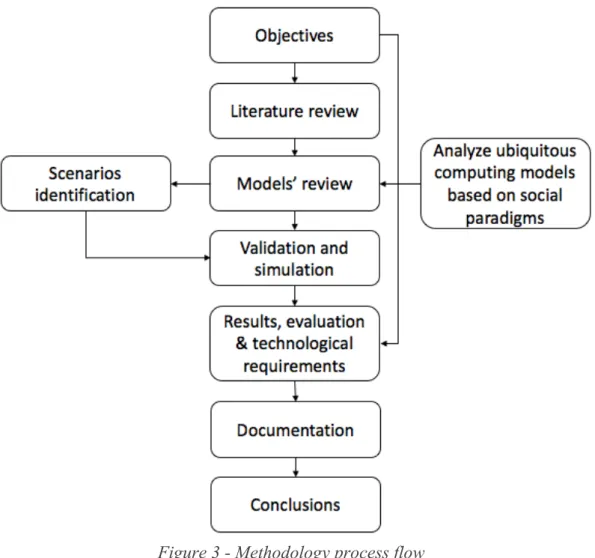
Figure 3 - Methodology process flow
3.3. GRAPHICAL REPRESENTATION AND SIMULATION
As described by Shannon (1975), Systems' simulation is comprehensively defined as the use of a mathematical/logical model as an experimental vehicle to answer questions about a referent system. To simulate something, it is first required a model to exist, representing the system itself, with the simulation demonstrating the functioning and operation of the system over time (Banks et. al, 2001). This way, simulation provides a means by which to assess a certain situation.
The use of simulation is often used in cases where the real system cannot be employed, not accessible, because of any dangerous or unacceptable engaging way, or sometimes due to it being currently in a prior to release phase of design but not yet constructed, and in some cases, it may also not exist yet (Sokolowski, J.A.; Banks, C.M. (2009).
21 Considering methods for qualitative modeling in simulation, and as referred by Fishwick (1991), Qualitative methods express the qualities of system behavior, including asymptotic stability or qualities of the model structure such as its simplicity in form. And this relates directly to simulation model abstraction and model evolution.
In the setting of this research, and since the real system is not yet built, we intend to do the simulation of the model and proposed scenarios through the qualitative simulation and graphical representation, hence with it providing support in the understanding of the functioning of the system and in the assessment of the utility and validity of such proposed and conceived scenarios.
3.4. PROCESS
The first step in our research is to explore some of the sturdiest models currently existent in ubiquitous computing area. This way, we are able to map each of its capabilities and requirements, enabling for an understanding on the current state of the art. At the same time, we aim to explore the existent ontologies that are applicable, and after this, decide and compare which one to study and apply to our research.
The intention of our research is to find and gather aspects and characteristics in the analyzed models so that we can conceptualize scenarios' building which incorporate these and explicitly evaluate its functioning, according to the selected methodology to use.
Scenario identification phase comprises the reasoning and understanding on what situations could be used as example to demonstrate the functioning of the model and ontology, being our intention to use simple social scenarios to the benefit of society, describing real-life situations that can be leveraged by ubiquitous computing application on users' devices. After the identification phase, comes the building of the specific scenarios, under the structure of the chosen model and ontology for the research. The scenarios are based on it, building up on the existent architecture, and evaluating on a theoretical level the needed requirements and technology specifications, as well as the behaviour of the devices in the environment.
After scenarios' building, it is intended to test and validate its utility, as per a run of the model process, to gather as much insight as possible to improve the ongoing research.
Once the scenarios are finalized, and all the existent and possible models, ontologies and technology are mapped, we present a requirements specification on the technological requirements a device should have to be inserted and incorporated in
22 that specific social scenario, being also applicable to other similar situations and contexts where the same network and technological structure can be used.
23
4. MODEL
The proposed model to further study and conduct research is the social paradigms model of Santos (2013, 2015) and further developed by Kamberov (2017). The reason for the choice of the previously named model was because it expresses in a new and socio-contextual form the dynamic integration of a device into a context-enabled computing system, always taking into consideration that devices exist to aid in people's activities of daily life. Moreover, and under the model, a device needs to possess certain information about the surrounding environment so that it understands the social roles available in the environment it is present at. Besides the knowledge about the available roles, it also needs to know the roles that it can play at the specific environment, and also the other participant devices that are actuating in that environment. In this model, social paradigms are central, such that cooperation and environment recognition are based on social and organizational relationships. These comprehend the Role, Ownership, and Responsibility. Kamberov, R., Granell, C., and Santos, V. (2017) proposed a revision of the firstly introduced model with more comprehensive notions on how the formal representation of different systems should be expressed, so that it could achieve a dynamic integration into a system with enabled context-aware behavior. Also in this research, it is discussed the model limitations such as the honesty validation for a device to perform a certain role, being further efforts needed to define relations and rules between devices, facilitating their ability to reason and achieve the outcomes based on the current context faced.
The social paradigms structure defined (as in figure 4) is characterized as follows: Roles, which are particular connections of a device to the cooperative structure of a system defined by a number of responsibilities for a device.
Ownership, which is the association of the device with the role to be performed in the system. One device can be the owner of more than one role as long as it has all the functionalities for the performance of the desired role.
Responsibility, being the task association to a role, entailing obligations to achieve tasks execution, being it fulfilled by the device or delegated to another cooperative one (Santos, V, Santos, C., Cardoso, T., 2015).
24
Figure 4 - Social paradigms structure (Santos, V, Santos, C., Cardoso, T., 2015)
Under the model revised by Kamberov, R., Granell, C., and Santos, V. (2017), it is addressed the need to supply the device with information about the different roles, being proposed, in their ongoing and not yet published research, a web interface that does this through a database with the full context formal structure and the device registration skills, being organized as web services. This way, it is possible to convey the device competence and skills, receiving the requirements needed to execute a task.
Considering this, and once a device owns a specific role, it is admitted that the device implements itself all the functions required for the correct performance of the role(s).
4.1. SCENARIO IDENTIFICATION
Below we present the social scenarios identified and built, constructed upon the Social Paradigms ontology and model developed by Kamberov and Santos (2017). The reasoning behind these conceptualized model and ontology lies in the need for a device to acquire the specific context it is at. Hence, this can be achieved either through the usage of diverse technology available for this purpose or to include the option on a user's device to selectively manage and identify which is the current environment and context. After this step, the device requests to download the ontology related to that context and to the user's device role in it. As in the ongoing
25 research of Kamberov, this can be achieved through the ontologies' upload to a system database (DB) and user interface managed by an administrator. Then, the device can connect to this specific DB, and the context selection process can start, with the context data packages made available to public download, being then possible to download to all users' systems and, in a next step, actuate per the selected context and its specific role in the ontology.
The chosen scenarios identified were 1. School and 2. Gymnasium. These two different contextual scenarios are very descriptive of social contexts in which high amounts of people engage and interact with devices, being relevant on a social benefit point of view to analyze and apply the model and ontology. The scenarios also are of different nature, serving different purposes and users' needs. Moreover, one scenario comprises its execution on an outdoor and indoor level (school), and the other, a solely indoor level. Thus, we assume from the start that it will enable us to develop our scenario building and specifications following different reasoning paths and technological requirements.
4.2. SCENARIO BUILDING
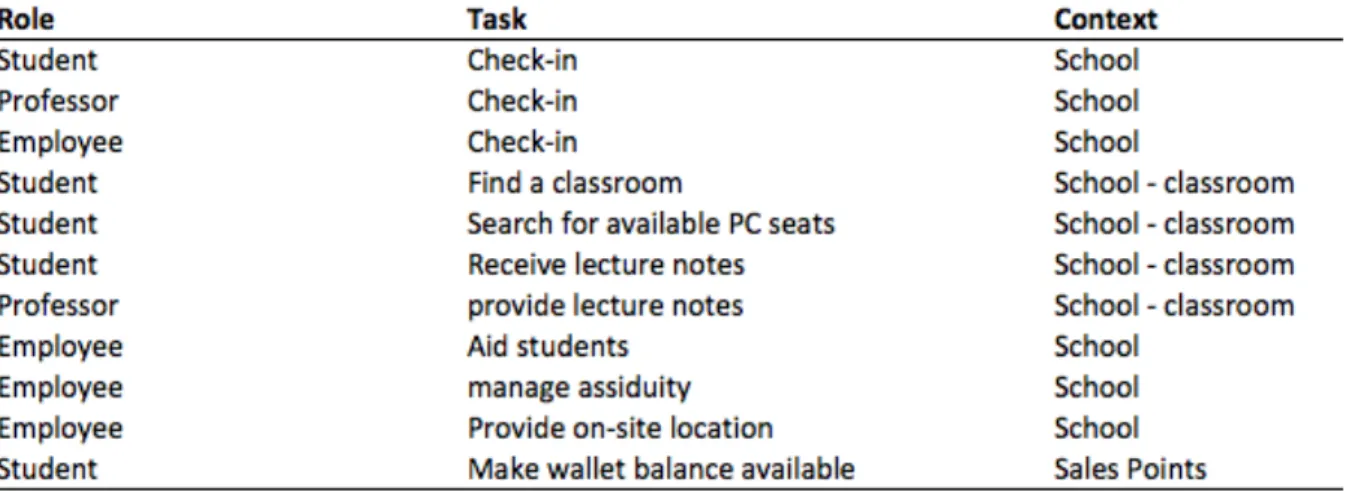
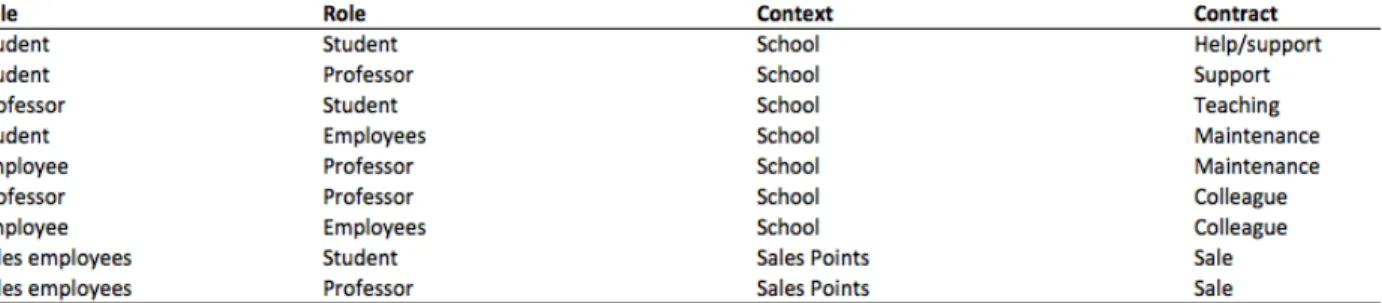
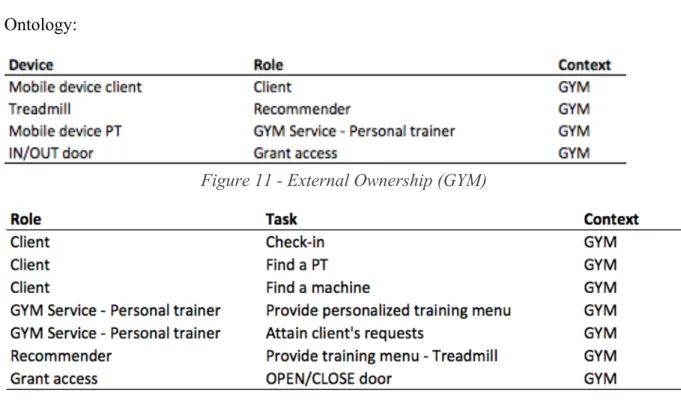
To build the presented below scenarios it was followed an organizational structure as seen in the originally developed Santos' model (2015), covering external ownership of a device's role; the Execution responsibility to accomplish the task; the Partial ownership, as known as the referencing of what device with what role does which task; the Breakdown chart of subtasks per task; Relationship between all roles available in each scenario; and the so called "Contracts" existent in the environment. 4.2.1. School scenario (outdoor & indoor)
Ontology:
26
Figure 6 - Execution Responsibility Chart (SCHOOL)
Figure 7 - Partial Ownership (SCHOOL)
27
Figure 9 - Relation between roles(SCHOOL)
Figure 10 - Contract characterization (SCHOOL) Device technological requirements' specification
For the school scenario, the technology that is proposed to be used is the AWARE middleware, P2P, and WiMax.
The AWARE middleware is proposed as it enables devices in a network to possess a set of capabilities that allow them to divulge the contextual environment they are at. This is achieved through personal settings and communications' definitions, allowing for each of the device's data to be shared with the applications that can make use of it, i.e.: geo-location. Thus, by having an application that can load it, the device can be totally monitored and served with useable information regarding the context it informs it is at. Once a device is setup to the different environmental contexts where it can be present, it is possible for it to download the set of data packages loaded with the ontologies related to those specific contexts. Once downloaded, it is enabled with the capabilities to assume the different socio-contextual roles of the environment and participate actively in it, interacting both with the other context's system devices and user controlled devices.
Additionally, having P2P technology implemented, and being aware of its roles in the environment, a users' device is empowered with the ability to connect to the
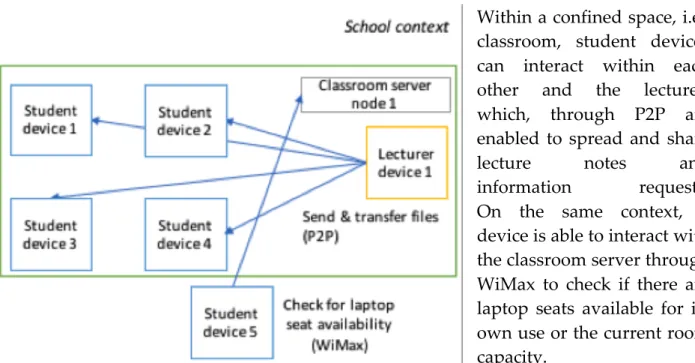
28 other peer nodes in the network to, cooperatively or not, access or allow access to specific sets of data, being these files or other indefinite packages of data. It is then possible to make the request of access to specific data to be shared, and to make it available in the network, constituting a fundamental requirement in the automation of information sharing in a setting where users are required to be given certain types of information or files related to the type of environment they are at. This is a situation that could be already made available in a theoretical school scenario, where students and lecturers would interact and share information between them, under a rule setting of communication, with or without side-contact between students. Once in operation using AWARE middleware, the network should be enabled with a high range span signal, so that every user could be reached and connected. For this, WiMax seems to be the right technology to use, due to its high range actuation. One requirement would be the maintenance of transmitters to accommodate a capacity of 500 users per transmitter. The advantage of WiMax is that it works the same way as WiFi, however, not in a confined space and low range radius, allowing for all users to be connected through broadband and in multiple places of a large area. Thus, with this technology, users are able to be connected through the network and communicate easily between each other, exchanging data in the process.
4.2.2. Gymnasium scenario (indoor) Ontology:
Figure 11 - External Ownership (GYM)
29
Figure 13 - Partial Ownership (GYM)
Figure 14 - Breaking down chart (GYM)
Figure 15 - Relation between roles(GYM)
Figure 16 - Contract characterization (GYM) Device technological requirements' specification
For the Gymansium scenario, it is proposed to be used the BLE, RFID, and WINDware middleware.
The BLE technology usage is proposed considering the existence of a WiFi network. This way, it can take advantage of the supposed existent WiFi network already
30 spread around a building, enabling a new layer of connectivity between all the network environment of devices that can be connected on it. This way, devices can communicate with the master node, transmitting information and receiving instructions and contextual data. Thus, it enables the connection between all the network devices, providing a powerful method for interaction between users and a user-device relationship. Moreover, BLE has the capacity to make a device detect the environment it is at, through geo-fencing technology, making it a powerful context identifier if the user's device already has pre-defined data of geographical context information of the specific areas it wants to be connected in. Hence, and due to its decreased power consumption, it is a viable solution for scenarios where communication is made through wireless networks and confined to the inside of a single building, such as a Gymnasium.
This way, the user's device can download the specific identified context, and the related social ontology, providing afterwards to its users the option to select their social role in that specific context. From that moment on, the user is employing its role(s) in the current system, interacting with the other devices available in the network, being this either another person's device or also the specific several different devices available in the gym for its usage.
Moreover, and still considering the Gym scenario, in situations where one intends to grant access to people, by granting access through the validation of their devices, the RFID technology is of easy and adequate usage. Considering the developed middleware of WINDware, one can further make use not only of the access granting in one single location but also in the whole grid where people bring their devices to. The requirement is the implementation of RFID sensors across the locations requiring access granting, and the possession of the WINDare middleware from both the receiver and transmitter of signals, which, on the receiver side, can be achieved by the download of a simple data package with the middleware code. Thus, this brings us to the configuration of a Gym scenario with the technology of WiFi, integrated with BLE, making it apt for the reception and transmission of data to all devices present in the network. Also, through the implementation of RFID technology and sensors in some spots inside the building, the control of accesses and permissions to users can be done, this way achieving a perfect integration of the users' devices in the environment it is at.
31
4.3. SCENARIO SIMULATION
4.3.1 Scenario simulation - GYM
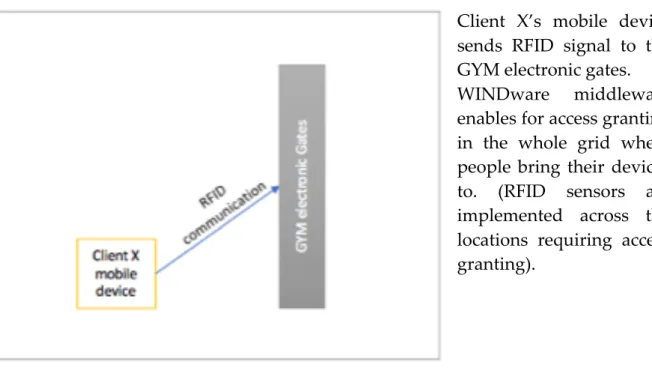
Client X’s mobile device sends RFID signal to the GYM electronic gates. WINDware middleware enables for access granting in the whole grid where people bring their devices to. (RFID sensors are implemented across the locations requiring access granting).
Figure 17 - Client X - electronic gates' interaction
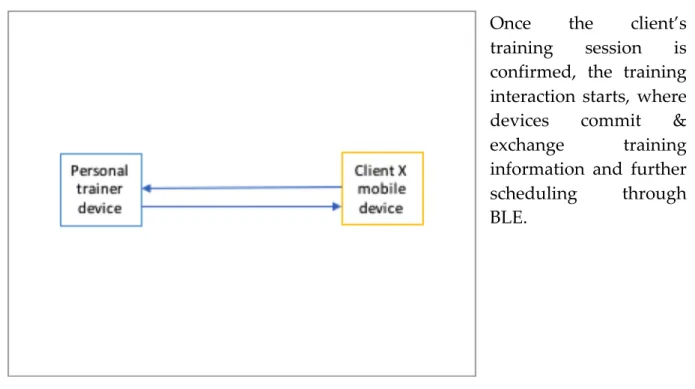
Through the WI-FI powered network, and by using BLE technology, client X’s mobile device
can detect the
environment it is at, and thus communicate with all the contextual devices existent. It sends an availability request to all the entitled Personal trainer (PT) devices, with the aim to receive a signal back with the PT devices available to take a training session.