- 408 - Original Article
REPRESENTATIONS OF VULNERABILITY AND EMPOWERMENT OF
NURSES IN THE CONTEXT OF HIV/AIDS
1Érick Igor dos Santos2, Antonio Marcos Tosoli Gomes3, Denize Cristina de Oliveira4
1 Excerpt from the dissertation - Vulnerabilidade de enfermeiros no cuidado a pacientes com HIV/aids: Um estudo de representações
sociais, submitted to the Graduate Program in Nursing, School of Nursing, State University of Rio de Janeiro, 2012.
2 Ph.D. in Nursing. Assistant Professor of the Department of Nursing, Fluminense Federal University. Rio de Janeiro, Brazil.
Email: [email protected]
3 Ph.D. in Nursing. Professor of the School of Nursing, State University of Rio de Janeiro. Rio de Janeiro, Brazil. Email: mtosoli@
gmail.com
4 Ph.D. in Nursing. Professor of the State University of Rio de Janeiro. Rio de Janeiro, Brazil. Email: [email protected]
ABSTRACT: The aim of this study was to analyze the social representations of vulnerability and empowerment of nurses, in the context of their relationships with the work environment, in which they care for people with HIV/AIDS. A qualitative and descriptive study was carried out with 30 nurses in a public hospital that is a reference for HIV/AIDS care. The theoretical framework of the procedural approach from the Social Representations Theory was adopted. The interviews were transcribed and submitted to thematic content analysis using the software Nvivo 9.0. Vulnerability was expressed as embarrassment, dissatisfaction, distress, frustration, insecurity, overload and stress. In turn, empowerment was expressed in the form of positive interpersonal relationships, moral and operational support from the team, adaptations and improvisations, acquisition of scientiic knowledge, and professional self-protection. KEYWORDS: Health vulnerability. Nursing care. Acquired immunodeiciency syndrome. Nurses. Occupational health.
REPRESENTAÇÕES DA VULNERABILIDADE E DO EMPODERAMENTO
POR ENFERMEIROS NO CONTEXTO DA AIDS
RESUMO: Esta pesquisa objetivou analisar as representações sociais da vulnerabilidade e do empoderamento elaboradas por enfermeiros, no contexto das relações mantidas no ambiente de trabalho, no qual cuidam de pessoas com HIV/aids. Trata-se de pesquisa qualitativa e descritiva, realizada com trinta enfermeiros de um hospital público de referência em HIV/aids. Adotou-se o referencial da abordagem processual da Teoria das Representações Sociais. As entrevistas foram transcritas e submetidas à análise de conteúdo temática instrumentalizada pelo software Nvivo 9.0. A vulnerabilidade foi expressa em constrangimento, insatisfação, angústia, frustração, insegurança, sobrecarga e estresse. Já o empoderamento foi expresso sob a forma de relacionamento interpessoal favorável, apoio moral e operacional por parte da equipe, adaptações e improvisações, obtenção de conhecimento cientíico e autoproteção proissional. Conclui-se que os enfermeiros carecem de políticas promotoras de um ambiente de trabalho mais saudável.
PALAVRAS CHAVE: Vulnerabilidade em saúde. Cuidados de enfermagem. Síndrome da imunodeiciência adquirida. Enfermeiros. Saúde do trabalhador.
REPRESENTACIONES DE LA VULNERABILIDAD Y EMPODERAMIENTO
POR ENFERMEROS EN EL CONTEXTO DEL SIDA
RESUMEN: El objetivo fue analizar las representaciones sociales de la vulnerabilidad y empoderamiento elaboradas por enfermeros en el contexto de las relaciones que mantienen con el ambiente de trabajo en el que cuidan de personas con VIH/Sida. Esta es una investigación cualitativa y descriptiva, realizada con 30 enfermeros de un hospital público de referencia en el VIH/Sida. Se adoptó el referencial del abordaje procesal de la Teoría de las Representaciones Sociales. Las entrevistas fueron transcritas y sometidas al análisis de contenido temático por medio del programa Nvivo 9.0. La vulnerabilidad fue expresa en forma de encogimiento, insatisfacción, angustia, frustración, inseguridad, sobrecarga y estrés. Ya el empoderamiento, fue expreso en forma de relación interpersonal favorable, apoyo moral y operativo por parte del equipo, adaptaciones e improvisaciones, obtención de conocimiento cientíico y autoprotección profesional.
PALABRAS CLAVE: Vulnerabilidad en salud. Atención de enfermería. Síndrome de inmunodeiciencia adquirida. Enfermeros. Salud laboral.
INTRODUCTION
Despite the theoretical construct of vulner-ability being broadly used in various areas of knowledge, including health and nursing, some studies have defended its non-crystallization, and the need to revisit and constantly question its fundamental aspects. Based on this statement, studies that portray how different social groups conceive of their vulnerability are important, as well as studies that show the knowledge and prac-tices nurses use to reduce vulnerability through empowerment. Moreover, examination of the incorporation of this concept by health profession-als is necessary, as well as how they organize indi-vidually and/or collectively to tackle the fragility present in various contexts of health care, either in primary, secondary or tertiary care.1-2
The object of this study consist of the social representations of vulnerability and empower-ment developed by nurses in the context of their relationships with their working environment, in which they care for people living with HIV/AIDS in the hospital setting. Its aim, therefore, was to analyze the social representations of vulnerability and empowerment developed by nurses, in the context of the relationships they keep with their working environment under the auspices of HIV/ AIDS. Vulnerability is understood as a dynamic and changeable state of frailty, or a typically hu-man disability, with different dimensions, being the result of several factors and situations that are intrinsic and extrinsic to health care system pa-tients, or the professionals charged with their care. The state of vulnerability impels the formulation of coping strategies that facilitate empowerment in face of the experience of the health-illness care pro-cedure. The threats experienced risk the continuity of their existence, the quality of life that they have or can attain, as well as the social fabric in which they are included, both in the everyday of being cared for or a caregiver, taking into account their individual characteristics, the stage of the disease, the setting that the care assumes when psychoso-cially reconstructed, and the sociocultural context that surrounds it.1-2
In the context of nursing care, vulnerability is not restricted to susceptibility of contamination by some pathogen. Despite comprehending the universe of social, individual, political and insti-tutional factors, which put individuals at risk of acquiring diseases in the hospital environment, it encompasses everything that represents a threat
to the physical, moral, mental, spiritual, social or affective integrity of nursing professionals.1-5
This study is supported by previous stud-ies, whose results point to important character-istics of vulnerability in the set of knowledge and practices cited by nurses and other nursing professionals. These studies have highlighted the fear of exposure to communicable diseases in the hospital, the psychophysical wear caused by be-ing overwhelmed by providbe-ing care, and lack of supplies, equipment and suficient staff, conlicts between personal and institutional values, and lack of motivation for work.6-8
METHODS
The Social Representations Theory was ad-opted as the theoretical-methodological approach of this study, with its processual approach devel-oped from the perspective of social psychology. The processual approach was chosen to guide the research because it targets the constitutive aspects of the representations, a characteristic that aids understanding of the object of study, outlined in its multiple intervening factors, and because of the complexity presented by the object of repre-sentation.9-10
The study population was composed of 30 nurses who work in the scenario chosen for the research, a municipal hospital in Rio de Janeiro that is a reference for the treatment of people living with HIV/AIDS and/or tuberculosis. This number was established because it is recognized in the Social Representations Theory as being the minimum quantity to recover the social represen-tations of a group.10-11 Professionals with less than
six months of professional activity in the context chosen were excluded. This is due to the factor of time being a determinant in the development of social representations. No other attribute was constituted as a criterion for justiiable exclusion.
The data collection techniques chosen were a sociodemographic questionnaire to characterize the subjects and a semi-structured interview. Data were collected between June and August of 2009. The interviews were transcribed and analyzed us-ing the theoretical and methodological postulates of Social Representations. The analysis technique chosen was Thematic Content Analysis,12 after
systematization13 and operationalization by the
categories (tree nodes) in a computerized manner.2
The construction of categories was performed so as to reorganize the social thought of the group investigated, in order to capture the constituent processes of representational dimensions of vul-nerability and empowerment, especially those re-lated to processes of objectiication and anchoring. The study was developed with the aim to comply with the ethical principles of research involving human beings set out in the Declaration of Helsinki and Resolutions n. 196/96 and n. 466/12 of the National Health Council (NHC), of the Ministry of Health (MOH) of Brazil. The project to which this study pertains was submitted to the Ethics Committee of the Municipality of Rio de Janeiro, and obtained approval under protocol n. 200/08.
RESULTS
The majority of study participants were women (87%), aged between 41-45 years (27%), Roman Catholics (40%), living with a partner (70%), with latu-sensu graduate degree (90%), with 16 or more years of institutional work (37%), 16 or more years of work with people living with HIV/ AIDS (30%), performing care work at the time of data collection (63%), and with access to scientiic information (77%).
The result of the computerized analysis by NVivo 9.0 obtained 1696 Record Units (RUs), dis-tributed into seven categories representing 100% of the corpus analyzed. In this study, the number two category is broadened, comprising 277 RUs, distributed in 21 themes relating to 16.3% of the corpus, called “The hospital institution and its infrastructure: hub of vulnerability and empow-erment in sociosymbolic constructs of nurses that care for patients with HIV/AIDS.”
Although vulnerability is the object of study of this research, ways of coping with the state of vulnerability emerged in the discursive production of the nurses. These will be included as components of human empowerment. Because it has affective, attitudinal, symbolic, practical, cognitive and other dimensions,2 empowerment
will be approached as an object of representation, which emerged in association with vulnerability. Considering the complexity of the results, their discussion will be carried out on two axes, the distinction of which is more didactic than real in the representational framework of the study participants.
Axis 1 – The dificulties imposed by hospital
infrastructure on the practice of nursing care
In this axis, the precarious working condi-tions at the hospital are revealed by the subjects as a factor detrimental to the plenitude of their care practices. A negative attitude exists (unfavorable positioning) among the nurses interviewed about the scenario in which they work: […] the infrastruc-ture issues, which include furniinfrastruc-ture, the location, and that we often need support and don’t get it! [...]. So we need continual maintenance of doors, fans, equipment, and this hasn’t happened. We ask, but we aren’t served to in a timely manner! And it generates anxiety, because we ask and don’t get a response (e24).
It is noteworthy that the attitudinal dimen-sion is central in the Social Representations Theo-ry, and from its point of view, whether favorable or unfavorable, it is linked to the positioning of a group about an object of representation.10
In the psychosocial constructs of the nurses, their vulnerability is at least partly a product of the lack of an eficient ventilation system, in the absence of responses to requests for materials, the inadequacy of equipment, and objectiied in the anguish generated by these factors. These expressions relect the weakness perceived by the subjects of this study, who appear to have some degree of dissatisfaction and psychophysical wear, arising mainly from precarious work conditions with respect to human and material resources. These results are similar to those identiied by another recently published study.4
The sharing of vulnerability, a concept explored in previous research,2 was found in
the discursive process of the nurses, because in their representational content, some elements of everyday care simultaneously weaken them and patients physically or psychologically.
When we are going to puncture the patient, it is very embarrassing because the beds are very low [...].
It’s uncomfortable for the professional and the patient
(e3); We have horrible beds. If you raise the back, it doesn’t go back down. We do not have adequate fur-niture. The least we can offer a person when he is sick is comfort. I think that if he requires more intensive care, we have an infusion pump. But nothing beyond that (e25).
infrastructure of the hospital, feel distressed, un-comfortable, frustrated and embarrassed. Vulner-ability, which makes sense in the embarrassment suffered, in this case threatens the subjects in their subjective and physical dimensions.14-15 The basic
inputs for work are also pointed to by the nurses as lacking: [...] We don’t use the goggles because they are not available (e14).
The lack of adequate equipment, par-ticularly Personal Protective Equipment (PPE), weakens the professionals because it can in-crease their susceptibility to infection by certain pathogens. With regard to the use of PPE, the nursing staff may sometimes prioritize the care of another over themselves.7 Despite recognition
of the situation, the negative attitude due to the lack of resources for work, verbalization of feel-ings of fear and insecurity, and the adoption of behaviors that reduce the risk of accidents,6 the
study participants strive to justify the established situation: [...] now, this mask costs four dollars. My understanding is that this is why I only receive it once a month (e20); [...] I do not have a personal protective mask provided by the unit. Because we are from the outpatient unit. The risk is lower. And we care for AIDS, nottuberculosis (e27).
The lack of human resources in qualitative and quantitative aspects constitutes a factor that interferes in care, and gives the nurses a greater de-gree of vulnerability.2 The nurses recognize there
is a lack of time for the work required, caused by the shortage of human resources: [...] It’s the work-load and insuficient number of professionals. And the nurses have a very large administrative overload (e10); [...] like it or not, the professionals get more tired and more stressed (e25).
The lack of a suficient number of staff nega -tively affects the care provided by, and quality of professional life of the nurses. In this context, their vulnerability is relected in the expressions of be -ing “at the limit,” “overwhelmed” and “stressed out.” The study subjects point out that the lack of professionals presents an opportunity to overcome the deicit, which overwhelms them. This sense of being overwhelmed, an imagery dimension of the representation identiied, has been noted by pre -vious studies among nursing professionals, and is attributed to inadequate working conditions, long hours, low pay and ethical conlicts between nurses and their respective workplaces, among other institutional factors.8,16 Furthermore, the lack
of vacancies available at other institutions to trans-fer patients who require more
technologically-complex care appears as a barrier that is sometimes insurmountable for nurses, which comes from the disconnection between the policies advocated by the public health system and their day-to-day in-stitutional implementation. It is very dificult to ask
for a vacancy at the general hospital. So I get anxious because they do not want to take the patient. I want to take the patient onto my lap and carry her to the ICU
[Intensive Care Unit]. So I get desperate! I see the patient dying (e21).
In general, nurses can face the death of patients with terminal illnesses as an inherent fact of human life,7 but when death is caused by
dependency on another institution, department and/or professional, it appears to cause anguish, despair and other forms of psychological distress to the workers,4,7-8 who undertake efforts to
pro-vide technological resources to meet the needs of patients with AIDS.
The vulnerability expressed in the sense of technical unpreparedness and lack of initiatives for lifelong learning exhibits a cognitive dimen-sion of the representation, and can be perceived in the following statements: I think it’s important, in addition to specialization, to always take refresher courses. So I think that’s what’s missing in the hospital, an incentive for nurses to take courses (e5).
The sum of the factors that overwhelm the professional causes harm by generating a greater a degree of vulnerability to physical injuries and psychological damage, and by moving him/her to carry out their work in a mechanical manner, without being possible to develop skills, abilities and knowledge in performing his/her praxis.8
Axis 2 - Empowerment in relationships
between nurses and the hospital
In opposition to the representational con-structs related to vulnerability are those of em-powerment, the conformation of which includes the hospital’s positive characteristics, ranging from aspects of its infrastructure to the organization of nurses’ work, which positively impact the care by nursing and promote wellness in the workplace, satisfaction with the care provided, and a greater sense of control over the care process.2
value among this professional group. Unlike other hospitals, here I don’t smell blood, feces and urine. [...].
The cleaning here is very well done (e20).
This information is important in nursing, because concern with the inluence of the envi -ronment on nursing care is based on a theoretical construct of great prominence in this profession, that being Florence Nightingale’s environmental theory.17
In addition, there is a cognitive dimension to empowerment based on the perception of em-powerment and autonomy in the everyday care experienced in the institution, which are linked to the sense of freedom and recognition. That is, the relationship between professional and environ-ment of care, with regard to freedom of action, appears to be favorable, which causes the nurses to feel more capable, strengthened, resolute, au-tonomous and satisied with their work,14,17-18 and
therefore more empowered: [...] nurses have a lot of respect here in this hospital. We have considerable autonomy (e25).
This finding was reported in a previous study that examined the social representation of autonomy among nurses from the basic and hospital care network.18 The authors of this
re-search, in addition to identifying the presence of elements such as “freedom,” “knowledge” and “achievement,” highlight the procedural nature of the autonomy of nursing in the psychosocial constructs of the nurses.
Teamwork was positively evaluated by the subjects, who are in favor of it. They afirm that they maintain positive relationships with other professionals, whether nurses or not. Real affec-tion is perceived in the representaaffec-tions identiied, and the nurses use the term “family” to describe the team with which they work. I like it here much more than my other jobs. I think, in terms of staff, it is very cool, it’s more like a family. The staff respects us. The staff is uniied. We are recognized. Both physicians as well as nursing assistants. There’s no ighting to see who knows more. Quite on the contrary! (e1); [...] it is acceptable for the nurse to give an opinion about a patient. The physician listens, researches, will try to see. So I think it’s a good interaction (e12).
The nurses also perceive themselves as col-laborators in the provision of care by multidisci-plinary teams. If there is any complication that exceeds their jurisdiction of operation, they feel they can turn to other professionals, in particular to the physicians, because, according to the study
subjects, physicians have conidence in scientiic knowledge and control of the situation by the nurse: [...] over time, we were able to gain respect for nursing. The nurses have respect [...]. If I have to take a patient now and insert a catheter, I’ll insert it. Be-cause I know what I’m doing. I know it was necessary. And tomorrow, I will communicate to the physician: ‘doctor, I inserted the catheter based on this, this and this.’ And he will understand. [...] people respect. They know that the nursing staff takes a lot of care. And we are there twenty-four hours a day. So, if it was done, it was because it was necessary. And the patients also respect this (e25).
The subjects attribute their role on the health care team to the existence of multidisci-plinary work, by perceiving themselves as the link between its members, important sources of information and, above all, by staying beside the patient with HIV/AIDS 24 hours a day. Feeling safe means to feel respected and valued before the team, which is consistent with the notion of empowerment used in this research. Professional recognition has been identiied as a factor that contributes to the worker’s health, whether dem-onstrated by words, gestures, gifts or looks.7 For
this reason, recognition is an important aspect for the formation of a greater level of empowerment perceived.
As part of the representation of empower-ment, autonomy and professional recognition have characteristics that are worth highlighting. In this discursive formation of the study subjects, autonomy is the result of an arduous process of gaining respect from the other members of the healthcare team. Professional recognition was expressed as understanding and acceptance by other professionals of the decisions made by nurses. This form of empowerment is constituted in a space ceded by the other, from the intimate relationships that they maintain. In other words, if the autonomy of nurses is objectiied in a self-afirming positioning in the search for respect, professional recognition is anchored in the strong affection present in interpersonal relationships between nurses and other professionals.
The team acts to warn about the seropositive status of the patient, even though adherence to standard precautions does not require this explic-itly: [...] depending on who goes to give the puncture, a signal is always given to the other: ‘the patient is HIV positive. Be careful!’ (e26).
of the unknown proportioned by social memories constructed in the beginning of the epidemic.1
The threat of risk perceived by some members of the nursing staff seems to provoke the use of cautionary measures not only for him/herself, but for the whole group, in an effort to protect the other. By generating a certain degree of complic-ity among some members of the nursing team, coexistence becomes a solid basis for the sharing of personal and professional problems, as well as protection of each other against some of the day-to-day problems.7
Mutual zeal and overcoming suffering on the team were shown to be actions that generate mo-tivation, despite the weight of the workload and density of the everyday touched by the disease, fragility and death: It [work with HIV/AIDS] ends up generating a very heavy emotional load, because I deal with the issue of death every day. Because there is always someone who is very ill or dying. And at this moment, despite that sector being heavy, the team rose to the situation [...] (e16).
It is perceived that among other forms of support, psychological comfort is one way of coping with the emotional charge generated by the environment of working with HIV/AIDS. This inding is different from that identiied by another study,8 in which subjects used
detach-ment and denial of feelings, when there is a lack of motivation and work overload. Another emerg-ing aspect to the representations developed by the nurses are adaptations and improvisations in the face of absence of some materials needed for care: [...] because sometimes you can’t help all of the patients. So I always try to help the serious cases (e5); [...] I won’t have cotton, but I’ll have gauze. I won’t have alcohol, but I’ll have other things to be able to do that cleaning (e17).
In the universe of practices present in the representational set, there is a clear attempt by the nurses to adapt to the shortage of human resources and materials for performing proce-dures. The practical dimension of the representa-tion of empowerment, based on improvisarepresenta-tion, in this sense, appears as a plausible strategy to circumvent possible harm to the care identiied by the subjects of this study. In this way, nurses can perceive in the interim between the criteria recommended by science and/or standards es-tablished by the hospital, and concrete action of care.7 This is a space in which the professional
lacks subjectivity to ind ways of performing care in the best way possible.
DISCUSSION
Social representations are rooted in the con-cepts developed by human groups, as products of continuous interactions and the worldviews of its members. At the same time, it allows for understanding of the behavior of populations in their complexity, by providing access to af-fective, symbolic, and attitudinal dimensions, among others.9-11 It is therefore postulated that the
nurses interviewed for this study verbalize their psychosocial constructions embedded in the work environment in which they operate, since their speech, behavior and social practices in the face of situations of vulnerability and empowerment are supports for transmitting social representations in the hospital institution.2,11
It conirms that the subjects are immersed in a system of humanistic, selless and altruistic values, which is in accordance with the code of conduct advocated in the profession of nursing.17-19
Nevertheless, despite the nurse being key to the achievement of the institutional mission of the hospital, this immersion puts on their shoulders an ethical commitment to patient recovery and ex-cellence of care provided, the possibility of which tends to be limited in the face of infrastructural, political and human and material resources limita-tions that are imposed on them.18,20-21
The disorganization of work,14-15 the
dis-couragement caused by its atmosphere, and ten-sions that arise within the HIV/AIDS sector1-2,22
are characterized as some of the major sources of distress for nurses in the study. As an object of representation of nurses, vulnerability is marked by precarious service and unhealthy activity, which reinforce the presence of imminent risk and exposure in their symbolic constructions.22-24 The
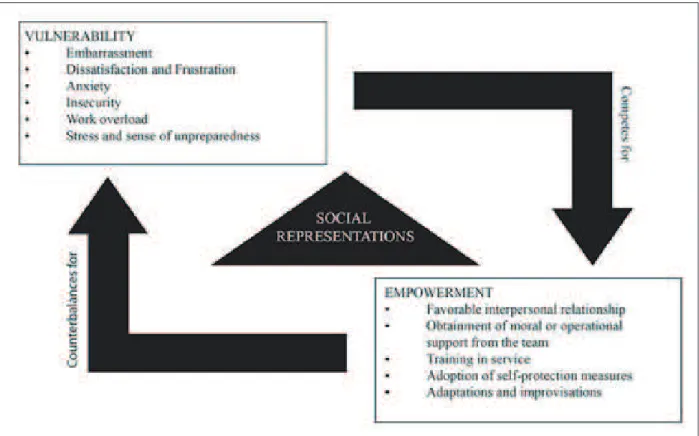
discourse of the subjects of this study highlights the circumscription of the dynamics maintained between vulnerability and empowerment. This dynamics of contradiction, already referred to as the vulnerability-empowerment dyad,2 is the
movement of balance and counterbalance that competes to achieve the balance necessary for maintenance of harmony between the elements that weaken and strengthen human beings.25
with feelings of embarrassment, dissatisfaction, distress, frustration, insecurity, overload, stress and unpreparedness. By presenting themselves as participating elements of the representation of the state of vulnerable among nurses, these may discourage the exercise of the profession, which can only be avoided by redemption of the status of empowered, presented in the form of favorable interpersonal relationships with patients/staff, obtaining moral or operational support from other professionals, training services, the adoption of measures of self-protection, and the practice of adaptations and improvisations.
The second reason is that vulnerability feeds back into empowerment, because it contributes to the deinition of the elements that constitute it. It is important to highlight that the elements participat-ing in the psychosocial construction of empower-ment have the functionality to compensate for the perceived vulnerability status. Nevertheless, at certain times in which context proves to be un-favorable to the nurses, the status of vulnerable overlaps that of empowered. This contradictory movement is characteristic of the dyad formed by vulnerability and empowerment, and mediated by the elaborated social representations (Figure1).
Figure 1 - Schematic illustration of the vulnerability-empowerment dyad in the context of the relationships between nurses and their work environment with seropositive patients. Rio de Janeiro-RJ
CONCLUSION
In conclusion, the results point to the re-signiication of contexts of vulnerability and em -powerment, closely linked to the arrangements of the workplace in the context of HIV/AIDS. Thus, social representations act as mediators between a perceived status of greater weakness or strength, in movements of mutual contradiction.
The way vulnerability manifests itself in daily nursing care consists of a phenomenon of
great importance to the science of nursing, taking into consideration the psychosocial understanding of the behaviors, values , attitudes, practices and images, which enunciate how nurses understand the concept and state of vulnerability day to day in the hospital, under the aegis of HIV/AIDS.
institutional, technological, political and social barriers pit one against the other, which weakens the professionals in their multiple dimensions.
Given the limited number of subjects in-cluded in this study, as well as its realization in a restricted location, further research is re-quired, from other viewpoints and approaches, the expressions of vulnerability in relationships between nurses and working environment, inside and outside the context of communicable dis-eases. Nurses who perform their work activities in hospitals lack government and institutional policies directed towards their appreciation, recognition, encouragement, horizontal relation-ships, resolution of the problems they face and in-service training. These measures contributed to prevent illness as a result of the work process, and to promote a healthier work environment, in which the practices of nursing care and health may be full, resolute, effective and satisfactory for everyone involved.
REFERENCES
1. Gomes AMT. A vulnerabilidade como elemento organizador do cuidado de enfermagem no contexto do HIV/aids: conceitos, processos e representações sociais [tese]. Rio de Janeiro (RJ): Universidade do Estado do Rio de Janeiro. Faculdade de Enfermagem; 2011.
2. Santos ÉI. Vulnerabilidade de enfermeiros no cuidado a pacientes com HIV/aids: um estudo de representações sociais [dissertação]. Rio de Janeiro (RJ): Universidade do Estado do Rio de Janeiro. Faculdade de Enfermagem; 2012.
3. Barra DCC, Lanzoni GMM, Maliska ICA, Sebold LF, Schlindwein BH. Processo de viver humano e a enfermagem sob a perspectiva da vulnerabilidade. Acta Paul Enferm. 2010 Nov-Dez; 23(6):831-6. 4. Carter MA. Trust, power, and vulnerability: a
discourse on helping in nursing. Nurs Clin North Am. 2009 Dez; 44(4):393-405.
5. Feito L. Vulnerabilidad. An Sist Sanit Navar. 2007 Set; 30(Supl3):7-22.
6. Sailer GC, Marziale MHP. Vivência dos trabalhadores de enfermagem frente ao uso dos antirretrovirais após exposição ocupacional a material biológico. Texto Contexto Enferm. 2007 Jan-Mar; 16(1):55-62. 7. Azambuja EP, Pires DEPP, Vaz MRC, Marziale
MH. É possível produzir saúde no trabalho da enfermagem? Texto Contexto Enferm. 2010 Out-Dez; 19(4):658-66.
8. Meneghini F, Paz AA, Lautert L. Fatores ocupacionais associados aos componentes da Síndrome de Burnout em trabalhadores de enfermagem. Texto
Contexto Enferm. 2011 Abr-Jun; 20(2):225-33. 9. Moscovici S. A representação social da psicanálise.
Rio de Janeiro (RJ): Zahar Editores; 1978.
10. Jodelet D. Folie et représesentations sociales. Paris (FR): PUF; 1989.
11. Sá CP. A construção do objeto de pesquisa em representações sociais. Rio de Janeiro (RJ): EdUERJ; 1998.
12. Bardin L. Análise de conteúdo. Lisboa (PT): Edições 70; 2006.
13. Oliveira DC. Análise de conteúdo temático-categorial: uma proposta de sistematização. Rev Enferm UERJ. 2008 Out-Dez; 16(4):569-76.
14. Santos JM, Oliveira EB, Moreira AC. Estresse, fator de risco para a saúde do enfermeiro em centro terapia intensiva. Rev Enferm UERJ. 2006 Out-Dez; 14(4):580-5.
15. Souza NVDO, Lisboa MTL. Os múltiplos e contraditórios sentidos do trabalho para as enfermeiras: repercussões da organização e do processo laboral. Ciênc Cuid Saúde. 2006 Set-Dez; 5(3):326-34.
16. Gaudine A, Thorne L. Nurses’ ethical conlict with
hospitals: a longitudinal study of outcomes. Nurs Ethics. 2012 Nov; 19(6):727-37.
17. Nightingale F. Notas sobre enfermagem: o que é e o que não é. São Paulo (SP): Cortez; 1989.
18. Gomes AMT, Oliveira DC. Estudo da estrutura da representação social da autonomia proissional em enfermagem. Rev Esc Enferm USP. 2005 Jun; 39(2):145-53.
19. Thorup CB, Rundqvist E, Roberts C, Delmar C. Care as a matter of courage: vulnerability, suffering and ethical formation in nursing care. Scand J Caring Sci. 2012 Set; 26(3):427-35.
20. Olinski SR, Lacerda MR. Cuidando do cuidador no ambiente de trabalho: uma proposta de ação. Rev Bras Enferm. 2006 Jan-Fev; 59(1):100-4.
21. Gomes AMT, Oliveira DC, Santos ÉI, Santo CCE, Valois BRG, Pontes APM. As facetas do convívio com o HIV: formas de relações sociais e representações sociais da aids para pessoas soropositivas hospitalizadas. Esc Anna Nery. 2012 Mar; 16(1):111-20.
22. Guido LA, Linch GFC, Pitthan LO, Umann J. Estresse, coping e estado de saúde entre enfermeiros hospitalares. Rev Esc Enferm USP. 2011 Dez; 45(6):1434-9.
23. Santos ÉI, Gomes AMT, Oliveira DC, Santo CCE. Between suffering and pleasure: vulnerability to nurses in their interpersonal relationships with HIV/AIDS patients. Rev enferm UERJ. 2013 Jan;21(1):9-15.
for caring for HIV-positive individuals: a cross-sectional survey. J Clin Nurs. 2010 Nov; 19(21-22): 3227-34.
25. Sellman D. Towards an understanding of nursing as a response to human vulnerability. Nurs Philos. 2005 Jan; 6(1):2-10.
Correspondence: Érick Igor dos Santos Rua Recife, s/n
Universidade Federal Fluminense, Departamento de Enfer-magem
28895-532 Rio das Ostras, RJ, Brazil E-mail: [email protected]