2017
FACULDADE DE CIÊNCIAS
Polyandry and host-endosymbiont conflicts in the spider mite
Tetranychus urticae
Doutoramento em Biodiversidade, Genética e Evolução
Ana Leonor Rapoula Rodrigues
Tese orientada por:
Professora Doutora Sara Magalhães
2017
UNIVERSIDADE DE LISBOA FACULDADE DE CIÊNCIAS
Polyandry and host-endosymbiont conflicts in the spider mite
Tetranychus urticae
Doutoramento em Biodiversidade, Genética e Evolução
Ana Leonor Rapoula Rodrigues
Tese orientada por:
Professora Doutora Sara Magalhães
Júri: Presidente:
● Maria Margarida de Mello dos Santos Reis Gutteres da Fonseca, Vogais:
● Doutor Patrice David ● Doutora Suzanne H. Alonzo
● Doutor Nuno Miguel Pinto de Sousa Monteiro
● Doutora Margarida Maria Demony de Carneiro Pacheco de Matos ● Doutora Sara Newbery Raposo de Magalhães
Documento especialmente elaborado para a obtenção do grau de doutor Fundação para a Ciência e a Tecnologia
This study was funded by Fundação para a Ciência e a Tecnologia, through a PhD scholarship (SFRH/BD/87628/2012) and by a R & D project granted to Sara Magalhães and Isabelle Olivieri by Fundação para a Ciência e a Tecnologia (FCT) e Agence Nationale de la Recherche (ANR) (FCT-ANR/BIA-EVF/0013/2012).
Acknowledgements
AgradecimentosI should start by acknowledging my two supervisors, Isabelle Olivieri and Sara Magalhães. It’s mainly thanks to them that this exciting scientific journey was possible. I would like to have thanked Isabelle, for having received me in her country, at her place, in her life, when I was a master student fresh out of an extremely motivating first year of masters. A girl like me, lost in France, would have suffered quite a lot with a different supervisor! Her presence was impressive, but so was her simplicity, in life and in science. I consider an injustice the absence of her name in the cover of this thesis. In fact, without her, this project wouldn’t have even started. She was the one who encouraged me to do what I wanted during my masters, which then led to this PhD, instead of what had been proposed to me back in Portugal. “Do whatever you like, life is too short!” Life is, indeed, too short.
A Sara recebeu-me de braços abertos quando regressei a Portugal. Ajudou-me a escrever a minha tese de mestrado e um projecto de doutoramento e, graças a isso, em Outubro de 2012, estava no laboratório a trabalhar. Vi o seu grupo nascer e crescer até à grandiosidade de hoje, detentor da primeira ERC da Faculdade de Ciências da Universidade de Lisboa! À Sara devo quase tudo o que aprendi e consegui nestes últimos anos. Consequentemente, nada do que eu diga aqui vai conseguir transmitir o que penso. És a minha mamã científica de todas as formas e mais algumas. Obrigada por confiares em mim e me dares asas para voar. Obrigada por todo o apoio, pela paciência e pelas reuniões repletas de risos.
A minha tese de doutoramento foi um prolongamento daquilo que me deu tanto prazer a fazer durante a minha tese de mestrado em Montpellier. Durant cette période, des personnes comme Cassandra Marinosci, Emilie Macke, Elodie Flaven, Fabien Bach et, bien sûr, Isabelle Olivieri, ont été essentielles à mon succès. Merci à tous!! Toujours durant cette même période de ma vie, je ne peux oublier Renata Santos et Anna Morvan, mes meilleures amies à Montpellier, et maintenant, je le sais, gwelloc'h keneil pour la vie. Sans vous, cette thèse n'aurait certainement jamais commencé!
Já de volta a solo lusitano, nasceu o Mite Squad. Co-fundado por mim, o Gonçalo Matos e a Salomé Clemente num acesso de loucura no laboratório 2.1.13, no ano de 2013, o Mite Squad é uma família em todo o seu esplendor! Tem os seus momentos menos bons; há discussões, discórdia, amuos e impaciência. Atrevo-me a dizer que nos odiamos! Do fundo do coração! Da mesma forma intensa com que nos adoramos! Não há nenhum membro do Mite Squad que se possa gabar de ter conseguido almoçar muitas vezes desacompanhado ou que tenha podido faltar a muitas pausas para lanches. Contam-se pelos dedos os membros que nunca receberam uma prenda de anos (e que prendas!!), que
nunca foram a uma festa de Natal, de anos, de Halloween, de Verão… Juntos rimos e choramos com e pela ciência! São, ou foram, membros do Mite Squad a Sara Magalhães (Boss Mite), a Rita Ponce, o Gonçalo Matos, o Diogo Godinho (Old Mite), a Flore Zélé (Handy Mite), a Inês Santos (Helping Mite), a Salomé Clemente (Tiny Mite), o Alexandre Figueiredo (Speedy Mite), o Joaquim Santos (Cell Mite), a Jéssica Paulo (Happy Mite), o João Alpedrinha (Model Mite), o Miguel Cruz (Geek Mite), a Paula Martinez Jimenez (Etanol Mite) e muitos outros que passaram pelo nosso laboratório e por lá deixaram a sua marca. Apesar de, sem dúvida, querer agradecer-vos a todos do fundo do coração (Muito, muito obrigada!), tenho que ocupar um bocadinho mais de espaço com a Inês, a Flore e o Alex. Quero agradecer à Inês, que foi, possivelmente, a primeira amiga que fiz neste grupo e que sempre me apoiou nos meus dias mais negros. Também te agradeço por me ajudares a não esquecer a importância das férias, das pausas e da vida fora do laboratório. À Flore, por todas as discussões científicas mais que estimulantes, por todas as valiosas aulas de estatística, por me “emprestar” uma experiência e por me ajudar a não me sentir sozinha na difícil luta que é querer ser cientista. És aquilo que eu quero ser daqui a 3 anos. Ao Alex, por me ter mostrado que aquilo que eu faço/nós fazemos é interessante e excitante, todos os dias! És o mais corajoso de nós os dois.
Ainda na Faculdade de Ciências, gostaria de agradecer às Moscas. As Moscas iniciaram os Ácaros nas andanças pela Faculdade de Ciências. A Inês Fragata e o Pedro Simões receberam-me nos corredores do piso 1 e responderam a todas as minhas dúvidas parvas, ensinaram-me como usar (e amar) incubadoras velhas, como lidar com orientadores cheios de ambição, como vir para a faculdade ao fim de semana com um sorriso nos lábios e, acima de tudo, como a união entre grupos é tão importante como a união dentro de grupos. Também quero agradecer à Prof Margarida Matos e à Susana Varela, por todo o apoio no delineamento de experiências experimentais e “consultadoria científica” diversa, às Profas Manuela Coelho e Margarida Santos-Reis por me ajudarem com todas as
chatices burocráticas relacionadas com fazer um doutoramento na Faculdade de Ciências da Universidade de Lisboa e a todos os restantes membros do cE3c, por encherem as minhas semanas de «bons dias» e sorrisos. Foi um prazer trabalhar aqui! E não deixem que vos enganem, a ciência em Portugal vale a pena!
Gostava também de agradecer à Nufarm ®, por nos ter facultado o pesticida com que trabalhei ao longo destes anos.
I would also like to thank all other researchers who helped me during the development of this thesis. I would like to acknowledge Thomas Van Leeuwen for having shared with us his resistant and susceptible lines and to thank Alison Duncan and Jordi Moya-Laraño for all their support and much useful contribution in the development of my first article (and what a challenge that was!). I would also
like to thank Jordi, for being a great teacher and showing me how much statistics and R can be an exciting challenge and to Celine Devaux and Caroline Nieberding, for helping with part of the experimental designs. Finally, I would like to thank the members of the jury, Margarida Matos, David Shuker, Suzanne Alonzo and Nuno Monteiro, who kindly accepted to examine this thesis and, that way, share with me part of their wisdom. I’m certain my thesis defence will be a positive and stimulating challenge.
Por fim restam os amigos e a família.
Aos meus amigos biólogos, quero agradecer acima de tudo por partilharem comigo a minha paixão pela ciência e por saberem o que é a deriva genética, os trade-offs e a selecção natural. Também sabem como é querer trabalhar em ciência e ter que ceder em tanta coisa para isso acontecer. De uma forma ou de outra, vocês sentem a minha indecisão e ajudam-me a fazer escolhas (certas?). Miguel, pH, Jonas, João, e Zé é bom ter-vos na minha vida científica (e na outra também, mas isso ficar para outros agradecimentos). Mariana e Teresa, um obrigada especial para vocês, por existirem! Tudo o resto é um bónus!
No entanto, a vida não é feita só de ciência e os meus amigos que não têm nada a ver com ciência, foram importantes precisamente por não terem estado envolvidos de modo algum no desenvolver desta tese. Não é que não me tenham perguntado, ao longo destes 4 anos, como é que ia o meu trabalho (“Como vão os filmes pornográficos das amibas?”), simplesmente perguntaram-me muitas outras coisas. Sem isso, onde estaria a minha sanidade mental? Quem é que quer saber de problemas com ácaros quando há bebés a nascer, pessoas a sair de casa dos pais, festas de anos e de natal, passeios à beira mar? Obrigada por fazerem da minha vida mais do que o trabalho (e o pregarem na parede de minha casa, Tiago, Inês e Gabriela).
Quanto à minha família ramifica-se pelo infinito fora. Há a minha mãe e o meu pai, a quem eu devo aquilo que sou hoje. Duas pessoas tão diferentes não podiam ter conseguido complementar-se tão perfeitamente. Gosto das duas faces da mesma moeda que eu sou com cada um de vocês. Há os meus avós que são a minha claque na vida, uma espécie de Juve Leo privada. Não sabem bem o que são ácaros, não percebem conceitos evolutivos, mas nunca deixaram de fazer perguntas sobre o meu trabalho ou sobre ciência. Há a Beta e o António, que para além de preencherem os vazios da vida dos meus pais, preencheram vazios que eu não sabia que existiam no meu coração! Há os meus manos e manas, a quem eu devo a maior parte dos meus sorrisos mais profundos. Os gémeos nunca perceberam porque que não podiam fazer festas a àcaros nas suas casas de folha, mas sempre acharam que ser cientista era o máximo, a Maria não sabe bem o que eu faço, mas diz a toda a gente que tem uma irmã cientista e a Mariana acha inacreditável uma pessoa receber um salário para andar a cortar folhas de
feijão! Há os pais do Diogo e a minha nova mana Marta que me receberam e introduziram numa nova família, sem reservas. Desde o primeiro dia que me senti em casa, na vossa casa. E há os tios e primos e manos e avós, emprestados ou não, que enchem os meus fins de semana de bons momentos! A esta grande família que me contruiu e que eu fui construindo, um muito obrigada! Enquanto vos tiver a vocês, estarei sempre bem! Mesmo quando os ácaros não acasalam, as folhas apodrecem ou as incubadoras deixam de funcionar!
Finalmente, e porque tenho que acabar com o que este doutoramento me deu de mais eterno, obrigada ao Diogo. Obrigada partilhares comigo a paixão pela vida e pela ciência. Obrigada por seres tão paciente e confiante, por acreditares em mim quando eu deixo de acreditar e me trazeres constantemente de volta à realidade. No fundo, obrigada por tudo.
PS- Para salvaguardar a possibilidade de me ter esquecido de alguém (és importante na mesma!), decidi recorrer ao Sérgio Godinho, até porque realmente a vida é feita de pequenos e deliciosos nadas! Substituam “boa noite” por “obrigada” e fica tudo dito.
“Muito boa noite, senhoras e senhores
muito boa noite, meninos e meninas
muito boa noite, Manuéis e Joaquinas
enfim, boa noite, gente de todas as cores
e feitios e medidas
e perdoem-me as pessoas
que ficaram esquecidas
boa noite, amigos, companheiros, camaradas
A vida é feita de pequenos nadas!
Resumo
Na natureza, os organismos competem por diferentes de tipos de recursos, sendo os recursos mais estudados a comida, os hospedeiros e os parceiros sexuais. Infelizmente, o estudo de cada um destes recursos pertence a uma área de investigação diferente, o que dificulta a compreensão plena do papel da competição enquanto força selectiva. No trabalho que aqui se apresenta, começamos por demonstrar de que modo a evolução experimental pode ser aplicada transversalmente ao estudo da competição, de forma a permitir extrair padrões e processos comuns às várias áreas de investigação. Isto torna-se possível uma vez que, em todos os casos, os organismos competem por acesso a um recurso limitante, qualquer que seja esse recurso.
Os capítulos seguintes da tese focam-se na competição por parceiros sexuais, um tipo de competição moldado pela selecção sexual. O principal objectivo deste trabalho foi estudar que adaptações são favorecidas pela selecção sexual em diferentes fases da reprodução, nomeadamente antes e depois do acasalamento. Desta forma, esperamos contribuir para enriquecer o nosso conhecimento no que diz respeito à ocorrência de poliandria, isto é, ao acasalamento de vários machos com uma única fêmea, em espécies com precedência espermática do primeiro macho. Nestas espécies, o primeiro macho a acasalar com uma fêmea é aquele que fertiliza todos os seus ovócitos. Consequentemente, parece paradoxal que estas fêmeas acasalem mais do que uma vez, a não ser que este comportamento traga alguma vantagem, esteja geneticamente relacionado com outra característica que seja vantajosa, ou ocorra inadvertidamente. De modo a poder abordar esta aparente contradição, usámos o ácaro-aranha Tetranychus urticae, uma espécie haplodiplóide, com precedência espermática do primeiro macho e cujos indivíduos acasalam frequentemente com fêmeas já fecundadas.
Numa primeira abordagem, testámos se os machos desta espécie eram capazes de distinguir fêmeas virgens de fêmeas fecundadas e que tipo de pistas são usadas pelos machos para exercer a sua preferência. Graças a este estudo, pudemos confirmar que os machos usam pistas químicas, nomeadamente voláteis, e rastos químicos deixados no substrato, para distinguir fêmeas virgens de fêmeas fecundadas. Estes resultados permitiram-nos concluir que a poliandria não ocorre devido a uma incapacidade, por parte dos machos, de discriminar fêmeas fecundadas de fêmeas virgens, o que sugere que este comportamento é vantajoso para pelo menos um dos sexos. Na sequência desta constatação, procurámos encontrar potenciais benefícios provenientes da existência de poliandria em machos e fêmeas. Para esta experiência utilizámos a resistência a um pesticida como marcador genético, o que nos permitiu determinar a paternidade da descendência produzia pelas várias fêmeas testadas. Esta metodologia é essencial para determinar se a poliandria altera o padrão de precedência
espermática desta espécie, conferindo assim benefícios directos aos machos. Os nossos resultados indicam que nenhum dos sexos beneficia directamente com acasalamentos múltiplos. De facto, a precedência espermática do primeiro macho foi sempre mantida, independentemente do número e do intervalo entre acasalamentos, sugerindo que acasalar com fêmeas fecundadas não confere nenhum benefício directo aos machos. Para além disso, fêmeas que acasalaram múltiplas vezes apresentaram uma menor longevidade e fecundidade do que fêmeas que acasalaram só uma ou duas vezes, sugerindo que há custos em acasalar múltiplas vezes para as fêmeas. No entanto, os machos desta espécie, apesar de não terem obtido benefícios directos com a poliandria, não sofreram custos de longevidade quando foram colocados exclusivamente com fêmeas previamente fecundadas. Além do mais, o número total de descendência produzida pelo primeiro macho a acasalar com uma fêmea fecundada é menor quando essa fêmea acasala múltiplas vezes, do que quando essa fêmea não acasala novamente, ou acasala apenas mais uma vez. Esta diminuição do número de descendência quando a fêmea acasala múltiplas vezes, faz com que o sucesso reprodutor do primeiro macho diminua, levando a um aumento relativo do sucesso reprodutor dos machos seguintes. Este benefício indirecto pode explicar, ainda que em parte, a ocorrência de poliandria no ácaro-aranha. De qualquer forma, este resultado não exclui a possibilidade de existirem outros benefícios que possam explicar a existência de poliandria. Por exemplo, ao acasalarem múltiplas vezes, os indivíduos podem reduzir o risco de se envolverem apenas em acasalamentos inviáveis.
A existência de acasalamentos inviáveis pode ser atribuída à presença de bactérias endosimbiontes. Estes organismos empregam diversas tácticas como, por exemplo, alterar a reprodução dos seus hospedeiros, de forma a favorecerem a sua transmissão. Quando essas tácticas são custosas para o hospedeiro, prevê-se que este evolua estratégias de modo a poder evitar ou reduzir os custos da infecção. Frequentemente, as populações de ácaros encontram-se infectadas com
Wolbachia, uma bactéria endossimbiótica que induz incompatibilidade citoplasmática. A
incompatibilidade citoplasmática resulta na redução do número de descendência fertilizada proveniente de acasalamentos entre fêmeas não infectadas e machos infectados. Com as experiências seguintes, procurámos saber se fêmeas de ácaros-aranha não infectadas evoluem a capacidade de escolher parceiros sexuais compatíveis ou de acasalar múltiplas vezes, de modo a contornar os custos impostos pela incompatibilidade citoplasmática. De forma a testar esta possibilidade, realizámos uma experiência na qual populações de ácaros-aranha evoluíam nas seguintes condições: i) populações totalmente infectadas com Wolbachia, ii) populações totalmente livres de Wolbachia ou iii) populações com uma prevalência intermédia deste simbionte. No último caso, a cada geração, fêmeas não infectadas foram colocadas com machos infectados e não infectados, na mesma proporção, de modo a promover os acasalamentos entre indivíduos. Este último regime de evolução experimental
corresponde às condições ideais para a evolução de um mecanismo compensatório contra a Wolbachia, por parte do hospedeiro. Após doze gerações de selecção, indivíduos mantidos com prevalência intermédia de Wolbachia não alteraram a sua capacidade de escolha. Para além disso, não se verificaram modificações na latência à copula ou na duração de cópula em qualquer um dos regimes. Isto permite-nos concluir que o efeito da Wolbachia na evolução de isolamento reprodutor em ácaros, se existe, é residual. Este resultado é relevante para o estudo da especiação, uma vez que o isolamento reprodutor é considerado um comportamento com elevado impacto neste processo. Apesar de não termos encontrado diferenças no comportamento que antecede a cópula, fêmeas não infectadas que evoluíram em populações com prevalência intermédia de Wolbachia apresentaram uma redução no grau de incompatibilidade citoplasmática após acasalarem com machos infectados e machos não-infectados, sequencialmente. Este resultado permite-nos concluir que a poliandria pode ser vantajosa em ambientes em que existe o risco de acasalamentos inviáveis, uma vez que permite reduzir a incompatibilidade citoplasmática. Ao fazê-lo, os ácaros-aranha alteraram o seu padrão de precedência espermática a favor do segundo macho. No entanto, esta alteração só ocorreu numa direcção, uma vez que, nas situações em que o primeiro macho era compatível, i.e., não estava infectado com Wolbachia, a precedência espermática pelo primeiro macho foi mantida. A unidirecionalidade na alteração do padrão de precedência espermática é muito provavelmente um factor essencial à evolução de poliandria incitada pelos custos associados à incompatibilidade citoplasmática, em espécies com padrões de precedência espermática enviesados.
Em suma, o trabalho desenvolvido ao longo desta tese, ao endereçar questões importantes que tinham sido, até agora, negligenciadas, permite-nos compreender mais aprofundadamente qual o papel da poliandria em espécies com precedência espermática do primeiro macho. Para além disso, os resultados apresentados aqui contribuem substancialmente para o estudo das interações entre endosimbiontes e os seus hospedeiros, bem como para compreender de que forma essa interação afecta o processo de especiação.
Palavras-chave
Abstract
Organisms compete for several resource types, the most studied being food, hosts and mates. Regrettably, the study of competition for each of these resource types belongs to different research fields that rarely overlaps, which might hamper a comprehensive understanding of competition as pervasive selective force. In this work, we begin by showing how experimental evolution can be transversally applied to the study of competition across research fields and attempt to extract general patterns and processes, as in all cases individuals are competing for the use of a limiting resource.
The rest of this thesis is directed towards competition for mates, a type of competition that is shaped by sexual selection. The main goal of this work was to study the adaptations favoured by sexual selection at different stages of reproduction, namely prior and after mating, in order to better understand the occurrence of polyandry in species with first male sperm precedence. In these species, the first male that mates with a female will sire all her offspring. Consequently, it seems paradoxical that females mate multiply, except if this behaviour provides an advantage for females or males, if it correlates with other traits, or if it occurs inadvertently. In order to tackle this, we used the spider mite
Tetranychus urticae, a haplodiploid species with first male sperm precedence in which polyandry is
pervasive.
First, we tested whether males distinguish between virgin and mated females and which type of cues they use to exert their preference. In fact, spider mite males preferred virgin over mated females and used chemical cues, namely volatiles and chemical trails, to distinguish them. These results indicate that polyandry does not occur due to a lack of ability to discriminate females of different matings status, suggesting this behaviour might be advantageous for either sex. Consequently, the next step was to test the potential costs and benefits of polyandry for males and females. Neither males, nor females benefited directly with polyandry. In fact, females that mated multiple times survived less and laid fewer eggs, compared to females that mated once or twice only. Nevertheless, males did not suffer longevity costs when they mated with mated females and they were able to decrease the fitness of first males, gaining an indirect benefit with this behaviour. Polyandry can thus be, even if partially, explained by this indirect benefit. Still, these results do not rule out the existence of other, indirect benefits. For instance, by mating multiply, individuals might reduce the risk of only mating with incompatible mates.
Incompatible matings may be attributed to the presence of endosymbiotic bacteria. These organisms can employ various tactics, such as altering the reproduction of their hosts, in order to favour their own transmission. When these tactics are costly for the host, hosts are expected to evolve strategies to avoid or reduce such costs. Spider mite populations are often infected with Wolbachia, an
endosymbiotic bacterium that induces cytoplasmic incompatibility (CI), whereby crosses between uninfected females and infected males yield reduced fertilized offspring. Here we tested whether T.
urticae uninfected females evolve mate choice and multiple mating to circumvent the costs imposed
by CI. To this aim, we performed experimental evolution on spider-mite populations with i) full
Wolbachia infection, ii) no infection, or iii) mixed infection. In the latter, Wolbachia-uninfected females
could copulate with both Wolbachia-infected and Wolbachia-uninfected males at each generation, which is expected to result in high costs for uninfected females, and hence promote the evolution of a compensatory mechanism. Evolving under mixed infection did not affect host mate choice, latency to copulation or copulation duration, after 12 generations of selection. Therefore, the role of Wolbachia in pre-copulatory reproductive isolation in spider mites, if present, is probably residual. However, after 20 generations of selection, uninfected females evolving under mixed infection that mated with
infected males presented a higher degree of CI than those mated first with
Wolbachia-infected and then with Wolbachia-unWolbachia-infected males evolving under mixed infection. Therefore, polyandry can be advantageous when there is the risk of incompatible matings, since it reduces the degree of CI. By doing so, spider mites break their sperm priority pattern in favour of the second male. However, this disruption of sperm precedence only occurred in one direction. Indeed, when the first mating was compatible, i.e., the first male was not infected with Wolbachia, individuals kept first male sperm precedence. The unidirectional disruption of the sperm precedence pattern might be a key factor for the evolution of CI-driven polyandry in species with skewed patterns of sperm precedence.
Overall, the results obtained here contribute to improve our understanding of mating strategies by addressing important questions that have been largely neglected so far, namely the putative drivers of multiple mating in species with first male sperm precedence.
Keywords
Acknowledgements
i
Resumo
v
Abstract
viii
General Introduction
1.
Biology of mating strategies
2
1.1 Pre-copulatory mating strategies 4
1.1.1 Intra-sexual competition 4
1.1.2 Inter-sexual mate choice 5
1.2 Post-copulatory mating strategies 6
1.2.1 Sperm competition 7
1.2.1.1 Defensive traits 7
1.2.1.2 Offensive traits 10
1.2.2 Cryptic choice 11
1.2.2.1 Cryptic female choice 11
1.2.2.2 Cryptic male choice 12
1.3 Costs, benefits and sexual conflicts in reproduction 13
1.3.1 Costs and benefits of mate choice 13
1.3.2 Costs and benefits of mating 14
1.4 How mating systems and sperm priority patterns affect costs,
benefits and conflicts over mating 17
1.5 Haplodiploidy and sexual conflicts over mating rate 19
2.
Host-symbiont conflicts over mating strategies
19
2.1 Effects of endosymbionts on host biology 20
2.1.1 Cytoplasmic incompatibility 22
2.2 Host responses to symbiont effects on reproduction 23
2.2.1 Mate choice as strategy against endosymbionts effects on host reproduction 23 2.2.2 Polyandry as strategy against endosymbionts effects on host reproduction 25 2.3 The consequences of haplodiploidy in host-symbiont conflicts 28 2.4 Evolutionary implications of endosymbiotic-driven changes in host behaviour 29
3.
Biology of the two-spotted spider mite Tetranychus urticae
30
3.1 General description 30
3.2 Reproduction and mating behaviour in spider mites 32
3.3 Wolbachia infection in spider mites 32
4.
Outline of my thesis
34
Integrating competition for food, hosts, or mates via Experimental Evolution
Abstract 48
What does an experimental evolution approach add to the study of competition? 49 Measuring evolutionary change: the importance of the ancestral state 51 Experimental manipulations of competition and their (hidden) assumptions 52
Evaluating the effect of competition 56
Correlated responses to selection: commonalities and specificities across resource types 57
Perspectives for future research 59
Concluding remarks 60
Box1: Types of competition 61
Box 2: Learning from parallels involving different resource types 62
References 66
Male spider mites use chemical cues, but not the female mating interval, to choose
between mates
Abstract 74
Introduction 75
Materials and Methods 77
Results 81
Discussion 85
References 87
CHAPTER II
47
Do they do it for fun? The puzzle of polyandry in a species with first male precedence
Abstract 91
Introduction 92
Materials and Methods 94
Results 99
Discussion 102
References 107
Does mate choice in spider mites evolve in response to the presence of reproductive
manipulators?
Abstract 112
Introduction 113
Materials and Methods 115
Results 119
Discussion 124
References 128
Wolbachia modifies sperm precedence patterns in spider mites
132
Abstract 133
Introduction 134
Material and Methods 136
Results 140 Discussion 143 References 146
CHAPTER IV
90
CHAPTER V
111
CHAPTER VI
132
Conclusion and Perspectives
1.
Key results
151
2.
Main perspectives
157
CHAPTER VII
150
APPENDIX 1
165
APPENDIX 2
179
CHAPTER I
Competition shapes the evolution of organisms. Organisms compete for several resource types, the most studied being food, hosts and mates. The mechanisms underlying these processes are the same, but their study belongs to different research fields. In my thesis, I will focus on competition for mates, which is driven by sexual selection.
Sexual selection was first proposed by Darwin (1871, p.256) in The descent of Man and Selection
in Relations to sex to explain why the evolution of some traits depended “ on the advantage which certain individuals have over other individuals of the same sex and species in exclusive relation to reproduction.” In this introductive chapter, I will focus on the adaptations favoured by sexual selection
at different stages of the reproductive process (section 1). I will summarize what is known about pre- and post-copulatory mating strategies and how these strategies can benefit competition for mates. In addition, given that endosymbiotic infection can have important consequences on the matings strategies of hosts, I will review what is known about endosymbiotic-host interactions and their effect on host reproduction, focusing mainly on the interaction between the endosymbiotic bacteria
Wolbachia and arthropods (section 2). All along these lines, I will highlight how haplodiploidy and
different mating systems can impact on evolutionary predictions. Finally, in the last section, I will provide a brief overview of the biology of the model species used in my experiments, the two-spotted spider mite Tetranychus urticae (section 3), followed by an outline of my thesis (section 4).
1. Biology of mating strategies
Sexual selection is divided in intra-sexual competition and inter-sexual choice. Intra-sexual competition occurs when individuals of one sex compete to gain access to, or monopolize, mates and their gametes. Inter-sexual choice arises when a trait of the chosen sex leads to non-random mating success of the choosy sex (Shuker 2014).
In the classical view of sex roles, proposed by Darwin (1871) and reinstated by Bateman (1948), males compete for access to females and females select among males. However, throughout the years, it has become increasingly clear that the roles of males and females can be dynamic and interchangeable. Reverse sex roles, i.e., choosy males and female-female competition, were first observed in species where males contribute to parental care (Trivers 1972; Davies et al. 2012). For instance, in the pipefish Nerophis ophidion, embryo development occurs inside the body of the male. Pregnancy lasts several weeks during which females can produce several clutches of eggs. Consequently, males become the limiting resource and females compete for males, who prefer larger and more ornamented females (Rosenqvist 1990). Yet, male mate choice can occur even in species
where males contribute with little more than sperm to females (Bonduriansky 2001; Edward & Chapman 2011). In fact, even in taxa where the ratio of sexually active males to females (operational sex ratio, OSR) is male-biased, in which available females are scarce and males are likely to be able to mate with all available females, male mate choice can evolve if the benefits of choice outweigh the costs of being choosy (Arnqvist 2014, section 1.3). Thus, in many species, both sexes are selective in their choice of mates, i.e., there is mutual mate choice (Bergstrom & Dugatkin 2012). Similarly, competition for mating opportunities in females is not necessarily dependent on the OSR. In fact, strong female mate choice itself might select for female-female competition, if the amount of females exhibiting preference for the most attractive males exceeds their mating capacity (Kvarnemo & Simmons 2013).
The intensity of intra-sexual competition will depend on the benefits obtained with mating (see section 1.3) and on the number of available mates (see section 1.4). Indeed, the more time females spend in a sexually-unreceptive state, the more male-biased will the OSR be, selecting for stronger male-male competition (Edward & Chapman 2011). Likewise, several key factors affect the evolution of mate choice. First, the reproductive strategies of the choosy sex (mating effort, i.e., the amount of resources invested in each mating, and investment in parental care) are expected to influence mate choice (Bonduriansky 2001; Edward & Chapman 2011; Davies et al. 2012). For instance, long courtship/copulations should favour mate choosiness. Indeed, increased mating effort and/or parental care increases the number of mates available to copulate with in the population, but reduces the capacity of mating of each individual (Edward & Chapman 2011). Second, there must be variance in the quality of the chosen sex for mate choice to evolve (Bonduriansky 2001; Edward & Chapman 2011; Gibson & Langen 1996). Finally, the evolution of mate choice will be contingent on the costs and benefits of being choosy (Bonduriansky 2001; Edward & Chapman 2011; Gibson & Langen 1996), as we will see in section 1.3.
In polyandrous species, i.e., in species where females have multiple mates, sexual selection can act prior to mating, via mate choice and competition for direct access to mates, or after mating, through sperm competition and cryptic choice. Consequently, sexual selection should favour adaptations that ensure male and female reproductive success both prior and after mating. However, adaptations for pre-copulatory and post-copulatory success are not necessarily synergistic (Kvarnemo & Simmons 2013) and male and female adaptations are often antagonistic. The net strength of selection acting on males or females will thus depend on the interactions between male and female strategies within and across episodes of selection (Figure 1).
In this section, I will summarize the reproductive strategies that can arise both prior to – (section 1.1) or after mating (section 1.2) and highlight their benefits for males and females. I will finish by considering the effect of sperm priority (section 1.4) and haplodiploidy (section 1.5) in some of these strategies.
Figure 1. Schematic representation of episodes of sexual selection, their interaction and their impact on fitness. White balloons represent stages during reproduction at which sexual selection can act. The first stage occurs before fertilization and will be discussed in section 1.1, the second takes place after mating and will be addressed in section 1.2. Arrows indicate synergistic (plus symbols) and antagonistic (minus symbols) selection. The net strength of selection acting on males or females will depend on the interactions between male and female processes within episodes of selection, and on the interactions across episodes of selection. (Adapted from Kvarnemo & Simmons 2013)
1.1 Pre-copulatory mating strategies
1.1.1 Intra-sexual competition
As pointed out before, intra-sexual competition occurs when individuals of one sex compete to gain access to, or monopolize, mates and their gametes (Shuker 2014). Individuals can gain access to mates through several different pre-copulatory mechanisms, including endurance rivalry, scramble and physical contests (Shuker 2014). Endurance rivalry selects for traits that increase survival, assuming increased survival will result in increased reproductive success (Shuker 2014; Danchin & Cézilly 2008). Scramble competition, or exploitative competition, occurs whenever competitors exploit the same limiting resource, thereby reducing the quality of resources available (Chapter II, Danchin and Cézilly 2008). This type of competition should select for traits that improve searching and monopolization of
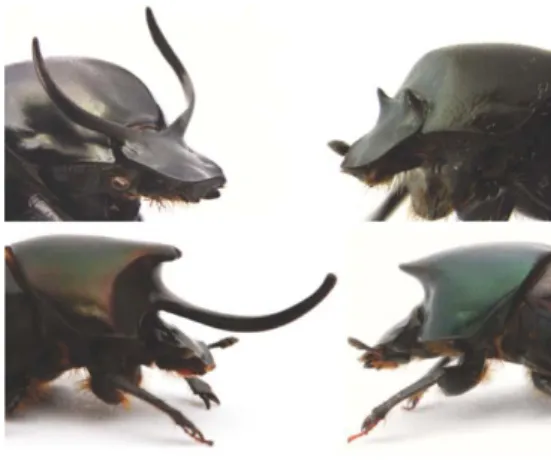
mates. For instance, some species exhibit pre-copulatory mate guarding, a behaviour seen as means of monopolizing access to females until they become available for mating. In Sepsis cynipsea, for example, males guard gravid females while they oviposit, so copulation occurs as soon as females become receptive again, thus improving the male genetic representation in the subsequent eggs clutches (Simmons 2014). Finally, physical contests select for traits that improve the competitors’ ability to win fights, including weaponry, increased aggression and large size. For instance, in several species of dung beetles, females build tunnels and fill them with dung in which they lay their eggs. Males have evolved horns (Figure 2) that they use in fights against other males to guard the tunnels and the winner male mates repeatedly with the resident female. In laboratory experiments, males with longer horns were more likely to win contests (Emlen & Oring 1977; Emlen 2014). These intense contests may also select for alternative mating tactics, in which individuals display strategies that circumvent the costs of direct contact. Indeed, in these dung beetles, small hornless males sneak in tunnels guarded by other males, by digging new tunnels that intercept the guarded ones belowground (Emlen 1997; Moczek and Emlen 2000; Emlen 2014 Figure 2). In this way, small males are able to avoid contests they were likely to lose and still fertilize some females.
Note that none of the mechanisms presented above are mutually exclusive and that they do co-occur in several species (Shuker 2014).
Figure 2. Examples of alternative male morphs in dung beetles. Onthophagus taurus (top), O. nigriventris (bottom). Large horned males are shown on the left and small hornless males on the right. Females (not shown) are entirely hornless in both species. Adapted from Valena and Moczek 2012.
1.1.2 Inter-sexual mate choice
Prior to mating, mate choice can take place in two phases: mate location and mate assessment (Brooks & Griffith 2010; Danchin & Cézilly 2008). Individuals can use different cues to exert their preference. These cues can be phenotypic traits, or resources defended or provided by the chosen sex, like nests
or territories (Candolin 2003). Phenotypic traits include visual, chemical, acoustic, olfactory, tactile and behavioural traits (Candolin 2003; Johansson & Jones 2007). Some of these traits, such as body constitution, can arise and be maintained through natural selection but simultaneously be used as indicators of fitness. Others, like colourful ornaments or courtship behaviours, have evolved with the sole purpose of attracting mates and can be detrimental to survival (Candolin 2003).
Any trait that attracts and stimulates partners, or the monopolization of any high-quality resource necessary for reproduction (Danchin & Cézilly 2008) should be favoured in the competing sex. For instance, across insects, the most common traits preferred by males are female size or weight, which often act as proxies for female fecundity, and female mating status. Mating status can predict the risk - the probability that a female will mate with two males - or intensity - the number of competitors- of sperm competition, as we will see in section 1.2.2.2 (Kelly & Jennions 2011; Bonduriansky 2001).
Frequently, if not always, multiple cues are used in mate choice (Jennions & Petrie 1997; Candolin 2003). There are several explanations for the use of multiple cues. First, some of these cues might be unreliable indicators of mate quality solely maintained due to pre-existing sensory biases (Candolin 2003; Jennions & Petrie 1997). Second, they can provide different information regarding a prospective mate. In fact, there are some evidences that different signals are evaluated differently depending on which type of benefits the choosy individual is selecting (see section 1.3.1). For instance, in some species of birds, females use song repertoires, a proxy of male quality, to choose extra-pair mates, but use territory characteristics, like nest quality, to select cuckolded males (Candolin 2003). Third, multiple cues can be redundant. For instance, in Bicyclus anynana, females use both chemical and visual cues, even though only one type of cue is sufficient to elicit preference (Costanzo & Monteiro 2007). The redundancy of cues is associated with a decrease in mate-choice errors (Candolin 2003). Finally, different cues can be differentially useful in different environments (Jennions & Petrie 1997; Bro-Jørgensen 2010).
1.2 Post-copulatory mating strategies
Parker (1970) was the first to emphasize that sexual selection can persist after mate acquisition. If females mate multiply, then the sperm from two or more males can still compete for the same set of eggs, a term coined “sperm competition”. Thus, sperm competition can be seen as the post-copulatory equivalent of pre-copulatory male-male competition. Sperm competition is a widespread phenomenon, given that females mate multiple in most internally fertilized species (Simmons 2001). Sperm competition will generate sexual selection on males to improve their reproductive success, ultimately
resulting in a pattern of sperm precedence, as we will see in section 1.4. However, before discussing the patterns of sperm precedence I will focus on the potential mechanisms of sperm competition (section 1.2.1).
Storage, maintenance and utilization of sperm occurs within the female. Hence, these traits are, ultimately, under female control (Simmons 2001). Thus, in the same way sperm competition can be seen as the post-copulatory equivalent of pre-copulatory male-male competition, pre-copulatory female choice can be extended to after copulation, a phenomenon called cryptic female choice (Thornhill & Alcock 1983; Arnqvist 2014). In addition, given that sperm production is costly, males can exert male choice after mating. These mechanisms of post-copulatory mate choice are briefly summarized in section 1.2.2. Note that strategic parental investment can also occur. However, I will not address it in this introduction.
Post-copulatory mechanisms can be essential to determine the intensity and direction of selection on sexual traits. Notwithstanding, there is a lot we do not know about them, mainly because of technical challenges related to direct observation of sperm within the female tract and of the limited ability to discriminate sperm from different males. For instance, until recently it was thought that in
Drosophila melanogaster last male sperm precedence was achieved through chemical sperm removal
(Harshman & Prout 1994). However, in 2010, when sperm observations were done in vivo, it was discovered that mechanical sperm displacement by rival males and sperm ejection by females were operating in this species, rather than chemical displacement (Manier et al. 2010).
1.2.1 Sperm competition
Sperm competition is usually viewed as an extension of male-male competition. Indeed, males are expected to evolve strategies that allow them to maximize their own reproductive success not only before but also after copulation, within the female. In fact, internal fertilization itself is thought to be an adaptation against sperm competition: the closer to the site of fertilization the sperm is delivered, the lower the intensity of sperm competition and thus the bigger the chance of successful fertilization (Simmons 2001). The existence of sperm competition can select for both defensive and offensive traits in males (Arnqvist & Rowe 2005). The outcome of a multiple mating will depend, in part, on how different male adaptations perform against each other (Danielsson 1998).
1.2.1.1 Defensive traits
Defensive traits reduce the risk of sperm competition – the probability that a female will mate with two males – by reducing or even preventing females from re-mating. These adaptations can be physiological, behavioural or mechanical.
Defensive reproductive behaviours include prolonged copulation and post-copulatory mate guarding. Prolonged copulations are described as a prolonged period of male-female association beyond the time necessary for insemination, functioning as a physical barrier against potential competitors. In post-copulatory mate guarding, in contrast, males stay attached to females without maintaining genital contact. Both behaviours prevent females from re-mating. However, frequently, during prolonged copulation and post-copulatory mate guarding, there are take-over attempts by other males. Selection is thus expected to favour males that are able to reduce or prevent those take overs. This can be achieved using special organs that serve to maintain the connection between male and female or displaying aggressive behaviour towards competitors (Danielsson 1998). Note that these strategies occur at the expense of mate searching, being selected only when the benefits of mate guarding are superior to the costs of lost mating opportunities. Consequently, selection is expected to favour phenotypic plasticity in mate guarding behaviour in response to the risk of sperm competition (Kvarnemo & Simmons 2013). For instance, in fire buds, Pyrrhochoris apterus, copulation duration is dependent on the OSR, with longer copulations, that can last up to seven days, occurring in more male-biased OSR (Figure 3). This happens even though sperm transfer is finished a few hours after pairing, suggesting that extended time of copulation serves to prevent females from re-mating (Simmons 2014).
Figure 3. Duration of copulation in firebugs, Pyrrhochoris apterusdepends on the sex-ratio of the populations. Sperm transfer is complete after 4 hours of copulation but males adjust their time of association with the female depending on the risk of re-mating. Adapted from Simmons 2014. Picture firebugs: Alex Hide
Males can also evolve defensive strategies that allow them to continue mate searching after copulation. Along with sperm, males transfer products from the accessory glands. These seminal products may have significant impacts on female physiology and behaviour. Males can reduce the
attractiveness of females by decreasing their output of pheromones or by applying anti-aphrodisiac substances during copulation (Danielsson 1998). Alternately, seminal products can decrease or delay female receptivity to future matings and/or promote oviposition (Simmons 2001). For instance, an exhaustive study done on several mosquito species, namely ten Aedes species, Culex pipiens and
Anopheles quadrimaculatus, has found that females with implanted male accessory glands on their
thorax were never inseminated by males, while 75-100% of females with male gut on their thorax were successfully inseminated (Craig 1967). Another possible defensive strategy is to transfer with sperm masses of material secreted by the accessory glands that coagulate in the tract of the female, functioning as a physical barrier (Simmons 2001). These structures, called mating plugs serve the dual function of helping deliver the ejaculate (i.e., preventing passive loss of sperm; “leaking hypothesis”) and of plugging the reproductive tract preventing subsequent matings (Simmons 2001). However, they can be short-lived barriers and thus not totally effective against females re-mating.Nevertheless, the mean proportion of effective second matings is lower in species with mating plugs than in species without such structure (Simmons 2001).
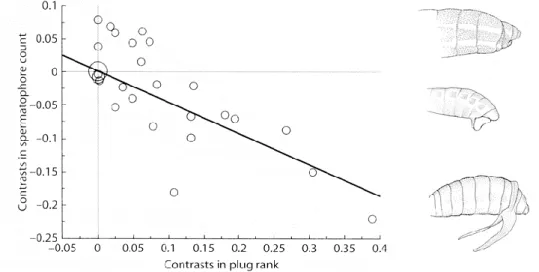
While these strategies leave the males free to search for additional mates, the production of seminal products can be a high-energy investment, limiting their ability to fertilize other females (Arnqvist 2014). Thus, as in mate guarding, we expect males to allocate their resources depending on the intensity of sperm competition (Arnqvist 2014). Consistent with this prediction, across species of butterflies, there is a negative correlation between female mating frequency and the investment of males in mating plugs (Figure 4).
Figure 4. Correlated evolution of mating plugs and female re-mating frequency among butterflies. Species with small mating plus (top right) have high mating rates, while those with bigger plugs have moderate to low female mating rates. From top to bottom: Graphium sarpedon, Atrophaneura alcinous and Euryades corethrus. Adapted from Simmons 2014.
1.2.1.2 Offensive traits
Offensive traits increase the ability of males to outcompete the ejaculate of other males within the female. Several adaptations for sperm priority have been suggested so far. For instance, males can improve their chance of fertilization success by evolving behavioural adaptations, such as prolonged copulation. Indeed, the degree to which a male can displace rival sperm may depend on the time he spends copulating with a given female (Simmons 2001). Besides, prolonged copulation can facilitate repeated inseminations and consequently increase the reproductive success of males in species with sperm mixing (Simmons 2001). This behaviour can thus function as defensive trait, as see in the previous section, and as offensive trait. In fact, this is the case for several male adaptations (Simmons 2001).
In addition, to prolonged copulation, sexual selection driven by variation in sperm fertilization success can lead to rapid and divergent evolution of male genitalia, sperm production and sperm morphology and physiology.
Altered genitalia can act directly, by removing or displacing rival sperm, or by improving the chance of successful insemination. For instance, in seed beetles Callosobruchus maculatus, male’s altered genitalia pierce the internal walls of the female genital tract, allowing seminal fluid compounds to enter the female’s haemolymph. Males with longer spines have increased competitive fertilization success (Hotzy et al. 2012). These traumatic inseminations allow males to bypass the usual route of insemination, thus gaining a selective advantage over other males. Alternately, altered genitalia can act indirectly, stimulating the female reproductive tract in order to gain sperm priority (Simmons 2001; Danielsson 1998). Female stimulation can be achieved through chemical or behavioural processes, eliciting sperm transport, sperm removal and/or egg abortion. For example, in the fly Dryomyza analis, females expel a droplet of sperm before oviposition. By tapping repeatedly on the external genitalia of females, males succeed in increasing the proportion of sperm from previous males in the droplet expelled, thereby promoting their relative reproductive success (Danielsson 1998).
Sperm form and function can also play a large role in fertilization success. For instance, in D.
melanogaster, mechanical sperm displacement by rival males and sperm ejection by females operate
as mechanisms of sperm priority (Manier et al. 2010). Long and slow-swimming sperm are better able to enter the seminal receptacle of the female and less likely to be displaced than other sperm, conferring an advantage to the male that produces them (Lüpold et al. 2012).
1.2.2 Cryptic choice
Cryptic choice is defined as any pattern of non-random post-copulatory reproductive success across chosen individuals that is caused by the choosy individual (Thornhill & Alcock 1983; Arnqvist 2014; Bonduriansky 2001). As underlined before, cryptic choice can occur in both sexes.
1.2.2.1 Cryptic female choice
Cryptic female choice traits can be broadly categorized as morphological, physiological or behavioural (Arnqvist 2014). The shape of the female internal reproductive duct is an example of morphological cryptic female choice. For instance, long or fast sperm will gain an advantage over other sperm in a long and winding duct (Arnqvist 2014). Likewise, females might control the usage and storage of sperm. For instance, feral fowl females expel sperm following copulations with some males and yet accept sperm from others, biasing paternity (Simmons 2001; Pizzari & Birkhead 2000). Another example of cryptic female choice is found in the flour beetle Tribolium castaneum. In this species, a positive correlation is observed between the rate at which males rub with their tarsi on the lateral edges of the females’ elytra during copulation and males’ reproductive success in a double mating. However, when Edvardsson and Arnqvist (2000) ablated the tarsi of males, thus preventing the them from reaching the females’ elytra, the positive correlation found in control males was lost (Figure 5). This occurred even though manipulated males kept “rubbing” in the air and the same amount of sperm was transferred during copulation by manipulated and control males. Their experimental manipulation thus show that female perception of male copulatory courtship behaviour, rather than the behaviour of the male itself, affects male competitive fertilization success in the flour beetle.
Figure 5. Cryptic female choice in the female flour beetle, Tribolium castaneum. When males have ablated tarsi, they are prevented from reaching the females’ elytra, which they normally rub during copulation. Consequently, the positive correlation found between the rate at which control males rub with their tarsi on the lateral edges of the females’ elytra and male reproductive success in a double mating is lost. Ablated males: filled circles and solid line; control males: open circles and dashed line. Adapted from Arnqvist 2014.
1.2.2.2 Cryptic male choice
As females, males can exert cryptic male choice, through strategic adjustment of ejaculates and differential allocation of parental care (Edward & Chapman 2011). Here, I will only focus on strategic ejaculation.
Strategic adjustment of ejaculates can involve changes in chemical composition, influencing sperm performance, in sperm morphology and in sperm number (Kelly & Jennions 2011). There are several main factors that can affect strategic ejaculation. Males should transfer more sperm in copulations with females of higher quality, assuming males can reliably assess female quality (Kelly & Jennions 2011; Wedell et al. 2002). Indeed, in some insects, males have been shown to transfer larger nutritious ejaculates to larger females, size being a proxy of fecundity (Kelly & Jennions 2011; Wedell et al. 2002). In addition, males should exhibit phenotypic plasticity in ejaculate properties in response to the risk and intensity of sperm competition (Kelly & Jennions 2011; Wedell et al. 2002; Edward & Chapman 2011). At low levels of sperm competition, when females may or may not mate with more than one male, males are expected to increase their ejaculate expenditure with increasing risk of competition, i.e., the probability that a female re-mates. Indeed, a meta-analysis done in 15 insect species has shown that males transfer more sperm in contact with rival males (Kelly & Jennions 2011). However, with increasing levels of sperm competition, which entails that all females mate more than once, male ejaculate expenditure should decrease with increased intensity of sperm competition, i.e., the number of male competitors (Kvarnemo and Simmons 2013; Simmons 2014; Figure 6). This is because the more polyandrous females are, the lower is their reproductive value for males (Kvarnemo & Simmons 2013). For instance, in the field cricket Teleogryllus oceanicus, males increase the proportion of viable sperm in their ejaculate when they perceive the odour of just one rival but reduce this proportion with cues from an increasing number of rivals (Thomas and Simmons 2009, Figure 6).
The risk and intensity of sperm competition are often predicted by males via the female mating status. That is because a virgin female might not mate again after mating with the focal male, while a mated female already contains sperm from another male. The risk of sperm competition is thus higher in mated females. In this sense, males should increase their ejaculate expenditure in matings with mated females, provided there are no additional competitors. The intensity of sperm competition, on the other hand, is predicted to be higher in mated females than in virgins and males should increase their ejaculate expenditure in matings with virgins. In fact, males often copulate during a longer period of time with virgins than with mated females (Kelly & Jennions 2011).
Figure 6. The correlation between sperm ejaculate and sperm competition. a) Theoretical predictions from sperm competition game theory for ejaculate expenditure depending on the number of rivals. ESS: evolutionary stable strategy. After Parker and Simmons 1996 b) Empirical study using the field cricket Teleogryllus oceanicus. Females were impregnated with different amounts of extracted cuticular hydrocarbons (CHC), corresponding to a different number of rival males. Tested males transfer more viable sperm with increased risk of competition, when they perceive the odour of just one rival, but reduce the proportion of viable sperm transferred when mating with females to which increasing quantities of CHC were applied – increased intensity of competition. After Thomas and Simmons 2009. Adapted from Simmons 2014.
1.3 Costs, benefits and sexual conflicts in reproduction
None of the strategies described so far is free of costs. Consequently, these mechanisms are expected to evolve when the reproductive advantage gained is superior to the costs incurred. However, as pointed out before, male and female adaptations do not need to be advantageous for the opposite sex. In fact, frequently the evolutionary interest of males and females do not coincide, giving rise to sexual conflicts, as we will see in the next section (1.3.2). In addition, I will summarize the potential costs and benefits of mate choice (1.3.1) and of mating (1.3.2).
1.3.1 Costs and benefits of mate choice
The costs of being choosy should be independent of the sex that chooses. Individuals risk decreasing their reproductive success with prolonged search time and loss of energy evaluating mates and/or wrong mate quality assessment. These costs are expected to be inversely proportional to the life expectancy, mating capacity and mate availability (Bonduriansky 2001). In addition, males and females risk increased exposure to predators, harassment, sexually-transmitted diseases and opportunity costs,
b) a)
as the best mates can be removed from the pool of available mates as time passes (Brooks & Griffith 2010). However, mate choice can be extremely advantageous as well.
During the last decades, many empirical and theoretical studies have tackled the problem of what benefits females might gain from being choosy. Although poorly addressed in the literature, it seems straightforward to assume that these benefits can be transversally applied to females and males.
Mate choice should be beneficial whenever it increases the number and/or quality of offspring for choosy individuals as compared to individuals that mate randomly (Johansson & Jones 2007). The benefits of mate choice are direct whenever choosy individuals acquire more resources that enhance their survival or reproductive success than non-selective ones. These resources include territories, food or protection (Hunt & Sakaluk 2014; Brooks & Griffith 2010; Davies et al. 2012). For instance, in hanging flies Hylobittacus apicalis, females mate with males that provide them with large insects, which they will eat while mating. This has direct implications for the reproductive success of the male, because the larger the insect, the longer he may copulate with the female and the more sperm he is able to transfer (Thornhill 1976). In some species, males supply females with more than one direct benefit. For instance, in flycatchers, males provide nest site, feeding territory, protection against harassment by other males, nest defence and parental care (Brooks & Griffith 2010).
Choosy individuals do not always acquire material benefits. Indeed, they can distinguish among prospective mates on the basis of some phenotypic trait to improve the fitness of their offspring (Hunt & Sakaluk 2014). In this case, the benefits are indirect. Indirect, or genetic benefits, occur when certain genes (intrinsic male quality) or gene combinations (genetic compatibility) produce fitter offspring than others (Kvarnemo & Simmons 2013). In the first, discrimination is done based on the ability to produce sexier or better quality offspring. In this case, a certain genome always produces offspring of the same quality (Shuker 2014) In the second, genetic benefits arise as a consequence of an interaction between a given maternal and a given paternal genome and the quality of the offspring will depend on this interaction (genetic incompatibility hypothesis; (Zeh & Zeh 1997; Zeh & Zeh 1996; Tregenza & Wedell 2000; Wedell 2013). Genetic incompatibility can arise due to male-female relatedness (Tregenza & Wedell 2002) and selfish genetic elements, such as cellular endosymbionts, as we will see in section 2 (Zeh & Zeh 1996; Wedell 2013).
1.3.2 Costs and benefits of mating
Once individuals have been chosen, mating will take place. The act of mating encompasses several costs for both males and females as well (reviewed in Göran Arnqvist and Rowe 2005; Arnqvist and Nilsson 2000), the most common being energy expenditure, increased risk of predation due to decreased
motility or greater visibility and loss of other mating opportunities. Besides the costs of mating themselves, male adaptations to sperm competition can also be costly for females. Females risk suffering from sexual harassment (McLain & Pratt 1999; Rossi et al. 2010), injury caused by male genitalia (Blanckenhorn et al. 2002; Rönn et al. 2007) and the effect of toxic ejaculate substances. For example, the seminal products transferred with sperm can have dramatic effects on female reproductive physiology, reducing its receptivity and longevity (Arnqvist & Rowe 2005). This was demonstrated in Drosophila melanogaster, in which an increasing exposure to products in the seminal fluid led to increased death rate in females (Chapman et al. 1995).
The differences in costs and benefits obtained with each mating by males and females will give rise to sexual conflicts (Arnqvist & Rowe 2005). Note that in sexual diploid species it is always beneficial for both males and females to mate at least once, as mating is necessary to produce offspring (Arnqvist & Rowe 2005). In this case, we do not expect sexual conflicts to arise over the first mating of an individual. However, this is not the case in haplodiploid species, as we will see in section 1.5.
Sexual conflicts occur whenever the fitness optimum of the sexes differs (Arnqvist & Rowe 2005). There are numerous examples that confirm the existence of sexual conflicts over mating rate and describe the reproductive tactics employed either to persuade or to resist matings (for review see Göran Arnqvist and Rowe 2005). For instance, in the water strider Rheumatobates rileyi, males have grasping antennal claspers to grab females during copulation (Figure 7). In response, females possess modified genital segments that appear to reduce the efficiency of male grasping devices (Arnqvist & Rowe 2005). However, rejecting male attempts can become too costly for females (Arnqvist & Rowe 2005). In these situations, females can mate at a rate higher than their optimum to avoid the costs of rejecting unnecessary mates, a phenomenon called convenience polyandry (Thornhill & Alcock 1983; Snook 2014). Note however, that females can harm males too during copulation, the most extreme cases being when males are eaten by females, as seen in several species of spiders (Arnqvist & Rowe 2005). Even though females are frequently the sex with the lowest optimum mating rate, multiple mating does not have to be always costly for females.
Polyandry is easily explained when females gain direct benefits by mating multiply. As in pre-copulatory mate choice, multiple mating is considered a direct benefit when it increases females reproductive output (Danielsson 1998). Multiply-mated females can directly benefit from nutrients in the ejaculate and nuptial gifts, which can increase egg production in females and/or their longevity. Arnqvist and Nilsson (2000) have found compelling evidence that direct benefits can explain polyandry in several species, especially when nuptial gifts are involved. In addition, females can also benefit with increased parental care and guarding services for herself and her offspring. Finally, polyandry can
prevent against infertility when infertile or sperm depleted males are frequent in the populations (Snook 2014). In fact, the proportion of infertile matings in insects is quite high, varying between 0% and 63%, with a median of 22%, in a study with 30 insect species (Garcia-Gonzalez 2004). Ironically, polyandry can be the solution of sperm depletion but also the cause, when males mate with several females.
Figure 7. a) Male and female evolved structures in response to sexual conflicts. Scanning electron microphotograph of the antennae of female (left) and male (right) Rheumatobates rileyi. The male uses his modified large antennae to grasp the female near the eye during the mating struggle in an attempt to subdue her (Image: Lock Rowe, university of Toronto) b) Female (left) and male (right) Rheumatobates rileyi. Adapted from Westlake, Rowe, and Currie 2000.
Moreover, females might gain from polyandry indirectly, through increased performance of their offspring. As seen before, pre-copulatory mate choice can target genes that increase offspring performance. However, when gene quality cannot be assessed prior to mating, females may mate multiply to increase their chances of finding good quality sires. When there is variation in the genetic quality of males, multiple mating enables the female to exercise mate cryptic choice, thus improving offspring quality (the “good genes” hypothesis; reviewed in Andersson 1994; Davies, Krebs, and West 2012; Snook 2014). The same logic is applied when there is variation in insemination success. By mating
a)