Universidade de ´
Evora - Escola de Ciˆ
encias e Tecnologia
Mestrado em Engenharia Inform´
atica
Disserta¸c˜ao
A context aware recommender system for tourism with
ambient intelligence
Tania Tanzin Hoque
Orientador(es) | Salvador Lu´ıs de Bethencourt Pinto de Abreu Maria Goreti Carvalho Marreiros
´
Universidade de ´
Evora - Escola de Ciˆ
encias e Tecnologia
Mestrado em Engenharia Inform´
atica
Disserta¸c˜ao
A context aware recommender system for tourism with
ambient intelligence
Tania Tanzin Hoque
Orientador(es) | Salvador Lu´ıs de Bethencourt Pinto de Abreu Maria Goreti Carvalho Marreiros
´
A disserta¸c˜ao foi objeto de aprecia¸c˜ao e discuss˜ao p´ublica pelo seguinte j´uri nomeado pelo Diretor da Escola de Ciˆencias e Tecnologia:
Presidente | Irene Pimenta Rodrigues (Universidade de ´Evora)
Vogais | Salvador Lu´ıs de Bethencourt Pinto de Abreu (Universidade de ´Evora) (Orientador)
Teresa Cristina de Freitas Gon¸calves (Universidade de ´Evora) (Arguente)
´
i
A
BSTRACTRecommender system (RS) holds a significant place in the area of the tourism sector. The major factor of trip planning is selecting relevant Points of Interest (PoI) from tourism domain. The RS system supposed to collect information from user behaviors, personality, preferences and other contextual information. This work is mainly focused on user’s personality, preferences and analyzing user psychological traits. The work is intended to improve the user profile modeling, exposing relationship between user personality and PoI categories and find the solution in constraint satisfaction programming (CSP). It is proposed the architecture according to ambient intelligence perspective to allow the best possible tourist place to the end-user. The key development of this RS is representing the model in CSP and optimizing the problem. We implemented our system in Minizinc solver with domain restrictions represented by user preferences. The CSP allowed user preferences to guide the system toward finding the optimal solutions.
iii TÍTULO
Um sistema de recomendação contextual, para turismo
R
ESUMOO sistema de recomendação (RS) detém um lugar significativo na área do sector do turismo. O principal fator do planeamento de viagens é selecionar pontos de interesse relevantes (PoI) do domínio do turismo. O sistema de recomendação (SR) deve recolher informações de comportamentos, personalidade, preferências e outras informações contextuais do utilizador. Este trabalho centra-se principalmente na personalidade, preferências do utilizador e na análise de traços fisiológicos do utilizador. O trabalho tem como objetivo melhorar a modelação do perfil do utilizador, expondo a relação entre a personalidade deste e as categorias dos POI, assim como encontrar uma solução com programação por restrições (CSP). Propõe-se a arquitetura de acordo com a perspetiva do ambiente inteligente para conseguir o melhor lugar turístico possível para o utilizador final. A principal contribuição deste SR é representar o modelo como CSP e tratá-lo como problema de otimização. Implementámos o nosso sistema com o solucionador em Minizinc com restrições de domínio representadas pelas preferências dos utilizadores. O CSP permitiu que as preferências dos utilizadores guiassem o sistema para encontrar as soluções ideais.
v
A
CKNOWLEDGMENTSBeyond everything I would like to express the deepest gratitude to almighty Allah (The God) to bring me at this stage. Especially, I would like to dedicate to my mother who is suffering for cancer last stage and waiting to see me graduate. I should confess strongly about my father Md Nurul Hoque and my husband Md Tofael Ahmed who always encouraged me to go ahead and supports those moments when I was mentally stressed due to my mother cancer.
I should strongly confess about my supervisor Professor Salvador Abreu, who made this thesis possible to be done. His encouragement, supports, and guide never let me go backward during my thesis work. He is such a genius teacher who introduce me with the approach of constraint satisfaction programming where I was able to learn new technology. I would like to express the name honorably Professora Goreti Marreiros (Co-supervisor), for whom I learned the biggest part of my life. I had a best opportunity to work under her supervision where I learned about research and development practically. She helped me to explore my knowledge on recommendation system and context awareness. Without those experience my thesis would not have been possible.
In addition, my especial thanks go to Professora Teresa Gonçalves who was the coordinator of Erasmus Mundus LEADER program. I would like to show my gratitude to the Erasmus Mundus LEADER project for granting me a scholarship for making a possible master’s degree completion.
vii
C
ONTENTS
List of Figures ...ix
List of Tables ...ix
Nomenclature...x Acronyms ... …xi Chapter 1. INTRODUCTION ... 13 1.1 INTRODUCTION ... 13 1.2 MOTIVATION ... 14 1.3 THESIS INTEND ... 16 1.4 THESIS ORGANIZATION ... 17 Chapter 2. BACKGROUND ... 18
Chapter 3. AMBIENTINTELLIGENCEINDOMAIN ... 30
3.1 AMBIENT INTELLIGENCE ... 30
3.2 AmI AFFECTIVE FACTOR IN RECOMMENDER SYSTEMS ... 31
3.3 AMBIENT INTELLIGENT SEQUENCE DIAGRAM ... 34
3.4 ISyR AMBIENT INTELLIGENT ARCHITECTURE ... 35
Chapter 4. CONTEXT AWARENESS ... 37
4.1 WHAT IS CONTEXT AWARENESS ... 37
4.2 IMPORTANCE OF CONTEXT AWARENESS ... 38
4.3 DATA ACQUISITION ... 40
4.4 CONTEXT-AWARE RECOMMENDATION ALGORITHM ... 41
4.4.1 Collaborative Filtering According to User-based ... 41
4.4.2 Collaborative Filtering Algorithm based on relationship ... 42
4.4.3 Location Similarity Collaborative Filtering Algorithm ... 42
Chapter 5. POINTS OF INTEREST MODELING ... 43
5.1 MODELLING POINTS OF INTEREST AND VISITORS PROFILE ... 43
5.2 BIG 5 TRAITS MODEL ... 44
viii
Chapter 6. CONSTRAINT SATISFACTION ... 50
6.1 CONSTRAINT SATISFACTION PROBLEM ... 50
6.2 CONSTRAINT SATISFACTION ADVANTAGES ... 50
6.3 CONSTRAINT BASED RECOMMENDER SYSTEM TECHNOLOGY ... 51
6.3.1 Motivating Example ... 53
6.4 IMPLEMENTATIONS ... 54
6.4.1 Sign and Definitions ... 55
6.4.2 CSP Model Representation ... 56
6.4.3 Model Definition ... 56
6.4.4 Data Acquisition ... 57
6.4.5 Optimisation ... 58
6.4.6 Experimental Result and Evaluation ... 60
Chapter 7. CONCLUSION AND FUTURE WORK ... 63
ix
LIST OF FIGURES
Figure 1 – Portugal Tourism Revenue in the last 1 year ... 15
Figure 2 – Portuguese Touristic Revenue Over the Past Ten Years ... 15
Figure 3 – Tour Recommendation Framework ... 20
Figure 4 – Constraint-based personalised system ... 22
Figure 5 – Rating prediction procedure for a user ... 23
Figure 6 – The hybrid recommender system workflow ... 24
Figure 7 – Smart Spot, Smart PoI and PoI relationship scheme ... 26
Figure 8 – Recommendation Engine Flowchart ... 27
Figure 9 – TheRoute system architecture ... 28
Figure 10 – Ambient Intelligence Architecture ... 31
Figure 11 – Towards the next generation of ambient recommender systems: an extended approach ... 33
Figure 12 –Sequence Diagram of the proposed system ... 34
Figure 13 – Proposed Architecture of the ISyRAmI work ... 35
Figure 14 – Multidimensional model of context awareness system ... 40
Figure 15 – Big 5 traits model ... 44
Figure 16 –Relation between Big 5 and tourist categories ... 46
Figure 17 – Graph colouring ... 54
LIST OF TABLES
Table 1 – Description of Mild Connections ... 48Table 2 – Description of Strong Connections ... 48
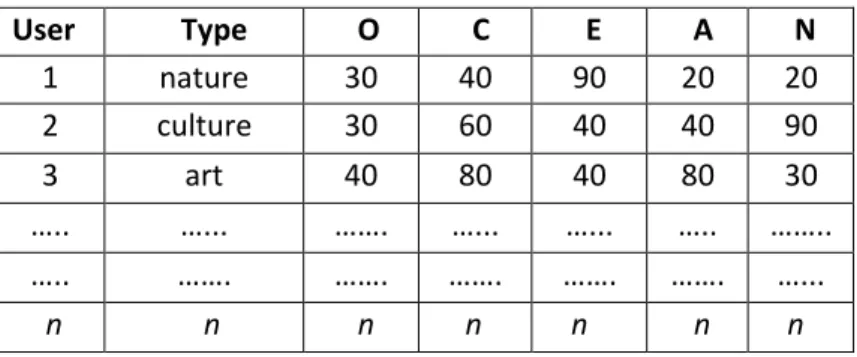
Table 3 – Dataset of user information ... 57
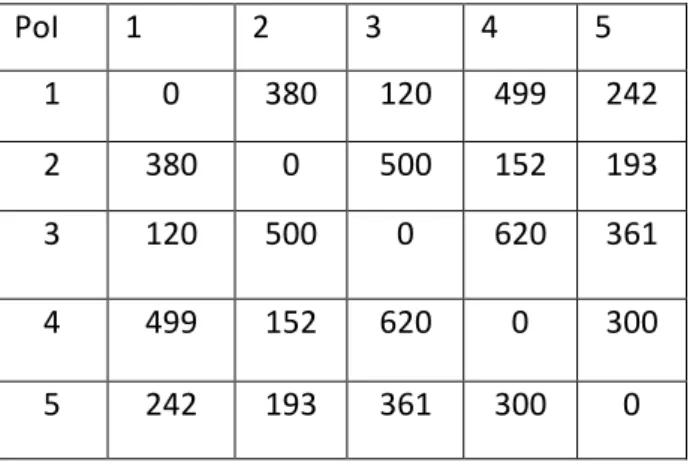
Table 4 – PoI Table ... 57
x
N
OMENCLATURE U User-Set P PoI Set C Context-aware system R g Rating Function R f Corresponding Function R h Function w D Different Dimension j l Check-in locationη
Weighting Factorα
User Interest β User Personalityxi
A
CRONYMSRS Recommender Systems
AmI Ambient Intelligence
PoI Points of Interest
GDP Gross Domestic Product
LBSNs Location-Based Social Networks
BPR Bayesian Personalised Ranking
EM Expectation Maximisations
CF Collaborative Filtering
JR Japan Railway
TWIN Tell Me What I Need
HyRA Hybrid Recommendation Algorithm
ISyRAmI Intelligent Systems Research for Ambient Intelligence
GPS Global Positioning System
RFID Radio-Frequency Identification
CSP Constraint Satisfaction Problem
AI Artificial Intelligence
13
Chapter 1.
I
NTRODUCTION
1.1
I
NTRODUCTIONWith the expanding volume of online information, recommender systems (RS) have been an efficient strategy to overcome information being overload. A new paradigm of internet-based support systems has been proposed as recommender system with the ascending growth of using smart devices, the internet. This RS gained progressive priority in the nineties [1], as the web became the main channel of e-commerce transactions and business. It provided a novel opportunity in the sector of personalization which was not available in another channel. It also provided comfort in user interface and data collection that might be devoted to recommending items in a no-intrusive way. Since then, the RS has gained priority to public awareness. As a witness of this fact, that is most conferences workshop is exclusively complying on recommender system. The goal of recommender systems is to rank data information according to partly revealed preferences, which are encapsulated in previously undertaken surveys, marks user and information properties itself. This topic incorporates various diversities because it can use many types of user personality, preferences and information requirement to make recommendations. Since we are surrounded by technologies, it is easy to get a person’s data by the medium. In today’s world, everyone and everything is increasingly connected with each other. Technologies have been promising us for a long time and making life easier with perceiving what we desire. Therefore, Ambient Intelligence (AmI) is a branch of advanced technologies that empower to create truly personalised and context-aware interaction. It is an arising trend that brings intelligence to our everyday life in the surrounding environments and for the ambient intelligence it can be sensitive to us [2]. AmI is a hidden talent network coalition that can smartly recognise person’s presence and can give a structure of our environment for our immediate needs, habits, gestures, and emotions. We can say shortly that AmI signifies the presence of Intelligence. The sectors of using AmI could be homes, offices, diverse, meeting rooms, hospitals, sports, stores, music, transports, and tourism and so on. In this paper, our focus is mainly on tourism sector. As we know context-awareness is the perfect way for realising Ambient Intelligence (AmI), because the sensing device from ambient area considers information from user surrounding context. Specifically, in the sphere of tourism, it is very significant to suggest the right
14 sets of events, places, and attractive locations. According to those concepts, to understand users’ personal choice, mood, event, and the location, we approach our project on tourism recommendation including Ambient Intelligence with the bridge of Context-Awareness and Visitants’ Profile Adaptation. With the composition of a context-aware touristic recommendation system it can suggest a series of locations to a user based on their personality, preferences, and context.
The basic idea of the recommender system is to utilise different information, interest, and data source to infer user interests. In the recommendations it is considered the entity as a user and the places which are referred as Points of Interest (PoI). Therefore, recommendation search might be based on the early interaction among the users and PoIs, as a result of previous interest and interaction are often best for predicting future choices. The principle of the recommendations is that the dependency relation between users and PoIs central relationship. As an example, we can say if a user is interested in nature type of places, it means he is more or likely interested in nature categories or adventure categories rather than historical places. However, in many cases, a different type of categories PoIs may demonstrate significant relations which can be helpful to develop more accurate recommendations.
Personality based recommender system has been improving since long. Though there are several methods are present for a tourist recommender system, but only a few of them consider the user preferences [3, 4]. PoI recommendation system is becoming popular research in academia and industry as well [4]. A group of researchers [5] conducted an online experiment with over 1,800 users for six months on recommendation system. However, our recommender system is specifically instructed for tourism recommender system. The speciality of the work is to provide a context-aware recommender system for tourists.
1.2
M
OTIVATIONTourism recommender system is one of the most growing trends now a day in the world market. Worldwide 292 million people are employed to serve 1320 million tourists stated in the report of World Travel & Tourism Council (2017) [6]. The Tourism industry is such a sector where it is driving a major source of income source in many developing/middle-income countries in the world [7]. The Economic Impact of Global Travel and Tourism (2018) published that, 2017 was one of the
15 strongest years of Gross Domestic Product (GDP) growth in a decade with robust consumer spending worldwide [8]. It is playing a vital role in economic growth across the world.
Tourism is one of the rapid growing sectors for Portugal’s economy also. In 2017, the online journal The Telegraph from the United Kingdom published that the number of tourists visiting Portugal increased 12 percent in 2017 which crossed 12 million for the first time [9].
Figure 1. Portugal Tourism Revenue in the Last 1 Year [10].
In Portugal, tourism revenues increased by 8.8 percent to EUR 1.56 billion in June 2019 from EUR 1.43 billion in the same month of the previous year. The vast numbers of tourists are visiting in Portugal, so the revenue over the past ten years is increasing what we can see in the graph below.
Figure 2. Portuguese Touristic Revenue Over the Past Ten Years [10].
Now a days services related to tourism are rapidly influenced using the internet and the technologies so that it could find the easiest ways without relying on a travel agency. On the other hand, AmI technologies are increasing several choices for users so that tourists can easily find their way what they are looking for. There are many systems already built for tourism recommendations named CT-Planner, EnoSigTour, City Trip Planner, CRUZAR, City Trip Planner,
16 CRUZAR, Smart City, Otium, and e-Tourism [11]. Different kinds of Artificial Intelligence techniques can be used for building tourism recommendation systems. Such as Optimization Techniques, Machine Learning, Multi-Agent Systems, Knowledge Representation [11]. The work will use the bridge of Ambient Intelligence and context awareness concepts.
The perspective of research academy is that the tourism and heritage is one of the oldest and most extensive forms. The extensive number of studies investigates the economic impact on tourism and also some increasing number such as personal freedom or cultural dimensions determines the studies focusing on non-economic area on tourism [12]. One of the focus of this work is to enrich the Portuguese economy by enhancing tourism domain. People always prefer to maintain their job by easy and simplified way. Concerning this simplification, one of the advantages of our proposed system is suggesting PoI according to user personality. The problem is modelled in constraint satisfaction problem.
1.3
T
HESISI
NTENDOur system goal is to recommend visiting places based on available points of interest, user personality and context awareness. Though, there are several recommender systems are available in the market, but only a few of them take into account users’ preferences [3]. We will consider user preference by rating some images and also user personality traits. Moreover, we will design a user mental model based on the psychological profile of the registered user what is going to support a user to suggest some places based on their profile.
The recommendation concept was proved by the constraint satisfaction programming. The model was furnished for the optimisation approach where the expectation was maximising the user satisfaction level. It was also considered the minimisation of distance. The system would perform as a web platform and also fit for all kinds of mobile devices. It also favours the most visiting number of places and rating places for suggesting. The recommending system will suggest the most suitable places where the places are fit for a user according to the present weather and timing of the users’ location. Moreover, to suggest appropriate and most relevant places to the travellers, different kinds of potential contextual factors will be included.
17
1.4
T
HESISO
RGANIZATIONThe thesis is organized as follows. In chapter 2, we present the recent related problem and solution of tourism recommender systems, exiting personality-based tourism recommendation techniques, personality estimation, constraint-based recommendation solutions and we also present an overview of tourism recommender systems with context awareness.
In chapter 3, we describe the ambient intelligent architecture where we explain how the ambient environment works smartly, explain the affective factor of AmI in the recommendation, clarify the layer of the AmI architecture. We also present our AmI sequence diagram.
In chapter 4, we illustrate the context awareness for recommendation system. It also describes why context-awareness for tourism recommendation system should take into consideration, how it’s playing an important role for recommendation system, how does it work, discussed some related work, and proposed a modified algorithm with collaborative filtering.
In chapter 5, we present the modelling point of interest and user, how it’s related to user psychological traits with the points of interest. We discuss user mental model and define the relations.
In chapter 6, we describe constraint programming, optimization, present proposed solution, experiment and evaluation.
Chapter 7 summaries the outcomes of our goal and describe possible directions for future research.
18
Chapter 2
.
B
ACKGROUND
Now a days Location-Based Social Networks (LBSNs) is getting attention. In LBSNs, user’s satisfaction relies on the personalized recommendation of Points of Interests (PoIs). The paper [13] describes a personalised context-aware PoIs recommendation system. In PoI, user satisfaction is ensured by approaching the most interesting locations according to the user’s preferences and constraints [14, 15]. To search the connection among the user-annotated tags and locations taste keywords a probabilistic model is proposed in this paper. It can consider the users personal preferences which makes the system more accurate by making a meaningful correlation.
A dataset is also introduced on contextual appropriateness and usefulness is demonstrated by predicting the locations’ contextual relations. In the dataset recommendation effectiveness, reduction of dimensionality and usage tag prediction are considered. The data sparsity problem is addressed by using four approaches in the proposed method. The first model is the reduction of dimensionality for the location taste keywords. For the user tags assumption for a new location the other three models are proposed. By using multiple LBSNs, distinct scores are also calculated here which also demonstrates the procedure of adding new information into a PoI recommendation approach from the mapping. The technique learning to rank is used to compute the integrated scores here. Finally, it describes the way of incorporating the information into the PoI recommendation by calculating several information scores from many LBSNs. The experiment shows the efficient use of the proposed approach.
The paper [16] describes a personalised next PoI recommendation system by using latent behaviour patterns inference. For LBSNs next PoI recommendation system is very important but challenging. The hypothesis about human nature is to show various mobility patterns under different contextual scenarios. An integrated model of the next PoI recommendation system by using latent behaviour pattern is established here. The extension of the proposed global model to accommodate personalised pattern distribution is necessary for the supporting of the personalised latent behaviour patterns. For the modelling of successive check-in behaviour, the adoption of a third-rank tensor is proposed in this paper. In the related work, PoI recommendation system is classified into four main categories are time-aware, geographical influence enhanced, content-aware approaches and social influence enhanced PoI
19 recommendation. The new Point of Interest recommendation problem is dealt with by nature with the proposed model which integrates categorical influence into mobility patterns and aggregates user’s preferences on a PoI. A Bayesian Personalized Ranking method is furnished to solve the personalized Markov chain with implicit pattern. In this work to model the parameters Expectations Maximization (EM) is used. To improve the recommendation system performance then a personalized model is developed that considers personalized mobility patterns under the contextual scenarios. Two large-scale LBSNs datasets are considered for comprehensive experiments. The experimental results show significant improvements in the proposed model. The speciality of this model is that it can predict a journey of long-distance of the users and the consecutive check-ins for a long period time in the recommendation system.
If we take a look on the paper [17], the author proposed an algorithm named PERTOUR for personalized tour recommendations according to PoI visit durations and user interests. This system can derive automatically from real-life travel sequences considering geo-tagged photos. The method considers PoI popularity, interest preferences of user and how much time users spend at each PoI. Moreover, the system also considers a framework where geo-tagged photos use automatically detect from real-life sequences. The algorithm improves in two ways comparing others in earlier research:
• by introducing time-based user interest and • personalized points of interest visit duration.
20 The proposed model of the framework is shown in the figure below.
Figure 3. Tour Recommendation Framework [16]. The main improvements of the project are as follows:
● PERTOUR algorithm recommends a tourist according to points of interest and visit duration according to points of interest popularity, users’ interest preferences and also include constraints for trip.
● It also includes the concept of time-based user interest which measures a user interest level based on his/her moment spent at each PoIs.
● By demonstrating a personalisation of PoI visit duration, their result showed accurate reflection in real-life PoI durations of the visit for users.
● The framework has been implemented for a user’s real-life travel history extraction where the algorithm can train and serve as ground truth.
● Finally, the evaluation results of PERTOUR against various baselines shows outperform these baselines according to user interest, tour popularity, recall, precision and F1-score. Author proposed POST-VIA 360 [18] which is a platform for the mobile supported recommender systems for tourists. This can assist tourists in all (pre-visit, during-visit and post-visit) stages of their travels. This platform reads the life-cycle from the first visit. It takes data from the initial visit of tourists and analyses the collected data. After analysing data is able to recommend relevant places according to bio-inspired systems and positioning. In order to validate the system,
21 case study was conducted between POST-VIA 360 and a group of experts. The evaluation provided more pleasing result than previous research.
The author [19] introduces a tourist recommender system that includes user mood, current weather and time of day. Those contexts determine the visitor’s appropriate location and suggest the place to go. Visiting places are suggested according to the other user already visited that of same type and this system also puts the rates of every user so that it can suggest others by using that collected information. This system used the genetic algorithm using the gamma function. The experimental result proved high-quality recommendation places for the user considering the contextual goal. The system analyses user preferences from the past rating and their personality as well.
In the paper [20] author presents an algorithm named RecUFG which was developed by location-based social networks. The system followed user collaborative filtering (CF) technique with the most trusted friend’s geographic context and relationships. It illustrates social relationships and geographic information between the user and attractive location. When a user or friends of a user share information (i.e.: pictures, location) based on geographical location, then CF algorithms search similarity of that user and consider other related preferences. The algorithm will calculate the user’s best preference attractions and can effectively suggest a visiting place. The experimental result was performed on a real-world data and compared the accuracy. They take into account the data from the user who already check-ins for at least 10 location during a year from February 2015 to January 2016. They also made a relationship among user-friends distance and check-in probability by the experiment. The evaluation verified the RecUFG algorithm. The author [21] proposed a novel personalised constraint-based configuration which is able to solve tasks in e-commerce environments. This recommendation system hybridised knowledge-based configuration following the collaborative approaches from the source of recommender system. The goal is to utilize user preferences to conduct and extract out the solution process through the large product spaces. The execution was in a constraint solver called Choco open source. The development was a scenario combining of five product classes with total 30 different product properties. The following example of architecture illustrates the whole system.
22 Figure 4. Constraint-based personalised system [21].
A CSP-based bundling system calculates personalised product by applying the recommendation list and domain constraints of collaborating filtering according to current user needs and system context. The example was applied in the e-tourism domain. The evaluation targets completely on calculation time and doesn’t consider the quality and conclusive recommendations. The major development of the paper was a generic web configuration that associates recommendation functionality to generate product bundles. It relies on the ability of the system for product bundles personalisation and in presenting an exact form of recommendation process. This system domain makes a restriction between a constraints and user preferences from recommender system. Therefore, the author demands their proposed system as a novel approach to merging preference information formed from recommendation approaches.
Author [22] presents the approach which calculates user similarity using collaborative filtering. This similarity was specified based on user’s personality model. The system analysed the user psychological status where it finds the similarity between user personality which can call big 5 traits. In this case, collaborative filtering stands for three main advantages:
• It avoids the new user problem by asking questionnaires initially. • It has fewer requirements for generating similarity between users.
• The approach decreases the impression of sparse problem as calculation of similarities does not rely on ratings.
23 Figure 5. Rating prediction procedure for a user [22].
The figure 5 describes the rating prediction procedure for the already selected user u. They perform it an offline experiment of a memory-based CF recommender system that depends on end user’s personality parameters to define the nearest neighbours’ algorithms. The result was compared between personality-based similarity and two rating-based similarities. The personality-based measures were statically equal or better rating-based measures. Their proposed approach allows finding users that have common multimedia interest which is reflected by their similar emotive responses according to their personality values.
In paper [23], author innovates a system which can suggest optimal tour schedules according to various points of interest (PoI). It also considers user preferences and context. Author considered the area of Tokyo metropolitan as an example. The methodology is divided into three parts (data collection, user’s preferences and grouping PoIs, tours recommendation using greedy algorithm). Data collection includes data source and description and retrieving using web scraping technique. User preferences and grouping PoIs includes traveller’s scenarios and heuristic PoIs grouping according to the nearest Japan Railway (JR) train station. It smartly gains and analyses data from huge number of tourists most preferred area and geographical nodes from the JR networks including weather, time estimation, expenses, and multiple cultural events. This system is built with a greedy algorithm.
24 Author [24], the objective of the recommender system is to create a personalized recommender system which collects information from individual user tastes. In order to get accurate preferences system analyses available data, information, hotels, and points of interest. This system accuracy highly depends on available information web pages, filtering, and de-duplication process. One of the major problems of this system is data duplication data. De-duplication technique removes the duplicate/repeated data and analysis only single copy of information initially, it takes existing data, after that it reduces the duplicate copies of information by using de-duplication. De-duplication improves system duplication and quality. The author used Hadoop technology for a recommender system which helps tourists to find the best location based on user profile. In order to get the best accuracy system, four significant phases should follow i.e. scrapping, mapping, de-duplication, and recommendation. First of all, from the websites data object scrapped using jsoup library, then dataset mapped using PigLatin scripts of Hadoop. For mapping the maps, it needs attributes from datasets. Duplicates data will be saved in datasets in data de-duplication. Finally, recommendation suggests most perfect location which fits with the tourist profile.
Author [3], presents a hybrid recommender system for personalized points of interest selection. This system also considers user’s preferences. Various approaches were used such as content-based, knowledge-based and collaborative filtering approach used to select points of interest in this system.
25 The content-based approaches used to analyse user’s behaviour repetition in the same circumstances. It constructs the interest model of users’ past behaviour. This will be captured by the rates which given by other visitors to similar PoIs. Then collaborative filtering makes a group under similar circumstances. Collaborative filtering builds with two major categories i.e. (model-based collaborative filtering and memory-(model-based collaborative filtering). Memory-(model-based collaborative filtering helps to find the similarity among the users using the nearest neighbour algorithm and model-based collaborative filtering uses a machine-learning algorithm to learn model of ratings for users. Finally, knowledge-based function helps how items need different user in different circumstances. The preliminary results were presented in the paper. The result of the experiment performed on real users and data.
In [25], the author proposes a novel approach which is for tourism recommender system based on chat-based group. The system always monitors users’ interactions in the group discussion chat box. The algorithm considers the feedback from the group discussion to update the system definition of the visitor’s utility functions. The system is developed for Smartphone. Group recommender systems are one of the information filtering and decision support mobile applications which goal to support a users’ group for making discussion allowing a set of alternatives. The experiment was conducted with user live study where they measured usability of system, preferences, and quality of group suggestions. After analysing the group chat and monitoring this system recommend some suggestions to guide them properly.
Author [26] propose a TWIN (Tell me What I Need) personality-based recommender system where it recommends the people with similar personality types estimated from the plain text. This RS considers a combination of user-based collaborative filtering and content-based approaches. They guess the accord between users can be constructed by computing the context of words which they are using. User information will collect from textual content automatically. Individually they are not resisted to explicitly provide personal data, ratings, and answers, etc, which can save time and minimize the effort. After finishing the analysis, the information gets stored in database and used to construct and visualize the user profile. TWIN system can use two ways: as a recommender system, or as a personality visualize. In order to recommend, the system searches for the profile personality similar case to the target user and creates a list of most items favoured by them. The further list of recommendations visualized for the user at the final stage. In the domain of tourism, it is necessary to suggest the right sets of locations, events. In general context-aware recommender systems aimed to advice some relevant points of interest to
26 tourists. This kind of framework combined user profiles, personal preferences, contextual model and PoIs data. There are several methods are existing for improving contextual information in tourism sector. With developing the algorithm [27] author proposed a recommendation system for smart point of intersection (PoIs) to specific users based on their personal preferences and smart points of intersection context. Author developed an algorithm HyRA (Hybrid Recommendation Algorithm) which intend to recommend the smart point of intersection for specific user based on user preferences and the smart PoIs context. This novel algorithm incorporates an aggregation operator into the user used-based collaborative filtering as well as geographical information and smart PoIs.
The concept of Hybrid Recommendation Algorithm (HyRA) is developed based on points of interest to smart points of Interaction. A smart PoI is introduced as a smart interaction area among the users and specific physical points, specified by smart spot. On the other hand, PoI is presented as an interesting place for visitors. Figure 7 is representing a graphic of the relationship between Smart PoI and PoI.
Figure 7. Smart Spot, Smart PoI and PoI relationship scheme [27]. The advantages of smart PoI into different contexts listed below.
✓ Any entity can be Smart PoI while placing it in a smart spot.
✓ Smart PoI can present a smart interaction area among entities and people by a smart device. Smart PoI can represent an interesting place for a tourist according to their context.
On the other hand, personalization recommender system can implement depending on multiple PoIs [28]. The system looks for the crowd-sourced user footprints to help users find out the interesting locations. In addition, it generates travel packages including different types of
27 locations and visiting sequences. It also considers crowd-sourced check-in records, user ratings, PoI categories, geographical influence, and temporal information. The aspects considered are described below:
Figure 8. Recommendation Engine Flowchart [28].
At first, system will find out the PoIs that are near to the current location. Then it calculates the user’s preference based on the user’s profile according to those PoIs. By continuing the process for each time, it finds the travel packages with the orders PoIs and determines a route. This location-based social networks (LBSNs) provides facilities for the user to share their locations, write a review about interesting places. The approach is able to collect data from LBSNs and recommend a personalization travel package to help users make travel plans. The proposed system is being developed with a prototype system which obtains a user travel demand from mobile client and generates a package containing multiple PoIs and their visiting profile. Main contributions of the systems [28] are:
● User profile and location modelling based on LBSNs. ● Generating personalized travel packages with multi-PoIs. ● System prototyping and performance evaluation.
We will look at the project TheRoute [11] where the author developed a context-awareness recommender system taking into consideration user personality, mood and surrounding context. This project was developed with the perspective of ambient intelligence and visitor profiling adaptation. This novel approach not only recommends a place, but it also generates routes for group of visitors. This automatics route generation includes the aspects of
28 emotion/mood/personality also. This system can suggest a series of locations to user-based preferences. The main advantage of this recommendation is:
● Suggest PoI according to the user's mood, personality, and context. ● It is able to suggest location to group of visitors.
● It can generate a route automatically from user current position.
Figure 9. TheRoute system architecture [11].
This system has an admin panel where he/she can create PoI and monitor the system. The system requires to answer 10 questions while login for the first time and the information passes to the algorithm. It was developed by followed genetic algorithm. It minimizes the travelling time, waiting time and visit duration to traverse a particular candidate route. To evaluate the result, it was performed with real-world data and contextual awareness considering time window. The test scenario was performed by two proposed algorithm branch-and-bound based process & sequential addition of the nearest feasible sub-route. After completing the experimental result author demand that they are now capable of realizing the best choice and preferences of the visitor.
Tourism recommender system is getting more and more attention in case of research domain. But restaurant recommender system has been largely ignored in research area [29]. So, the author proposed a novel system named RestRec which enables to suggest a user according to user personality, context-aware, hybrid recommender system restaurants. This system addresses the cold-start user with particularly dominant in the restaurant domain where majority users are cold-start users. The evaluation conducted on friends, family and fellow students. The result
29 impact positive on real-world aspect and accuracy of the result exceeds 70% on their approach. In paper [29] author discovers most important techniques and features and some future works which ways are to expand in ResrRec system.
● Customer Reviews: Customer Reviews with text analysis are one of the most important phases which are going to be solved in the future. From the given reviews of users, text analysis software will extract information. It would be an interesting process to look at the reviews and to learn what could be improved and which restaurant could avoid for recommendation.
● Factual data: Factual data is another phase which is going to solve in the future. It would be helpful for possession of different kinds of entities in touristic domain.
● Implicit feedback: Implicitly feedback is such as time is very noisy. However, it is something where system would able to understand most spending time of user in the place.
● Additional contextual information: It can help the system for understanding user interest by tracking surrounding location.
30
Chapter 3
.
A
MBIENT
I
NTELLIGENCE
IN
R
ECOMMENDATION
D
OMAIN
3.1
A
MBIENTI
NTELLIGENCEAmbient Intelligent has ejected in the past 15 years as a next wave in ICT and new computing paradigm. It offers the future technology with far-reaching societal implications, represent recently prevailing configuration of social-scientific information and historical event [30]. AmI is such a technology where multidisciplinary field with a wide range of technological, scientific areas and human-directed science combines a vision of the future. It also has enormous opportunities and huge possibilities such as in future it can incorporate the machine intelligence into a person’s everyday lives and existing environment/area. As we discussed before that our recommendation system solving bridge is ambient intelligence, therefore this a significant part to describe about AmI. Because the system considers the information from AmI area. In below we will illustrate about AmI area and the AmI Architecture.
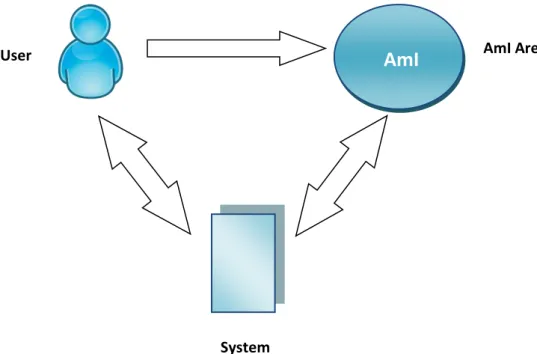
AmI deals with ubiquitous computing devices where people make a smart interaction between the physical environment and people [31]. The environment should be aware of a person's needs, behaviours and customize requirements as well. AmI area can have a variety of applications such as health care, smart shop, smart home, assisted living and location-aware services. Tourist guide is one of the applications where ambient intelligence can contribute a great quality of services [32]. Visitors may not be familiar with the touristic places. In that case, they need location-aware, personalized, ubiquitous and information services. This kind of service should be able to realize the user preferences, predict their interests. This is desirable only when AmI area is enriched of knowledge. The goal of artificial intelligence is to include more facilities in AmI area for allowing people with extra facilities. Including more knowledge in AmI area could be essential for decision making while people will interact with system. Our AmI system diagram is depicted below:
31
Figure 10. Ambient Intelligence Architecture.
3.2
AmI Affective Factor in Recommender SystemsAmbient intelligence contribution in the tourism domain and the travelling sector is significant because visitors usually may not familiar with their destination area. Therefore, they need as assistive, adaptive, intelligence, personalized and ubiquitously location-aware service in order to make their job easy. In order to facility of that kind of facilities to the user, crowd-sourced trajectories [32] of movements are capable of analysing the movements of an art gallery, patterns of movements, identify the PoIs using Spatio-temporal data mining techniques can help. In order to recognize tourists’ demand, trajectory of movements uses data mining techniques and collects data from indoors and outdoors.
Some people can skip particular paintings in the gallery and can spend more time in other sections because their interest criteria can be different. If such kind of pattern can be defined, then same suggestions can be made a new person whose interest criteria are same. The use of crowd-sourced data allows clustering tourists according to similar interests without distracting through keep asking questions. If shared patterns are available, then visitors need, and patterns will automatically be predicted. In addition, if the interest and preferences are identified, then some additional information can be provided to the tourist with respect of PoIs. In general, touristic
AmI Area
AmI
User
32 assistance is one of the platforms where AmI can have a great contribution to improve quality services [32].
Technologies have been ubiquitous in public areas: from CCTV cameras to smart devices and from extensive public displays to travel cards [33]. Although this kind of technology comes with great potential there is always possibility of threats of acceptance issues and privacy issues. The research shows [33] the positive more likely public spaces and acceptance of sensor in the dimension of tourism. Itour project investigates the possibilities and acceptance of using sensor technology including the ambient media to collect user movement, behaviour and experiment in the place. Some researchers are combining users’ emotional information from different research areas to achieve a better result with machine learning and intelligent agent. The better result includes providing highly relevant recommendations in daily life, in this way reducing user’s information overload and creates a bond between human-machine interactions more flexible. AmI is a suitable way to take advantage of users’ interactions in the sense of improving the learning process of ubiquitous RS in daily life.
The intensive research based on the perspectives of performance and traditional approaches (i.e. content-based, collaborative-based knowledge, hybrid-based, etc) in recommendations. Although, only a few of them consider the contextual information which is associated with AmI approach. On the other hand, research work is being conducted with users’ emotional factors to understand complex situations [34]. Note that users’ different behaviour depends on the context where they are in now. So, it is significant to read users surrounding knowledge source and user profile by context (Figure -12). This comprehensive was including several properties (e.g.: social context, cognitive context, physical context, location context) based on the user’s circumstances, using new techniques and existing recommendations.
33
Figure 11. Towards the next generation of ambient recommender systems: an extended approach. The most sensitive context is the user emotional factor component [35]. The emotional factor expresses as the relevance where each user gives to differential values (i.e.: actions, services, products), it is described in the user’s decision-making process on her/his actions.
Each user can motivate in different ways of choosing the places. Those interests are linked with user personality, current mood, personal choices and also the surrounding context. Some users can be motivated by where other users went places. Some can be motivated to see other people’s activities (i.e.: Ratings, Comments). So, several recommender systems are being developed for considering the sensitivity. The most effective way to increase the learning capabilities of smart behaviour within a wide mixture of complex circumstances.
34
3.3
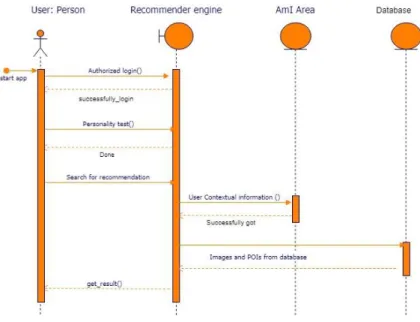
Ambient Intelligent Sequence DiagramIn figure 12 we are going to show theproposed sequence diagram of our recommender system. There will be three major parts of the system such as User, Recommender engine or system, AmI area, Database.
The system will ask for authorization of login, Authorized_login ( ). If the login is authorized the user is allowed for access the system. This is very basic for every security system. The next task will be given to user for measuring user personality. The function call Personality_test ( ), this part will be calculated user personality based on question answering and image rating. Once it’s done, user will get the confirmation for using the system. The system will collect the contextual information of user from AmI area, the function is User_Contexual_information ( ). The AmI area is such knowledge for the system where the recommender engine can find the important information of user mode, location, time, weather, interest, user’s frequent travel locations, social media information and most attractive places of the particular user. In Order to make a better decision for a user, the recommender engine will calculate user best choice of places. The engine will ask to Database for available points of interest according to user choice and it will also aware about the starting time and closing time of those PoIs. The recommender engine is now able to return get_result ( ) user best choice according to his personality, context, mood, and preference as well.
35
3.4
ISyR Ambient Intelligent ArchitectureThe Intelligent Systems Research for Ambient Intelligence (ISyRAmI) [36] architecture introduces the internal layers of the system. The principal feature of ISyRAmI architecture is to develop ambient intelligence systems taking into account artificial intelligence methods and techniques. This layer was organized for intelligent behaviour. The ISyRAmI architecture considers the information from wide range sensors by media sources. The AmI area using a smart sensing device such that cameras, raw sensors, RFID, microphones, GPS. The new source includes social media, web, general persons, books, TV, radio etc. It can operate directly with Ambient intelligence area using intelligent agents, devices and robots. The direct interaction between human and AmI can helps to decision support system. Other actuators have ability to interact with AmI environment directly.
Figure 13. Proposed Architecture of the ISyRAmI work [36].
Data/knowledge/ information acquisition: This layer has the ability to collect data/information from ambient intelligent area with intelligent interaction directly. The surrounding contextual behaviour will acquire the knowledge, but this layer is not able to decide if that collected information is affected by uncertainty. Notice that, the uncertainty can also happen in human life which we cannot ignore [11].
36 Knowledge Storage: This is the second layer of the module which can store and fusion the information/knowledge. The knowledge was collected from the contextual service layer. From the acquired knowledge, it is responsible to marge some significant aspects of the context. For instance: thermometer indicates 20º C and no rain; the weather furcating temperature is high and rain possibilities is there; and friend is informing that temperature is moderate and it is raining [11].
Intelligent Reasoning: This layer is one of the most significant layers to performing any process for planning, machine learning, optimizing, image and Language semantics Understanding, knowledge-based interface, Multi-agent-based modelling and simulation, etc. gaining information from previous layer will be essential for decision support.
Decision Support Layer: The top layer has ability to interact with the user directly or indirect responsibility with AmI area. The decision support layer will follow the command assigned by user or assigned by the agent. Therefore, this layer is one of the most important layers for making an intelligent decision for the system. Input tasks can be assigned by user directly on the other hand, some cases can be assigned by AmI area. Direct Interaction of the user can accept the changes in case of any situation, having “what-if” performance due to respond to the proposed changes, and consider user desire observation. This layer is responsible to interact with other actuators of Ambient intelligence area. Another characteristic of this module is updating the other origin of knowledge/data/information.
37
Chapter 4
.
C
ONTEXT
A
WARENESS
4.1
What is Context AwarenessThe main term of context-awareness originated from ubiquitous computing which sought to deal with changing in the environment with computer systems [37]. When a system gives the relevant information of users according to their surrounding situation, it can be considered as context-awareness. Usages style of mobile devices always depends on different kinds of factors such as time, location, weather, personalities, proximity, user status, and other actions. A system is context aware when it gives to user’s relevant information based on user’s current situation. It can be considered as a personalized of a specific user. Due to suggest some relevant information to the visitors, it is a very significant step to aware of their context. So, it will be essential to recommend a user based on their personalization.
Personalization recommendation systems have been widely concerned as a business and academic domain in order to consider persona’s preference and attraction from the relevant entities. Context can be characterizing the situation of the entity. An entity can be user, place, and object where it can be considering the interaction between user and system. Most of the time tourists share their travel photos and application activity and other information on social media. Therefore, some system has been developed based on geo-tagging and geographic context over social media [20-38].
For this reason, context awareness recommender systems with context-awareness are achieving more and more attention in research area [3,20,39]. Context-aware recommender systems are referred to the additional information of user. The examples are i) Time, ii) Location, iii) Social information.
1. Time: Time has many aspects in terms of recommendations, such as weekdays, weekends, holidays, etc. A recommendation can be affectedby someone in the morning and some others can prefer evening. Places recommendation can be different for summer and winter. So, there are lots of variations.
2. Location: With rapid growth of GPS developed smart devices; location-based is increasing its popularity from past years. A traveller might have wished to determine a
38 recommendation for a museum in her locality. So, context awareness can suggest museum in his area by using a location near to him.
3. Weather: Weather is one of the major parts of context system. The weather conditions can help for visiting outside depending on the weather conditions.
4. Social Information: Social media information is often important for several perspectives of recommendation systems. In order to recommend a user based on the similarity of his close person, friend, most tagged circles, so this can be affecting the recommendation process.
4.2
Importance of Context AwarenessWith the rapid development of social network and internet user, the location-based recommendation system is gradually rising [19]. To restore users’ most favoured attractions from the tourism domain, location-based has been widely concerned in academia and industry as well. Many tourists like to share their surrounding context as like travel experiences and travel photos on social media or share surrounding/personal information about their visiting location. This can help to find the user preferences location to suggesting the PoI. But most of the social media sites are checked in by very a smaller number of users, nevertheless sometimes new developed locations get never checked in by users. So, location-based recommendation algorithm can face some trouble such as cold-start and data sparsity which can give low accuracy and cannot reach the user’s personal needs [20]. To avoid this case, we can only take into account user personality for a new user.
The conventional recommender systems with set U for user and set P for PoI, the possibilities set in U P is mapped to be a rating. The mapping results in rating matrix size are set in U P . The result can represent the ratings. The corresponding functions fR can be defined as follows:
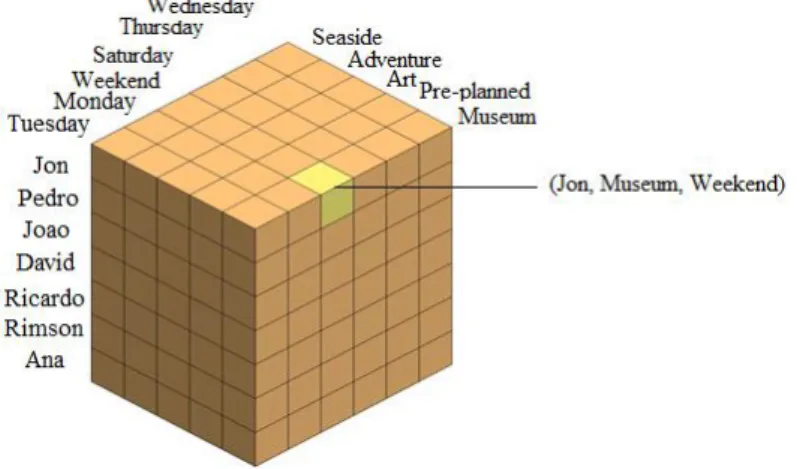
39 Another set of contextual possibilities available in context-aware systemC. As a case; In the context set C can have variety of information like morning, evening, night which can corresponding to the time of day. In this case, it is not possible to outline the ratings U P , because different preferences for an item can be different for same user but totally depending on time, it can be morning, or evening or night. The content must have the mapping due to provide a more refined and accurate recommendations. Therefore, the possibilities of ratings are U P C are mapped. Suppose we have the functionhR which mapped the user, PoI, and context
h : U×P×CR → Rating (2) Here functionhRis subscripted by R denote the data set where it is applied. Therefore, rating data is 3-dimensional ratings data cube corresponding to theU×P×C. It can occur in single context with multiple types of recommendation applications. For evidence, weather, one side of time, the social context or one might use location. In this case, it can have multiple contextual dimensions. The two-dimensional ratings used by this function to create mapping. The dimension is not just user or PoI but any type of context. This general regulation derives the multidimensional method to recommend where w is a set different dimensional value to a rating.
gR : D1D2 ... Dw → Rating (3) Here rating data R is containingwdifferent dimensions which are mapped for ratings. The different dimension is denoted asD1... Dw. Two dimensions always should be users and PoI,
as like multidimensional recommendations classical case. However, other values of Dimight be corresponding to another context. For instance, those can be time, location and so on. The rating functiongRcan be present as a in complete function, where numbers of argument and dimensions
wis equal.
Suppose the rating functiongR ( Jon, museum, weekend) denotes the ratings of a user Jon when he went to a museum at weekend. The functiongRis referring as a partial to defined for the subset
cells to observe the rating values. Rest of the values necessary to learned in data-driven approach for contextual suggestions. A context might be the user property or PoI individually, or a property of both combinations, or independent property. For example, Jon goes to travel normally on weekends, but time doesn’t directly relate to user or PoIs. However, occasionally the context
40 relates to the user or PoIs. As an example: a tourist recommender application allows to recommend depending on rating matrix and the demographic information.
Figure 14. Multidimensional model of context awareness system.
In this situation, context is specifically associated to the user. Although it is not significant that, the context is associated with whom, because it is controlled an entire independent entity from user and PoI. So, a specific dimension is allowed separately to each context. There some individual dimensions assigned to user and PoI respectively. This kind of addressing can help the overall cases of context-awareness recommendation systems.
4.3
Data AcquisitionThe contextual information can be collected the ways bellow:
● Explicitly: By accurately approaching relevant people or other origins of contextual environment and explicitly gaining this information. It might be by asking direct questions or eliciting this information aside from other sources [38]. for instances, a website may gather contextual information by asking a person to fill up a form or answer some specific questions before accessing the system. However, user can update his mood in the system. The mood changing option can have radio button with some emoji.
● Implicitly: From the data of the surrounding environment, for example changing the location of the user detected by using mobile phones. The three main sensing techniques can be used GPS, GSM, and Wi-Fi. These can be use proximity and triangulation to detect location [38]. Location information is important because user could ask for directions and
41 information for each PoI around their current location. On the other hand, temporal contextual knowledge can be implicitly gained from the timestamp of transaction. Interacting with user or another source of contextual knowledge nothing needs to be done, because the source of implicit contextual knowledge is accessed directly, and data can be extracted from it. We can gather weather data [39] from the world weather online API, which can provide the weather conditions for the user’s location.
4.4
Context-aware Recommendation AlgorithmIn this section, we present some recent existing personalized tourist attraction recommendation algorithm which focused the shortcomings of algorithms. The existing algorithms discussed about three (User based, trusted friends, location base) different mechanism of collaborative filtering algorithm considering context. The examples are given below:
4.4.1Collaborative filtering according to user-based
Usually in location-based collaboration, locations and users are linked by location check-in. User’s Check-in can work as a mirror of a user preferences for a variety of locations [41]. User-based collaborative filtering for location recommendation mainly includes three steps:
● Calculating the similarity between users
● Interest degree calculation of user to user locations ● Find out the Top-N and calculation.
The similarity of the useruiand user ukcalculated by similarity
, , i,k 2 2 , , . W j j j i j k j I L i j k j I L I L C C C C =
(4) whereLpresents a common check-in set of uianduk,Ci,j andCk,j is the check-in at location lj ofuseruiandukrespectively.
User based collaborative filtering algorithm primarily recommends the similarity between users, but do not consider the trusted friend and specific location. So the accuracy is less here.
42 4.4.2 Collaborative filtering algorithm based on relationship
PTLR method calculates user attractions pictures, calculates similar neighbour depending on trust friend, suitable attraction time and users surrounding attractions [42]. In the equation bellow, SUis
user set ofu,SVis friend set ofv,CUis concerned friend set ofu. Now, ifuandvare friends and there
is another user who concerns aboutuandvtogether, it can be agreed thatuandvis likely to know
each other.
(
)
(
)
CU SU SV + τSU CU CV IF SU×CU1 if u and v both are friends, τ =
0 if u followed v but not followed u.
= (5)
In fact by the social network if they can find more specific similarity between two users (i. e: age, economic conditions, disposable time) then there can be stronger recommendations. Actually PTIL takes full advantage of friend similarity recommendations but it ignores the location fact.
4.4.3 Location Similarity Collaborative Filtering Algorithm
Author [42] considers the location similarity between the user. They demand that, if the distance is closer, location similarity between users are higher: if distance is farther then locations similarity is lower. They divided the locations area for users, for the target user for any one position with neighbour location of the user. Set ias user, j is the user who is the neighbour user of location i. Location similarity betweensimD i, j
( )
of user( )
i, j can be present by:
( )
0 d (i, j) > 2000, 0.2 10000 d (i, j) 20000, 0.4 5000 d (i, j) 10000, simD i, j 0.6 3000 d (i, j) 5000, 0.8 1000 d (i, j) 30000, 1 d (i, j) 1000, = (6)43
Chapter 5
.
P
OINTS OF
I
NTEREST
M
ODELING
5.1
Modelling Points of Interest and Visitors ProfileSelecting relevant points of interest is the most important phase for a recommender system. There are many (e.g.: City Trip Planner, Planner4, EnoSigTour , CRUZAR , Smart City , e-Tourism , Otium and iTravel) recommender systems available in the market, but only a few of them consider user’s preferences [3]. But research shows that the trend of appreciating based recommender systems are increasing more than rating based system [26]. The personality-based recommender system can be useful to recommend different sector such as movie recommendations, book recommendations, restaurant recommendations, touristic place recommend, music recommended and so on. Tourism recommender system is one of the most growing sectors all over the world and research domain world as well [3]. To identify the accurate points of interest, tourist needs to spend lots of time researching travel guides. But nowadays people prefer getting their jobs simplified or easy access with more information including multiple features which will make life easier.
The efficient way to avoid manual selection and reduce search complexity is by using recommender system [44]. Indeed, personality-based recommender systems can assist them to find the visiting places according to their choice and psychological traits. Hence, it can automatically suggest the points of interest (PoI) in the system based on their preference. One of the main advantages can be considered in personality-based recommender system is that, the possibility of personalization search for each user. Personalization also includes context in user specifics, preferences, ratting on images and provides relevant results.
There are several recommended approaches available for personalized PoI selection. Such as Content-based filtering, Collaborative filtering, data mining methods, knowledge base approach and user profile construction.
We already discussed some of personality based recommend system approaches in chapter 4. In our case, we will take into account user psychological traits. To make a personality-based recommender system, the system needs to integrate the tourist profile and tourist categories. For analysing user personality, each user must need to answer ten questions. That question’s
44 answer will assist to differ each user categories. The user must have to answer during registration, besides user must need to rate some images that are corresponding to a certain category, so that user preference profile can assume. To define touristic category, we will follow worldwide [26] used Big five Inventory. It requires a short time to answer and prevents the participants from becoming bored. Thus, we have chosen big 5 traits for the personality modelling of a tourist.
5.2
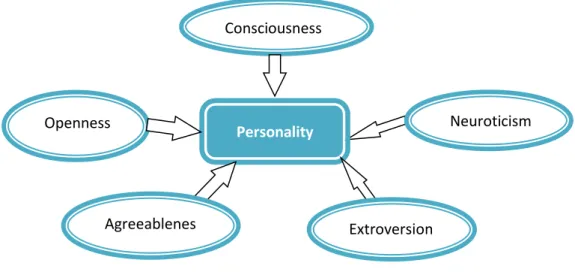
Big 5 Traits ModelThe big five models are one of the most recognized and accepting psychological research worldwide [26]. This is the general contract in the number of aspects into consideration, but the actual ambit can be different from one model to another. Most of the experimental research was done by the application of the model of McCrae and Costa counting the dimensions of Openness, Conscientiousness, Extraversion, Agreeableness and Neuroticism (OCEAN).
Figure 15: Big 5 traits model.
The fact is there is no connection between each point of interest and psychological profile. Therefore, it is compulsory to determine integrate between them with a human psychological model. The big 5 models consist of Openness, Consciousness, Extraversion, Agreeableness, Neuroticism (abbreviated as OCEAN). It suggests human psychology into five traits. The descriptions of each category are below:
Openness: This trait refers to the tendency of the person to be intellectually curious, non-conventional thinking, sensitive to new ideas. It also considers the availability of emblematic
Consciousness
Openness Personality
Agreeablenes
s Extroversion
![Figure 2. Portuguese Touristic Revenue Over the Past Ten Years [10].](https://thumb-eu.123doks.com/thumbv2/123dok_br/15194426.1017270/17.892.189.698.711.937/figure-portuguese-touristic-revenue-past-years.webp)
![Figure 3. Tour Recommendation Framework [16].](https://thumb-eu.123doks.com/thumbv2/123dok_br/15194426.1017270/22.892.289.603.150.492/figure-tour-recommendation-framework.webp)
![Figure 7. Smart Spot, Smart PoI and PoI relationship scheme [27].](https://thumb-eu.123doks.com/thumbv2/123dok_br/15194426.1017270/28.892.226.664.585.806/figure-smart-spot-smart-poi-poi-relationship-scheme.webp)
![Figure 17. Graph colouring [51].](https://thumb-eu.123doks.com/thumbv2/123dok_br/15194426.1017270/56.892.274.615.177.435/figure-graph-colouring.webp)