Pre-purchase Information Acquisition and Credible
Advertising*
Pedro M. Gardete
(Nova School of Business and Economics) Liang Guo
(Chinese University of Hong Kong)
* The authorship is alphabetical. Address for correspondence: Nova SBE, R. Holanda n.1, 2775-405 Carcavelos, Portugal; CUHK Business School, Chinese University of Hong Kong, Shatin, Hong Kong, China. Email: [email protected] and [email protected]. This work was funded by Fundação para a Ciência e a Tecnologia [Grants UID/ECO/00124/2019, UIDB/00124/2020], POR Lisboa and PORNorte, and Social SciencesDataLab
Pre-purchase Information Acquisition and Credible Advertising
ABSTRACT
Consumers can decide whether to acquire more information about their valuations prior to pur-chase. In this paper we examine pricing and advertising strategies when consumers can engage in pre-purchase information acquisition. We show that consumer information acquisition can increase valuation heterogeneity and undermine a firm’s ability to extract consumer surplus. As a result, in-terestingly, a higher product quality can exert a non-monotonic impact on equilibrium information acquisition, hurt firm profitability, and lead to lower consumer surplus. We also demonstrate that pre-purchase information acquisition can be an endogenous mechanism to enable credible advertis-ing in a cheap-talk settadvertis-ing. We show that quality claims in advertisements can be informative even when the firm can freely misrepresent its advertising message. Informative advertising can arise because a higher perceived quality can not only increase consumers’ expected value, but also induce more information acquisition and thus hurt the firm’s ability to extract consumer surplus. This novel explanation for the credibility of cheap-talk advertising is distinguished from those identified in the literature (e.g., matching between firm types and heterogenous consumers, restrictive com-munication on multidimensional attributes). Moreover, we show that a higher quality can soften competition by inducing more information acquisition, thus benefiting the rival firm’s profitability.
1
Introduction
Consumers can invest time and efforts to gather relevant information before deciding whether to make a purchase. Pre-purchase information acquisition can help reduce valuation uncertainty and improve decisions. Many consumers visit physical stores to examine products (e.g., clothes, electronics, furniture, shoes, toys) that they order online subsequently (Kuksov and Liao 2018, Jing 2018). Such showrooming activity happened for 73% of people in a survey by Accenture (2013). Analogously, consumers may engage in webrooming and use the Internet to collect information for products and services (e.g., cruises, flights, hotels, restaurants) before visiting a physical/online store. For example, it is common for people to employ search engines (e.g., Google) to plan trips, learn about individual needs, compare alternatives, and so on. Many users start with generic queries (e.g., hotels), narrow down to branded keywords (e.g., Hilton Las Vegas), and may take multiple days or weeks to click around and then possibly proceed to the conversion stage.1 It is becoming
prevalent that consumers read reviews/ratings in online platforms (e.g., tripadvisor.com) as the first step in their decision-making process. People may also expand the scope/source of information acquisition: they may consult friends or relatives with similar experiences, attend seminars or take courses before deciding whether to subscribe to health-related programs, study legal documents prior to home purchase, or pay for professional opinions on critical investment decisions.
Information acquisition is usually separated in time from actual purchase along the decision funnel. The growth in the number and variety of products/attributes lengthens and complicates consumers’ decision process. Nevertheless, the ubiquity of information-gathering devices (i.e., search engines, review/video platforms, social media, mobile networks) makes it unprecedentedly feasible to initiate information collection substantially before making a purchase. Therefore, it is common that consumers decide whether to search for product information without knowing the actual price they need to pay to secure a purchase. Posted prices may not be guaranteed, terms for price quotes or promotions can be ambiguous, and unexpected payments (e.g., taxes, handling fees, delivery charges) may be imposed. Similar tricks can be adopted by online sellers who shroud actual prices that are revealed only in the checkout page (Gabaix and Laibson 2006). More generally, prices are revised from time to time, especially in markets where dynamic/surge pricing is conventionally implemented (e.g., airlines, hotels, demand-sharing platforms). Online sellers such as Amazon can modify their prices several million times a day, or every several minutes for an average product (Mehta, Detroja and Agashe 2018). Recent years have also seen examples of brick-and-mortar stores removing shelve prices to enable the adoption of dynamic/surge pricing (Kristof 2017).
1Rutz and Bucklin (2011) find that 88% Google searches for a major lodging chain involved generic keywords.
These observations raise important research questions. First, how should a firm price its offering when consumers may engage in pre-purchase information acquisition on product valuation? Re-latedly, how would product quality influence equilibrium behavior (i.e, information acquisition and pricing), firm profit, and consumer surplus? As consumers need to gauge the benefit and cost of information acquisition, their ex post valuations would be endogenously determined. In addition, because information acquisition activities normally occur before the final purchase stage, prices would directly influence consumers’ purchase decisions but not their initial decisions on whether to acquire information. Nevertheless, when consumers make their information acquisition decisions, they need to take into account the price they expect to encounter (as well as their anticipated purchase decision). These considerations distinguish current research from the standard pricing problem where consumer preferences are exogenous.
Second, how should a firm advertise its product quality to directly influence the interaction between consumer information acquisition and firm pricing? In practice most advertisements focus on subjective quality perceptions rather than objective attributes (Abernethy and Butler 1992). It is common to observe commercials that are abundant with celebrity endorsements, inspiring stories, interesting concepts, and exquisite scenes, but contain no direct information on technical attributes. Many firms seek to enhance consumers’ subjective perceptions by making direct quality claims. For example, supermarkets may boast about the freshness of food supply, and hotels may exaggerate their services or security. However, these claims are typically unverifiable. This yields a striking puzzle: if consumers are credulous of advertising messages, firms would easily overstate their quality claims and thus render advertising uninformative, but if consumers simply disregard the content of advertisements, it is not clear why firms would want to spend significant resources into such advertising campaigns. Therefore, the critical question is whether and how plain claims in advertising can informatively and credibly convey a firm’s true quality to the consumers.
We tackle these issues in this research. We consider a simple model in which consumers are ex ante homogenous and uncertain about their product valuations in a monopoly market. The quality of the product is subjective in that it can exert a stochastically positive influence on consumer valuation, and that it cannot be verified or demonstrated. In particular, the quality of the product determines the probability that a consumer has high product valuation. A consumer can choose to incur a cost to acquire relevant product information and become informed of her idiosyncratic valuation, before deciding whether to make a purchase. As more consumers acquire information, their heterogeneity in valuation would increase and hence the firm’s ability to appropriate consumer surplus would be undermined. Conversely, as the price becomes overly low or sufficiently high, the consumers would have less incentive for information acquisition. We show that the interaction of pre-purchase information acquisition and firm pricing may lead to a unique mixed-strategy equilibrium.
Interestingly, when product quality is known to the consumers, it can exhibit a non-monotonic impact on the equilibrium proportion of consumers who choose to search for product information. As product quality increases, firm profitability may be hurt because a higher quality may lead more consumers to acquire information. Furthermore, consumer surplus can be negatively influenced by product quality, because greater quality may induce higher prices.
More importantly, we identify pre-purchase information acquisition as a novel mechanism that may yield credible advertising. When product quality is unverifiable and unknown to the consumers, the firm may misrepresent its quality claims. However, we show that there may exist conditions under which the firm reports its quality truthfully even though it can freely choose not to do so. This is because firm types of different qualities may have differential preferences over consumer information acquisition and perceived quality may influence the consumers’ incentive for information acquisition. In particular, information acquisition is relatively less harmful for a high-quality firm than for a low-quality firm, because the consumers are more likely to have high valuation for high-quality products. As a result, high-high-quality claims can be credible if more consumers are induced to search for product information: the low-quality type may not want to imitate the high type because that would result in more searching consumers. Conversely, the high type may prefer to shun away from the low type because mimicking would reduce the non-searching consumers’ expected value. In other words, pre-purchase information acquisition can endogenously discipline the firm’s quality claims, making advertising credible and hence informative.
We consider two directions to extend our basic model. We demonstrate that the main results are robust to continuous valuations: the mixed-strategy equilibrium continues to arise and product quality still exerts non-monotonic impacts on equilibrium behavior and welfare. We also investigate two alternative models on duopoly competition, depending on whether the consumers are informed of the additional firm’s price when deciding whether to search for information. We show that the basic model’s main insights are not restricted to monopoly markets. Moreover, we demonstrate that a firm may become better off as the rival firm’s quality increases, because competition can be softened as consumer information acquisition endogenously increases ex post differentiation.
It is important to distinguish pre-purchase information acquisition from two related concepts. The term search is typically used to represent the gathering of product information (e.g., quality, price) where purchase is infeasible without search (e.g., Wernerfelt 1994, Villas-Boas 2009, Guo and Meng 2015).2 The unique role of search is to ensure the purchase opportunity, whereas the information-gathering role is only secondary.3 Another related term is deliberation which has been
2There are exceptions where purchase is possible without search (e.g., Kuksov and Villas-Boas 2010, Branco et
al. 2012, Ke et al. 2016).
3Nevertheless, where no confusion arises, the terms “pre-purchase information acquisition,” “information
used to capture cognitive and physical activities of acquiring valuation-related information at the purchase occasion, e.g., information retrieval/processing, introspection, retrospection, anticipation, and inspection (Guo and Zhang 2012, Guo 2016, Guo and Wu 2016). That is, deliberation refers to the contemplation about product valuation in the “last-minute” of the purchase process where all attributes are known (e.g., technical specifications, price). By contrast, when consumers engage in pre-purchase information acquisition, they are not fully informed of the price.
There is a literature on the credibility of costless communication between agents (i.e., cheap talk). Crawford and Sobel (1982) show that cheap talk can be partially credible if the extent of sender bias is exogenously restricted. Subsequent studies identify various mechanisms to endogenize the credibility of cheap-talk communication. Bagwell and Ramey (1993) demonstrate that costless communication can serve as a matching mechanism when the interests of firm types and consumer segments are aligned. In particular, high-quality firms may want to attract high-type consumers who purchase fewer units at high margins, whereas low-quality firms may prefer to attract low-type consumers who buy more at low prices. In addition, consumers differ in their tradeoff between quality and price, and low-type consumers may not like high-quality firms that charge high prices. Gardete (2013) considers misrepresentation of quality claims in vertically differentiated markets and shows that partial informativeness can arise in a semi-separating equilibrium. More generally, costless communication can be credible when there are multiple information receivers who differ in their preferred type of information sender (Farrell and Gibbons 1989). Another mechanism that may attain informativeness in cheap-talk persuasion is multidimensional communication. Chakraborty and Harbaugh (2010, 2014) show that credibility can endogenously arise when the product involves both horizontal and vertical characteristics.
The mechanism of informative advertising we identify in this paper departs from those in the literature.4 We consider ex ante homogenous consumers who can purchase without information acquisition. This removes the possibility of heterogeneous preferences among multiple information receivers, and renders the issue of matching products to consumers irrelevant (Bagwell and Ramey 1993, Gardete 2013). In addition, in our setup the quality types are vertically differentiated and a high-quality product is always “good news” for all consumers. Moreover, we consider only one-dimensional uncertainty such that credibility does not result from restrictive communication as in Chakraborty and Harbaugh (2010, 2014). Therefore, we contribute to the literature by identifying pre-purchase information acquisition as a new mechanism for credible communication.
4Another role of cheap-talk advertising is to facilitate the coordination and the signaling among consumers
(Wernerfelt 1990). Recently, Kuksov et al. (2013) investigate the interaction between firm advertising and consumer communication when consumer preferences for functional and self-expressive attributes are correlated and brand identity is determined by the composition of users. See also Zhu and Dukes (2015) on how competition may influence communication in media stances.
There are other means of strategic communication. A large stream of research work in Economics and Marketing investigate costly signaling devices under which observable actions are taken to credibly convey private information. For example, Kihlstrom and Riordan (1984) and Milgrom and Roberts (1986) consider the role of advertising spending as a signal of product quality. The key difference between costly signaling and cheap-talk models hinges on whether the content/act of communication can directly influence the information sender’s payoffs.
Another type of strategic communication is truthful disclosure where misrepresentation is illegal or verification is feasible.5 Anderson and Renault (2006) examine optimal advertising content in
disclosing horizontal attributes. The analysis is extended in Anderson and Renault (2013) to account for the disclosure of both vertical and horizontal attributes. Mayzlin and Shin (2011) show that a high-quality firm may choose strategically not to reveal its quality even though disclosure is costless. This is because consumer information acquisition and firm disclosure are substitutes (in revealing the firm’s quality) such that the former can cause strategic withholding if disclosure is restrictive due to limited bandwidth in advertising. However, our finding is qualitatively different: the firm credibly conveys its quality in equilibrium even though truthful communication is not presumed. This is because consumer information acquisition and cheap-talk advertising are complements in our model (in the sense that a higher advertised quality can induce more information acquisition about valuation) such that the former can endogenously generate advertising credibility.
2
Basic Model
2.1
Setup
We consider a market with a monopoly firm selling a single product (or service) to a unit mass of consumers. The firm’s fixed and marginal costs are, without loss of generality, normalized to zero. The product has a quality level q ∈ (0, 1). A consumer can have either a high product valuation v1, or a low valuation v0, where v1 > v0 > 0. The product quality can increase the likelihood that
a consumer’s valuation is high. In particular, with probability q the product yields gross utility v1,
and with probability 1 − q the gross utility is v0. The distribution of product valuation is identical
and independent across consumers. That is, the consumers are ex ante homogenous, although their ex post valuation can be heterogeneous if some consumers choose to acquire information about their valuation. This assumption is intentionally made to rule out ex ante consumer heterogeneity as a potential driver for informative advertising. Each consumer demands at most one unit of the
prod-5See also Guo (2009) on quality disclosure formats in distribution channels, and Guo and Zhao (2009) on how
-s s
Consumer Search & Firm Pricing
Stage 1
Consumer Purchase Decision
Stage 2
Figure 1: Timing of the Basic Model with Known Product Quality
uct, and the utility of not buying is normalized to zero. Similar setup of product quality/valuation can be seen in the literature (e.g., Schmalensee 1982, Moorthy and Srinivasan 1995).
In the basic model we assume that the consumers know the product quality. Nevertheless, although the valuation distribution with a given quality is common knowledge, the product valuation is not a priori known. In order to learn the product valuation prior to purchase, the consumers can engage in various information acquisition activities. For example, consumers can inspect/experience the product in physical stores before deciding whether to buy it online (i.e., showrooming), or browse online reviews/ratings before visiting a retail store (i.e., webrooming). Consumers can also seek advice from friends or relatives with relevant experiences, and/or consult professional opinions. A consumer can decide whether to invest in these costly information gathering activities. Only if a consumer decides to invest does she incur a cost c > 0 and learn her valuation for the product.6 If a consumer decides not to search for information, she maintains her prior belief.
The cost of acquiring information can represent, for instance, the disutility of spending time or cognitive/physical efforts. A fundamental feature of the model is that the consumers can still buy regardless of their information acquisition decision. Hence, the search decision affects only the consumers’ information about valuation but not their ability to buy the product.7
The timing of the game is presented in Figure 1. First, the consumers independently make their decision on information search, and the firm sets the price p. In the second stage of the game, after observing p, each consumer decides whether to purchase the product, conditional on her first-stage decision and outcome of information acquisition.
Note that the consumers’ search and the firm’s pricing decisions are made simultaneously. This assumption does not mean that these two decisions are made at the same time in practice. It simply represents scenarios under which the consumers are not informed of the price the firm is setting when they decide whether to search for information, and vice versa. On the one hand, many information-acquisition activities (e.g., showrooming, webrooming, keyword search) precedes the actual purchase
6This assumption can be readily relaxed to accommodate scenarios when information acquisition does not resolve
all valuation uncertainty. This can be done by re-defining v1 and v0 as the expected product valuations integrating
over all residual uncertainty that cannot be resolved by pre-purchase information acquisition.
7See also Lynch and Ariely (2000) on pre-purchase information acquisition for quality-related attributes that may
occasion, whereas the actual price a consumer will encounter cannot be perfectly foreseen. Tricks for shrouded pricing can be exercised by physical or online stores (Gabaix and Laibson 2006). Service providers (e.g., airlines, hotels, demand-sharing systems) may adopt dynamic/surge pricing, and online sellers such as Amazon can adjust their prices every several minutes for an individual product (Mehta, Detroja and Agashe 2018). Retail stores can even remove shelve prices to implement dynamic/surge pricing as in online stores (Kristof 2017). On the other hand, this timing reflects the practice that consumer information acquisition is a latent decision. It means that consumer information acquisition is unobservable to the firm and thus exerts no direct impact on the firm’s price setting decision. As a result, it is as if the consumers’ information-acquisition and the firm’s price-setting decisions are de facto made simultaneously.
It is also important to emphasize that we are not assuming that search can reveal information only on valuation but not on price: what is needed for our results is that the consumers do not know the actual price before deciding whether to search. Moreover, the simultaneous-move setup allows us to rule out the informational role of pricing.8 This is a common assumption in the
informative advertising literature that can help isolate the informational effect of advertisements and avoid imposing beliefs when pricing and advertising messages are inconsistent (e.g., Bagwell and Ramey 1993, Gardete 2013). This assumption is especially useful in Section 3 when we focus on the informativeness of advertising in influencing consumer information acquisition.
A summary of the main notations is presented in Table 1.
2.2
Optimal Consumer Decisions
We start with the consumers’ optimal purchase decision in the last stage of the game. If a consumer has decided not to acquire product information, she maintains the prior belief and will buy the product if and only if E [v|q] − p ≥ 0, where E [v|q] ≡ q v1 + (1 − q)v0 captures the expected
gross utility from purchasing the product. If the consumer has acquired product information, the purchase decision depends on the realized product valuation. In particular, the consumer will buy the product if and only if v1 − p ≥ 0 for the high-valuation product, and v0 − p ≥ 0 for the
low-valuation product, respectively.
Consider now the consumers’ decision on information acquisition in the first stage of the game. Letp be the consumers’ expectation on the price charged by the firm. Note that it is never optimalb
for the firm to set a price below the consumers’ lowest possible valuation. That is, the anticipated price must satisfy p ≥ vb 0. This implies that a consumer’s anticipated surplus is always zero in case
8Guo and Wu (2016) investigate the signaling role of pricing in the alternative timing in which the price is observed
Table 1: Model Notation
Notation Explanation Basic Model
v Product Valuation (v ∈ {v1, v0})
q Product Quality (q ∈ (0, 1)): Probability of v = v1
c Information Acquisition Cost
p Price
E [v|q] Expected Product Valuation (E [v|q] ≡ q v1+ (1 − q)v0)
b
p Consumers’ Expected Price
q0 or q1 Quality Boundary with No Consumer Search (for any Anticipated Price)
α Proportion of Searching Consumers π (p; α) Profit Function (Conditional on p and α)
q Quality Cutoff Point that Characterizes Optimal Pricing Behavior α0 or α1 Indifference Point on α (between Price Levels)
β0 or β1 Probability of Setting p = v0 or p = v1
β Probability of Charging Extreme Prices (β = β0+ β1)
E(CS) Expected Equilibrium Consumer Surplus
Advertising
Q Set of Quality Types (Q ≡ {qL, qH})
λ Probability of High Quality Type (qH)
m Advertising Message
b
q(m) Consumer Belief on Quality (Conditional on Message m) π (p; q,q)b Profit Function for Type q (Conditional on p andq)b
Extensions
θ Relative Weight between Attributes p(α) Optimal Price (Conditional on α) GBS1 or GBS0 Gross Benefit of Search
pi Price for Firm i ∈ {a, b}
x Product Valuation for Firm a
y Consumer Surplus from Buying Product a (y = x − pa)
˜
v1 or ˜v0 Relative Valuation for Firm b (˜v1 = v1− y, ˜v0 = v0− y)
E [˜v|q] Expected Relative Valuation for Firm b (E [˜v|q] ≡ q ˜v1+ (1 − q)˜v0)
yl or yh Equilibrium Offer by Firm a
the product turns out to be of low value: she will either buy the product at a price that completely extracts her surplus, or she will choose the outside option with zero utility. As a result, a consumer decides to search for product information if and only if
where the left-hand side represents the expected utility of search, and the right-hand side captures the best of the two possible scenarios that the consumer may face if she does not search. In the absence of product information, the consumer receives the maximum utility between buying the product and resorting to the outside option. In particular, ifp ≤ E [v|q] the consumer believes thatb
she will buy the product should she decide not to search, and if p > E [v|q] she anticipates that sheb
will not make an uninformed purchase.
We consider these two scenarios in turn. Consider first the scenario when the anticipated price is p ≤ E [v|q].b A consumer would decide to acquire product information if and only if
q (v1−p) − c ≥ E [v|q] −b p. This condition can be simplified asb p ≥ vb 0+
c
1−q. Alternatively, consider
the case when the consumer believes that the product is too expensive to warrant a purchase if no product information is available, i.e., p ≥ E [v|q]. In this case the consumer would acquire productb
information if and only if q (v1−p) − c ≥ 0, which can be rearranged asb p ≤ vb 1 −
c q.
Therefore, the consumers’ optimal information acquisition decision depends on the anticipated price. When the anticipated price is low enough, the consumers are willing to buy without searching for product information. As the anticipated price increases, the consumers prefer to acquire more information to guide their purchase decision. However, when the anticipated price is overly high, the information value of search would be suppressed and not be enough to justify the search cost. The consumers would then decide not to search and not to purchase.
Lemma 1 The consumers decide to acquire product information only when the product quality is intermediate, i.e., q ∈ [q0, q1], where the boundary points q0 and q1 are given in the Appendix. When
q < q0 or q > q1, the consumers do not acquire product information for any anticipated price p.b
When the product quality is very low, acquiring information is not valuable because the product is unlikely to be of high valuation to ensure a purchase. On the other hand, when the product quality becomes sufficiently high, the consumers would act without information acquisition either. In this case the consumers do not need to be informed of the specific product valuation to justify the purchase. It is only when the product quality is intermediate that information acquisition may be preferable, depending on the anticipated price. Intuitively, knowing the product valuation can improve the consumers’ expected payoff only if the valuation uncertainty is large enough and the acquired information can guide the purchase decision.
As can be seen from the Appendix, one necessary condition for information acquisition to be desirable is that the information search cost must be small enough vis-a-vis the valuation range, i.e., c < (v1− v0) /4. When this condition is not met, information search is never optimal for any
2.3
Equilibrium Outcome
We now derive the equilibrium outcome when the product quality is known. Recall that the con-sumers decide on information acquisition before knowing the price, and similarly the firm sets the price without knowing the consumers’ information search decision. Therefore, we will analyze the parties’ best responses to each other’s behavior, and then determine the equilibrium outcome by jointly solving the parties’ optimization problems.
Consider first the case when the product quality is either very low or very high. According to Lemma 1, if q ∈ (0, q0) ∪ (q1, 1), the consumers would never acquire information for any anticipated
price. Given this, the firm would charge p = E [v|q] that completely extracts consumer surplus. No profitable deviation for either party can arise and a pure-strategy equilibrium exists. That is, when uncertainty about product valuation is sufficiently small, the unique equilibrium involves no information acquisition.
Consider then the intermediate quality range, q ∈ [q0, q1]. In this case no pure-strategy
equilib-rium can exist. To see this, suppose all consumers decide to acquire information. This means that the ex post product valuation of some consumers of size q is v1, and that of the other consumers of
size 1 − q is v0, respectively. Given this, the firm would optimally charge either p = v1 or p = v0.
However, according to Section 2.2, at either of these anticipated prices, the consumers are better off deviating and saving the cost of information acquisition. That is, if p = vb 1 the consumers will
give up search and forgo the purchase opportunity, and if p = vb 0, the consumers will buy without
acquiring information. Conversely, suppose all consumers decide not to acquire information. The optimal response for the firm would be to set p = E [v|q]. But at this anticipated price the con-sumers are better off acquiring product information to decide whether to purchase. As a result, no pure-strategy equilibrium can exist from which the parties find no profitable deviation.
It follows that, for the intermediate quality range, there exists only mixed-strategy equilibrium under which some consumers acquire information and the others do not. Denote α ∈ [0, 1] as the proportion of consumers who decide to acquire information. This gives rise to three segments of consumers at the purchase stage, with (expected) product valuation v1, v0, and E [v|q], and segment
size αq, α(1 − q), and 1 − α, respectively. As a result, the optimal price would take one of these three possible values. This yields the firm’s profit function:
π (p; α) = v0, if p = v0 (αq + 1 − α) E [v|q] , if p = E [v|q] αqv1, if p = v1. (2)
The lowest price p = v0 can be set such that all consumers are sure to purchase the product
irrespective of their decision, or the outcome, of information acquisition. Alternatively, the firm can raise the price to p = E [v|q] and target those consumers who decide not to search for product information and those with high valuation. Finally, the firm can charge a high price p = v1 and sell
only to the consumers who find that the product is of high valuation after information search.
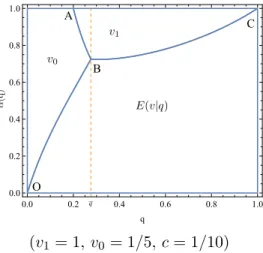
Lemma 2 When q ≤ q, the optimal price is given by:
p = E [v|q] , if α ≤ α0 v0, if α0 ≤ α ≤ qvv0 1 v1, if α ≥ qvv01;
when q ≥ q, the optimal price is given by:
p = E [v|q] , if α ≤ α1 v1, if α ≥ α1, where q ≡ √ 2v0 v1(5v1−4v0)−(v1−2v0) , α0 ≡ E[v|q]−v0 (1−q)E[v|q], and α1 ≡ E[v|q] qv1+(1−q)E[v|q].
This lemma characterizes the firm’s optimal pricing decision in response to the consumers’ information acquisition behavior. Figure 2 illustrates how the firm’s optimal price is influenced by the level of quality and the information search intensity in the (q, α) space. When the quality is sufficiently low, it is very likely that the consumers search to find a low-valuation product. In this case the firm’s main tradeoff is between charging p = v0 and selling to all consumers, and setting
p = E [v|q] and targeting consumers except those in the low-valuation segment. When the product is of sufficiently high quality, the firm compares setting p = v1 and selling only to the consumers who
find the product to be of high valuation, with setting p = E [v|q] and targeting also the consumers who decide not to search. In either case, it is optimal to charge a price equal to the expected value E [v|q] only if not many consumers choose to acquire information (i.e., α ≤ min{α0, α1}).
The indifference curve between charging p = v0 and p = E [v|q], and that between p = v1 and
p = E [v|q], are depicted by the segments OB and BC in Figure 2, respectively.
Next, we analyze the consumers’ optimal information acquisition decision in response to the firm’s anticipated pricing behavior. Let β0 ∈ [0, 1] and β1 ∈ [0, 1] be the probabilities that the firm
charges p = vb 0 and p = vb 1, respectively. The consumers decide to acquire information if and only
if the expected payoff of search exceeds that of no search:
0.0 0.2 0.4 0.6 0.8 1.0 0.0 0.2 0.4 0.6 0.8 1.0 q C B A O q (v1 = 1, v0 = 1/5, c = 1/10)
Figure 2: Optimal Firm Pricing
It is evident from (3) that searching for product information can improve the expected payoff (gross of the search cost), only when the firm charges p = E [v|q] and the consumers search to findb
the product to be of high valuation. When the anticipated price is p = vb 0, information acquisition
is unnecessary, because it is always optimal to purchase the product irrespective of the decision or the outcome of search (i.e., the part β0(E [v|q] − v0) appears in both sides of (3)). When the firm
charges p = vb 1, the consumers cannot benefit from information acquisition either, because their
expected surplus would always be zero. Only when the firm charges the intermediate price, can information acquisition improve the purchase decision and hence increase the expected payoff: the searching consumers purchase the product if and only if it is found to be of high valuation, thus avoiding the non-searching consumers’ unwanted incidence of buying a product of low valuation.
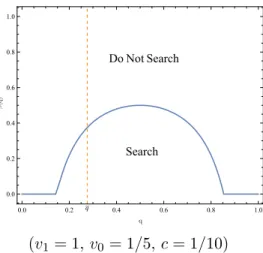
Let β = β0+ β1 be the probability of charging the extreme prices (v0 and v1). It follows from
(3) that search is beneficial if and only if β is not too high. This is illustrated by Figure 3, where the solid curve represents the value of β that makes the two sides of (3) equal to each other. When the product is of overly low or overly high quality, information acquisition is dominated irrespective of firm price. In the middle range, the net benefit of information acquisition is non-monotonic, first increasing and then decreasing as the quality becomes higher. For a given q, the consumers decide to search if and only if the firm’s probability of charging the extreme prices is below a threshold.
It follows from (3) that the net benefit of information acquisition is negative if the firm charges
b
p = E [v|q] with zero probability (i.e., β = 1). This means that there does not exist an equilibrium in which the firm mixes betweenp = vb 0 andp = vb 1 only. Moreover, there does not exist an equilibrium
in which the firm charges each of the three possible prices with strictly positive probability. This is because, as can be seen from Lemma 2, there does not exist an α such that the firm is indifferent
0.0 0.2 0.4 0.6 0.8 1.0 0.0 0.2 0.4 0.6 0.8 1.0 Do Not Search Search q (v1 = 1, v0 = 1/5, c = 1/10)
Figure 3: Optimal Consumer Information Acquisition
between all three price levels. As a result, under the only feasible mix-strategy equilibrium, the consumers are indifferent between searching and not searching, and the firm mixes between p = v0
and p = E [v|q], or between p = v1 and p = E [v|q].
Proposition 1 The equilibrium outcome with known product quality is given by:
(i) When q < q0 or q > q1, the consumers buy the product without acquiring information, and the
firm sets p∗ = E [v|q];
(ii) When q ∈ [q0, q], the consumers acquire information with probability α∗0, and the firm mixes
between p∗ = v0 and p∗ = E [v|q] with probability β∗ and 1 − β∗, respectively;
(iii) When q ∈ [q, q1], the consumers acquire information with probability α∗1, and the firm mixes
between p∗ = v1 and p∗ = E [v|q] with probability β∗ and 1 − β∗, respectively,
where β∗ ≡ 1 − c q(1−q)(v1−v0).
This proposition completely characterizes the equilibrium outcome when the product quality is known to the consumers. When consumer valuation uncertainty is small enough (i.e., q is sufficiently low or sufficiently high), in equilibrium the consumers acquire no information for sure and the firm can extract all consumer surplus. When the product quality is intermediate, the only equilibrium is mixed: some consumers decide to acquire information while the others do not, and the firm’s prices are such that the consumers are indifferent whether to search or not. Intuitively, when the product quality is not too high (i.e., q ∈ [q0, q]), the firm has no incentive to target only the high-valuation
consumers, and the equilibrium prices are mixed between v0 and E [v|q]. On the other hand, when
consumers any more, and the equilibrium prices are mixed between v1 and E [v|q]. In either case
the non-searching consumers are targeted as the marginal consumers with positive probability.
Mixed strategies in equilibrium pricing are typically interpreted as temporary promotions. Price competition with discrete demand is one standard mechanism to yield mixed pricing in equilibrium (e.g., Varian 1980, Narasimhan 1988). In contrast, here the mixed-strategy equilibrium arises for a monopoly because pre-purchase information acquisition leads to not only endogenous consumer preference but also “concurrent” price setting. Moreover, as will be demonstrated in Section 4.1, we can obtain the mixed-strategy equilibrium even for continuous valuations.
We now conduct comparative statics analyses to evaluate the impacts of product quality q on the equilibrium outcome.
Proposition 2 When q ∈ [q0, q], the equilibrium information acquisition probability α0∗ strictly
increases in q. When q ∈ [q, q1], the equilibrium information acquisition probability α∗1 strictly
increases in q if v1 < 4v0, and first decreases and then increases in q if v1 > 4v0.
This proposition presents the impact of quality on the equilibrium probability of acquiring information. Recall from (3) and Figure 3 that the net benefit of information acquisition first increases and then decreases with quality in the range q ∈ [q0, q1]. One might then be tempted
to expect a similar impact on the equilibrium probability of information acquisition. However, Proposition 2 shows that this intuition is not confirmed. Figure 4 depicts the two different cases characterized in the proposition. In either case the consumers’ equilibrium likelihood of information acquisition always increases with quality in the range q ∈ [q0, q]. A similar pattern would emerge
for the range q ∈ [q, q1] if, as in the left panel, the valuation range is not wide (i.e., v1 < 4v0). In
contrast, if the valuation range is wide enough (i.e., v1 > 4v0), as shown in the right panel, there
would be a non-monotonic relationship between equilibrium search probability and quality.
This is because the consumers’ search behavior here is influenced not only by the net benefit of information—in equilibrium they are indifferent between searching and not searching—but also by the need to balance the firm’s pricing behavior. The proportion of searching consumers has to be such that the firm is indifferent mixing between the equilibrium prices. When q ∈ [q0, q], the firm
mixes between p = v0 and p = E [v|q]. As can be seen from (2), the firm’s profit of charging p = v0
is constant, whereas that of charging p = E [v|q] is unequivocally increasing in q and decreasing in α. Therefore, as the product quality increases, more consumers would choose to search to make the firm’s profits unchanged across the equilibrium prices, i.e., α∗0 is unambiguously increasing in q.
In contrast, when q ∈ [q, q1], the proportion of searching consumers needs to ensure the same
0.0 0.2 0.4 0.6 0.8 1.0 0.0 0.2 0.4 0.6 0.8 1.0 q α *(q ) q q0 q1 0.0 0.2 0.4 0.6 0.8 1.0 0.0 0.2 0.4 0.6 0.8 1.0 q α *(q ) q q0 q1 v1 < 4v0 (v1 = 3/5, v0 = 1/5, c = 1/20) v1> 4v0 (v1 = 2, v0 = 1/5, c = 1/10)
Figure 4: Equilibrium Behavior of Information Acquisition
result, the equilibrium impact of product quality on the search probability α∗1 depends on whether π (v1; α) or π (E [v|q] ; α) is raised relatively more by a higher q. A higher quality increases both
π (v1; α) and π (E [v|q] ; α) through its positive effect on the number of searching consumers who
find high valuation. In addition, product quality positively affects the non-searching consumers’ expected value E [v|q], thus resulting in an additional impact on π (E [v|q] ; α). Therefore, when q is sufficiently high or when the valuation range is not very large such that E [v|q] is sufficiently close to v1, an increasing q can exert a larger impact on π (E [v|q] ; α) than on π (v1; α). This would then
lead more consumers to search for product information. Conversely, when q is not too high and the valuation range is sufficiently large, the valuation gap between the non-searching consumers and the high-valuation consumers would be large enough such that a higher q increases π (v1; α) more
than π (E [v|q] ; α). This would then yield the negative relationship between α∗1 and q.
The expected equilibrium price strictly increases with quality. When q < q0 or q > q1, the
equilibrium price is equal to E [v|q]. When q ∈ [q0, q], the expected equilibrium price is β∗v0+ (1 −
β∗)E [v|q] = v0+1−qc . Recall from Section 2.2 that this is the highest price to induce (all) consumers
to purchase the product without search. However, here a strictly positive proportion of consumers may not buy if they search to find a low valuation. When q ∈ [q, q1], the expected equilibrium price
is β∗v1+ (1 − β∗)E [v|q] = v1−cq. If the firm charged this price for sure, all consumers would search
and those with a high valuation would buy. In contrast, here both the proportion of non-searching consumers and their likelihood of not buying are strictly positive. Therefore, due to the equilibrium mixed strategy, the firm charges the same expected prices but has lower sales, in comparison to the (pure-strategy) equilibrium outcome in the alternative setup in which the firm sets the price prior to consumer information retrival/gathering (e.g., Guo and Wu 2016). In other words, pre-purchase information acquisition, compared with on-purchase deliberation, can hurt firm profitability.
Proposition 3 The equilibrium profit strictly decreases in q at q = q0.
Interestingly, the firm’s equilibrium profit may decrease with the product quality. This is due to the discontinuous drop of the equilibrium profit at q = q0. When q < q0, the consumers’ incentive
for information acquisition is sufficiently low such that the firm can charge p∗ = E [v|q] to extract all consumer surplus (part (i) of Proposition 1). However, when q ≥ q0, information acquisition would
be valuable enough and the consumers would become ex post heterogeneous in equilibrium. This would undermine the firm’s ability to extract consumer surplus: the firm’s equilibrium profit under part (ii) of Proposition 1 is reduced to v0.9 However, consumer information acquisition per se does
not necessarily yield this result. It can be shown that the equilibrium profit is strictly increasing in quality in the above-mentioned alternative setup of consumer deliberation (e.g., Guo and Wu 2016). When consumer information search follows firm pricing, the firm can always price to prevent search and thus extract all consumer surplus (if that is desirable). In comparison, here information acquisition would take place inevitably under the mixed-strategy equilibrium, because it cannot be directly influenced by firm pricing. Therefore, it is pre-purchase information acquisition that leads to the harmful effect of a higher quality.
Proposition 4 The equilibrium consumer surplus is zero when q < q0 or when q > q. When
q ∈ [q0, q], the equilibrium consumer surplus strictly increases in q if the valuation range v1− v0 is
sufficiently large, and first increases and then decreases in q if v1− v0 is sufficiently small.
The consumers’ equilibrium surplus is positive only if the product quality is in the range [q0, q].
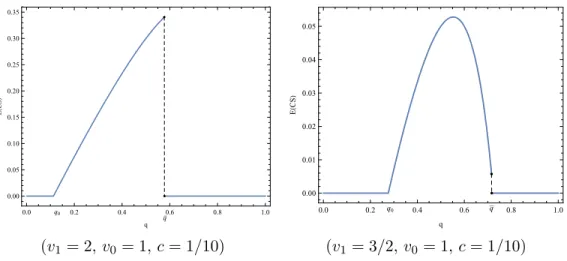
In this case the equilibrium is in mixed-strategy such that the consumers have the same expected surplus no matter they decide to search or not. It then follows from the right-hand side of (3) that the consumers’ equilibrium surplus is equal to their expected valuation, E [v|q], minus the expected equilibrium price, β∗v0 + (1 − β∗)E [v|q] = v0 + 1−qc . A higher quality increases the
expected valuation as well as the expected equilibrium price. As shown in the left panel of Figure 5, the impact on the expected valuation is relatively stronger when the valuation range is sufficiently large. Nevertheless, when the valuation range is not very large, a higher quality can increase the
9We would still get the result in Proposition 3 even when v
0 < 0: part (ii) of Proposition 1 would be empty
and the equilibrium profit at q = q0 would be characterized by part (iii). To see this, note that the firm would
then charge the same price (under the mixed-strategy equilibirum) as that for q < q0 (i.e., p∗ = E [v|q]) but less
consumers would buy because of information acquisition. Note also that, when v0 < 0 (or marginal cost is higher
than v0), if endogenous consumer information acquisition were not allowed, the firm prefers to provide information
to the consumers and thus price to the high-valuation consumers rather than the uninformed average consumers. Therefore, the underlying mechanism here differs from that in the literature (e.g., Xie and Shugan 2001, Shulman, Coughlan and Savaskan 2009) whereby a firm may prefer to sell to uninformed over informed consumers when the possible valuations are not too low relative to the firm’s marginal cost (which is normally set to zero).
0.0 0.2 0.4 0.6 0.8 1.0 0.00 0.05 0.10 0.15 0.20 0.25 0.30 0.35 q E (CS ) q q0 0.0 0.2 0.4 0.6 0.8 1.0 0.00 0.01 0.02 0.03 0.04 0.05 q E (CS ) q q0 (v1= 2, v0= 1, c = 1/10) (v1= 3/2, v0 = 1, c = 1/10)
Figure 5: Equilibrium Consumer Surplus
expected equilibrium price more than the expected valuation. As a result, as demonstrated in the right panel, the consumers can be hurt as the quality increases.
3
Informative Advertising
3.1
Setup
We now investigate how the firm can credibly advertise its quality. To this end, we assume that the firm has private information about its own quality q ∈ Q ≡ {qL, qH}, where 0 ≤ qL < qH ≤ 1.
We will call the high- and the low-quality firm as the type-H and type-L firm, respectively. The prior probability that the firm is type H is λ ∈ (0, 1), which is common knowledge. The firm can communicate its quality to the consumers by engaging in informative advertising. In particular, the firm can send an advertising message m to the consumers. The content of the message is cheap talk in the sense that it can be freely set irrespective of the firm’s quality type, and that neither the cost of advertising nor the cost of the advertising content vary across firm types. This stands in contrast to alternative communication mechanisms such as costly signaling or truthful disclosure.
The timing of the game is depicted in Figure 6. At the beginning of the game the firm is endowed by nature with a product of quality q, which is unknown to the consumers. After observing its product quality, the firm determines the message to send to the consumers about its quality. The rest of the game is the same as that we consider in Section 2 with known quality. Let the consumers’ belief, prior to the search decision (at stage 2), that the firm is of type H be b1(m) ≡ dP r (H|m).
-s s s Firm Advertising Stage 1 Consumer Search & Firm Pricing
Stage 2
Consumer Purchase Decision
Stage 3
Figure 6: Timing of the Game with Costless Quality Advertising
At the time of purchase, those consumers who decide not to search are still uncertain about their product valuations. Define b2(m, p) ≡P r (H|m, p) as the non-searching consumers’ belief, prior tod
the purchase decision (at stage 3), that the firm is of type H.
The solution concept we adopt is the Perfect Bayesian Equilibrium (PBE). This requires that in equilibrium the consumers update their beliefs about firm type according to the Bayes’ rule when-ever applicable. That is, the consumers’ belief updating is consistent with the firm’s equilibrium strategies. The consumers can make inference about the firm’s optimal behavior, and understand that the firm may have an incentive for misrepresentation in the cheap-talk advertising.
We focus on separating equilibrium in which the firm’s advertising message is informative such that it can credibly convey the firm’s type to the consumers.10 That is, the firm’s equilibrium advertising message satisfies m∗(q) = q, for q ∈ Q.11 Moreover, under the PBE we must have b∗1(qH) = 1 and b∗1(qL) = 0, i.e., in equilibrium the consumers have correct beliefs about firm type.
We assume that the (non-searching) consumers’ belief is influenced by advertising only, i.e., b2(m, p) = b1(m), ∀p. This is a restriction on the off-equilibrium belief. Note that PBE requires
that b∗1(m∗) = b∗2(m∗, p∗), where m∗ and p∗ are the equilibrium advertising message and price, re-spectively. That is, in equilibrium the (non-searching) consumers cannot receive an informative advertising message that is later contradicted by the message conveyed by the price. More impor-tantly, this restriction permits us to concentrate on the informational role of advertising. It is a common assumption in games of asymmetric information with potentially multiple signals (e.g., Hart and Tirole 1990, Caminal and Vives 1996). We intentionally make this assumption, because it allows us to show that cheap-talk advertising can be informative even when pricing is not.12
10As in models of cheap talk, there always exists a “babbling” equilibrium in which the advertising message is
uninformative and the consumers maintain their prior belief about firm type.
11The advertising message can be informative even if its content is factually irrelevant or even wrong. In addition,
it does not matter what specific language is used for the advertising message. What is critical for the advertising to be informative is that different messages are sent across quality types, and that the mapping from quality type to advertising message can be understood by the consumers. For example, the firm can send the message ‘the sky is green” when its quality is high, and the message “the sea is yellow” when its quality is low. Nevertheless, to comply with tradition and to ease exposition, the set of quality types, Q, is used for the set of informative messages.
12In the absence of advertising, price alone cannot credibly signal the firm’s type in the current setup because no
3.2
Equilibrium Outcome
Under the equilibrium of informative advertising, the type of the firm is credibly communicated to the consumers. As a result, along the equilibrium path, the subgame starting from stage 2 is equivalent to the game of complete information we investigate in Section 2. This means that in equilibrium the consumers’ decisions are the same as those characterized under known quality, because their beliefs do not vary with the price. Let q(m) be the consumers’ believed quality afterb
receiving the advertising message m. In the informative equilibrium we would have qb
∗(m) = m,
and the consumers’ equilibrium probability of search would be given by α∗(q) as in Proposition 1.b
Given that the consumers believe in the firm’s advertising message, the firm’s expected profit function (at stage 1) when its true quality is q and the consumers’ believed quality is q is:b
π (p; q,q) =b v0, if p = v0 [α∗(q)q + 1 − αb ∗ (q)] E [v|b q] ,b if p = E [v|q]b α∗(q)qvb 1, if p = v1. (4)
The key to sustain the informative advertising equilibrium is to ensure that the firm is indeed willing to report its type truthfully, given that its claimed type is to be believed by the consumers. Truth telling (i.e., m∗(q) = q) is desirable for the firm if and only if the following incentive compat-ibility conditions are satisfied:
IC1 : maxpπ (p; qL,qbL) ≥ maxpπ (p; qL,qbH) , (5)
IC2 : maxpπ (p; qH,qbH) ≥ maxpπ (p; qH,qbL) . (6)
The left-hand sides in the incentive compatibility conditions represent the firm’s maximized profits when its advertising message truthfully communicates its quality to the consumers. The right-hand sides capture the firm’s best possible profits when its true type is qL but it deviates to
claim to be qH, or when its true type is qH but it deviates to claim to be qL, respectively.
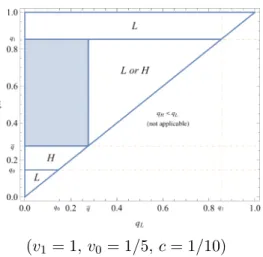
Proposition 5 Informative advertising cannot credibly arise in equilibrium unless the quality levels are qL∈ (0, q) and qH ∈ (q, q1).
This proposition characterizes the parameter regions of the qualities under which the informative advertising equilibrium cannot be sustained. In particular, it shows that the incentive compatibility conditions cannot be satisfied unless the quality of type L is in the interval (0, q) and that of type
(v1 = 1, v0 = 1/5, c = 1/10)
Figure 7: Parameter Regions of Misrepresentation of Advertising Message
H is qH ∈ (q, q1). This is represented by the shaded area in Figure 7. The other areas in the figure
capture the parameter regions under which at least one of the incentive compatibility conditions is violated, where the capital letters L and H denote the firm type(s) that would benefit from misrepresenting its quality type in each region.
Consider first the regions where the high type’s quality is sufficiently low or sufficiently high (i.e., qH < q0 or qH > q1) such that no consumer would acquire information if they were informed of
the high-type’s quality. The high type would be able to completely extract the consumers’ surplus by charging E [v|qH], if it could successfully separate from the low type. However, the low-quality
firm would have an incentive to claim to be the high type. This imitation can result in a higher profit for the low-type firm through increasing the consumers’ willingness to pay from E [v|qL] to
E [v|qH], and/or through reducing the proportion of searching consumers from α∗(qL) to zero.
In the regions where qH ∈ [q0, q], the type-H firm would induce a proportion α∗0(qH) of consumers
to search for product information if it truthfully reveals its type to the consumers. In this case the high-quality firm is indifferent between selling to all consumers and pricing at the non-searching consumers’ expected value. A smaller number of searching consumers would increase the expected revenue of targeting the non-searching consumers, but does not change the profit of serving all consumers. As a result, the high type would prefer to understate its quality, even though that would lower the consumers’ expected value. This is because, if the consumers believe that the firm is of the low type, they would reduce their equilibrium probability of search to α∗0(qL) (when
qL ∈ [q0, q]) or even zero (when qL< q0). Conversely, the low-type firm does not want to overstate
its quality because that would increase the number of searching consumers.
consumers’ probability of information acquisition would be such that the firm is indifferent between selling only to the high-valuation consumers and targeting also the non-searching consumers. A larger number of searching consumers would increase the expected revenue serving only the high-valuation consumers, but would decrease the profit of pricing to cover the non-searching consumers. Therefore, the low-type firm can increase its profit by misleading the consumers to believe that it is the high type. This is because the low-type firm can sell to more high-valuation consumers if imitating the high type increases the number of searching consumers, or serve more non-searching consumers at a higher price if otherwise. Similarly, the high-type firm may want to mimic the low-type firm’s advertising message if that can lead more consumers to acquire information.
Next, we investigate the remaining two parameter regions under which informative advertising may emerge in equilibrium. We will identify conditions under which neither firm type has an incentive to deviate from the informative equilibrium.
Proposition 6 In the region where qL < q0 and qH ∈ (q, q1), informative advertising can credibly
arise in equilibrium, if and only if v1−v0
v0 is low (or v1−v0
v0 is high and qL is high) and qH is high.
This proposition shows that there exist conditions to sustain the informative advertising equi-librium. In this case the consumers do not acquire information if they know the product is the low-quality type, whereas a proportion α∗1(qH) of consumers would search if they believe that the
firm is type H. As a result, by claiming to be the high type, the low-type firm could increase its profit margin from E [v|qL] to E [v|qH], whereas its expected demand would drop from one to
α1∗(qH)qL + 1 − α∗1(qH). The improvement in profit margin, E[v|qE[v|qH]
L] =
1+qH(v1−v0)/v0
1+qL(v1−v0)/v0, is
increas-ing in the ratio of valuations, v1−v0
v0 . Conversely, the loss in expected demand, (1 − qL)α ∗ 1(qH) = (1−qL)[1+qH(v1−v0)/v0] 1+qH(2−qH)(v1−v0)/v0 , is decreasing in v1−v0 v0 . Therefore, when v1−v0
v0 is low, imitating the high-quality
type is not profitable because the gain in profit margin cannot compensate the loss in demand. When v1−v0
v0 becomes high, the low-type firm may want to mimic the high type unless its quality is
not too low. This is because the expected payoff under truth telling would increase faster than the best deviating profit as qL becomes higher.
The high-quality firm would earn an expected payoff of α∗1(qH)qHv1 if it truthfully communicates
its type to the consumers. This payoff is strictly increasing in its product quality qH. In comparison,
the high-type firm’s expected profit would be E [v|qL] if it chose to misreport its quality type. As
a result, truth telling is compatible with the high-type firm’s incentive if qH is high.
The shaded area in Figure 8 represents the parameter values (in the region qL < q0 and qH ∈
(q, q1)) that sustain the incentive compatibility conditions for both firm types. For the set of
v1−v0
v0 low (v1 = 1, v0 = 1/5, c = 1/10)
v1−v0
v0 high (v1= 3/2, v0 = 1/5, c = 1/10)
Figure 8: Incentive Compatibility Conditions for Informative Advertising (qL < q0)
letter L or H captures the firm type that has the incentive for quality misrepresentation. The left panel demonstrates the scenario when v1−v0
v0 is low such that type L does not want to deviate from
truthful communication. As the right panel shows, if v1−v0
v0 is high, the low-type firm may want to
lie about its quality unless its quality is not too low. In either case the high-type firm’s quality needs to be high enough to ensure its incentive compatibility for truthful advertising.
Proposition 7 In the region where qL ∈ (q0, q) and qH ∈ (q, q1), informative advertising can
credibly arise in equilibrium, if and only if qL is low and v1v−v0 0 is high.
This proposition confirms that informative advertising can also be credible in the alternative region in which both quality types in equilibrium induce some consumers to acquire information. In this case, if the low-quality firm truthfully communicates its quality, it would be indifferent between setting p = v0 and p = E [v|qL], and its expected profit would be equal to v0. If it deviated to
overstate its quality, it would be able to earn an expected payoff of [α∗1(qH)qL+ 1 − α∗1(qH)] E [v|qH],
which is increasing in qL. As a result, it is necessary that qL is not too high for the low-quality firm
to truthfully advertise its quality.
The high type’s equilibrium expected profit is α∗1(qH)qHv1 = [α1∗(qH)qH + 1 − α∗1(qH)] E [v|qH].
Imitating the low type would be desirable if that leads more consumers to search (i.e., α∗0(qL) >
α1∗(qH)). If instead fewer consumers would acquire information, the high-quality firm could consider
mimicking the low type while charging p = E [v|qL] to target the non-searching consumers. This
would increase the high type’s expected demand from α∗1(qH)qH+1−α∗1(qH) to α∗0(qL)qH+1−α∗0(qL),
0.16 0.18 0.20 0.22 0.24 0.26 0.30 0.35 0.40 0.45 (v1 = 1, v0 = 1/5, c = 1/10)
Figure 9: Incentive Compatibility Conditions for Informative Advertising (qL ∈ (q0, q))
is decreasing, and that of the loss in margin is increasing, in v1−v0
v0 . As a result, the high-quality
firm would be better off advertising truthfully if v1−v0
v0 is high.
Figure 9 illustrates the set of parameter values (in the region qL ∈ (q0, q) and qH ∈ (q, q1)) under
which the incentive compatibility conditions can be satisfied. It shows that the low type is better off sending a truthful advertising message as long as its quality is lower than the upper bound of the shaded region, and the high-quality firm prefers truthful advertising as long as its quality is above the lower bound of the shaded region.
Proposition 8 Under the informative advertising equilibrium, the consumers’ ex ante surplus may decrease in the probability λ that the firm is the H type.
The equilibrium ex ante consumer payoff is the weighted average of the complete-information surplus across the two quality types. Recall from Proposition 4 that the equilibrium consumer surplus is strictly positive only when q ∈ (q0, q). This means that the consumers may enjoy a higher
equilibrium surplus when the product quality is reduced. As a result, the consumers may become worse off as the probability of facing the high-quality firm increases. This surprising result would arise when the low type’s quality is qL∈ (q0, q) and that of the high type is qH ∈ (q, q1).
4
Extensions
We extend our basic model along two directions: continuous value distribution and competition. We will show that the main results are robust to these extensions.
4.1
Continuous Valuation
Consider the following alternative setup. The product consists of two attributes that are valued as u1(q) and u2(q), respectively, where u1(q) > u2(q) are both increasing in the quality q ∈ (0, 1).
The overall product valuation is v = θu1(q) + (1 − θ)u2(q), where θ is the relative weight between
the attributes. The weight θ is uniformly distributed between zero and one. This means that product valuation is uniformly distributed between u2(q) and u1(q). For simplicity, we will focus
on a specific setting: u1(q) = q and u2(q) = q2. This captures the same features as those of the
two-point setup in the basic model: a higher quality stochastically increases product valuation, whereas the valuation uncertainty (i.e., q − q2) is enlarged as the quality q becomes intermediate, but converges to zero as q approaches zero or one. As in Section 2, the consumers have identical and independent distribution for θ (or v) prior to search, but can learn about the weight/valuation by incurring a cost c > 0. The other assumptions are also retained.
Let us start with characterizing the firm’s optimal behavior. Conditional on the price p and the proportion α ∈ [0, 1] of searching consumers, the profit function becomes
π (p; α) = h αq(1−q)q−p + 1 − αip, if p ≤ E [v|q] αq(1−q)q−p p, if p > E [v|q] , (7)
where E [v|q] ≡ q(1 + q)/2 is the expected valuation for the non-searching consumers. It follows that the optimal price is given by p(α) = maxnminnq−(1−α)q2α 2, q(1 + q)/2o, q2o.
Consider then the consumers’ optimal response to the anticipated price p. Upon searching tob
learn about v, a consumer would buy the product if and only if v ≥ p. The expected payoff ofb
search is then Rq b p v−bp q(1−q)dv − c = (q−bp)2
2q(1−q)− c. This is a better choice than no search if and only if
(q −p)b
2
2q(1 − q) − c ≥ max {E [v|q] −p, 0} .b (8)
Note that the optimal price is never higher than E [v|q]. The above condition for search can then be simplified as p ≥ qb
2+q2q(1 − q)c.
Consider the interaction between the firm and the consumers. If all consumers search, the firm would optimally charge p(1) = max {q/2, q2}. In anticipation of this, the consumers would choose
to search if and only if the cost c is not higher than the gross benefit of search:
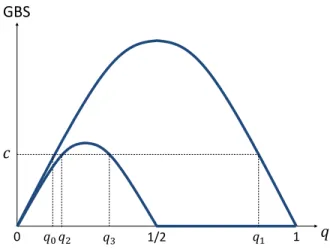
GBS1(q) = q(1−2q)2 8(1−q) , if q ∈ (0, 1/2] 0, if q ∈ [1/2, 1). (9)
GBS 𝑞𝑞 1 𝑞𝑞1 𝑞𝑞3 1/2 𝑞𝑞2 𝑞𝑞0 0 𝑐𝑐
Figure 10: Incentives for Information Acquisition (Continuous Valuation)
Conversely, if no consumer acquires information, the optimal price would be p(0) = q(1 + q)/2. The condition for preferring search would then be that c is less than or equal to GBS0(q) = q(1 − q)/8.
It is evident that both GBS1(q) and GBS0(q) are single peaked (i.e., first increasing and then
decreasing), and that GBS1(q) < GBS0(q), for q ∈ (0, 1). This implies that, if c is not too
high, there are two solutions q0 and q1 for GBS0(q) = c, and q2 and q3 for GBS1(q) = c, where
q0 < q2 < q3 < 1/2 < q1. This is illustrated in Figure 10.
We are ready to derive the equilibrium outcome. If q ∈ (0, q0)∪(q1, 1), we have GBS1(q) < c and
GBS0(q) < c and thus the unique equilibrium involves zero consumer search (α∗ = 0). However, if
q ∈ (q0, q2)∪(q3, q1), no pure-strategy equilibrium can exist because GBS1(q) < c but GBS0(q) > c.
Under the mixed-strategy equilibrium, the price is such that the consumers are indifferent between searching and not searching (i.e., p∗ = q2+q2q(1 − q)c), and the proportion of searching consumers is such that the firm optimally charges the equilibrium price (i.e., p(α∗) = p∗), which implies that α∗ = q−q2
q2+2√2q(1−q)c. Finally, if q ∈ (q2, q3), we have GBS1(q) > c and GBS0(q) > c, resulting in
the unique equilibrium under which all consumers search (α∗ = 1). These results are summarized in the following proposition.
Proposition 9 The equilibrium outcome with known product quality under continuous valuation is given by:
(i) If q ∈ (0, q0) ∪ (q1, 1), the consumers buy the product without acquiring information (α∗ = 0),
and the firm sets p∗ = E [v|q] = q(1 + q)/2;
(ii) If q ∈ (q0, q2) ∪ (q3, q1), the consumers acquire information with probability α∗ = q−q 2 q2+2√2q(1−q)c,
and the firm sets p∗ = q2+q2q(1 − q)c;
This proposition demonstrates that the equilibrium outcome is qualitatively similar to that under discrete valuation (Proposition 1). There are two minor differences, both of which are driven by the continuity of current profit function. The first is that, under the mixed-strategy equilibrium, the consumers continue to randomize between searching and not searching, but the firm charges a specific price with probability one. Second, there may exist a unique equilibrium where all consumers search (for intermediate quality range) here but not in the discrete-valuation setup.
The continuous-valuation setup yields some interesting results on equilibrium welfare as those under discrete valuation. In particular, the firm’s equilibrium profit strictly decreases at q = q0 (as
in Proposition 3). Again this is because of the discontinuous change in the consumers’ equilibrium search behavior, and more importantly, due to the firm’s inability to directly influence consumer information acquisition. When q < q0, no consumer searches in equilibrium and the firm charges
p∗ = E [v|q] to extract all consumer surplus. In contrast, when q is above but sufficiently close to q0,
the price that ensures indifference between searching and not searching (i.e., p∗ = q2+q2q(1 − q)c) is slightly below E [v|q]. But to induce the firm to set this price, the proportion of searching consumers has to be sufficiently above zero: otherwise the optimal price would be at the boundary solution p = E [v|q]. This would then lead to the discontinuous drop in the firm’s equilibrium profit.
In addition, similar to that in Proposition 4, the consumers’ equilibrium surplus is non-monotonic in the quality q. This can be readily seen from the observations that E(CS) is continuous for all q ∈ (0, 1) (because of the continuity of p∗), E(CS) = 0 for q < q0 or q > q1, and E(CS) > 0 for
q ∈ (q0, q1) (because then E [v|q] > p∗ = max{q2 +
q
2q(1 − q)c, q/2}). We can also show that E(CS) first increases and then decreases in q within the range (q0, q1).
Moreover, the firm may credibly advertise the quality q ∈ Q ≡ {qL, qH} to the consumers. For
example, consider the case when c is neither too low nor too high (i.e., 5
√ 5−11
16 < c < 1/32) such
that the range (q2, q3) is null. It can be shown that credible advertising cannot be sustained in
equilibrium unless qL < q0 and qH ∈ (q0, q1). When the quality levels fall into these respective
ranges, the low-quality type may not want to imitate the high type because that would lead to a higher proportion of searching consumers. Conversely, it may not be desirable for the high type to mimic the low type’s quality claim because that would decrease the (non-searching) consumers’ expected valuation. Therefore, credible advertising can arise as in the discrete-valuation setup.
4.2
Competition
We extend the basic model to consider a duopoly market with two competing firms, i ∈ {a, b}. The consumers’ valuation for the product of firm a is x, and that for firm b remains v ∈ {v1, v0}, where