NATURAL EXTRACTS FROM PTEROSPARTUM TRIDENTATUM AT DIFFERENT
VEGETATIVE STAGES: EXTRACTION YIELD, PHENOLIC CONTENT AND
ANTIOXIDANT ACTIVITY
Maria Teresa Coelho1,2*, Catarina Pimenta3, José Carlos Gonçalves1,2, Vitor Alves3, Margarida Moldão-Martins3
1
Escola Superior Agrária de Castelo Branco, Quinta Sra de Mércules, Apartado 119, 6001-909 Castelo Branco
2
CERNAS – Centro de Estudos de Recursos Naturais, Ambiente e Sociedade 3
CEER – Biosystems Engineering. ISA. Technical University of Lisbon. Tapada da Ajuda. 1349-017 Lisboa, Portugal ([email protected])
*Corresponding author: Phone: +351272339900 Fax: +351272339901
E-mail address: [email protected]
ABSTRACT:The aerial parts of Pterospartum tridentatum, a wild growing species in Portugal used in traditional medicine and gastronomy, were harvested at different stages (vegetative phase, flowering phase and beginning of dormancy) in two locations in Portugal (Malcata and Gardunha mountains), and the respective aqueous extracts have been studied. The influence of the seasonal variation in the extraction yield, total phenolic content and antioxidant activity was evaluated. The extraction was carried out in boiling water in consecutive steps. After each step, the aqueous extract was separated and fresh water was added maintaining the same plant material. The procedure was repeated seven times, within an overall time period of 180 minutes.
Higher extraction yields were achieved with plant stems collected at the vegetative phases, either from Malcata or Gardunha regions. The total phenolic content of the extracts from Malcata plants ranged from 273 mg to 400 mg gallic acid equivalent/g dry matter, which was quite similar to that determined for extracts from Gardunha (245 to 394 mg gallic acid equivalent/g dry matter). The antioxidant activity was determined by the radical scavenging activity method using 2,2-diphenyl-1-picrylhydrazyl radical (DPPH). The greatest radical scavenging activity was observed in the flowers extracts, even though all extracts produced presented a good antioxidant activity. Furthermore, the antioxidant activity was not affected by the exposure of the plant material at 100ºC for long periods of time (180 min).
The results show that Pterospartum tridentatum has a great potential to be used as a new source of natural antioxidants for the food industry.
Key words: Pterospartum tridentatum; Aqueous extracts; Extraction yield; Antioxidant activity; Phenolic content.
INTRODUCTION
Researchers are looking for natural antioxidants as alternative to synthetic compounds, such
as butylated hydroxytoluene (BHT), butylated hidroxyanisole (BHA) and
ter-butylhidroxyquinone (TBHQ) that are widely used in the food and pharmaceutical industries.
The interest in plant-derived food additives has grown, because the consumption of synthetic
antioxidants has been related to the possible health risks.
Some plants synthesize secondary metabolites with biological activity, namely poliphenolic
compounds and alkaloids. The amount and type of metabolites produced is dependent on
the plant species and environmental factors that affect growth.
Polyphenols participate in plant defense mechanisms to counteract reactive oxygen species
in order to avoid oxidative damage. They are often presumed to be safe for human
consumption, due to their plant origin, and are used as health promoting ingredients (Moyo et
growing spontaneously up to 100 cm, is very common in the mountains of the north of
Portugal and can usually be found in the understory of Arbutus unedo, Pinus pinaster and
Eucalyptus
forests. Some authors refer the use of P. tridentatum in popular medicine,
claiming to possess digestive properties and activity against high blood pressure, cholesterol,
diabetes and even obesity (Vitor et al., 2004). It is also used in gastronomy as a condiment in
rice and rabbit stew to improve flavor. Carqueja is an underexploited natural source of
compounds with biological activity, which should be fully characterized aiming to its
valorization.
In the present study, the aerial parts of P. tridentatum were collected in two locations in
Portugal (Malcata and Gardunha mountains), at three different vegetative stages. The effect
of the harvest period and extraction time on the extract yield, as well as on the total phenolic
content and antioxidant activity, was evaluated.
MATERIAL AND METHODS
Samples of the aerial parts of Pterospartum tridentatum were collected at different stages:
vegetative phase (end of February), flowering period (in May) and beginning of dormancy
(end of October). The shrubs were collected in two locations in Portugal: Gardunha and
Malcata mountains.
Consecutive aqueous extraction steps were performed by refluxing a mixture of 25 g of plant
samples and 100 mL of distilled water in a Clevenger apparatus. They were processed in
consecutive time periods in boiling water: 15, 30, 60, 90, and 120, 150 and 180 minutes.
After each time period, the aqueous phase was removed and the extraction continued after
the addition of an equal amount of fresh water to the same plant material.
The recovered
aqueous phases were freeze-dried and a solid extract was obtained.
The total phenolic content (TP) of the extracts was evaluated by the method Ribéreau-Gayon
(1970), measuring the absorbance at 280 nm. TP values were expressed as mg gallic acid
equivalents per gram dry matter. All trials were carried out in duplicate.
The antioxidant activity of the solid extracts was determined by the radical scavenging
activity method using 2,2-diphenyl-1-picrylhydrazyl radical (DPPH). The freeze-dried extracts
(0.2 mg) were dissolved in water (1 mL), and added to a methanolic DPPH solution (4 mL).
After 40 min incubation period at room temperature, in the dark, the absorvance was
measured at 517 nm. The radical scavenging activity (RSA) was calculated as follows: RSA
(%) = [(Abs
control- Abs
sample)/ Abs
control] x 100, where Abs
controlis the absorvance of DPPH
radical in methanol and Abs
sampleis the absorvance of DPPH radical after reaction with
sample extract. Results were expressed as Trolox equivalents (mM Trolox/100 g extract dry
mass).
RESULTS AND DISCUSSION
Extraction yield
The cumulative extraction yields presented some differences when comparing different
harvesting seasons. Higher extraction yields were achieved from plant steams collected at
the vegetative phases, either from Malcata or Gardunha regions (Figure 1). Regarding the
extraction from plant parts collected in Malcata, a higher extraction yield was also obtained
from the flowers (Figure 1A), when compared to that obtained from stems collected during
flowering and in the beginning of dormancy. For all vegetative stages, there was an increase
of the cumulative extraction yield over the consecutive batch extraction steps, for all the
collected plant parts. This fact means that the plant material still contained unextracted
compounds even after seven extraction steps.
Figure 1. Cumulative curve of the extraction yield of P. tridentatum aereal parts collected in Malcata (A) and Gardunha (B) at various stages (stems at the vegetative phase; stems during flowering;
flowers; stems in the beginning of dormancy).
The stems from flowering phase and beginning of dormancy showed lower yield values
comparing to the plant parts harvested in the other phases. In the beginning of dormancy this
fact may be explained by the plant investment in the previous period with fruiting and seed
production. The lower extraction yield observed with stems from flowering phase may be due
to the channeling of reserves for the floral organ.
In order to determine the most convenient extraction time (which is related with the number
of batch extraction steps), the mass of extract recovered in each extraction step was
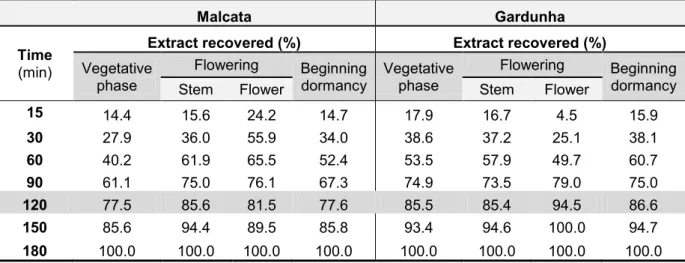
converted as the percentage of the overall mass of extract obtained (Table 1). It was found
that the mass of extract recovered after 60 minutes (three extraction steps), for Malcata and
Gardunha plants, was between 40 and 65% of the overall mass recovered. After 90 minutes
(four extraction steps) the percentage of extract recovered was between 61% to 79%, and
after 120 minutes (seven extraction steps) it was on average more than 75%, which may be
considered an acceptable value for the extraction time and energy costs involved. In most
cases, the addition of an extra hour of extraction leads to a low increase on the cumulative
extraction yield. For that reason, the extraction time of 120 minutes (five extraction steps)
was considered to be a good compromise between the amount of extract recovered and the
time and energy involved in the process.
Table 1. Mass of extract as percentage of the overall mass recovered as a function of extraction time.
Malcata Gardunha
Time (min)
Extract recovered (%) Extract recovered (%) Vegetative phase Flowering Beginning dormancy Vegetative phase Flowering Beginning dormancy
Stem Flower Stem Flower
15 14.4 15.6 24.2 14.7 17.9 16.7 4.5 15.9 30 27.9 36.0 55.9 34.0 38.6 37.2 25.1 38.1 60 40.2 61.9 65.5 52.4 53.5 57.9 49.7 60.7 90 61.1 75.0 76.1 67.3 74.9 73.5 79.0 75.0 120 77.5 85.6 81.5 77.6 85.5 85.4 94.5 86.6 150 85.6 94.4 89.5 85.8 93.4 94.6 100.0 94.7 180 100.0 100.0 100.0 100.0 100.0 100.0 100.0 100.0
A
B
used in Pakistan) the extraction efficiency was 10.7 ± 0.99% w/w (d.m.) (Sahreen et al.,
2010). These values are much lower than those observed in this work.
Total phenolic content
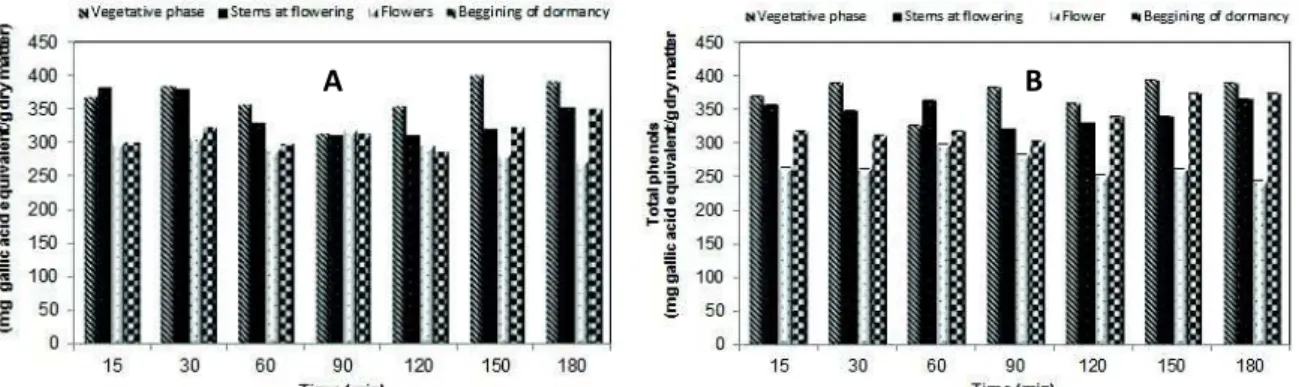
The total phenolic content of the extracts recovered from Malcata plants (Figure 2A) ranged
from 273 mg to 400 mg gallic acid equivalent/g dry matter, which was quite similar to that
determined for extracts from Gardunha (245 to 394 mg gallic acid equivalent/g dry matter)
(Figure 2B). For both Malcata and Gardunha plant extracts, the lowest value was observed in
flowers extracts after 180 minutes of extraction (eight consecutive extraction steps) and the
highest value in vegetative phase after 150 minutes.
Figure 2 - Total phenols in the aqueous extract of P. tridentatum from Malcata (A) and Gardunha (B) (Vegetative phase; Stems at flowering; Flowers; Beginning of dormancy). Measurements were made
in duplicate (SD ≤ 0.08).
We can consider that all extracts, from different vegetative phases and different extraction
times, presented high levels of phenolic compounds when compared to other species
described by Sousa et al. (2007). The phenols present in the species Pterospartum
tridentatum
show high levels at any stage of the vegetative cycle and were superior to other
studied species such as Harpephyllum caffrum, Sclerocarya birrea (Ajila et al., 2010) and
Carissa opaca
(Saherr et al., 2010).
A similar study with five medicinal plants (Terminalia brasiliensis, Terminalia fagifolia,
Cenostigma macrophyllum
, Qualea grandiflora, Copernicia prunifer) carried out by Sousa et
al
. (2007) has shown much lower phenolic contents ranging from 11.55 mg gallic acid
equivalent/g dry matter in the root extract of C. prunifera and 97.6 mg gallic acid equivalent/g
dry matter in the leaf extract of T. fagifolia. Rockenboch et al. (2008) obtained values of total
phenolic compounds in aqueous extract of Physalis peruviana fruit (47.8 mg gallic acid
equivalent/g dry matter).
Antioxidant Activity
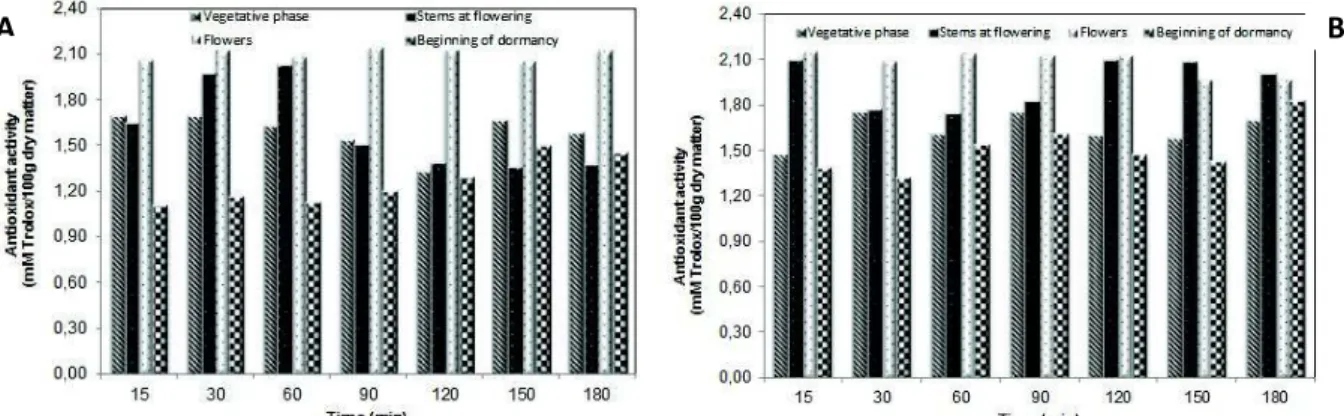
All extracts presented antioxidant activity, but higher AA values were obtained for the
extracts recovered from plants harvested during the flowering period (Figure 3).
Figure 3 - Antioxidant activity of aqueous extracts of P. tridentatum from Malcata (A) and Gardunha (B) (Vegetative phase; Stems at flowering; Flowers; Beginning of dormancy). Measurements were
made in triplicate (SD ≤ 0.02).
The values are consistent with the work reported by Luis et al. (2009), in which the AA of
aqueous extract of P. tridentatum was 1.30 mMTrolox/100g dry matter.
CONCLUSIONS
The extraction process of Pterospartum tridentatum aerial parts presented a high extraction
yield, being the highest yields achieved when processing flowers and plant stems harvested
at the vegetative phase. The aqueous extracts presented high contents of total phenolic
compounds, which did not change significantly with the harvesting season. In addition,
consecutive extracts isolated from the same plant material over time have shown to possess
similar total phenolic content and maintained their antioxidant activity. The results show that
Pterospartum tridentatum
has a great potential to be used as a new source of natural
antioxidants for the food industry. Future studies will be focused on the identification of the
major compounds present in the aqueous extracts and the correlation between the chemical
species with the antioxidant activity. Vitor et al. (2004) identified some compounds such as
isoflavones (namely prunetin, genistin and sissotrin) and the flavonol glycoside isoquercitrin.
REFERENCES
1. Ajila, C.M., Jaganmohan Rao & Prasada Rao, U. J.S. (2010). Characterization of bioactive compounds from raw and ripe Mangifera indica L. peel extracts. Food and Chemical Toxicology, 48, 3406-3411. 2. Luís, A., Domingues, F., Gil, C., Duarte, P. (2009). Antioxidant activity of extracts of Portuguese shrubs:
Pterospartum tridentatum, Cytisus scoparius and Erica spp. Journal of Medicine Plants Research, 3 (11). 886-893.
3. Moyo, M., Ndhlala, A.R., Finnie, J.F. & Staden, J.V. (2010). Phenolic composition, antioxidant and acetylcholinesterase inhibitory activities of Sclerocarya birrea and Harpephyllum caffrum (Anacardiaceae) extracts. Food Chemistry, 123, 69-76.
4. Nandita, S. & Rajini, P.S. (2004). Free radical scavengig activity of an aqueous extract of potato peel. Food Chemistr,, 85, 611–616.
5. Rockenbach, I. I., Rodrigues, E., Cataneo, C., Gonzaga, L. V., Lima, A., Mancini-filho, J., Fett, R.( 2008). Ácidos fenólcios e actividade antioxidantes em fruto de Physalis peruviana L. Alimentos e Nutrição – Brazilian Journal of Food and Nutricion, 19, n.3, p. 271-276.
6. Sahreen, S., Khuan, M. R., Khuan, R. A. (2010). Evaluation of antioxidant activities of various solvent extracts of Carissa opaca fruits. Food Chemistry, 122, 1205-1211.
7. Sousa, C. M. de M., Silva, H. R., Vieria-Jr., G. M., Ayres, M. C. C., Costa, da C. L. S., Araújo, D. S., Cavalcante, L. C., Barros, E. D. S., Araújo, P. M. de M., Brandão, M. S., Chaves, M. H. (2007). Fenóis totais e actividade antioxidantes de cinco plantas medicinas. Química Nova, 30, No. 2, 351-355.
8. Vítor, R., Mota-Filipe, H., Teixeira, G., Borges, C., Rodrigues, A., Teixeira, A. & Paulo, A. (2004). Flavonoids of an extract of Pterospartum tridentatum showing endothelial protection against oxidative