Universidade de Aveiro 2015
Secção Autónoma de Ciências da Saúde
PATRÍCIA GRAZIELA
CUNHA RIBEIRO
PRÁTICA CLÍNICA DE UM ENFERMEIRO DE
INVESTIGAÇÃO
Universidade de Aveiro 2015
Secção Autónoma de Ciências da Saúde
PATRÍCIA GRAZIELA
CUNHA RIBEIRO
PRÁTICA CLÍNICA DE UM ENFERMEIRO DE
INVESTIGAÇÃO
CLINICAL PRACTICE OF A RESEARCH NURSE
Projeto apresentado à Universidade de Aveiro para cumprimento dos requisitos necessários à obtenção do grau de Mestre em Biomedicina Farmacêutica, realizada sob a orientação científica do Professor Doutor Bruno Gago, Professor Auxiliar Convidado da Secção Autónoma de Ciências da Saúde da Universidade de Aveiro.Dedico este trabalho à minha família, pelo apoio que me deram na realização deste projeto.
o júri
Presidente Professor Doutor Nelson Fernando Pacheco da Rocha
Professor Catedrático da Universidade de Aveiro
Arguente Professora Doutora Alexandra Isabel Cardador de Queirós
Professora Coordenadora da Universidade de Aveiro
Orientador Professor Doutor Bruno Miguel Alves Fernandes do Gago
agradecimentos À Universidade de Aveiro, em especial ao Professor Doutor Luís Almeida e ao Professor Doutor Bruno Gago pela excelente direção do Mestrado.
A toda a equipa da Blueclinical pela disponibilidade e simpatia com que me receberam.
Ao meu filho, pelo seu carinho e paciência.
Aos meus pais, pelo seu apoio e pela ótima educação que me deram, que fez de mim o que sou hoje.
palavras-chave Enfermeiro de Investigação, Ensaios Clínicos, Unidade de Fase I, Bioequivalência, Biodisponibilidade.
resumo O presente trabalho propõe apresentar as principais atividades de um Enfermeiro de investigação, o seu papel em investigação clínica, no desenvolvimento e na introdução de novos medicamentos no mercado. O Mestrado em Biomedicina Farmacêutica permitiu reunir conhecimentos e desenvolver novas competências técnicas e pessoais de extremo valor na atividade diária, como enfermeira de investigação.
No decorrer da minha atividade profissional como Enfermeira de investigação, foram detetadas muitas lacunas na formação académica e profissional dos enfermeiros, no que diz respeito a esta área específica.
Pretendo apresentar uma visão pessoal, descrevendo as principais atividades desenvolvidas e como os conhecimentos adquiridos neste Mestrado
influenciaram o meu desempenho profissional.
O principal objetivo deste trabalho é constituir uma referência ou guia para outros enfermeiros que queiram enveredar pela área da investigação clínica.
keywords Research Nurse, Clinical Trials, Phase I Unit, Bioequivalence, Bioavailability.
abstract This paper proposes to present the main activities of a Research Nurse, its role in clinical research, and in the development and introduction of new drugs on the market.
The Master in Pharmaceutical Medicine brought together knowledge and development of new technical and personal skills extremely valuable in daily activity as research nurse.
During my professional activity as a research nurse, were detected many gaps in academic and professional training of nurses, with regard to this specific area.
I intend to present a personal view, describing the main activities developed and how the knowledge acquired in this Master influenced my work
performance.
The main objective of this work is to provide a reference or guide to other nurses who want to enter into the area of clinical research.
TABLE OF CONTENTS 1. INTRODUCTION ... 1 1.1 OBJECTIVES ... 1 1.2 PROFESSIONAL BACKGROUND ... 2 1.3 HOSTING INSTITUTION ... 4 2. STATE-OF-THE-ART ... 7
2.1 R&D OF MEDICINAL PRODUCTS ... 7
2.2 CLINICAL TRIALS IN PORTUGAL ... 15
3. RESEARCH NURSING ACTIVITY ... 19
3.1 RESEARCH NURSE SKILLS AND COMPETENCES ... 19
3.2 RESPONSIBILITIES OF A RESEARCH NURSE... 22
3.3 RESEARCH NURSE IN THE MULTIDISCIPLINARY TEAM ... 26
4. CLINICAL TRIALS EXPERIENCE IN A PHASE I UNIT ... 29
4.1 BLUECLINICAL PHASE I UNIT ... 29
4.2 EXPERIENCE AS RESEARCH NURSE ... 31
4.3 RESEARCH NURSE ACTIVITIES IN AN ONCOLOGICAL PHASE I/IIA TRIAL ... 40
5. DISCUSSION ... 43
6. CONCLUSION ... 47
List of figures
Figure 1- Stages of pharmaceutical R&D ... 7 Figure 2 - Paradigm of drug development "quick win, fast fail” ... 12 Figure 3 - Representation of relevant parameters in bioequivalence studies ... 14 Figure 4 - Submitted Clinical Trials for authorization (2006-2015) – from INFARMED website . 16 Figura 5 - Clinical Research Nursing Dimensions ... 20 Figure 6 - Blueclinical Phase I Organogram ... 29
List of tables
Tabela 1 - Clinical Development Phases of Clinical Trials submitted since 2006 – adapted from INFARMED website ... 16
List of Abbreviations AE API AUC AUC0-t AUC0-∞ BA BE CAPA CEIC Cmax CNPD CRF CRN CRP CSC CSR CTA CTP ECG eCRF GCP HIV ICF ICH IMP INFARMED MRI PD PDT PEG PoC PK R&D RNC RNCES RNEC SmPC SOP tmax VMER Adverse Event
Active Pharmaceutical Ingredient
Area Under the Plasma Concentration-Time Curve
AUC From Time Zero to Last Sampling Time With Quantifiable Concentrations AUC From Time Zero to Infinity
Bioavailability Bioequivalence
Corrective Action Preventive Action
Comissão de Ética para a Investigação Clínica (Portuguese Ethics Committee for Clinical Research) Maximum Observed Plasma Concentration
Comissão Nacional de Proteção de Dados National Data Protection Committee Case Report Form
Clinical Research Nurse Clinical Research Partnership Clinical Study Coordinator Clinical Study Report Clinical Trial Assistant Clinical Trial Protocol Electrocardiogram
Electronic Case Report Form
Good Clinical Practice
Human Immunodeficiency Virus Informed Consent Form
International Conference on Harmonization Investigational Medicinal Product
Autoridade Nacional do Medicamento e Produtos de Saúde I.P. (Portuguese National Authority for Medicines and Health Products) Magnetic Resonance Imaging
Pharmacodynamic Photodynamic Therapy Percutaneous Gastrostomy Proof-of-Concept
Pharmacokinetic
Research and Development Research Nurse Coordinator
Rede Nacional de Comissões de Ética para a Saúde (National Network of Ethics Committees for Health)
Registo Nacional de Estudos Clínicos (National Register of Clinical Trials) Summary of Product Characteristics Standard Operating Procedure
Time to Maximum Observed Concentration Viatura Médica de Emergência e Reanimação (Emergency and Resuscitation Medical Car)
1. INTRODUCTION
The world of clinical research is developing in a quick way, it is therefore urgent to promote the development and education of professionals who participate in it.
It is extremely important that professionals working in this field have the best qualifications because are they who will test drugs and collect data for further analysis, without forgetting that the safety of participants (sick or not) is above any value. The training course in Pharmaceutical Medicine plays an important role in promoting the education of health professionals, covering all aspects of drug development, from discovery to post-marketing phase.
Nurses play an important role in clinical research, assuring participant safety, implementation and conduction of the protocol and ongoing maintenance of informed consent, all within the context of effective and appropriate clinical care. It is critical that investigators, sponsors of clinical research, health policy makers and regulators have an understanding of this important role.
The present work pretends to describe the clinical practice of a research nurse, describing the necessary skills, responsibilities and main activities in this area. In order to be easy to follow, it will be done a link to the theoretical knowledge, making an overview of Research and
Development (R&D) of medicinal products and the current perspective of clinical research in Portugal.
My personal experience in this area as research nurse and all my educational and professional background will be displayed in this work.
My expectations for this work focus on the possibility of, in the future, be an “inspiration” to nurses that want to follow a career in Clinical Research.
1.1 OBJECTIVES
The objective of this work is to structure and define the duties and responsibilities of a research nurse, listing the main personal and technical competences needed to develop in the daily
2
practice. It also pretends to present the main activities of a research nurse, its role in clinical research, and in the development and introduction of new medicinal products on the market. The development of this work aims to be a guide for nurses who want to work in the field of clinical research, or who knows, be a starting point to the beginning of a new nursing specialty.
1.2 PROFESSIONAL BACKGROUND
Besides the theoretical knowledge obtained in the training Program of Pharmaceutical Medicine, my professional background through the different services and institutions where I worked gave me huge knowledge and clinical practice, which could only be accumulated over the years. The 19 years of experience were fundamental in the acquisition of all clinical information that I gathered as well as the acquisition of personal and technical skills,
fundamental in the activity that I currently perform in the clinical research area. This skills and competences will be described later as the core competencies necessary to research nurse activity.
Next, it is presented the journey through the different services/institutions and the key skills acquired in each of them.
HOSPITAL DE SÃO JOÃO
In 1995, I started my professional career in Hospital de São João, a central hospital, in Adult Emergency Service, where I worked for eleven years. In this service I had the opportunity to work with several medical and surgical specialties, gathering knowledge in different areas, learning to act in an accurate and precise way, because in emergency situations speed is friend of perfection and minutes can make the difference between life and death.
In 1997, I started working at pre-hospital emergency service, in the Emergency and Resuscitation Medical Car (VMER), until 2014. In this service, the team is composed by a physician and a nurse, and in this activity we take emergency care out of the hospital to the patient's home, to the street or to the scene of the incident. We learn to be autonomous, flexible, multifaceted and to improvise, often in adverse situations.
In 2006, I decided to learn more in another area and I changed to oncology, specifically, hemato-oncology service, where I stayed for eight years. In this service I acquired knowledge on hemato-oncology diseases, autotransplant, chemotherapy treatments and development of human relationship with the patient, since confinements are longer and the patient can be contextualized in their social and family reality.
In Hospital de São João did not have experience with clinical trials, but all the clinical
knowledge gained in these 19 years of experience were fundamental in the performance of my current professional activities as a research nurse.
BIAL
My contact with clinical research happen in 1999, when I started working at part-time as research nurse in the Human Pharmacology Unit of Phase I, at a Portuguese pharmaceutical company named Bial. The Phase I Unit was composed by 6 beds with cardio-respiratory monitoring. At this time my knowledge of clinical trials were very limited. The nursing academic training did not include any education or training in clinical trials or clinical research.
As phase I research nurse, I performed the clinical procedures required by Protocol, and at the same time I was increasing my knowledge in this area. Besides working as research nurse, I also coordinated the nursing team, until I become Research Nurse Coordinator (RNC). I also cooperated in the performance of the working plans, managing supplies and equipment, assuring its good conditions, maintenance and stock. I was responsible for elaboration of clinical Standard Operating Procedures (SOP´s).
I've been involved in the elaboration of structural plan of the new Human Pharmacology Unit of Bial, composed by 20 beds, 10 of these with cardio-respiratory monitoring, and in the selection of the necessary equipment to the normal operation of the Unit. During this time, I had the opportunity of monitoring some phase I clinical studies.
In this Phase I unit, I participated in several clinical trials in healthy volunteers, including bioavailability and bioequivalence studies, drug-drug interactions, effect of food and dosage
4
form proportionality, entry-into-man and special populations, having the opportunity to collaborate in the clinical development of six new chemical entities.
1.3 HOSTING INSTITUTION
I started to work at Blueclinical, as RNC, in 2013. Blueclinical is a Portuguese Clinical
Research Company founded in 2012. The purpose of Blueclinical is generate value for society, through effectiveness and therapeutics innovation, and conduct clinical research according all applicable ethical, scientific and regulatory requirements.
This company is divided into three business units, providing services covering different phases of drug discovery process, from bench to bedside: Blueclinical R & D consultancy,
Blueclinical Clinical Research Partnership (CRP) and Blueclinical Phase I.
The mission of Blueclinical R&D is to promote the development of translational medicine projects and support other companies and institutions, especially start-ups, in the development of their R&D projects with the goal of market introduction. This business unit provide advice in development plans of new drugs, medical devices and other health products, during all the development phases - pharmaceutical, preclinical, clinical and regulatory. It also support in preparation of scientific advice, preparation of investigator brochure, investigational medicine dossier, business development plan, portfolio selection and funding application 1.
Blueclinical CRP was created to provide support to clinical research activity in study sites promoting mutual growth, efficiency and quality in the conduct of studies, with medicinal products and medical devices.
The CRP network is growing in hospitals and primary care units, providing organized and expert research teams focused on complying with quality standards, ethical and legal requirements. The growing efficiency and quality provide an excellent reputation of clinical research centers 2.
Blueclinical Phase I was inaugurated in 2013, the mission is to conduct phase I studies in healthy subjects and early stage studies (proof-of-concept) in selected patient populations, in full compliance with international regulations 3.
The experience as research nurse at Blueclinical Phase I Unit will be developed further on in a more detailed manner.
2. STATE-OF-THE-ART
The clinical research plays a central role in generating new knowledge and turn the scientific discoveries useful to society through the drug development processes. The main objective of this chapter is to give an overview of the pertinent items related with clinical research and the key points of drug development process.
2.1 R&D OF MEDICINAL PRODUCTS
The development of a new medicinal product, from the original idea to the finished product, can take a long and complex process of about 10-15 years. The estimated cost to research and develop each successful drug is around $800 million to $1 billion. This amount includes the cost of the thousands of failures. For each 5,000-10,000 compounds in R&D just one receive approval 4.
With the knowledge of the human genome, scientists hope to discover new drugs that specifically and powerfully can prevent and cure diseases.
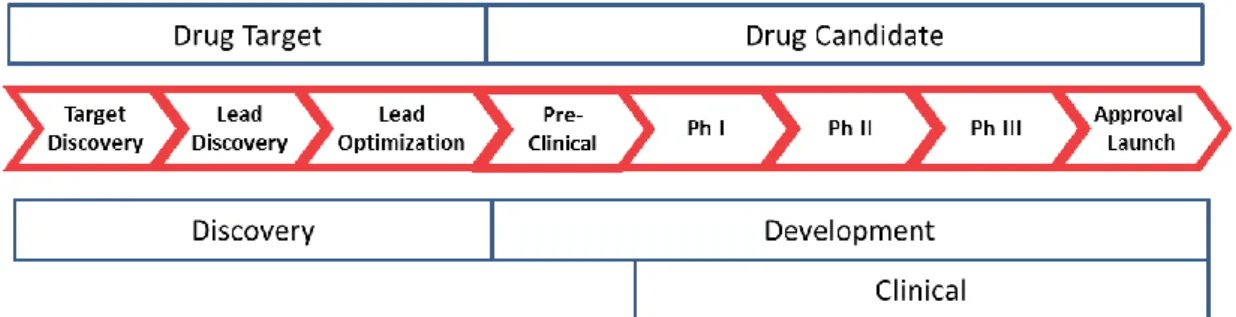
The different stages of Research & Development process are represented in Figure 1.
8
Discovery phase
In the development of medicinal products the main objectives are to demonstrate that the new entity has a constant chemical quality, is effective in a significant number of patients and most of all is safe. The original idea could come from academics, clinical research or even
commercial sector, and includes a profound understanding of the disease and their causes. Researchers work to reconstruct the basic causes of disease at the level of genes, proteins and cells. This information allow recognise “targets” which could be affected by potential new medicinal drugs. When a target is selected, “target discovery”, it starts a process to identify molecules which have appropriate characteristics to create suitable medicinal products. These molecules should be capable to interact with the selected target and cause the desired effect “target validation” 6
.
The knowledge of the disease, allow scientists to begin search for a molecule, or “lead compound” that may act on their target and modify the disease development. The “lead compound” will pass through a series of tests, in living cells, in animal models of disease and computational models, to determine which compound are suitable to continue. This tests assess the safety and efficacy of the compound, testing pharmacokinetics, pharmacodynamics and toxicological properties of each one 7.
The drugs that pass the initial screening will suffer an optimization, “lead optimization”, to become more effective and safer. Scientists change their structure given it different properties, for example, they can reduce the possibility of interaction with other substances, reducing by this way the potential of causing side effects. At this stage, researchers begin to think about development methods for purifying, formulating, manufacturing, and testing the product candidate 7.
The objective of the final drug discovery phase is to preserve favourable properties in compounds while others are improved.
Non-clinical studies
After the discovery phase, scientists carry out in vitro and in vivo tests extensively to
understand the action and safety profile of the drug, to decide if they should move on to testing in humans.
Several pre-clinical preliminary studies will have to be conducted in order to collect
information to support the conduct of clinical trials and all progress until marketing approval by regulatory authorities. These tests include in vitro and in vivo studies, and most recently in silico studies. These tests can help to decide how to proceed to the next clinical development phase and are essential to primarily understand the potential success of the drug 8.
The various safety studies, from those that are necessary to evaluate the risk of exposing the first human to those required by regulatory authorities in order to market a medicine, are essential elements of a fundamental International Conference on Harmonization (ICH
guideline, Guidance on Non-clinical Safety Studies for the Conduct of Human Clinical Trials and Marketing Authorization for Pharmaceuticals 9. Different studies are required for each development phase. In these studies is extremely important to take into account that may exist qualitative and quantitative differences in biological responses in animals compared to
humans. In practice this means that non-clinical animal studies may not reproduce the intended pharmacological effect in humans, may give an incorrect interpretation of pharmacokinetic results and may not identify relevant toxic effects.
The information obtained in non-clinical studies is used to estimate a safe starting dose and doses range for clinical trials 9.
In order to bring a new medicinal product to the market, Sponsors have to demonstrate its efficacy, quality and safety with a several types of clinical trials.
During this stage researchers start to work in the first scale up of the drug, techniques to translate the small scale of a lab to larger production, to make large quantities of the drug for clinical trials 4.
Clinical Trials
Before the beginning of a clinical trial important information will be evaluated by Competent Authorities and Ethics Commission to assure that subjects who participate in the clinical trials will not be exposed to unreasonable risks.
The results of the preclinical work, the chemical structure of the candidate drug and how it is supposed to work in the body, side effects and manufacturing information, will be evaluated.
10
The complete clinical trials plan, including how, where and whom will perform the studies, also will be a focus of attention. Experts will review all the information to determine if the medicine reveals to be sufficient safe and effective to be approved.
Traditionally, clinical trials have been divided in four phases:
Phase I or Human Pharmacology Studies
The candidate drug is tested for the first time in humans. The testing is performed in small groups of healthy volunteers, about 20 to 100 subjects 10,11.
The objective is determine drug safety and tolerability in humans. The researchers study the pharmacokinetics (PK) and the pharmacodynamics (PD) profile and identify side effects 10,11. PK and PD studies may be conducted in healthy volunteers or in patients with the target disease.
This trials are carefully monitored and help researchers to find the safe dosage range and help him to decide to move on to additional development.
Phase II or Therapeutic Exploratory Studies
In this phase the drug candidate is tested in a small group of patients, about 100 to 500 patients with the disease or condition to be studied 10,11.
The drug candidate is evaluated for therapeutic efficacy, potential short-term side effects (adverse events), and risks associated with the drug 10,11.
The researchers can estimate the dosage and regimen for following studies, and define the preliminary tolerability/safety profile in patients.
Clinical trial Phase II sometimes are divided into:
Pilot clinical trials to evaluate efficacy (and safety), dose range exploration or proof of concept in selected populations, could be conducted in patients or healthy volunteers 10,11.
Phase IIb
Well controlled pivotal trials to evaluate efficacy (and safety) and dose finding in patients with the disease or condition to be treated 10,11.
Phase III or Therapeutic Confirmatory Studies
Phase III studies begin if evidence of effectiveness is shown in Phase II. These studies collect more information about safety and effectiveness of the drug candidate, compare it to
commonly used treatments. This studies are made in a larger number of patients, about 1,000-5,000, to generate statistically significant data 10,11.
Different populations, different dosages and different combination with other drugs are studied in this phase. It also provides important data that can be used to support adequate instructions for use of the drug.
Phase III trials are the most expensive and longest trials. These studies are intended to provide a satisfactory foundation for marketing approval.
Phase IV or Therapeutic Use
This studies occurs after marketing approval, in a large number of patients that begin to use the medicinal product, providing information about therapeutic effectiveness in real life conditions and optimisation of the drug's use 10,11.
Pharmaceutical companies should continue to monitor the medicinal product, including long-term safety and adverse events (AE).
The traditional R&D model represents high costs, slowness, high failure rates, and
12
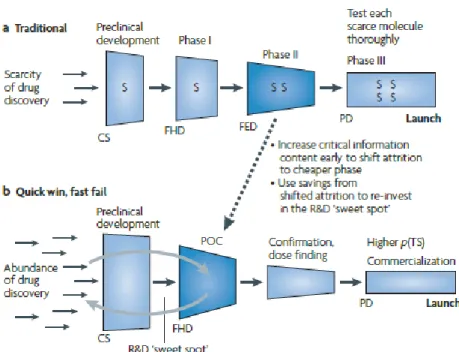
The traditional paradigm of drug development contrasts with alternative development paradigm referred to as "quick win, fast fail" (Figure 2).
Figure 2 - Paradigm of drug development "quick win, fast fail” 12.
In this new paradigm, technical uncertainty is decreased before moving on to more advanced and quite expensive phases such as phase II and III.
The proof of concept (PoC) is the earliest point in the drug development process. It allows assessing the usefulness and effectiveness of a new molecule and establish the safety of drug candidates in the target population. This test should involve a small number of subjects and should be performed earlier in clinical development, preferably in phase I.
With this new paradigm, there is a reduction of new molecular entities moving to Phase II and III, but that progress has higher probability of success. PoC is a landmark in the decision to proceed with the remaining clinical development of a drug 12.
The savings achieved by suppression of the later stages of development, which would result in failure, are reinvested, increasing productivity, selection of new entities, conducting the first
dose efficacy and first human dose, and developing a new product. These measures allow drug developers to make "Go/No Go" decisions about proceeding with larger and more expensive studies enabling save time and money 12.
Bioequivalence (BE) and Bioavailability (BA) studies and Generic Drugs
Pharmaceutical development is a long and expensive process. Pharmaceutical patents
registering can be done during any phase of drug development. In most countries of the world, patent protection expire 20 years from the date of registering. However, some countries, as USA, grant additional protective measures as Exclusivity. This additional measure is an exclusive marketing right granted by the FDA. Exclusivity is granted upon approval of a drug product and was designed to promote a balance between new drug innovation and generic drug competition 13.
A generic drug is produced and distributed without patent protection. The generic drug may still have a patent on the formulation but not on the active ingredient
A generic drug must contain the same active ingredient as the original formulation, must be identical in dose, strength, route of administration, safety, efficacy, intended use and must demonstrate bioequivalence with the reference medicinal product, by appropriate
bioavailability studies. Safety and efficacy studies are already known from the approved product, and it would be unethical to subject research participants to clinical studies just to prove information that already exists 14.
Bioavailability refers to the rate and extent to which the active pharmaceutical ingredient (API), or its active moiety, is absorbed from a pharmaceutical product and becomes available at the site of action 15.
Bioequivalence is defined as the absence of a significant difference in bioavailability between two pharmaceutically equivalent products or pharmaceutical alternatives under similar conditions in an appropriately designed study 15.
The recommended standard design to compare two formulations is a randomised, two-period, two-sequence single dose crossover study. The wash out period to separate the treatment periods should be sufficient to ensure that at the start of the second period, drug concentrations
14
are below the lower limit of bioanalytical quantification in all subjects. Usually, to achieve this are necessary at least 5 elimination half-lives 16.
The number of evaluable subjects in a BE study should be based on an appropriate sample size calculation and should not be less than 12 16.
The test conditions should be standardized to minimize variability except for the products to be tested. So it is recommended to standardize diet, fluid intake and exercise. Usually, a
bioequivalence study should be conducted under fasting conditions, however if the Summary of Product Characteristics (SmPC) recommends intake the reference medicinal product only in fed state, the bioequivalence study should be conducted under fed conditions. The meal should be a high-fat and high-calorie meal 16,17.
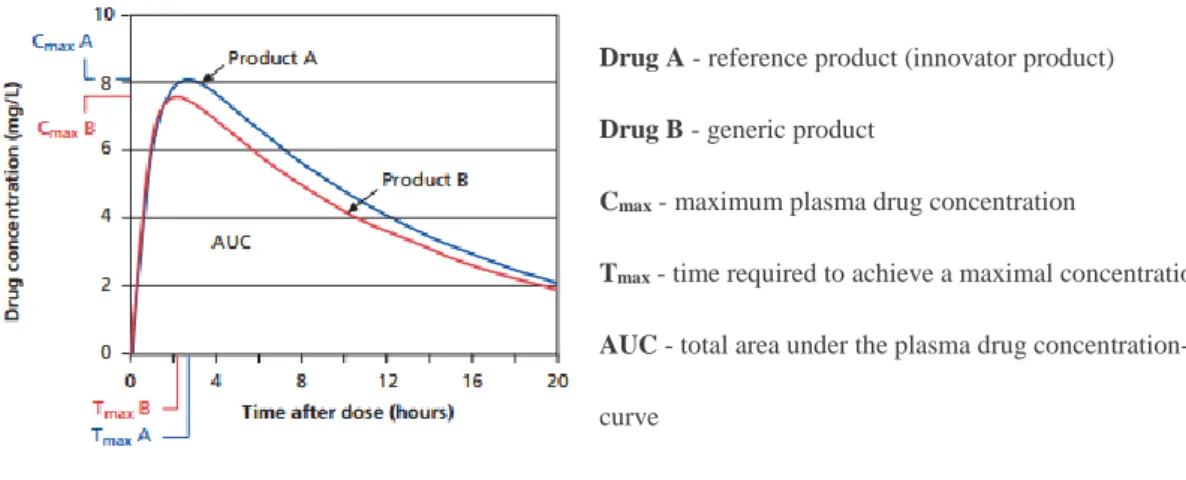
A sufficient number of samples should be collected to describe appropriately the plasma concentration-time profile. In studies to determine bioequivalence after a single dose should be determined area under the plasma concentration versus time curve (AUC) from time zero to the last sampling time with quantifiable concentrations (AUC0-t), AUC from time zero to
infinity (AUC0-∞), residual area, maximum observed plasma concentration (Cmax) and time of
occurrence of Cmax (tmax) 16,17,18. These parameters are graphically represented in Figure 3.
Figure 3 - Representation of relevant parameters in bioequivalence studies 19.
In bioequivalence studies, the plasma concentration time curve is generally used to assess the rate and extent of absorption. For these parameters the 90% confidence interval for the ratio of
Drug A - reference product (innovator product) Drug B - generic product
Cmax - maximum plasma drug concentration
Tmax - time required to achieve a maximal concentration AUC - total area under the plasma drug concentration-time
the test and reference products should be contained within the acceptance interval of 80.00-125.00%. Products meeting the bioequivalence requirements can reliably be assumed to produce similar clinical effects when used interchangeably in the same patient 18,20.
Sometimes it is stated that the 80 to 125% limit means there can be a 45% variation between the generic and the reference product, but this is not really the case. The average is usually close to 100% and this is the value of maximum likelihood for the comparison.
Bioequivalence studies are growing due to the faster process of drug development and to the very competitive prices (30-60% lower) comparatively with Reference products.
In the generic drugs development is important to maintain a demanding regulation, in order to keep the high quality standards as is required to reference products.
2.2 CLINICAL TRIALS IN PORTUGAL
Regulatory environment in Portugal is constituted by national regulations and transpositions of European Directives. All These regulations lead to a complex and slow submission process. The conduction of a clinical trial in Portugal has to be previously authorized by the Competent Authorities.ThePortuguese National Authority for Medicines and Health Products
(INFARMED) is responsible for evaluating the risk and benefit of the clinical trial and to authorize its conduction. It is also required an approval of the Ethics Commission for Clinical Research (CEIC) which will make its ethical evaluation 21,22.
The Portuguese Commission of Data Protection (CNPD) is a National Commission responsible for authorizing the processing of personal data and supervise data confidentiality and respect for human rights 22,23.
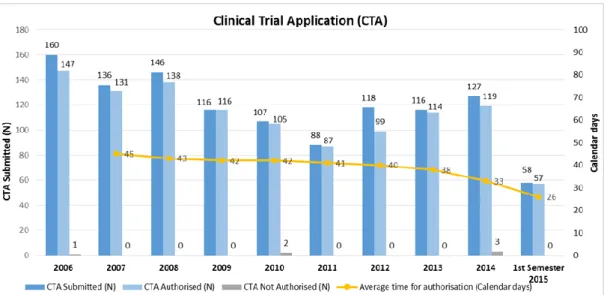
According to the data available on INFARMED website, the number of clinical trials submissions in Portugal had gradually declining until 2011, outlining a slight increase from there, while the approval time decreases, as represented in Figure 4 24.
16
Figure 4 - Submitted Clinical Trials for authorization (2006-2015) – from INFARMED website 24.
The Clinical Research law may be one of the factors responsible for the reduction of the authorization time observed between the year 2014 and the 1st half of 2015 24.
There has been an effort by regulatory authorities to reduce the time of approval in order to promote the development of clinical research in Portugal. Despite the approval time has been decreased that remains to be seen as a foreign negative point by sponsors.
According to the INFARMED website, the Table 1 represents the distribution of clinical trials submissions by the different clinical development phases. Since 2006, the majority of
submissions corresponds to Phase III. The best years for clinical trials Phase I were 2013 and 2014, were submitted a total of 10 trials, the largest number since 2006 24.
Tabela 1 - Clinical Development Phases of Clinical Trials submitted since 2006 – adapted from INFARMED website 24. Development Phase 2006 2007 2008 2009 2010 2011 2012 2013 2014 1st Semester 2015 Phase I 2 7 3 6 2 6 3 10 10 3 Phase II 20 30 31 27 17 19 25 20 24 11 Phase III 104 74 100 73 79 58 82 75 81 39 Phase IV 27 21 12 9 9 5 8 9 12 5
The law 21/2014 of 16 April regulates Clinical Investigation, including the arrangements for conducting clinical trials of medicines for human use, due to the transposition of Directive 2001/20/EC, and the regime of clinical research of medical devices resulting from the partial transposition of Directive 2007/47/EC of the European Parliament.
The Clinical Investigation Law creates a new framework for research with human beings in Portugal. It promotes transparency in scientific activity, from submission, advices, results, used instruments and data, facilitating the creation of research networks.
The creation of the National Network of Ethics Committees for Health (RNCES) ensures the application of ethical evaluation to all clinical research and all kinds of studies 22,25.
The creation of the National Register of Clinical Trials (RNEC) of public consultation promotes mandatory public register of studies, advices, authorizations, as well as support material and dissemination of studies. This public disclosure contributes to the non-repetition of studies 22,25.
Submission process, assessment and standards of good practice become clear and expeditious contributing to reduce approval times and opinions by different entities, specifically the CEIC, INFARMED and CNPD.
This law promotes increased responsibility of all clinical research stakeholders and represents a big improvement opportunity to Clinical Research in Portugal.
3. RESEARCH NURSING ACTIVITY
3.1 RESEARCH NURSE SKILLS AND COMPETENCES
Research is an important and vital aspect of health care, being essential for the provision of safe and effective health care and social assistance.
The name “research nurse” has been commonly applied to nurses that work in a clinical research environment 26. The clinical role of research nurses has been more common in oncology clinical trials, maybe because these trials involve subjects who need long and complex treatments. The research nurse job is complex, varied and stimulating.
During the research for the development of this project, I found several descriptions of competencies and research nurse's responsibilities, finding as well research nursing specialty area, with defined fields of action.
According to American National Institutes of Health Clinical Center “The domain of practice for the specialty of clinical research nursing includes care provided to research participants, as well as activities to support protocol implementation, data collection and human subject protection” 27
.
As the clinical research expands, it is critical to emphasize the important role of clinical research nurses. They assure appropriate clinical care to research participants, ensuring their safety and welfare, the continuous accomplishment of the informed consent and the integrity and accuracy of collected data.
The way the American National Institutes of Health Clinical Center describes the acting areas of research nurse is very structured and well defined, so I make a brief reference to some concepts that are part of the daily practice of the research nurse. In 2007, the American National Institutes of Health Clinical Center defined a scope of the Clinical Research Nurses (CRN) specialty including two nursing roles 27:
The CRN: clinical nurses that support study implementation with a central focus on care delivery to research participants.
20
Research Nurse Coordinators (RNC): nurses responsible for study implementation and coordination, data management and compliance with regulatory requirements.
According to the American National Institutes of Health Clinical Center, the clinical research nursing practice include five dimensions and each one include a set of activities that overall describe the specialty practice, as represented in Figure 5.
Figure 5 - Clinical Research Nursing Dimensions, according to the American National Institutes of Health Clinical Center 27.
Clinical Practice Dimension refers to nursing care and support provided to clinical research participants. Nursing care are determined by the clinical condition of the patient, study protocol requirements and clinical effects caused by the study procedures.
Study Management Dimension refers to management of clinical and research activities to ensure clinical needs and patient safety, accurate data collection and protocol integrity. Care Coordination and Continuity Dimension, related with coordination of clinical and research activities according to clinical needs, requirements to complete the study and manage the link with primary care providers.
Human Subjects Protection Dimension deals with the informed participation of clinical research participants, coordinating research activities in order to minimize subject risk.
Contributing to the Science refers to research nurse contribution as a research team member to the development of new ideas for study, exploration of new findings and innovation to improve the practice, patient outcomes and data collection accuracy.
The list of what a research nurse could be doing is quite extensive. CRN play a central role on providing safe and quality care to research participants. They should have an extensive knowledge of good clinical practices, a good understanding of the study, the regulations and legislation to support protocol implementation, data collection and human subject protection, within the context of the care delivery. Along with clinical knowledge and judgment, their combined training gives these nurses insights and unique abilities in research activities 27.
A research nurse are motivated by challenges, have initiative and the ability to effectively meet challenges, be adaptable and have the flexibility and skills necessary to handle with research activities of varying complexity, having as well leadership and excellent organizational skills. They must be accurate, pay attention to details, have meticulous approach, have the ability to read, analyze and interpret technical procedures such as protocols, informed consent
documents and regulatory documents and have a high level of integrity.
These professionals must have highly developed skills in research activity. Nurses are vital to maintain the accuracy of the data collection in research studies. Provide clinical support and guidance in research studies development 28.
The results of a research project may be severely compromised if the protocol is not followed exactly on the day of procedures, for example, if the participants do not receive the correct dose, or samples are not collected in a timely manner and to the correct subject.
A research nurse as good communication and negotiation skills, maintaining good
relationships with colleagues, working always in a transparent manner, with high standards of professional integrity, using resources and skills enabling successful outcomes.
Excellent communication skills are extremely important. Research nurses must be able to effectively communicate with scientists, physicians, researchers, corporate executives and often communicate complex information to patients / healthy volunteers groups according to their understanding. Nurses need an ability to interpret complex information, give clear explanations, along with excellent communication and interpersonal skills 29.
22
Skills to identify potential obstacles and solutions and the capacity to solve problems, planning short and long term strategic objectives, allow efficient management of costs and time.
The research nurse should be able to work alone, being able to prioritise and to make
decisions, staying motivated and responsible, and at the same time be part of a highly qualified team of motivated and respectful professionals with common goals. They must be able to perform multiple tasks in a timely manner, and work efficiently under pressure. They also must have general computer literacy, especially in the use of word processing, spreadsheets,
database and presentation software, and the ability to undertake internet searches 30.
Research nurse must be a critical thinker and have an analytical approach to problem solving, being flexible and able to manage multiple clinical trials (sometimes simultaneously) and function independently, performing diverse clinical duties.
3.2 RESPONSIBILITIES OF A RESEARCH NURSE
The research nurses involved in a research project have a quite extensive list of
responsibilities. They have responsibilities that can only be exclusively made by nurses and other activities, which in many research centers, may be shared with other professionals, such as Clinical Trial Assistants (CTA) or Clinical Study Coordinators (CSC).
To be easier to transmit and realize the different activities performed by research nurses, it will be described in context of different moments of the development and implementation of a clinical trial.
Protocol development
The first stage of a research project is the development of a study protocol, that includes the study objectives, how will be measured, clinical procedures required, what time points, what clinical data will need to be collected.
There is a team involved in the protocol development, but it is really important include research nurses at this stage. They provide nursing expertise to the research team during study
development and implementation. They know patients, care requirements and they have invaluable knowledge and experience to help researchers gather the information they will need to draw conclusions from the study. Research nurses could help to evaluate if the demands are too great or the criteria for inclusion too strict, it may be difficult to recruit patients or they may want to abandon the study before it finishes. It is important to obtain a good balance between the needs of the research and the research subjects involved.
Study submission/Approvals
In Portugal, before the beginning of any study, it is required approval by INFARMED, CEIC and CNPD. Some research nurses have the responsibility of completing these application forms and submit them to the competent authorities for review and approval.
Patient Recruitment
After study approval, patient recruitment is often the responsibility of the research nurse. Research nurses spend a good part of their time, identifying potential patients for a study or a clinical trial. They may screen hospital notes or during the multidisciplinary team meetings to highlight which patients are suitable for which study.
They also have an important role in the recruitment of healthy subjects, enrolment and scheduling study visits.
Informed consent
Informed consent is a critical ethical component of conducting research in human subjects, and it is essential before participation in any type of research. The informed consent is a legal document that inform study subjects about their rights, the purpose of the study, describes all study procedures, potential risks and benefits, and alternative treatments. Subjects must participate in the study willingly, and vulnerable populations must receive extra protection 31.
24
The informed consent form (ICF) must be written in language easily understood and must provide enough information so that the subject can decide whether or not to participate in the study.
Often research nurses are involved in the writing of informed consent form, as well as, in the verbal discussion with research participants. They know how to speak to patients or healthy volunteers in a way that allows them to understand complex scientific and medical
information, explaining participants responsibilities, benefits and potential risks of the study. The explanation of data protection and share of on-going information regarding the study is an important part of the discussion of the informed consent process and could be responsibility of the research nurse.
Research nurse should be patient advocacy. The rights, safety and wellbeing of research participants are the most important considerations and must prevail over the interests of science and society 27.
Research nurses collaborates with physicians in determining eligibility of patients for clinical trials, cooperating with investigators on the review of inclusion and exclusion criteria. During clinical trial development, they work directly with the physician/investigator and clinical staff to ensure the completion of all study procedures and protocol compliance.
Clinical Procedures
Research nurses perform clinical procedures required by Protocol, providing direct nursing care to research participants, performing assessements and interventions related with studies. They also administers treatments and the research compound, perform specimen collection attaching great importance to proper sample collection and handling, and the timely execution of every study procedures.
Collection of samples at specific time points, the accuracy in the fulfilment of the times and proper care of these samples during processing and storing are of utmost importance.
In many research centers, lab skills are often undertaken by research nurses. After processed, samples will be stored for later analysis and determine the outcome of the study. Samples integrity is essential for taking conclusions with confidence.
The safety and well-being of research participants should be the top priority in clinical trials. Research nurses must have proper skills that allow them to early identify AEs, act in
immediate and appropriate way, ensuring the safety and welfare of the participant. Timely reporting of AEs is fundamental to patient protection and a responsibility of the research nurse.
Data collection and Data entry
The research nurse monitors the patients or healthy volunteers recruited to the clinical trial. During the treatment, they assure that subjects attend all necessary visits according to protocol and that all data is collected at each visit, assuming responsibility for clinical trial
documentation.
Another important aspect of data collection is the report of AEs. The report should be done in a clear and fast way, especially when they are more serious. The balance between effectiveness of a drug and its side effects should demonstrate that benefits must outweigh the risks. The data collected in a clinical trial should be complete and accurate, and data entry must be done in a timely way. Without accuracy in the compliance to a protocol and data collection, a study is not worth the efforts of all involved, including trial participants who gave their time and themselves. Activities of Quality Assurance should be performed to assure data integrity. Data collection should be performed based on study endpoints. The research nurse has the responsibility of completing accurately source documents and could assist the study coordinator with data transcription onto the case report form (CRF).
The research nurse is often the point of contact for patients, answering patient questions, since the initial enrolment in the study until they finish the clinical trial. During the study, the
research nurse has to make screening phone calls from patients with complaints, and must have the knowledge and confidence to deal with such calls, with maximum efficiency and safety, and referencing patients to other members of the care team when it deems appropriate. The nursing team must be trained and educated in the standard nursing research procedures, their practice must be in compliance with principals of Good clinical practice (GCP),
26
regulatory requirements, study protocols and internal SOPs of the research unit. The research nurse should disseminate clinical knowledge and best practices related to clinical research through interactions with nursing colleagues, presentations or publications.
Provide teaching to research participants, patients or healthy subjects and family about participation in the study, their clinical condition or disease process.
Monitor and assure the research participant safety and report potential AEs, drug interactions and the overall efficiency of the medication.
Record research data (example: vital signs, administration of investigational medicinal product (IMP), participant responses, etc.) in approved source document or clinical report forms, if applicable.
The senior research nurses should behave as experts in a specialty area and participate in the query and analysis of research data. They should disseminate clinical knowledge and best practices related to clinical research through interactions with nursing colleagues,
presentations, meetings or publications. They should mentor junior colleagues and students participating as members of the research team.
3.3 RESEARCH NURSE IN THE MULTIDISCIPLINARY TEAM
A multidisciplinary team involves a range of health professionals, working together to deliver comprehensive patient care, addressing patient's needs as much as possible. As the clinical condition of a patient changes over time, the composition of the team may change to meet the medical and psychosocial needs of the patient. To ensure best functioning of the team and effective outcomes, the roles of the multidisciplinary team members must be clearly defined. Research nurse cooperates and works in a wide variety of clinical specialties, identifying the most appropriate information and collaborating with the investigators to ensure that each study is conducted safely and accurately according to the protocol. It also assists investigators developing prescriptions and data collection tools. Working with other researchers and the multidisciplinary team is fundamental for successful research. The effectiveness of the team is the total sum of their individual efforts.
Research nurses work within the care teams, assuring the studies maintain visible to the
multidisciplinary team and to the patients. The challenge is to use every opportunity to dissolve the barrier between care and research, trying integrate the two, so as to deliver excellence in healthcare 30.
Research nurses coordinate interdisciplinary meetings and activities in the context of a study and coordinate research activities to minimize subject risk. They act as a key link in the communication network within the multidisciplinary team, and effective communication is essential in the clinical trials.
Most clinical research involves not only the multidisciplinary team of nurses, doctors and other professionals in the local site, but also external organizations which otherwise might be
involved with the research. The research nurse needs to liaise with a variety of different individuals to facilitate the smooth running of the trial and to achieve the best results, assuring the management of time and costs and the collection of accurate and reliable data.
4. CLINICAL TRIALS EXPERIENCE IN A PHASE I UNIT
4.1 BLUECLINICAL PHASE I UNIT
Blueclinical Phase I unit conduct studies in healthy subjects and is located at the third floor of Prelada’s Hospital, Porto.
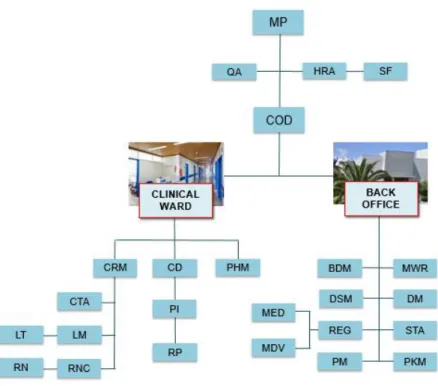
Blueclinical Phase I Unit organization is schematized in the organogram in Figure 6.
Figure 6 - Blueclinical Phase I Organogram 32.
MP-Managing Partner; QA-Quality Assurance; HRA-Human Resources and Administration; SF-Support Functions (IT,
HR, Administration); COD-Clinical Operations Director; CRM-Clinical Research Manager; CD-Clinical Director;
PHM-Pharmacy Manager; CTA-Clinical Trials Assistants; LM-Laboratory Manager; LT-Laboratory Technicians; RNC-Research Nurse Coordinator; RN-Research Nurses; PI-Principal Investigator; RP-Research Physicians;
BDM-Business Development Management; DSM-Drug Safety Management; REG-Regulatory Affairs Management; MED-Medicines Unit; MDV-Medical Devices Unit; PM-Project Management; MWR-Medical Writing and Reporting; DM-Data Management; STA-Statistics; PKM-Pharmacometrics.
30
The clinical and scientific team has experience in varied types of studies for the global market, both with generics (bioavailability/bioequivalence) and innovative medicines.
The clinical and scientific team is composed 2 Clinical Pharmacologists, 8 Research
Physicians, 22 Research Nurses, 3 Laboratory Technicians, 2 CTAs and 1 Pharmacist. Some collaborators have more than 10 years of experience in phase I studies.
Blueclinical Phase I unit, for being located in the hospital, has access to immediate medical support in case of emergency, accredited clinical laboratory and imaging for safety tests and logistic services.
Phase I unit has restricted access with electronic system and facilities include:
34 adjustable beds, distributed by seven quadruple rooms and three double bedrooms;
For safety reasons, the rooms have an internal window that allow permanent visual monitoring of trial participants;
Several bathrooms and showers;
Dining and living room for volunteers;
All bedrooms, dining and living room have cable television. All unit are equipped with wireless internet;
Emergency call system to use in case of emergency, in bedrooms, bathrooms and showers;
A pharmacy with electronic restricted access to necessary staff. The room has protection of direct light and control of temperature and humidity.
The laboratory is equipped with appropriated equipment to perform sample processing.
The storage room, near the laboratory, has electronic restricted access to necessary staff and is where are located the freezers (-20°C / -80°C) for sample storage. The room is protected from direct light and has temperature control. Electrical outlets of this room have access to a back-up generator in the event of power failure;
The nursing room is appropriately equipped with sample collection chairs and clinical equipment and supplies necessary to perform clinical procedures;
The emergency cart is located in strategic position in the corridor to allow immediate movement in case of emergency;
A physician office with clinical equipment to perform medical appointment and clinical examination;
A management office and a coordination office.
Phase I unit contains the required clinical equipment to perform clinical procedures according with required with Protocols and Blueclinical Standard Operating Procedures (SOP).
4.2 EXPERIENCE AS RESEARCH NURSE
In 2013, I start working at Blueclinical, in part-time, as RNC and in the same year I started the Training Programme in Pharmaceutical Medicine, at Aveiro University.
Despite having a few years of experience in clinical trials, the knowledge acquired at the Training Programme in Pharmaceutical Medicine is huge. When administering a medicinal product had no idea of the amount of years of research and the costs involved until the introduction of the new drug on the market.
In 2014, I leave the hospital and begin full-time functions in Blueclinical as RNC.
EXPERIENCE AS RESEARCH NURSE COORDINATOR
Nursing team coordination
As RNC I lead, organize and manage Blueclinical Phase I nursing team, ensuring adequate training and qualifications, in compliance with applicable legal and regulatory requirements,
32
clinical trial protocols (CTP), Blueclinical Standard Operating Procedures (SOPs) and ICH Good Clinical Practices (GCP).
As responsible of the training process of the nursing team I provide training and assure the development of clinical SOPs related with nursing practice, in order to standardize nursing activity. Re-education of nursing team could be necessary according with evaluation of their performance.
It is also my responsibility the recruitment, interview and selection of new staff to integrate the nursing team.
Quality assurance
As Research Nurse Coordinator collaborate with Quality Assurance Department developing appropriate action plans for quality improvement.
SOP is a set of information and written instructions that document a procedure or activity in order to perform it properly and consistently, reflecting the activity followed by an
organization. SOPs minimizes variation of procedures and promotes quality through consistency even if there are personnel changes 33.
The development and use of SOPs are an important step of a successful quality system. SOP is not rigid, can be updated and I am responsible for reviewing the SOPs concerning to nursing procedures and assure their suitability to practice.
Evaluate nursing performance and ensure that nursing team guides its practice in a standardized way, according to defined in SOP.
Audits and inspections
Blueclinical is a growing company and qualification audits are becoming a common situation in daily life of the company. The purpose of these audits is to evaluate the company in order to establish partnerships. These visits are very complete and include presentation of Blueclinical services, facilities tour, interviews to some collaborators, consulting of documents as SOPs,
templates of medical documentation and source documents, site qualification documents (CVs, training and qualification records of staff), laboratory and equipment documents.
After an audit the company writes a visit report, making observations about situations, negative or positive, which it considers relevant. After an inspection will be issued a document reporting the findings found.
As member of the clinical team I collaborate in internal and external auditing, inspections, qualification visits, activities preparation and in the implementation of eventually necessary Corrective Action Preventive Action (CAPA) plans.
Consultant
My collaboration as a consultant began in the elaboration of structural plan of Blueclinical Phase I Unit. I and other members of the team, as the Clinical Director and Clinical Research Manager, were invited to meet the infrastructure and give opinion in order to get the best structural design for the new Phase I unit, taking into account the previous work experience. After completion of the project, it was necessary to equip the entire unit with appropriate clinical equipment and supplies for the beginning of activity and to the normal operation of the Unit. It was a gratifying experience, start a project and see it grow is always a major focus of motivation.
The protocol is developed by a team, and sometimes my collaboration is required as a
consultant on issues related to clinical practice, collaborating in the protocol design in terms of planning of clinical procedures.
Emergency Cart maintenance
The best strategy to deal with an emergency is to be prepared before it happens. For this reason, Blueclinical Phase I Unit is prepared with clinical staff trained and qualified in emergency, with an emergency cart, immediate medical support of the Hospital in case of emergency and availability of vacancies in the Intensive Care Unit.
34
The emergency cart is equipped with defibrillator monitor, emergency equipment, rescue medication and oxygen. The material is organized to allow intervention in case of
life-threatening due to impairment of respiratory, cardiac or neurological system, allowing to act on the airway, breathing, circulation and neurological dysfunction.
I am responsible for the maintenance of the emergency cart and rescue medication together with the research pharmacist.
The emergency cart is sealed and this seal is checked daily to assure that all equipment is according the last review.
All equipment and supplies are verified monthly to check their conditions and expiry dates. The defibrillator monitor is tested monthly to assure the proper function, and is calibrated for an external company at least once a year.
This procedures are described in SOP and must be recorded in appropriate documents.
Work plans and Nursing Schedule
As Coordinator of the nursing team I collaborate with Project Manager on the performing of Master Work plan. This plan contains all the procedures to be performed individually to each volunteer, as required by the protocol. After preparation of this plan, it is possible to determine the staff number necessary to perform all the clinical trial procedures, for example, the number of Physicians, Nurses, Laboratory technicians or CTAs. Besides the calculation clinical staff, also allows to perform the work plans of each team member.
During the clinical trial, the work plans are used to guide each team member, defining the tasks and procedures necessary to perform.
To assure the plan is well designed, these documents are subjected to rigorous quality control process, made by different person. A small mistake in these documents can lead a big deviation from the protocol.
I also have the responsibility of performing the Nursing shifts schedule. When developing the nursing schedule I always have the concern to balance the number of Junior and Senior nurses.
The Senior Nurses have more experience in clinical trials and are qualified with advanced life support course. Senior Nurses are present in all confinement period of the clinical trial.
Equipment and stock management
Every clinical trial needs preparation, namely in what refers to clinical equipment and
materials. The overall clinical equipment must remain properly calibrated and verified, taking into account their specificity and needs. As for the clinical supplies, the stock needed for each clinical trial is calculated according with the specifications of each protocol, for example, number of volunteers, number of confinement periods, number of required blood samples or the need for electrocardiograms (ECGs), ensuring that sufficient and proper equipment and material are available to the conduct of the clinical trial.
Selection of clinical supplies and equipment necessary for the proper functioning of the unit requires research, contact with suppliers and budgets management, in order to obtain the desired product at the best price.
It is my responsibility to assure the management of clinical supplies and clinical equipment, ensuring its good conditions, maintenance and stock.
EXPERIENCE AS RESEARCH NURSE
Besides the coordination of the nursing team, I also have the research nurse functions. During the development of a clinical trial there are a lot of activities that could be done by a research nurse. I had the opportunity of developing the following procedures and responsibilities during my professional activity.
Investigators Meeting
After authorities approval and before every trial initiation it is necessary to organize and conduct the investigators meeting to assure that all team, clinical and non-clinical, has the
36
appropriate training in the clinical trial protocol about to start. Besides this training, the team must have their training in GCP and SOPs updated.
At the meeting, the clinical trial protocol will be presented in detail, addressing the study objectives, the IMP to be tested, eligibility criteria, randomization and enrollment procedures, clinical procedures during the trial, safety assessment and AEs monitoring and report. The source documents, electronic case report forms (eCRFs), and instructions for completing will be presented to. During this meetings can be clarified doubts about the trial and discussed opportunities of improvement.
Volunteers recruitment
Before volunteers recruitment, a recruitment memorandum is prepared with Protocol and informed consent information, to be used as a guide during the recruitment phone call and to present information about the trial.
Blueclinical Phase I has an online database (approved by CNPD) where candidates to
volunteer can do their registration and fill some personal information. Volunteers can only be selected from this database.
During recruitment, a screening visit is scheduled to assess volunteer healthy condition and evaluate volunteer eligibility.
Informed Consent
Before the screening process, the volunteer will be informed about the study, specifically about its end points and participation risks. All doubts about the trial will be explained and the volunteer can decide in a free way if he/she wants to participate in the clinical trial. The decision is consummated with the signing of ICF.
As research nurse, I can support research physician obtaining the informed consent, according to protocol, SOPs and regulatory requirements and review of the informed consent form signatures.
Screening
The screening goal is to assess and document volunteer healthy condition and evaluate volunteer eligibility.
The screening visit comprise a medical appointment which includes demographic data, vital signs, medical history and physical examination. After medical appointment the following exams are performed by the research nurse: ECG, blood samples to hematology, biochemistry, coagulation, viral serology (Human Immunodeficiency Virus (HIV), hepatitis B and C) and serum pregnancy test (if woman). Urine is collected to urinalyses and to test drugs-of-abuse, and it will be performed an ethanol breath test. Additionally, it may be performed more laboratory tests if required by protocol.
The volunteer eligibility is only finalized after evaluation of the laboratory results, by the Principal investigator or the authorized research physician.
After eligibility completion, the volunteer is informed by phone that can proceed to admission, this contact can be performed by the research nurse.
Admission
Admission occurs on the day before of the dosing day. At this moment, it is performed a review of selection criteria, medical history and physical examination update, by research physician. The research nurse will be responsible to perform ethanol breath test, assessment of vital signs and urine collection to test drugs-of-abuse and pregnancy test in woman. After assessing all results, the research physician randomize the volunteers that accomplish all requirements to participate in the clinical trial and starts the confinement phase.
In Phase I Unit, after randomization, the volunteers will be identified with a bracelet which will include the number of randomization and initial of his name. It will be assigned a uniform to use in the unit and will be assigned a bed according to their number. The belongings will be stored in a locker with a key.
All unit rules will be explained as well as all procedures that will be performed so that the whole process of confinement runs smoothly.
38
Confinement phase
All volunteers stay confined at the clinical research facilities under the same conditions. Diet and fluids are standardized, meals and snacks are identical in all periods and provided according with times defined in Protocol.
According with randomization code, volunteers are assigned with treatment sequence defined in Protocol, and the IMP can be administered by research nurse or research physician, after an overnight fasting or after a high-fat and high-caloric breakfast. IMP administration is a critical procedure and according with SOP, is made under supervision of a witness that could be another research nurse, a research physician, a Research Pharmacist or a CTA.
Blood samples are collected by research nurse, at selected times, to determine plasma concentrations. The assessment of vital signs can be done by research nurse or research physician, at times defined on Protocol.
All the procedures, as meals, IMP administration, blood samples collection and vital signs assessment are made under strict compliance with the time set for their achievement. Blood samples are centrifuged, processed and storage by a Laboratory Technician, and later are transported to a biolaboratory to be analysed.
End of Study and Follow up
At the end of the study some procedures are repeated for safety reasons and to document that health condition of volunteer maintains.
Research nurse perform vital signs measurement and collect blood for hematology, plasma biochemistry and serum pregnancy test, in woman.
Research physician updates AEs and if safe, authorize discharge from the confinement phase. After discharge may be necessary to return for additional blood samples or other follow up test.