CARNEGIE MELLON UNIVERSITY INFORMATION NETWORKING INSTITUTE
SECURING CRITICAL UTILITY
SYSTEMS & NETWORK INFRASTRUCTURES
Bruno Miguel Inácio Garrancho
Thesis Committee:
Paulo Jorge Esteves Veríssimo, Advisor António Casimiro Ferreira da Costa, Reader
Hans Peter Reiser
Submitted in partial fulfillment of the requirements for the degree of MASTER OF SCIENCE IN
INFORMATION TECHNOLOGY - INFORMATION SECURITY
November 2009
UNIVERSIDADE DE LISBOA FACULDADE DE CIÊNCIAS DEPARTAMENTO DE INFORMÁTICA
SECURING CRITICAL UTILITY
SYSTEMS & NETWORK INFRASTRUCTURES
Bruno Miguel Inácio Garrancho
MESTRADO EM SEGURANÇA INFORMÁTICA
UNIVERSIDADE DE LISBOA FACULDADE DE CIÊNCIAS DEPARTAMENTO DE INFORMÁTICA
SECURING CRITICAL UTILITY
SYSTEMS & NETWORK INFRASTRUCTURES
Bruno Miguel Inácio Garrancho
Orientador
Prof. Doutor Paulo Jorge Esteves Veríssimo
MESTRADO EM SEGURANÇA INFORMÁTICA
Resumo
As infra-estruturas críticas de TI para serviços públicos são apoiadas por inúmeros sistemas complexos. Estes sistemas permitem a gestão e recolha de informação em tempo-real, con-stituindo a base para a gestão eficiente das operações. A utilização, cada vez mais fre-quente, de software e hardware (Commercial Off-The-Shelf, COTS) em sistemas SCADA permitiu grandes beneficios financeiros na aquisição e desenvolvimento de soluções téc-nicas que suportam os serviços públicos. O uso de hardware e software COTS em sistemas SCADA transferiu para as estruturas críticas os problemas de segurança de uma infra-estrutura de TI empresarial.
Neste contexto, um desafio para as equipas de gestão operacional dos sistemas de TI é a gestão eficaz dos sistemas e redes que compõem as infra-estruturas críticas dos serviços públicos. Apesar de estas organizações adoptarem, cada vez mais, normas e melhores práticas que visam melhorar a gestão, operações e processos de configuração.
Este projecto de investigação propõe-se a desenvolver um estudo comparativo de plata-formas de gestão integrada no contexto dos sistemas SCADA que suportam serviços públi-cos. Adicionalmente, este projecto de investigação irá desenvolver estudos acerca de perfis operacionais dos Sistemas Operativos que suportam a infra-estrutura IT dos serviços públi-cos crítipúbli-cos. Este projecto de investigação irá descrever como as decisões estratégicas de gestão têm impacto nas operações de gestão de uma infra-estrutura TI.
Palavras-chave: SCADA; Segurança; Monitorização; Sistemas Operativos; Plataformas de Gestão Integrada;
Abstract
Modern critical utility IT infrastructures are supported by numerous complex systems. These systems allow real-time management and information collection, which is the basis of efficient service management operations. The usage of commercial off-the-shelf (COTS) hardware and software in SCADA systems allowed for major financial advantages in pur-chasing and developing technical solutions. On the other hand, this COTS hardware and software generalized usage in SCADA systems, exposed critical infrastructures to the se-curity problems of a corporate IT infrastructure.
A significant challenge for IT teams is managing critical utility IT infrastructures even upon adopting security best practices that help management, operations and configuration of the systems and network components that comprise those infrastructures.
This research project proposes to survey integrated management software that can address the specific security constraints of a SCADA infrastructure supported by COTS software. Additionally, this research project proposes to investigate techniques that will allow the creation of operational profiles of Operating Systems supporting critical utility IT infra-structures.
This research project will describe how the strategic management decisions impact tac-tical operations management of an IT environment. We will investigate desirable technical management elements in support of the operational management.
Keywords: SCADA; Security; Monitoring; Operating Systems; Integrated Management Platforms;
Acknowledgments
I would like to thank Carnegie Mellon University, Information Networking Institute, and Faculdade de Ciências da Universidade de Lisboa, Departamento de Informática, for their dedication to this project.
I would like to thank Professor Paulo Veríssimo for his guidance during the development of this research project.
I would like to thank Luís Barruncho and Logica for believing in me and supporting my work during the last year.
I would like to thank Paulo Moniz and Miguel Areias for their insigth during the develop-ment of this project.
I would like to thank my colleagues Benjamim Durães, Carlos Silva, Elisa Páscoa, Eugénio Pinto, João Borralho, João Ramos, Luís Sousa, Nuno Loureiro, Ricardo Ramalho, Sérgio Nunes and Tiago Mendo. You have been great journey companions and I have learned from all of you.
I would like to thank Patrícia and my parents for their patience during the course of this endeavour.
”Dream in a pragmatic way.”, Aldous Huxley
Contents
1 Introduction 1
1.1 Motivation . . . 1
1.2 Contributions . . . 3
2 Critical Utility IT Infrastructures Security Management 5 2.1 IT Infrastructure Service Management . . . 5
2.1.1 ITIL . . . 6
2.1.2 IT Governance . . . 6
2.1.3 CobiT . . . 6
2.1.4 ITSM . . . 6
2.2 IT Infrastructures Security Management Process . . . 7
2.3 IT Infrastructures Security Management Concepts . . . 8
2.4 Operational Management of Critical Utility IT Infrastructures . . . 9
2.5 Defense in Depth and Information Assurance in Critical Utility IT Infra-structures . . . 10
2.6 CRUTIAL - CRitical UTility InfrastructurAL resilience . . . 13
2.7 Management Standards & Critical Utility IT infrastructures . . . 14
2.8 Security Challenges in Critical Utility IT infrastructures . . . 15
3 Survey of IT Systems Management Software 17 3.1 Trends and Evolution . . . 17
3.3 Survey of Vendors and Platforms . . . 19 3.3.1 BMC . . . 20 3.3.2 CA . . . 21 3.3.3 EMC . . . 21 3.3.4 HP . . . 22 3.3.5 IBM . . . 23 3.3.6 Microsoft . . . 24
3.3.7 IT Systems Management Platform Analysis . . . 24
3.4 Evaluation of Selected Platforms . . . 25
3.4.1 HP Operations Manager 8.10i . . . 26
3.4.1.1 Overview . . . 26
3.4.1.2 Operations Manager Console . . . 26
3.4.1.3 Operations Manager Server . . . 27
3.4.1.4 Operations Manager Agents . . . 27
3.4.2 Microsoft System Center Operations Manager 2007 R2 . . . 28
3.4.2.1 Overview . . . 28
3.4.2.2 Required Server Roles and Components . . . 28
3.4.2.3 Optional Server Roles and Components . . . 31
3.4.2.4 Management packs . . . 34
3.4.3 Evaluation . . . 35
4 Windows Management Architecture 37 4.1 The Registry . . . 37
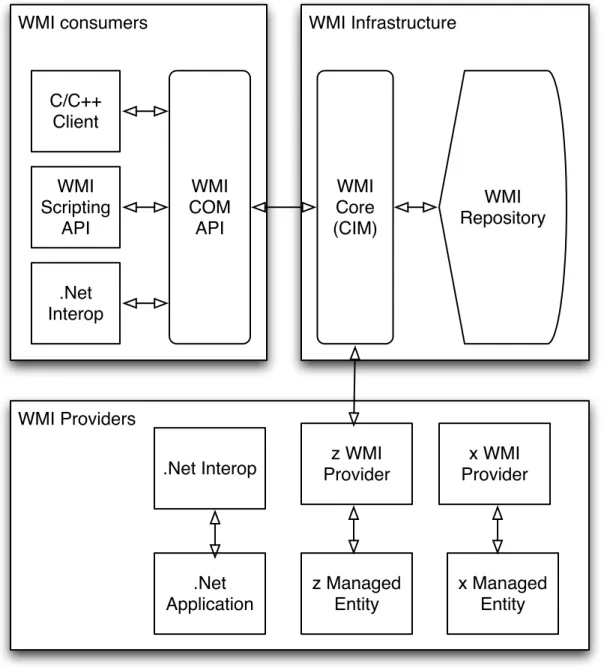
4.2 Windows Management Instrumentation . . . 38
4.3 Windows Securable Objects . . . 40
5 Monitoring COTS Control Systems 43 5.1 Event Tracing . . . 43
5.3 Windows OS Event Providers . . . 47
5.4 Kernel Trace Analysis . . . 49
5.4.1 Process, Thread, Modules, Process Counter Events . . . 50
5.4.2 Context Switch and Interrupt Service Routine Events . . . 51
5.4.3 Memory Events . . . 52
5.4.4 Network Events . . . 52
5.4.5 Registry Events . . . 52
5.4.6 Sample-Based Profile Events . . . 52
5.4.7 System Call Events . . . 53
6 IT Managment Platform Agent Profiling 55 6.1 Testbed . . . 55
6.2 HP Operations Manager 8.10i Agent Scenario . . . 55
6.3 Microsoft Systems Center Operations Manager 2007 R2 Agent Scenario . . 57
6.4 ETW Agent Scenario . . . 58
6.5 Evaluation . . . 60
7 Conclusion and Future Work 61 7.1 Conclusion . . . 61
7.2 Future Work . . . 61
List of Figures
2.1 Defense in Depth Layers . . . 11
3.1 Systems Center Operations Manager 2007 R2 Architecture . . . 29
4.1 WMI Architecture . . . 39
5.1 ETW Architecture . . . 44
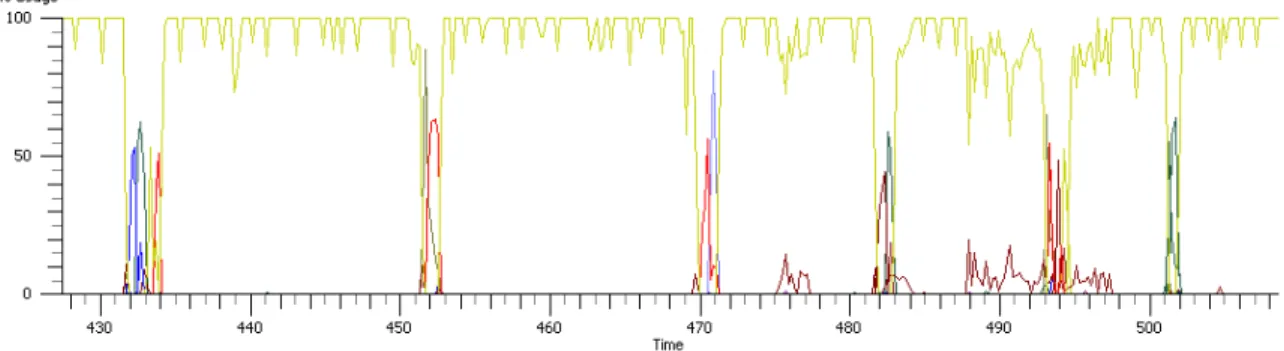
6.1 CPU Sampling of HP Agent Processes + Idle (System Overview) . . . 56
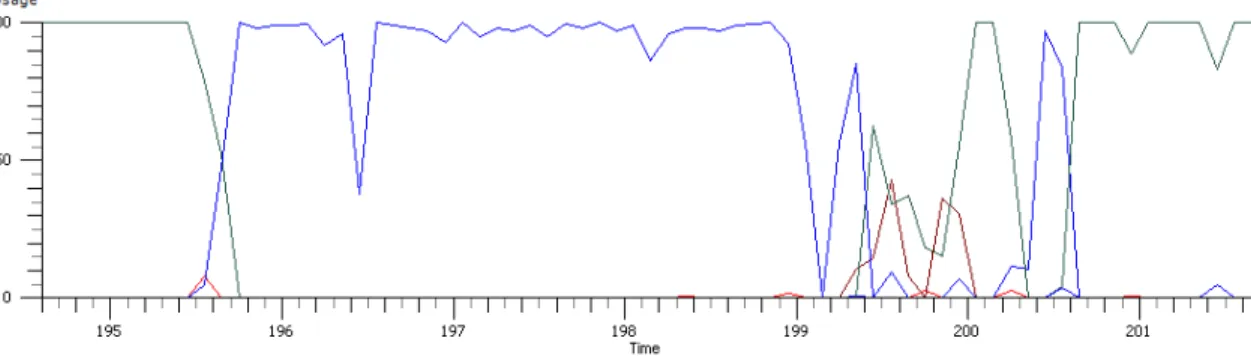
6.2 CPU Sampling of HP Agent Processes + Idle (Detailed View) . . . 56
6.3 Total CPU Utilization (Detailed View) . . . 56
6.4 CPU Sampling of SCOM Agent Processes + Idle (System Overview) . . . . 57
6.5 CPU Sampling of SCOM Agent Processes + Idle (Detailed View) . . . 57
6.6 Total CPU Utilization (Detailed View) . . . 58
6.7 CPU Utilization ofrt-app + rt-sup + Idle Process (Overview) . . . 59
6.8 CPU Utilization ofrt-app + rt-sup + Idle Process (Detailed View) . . . 59
List of Tables
2.1 Corporate VS Control Systems . . . 16
3.1 Comparative Table of the IT Management Platforms . . . 25
3.2 Testbed Configuration Per Machine . . . 35
5.1 Flags Per Function . . . 48
5.2 Flags Per Group . . . 49
Chapter 1
Introduction
1.1 Motivation
Modern Critical Utility IT Infrastructures are supported by numerous complex systems. These systems allow real-time management and information collection, which is the basis of efficient service management operations. SCADA stands for Supervisory Control And Data Acquisition and it serves to designate these types of systems.[1]. The main function of SCADA systems is to provide accurate, and as close to real-time, information while allowing operators to respond to events in order to maintain the functional requirements of a system.
To support the communication of SCADA data a communication network must be in place. Traditionally these communication systems operated proprietary protocols on fixed tele-phone landlines and modems. As communication networks evolved, TCP/IP based tech-nology became an efficient way of communicating SCADA data. TCP/IP was used to overcome some of the legacy problems and also allowed for more flexibility in terms of scalability and operations.
As with communications, systems and hardware also became more mainstream and with that, the usage of COTS (commercial, off-the-shelf) hardware and software in SCADA systems allowed for major financial advantages in purchasing and developing. On the other hand, this COTS hardware and software generalized usage in SCADA systems, exposed critical infrastructures to the security problems of a corporate network.
A significant challenge for IT teams managing Critical Utility IT Infrastructures are man-agement, operations and configuration of the systems and network components that com-prise those infrastructures. The management knowledge travels from the corporate world
into a distinct paradigm. Usually, the properties that have to be achieved by the systems supporting critical infrastructures differ from those on the corporate world.
One source of security concerns is the operational management of the IT infrastructure. Operations can drive a system, and potentially the whole IT infrastructure, to an insecure state. As the systems that support the SCADA operations rely more on COTS hardware and software, infrastructure security relies on extending operational procedures common on corporate infrastructures to the SCADA infrastructure domain. Another important aspect of these SCADA infrastructures is that they are in constant evolution in response to the company’s demands. This puts an even greater stress on the operational management staff capabilities, and often security problems originate in erroneous operational configurations. One extremely important threat to critical utilities is Cyber-Terrorism which, in general terms, relates information technology to unconventional warfare attacks. In [2], Purpura draws a broad picture of the practical implications of Terrorism for the United States of America, but his reasoning is quite accurate for other country’s reality. In his characteriza-tion of terrorism he describes specific forms of terrorism, like Cyber-Terrorism. Common sense and history have proved, numerous times, that utilities are a natural target in conven-tional warfare and unconvenconven-tional warfare scenarios.
By 2005, the SmartGrids European Technology Platform for Electricity Networks of the Future started with the promotion of a new vision for the development of European electri-city networks[3]. For this vision to become reality it is required that all the stakeholders, involved in the project, are aware of the challenges that lay ahead. Some of these fore-seeable challenges are heavily dependent on information and communication technologies and the resilience of those technologies to failures or attacks.
This research project will focus on establishing the grounds to achieve a dependable oper-ational environment for a critical utility IT infrastructure. We will establish a strategy to maintain a dependable environment, based on COTS software, and survey operational man-agement platforms, from several industry vendors, accessing their coverage for the tactical requirements of such an environment.
One of the goals of this project is to investigate techniques that will allow the monitorig of COTS systems supporting criticl utility IT infrastructure. This information has significant value for day-to-day operations and can also be used in behavior-based intrusion detection, note that behavior-based detection can coexist with signature-based detection in such in-frastructures. System monitoring is a starting point for a complete security management process which includes assessing risks and threats, product vulnerabilities and new attack vectors. This work will enable the operational management team to create strategies and
plans for detection of threats and protection of the SCADA IT infrastructure.
1.2 Contributions
This research project is a subset of an ongoing major effort to improve the security of the SCADA system for a European Electric Power Company.
The starting point for this research project is the necessity to evaluate tools that will enable a global strategy of Defense-in-Depth of the complete critical utility IT infrastructure. One important goal is detailing a plan for the evolution of a reliable management platform on which next generation demands can be met without compromising security.
This research project will include studying several techniques of monitoring of OS in-formation. The gathered information will promote the creation of a plan to supervise the SCADA IT infrastructure. A first step will require the study of IT operations management platforms, these platforms will allow the collection of relevant metrics and events on which the operational management of the SCADA IT infrastructure can define security policies. The collected information will in turn be correlated with other information ( NIDS, firewall logs ) to achieve full coverage of the IT infrastructure.
Furthermore, this research project will focus on studying the Microsoft Windows Operating System architecture supporting these critical information systems in order to investigate systems analysis techniques which can help identify threats to systems and, ultimately, the whole infrastructure.
Chapter 2
Critical Utility IT Infrastructures
Security Management
2.1 IT Infrastructure Service Management
The growing complexity and evolution of IT infrastructures lead to IT Service Manage-ment concept. Winniford et.al., studied the currently adopted concepts and frameworks [4]. The study concluded that the broad definitions of the concepts and frameworks are sufficient for the upper management requirements of the IT Service Management process. The frameworks studied aim at managing service of generic IT infrastructures and are extremely valuable in order to relate the Critical Utility IT Infrastructure to the upper man-agement business requirements. One interesting concept of IT Service Manman-agement is the ”functional silos” concept, i.e. aggregation of IT services with end-to-end definitions for availability and performance, that concept loosely relates to the defense-in-depth strategy for achieving dependable Critical Utility IT infrastructures.
IT Service Management concepts have grown out, among others, of the Information Tech-nology Infrastructure Library - ITIL[5]. Currently the IT community discusses the exact scope and overlapping of IT concepts, such as ITSM, ITIL, Control Objectives for In-formation and related Technology - CobiT[6]. Additionally, the International Standards Organization (ISO) ratified ISO/IEC 20000 a standard that brings together these several paradigms under a common set of principles, which can be generally defined as IT Service Management.
Next, we characterize some of these views on IT systems management. This description serves to situate Critical Utility IT infrastructures management in the complex management
scenario of an organization.
2.1.1 ITIL
General recognition of IT service management needs resulted in the definition and rise of ITIL, a set of books describing best practices in several areas of service management. Cur-rently the scope has been broadened to include a life-cycle perspective on service strategy, design, transition, operation, and continuous improvement. ITIL service support consists of several sub-processes for making structured changes to the infrastructure. ITIL service delivery defines sub-processes for maintaining the infrastructure running at agreed-upon levels, including Service Level Management - SLM as one of those sub-processes.
2.1.2 IT Governance
Started by the audit abuses that prompted the Sarbanes-Oxley Legislation - SOX [7], IT governance is yet another term subject to broad and narrow definitions. IT Governance in a strict sense is the appropriation of decision rights in an organization structure, and in a broad sense is the overall strategy. This strategy definition includes risk, financial, and process management. IT governance does not address the daily management of an IT organization.
2.1.3 CobiT
The Information Systems Audit and Control Association - ISACA [6] has developed the Control Objectives for Information and related Technology to translate another paradigm of IT management concepts. CobiT groups IT governance objectives into areas cover-ing: Planning and organizing; Acquiring and implementing; Delivering and supporting; Monitoring and evaluating. The CobiT framework seeks to create business controls and accountability while still viewing IT service in terms of functional silos .
2.1.4 ITSM
In 2005, the International Standards Organization - ISO ratified ISO/IEC 20000 [8] which, again, brings together several service management streams under a common set of prin-ciples, which are generally called IT Service Management. It defines both a specification
and a code of practice for service management. The service delivery areas of IT operations management have little, to none, published academic research. Researchers are still trying to determine the industry maturity, understanding and adoption of IT Service Management practices.
2.2 IT Infrastructures Security Management Process
Security management planning requires the creation, deployment, and enforcement of a se-curity policy. The most effective way to address sese-curity management planning is using a top-down approach. The definition of security policies for the organization is, the respons-ibility of the upper management, usually based on the concepts described in Section 2.1. These security policies provide direction to the lower levels of the organization’s hierarchy. The responsibility of middle management is to, starting from the security policy, adopt and develop standards, baselines, guidelines, and procedures. The operational managers must then deploy the configurations detailed by the security management documentation and monitor the system for exceptions to the security policy.
In a broad sense a key function of most organizations is to ”maintain security”. Every organization is interested in securing its assets, its information and its business. The process of designing, implementing and operating IT infrastructures is complex and, therefore, risk prone. To better manage IT infrastructure security design, implementation and operation those processes have been, to some extent, formalized. A goal of the process formalization is to transform the complexity of the IT security design, implementation and operations into a manageable process which allows for accountability and verification.
The formalization of security process can be viewed as an hierarchical organization of information and documentation. The top level of this formalization can be viewed as a security policy, i.e., a definition of the scope of security mechanisms needed by the or-ganization in relation to assets that need protection. The following layer can be viewed as security standards, baselines, and guidelines which is a more detailed technical guidance for the enforcement of the security policies. The bottom layer is comprised of security procedures, i.e., a detailed technical description of a specific security mechanism, control, or solution.
Most of the reasoning in this section is a direct match to corporate world current panorama, but also a valuable starting point when addressing Critical Utility IT Infrastructures.
2.3 IT Infrastructures Security Management Concepts
Security management concepts and principles are fundamental elements of a security policy. They define the parameters needed for a secure environment. They also serve as goals and objectives that both policy creators and implementers must achieve in order to create a secure environment.
The primary goals and objectives of security are as follows: • Confidentiality
• Integrity • Availability
We shall not go into extensive description given that these security principles have been subject to much discussion and tend to be common sense for the security field practitioners. Security controls are usually evaluated on whether they address these core information security principles. Vulnerabilities and risks are also evaluated based on the threat they pose against one or more of the goals and objectives stated above.
In corporate environment each of the principles tends to have the same relative weight in relation to the other two in every stage of the security management planning process. This research project will focus on the operational aspects of Critical Utility IT infrastructures in regards to achieving, what are understood as the primary goals and objectives of security. Also, when designing a security policy and deploying a security solution there are also other security principles that need to be addressed, namely: privacy, identification, authen-tication, authorization, accountability, non-repudiation and auditing.
Along with the security concepts, this research project also considers protection mechan-isms. They represent some of the characteristics of security controls, namely: layering, abstraction, data hiding and encryption. The security controls offer their protection for confidentiality, integrity, and availability through the use of these mechanisms.
One important aspect of security management is the management of change. Change in a secure environment can lead to vulnerabilities. To maintain security in the face of change requires to systematically manage change. To achieve this systematic approach requires extensive planning, testing, logging, auditing, and monitoring of activities related to secur-ity controls. The records of changes to an environment can be used to identify agents of change, whether those agents are objects, subjects, programs, communication pathways, or
even the network itself. A goal of change management is to ensure that any change does not lead to reduced or compromised security situation.
2.4 Operational Management of Critical Utility IT
Infra-structures
Most companies are aware that day-to-day operations of their corporate IT infrastructure can be a source of security related problems. IT best practices are usually aligned with business requirements,i.e. IT Service Management. One of the basic goals of an IT organ-ization is to optimize server and application availability and performance.
Continuous optimization of the Critical Utility IT Infrastructure is a fundamental role of the Operations Management team. One significant challenge these IT teams face is achieving the balance between efficient and cost effective management. This is due, mainly, to two factors: the functional silos, teams specialized in a specific IT technology; and the tools or management platforms are unique, within the functional silos, in support of operations. Difficult cooperation between distinct functional silos, due to proprietary interfaces, has an impact on the efficiency of the management environment. Not forgetting that new ap-plications introduced in support of business requirements require, themselves, specialized management and monitoring. Given the above scenario, it is clear that root cause analysis of incidents impacting business can be an challenging task in such a scenario. We can also state that, to some extent, the existence of independent functional silos prevents the adoption of management processes, like the ones described in Section 2.2.
Those management process controls, described in Section 2.2, are becoming a mandated requirement for most corporations and critical utilities companies are no exception. This shows the inter-relations between corporate management processes and IT operations man-agement. Additionally, all this reasoning justifies the importance of cross-functional silos integrated management.
Chapter 3 describes into technical extent the requirements of integrated management plat-forms.
2.5 Defense in Depth and Information Assurance in
Crit-ical Utility IT Infrastructures
One easy parallel to trace while addressing Critical Utility IT infrastructures is that of information in support of military operations [9]. The management of SCADA systems requires timely and accurate information, just like military warfare operation. Defense in Depth strategy relates to managing in an integrated manner the capabilities of teams, operations and technology to achieve effective, multi-layer, multi-dimensional resilience to possible attacks on the infrastructure. The goal is to delay the advance of the attacker by maintaining multiple, layered lines of defense rather than one strong defensive line, perimeter defense.
In terms of infrastructure security, defense in depth is a security strategy wherein defenses are overlapped so that a breach in one layer only leads the opponent to the next layer of defenses. Layering defenses helps to prevent direct attacks against critical systems and data, increases the probability of the attack being detected, and provides the defender with more time to reconfigure defenses to where they are really needed in the event of an at-tack. In figure 2.1 we provide a vision of defense in depth with relation to a critical utility infrastructure.
The layers of defensive positions in defense in depth can be described as follows:
• Data. An attacker’s first choice target. Databases, service information, documents contain deep knowledge on the operational scenario and tend to be trampolines to more broad attacks.
• Application. The software that manipulates the data that is the ultimate target of attack.
• Host. The systems that are running business critical applications. • Internal Network. The network infrastructure.
• Perimeter. The network that connects the IT infrastructure to other networks, such as to external users or application support.
• Physical. The tangible aspects in computing. Computers, network devices, facilities. • Security Management Process. The overall governing principles of the security
Figure 2.1: Defense in Depth Layers
Host and Application are the main concerns of our research project. The details investigated in this research project are strictly linked to those areas of security. This approach eases the separation of duties and concerns among distinct functional silos of an organization, and thus eases the roll-out of this project onto an organization adhering to this strategy.
An important principle that guides defense in depth is achieving Information Assurance. Information Assurance is an holistic principle that relates protection coverage from attacks, by application of security mechanisms, to assure confidentiality, availability, integrity, au-thentication and non-repudiation. It is clear to say that achieving Information Assurance requires an organic relationship between three key elements: people, technology and oper-ations.
People
Senior level management commitment, based on a clear understanding of the perceived threats, is a key point in the whole strategy of defense in depth. This must be followed with effective policies and procedures, clear definition and assignment of roles, training of users and system operators, and infrastructure wide personal accountability and audit-ability. This includes the establishment of physical security and personnel security measures, the
goal is to control and monitor access to facilities and elements of the IT infrastructure environment.
Technology
Currently, a wide variety of technologies are available in support of Information Assur-ance. To insure that the right technologies are procured and deployed, any organization should establish a strict policy for technology acquisition. Where and how to deploy these technologies should be defined along the lines of Defense in Depth strategy.
In critical utility IT infrastructures the focus should be on the following general areas: Networks - An organization needs to deploy security mechanisms at multiple locations to
handle all classes of attacks. Adversaries can attack a target from multiple points us-ing either insiders or outsiders. These defensive standpoints should include defend-ing the networks and communications infrastructure. The protection mechanisms should include providing confidentiality and integrity protection for data transmit-ted over these networks, protection from Denial of Service attacks should also be included in both the local and wide area communications networks.
Boundaries - Firewalls and intrusion detection systems to address active network attacks. Defend the computing environment by providing adequate access controls on hosts to resist insider attacks.
Layering - Even the best available products have inherent weaknesses and finding an ex-ploitable vulnerability in a system is just a matter of time and effort. To address this problem organizations must deploy multiple defense mechanisms between the attacker and his target. Each of these mechanisms must present unique obstacles to the adversary and optimally should include both protection and detection measures. These measures help increase risk of detection for the attacker while reducing his chances of success or making successful penetrations unaffordable.
Robustness - It is necessary to specify the security strength of protection components as a function of the value of what’s it is protecting and the threat at the point of applica-tion, risk management. Additionally choosing where to deploy stronger mechanisms is also of significant importance to the overall strategy.
Detection - Mechanisms should be in place in the managed infrastructures to detect in-trusions, analyze and correlate the results and react accordingly. The goal is to turn
infrastructures into helpers of the Operations staff. These mechanisms should allow Operations staff to identify if the infrastructure is being attacked, what are sources and targets of the attack and what further measures are needed to correct the situation.
Operations
Operations focuses on all the activities required to maintain an organization’s security pos-ture on a day to day basis. These activities include:
• Managing the security evolution of the deployed technology (e.g. installing patches, managing access control lists) ;
• Providing secure key management services ;
• Performing system security assessments to assess the readiness status of the infra-structure ;
• Monitoring and reacting to current threats ; • Attack sensing, warning, and response ; • Recovery and reconstitution ;
In Chapter 4 we further analyze technical details of defense in depth in a critical utility IT infrastructure
2.6 CRUTIAL - CRitical UTility InfrastructurAL
resili-ence
CRUTIAL is a project of the Information Society Technologies program of the European Commission[10]. Part of what is proposed by the authors is a blueprint for a distributed systems architecture that serves as a reference for modern critical information infrastruc-tures. The authors propose a set of classes of techniques and algorithms based on paradigms providing resilience to faults and attacks in an automatic way.
CRUTIAL’s vision resides in modelling interdependent infrastructures and taking into ac-count the multiple dimensions of inter-dependencies. Additionally providing new architec-tural patterns, resilient to both accidental failures and malicious attacks. There are several
goals of interest, in the scope of this research project, namely: investigation of models and architectures that address scenarios of openness, heterogeneity and evolution that electrical utilities infrastructures are being subject to; analysis of faults in the information infra-structure that can cause significant impacts on the controlled electric power infrainfra-structure; investigation of distributed architectures enabling dependable control and management of the critical utility IT infrastructures.
As part of the the project, Verissimo, P. and Ferreira Neves, N. and Correia, M. propose a blueprint for a reference critical information infrastructure architecture[11].
The proposed solution encompasses a range of mechanisms of incremental effectiveness, to address from the lowest to the highest importance operations in a critical utility IT infra-structure. They propose architectural configurations with trusted components in key places to induce prevention of some classes of attacks. Together with middleware based automatic tolerance of the remaining faults and intrusions.
This is a comprehensive and extensive project that introduces several new paradigms to the management of critical utilities infrastructures and will certainly change the way critical utility IT infrastructures are designed and planned in the foreseeable future.
2.7 Management Standards & Critical Utility IT
infra-structures
SNMP was proposed for the unification of the management information and of the admin-istration protocols, over IP based networks [12]. SNMP is an application-layer protocol which can serve as a platform for the monitoring and management of network attached devices. It is commonly used in the corporate world as a unified mechanism to monitor the status and operation of a diverse range of equipment.
The architectural model of SNMP, master-slave, permits the management and monitoring of network attached devices by the direct polling and query of an SNMP agent by a master, or the receipt of monitoring notification, a SNMP trap, by a master from a slave. The operational elements that are exposed to monitoring or management through the SNMP protocol are typically referred to as objects. A list of these objects is referred to as a management information base (MIB). These MIBs are highly variable and while there are some recommendations there is no fixed set of mandatory rules. At a conceptual level the structure of the SNMP protocol makes it adequate for monitoring critical utility IT infrastructures.
WS-Management [13] is another standard that addresses IT management by providing a common platform for systems to exchange management information across the IT infra-structure. In its core are Web Services and XML flexibility tied together to manage IT infrastructures. While it enables more management capabilities than SNMP, its overhead may compromise attempts to use it in a critical utility IT infrastructure scenario.
2.8 Security Challenges in Critical Utility IT
infrastruc-tures
Modern critical utility IT infrastructures are commonly TCP/IP based environments, much as the corporate infrastructure for managing the business that drives operations in a control system, there are technology related vulnerabilities that need to be addressed. Clearly, the main concern as control systems become part of these large architectures is providing security procedures that cover the control system domain as well.
Network-based communications have security issues that must be addressed in the control system domain, since vendor-specific protocols and assumed legacy system security is not always adequate to protect these critical utility IT infrastructures. Examples of threats in open systems architectures that can migrate to control system domains include: hostile code, escalations of privileges, network reconnaissance and data gathering, covert traffic analysis. With successful intrusion into control systems networks come new issues like: attacks on operator consoles, unauthorized access into high security critical networks and remote facilities.
There are key differences between traditional IT architectures and critical utility IT infra-structures systems technology that impact the way to address security problems. From a mitigation viewpoint, deploying IT security technologies into a critical utility IT infra-structure may not be a viable solution. Even if critical utility IT infrainfra-structure use the same protocols that are used in corporate networks, the very nature of control system functional-ity may turn otherwise appropriate securfunctional-ity technologies inappropriate. These systems have usually high time sensitive requirements, so latency and throughput associated with secur-ity mechanisms may introduce unmanageable delays and produce high impact on overall system performance. Table 2.1 highlights common security elements present in a corporate infrastructure opposed to critical utility IT infrastructure.
One way to address these differences and their impact is to move into a defense in depth strategy, as described in Section 2.5. Additionally, the importance of an integrated
manage-Security Topic Corporate IT Critical Utility IT Infrastructure
Anti-Virus Common Uncommon
Technology Lifetime 3-5 years Around 20 years
Patch Management Usual Rare
Change Management Easy to maintain Highly complex
Timeliness Constraints Unspecified delays are
accepted Delays are unacceptable Availability Service interruption subject
to SLA Continuous
Facilities Concentrated in few locations
(mostly) Geographically disperse Table 2.1: Corporate VS Control Systems
ment systems and platforms has been subject to much discussion in the field of distributes systems, Veríssimo P. et al. [14]. These platforms concentrate several functions that are nor-mally performed by isolated tools and allow infrastructure wide management. Naturally, some of the differences of the two worlds, corporate versus critical utility IT infrastructure, cause impairments that prevent adoption of a more dynamic management approach. The adoption of infrastructure wide platforms is a complicated subject to address and efficiently study outside real testbed scenarios.
In Chapter 3 we investigate the coverage and depth of some of these system management platforms and validate if they are adequate to produce a positive impact in regards to overall security of a critical utility IT infrastructure and its control systems.
Chapter 3
Survey of IT Systems Management
Software
IT systems management is a broad area which includes many related products and plat-forms. There is a multitude of vendors that provide the widest technological coverage. The importance of IT systems management is increasing, as enterprises mature in terms of their attitudes to IT infrastructures and demand greater visibility into IT operations. IT systems management solutions also have an important role in measuring the return on IT investments. The automation of IT is another emerging function of IT systems management that has become an important priority for enterprises seeking to improve their efficiency, and enhance the alignment between their IT priorities and their business priorities. IT systems management allows enterprises to rationalize their IT spend, while simultaneously improving the efficiency of business operations and enabling maintaining and self-managing IT systems. Critical utility IT infrastructures are part of this evolution.
3.1 Trends and Evolution
IT systems management solutions are evolving rapidly due to their broad scope and the fact that they are embedded in many business and technology processes within the enterprise. This section discusses important trends affecting the IT systems management platforms. Rising energy prices and an increased awareness of climate change have resulted in a much greater focus on reducing energy consumption in the enterprise with a focus on data cen-ters and IT asset management. IT systems management solutions are key components in
implementing power saving strategies and is expected that IT systems management offer-ings will bring together IT and facilities management under one view. This trend will also lead to greater integration between IT management and facilities management, since power management requirements span both functional areas.
Enterprises are facing challenges in grasping the full benefits of their virtualization deploy-ments. This is due to the difficulty in managing numerous virtualized servers, adequately defining granular roles for servers, availability and performance. IT service management platforms are expected to provide the appropriate technologies to address this challenge and enable virtualization benefits. Virtualization management is also an crucial element of green IT since it allows more efficient utilization of server hardware, along with an expected reduction in the number of physical servers.
The rapid adoption of new communication technologies such as next generation networks and enterprise voice-over-Internet protocol - VoIP - is changing telecommunication net-works and enterprise netnet-works. IT applications and standard IP technologies have now replaced proprietary network applications and this fact is removing the distinction between telecommunications networks and IT networks. The cost savings relating to a single net-work are linked with additional risk and complexity, since that all communications will take place in this new paradigm. With all application data, user data, voice all routed through one network, it is of critical importance that this network is managed in a reliable and effective manner.
Application management in IT systems management platforms has been focused on ap-plication availability and reliability. Naturally as the importance of apap-plications, in an enterprise, increases so does the role of application performance management. The need for measuring the quality and performance of application services is driven by the move towards service oriented architecture - SOA - and the increasing prevalence of software-as-a-service - SaaS - business models. Measuring an application’s availability along with its performance and speed will support important metrics on the IT infrastructure. This is specially important for managing time-sensitive applications in a critical utility IT infra-structure.
The importance of information and the risk associated with managing it are gaining vis-ibility from the enterprise community. Enterprises need to be aware of their IT assets, specially sensitive information, the increasing regulatory pressure from authorities requires enterprises to monitor access to their data and systems activity, and audit it. This need forces IT systems management platforms to increase its level of integration with secur-ity information. Along with delivering reliable tools to monitor IT systems for auditing,
IT governance, and security purposes, IT systems management platforms should handle any issues that affect global system stability. Auditing and monitoring are also extremely important in managing, streamlining system change and configuration.
Service management, which is an integral part of an effective IT systems management strategy, is a key component of IT and business alignment because it provides the ability to measure the value of IT systems to the business.
3.2 IT Systems Management Platforms
In the course of the research project we evaluated several IT systems management platforms in order to provide a central point of IT operations information and also a platform to deliver and aggregate security related information.
Our focus was evaluating the capability to extract system and application information, and thus enable proactive prevent reliability and availability issues. The targeted systems are all Windows OS hosts, with few exceptions, so we considered the specific details of a Win-dows system in the survey process. Although the reach of these management platforms can be superimposed, by network monitoring solutions and configuration management solu-tions, the infrastructure environment remains quite static and currently lacks broad and deep operational insight.
Before we continue let us make a brief note on how the operations management software performs its job and the impact it can possibly have on a critical utility IT infrastructure. These platforms manage systems that can be agent-managed computers or agent-less man-aged computers. A critical utility IT infrastructure has two major distinct scenarios of operation for COTS software namely, central servers and control systems hosts. So to some extent the problem of managing a critical utility IT infrastructure is similar to that of desktop and server management of the corporate IT world.
3.3 Survey of Vendors and Platforms
This information was surveyed from May to November 2009.
Throughout the years HP and IBM have been very innovative in terms of technology and have coupled their technology know-how with planned evolution and customer focus. They both, IBM and HP, have very advanced technical features, IT concepts and significant mar-ket experience.
CA has invested in technology and has differentiating capabilities of IT and data center automation, and this is a key point in the IT systems management market.
Microsoft has made significant advances in its IT systems management technology. With the release of its System Center 2007 solution, Microsoft has broadened and improved its IT systems management offering in terms of quality and coverage. It has also enhanced its support for other platforms, thereby removing a key barrier against the adoption of its IT systems management product offering. Microsoft’s technology still lacks the maturity and breadth of more established products.
BMC’s has a broad portfolio and very strong support for Business Service Management and mainframe management.
While the open source community creates and maintains several alternatives to the commer-cial systems they are simply monitoring solutions that store collected events by the agents. Of the surveyed solutions only the commercial products performed root cause analysis and service dependency hierarchy mapping.
3.3.1 BMC
BMC offers a portfolio of Business Service Management (BSM) solutions that aim at providing a unified platform for managing IT infrastructures[15]. BMC offers solutions across an entire IT organization but its main focus is consulting services. Next, follows a description of the management platforms and tools, per functional area, offered by BMC that are designed to addresses the problems of managing a critical utility IT infrastructure. BMC Atrium CMDB & BMC Atrium CMDB Enterprise Manager is comprised of a data repository and a management tool that aim at ensuring a consistent view over the IT infrastructure [16],[17]. These tool were designed to help maintain business-aware relation between business processes, users, and IT infrastructure reflecting configuration changes and their impact in business service.
BMC Atrium Orchestrator is comprised of specific tools that follow ITIL processes for Service Management, Problem Management and Service Automation, the goal is to provide an integrated Business Service Management environment to an organization[18]. This tool preforms like a workflow manager as it that allows the automation of routine operational procedures across an IT infrastructure.
BMC Dashboards for BSM & BMC Analytics for BSM are two platforms that help in providing a unified view over the an infrastructure key IT performance indicators[19],[20].
Those indicators are fundamental in the operation and maintenance of an IT organization. Commonly, these indicators are scattered across several IT management tools and applica-tions, making the task of delivering an overall view of performance and availability within an IT infrastructure a significant challenge.
3.3.2 CA
CA offers a portfolio of Enterprise IT Management solutions that aim at providing a plat-forms for managing IT infrastructures [21]. CA is currently owner of Spectrum, which was originally developed by Cabletron Systems, and was one of the first network manage-ment platforms commercially available. Next, follows a description of the managemanage-ment platforms and tools, per functional area, offered by CA that are designed to addresses the problems of managing a critical utility IT infrastructure.
CA NSM is a systems management platform designed to provide integration with other CA enterprise IT management platforms[22]. This platform provides in-depth event man-agement along with performance reporting capabilities. Additionally it allows the creation of a service availability view that builds on correlating events together with the control and management systems and services.
CA Spectrum Automation Manager is a policy driven server management and automa-tion platform[23]. This platform also provides configuraautoma-tion and change management. The automation features are designed to reduce costs and increase efficiency when managing critical operational environments.
3.3.3 EMC
EMC offers a portfolio of IT Management solutions that aim at providing a platforms for managing IT infrastructures [24]. Next, follows a description of the management platforms and tools, per functional area, offered by EMC that are designed to addresses the problems of managing a critical utility IT infrastructure.
IT Operations Intelligence is a platform that was designed to gather data from events, topology, and inventory across an IT infrastructure[25]. Using the information gathered to deliver centralized visibility into the entire IT infrastructure. It is comprised of several tools that provide automated, root-cause and impact analysis of networks, systems, and services.
3.3.4 HP
HP Business Technology Optimization [26], is an initiative from HP to address IT man-agement necessities. The which they identified primarily as: Optimize allocation of IT resources based on business priorities, Automation of key processes across IT infrastruc-ture, Measure IT effectiveness and efficiency.
Next, follows a description of the management platforms and tools offered by HP that are designed to addresses the problems of managing a critical utility IT infrastructure.
HP Operations Manager i 8.10 is a platform the helps the consolidation of IT infrastruc-ture management operations [27]. In addition to systems and network consolidation it helps to consolidate operational processes to achieve better alignment with the business needs. This platform comprises a suite of products that address the challenges of managing IT operations.
HP Operations Smart Plug-ins (SPIs) are specific system plug-ins that provide intelli-gence and operational know-how to the management platforms[28].
HP Performance Manager is an analysis and visualization performance tool that provides operational insight on systems usage [29]. It performs system performance and bottleneck analysis, and allows baseline, forecast, and trend systems capacity.
HP Reporter is a management reporting solution that aggregates data collected by in-dividual HP Operations Center software tools and platforms[30]. This software delivers historical reports and rich performance and availability data. That processed data is valu-able management information that IT organizations can use for service level reporting and planning.
HP SiteScope provides availability and performance metrics over a distributed IT infra-structures [31]. The main distinctive features is that this is a agent-less monitoring plat-form. It was designed to provide a centralized view of an entire infrastructure without installing agents or software on production systems.
HP Universal Configuration Management Database (CMDB) platform by HP provides operators with a single view of the truth about the relations between infrastructure, applic-ations and business services[32]. Like other platforms this software integrates with other HP IT management software platforms. This configuration management database supports business service management and ITIL-based initiatives.
3.3.5 IBM
IBM acquired a systems management company, Tivoli Systems, in 1996. The purchased Tivoli architecture was designed to allow the management of numerous remote locations and devices. Currently, Tivoli is part of IBM’s Integrated Service Management business area. Next, follows a description of the platforms and tools under the Systems and Asset Management area that are designed to addresses the problems of monitors, controlling and optimizing the management of a critical utility IT infrastructure.
Tivoli Availability Process Manager provides coverage over IT components, applications with relation to their business impact[33]. Its focus is on providing the necessary tools to effectively diagnose and prioritize incidents. Gives IT operations mechanisms to determine and prioritize impact efficiently. Allows the creation of streamlined processes for IT oper-ations staff. Relates existing SLAs and Operating Level Agreements, enabling a focused intervention by IT operations staff.
Tivoli Monitoring its the main monitoring platform from IBM it as a wide operating sys-tems coverage, namely: AIX, HP Unix, IBM i family, Sun Solaris, Windows[34]. Its was designed to provide flexible workspace to enable system monitoring. It is aimed at detec-tion and recovery from problems, in critical system resources, in an automated manner. It is designed to integrate with other composite application, event, network and service-level management solutions from IBM Tivoli.
Tivoli Performance Analyzer builds on Tivoli Monitoring to provide forecasting on re-source utilization trends, enabling to change focus on monitoring of emerging problems[35]. Enables predictive trend analysis based on key operational metrics providing a view over system performance and capacity evolution over time. It as built-in metrics of specific dis-tributed systems, including key performance indicators(KPIs) and thresholds that help IT operations staff managing the infrastructure.
Tivoli Configuration Manager is the configuration management platform from IBM[36]. It provides software distribution capability that enables efficient deployment of mission-critical applications to multiple locations from a central point. Includes an inventory mod-ule that enables automatic discovery of hardware and software configuration information. Additionally it can enforce adherence to your organization’s policies by changing system configurations.
Tivoli Data Warehouse provides the repository for all systems management data and the starting point for all Tivoli reporting solutions[37].
3.3.6 Microsoft
Microsoft vision for IT management is the Systems Center initiative[38]. Next, follows a description of the platforms proposed by Microsoft that can address the problem of man-aging a critical utility IT infrastructure.
System Center Configuration Manager R2 platform provides a comprehensive solution for change and configuration management[39]. It collects hardware and software inventory, distributes and installs updates to software. Allow for monitoring compliance to a given configuration.
System Center Operations Manager 2007 R2 provides an end-to-end management cap-ability over the IT environment as it delivers a comprehensive view of the health of an organization’s IT environment[40]. This platform enables response to events via the de-tailed troubleshooting and best practices knowledge, included in the software package. It is designed to use application and operating system knowledge to identify operational problems. It provides a centralized management solution to monitor both Microsoft and non-Microsoft platforms and unified monitoring under a single tool.
3.3.7 IT Systems Management Platform Analysis
To create a basis for comparison and analysis we must first describe the features and prop-erties that can serve to identify the strengths and weaknesses of these IT systems manage-ment platforms. Evaluation of these platforms is a subjective matter and naturally analysts are subject to a lot of marketing and business pressure. In this research we try to provide some insight on the characteristics that would enable the adoption of these platforms into a critical utility IT infrastructure.
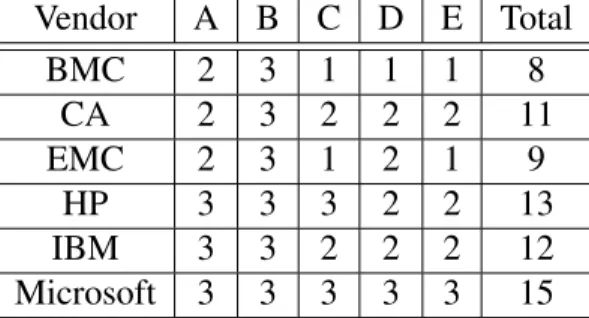
On the technical side these platforms can be evaluated by large sets of parameters, which we arrange in sets to better summarize their coverage:
• A - Standards compliance and Interoperability. Grades the platform ability to adhere to standards, preventing vendor lock-in. Additionally, interoperability relates to the capability to operate in conjunction with legacy systems;
• B - Scalability. Relates to the degree to which the platforms can handle increasing number of managed hosts;
• C - Integration and Development capabilities. Relates to the openness of the platform to developer extensions;
• D - Monitoring independence. Relates to the system dependencies that are needed to deploy the management platform;
• E - Operational management of hosts. Relates to the capability the management platform has to effectively manage a given type of hosts, namely Windows OS hosts;
Apart from the technology features there are some other features that need to be taken into account when surveying these platforms. User sentiment and market impact are also valued when evaluating these platforms. Although not directly related to technology features of the product these metrics allow to establish comparisons related to the capacity and quality of the software producers. User sentiment usually is gathered via interviews with current users of the platforms and relates to factors like customer support, client engagement and vendor service capabilities. Market impact is more directed at analyzing vendor revenues, installed base, and geographic presence.
Table 3.1 sums up our qualitative evaluation of these platforms according to the proposed evaluation criteria. This evaluation was biased by the restricted operational scenario of the targeted critical utility IT infrastructure, based on the information provided by the vendors and included all the platforms from the vendors. The grade scale from 1 to 3 indicates limited - 1, regular - 2 and substantial - 3 technical capabilities.
Vendor A B C D E Total BMC 2 3 1 1 1 8 CA 2 3 2 2 2 11 EMC 2 3 1 2 1 9 HP 3 3 3 2 2 13 IBM 3 3 2 2 2 12 Microsoft 3 3 3 3 3 15
Table 3.1: Comparative Table of the IT Management Platforms
3.4 Evaluation of Selected Platforms
We selected the two highest scoring vendors and chose two platforms, HP Operations Man-ager 8.10i and , to further analyze. For this analysis we studied the documentation and created an evaluation scenario which yields empirical insight to our evaluations.
3.4.1 HP Operations Manager 8.10i
HP Operations Manager for Windows (HPOM) is a distributed, client-server software solu-tion designed to provide service-driven event and performance management of enterprise systems, applications, and services. HPOM enables management of distributed, hetero-geneous, IT infrastructures and includes support for a broad range of Windows and UNIX systems and applications. HPOM monitors thousands of events occurring on all managed nodes and presents just the relevant information for a organization’s needs.
3.4.1.1 Overview
HP Operations Manager software HP Operations Manager provides comprehensive event management, proactive performance monitoring, automated alerting, reporting and graph-ing for operatgraph-ing systems, middleware and applications. HP Operations Manager software consolidates an enterprise operations console for an entire IT infrastructure. Integration of events from the network monitoring solution and end-user experience monitoring provides IT operations team a comprehensive view of the managed environment.
HP Operations Manager for Windows software comprises three main components in a dis-tributed architecture.
3.4.1.2 Operations Manager Console
The first component, the Operations Manager Console, provides the user interface for op-erations and administration. It is available as an Microsoft Management Console client or as a web browser interface.
To make use of the console each operator is provided with a specific user role based view, restricting what they see and what they can do within the managed environment. User roles include operational service views enabling operators to determine impact and root cause analysis associated with events.
Other operational functions are enabled by built-in tools, allocated by user role, that allow operators to run actions on managed systems, streamlining operational processes and op-timizing operational efficiency. Additionally,a feature enables Operations Manager server to perform auditing and logging of operator activities.
Finally, built-in performance and reporting tools support monitoring and performance ana-lysis of the managed environment.
3.4.1.3 Operations Manager Server
The Operations Manager server provides the business logic and manages a database which is used to maintain configuration information for the managed environment and the gener-ated alerts and collected performance information.
The Operations Manager servers provide numerous functions, among them :
• Automated discovery of servers and applications infrastructure;
• Automated deployment of monitoring rules to managed nodes based on their applic-ation role;
• Receipt of events from the agents on the managed nodes, including event correlation, suppression and escalation;
• Consolidation of events from other tools, such as network monitors. Integration of events from systems monitored by third-party agents or agent-less technologies. This functionality provides a single normalized view of the managed environment; • Forwarding of events to external notification systems and the ability to create, and
synchronize, incident tickets in help desk management systems;
• Addition of resolution guidance information into events and the provision of operator-guided actions for issue resolution;
• Integrated scheduled and operational maintenance modes for managed systems to prevent operations staff from seeing false alarms during authorized interventions; • Scalable, and flexible deployment architectures including support for high-availability
cluster architectures and disaster tolerant distributed architectures with multiple Op-erations Manager servers.
3.4.1.4 Operations Manager Agents
HP Operations Manager agents are installed on managed hosts collecting, aggregating, and correlating monitoring information from a variety of information sources. These agents are extensible and customizable allowing incorporation of any monitoring source not in-cluded in the out-of-the-box monitoring policies. Additionally, agents collect and analyze performance data and can use historical patterns to establish performance baselines.
Note that HPOM agents are autonomous and can undertake automated corrective actions without indication from the Operations Manager server. By using filtering, duplicate sup-pression and correlation, the agents manage by exception only forwarding actionable events to the Operations Manager server.
Finally, Smart Plug-Ins (SPIs) provide packaged application management for Operations Manager. SPIs include application-specific auto-discovery, pre-defined monitoring policies, actions, tools and detailed performance data collection. Core Smart PlugIns are included with HP Operations Manager for Windows and provide coverage for systems and applica-tions. Each Operations Manager Agent includes an Operating System SPI for the relevant OS (Windows, Linux, UNIX).
3.4.2 Microsoft System Center Operations Manager 2007 R2
Microsoft System Center Operations Manager 2007 R2 (SCOM) provides the end-to-end management capability over the IT environment. SCOM provides a comprehensive view of the health of an organization’s IT environment. SCOM enables response to events via the detailed troubleshooting and best practices knowledge included in the software package, especially in Windows environments. SCOM can use application and operating system knowledge to identify operational problems.
This platform provides a centralized management solution to monitor both Microsoft and non-Microsoft platforms. It provides unified monitoring under a single tool as data is ag-gregated across environments to present one picture of performance and availability.
3.4.2.1 Overview
An Operations Manager 2007 infrastructure is composed of core components and a set of optional components. This section describes these components and features. Figure3.1 gives a high level description of key SCOM components.
3.4.2.2 Required Server Roles and Components
The basic unit of functionality of all Operations Manager 2007 implementations is the management group. It consists of the Operations Manager database, the root management server, the Operations console, and one or more agents that are deployed to monitored computers or devices are the base components of a management group.
Figure 3.1: Systems Center Operations Manager 2007 R2 Architecture
Operations Manager Database
The Operations Manager database is the first component to be installed in all management groups. This database holds all the configuration data for the management group and stores all the monitoring data that has been collected and processed by the agents.
Because only one Operations Manager database can be in a management group, it must be functional for the management group to function. To mitigate the single instance of the Operations Manager database from being a single point of failure, the Operations Manager database can be placed in a Cluster service fail-over cluster. In addition, log shipping can be configured so that current operations data and configuration information can be sent to another server that is hosting a duplicate copy of the primary Operations Manager database. Should there be a failure in the primary database, the duplicate can be updated and switched to.
Root Management Server
The root management server (RMS) is a special type of management server in a manage-ment group. Only one RMS can be active per managemanage-ment group at a time. In brief, the RMS is the primary point for administering the management group configuration, admin-istering and communicating with agents, and communicating with the Operations Manager database and other databases in the management group.
The RMS hosts the System Center Data Access service and the System Center Manage-ment Configuration service. These services run only on the RMS. The System Center Data Access service provides secure access to the Operations Manager database for all clients, including the Operations console, Operations shell, and Web console. The System Cen-ter Management Configuration service is responsible for calculating and distributing the configuration of all management servers, agents, and management packs.
Like the Operations Manager database, the RMS role can be installed into an fail-over cluster to make it highly resilient to primary server outages. In addition, other management servers in the management group can be promoted to the role of RMS.
Agent
An Operations Manager 2007 agent is a service that is deployed to a computer to be mon-itored. On the monitored device, an agent is listed as the System Center Management service. Every agent reports to a management server in the management group. This man-agement server is referred to as the agent’s primary manman-agement server. Agents watch instrumentation data sources on the monitored device and collect information according to the configuration. When the state of a monitored object changes or other criteria are met, an alert can be generated from the agent. The agent is also able to calculate the health state of the monitored object and report back to the management server.
Agents also have the ability to take many different types of action to help diagnose issues or correct them. By feeding health data to the management server about the monitored device, the agent provides an up-to-date picture of the health of the device and all the applications that it hosts.
It is possible to monitor devices in an agent-less fashion. In this case, a management server pools the monitored device for information.