Nutecca Revista Hipótese, Itapetininga, v. 3, n. 4, 2017.
DOSSIÊ
NEW BUSINESS: HAVE YOU DONE YOUR
HOMEWORK?
NOVO NEGÓCIO: FEZ O SEU TRABALHO DE CASA?
João M. S. Carvalho4
Submissão: 20/05/2016 Revisão: 30/06/2016 Aceite: 30/06/2016
Abstract: This paper intends to present a new business canvas that can help entrepreneurs doing their homework before starting a new venture. The Basic Business Creation Model (BBCM) acts like an acid test validating or not the new idea. It can be used as a pedagogical tool as well as a first approach to a new project. With a few steps it is possible to structure the business and assess its economic viability. More, the model makes the entrepreneur decide and act based on a strategic reflection upon the critical factors to be succeeded, and it develops a new insight about the value model that underlies any business.
Keywords: entrepreneurship, business models, basic business creation model, value model. Resumo: Este artigo pretende apresentar um novo quadro que possa ajudar os empreendedores na realização do seu trabalho de casa, antes de iniciar um novo projeto de negócio. O Modelo Básico para a Criação de Negócios serve como um teste rigoroso na validação ou não da nova ideia. Pode ser utilizado como uma ferramenta pedagógica, assim como uma primeira abordagem a um novo projeto. Em poucos passos, é possível estruturar o negócio a avaliar a sua viabilidade económica. Mais, o modelo faz o empreendedor decidir e agir com base numa reflexão estratégica acerca dos fatores críticos para ser sucedido, e permite desenvolver uma nova visão sobre o modelo de valor subjacente a qualquer negócio.. Palavras chave: empreendedorismo, modelos de negócio, modelo básico de criação de negócios, modelo de valor.
4 Professor doutor. Instituto Universitário da Maia, Portugal. CICS.NOVA.UMinho /
Nutecca Revista Hipótese, Itapetininga, v. 3, n. 4, 2017.
Introduction
The entrepreneurial process starts when someone discovers a human need or desire that needs a new approach to be satisfied. This leads to the creation of a new market-oriented product (good, service, idea). Then, it is necessary to design a business model where the method whereby the entrepreneur can produce and deliver a balanced value proposition to the market is proposed (Carvalho & Jonker, 2015). Thus, our aim is to conceptualize and systematize a method to support entrepreneurs in the initiation of a new venture. This method follows the Basic Business Creation Model (BBCM), which begins with an entrepreneurial phase, followed by the creation of a business model and a mission to the project or organization, in order to end with an evaluation of its economic viability. A business model is the link between a market opportunity and the objectives of an organization. It integrates a broader concept of value, which can include, besides economic value that is the basis of any business, other types of values at ecological, social, and psychological levels.
Additionally, the use of the BBCM can also contribute to strategic thinking about entrepreneurial learning and teaching.
Background
There are ten components that compromise the building blocks of the BBCM, namely within the entrepreneurship phase: (1) the need, (2) the product, and (3) demand estimation; within the business model phase, starting with the product: (4) segmentation, choice and positioning; (5) price, distribution, and communication; (6) team, partnerships, and processes, and (7) value model and stakeholders; within the strategic planning phase, with just the beginning step: (8) mission; and within the financial plan phase: (9) previsional budgets; and (10) economic viability.
Nutecca Revista Hipótese, Itapetininga, v. 3, n. 4, 2017.
Entrepreneurship
Entrepreneurship is the creation of something, most of the times through an organization, in order to satisfy human wants and needs. The essence of entrepreneurship is to create and extract value from a market opportunity (Anderson, 1998). There is also social entrepreneurship that generates value for social ends, but that also needs to maintain the sustainability of the business (Chell, 2007; Michelini, 2012) in order to proceed with its social mission. Therefore, even in a non-profit context, the organization’s financial sustainability is a concern to owners and managers. By using a business creation model, which can be employed in all entrepreneurial contexts, potential entrepreneurs are encouraged to think about all of the key issues that determine the success of the new venture.
In the beginning, an entrepreneur must care about market orientation and market research in order to create the best offer to the customers. Market orientation is defined as a business philosophy and behavior based on planning and implementing activities which lead to an offer that intends to satisfy the present and latent needs and wishes of stakeholders (Carvalho, 2004). Thus, in a start-up or in an existing organization, the entrepreneurs must be market-oriented in order to be successful and to survive in the market. The organization’s ability to continuously aggregate intelligence regarding present and latent needs of customers and about how to satisfy those needs (Kohli & Jaworski, 1990) is essential for the creation and improvement of customer value (Slater & Narver, 2000). Of course, this gathering of intelligence should not only consider customers but also other stakeholders like suppliers, distributors, competitors, partners, reference groups, state, community, etc. (Carvalho, 2004; Teece, 2010).
Thus, the entrepreneurial process is initiated by looking for unsatisfied human needs and desires and the concept of a new product (good, service, idea) to fulfill them. The entrepreneur must subsequently assess the potential of the
Nutecca Revista Hipótese, Itapetininga, v. 3, n. 4, 2017.
market opportunity through the study of the business sector attractiveness, the estimation of demand, the scrutiny of organizational competitiveness and resources availability, by performing PESCT (political, economic, social, cultural, and technological tendencies) and SWOT-GO (strengths, weaknesses, opportunities, and threats linked to goals and objectives) analyses. These are traditional and well-known conventional instruments to assess a market opportunity that can be found in the literature concerning strategic management or strategic marketing.
What we refer to as the entrepreneurial phase of the BBCM interacts with the first business model decisions (second part of the BBCM) where the strategic marketing approach is established through segmentation, targeting, and product positioning. These interactions between market research and market orientation are crucial to the success of the product, and allow the entrepreneur to design an adjusted business model.
Business Models
The business model depends on the context of the product and the market that must be analyzed in the entrepreneurial phase. In this second phase, the customer segments (one, some, or all of them) that will be served with the product must be determined. Consequently, the entrepreneur will define strategic policies in terms of pricing, distribution, and communication. All these aspects are considered in the initial marketing plan.
In order to produce, distribute and communicate value, the entrepreneur may need a team and partners that will help perform key activities and carry out defined processes. Thus, these kind of decisions are made within the chosen business model.
A business model is the method by which a firm uses its resources to offer its customers better value (Afuah & Tucci, 2001) or a blueprint of how an organization does business (Osterwalder et al., 2005). Thus, creating and
Nutecca Revista Hipótese, Itapetininga, v. 3, n. 4, 2017.
offering value, that is, the value model is the common foundation for every business, and a potential source of competitive advantage (Casadesus-Masanell & Ricart, 2010; Markides & Charitou, 2004). Within the value model, the entrepreneur outlines the value proposition for organizational stakeholders and the key activities used to create, deliver, and capture that value (Magretta, 2002; Osterwalder & Pigneur, 2010; Seddon et al., 2004; Teece, 2010; Zott et al., 2011).
Carvalho and Jonker (2015) presented an extensive revision of literature on value theory. The conclusions of these authors can be summarized as a complex concept of value proposition, which takes into account the impact on economy (economic value to the firm, to the customer, and to society); on people (social value related to economic externalities, health, security, etc.); on the earth (ecological value related to environmental concerns and sustainability); and on individual mentality and behavior (psychological value related to an increased awareness of an important issue, attitudinal change, knowledge improvement, learning new skills, more self-efficacy). This new approach was called tetrad-value theory (Carvalho & Sousa, 2015). The ability to design and craft a value proposition can be considered the bridge between an entrepreneurial idea and a successful business model.
The most widespread method to construct a business model is the CANVAS method (Osterwalder, 2004; Osterwalder et al., 2005; Osterwalder & Pigneur, 2010) which identifies nine building blocks: (1) Value Proposition; (2) Target Customer; (3) Distribution Channel; (4) Customer Relationship; (5) Value Configuration; (6) Core Competency; (7) Partner Network; (8) Cost Structure; and (9) Revenue Model. The model we are going to present on this paper is more focused on other crucial aspects that are not clearly considered in Osterwalder’s: the important role of stakeholders in the creation of a business model; the multiple value creation (Elkington, 1997, Carvalho & Jonker, 2015); the mission of the organization; and the economic viability analysis. This leads
Nutecca Revista Hipótese, Itapetininga, v. 3, n. 4, 2017.
to the definition of a business model as a strategic, conceptual, and operational tool that describes the values (economic, social, ecological and psychological) offered to stakeholders through the coordination of key activities within an organizational network of partners in order to create a product (good, service, or idea).
The BBC model
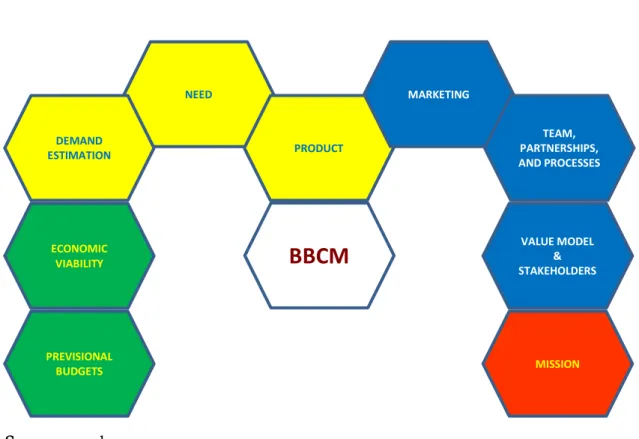
The Advanced Business Creation Model (Carvalho & Jonker, 2015) presents all steps needed to complete a business plan, including the strategic planning process. However, in BBCM (Figure 1), which is a model to test a new business idea, this process is reduced to only one partial step: to define the purpose of the business, the reason to create an organization, i.e., the mission of the organization. The model ends with a simple financial plan that includes well known budgeting and economic viability techniques.
Figure 1 – BBC Model Source: author. ECONOMIC VIABILITY NEED DEMAND ESTIMATION PRODUCT MARKETING TEAM, PARTNERSHIPS, AND PROCESSES VALUE MODEL & STAKEHOLDERS MISSION
BBCM
PREVISIONAL BUDGETSNutecca Revista Hipótese, Itapetininga, v. 3, n. 4, 2017.
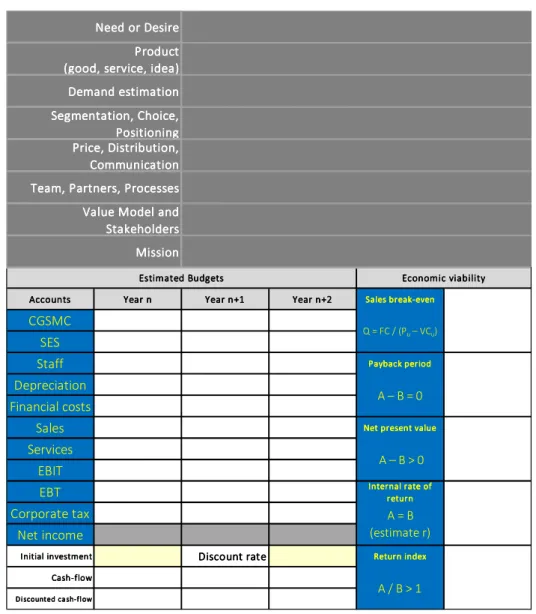
First of all, one must be aware that all blocks are intertwined in theory and in practice. The alignment of their presentation concerns the relationship with major concepts of entrepreneurship, business model, strategic planning, and financial plan (Figure 2).
Figure 2 – BBCM Canvas
Source: author.
Legend: : A = ∑ ; B = I0 = initial investment ; Q = quantity ; FC = Fixed costs
Pu = Unitary price ; VCu = Unitary variable cost ; r = discount rate
Cash flow = EBIT × (1 – CT) + Depreciation
Accounts Accounts Accounts
Accounts Year nYear nYear nYear n Year n+1Year n+1Year n+1Year n+1 Year n+2Year n+2Year n+2Year n+2 Sales break-evenSales break-evenSales break-evenSales break-even
CGSMC SES
Staff Payback periodPayback periodPayback periodPayback period
Depreciation Financial costs
Sales Net present valueNet present valueNet present valueNet present value
Services EBIT
EBT Internal rate of Internal rate of Internal rate of Internal rate of returnreturnreturnreturn Corporate tax
Net income
Initial investment Initial investmentInitial investment
Initial investment Discount rateDiscount rateDiscount rateDiscount rate Return indexReturn indexReturn indexReturn index
Cash-flow Cash-flow Cash-flow Cash-flow Di scounted ca sh-fl ow Di scounted ca sh-fl owDi scounted ca sh-fl ow Di scounted ca sh-fl ow A = B (estimate r) A / B > 1 Q = FC / (Pu – VCu) A – B = 0 A – B > 0
Value Model and Value Model and Value Model and Value Model and Stakeholders Stakeholders Stakeholders Stakeholders Mission Mission Mission Mission Estimated Budgets Estimated Budgets Estimated Budgets
Estimated Budgets Economic viabilityEconomic viabilityEconomic viabilityEconomic viability
Segmentation, Choice, Segmentation, Choice, Segmentation, Choice, Segmentation, Choice, Positioning Positioning Positioning Positioning Price, Distribution, Price, Distribution, Price, Distribution, Price, Distribution, Communication Communication Communication Communication Team, Partners, Processes Team, Partners, Processes Team, Partners, Processes Team, Partners, Processes Need or Desire Need or DesireNeed or Desire Need or Desire
Product Product Product Product (good, service, idea)
(good, service, idea) (good, service, idea) (good, service, idea) Demand estimation Demand estimationDemand estimation Demand estimation
Nutecca Revista Hipótese, Itapetininga, v. 3, n. 4, 2017.
An entrepreneur must identify a need or wish not yet covered by existing products and then create a product (good, service, idea), in order to satisfy potential customers. Thus, estimating the demand is mandatory in the initial phase. The entrepreneur should research data in statistical offices or industry associations. Market research should be used to validate potential customers and to design their profiles following a segmentation process. The identification and characterization of segments in the market, as well as the profile of the basic product, should influence the entrepreneur’s choice regarding the type of customers that will be the most appropriate to contact in the launching phase. To define an adjusted marketing mix to each market segment, the entrepreneur ought to test and decide about prices, the distribution model, as the way to provide value to stakeholders, and the communication instruments to contact customers. Obviously, to produce the product it is necessary to analyse the available resources (physical, human, intellectual, financial) and all key activities that are comprehended in the internal processes, which can be provided or performed by the organizational team and/or partners in a network of collaboration. At last, the entrepreneur has all the data to describe the value proposition, i.e., to define the value model in relation to all stakeholders. This value proposition is composed by a description of the economic value of the product to customers, organization and society, and it can also include the other types of value if they exist: psychological, social, and ecological. This text should be congruent with the product positioning in the market, and will be the master copy to all marketing communication. Finally, the entrepreneur is able to write the mission of the organization as a crucial tool for motivation of the team, as well as to declare the purpose of the new venture.
The initial financial plan in this model is simple, with 3 years of budgeting in respect to main revenues and cost accounts:
Nutecca Revista Hipótese, Itapetininga, v. 3, n. 4, 2017.
Costs: cost of goods sold and raw materials consumed; supplies and external services; expenses with staff; depreciation; and financing costs.
Then, it is possible to calculate ‘Earnings before interest and taxes – EBIT’, ‘Earnings before taxes’, and deducting ‘Corporate tax’ to obtain ‘Net income’.
The value of the initial investment and the discount rate of the cash flows generated by the organization also need to be considered. This discount rate is based on the sum of the risk-free rate of return (e.g. treasury bonds) with the risk premium of the market, and also taking into account the inflation rate. This is the opportunity cost of capital which is therefore the entrepreneur’s or investor’s required rate of return for investing. In this basic model, the possibility of further investing after the initial period is not considered
Afterwards, the discounted cash flows are calculated using the discount rate. In this approach, the cash flow is considered to be the sum of the operational income corrected for the Corporate Tax [EBIT × (1 – CT)], plus depreciation and amortization. A depreciation is the systematic allocation of the depreciable amount of a tangible asset (e.g. cars, buildings, machinery, computers, operating systems) throughout its life, that is, the registration of the reduction in the value of assets by wear or loss of utility for use, action of nature or obsolescence. We do not consider here the amortization of intangible assets (e.g. trademarks, patents, research and development projects, software).
With these figures it is possible to perform the analysis of economic and financial viability, by calculating the sales break-even (the sales quantity for which the operational result is zero), the net present value (the difference between the sum of the discounted annual cash flows that are expected to be generated and the initial investment must be greater than zero), the payback period of the investment (the number of years it takes to recover the initial investment, that is, how long does it take for the discounted cash flows to cover the investment expenses), the internal rate of return (which is the discount rate
Nutecca Revista Hipótese, Itapetininga, v. 3, n. 4, 2017.
that equals the initial investment to the total discounted cash flows, which is calculated by approximation), and the return index (that measures the profitability of the investment and should be greater than 1).
Conclusion
This paper intends to propose a new model – Basic Business Creation Model – to help entrepreneurs testing new business ideas. It presents 4 strategic phases of analysis: (1) entrepreneurship; (2) business model; (3) mission; and (4) financial plan. At its core is a broader concept of value that comprehends not only the economic value but also the existence of psychological, social, and ecological values. This model has its own canvas, which helps entrepreneurs, teachers and students with their strategical thinking around the main issues of a new venture: costumer need, product (good, service, idea), demand, marketing, key activities and resources, value model and stakeholders, mission, budgeting, and economic viability. The initial focus relies on market orientation to find the need and the product, which must be followed by market (supply and demand analysis) and marketing research (marketing mix tests). Then, the entrepreneur defines the team, partnerships and processes in order to produce and deliver a profitable value proposition. All these activities are meaningful and critical to business success in the market. If the business has economic viability, then the entrepreneur may proceed to complete a business plan.
References
AFUAH, A.; TUCCI, C. Internet Business Models and Strategies: Text and Cases. New York: Irwin/McGraw-Hill, 2001.
ANDERSON, A. R. Cultivating the Garden of Eden: Environmental Entrepreneuring. Journal of Organizational Change Management, v. 11, n. 2, p. 135–144, 1998. CARVALHO, J.M.S. Orientação de Mercado e Desempenho – Estudo das Organizações Sem Fins Lucrativos em Portugal, através de um Modelo de
Equações Estruturais. [Market Orientation and Performance – Study of the Social Sector Organizations in Portugal through Structural Equation Modelling]. PhD Thesis. Faculdade de Economia do Porto, 2004.
Nutecca Revista Hipótese, Itapetininga, v. 3, n. 4, 2017. CARVALHO, J.M.S.; JONKER, J. Creating a Balanced Value Proposition – Exploring the Advanced Business Creation Model. Journal of Applied Management and
Entrepreneurship, v. 20, n. 2, p. 49-64, 2015.
CARVALHO, J.M.S.; SOUSA, C. PSocial entrepreneurship, sustainability, and tetrad-value theory. in: Global Cleaner Production and Sustainable Consumption Conference
2015. 1-4 November, Sitges, Spain. Book of Abstracts, WS-32-02, 2015.
CHELL, E. Social enterprise and entrepreneurship: towards a convergent theory of the entrepreneurial process. International Small Business Journal, v. 25, n. 1, p. 5–26, 2007. CASADESUS-MASANELL, R.; RICART, J.E. From strategy to business models and to tactics. Long Range Planning, v. 43, p. 195–215, 2010.
ELKINGTON, J. Cannibals with Forks: The Triple Bottom Line of 21st Century
Business. CA: New Society Publishers: Gabriola Island, 1997.
KOHLI, A.K.; JAWORSKI, B.J. Market orientation: the construct, research propositions, and managerial implications. Journal of Marketing, v. 54, n. 2, p. 1–18, 1990.
MAGRETTA, J. Why business models matter. Harvard Business Review, v. 80, n. 5, p. 86–92, 2002.
MARKIDES, C.; CHARITOU, C.D. Competing with dual business models: a contingency approach. Academy of Management Executive, v. 18, p. 22–36, 2004.
MICHELINI, L. Social Innovation and New Business Models – Creating Shared Value in Low-Income Markets. Springer, 2012.
OSTERWALDER, A. The Business Model Ontology - A Proposition in a Design Science Approach. PhD thesis: University of Lausanne, 2004.
OSTERWALDER, A.; PIGNEUR, Y. Business Model Generation: A Handbook for Visionaries, Game Changers, and Challengers. Hoboken NJ: John Wiley & Sons, 2010. OSTERWALDER, A.; PIGNEUR, Y.; TUCCI, C.L. Clarifying business models: origins, present, and future of the concept. Communications of the Association for
Information Systems, v. 16, Article 1, p. 1–38, 2005.
SEDDON, P.B.; LEWIS, G.P.; FREEMAN, P.; SHANKS, G. The case for viewing business models as abstractions of strategy. Communications of the Association for Information Systems, v. 13, p. 427–442, 2004.
SLATER, S.F.; NARVER, J.C. Intelligence generation and superior customer value. Journal of the Academy of Marketing Science, v. 28, n. 1, p. 120–127, 2000.
TEECE, D.J. Business models, business strategy and innovation. Long Range Planning, v. 43, p. 172–194, 2010.
ZOTT, C.; AMIT, R.; MASSA, L. The business model: recent developments and future research. Journal of Management, v. 37, n. 4, p. 1019–1042, 2011.